AI agents for law firms are software workers that take a defined piece of legal or firm-operations work — an intake enquiry, a contract, an overdue invoice, a compliance check — read the relevant context, follow the firm's rules, act inside set limits, and hand the rest to a lawyer with an audit trail.
This guide maps 32 use cases across seven areas of a law firm, and for each one states where it should start on the autonomy ladder, who signs off, and which number to baseline before you begin. It is written for managing partners, chief operating officers, legal-operations leads and IT heads who need to decide what to automate, in what order, and under what controls.
Key takeaways
- The fastest returns for law firms in 2026 sit in intake-to-cash and document work — intake triage, onboarding, document extraction, pre-bill review, collections — not in legal research.
- Every use case below carries a starting autonomy level and a human checkpoint. Confidentiality, privilege and professional-responsibility rules make "just automate it" unacceptable; the control is part of the design.
- Firms will run two kinds of agents from two kinds of vendors: lawyer-work agents (research, drafting, review) and firm-work agents (operations across practice management, documents, finance and email).
- Governance is a runtime layer — identity, deterministic rules, approvals, audit trail, controlled deployment — not a policy PDF.
- Start with one process that has a trigger, a completion state, an accountable owner and a baseline number. Expand from there.
Why law firms are moving from AI tools to AI agents in 2026
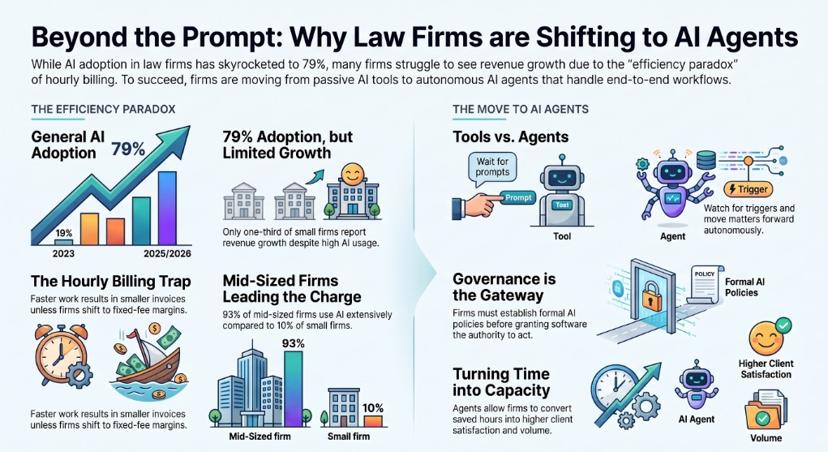
Adoption is no longer the story. According to Clio's Legal Trends Report 2025, 79% of legal professionals use AI in some form, up from 19% in 2023. Clio's March 2026 report on mid-sized firms found that 93% of firms with 50 to 200 lawyers use AI extensively, against 10% of small firms. The American Bar Association's 2024 Legal Technology Survey, which asks a narrower question about professional use, still recorded 30%, up from 11% the year before.
The problem is what adoption has produced. Clio's 2026 Legal Trends Report for Solo and Small Law Firms found that 71% of solo practitioners and 75% of small firms use AI, yet only about a third report revenue growth from it, and most have made no change to pricing. Clio calls this the efficiency paradox: under hourly billing, faster work can mean smaller invoices. The firms that grew were the ones that turned saved hours into capacity, fixed-fee margin and better client response — which requires AI that completes work, not AI that answers prompts.
That is the difference between a tool and an agent. A tool waits for a lawyer to type. An agent watches for a trigger, assembles the file, applies the firm's rules and moves the matter forward until a person needs to decide. The gains Clio measured at high-adoption mid-sized firms — materially more capacity for new work and higher client satisfaction — come from workflows that run every day, not from occasional prompting. That is why the conversation has moved from AI tools to AI agents for law firms.
The barrier is governance. In 8am's 2026 Legal Industry Report of more than 1,300 legal professionals, 43% said their firm has no formal AI policy and no plan to create one. A firm without a policy cannot safely give software the authority to act. The rest of this guide treats that as the design constraint, not an afterthought.
What is an AI agent for law firms, and how is it different from a legal AI tool?
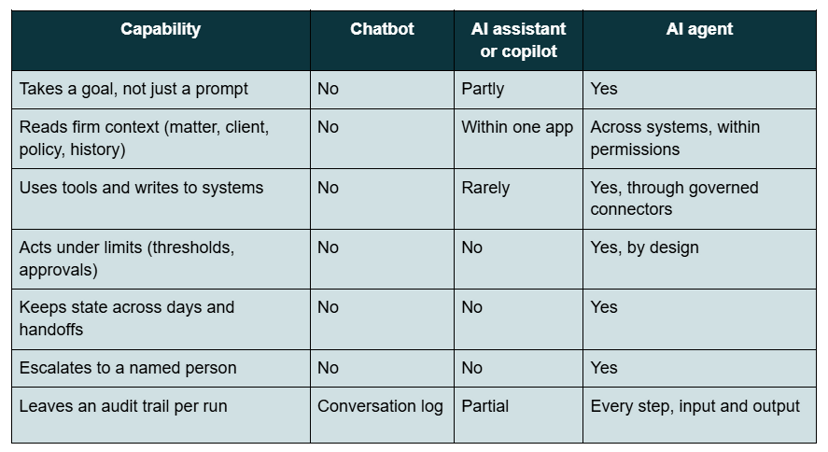
A legal AI tool answers a question or edits a document when asked. A legal AI agent is given a goal and a boundary, and works the goal until it is done or a human is needed. The distinction matters because the second one can be assigned responsibility, and responsibility needs controls.
Agent vs assistant vs chatbot
Two kinds of agents every firm will run
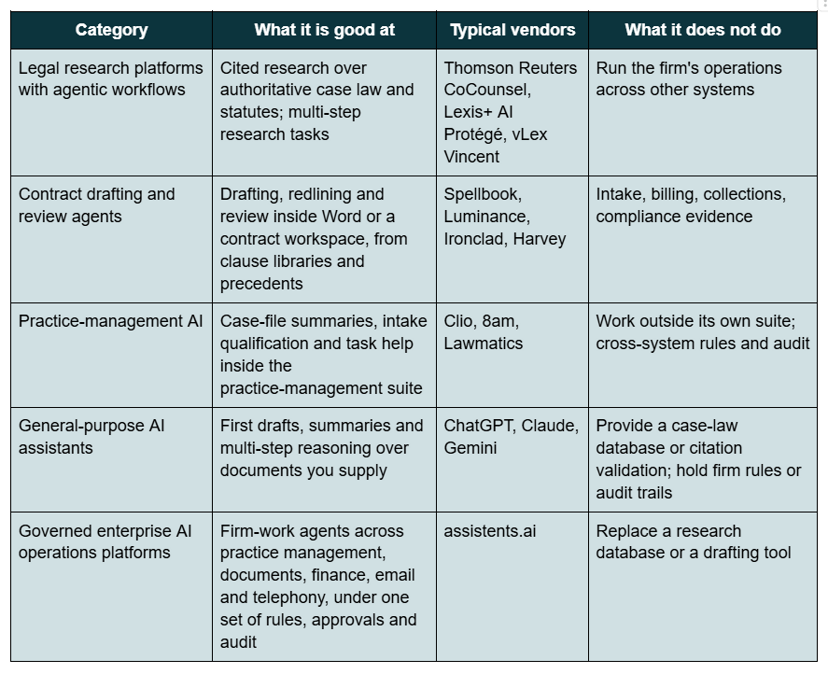
The first kind does lawyer work: research with citations, first drafts, contract review, redlining, deposition preparation. This is the category occupied by research databases and drafting tools, and it lives inside Word, the research platform or the matter workspace.
The second kind does firm work: intake and conflicts, onboarding and KYC, document intake and extraction, time capture and pre-bill review, collections, compliance evidence, client status updates. This work runs across the practice-management system, the document management system, the finance system, email and telephony. It needs a platform that connects those systems, holds the firm's rules, routes approvals and records every action.
Most firms will run both, from different vendors. The mistake is expecting a drafting tool to run collections, or expecting an operations platform to replace a case-law database. The 32 use cases below are labelled so you can see which category each belongs to.
The autonomy ladder for legal work
Autonomy is not a switch. It is a rung, set per task, and different tasks inside one matter sit on different rungs.
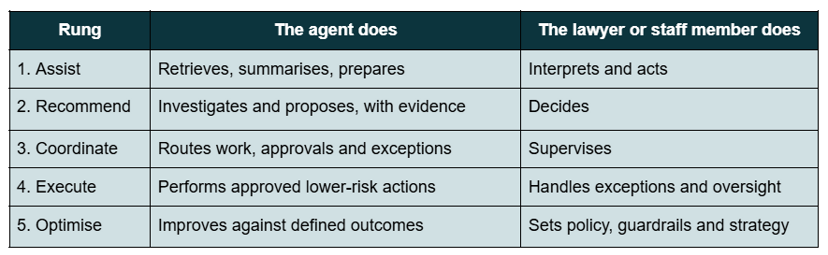
Within a rung, each decision class carries one of six modes: recommend only; require human approval; act automatically below a defined threshold; act and notify a responsible person; act autonomously within a tightly defined policy boundary; prohibit automated action. A collections reminder for a small balance can be "act and notify". A credit note is "require human approval". A privilege call is "prohibit automated action".
32 AI agent use cases for law firms
The AI agents for law firms below are grouped by where the work happens in a firm. Each table gives the trigger and action, the rung to start on, the human checkpoint, the metric to baseline before you begin, and an evidence tag:
- P — a capability in production or reference use on the assistents.ai platform.
- A — an anonymised example from the delivery record of Ampcome, the company behind assistents.ai, in an adjacent regulated or professional-services setting. No client is named.
- I — an illustrative design that a governed platform can be configured to run; not a claim of a live legal deployment.
None of the A examples is a law firm. They are included because the work pattern — document intake, cited research, rule-governed follow-up, auditable case handling — is the same pattern a firm needs, and because they show what the outcome measurement looks like when it is done properly.
1. Client intake and matter opening
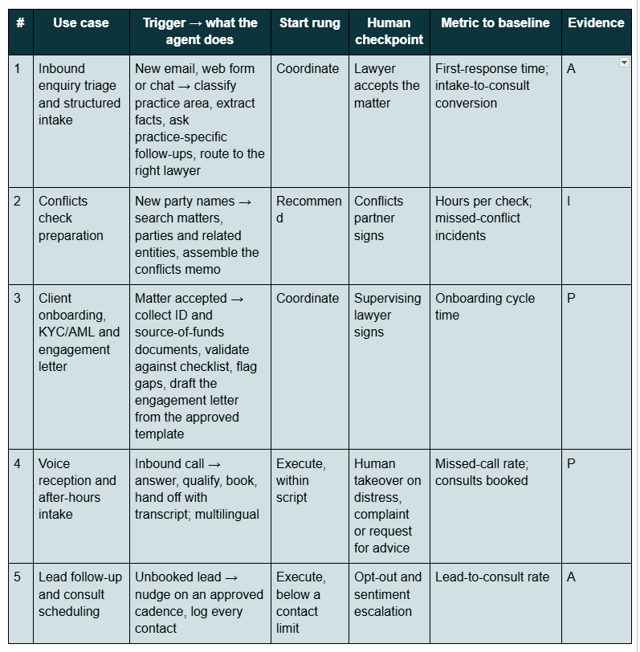
1. Inbound enquiry triage and structured intake. The agent reads the enquiry, identifies the practice area, pulls the facts a lawyer would ask for first — dates, parties, documents, deadlines — and asks for whatever is missing before routing. In a deployment for a fintech serving banks and credit unions, an omnichannel intake agent classified incoming requests across chat, email and phone, summarised them for staff and routed them into an auditable workflow with service-level monitoring; the measured outcomes were faster case handling and more consistent responses. A luxury hospitality group used the same pattern for email intake: intent classification, data extraction and a conversational loop to capture missing details before a human took over the bespoke part.
2. Conflicts check preparation. The agent searches the firm's matter and party records, expands related entities and prior names, and drafts the conflicts memo with sources. The decision stays with the conflicts partner; the agent removes the searching, not the judgement.
3. Client onboarding, KYC/AML and engagement letter. The agent collects identity and source-of-funds documents, checks them against the firm's checklist, flags what is missing or inconsistent, and assembles the engagement letter from the approved template. The assistents.ai lending reference application runs this pattern end to end — document collection, validation, deviation flagging and human review — in a regulated credit context, which is a stricter version of a law firm's client-money and AML obligations.
4. Voice reception and after-hours intake. A voice agent answers, qualifies the caller, books a consultation and hands the lawyer a transcript. assistents.ai voice agents are in production, including a multilingual voice service running across more than 700 retail locations, and the escalation rules — distress, complaint, any request for legal advice — are configured, not improvised.
5. Lead follow-up and consult scheduling. The agent follows up leads that have not booked, on a cadence the firm approves, and logs every contact. A sales deployment used the same rule-governed follow-up: always-on monitoring, opportunity identification and orchestrated next steps, with the outcome measured as higher account coverage without added headcount.
2. Documents, contracts and evidence
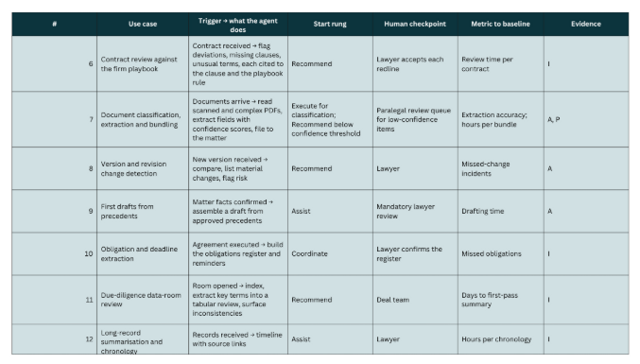
6. Contract review against the firm playbook. The agent compares each clause with the firm's standard positions and flags deviations, absences and unusual language, with a citation to both the clause and the rule it breaks. Every redline is accepted or rejected by a lawyer. This is the lawyer-work category; a firm that already has a drafting tool should let it do this, and connect its output to the matter workflow.
7. Document classification, extraction and bundling. The agent reads incoming documents, including scanned and badly formatted PDFs, classifies them, extracts the fields the matter needs with a confidence score, and files them. In a deployment for an Australian specialist contractor, a multi-agent document workbench retrieved tender documents, determined the right workflow, extracted data from complex PDFs with a vision model, and synchronised the result into the core operating system with quote locking and audit logs. That system was engineered for up to roughly 90% faster document processing and a roughly 95% extraction-accuracy target for standard formats — engineered targets, stated as such. The assistents.ai Document Processing Agent provides the extraction layer; the legal taxonomy is firm configuration.
8. Version and revision change detection. The agent compares versions and lists every material change with its location and a risk flag. The same contractor deployment used revision and change detection to reduce bid risk, because a missed change in a tender is the same failure as a missed change in a contract.
9. First drafts from precedents. The agent assembles a first draft from approved precedents and the confirmed facts of the matter, and every generated artefact goes to a lawyer before it goes anywhere else. A US tax-research automation provider used this pattern for draft memos and position papers, with automated source collection and summarisation feeding the draft; the outcome was faster research cycles and more consistent output.
10. Obligation and deadline extraction. Once an agreement is signed, the agent extracts obligations, notice periods and renewal dates into a register and sets reminders. The lawyer confirms the register once; the agent maintains it.
11. Due-diligence data-room review. The agent indexes the room, extracts key terms across hundreds of documents into a tabular review, and surfaces inconsistencies between documents. The deal team reads the table, not the room.
12. Long-record summarisation and chronology. For medical records, correspondence or disclosure, the agent produces a timeline where every entry links to its source page. This stays at Assist: the lawyer reads the chronology as a map, then reads the sources that matter.
3. Research, knowledge and monitoring
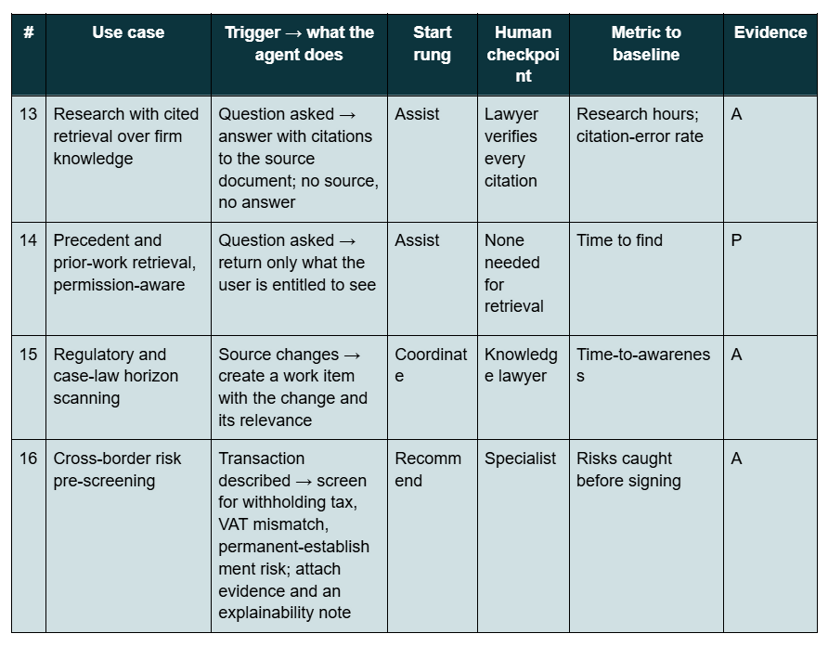
13. Research with cited retrieval over firm knowledge. The agent answers from the firm's own precedents, memos and know-how, and every answer carries a citation to the document and passage it came from. This matters because a 2024 Stanford RegLab and HAI benchmark found that even purpose-built legal research tools produced hallucinated or incorrect answers in a meaningful share of queries — roughly one in six or worse, depending on the tool. A US tax-research automation provider deployed exactly this discipline: automated source retrieval, summarisation and drafting support with citations, which reduced manual source-hunting time and made outputs consistent enough to review quickly.
14. Precedent and prior-work retrieval, permission-aware. The agent searches documents the user is allowed to see and nothing else. On assistents.ai, retrieval runs over document repositories using semantic search with configurable relevance thresholds and returns citations; access follows workspace membership, enforced on the server, so a paralegal in one group does not surface another group's client files.
15. Regulatory and case-law horizon scanning. The agent watches defined sources — regulators, courts, gazettes — and when something changes it creates a work item with the change, the affected matters and a suggested owner. A manufacturer used this pattern to monitor competitor pricing and offers across e-commerce portals continuously and convert signals into alerts, replacing manual portal checks; the mechanism is identical when the source is a regulator.
16. Cross-border risk pre-screening. The agent screens a proposed transaction for withholding tax, VAT mismatches and permanent-establishment exposure, attaches the evidence and an explainability note, and escalates anything material to a specialist. A UK tax-technology company deployed transaction-screening workflows with risk classification, evidence collection and expert escalation; the outcome was earlier detection of withholding and VAT risk and fewer last-minute deal disruptions.
4. Litigation and disputes
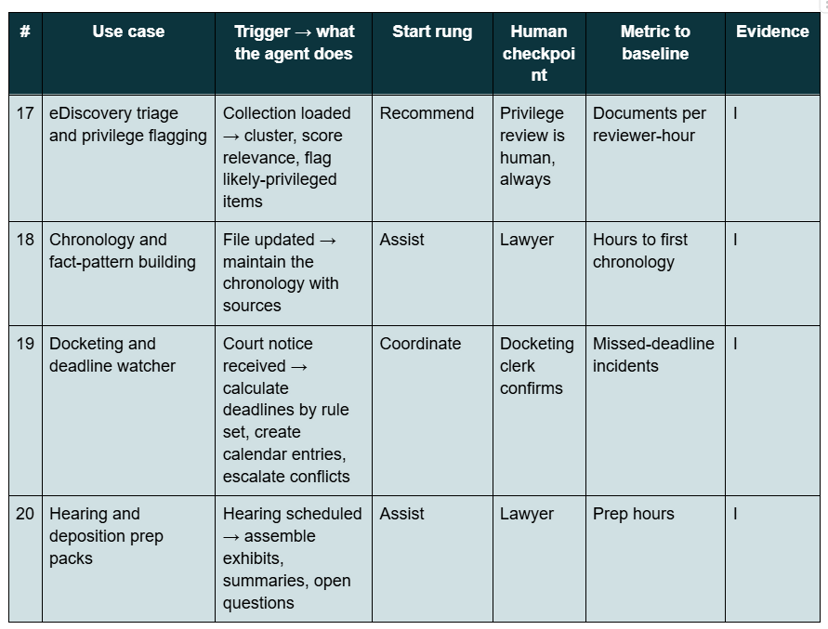
17. eDiscovery triage and privilege flagging. The agent clusters the collection, scores relevance and flags documents that look privileged for a lawyer's decision. The privilege call itself is prohibited from automation; the agent's job is to make sure nothing privileged reaches the review queue unflagged.
18. Chronology and fact-pattern building. As the file grows, the agent keeps the chronology current, each entry sourced. This is the litigation twin of use case 12.
19. Docketing and deadline watcher. The agent reads court notices, applies the firm's deadline rules, creates calendar entries and reminders, and escalates conflicts between deadlines. Scheduled and event-driven workflows are standard on a governed platform; the jurisdiction's calendaring rules are firm configuration and the docketing clerk confirms every entry until the error rate earns a higher rung.
20. Hearing and deposition prep packs. The agent assembles the exhibits, summaries and open questions for a hearing into one pack. It prepares; the lawyer performs.
5. Firm operations, billing and finance
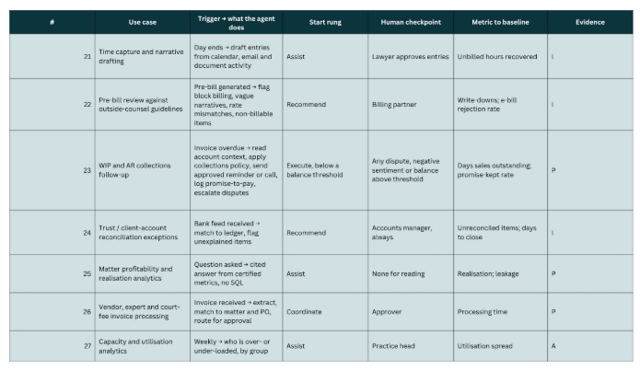
21. Time capture and narrative drafting. The agent drafts time entries from what actually happened — calendar, email, documents opened — in the narrative style the client's guidelines require, and the lawyer approves. Recovered unbilled hours is the number to baseline first, because it is usually the largest and least contested gain.
22. Pre-bill review against outside-counsel guidelines. The agent checks every pre-bill against the client's guidelines before it leaves the firm: block billing, vague narratives, rate mismatches, non-billable tasks. This is a deterministic-rules job with a language model reading the narratives; on assistents.ai the guideline rules are versioned in the rule engine, so a change for one client cannot silently change another.
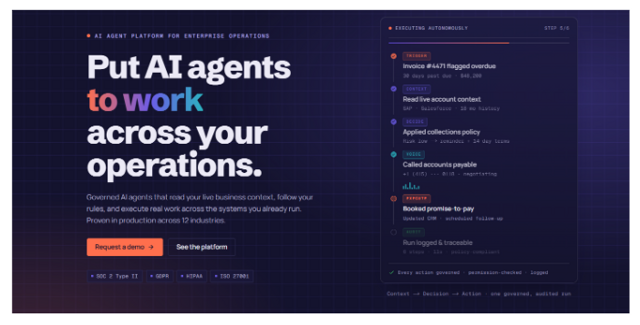
23. WIP and AR collections follow-up. An invoice crosses its ageing threshold; the agent reads the account's history and any open disputes, applies the firm's collections policy, sends the approved reminder or places a call, records the promise to pay and the follow-up date, and escalates anything that mentions a dispute, a complaint or a regulator to the relationship partner. assistents.ai runs receivables follow-up in production, and the governed collections run — trigger, context, policy decision, voice call, promise-to-pay logged, audited — is the worked example on the assistents.ai homepage. For a law firm the policy adds one rule: no contact with a client who has an open complaint.
24. Trust / client-account reconciliation exceptions. The agent matches the bank feed to the client ledger and lists every unexplained item with the evidence it found. The accounts manager clears each exception; the agent never posts to a client account.
25. Matter profitability and realisation analytics. Partners ask questions in plain language — realisation by practice group, leakage by client, write-downs by lawyer — and get cited answers from certified metric definitions. The assistents.ai BI layer and conversational analytics run on the same semantic definitions the agents use, so the number in the dashboard and the number the agent acted on are the same number.
26. Vendor, expert and court-fee invoice processing. The agent extracts the invoice, matches it to the matter and any purchase order, and routes it for approval. Document AI plus an approval workflow; the only firm-specific work is the matter-matching rule.
27. Capacity and utilisation analytics. The agent reports weekly who is over- and under-loaded, by practice group and level. A multi-branch training institute used utilisation and slot-optimisation analytics for its instructors; a firm applies the same analysis to fee earners.
6. Client service and communication
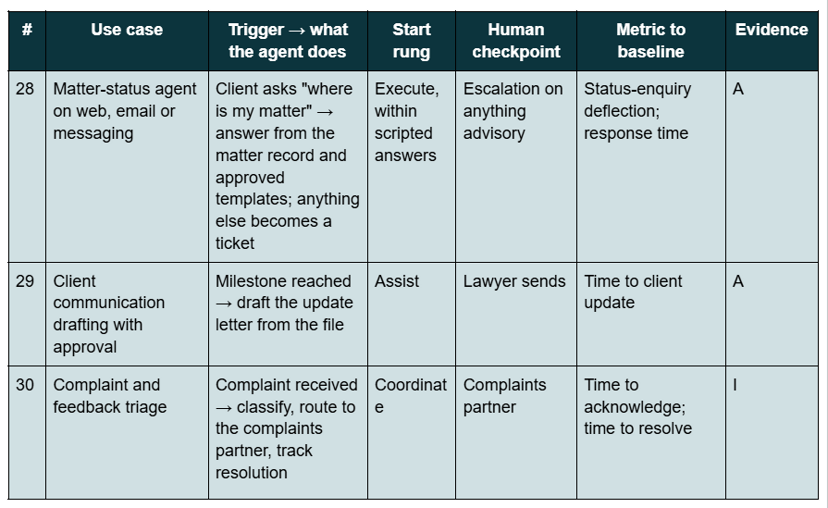
28. Matter-status agent on web, email or messaging. The agent answers routine status questions from the matter record and the firm's approved wording, around the clock, and turns anything it cannot answer into a ticket for the right person. A large real-estate portfolio manager in the Middle East deployed an omnichannel service agent with a knowledge base over its policies, tenancy documents and procedures, with triage, ticketing and human escalation; the outcomes were a consistent 24×7 experience, lower call-centre load and better service-level adherence. Replace tenancy documents with engagement terms and matter milestones and the design is the same.
29. Client communication drafting with approval. The agent drafts the milestone update from the file; the lawyer edits and sends. In the fintech deployment above, agent-assist summarisation and next-best-action suggestions gave staff a draft to work from rather than a blank page.
30. Complaint and feedback triage. The agent classifies the complaint, routes it to the complaints partner, starts the clock and tracks resolution. Nothing is sent to the client without a person.
7. Compliance, risk and firm governance
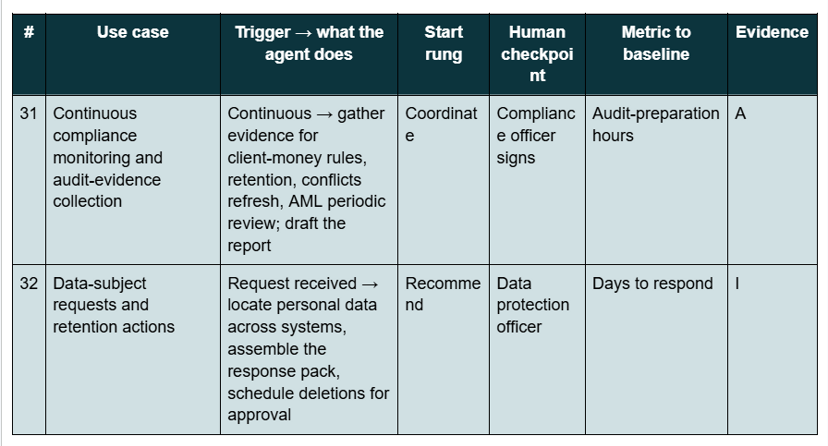
31. Continuous compliance monitoring and audit-evidence collection. Instead of a quarterly scramble, the agent gathers evidence continuously — client-account reconciliations completed, conflicts refreshed, AML reviews due, retention actions taken — and drafts the compliance report for the officer to sign. In a financial-services deployment published on this site, continuous monitoring with human-in-the-loop approval and audit-ready reporting cut regulatory reporting time by three quarters; the fintech deployment above used the same auditable workflow design for compliance readiness.
32. Data-subject requests and retention actions. The agent locates a person's data across the practice-management, document and email systems, assembles the response pack, and schedules deletions that the data protection officer approves. Nothing is deleted without approval.
If one of these 32 is the process that costs your firm the most, bring it to a 30-minute discovery call. We will tell you which rung it belongs on and what to baseline. Talk to us.
The governance layer: running AI agents without risking confidentiality or privilege
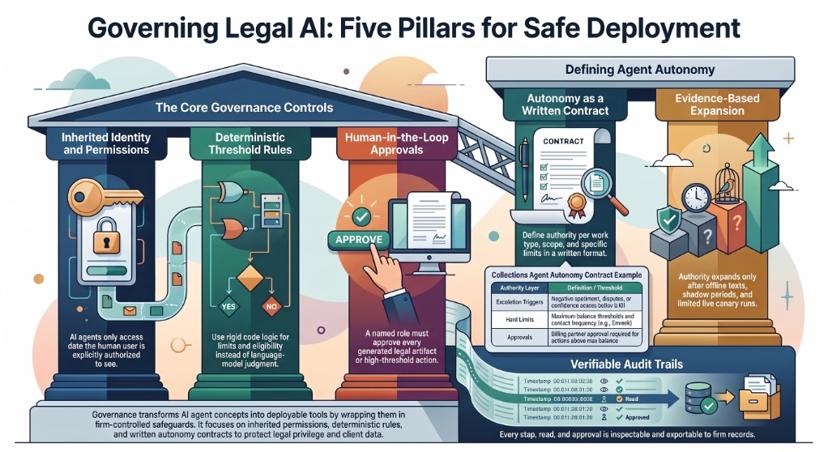
Most guides to AI agents for law firms mention confidentiality and stop. Governance is what makes the 32 use cases above deployable, so it deserves its own design.
Five controls every legal AI agent needs
- Identity and permissions inherited from the firm's systems. The agent sees what the person it works for is allowed to see, and nothing more. Permissions are checked at runtime, not assumed in a prompt.
- Deterministic rules for anything with a threshold. Approval limits, contact frequency, eligibility, authority, guideline compliance: these are rules with versions and execution history, not language-model judgement calls.
- Human approval on every generated legal artefact and every action above a threshold. Approval is a control the agent cannot bypass, and it is assigned to a named role.
- An audit trail for every run. What triggered it, what it read, what each step produced, who approved what, and how it ended — inspectable after the fact and exportable to the firm's records.
- Deployment the firm controls, with model choice. Client data stays inside infrastructure the firm chooses, and the language model is a configuration decision that can change without rebuilding the solution.
Autonomy as a written contract, not a switch
The authority of an agent should be written down per work type, per scope, per action and per limit. Here is what that looks like for the collections agent in use case 23:
agent: collections-follow-up
work_type: standard_overdue_reminder
scope:
client_segment: commercial
overdue_days: 30-90
permissions:
read_matter_and_billing: true
send_approved_reminder: true
place_reminder_call: true
log_promise_to_pay: true
offer_payment_plan: false
discount_or_write_off: false
limits:
max_balance: <firm threshold>
contacts_per_client_per_week: 2
escalate_when:
- dispute_raised
- open_complaint_on_file
- negative_sentiment
- regulator_or_court_mentioned
- confidence_below_0.80
approvals:
above_max_balance: billing_partner
valid_until: 2026-12-31
Authority expands only after evidence: offline tests on historical work, a shadow period beside the human path, then a limited live canary. A contract like this is also what you show the regulator, the insurer and the client who asks how the firm uses AI.
Deterministic macro, agentic micro
The workflow owns the process: its stages, deadlines, approvals, retries and what happens when a step fails. The agent reasons only inside a bounded zone within that process — gathering evidence, forming a view, drafting, choosing which tool to call — and it cannot widen its own authority or change the surrounding workflow. This is the architecture that lets a firm put language models to work on legal documents without letting them decide who gets paid, what gets filed or what is privileged.
Professional responsibility mapped to controls
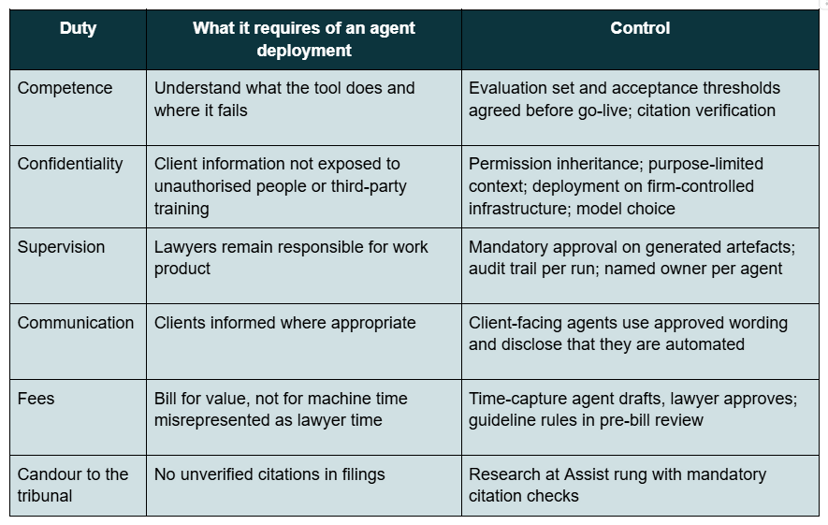
The American Bar Association's Formal Opinion 512 (2024) sets out how the existing duties apply to generative AI, and most bars have issued comparable guidance. The table shows how each duty maps to a control; check your own jurisdiction's rules, and treat this as design guidance rather than legal advice.
Security threats specific to agents
Agents introduce risks that chatbots do not: prompt injection hidden inside an incoming document, misuse of a connected tool, poisoning of stored memory, and cascading failures across agents that trust each other. The OWASP Top 10 for Agentic AI Security (2025) catalogues these. The practical defence is the same as the governance design above — deterministic controls between reasoning and action, least-privilege tool access, validated tool arguments and a kill switch per agent.
The legal AI agent landscape in 2026, by category
This is a map, not a ranking. Each category is good at a different job, and a firm should expect to use more than one.
Why assistents.ai for law-firm operations
assistents.ai is not a legal research database and does not replace Westlaw, Lexis, Harvey or a drafting tool. It is the governed layer that runs the firm's operational work — intake, onboarding, documents, billing, collections, compliance, client service — across the practice-management, document, finance and communication systems the firm already has. That boundary is the reason it works alongside the lawyer-work tools rather than competing with them, and it is the category of AI agents for law firms where a governed platform is the right answer.
Rules and reasoning together. A deterministic rule engine holds the firm's thresholds — approval limits, contact frequency, eligibility, guideline compliance — with checksummed versions and a full execution trace. The language model reasons inside those rules; it never decides the rule. This is the difference between an agent that follows the collections policy and one that improvises it.
Human approval where it matters. Approvals are a control in the platform, not a decoration on a workflow. Any generated legal artefact, and any action above a threshold, waits for a named person, and the approval is recorded with the run.
Every run on record. Every execution is recorded — what triggered it, which steps ran, what each step produced, and how it ended. Rule executions additionally retain the inputs, the outputs, an execution trace, and latency, and are inspectable after the fact. That is the audit trail a compliance officer, an insurer or a client can be shown.
Documents with citations. assistents.ai retrieves from document repositories using semantic search with configurable relevance thresholds, and returns citations so users can trace an answer to its source. Document ingestion is configured per source during implementation. The Document Processing Agent handles the extraction and classification layer for use cases 7, 8, 10, 11 and 26.
Your infrastructure, your models. assistents.ai supports deployment patterns designed for private, dedicated, on-premise, and customer-controlled environments. The specific architecture, data flows, model access, and operational boundaries are defined and validated against your requirements during solution design. The platform is model-independent: agents run on models from multiple providers with an ordered preference per agent, and any OpenAI-compatible endpoint, including a model you host yourself, can be used. Model choice is a configuration decision, not an architectural commitment. See on-premise deployment and the model hub.
Scoping, stated precisely. Agents, rules, workflows and analytical assets are scoped to a workspace within your organisation, with access gated by workspace membership and enforced by server-side authorisation. Data connections are managed at organisation level and shared across the workspaces you choose to grant them to. Identity and access control integrate with your enterprise identity provider, configured as part of deployment.
Connecting your systems. Practice-management, document-management and finance systems are connected through their published APIs as an integration scoped per firm; assistents.ai does not pretend that a legal system is a one-click connector. Voice is available for use cases 4 and 23, and the BI layer runs on the same semantic definitions the agents use.
Evidence, without client names. Receivables follow-up runs in production and is the worked example on the homepage. Voice agents run in production, including the multilingual voice service across more than 700 retail locations described in the published field reports. The financial-services compliance deployment on this site reduced regulatory reporting time by three quarters with human-in-the-loop approvals. The document workbench, cited research and cross-border screening examples above come from the delivery record of Ampcome, the company that builds assistents.ai, in adjacent regulated settings. For the wider professional-services picture, see AI agents for professional services and the governance playbook.
Why a governed platform beats a stack of point tools
Most firms will arrive at agents the way they arrived at software: one tool per problem. That works for lawyer work, where the tools live in Word and the research platform. It fails for firm work, where every tool would need its own rules, its own approvals and its own log.
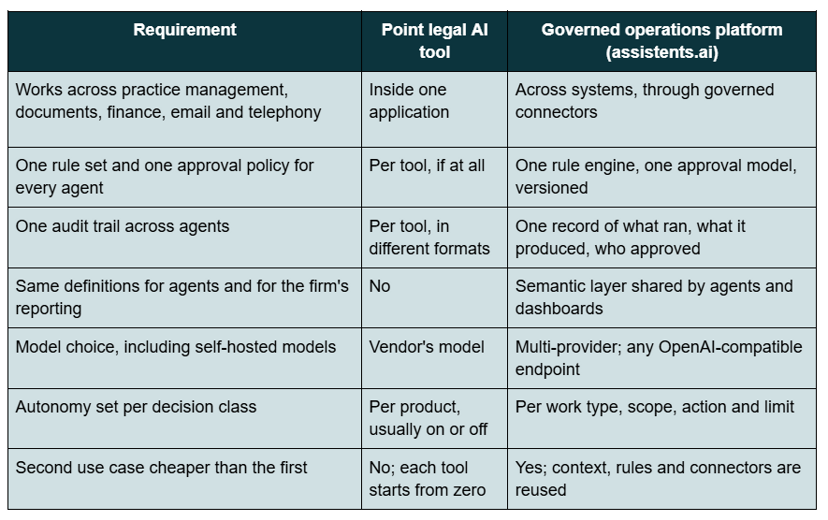
The practical path is the one that has worked in every deployment we have run: land with one measurable operation, prove it against its baseline, then add the adjacent operation on the same rules and context. The platform story is what makes the second use case cheap; it is not the reason to buy the first one.
Systems of record store the firm. Systems of intelligence explain it. assistents.ai is the System of Agency that helps lawyers and AI agents operate it together.
How to deploy AI agents in a law firm: a 90-day plan
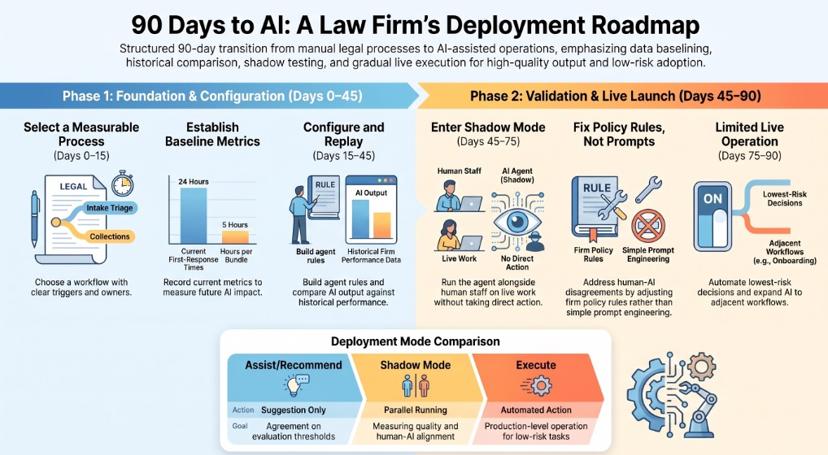
Days 0–15: choose and baseline. Pick one process with a trigger, a completion state, an accountable owner and a number you can measure today. For most firms that is intake triage (use case 1), document intake (7) or collections (23). Record the baseline: first-response time, hours per bundle, days sales outstanding. Confirm data flows, permissions and the deployment topology. Write the autonomy contract.
Days 15–45: build in Assist and Recommend. Configure the agent, the rules and the approval routing. Replay it against historical work and compare its output with what the firm actually did. Agree the evaluation set and the acceptance thresholds; the platform provides the evaluation machinery, and the design of the test for your process is agreed at pilot design.
Days 45–75: shadow mode. The agent runs beside the human path on live work without acting. Measure quality, rework, escalations and the cases where a person disagreed with it. Fix the rules, not the prompt, wherever a disagreement is about policy.
Days 75–90: limited live operation and the production decision. Move the lowest-risk decision class to Execute with approvals, keep everything else at Recommend, and compare the numbers with the baseline. Make a production decision on evidence. Then add the adjacent process — onboarding after intake, pre-bill review after time capture, compliance evidence after collections — on the same rules and context.
Where this is heading
The direction is a firm in which agents run the normal path of intake-to-cash and document work, lawyers own judgement and accountability, and the platform keeps every action inside policy and on record. Some people call that destination the autonomous law firm. It is worth being precise: AI agents for law firms will not arrive as a switch, and the destination will never mean a firm without lawyers. It arrives one governed operation at a time, as each agent earns a higher rung on evidence.
The firms that get there first will not be the ones with the most tools. They will be the ones that wrote down the rules, measured the baseline, and gave software authority only as fast as it proved it deserved it.
Ready to pick your first process? Request a demo and bring the workflow that costs your firm the most.
FAQs
What is an AI agent for law firms?
An AI agent for law firms is software that takes a defined piece of legal or firm-operations work, reads the relevant context from the firm's systems, follows the firm's rules, acts within set limits, and hands the rest to a lawyer with an audit trail. It differs from a chatbot in that it is assigned a goal and a boundary rather than a prompt.
What is the difference between a legal AI agent and a legal AI tool?
A tool responds when a lawyer asks: it drafts, summarises or searches. An agent watches for a trigger, assembles the file, applies rules, takes bounded actions across systems and escalates exceptions. Tools reduce individual effort; agents change who does the work and therefore need governance — permissions, approvals and an audit trail.
How do AI agents protect client confidentiality and privilege?
Through permissions inherited from the firm's systems so the agent sees only what its user may see; purpose-limited context rather than open access to the document store; human review of anything privileged; a per-run audit trail; model choice; and deployment on infrastructure the firm controls. Privilege decisions themselves should be prohibited from automation.
Will AI agents replace lawyers or paralegals?
No. Agents remove repetitive work — intake questions, document sorting, reminders, evidence gathering — so lawyers and paralegals focus on judgement, exceptions and accountability. Every generated legal artefact still goes to a person, and professional-responsibility rules keep the lawyer responsible for the work product.
Which law-firm tasks should be automated first?
Start where volume is high, the rules are clear and the output feeds a human check: intake triage, document classification and extraction, collections follow-up, pre-bill review. These have measurable baselines — response time, hours per bundle, days sales outstanding, write-downs — and low risk at the Recommend rung.
Are AI agents safe for legal research?
Only with citation discipline. A 2024 Stanford benchmark found that even purpose-built legal research tools hallucinated in a meaningful share of queries. Keep research at the Assist rung, require a source for every answer, and verify every citation before it reaches a client or a court.
How much do AI agents cost for a law firm?
Cost is driven by the number of processes and agents, the systems to be integrated through their APIs, model usage, voice minutes where used, deployment topology (private cloud or on-premise costs more than shared), and implementation effort. Firms should price against the baseline number they expect to move rather than against licence cost alone.
How do managing partners measure ROI from AI agents?
Baseline one number per process before go-live — first-response time, onboarding cycle time, hours per document bundle, days sales outstanding, write-downs, audit-preparation hours — then measure the same number after shadow mode and after limited live operation. Human acceptance of an agent's suggestion is a behavioural signal, not proof of value; the business number is.
Can small law firms use AI agents?
Yes, and the data suggests they need them most: Clio's 2026 research found 71% of solo and 75% of small firms use AI but only about a third have grown revenue from it. A small firm should start with one firm-work agent — intake or collections — on a governed platform, rather than a dozen disconnected tools.
Is it ethical for lawyers to use AI agents?
Yes, within the existing duties. ABA Formal Opinion 512 (2024) and comparable bar guidance apply competence, confidentiality, supervision, communication and fee rules to generative AI. Each duty maps to a control: evaluation before go-live, permission inheritance, mandatory approvals, disclosure where appropriate, and honest billing. Check your jurisdiction's guidance.