A dashboard can tell you that regional margin dropped 6 points last month. It cannot tell you which three vendors caused it, whether the pattern is seasonal, or who should be notified before it happens again. That gap — between showing a number and doing something useful with it — is exactly what agentic BI for data analysis is built to close.
In one sentence: agentic BI for data analysis is business intelligence run by AI agents that plan their own investigations, query live data across multiple systems, explain what they find in plain language, and either recommend or take the next action — instead of waiting for a person to open a dashboard and interpret it.
This guide is built around 32 real, anonymized use cases pulled from actual enterprise deployments across hospitality, logistics, financial technology, healthcare, real estate, procurement, market research, marketing, and more. No client names are used, but the problems, the agent designs, and the measured outcomes are drawn directly from production implementations — not hypothetical scenarios.
If you want the deeper architecture explainer — what an agentic BI system is made of, the four types of data-analysis agents, and a full buyer's checklist — we cover that in detail in AI Agents for Data Analysis: The Enterprise Guide. This guide is the companion piece: it's about breadth. How many different jobs is agentic BI actually doing right now, in how many different functions and industries, and what does "good" look like in each one.
What is agentic BI for data analysis?
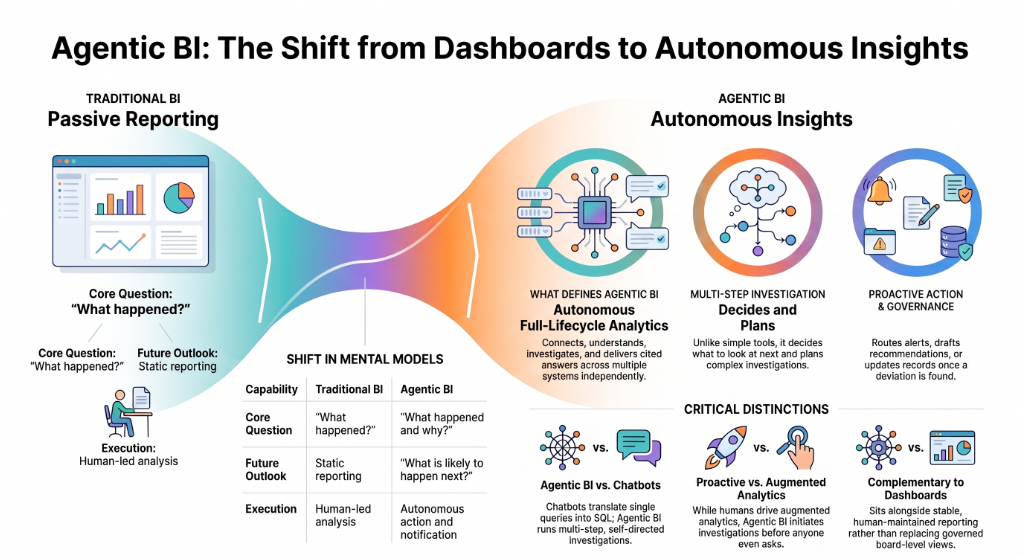
Agentic BI for data analysis is the application of autonomous AI agents to the full analytics lifecycle: connecting to data, understanding what the numbers mean in your specific business, deciding what to investigate, running the investigation across multiple systems at once, and delivering a finished, cited answer — or, where it's governed to do so, taking the next step directly (routing an alert, drafting a recommendation, updating a record).
It's a term that gets used loosely, so it's worth being precise about what it is not:
- It is not the same as a chatbot bolted onto a dashboard. A natural-language box that translates "show me Q3 revenue" into a single SQL query against one warehouse is a convenience feature. Agentic BI plans multi-step investigations across many systems and decides for itself what to look at next.
- It is not the same as augmented analytics. Augmented analytics uses AI/ML to help a human analyst prepare data, generate a chart, or suggest an insight. The human still initiates and drives the process. Agentic BI initiates on its own — it notices a metric deviation and starts investigating before anyone asks.
- It is closely related to, but a slightly different lens than, "AI agents for data analysis." That phrase emphasizes the agent — the autonomous software worker. "Agentic BI" emphasizes the category of platform — the business intelligence layer, now rebuilt around agents instead of dashboards. In practice the two terms describe the same shift; this guide uses "agentic BI" because that's how the category is increasingly branded by platform vendors, while our companion piece on AI agents for data analysis goes deeper on the mechanics of the agents themselves.
- It is not "no more dashboards." Stable, regulated, board-level reporting still benefits from a governed, human-maintained view that doesn't change shape every time someone asks a new question. Agentic BI sits above and alongside that layer, not as a wholesale replacement for it.
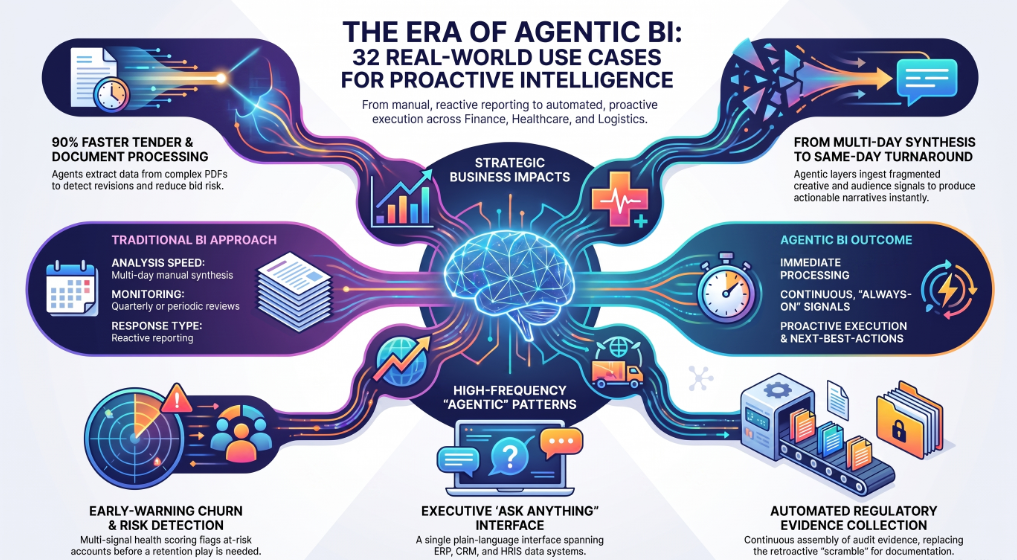
The most useful mental model: traditional BI answers "what happened." Agentic BI answers "what happened, why it happened, what's likely to happen next, and here's who I've already notified about it."
Agentic BI vs. traditional BI vs. augmented analytics
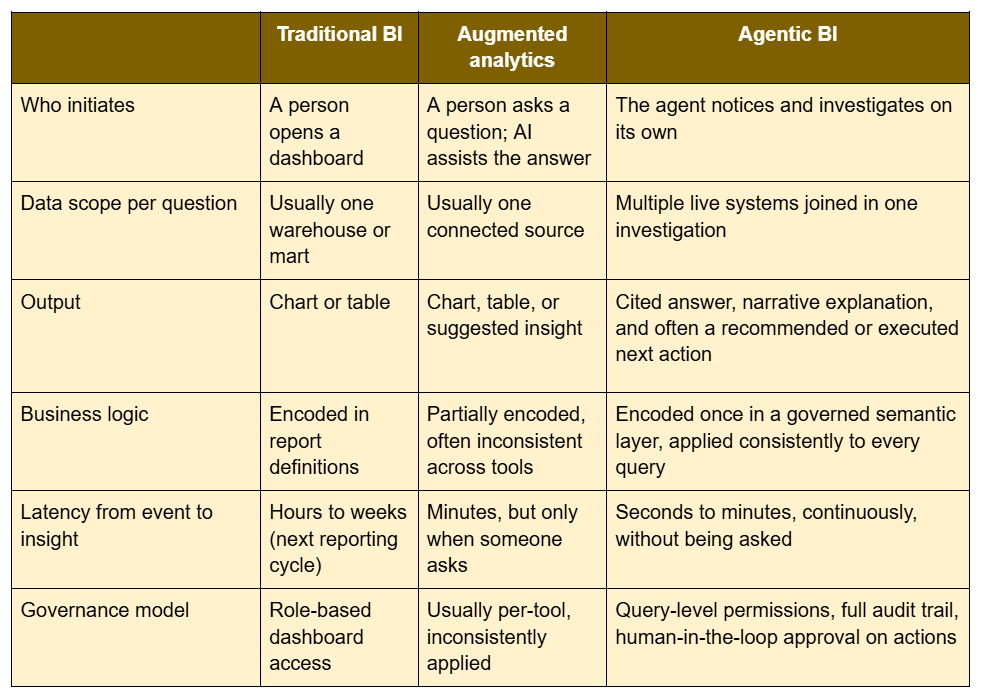
Where traditional BI still wins. It's worth being honest about this rather than pretending the category is obsolete. Traditional dashboards remain the right tool for stable, regulated, board-level reporting where the definition of the metric cannot change quietly between refreshes, where auditors expect a fixed, versioned artifact, and where there simply isn't yet a governed semantic layer for an agent to stand on. If your organization doesn't have consistent metric definitions across systems, the fix is to build that layer first — an agent pointed at ungoverned raw data will answer the same question differently each time, confidently, which is worse than a dashboard someone actually maintains.
Where agentic BI earns its place is everywhere the cost of an unanticipated question is high: exception monitoring, root-cause investigation, cross-system questions nobody built a report for, and any workflow where the value of an insight decays with every hour it sits unread.
How agentic BI for data analysis actually works
Every credible agentic BI deployment follows roughly the same five-stage loop, whether it's monitoring grid sensors or screening cross-border tax exposure.
1. Connect. The agent is pointed at live data — ERP, CRM, data warehouse, ticketing systems, POS, documents, spreadsheets, APIs — not a stale nightly export. Read access is governed the same way a human's access would be.
2. Understand context. A semantic layer maps what your organization actually means by "active customer," "at-risk vendor," "qualified pipeline," or "overdue tender." Without this step, an agent is technically correct and contextually wrong — which is the single most common failure mode in agentic analytics deployments, and the reason a governed semantic layer is treated as a prerequisite, not a feature, by every serious platform in this category.
3. Plan and query. Either a person asks a question in plain language, or the agent detects a deviation on its own and decides what to investigate. It decomposes that into a multi-step query plan across however many systems the answer requires.
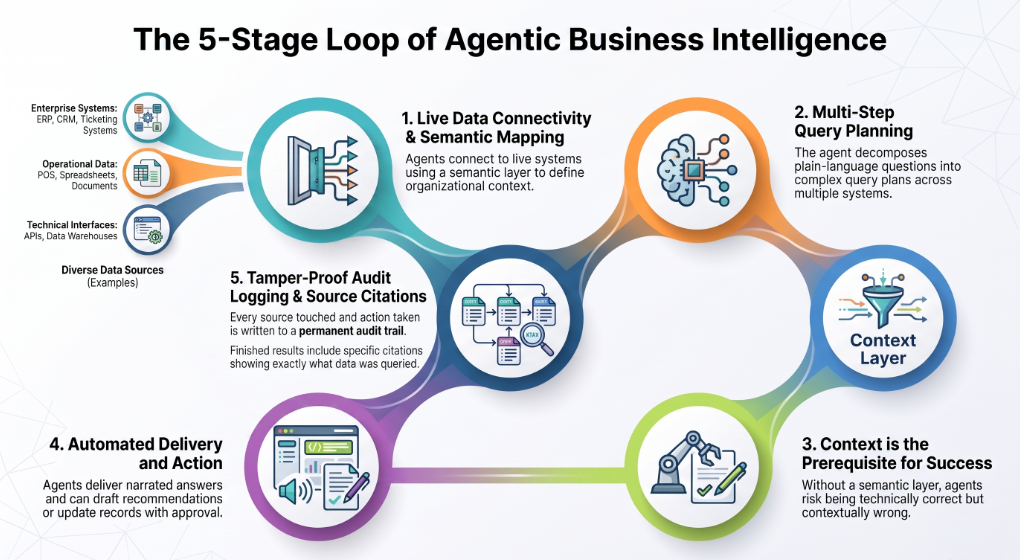
4. Deliver or act. The result is a finished answer — a narrative, a chart, a table — with source citations showing exactly what was queried. Where the platform is governed to allow it, the agent goes one step further: it drafts a recommendation, opens a case, routes an alert, or updates a record, subject to permission checks and, where warranted, human approval.
5. Log everything. Every query, every source touched, every action taken is written to a tamper-proof audit trail. In regulated environments this isn't a nice-to-have; it's the difference between a system that can be deployed and one that can't.
This loop is what separates a genuinely agentic system from a smarter search box — and it's the loop you'll see repeated, with different data and different stakes, across all 32 use cases below.
32 real agentic BI for data analysis use cases
These are grouped by function and industry. Company names have been removed; the problems, the agent design, and the measured outcomes are drawn from real, production deployments.
Revenue, growth, and customer intelligence
1. Automobile leasing portfolio intelligence. An independent auto leasing provider needed continuous visibility into portfolio risk, delinquency, maturity schedules, and residual value exposure across its dealer network — previously assembled manually across spreadsheets. An agentic layer now surfaces portfolio KPIs and dealer-network performance continuously, with alerts on exceptions and early risk signals, giving the leasing team days of earlier warning on deteriorating accounts.
2. Creator-economy campaign performance intelligence. A creator-marketing platform needed to turn scattered campaign data into usable insight for brand clients without expanding its analytics team. Agents now handle creator-discovery enrichment, automated reporting summaries, content KPI and brand-safety monitoring, and campaign ROI analytics — cutting manual reporting effort while improving consistency of the numbers clients receive.
3. Brand and creative-insight synthesis. A brand-insights studio needed to convert fragmented creative, performance, and audience signals into narratives marketing teams could act on, rather than another dashboard to interpret. An agent ingests multi-source creative and performance data and produces themed insight narratives and recommendation packs directly for leadership review — compressing what used to be a multi-day synthesis exercise into a same-day turnaround.
4. Always-on account and opportunity monitoring for enterprise sales. A B2B sales organization needed continuous visibility into which accounts carried risk or unrealized opportunity, instead of relying on quarterly business reviews to surface it. An agentic sales-intelligence layer now monitors account signals continuously, flags opportunities and risks against governed playbooks, and pushes next-best-action recommendations into the CRM — increasing account coverage without adding headcount.
Financial operations and procurement
5. Continuous CFO-grade cashflow intelligence. A financial-planning platform for growing businesses needed to replace static monthly cashflow reviews with something closer to real time. An AI CFO agent connects to accounting and banking data, runs forecasting and scenario models continuously, and generates runway and cash-risk alerts with recommended actions — giving finance teams advisory-level insight without adding headcount, and giving advisors a consolidated portfolio view across every client they manage.
6. Pharma sourcing and RFQ analytics. A pharmaceutical sourcing platform covering thousands of SKUs and excipients needed to speed up supplier discovery and procurement decisions. Agents now automate RFQ workflows, supplier matching, and quality/regulatory document handling, with analytics on price, lead time, and vendor performance layered on top — shortening procurement cycles and reducing manual vendor coordination.
7. Cross-entity margin and vendor-performance alerting. A diversified holding group needed a single view of purchase-price trends, gross-margin impact, and vendor delivery performance across dozens of operating entities, rather than reconciling separate spreadsheets from each business unit. Automated alerts now flag purchase-price trend shifts, GM impact, early-payment financing costs, and vendor delivery/return performance, with scheduled insight packs delivered straight to leadership.
8. Technical and financial diligence analytics for acquisitions. A long-term holding company that partners with founder-led and family businesses needed rigorous, repeatable technical diligence for investment decisions rather than one-off consulting engagements each time. An agentic analytics layer now performs code and architecture review, infrastructure and security assessment, and produces a structured risk register and remediation roadmap for every deal — turning diligence into a faster, more consistent, and better-documented process.
9. Sales-and-use-tax research automation. A specialized tax-research tool needed to speed up how tax professionals gather and act on constantly shifting jurisdictional rules. Agents automate source collection and summarization and generate draft memos and position documents with full source tracking — reducing manual source-hunting time and producing more consistent research outputs across analysts.
10. Cross-border tax risk pre-screening. A tax-technology platform needed to flag withholding-tax, VAT-mismatch, and permanent-establishment risk earlier in cross-border deal cycles, before those issues caused last-minute disruption. Agentic transaction screening now classifies risk, collects supporting evidence with explainability notes, and escalates only the flagged cases to human tax experts — catching exposure earlier and reducing deal-closing surprises.
Operations and supply chain
11. Cross-entity operational KPI consolidation for a global logistics network. A multinational logistics and warehousing company operating across several regions needed one consistent operational view instead of separate reporting standards in every market. An agentic analytics layer now standardizes KPIs across entities, builds consolidated dashboards with variance explanations, and applies data-quality checks and governance uniformly — giving leadership a single operational view and materially faster issue identification.
12. Tender and bid-document intelligence. A remedial-building and waterproofing specialist needed to process complex tender documents faster and catch revisions that create bid risk. A multi-agent document workbench now retrieves tenders, extracts data from complex PDFs using vision-capable models, determines the required workflow, and flags revisions or changes automatically — engineered for roughly 90% faster tender processing and materially reduced bid risk through better revision detection.
13. Smart-city and connected-infrastructure operations analytics. A smart-infrastructure operator running dozens of city-scale operations centers and millions of connected assets needed agentic analytics layered on top of existing smart-utility systems rather than a rebuild. The result was agentic analytics for smart-grid operations, automated operational alerting, and standardized dashboards feeding city-scale decision-making — improving reliability and shifting operations from reactive to proactive across the connected footprint.
14. Campus energy management for a research institution. A premier astrophysics research institute needed reliable monitoring and optimization of campus-scale infrastructure without a dedicated facilities-analytics team. Utility and sensor data ingestion, anomaly detection, and forecasting recommendations now feed proactive dashboards and alerts — improving energy visibility and catching inefficiencies earlier than manual checks ever could.
15. Governed agentic analytics layered on existing dashboards. Several organizations — a private retail holding company and a real-time business-analytics startup among them — needed to convert existing BI dashboards from something people read into something that produces action, without ripping out infrastructure that already worked. An agentic layer sits on top of existing dashboards, adds a semantic-governance layer for consistent definitions, and turns insights into governed, auditable tasks — shifting the operating model from reactive reporting to proactive execution loops with standardized decision logic across teams.
Market and competitive intelligence
16. Competitive pricing and promotion intelligence for a consumer-durables manufacturer. A major appliance and cooling-systems manufacturer needed continuous visibility into competitor pricing and promotions across e-commerce channels instead of periodic manual checks. Agents now continuously monitor pricing, MRP/discount levels, offers, and ratings across channels, with dashboards mapped directly to the questions leadership actually asks — replacing manual portal checks with always-on monitoring and catching pricing gaps and promotional shifts earlier.
17. E-commerce channel and pricing analytics for a high-velocity retailer. A large-catalog e-commerce operation needed conversational, self-serve analytics across sales, inventory, promotions, and customer behavior rather than analyst-built reports for every question. Natural-language conversational analytics now sits directly over sales, product, inventory, and promotion data, with automated KPI monitoring and exception alerting — giving the business faster, more scalable decision-making without adding analyst headcount.
18. Technical market-analysis and research automation. A market-research platform producing Elliott Wave and technical-indicator analysis for equity markets needed to scale research output without scaling analyst headcount. Agents now handle data ingestion, indicator pipelines, and research automation, generating thematic dashboards and alerts — producing market-insight packs faster and more consistently than manual analysis allowed.
19. Crypto trading signal and strategy intelligence. An AI-first trading terminal needed to combine market-data ingestion, pattern analysis, and strategy simulation into one governed workflow instead of scattered tools. A network of specialized agents now ingests market data, analyzes patterns and indicators, simulates strategies under risk guardrails, and surfaces alerts and recommendations ready for execution-linked workflows — compressing analysis cycles and improving decision cadence under explicit risk controls.
Customer, service, and workforce analytics
20. Demand and booking intelligence for luxury hospitality. A collection of boutique lodges and camps across multiple safari destinations needed faster, more accurate booking decisions for high-expectation travelers without losing the human judgment luxury service requires. A digital booking agent automates intent classification, real-time inventory checks, and alternative-date negotiation, with a human-in-the-loop for final itinerary curation — cutting booking turnaround while improving accuracy on complex, multi-property requests.
21. Operational analytics for a healthcare testing provider. A UK private healthcare and testing operator needed better visibility into its full booking-to-reporting workflow at high consumer volume. Platform automation across booking, processing, and reporting now feeds operational analytics directly — improving service visibility through unified reporting and reducing operational load.
22. Healthcare staffing fill-rate and utilization analytics. A healthcare-staffing platform connecting nursing professionals to facilities needed better visibility into fill rates and workforce utilization to stay responsive at scale. An AI platform for matching, scheduling, and compliance workflows now feeds revenue and utilization analytics with performance dashboards — improving fill cycles and giving clearer visibility into workforce responsiveness.
23. Funnel and instructor-utilization analytics for a driving school network. A multi-branch driving institute needed to understand where prospective students dropped out of the enrollment funnel and how efficiently instructor time was being used. Funnel analytics from enrollment through lessons and testing, combined with instructor-utilization and slot-optimization dashboards, now feed customer-experience alerts directly to operations — reducing scheduling friction and improving conversion visibility.
24. Tenant and customer-support analytics for a real-estate portfolio. A diversified real-estate owner managing office, retail, industrial, and residential assets across multiple emirates needed consistent support analytics across a fragmented tenant base. An omnichannel service agent handles tenant query triage and rental/payment workflows while feeding a knowledge base built over policies and tenancy documents — improving SLA adherence and consistency of the tenant experience across a large, varied portfolio.
25. Engagement and competency analytics for a global education community. A teacher community spanning more than a million educators across over 130 countries needed to understand engagement and competency gaps at a scale no manual review process could handle. Agents now build competency insights from teacher profiles, power a support agent for program queries, and generate analytics for program operators and partners — giving a global education network visibility it couldn't get manually and improving access to learning resources for the educators it serves.
Common patterns worth naming on their own
The 25 use cases above are drawn from named production deployments. The following seven are patterns that recur so often across industries — in the same case-study data and well beyond it — that they deserve to be named explicitly, even where no single deployment is being described.
26. Revenue-cycle anomaly detection. Continuous monitoring of billing, claims, or invoicing data to catch denials, underpayments, or leakage the moment they appear, rather than during a quarterly reconciliation.
27. Manufacturing downtime and OEE analysis. Agents correlating sensor, maintenance, and production data to explain why a line's overall equipment effectiveness dropped — not just that it did — and to flag the likely recurrence window.
28. Marketing spend attribution across channels. Reconciling ad-platform, CRM, and web-analytics data automatically to answer "which channel is actually driving pipeline" without a weeks-long manual attribution project.
29. Workforce capacity and demand planning. Agents that combine scheduling, ticket-volume, and seasonality data to recommend staffing changes before a service-level breach happens, not after.
30. Regulatory and compliance evidence collection. Continuous, automated assembly of the evidence auditors will eventually ask for — instead of a scramble to reconstruct it retroactively when the audit request lands.
31. Customer churn early-warning. Multi-signal health scoring that flags at-risk accounts from usage, support, and billing data together, early enough for a retention play to actually work.
32. Executive "ask anything" cross-system query. A single interface where a CFO, COO, or CMO can ask a plain-language question that spans ERP, CRM, and HRIS data in one query — the pattern nearly every use case above ultimately builds toward.
Why assistents.ai: the architecture built for agentic BI
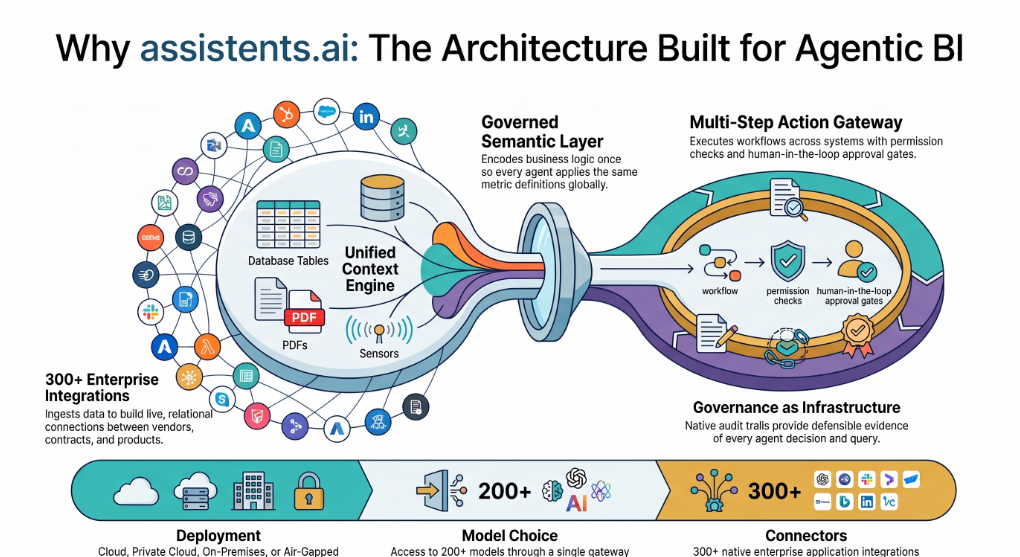
Most of the platforms competing for the "agentic BI" label were built as a chat layer bolted onto an existing dashboard product, or as a single-purpose analytics tool that later added an agent framework. assistents.ai was built the other way around: as a governed agent platform where business intelligence is one native capability among several — conversational agents, voice agents, document intelligence, autonomous workflow agents, and agentic BI — all sharing the same underlying context, permissions, and audit trail.
That architecture matters for the specific problems the 32 use cases above have in common:
A Context Engine that reasons across structured and unstructured data together. Every use case above eventually needs to join a database table to a PDF, a CRM field to a policy document, or a sensor reading to a maintenance log. assistents.ai's Context Engine ingests from 300+ enterprise applications and builds a live, relational understanding of the connections between them — vendors to contracts, deals to contacts, tickets to products — instead of treating each source as an isolated silo an agent has to bridge with guesswork.
A governed Semantic Layer, not a per-tool workaround. The single most common failure mode in agentic analytics is inconsistent metric definitions — one team's "active customer" isn't another team's. assistents.ai's semantic layer encodes your business logic once, so every agent, in every department, applies the same definition of margin, risk, or "at risk" every time, whether the question comes from a finance agent or a sales agent.
An Action Gateway, so insight doesn't stop at the chart. Several use cases above — cashflow alerting, tax risk escalation, procurement RFQ workflows — only create value if the agent's finding turns into a routed action: a ticket, an approval request, a CRM update. assistents.ai's action layer executes multi-step workflows across connected systems with permission checks on every step, so the same platform that finds the anomaly is the one that can act on it, with a human approval gate wherever the risk profile calls for one.
Governance and audit trails as infrastructure, not an add-on. Every deployment above that touches regulated data — healthcare, financial services, cross-border tax — needed defensible, exportable evidence of what the agent queried, why, and what it did with the result. That's native to how assistents.ai logs agent decisions, not a feature layered on after the fact.
Deploy on your terms. Cloud, private cloud, on-premises, or air-gapped, with model choice across 200+ models through a single gateway — a requirement in several of the regulated and infrastructure-heavy use cases above, and one point solutions built for a single cloud rarely meet without significant rework.
What to evaluate in an agentic BI platform
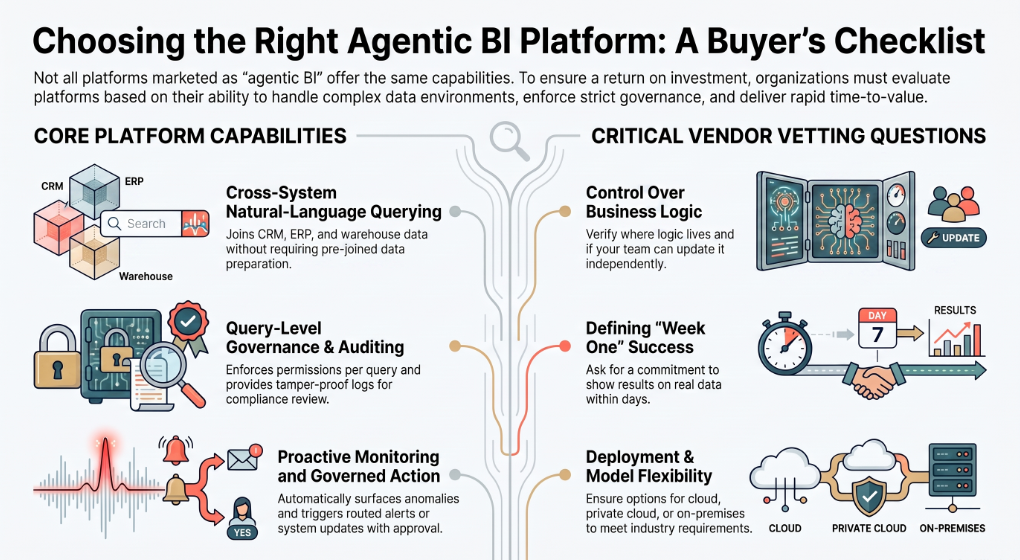
Not every platform marketed as "agentic BI" delivers the same thing. Before you commit, check for these:
- Cross-system natural-language query — can it join your CRM, ERP, and warehouse in one question, without pre-joined data prepared in advance?
- A configurable semantic layer — where does business logic live, and can your team update it without vendor involvement?
- Query-level governance — is access enforced per query, not just per dashboard, with automatic redaction where needed?
- Full, exportable audit trails — can compliance pull a tamper-proof log of every query, source, and action for review?
- Proactive monitoring, not just Q&A — does it surface anomalies on its own, or only answer what it's asked?
- Governed action, not just narration — can a finding turn directly into a routed alert, task, or system update, with human approval where warranted?
- Deployment flexibility — cloud, private cloud, on-premises, and model choice, if your industry requires it.
- Time to first value — does the vendor commit to showing results on your real data within days, not months?
Five questions worth asking any vendor directly: Can your agent query across our systems without pre-joined data? Where does our business logic live and how do we edit it? What exactly does the audit log capture? How does access differ for two people asking the same question with different permissions? What does week one of production actually look like?
A 30/60/90-day path to production
Days 1–2: connect and scope. Point the platform at two or three live systems tied to one painful, well-bounded question — not "all our data." Pick a use case from the list above that matches your function.
Days 3–7: build the semantic layer. Define the handful of metrics and business rules that matter for that use case. This is the highest-leverage step in the entire rollout — get it right once and every future question inherits it.
Weeks 2–4: pilot with governed access. Put the agent in front of the actual team that will use it, with role-based permissions active and audit logging on from day one. Measure time-to-answer against the old manual process.
Days 30–60: add proactive monitoring. Move from "ask a question" to "get notified before you'd have thought to ask." This is where most of the compounding value in the use cases above actually shows up.
Days 60–90: extend to a second use case and, where appropriate, governed action. Once the first deployment has a track record, expand to an adjacent function and start allowing the agent to take low-risk actions directly, with human approval retained for anything consequential.
Agentic BI for data analysis isn't a single feature — it's 32 different jobs, across a dozen industries, all built on the same underlying loop: connect to live data, understand what it means in your business, investigate continuously, and turn the finding into a governed action instead of another chart to interpret. The organizations above didn't adopt it all at once. Each started with one painful, well-bounded question.
See the Agentic BI platform or book a data architecture review — including a 48-hour ROI analysis run against your own data, not a demo dataset.
FAQs
What is agentic BI?
Agentic BI is business intelligence delivered by autonomous AI agents that plan their own investigations, query live data across multiple systems, and deliver cited, explained answers — proactively, not only when asked — instead of static dashboards that a person has to interpret.
How is agentic BI different from traditional BI?
Traditional BI waits to be opened and queried, usually against one prepared data source, and returns a chart or table a person has to interpret. Agentic BI initiates its own investigations, joins multiple live systems in a single query, and returns a finished, explained answer — often with a recommended or executed next action.
What are examples of agentic BI?
Examples include continuous cashflow-risk monitoring for finance teams, competitive-pricing intelligence for retail and manufacturing, cross-border tax-risk pre-screening, portfolio-risk analytics for lending and leasing, procurement RFQ automation with supplier analytics, and executive "ask anything" queries that span CRM, ERP, and HRIS data in one question — see the 32 use cases above for the full range.
Is agentic BI the same as agentic analytics?
They describe largely the same shift and are often used interchangeably. "Agentic BI" tends to emphasize the business-intelligence platform category; "agentic analytics" tends to emphasize the analytical workflow itself. In practice, evaluate any vendor using either term against the same criteria: proactive monitoring, cross-system queries, a governed semantic layer, and full audit trails.
What's the difference between augmented analytics and agentic BI?
Augmented analytics uses AI to help a human analyst prepare data or generate a suggested insight — the human still initiates the process. Agentic BI initiates on its own: it notices a deviation and starts investigating before anyone asks.
What tools or platforms support agentic BI?
The category includes both point-solution BI vendors adding agent capabilities to existing dashboard products, and enterprise agentic-AI platforms — like assistents.ai — that offer agentic BI as one native capability alongside conversational, voice, document, and autonomous workflow agents on shared context and governance.
How much does agentic BI cost to implement?
Cost depends on the number of connected systems, the complexity of the semantic layer, and whether the deployment includes governed action (not just insight delivery). A well-scoped first use case, connected to two or three systems with a defined semantic layer, is typically far less expensive and far faster to deploy than an enterprise-wide analytics program — most organizations start with one function and expand from a proven result.
Is agentic BI secure enough for regulated data?
Enterprise-grade agentic BI platforms enforce role-based access at the query level, auto-redact PII, support frameworks like SOC 2, HIPAA, and GDPR, and log every query and action in a tamper-proof audit trail. Several of the use cases above — cross-border tax screening, healthcare operations, financial diligence — operate under exactly these requirements in production.
How long does it take to deploy agentic BI?
A well-architected platform with pre-built connectors can move from first connection to a working pilot within one to two weeks, and to a defended production deployment within 30 to 90 days, depending on how many use cases and how much governed action are in scope.
Do I need a semantic layer for agentic BI to work?
Yes. Without a governed semantic layer, an agent will answer the same question differently depending on how it interprets ambiguous raw data — confidently, which is worse than a dashboard someone actually maintains. Building or mapping the semantic layer is the first real step of any credible agentic BI rollout, not an optional refinement.