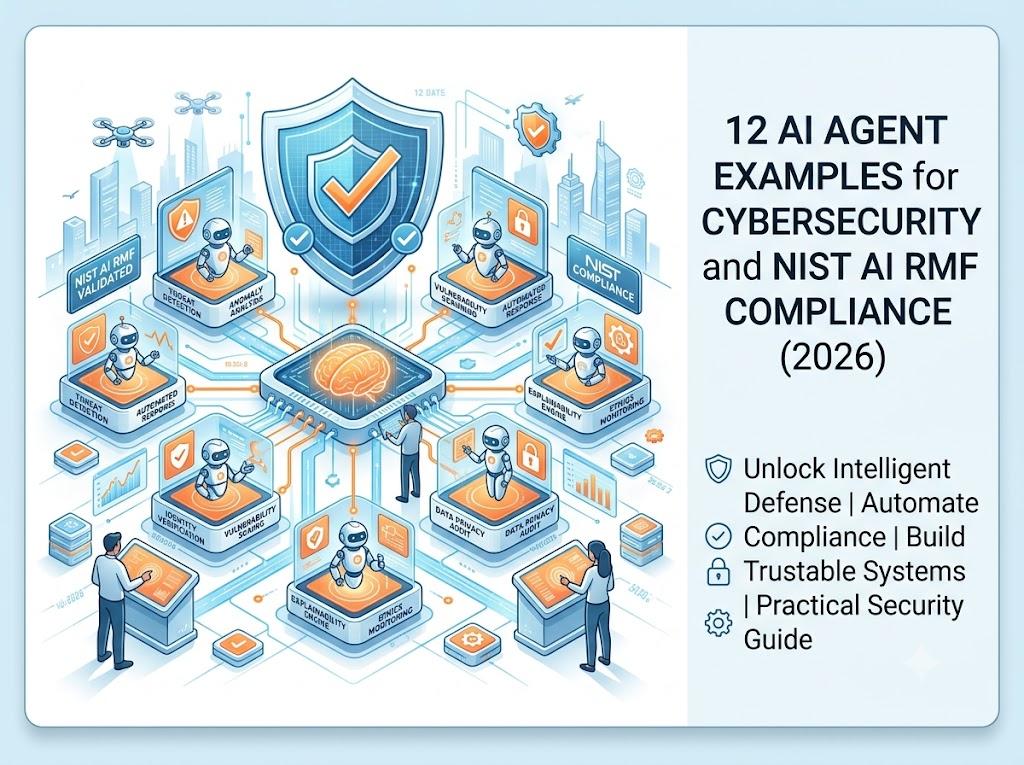
Discover 12 real AI agent examples mapped to NIST AI RMF and cybersecurity workflows — identity governance, SOC triage, compliance evidence, and incident response. Real deployments, real outcomes, and a practical way to talk to your auditors about both.
Security and compliance teams have watched two waves of AI hype arrive with a lot of promise and not much production evidence. The third wave is different, and it's already showing up in audit evidence, SOC dashboards, and board reporting: AI agents that don't just flag a problem, but investigate it, document it, and act on it — inside a governance envelope an auditor can actually read.
That governance envelope increasingly has a name. The NIST AI Risk Management Framework (AI RMF) — extended by the December 2025 Cybersecurity Framework Profile for Artificial Intelligence (Cyber AI Profile, NIST IR 8596) and the in-progress Control Overlays for Securing AI Systems (COSAiS) — is fast becoming the reference vocabulary US enterprises and their auditors use to talk about agentic AI risk. If you work in security, GRC, or platform engineering, you are going to be asked how your AI agents map to it, whether your organization calls it that or not.
This article does two things most content in this space doesn't do together: it shows 12 concrete AI agent examples drawn from production enterprise deployments and realistic security-operations patterns, and it maps every one of them to the specific NIST AI RMF function (Govern, Map, Measure, or Manage) it supports. No client names — the deployments below are described the way they'd appear in an anonymized case file, which is also how most security teams need to see this kind of evidence anyway.
What Is an AI Agent for Cybersecurity and NIST AI RMF, Exactly?
An AI agent for cybersecurity is a software system that can perceive security-relevant signals (alerts, logs, tickets, documents, sensor data), reason about what they mean, select and invoke tools, and take or recommend action — within a defined authority boundary — without a human directing every step.
That last clause is the whole point of the NIST AI RMF angle. A chatbot that answers "is this alert a false positive?" is generative AI. An agent that triages the alert, enriches it with threat intelligence, opens a ticket, and requests approval for containment is agentic — and the moment it can take action, it becomes a governance object, not just a productivity tool. That's exactly the gap the AI RMF, the OWASP Agentic AI Threats project, and NIST's own AI Agent Standards Initiative were built to close: identity, authorization, interoperability, and agent security are explicitly called out as foundational requirements for trusted agent adoption.
RMF or AI RMF? Clearing Up the Most Common Confusion
If you work in federal or defense-adjacent security, "RMF" almost certainly means the Risk Management Framework under NIST SP 800-37 — the six-step process (Categorize, Select, Implement, Assess, Authorize, Monitor) that produces an Authorization to Operate (ATO). If you work in enterprise AI governance, "RMF" increasingly means the AI Risk Management Framework (AI RMF 1.0, NIST AI 100-1), a voluntary, four-function framework (Govern, Map, Measure, Manage) published in January 2023 specifically for AI risk.
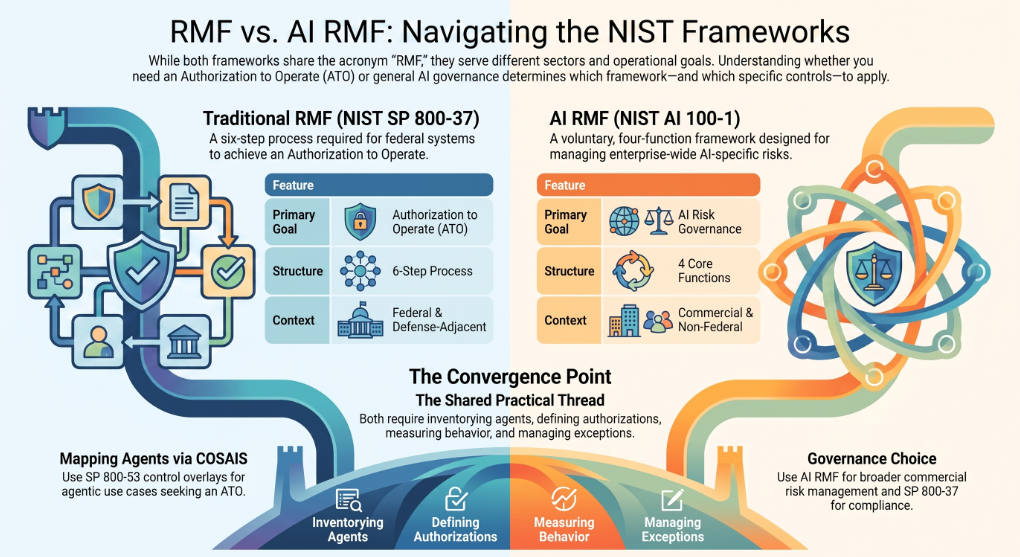
They are related but not identical, and AI agents intersect with both:
- If your AI agent is part of a system seeking an ATO, it falls under the traditional SP 800-37 RMF — and NIST's Control Overlays for Securing AI Systems (COSAiS) project is explicitly building SP 800-53 control overlays for two agentic use cases ("Using AI Agent Systems, Single Agent" and "Using AI Agent Systems, Multi-Agent") to make that mapping concrete.
- If your organization is managing AI risk more broadly — including in commercial, non-federal settings — you're almost certainly talking about the AI RMF's Govern/Map/Measure/Manage functions, which is the framework this article focuses on primarily, with federal RMF/ATO context noted wherever it matters.
Either way, the practical work is the same: inventory what agents exist, define what they're authorized to do, measure their behavior continuously, and manage the exceptions. That's the thread running through every example below.
Why Security and Compliance Teams Are the Next Frontier for Agentic AI
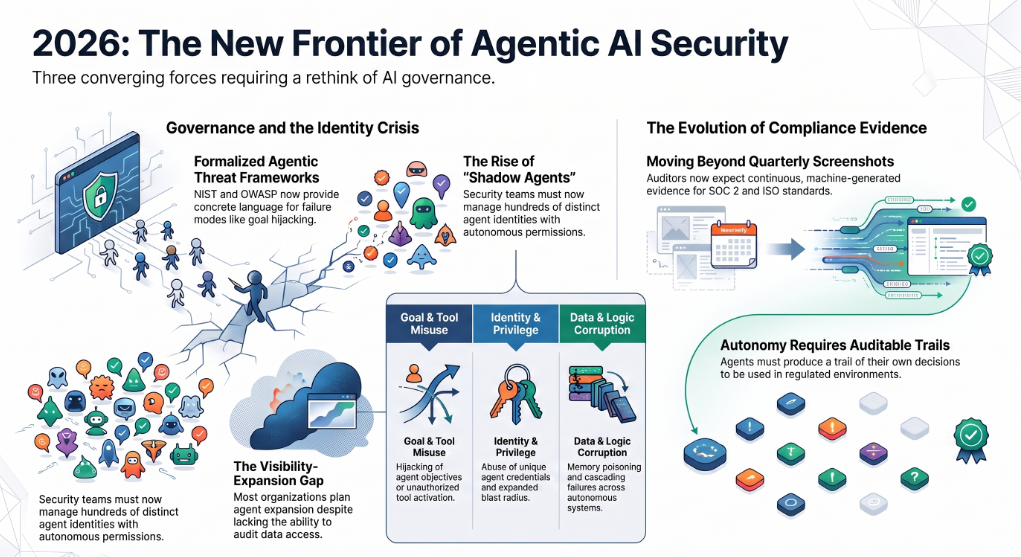
Three forces are converging in 2026:
The standards caught up. NIST's Cyber AI Profile bridges the AI RMF and the Cybersecurity Framework 2.0 and explicitly treats agentic systems as one of its primary deployment archetypes. OWASP's Agentic AI Threats project now catalogs concrete failure modes — goal hijacking, tool misuse, identity and privilege abuse, memory poisoning, cascading failures, rogue agents — that didn't have a name eighteen months ago. Auditors now have language for what they've been worried about intuitively.
The identity problem became unavoidable. Security teams that could once treat "the AI" as a single vendor risk now have hundreds of distinct agent identities acting with their own permissions, credentials, and blast radius. Industry reporting shows a majority of organizations plan to expand agent deployment over the next year even as a large share admit they can't fully track or audit what data those agents access — a visibility gap that mirrors exactly what the shadow-IT and shadow-SaaS waves looked like a decade earlier, except this time the "shadow" system can take autonomous action.
The evidence bar rose. SOC 2, ISO 27001, and ISO 42001 auditors increasingly expect continuous, machine-generated evidence rather than quarterly screenshots. An agent that can produce an auditable trail of its own decisions is not just an efficiency play anymore — in regulated environments, it is becoming close to a prerequisite for using AI agents at all.
The Frameworks Behind This Article
You don't need to become a NIST specialist to use the examples below, but it helps to have the vocabulary in one place.
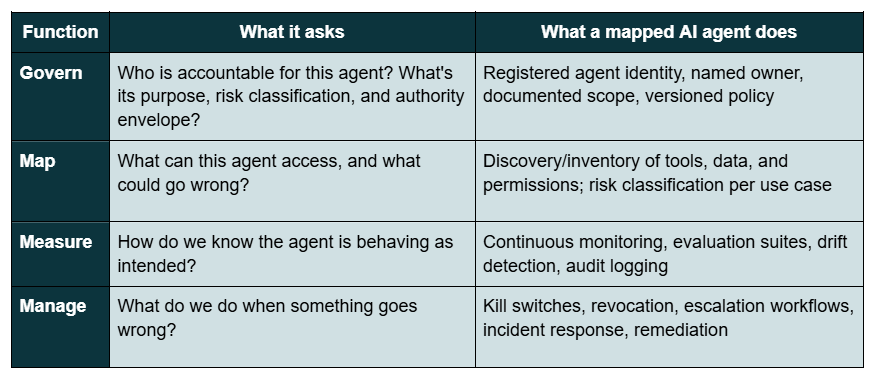
Alongside the AI RMF, three companion references show up repeatedly in this space and are worth knowing by name: the OWASP Agentic AI Threats project (the closest thing to an agentic-specific vulnerability catalog), the NIST Cyber AI Profile (NIST IR 8596) (bridging AI RMF and the Cybersecurity Framework 2.0), and COSAiS (the SP 800-53 control overlays for AI systems, including two overlays specifically for single- and multi-agent systems).
12 AI Agent Examples for Cybersecurity and NIST AI RMF: Real Deployments, Real Outcomes
The examples below combine anonymized production deployments with the operational patterns that recur across regulated, security-conscious enterprises. No client names are used.
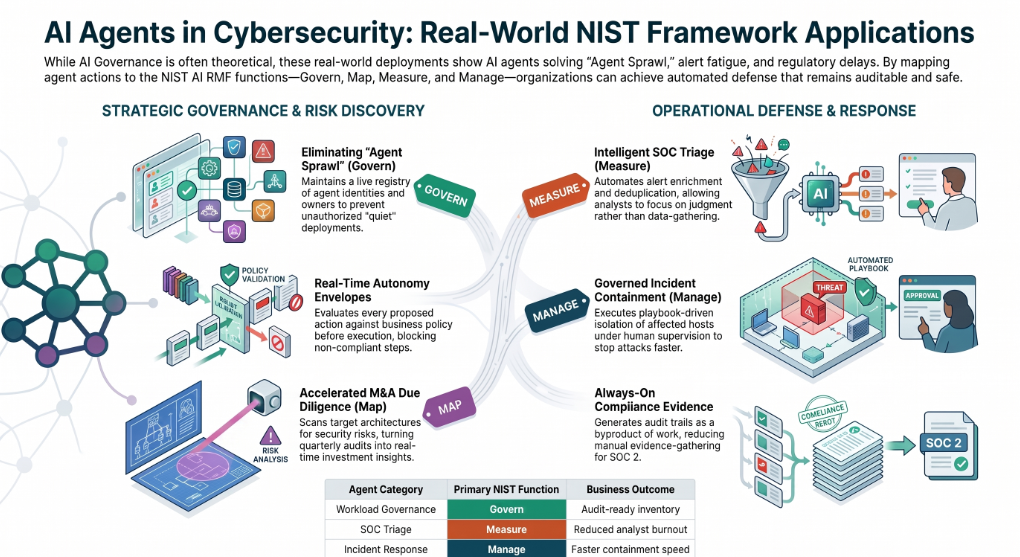
1. Identity and Workload Governance Agent — maps to Govern
The problem: Most enterprises can't answer a simple question with confidence: which agents exist right now, who owns each one, and what is each one actually authorized to do? Agent sprawl happens the same way SaaS sprawl did — quietly, department by department.
What the agent does: A governance agent maintains a live registry across three identity layers — the logical agent identity (the registered instance, role, and owner), the runtime workload identity (the actual process or container executing it), and the delegated business identity (the human or role it acts on behalf of). It flags unregistered or orphaned agents, checks for over-permissioned service accounts, and produces an always-current inventory that answers the auditor's first question before they ask it.
Why it matters for AI RMF: This is the Govern function made concrete. A governance lifecycle written without a current inventory governs systems that may no longer reflect reality — the inventory has to come first.
2. Policy and Autonomy Envelope Agent — maps to Govern + Manage
The problem: "The AI is not allowed to do that" is not a control until it's enforced at runtime, not just written in a policy document.
What the agent does: This agent evaluates every proposed action against layered policy — technical authorization (identity, resource, capability access), business policy (eligibility, limits, approvals), and runtime guardrails (prompt injection detection, sensitive-data handling, unsafe tool arguments) — before the action executes, not after. Actions outside the defined autonomy envelope are blocked and routed to a human, with the decision logged either way.
Real deployment pattern: An AI-first trading terminal combining research, analysis, and execution agents into one workflow was deployed with explicit strategy-simulation and risk-guardrail layers before any execution-ready integration was enabled — governed autonomy, not unrestricted autonomy, was the design requirement from day one.
3. SOC Tier-1 Triage and Enrichment Agent — maps to Measure
The problem: Security Operations Centers drown in alert volume. Analysts spend most of their time on deduplication and context-gathering, not judgment.
What the agent does: Classifies, deduplicates, and enriches incoming alerts with IOC checks, endpoint data, and account context, then presents a prioritized queue to human analysts — reducing noise without removing the human decision on anything ambiguous.
Why it matters for AI RMF: This is a textbook Measure-function deployment: it doesn't change what's authorized, it improves the organization's ability to observe and evaluate what's actually happening across its environment in near real time.
4. Compliance Evidence and Audit-Trail Agent — maps to Measure
The problem: Compliance teams spend enormous time assembling evidence for SOC 2, ISO 27001, or ISO 42001 audits — pulling logs, screenshotting dashboards, and chasing down control owners for attestations.
Real deployment: A global fintech provider delivering cloud-based automation for banks and credit unions deployed omnichannel AI agents across disputes, fraud, and compliance workflows, built around auditability, SLA monitoring, and reporting from the start. The result was faster case handling, materially reduced manual operational load, and — critically for a regulated financial services environment — better compliance readiness driven directly by the audit trail the agents generated as a byproduct of doing the work, not as a separate reporting exercise.
Who this is for: Compliance, GRC, and audit teams in regulated industries who currently rebuild evidence packages manually every quarter.
5. Cross-Border and Regulatory Risk Screening Agent — maps to Map
The problem: Regulatory risk that isn't caught early gets caught late — usually during due diligence on a deal, at which point it's a disruption, not a data point.
Real deployment: A tax-technology product focused on early screening of cross-border transactions for risks like withholding tax, VAT mismatches, and permanent establishment issues deployed an agent for automated transaction screening, evidence collection, explainability notes, and escalation to human tax experts. Outcomes included earlier detection of regulatory risk, fewer last-minute deal disruptions, and a faster, more consistent pre-compliance review process.
Why it matters for AI RMF: This is the Map function in its purest form — identifying and classifying risk in context before it becomes an incident, not after.
6. Technical Security and Architecture Due-Diligence Agent — maps to Map
The problem: Investment and acquisition decisions increasingly hinge on technical risk that most deal teams aren't equipped to assess quickly — architecture soundness, scalability, and security posture of a target's systems.
Real deployment: A long-term holding company that partners with founders and family businesses on investment and acquisition decisions deployed an agent-supported technical due diligence process for a mobile banking target, covering code and architecture review, infrastructure and security assessment, scalability and resilience evaluation, and a structured risk register with a remediation roadmap. The outcome was faster, better-informed investment decisions and materially reduced post-deal technical surprises.
Who this is for: Corporate development, private equity, and M&A teams who need security and architecture risk visibility on a deal timeline, not a quarterly audit timeline.
7. Critical-Infrastructure Anomaly Detection Agent — maps to Measure + Manage
The problem: Utilities, transmission operators, and other critical-infrastructure organizations run assets at a scale where a human-only monitoring model guarantees blind spots — and NIST's own April 2026 concept note on a Trustworthy AI Profile for Critical Infrastructure signals just how fast this category is moving from theoretical to expected.
Real deployment pattern: A state power transmission utility responsible for operating and maintaining transmission systems deployed continuous KPI monitoring, anomaly detection, and automated alerting for field operations, layered on top of existing smart-grid infrastructure. Separately, a smart-city infrastructure operator running dozens of city-scale operation centers and connecting millions of assets deployed the same category of agentic analytics and automated operational alerting at much larger scale. Both deployments moved the organization from periodic manual checks to continuous, always-on operational visibility — the same monitoring discipline that underpins security operations in any environment where "we'll notice it at the next review" is not an acceptable answer.
Why it matters for AI RMF: Continuous monitoring is the operational core of the Measure function, and the automated alert-and-escalation layer on top of it is where Manage begins.
8. Automated Research and Documentation Agent for Regulatory Change — maps to Measure
The problem: Regulatory and compliance research is a moving target. Standards, tax codes, and control frameworks update continuously, and manually tracking source changes doesn't scale.
Real deployment: A specialized sales-and-use-tax research automation platform deployed an agent for automated source collection and summarization, draft memo and position generation, and workflow tracking with knowledge-base building — producing citation-backed research output rather than unsupported summaries. Outcomes included faster research cycles, better documentation hygiene, and materially reduced manual source-hunting time.
Why it matters for AI RMF: Evidence and documentation are measurement artifacts. An agent that keeps the evidence current as the underlying rules change is doing continuous Measure work that a point-in-time audit can't replicate.
9. Vulnerability Discovery and Prioritization Agent — maps to Map + Measure
The problem: Vulnerability backlogs routinely outstrip the capacity of security teams to triage them manually, and prioritization by CVSS score alone misses business context.
What the agent does: Continuously scans for exposed assets and misconfigurations (external discovery) and evaluates runtime configurations and API accessibility (internal discovery), then scores and prioritizes findings using both technical severity and business context — feeding a governed queue rather than a raw scanner output.
Why it matters for AI RMF: This is where Map (what exists, what's exposed) and Measure (how severe, how likely) meet in practice — the combination is what turns a vulnerability scanner into a risk-prioritization system.
10. Incident Response and Containment Agent — maps to Manage
The problem: The minutes between detection and containment are where damage compounds. Fully manual containment doesn't scale to modern attack speed; fully autonomous containment without guardrails is its own risk.
What the agent does: Executes predefined, playbook-driven containment actions — isolating an affected host, enforcing an access restriction — under human supervision or within a pre-approved autonomy envelope, and logs every action with full context for post-incident review.
Why it matters for AI RMF: This is the clearest expression of the Manage function: addressing risk once it has been identified, with an explicit, revocable authority boundary rather than open-ended autonomy.
11. Agent Inventory and Drift Detection ("Control Tower") — maps to Govern + Measure
The problem: Once an organization has more than a handful of agents in production, the question shifts from "does this one agent behave correctly" to "which agents exist, which are over-permissioned or drifting, and which are quietly underperforming or failing silently."
What the agent does: Provides a standing answer to exactly those questions — which agents exist and who owns them, what work they're doing, which are over-permissioned or drifting from their evaluated baseline, which actions are being denied or failing verification, and what value each is producing relative to its cost and risk.
Why it matters for AI RMF: This is Govern and Measure operating together at the portfolio level, not the single-agent level — the difference between governing one system and governing a hybrid workforce of them.
12. Compliance-Native Customer and Case Workflow Agent — maps to Govern + Measure + Manage
The problem: Customer-facing and case-management workflows in regulated sectors (financial services, healthcare, real estate, government-adjacent services) need automation that is fast and defensible — a fast answer that can't be explained in an audit is a liability, not a win.
Real deployment: A UAE-based diversified real estate portfolio owner deployed an omnichannel service agent for tenant and customer support with a knowledge base built over policies, tenancy documents, and SOPs, full ticketing and escalation to human teams, and governed, auditable actions layered on top of existing dashboards. The result was faster response times, consistent round-the-clock service, and — the part that matters for this article — better SLA adherence achieved through automated routing that is fully traceable, not a black box.
Who this is for: Any regulated customer-operations function — financial services, healthcare, real estate, insurance — where speed and auditability have to coexist, not trade off against each other.
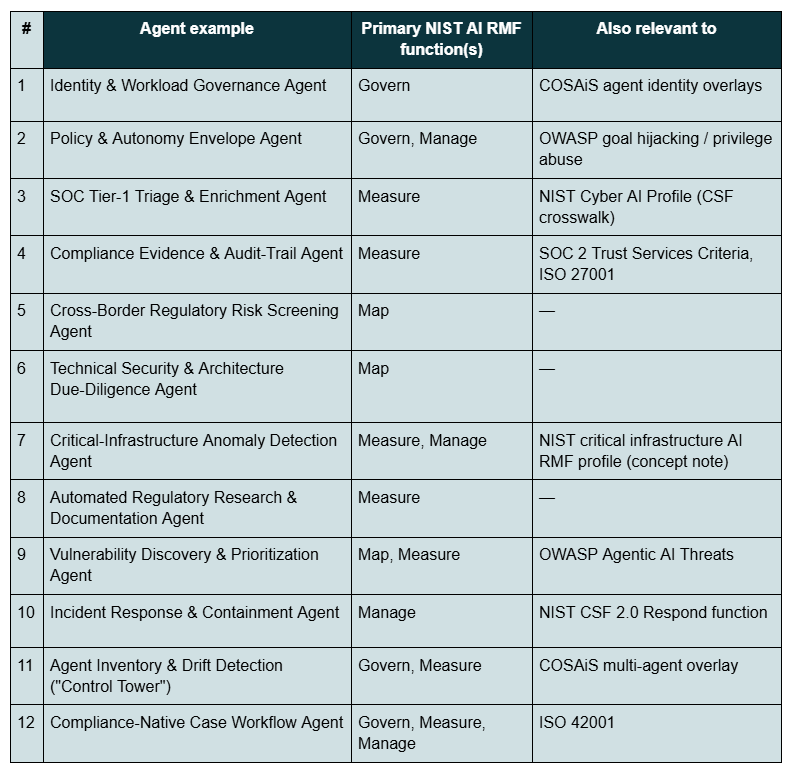
Agent-to-Framework Mapping Table
Agentic AI vs Traditional SOAR/GRC Tooling: What's Actually Different?
Security and compliance teams already run SOAR platforms, SIEMs, and GRC tools. A fair question is what an AI agent adds that those tools don't already do.
Traditional SOAR/GRC automation is rule-based. It executes predefined playbooks reliably when the input matches what the playbook expects. The moment an alert doesn't fit the expected shape, a document doesn't match the expected template, or a regulation changes mid-quarter, the automation stops and waits for a human.
Agentic AI handles the exception as a first-class case, not a failure mode. It reads unstructured inputs semantically (a novel phishing pattern, an oddly formatted tender document, a regulatory update in a new jurisdiction), reasons about what changed, and either adapts the workflow or escalates with context attached — rather than simply halting.
The practical difference: SOAR and GRC tooling reduce the cost of doing the same defined thing repeatedly. Agentic AI reduces the cost of handling the undefined case — which, in security and compliance, is most of them.
The Governance Controls an RMF-Aligned Agent Deployment Actually Needs
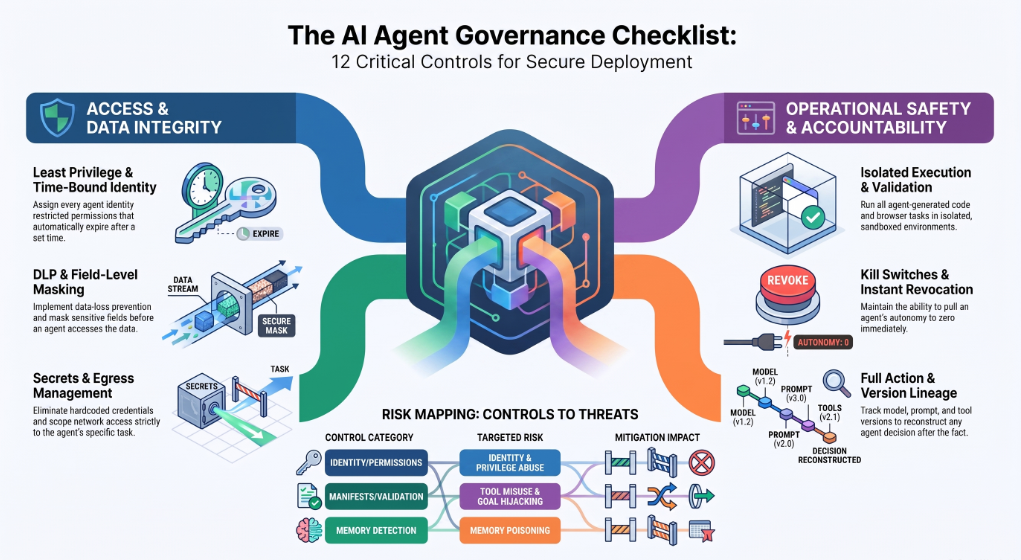
If you're evaluating or building AI agents for a security- or compliance-sensitive environment, this is the control checklist that should exist before an agent touches production data, regardless of vendor:
- Least privilege and time-bound permissions for every agent identity
- Data-loss prevention and field-level masking on any sensitive data an agent can access
- Prompt and document provenance tracking so you can trace what an agent acted on
- Isolated code and browser execution for any agent that runs generated code or browses the open internet
- Secrets management — no agent should hold long-lived, shared, or hardcoded credentials
- Network egress policy scoped to what the agent's task actually requires
- Signed capability manifests and tool-argument validation before any tool call executes
- Memory poisoning detection for agents with persistent memory or long-running context
- Agent-to-agent trust policy for any multi-agent handoff
- Kill switches and revocation that can pull an agent's autonomy to zero immediately, not on the next release cycle
- Incident response and forensic evidence capture specific to agent actions, not just infrastructure logs
- Model, prompt, tool, and policy version lineage so any agent decision can be reconstructed after the fact
This list maps closely to what OWASP's Agentic AI Threats project identifies as the operational risk surface — goal hijacking, tool misuse, identity and privilege abuse, memory poisoning, cascading failures, and rogue agents — and to what the NIST AI RMF's Govern and Manage functions ask for in practice.
How assistents.ai Implements RMF-Aligned Agent Governance
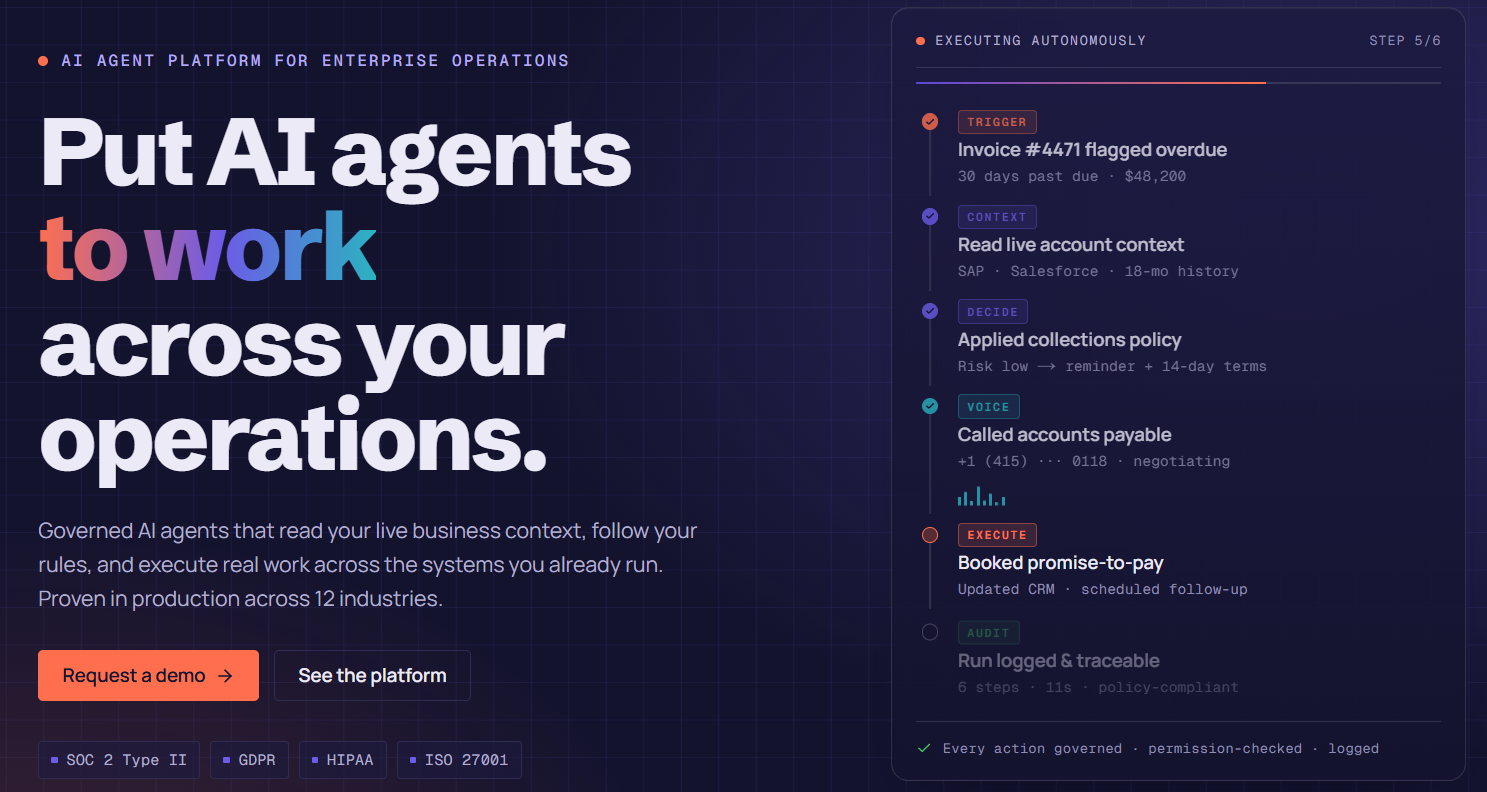
Every example above assumes a platform that can actually enforce these controls at runtime, not just document them in a policy binder. This is where assistents.ai's platform architecture is built specifically for security and compliance teams, not retrofitted for them:
- Governance is a policy engine, not a wrapper. Every proposed agent action is checked against defined business rules and compliance requirements before execution. Violations are blocked and flagged, not caught after the fact in a log review.
- Role-based access control at the resource level. Administrators define exactly what data each agent can access, what actions it can take, and what approval workflows apply — permission scope is explicit, not inferred.
- Full audit trails by default. Every agent action is logged with context: what data was accessed, why, what decision was made, and what action followed — filterable by agent, user, date range, or action type, with real-time alerting on policy violations.
- Certified compliance posture. The platform is SOC 2 Type II certified and supports HIPAA compliance with signed BAAs, with governance controls covering encryption, access logging, retention policies, and configurable compliance rules for regulated industries.
- Purpose-built for security leaders. assistents.ai's CISO and security-team offering maps agent behavior across multiple compliance frameworks with hundreds of pre-mapped controls, automates evidence collection for SOC 2 and equivalent audits, and provides continuous monitoring for access anomalies and privilege escalation — with human oversight preserved at every governed step.
None of this replaces your organization's own risk decisions. It means the platform doing the work can actually produce the evidence your AI RMF documentation — Govern, Map, Measure, and Manage alike — requires.
Why assistents.ai Is Built Differently for Security and Compliance Teams
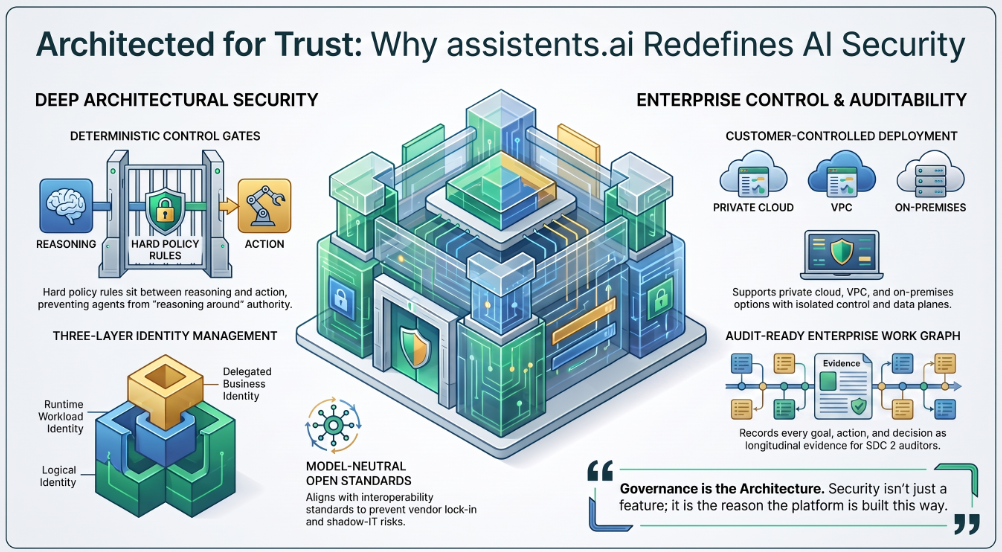
Beyond the governance and compliance features above, the deeper architectural choices behind assistents.ai matter specifically for security-conscious buyers evaluating a long-term platform, not just a point tool:
- Three separate identity layers, not one. Every agent carries a distinct logical identity (the registered role and owner), runtime workload identity (the actual executing process), and delegated business identity (who it acts for) — the same separation security teams already expect from workload identity and non-human-identity management, applied natively to agents rather than bolted on afterward.
- Deterministic controls sit between reasoning and action. Binding policy, approval thresholds, and authority rules are enforced as deterministic checks the agent cannot reason its way around — the architecture treats "the model decided to" as insufficient justification for any action with real-world consequences.
- Customer-controlled deployment. Private cloud, customer VPC, and on-premises deployment options — with customer-controlled model keys and tenant isolation — are built for regulated and infrastructure-heavy enterprises where "trust our SaaS" isn't a sufficient answer, and where a separated control and data plane may be a hard requirement.
- An Enterprise Work Graph that becomes your own evidence base. The structured history of every agent's goals, actions, decisions, and outcomes accumulates as a customer-specific operating record — the kind of longitudinal evidence an AI RMF Measure function or a SOC 2 auditor actually wants to see, rather than a generic vendor demo.
- Open, model-neutral, standards-aligned. Support for interoperability standards for tool use and agent-to-agent communication means assistents.ai is designed to sit as a governance and orchestration layer across your existing systems and models — not as another closed suite that becomes its own shadow-IT risk.
The pattern across all of it: governance is not a feature added to an agent platform. It's the reason the platform is architected the way it is.
How to Deploy Your First RMF-Aligned Security Agent
You don't need a multi-year program to start. The deployments referenced in this article moved from pilot to production in weeks, not years, by sequencing deliberately:
Step 1: Start with a Measure-function win. SOC alert triage, compliance evidence collection, or continuous anomaly monitoring are the highest-ROI starting points — they're high-volume, well-defined, and don't require resolving every Govern-function policy question on day one.
Step 2: Run the inventory before you write the policy. Discover what agents (and shadow-AI features inside existing SaaS tools) are already operating in your environment before writing governance for imaginary systems.
Step 3: Define the autonomy envelope explicitly. Decide, in writing, what each agent can execute autonomously and what requires human approval — and make that boundary enforceable at runtime, not just documented.
Step 4: Instrument for evidence from day one. Audit logging, decision reasoning capture, and policy-violation alerting should be part of the initial deployment, not a phase-two addition once an auditor asks for it.
Step 5: Build the kill switch before you need it. Confirm you can reduce any agent's autonomy to zero immediately — this is the single most common gap security teams find when they evaluate agent platforms after the fact.
Ready to Map Your AI Agents to NIST AI RMF?
The examples in this article are not hypothetical. They are production patterns already running in regulated, security-conscious enterprises across financial services, critical infrastructure, real estate, and professional services.
assistents.ai's Agentic Intelligence Platform is built for exactly this use case: governance-native agent orchestration with full audit trails, SOC 2 Type II certification, and human oversight built into every governed action — deployable on infrastructure you control.
Explore AI Agents for CISOs & Security Leaders →
FAQs
What is the NIST AI RMF for AI agents?
The NIST AI Risk Management Framework (AI RMF 1.0) is a voluntary, four-function framework — Govern, Map, Measure, Manage — for managing AI risk across a system's lifecycle. Applied to AI agents, it means registering agent identity and ownership (Govern), inventorying what each agent can access and where risk concentrates (Map), continuously monitoring agent behavior and outcomes (Measure), and maintaining kill switches, escalation paths, and remediation processes (Manage).
Is "RMF" the same as "NIST AI RMF"?
Not necessarily. In federal and defense contexts, "RMF" usually refers to the traditional Risk Management Framework under NIST SP 800-37, the process used to grant an Authorization to Operate (ATO). "AI RMF" is a separate, newer framework specifically for AI risk. AI agents can intersect with both, especially as NIST's Control Overlays for Securing AI Systems (COSAiS) project builds SP 800-53 control overlays specifically for single- and multi-agent systems.
How do AI agents help with RMF or AI RMF compliance?
By generating the evidence each function actually requires as a byproduct of normal operation: a registered, owned identity for Govern; a live inventory of access and tool use for Map; continuous monitoring and audit logs for Measure; and enforceable kill switches and escalation workflows for Manage — rather than requiring a separate reporting exercise layered on top.
What are examples of AI agents in security operations (SecOps)?
Common production patterns include Tier-1 alert triage and enrichment agents, threat-hunting support agents that correlate indicators across systems, containment agents that execute playbook-driven response actions under human supervision, and vulnerability discovery and prioritization agents — each typically operating with human review preserved for ambiguous or high-impact decisions.
Can AI agents help with SOC 2 or ISO 42001 compliance?
Yes. AI agents can automate large parts of continuous compliance work — evidence collection, control monitoring, audit-log generation, and violation flagging — for frameworks including SOC 2, ISO 27001, and ISO 42001. The requirement is that the underlying platform enforces policy at runtime and produces auditable records, not that the agent simply claims compliance after the fact.
What are the OWASP Agentic AI Top risks?
OWASP's Agentic AI Threats work identifies risks specific to autonomous, tool-using systems: goal hijacking, tool misuse, identity and privilege abuse, memory poisoning, cascading failures across multi-agent systems, and rogue agent behavior. These sit alongside — and often map directly into — the Measure and Manage functions of the NIST AI RMF.
Do AI agents need their own identity for security purposes?
Yes, and this is one of the fastest-moving areas of the space. Best practice is to separate an agent's logical identity (its registered role and owner), its runtime workload identity (the process actually executing), and the delegated human or business identity it acts on behalf of — rather than treating "the AI" as a single undifferentiated actor or, worse, letting it share credentials with a human user.
What is a kill switch for an AI agent, and why does it matter?
A kill switch is the ability to immediately reduce an agent's autonomy to zero — revoking its permissions and halting its actions — independent of a full deployment or release cycle. It matters because it's consistently the first thing security teams discover is missing when they evaluate an agent platform after an incident, rather than before deploying it.
Is agentic AI itself a cybersecurity risk?
It can be, in both directions. Poorly governed agents introduce genuine risk — privilege abuse, prompt injection, cascading multi-agent failures — which is exactly why frameworks like the AI RMF and OWASP's agentic threat catalog exist. At the same time, documented offensive use of agentic tooling by threat actors has already been observed in the wild, which is precisely the argument for why defensive teams need governed agentic capability of their own rather than ceding that operational speed advantage to attackers.