Salesforce Agentforce is a strong AI agent layer if your entire business runs inside Salesforce. If it doesn't — if your operations span SAP, Oracle, Workday, NetSuite, or ServiceNow, need on-premise or private-cloud deployment, or require agents to act on finance, HR, procurement, or operations data outside the CRM — you need a platform built for that from the ground up. This guide ranks 9 real Salesforce Agentforce alternatives for 2026, evaluated on cross-system reach, governance, deployment flexibility, and pricing transparency, with assistents.ai ranked first for multi-system, governed enterprise AI.
WHAT SALESFORCE AGENTFORCE IS (AND ISN'T)
Salesforce Agentforce is Salesforce's platform for building and deploying AI agents inside the Salesforce ecosystem — Sales Cloud, Service Cloud, and Commerce Cloud. It runs on Salesforce's Atlas reasoning engine, is grounded in Data Cloud (Salesforce's unified customer data layer), and builds on Einstein's existing predictive and generative AI capabilities. Agentforce agents can read Salesforce records, trigger Flows, and take action on cases, opportunities, contracts, and orders without a human clicking through every step.
It is genuinely strong at what it was built for: agentic automation over data that already lives in Salesforce. Salesforce's own architecture materials describe Agentforce as part of a broader "Agentic Enterprise" vision — an enterprise where agents, employees, applications, and data are all connected within one IT architecture.
What it isn't: a general-purpose enterprise agent platform. Its value is tightly coupled to how much of your business already lives inside Salesforce. The moment an agent needs to reconcile an invoice in SAP, check stock in an ERP, pull a policy document from a document repository, or approve a staffing request in a scheduling system, Agentforce needs custom integration work — usually through MuleSoft — to reach that far. That coupling, more than any single feature gap, is why so many enterprises start evaluating alternatives in 2026.
WHY ENTERPRISES LOOK FOR SALESFORCE AGENTFORCE ALTERNATIVES
THE REAL COST OF AGENTFORCE
Salesforce publishes a simple headline number, but the full cost stack has three layers, and most buyers only budget for the first one when they start evaluating.
Layer one — agent usage. Priced at $2 per conversation under the fixed model, or through Flex Credits at $500 per 100,000 credits, where a standard action consumes about 20 credits (roughly $0.10 per action) and a voice action consumes more. There are also per-user options, including an add-on around $125 per user per month and higher-tier editions bundling in a fixed pool of Flex Credits. Salesforce currently runs multiple pricing models concurrently, and which one applies depends on how and where you deploy.
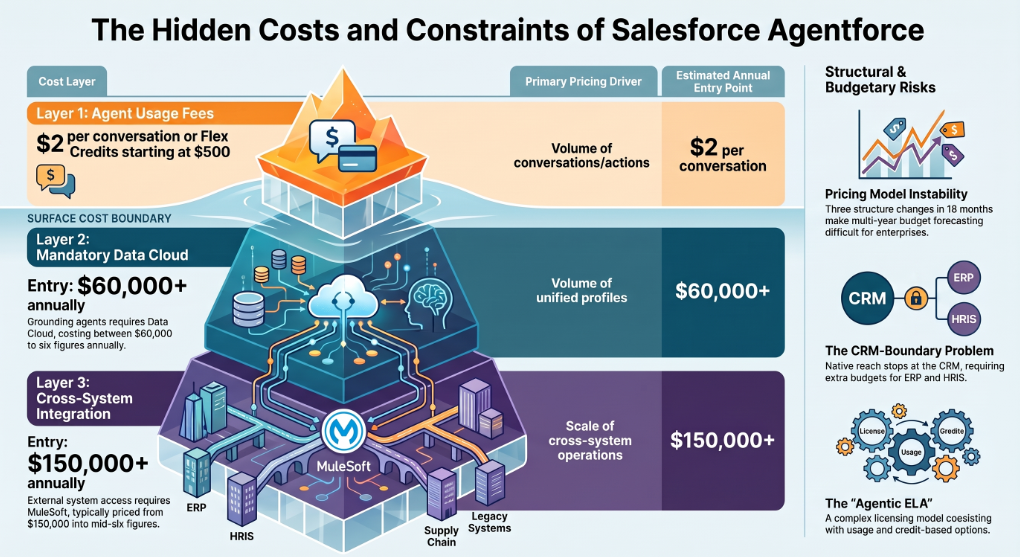
Layer two — Data Cloud. Agentforce depends on Data Cloud (also called Data 360) for grounding agents in unified customer data. This is generally described as a practical requirement for any production-grade deployment, not an optional add-on. Published starting prices for Data Cloud tiers commonly run from roughly sixty thousand dollars a year into six figures annually, depending on the volume of unified profiles and functionality required.
Layer three — cross-system integration. The moment an agent needs to act outside Salesforce — an ERP, a core banking platform, an EHR, a logistics system — you need an integration layer. MuleSoft, Salesforce's own integration platform, is the natural fit, and typical enterprise licensing for it runs from roughly one hundred fifty thousand dollars into the mid six figures annually, depending on scale.
Layer one is the number Salesforce leads with in every conversation. Layers two and three are usually where the real enterprise budget goes, and they are the layers most comparison articles — and most sales conversations — leave out.
THE PRICING-MODEL PROBLEM
Salesforce has changed its Agentforce pricing structure three times in roughly eighteen months: from a straightforward per-conversation fee, to consumption-based Flex Credits, to per-user licensing under what Salesforce calls the Agentic Enterprise License Agreement. All three models currently coexist, and a buyer has to pick the one that matches how they intend to use the product — which is flexible for Salesforce, but makes multi-year budget forecasting genuinely difficult for the enterprises buying it. This unpredictability shows up repeatedly in procurement discussions and is one of the most commonly cited reasons enterprises start a formal alternatives evaluation.
THE CRM-BOUNDARY PROBLEM
Most high-value enterprise work does not happen inside a CRM. Invoice processing, monthly close, procurement approvals, employee onboarding, collections, energy and grid monitoring, terminal-to-rail logistics coordination, pharmaceutical sourcing, tax risk screening — these are cross-system operations by nature, touching ERP, HRIS, finance systems, and operational technology as much as (or more than) customer records. A platform whose native reach stops at the edge of the CRM will always need a second platform, a second governance model, and a second integration budget to cover the rest of the enterprise. For an enterprise trying to build one coherent AI operating model rather than a patchwork of point solutions, that duplication is itself the problem.
HOW WE EVALUATED THESE ALTERNATIVES
Each platform below is assessed against six criteria that matter for real enterprise deployment, not demo-day feature lists.
One — cross-system reach: can it act across CRM, ERP, HRIS, and finance systems, or only within one ecosystem.
Two — governance and auditability: are actions permissioned, rule-checked, approved, and logged, or is it a black-box agent with no audit trail.
Three — deployment flexibility: cloud-only, or also private cloud, on-premise, hybrid, and VPC.
Four — voice AI depth: a full voice platform with conversation management and analytics, or a basic add-on.
Five — pricing transparency: can you forecast total cost of ownership before you sign, or does the real number only appear after implementation.
Six — proven production use: is there real, verifiable deployment evidence across industries, or only pilot and demo claims.
THE 9 BEST SALESFORCE AGENTFORCE ALTERNATIVES IN 2026
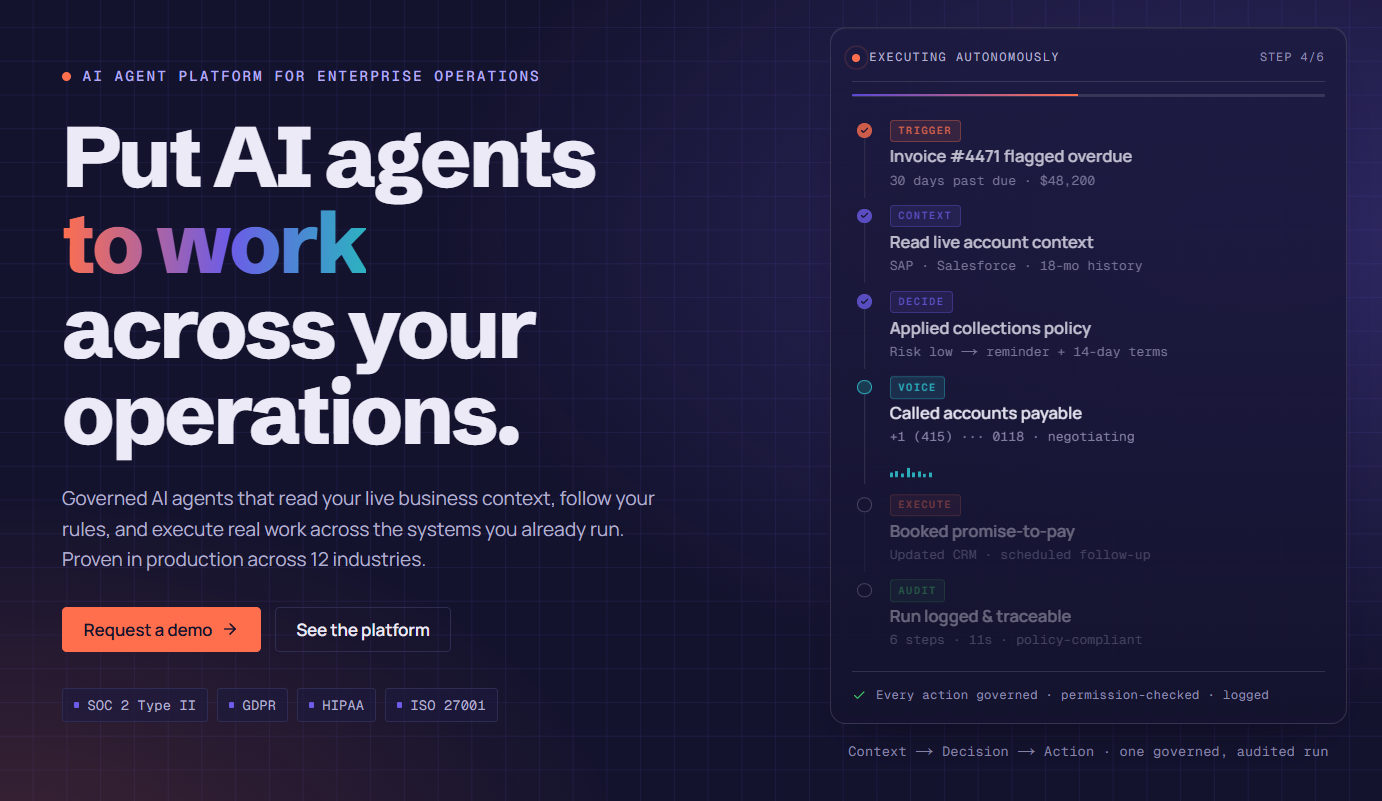
assistents.ai is an enterprise AI platform built on a different premise than Agentforce: enterprise work doesn't live in one system, so the agent platform managing that work shouldn't either. It orchestrates AI agents across 300-plus enterprise systems — Salesforce, SAP, Oracle, Workday, NetSuite, ServiceNow, and more — through pre-built connectors, rather than treating everything outside the CRM as a custom integration project billed separately.
Why it ranks first:
System-agnostic by design. One governance model and one operating layer across your CRM, ERP, HRIS, and finance systems, instead of a CRM-native tool with integrations bolted on afterward.
A full voice AI platform, not a basic add-on. Conversation management, call recording, sentiment analysis, and voice automation across departments — not limited to customer service scripts.
Deployment flexibility Agentforce cannot match. Cloud, private cloud, on-premise, hybrid, or VPC. If your data governance requirements mean data cannot leave your infrastructure, that is a supported deployment model, not a workaround involving extra middleware.
Governed, auditable, multi-step action-taking. Actions run through identity checks, business rules, approval flows, limits, and verification before anything touches a production system — applied consistently across every connected system, not only Salesforce records.
Transparent, usage-based pricing with an ROI calculator, instead of three concurrent pricing models layered on top of a mandatory data platform fee and a separate integration budget.
WHY THIS MATTERS IN PRACTICE
A recurring pattern shows up across real, anonymized enterprise deployments: the highest-value automation opportunities are almost never confined to a CRM. A global ports and logistics operator needed terminal-to-rail coordination — a workflow with no CRM footprint at all. A state power transmission utility needed anomaly detection across grid sensor data — pure operational technology. A pan-India retailer needed a bilingual voice agent that could see inventory, pricing, and store-level promotions simultaneously across POS and inventory systems. None of these are Salesforce-native use cases, and none of them could be solved by a platform whose native reach stops at CRM records without a second, separately budgeted integration layer. (Full detail on these deployments is in the case study section further down.)
ASSISTENTS.AI VS SALESFORCE AGENTFORCE, IN SHORT
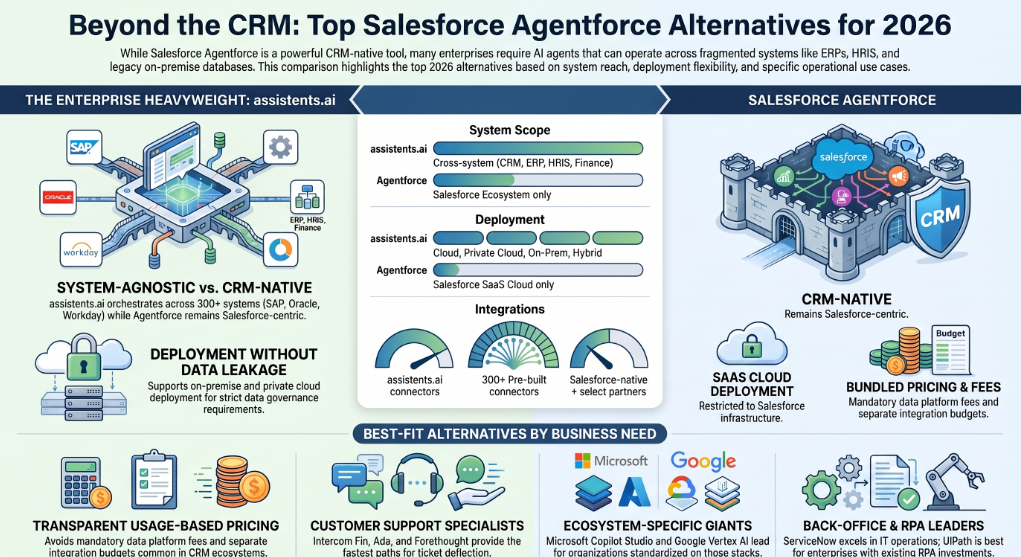
Platform scope — assistents.ai: cross-system across CRM, ERP, HRIS, and finance. Agentforce: Salesforce ecosystem only.
Voice AI — assistents.ai: full voice platform. Agentforce: basic, via Einstein Voice.
Deployment — assistents.ai: cloud, private cloud, on-premise, hybrid, and VPC. Agentforce: Salesforce cloud, SaaS only.
Integrations — assistents.ai: 300-plus pre-built connectors across any system. Agentforce: Salesforce-native plus selected partners.
Pricing — assistents.ai: transparent, usage-based, with an ROI calculator. Agentforce: three concurrent pricing models, with Data Cloud and integration costs billed separately.
See the full feature-by-feature breakdown at assistents.ai/compare/salesforce-agentforce.
- INTERCOM FIN — BEST FOR HIGH-VOLUME CUSTOMER SUPPORT DEFLECTION
Fin is a customer-support-focused resolution agent that plugs into Intercom, Salesforce Service Cloud, or other helpdesks, priced per resolved conversation. It is one of the faster options to launch when the Agentforce evaluation is narrowly about ticket deflection. Its scope stays within customer support; it is not designed to orchestrate work across ERP or back-office systems.
- ADA — BEST FOR MID-MARKET, HIGH-CHAT-VOLUME SUPPORT TEAMS
Ada is an established, CRM-agnostic customer service chatbot-to-agent platform with a long production track record and broad channel coverage. It is a reasonable evaluation candidate when the driving question is specifically about a support channel rather than enterprise-wide agent orchestration.
- FORETHOUGHT — BEST FOR COMBINED SOLVE, TRIAGE, AND QA IN ONE SUPPORT STACK
Forethought bundles resolution, triage, agent-assist, and quality assurance into a single support-focused platform using natural-language automation flows. Like Fin and Ada, its reach is bounded by the support use case rather than cross-departmental enterprise work, and it was acquired by Zendesk in 2026, which is worth factoring into a long-term platform decision.
- MICROSOFT COPILOT STUDIO — BEST FOR MICROSOFT-NATIVE ENTERPRISES
Copilot Studio is Microsoft's low-code agent-building platform, integrated with Microsoft 365, Teams, SharePoint, and the Power Platform. Enterprises already standardized on Microsoft 365 and Dynamics will find integration depth here that Agentforce cannot match on that side of the stack — though it carries its own form of ecosystem gravity, centered on Microsoft rather than Salesforce.
- SERVICENOW AI AGENTS — BEST FOR IT-OPERATIONS-FIRST ENTERPRISES
ServiceNow approaches agents from the operational-workflow side rather than the customer-relationship side, building on the Now Platform and its existing strength in IT service management. It is a credible alternative for enterprises whose highest-value automation opportunities sit in IT operations, employee services, and internal workflows rather than customer-facing processes. Where Agentforce's architecture is strongest in the front office, ServiceNow's is generally considered stronger in the back office.
- UIPATH AGENTIC AUTOMATION — BEST FOR RPA-HEAVY ENTERPRISES
UiPath extends its robotic process automation heritage into agentic orchestration, making it a natural next step for enterprises with substantial existing RPA investment that want to layer reasoning and adaptability on top of deterministic bots they already operate.
- GOOGLE VERTEX AI AGENT BUILDER — BEST FOR GCP-NATIVE ENTERPRISES
Vertex AI Agent Builder lets Google Cloud-native organizations build and deploy agents using Google's model and infrastructure stack. It is a strong fit where data and ML infrastructure already sit in GCP, though multi-cloud or hybrid environments add complexity outside that native context.
- IBM WATSONX ORCHESTRATE — BEST FOR REGULATED, IBM-ALIGNED ENTERPRISES
watsonx Orchestrate targets enterprises, often in regulated industries, that want agent orchestration with IBM's governance and compliance tooling built in. It is a reasonable fit for organizations already standardized on IBM's data and AI stack.
SALESFORCE AGENTFORCE VS ASSISTENTS.AI: HEAD-TO-HEAD
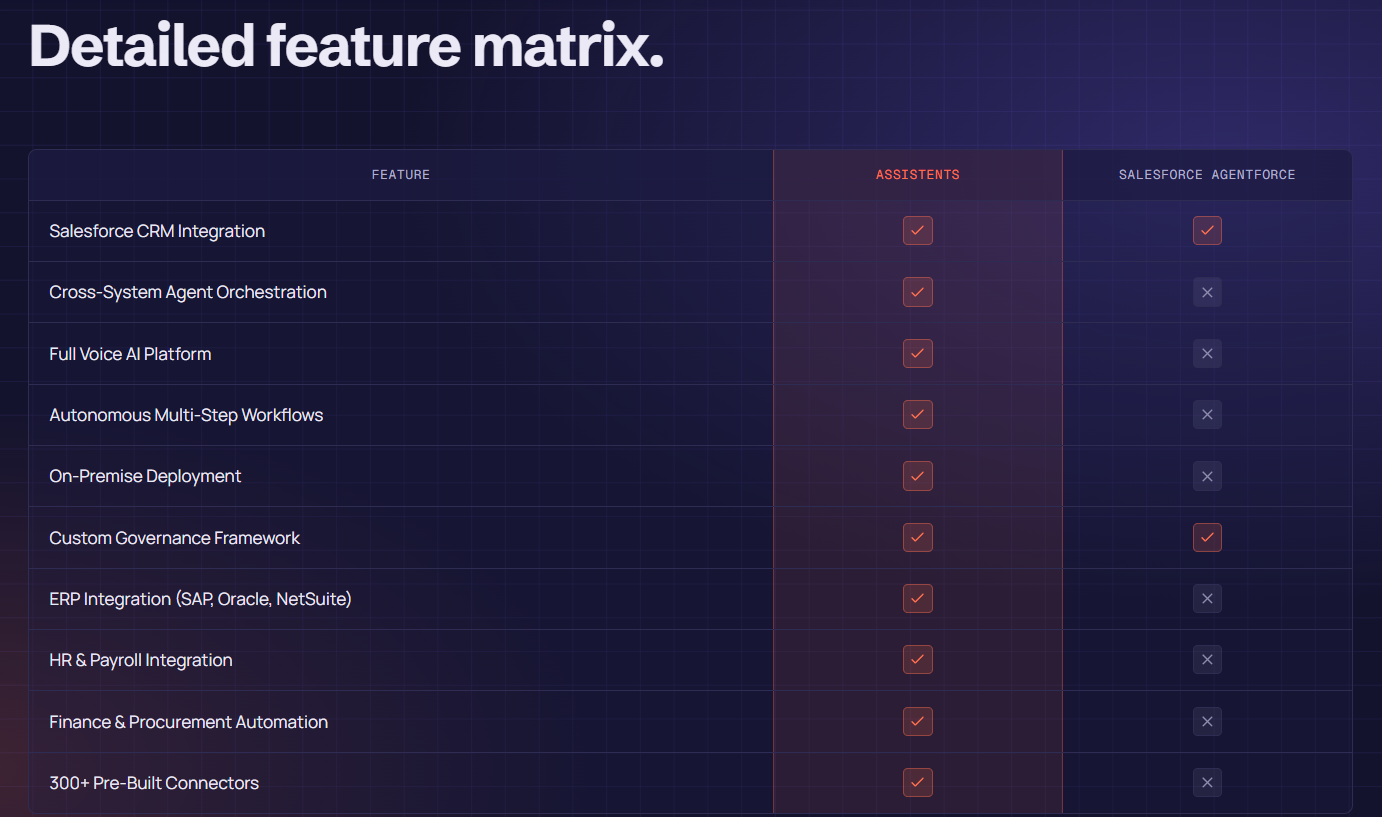
If the evaluation has narrowed to these two, here is the direct comparison.
Platform scope — assistents.ai covers CRM, ERP, HRIS, finance, and support in one system. Agentforce covers the Salesforce ecosystem only.
Cross-system orchestration — supported natively in assistents.ai; not supported in Agentforce without custom MuleSoft integration work.
Voice AI — a full voice platform plus conversational agents in assistents.ai, versus basic Einstein Voice in Agentforce.
Autonomous multi-step workflows — supported across systems in assistents.ai, versus supported within Salesforce in Agentforce.
Deployment — cloud, private cloud, on-premise, hybrid, and VPC in assistents.ai, versus Salesforce cloud SaaS only in Agentforce.
Governance — a custom governance framework applied across every connected system in assistents.ai, versus a custom governance framework scoped to Salesforce in Agentforce.
Pricing model — usage-based and transparent with an ROI calculator in assistents.ai, versus per-conversation, Flex Credits, or per-user pricing in Agentforce, with Data Cloud and integration costs billed separately.
WHERE AGENTFORCE GENUINELY WINS
If customer data, cases, and routing already live entirely inside Salesforce, Agentforce's native read-and-write access to CRM objects, deep Flow integration, and years of Einstein's predictive-model maturity are a real, tangible advantage. There is no integration tax when the entire workflow is already Salesforce-native, and enterprises with deep existing Salesforce investment and in-house admin expertise will generally find the shortest path to production there. A fair comparison has to acknowledge that.
CHOOSE ASSISTENTS.AI IF YOU:
Operate across multiple enterprise systems — Salesforce, SAP, Oracle, Workday, NetSuite, ServiceNow, and similar. Need voice AI capability beyond a basic add-on. Require on-premise, hybrid, or private cloud deployment for data governance reasons. Want a single governance model across the whole organization rather than one per system. Need agentic automation in finance, HR, procurement, or operations alongside — or instead of — CRM. Value pricing you can forecast before signing rather than after implementation.
CHOOSE SALESFORCE AGENTFORCE IF YOU:
Run your entire tech stack inside Salesforce. Have deep existing Salesforce and Einstein investment along with in-house admin expertise. Are solving primarily for sales, service, and customer engagement workflows. Prefer a fully vendor-managed SaaS model with Salesforce's support infrastructure behind it.
See the complete feature-by-feature comparison at assistents.ai/compare/salesforce-agentforce, or talk to the team about your specific systems at assistents.ai/contact.
WHICH ALTERNATIVE FITS YOUR ENTERPRISE — A DECISION FRAMEWORK
If your entire stack is Salesforce and your workflows are sales, service, or commerce — stay with Salesforce Agentforce.
If your operations span Salesforce plus SAP, Oracle, Workday, or ServiceNow, or you need on-premise deployment — assistents.ai is the fit.
If your entire stack is Microsoft 365 or Dynamics — Microsoft Copilot Studio.
If your heaviest automation need is IT operations or ITSM — ServiceNow AI Agents.
If you have significant existing RPA investment — UiPath Agentic Automation.
If your entire stack is Google Cloud — Vertex AI Agent Builder.
If your primary need is customer-support ticket deflection only — Intercom Fin, Ada, or Forethought.
If you're in a regulated industry with IBM-aligned infrastructure — IBM watsonx Orchestrate.
To get a better understanding, check https://assistents.ai/resources/enterprise-ai-buyer-guide
REAL ENTERPRISE RESULTS: CROSS-SYSTEM AI AGENTS IN PRODUCTION
These are anonymized, real production deployment patterns — evidence you can weigh against your own use case, not vendor claims from a demo environment. No client names are used.
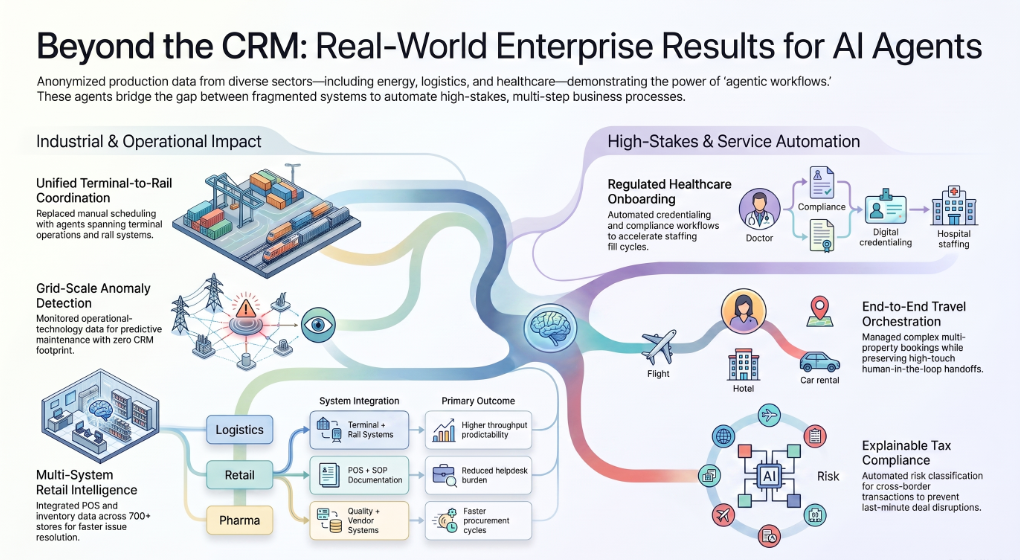
LOGISTICS AND PORTS. A global ports and logistics operator digitized its terminal-to-rail coordination, replacing manual scheduling and visibility gaps with an agentic workflow spanning terminal operations and rail scheduling systems — a cross-system workflow no CRM-native platform is built to touch. The result was higher predictability of terminal-to-rail throughput and more efficient coordination across terminal and inland logistics.
ENERGY AND UTILITIES. A state power transmission utility deployed agentic analytics for anomaly detection and predictive maintenance across its grid operations — entirely operational-technology data, with no CRM footprint at all. The result was faster identification of exceptions and operational risks, and more proactive grid operations through continuous monitoring and automated alerting.
RETAIL AT SCALE. A pan-India value retailer with more than 700 stores deployed a bilingual, Hindi-and-English voice support agent alongside a store-level inventory intelligence agent and a knowledge-and-training agent built on POS and SOP documentation — a single deployment spanning three different system types at once. The result was reduced manual helpdesk burden, faster store-level issue resolution, improved inventory visibility, and faster onboarding through on-demand training guidance.
REAL ESTATE AND DIVERSIFIED HOLDINGS. A large UAE real estate portfolio owner and manager unified structured and unstructured data — documents, policies, and system records — into one governed, auditable decision layer for leadership, rather than deploying a single-purpose chatbot. The result was a single operational view across entities, faster leadership reporting, and improved consistency of operational metrics.
HEALTHCARE STAFFING. A healthcare staffing platform automated talent onboarding, facility staffing intake, scheduling, and compliance workflows — regulated, multi-step, and auditable by design, spanning credentialing systems and scheduling tools together. The result was faster fill cycles, lower scheduling friction, and better workforce utilization.
LUXURY HOSPITALITY. A luxury hospitality brand operating boutique lodges and camps across multiple countries automated end-to-end travel booking — email intake, intent classification, real-time inventory checks across properties, alternative-date negotiation, and automated invoice generation — with a human-in-the-loop handoff preserved for curated itinerary creation. The result was faster booking turnaround, higher accuracy on complex multi-property guest requirements, and scalable operations that did not compromise the high-touch service the brand is known for.
PHARMACEUTICAL SOURCING. A pharma sourcing and excipients platform automated RFQ generation, supplier discovery, and procurement decision support across a catalog of thousands of SKUs — a workflow spanning quality documentation, vendor systems, and pricing data simultaneously. The result was faster procurement cycles, reduced vendor coordination overhead, and better price and lead-time competitiveness through continuous insight.
TAX AND CROSS-BORDER COMPLIANCE. A tax-technology platform focused on early screening of cross-border transactions automated source collection, risk classification, and escalation workflows for issues like withholding tax and VAT mismatches — evidence-based, explainable, and routed to human tax experts only when needed. The result was earlier detection of risk, fewer last-minute deal disruptions, and faster, more consistent pre-compliance review.
Each of these workflows sits outside what a CRM-native agent platform is architected to reach — which is precisely the gap most enterprises evaluating Salesforce Agentforce alternatives are trying to close.
KEY TERMS
Agentic AI — AI systems that can plan, take multi-step action, and adapt their approach as new information arrives, rather than simply answering a single question or following a fixed script.
Governed AI agent — an AI agent whose actions are constrained by identity checks, business rules, approval workflows, spending or contact limits, and audit logging, so that autonomous action remains accountable and reversible.
Cross-system orchestration — the ability of an AI agent platform to read data from, and take action across, multiple enterprise systems (CRM, ERP, HRIS, finance) within a single governed workflow, rather than being scoped to one system.
System of Agency — an emerging category of enterprise software that determines what work needs to be done, who or what should do it (human or AI agent), what context and authority apply, and whether the intended outcome was actually achieved — distinct from systems of record, systems of intelligence, and systems of automation.
BOTTOM LINE
Salesforce Agentforce is a well-built AI agent layer for enterprises whose operations already live entirely inside Salesforce. But most enterprises don't work that way — their highest-value automation opportunities sit in finance, procurement, HR, logistics, and operations systems that Agentforce was not built to reach without a separate integration investment and a second governance model.
For enterprises that need governed AI agents operating across their entire system landscape — not just their CRM — assistents.ai is built for exactly that, with deployment flexibility including on-premise and private cloud, and pricing you can forecast before you sign.
See the full assistents.ai vs Salesforce Agentforce comparison at assistents.ai/compare/salesforce-agentforce. Talk to the team about your systems at assistents.ai/contact.
FAQs
What is a good alternative to Salesforce Agentforce?
It depends on what is driving the evaluation. For enterprises whose operations span multiple systems — CRM, ERP, HRIS, finance — assistents.ai is built specifically for that cross-system, governed use case. For teams whose need is narrowly customer-support ticket deflection, options like Intercom Fin or Ada are worth evaluating. For Microsoft- or Google-native enterprises, Copilot Studio or Vertex AI Agent Builder align more naturally with existing infrastructure.
Is Salesforce Agentforce worth the cost?
For enterprises fully standardized on Salesforce, generally yes — native integration removes a layer of integration cost that alternatives would otherwise require. For enterprises whose workflows extend beyond Salesforce, total cost — agent usage, mandatory Data Cloud, and MuleSoft integration for cross-system reach — often exceeds what a system-agnostic platform would cost to cover the same scope.
Does Salesforce Agentforce work outside Salesforce?
Agentforce can be extended to non-Salesforce systems, typically through MuleSoft, but this requires additional integration engineering and cost. It is not natively cross-system in the way a platform purpose-built for multi-system orchestration is.
Can AI agents work across SAP, Oracle, Workday, and Salesforce together?
Yes. Platforms built for cross-system orchestration, such as assistents.ai, connect to 300-plus enterprise systems — including SAP, Oracle, Workday, NetSuite, and ServiceNow — through pre-built connectors, without requiring a separate integration platform for each system pairing.
Does Salesforce Agentforce support on-premise deployment?
No. Agentforce runs on Salesforce's own cloud infrastructure as a SaaS product. Enterprises that require on-premise, private cloud, or VPC deployment for data governance or regulatory reasons need a platform that supports those deployment models natively.
How much does Salesforce Agentforce actually cost?
Salesforce publishes a headline price of two dollars per conversation, or Flex Credits at five hundred dollars per hundred thousand credits, roughly ten cents per action. In practice, production deployments also require Data Cloud — typically sixty thousand to well over a hundred thousand dollars per year — and, for cross-system use cases, an integration layer such as MuleSoft, commonly one hundred fifty thousand dollars or more annually. The realistic total cost is significantly higher than the headline number for most enterprise deployments.
What is the difference between Agentforce and a governed cross-system AI agent platform?
Agentforce is an agent-building and deployment layer scoped to the Salesforce ecosystem. A governed, cross-system platform such as assistents.ai extends the same underlying principles — identity, permissions, business rules, approvals, and audit trails — across every connected enterprise system, not only CRM records, so one governance model covers the entire organization rather than one per system.
Is Agentforce the same as Einstein AI?
No, though they are related. Einstein is Salesforce's broader family of AI and predictive-analytics capabilities, built up over several years. Agentforce is Salesforce's newer, agent-specific layer that uses Einstein's underlying models and the Atlas reasoning engine to let agents plan, act, and adapt across multiple steps rather than return a single prediction or recommendation.
What should I evaluate beyond feature checklists when comparing Agentforce alternatives?
Total cost of ownership across all three cost layers (usage, data platform, integration), deployment flexibility for data governance requirements, whether governance and audit trails extend across every connected system or only one, and whether the vendor can show real, verifiable production deployments across more than one industry — not only pilot programs or single-customer case studies.