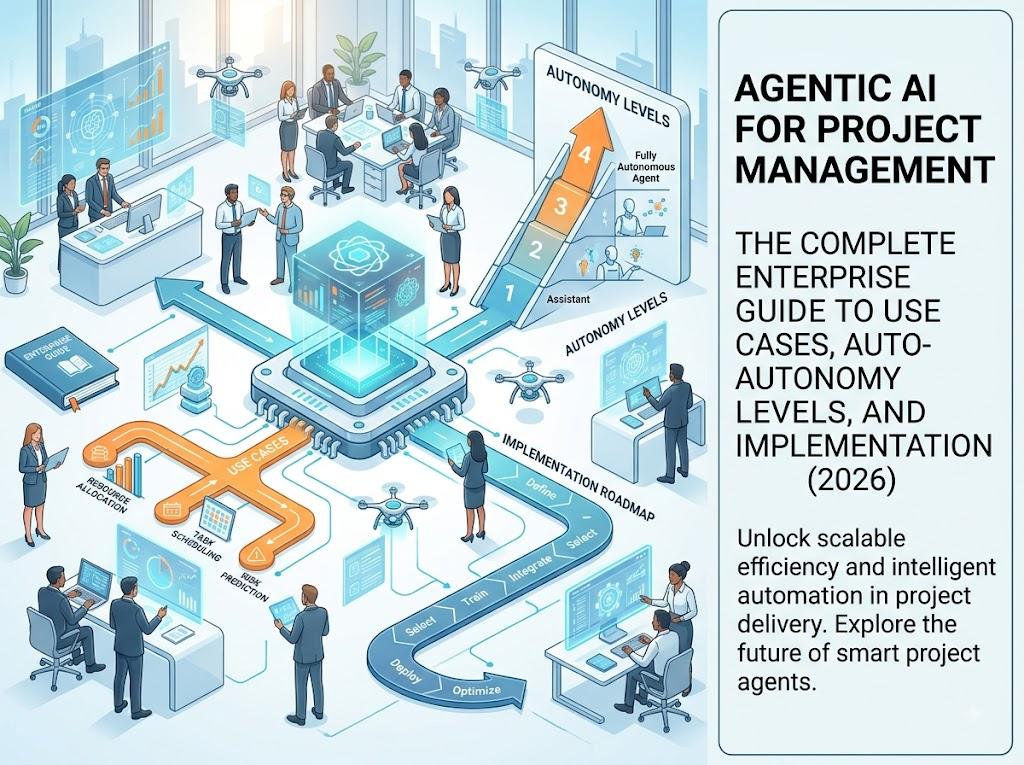
Agentic AI for project management is AI that doesn't just draft plans or summarise status. It continuously monitors project state, detects risks and slippage, decides what should happen next, executes those actions across the enterprise systems where project work actually lives, and escalates to humans when something falls outside its boundaries. The difference between AI you prompt and AI that acts is the difference between an assistant and a teammate — and in 2026, that distinction is reshaping how enterprises plan, deliver, and govern projects.
This guide explains what agentic AI means in a project context, how it differs from the generative AI already embedded in your PM tools, 12 concrete use cases across the project lifecycle, a three-level autonomy framework for adopting it safely, real enterprise deployment patterns, and how to evaluate platforms — including why a governed, cross-system approach outperforms tool-confined copilots.
Key takeaways
- Agentic AI moves project management from reactive tracking to proactive execution: agents detect problems, act within guardrails, and escalate exceptions rather than waiting to be asked.
- The biggest limitation of most "AI project management" features today is that they only see the data inside one tool. Real project truth is scattered across PM software, ERP, CRM, documents, email, and calls.
- Safe adoption follows the Ask → Execute → Autonomous ladder: start with conversational answers, graduate to gated actions, and expand autonomy only as evidence accumulates.
- Governance — permission-scoped actions, deterministic rules, approval gates, and audit trails — is what separates a production deployment from a stalled pilot.
- Project managers are not being replaced. The role is shifting from status administration to exception management, stakeholder leadership, and outcome ownership.
What is agentic AI in project management?
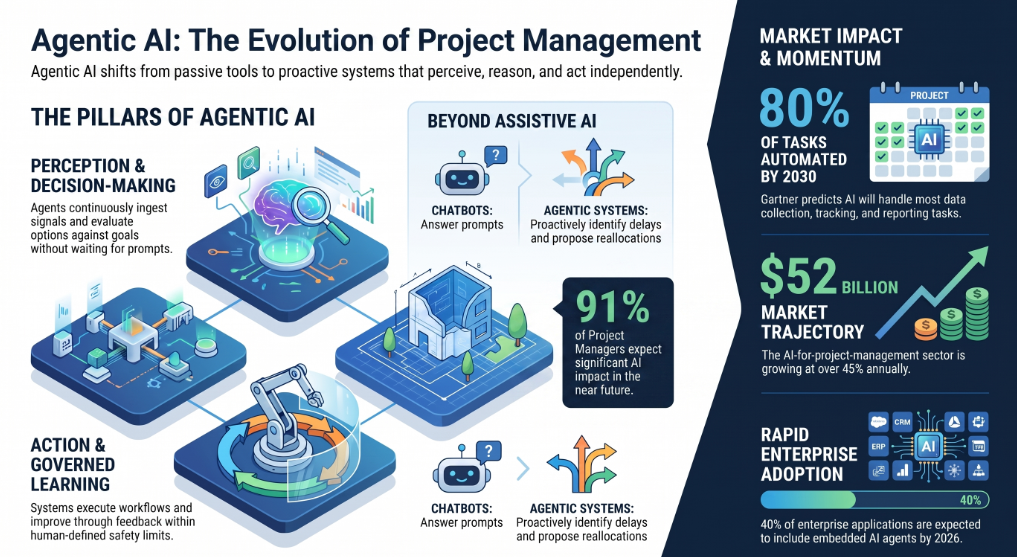
Agentic AI in project management refers to AI systems that pursue project goals with a degree of independence: they perceive what is happening across project data and connected systems, reason about what it means, take actions to keep delivery on track, and learn from the outcomes — all within boundaries that humans define.
That is a fundamentally different proposition from the AI most teams have used so far. A chatbot answers when asked. A dashboard displays what already happened. A generative assistant drafts a status report when you prompt it. An agentic system notices that a critical-path task has been idle for three days, checks whether the assignee is overloaded, models the downstream schedule impact, proposes a reallocation, drafts the stakeholder note, and routes the decision to the project manager for approval — without anyone asking it to look.
From tools that answer to agents that act
Four capabilities distinguish a genuinely agentic system from assistive AI:
- Perception. The agent continuously ingests signals — task states, budget burn, document changes, emails, meeting notes, system events — rather than waiting for a prompt.
- Decision-making. It evaluates options against goals, constraints, and rules: is this delay material, who should be informed, what mitigation is realistic.
- Action. It executes: updating records, creating tasks, sending communications, triggering workflows in downstream systems — subject to permissions and approvals.
- Learning within limits. It improves from feedback and outcomes, but under controlled conditions, so behaviour changes are deliberate rather than silent drift.
Remove any one of these and you have something useful but not agentic. A model that perceives and decides but cannot act is an analyst. One that acts without governed decision-making is a liability.
Why this matters now
The momentum behind agentic project management is not speculative. According to PMI research, 91% of project managers expect AI to have at least a moderate impact on project work. Gartner has projected that 80% of project management tasks — data collection, tracking, reporting — will be handled by AI by 2030, and separately predicted that 40% of enterprise applications would ship with embedded, task-specific AI agents by 2026, up from under 5% in 2025. Industry analyses put the AI-for-project-management market on a trajectory toward roughly $52 billion by 2030, growing at over 45% annually.
Behind those numbers is a simpler operational truth: project managers spend a large share of their week collecting updates, reconciling data between systems, compiling reports, and chasing people. That work is exactly what agents automate first — not because it is glamorous, but because it is structured, repetitive, and expensive.
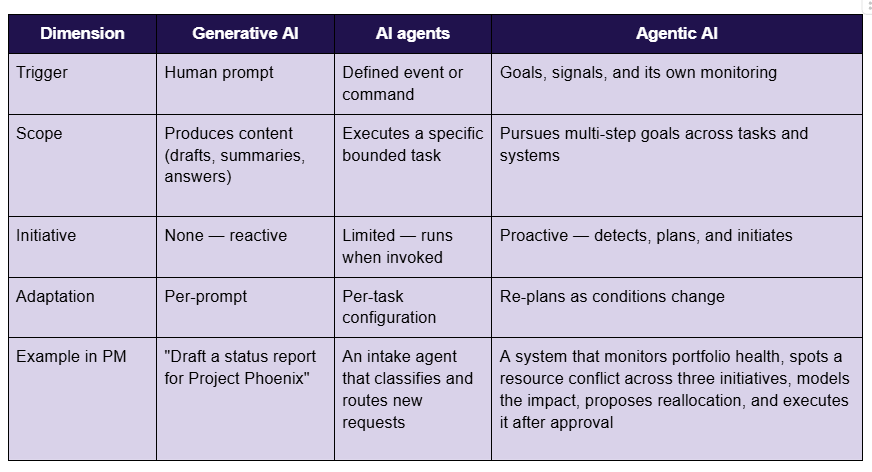
Agentic AI vs AI agents vs generative AI: what's the difference?
The three terms get used interchangeably, but they describe different levels of capability — and knowing the difference matters when you evaluate vendors, because almost everything is now marketed as "agentic."
A simple test: who notices the problem first?
If a human must notice the problem and ask the AI about it, you are using generative AI. If the AI runs a predefined check when triggered, you have an AI agent. If the system itself notices the emerging problem, decides it matters, and begins acting on it within its mandate — that is agentic AI. In project management, where the cost of a problem grows with every day it goes unnoticed, this distinction is not academic. It is the difference between a faster way to write reports and a structurally different way to run delivery.
Why traditional project management breaks — and where agents fit
The status-chasing tax
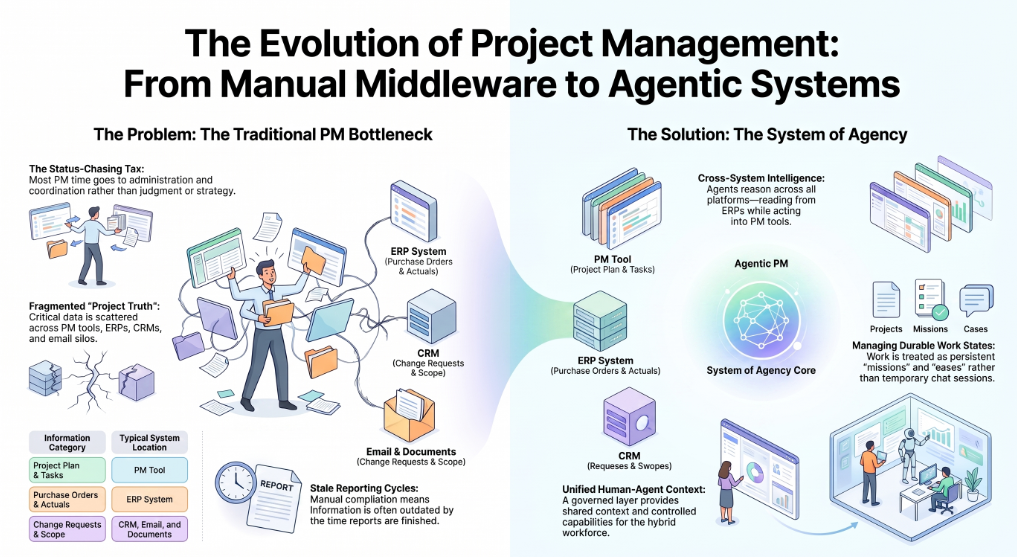
Ask any programme lead where the hours go. Not into planning or stakeholder strategy — into being human middleware. Collecting updates from six people in four tools. Re-keying data between the PM tool and the ERP. Turning meeting discussions into tasks that someone still has to create manually. Assembling the same weekly report from the same scattered sources. Studies of project work consistently find that a majority of a PM's time goes to administration and coordination rather than judgment. Every hour of that is an hour not spent on risk, scope, or people — and it is the single largest source of stale information in project reporting, because by the time the report is compiled, reality has moved.
Project truth is scattered
The deeper problem is architectural. The "project" as your PM tool sees it is a fraction of the project as it actually exists. The plan lives in the PM tool. The purchase orders and actuals live in the ERP. The client relationship and change requests live in the CRM and email. The contractual scope lives in documents. Commitments were made on calls and in meetings. Risks first show up as an anomaly in operational data, not as a row in a risk register.
This is why AI features confined to a single PM tool plateau quickly: they can only reason over the slice of reality that tool contains. An agent that can see the plan but not the ERP cannot tell you the budget is burning ahead of progress. An agent that can see tasks but not documents cannot tell you the change order contradicts the baseline scope. Agentic project management that works at enterprise level must operate across systems — reading from all of them, and acting into them with proper permissions.
Enterprise work needs durable state, not chat sessions
There is a third requirement that is easy to miss: project work is long-running, and model sessions are not. A project spans months; a conversation with an AI spans minutes. If the "memory" of what an agent is doing lives inside a chat thread, it evaporates.
Serious agentic project management therefore treats work itself as the central object. A goal-oriented body of work (reduce overdue receivables, deliver the migration programme) is a mission. A recurring operating cycle (monthly close, onboarding) is a process instance. A stateful, evidence-dependent situation (a supplier quality issue, a disputed change request) is a case. An atomic assignable unit (verify the document, obtain the approval) is a task. Each carries state — created, assigned, in progress, waiting, escalated, completed, outcome evaluated — independent of any AI session, along with commitments (who promised what by when) and exceptions (what deviated from the expected condition, and who must resolve it).
This is the thinking behind what we call a System of Agency: a governed layer above your existing systems that manages the work, gives humans and agents shared trusted context, lets agents act through controlled capabilities, and measures whether the intended outcome was actually achieved. Project management, viewed this way, is not a feature of a tool. It is the discipline of managing durable work across a hybrid workforce of people and agents — which is precisely what agentic AI platforms exist to do.
12 agentic AI use cases across the project lifecycle
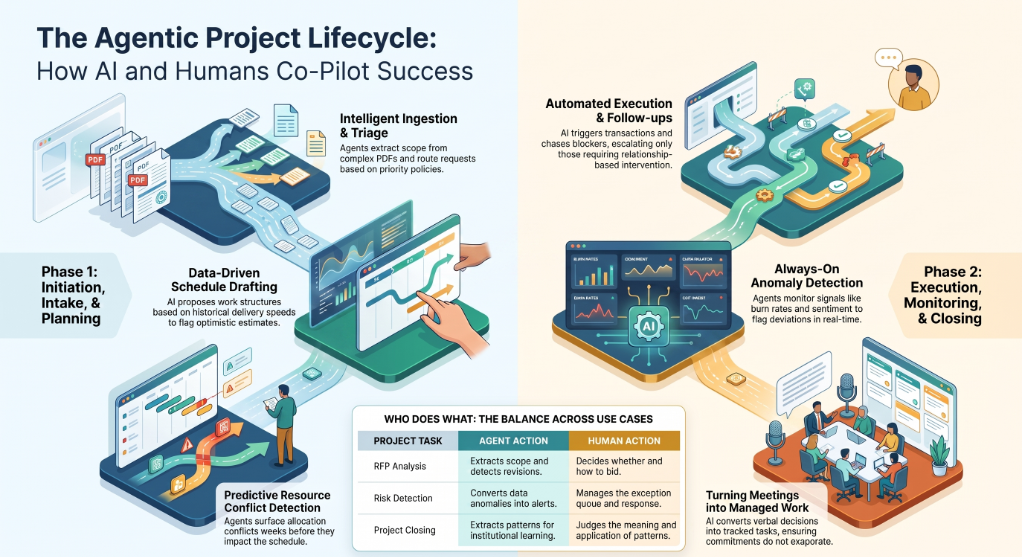
The most useful way to think about agentic AI use cases in project management is by lifecycle phase — because the value, the risk profile, and the right autonomy level differ at each stage. For each use case below: what the agent does, and what stays human.
Initiation and intake
1. Tender, RFP, and requirements ingestion. Document agents read incoming tenders, RFPs, statements of work, and requirement documents — including complex, inconsistently formatted PDFs — extract scope, deliverables, dates, commercial terms, and revisions, and load them into the operating systems where estimation and delivery begin. Revision detection matters as much as extraction: agents compare document versions and flag what changed between issue 3 and issue 4 of a tender, which is where bid risk hides. Human role: commercial judgment on whether and how to bid.
2. Intake triage and request routing. New project requests, change requests, and support demands arrive by email, form, and chat. An intake agent classifies them, checks completeness, gathers missing details conversationally, and routes each item to the right queue with priority attached. Human role: approving prioritisation policy; handling novel request types.
Planning
3. Draft plans and schedules from scope. Given extracted scope and historical delivery data, agents draft a work breakdown structure, propose durations grounded in how long similar work actually took, and flag estimates that look optimistic against history. Human role: owning the plan. The agent's draft is a starting point with evidence attached, not a decision.
4. Resource-conflict detection. Agents continuously check planned allocations against actual availability, other projects' demands, and calendars — surfacing conflicts weeks before they become schedule slips, and proposing reallocation options with modelled impact. Human role: making the trade-off call between competing projects.
Execution
5. Cross-system transaction execution. When project events trigger downstream transactions — a milestone that should generate an invoice, an approved requirement that should become an ERP order, a resourcing decision that should update the staffing system — agents interpret the trigger, validate the data against business rules, create the transaction in the system of record, and log the action for reconciliation. Exceptions route to humans; clean cases flow through. Human role: defining the rules; approving exceptions.
6. Blocker chasing and follow-ups. The unglamorous heart of delivery: the approval that has sat for four days, the supplier who has not confirmed, the dependency owned by another team. Agents track every open commitment, send escalating reminders through the right channel, and raise an exception when a commitment is at risk of breaching. Human role: intervening on escalations that need authority or relationship judgment.
Monitoring and control
7. Always-on risk and anomaly detection. Instead of humans scanning dashboards, agents watch the signals — burn rate versus progress, velocity trends, aging tasks, sentiment in updates, operational data anomalies — and convert deviations into structured exceptions with severity, impact, and a recommended response. Enterprises already run this pattern for competitive monitoring, grid operations, and procurement KPIs; applying it to project health is the same architecture pointed at delivery data. Human role: managing the exception queue rather than reviewing everything.
8. Predictive slippage and budget alerts. Agents forecast completion dates and cost-at-completion from current trajectory, and alert when the forecast crosses a threshold — before the milestone is missed, not after. Human role: deciding on mitigation; communicating with sponsors.
Stakeholder communication
9. Automated status reporting. Agents compile status from live system state — not from a Friday-afternoon email chase — and generate audience-appropriate reports: detailed for the delivery team, exception-focused for the steering committee. Reports cite their sources, so a number can always be traced to the record behind it. Human role: adding narrative judgment; owning the message.
10. Voice agents for status collection and confirmations. Some project information only exists in people's heads or on the phone: a field team's progress, a supplier's delivery confirmation, a contractor's availability. Voice AI agents place and receive these calls in natural conversation — with sub-300ms response latency and support for 40+ languages — capture the answers, and write structured outcomes back into project systems, escalating to a human mid-call when needed. For distributed and field-heavy projects, this closes the largest data gap in project reporting. Human role: handling calls that need negotiation or authority.
11. Meetings into managed work. Agents turn meeting outcomes into tracked tasks and commitments with owners and dates — so decisions made verbally stop evaporating between meetings. Human role: confirming the commitments are real.
Closing
12. Outcome evaluation and lessons capture. After delivery, agents compare planned versus actual across schedule, cost, and scope; assemble audit-ready documentation; and extract patterns from the project record into institutional knowledge that improves the next plan's estimates. Closing stops being a neglected administrative phase and becomes the input to organisational learning. Human role: judging what the patterns mean.
Across all twelve, notice the consistent shape: agents handle the routine flow; humans handle exceptions, trade-offs, and accountability. That shape is not incidental — it is the operating model that makes autonomy safe, and it deserves its own framework.
The Autonomy Ladder: Ask → Execute → Autonomous
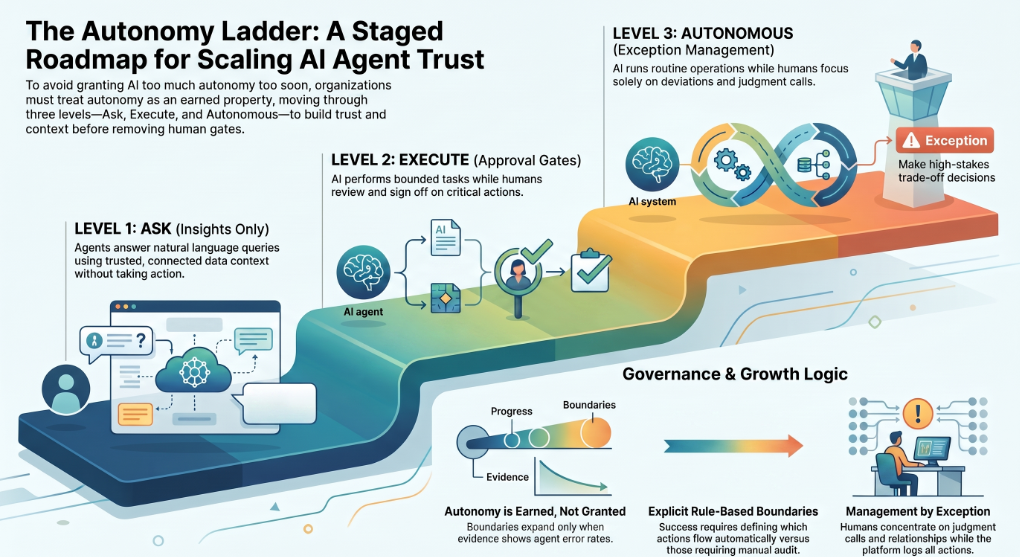
The most common failure mode in agentic AI adoption is a mismatch between ambition and trust: either an organisation grants autonomy before it has evidence the agent deserves it, or it keeps every action behind manual review forever and never captures the value. The Ask → Execute → Autonomous ladder resolves this by making autonomy an earned, staged property rather than a binary switch.
Level 1 — Ask
Agents answer questions and surface insight, but take no actions. Project teams query live project state in natural language — "which milestones are at risk this month and why," "where is actual spend running ahead of progress" — and receive governed, source-cited answers drawn from connected systems. Monitoring agents raise alerts, but every response to an alert is human.
Level 1 delivers immediate value (no more waiting for the weekly report; no more BI request queue) while building the two assets every later level depends on: trusted connected context, and organisational confidence that the system's answers are accurate.
Level 2 — Execute
Agents perform bounded actions with approval gates. They draft the status report and send it after sign-off. They prepare the ERP transaction and post it once approved — or post it automatically when it passes deterministic validation rules, routing only failures to humans. They chase blockers autonomously but escalate before anything customer-facing goes out.
The critical design element at Level 2 is the gate placement: which action classes flow automatically, which require approval, and which are prohibited to agents entirely. These boundaries should be explicit, rule-based, and auditable — not left to model judgment.
Level 3 — Autonomous
Agents run routine project operations end-to-end, and humans manage by exception. Intake is triaged, plans are updated, transactions are posted, reports are issued, follow-ups are chased — automatically, within a bounded operating contract. Human attention concentrates on the exception queue: the deviations, the judgment calls, the trade-offs, the relationships. Every agent action remains logged, attributable, and reversible where the underlying system allows it.
This is exception-managed project delivery: not "AI runs the project," but "AI runs the routine, humans run the exceptions, and the platform proves what happened." Autonomy at this level is not granted by configuration; it is earned by track record — an agent's boundary expands when the evidence from Levels 1 and 2 shows its error rate is lower than the process it replaced.
The ladder also gives leadership a shared vocabulary. "We are at Execute for reporting and Ask for financials" is a governance statement everyone can understand — and a roadmap everyone can see.
What agentic project management looks like in practice
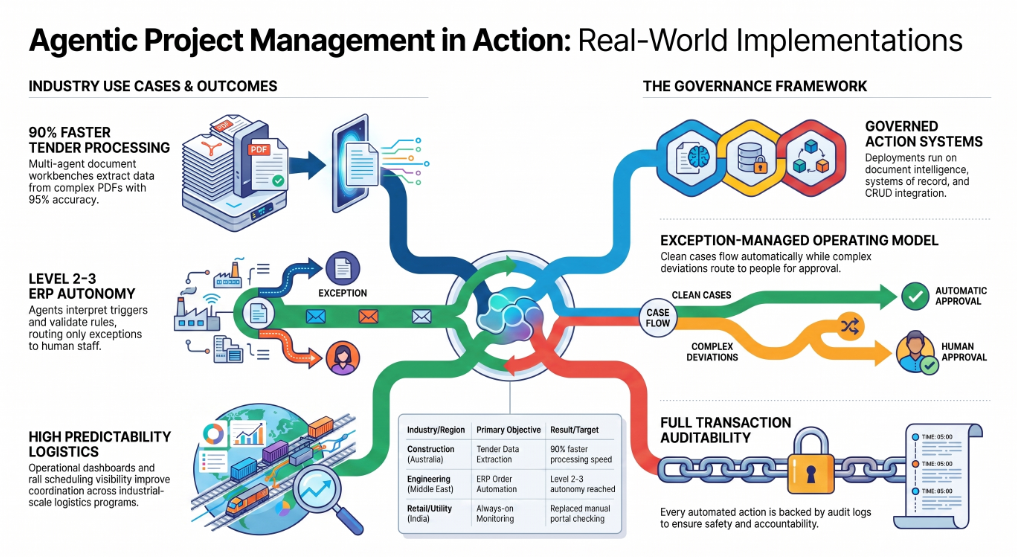
Frameworks are only as credible as the deployments behind them. The patterns below are drawn from real enterprise implementations delivered on the same platform primitives that agentic project management runs on — document intelligence, governed actions in systems of record, exception queues, and audit trails. Clients are described by industry and geography only; outcome figures are engineering targets and directional results from those engagements, not guaranteed benchmarks.
Multi-agent tender processing for a remedial construction specialist (Australia). A commercial works and remediation business dealt with a constant inflow of complex, inconsistently formatted tender documents — the intake phase of every project. A multi-agent document workbench was deployed to retrieve tenders, determine the correct workflow, extract structured data from complex PDFs using vision-capable models, detect revisions between document versions, and synchronise validated results into the company's core operational system with full create-read-update-delete integration, quote locking, and audit logs. The system was engineered for up to ~90% faster tender document processing, with an extraction-accuracy target of ~95% on standard formats — and, just as importantly for bid risk, automatic detection of what changed between tender revisions.
Agentic ERP order automation for an engineering and technology group (Middle East). Facing the end of life of a legacy document-workflow product, the group replaced manual order processing with agents that interpret order triggers, validate them against business rules, and create sales orders directly in the ERP — with governed exception handling, approval routing, reconciliation reporting, and audit logs. The result pattern: a faster order-to-confirmation cycle, fewer data-entry errors, and full auditability of every automated transaction. This is Level 2–3 of the autonomy ladder in production: clean cases flow automatically; exceptions route to people.
Terminal and rail operations digitisation for a global ports and logistics operator. Port-to-inland logistics is programme management at industrial scale: schedules, dependencies, exceptions, and coordination across parties. Workflow digitisation with operational dashboards, rail scheduling visibility, and exception management gave the operator higher predictability of terminal-to-rail throughput and faster coordination — the exception-managed operating model applied to physical operations.
Always-on monitoring for a pan-India value retailer and a state power transmission utility. In both cases, agents continuously watch operational signals — competitive pricing and availability across channels in one; grid KPIs, losses, and outage indicators in the other — and convert deviations into governed alerts and routed actions, replacing manual portal-checking and dashboard-watching. The identical architecture, pointed at project telemetry instead of market or grid data, is use case 7 above.
The common thread: none of these organisations bought "a project management feature." They deployed governed agents against the systems where their work lives — and the disciplines that made those deployments safe (rules, approvals, exception queues, audit) are exactly the disciplines agentic project management requires.
Governance: the difference between a pilot and production
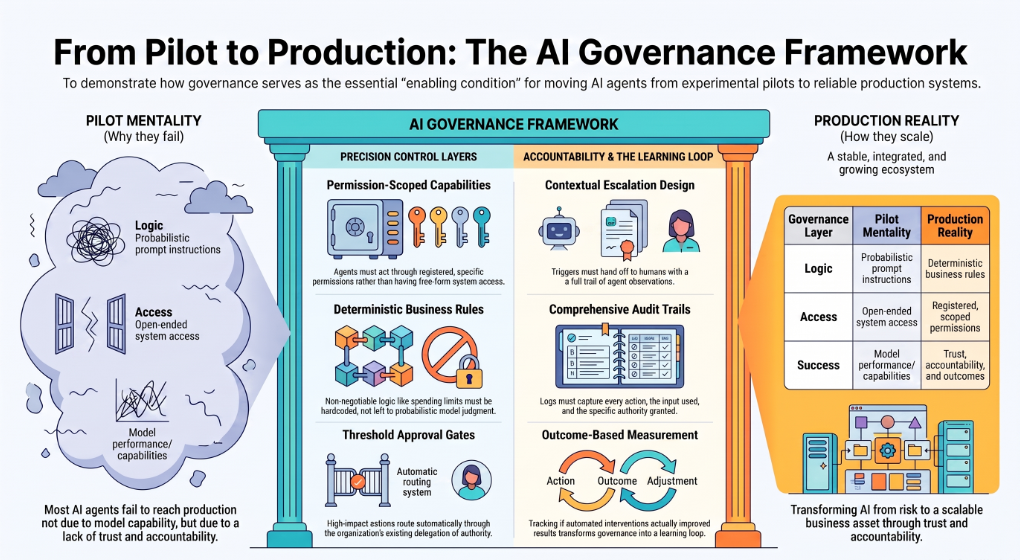
Most agentic AI pilots do not fail on model capability. They fail on trust: security won't approve system access, finance won't allow automated transactions, and leadership can't answer "what exactly can this thing do, and who is accountable when it does it?" Governance is not a brake on agentic project management — it is the enabling condition.
Permission-scoped actions and approval gates
Every agent should act through registered, permission-scoped capabilities — not free-form access. An agent that updates schedules has no path to touch payments. Actions above defined thresholds (budget impact, external communication, contractual commitments) route through approval gates matched to the organisation's existing delegation of authority. The question "what can this agent do?" should have a precise, inspectable answer.
Deterministic rules for what must never be probabilistic
Some logic should never be left to model judgment: spending limits, compliance conditions, sequencing constraints, regulatory thresholds. These belong in deterministic business rules that gate agent behaviour — evaluated identically every time, versioned, and testable. The agent brings flexibility to ambiguous work; the rules bring certainty to non-negotiable boundaries. Mature platforms treat this as a first-class layer, not a prompt instruction.
Human-in-the-loop and escalation design
Escalation is a design discipline, not a fallback. Define what triggers a handoff (confidence below threshold, policy rule, counterparty request, novel situation), who receives it, what context travels with it, and what happens if the human doesn't respond in time. A well-designed escalation arrives with the full trail — what the agent observed, what it did, why it stopped — so the human decision takes minutes, not an hour of reconstruction.
Audit trails and outcome measurement
Every agent action should be logged with what was done, by which agent, on whose authority, based on what input. That satisfies auditors — but the deeper value is improvement: connecting actions to outcomes lets you answer the question most automation programmes never ask: did the intervention work? Did the early risk alert actually prevent the slip? Did automated follow-ups improve on-time completion? Outcome measurement turns governance from a compliance cost into the platform's learning loop — and it is how agents earn their next rung on the autonomy ladder.
How to implement agentic AI in project management: a 30/60/90 plan
The organisations that succeed with agentic project management do not attempt a big-bang transformation. They pick one painful loop, prove value at low risk, and expand autonomy on evidence.
Days 0–30: connect and Ask
Choose one high-friction, low-risk loop — status reporting and intake triage are the usual candidates, because the pain is universal and the actions are reversible. Connect the systems that hold the relevant truth: the PM tool, the data warehouse or ERP views, the document store. Deploy at Ask level: conversational answers over live project state, plus monitoring alerts. Success in this phase is measured in trust — are the answers accurate, sourced, and faster than the old path?
Days 31–60: graduate to Execute
Add gated actions to the proven loop: report generation with approval, follow-up chasing with escalation rules, intake routing with human confirmation on non-standard cases. Define the gate map explicitly — auto-flow, approve-first, prohibited. Measure hard numbers against the pre-agent baseline: cycle time from event to report, percentage of updates collected without human chasing, triage turnaround, error rates.
Days 61–90: expand autonomy on evidence
Where 30–60 day evidence shows agent error rates at or below the human baseline, widen the auto-flow classes and reduce approval friction. Write the exception policies: severity definitions, escalation targets, response-time expectations. Put production guardrails in place — deterministic rules, audit reporting, rollback procedures — and take the second use case into Days 0–30 of its own cycle.
What to measure
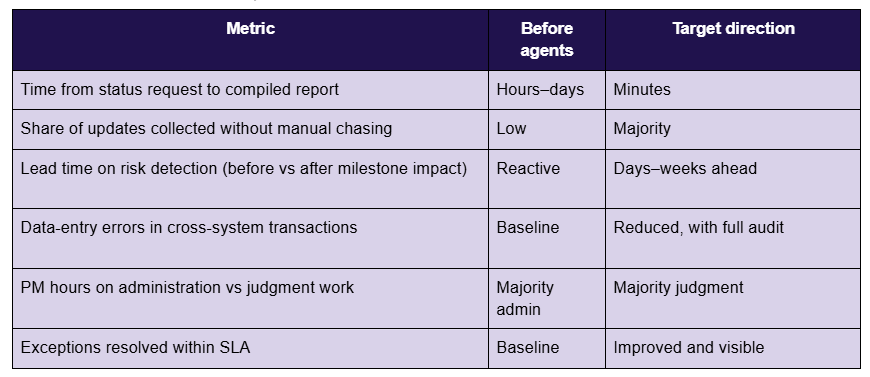
The discipline that matters most: never expand autonomy without the measurement to justify it. The ladder only works if each rung produces evidence.
How to evaluate agentic AI platforms for project management
The market now offers three genuinely different categories, and most evaluation mistakes come from comparing across them as if they were interchangeable.
PM-tool copilots (the AI in Wrike, Atlassian, Asana, monday.com and similar) are excellent at improving work inside those tools — summaries, risk flags on tool data, intake automation. If your project reality lives substantially in one tool, they are the fastest path to value. Their ceiling is structural: they cannot see or act on the ERP, the documents, the calls, or the email where the rest of the project lives.
Horizontal agent builders and automation frameworks give technical teams maximum flexibility to assemble agents, but leave the enterprise plumbing — governance, audit, tenant isolation, approval gates, durable work state — as your engineering problem. Powerful for experiments; expensive to make production-safe.
Governed enterprise agentic platforms provide the agent capabilities and the control plane: cross-system context, orchestration, rules, approvals, audit, and deployment control. This is the right category when project work spans systems, when compliance and auditability are non-negotiable, and when you intend to move up the autonomy ladder rather than stay at drafting assistance.
Whatever the category, evaluate against these criteria:
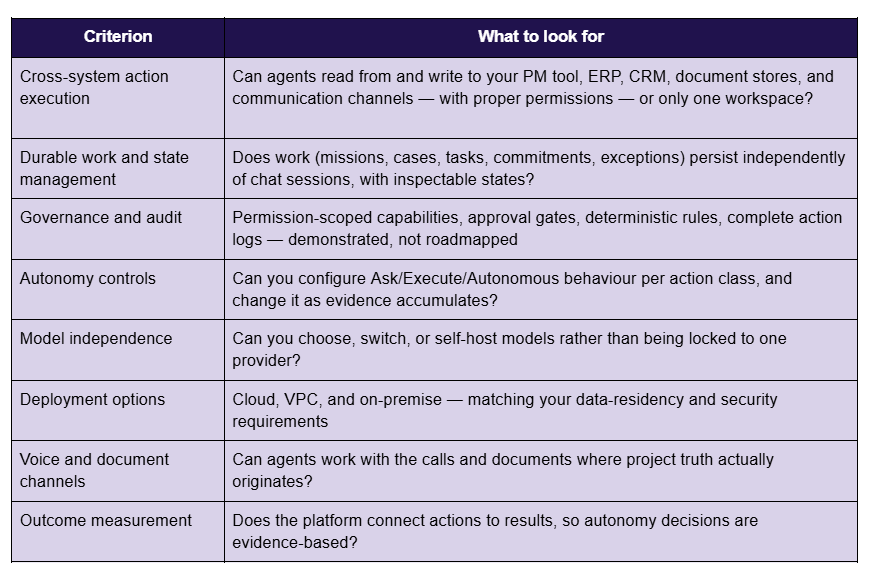
Ask every vendor one revealing question: "Show me the audit trail for an action an agent took in a system outside your own product." The answer separates the categories faster than any feature matrix.
Why assistents.ai for agentic project management
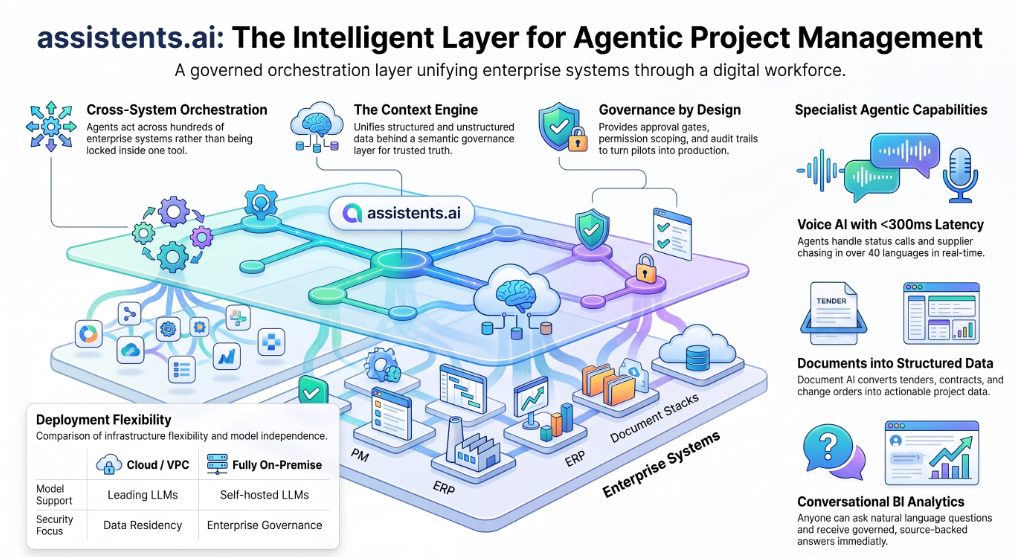
assistents.ai is a governed enterprise agentic intelligence platform — a context, governance, decisioning, and action layer that sits above the systems where your project work already lives. Rather than replacing your PM tool, ERP, or document stack, it gives you a digital workforce that operates across them.
Agents that act across systems, not inside one tool. The Agent Builder and Workflow Builder let teams create agents and multi-step automations without code, connected to hundreds of enterprise systems — so a milestone in the plan can trigger a validated transaction in the ERP, and a signal in operational data can become a routed exception in the delivery queue.
Trusted context for every agent and every human. The Context Engine unifies structured and unstructured project truth — plans, tenders, contracts, tickets, emails, historical delivery data — behind a semantic governance layer, so agents act on the same trusted state your teams see, with consistent metric definitions rather than conflicting numbers.
Multi-agent orchestration for real delivery loops. Agent Orchestration coordinates specialist agents — intake, planning, monitoring, reporting, follow-up — into governed end-to-end loops, including the human handoffs that real projects require.
Governance by design, not bolted on. Agent Governance provides the approval gates, permission scoping, deterministic rules, and audit trails described throughout this guide — the control plane that turns pilots into production.
Voice as a first-class project channel. Voice AI agents make and take calls with sub-300ms latency in 40+ languages — collecting field status, confirming supplier deliveries, chasing approvals by phone — executing real-time actions during the call and handing off to humans with full context when judgment is needed.
Documents into structured project data. Document AI turns tenders, contracts, change orders, and specifications into structured, actionable data — the intake capability behind the tender-processing deployment described above.
Answers without the BI queue. Business Intelligence with conversational analytics lets anyone ask project questions in natural language and get governed, source-backed answers, with automated KPI monitoring and exception alerting running continuously underneath.
Your infrastructure, your models. Deploy in the cloud, your VPC, or fully on-premise, with model independence across leading and self-hosted LLMs — so the platform meets your security and data-residency requirements rather than the other way around.
Why enterprises choose assistents.ai over PM-tool copilots
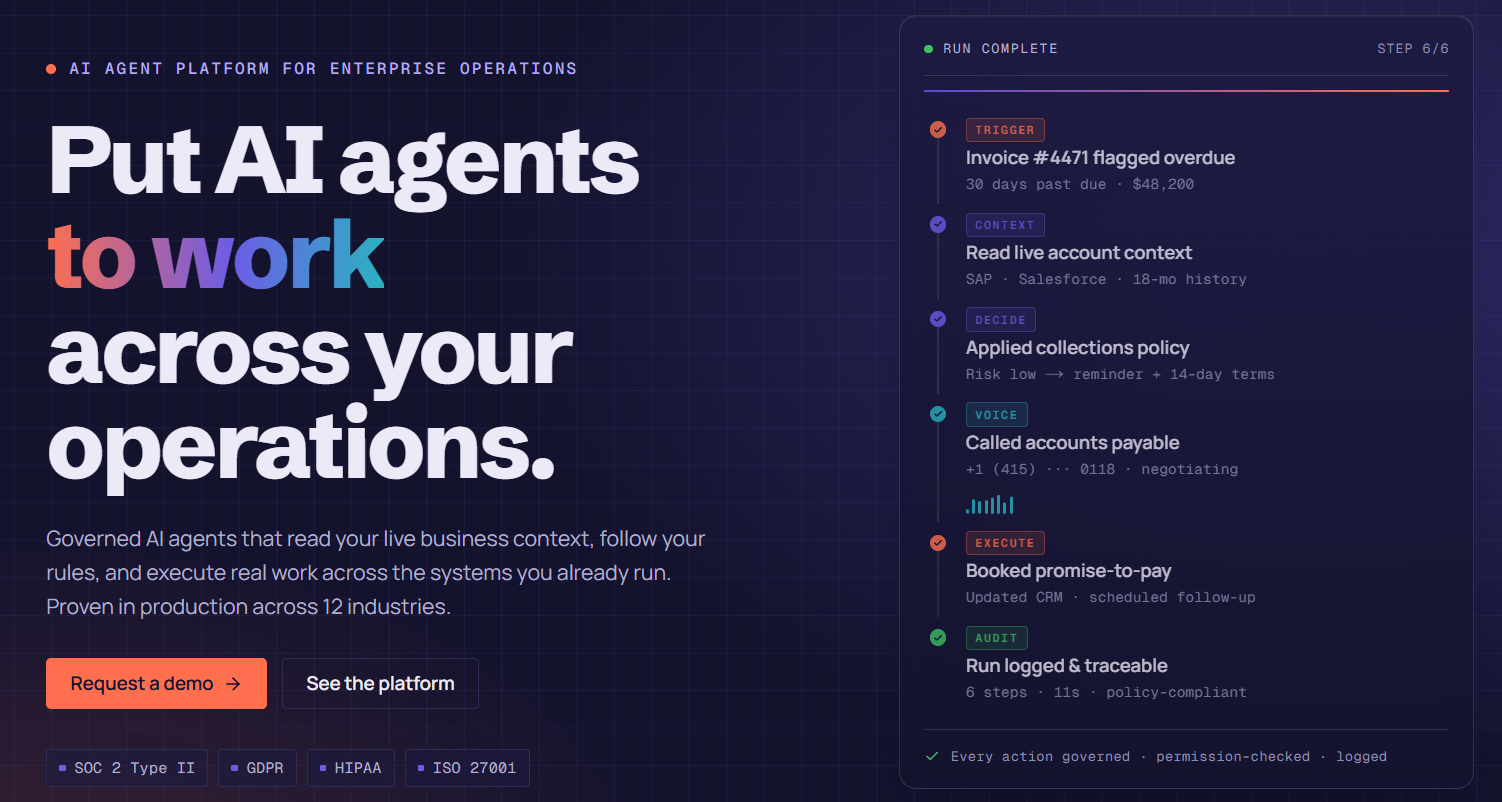
Copilots summarise; a System of Agency executes. The AI inside a PM tool can only reason over that tool's data. assistents.ai agents operate where enterprise project work actually happens — across the ERP, CRM, documents, email, and voice — and act into those systems with governed permissions. The difference shows up the first time a project problem originates outside the PM tool, which, in practice, is where most of them originate.
Autonomy you govern, not autonomy you hope for. The Ask → Execute → Autonomous ladder is built into how the platform operates: autonomy is configured per action class, gated by deterministic rules and approvals, and expanded on evidence. You always have a precise answer to "what can our agents do, and who approved it."
Exception-managed delivery instead of universal review. The platform's work model — durable missions, cases, tasks, commitments, and exceptions with inspectable states — means humans stop reviewing everything and start managing only what deviates, with the full trail attached. That is where the step-change in PM capacity comes from.
Proven enterprise delivery patterns. The same primitives have been deployed in production across construction, engineering, ports and logistics, retail, and utilities — from multi-agent tender processing engineered for up to ~90% faster document handling, to governed ERP transaction automation with full audit, to always-on monitoring that replaced manual checking. These are delivery patterns, not demo scenarios.
Enterprise deployment reality. On-premise and VPC options, model independence, tenant isolation, and role-based access meet the requirements that rule out most SaaS copilots in regulated and security-conscious environments.
The honest guidance: if your project world genuinely fits inside one PM tool, use that tool's copilot. The moment your delivery depends on what happens in the ERP, in documents, on calls, and across teams — you need a platform built for that reality.
Will AI replace project managers?
No — but it will decisively change what the job is. Gartner's projection that 80% of project management tasks will be handled by AI by 2030 is a statement about tasks, not roles. The tasks being automated — data collection, tracking, reporting, chasing — are the ones project managers consistently describe as the least valuable use of their time. What cannot be automated is what the role was always supposed to be about: accountability for outcomes, stakeholder leadership, negotiating trade-offs, judgment on ambiguous exceptions, and the trust that makes teams follow a plan.
The new PM skill set
The project managers who thrive alongside agentic AI develop three capabilities. Agent supervision: defining what agents do, reviewing their performance evidence, and deciding when to expand their autonomy — managing digital team members with the same seriousness as human ones. Exception judgment: operating from an exception queue rather than a status grid, which concentrates the work into precisely the decisions that need human authority. Autonomy governance: fluency in the rules, gates, and audit mechanisms that make delegation to agents safe — because in the agentic era, governance design is project management design.
The role becomes smaller in administration and larger in leadership. For most project managers, that is not a threat. It is the version of the job they wanted in the first place.
FAQs
What is agentic AI in project management?
Agentic AI in project management is AI that autonomously monitors project state, detects risks, decides on next actions, executes them across connected enterprise systems within human-defined guardrails, and escalates exceptions to people. Unlike generative AI, which responds to prompts, agentic AI takes initiative toward project goals.
How is agentic AI different from AI agents?
An AI agent typically performs a specific bounded task when triggered — classifying a request, drafting a report. Agentic AI describes systems that pursue multi-step goals with initiative: monitoring continuously, planning, acting across systems, and adapting as conditions change. In practice, agentic systems coordinate multiple specialised agents.
How is agentic AI different from generative AI?
Generative AI produces content on request — plans, summaries, reports. Agentic AI acts: it notices the problem without being asked, decides what to do, executes within guardrails, and reports what it did. Generative capability is one component inside an agentic system, not the same thing.
Will AI replace project managers?
No. Analyst projections that most PM tasks will be automated by 2030 refer to administrative tasks — tracking, reporting, data collection. The role shifts toward exception management, stakeholder leadership, agent supervision, and outcome accountability, which remain human responsibilities.
What are examples of agentic AI in project management?
Examples include multi-agent tender and document ingestion into operational systems, automated ERP transaction creation from project triggers with rules and approvals, always-on risk and anomaly monitoring with exception routing, automated status reporting from live system state, and voice agents that collect field updates and supplier confirmations by phone.
How do you implement agentic AI in project management?
Start with one painful, low-risk loop such as status reporting or intake triage. Run 30 days at "Ask" level (answers only), 30 days at "Execute" (gated actions), then expand autonomy where measured error rates beat the human baseline. Define approval gates, deterministic rules, and exception policies before widening scope.
What are the risks of agentic AI in project management?
The main risks are ungoverned actions, silent errors compounding at machine speed, unclear accountability, and data-access overreach. All four are mitigated by permission-scoped capabilities, approval gates, deterministic rules for non-negotiable logic, complete audit trails, and staged autonomy expansion based on evidence.
Can AI create a project plan?
Yes — agentic systems can draft a work breakdown structure, propose schedules grounded in historical delivery data, and flag optimistic estimates. The draft is a starting point with evidence attached; plan ownership and trade-off decisions remain with the project manager.
What is the best AI agent platform for project management?
It depends on where your project work lives. If it fits inside one PM tool, that tool's copilot is the fastest path. If delivery spans ERP, CRM, documents, email, and calls — and governance and auditability matter — a governed enterprise agentic platform such as assistents.ai, which acts across systems with approval gates and audit trails, is the stronger fit.
What skills do project managers need in the AI era?
Agent supervision (defining, reviewing, and expanding agent responsibilities), exception judgment (managing from a deviation queue rather than a status grid), autonomy governance (designing rules, gates, and escalation), plus the enduring human skills: stakeholder leadership, negotiation, and outcome ownership.
What is an AI PMO?
An AI PMO is a project management office that runs on a hybrid workforce: agents handle intake, monitoring, reporting, and follow-ups continuously across the portfolio, while humans set standards, manage exceptions, govern agent autonomy, and own outcomes — turning the PMO from a reporting function into an execution capability.
Can agentic AI work with our existing tools like Jira, SAP, or Microsoft Project?
Yes — that is the defining requirement. A cross-system agentic platform connects to existing PM tools, ERPs, CRMs, document stores, and communication channels, reading state from them and acting into them with scoped permissions, rather than requiring you to migrate project work into a new tool.