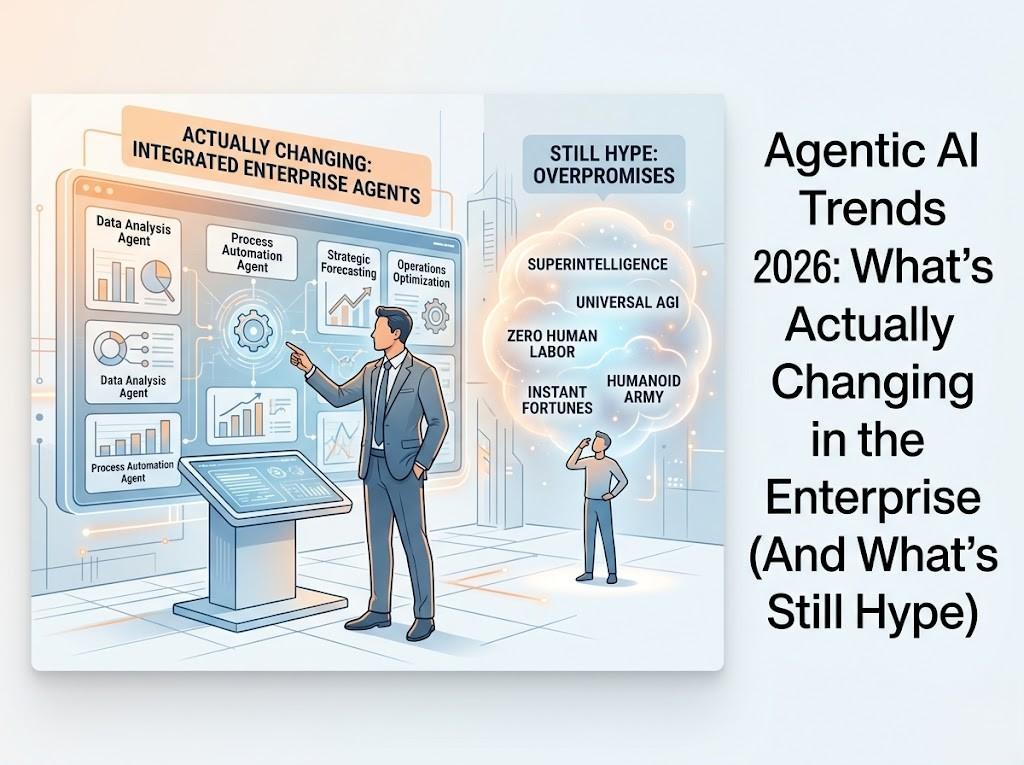
Search "agentic ai latest trends" this week and you'll find a dozen nearly identical lists: seven trends here, ten there, fifteen somewhere else, each leaning on the same handful of analyst quotes. What most of them skip is the harder question — which of these trends are enterprises actually running in production today, and which are still slide-deck predictions?
Here's the short version: in 2026, the biggest agentic AI trends are less about smarter models and more about control. Enterprises are moving AI agents out of isolated copilot windows and into a governed digital workforce, where identity, permissions, and outcome tracking get treated as seriously as the AI itself.
That's the thread running through the nine shifts below. None of them are speculative.
Each is grounded either in third-party research (cited, not guessed at) or in real production deployments across finance, retail, logistics, healthcare, and a dozen other industries — described here without client names, because confidentiality matters more than a name-drop.
In short — the 9 agentic AI trends actually reshaping the enterprise in 2026:
- AI agents are becoming digital workers, not just assistants
- Agent identity and governance are becoming the real control point
- Multi-agent orchestration is replacing the single do-everything agent
- The industry is converging on a missing category — and naming it differently
- Autonomy is becoming a maturity ladder, not an on/off switch
- ROI measurement is getting formalized — "trust me" is no longer enough
- Vendors are packaging agents as outcome-owning teams, not single tools
- Data quality, not model capability, is the real adoption bottleneck
- "Land and prove" is beating big-bang transformation
Let's go through each.
1. AI agents are becoming digital workers, not just assistants
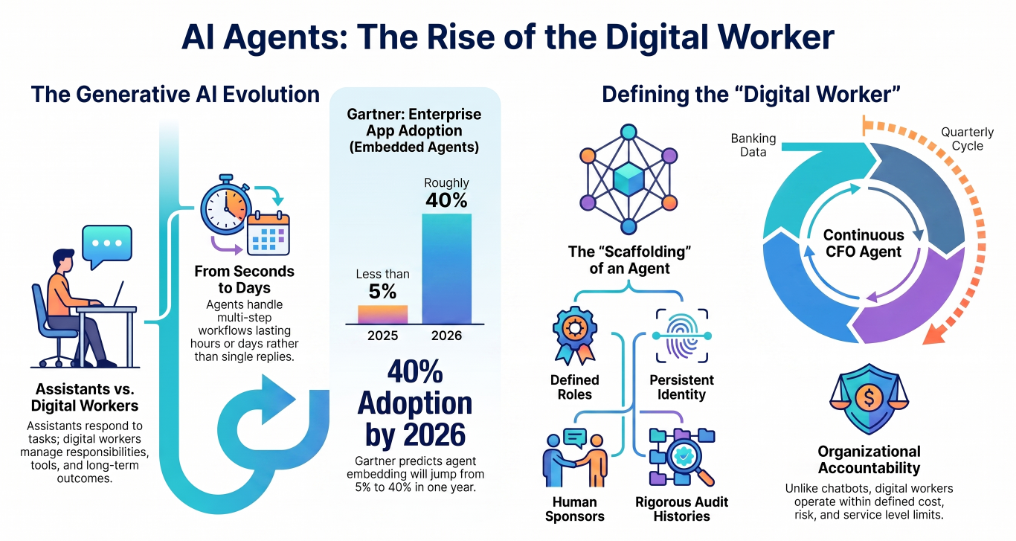
The first wave of enterprise generative AI was built around assistance: drafting, summarizing, searching, answering questions. Useful, but the operating model never really changed — a person still started the task, judged the output, and remembered what had to happen next.
The second wave is agentic, and it changes the unit of work. Instead of a response, you get something closer to a colleague: an agent that can be assigned a responsibility, invoke tools and systems on its own, wait on events, hand off to other agents, and stay accountable for an outcome that plays out over hours or days, not one reply.
Gartner has forecast that by the end of 2026, roughly 40% of enterprise applications will have AI agents embedded directly into them — up from less than 5% just a year earlier. That's not a gradual curve. That's a category shift happening inside a single budget cycle.
What actually makes something a "digital worker" rather than a smarter chatbot isn't the model behind it — it's the scaffolding around it: a defined role, a persistent identity, permitted data and capabilities, a human sponsor, service levels, cost and risk limits, and a performance history the organization can actually audit. A model with a system prompt doesn't have any of that. A digital worker does.
We've watched this play out directly in production: a CFO-style agent that continuously reads accounting and banking data, flags cash-risk anomalies before they become a Monday-morning surprise, and runs forecast scenarios on request — not on a quarterly cycle, but continuously. Or a rehearsal-partner agent used by actors preparing self-tapes, standing in as a responsive, always-available scene partner rather than a static script reader. Neither looks like a chatbot. Both look like a coworker who happens to be software.
2. Agent identity and governance are becoming the real control point
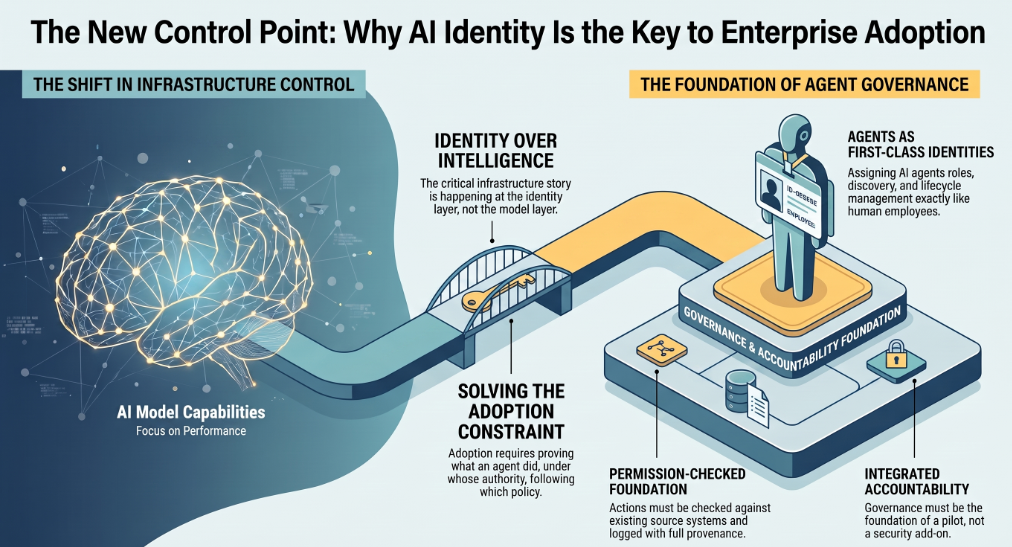
The more interesting infrastructure story in 2026 isn't happening at the model layer — it's happening at the identity layer. Several of the largest enterprise software vendors have spent the past year building out ways to treat AI agents as first-class identities: assigning them roles and access the way you'd assign them to an employee, giving them discovery and lifecycle management, and putting audit trails around what they're allowed to touch.
That convergence, from several directions at once, tells you something important: the constraint on enterprise AI adoption was never really "can the model do the task." It was "can we prove, after the fact, exactly what the agent did, under whose authority, and whether it followed policy." An enterprise with hundreds of agents can't be run as a pile of API keys and chat sessions. It needs the same rigor applied to human employees — identity, role, permission, and accountability — applied to digital ones.
In practice, that means every action an agent takes should be permission-checked against the same access controls that already exist in your source systems, logged with full provenance, and traceable end to end — not as an add-on bolted onto a pilot after a security review flags it, but as the foundation the pilot was built on in the first place.
3. Multi-agent orchestration is replacing the single do-everything agent
The early pattern for enterprise agents was one agent, one job: a customer-service agent resolved tickets, an inventory agent watched stock levels, a reporting agent generated summaries — each working in isolation, each wired to its own narrow slice of data.
That's shifting fast. Gartner reported an over 1,400% surge in enterprise inquiries about multi-agent systems between early 2024 and mid-2025. Salesforce's 2026 Connectivity Benchmark Report found the average enterprise already runs around a dozen AI agents, a figure expected to climb toward 20 by 2027 — but also found that roughly half of those agents still operate completely on their own, with no coordination between them. The gap between "we have agents" and "our agents work together" is where most of the near-term engineering effort in this space is actually going.
We've built this pattern directly into complex document-heavy workflows: an orchestration layer where one agent classifies and extracts data from incoming documents using vision-based extraction, a second determines the right workflow path, and a third analyzes revisions and flags changes for audit — running as a coordinated team rather than three disconnected tools.
In one deployment for a remediation and diagnostics contractor handling dense tender documentation, that kind of coordinated, multi-agent document workbench was engineered to cut processing time by as much as 90%, with a roughly 95% extraction accuracy target on standard formats.
4. The industry is converging on a missing category — and naming it differently
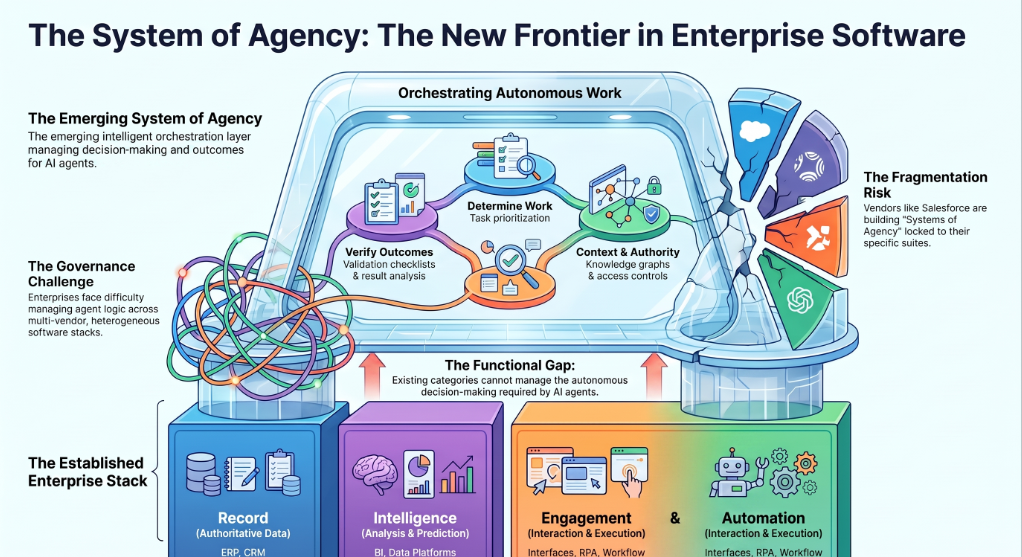
Here's the pattern worth paying attention to. The enterprise software stack has four well-established categories: systems of record (authoritative data — your ERP, your CRM), systems of intelligence (analysis and prediction — your BI and data platforms), systems of engagement (interfaces for employees and customers), and systems of automation (execution of predefined logic — your workflow and RPA tools).
AI agents don't fit cleanly into any of the four. They need something that decides what work needs doing, who or what should do it, what context and authority apply, and whether the outcome was actually achieved. Multiple major vendors have independently arrived at the same conclusion — that this is a distinct, missing layer — and each is naming and scoping its own piece of it differently.
Salesforce has started describing its agent platform as a "system of agency," built around its own Customer 360 suite. Other large vendors are approaching the same problem from their own starting points: one from workforce and identity management, another from workflow and IT service management, another from productivity and enterprise identity infrastructure.
Each version is real, and each is scoped to the vendor's own suite. Which raises the question most of those vendors would rather you not ask out loud: what happens to agent governance in the very common enterprise that doesn't run its entire stack on any single one of those platforms?
Why assistents.ai is built for this convergence, not against it
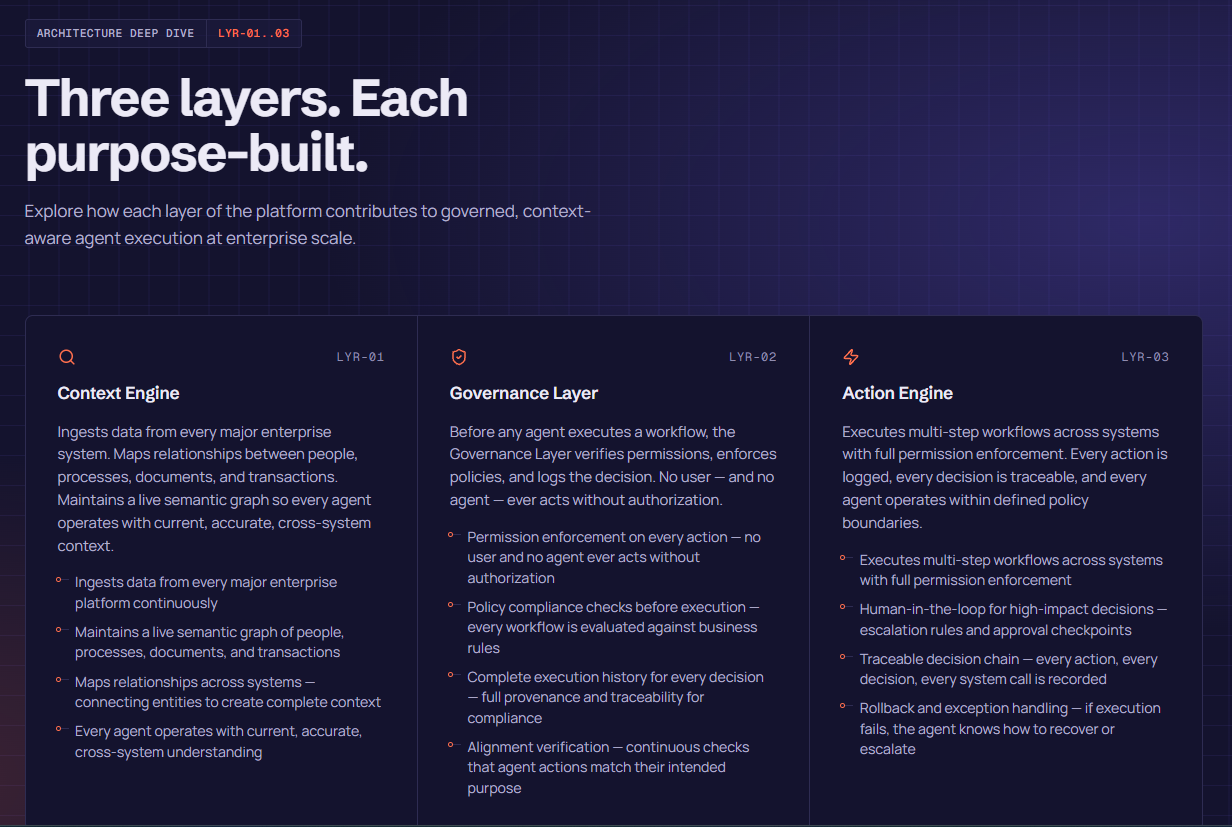
That's the gap assistents.ai is built to close. Rather than requiring a migration into one vendor's suite before agents can be governed properly, the platform is deliberately model-neutral and system-neutral:
- a Context Engine ingests data from 300+ enterprise applications and builds a live semantic understanding of your people, processes, documents, and systems;
- a Semantic Layer maps the relationships between them — vendors to contracts, deals to contacts, tickets to products — so agents reason with relational intelligence instead of keyword matching;
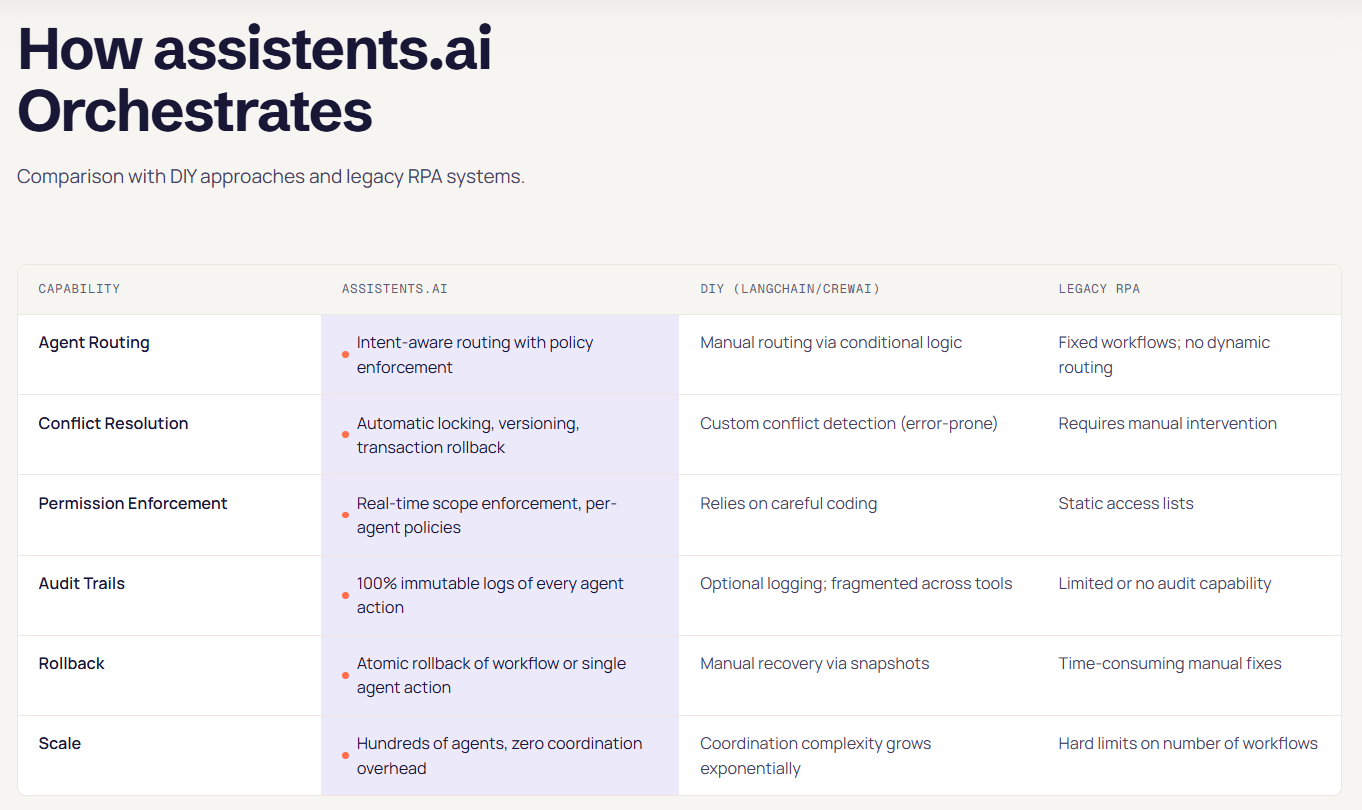
- and an Action Engine executes multi-step work across those systems with permission checks and full audit logging on every step.
In practice, that means the same governed agent layer works whether your stack runs on SAP, Salesforce, Workday, ServiceNow, Oracle, HubSpot, Microsoft, or — realistically — some combination of all of them, without asking you to consolidate onto one vendor's suite first. It's the difference between a system of agency that comes bundled with a specific CRM and one that sits above whatever you're already running.
See how the architecture works →
5. Autonomy is becoming a maturity ladder, not an on/off switch
The most common mistake in agentic AI conversations right now is treating autonomy as binary — either an agent is "autonomous" or it isn't. In production, it never works that way. Autonomy is earned in stages, and the enterprises getting real value from agents in 2026 are the ones deliberately choosing a stage rather than chasing the headline version.
Level
Operating model
Human role
Agent role
0 — Digitised
Systems record activity
Performs and coordinates all work
None
1 — Assist
AI prepares information or content
Initiates, validates, and acts
Advises
2 — Co-work
Human and agent share tasks
Owns the work, collaborates with the agent
Performs bounded steps
3 — Delegate
Agent owns bounded tasks
Sets the objective, handles escalations
Plans and completes assigned tasks
4 — Exception-managed
Agents run established processes
Manages policy and exceptions
Owns the normal operating path
5 — Adaptive
Agents propose operating improvements
Approves goals, policy, and releases
Optimizes work under controlled release
Almost none of the enterprises deploying agents successfully in 2026 are aiming for Level 5 across the whole company — and the ones claiming they are should probably be asked harder questions about what's actually in production versus what's in a pilot. The real trend is enterprises deliberately targeting Levels 2 through 4 in specific, bounded operations: a collections workflow, a procurement queue, a compliance check — where the agent owns the normal path and a human manages the exceptions, rather than reviewing every step or being cut out of the loop entirely.
6. ROI measurement is getting formalized — "trust me" is no longer enough
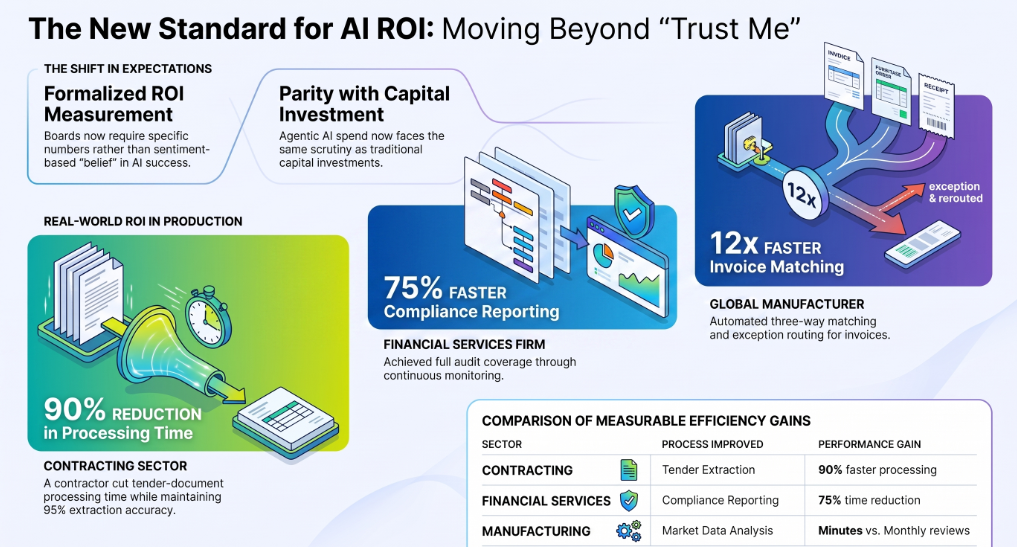
For the past two years, "we believe this is working" has been an acceptable answer to a board asking about AI investment. That's changing. CFOs and boards are increasingly asking for the same rigor applied to agentic AI spend that gets applied to any other capital investment — specific numbers, not sentiment.
That's a trend that rewards the enterprises (and vendors) who actually have numbers to show. A few, pulled from real production deployments across different industries, described here by sector rather than by name:
- A remediation and diagnostics contractor cut tender-document processing time by up to 90%, with extraction accuracy targeting roughly 95% on standard formats.
- A financial-services enterprise cut quarterly compliance-reporting time by 75%, with full audit coverage and zero missed deadlines, after moving from manual, disconnected evidence collection to continuous monitoring.
- A Fortune 500 global manufacturer now processes invoices twelve times faster, with three-way matching, exception routing, and compliance checks running end to end with full audit trails.
- Another global manufacturer runs anomaly detection across 10 million-plus pricing data points, pushing alerts to category managers within minutes of a market shift instead of finding out at the next manual review.
None of these are projections. They're what already shipped.
7. Vendors are packaging agents as outcome-owning teams, not single tools
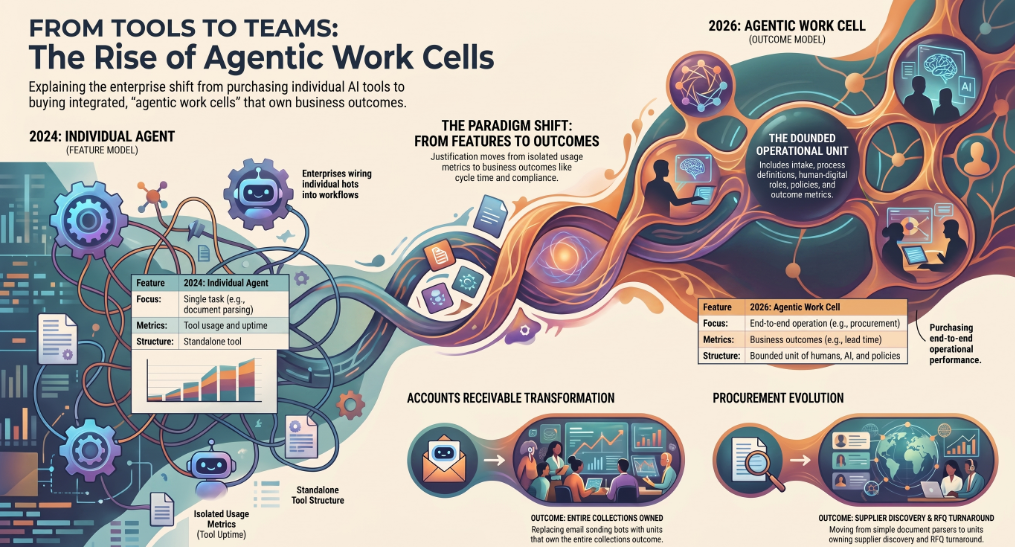
A single agent that does one thing well is a feature. What enterprises are actually buying in 2026 is the reliable performance of a business operation — and that's driving a shift from selling individual agents toward packaging governed human-agent teams around a defined outcome.
Think of it as a work cell, but agentic: a bounded unit that owns a specific operation end to end — its intake, its process definitions, its digital and human roles, its policies and approval limits, its applications, and its outcome metrics — rather than a standalone tool a team has to wire into their own workflow. An accounts-receivable team gets a unit that owns collections outcomes, not just a bot that sends reminder emails. A procurement team gets a unit that owns supplier discovery and RFQ turnaround, not just a document parser.
This packaging matters more than it sounds like it should, because it changes what the customer is accountable for proving. Instead of justifying an isolated agent's usage metrics, they're justifying an operation's outcome — collections cycle time, procurement lead time, compliance coverage — which is a conversation finance and operations leaders already know how to have.
8. Data quality, not model capability, is the real adoption bottleneck
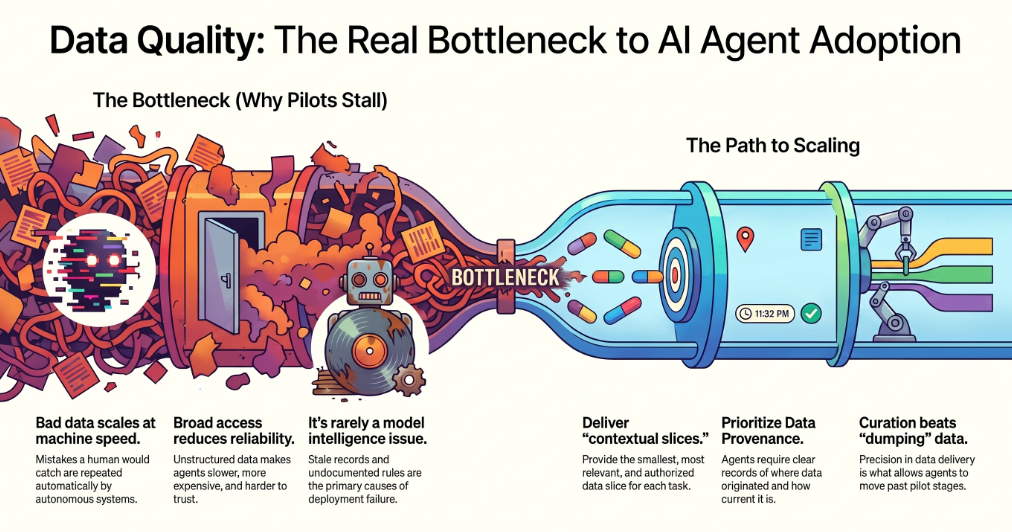
Ask any team that's actually deployed agents past the pilot stage what slowed them down, and the answer is rarely "the model wasn't smart enough." It's almost always data: inconsistent definitions across systems, stale records, undocumented business rules, permission structures nobody fully mapped. An autonomous system amplifies bad data at machine speed — a mistake a human would catch and correct manually gets executed and repeated automatically before anyone notices.
The fix isn't dumping more data into an agent's context and hoping reasoning sorts it out. It's the opposite: agents should receive the smallest, most relevant, properly authorized slice of context needed for the specific piece of work in front of them, with clear provenance for where it came from and how current it is. Broad, unstructured access to enterprise data doesn't make an agent smarter. It mostly makes it slower, more expensive to run, and considerably harder to trust.
This is a genuinely unglamorous trend compared to "agents that reason like analysts," but it's the one separating deployments that scale from the ones that stall out in pilot purgatory.
9. "Land and prove" is beating big-bang transformation
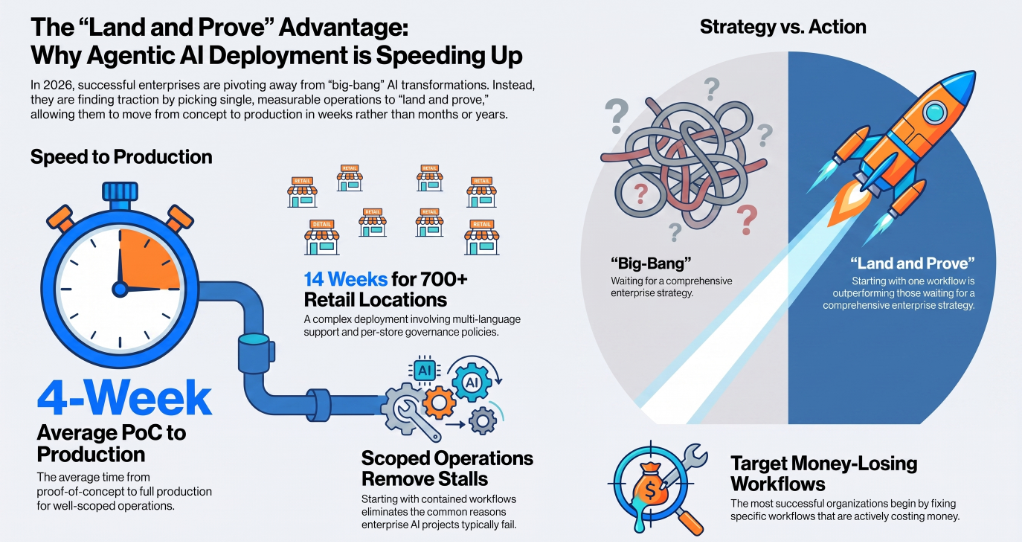
The enterprises getting real traction with agentic AI in 2026 aren't the ones announcing company-wide autonomous transformation programs. They're the ones picking one measurable operation, proving it works, and expanding from there.
That pattern shows up directly in deployment timelines. A retail deployment covering 700+ store locations, supporting multiple languages and per-store governance policies, went from kickoff to full production in 14 weeks.
Across deployments more broadly, the average time from proof-of-concept to production sits at around four weeks — not because the technology got simpler, but because starting with one contained, well-scoped operation removes most of the reasons enterprise AI projects usually stall.
The organizations still waiting for a comprehensive, enterprise-wide agentic strategy before starting anywhere are, in practice, the ones falling furthest behind the ones who just started with one workflow that was actually costing them money.
Why enterprises are choosing assistents.ai to make these trends real
The nine trends above aren't abstractions here — they're the shape of what's already running in production. Enterprises across 12+ industries use assistents.ai for exactly this: not a demo, not a roadmap slide, but governed agents doing real work with numbers behind them. Across live deployments: processing that runs up to 90% faster, agent task accuracy holding at 97% with full audit trails, and an average of four weeks from pilot to production.
That's alongside the specific wins already covered above — a manufacturer processing invoices 12x faster, a financial-services enterprise cutting compliance reporting time by 75%, a 700-store retail rollout live in 14 weeks. All of it built on zero-trust governance (SOC 2 Type II, GDPR, HIPAA, ISO 27001), model choice across Bedrock, Azure, Vertex AI, and OpenAI, and a deployment model — cloud, private, or fully on-premises — that doesn't lock you into rebuilding your stack to get there.
If any of the nine trends above sound like a gap in what you're running today, the fastest way to find out where you'd start is a 30-minute discovery call — bring the workflow that frustrates your team most.
FAQ:
What is agentic AI?
Agentic AI refers to AI systems that can pursue a goal with minimal step-by-step supervision — planning a sequence of actions, using tools and systems, and adapting as conditions change — rather than simply responding to a single prompt.
How is agentic AI different from generative AI?
Generative AI produces an output — text, an image, an answer — for a person to use. Agentic AI takes that a step further and acts on it: invoking systems, completing multi-step tasks, and owning an outcome rather than a single response.
What are the biggest agentic AI trends in 2026?
The clearest ones are the shift from copilots to governed digital workers, agent identity and governance becoming the top control point, multi-agent orchestration replacing single-purpose agents, formalized ROI measurement, and enterprises deliberately targeting bounded autonomy rather than full automation.
Is agentic AI the same thing as AI agents?
Closely related, not identical. "AI agents" usually refers to the individual software components; "agentic AI" describes the broader approach — systems built to plan and act with autonomy, whether that's one agent or a coordinated team of them.
What is a "system of agency" in enterprise software?
It's a proposed new category of enterprise software, sitting alongside systems of record, intelligence, engagement, and automation, responsible for deciding what work needs doing, who or what should do it, what authority applies, and whether the outcome was achieved. Several major vendors are each building their own version, scoped to their own platform.
How much of enterprise software will use AI agents by 2026?
Gartner has forecast that roughly 40% of enterprise applications will have AI agents embedded by the end of 2026, up from under 5% a year earlier.
What is an Agentic Workcell?
A governed human-agent team configured to own a defined business operation — like accounts receivable or procurement — end to end, including its processes, policies, applications, and outcome metrics, rather than a single standalone agent.
How do enterprises measure ROI from agentic AI?
Increasingly through specific, auditable metrics tied to the operation an agent runs — cycle-time reduction, error-rate change, compliance coverage, cost avoided — rather than usage metrics like queries handled or tokens processed.
What's the biggest risk in agentic AI adoption?
Poor data quality and governance, more than model capability. Autonomous systems amplify bad data and undefined authority at machine speed, which is why identity, permissions, and provenance matter as much as the AI itself.
How is agentic AI governed at enterprise scale?
Through identity and permission systems that treat agents like employees — assigned roles, defined access, logged and auditable actions — combined with policy-based approval limits and continuous monitoring for behavior that drifts from an agent's intended purpose.