An AI voice agent interview platform is software that conducts a live, two-way spoken interview with a candidate — asking questions, listening, following up on the answers, and producing a scored transcript — without a recruiter on the call. It replaces the phone screen, not the hiring decision. In 2026 it also sits inside a regulated category, which changes how you buy one.
That last sentence is the reason this guide exists.
Most comparisons of AI voice interview platforms were written for a market that no longer exists. They rank tools on conversational quality, price per interview and ATS integration — all real criteria — and treat compliance as a column in a table. As of 2 August 2026, when the EU AI Act's high-risk obligations for employment systems came into force, compliance stopped being a column. It became the gate.
This guide covers what these platforms are, how they work, what the law now expects of them, and how to evaluate a vendor against evidence rather than a demo. It includes four frameworks you can use directly: an autonomy ladder, a reference architecture, a 10-question vendor evidence test, and an operating model for what comes after the interview.
What an AI voice agent interview platform actually is
Strip away the marketing and there are three things happening.
A candidate applies. Instead of entering a scheduling queue and waiting three to nine days for a recruiter's calendar to open, they receive a link or a call. They have a spoken conversation with an AI agent that asks role-specific questions, probes vague answers, skips questions they have already addressed, and confirms logistics — availability, right to work, salary expectation, location, certifications. The conversation produces a transcript, an audio recording, structured extracted fields, and a score against criteria the employer defined in advance.
That is the product. Everything else is implementation detail — but the implementation detail is where platforms diverge enormously, and where the buying mistakes happen.
Three distinctions matter before you look at any vendor:
An AI voice interview is not an IVR. IVR is a decision tree with recorded prompts. A voice agent interview is a language model reasoning over an open response and choosing what to ask next. If a vendor's demo follows a fixed script regardless of what you say, you are looking at IVR with better audio.
It is not a one-way video interview. One-way video records a candidate answering static prompts to a camera. There is no follow-up, no adaptation, and — critically for compliance — often a visual analysis component that pulls a separate set of legal obligations into scope.
It is not a transcription tool. Note-takers and interview-intelligence products sit alongside a human interviewer. A voice agent interview platform replaces the human on that first call. That distinction determines whether the tool is an automated employment decision tool under law, which we come to in section 2.
The three-step voice pipeline
Every real-time voice agent, in every category, runs the same three-stage loop:
- Listen. Speech-to-text converts the candidate's speech into text in real time, streaming rather than waiting for them to finish.
- Think. A language model receives the transcript plus context — the job description, the scoring rubric, the candidate's application data, the conversation so far — and generates the next turn.
- Speak. Text-to-speech renders that turn as audio and streams it back.
The number that governs whether this feels like a conversation or an interrogation is turn latency: the gap between the candidate finishing a sentence and the agent beginning to respond. Human conversational turn-taking sits at roughly 200 milliseconds. Anything past about 700ms reads as awkward; past a second, candidates start talking over the agent and the interview degrades.
The assistents.ai voice platform runs this pipeline at sub-300ms p99, with the speech-to-text, language model and text-to-speech stages each independently selectable — which matters more than it sounds, and we return to it in section 11.
Voice vs one-way video vs chat screening
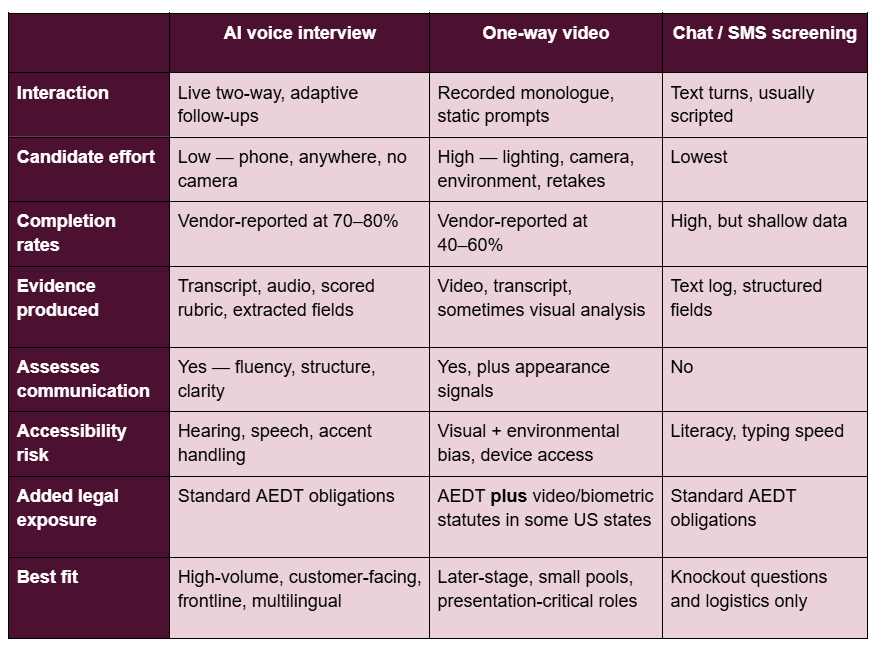
On those completion numbers: the 70–80% figures for voice and 40–60% for video are published by vendors, not independently audited, and the denominators are rarely stated. The directional finding — removing the scheduling step and the camera raises completion — is consistent enough across sources to plan around. The specific percentages are not. Treat them as a hypothesis to test in your own pilot, and be suspicious of any vendor that quotes them as though they were census data.
What changed on 2 August 2026
This is the section most buyer's guides skip, and it is now the section that decides your shortlist.
Under the EU AI Act — Regulation (EU) 2024/1689 — AI systems used for recruitment and selection are classified as high-risk under Annex III, point 4. That covers targeted job advertising, application filtering, candidate evaluation and interview assessment. The high-risk obligations became applicable on 2 August 2026. Penalties for non-compliance with high-risk obligations run to €15 million or 3% of global annual turnover, whichever is higher.
In parallel, in the United States:
- NYC Local Law 144 requires an annual independent bias audit of any automated employment decision tool used for NYC roles, public posting of the audit summary, and individual candidate notice at least 10 business days in advance. Penalties are modest per instance — $500 for a first violation, $500–$1,500 for subsequent ones — but each day of use counts separately, and a published impact ratio below 0.80 becomes documented evidence in a disparate-impact claim. New York's DCWP moved from complaint-driven to proactive enforcement following a critical 2025 Comptroller audit.
- Colorado's AI Act (SB 24-205) imposes duties on both developers and deployers of high-risk AI systems, hiring included, and took effect in 2026.
- Illinois has two instruments: the AI Video Interview Act, in force since 2020, requiring consent and transparency where AI analyses video interviews, and HB 3773, effective January 2026, extending bias-prevention duties across AI in employment more broadly.
- Maryland HB 1202 requires consent for facial recognition in pre-employment interviews.
Two practical consequences follow, and both are counter-intuitive.
First: liability sits with you, not the vendor. DCWP guidance is explicit that the employer carries the obligation even when the tool is a third-party product. "The vendor said it was compliant" is not a defence. What protects you is evidence you hold.
Second: voice-only is a narrower surface than video. Several of the US statutes — Illinois' AI Video Interview Act, Maryland's HB 1202 — attach specifically to video and facial analysis. A voice-only interview does not trigger them. It remains squarely within the EU AI Act's high-risk scope and within Local Law 144's AEDT definition, so this is a reduction in surface area, not an exemption. But for organisations hiring across multiple US jurisdictions, it is a real and under-discussed reason to prefer voice over video.
This section describes regulatory requirements as of August 2026 and is not legal advice. Regulatory timelines in this area have shifted repeatedly. Confirm current obligations with counsel before deployment.
What "high-risk" actually means for a voice interview
Translated out of regulatory language into things a platform must be able to do:
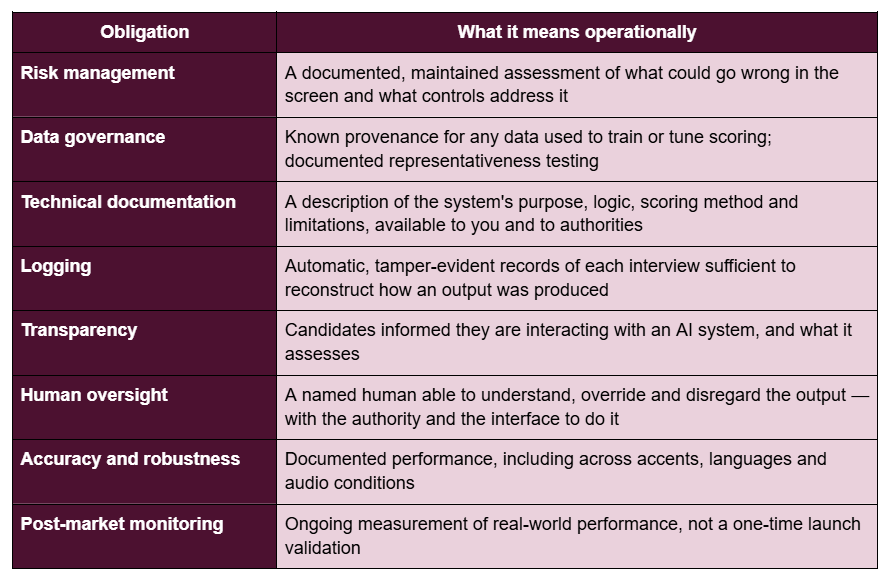
Read that list against a typical AI interview product and the gaps are obvious. Most were built to produce a shortlist quickly. Logging, oversight interfaces, and per-decision evidence trails were not the design centre — they were bolted on.
2b. The six documents to demand before deployment
Do not accept a compliance page. Ask procurement to require these in writing:
- Technical documentation covering intended purpose, scoring logic, known limitations and performance characteristics.
- A bias audit or impact-ratio analysis, dated within twelve months, from an independent party, with the methodology and sample described.
- A logging specification — what is recorded per interview, retention period, tamper-evidence, and how you export it.
- A human-oversight design document — escalation thresholds, what a reviewer sees, and what they can change.
- A data flow and residency map — where audio, transcripts and derived scores are stored and processed, which sub-processors touch them, including every model provider.
- A sub-processor list with change-notification terms. If your candidate audio can be routed to a new model provider without notice, you cannot maintain a data flow map.
If a vendor cannot produce items 1, 3 and 5 within a week, that is your answer. These are not exotic asks; they are artefacts any platform that took governance seriously already has.
The Interview Autonomy Ladder
The Interview Autonomy Ladder is a five-level model for deciding how much of your screening process an AI voice agent should own — and what platform capability each level requires. Most failed deployments are a level mismatch: an organisation buys L3 capability, deploys it at L3, and has only built the oversight infrastructure for L1.
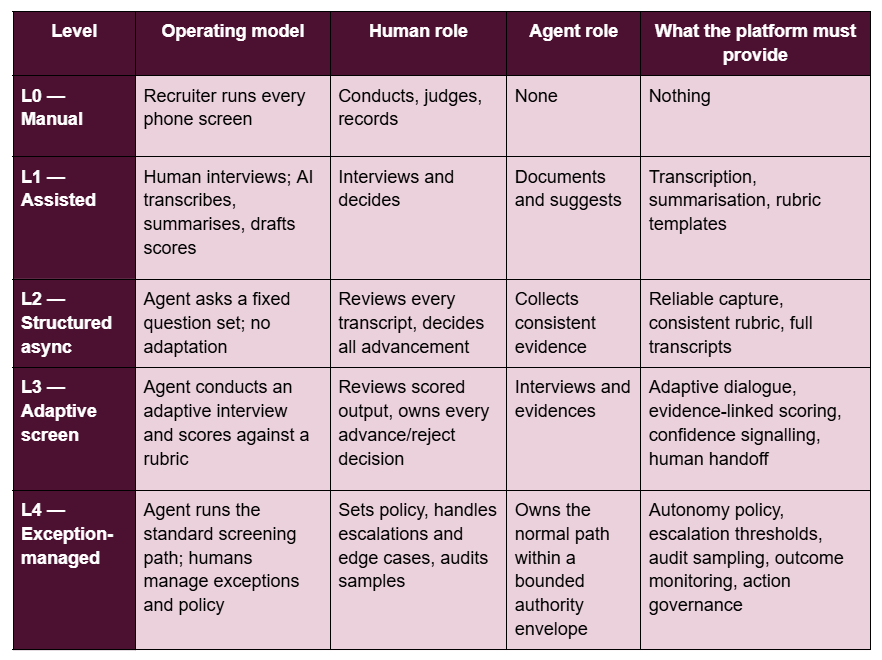
Two rules for using this ladder.
Rule one: buy for L4, deploy at L2. The platform's ceiling should be above your operating level, because moving up a rung should be a configuration change, not a re-procurement. But your initial deployment should sit a rung below where you think you're ready, because the first month of transcripts will tell you things about your rubric that you did not know.
Rule two: L4 is not "no humans." At L4 a human still owns every rejection that carries adverse-action consequences. What changes is that the human is reviewing exceptions and audit samples rather than every transcript. Under EU AI Act human-oversight obligations, there is no legitimate L5 for hiring. Any vendor selling one is selling you a liability.
The Six-Layer Voice Interview Stack
The Six-Layer Voice Interview Stack is a reference architecture for AI interview platforms. Each layer fails in a characteristic way, and knowing which layer a problem lives in is the difference between fixing it and switching vendors.
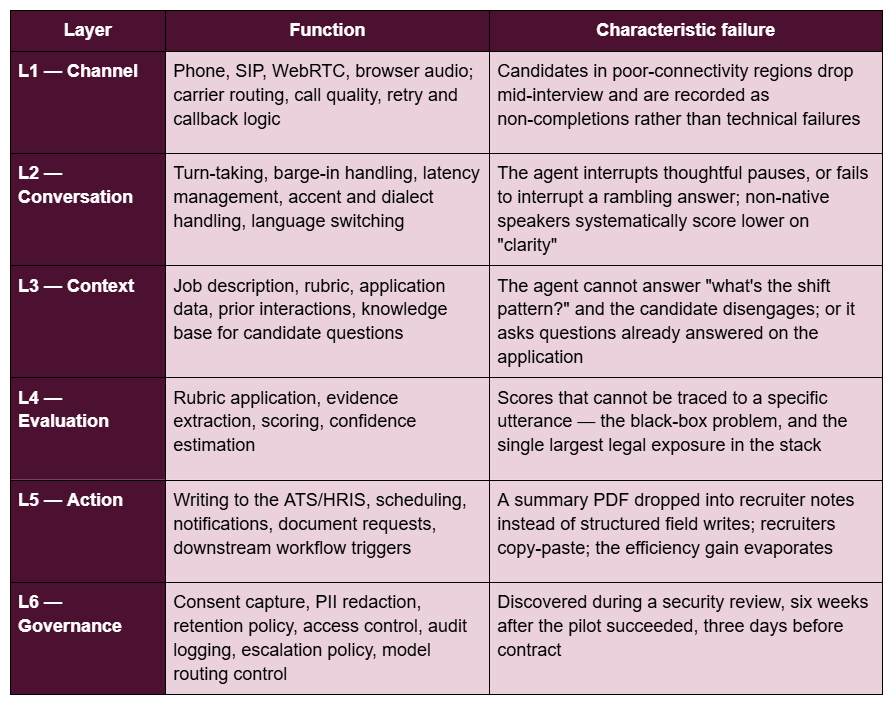
Most vendor demos show you L2 and L4 — the conversation sounds good and the score looks confident. Nearly every failed deployment fails at L5 or L6.
When you run a proof of concept, deliberately test the layers the demo skipped. Ask to see a field-level write into a live ATS sandbox, not a PDF. Ask to see the audit log for the call you just made. Ask which sub-processors received the audio. The answers to those three questions separate the shortlist faster than any amount of conversational polish.
The AEDT Evidence Test
The AEDT Evidence Test is a ten-question vendor due-diligence instrument. Each question is scored 0, 1 or 3 based on the evidence a vendor can produce — not on what they claim. It is designed to be run in a single 60-minute session with the vendor's solutions engineer, with procurement and legal in the room.
Scoring: 3 = evidenced (they showed you the artefact or performed it live). 1 = asserted (they said yes, credibly, but produced nothing). 0 = absent, deflected, or "on the roadmap."
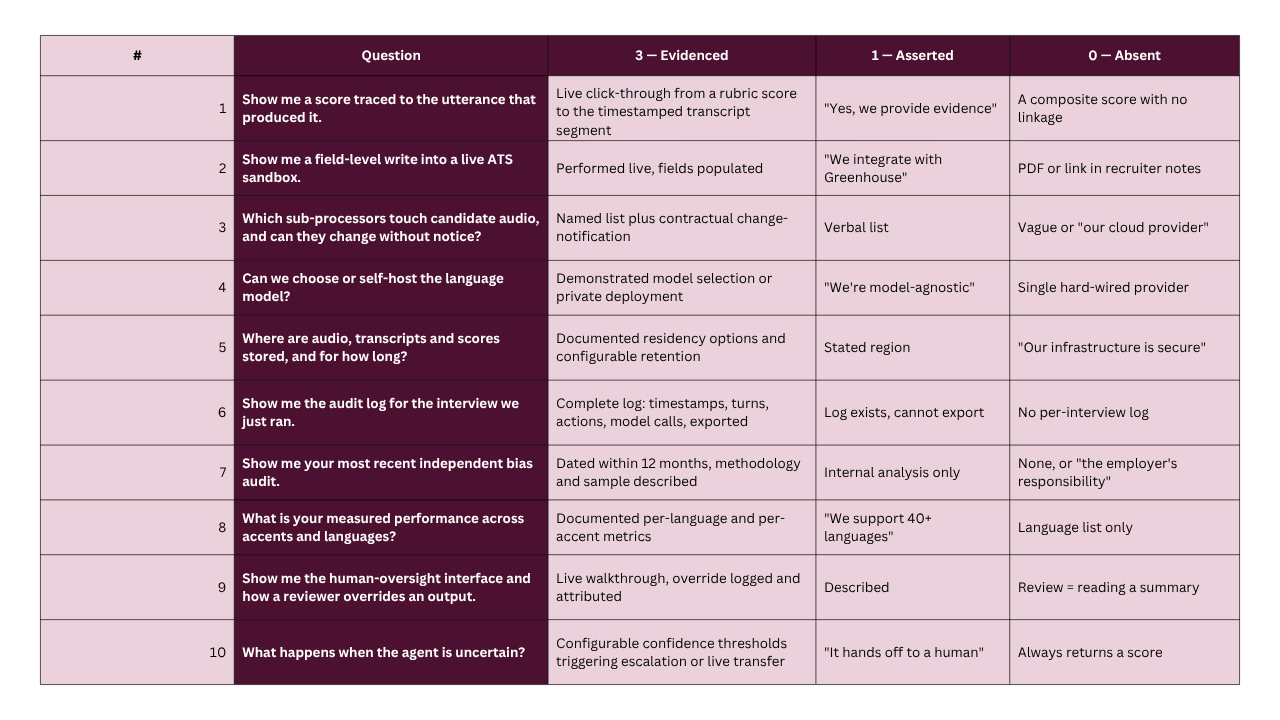
Reading the result — out of 30:
- 24–30: Enterprise-ready. Proceed to security review.
- 16–23: Viable with contractual remediation. Get the gaps written into the MSA with dates.
- 8–15: A capable product, not an enterprise platform. Acceptable only for L1–L2 deployment with heavy human review, and only in non-EU, non-NYC hiring.
- Below 8: You are the compliance layer. Decline.
A note on how to use this fairly: questions 1, 6 and 9 are the ones almost no vendor scores 3 on today, including several well-funded ones. If your whole shortlist scores 1 on those, that is market-level information, not a reason to abandon the exercise — it tells you exactly what to negotiate into the contract.
Five ways AI interview platforms fail in production
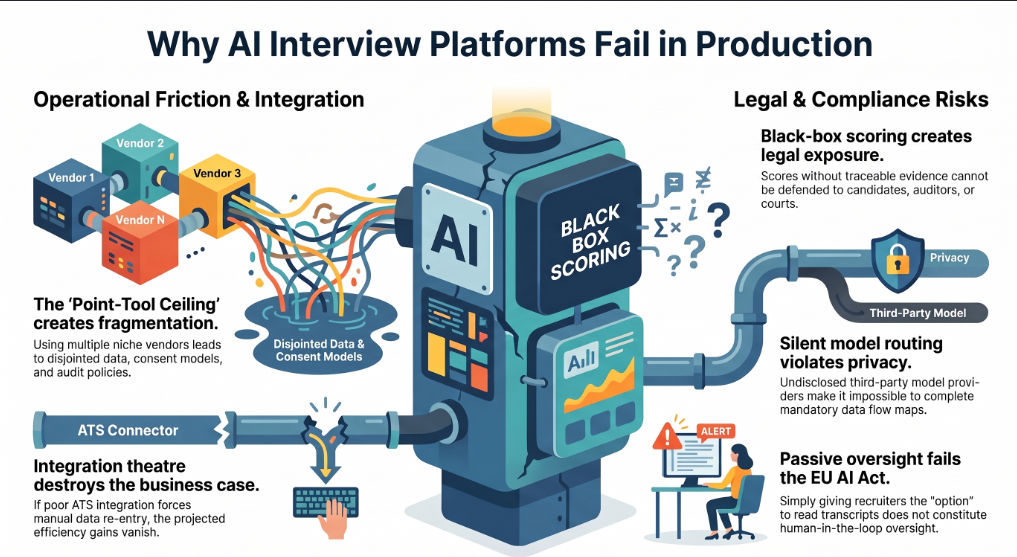
The point-tool ceiling. The interview agent works. Then someone asks whether it can also chase missing certifications, confirm start dates, run the 90-day check-in call, and handle the inbound "where is my application?" calls. It can't, because it was built to do one thing. You buy a second voice product, then a third. Within eighteen months you have four voice vendors, four consent models, four retention policies, four audit surfaces, and no single view of what any of them did.
Black-box scoring. A composite number with no traceable evidence is worse than no score. It cannot be defended to a candidate, a works council, an auditor or a court, and it cannot be improved because you cannot see what drove it. This is the failure mode that converts an efficiency project into a legal exposure.
Integration theatre. "Integrates with your ATS" covers an enormous range, from field-level bidirectional writes to emailing a PDF. If recruiters end up retyping data, the business case is gone — and you will not discover this until week three of the pilot.
Silent model routing. Many voice products route inference to whichever provider is cheapest or fastest that quarter. Candidate audio is among the most sensitive data your organisation processes. If you cannot name every model provider that hears it, you cannot complete a data flow map, and you cannot answer question 3 of the Evidence Test on your own behalf when your own auditor asks.
Oversight as a slogan. Every vendor says "human in the loop." Ask what triggers the loop. If the honest answer is "the recruiter can read the transcript if they want to," there is no loop — there is an option that nobody exercises at volume, which is exactly the scenario the EU AI Act's human-oversight obligation was written to prevent.
Why assistents.ai: the capability case
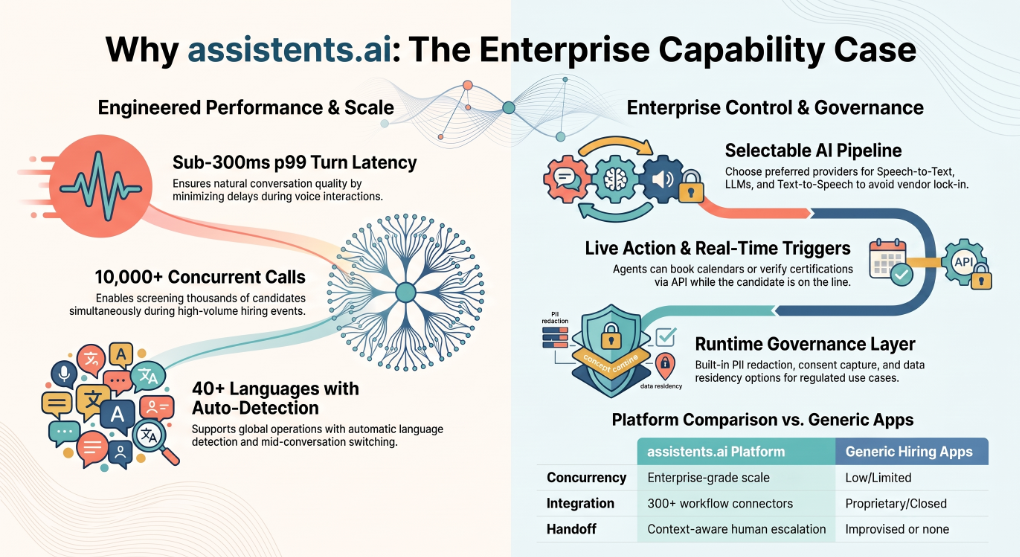
Most products on this SERP are hiring applications that added voice. assistents.ai is an enterprise voice AI platform that runs a hiring workload — and for a regulated, high-volume screening use case, that difference compounds in your favour.
The interview agent is a template, not a separate product. The voice agent library ships a pre-configured Recruitment Screening Agent alongside templates for appointment booking, front desk, survey and feedback, lead qualification and collections. You configure the rubric, the questions, the voice and the knowledge base, and call it live from the builder. The same platform, the same governance model, the same audit surface — whether you deploy one voice agent or eight.
Conversation quality is engineered, not claimed. Sub-300ms p99 turn latency, 40+ languages with automatic detection and mid-conversation switching, and 10,000+ concurrent calls with a 99.9% uptime SLA. For a hiring event where 4,000 applications arrive in 72 hours, concurrency is not a vanity metric — it is the difference between screening the pool and screening the first 400.
Every stage of the pipeline is selectable. Speech-to-text across Deepgram, Azure or Whisper. Language models across leading providers or self-hosted. Text-to-speech across ElevenLabs, Cartesia or Azure. You are not locked to one vendor's opinion about which model should hear your candidates — which is what makes question 4 of the Evidence Test answerable rather than aspirational.
The agent can act during the call, not just after it. Custom API triggers let the agent check a real requisition status, verify a certification against a system of record, or book a follow-up slot in a live calendar while the candidate is still on the line — with permission checks and audit trails on each action. Post-call, transcripts, recordings, sentiment and custom extracted fields flow into your systems through REST APIs, webhooks and 300+ workflow connectors.
Handoff is designed, not improvised. Configurable escalation triggers transfer the call to a human with full conversational context when confidence drops below your threshold or a policy rule requires it. That is the operational shape of question 10 — and of the human-oversight obligation.
Governance is in the runtime. Consent capture before recording, PII redaction, role-based access to transcripts, configurable retention, data residency options, and complete call logs with timestamps, participants and actions taken. Agent governance is a platform layer, not a compliance page.
What this looks like in production
Anonymised, from deployments across the assistents.ai platform. Industry, geography and scale only — no client identification.
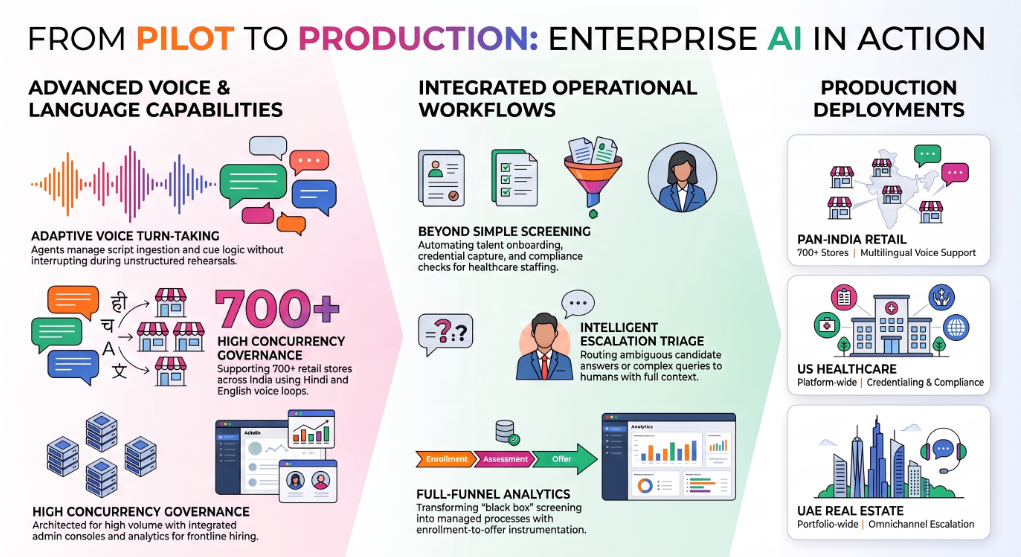
Adaptive turn-taking under real conversational load. A global consumer performance-rehearsal application, available on iOS and Android, deployed a voice agent as a live rehearsal partner: script ingestion, scene management, character and voice control, pacing and cue logic, and rehearsal analytics — under cost-controlled inference. This is the hardest version of the interview problem. The agent must hold a role, wait through a pause without interrupting, come in on cue, and maintain that across a long unstructured exchange. Structured interview turn-taking is a subset of what that deployment required.
Multilingual voice at national scale, with a governance layer. A pan-India value retailer operating 700+ stores across hundreds of cities deployed a voice support agent running the full speech-to-text → language model → text-to-speech loop in Hindi and English, alongside an inventory intelligence agent and a knowledge agent retrieving over point-of-sale and standard-operating-procedure documents — with an admin console, analytics and ticketing integration, architected for high concurrency. Frontline hiring in India has exactly this shape: high volume, multiple languages in one candidate pool, and a governance requirement that does not relax because the volume is high.
The workflow after the interview. A US healthcare staffing platform deployed talent onboarding and credential capture, facility staffing-request intake with matching logic, scheduling and notification workflows, compliance checks, and fill-rate and utilisation reporting. This is the part of hiring that a screening point tool structurally cannot reach — and in credential-dependent hiring it is where most of the cycle time actually sits.
Screening funnel analytics. A UAE multi-branch training institute deployed funnel analytics across enrolment → lessons → tests, instructor utilisation and slot optimisation, and customer-experience dashboards with alerting. The same instrumentation applied to applied → screened → advanced → offered is what turns a screening deployment into a managed process rather than a black box that produces shortlists.
Escalation to humans, designed properly. A UAE real estate portfolio owner deployed an omnichannel service agent with query triage, ticketing, structured escalation to human teams, and a knowledge base over policies and standard operating procedures. Escalation design is the transferable asset: the same pattern that routes a complex tenant query to the right human routes an ambiguous candidate answer to the right recruiter, with context attached.
The internal thesis is also explicit that assistents.ai has production experience in voice-based field-sales assistance and receivables follow-up — both outbound, both at volume, both requiring compliant call handling. Outbound candidate screening is the same operational envelope.
Beyond the screen: the Screening Workcell
A Screening Workcell is a governed human–agent team that owns a defined hiring operation end to end — from requisition to onboarding — rather than a single tool that owns a single step.
Here is the argument for why the interview is the wrong unit to buy.
Map the actual cycle time in a high-volume requisition. The screen itself is minutes. What consumes weeks is everything around it: chasing candidates who didn't respond, collecting certifications and right-to-work documents, coordinating three calendars, confirming start dates, answering "have you looked at my application yet" for the fourth time, and re-engaging the silver-medallist pool when the first hire falls through. A screening point tool compresses the minutes and leaves the weeks untouched.
A workcell owns the whole operation:
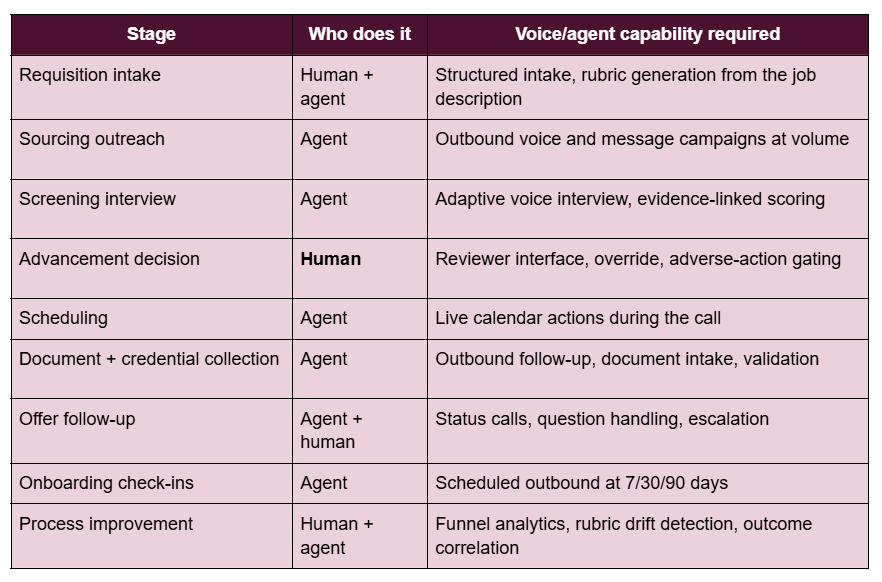
Two things hold this together and neither is a voice feature: one identity and permission model across every step, and one audit surface where the whole cycle can be reconstructed.
Directional, not shipped. The assistents.ai internal strategy paper (July 2026) describes the platform services that formalise this pattern — an Enterprise Work Kernel giving each of these stages a durable work item, a Capability Registry and Action Gateway governing what agents may execute, an Autonomy Policy Service defining bounded authority per worker and work type, and an Operations Control Tower for oversight. These are roadmap direction, not currently shipped functionality, and should be evaluated as such. What ships today is the substrate they will sit on: voice agents, agent orchestration, workflow automation, document intelligence, deterministic rules, human approvals, audit trails and permission-aware retrieval.
Build vs buy: an honest answer
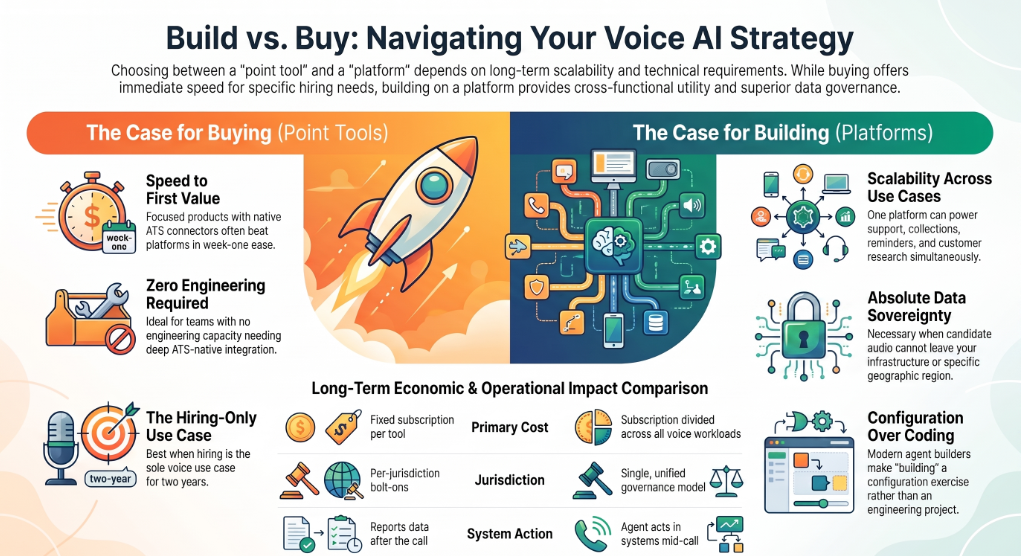
Buy a hiring-only point tool when: hiring is your only planned voice use case for the next two years, you hire in a single jurisdiction, your volume is steady rather than spiky, you have deep ATS-native integration needs and no engineering capacity, and speed to first value outweighs everything else. This is a real and often correct answer. A focused product with native connectors into your specific ATS will beat a platform on week-one ease.
Build on a platform when any two of these are true:
- You already have, or will have, other voice use cases — support, collections, appointment reminders, field operations, customer research.
- You hire across the EU and the US, and need one governance model rather than per-jurisdiction bolt-ons.
- You hire in more than two languages, or in one language across widely varying accents.
- Candidate audio cannot leave your infrastructure or your region.
- Your rubric is genuinely proprietary and you need control over how it's applied and evidenced.
- You need the agent to act in your systems mid-call, not just report afterwards.
The economic argument sharpens over time. A point tool's cost is its subscription. A platform's cost is its subscription divided across every voice workload you run on it — plus the vendor-consolidation savings on security reviews, DPAs, sub-processor tracking and audit surfaces you don't have to maintain four times over.
The agent builder and workflow builder make "build" a configuration exercise rather than an engineering project — which is what makes this a genuine choice rather than a false one.
Why assistents.ai: the governance and deployment case
Section 7 covered capability. This is the argument that actually decides enterprise deals, because it is the one that survives security review.
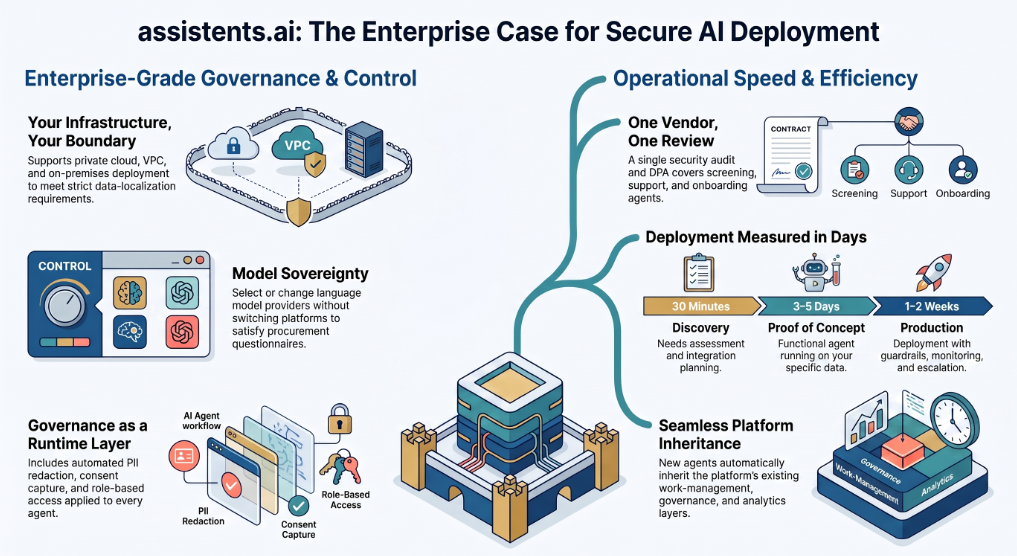
Your infrastructure, your boundary. Private cloud, VPC and on-premises deployment are supported. For hiring in jurisdictions with data-localisation requirements, or in sectors where candidate PII cannot leave a controlled boundary, this is not a preference — it is the gate that eliminates most of the shortlist. Almost every product on this SERP is multi-tenant SaaS with no other option.
Model sovereignty answers a question you will be asked. Because the language model is selectable — including self-hosted — you can state, in writing, exactly which model providers process candidate audio, and change that decision without changing platform. Question 3 and question 4 of the Evidence Test become answerable in a procurement questionnaire rather than deferred to a roadmap conversation.
Governance is a runtime layer, not a policy document. Consent capture before recording, automatic PII redaction, role-based access to transcripts, configurable retention, data residency options, and complete call logs with timestamps, participants and actions taken — carried by the platform, applied to every agent, including the ones you build after this one.
One vendor, one review, many workloads. A single security review, DPA, sub-processor list and audit surface covering the screening agent, the candidate-support agent, the onboarding check-in agent and every non-HR voice workload in the organisation. Anyone who has run four parallel vendor reviews in one calendar year understands what this is worth.
The interview agent inherits the platform, and the platform keeps moving. The screening agent sits on the same substrate as agent orchestration, document AI, deterministic rules, the context engine and governed analytics. As the platform's work-management and governance layers develop, the hiring workload inherits them — without a migration.
Deployment measured in days. A 30-minute discovery call, a proof of concept in 3–5 days on your data and integrations, and production deployment with guardrails, monitoring and escalation workflows in 1–2 weeks.
What we are not claiming. We do not claim candidate identity verification or cheat detection — if that is a hard requirement for your roles, evaluate it separately and honestly. We do not sell an independent bias audit; that is an obligation you hold, and what the platform provides is the logging and evidence trail that makes the audit possible. And the work-management services described in section 9 are roadmap direction, not shipped features. A vendor that is precise about what it does not do is easier to trust about what it does.
A 30-day pilot that produces a defensible decision
Most pilots test whether the AI sounds good. That is the least informative question available, because in 2026 they all sound good.
Days 1–5 — Define the instrument before you see a demo. Choose one high-volume role. Write the rubric with the hiring manager, with each criterion tied to an observable behaviour. Define your success metrics now: time-to-shortlist, completion rate, hiring-manager agreement with agent scoring, candidate satisfaction. Bring legal in on day one, not day twenty-five, and settle consent wording, retention and oversight design before any candidate is called.
Days 6–10 — Run the Evidence Test. One 60-minute session per vendor with procurement and legal present. Insist on live demonstrations for questions 1, 2, 6 and 9. Score it. Keep the sheet — it becomes your contract negotiation agenda.
Days 11–20 — Run parallel, not replacement. Route 200–300 candidates through both the agent screen and your existing human screen. This is the single most valuable design choice in the pilot: it gives you an agreement rate between agent scoring and recruiter judgement, and disagreements are where your rubric is actually wrong. Deliberately include non-native speakers, poor-connectivity callers and candidates with atypical backgrounds — the edge cases are the whole point.
Days 21–25 — Read the transcripts, not the dashboard. Have two people independently read 40 transcripts. Where did the agent miss an obvious follow-up? Where did it score fluency and call it competence? Where did a strong candidate get a weak score? This is rubric-drift detection and it does not show up in aggregate metrics.
Days 26–30 — Decide with evidence. Compare metrics against your day-5 baseline. Document the human-oversight design you actually operated. Run one adversarial test: take a rejected candidate and try to reconstruct, from the platform's logs alone, exactly why. If you can't, you have found the gap that matters most — and you have found it before it was your problem.
What you actually pay for
Pricing in this category is deliberately hard to compare. The units differ by vendor and the quoted number rarely covers the whole cost.
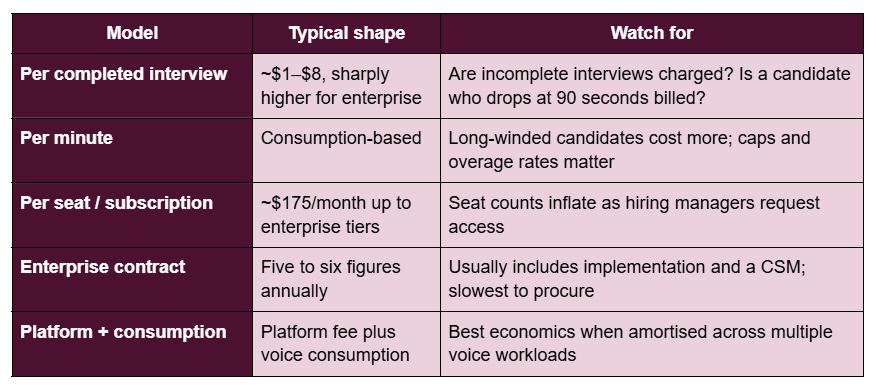
Costs that are usually excluded from the quote and always land on your budget: telephony and carrier charges (bring-your-own-carrier can reduce this materially), ATS integration work where it isn't native, the independent bias audit, internal legal review, and the recruiter time spent reviewing transcripts — which does not go to zero at any autonomy level and should not.
The right comparison is not cost per interview against cost per interview. It is fully-loaded cost per qualified candidate advanced, against your current human phone-screen cost including recruiter time, scheduling overhead and the cost of candidates lost to delay. Run that calculation before you take a demo; it will change which vendors you take seriously. The ROI calculator is a reasonable starting frame.
See it against your own hiring workflow
The fastest way to evaluate an AI voice agent interview platform is to run one on a real requisition with your rubric, your systems and your compliance constraints.
Book a Voice Architecture Review — a working session on your screening workflow, integration points and governance requirements, with a proposed architecture and ROI hypothesis within 48 hours.
Or explore the enterprise voice AI platform and the Recruitment Screening Agent template first.
FAQs
What is an AI voice agent interview platform?
Software that conducts a live, two-way spoken interview with a candidate — asking questions, listening, adapting follow-ups to the answers, and producing a scored transcript — without a recruiter on the call. It typically handles first-round screening and passes a ranked, evidenced shortlist to a human.
Are AI voice interviews legal?
Yes, in every major jurisdiction, but they are regulated. Under the EU AI Act they are high-risk systems with obligations that became applicable on 2 August 2026. In New York City they are automated employment decision tools requiring an annual independent bias audit, published results and advance candidate notice. Colorado and Illinois have their own requirements. Legality depends on how you deploy, document and oversee the tool — not on the tool itself. This is not legal advice; confirm current obligations with counsel.
Is an AI voice interview platform an AEDT under NYC Local Law 144?
If its output substantially assists or replaces a human decision about who advances, assume yes. Scoring, ranking or filtering candidates puts a tool in scope. The obligation sits with the employer, not the vendor.
Does the EU AI Act apply to AI interviews?
Yes. Annex III, point 4 classifies AI used in recruitment and selection — including candidate evaluation — as high-risk. High-risk obligations became applicable on 2 August 2026, covering risk management, data governance, technical documentation, logging, transparency, human oversight, accuracy and post-market monitoring. Penalties reach €15 million or 3% of global turnover.
How accurate is AI interview scoring?
It varies widely and is rarely independently validated. The more useful question is whether a score can be traced to the specific utterance that produced it. A traceable score can be audited, defended and improved. An untraceable composite cannot, regardless of how accurate it claims to be. Test agreement rate against your own recruiters during a parallel pilot rather than trusting a published accuracy figure.
Can candidates cheat on an AI voice interview?
Yes — by reading prepared answers or using an assistant off-camera. Some vendors offer detection features. assistents.ai does not currently claim identity verification or cheat detection; if that is a hard requirement, evaluate it as a separate capability. A practical mitigation used by many teams is to treat the AI screen as a filter for logistics, qualification and communication rather than as the sole basis for a hiring decision.
How much does an AI voice interview platform cost?
Per-interview pricing commonly ranges from roughly $1 to $8, with enterprise contracts running into five and six figures annually. Per-minute and per-seat models also exist. Compare fully-loaded cost per qualified candidate advanced — including telephony, integration work, bias auditing and recruiter review time — rather than headline cost per interview.
AI voice interview vs one-way video interview — which is better?
For high-volume screening, voice generally wins on completion rate, candidate effort and accessibility, and it avoids the video-specific statutes in states like Illinois and Maryland. Video retains value later in the funnel and for presentation-critical roles. Voice is adaptive; one-way video is not.
Do candidates actually complete AI voice interviews?
Vendor-reported completion rates cluster around 70–80% for voice against 40–60% for scheduled or video screens. These figures are self-published and rarely define their denominators. The directional finding — removing scheduling friction and the camera raises completion — is consistent, but measure it in your own pilot rather than budgeting against a vendor's number.
Can you build your own AI voice interview agent?
Yes. On an enterprise voice platform this is a configuration exercise rather than an engineering project: select a screening template, define the rubric and questions, connect the knowledge base and systems, set escalation thresholds, and test. Building on a platform makes sense when you have other voice workloads, multi-jurisdiction hiring, data-residency requirements or a proprietary rubric.
Can AI conduct technical interviews?
It can conduct structured technical screening — verifying stated experience, probing specific technologies, assessing how someone explains a technical decision. It is weaker at open-ended problem-solving that depends on shared visual context such as a whiteboard or code editor. Most teams use it as a technical pre-screen ahead of a human technical round.
What languages can AI voice interviews run in?
Leading platforms support 40+ languages with automatic detection and mid-conversation switching. The number to ask about is not the language count but the measured performance per language and per accent. A platform supporting 40 languages well in five of them is a fairness problem in a multilingual candidate pool.