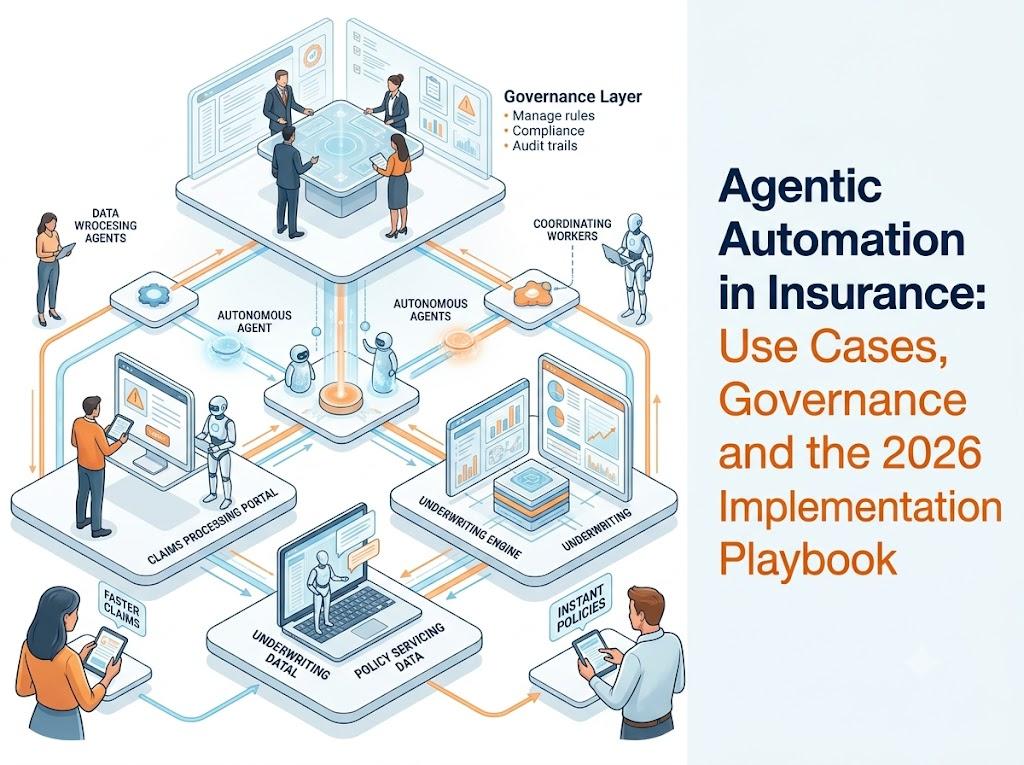
Agentic automation in insurance is the use of AI agents that plan and execute multi-step insurance work — intake, verification, assessment, communication and system updates — inside an explicit authority envelope defined by the carrier. Unlike RPA, it handles unstructured evidence. Unlike generative AI, it acts on systems of record. Unlike full autonomy, every action is bounded, approved where material, and individually auditable.
That definition carries the whole argument of this guide, so it is worth unpacking the last clause. Most insurers do not fail at agentic automation because the models are not good enough. They fail because they deployed an agent without deciding, in writing, what that agent was allowed to do — and then could not answer a market-conduct examiner asking why a specific claim was declined on a specific Tuesday.
This guide is written for the person who already runs an automation estate and now has to extend it to work that resists rules. It covers where agentic automation genuinely pays across the insurance value chain, the authority model that makes it safe, the architecture underneath it, the 2026 regulatory obligations across the US, EU, UK and India, evidence from comparable regulated deployments, and a 90-day rollout that produces measurable results rather than another pilot deck.
What agentic automation in insurance actually means
Insurance has automated the same layer three times. First the transaction: policy administration, billing, claims payment. Then the interface: portals, apps, self-service. Then the task: robotic process automation moving data between screens that were never designed to talk to each other.
What none of those waves touched is the judgement layer — the part where a human reads a loss description, checks it against a wording, notices the date of loss falls two days before the endorsement, pulls the prior claim, decides the file needs an engineer, drafts the reservation-of-rights letter, and updates four systems. That work is high volume, expensive, slow, and resistant to rules because the inputs are documents, photographs, phone calls and emails rather than fields.
Agentic automation is the automation of that judgement layer under control. An agent differs from earlier automation in four specific ways:
- It plans. Given an objective — "progress this motor claim to a settlement decision" — it decides its own sequence of steps rather than following a fixed script.
- It works with evidence, not fields. Damage photographs, adjuster notes, repair estimates, medical reports, police reports, policy wordings and email threads are all first-class inputs.
- It acts. It writes to the claims system, sends the letter, books the inspection, raises the recovery task. An agent that only summarises is a copilot, not an agent.
- It escalates. It knows the conditions under which it must stop and hand to a human, and it stops.
The fourth property is what separates insurance from every other industry adopting this technology. In e-commerce, an agent that gets a decision wrong causes a refund. In insurance, an agent that gets a decision wrong causes a coverage dispute, a regulatory finding on unfair claims settlement practices, and potentially a class action. The design constraint is not capability. It is bounded capability with evidence.
The three components an insurance agent always has
Strip away the vendor language and every credible insurance agent deployment has the same three parts:
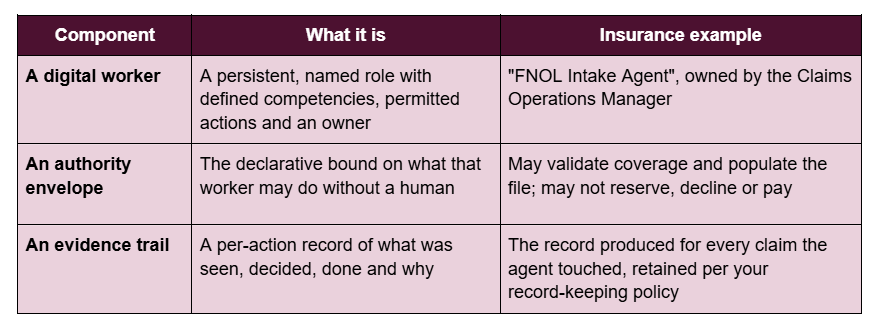
If a vendor demo shows you the first without the second and third, you are looking at a prototype, not a deployment.
Agentic automation vs RPA vs generative AI vs straight-through processing
Insurance teams conflate these four constantly, usually in the same meeting. They are not competing options — most mature deployments use all four in one flow — but they fail in different ways and need different controls.
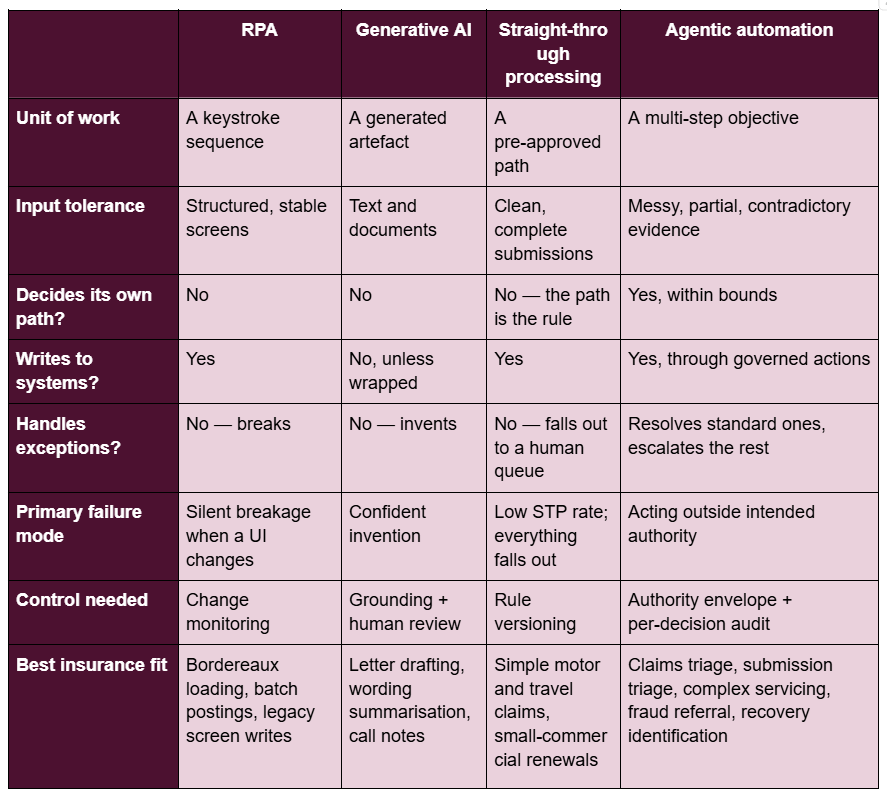
The practical reading: RPA and STP are still the right answer for the deterministic 40%. Agentic automation is how you attack the 60% that currently falls out to a human queue — and its economics come from raising the share of fall-out resolved without a human, not from replacing what is already automated.
Where "agentic AI in insurance" and "agentic automation in insurance" differ
They are used interchangeably and mostly mean the same thing. The distinction worth holding: agentic AI describes the capability — reasoning systems that plan and act. Agentic automation describes the operating discipline — that capability deployed into a production process, with orchestration, controls, exception routing and measurement around it. Carriers with an existing automation Centre of Excellence should use the second framing internally, because it correctly implies that agents inherit the governance apparatus already applied to bots, not a new parallel one.
Why 2026 is the inflection point
Three things converged this year, and only one of them is about model capability.
Deployment moved past pilots. Evident's Q4 2025 Insurance AI Use Case Tracker found that 68% of publicly disclosed insurance AI deployments were generative or agentic, with agentic accounting for 21% — a share that did not exist eighteen months earlier. Industry surveys through 2025–26 consistently show full AI adoption among carriers rising several-fold year over year.
The measured value stopped being anecdotal. Published analysis of commercial P&C carriers running agentic underwriting reports loss-ratio improvements in the low single-digit percentage points and large reductions in quote-to-bind time; carriers publishing claims-optimisation results report annual value in the tens of millions of dollars at large-book scale. Treat all vendor-published figures with the scepticism they deserve — including ours — but the direction and order of magnitude are now corroborated across independent sources.
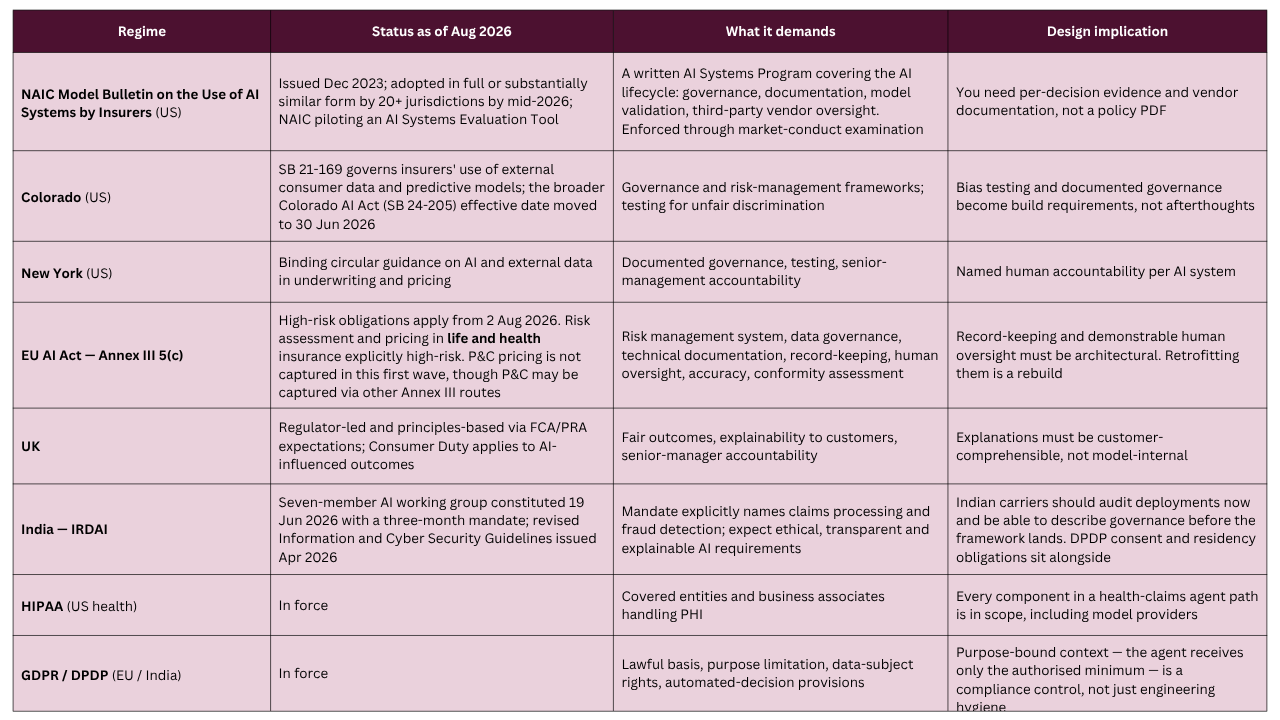
Regulation arrived, and it arrived asking for evidence. This is the part that changes procurement. By mid-2026, more than twenty US jurisdictions had adopted the NAIC Model Bulletin on the Use of Artificial Intelligence Systems by Insurers or substantially similar guidance, and the NAIC began piloting a structured AI Systems Evaluation Tool. The EU AI Act's high-risk obligations under Annex III — which explicitly capture risk assessment and pricing in life and health insurance — apply from 2 August 2026. In India, IRDAI constituted a seven-member AI working group in June 2026 with a three-month mandate covering claims processing and fraud detection specifically, following revised information and cyber security guidelines issued in April 2026.
Read those three together and the conclusion is uncomfortable for most carriers: the technical ability to deploy agents arrived before the organisational ability to evidence them. Every serious 2026 insurance AI programme is now a governance programme with an automation component, not the reverse.
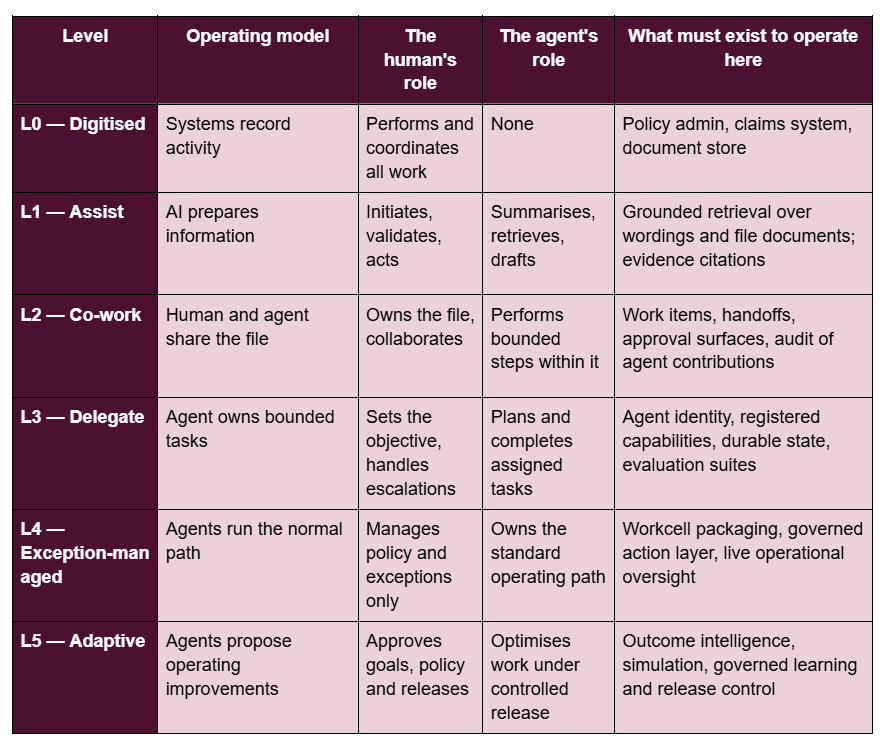
The Insurance Agentic Authority Ladder
The Insurance Agentic Authority Ladder is a six-level model that replaces the binary question "is this agent autonomous?" with the useful question: what authority does this agent hold, over which work, under whose delegation, and what has to be true before it moves up a level?
Autonomy is not a switch. Treating it as one is the single most common cause of stalled insurance AI programmes — the risk committee is asked to approve "autonomous claims handling", says no, and the programme dies. Asked instead to approve "the intake agent may validate coverage and populate the file, and may not reserve, decline or pay", the same committee says yes in a fortnight.
How to read the ladder as an insurer
Most carriers should be commercialising L2 to L4 and designing for L5. You do not need to accept broad autonomy to receive value — that is the trap in most vendor narratives. A well-run L2 deployment on submission intake typically pays for itself before an L4 deployment finishes its risk review.
Different functions in the same carrier should sit at different levels simultaneously:
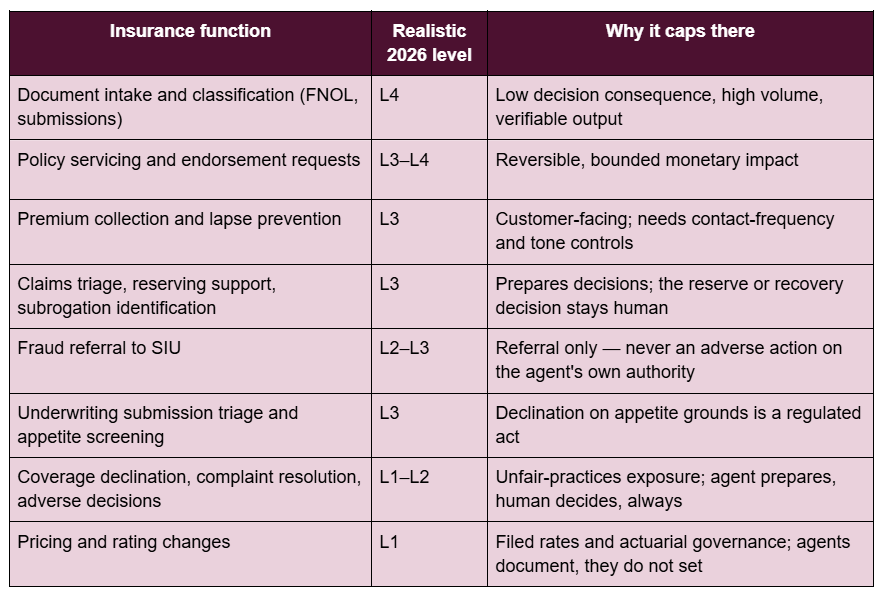
The right question in a steering committee is never "should we let AI do this?" It is "which rung, for which work type, under whose delegated authority, and what evidence moves us up one?"
Fourteen use cases across the insurance value chain
Use-case lists in this category are usually five bullets deep and stop at claims and fraud. The list below is organised by where the money and the risk actually sit, and each entry names the control that has to hold — because a use case without its control is not an implementation plan.
Distribution and new business
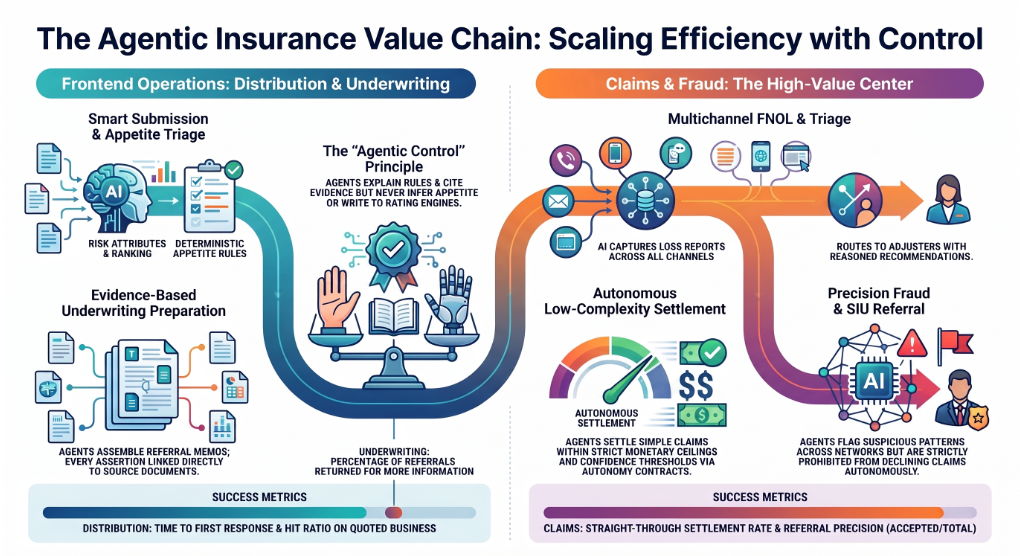
1. Submission triage and appetite screening. The agent reads inbound broker submissions in whatever form they arrive — email body, PDF schedule, spreadsheet, ACORD form — extracts risk attributes, checks them against written appetite, ranks the queue by expected value and completeness, and drafts the decline-to-quote or request-for-information response. Control: appetite rules stay in a versioned, deterministic rule set. The agent applies them and explains them; it does not infer them. Metric: submissions triaged per underwriter-day; time to first response; hit ratio on quoted business.
2. Submission completeness and data enrichment. The agent identifies what is missing, drafts the broker follow-up, ingests the response, and enriches with third-party data. Control: enrichment sources are registered and logged per submission; no unregistered external data enters a rating decision. Metric: percentage of submissions complete at first pass; broker cycle time.
3. Quote document assembly and renewal comparison. The agent drafts quote wording, assembles subjectivities, and produces the comparison against expiring terms. Control: generated wording is drawn from an approved clause library, not composed freely. Metric: quote-to-bind time; underwriter minutes per quote.
Underwriting
4. Underwriting file preparation and referral packs. The agent assembles the full picture an underwriter needs — loss history, exposure schedules, survey reports, prior correspondence — and writes the referral memo with every assertion linked to its source document. Control: the memo cites evidence; the underwriter's decision is recorded separately from the agent's preparation. Metric: referral turnaround; percentage returned for more information.
5. Model and rating governance support. The agent monitors documentation currency for pricing models, flags undocumented changes, maintains version lineage, and drafts the artefacts a model-governance review requires. Control: the agent has read and draft rights on documentation, never write access to a rating engine. Metric: documentation completeness at review; findings raised in model validation.
6. Portfolio monitoring and appetite drift detection. Continuous monitoring of written business against stated appetite, aggregation limits and concentration thresholds, with alerts that arrive as work items rather than emails nobody opens. Control: thresholds are policy objects, versioned and owned by a named human. Metric: time from breach to acknowledged action; breaches detected before month end rather than after.
Claims — where most of the value is
7. FNOL intake and structuring. Loss reports arrive by phone, app, email, broker portal and PDF. The agent captures them in any channel, structures them into a claim record, identifies the policy, checks the loss date against coverage periods, and flags immediate red flags. Control: policy identification is verified against the policy administration system, never inferred; a mismatch escalates rather than resolves. Metric: time to claim record created; percentage requiring rework at first touch.
8. Coverage verification and claims triage. The agent compares loss circumstances against the wording, identifies applicable sections, exclusions and conditions, assesses complexity, and routes to the right adjuster segment with a reasoned recommendation. Control: the coverage opinion is a recommendation with citations to wording clauses. The coverage decision is human at L3. Metric: triage accuracy against adjuster reclassification rate; time to correct desk.
9. Autonomous claims processing for low-complexity segments. For narrow, well-defined segments — small-value motor own damage, travel baggage, simple health reimbursements — the agent can carry the file end to end within a monetary ceiling, with sampling-based human review after the fact rather than before. Control: segment definition, monetary ceiling and confidence threshold all live in the autonomy contract. Any signal outside the envelope stops the agent immediately. Metric: straight-through settlement rate within segment; leakage on sampled audit; complaint rate versus human-handled files.
10. Claims document workbench. Medical reports, repair estimates, invoices, engineer reports, police reports and photographs are extracted, validated against the file and against each other, and inconsistencies are surfaced as specific questions rather than as a confidence score. Control: extraction confidence thresholds route low-confidence fields to human verification; the human correction is captured as evaluation signal. Metric: extraction accuracy by document type; adjuster minutes per file on document handling.
11. Fraud signal detection and SIU referral. The agent correlates patterns across the claim, policy history, prior claims and network relationships, then prepares a referral pack for the Special Investigation Unit. Control: the agent refers; it never declines, delays payment, or takes any adverse action on a policyholder on its own authority. This is the single most important control in the entire list. Metric: referral precision (accepted referrals ÷ total referrals); investigator hours per confirmed case.
12. Subrogation and recovery identification. Systematic review of closed and open files for recovery opportunities never pursued, with the recovery file prepared and the limitation date tracked as a commitment with an owner. Control: recovery pursuit above a threshold requires human authorisation; limitation dates are first-class commitments, not calendar reminders. Metric: recovery identified as a percentage of paid losses; leakage recovered per quarter.
Policy servicing, finance and compliance
13. Policy servicing, renewals and lapse prevention. Endorsement requests, beneficiary and address changes, certificate issuance, renewal outreach and payment follow-up handled across chat, email and voice, in the policyholder's language, with the system update executed under maker-checker. Control: contact-frequency caps per policyholder per period; sentiment and dispute detection trigger immediate human handover; no coverage change without confirmation of authority. Metric: self-service resolution rate; renewal retention; lapse rate in the treated cohort.
14. Regulatory and complaints evidence assembly. The agent assembles the file an examiner, ombudsman or complaints body asks for — decision chronology, communications, the reasoning behind each material step — from the system of record rather than from someone's memory. Control: evidence is assembled, never generated. Every element traces to a source record. Metric: time to produce a complete complaint or examination file; findings related to record-keeping.
A note on health claims. Adjudication against benefit schedules, pre-authorisation, provider network verification and coding validation are all strong agentic candidates, and health carriers frequently see the fastest measurable return. They also carry the tightest constraints — protected health information, benefit-denial exposure, and in the US, HIPAA obligations on every component in the path. Health deployments should start at L2 on non-adverse work and earn their way up.
Why insurers choose assistents.ai
Most platforms in this category start from one of three places: a CRM, an RPA estate, or a model provider. Each of those origins leaves a gap that shows up in month four of an insurance deployment — usually as an inability to prove what happened.
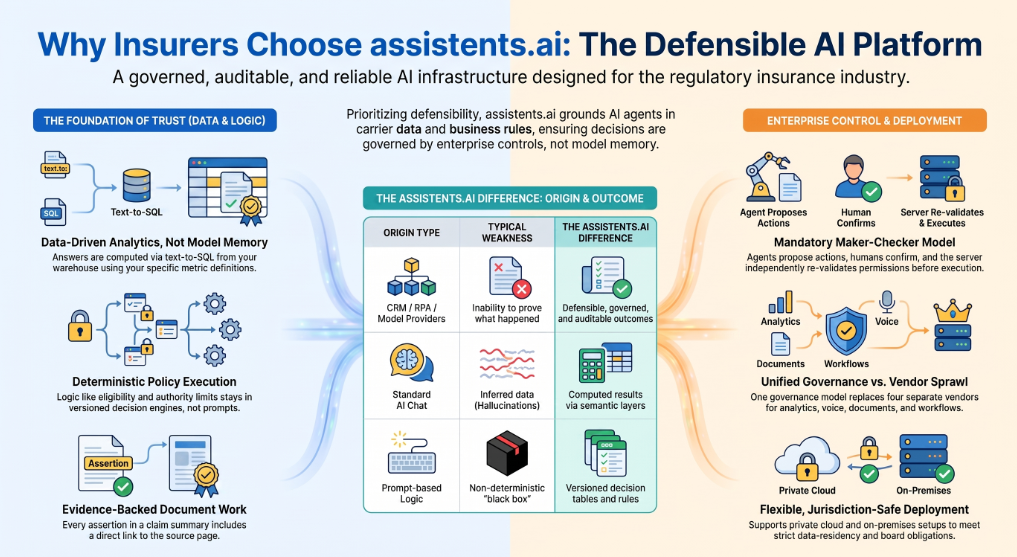
assistents.ai starts from a different place: the answer has to be defensible before it is fast. It is a governed enterprise AI platform that grounds AI agents in a carrier's own data, metrics and business rules, then analyses, decides and acts under enterprise controls. Here is what that means concretely, using only capability that is shipped today.
Numbers that come from your data, not from a model's memory
Conversational analytics on the platform runs text-to-SQL over a semantic layer built from your own metric definitions. When a claims manager asks "what is our average settlement time on commercial property this quarter", the answer is computed from the warehouse against your definition of settlement time — not inferred by a language model. For a regulated business this is the difference between a tool people trust and a tool people quietly stop using. It is the platform's founding promise, and every other capability sits on top of it.
Deterministic policy stays deterministic
Eligibility logic, appetite rules, benefit schedules, authority limits and deviation rules belong in a versioned decision engine, not in a prompt. assistents.ai ships deterministic rules and decision tables through GoRules, executed as policy inside agent flows. Agents gather evidence, reconcile conflicts, prepare assessments and explain outcomes; the binding rule executes deterministically and identically every time. This is the pattern the internal Autonomous Lending OS work established in a regulated credit environment — claims and underwriting have the same shape.
The AI proposes; a human confirms; the server re-checks
Every write path follows a maker-checker model. The agent proposes an action, a human confirms where policy requires it, and the server independently re-validates permissions before execution. It is not a UI convention that can be skipped under load — it is how the action path is built. For claims payments, coverage decisions and policy admin writes, this is the control your risk function will ask about first.
Documents are a first-class input, not an integration afterthought
Insurance work is document work. The platform ships document ingestion, extraction, validation and human review with hybrid retrieval and evidence-backed responses, so an assertion in a referral memo or claim summary carries a link back to the page it came from. Adjusters and underwriters do not accept AI output they cannot check. Making the check one click long is what drives adoption.
Voice is a channel for the same digital worker, not a separate product
The platform runs voice agents connected to live business data — the same agent definition, the same permissions, the same audit trail, reached by phone instead of chat. For FNOL intake, renewal outreach and premium follow-up this matters commercially: policyholders in most markets still reach for the phone at the moment of loss, and there is production experience behind voice-based receivables follow-up on this platform already.
Your deployment, your models, your data residency
assistents.ai supports private cloud, VPC and on-premises deployment, with model routing across multiple providers and per-organisation bring-your-own-key. For carriers with data-residency obligations or a board that will not approve policyholder data leaving a jurisdiction, this is frequently the criterion that decides the shortlist. Model neutrality also protects the investment: when a better model ships, you route to it — you do not rebuild.
Row-level security and audit in the governed application path
In the App Builder path, row-scope predicates and field-level masks are folded into the query itself and into the write path, so a branch claims manager and a group risk officer running the same request see different data by construction. Audit trails and human-in-the-loop controls are platform-level, not per-application. The honest boundary: enforcement characteristics differ between the fully governed application path and conversational analytics over a warehouse connector, so per-connector behaviour should be validated during your security review rather than assumed.
One platform, one governance model
The practical alternative is four vendors, four security reviews, four audit models and a systems-integration line item larger than all four licences. assistents.ai carries governed analytics, agent building and multi-agent coordination, a workflow engine with human tasks and approvals, a low-code application builder, document intelligence, rules, voice, and warehouse/BI connectivity alongside 80+ workflow integrations and generic REST connectivity — under one governance model. That is what makes a 90-day first deployment realistic rather than aspirational.
The Six-Layer Reference Architecture for insurance agentic automation
The Six-Layer Reference Architecture describes the stack an insurance agent needs beneath it to be safe: Context, Knowledge, Reasoning, Policy, Action and Outcome. Deployments fail at whichever layer is missing, and the two most commonly missing are Policy and Outcome.
Layer 1 — Context. Governed access to policy, claims, billing and exposure data through a semantic layer carrying your metric definitions. Failure mode: the agent computes "loss ratio" differently from the actuarial team, and one wrong number in front of an executive ends the programme.
Layer 2 — Knowledge. Wordings, endorsements, claims manuals, underwriting guidelines, precedent and the file's own documents, retrieved with permission-awareness and returned with provenance. Failure mode: the agent cites a superseded wording. Every retrieved assertion must carry document, version and page.
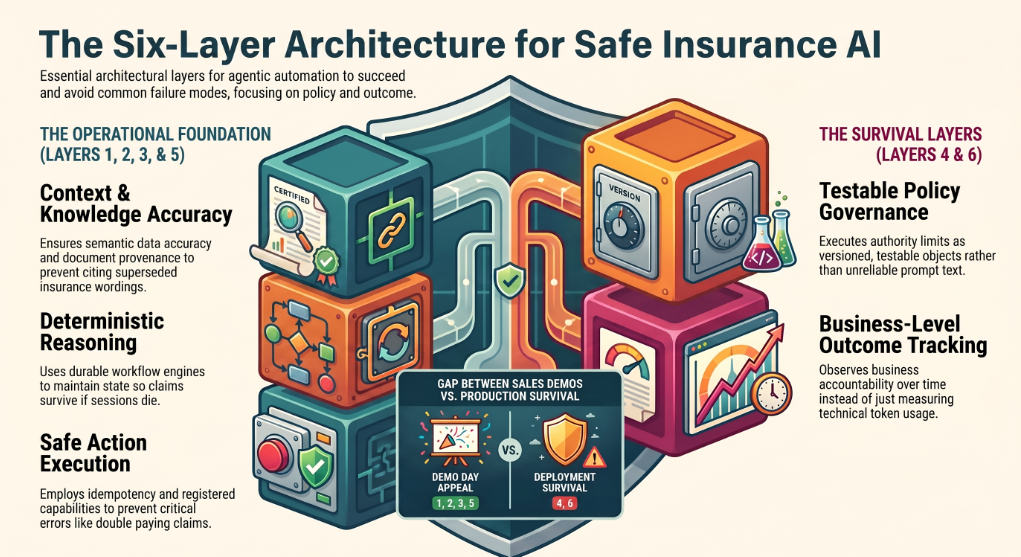
Layer 3 — Reasoning. Agents and multi-agent coordination running inside durable workflow. The principle is deterministic macro, agentic micro: the workflow engine owns state, waits, deadlines, retries, approvals and compensation; the agent chooses adaptive steps inside bounded zones where interpretation is genuinely valuable. Failure mode: treating the whole process as one long agent conversation. Chat sessions are not process state. When the session dies, the claim must not.
Layer 4 — Policy. Where most insurance deployments are thinnest. Appetite, benefit schedules, authority limits, delegated authority, escalation triggers and autonomy contracts execute here as versioned, testable objects. Failure mode: policy embedded in prompt text — unversioned, untestable, and silently different across environments.
Layer 5 — Action. A registered business capability, not an arbitrary API call: typed inputs, preconditions, permission checks, approval requirements, idempotency keys, post-condition verification and a receipt. Idempotency deserves special emphasis in insurance — a retry that pays a claim twice is a different class of incident from a retry that sends a duplicate email. Failure mode: giving an agent broad API credentials and calling the resulting log an audit trail.
Layer 6 — Outcome. Whether the work achieved the business result, observed on a schedule rather than assumed at completion. Failure mode: measuring tokens, calls and acceptance rate — technical observability mistaken for business accountability.
The load-bearing claim: layers 1, 2, 3 and 5 are where vendors compete on demo day. Layers 4 and 6 are where insurance deployments survive or die.
Layers 1, 2, 3 and 5 are shipped capability on assistents.ai today, alongside the rules engine at layer 4. The deeper elements of layers 4 and 6 — a formal capability registry and action gateway, an autonomy policy service, and a business-level operations control tower — are directional roadmap per the July 2026 internal strategy paper, not current functionality. That distinction matters more in an insurance RFP than any feature list, and it should be stated as plainly by every vendor you evaluate.
The Autonomy Contract: how to bound a claims agent
An Autonomy Contract is a declarative, versioned, expiring statement of exactly what one agent may do — scope, permitted actions, limits, escalation triggers and confidence floor. It is the artefact that replaces the meaningless flag autonomous: true.
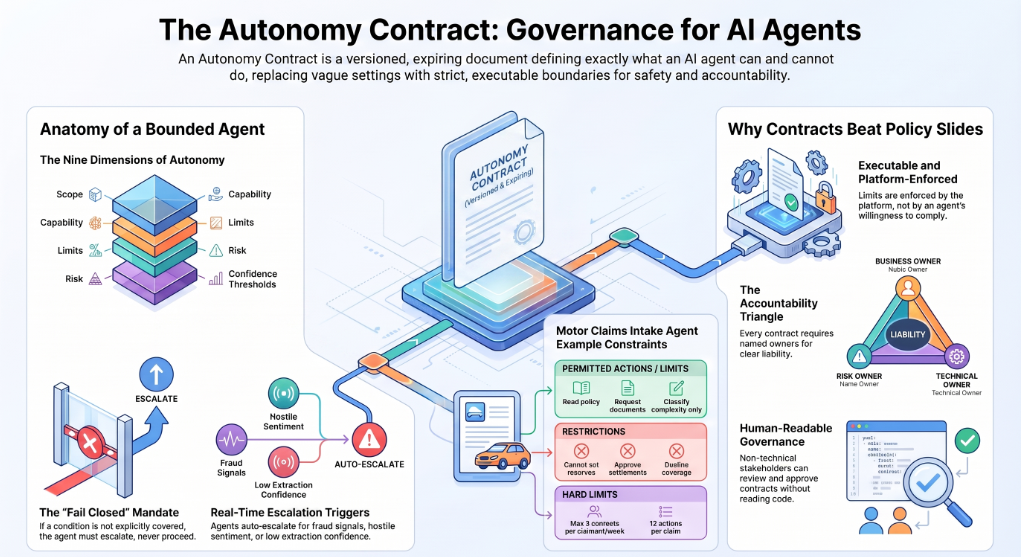
Effective autonomy is never a single property. It is the intersection of nine dimensions:
agent instance
× work type
× business scope
× capability
× affected object
× monetary or operational limit
× time window
× risk class
× required evidence and confidence threshold
Here is what that looks like as a working artefact for a motor claims intake agent. This is the thing you take to your risk committee — not a slide about AI.
agent: motor-claims-intake-agent
version: 3
work_type: motor_own_damage_fnol
owner:
business_manager: claims_operations_manager
risk_owner: head_of_claims_governance
technical_owner: platform_team
scope:
line_of_business: motor
claim_type: own_damage
policy_status: [in_force]
estimated_quantum_max: 150000
territory: [IN]
permissions:
read_policy: true
read_claim_history: true
create_claim_record: true
request_documents_from_insured: true
classify_complexity: true
recommend_reserve: true
set_reserve: false
approve_settlement: false
decline_coverage: false
issue_payment: false
contact_third_party: false
limits:
contacts_per_claimant_per_week: 3
documents_requested_per_claim: 2
autonomous_actions_per_claim: 12
escalate_when:
- injury_indicated
- third_party_involved
- policy_period_boundary_within_days: 7
- prior_claims_in_period_gte: 2
- fraud_signal_score_gte: 0.6
- claimant_sentiment: [distressed, hostile]
- complaint_language_detected
- legal_representation_indicated
- extraction_confidence_below: 0.85
- any_condition_not_covered_by_this_contract
evidence_required:
- policy_match_verified_against_pas
- loss_date_within_coverage_period
- document_provenance_recorded
review:
sampling_rate: 0.10
reviewer_role: senior_adjuster
valid_until: 2026-12-31
Six things this artefact does that a policy document cannot
- It is executable. The escalation triggers are enforced by the platform, not by an agent's willingness to comply with an instruction.
- It is versioned. Version 3 is a different set of authority from version 2, and every claim carries the version it was handled under.
- It expires. Authority that does not expire is authority nobody re-examines. An annual expiry forces a conversation.
- It has named owners. Business manager, risk owner, technical owner — the same accountability triangle you apply to a human authority holder.
- It fails closed. any_condition_not_covered_by_this_contract is the most important line in the file. The default is escalate, never proceed.
- It is reviewable by non-technical people. Your head of claims governance can read that YAML and say yes or no. Try that with a system prompt.
The rollout sequence every material agent should pass through
Offline evaluation → historical replay on real closed files → simulation → shadow mode with no action taken → recommendation only → human-approved execution → limited autonomous canary on a narrow segment → wider bounded operation → continuous monitoring with rollback ready.
Historical replay is the underused step. Running a proposed claims agent across two thousand closed files and comparing its recommendation to the actual outcome tells you more about production risk than any benchmark — and it produces exactly the evidence a regulator will want on how the system was tested before deployment.
The Regulator-Ready Decision Record
A Regulator-Ready Decision Record (RRDR) is the per-decision audit artefact an insurance agent produces for every material action: twelve fields that let a reviewer reconstruct, months later, exactly why a specific outcome occurred on a specific file.
The NAIC Model Bulletin expects a documented AI Systems Program covering governance, model validation and third-party oversight. The EU AI Act's high-risk obligations require record-keeping and human oversight that can be demonstrated. Both regimes, and every state and national variant, converge on the same practical demand: show me this decision. Not the model. Not the policy. This decision, on this file, on this date.
Most agent platforms log traces. A trace is not a decision record. Here is the difference:
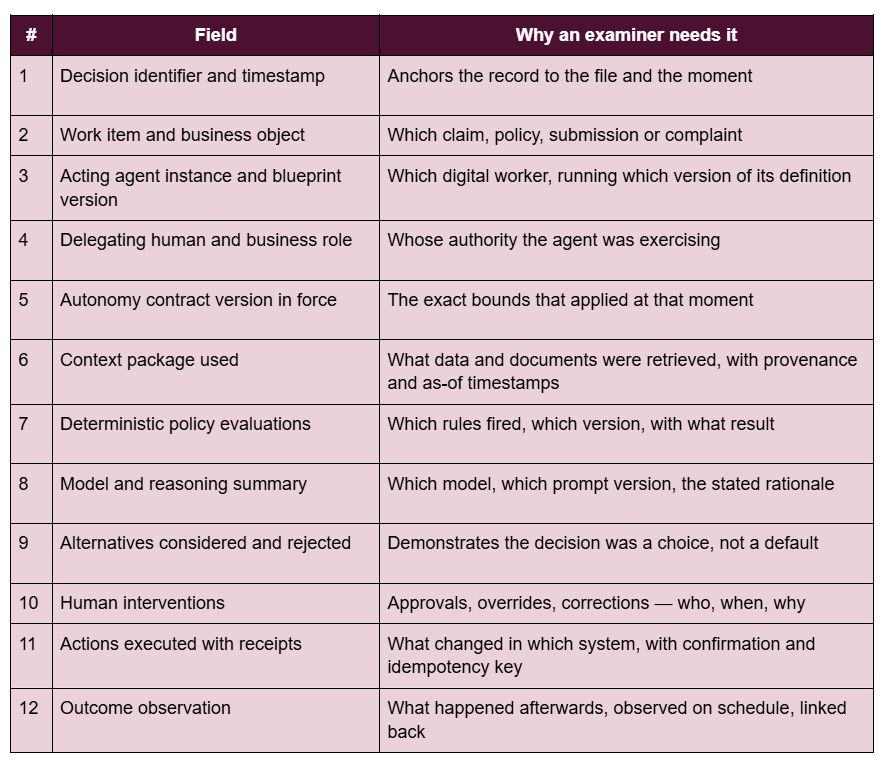
Fields 4, 5, 9 and 12 are the ones almost nobody implements — and they are the ones that turn a log into a defence.
The delegation point is subtle and important
An AI agent has no authority of its own. It exercises authority delegated by a human role holder, bounded by an autonomy contract, within a work purpose. Authority should therefore be computed at runtime, not asserted in a prompt:
runtime identity
∩ registered agent role
∩ delegating human or business role
∩ assigned work purpose
∩ capability permission
∩ business policy
∩ risk and budget envelope
If any one of those is empty, the action does not execute. An insurer that can describe its agent authority in these terms will pass a governance review; one that describes it as "the agent has access to the claims system" will not.
The 2026 regulatory map for insurance AI
This is a working map, not legal advice — verify with counsel, because this landscape is moving faster than any published guide.
The one design decision that satisfies most of it at once
Across every one of these regimes, four requirements recur: documented governance, demonstrable human oversight, per-decision record-keeping, and third-party vendor documentation.
An architecture that produces a Regulator-Ready Decision Record on every material action, bounded by a versioned Autonomy Contract, running deterministic policy in a versioned rule engine, satisfies the evidentiary core of all of them simultaneously. You will still need programme documentation, bias testing and counsel review. But you will not need to reconstruct history from logs — which is where most carriers discover the problem, during the examination rather than before it.
Insurance Agentic Workcells: the unit you actually deploy
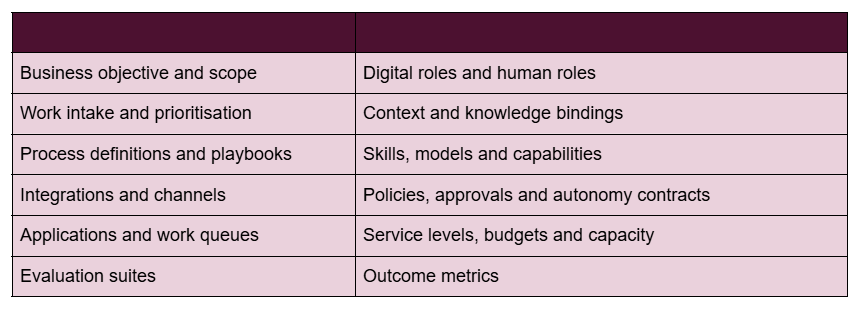
An Insurance Agentic Workcell is a governed team of humans and digital workers packaged to own one insurance operation and its outcome — with its own intake, playbooks, context, policies, applications, service levels and measured results.
The commercial insight behind the framing: a carrier does not want an agent. It wants a claims operation that performs. Buying agents produces a portfolio of demos nobody owns. Buying workcells produces an operation with a name, an owner and a number attached to it.
A workcell packages twelve things:
The four insurance workcells worth building first
Claims Operations Workcell. Owns FNOL through settlement decision for a defined segment. Digital roles: Intake Agent, Coverage Verification Agent, Document Workbench Agent, Fraud Signal Agent, Recovery Identification Agent, Communications Agent. Human roles: adjuster, technical claims specialist, SIU investigator, claims governance. Outcomes: cycle time, leakage on sampled audit, complaint rate, cost per file.
Underwriting Operations Workcell. Owns submission through quote issuance for a defined class. Digital roles: Submission Triage Agent, Enrichment Agent, Referral Memo Agent, Portfolio Monitoring Agent. Outcomes: quote-to-bind time, submissions per underwriter-day, hit ratio, appetite adherence.
Policy Servicing Workcell. Owns inbound servicing, endorsements, renewals and lapse prevention across chat, email and voice. Outcomes: self-service resolution rate, retention, servicing cost per policy, first-contact resolution.
Premium and Receivables Workcell. Owns collection, reminders, payment-plan follow-up and reinstatement workflows. Outcomes: days sales outstanding, collection rate by ageing bucket, lapse prevented, contact efficiency.
Workcells are also the right unit for land-and-expand. Land with one contained, measurable use case using capability that exists today. Prove it on quality, time saved, action success, human rework, risk and business impact. Form a workcell by adding adjacent work, digital roles and shared context around the same operation. Expand into more channels, systems and autonomy. Connect workcells through shared identity, context and policy. That sequence — use case → operating workflow → workcell → function → cross-functional fabric — is how a carrier gets to a transformed operating model without ever having to approve a transformation programme.
Evidence from comparable regulated deployments
Insurance-specific reference logos are the currency of this market, and most vendors overstate them. What follows is different and more useful: anonymised evidence from deployments on this platform in adjacent domains with the same technical and control characteristics as insurance work. Client names are withheld by policy; each is described by industry, geography and scale so you can judge comparability yourself.
The relevance argument is specific: a claim file is a case with durable state, contested documents, monetary consequence, delegated authority and an audit obligation. So is a tender bid, a bank dispute, a cross-border tax position, an SAP sales order and a healthcare revenue-cycle exception. The mechanics transfer.
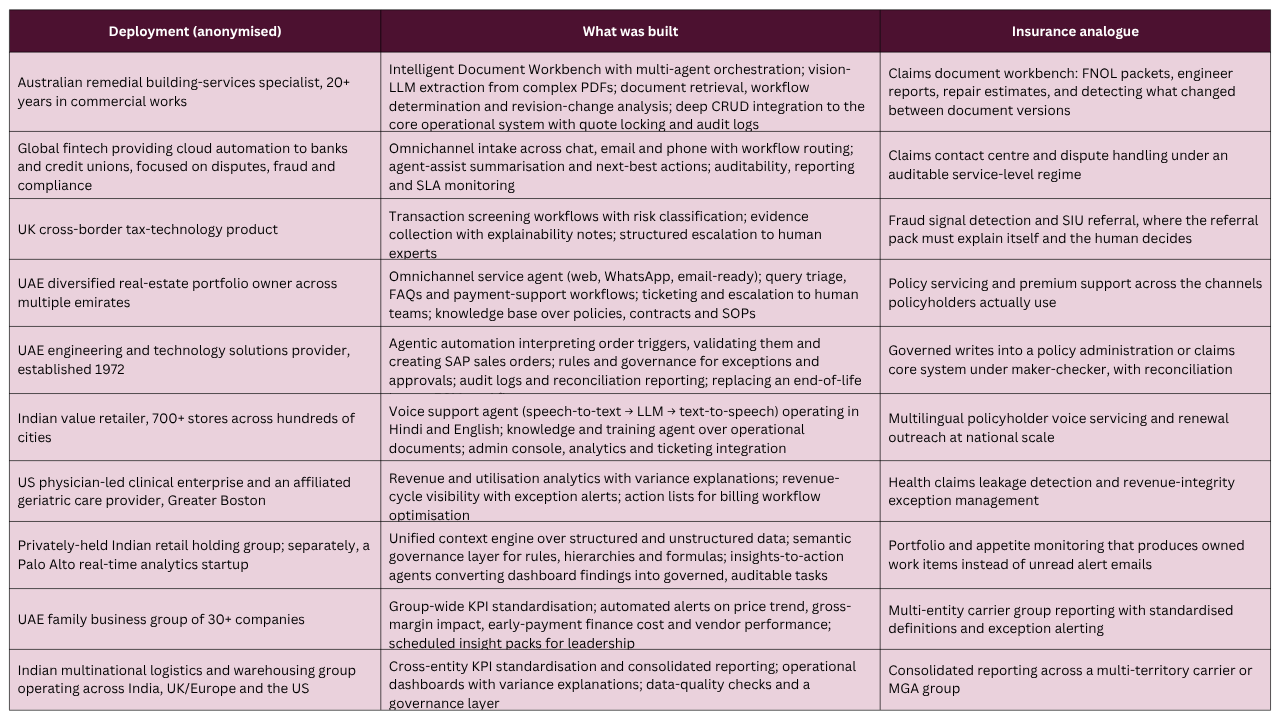
Three worth reading closely
The document workbench is the closest analogue to claims. In the Australian deployment, complex tender documents in varied and inconsistent PDF formats were processed by a multi-agent workbench that determined the correct workflow per document, extracted structured data using vision-capable models, detected revisions between versions, and wrote results into the operational system with quote locking and full audit logging. The programme was engineered against targets of up to roughly 90% faster document processing and around 95% extraction accuracy on standard formats — these are design targets from the engagement, not independently audited outcomes, and should be treated as such. The transferable point is architectural: revision detection and workflow determination per document are exactly what a claims file needs and what naive OCR pipelines never provide.
The tax-screening deployment is the closest analogue to fraud referral. It screens transactions for risk, classifies them, collects the evidence, writes the explainability note, and escalates to a human expert. The system never makes the adverse determination. That is precisely the control boundary an SIU referral agent must respect — and a working example of the boundary holding in production.
The SAP order automation is the closest analogue to core-system writes. Interpreting a trigger, validating it against rules, and creating a transaction in a system of record — with governance for exceptions, approval routing, audit logs and reconciliation reporting — is structurally identical to an agent creating a claim, posting a reserve or issuing an endorsement. Note the reconciliation reporting specifically: knowing that what the agent believed it did matches what the core system actually recorded.
The honest caveat. These are adjacent-domain deployments, not insurance references. They demonstrate that the platform's document, workflow, governed-action, voice and analytics machinery works in production under audit conditions. They do not demonstrate an insurance-specific implementation. Any vendor — including this one — should be asked to distinguish the two, and you should discount anyone who does not.
Build, buy or platform: an evaluation framework
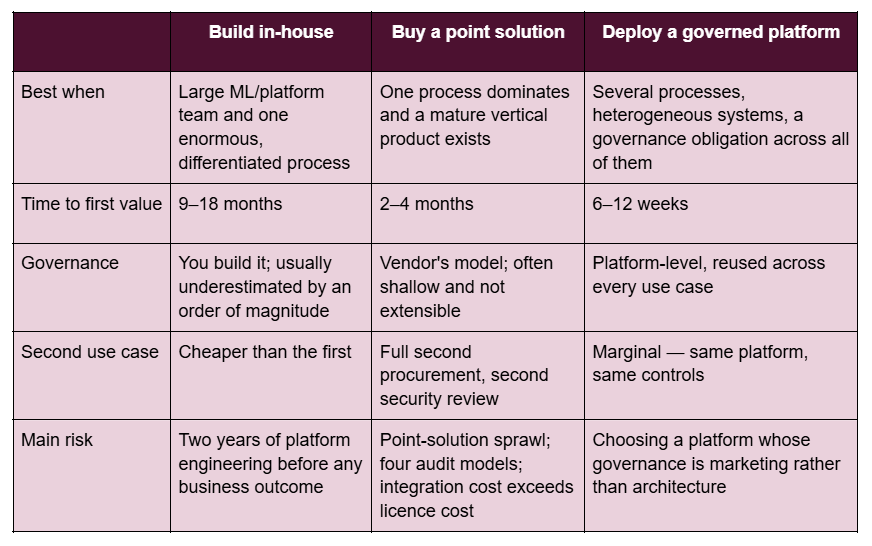
The RFP questions that actually separate vendors
- Show me a per-decision audit record. Not a trace, not a dashboard — the record for one decision, with the delegating human, the authority version in force, the rules that fired, and the alternatives rejected.
- How is authority expressed? If the answer is "in the system prompt", the product is not ready for a regulated deployment.
- Where does deterministic policy execute, and how is it versioned? Appetite, benefit schedules and authority limits must be testable objects with version history.
- Can this run in our VPC or on-premises, and which models can we route to? Then ask what breaks in that topology — something always does.
- How do you prevent an agent from executing the same financial action twice? Idempotency should have a specific answer, not a reassurance.
- What happens when the agent is wrong? Look for compensation, rollback, sampling review and a documented incident path — not a confidence score.
- How is row-level and field-level security enforced, on which paths? Insist on the distinction between paths. A vendor claiming uniform enforcement everywhere has not thought about it.
- What is shipped versus what is roadmap? Ask for the line in writing, then ask which of your use case's capabilities sit on which side of it.
- What documentation do you supply for our AI Systems Program and third-party oversight obligations?
- Show me a deployment in a regulated domain with audit obligations, and tell me honestly how comparable it is to insurance.
Question 8 is the one most likely to be answered evasively across the market. Weight it accordingly.
The 90-day implementation plan
This is a first-deployment plan, not a transformation plan. Its objective is a single workcell in production at Level 3 with measurable results and a governance file that survives review.
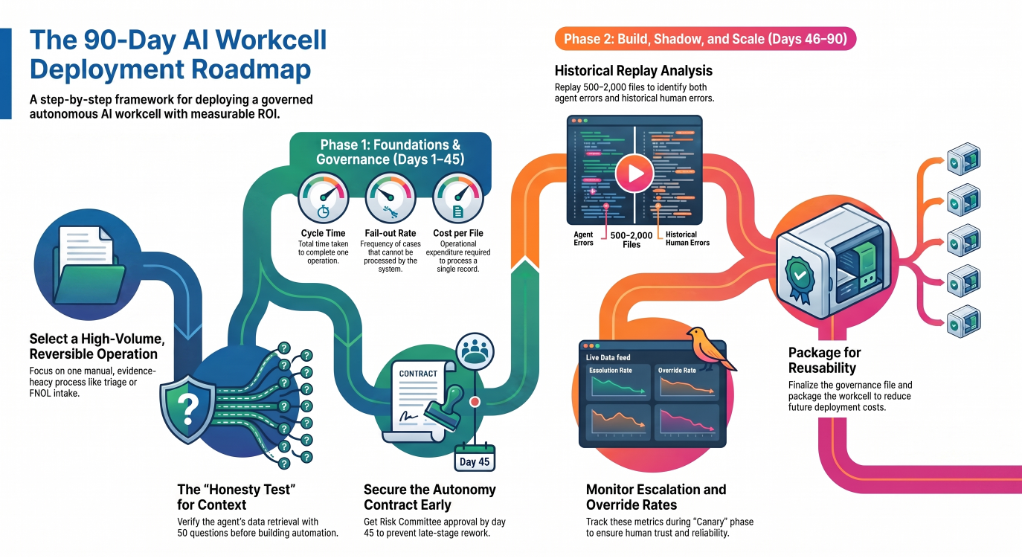
Days 1–15 — Choose the work and set the bar. Pick one operation, not a portfolio: high volume, heavy manual handling, evidence-heavy, reversible consequences, one accountable owner. Submission triage and FNOL intake are the two most common correct answers. Define the target numerically before writing any code — current cycle time, cost per file, fall-out rate, rework rate. Programmes that skip this cannot prove value later and get cancelled in the next budget cycle regardless of how well they work. Name three owners: business manager, risk owner, technical owner. Assemble 500–2,000 historical files for replay. Exit criteria: operation selected, baseline measured, owners named, replay dataset assembled.
Days 16–30 — Establish context and knowledge. Connect governed policy, claims, billing and exposure data; define the semantic metrics the agent and the humans will share. Ingest wordings, endorsements, manuals, guidelines and SOPs. Then run the honesty test: ask fifty questions your team already knows the answers to, and check both the answer and the citation. Fix the context layer before adding any agent — every hour here saves five later. Exit criteria: semantic metrics agreed with the business owner; retrieval returning correct, cited, permission-aware results on a fifty-question benchmark.
Days 31–45 — Write policy and the Autonomy Contract. Encode appetite, benefit schedules, authority limits and escalation triggers as versioned deterministic rules. Draft the Autonomy Contract. Take it to the risk committee now, not after the build. This is the highest-leverage sequencing decision in the plan: a contract approved at day 45 is a build specification; a contract reviewed at day 80 is a rework order. Exit criteria: rules versioned and unit-tested; Autonomy Contract v1 approved by the risk owner.
Days 46–60 — Build, replay and evaluate. Build the agents inside durable workflow — deterministic macro, agentic micro. Register actions as governed capabilities with typed inputs, permissions, approvals and idempotency keys. Build the human work surface: queue, file view, approval control, override with reason capture. Then replay against historical files and investigate every disagreement. Some will be agent errors; a useful proportion will be historical human errors, and those findings are often worth more than the automation. Exit criteria: replay complete; disagreement analysis documented; evaluation suite green; decision record produced for every replayed decision.
Days 61–75 — Shadow and canary. Run in shadow alongside the human team, taking no action. When agreement is stable and disagreements are understood, promote to human-approved execution on live work, then open a limited autonomous canary on the narrowest permitted segment. Watch three things obsessively: escalation rate (too low means over-confidence), override rate (too high means the humans do not trust it), and rework rate (the truth-teller). Exit criteria: shadow agreement stable; approved-execution live; canary open; monitoring and rollback tested.
Days 76–90 — Measure, harden and package. Measure against the day-15 baseline. Complete the governance file: autonomy contract history, evaluation results, replay analysis, decision-record samples, incident log, vendor documentation. Harden the failure paths — source system down, document unreadable, policy unmatchable. Then package what you built as a workcell so the second deployment costs a fraction of the first. That reusability is the entire economic argument for a platform over a point solution, and it only materialises if you deliberately package it. Exit criteria: measured result against baseline; governance file complete; workcell packaged; next operation selected.
The Agentic Operations Scorecard
The Agentic Operations Scorecard is eight metrics across four dimensions — quality, velocity, control and economics — that together prove or disprove whether an insurance agent deployment is working.
Token counts, call volumes and user satisfaction scores are technical observability. They are not business accountability, and reporting them to a steering committee is how programmes lose credibility.
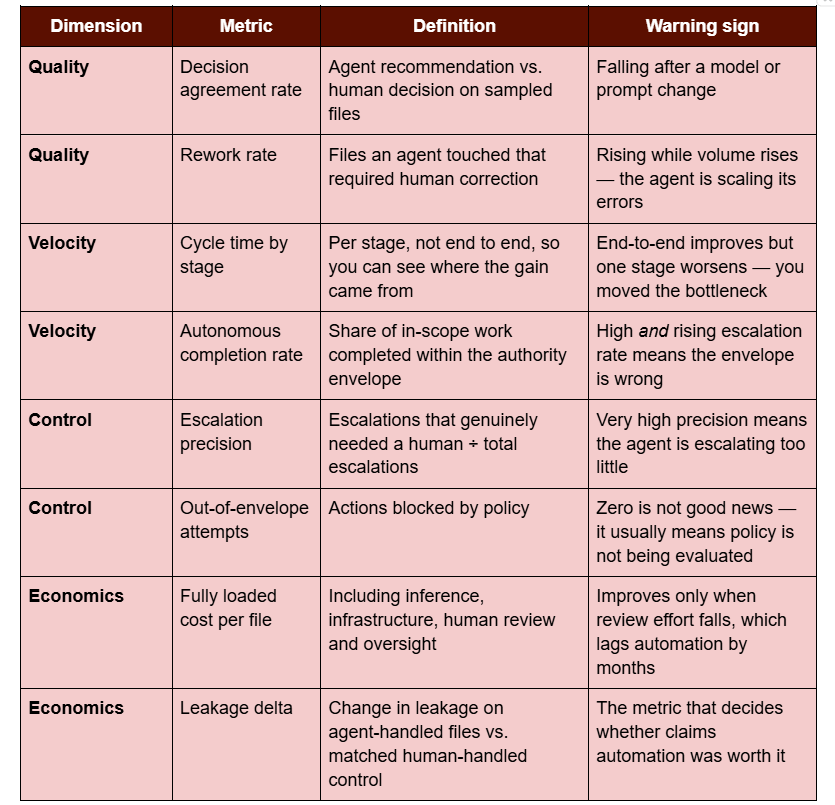
Two measurement rules matter more than the metrics themselves. Use a matched control group — agent-handled versus human-handled on comparable files in the same period, never against last year's average. And sample-audit forever, not just during the pilot; the failure mode of a well-performing agent is quiet drift, and drift is only visible against a standing sample.
Ten ways agentic automation fails in insurance
- Autonomy asserted, not designed. No autonomy contract, so authority lives in prompt text and nobody can say what the agent is permitted to do.
- Policy in the prompt. Appetite and benefit rules embedded in instructions — unversioned, untestable, silently different across environments.
- The chat session as process state. The session dies, the claim's state dies with it. Durable workflow is not optional.
- Traces mistaken for audit. A technical log answers "what did the system do". An examiner asks "why was this decision made". Different artefacts.
- Broad credentials instead of governed capabilities. The agent gets a wide-scope API key, and the blast radius of a bad plan becomes the whole core system.
- No idempotency on financial actions. A retry pays a claim twice, and the incident is now a finance problem and a regulatory one.
- Adverse actions delegated to agents. A declination, payment delay or fraud-driven hold taken on an agent's own authority. Fastest route to an unfair-practices finding.
- Optimising the wrong metric. Cycle time improves, leakage worsens, nobody notices for two quarters because leakage was never measured on a matched sample.
- Everything as multi-agent. Six agents where a rule and a form would do — complexity that adds cost, latency and failure surface without adding capability.
- No packaging. The first deployment works and the second costs the same, because nothing was made reusable. This is how a promising pilot becomes a permanent pilot.
Why assistents.ai is the right platform for insurance agentic automation
Section 6 covered the shipped capability. This section is the strategic argument: why a carrier should place a multi-year bet here rather than on a CRM's agent add-on, an RPA vendor's agentic layer, or a model provider's framework.
The category is a System of Agency, and insurance needs it more than most
Systems of record store authoritative transactions. Systems of intelligence analyse and predict. Systems of engagement provide interfaces. Systems of automation execute predefined logic. The layer missing from the insurance stack is a System of Agency: the layer that decides what work needs doing, who or what should do it, what context is permitted, what authority applies, which capabilities may be invoked, and whether the outcome was achieved.
Your policy admin system will not become that layer, and it should not. Your CRM will not, because it does not see claims. Your RPA platform will not, because its execution model has no concept of delegated authority. assistents.ai is built to be that layer across those systems, leaving each authoritative for its own transactions. For a carrier running a policy admin system, a claims system, a billing system, a document repository and three warehouses — which is every carrier — an operating layer across them is the only architecture that does not require replacing any of them.
Six assets that compound rather than depreciate
Models will improve and commoditise; a platform bet made on model access has a short half-life. What compounds is different:
- Your work and outcome history. The structured record of goals, work, actors, context, decisions, actions and outcomes becomes an operating memory specific to your book. Nobody else has it, and it gets more valuable every quarter.
- Your certified digital workforce. Role definitions, evaluation suites, performance records and authority envelopes become reusable enterprise assets, the way trained adjusters are.
- Your capability and policy estate. Every governed integration, action contract, rule and approval mapping expands what agents can safely do next. The tenth use case is dramatically cheaper than the first.
- The workcell library. Reusable operating patterns across claims, underwriting, servicing and receivables reduce each subsequent implementation.
- Deployment control. Private cloud, VPC and on-premises with model choice — the criterion that decides regulated shortlists and protects you from a provider's pricing or policy change.
- Outcome evidence. The ability to prove business impact from real work history is more defensible in a board paper than any demo.
Model-neutral and system-neutral, deliberately
Both backends route models through a gateway supporting multiple providers, with per-organisation bring-your-own-key. Interoperability with external agents and existing enterprise systems is an architectural goal, not a competitive concession. The durable assets are meant to be your work model, your context, your capabilities, your policies and your outcome history — not a dependency on one model provider, one framework, or one cloud. A carrier that has to re-platform every time the model landscape shifts has not bought a platform.
Stated plainly: what is shipped and what is directional
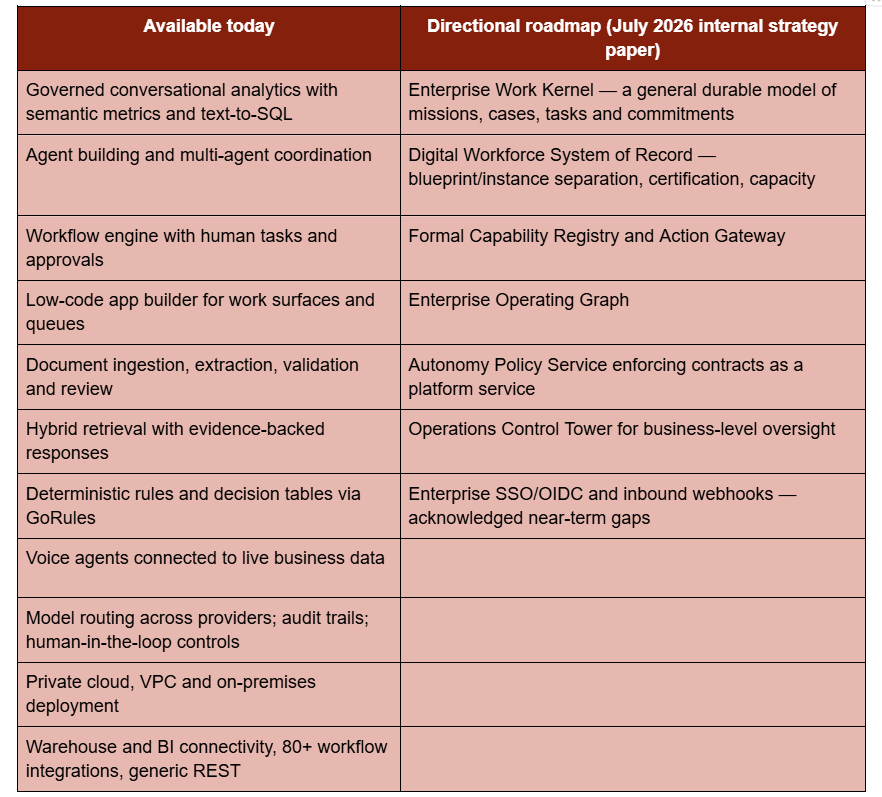
We publish this table because in a regulated procurement the vendor who draws the line clearly is easier to work with than the vendor who does not — and because your risk function will find the line anyway.
Where to start
If you take one thing from this guide, take the sequencing. Most insurance AI programmes fail on order of operations, not on technology: they build first, discover the governance requirement in month four, and rebuild. The order that works is baseline → context → policy → build → replay → shadow → canary → measure → package.
And take the framing to your steering committee: not "should we let AI do this", but which rung of the authority ladder, for which work type, under whose delegated authority, with what evidence to move up. That question gets a yes.
Book a working session with the assistents.ai team. We will map one insurance operation to the Six-Layer Reference Architecture, draft the Autonomy Contract for the agents it needs, and give you a costed 90-day plan — including an honest account of what is shipped today and what is roadmap.
FAQs
What is agentic automation in insurance?
Agentic automation in insurance is the use of AI agents that plan and execute multi-step insurance work — intake, verification, assessment, communication and system updates — within an authority envelope the carrier defines. It differs from earlier automation in that it handles unstructured evidence such as documents, photographs and calls, chooses its own path within bounds, writes to systems of record through governed actions, and escalates when it encounters conditions outside its permitted scope.
What is the difference between agentic AI and RPA in insurance?
RPA executes a fixed keystroke sequence against stable screens and breaks when anything changes. Agentic AI reasons over ambiguous inputs and decides its own sequence toward an objective. In practice they are complementary: RPA remains the right tool for deterministic, high-volume legacy writes such as bordereaux loading, while agentic automation handles the work that currently falls out of automated paths into human queues.
How is agentic AI used in claims processing?
Most commonly for FNOL intake and structuring, coverage verification and triage, document extraction and cross-validation, fraud signal detection with referral to a Special Investigation Unit, subrogation and recovery identification, and end-to-end handling of narrow low-value segments within a monetary ceiling. Claims decisions with adverse consequences for a policyholder — declination, delay, reduction — should remain human at current maturity.
Can AI agents settle insurance claims without a human?
Technically yes, within tightly defined segments — low-value, single-party, well-documented claims with a monetary ceiling and a confidence floor. Whether you should depends on your regulatory exposure and risk appetite. The defensible pattern is autonomous handling inside a narrow segment with post-hoc sampled human review, never autonomous handling of adverse decisions.
Is agentic AI safe for regulated insurance decisions?
It is safe when authority is bounded by a versioned autonomy contract, binding policy executes in a deterministic rule engine rather than a prompt, every material action produces a per-decision audit record, and adverse actions remain with humans. It is unsafe when autonomy is a configuration flag and the audit trail is a technical log. Safety is a property of the deployment design, not of the model.
What does the NAIC Model Bulletin require for AI?
It expects insurers to maintain a written AI Systems Program covering the AI lifecycle, with documented governance, model validation and third-party vendor oversight, and it reminds insurers that AI-supported decisions must still comply with existing insurance law including unfair trade practice and unfair discrimination statutes. It is principles-based guidance adopted by state regulators, enforced through market-conduct examination, and by mid-2026 it had been adopted in full or substantially similar form in more than twenty US jurisdictions.
Does the EU AI Act apply to insurance AI?
Yes, in part. Annex III point 5(c) classifies AI systems used for risk assessment and pricing in life and health insurance as high-risk, with obligations applying from 2 August 2026 — covering risk management, data governance, technical documentation, record-keeping, human oversight, accuracy and conformity assessment. Property and casualty pricing is not captured by that specific provision in the first wave, though P&C systems may still be high-risk through other Annex III routes and remain subject to national and US state rules regardless.
What are the IRDAI rules on AI for insurers in India?
As of August 2026 there is no dedicated IRDAI AI framework in force. IRDAI constituted a seven-member AI working group on 19 June 2026 with a three-month mandate covering the current state of AI adoption and a proposed framework for ethical, transparent and explainable use, naming claims processing and fraud detection specifically. Revised Information and Cyber Security Guidelines issued in April 2026 already apply. Indian insurers should treat this window as preparation time — auditing deployments and documenting governance before requirements are formalised.
How do you audit an AI agent's decision in insurance?
With a per-decision record capturing the acting agent instance and version, the delegating human authority, the autonomy contract in force, the context and documents used with provenance, the deterministic rules that fired, the model and rationale, alternatives rejected, human interventions, executed actions with receipts, and the observed outcome. A technical trace answers what the system did; only this record answers why the decision was made.
Which insurance processes should be automated first?
Start where volume is high, manual handling is heavy, evidence is document-based, consequences are reversible and one person owns the outcome. Submission triage and FNOL intake meet all five criteria more often than any other candidate. Avoid starting with adverse-decision processes or anything touching filed rates, regardless of how attractive the business case looks.
How long does an agentic automation deployment take in insurance?
A first workcell in production at delegated authority, with a governance file that survives review, is achievable in roughly 90 days when the operation is contained and the risk committee is engaged from day 30 rather than day 80. Subsequent workcells on the same platform are materially faster because context, policy, capabilities and controls are reused.
What ROI should insurers expect from agentic automation?
Published carrier and vendor results through 2026 point to loss-ratio improvements in the low single-digit percentage points in commercial underwriting, large reductions in quote-to-bind and claims cycle time, and eight-figure annual value at large-book scale. Treat all vendor-published figures sceptically and build your own case: measure a baseline before you build, use a matched human-handled control group, and include fully loaded costs including human oversight, which lags automation by months.
What is a digital worker in insurance?
A persistent, named AI agent with a defined business role, competencies, permitted capabilities, an owner and a performance history — managed with the same seriousness as a human role holder rather than as a prompt. Treating agents as workers rather than features is what makes lifecycle management, certification and audit tractable once you have more than a handful of them.