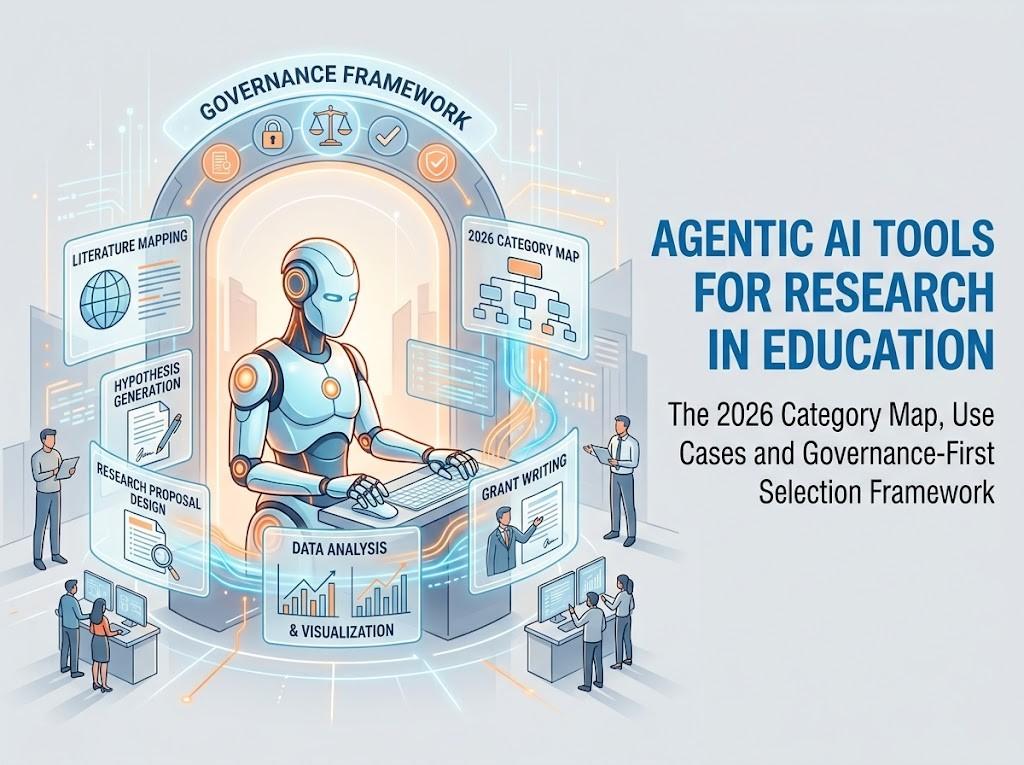
Agentic AI tools for research in education fall into six distinct categories, and most institutions buy the wrong one. Three of those categories serve the individual researcher — literature discovery, evidence extraction, academic writing. Three serve the institution — institutional research analytics, research administration, and the governed platform layer everything else runs on.
A literature agent will summarise four hundred papers beautifully and still cannot tell a provost which doctoral programmes are losing candidates in year three, because it has no permitted access to the student information system, no agreed definition of attrition, and no audit trail to defend the answer.
This guide maps all six categories, sets out fourteen use cases with explicit human checkpoints, supplies a sixteen-point readiness checklist and twelve vendor questions, and describes the governed architecture that makes agentic research operations safe in an environment holding student records, research subject data and sponsored funds.
To Summarize:
- Agentic AI tools for research in education are systems that plan, retrieve, reason, act and verify across a research workflow rather than answering a single prompt.
- They divide into six layers: literature discovery, evidence extraction, writing and citation integrity, institutional research analytics, research administration and compliance, and governed agent platforms.
- The first three are individual productivity tools. The last three are institutional infrastructure. They are not substitutes.
- The blocking constraint is almost never model quality. It is data governance, agreed metric definitions, permissions and human-in-the-loop placement.
- The realistic adoption path is a maturity ladder: Ask → Execute → Autonomous. Most institutions should be operating at Ask and piloting Execute in 2026.
- Assistents.ai operates at layer six: a governed platform with a semantic layer, row-level security, human approvals, immutable audit trails and private cloud, VPC or on-premises deployment.
What are agentic AI tools for research in education?
Agentic AI tools for research in education are software systems that pursue a research objective across multiple steps — retrieving sources, extracting structured evidence, querying institutional data, drafting outputs, and escalating to a human when confidence or authority runs out — rather than returning a single response to a single prompt. The defining property is not conversational fluency. It is the ability to decompose a goal, select tools, act on the result, and verify what it produced.
The phrase covers two very different things, and conflating them is the most expensive mistake in this category.
Agentic AI vs AI agents vs AI assistants vs chatbots
The sector has settled on a four-tier spectrum, and it is worth being precise, because procurement documents routinely use all four words to describe the same product.
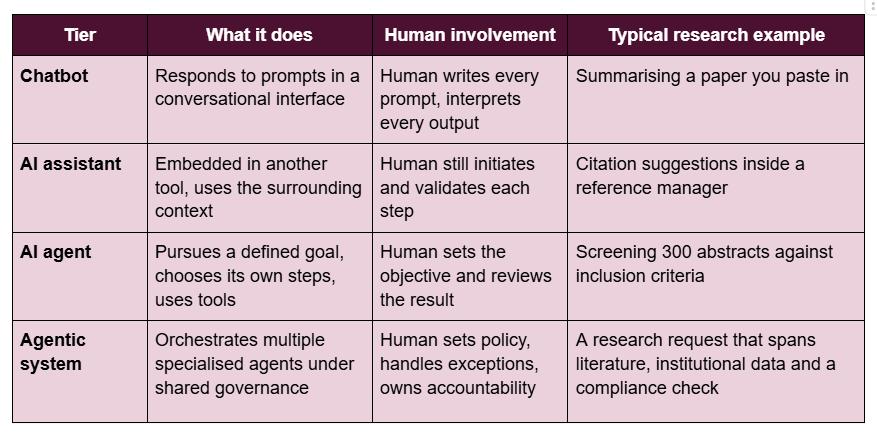
The step that matters for institutions is the third to the fourth. A single agent with broad permissions is a governance problem. An agentic system decomposes the work into scoped agents, each with its own guardrails, coordinated by an orchestration layer — which is what makes oversight tractable at institutional scale.
For a fuller treatment of the underlying distinction, see our guide on the difference between an AI assistant and an AI agent.
What makes a research tool "agentic"
A tool earns the label when it can complete this loop without a human driving each turn:
- Plan — decompose "assess whether our first-year intervention improved persistence" into retrievable sub-questions.
- Retrieve — pull from literature databases, institutional warehouses, document repositories and policy files, within permission.
- Reason — compare, reconcile conflicts, identify what the evidence does not support.
- Act — write a structured extract, generate a report, create a task, update a record.
- Verify — check outputs against source, flag low-confidence claims, confirm the action landed.
- Escalate — hand to a named human when the question exceeds its authority, confidence or data scope.
Steps four to six are where most "AI research tools" stop existing. A tool that summarises but cannot act, cannot verify and cannot escalate is an assistant with good marketing.
Why "research in education" means two different things
This is the distinction that determines your budget, your buyer and your risk profile.
Research in education as academic scholarship. A doctoral candidate running a systematic review on formative assessment. A faculty team synthesising qualitative interview data. A postdoc mapping a citation network. The unit of work is the paper. The buyer is an individual or a department. The data is public or consented. The tools are inexpensive and interchangeable.
Research in education as an institutional function. An institutional research office answering the provost's question about programme viability. A sponsored research office assembling a proposal package. An accreditation team producing a statutory reporting pack. The unit of work is a decision. The buyer is the institution. The data is student records, grant finances, faculty workload and regulated research subject information. The tools require permissions, provenance and audit.
Both are legitimate readings of the keyword. Only one of them is an infrastructure decision. Most published guidance addresses the first and quietly ignores the second, which is why so many institutions arrive at a governance review with a stack of individual subscriptions and no architecture.
The six categories of agentic AI tools for research in education
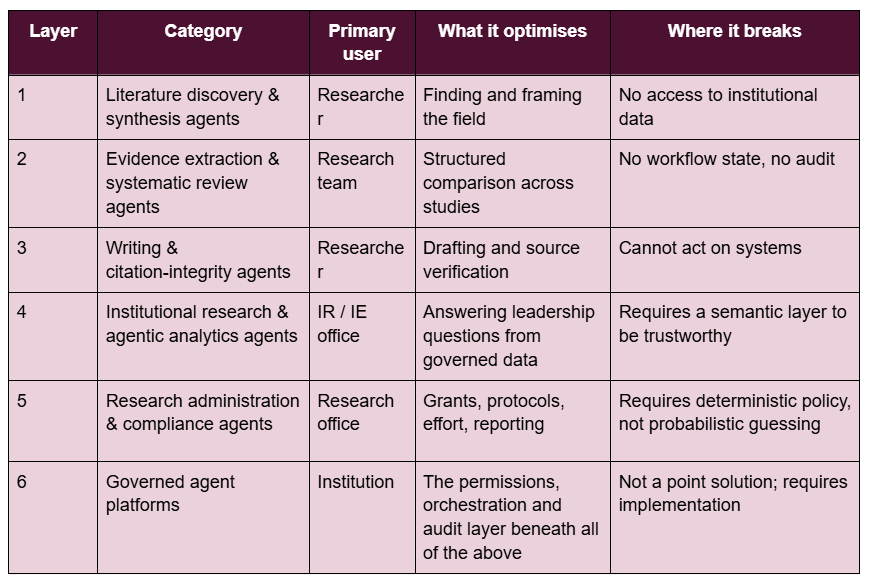
Here is the full landscape. We call this the Six-Layer Research Agent Stack. Layers one to three serve people. Layers four to six serve institutions. A tool in one layer cannot substitute for a tool in another, and the most common procurement failure is buying a layer-one tool for a layer-five problem.
1. Literature discovery and synthesis agents
These interpret a natural-language research question semantically rather than by keyword, and return conceptually relevant papers with structured summaries. The established names in this layer — Semantic Scholar, Consensus, Elicit, ResearchRabbit, Connected Papers, NotebookLM, Perplexity — are genuinely good at what they do, and a research office should not be building an in-house replacement for them.
Best for: scoping a field, finding the papers you did not know existed, mapping citation networks, rapid evidence checks.
Where it breaks: the moment the question involves your own institution. No literature agent can answer "how does our completion rate compare to the intervention effect sizes in this literature?" because it has no permitted route to your data.
2. Evidence extraction and systematic review agents
These operate on a defined corpus rather than the open literature, producing extraction matrices — populations, interventions, methods, effect sizes, limitations — across a screened paper set. This is the layer that turns three weeks of manual coding into a reviewable draft.
Best for: systematic and scoping reviews, meta-analysis preparation, structured comparison at scale.
Where it breaks: extraction quality degrades on qualitative and mixed-methods education research, where the constructs are not standardised. It also has no persistent workflow state — screening decisions, exclusion rationales and reviewer disagreements typically live outside the tool, which is a problem when a review must be defensible.
3. Academic writing and citation-integrity agents
Drafting support, structural editing, language editing, reference formatting, and — most importantly — citation verification. The citation-integrity function matters more than the writing function, because the failure mode of generative models in academic contexts is fluent fabrication.
Best for: manuscript preparation, submission readiness, translation, checking whether a claim is actually supported by the source cited.
Where it breaks: these tools cannot verify claims against your institutional data, and they carry academic-integrity policy exposure that varies by institution and funder.
4. Institutional research and agentic analytics agents
This is where the sector's centre of gravity is moving and where almost no published guidance exists. Agentic analytics means agents that sense, analyse, decide and act on governed institutional data — shifting analytics from a passive reporting layer to an active one.
The concrete change: a dean asks "how many international students have we enrolled over the last ten years, and where is the trend heading?" in plain language and receives an immediate, explained, data-backed answer, instead of joining a queue for an analyst.
Best for: natural-language access to enrolment, outcomes, finance and workload data; continuous monitoring of cohort signals; variance explanation; statutory and accreditation reporting.
Where it breaks: without a semantic layer, this is dangerous rather than useful. If "retention" resolves to four different SQL definitions across four departments, an agent will answer four different questions confidently and the institution will make decisions on incompatible numbers. The prerequisite is agreed metric contracts, not a better model.
5. Research administration and compliance agents
Grants, protocols, effort reporting, conflict-of-interest disclosures, sub-award monitoring, post-award financial compliance. This layer handles the operational scaffolding around research rather than the research itself, and it is where the measurable administrative time savings live.
Best for: funding opportunity matching, proposal assembly support, internal-consistency checking across protocol documents, readability assessment of participant-facing materials, compliance pre-screening, evidence collection for audit.
Where it breaks: policy cannot be probabilistic. An agent that usually applies the right eligibility rule is a liability. This layer requires deterministic rules and decision tables for the policy component, with the agent handling interpretation, retrieval and drafting around a hard rules core.
6. Governed agent platforms
The layer that determines whether layers four and five are possible at all. A governed agent platform supplies identity and permissions, a semantic layer, orchestration across multiple specialised agents, deterministic policy execution, human approval gates, immutable audit trails, and deployment control.
Best for: institutions that have moved past pilots and need agents that touch real systems and real records.
Where it breaks: this is not a subscription you activate on a Tuesday. It requires data readiness work, metric agreement and an owner. Institutions that skip that work do not get value from any of the layers above it.
For the general taxonomy beyond education, see our overview of the types of AI agents.
The gap nobody talks about: research tools stop at the paper, institutions need agents that reach the system
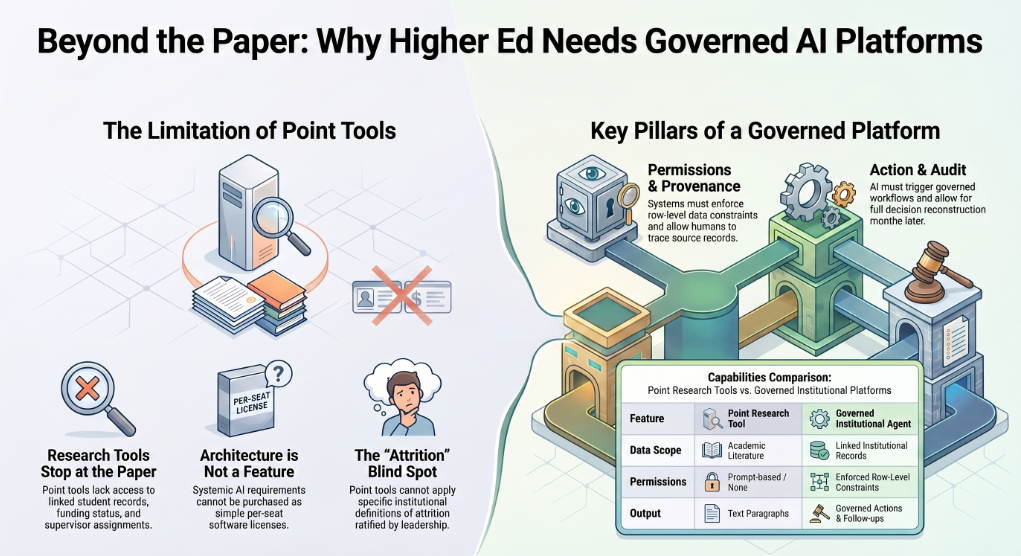
The published guidance on agentic AI in higher education is unusually clear about what is required and unusually quiet about how to satisfy it. The consensus position across association research, university guidance and peer-reviewed surveys converges on the same prerequisites: strong data quality and governance, agreed metric definitions matching the logic campus leadership actually uses, explicit decisions about data access and permissions, a defined place for human-in-the-loop oversight, and clarity about which workflows are too sensitive to delegate at all.
Every item on that list is an architecture requirement. None of them is a feature you can buy on a per-seat licence.
Why a literature agent cannot answer "which programmes are driving our doctoral attrition?"
Work the question backwards and the reason becomes structural rather than technical.
Answering it requires joining student records to programme enrolment to supervision assignments to milestone completion to funding status. It requires knowing which definition of attrition the provost's office ratified. It requires the answer to be visible only to people entitled to see student-level data, and aggregated for everyone else. It requires a record of who asked, what was returned, and which underlying tables were touched. And it requires a route from the answer to an action — a flagged cohort, an assigned review, a scheduled follow-up.
A literature agent has none of these. Not because it is poorly built, but because it was built for a different problem.
The four questions a point tool cannot answer
Before any agent touches institutional data, four questions need architectural answers:
- Permissions — who is this agent acting on behalf of, and what is that person entitled to see? Not "what did we tell the model in its prompt," but an enforced, row-level constraint the agent cannot talk its way around.
- Provenance — which specific records, documents and definitions produced this answer, and can a human trace it end to end?
- Action — when the answer implies something should happen, does it happen through a governed capability with approval and verification, or does it stop at a paragraph?
- Audit — six months later, when a decision is challenged, can the institution reconstruct exactly what the agent saw, did and was authorised to do?
Point research tools answer none of these because they were never designed to. Governed platforms exist specifically to answer all four.
14 agentic AI use cases for research in education
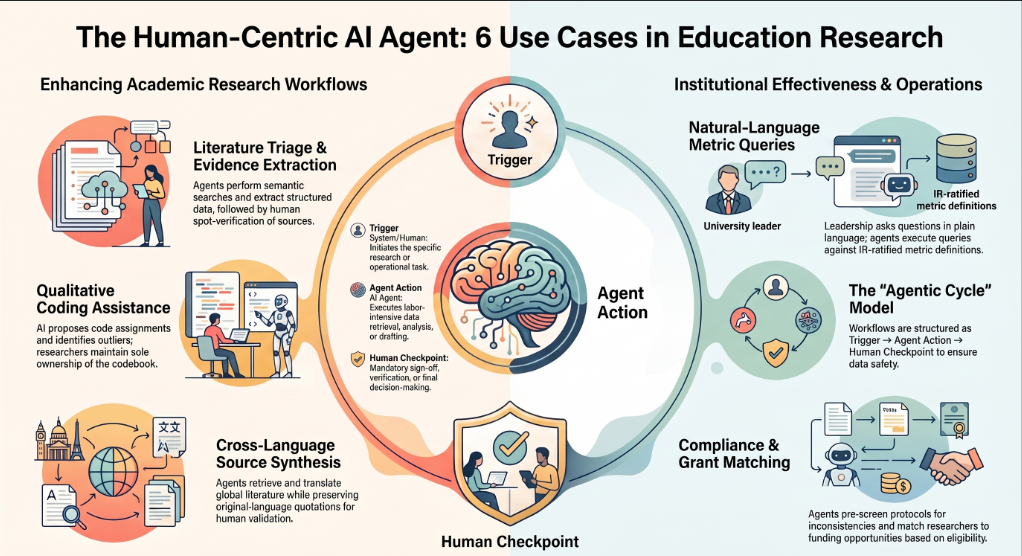
Each use case below is written as trigger → agent action → human checkpoint. The human checkpoint is not decoration. In a regulated data environment it is the design.
Academic research workflows
1. Literature triage at scale. Trigger: a defined research question and inclusion criteria. Agent: semantic search across databases, deduplication, first-pass screening against criteria, ranked shortlist with exclusion rationale. Checkpoint: the reviewer confirms the criteria interpretation before full-text screening proceeds.
2. Evidence extraction with citations. Trigger: an approved corpus. Agent: structured extraction of population, method, sample, intervention, outcome and limitation fields, with a source link and page anchor on every cell. Checkpoint: spot-verification of a sampled subset before the matrix is used.
3. Qualitative coding assistance. Trigger: an interview or open-response dataset and an initial codebook. Agent: proposed code assignments with supporting excerpts and confidence flags, plus surfaced passages that fit no existing code. Checkpoint: the researcher owns the codebook; the agent never finalises a code.
4. Methods and protocol drafting support. Trigger: a study design brief. Agent: assembles a draft protocol against the institution's template, checks internal consistency across sections, flags fields that reference each other and disagree. Checkpoint: the principal investigator reviews and submits; the agent never submits.
5. Cross-language source synthesis. Trigger: a review spanning non-English literature. Agent: retrieval, translation and normalised summarisation with original-language quotations preserved. Checkpoint: a native-language reviewer validates the sampled translations.
Institutional research and effectiveness
6. Natural-language enrolment and outcomes queries. Trigger: a leadership question in plain language. Agent: resolves the question against certified metric definitions, generates and executes the query within the asker's permissions, returns the number with the definition and lineage attached. Checkpoint: every metric definition is ratified by the IR office before it is queryable.
7. Cohort and attrition signal monitoring. Trigger: continuous. Agent: watches defined indicators across cohorts, detects deviation from expected pattern, produces a diagnosis with contributing factors. Checkpoint: the alert routes to a named human; the agent does not contact students.
8. Accreditation and statutory reporting packs. Trigger: a reporting cycle. Agent: assembles the required data set against the specification, reconciles against prior submissions, flags variances that need narrative explanation. Checkpoint: human sign-off before submission, with full audit trail retained.
9. Programme performance variance explanation. Trigger: a metric moves outside tolerance. Agent: decomposes the variance across contributing dimensions and produces a plain-language explanation with supporting evidence. Checkpoint: the IR analyst validates before it reaches a governance committee.
10. Multi-campus metric consolidation. Trigger: a group or system-level reporting requirement. Agent: standardises definitions across entities, consolidates, and flags where local definitions diverge from the standard. Checkpoint: divergences are resolved by humans, not silently normalised.
Research administration and operations
11. Grant opportunity matching and proposal assembly. Trigger: a researcher profile or a new funding announcement. Agent: matches opportunities to eligibility and research profile, assembles reusable proposal components, checks the package against sponsor requirements. Checkpoint: eligibility determination is confirmed by the research office.
12. Compliance pre-screening and evidence collection. Trigger: a protocol or disclosure submission. Agent: screens for internal inconsistency, missing required elements and readability problems in participant-facing documents, and assembles the evidence file with explainability notes. Checkpoint: every finding is a flag for human attention, never an automated decision.
13. Effort and utilisation analytics. Trigger: a reporting period. Agent: reconciles effort commitments against payroll and activity data, surfaces exceptions and near-threshold cases. Checkpoint: exceptions are reviewed and certified by the responsible administrator.
14. Research facility and resource optimisation. Trigger: continuous. Agent: monitors instrument, laboratory and infrastructure utilisation, forecasts demand, recommends scheduling and capacity adjustments. Checkpoint: recommendations enter an approval queue rather than executing directly.
Why Assistents.ai for agentic research operations in education
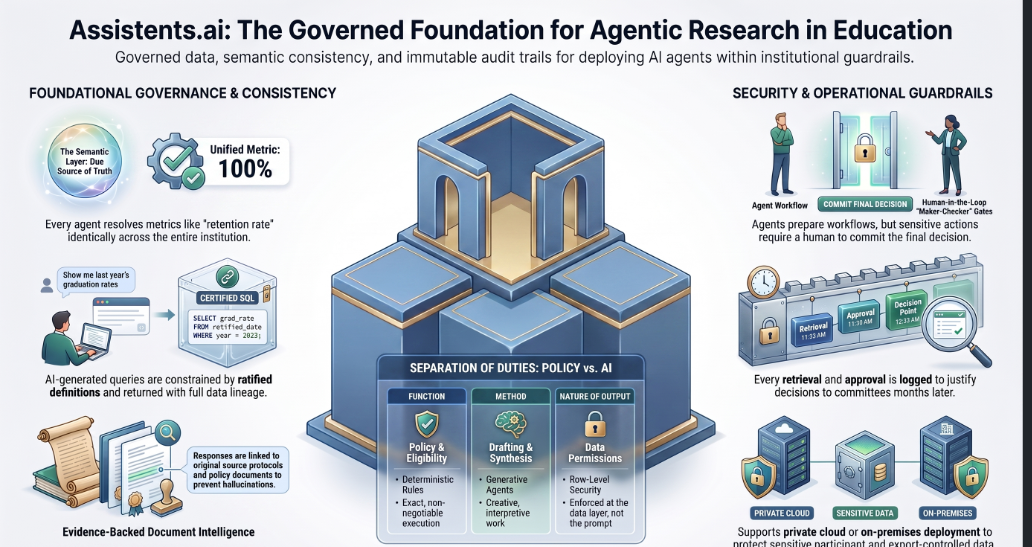
The requirement list the sector has converged on — governed data, agreed metrics, enforced permissions, defined human-in-the-loop placement, orchestration with scoped guardrails, and full auditability — is not a wish list for Assistents.ai. It is a description of the platform's shipped foundation.
Governed conversational analytics and text-to-SQL over institutional data
Assistents.ai provides natural-language analytics with text-to-SQL execution across governed data sources, including warehouse and BI connectivity. A dean, registrar or programme director asks a question in plain language; the platform resolves it against certified definitions and returns an answer with its lineage attached. The point is not that a model can write SQL. The point is that the SQL it writes is constrained by definitions the institution ratified.
A semantic layer so "retention rate" means one thing across every agent and every dean
The semantic layer holds metric definitions, hierarchies, formulas and business rules as governed objects. This is the component that separates a useful agentic analytics deployment from a confident, inconsistent one. Every agent on the platform resolves metrics through the same layer, which means the answer a provost receives and the answer a department head receives are computed identically.
This is the single highest-leverage prerequisite in the entire category, and it is the one most institutions have not yet built.
Row-level security, human-in-the-loop approvals and immutable audit trails
Permissions are enforced at the data layer through row-level security, not asserted in a prompt. Sensitive steps route through maker-checker approval gates in the workflow engine, so an agent prepares and a human commits. Every retrieval, action and approval is written to an immutable audit trail, which is what makes a decision defensible six months later when a committee asks how it was reached.
Document intelligence with evidence-backed, source-linked responses
Document ingestion, extraction, validation and review handle the unstructured half of research work — protocols, policy documents, sponsor guidelines, prior submissions, standard operating procedures. Hybrid retrieval returns evidence-backed responses with sources attached, which directly addresses the fabricated-citation failure mode that makes research offices nervous about generative tools.
Multi-agent orchestration with deterministic rules where policy must not be improvised
Agent building and multi-agent coordination allow complex research workflows to be decomposed into scoped specialists — a retrieval agent, an extraction agent, an analytics agent, a compliance agent — coordinated rather than merged. Where policy applies, deterministic rules and decision tables execute it exactly, every time. Eligibility, thresholds and mandatory checks run as rules; interpretation, drafting and synthesis run as agents. That separation is the difference between an auditable system and an unpredictable one.
Model-agnostic routing, BYOK and private cloud, VPC or on-premises deployment
Model routing across multiple providers means the institution is not structurally dependent on one vendor's roadmap or pricing. Bring-your-own-key keeps model access under institutional control. And the platform deploys into private cloud, VPC or on-premises environments — which for research environments holding participant data, unpublished results or export-controlled work is frequently the condition of the project existing at all.
A note on compliance language, because it matters in this sector: these are controls that support an institution's compliance programme. Regulatory compliance is an institutional determination made against your own policies, jurisdiction and data protection framework. Assistents.ai supplies the technical controls — permissions, audit, deployment locality, key control — that make that determination possible. It does not make it for you, and no vendor should claim otherwise.
What this looks like in production: anonymised deployments
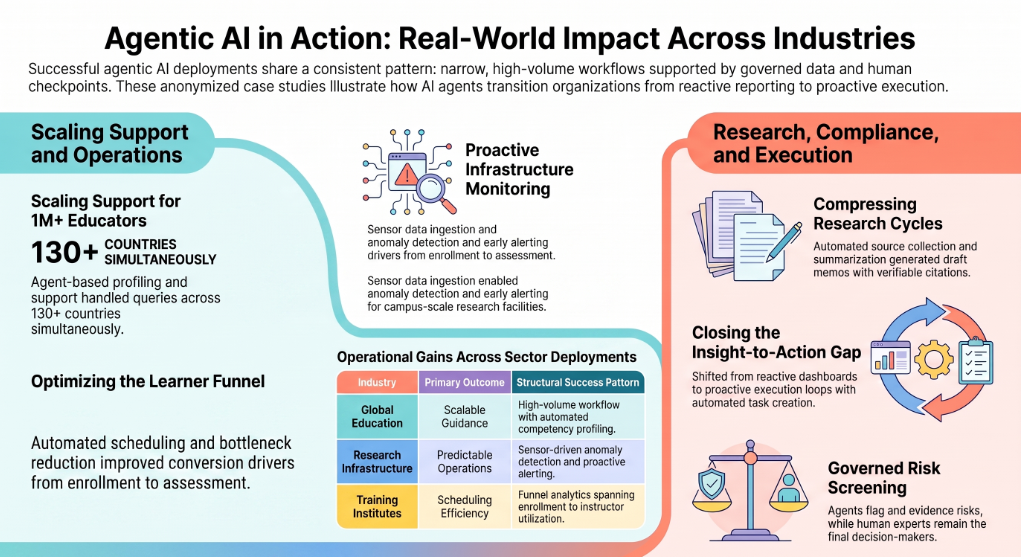
Across our deployments, the pattern that predicts success is consistent: a narrow, high-volume workflow with a clear owner, a governed data layer underneath, and a human checkpoint on anything consequential. The following are anonymised by industry, geography and scale. Results are directional and reflect the specific operating conditions of each deployment rather than guaranteed benchmarks.
A global teacher community and learning platform — over one million educators across 130+ countries
An education platform operating at genuine global scale needed to deliver competency insight, learning guidance and support to an educator community far larger than any human support function could serve. We built agent-based competency profiling, a support agent handling programme and learning queries, and analytics for the operators and partners running programmes on the platform.
Direction of results: scalable support for a very large educator community, faster access to learning resources and guidance, and materially better visibility into engagement and outcomes for programme operators.
Why it matters here: this is the education-sector proof that agentic support and competency analytics work at population scale rather than pilot scale.
A national astronomy and astrophysics research institute — campus-scale research infrastructure
A premier research institute with campus-scale operations needed reliable monitoring and optimisation of the infrastructure its research programmes depend on. We deployed sensor and utility data ingestion with anomaly detection, forecasting and optimisation recommendations, and dashboards with proactive alerting.
Direction of results: improved operational visibility, faster detection of inefficiencies, reduced manual monitoring effort, and more predictable operations through early alerting.
Why it matters here: research institutions run infrastructure as well as research. The same agentic monitoring pattern that protects instrument uptime and facility efficiency applies directly to laboratory capacity, equipment utilisation and research resource planning.
A multi-branch driving and training institute — Middle East
A training institution with multi-branch operations and digitally enabled customer journeys needed visibility into its full learner funnel. We built funnel analytics spanning enrolment through lessons to assessment, instructor utilisation and slot optimisation, and experience dashboards with alerting.
Direction of results: reduced operational bottlenecks, better scheduling efficiency, and improved visibility into conversion and performance drivers across the learner journey.
Why it matters here: the enrolment-to-completion funnel, instructor utilisation and scheduling optimisation are structurally the same problems a university faces in programme progression, faculty workload and timetabling.
A specialist research-automation product — North America
A research-automation product serving professional practitioners needed to compress a manual, source-hunting research cycle into a reviewable draft. We built automated source collection and summarisation, draft memo and position output generation with citations, workflow tracking, and progressive knowledge base construction.
Direction of results: faster research cycles, reduced manual source-hunting time, more consistent research outputs and better documentation hygiene.
Why it matters here: this is the closest structural analogue to an academic or institutional literature workflow — retrieve, summarise, draft with citations, track the work, and accumulate reusable knowledge — proven in a domain where a wrong citation has direct professional consequences.
A privately-held group operating across multiple functions — South Asia
A leadership team needed governed, cross-functional intelligence spanning systems and documents, and specifically needed to close the gap between seeing an insight on a dashboard and something actually happening. We deployed a unified context engine across structured and unstructured data, a semantic governance layer holding rules, hierarchies and formulas, an active orchestrator integrated with core systems, and insight-to-action agents layered on top of existing dashboards.
Direction of results: a shift from reactive reporting to proactive execution loops, standardised decision logic across teams, and automated task creation with completion tracking.
Why it matters here: this is precisely the institutional research problem. An IR office does not lack dashboards. It lacks a governed path from the number on the dashboard to the action that follows it, with a record of who decided what.
A cross-border risk screening product — United Kingdom
A specialist product needed to screen complex transactions for risk early enough to prevent late-stage disruption. We built transaction screening workflows with risk classification, evidence collection with explainability notes, and an escalation workflow to human experts.
Why it matters here: structurally identical to protocol and disclosure pre-screening. The agent flags, evidences and explains; the expert decides. That is the correct division of labour for any compliance function in a research office.
Assistents.ai is a governed enterprise agentic AI platform. Capabilities described as shipped are available today; items described as roadmap are stated as direction. Regulatory compliance is an institutional determination made against your own policies and jurisdiction; Assistents.ai provides technical controls that support your compliance programme.
The Agentic Research Maturity Model for Education: Ask → Execute → Autonomous
Autonomy is not a switch. It is a progression of operating models, and the platform requirements change at each level. Institutions that attempt to jump from level one to level three fail, and institutions that never leave level one never see a return.
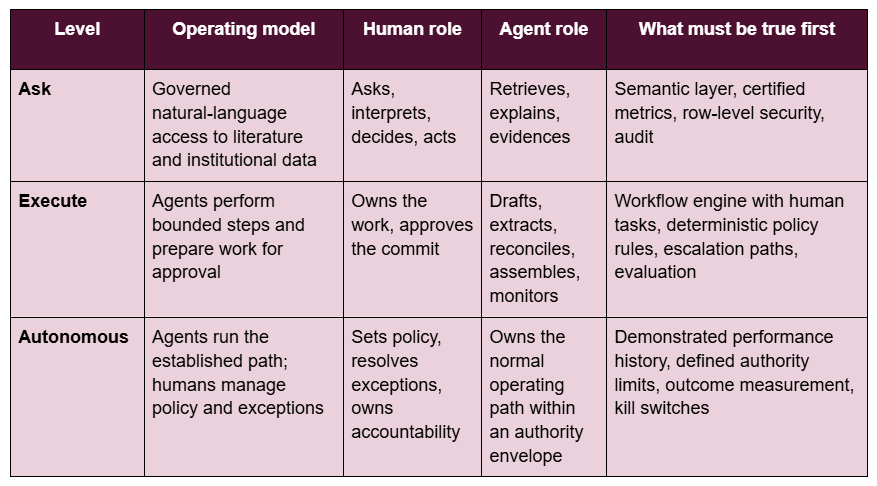
Level 1 — Ask
Governed conversational access. A dean asks a question and gets a defensible answer with its definition and lineage attached. Nothing is written, nothing is actioned, nothing is sent. This is the level almost every institution should be at in 2026, and most are not, because the semantic layer work has not been done.
Level 2 — Execute
Agents perform bounded, reviewable steps: assembling a reporting pack, extracting evidence from a paper set, reconciling effort data, drafting a proposal component, monitoring a cohort signal. Every consequential output passes an approval gate. This is where the measurable time recovery lives, and it is the right place for a 2026 pilot.
Level 3 — Autonomous
Agents run an established operating path end to end, within an explicit authority envelope, with humans managing policy and exceptions rather than approving every step. This is appropriate for high-volume, low-ambiguity, well-instrumented workflows with a track record. It is not appropriate for anything touching admissions decisions, academic judgement, student welfare or research integrity, and it should not be the goal of a first deployment.
What must be true before you move up a level
You do not earn the next level with a better model. You earn it with evidence: a demonstrated accuracy record on the current level, a defined authority envelope, an owner accountable for the agent's performance, an escalation path that has been tested, and outcome measurement that would detect degradation. Autonomy should be granted the way clinical privileges are granted — provisionally, on evidence, and revocably.
Agentic AI readiness checklist for education institutions
Sixteen points across four domains. If more than four are unresolved, the correct next investment is readiness work, not a tool.
Data readiness
- Are the data sources an agent would query documented, current and reliable?
- Do you have data lineage sufficient to trace any answer to its source records?
- Have the metrics leadership actually uses been defined, ratified and written down?
- Is there one agreed definition per metric, or four competing departmental versions?
Governance readiness 5. Is access enforced at the data layer, or asserted in application logic? 6. Have you decided which workflows may be delegated and which may not? 7. Is human-in-the-loop placement explicit — which step, which human, what authority? 8. Is there an audit trail sufficient to reconstruct a decision months later?
Legal and privacy readiness 9. Is it clear which data classes may never leave your environment? 10. Have research subject data and student record data been treated as distinct categories with distinct rules? 11. Is cross-border data transfer resolved for your deployment model? 12. Is model access under institutional key control?
Organisational readiness 13. Does every agent have a named human owner? 14. Is there a certification step before an agent is allowed near production data? 15. Is there a defined process for reviewing agent outcomes, not just agent uptime? 16. Is there a documented kill switch, and has someone tested it?
Risks, limits and academic-integrity guardrails
The category's failure modes are well documented and largely preventable. Naming them is not a caveat; it is the difference between a deployment that survives a governance review and one that does not.
Hallucinated citations and why provenance beats fluency
Generative models produce plausible references that do not exist. In an academic context this is not a minor defect — it is a research integrity event. Federal funders have been explicit that misconduct can occur through the use of AI tools, and that fabrication or plagiarism assisted by AI is treated as misconduct. The mitigation is architectural: every claim must carry a resolvable source link, retrieval must be evidence-backed rather than parametric, and citation verification must be a required step rather than an optional feature.
Student and research subject data
The categories differ and should be governed differently. Student record data carries statutory obligations. Research subject data carries consent obligations defined by the approved protocol — and using an AI service to process interview transcripts may constitute a data sharing practice that must be disclosed to the ethics committee, whether or not the researcher thought of it that way. Neither category should enter a general-purpose consumer model. This is the argument for private cloud, VPC or on-premises deployment, and it is usually the deciding factor in research environments.
Automation bias in institutional decision-making
The risk is not that an agent produces a wrong number. It is that a confident, well-formatted, plausibly-sourced wrong number is less likely to be challenged than a human analyst's estimate. Mitigations: display confidence and lineage alongside every answer, require metric definitions to be visible in the output, and preserve the analyst's role as validator rather than eliminating it.
Where agentic AI should not be used yet
Admissions decisions. Academic judgement and grading of consequence. Research integrity determinations. Student welfare interventions initiated without a human. Anything where the cost of a wrong action is borne by an individual who cannot appeal it. In each of these, agents can prepare, evidence and route — they should not decide.
How to evaluate agentic AI vendors for education research
12 questions to ask any vendor
- How are permissions enforced — at the data layer, or in the prompt?
- Where do metric definitions live, and who controls them?
- Can you show me the full lineage of a single answer, end to end?
- What exactly is written to the audit trail, and is it immutable?
- Where does deterministic policy execute, as distinct from model inference?
- What are the deployment options — SaaS only, or VPC and on-premises?
- Whose model keys are used, and can we bring our own?
- What happens when the agent is uncertain — does it guess, or does it escalate?
- How is an agent evaluated before it is allowed near production data?
- Which of these capabilities are shipped today, and which are roadmap?
- What happens to our data if we leave?
- Can you name a comparable deployment at comparable scale?
Question ten is the one that separates serious vendors from the rest. Ask for the shipped-versus-roadmap split in writing.
Red flags in agentic AI procurement
Compliance certifications claimed rather than evidenced. Demos on synthetic data only. No answer on where policy executes deterministically. "The model handles that" as a response to a permissions question. Autonomy positioned as the headline rather than as an earned end state. Reference customers who cannot be contacted.
Build, buy or platform
Build if you have a mature data engineering function, a clear single use case and appetite to own the governance layer permanently. Most institutions overestimate their capacity here.
Buy a point tool for layers one to three. These are cheap, good and replaceable. Do not build a literature search engine.
Adopt a platform for layers four to six, where the governance layer is the product and rebuilding it internally means rebuilding permissions, semantics, orchestration, policy execution and audit before you deliver a single answer.
Why institutions choose Assistents.ai over point tools and generic agent builders
Point research tools vs governed institutional platforms
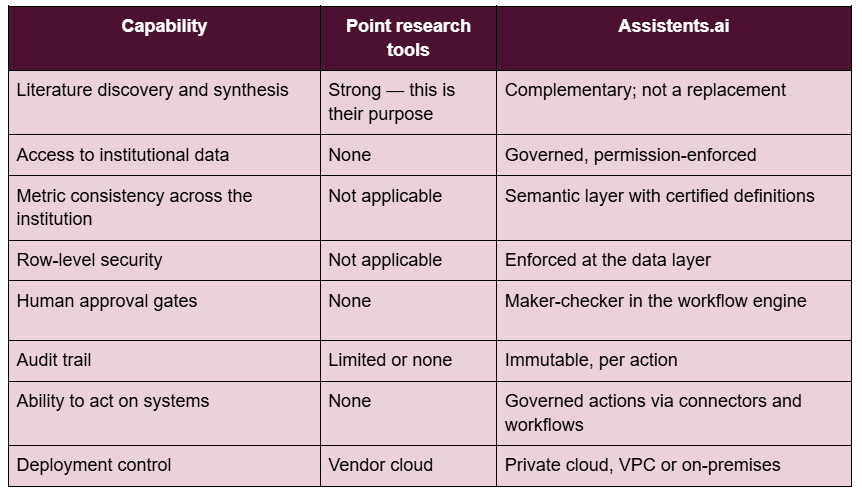
The honest position: keep your literature tools. They are good at layer one. Assistents.ai operates at layer six, underneath them.
Generic agent builders vs a platform with semantics and permissions built in
A generic agent builder gives you a canvas. What it does not give you is a semantic layer, enforced row-level security, deterministic policy execution, a document intelligence pipeline, or an audit trail — which means the institution builds those, and they are the hard parts. Assistents.ai ships them, along with agent building and multi-agent coordination, a workflow engine with human tasks and approvals, low-code applications for the surfaces staff actually use, hybrid retrieval with evidence-backed responses, voice agents connected to live data, model routing across providers, and warehouse, BI and 80+ workflow integrations plus generic REST connectivity.
Deployment control for sensitive research environments
Research environments frequently cannot use a multi-tenant SaaS product at all. Private cloud, VPC and on-premises deployment with bring-your-own-key model access is not a preference in those settings — it is the precondition for the project existing. This is consistently the capability that shortlists us in research-heavy institutions.
Where Assistents.ai is going
Our internal platform thesis is explicit that the next layer of the product is work-centric rather than agent-centric. The direction — and we describe this as roadmap, not shipped capability — is toward a durable work model where research requests, cases and tasks persist across sessions and owners; a workforce registry where each agent has a role, sponsor, lifecycle and performance record; a capability registry that turns actions into governed, verified, reversible operations; and an outcome layer that measures whether the work actually improved the result.
For an institution, that direction matters because it addresses the question every governance committee eventually asks: not "can the agent do this," but "who is accountable for it, and how do we know it worked?"
Explore the no-code AI agent builder to see how agents are composed, or read about governed, auditable actions for regulated workflows.
Where to start
Do not start with a platform-wide rollout. Start with one narrow, high-volume, well-instrumented workflow that has a clear owner and a real backlog — statutory reporting assembly, a specific recurring leadership question, or compliance pre-screening on a single submission type.
Get that workflow to the Ask level with a governed semantic layer and enforced permissions. Prove the answers are consistent and defensible. Then extend it to Execute, with an approval gate on anything consequential. Measure whether the cycle time actually moved. Only then consider a second workflow.
That sequence is unglamorous and it works. The institutions that struggle are the ones that bought eleven tools before agreeing what "retention" means.
If you are evaluating agentic AI tools for research in education and want to see what a governed deployment looks like against your own data model, book a walkthrough with the Assistents.ai team.
FAQs
What are agentic AI tools for research in education?
Agentic AI tools for research in education are systems that pursue a research objective across multiple steps — retrieving sources, extracting evidence, querying institutional data, drafting outputs and escalating to humans — rather than responding to single prompts. They span six layers, from literature discovery agents used by individual researchers to governed platforms that support institutional research and research administration.
What is the difference between an AI agent and agentic AI in education?
An AI agent pursues a single defined goal using its own chosen steps. Agentic AI describes a system that orchestrates multiple specialised agents under shared governance, with each agent scoped by its own guardrails. The distinction matters institutionally because a single broadly-permissioned agent is a governance risk, while an orchestrated system keeps oversight tractable.
Can agentic AI do a literature review on its own?
No, and it should not. Agentic tools can compress discovery, deduplication, first-pass screening and structured extraction from weeks into hours. The researcher remains responsible for the inclusion criteria, the interpretation of the evidence, verification of citations against the original sources, and every claim in the final manuscript.
What are the best agentic AI tools for institutional research?
Institutional research needs layer-four capability: governed natural-language analytics over institutional data with a semantic layer, enforced row-level security and an audit trail. General literature and writing tools cannot serve this need because they have no permitted route to student, enrolment or finance data. Evaluate on governance architecture, not model quality.
Are agentic AI research tools safe for student data?
Only under specific conditions: permissions enforced at the data layer rather than asserted in prompts, deployment in an environment the institution controls, institutional key control over model access, and an immutable audit trail. Student record data and research subject data should not be processed by general-purpose consumer AI services.
How do agentic AI tools handle citations and prevent hallucinated sources?
Reliable systems use evidence-backed retrieval, attaching a resolvable source link to every claim rather than generating references from model parameters. Verification against the original source must be a required step. Fabricated citations are a research integrity risk, and funders treat AI-assisted fabrication or plagiarism as misconduct.
Can agentic AI be used for systematic reviews in education research?
Yes, for screening, deduplication and structured data extraction, where it substantially reduces manual effort. Extraction accuracy is weaker on qualitative and mixed-methods education research where constructs are not standardised. Screening decisions, exclusion rationales and reviewer disagreements should be recorded in a system that preserves them for audit.
What is agentic analytics and how does it apply to higher education?
Agentic analytics is an approach where AI agents sense, analyse, decide and act on governed data, shifting analytics from passive reporting to active decision support. In higher education it means a dean can ask a question in natural language and receive an immediate, explained, data-backed answer instead of waiting in an analyst queue.
Do universities need on-premises or private-cloud deployment for research AI agents?
Frequently, yes. Research environments holding participant data, unpublished results or restricted work often cannot use multi-tenant services at all. Private cloud, VPC or on-premises deployment with institutional key control is commonly the precondition for approval rather than a preference.
Will agentic AI replace institutional researchers?
No. It changes the role. The scarce skill becomes defining metrics that match how leadership actually reasons, governing data quality, deciding where human oversight belongs, and validating what agents produce. Institutional researchers become the bridge between campus decision-making and the technical layer, which is a more central position than producing reports on request.