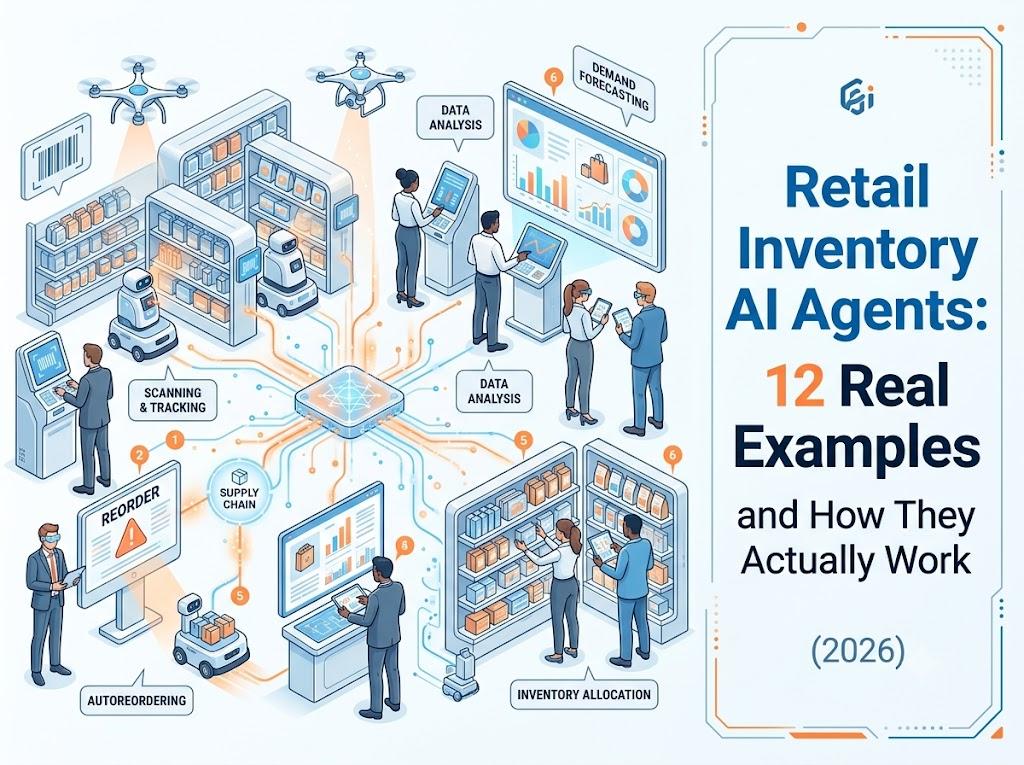
Retail inventory AI agents are governed software workers that continuously monitor stock, demand, inbound shipments and supplier performance, then create and complete work — investigating a projected stockout, proposing a store-to-store transfer, flagging a phantom-stock record, or triggering a replenishment order — under defined authority limits with human approval on exceptions.
Common retail inventory AI agents examples include stockout detection agents, replenishment coordinators, allocation agents, phantom inventory agents, markdown agents and supplier follow-up agents.
To summarize-
• A retail inventory AI agent is not a dashboard and not an RPA script. It senses a condition, investigates the cause, generates options, and executes within bounded authority — then verifies the outcome.
• Most production inventory deployments are not one agent. They are a coordinated set of roles: a watcher that creates work, an investigator that finds root cause, a coordinator that executes, and an analyst that measures whether it worked.
• The hardest problem in retail inventory AI is not forecasting. It is data accuracy. Industry research has found that up to 60% of retailers' inventory records are inaccurate, which means agents must be designed to detect wrong data rather than trust it.
• Autonomy is not a switch. It is a contract covering scope, permissions, monetary limits, escalation triggers and expiry — and it should start at observe-only.
• The retailers seeing results are not deploying "inventory AI." They are landing one agent on one measurable exception, proving the outcome, then expanding.
What is a retail inventory AI agent? (and what it is not)
A retail inventory AI agent is an autonomous software system that maintains a continuous view of stock position, demand signals, inbound supply and supplier reliability across stores, warehouses and digital channels — and then acts on what it finds.
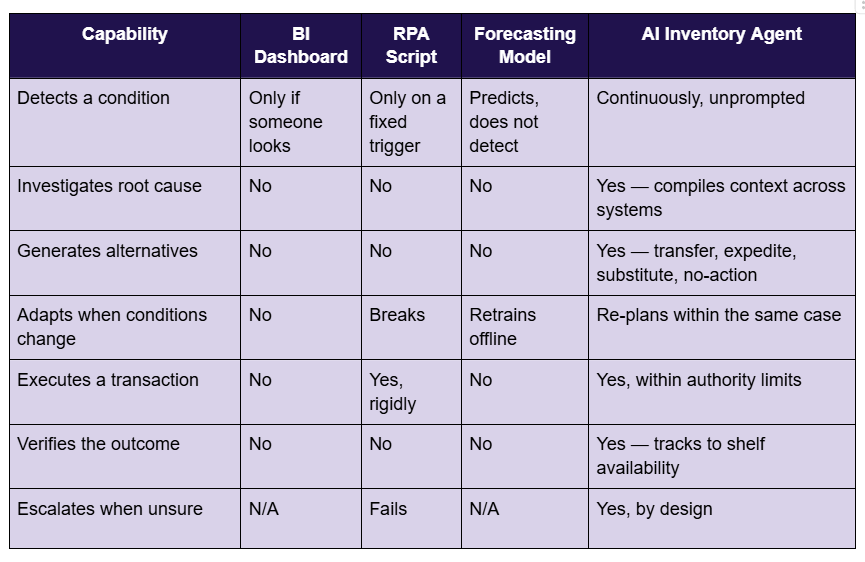
The word "acts" is doing the heavy lifting. A forecasting model produces a number. A dashboard produces a chart. An RPA bot executes a fixed sequence when triggered. An agent does something different: it notices that something is wrong, works out why, decides what should be done from a set of alternatives, checks that decision against business policy, and either executes it or hands it to a human with the reasoning attached.
Retail is unusually well suited to this. Most retailers already run POS systems, ERP, warehouse management and e-commerce platforms that emit continuous operational signal. The data exists. What has been missing is anything that closes the loop between the signal and the action.
Agent vs. dashboard vs. RPA vs. forecasting model
The three things that make it an agent
One: it senses. The agent watches POS movement, on-hand balances, inbound shipment status, promotion calendars and supplier fill rates without being asked a question first.
Two: it decides within limits. Given a projected stockout, it evaluates a store-to-store transfer against an expedited inbound order against doing nothing — weighing cost, lead time, source-store risk and policy.
Three: it executes and verifies. It creates the transfer transaction, notifies both stores, then tracks pick, shipment, receipt and shelf availability to confirm the intervention actually landed.
Why "the agent reorders automatically" is the wrong mental model
Most content on this topic collapses inventory agents into "AI that reorders stock." That framing is why so many pilots stall.
Automatic reordering is the easiest part and the least valuable. The value sits in everything around it: understanding whether the stockout is a demand surge, a delayed inbound, a phantom-stock record or a promotion executed incorrectly. Those four causes require four completely different actions. An agent that reorders without diagnosing will confidently order stock the retailer already has sitting in a back room.
The anatomy — 7 agent roles inside a retail inventory workcell
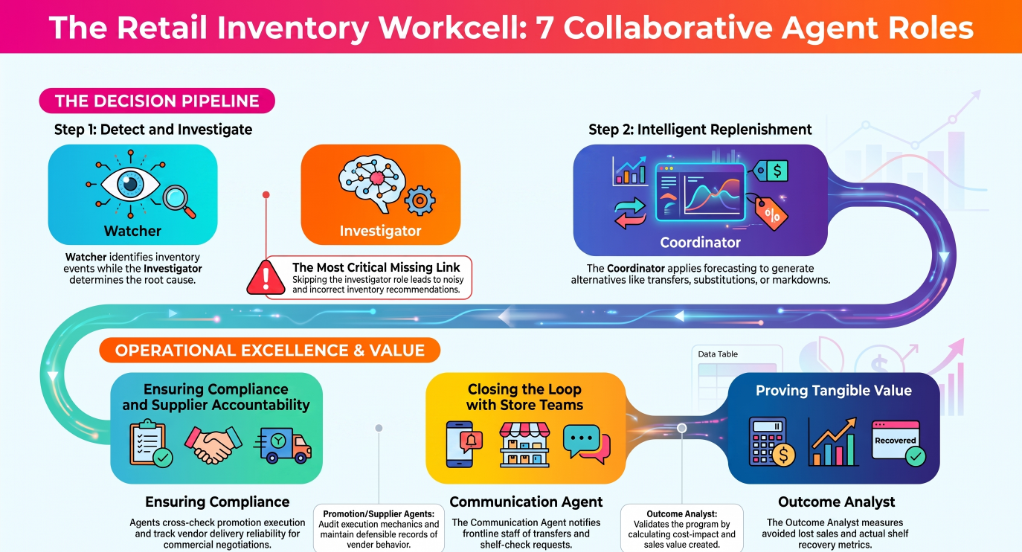
Production inventory deployments rarely consist of a single agent. They consist of specialised roles that hand work between each other, the same way a store operations team does. We call this the retail inventory workcell model.
1. Store Operations Watcher
Monitors POS and inventory events, promotion calendars, inbound shipment status, shelf-availability observations, supplier fill rate, store messages and local demand signals. Its only job is to notice something worth acting on and open a case. It does not decide.
2. Inventory Investigator
Takes an open case and compiles context: current on-hand, recent sell-through, open inbound, allocation policy, promotion status, comparable stores. It determines cause before anyone commits to an action. This is the role most implementations skip, and its absence is the single most common reason inventory agents produce noisy, wrong recommendations.
3. Replenishment Coordinator
Generates alternatives — transfer, expedite, substitute, markdown, no action — applies forecasting and optimisation, checks source-store risk and policy, then either prepares the recommendation for approval or executes within its authority.
4. Promotion Compliance Agent
Cross-checks planned promotion mechanics against actual price, stock position and channel execution. Catches the promotion that launched nationally but never reached 40 stores because the stock never shipped.
5. Supplier Follow-up Agent
Tracks fill rate, delivery reliability and returns by vendor. Chases delayed inbound, escalates repeat underperformance and maintains a defensible record of supplier behaviour for commercial negotiation.
6. Store Communication Agent
Closes the loop with frontline teams — notifying stores of incoming transfers, requesting shelf checks, answering stock and pricing questions from store managers in natural language or by voice.
7. Outcome Analyst
Measures whether the intervention worked: lost sales avoided, cost incurred, impact on the source store, whether shelf availability actually recovered. Without this role, an inventory agent programme can run for a year with no evidence it created value.
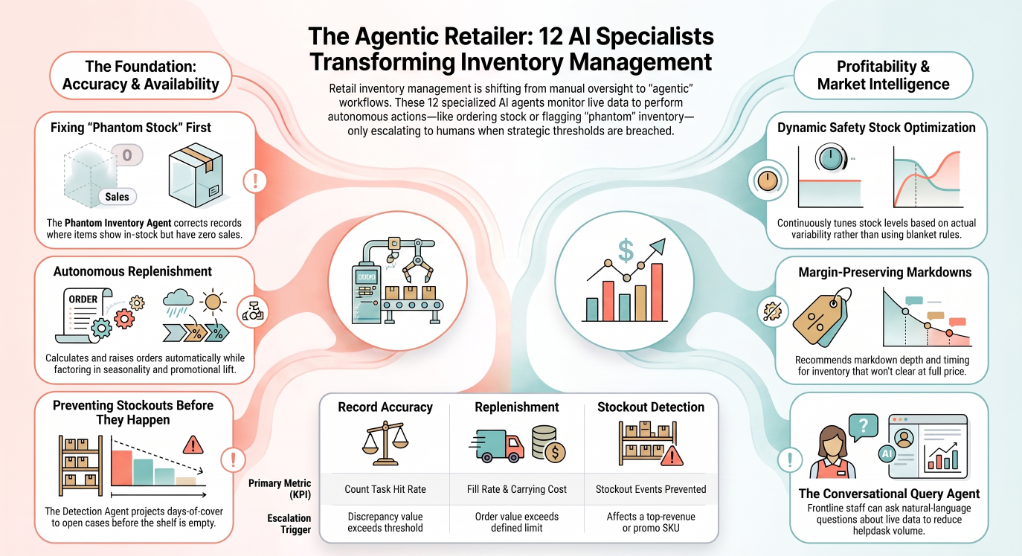
12 retail inventory AI agents examples
Each example below follows the same structure: what it watches, what it does, what it is allowed to do, when it escalates, and how it is measured.
1. Projected stockout detection agent
Watches: sell-through velocity, on-hand balance, open inbound, lead times, promotion calendar, by SKU and by location. Does: projects days-of-cover forward and opens a case before the shelf empties, not after. Allowed to: create cases, assign priority, request a shelf check. Escalates when: projected stockout affects a top-revenue SKU, a promotional line, or more than a threshold number of stores. Measured by: stockout events prevented, lead time between detection and resolution, false positive rate.
2. Autonomous replenishment agent
Watches: reorder points, supplier lead times, minimum order quantities, budget and open commitments. Does: calculates replenishment quantity and raises the order, factoring seasonality, promotional lift and inbound already in transit. Allowed to: raise orders below a defined value with a named supplier for a defined category. Escalates when: order value exceeds the limit, lead time is atypical, or supplier is flagged for reliability. Measured by: fill rate, carrying cost, emergency expedite spend, order accuracy.
3. Store-to-store transfer and allocation agent
Watches: inventory imbalance across the network — the same SKU sitting dead in one store and stocked out in another. Does: identifies profitable transfers, weighing transfer cost against expected sell-through at both origin and destination. Allowed to: propose transfers; execute below a defined value and distance threshold. Escalates when: the transfer would create a stockout risk at the source store. Measured by: sell-through improvement, transfer cost per unit, source-store impact.
4. Phantom inventory and record-accuracy agent
Watches: SKUs the system says are in stock but which have recorded zero sales for an abnormal period, receipt-scan anomalies, and mismatches between system availability and shelf observations. Does: flags likely phantom stock and issues prioritised physical count tasks to store teams — checking the highest-value discrepancies first rather than counting everything. Allowed to: raise count tasks, suppress replenishment on suspect records pending verification. Escalates when: discrepancy value exceeds a threshold or a pattern suggests shrink rather than error. Measured by: inventory record accuracy, count task hit rate, recovered sales from corrected records.
This agent is the quiet high performer. Industry research has found that inventory record inaccuracy is widespread across retail, and every downstream inventory agent inherits the errors of the records it reads. Fixing accuracy first raises the ceiling on everything else.
5. Demand forecasting and demand-sensing agent
Watches: historical sales, seasonality, promotional calendars, local events, weather, competitor availability and pricing. Does: produces and continuously revises SKU-location level demand forecasts, and — critically — explains variance when actuals diverge from forecast. Allowed to: publish forecasts, revise safety stock recommendations, flag forecast breakdowns. Escalates when: forecast error exceeds tolerance for a category or a structural break is detected. Measured by: forecast accuracy, forecast bias, planner time reclaimed.
6. Safety stock and service-level optimisation agent
Watches: demand variability, supply reliability and current service level by SKU and location. Does: continuously tunes safety stock so capital is held where variability actually justifies it, rather than applying a blanket rule across the catalogue. Deloitte's April 2026 research on agentic supply chains describes exactly this pattern — an Inventory Agent that continuously optimises service levels and safety stock at part level, drawing on simulation and forecasting agents in coordination. Allowed to: recommend parameter changes; apply changes within a bounded variance band. Escalates when: proposed change materially shifts working capital or affects a strategic category. Measured by: service level achieved, inventory turns, working capital held.
7. Inbound shipment exception agent
Watches: purchase order status, ASN data, carrier updates, port and terminal events, receiving discrepancies. Does: detects delayed or short inbound early, projects the downstream availability impact, and triggers mitigation before stores feel it. Allowed to: notify affected stores, propose expedite or reallocation, open supplier follow-up cases. Escalates when: delay affects promotional stock or exceeds a defined revenue-at-risk value. Measured by: on-time receipt rate, days of downstream disruption avoided.
8. Supplier fill-rate intervention agent
Watches: order-versus-delivered quantities, delivery timeliness, returns and quality rejections by vendor. Does: maintains a live supplier performance record, chases shortfalls automatically, and assembles evidence packs for commercial reviews. Allowed to: send standard follow-up communications, open intervention cases, update vendor scorecards. Escalates when: a supplier breaches contractual thresholds or a pattern suggests a structural problem. Measured by: fill rate improvement, chase cycles avoided, recovery value.
9. Ageing inventory and markdown agent
Watches: age profile, sell-through curve, seasonality windows, storage cost and margin position. Does: identifies inventory that will not clear at current price and recommends markdown depth and timing — as well as which locations to clear first. Allowed to: recommend markdown; execute pre-approved markdown ladders within a category. Escalates when: markdown exceeds a margin floor or affects a brand-sensitive line. Measured by: sell-through rate, margin retained versus write-off avoided, clearance velocity.
10. Price and master-data discrepancy agent
Watches: price consistency across POS, e-commerce and marketplace channels; product master attributes; unit-of-measure and pack-size errors. Does: detects mismatches that quietly corrupt both inventory maths and customer trust — a pack-size error that makes on-hand quantities meaningless, or a price live on the web but not at the till. Allowed to: raise correction tasks, notify category owners, block downstream replenishment on corrupted records. Escalates when: discrepancy is customer-facing or affects a high-volume SKU. Measured by: discrepancy detection lead time, records corrected, downstream errors prevented.
11. Store-team inventory query agent (conversational and voice)
Watches: nothing — this agent is reactive by design. Does: answers natural-language questions from store managers and regional teams. "Do we have this in any nearby store?" "What is the promo price on this line today?" "Why is this SKU showing zero?" It answers from governed live data rather than a stale report, and in the language the store team actually speaks. Allowed to: read governed data within the user's permission scope; raise tickets. Escalates when: the question implies an operational exception, at which point it opens a case rather than just answering. Measured by: helpdesk volume deflected, query resolution time, adoption by store count.
This is very often the highest-adoption agent in a retail deployment, because it removes friction for the largest group of users — frontline staff — without requiring anyone to change how they work.
12. Competitive availability and channel monitoring agent
Watches: competitor and marketplace listings — pricing, MRP and discount structures, offers, availability, ratings. Does: converts continuous channel surveillance into alerts and answers, so commercial teams learn about a competitor's stock-out or promotional move in hours rather than at the next monthly review. Allowed to: monitor, alert, answer questions, maintain trend histories. Escalates when: a pricing gap or availability shift crosses a defined threshold on a strategic SKU. Measured by: response cycle time to competitive moves, pricing gaps identified, manual monitoring hours replaced.
One worked example, end to end — how a stockout case actually runs
Here is the loop that separates a real inventory agent from a notification. Each step exists because skipping it causes a specific failure.
- Projected stockout signal. Days-of-cover for a SKU at a store falls below threshold given current velocity and open inbound.
- Create a replenishment case. The signal becomes durable work with an owner, a priority and a state — not a Slack alert that scrolls away.
- Compile context. Inventory position, recent demand, inbound status, promotion calendar, allocation policy and comparable store performance are assembled into one view.
- Investigate cause. Is this genuine demand acceleration, a delayed inbound, a phantom-stock record, or a promotion executed incorrectly? Skipping this step is how agents order stock that already exists.
- Generate alternatives. Store-to-store transfer, expedited inbound, substitution, or no action. Each with cost, lead time and expected recovery.
- Apply forecasting and optimisation. Quantify expected lost sales under each alternative and select the best trade-off.
- Check policy and source-store risk. Confirm the recommended action does not breach allocation rules or simply move the stockout to another store.
- Human approval or bounded execution. Below defined limits, execute. Above them, present the recommendation with full reasoning to a planner or store manager.
- Create the transaction and notify. Raise the transfer or order in the system of record and inform both origin and destination teams.
- Verify. Track pick, shipment, receipt and — the step almost everyone omits — actual shelf availability. Stock in the back room is not stock on the shelf.
- Measure the outcome. Lost sales avoided, cost incurred, source-store impact. Feed that evidence back so the next recommendation is better.
Where the human stays in the loop
At step 8, always, until the evidence justifies otherwise. And at any point where the agent's confidence falls below threshold, where a policy boundary is touched, or where the value at risk exceeds the agent's authority. A well-designed inventory agent escalates often in month one and rarely in month six — and that trajectory is itself a metric worth tracking.
5 real retail inventory agent deployments
The following are drawn from live enterprise deployments. No client names are used. Each describes the type of organisation, what was built, and what changed.
National value retailer, 700+ stores across hundreds of cities
The problem: store-level support, inventory visibility and staff training were consuming disproportionate operational overhead at national scale. Store managers had no fast, reliable way to check stock, pricing or promotional status for their own location. Reporting was centralised and consistently behind the pace of trading decisions.
What was deployed: a multi-agent configuration across three connected functions. A voice support agent operating in multiple languages to handle store helpdesk queries. An inventory intelligence agent providing real-time pricing, stock and promotional data at store level. A knowledge and training agent built over the retailer's own POS documentation and standard operating procedures. All supported by an admin console, analytics and ticketing integration, architected for high-volume national use.
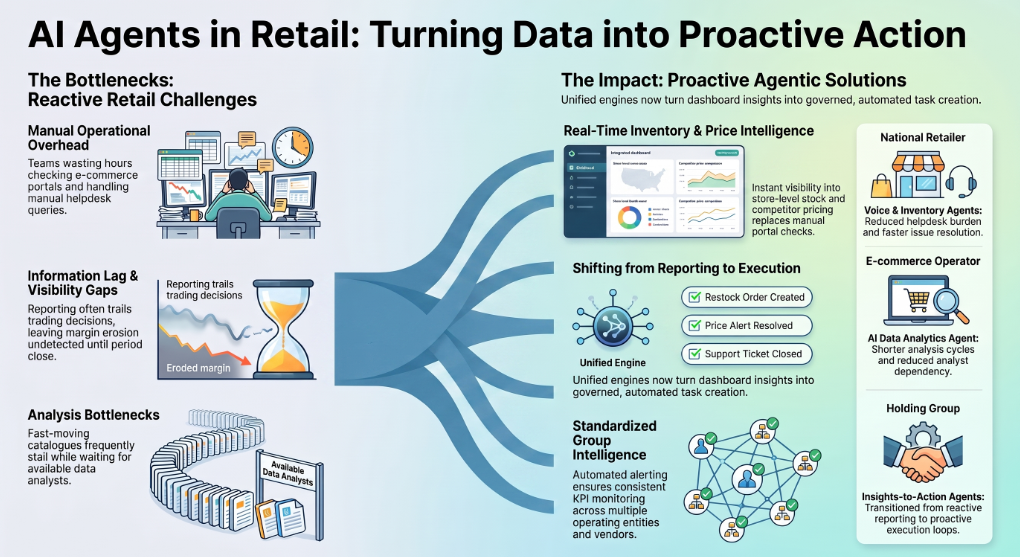
What changed: a measurable reduction in manual helpdesk burden, faster store issue resolution, improved store-level inventory visibility, and on-demand training access for frontline staff without waiting for regional trainers.
Consumer durables manufacturer competing in price-sensitive cooling markets
The problem: competitor visibility and pricing moves mattered daily, but monitoring was manual — teams checking e-commerce portals by hand, always days behind the market.
What was deployed: continuous monitoring across e-commerce and channel listings covering pricing, MRP and discount structures, offers, availability and ratings. Agentic question-answering mapped to the specific questions leadership actually asked. Analytics views surfacing pricing gaps, competitive threats and portfolio movement. The architecture was built to scale from proof of concept to production with governance and audit trails intact.
What changed: faster competitive response cycles, earlier identification of pricing gaps and promotional shifts, and always-on monitoring that replaced manual checks across portals.
High-volume UK e-commerce and distribution operator
The problem: a large catalogue moving fast, with commercial decisions bottlenecked behind analyst availability.
What was deployed: an AI data analytics agent ingesting sales, product, inventory, promotion and customer behaviour data, with a conversational interface for instant business queries and automated KPI monitoring with exception alerting.
What changed: shorter analysis cycles for recurring questions, better visibility into product performance and promotional effectiveness, and reduced reporting dependency on analysts.
Multi-entity retail and distribution group, 30+ operating companies
The problem: procurement and finance intelligence was inconsistent across entities, and margin erosion or vendor slippage typically surfaced only at period close.
What was deployed: group-wide KPI standardisation with automated alerting across purchase price trend, gross margin impact, early-payment analysis on a notional finance cost basis, and vendor performance covering delivery and returns — supported by dashboards and scheduled insight packs for leadership.
What changed: earlier detection of margin erosion and vendor slippage, standardised finance and procurement intelligence across entities, and fewer variance surprises through continuous monitoring.
Privately-held retail holding group
The problem: leadership had dashboards but no mechanism to turn insight into governed action. Reporting was rich; execution was manual and inconsistent.
What was deployed: a unified context engine spanning structured and unstructured data, a semantic governance layer holding rules, hierarchies and formulas, an active orchestrator integrating with core systems, and insights-to-action agents layered on top of existing dashboards.
What changed: a shift from reactive reporting to proactive execution loops, standardised decision logic across teams, automated task creation with completion tracking, and improved exception response.
Why Assistents.ai for retail inventory agents
Retail inventory is an unforgiving place to deploy agents. The data is messy, the actions are consequential, and the users are store teams with no tolerance for a tool that is wrong. The platform choices that matter here are not about model quality.
A governed data foundation before any autonomy
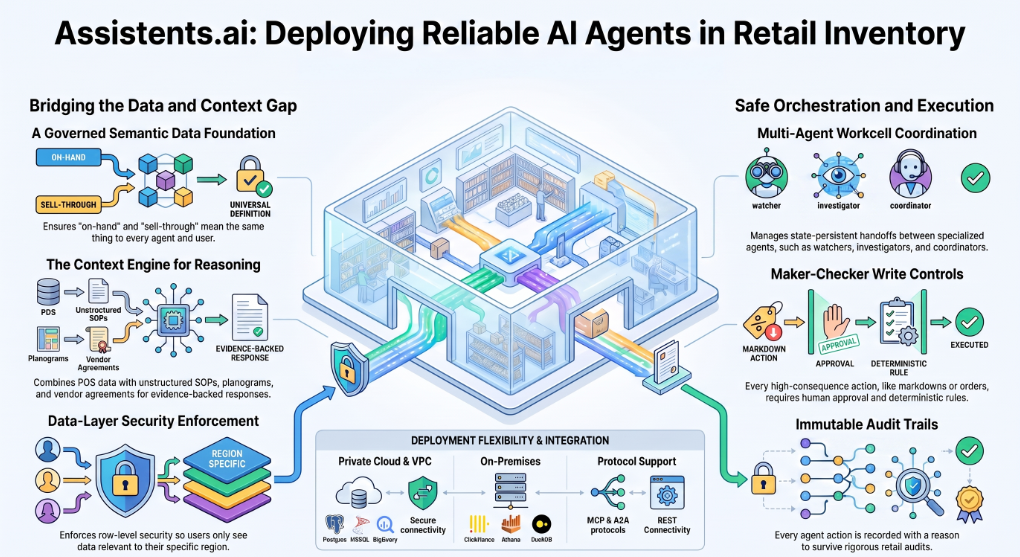
Assistents.ai runs a semantic layer over your governed data with natural-language analytics and text-to-SQL, so "on-hand," "available to promise" and "sell-through" mean the same thing to every agent and every user. Row-level security and attribute-based access control ensure a store manager sees their store and a regional head sees their region — the same agent, different truth, enforced at the data layer rather than in a prompt.
The Context Engine — agents that reason over more than tables
Retail context is not only structured. It is SOPs, planograms, vendor agreements, promotion mechanics and policy documents. The Context Engine combines structured and unstructured sources with hybrid retrieval and evidence-backed responses, so an agent investigating a promotion exception can reason over the promotion mechanics document and the POS data together.
Multi-agent orchestration — seven roles, one coordinated operation
The workcell model described above requires agents that hand work between each other with state that survives the handoff. Assistents.ai provides agent building and multi-agent coordination, plus a workflow engine with human tasks and approvals, so a watcher can open a case that an investigator enriches and a coordinator executes.
Maker-checker on every write action
Any agent that can create a transfer, raise an order or apply a markdown is an agent that can cause damage. Every write path runs through human-in-the-loop controls, deterministic rules and decision tables, and an immutable audit trail — so every action has a recorded reason, an approver where required, and a record that survives audit.
Deployed where retail data already lives
Private cloud, VPC and on-premises deployment. BYOK. Model-agnostic routing across providers. MCP and A2A protocol support, plus native connectors for Postgres, MSSQL, BigQuery, ClickHouse, Athena and DuckDB alongside broad workflow and REST connectivity. Retail groups with entity-level data residency requirements do not have to centralise data into a vendor's cloud to run agents on it.
How much autonomy should an inventory agent have?
Autonomy is not a boolean. It is a contract across several dimensions at once: which agent, which work type, which business scope, which capability, which limits, which time window, which evidence, which approval policy.
The five operating modes
Observe — monitors and reports only. No actions. Assist — prepares analysis and recommendations for a human to act on. Co-work — shares a work item with a human, each handling part of it. Delegate — owns bounded tasks end to end, escalating anything outside scope. Exception-managed — runs the normal operating path; humans handle only exceptions.
Most retail inventory programmes should commercialise between Assist and Delegate, and reach Exception-managed only on well-instrumented, low-variance work types.
What an autonomy contract looks like
agent: store-replenishment-coordinator
work_type: projected_stockout_transfer
scope:
region: north
category: fmcg
store_tier: [2, 3]
permissions:
read_inventory: true
propose_transfer: true
execute_transfer: true
raise_purchase_order: false
apply_markdown: false
limits:
transfer_value_max: 50000
transfers_per_store_per_day: 5
max_source_store_cover_reduction_days: 4
escalate_when:
- source_store_stockout_risk
- promotional_sku_affected
- confidence_below_0_80
- value_above_limit
valid_until: 2026-12-31
The expiry date matters. Authority should be reviewed, not granted permanently.
The rollout sequence
Offline evaluation against historical data. Historical replay. Simulation. Shadow mode, where the agent recommends but nothing is executed and recommendations are compared to what humans actually did. Recommendation-only in production. Human-approved execution. Limited autonomous canary on a narrow scope. Wider bounded operation. Continuous monitoring with rollback.
Retailers that skip to step six typically end up back at step one, having lost organisational trust in the process.
What retail inventory AI agents need to work
Data and systems
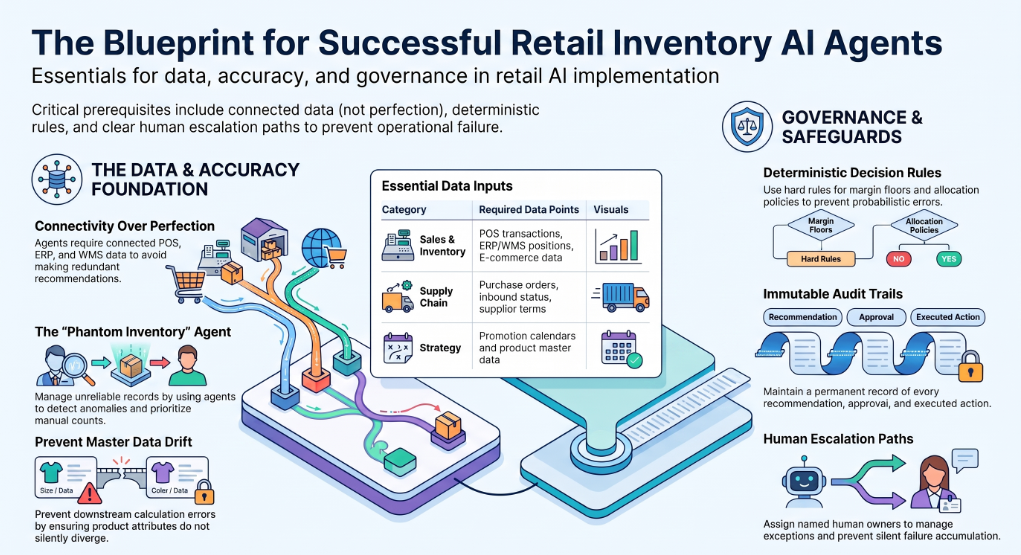
At minimum: POS transaction data, inventory positions from ERP or WMS, purchase orders and inbound status, promotion calendars, product master data and supplier terms. E-commerce and marketplace data where the retailer trades digitally. Store-level observations where available.
Agents do not require perfect data, but they require connected data. An agent that can see stock but not inbound will confidently recommend orders for goods already on a truck.
The inventory accuracy problem
This is the point most vendor content avoids. If inventory records are unreliable, an agent acting on them amplifies the error at machine speed.
The correct design response is not to wait for clean data. It is to build the phantom inventory agent first and treat record accuracy as an agent-managed workstream in its own right — detecting anomalies, prioritising counts by value at risk, and suppressing automated replenishment on records flagged as suspect until they are verified.
Governance requirements
Row-level security so agents respect the same access boundaries as people. Attribute-based access control for scope. Deterministic rules for the decisions that must never be probabilistic — margin floors, allocation policy, approval thresholds. An immutable audit trail covering every recommendation, approval and executed action. Clear escalation paths with named human owners.
Where agents fail
Master-data drift, where product attributes silently diverge and every downstream calculation becomes wrong. Unmeasured outcomes, where nobody can say whether the agent created value. No escalation path, so exceptions accumulate silently. And scope creep — an agent given twelve responsibilities that performs none of them well.
How to measure a retail inventory agent
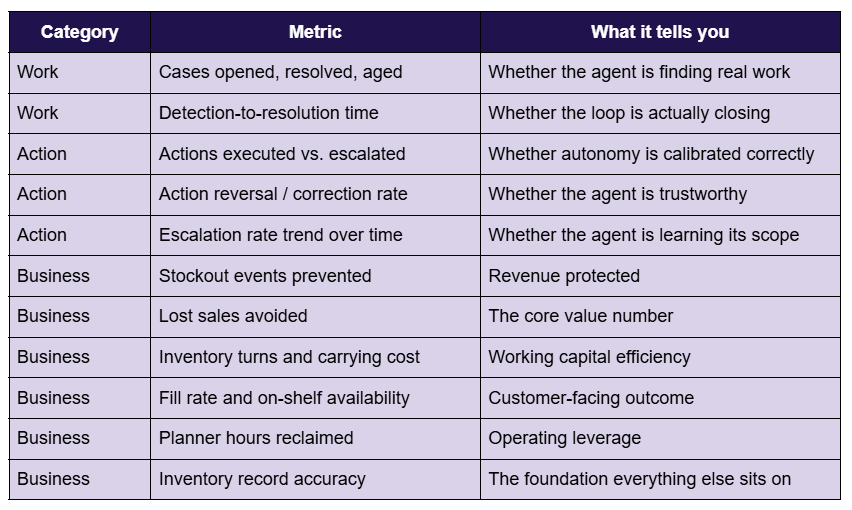
If you can only track one, track lost sales avoided against cost incurred. Everything else is diagnostic.
30-60-90 day implementation path
Days 1–30 — land one agent on one measurable exception
Pick a single work type with a clear owner, a measurable outcome and enough volume to prove something within a quarter. Projected stockouts in one region, or phantom inventory detection in one category, are good candidates. Connect the minimum data required. Run in shadow mode from day one and compare agent recommendations to human decisions.
Days 31–60 — add the investigator and the action path
Introduce root-cause investigation so recommendations arrive with reasoning attached. Open a bounded write path with maker-checker approval. Define the first autonomy contract with deliberately conservative limits. Instrument the outcome measurement before you expand — not after.
Days 61–90 — form the workcell and close the loop
Add adjacent roles: supplier follow-up, store communication, outcome analysis. Connect the outcome evidence back into the recommendation logic. Widen scope by region or category only where the evidence supports it, and only one dimension at a time.
The retailers who succeed with inventory agents are not the ones with the most ambitious first project. They are the ones whose first project produced a number the CFO believed.
Why Assistents.ai is the top choice for retail inventory agents
Production deployments, not pilots
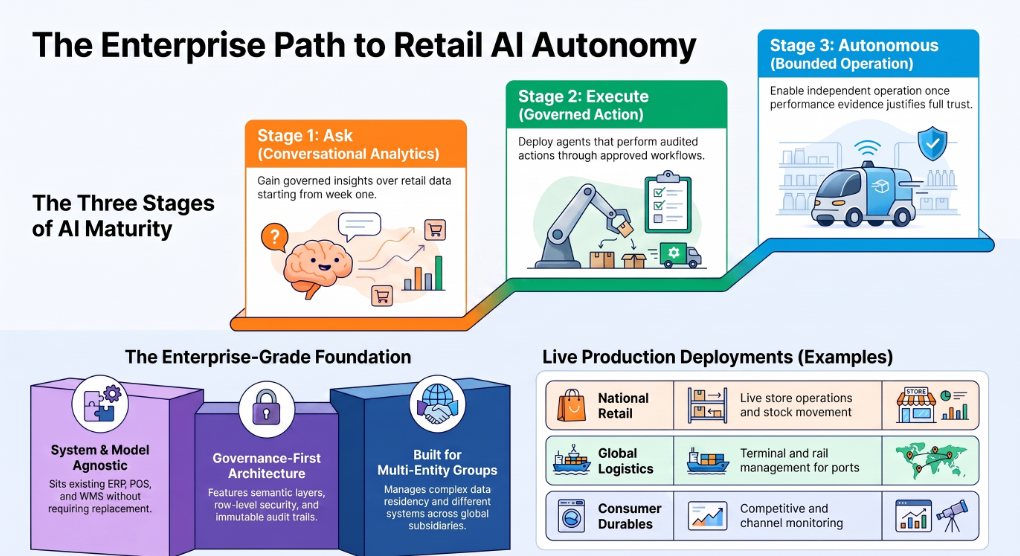
The examples in this article are drawn from live enterprise work — national-scale retail store operations, competitive and channel monitoring for a consumer durables manufacturer, e-commerce analytics for a high-volume UK operator, group-wide procurement and margin alerting across a 30-company portfolio, insights-to-action orchestration for a retail holding group, terminal and rail management for a global ports and logistics operator, and multi-entity analytics consolidation for an international supply chain business. Different systems, different geographies, one platform architecture.
Ask → Execute → Autonomous, and you can buy at any stage
Most platforms require you to accept broad autonomy to receive value. Assistents.ai is designed so each stage stands on its own. Ask: governed conversational analytics over your retail data — value from week one. Execute: agents that take governed, audited actions through workflows and approvals. Autonomous: bounded operation on well-instrumented work types once the evidence justifies it. You are never asked to trust a system you have not yet tested.
Model-agnostic and system-agnostic
Model-agnostic routing across providers means you are not exposed to a single vendor's pricing, availability or roadmap. Native database connectors, broad workflow integrations, generic REST connectivity, MCP and A2A protocol support mean the platform sits over the ERP, POS and WMS you already run — rather than requiring you to replace them.
Governance is the architecture, not a feature
Semantic layer for consistent definitions. Row-level security and ABAC for access. Deterministic rules and decision tables for the decisions that must be exact. Maker-checker and human-in-the-loop on write paths. Immutable audit trail across the whole surface. BYOK and private cloud, VPC or on-premises deployment. This is what allows a retail group to give an agent the authority to move stock between stores and still answer an auditor's questions eighteen months later.
Built for multi-entity, multi-geography retail groups
Retail rarely exists as one clean entity. It is banners, regions, subsidiaries and joint ventures with different systems and different data residency obligations. Semantic governance across entities, entity-scoped access control and flexible deployment topology are the difference between a platform that works in one business unit and one that works across the group.
Talk to the team
If you are evaluating retail inventory AI agents, the useful first conversation is not a product demo. It is a scoping conversation about which single exception in your operation has enough volume, enough measurable value and enough data to prove the model within one quarter. Book a discovery session with Assistents.ai.
Start with one exception, not an inventory strategy
The retail inventory AI agents examples in this article share a structure: something is watched continuously, a case is created, the cause is investigated before anyone acts, options are weighed against policy, an action is taken within known limits, and the outcome is measured.
That structure is the product. The model underneath it matters far less than most buyers assume.
The failure mode in retail is not choosing the wrong agent type. It is attempting inventory transformation as a programme rather than landing one agent on one exception with a number attached — and then earning the right to expand.
Pick the exception that costs you the most and that you can measure. Build the watcher and the investigator before the executor. Keep a human at the approval point until the evidence says otherwise. Then widen the scope one dimension at a time.
Ready to scope your first retail inventory agent? Book a discovery session with Assistents.ai and we will identify the highest-value exception in your operation and what it would take to prove it in a quarter.
FAQs
What are AI agents in inventory management?
AI agents in inventory management are autonomous software systems that continuously monitor stock positions, demand signals and supply status, investigate exceptions such as projected stockouts or record discrepancies, generate and evaluate options, and execute or recommend actions within defined authority limits. Unlike dashboards or RPA scripts, they adapt as conditions change and verify whether their actions produced the intended outcome.
What is an example of an AI agent in retail?
A common example is a projected stockout agent. It monitors sell-through velocity and open inbound by SKU and location, projects when a store will run out, opens a case, investigates whether the cause is demand, delay or a data error, then proposes a store-to-store transfer or expedited order — executing it automatically if the value falls within its authority, or routing it to a planner if it does not.
How is AI used in retail inventory management?
Across demand forecasting, replenishment, allocation, safety stock optimisation, phantom-stock detection, markdown decisions, supplier performance management and store-level query support. NRF research on 2026 retail trends found that 68 percent of retailers plan to use AI for inventory management and supply chain, making it the most popular planned AI use case.
Can AI agents automatically reorder stock?
Yes, within limits. A well-configured replenishment agent can raise orders below a defined value, for defined categories and approved suppliers, escalating anything outside that scope. Granting unbounded reorder authority is not recommended — the value lies in diagnosis and option generation, not in the ordering itself.
What is the difference between an AI inventory agent and inventory management software?
Inventory management software records state and applies fixed rules. An AI inventory agent senses conditions unprompted, investigates root cause across multiple systems, evaluates alternatives with trade-offs, acts within bounded authority and verifies the outcome. Software tells you the reorder point was breached; an agent works out why and does something about it.
What data do retail inventory AI agents need?
At minimum: POS transactions, on-hand inventory from ERP or WMS, purchase orders and inbound status, promotion calendars, product master data and supplier terms. E-commerce and marketplace data for omnichannel retailers. Connectivity matters more than completeness — an agent with partial but connected data outperforms one with rich but siloed data.
Are AI inventory agents safe to let run autonomously?
Only on work types that are well instrumented, low variance and bounded by explicit authority contracts covering scope, monetary limits, escalation triggers and expiry. The recommended sequence is shadow mode, then recommendation-only, then human-approved execution, then a limited autonomous canary — with continuous monitoring and rollback throughout.
How long does it take to deploy a retail inventory AI agent?
A focused first agent on a single exception type, with data already accessible, is typically a matter of weeks rather than months. Industry guidance commonly cites a pilot deployment of roughly 6 to 12 weeks, covering data integration, guardrail configuration and user onboarding. Programmes that attempt full inventory coverage before proving one outcome take considerably longer and often stall.
What is agentic AI in supply chain?
Agentic AI in supply chain refers to coordinated sets of specialised agents — forecasting, inventory, logistics, procurement — that sense conditions, plan, act and adapt across the supply network rather than producing static recommendations. Gartner has projected that 40 percent of enterprise applications will include task-specific AI agents by the end of 2026, with supply chain and inventory among the leading use cases.
Which retailers use AI agents for inventory?
Adoption spans large grocery and general merchandise chains, consumer durables manufacturers managing channel inventory, e-commerce and distribution operators, and multi-entity retail groups. Deployments range from store-level inventory query agents used by frontline staff to network-wide allocation and replenishment agents operating under bounded autonomy.