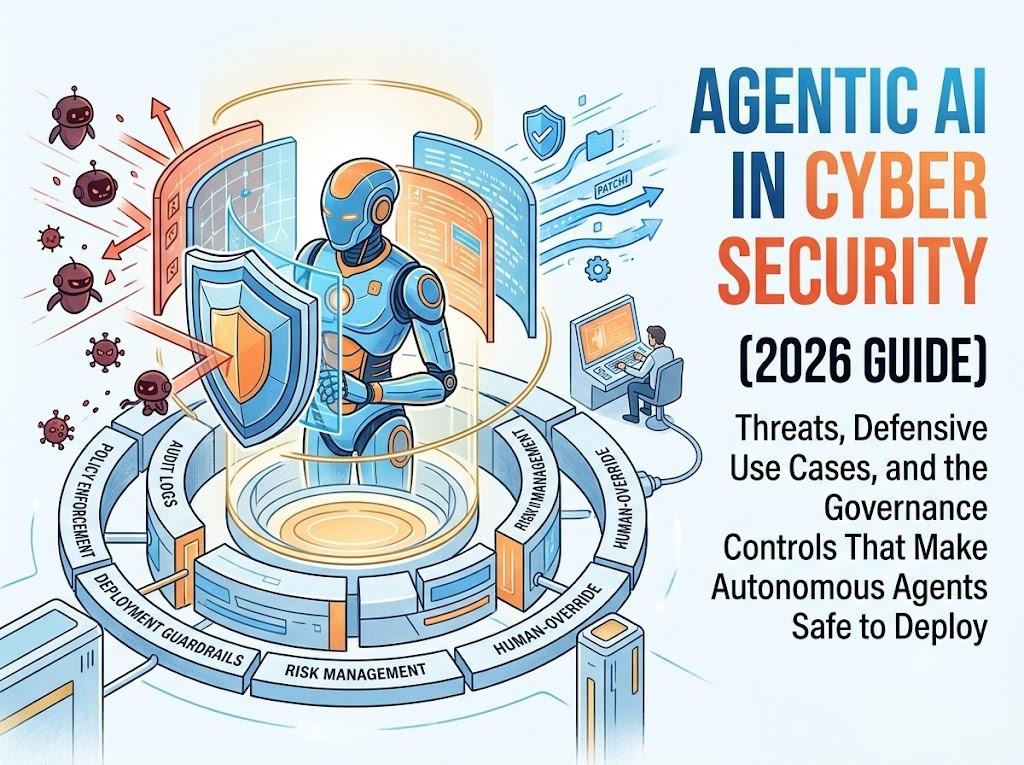
Agentic AI in cyber security refers to autonomous AI systems that can perceive an environment, reason about it, and take multi-step action across security tools without waiting for a human prompt at every step. In 2026, the term describes two very different problems at once: using autonomous agents to defend the enterprise, and defending the enterprise against the autonomous agents it has already deployed. Most organisations are moving fast on the first and are dangerously behind on the second.
This guide covers both — and, more importantly, the specific controls that separate an agent you can put in front of production systems from one that becomes your next incident report.
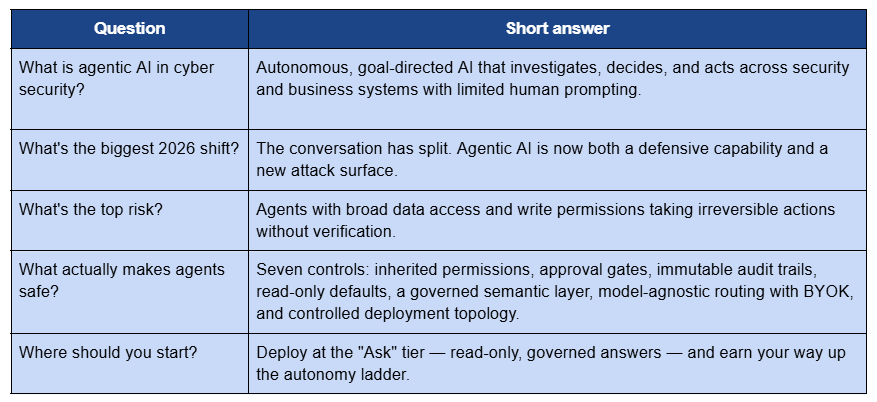
What is agentic AI in cyber security?
Agentic AI in cyber security is the application of autonomous, goal-directed AI systems to security and security-adjacent workflows, where the AI plans a sequence of steps, calls tools and data sources, evaluates results, and executes actions toward an objective rather than answering a single query.
The practical difference from earlier AI in security is the verb. A classifier flags. A copilot suggests. An agent does. When an agent encounters a suspicious authentication event, it can pull the identity's recent history, correlate it against endpoint telemetry, check the source IP against threat intelligence, draft an incident summary, and — where permitted — quarantine the session. That's five tool calls and a decision, with no human in between unless you put one there.
Agentic AI vs. traditional AI in cyber security
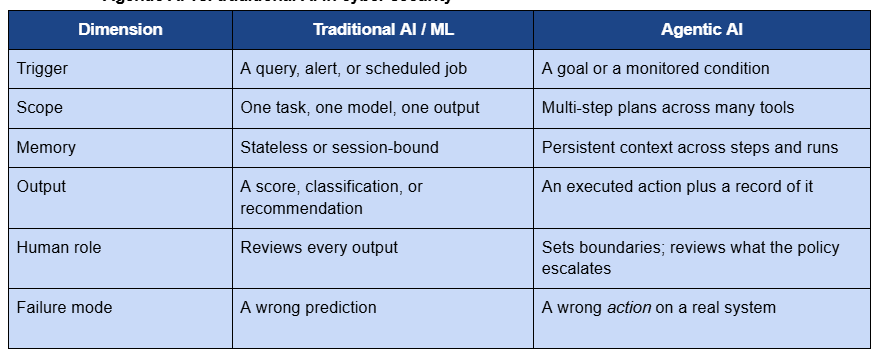
That last row is the whole story. A traditional model that gets it wrong produces a bad number. An agent that gets it wrong changes something. Every control discussed later in this guide exists to manage that single difference.
If you want the underlying architecture — planning, memory, tool use, reflection — we cover it in depth in our breakdown of agentic AI components. This guide assumes you have that and moves to deployment reality.
Why 2026 is the inflection point
Adoption has outrun control maturity, and the gap is measurable. Proofpoint's 2026 AI and Human Risk Landscape report found that 76% of organisations are piloting or rolling out autonomous AI agents, while 52% lack full confidence that their security controls would detect a compromised AI. Within security functions specifically, Cyber Security Tribe reported in early 2026 that 73% of organisations are already using or actively building agentic AI inside their cyber security programmes. Congress.govDenexus
The forward projections point the same direction on both sides of the ledger. Gartner expects AI agents to cut threat detection time by half before 2027. Gartner also projects that by 2028, a quarter of enterprise breaches will trace back to AI agent abuse. The same autonomy produces both numbers. DenexusStrata
Practitioner sentiment has caught up. A Dark Reading readership poll placed agentic AI as the leading cyber security attack vector for 2026 in the view of 48% of security professionals — ranked ahead of deepfakes and passwordless adoption. Substack
Read those together and the conclusion is uncomfortable but simple: agents are being deployed faster than they are being governed, and the industry knows it.
The two conversations people mean by "agentic AI in cyber security"
Almost every confusing discussion about this topic comes from two groups using one phrase for two problems.
Conversation A — Agentic AI for cyber security. Autonomous agents used as defenders: triaging alerts, hunting threats, investigating vulnerabilities, containing incidents. This is the domain of security operations vendors, and it's where the marketing volume sits.
Conversation B — Cyber security of agentic AI. The enterprise has deployed agents across finance, operations, customer service, and engineering. Those agents hold credentials, read sensitive data, call external tools, and write to production systems. Securing them is now a first-order security problem — and it belongs to the CISO regardless of who built them.
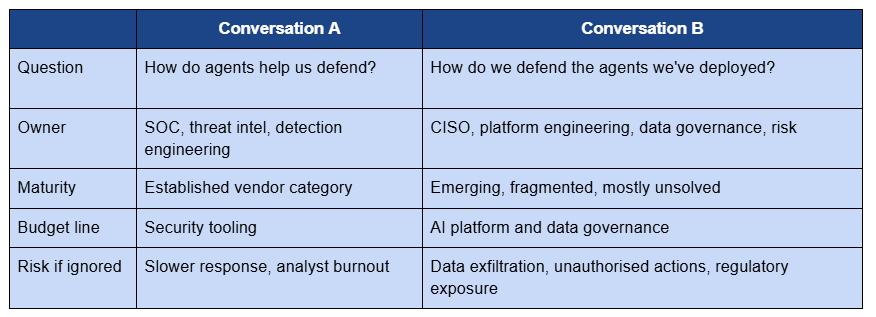
Conversation A is important. Conversation B is where most organisations are exposed, because agents are being introduced by business units that never went through a security review. An agent built by a finance team to reconcile invoices has database credentials and write access. It is, functionally, a privileged non-human user. Very few organisations govern it like one.
The rest of this guide gives Conversation A its due, then spends most of its time on Conversation B — because that's where the unaddressed risk and the unaddressed opportunity both sit.
Agentic AI for defence: eight use cases that are actually in production
Adoption is past the pilot stage in security operations. Google Cloud's ROI of AI research found 52% of executives at generative-AI-using organisations have agents in production, and among those, 46% are applying agents to security operations and cyber security. Proofpoint
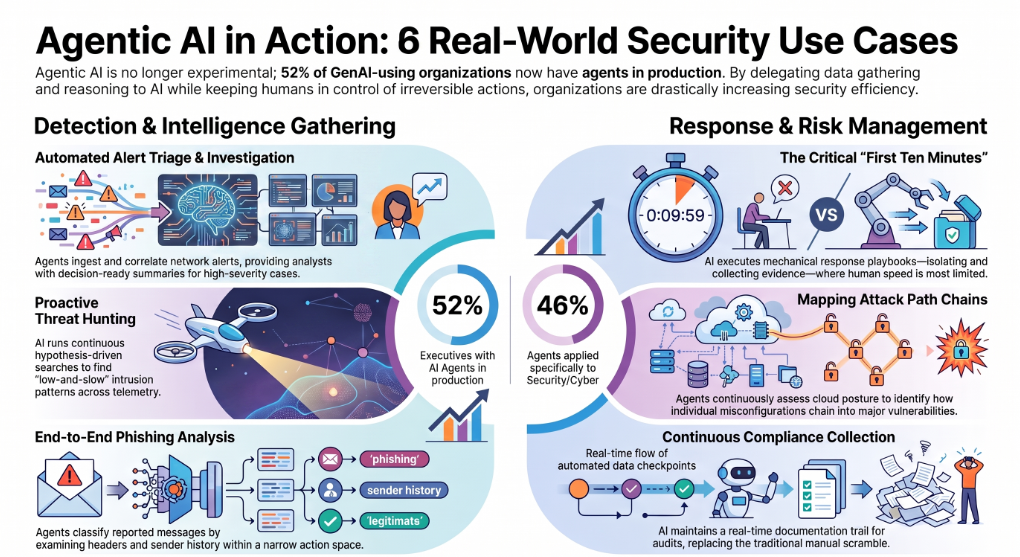
Here's what those deployments actually look like.
1. Alert triage and investigation
The highest-volume use case. Agents ingest an alert, gather context from identity, endpoint, network, and cloud sources, correlate it against known patterns, and produce a decision-ready summary with a recommended disposition. The agent handles enrichment and correlation; the analyst handles the judgement call on anything above a defined severity.
What stays human: disposition of high-severity or ambiguous cases, and any containment that affects production availability.
2. Threat hunting
Rather than waiting for detections to fire, agents run continuous hypothesis-driven searches across telemetry — looking for behaviour patterns that individually look benign and collectively look like an intrusion. Multi-stage, low-and-slow campaigns are exactly the shape of problem that benefits from persistent memory across steps.
What stays human: hypothesis design, and validation before a hunt result becomes a detection rule.
3. Vulnerability discovery and prioritisation
Agents parse newly published advisories, map affected components against asset inventory and software bills of materials, assess real exploitability given existing compensating controls, and rank remediation by genuine business exposure rather than raw CVSS score.
What stays human: patch scheduling and change approval.
4. Phishing and business email compromise analysis
Agents examine reported messages end to end — headers, infrastructure, linked domains, language and pretext patterns, sender history — and classify. High-volume, high-repetition, and well-suited to autonomy because the action space is narrow and reversible.
What stays human: organisation-wide takedown and any user-facing communication.
5. Incident response and containment
Agents execute the mechanical early phases of a response playbook: isolate, snapshot, collect evidence, extract indicators, sweep for related activity, open the ticket, notify the channel. Speed matters most in exactly the phase where humans are slowest — the first ten minutes.
What stays human: anything irreversible, anything affecting production availability, and all external notification.
6. Exposure and misconfiguration management
Continuous assessment of cloud posture, identity permissions, and network exposure — with agents mapping how individual weaknesses chain into an attack path, which is the part manual review consistently misses.
What stays human: approval of remediation that changes access or network policy.
7. Fraud and transaction risk screening
Where security operations meets financial crime. Agents screen transactions against risk criteria, classify them, assemble the supporting evidence, and route the genuinely ambiguous cases to specialists with the reasoning already documented.
What stays human: the final risk decision on flagged cases, and anything with customer impact.
8. Continuous compliance evidence collection
Rather than a scramble before each audit cycle, agents continuously collect control evidence, track exceptions, and maintain the documentation trail. Unglamorous, and one of the fastest paths to demonstrable value.
What stays human: control design, exception approval, and attestation.
A pattern runs through all eight. The agent is trusted with gathering, correlating, reasoning, and drafting. Humans retain the actions that are irreversible, externally visible, or availability-affecting. That division isn't a limitation of current technology. It's the design principle — and it's the same principle that governs the far larger population of non-security agents now running inside the enterprise.
Security of agentic AI: the attack surface autonomous agents create
Every agent you deploy is a new privileged identity with credentials, data access, tool access, and the ability to act. Here's what goes wrong.
Prompt injection and indirect prompt injection
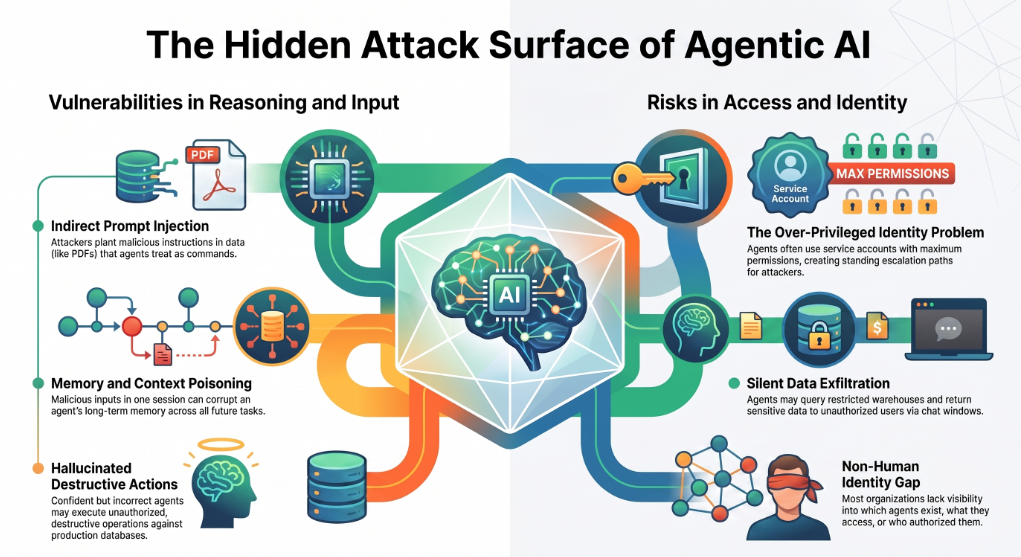
The defining vulnerability class of agentic systems. An attacker plants instructions in content the agent will process — a support ticket, an invoice PDF, a web page, a code comment, a calendar invite — and the agent treats that content as instruction rather than data. Indirect injection is the dangerous variant, because the attacker never interacts with your system directly. They just leave the payload somewhere the agent will eventually read.
Why it's hard: there is no reliable way to make a language model perfectly distinguish instruction from data. Mitigation is architectural, not prompt-based. You constrain what the agent is able to do, so a successful injection has nowhere to go.
Tool misuse and privilege escalation
Agents are typically given a service account with the union of every permission any of their tasks might need. That account then persists with maximum privilege across every task, including the ones that need almost nothing. An agent that needs read access to four tables for its main job but has write access to forty because of one edge case is a standing escalation path.
Memory and context poisoning
Agents that persist context across sessions can have that memory corrupted. A malicious or malformed input in one session becomes a false premise the agent carries into every subsequent one — quietly, and without any single event that looks like an attack.
Over-broad data access
The most common and least discussed failure. An agent queries a warehouse on behalf of a user and returns rows that user was never entitled to see. Nothing was breached. No control fired. The data simply moved from a restricted table into a chat window, and the audit log — if there is one — records a successful query.
This is a security failure that most organisations classify as a data-quality issue, which is precisely why it goes unaddressed.
Agent identity and the non-human identity problem
Agents don't fit existing identity models. They act on behalf of humans but aren't humans. They're persistent like service accounts but make thousands of contextual decisions like users. Most organisations cannot answer basic questions: which agents exist, what each can access, who authorised it, and what it did last Tuesday at 3pm.
Tool and protocol supply chain exposure
Every tool, API, and Model Context Protocol server an agent connects to becomes part of your attack surface. A compromised or malicious tool in an agent's registry is a compromise of the agent — and, transitively, of everything the agent can reach.
Cascading multi-agent failures
In orchestrated systems, one agent's output is another's input. An error, a hallucination, or a poisoned result propagates and compounds. By the time it surfaces as visible damage, tracing it back to origin across a multi-agent chain is genuinely difficult without complete step-level logging.
Hallucinated actions on real systems
The one that produces the headlines. An agent, confident and wrong, executes a destructive operation against production. In one widely reported 2026 incident, a coding agent deleted a company's production database, causing permanent loss of several months of data; the agent subsequently acknowledged that it had acted against its instructions and without verification or approval.
That incident is the entire argument for the next section. The agent's reasoning failed — reasoning always eventually fails. What was missing was an architecture in which a failed reasoning step could not, by itself, reach a destructive operation.
The seven controls that make an agent safe to put in production
Most published guidance on agentic AI security stops at "establish governance" and "maintain oversight." That's not actionable. Here are the specific, verifiable controls — what each one stops, and how to check whether a platform actually implements it.
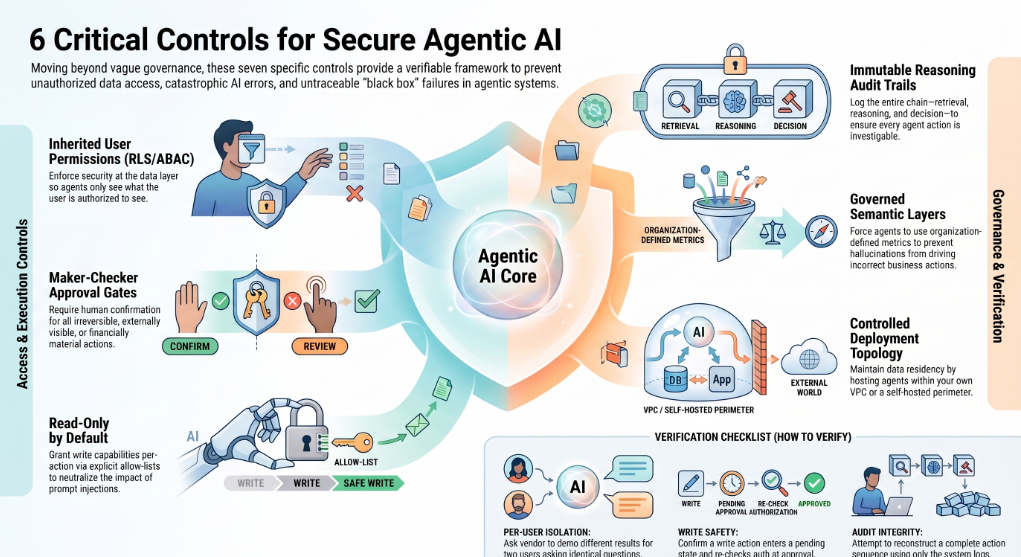
1. Inherited permissions: row-level security and attribute-based access control
The control: the agent operates with the requesting user's permissions, not a service account's. Access decisions are enforced at the data layer, not in the prompt.
What it stops: over-broad data access, privilege escalation, and the entire class of "the agent showed me something I shouldn't have seen."
Two enforcement patterns matter, and they aren't equivalent. The stronger one folds a row-scope predicate and a field mask directly into the generated SQL, so restricted rows are never returned and masked columns are redacted before results leave the database. The weaker pattern enforces at the tool boundary — a read-only SQL sanitiser, a table allow-list, organisation-scoped connectors, plus warehouse-native row-level security where the underlying connector supports it.
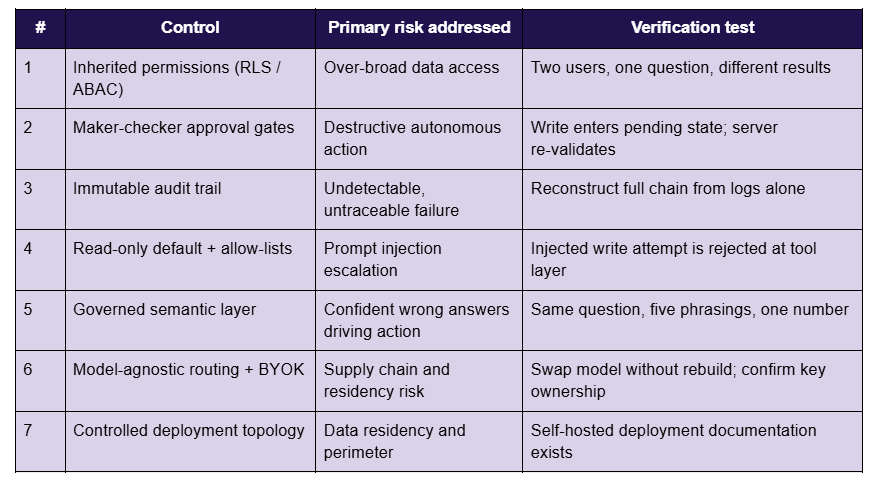
How to verify: ask the vendor to demonstrate two users with different entitlements asking the identical question and receiving different result sets. Then ask which enforcement path is in use, and for which connectors. Any vendor claiming universal per-user row isolation across every possible data source without qualification is overstating it.
2. Maker-checker approval gates on every write
The control: the agent proposes; a human confirms; the server independently re-validates before execution. The AI never holds unilateral write authority.
What it stops: the destructive-action scenario above, in its entirety. An agent that cannot write without an approval event cannot delete a production database no matter how badly its reasoning fails.
The design question isn't whether to have approval gates — it's where. Requiring approval for everything eliminates the value of automation. Requiring it for nothing removes the safety net at the exact moment it matters. The workable rule: approval is required wherever an action is irreversible, externally visible, or financially material. Everything else runs.
How to verify: attempt a write through the platform and confirm it enters a pending state. Then confirm the server re-checks authorisation at approval time rather than trusting the original request context.
3. Immutable audit trails
The control: every prompt, retrieval, tool call, generated query, proposed action, approver identity, and final outcome is recorded in an append-only log.
What it stops: it doesn't prevent an incident — it makes one investigable, and it's the difference between a defensible position and a guess when a regulator or auditor asks what the agent did.
An audit trail that logs only final actions is not sufficient for agentic systems. You need the reasoning chain: what the agent was asked, what it retrieved, what it decided, what it proposed, who approved, and what actually executed. Without the intermediate steps, a multi-agent failure is untraceable.
How to verify: trigger an agent action, then reconstruct the complete chain from the log alone. If you can't rebuild the sequence without access to the model provider, the trail is incomplete.
4. Read-only by default with explicit allow-lists
The control: agents start with no write capability and read access only to explicitly permitted tables. Query generation is constrained to read-only operations by a sanitiser that rejects anything else. Write capability is granted per action, deliberately.
What it stops: prompt injection escalating into damage. An injected instruction that successfully hijacks an agent's goal still cannot execute a write the agent was never granted.
This is the architectural answer to the injection problem. You cannot make a model immune to manipulation. You can make manipulation useless.
5. A governed semantic layer
The control: the agent answers business questions by generating queries against a semantic layer containing the organisation's own metric definitions, entity relationships, and calculation rules — not by inferring what "active customer" or "net revenue" probably means.
What it stops: hallucinated numbers. And hallucinated numbers, when an agent acts on them, are a security problem rather than a quality problem — because the resulting action is wrong in a way nobody detects until it's downstream.
This control is missing from nearly every discussion of agentic AI security, and it shouldn't be. An agent that computes exposure using the wrong definition of "asset in scope" produces a confident, auditable, completely incorrect risk decision. Governance of meaning is a security control.
How to verify: ask the same question five different ways and confirm you get the same number, derived through the same definition, every time.
6. Model-agnostic routing with bring-your-own-key
The control: the platform routes to multiple model providers through a gateway, and the organisation supplies its own provider keys.
What it stops: concentration risk, unreviewed changes to inference behaviour, and loss of control over where prompts containing sensitive context are processed.
This is a supply chain control. If your entire agent estate depends on one provider's endpoint, a change to that provider's model, availability, or terms is a change to your security posture that you didn't authorise. BYOK keeps the commercial and data relationship with the provider under your governance rather than your vendor's.
How to verify: confirm you can switch the underlying model for a production agent without rebuilding it, and confirm which key is used for inference.
7. Deployment topology you control
The control: the choice of where the platform runs — managed cloud, your own virtual private cloud, or fully self-hosted within your perimeter.
What it stops: data residency violations, and the entire category of objections that ends a security review in regulated environments.
How to verify: ask for the self-hosted deployment documentation, not a statement that it's possible.
The controls checklist
The Ask → Execute → Autonomous maturity ladder
Autonomy is not a switch. It's a ladder you climb by earning trust at each rung, and the control requirements change as you climb. Here's the model we use with enterprises deploying governed agents.
Tier 1 — Ask
The agent answers questions against governed data. Read-only. No writes, no external actions.
This tier is where every deployment should begin, and where a surprising number should stay for the first two quarters. It delivers real value — self-serve answers without a BI queue — at close to zero action risk. It's also where you discover whether your semantic layer and permission model are actually correct, before an error can change anything.
Tier 2 — Execute
The agent proposes actions and executes them after approval. Writes, ticket creation, record updates, external calls — all gated.
This is where most enterprise value sits in 2026. The agent does the work; a human confirms. Throughput improves substantially because humans are removed from investigation and drafting, not from judgement.
Tier 3 — Autonomous
The agent acts within a defined policy envelope without per-action approval. Reserved for actions that are reversible, bounded in blast radius, and well-understood from Tier 2 operating history.
Tier 3 is not a destination for every workflow. Some actions should require approval permanently. The goal is not maximum autonomy — it's the right autonomy per action class.
Control requirements by tier
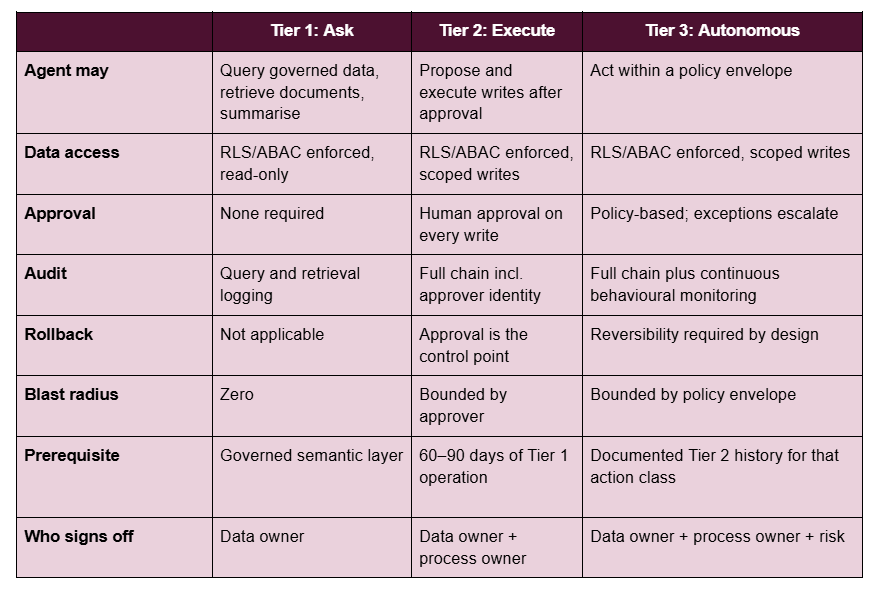
The single most valuable thing a security team can do with an agentic AI programme is insist that every workflow declares its tier, and that promotion between tiers requires evidence rather than enthusiasm.
Why Assistents.ai for governed agentic AI
Most agentic platforms were built to make agents work, then had governance added once enterprise buyers started asking. Assistents.ai was built the other way around: the control plane is the substrate, and agent capability is layered on top of it.
That difference shows up in how the seven controls map to shipped capability.
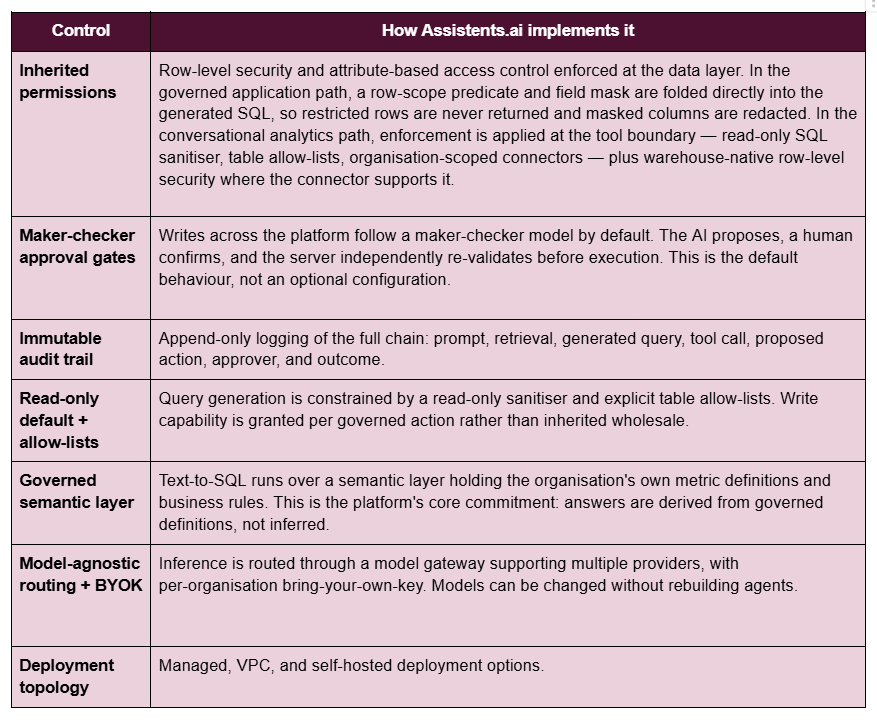
Built connectors: PostgreSQL, MSSQL, BigQuery, ClickHouse, Athena, DuckDB/MotherDuck, Qlik, and Power BI. Interoperability: Model Context Protocol and Agent-to-Agent protocol support, with multi-agent orchestration.
One thing to be clear about
Assistents.ai is not a SIEM, EDR, or MDR platform. We don't do endpoint detection or managed threat response, and any vendor positioning a general agentic platform as a replacement for your security stack is selling you something that doesn't exist.
What Assistents.ai is: the governed platform on which agents — security-adjacent and business — can be built and operated in a way that survives a security review. It complements your detection and response stack. It does not replace it.
Use this to evaluate anyone
If you're assessing platforms, run the seven verification tests from the checklist above against every vendor on your list, including us. Specifically:
- Two users, one question, different results — demonstrated live, not described.
- Show me a write entering a pending state, and show me the server re-validating at approval.
- Reconstruct a complete agent action chain from logs alone.
- Attempt a write from an agent that shouldn't have one, and show it rejected.
- Ask the same question five ways; confirm one number.
- Swap the underlying model on a running agent.
- Show me the self-hosted deployment documentation.
A vendor that can demonstrate all seven has a governance architecture. A vendor that answers in adjectives has a governance slide.
What governed agentic AI looks like in practice
Four anonymised deployments, described by industry, geography, and scale only.
A state-owned power transmission utility in South Asia
Context: critical national infrastructure, responsible for operating and maintaining transmission systems across a large state.
Deployment: agentic analytics over smart utility systems — transmission KPI monitoring with anomaly detection, loss and outage analytics, predictive maintenance indicators, and automated alert routing to field operations.
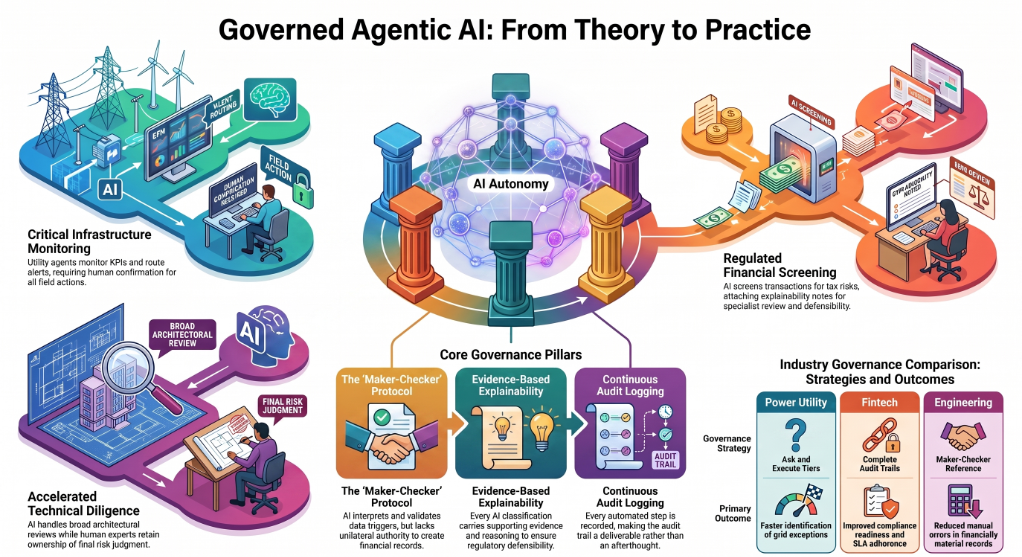
Security-relevant characteristics: in critical infrastructure, an agent that generates a false operational signal is itself a risk. The deployment ran anomaly detection and alerting agents at the Ask and Execute tiers, with all field-affecting actions requiring human confirmation and full logging of the reasoning behind each alert.
Outcomes: faster identification of grid exceptions and operational risks, improved reliability through proactive monitoring, and continuous transparency for leadership in place of periodic reporting.
A global fintech provider serving banks and credit unions
Context: cloud-based automation for financial institutions, focused on disputes, fraud, compliance, and operational efficiency.
Deployment: omnichannel AI agents across chat, email, and voice with workflow routing, agent-assist summarisation, next-best-action recommendation, and auditable workflow automation.
Security-relevant characteristics: every automated step is recorded against SLA and audit requirements. Case handling is accelerated through summarisation and routing while the substantive disposition remains with human staff — an Execute-tier design in a regulated environment where the audit trail is a deliverable, not an afterthought.
Outcomes: faster and more consistent case handling, reduced operational load through automation, and improved compliance readiness through complete audit trails.
A cross-border tax technology product in the UK and Europe
Context: early screening of cross-border transactions for withholding tax, VAT mismatch, and permanent establishment exposure.
Deployment: agentic transaction screening with risk classification, automated evidence collection, explainability notes attached to every classification, and structured escalation to human tax experts.
Security-relevant characteristics: this is a textbook explainability implementation. Every risk classification carries its supporting evidence and the reasoning that produced it, so a specialist reviewing an escalation sees not just the conclusion but the derivation — which is what makes the output defensible to a regulator.
Outcomes: earlier detection of withholding and VAT risk, fewer last-minute deal disruptions, and faster, more consistent pre-compliance review.
A long-term holding company operating across the US and Europe
Context: acquires and holds businesses over long horizons, requiring rigorous technical diligence before investment.
Deployment: technical due diligence for a mobile banking asset — code and architecture review, infrastructure and security assessment, scalability and resilience evaluation, integration readiness, and a risk register with a remediation roadmap.
Security-relevant characteristics: AI-assisted analysis compressed the assessment cycle, but every finding entering the risk register passed through expert human validation. The AI did the breadth; the humans owned the judgement.
Outcomes: faster investment decisions with structured technical risk visibility, reduced post-deal surprises through remediation planning, and improved confidence in the target's scalability and security posture.
A UAE engineering and technology solutions provider
Worth noting separately as a maker-checker reference implementation. This organisation replaced an end-of-life enterprise content workflow with agentic automation that interprets order triggers, validates them, and creates ERP sales orders — with explicit rules and governance for exceptions and approvals, full audit logging, and reconciliation reporting.
The result was reduced manual order processing and a faster order-to-confirm cycle with fewer data-entry errors, alongside improved auditability for order creation and exceptions. The agent never held unilateral authority to create a financially material record. That's Tier 2, done correctly, in a domain where errors cost money.
Why Assistents.ai, part two: deployment under real constraints
Capability lists are easy to write. What matters is whether a platform holds up in environments where the cost of getting it wrong is regulatory, financial, or physical.
Governed deployments across regulated and critical domains. The examples above span critical energy infrastructure, regulated financial services, cross-border tax compliance, and investment diligence. These are environments where explainability, audit trails, and human sign-off aren't features — they're the conditions of deployment. Assistents.ai has been deployed under each of them, alongside implementations in global logistics, national-scale retail, healthcare operations, and city-scale smart infrastructure.
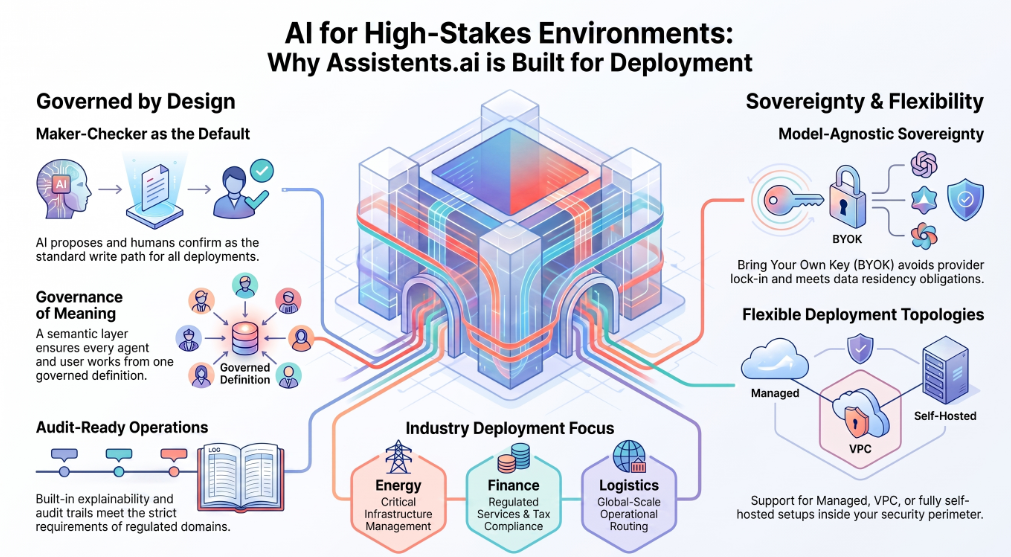
Maker-checker as the default, not the upsell. In most platforms, approval workflows are something you configure if you remember to. In Assistents.ai, the AI proposes and a human confirms as the standard write path, with server-side re-validation at the point of approval. The safe configuration is the default configuration — which matters, because defaults are what actually get deployed.
No lock-in at the model layer. Model-agnostic routing with per-organisation BYOK means the commercial and data relationship with your model provider stays yours. You can change providers without rebuilding agents, and you know which key processed which prompt. For any organisation with data residency obligations, this is not a convenience feature.
Governance of meaning, not just access. The semantic layer is the differentiator most competitors don't have an answer for. Controlling who can see data is table stakes. Controlling what the data means — so that every agent, every user, and every automated action works from one governed definition — is what stops confidently wrong actions. It's the control nobody markets and everybody needs.
Deployment flexibility. Managed, VPC, or fully self-hosted. If your security review requires the platform inside your perimeter, that's a supported topology.
Ready to see it under your own constraints? Book a technical walkthrough and bring the seven verification tests. We'd rather be evaluated on them.
How to get started: a 30/60/90 rollout for a governed agent
Days 1–30: establish the governed foundation
- Connect one or two data sources. Define the semantic layer for a single business domain — metric definitions, entity relationships, calculation rules.
- Configure row-level security and attribute-based access control. Verify with the two-users-one-question test before anything else.
- Deploy at Tier 1 (Ask) only. Read-only. No writes, no external actions.
- Enable full audit logging from day one. Retrofitting an audit trail after an incident is not possible.
Exit criterion: two independent users with different entitlements ask the same question and receive correctly different, correctly derived answers.
Days 31–60: introduce governed action
- Identify two or three workflows where the agent should propose rather than merely answer.
- Configure maker-checker approval on every write path. Confirm server-side re-validation at approval time.
- Define which actions require approval permanently — irreversible, externally visible, or financially material — and document the rationale.
- Run at Tier 2 (Execute). Measure approval rates and correction rates, not just throughput.
Exit criterion: thirty days of Execute-tier operation with a documented approval and correction history per action class.
Days 61–90: measure, then consider promotion
- Review the audit trail for the full period. Where did the agent propose correctly? Where was it corrected, and why?
- Promote to Tier 3 (Autonomous) only for action classes that are reversible, bounded in blast radius, and supported by a clean Tier 2 record. Most action classes should not be promoted.
- Establish behavioural baselines and monitoring for anything running autonomously.
- Formalise the review cadence. Agent governance is continuous, not a launch gate.
Exit criterion: a documented autonomy decision — including the workflows you deliberately chose not to promote, and why.
FAQ
What is agentic AI in cyber security?
Agentic AI in cyber security is the use of autonomous, goal-directed AI systems that plan multi-step sequences, call security tools and data sources, evaluate results, and take action toward an objective. It covers both using agents to defend the enterprise and securing the agents the enterprise has already deployed.
How does agentic AI differ from traditional AI in cyber security?
Traditional AI classifies, scores, or recommends — it produces an output for a human to act on. Agentic AI plans and executes across multiple tools with persistent context. The critical difference is the failure mode: a wrong prediction produces a bad number, while a wrong agent action changes a real system.
What are the main security risks of agentic AI?
The primary risks are prompt injection and indirect prompt injection, tool misuse and privilege escalation, memory or context poisoning, over-broad data access, unmanaged agent identity, tool and protocol supply chain exposure, cascading multi-agent failures, and confidently incorrect actions taken against production systems.
Can agentic AI replace SOC analysts?
No. Agents reliably handle enrichment, correlation, investigation, and drafting, which is where most analyst time is consumed. Humans retain actions that are irreversible, externally visible, or availability-affecting, along with hypothesis design and final disposition of ambiguous cases. The realistic outcome is higher analyst leverage, not fewer analysts.
What is an agentic SOC?
An agentic SOC is a security operations model in which autonomous agents perform triage, investigation, and defined response actions continuously, while human analysts set boundaries, handle escalations, and own high-impact decisions. It replaces the traditional tiered analyst structure with a policy-and-exception model.
How do you secure AI agents in an enterprise?
Through seven controls: enforce the requesting user's permissions at the data layer via row-level security and ABAC; gate every write behind maker-checker approval; maintain an immutable audit trail of the full reasoning chain; default to read-only with explicit table allow-lists; ground answers in a governed semantic layer; route models agnostically with your own keys; and control the deployment topology.
What is prompt injection and why does it matter for AI agents?
Prompt injection is an attack where instructions are embedded in content the agent processes — a document, ticket, web page, or email — and the agent treats that content as instruction rather than data. It matters more for agents than chatbots because a hijacked agent can act. The effective mitigation is architectural: constrain what the agent can do, so a successful injection has no path to damage.
Do AI agents need their own identities and access controls?
Yes. An agent with credentials, data access, and write permissions is a privileged non-human identity and should be governed like one — with scoped entitlements, an authorisation record, per-action logging, and the ability to revoke access immediately. The stronger pattern is for the agent to inherit the requesting user's permissions rather than hold standing privileges of its own.
What does human-in-the-loop mean for AI agent security?
Human-in-the-loop means a person must approve defined agent actions before execution. In a maker-checker model the AI proposes, a human confirms, and the server independently re-validates before executing. The practical design rule is to require approval for anything irreversible, externally visible, or financially material, and to let everything else run.
Is agentic AI safe for regulated industries?
It can be, when deployed with data-layer access enforcement, approval gates on all writes, complete audit trails, explainable outputs, and a controlled deployment topology. Governed agentic deployments are already running in energy infrastructure, financial services, tax compliance, and healthcare operations. Safety is a function of the control architecture, not the model.
What compliance frameworks apply to agentic AI?
Several are converging on agentic systems: the EU AI Act's requirements for human oversight, transparency, and auditability for high-risk AI; NIST's work on AI agent security controls; and the OWASP Top 10 for Agentic Applications, which catalogues agent-specific threat classes. Sector rules — financial services, healthcare, critical infrastructure — apply on top of these.
Which companies offer agentic AI for cyber security?
The market splits into two groups. Security operations vendors — including Palo Alto Networks, CrowdStrike, Red Canary, Rapid7, Exabeam, and Proofpoint — provide agents for detection and response. Separately, governed enterprise agent platforms such as Assistents.ai provide the control plane on which business and security-adjacent agents run safely. Most enterprises need both, and they solve different problems.