An AI agent for product managers is a system that takes a goal, pulls context from your product data, decides on a sequence of steps, uses tools to act, and produces an outcome a product team can use — a synthesised insight, a drafted artefact, or a governed action inside a system of record. The hard part is no longer building one. Any PM can wire a demo agent in an afternoon. The hard part is building one that connects to real company data, survives a security review, and still works in month six.
This guide covers the whole path:
- The difference between workspace agents (agents that do your PM job) and product agents (agents you ship inside your product) — and why conflating them is the most common reason PM agent projects stall
- The Ask → Execute → Autonomous maturity ladder, and how to tell which stage you're actually ready for
- Nine specific agents worth building first, with triggers, inputs, outputs, guardrails and realistic build times
- A seven-step build process, the build-vs-buy decision, and honest cost ranges
- The governance layer — row-level security, approvals, audit trails — that decides whether your agent ever leaves the sandbox
- Anonymised enterprise deployments showing what these patterns look like at scale
Key Takeaways
- Most PM agent guides teach you to build a demo. A demo drafts a summary. A production agent touches a system of record, and that changes every requirement.
- Start with agents that only read. Earn write access. Earn autonomy after that. Skipping this sequence is why agents get shut down by security rather than retired for lack of value.
- The single highest-leverage first agent for most PMs is voice-of-customer synthesis or competitive monitoring — both are read-only, both are frequent, both have obvious output destinations.
- Grounding beats prompting. An agent connected to your actual PRDs, tickets and analytics through a governed context layer outperforms a cleverly prompted agent guessing from general knowledge.
- Build an eval pack of 20–30 real, messy examples before you ship. Vibes are not a quality bar.
- Governance is not a blocker you handle at the end. Row-level security, approval gates and audit trails are design inputs on day one.
What "Building AI Agents" Actually Means for a Product Manager
The phrase hides two completely different jobs, and most guides pick one without telling you.
Workspace agents vs. product agents: the split nobody explains
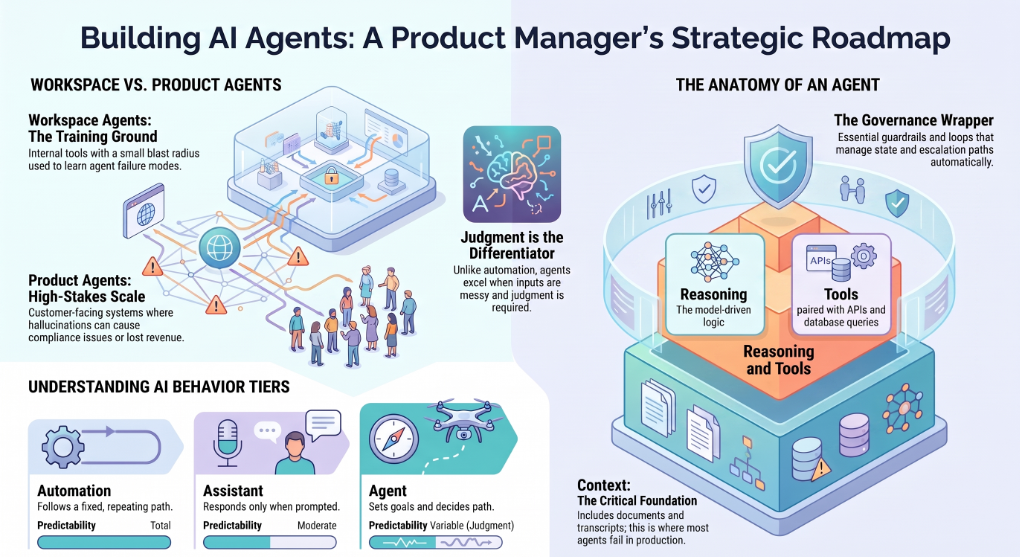
A workspace agent runs on your work. It reads your tickets, your interview transcripts, your analytics, your competitor pages. It produces artefacts you use: a themes report, a PRD draft, a Monday-morning digest. You are the user. The blast radius is your own calendar.
A product agent runs inside your product or a business process. It serves your customers or your operations team, on its own, at volume. You design the architecture, wire the tools, set the guardrails, define the escalation path — and then it runs without you watching. You are the product manager, not the user.
The reason this matters: the skills transfer, but the requirements do not. A workspace agent that hallucinates once costs you ten minutes. A product agent that hallucinates once may cost you a customer, a compliance finding, or a corrupted record in your ERP.
The right sequence is to use workspace agents as your training ground for product agents. Build three or four for yourself. Learn what breaks — the looping, the confident bluffing, the silent failure when a data source goes stale. Then apply those lessons where the stakes are real.
AI agent vs. AI assistant vs. workflow automation
Three terms, three behaviours:
- Automation follows a fixed path. Trigger fires, steps execute in the same order every time. Zero judgement, total predictability.
- An assistant answers when asked. You prompt, it responds. It doesn't act, it doesn't persist, it doesn't decide.
- An agent is given a goal and decides the path. It plans, calls tools, observes the result, and either continues or stops. The judgement is the point — and the judgement is also the risk.
If your workflow never varies, build automation. It's cheaper, faster, and it never surprises you. Reach for an agent when the input is messy, the steps depend on what the agent finds, or the volume of judgement calls exceeds what a human can sustain.
The four parts of every agent
Whatever tool you use, an agent has the same anatomy:
- Context — what it knows. Your documents, tickets, tables, transcripts. This is where most agents fail, and it's the part PMs underinvest in.
- Reasoning — the model deciding what to do next. Interchangeable, and increasingly commoditised.
- Tools — how it acts on the world. APIs, database queries, ticket creation. Increasingly standardised through protocols like MCP.
- Memory and state — what it carries between steps and between runs.
Wrapped around all four: a loop (plan → act → observe → repeat until a stop condition) and guardrails (what it may touch, what it must escalate, when it must stop).
Why most PM agent demos never reach production
The demo works because you gave it a clean input, watched it run, and read the output yourself. Production has none of those conditions. There, the agent meets a malformed export, a permissions boundary, a duplicate record, a question phrased three ways by three teams — and nobody is watching.
The gap between the two is almost entirely grounding and governance. Not model quality. Not prompt craft.
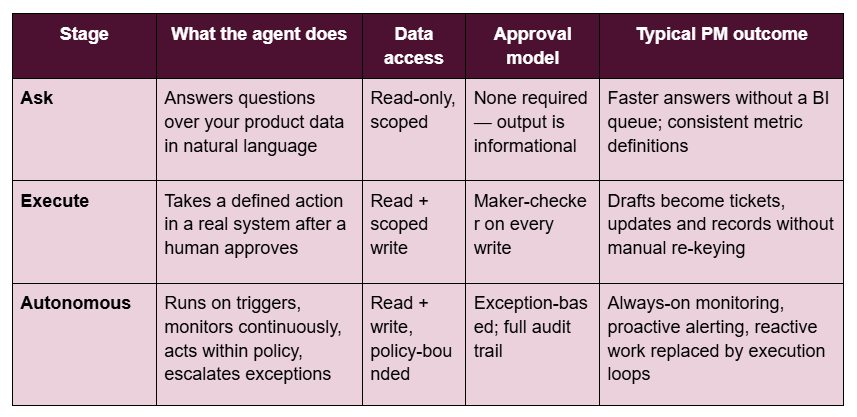
The Ask → Execute → Autonomous Maturity Ladder
Every product organisation deploying agents moves through three stages. Trying to skip one is the most reliable way to end up with a pile of disconnected tools that nobody trusts.
Stage 1: Ask
The agent reads. It answers "what changed in customer complaints this month," "which accounts churned after the pricing change," "what did the last twenty interviews say about onboarding." No write access, no side effects.
This stage is where you build organisational trust cheaply. It's also where you discover that your data is messier than you thought — which is a finding worth having before you let anything write.
Stage 2: Execute
The agent proposes an action and a human approves it. It drafts the Jira ticket; you click create. It writes the release note; you publish. It flags the duplicate; you merge.
This is where value compounds, because the re-keying disappears. It's also the first stage where governance is non-optional: every write needs an approver, a record of who approved it, and a way to reverse it.
Stage 3: Autonomous
The agent runs on a schedule or a trigger, acts within a policy envelope, and escalates only what falls outside it. A competitor drops a price by more than a threshold — the agent captures it, classifies it, files it, and alerts the category owner. Nobody asked. Nobody had to remember.
Most product teams should be running several Ask agents, one or two Execute agents, and zero Autonomous agents in their first six months. That is not a failure. That is the correct pace.
How to know which stage you're ready for
Answer honestly:
- Can you name the exact source of truth for the data the agent needs? (No → you're not ready for Ask.)
- Does someone own the definition of the metrics involved? (No → your Ask agent will produce confidently inconsistent answers.)
- Is there a named human who approves this action today? (No → you can't build Execute; you'd be automating an unowned decision.)
- Can you write down the exact conditions under which this action is always safe? (No → you cannot go Autonomous.)
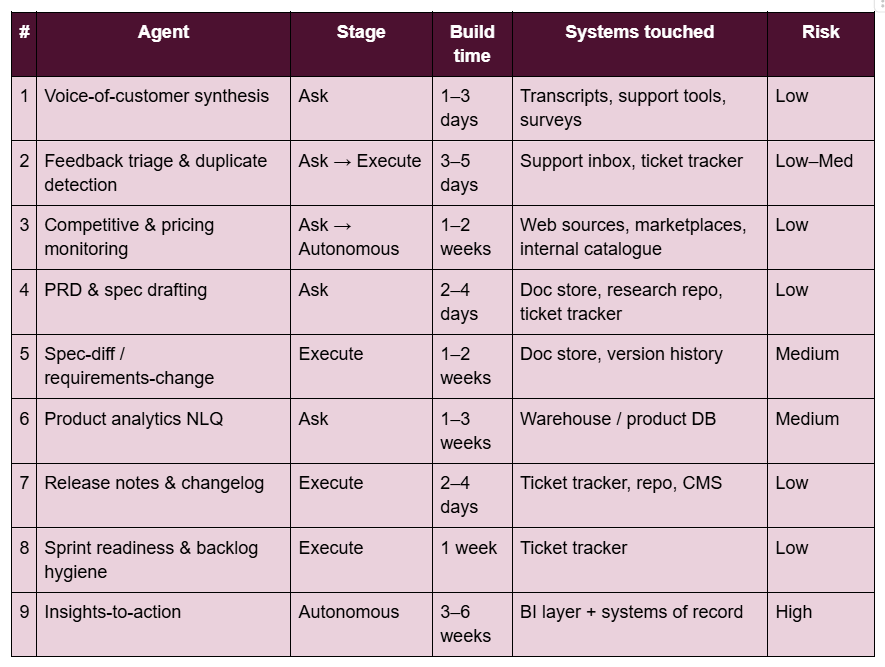
9 AI Agents Product Managers Should Build First
Each of these is a real, bounded workflow. Each ends in an artefact your team already uses.
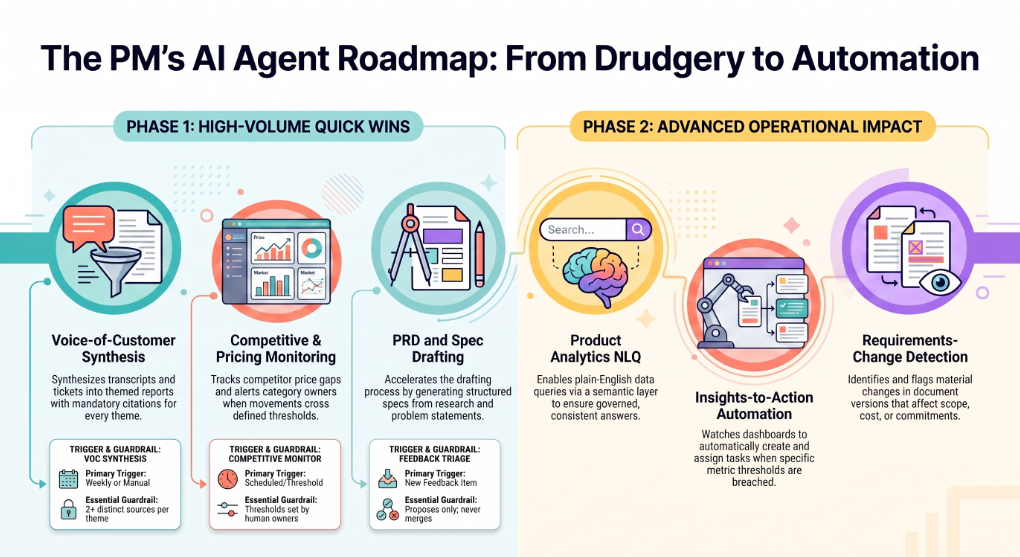
1. Voice-of-customer synthesis agent
What it does: Reads a batch of interview transcripts, support conversations and survey free-text, then produces a themed synthesis with supporting quotes and source links.
Trigger: Manual, or weekly on a folder. Inputs: Transcripts, tickets, survey exports. Output: A themes document — theme, frequency, severity, representative quotes, links back to source. Guardrail: Every theme must cite at least three distinct sources. No theme without evidence. Why start here: It's read-only, it's high-volume drudgery, and the output quality is easy for you to judge because you already know what's in those interviews.
2. Feedback triage and duplicate-detection agent
What it does: Classifies incoming feedback by area, severity and sentiment; checks whether a matching request already exists; either links it to the existing item or drafts a new one.
Trigger: New item in the feedback channel. Output: A classification plus either a link to an existing ticket or a drafted new one, held for approval. Guardrail: Never merges or closes anything. Proposes only. Confidence below threshold routes to a human.
3. Competitive and pricing monitoring agent
What it does: Continuously monitors competitor pricing, promotions, availability, ratings and product-page changes. Turns raw signal into structured records and answers questions like "where has our price gap widened since last month."
Trigger: Scheduled, plus threshold-based alerting. Output: A change log, a delta report, and proactive alerts when movement crosses a threshold. Guardrail: Alert thresholds set by category owners, not by the agent. Every alert carries the observation, timestamp and source. Note: This is the highest-consensus first agent in the industry for good reason — it needs almost no internal systems integration and the time saved is immediate and visible.
4. PRD and spec drafting agent
What it does: Takes a validated problem statement plus your research repository and produces a first-draft PRD in your template.
Trigger: Manual, on demand. Inputs: Problem statement, linked research, existing related specs, constraints. Output: A structured draft — problem, evidence, scope, non-goals, success metrics, open questions. Guardrail: The agent must populate an "open questions" section and must not invent metrics or user counts. Anything it cannot source, it flags. Reality check: This saves the blank-page hour, not the thinking hour. Treat it as a draft accelerator, never as a decision-maker.
5. Spec-diff / requirements-change agent
What it does: Detects what changed between two versions of a specification, contract or requirements document, classifies the materiality of each change, and flags anything that affects scope, cost or commitments.
Trigger: New document version uploaded. Output: A structured change list with materiality ratings and affected downstream items. Guardrail: Extraction confidence is reported per field. Below-threshold fields are marked "needs review" rather than guessed. Why it's underrated: Missed requirement changes are one of the most expensive silent failures in product delivery, and humans are genuinely bad at catching them across long documents.
6. Product analytics NLQ agent
What it does: Lets anyone ask product questions in plain English and returns a governed answer — "what's week-four retention for users who hit the aha moment in session one, split by acquisition channel."
Trigger: On demand. Output: An answer, the query it ran, and the definition it used. Guardrail: This one is only safe on top of a semantic layer — a governed definition of what each metric means. Without it, you get confident, inconsistent answers, which is worse than no answer. Row-level security must apply so the agent only sees what the asker is entitled to see.
7. Release notes and changelog agent
What it does: Pulls completed items in the release, groups them by theme and audience, and drafts internal and customer-facing versions.
Trigger: Release cut. Output: Two drafts — internal detail and customer-facing summary — held for approval. Guardrail: Nothing publishes without a human. Items marked internal-only never appear in the customer draft.
8. Sprint readiness and backlog hygiene agent
What it does: Checks upcoming tickets for missing acceptance criteria, unresolved dependencies, stale items, and duplicates. Posts a pre-planning readiness report.
Trigger: Two days before planning. Output: A readiness checklist per ticket, plus a flagged-items list. Guardrail: Comments on tickets, never edits or reassigns them.
9. Insights-to-action agent
What it does: The hardest and highest-value one. Watches your existing dashboards and metrics. When a signal crosses a defined boundary, it doesn't just alert — it creates the follow-up task, assigns it against the right owner using your existing rules, and tracks it to completion.
Trigger: Metric threshold breach. Output: A governed task in your system of record, with the triggering evidence attached. Guardrail: Full maker-checker on creation, immutable audit trail, and a documented policy for every automated action type. Why last: This is where an agent stops being a productivity tool and starts changing how the organisation operates. Build it after the other eight have earned trust.
How to Build Your First AI Agent: A 7-Step Process for Product Managers
You don't need to write code. You do need to think like you're specifying a feature — because you are.
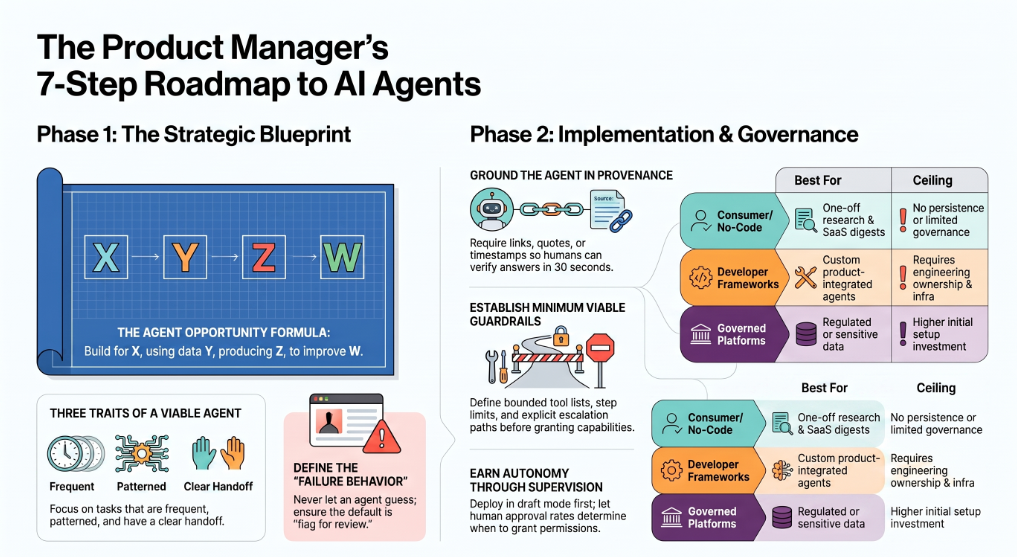
Step 1: Write the agent opportunity statement
Before you open any tool, write one sentence:
We will build an agent to do X, using data from Y, producing Z, so that we can improve W.
If you can't complete that sentence, you don't have an agent opportunity yet. A good candidate has three traits:
- Frequent. Daily or weekly, not quarterly. Ten minutes saved on something you do thirty times a week is real leverage. Ten minutes saved on something quarterly is a hobby.
- Patterned. The inputs may be messy, but the shape of the work is consistent — same sources, same kind of decision, same type of output.
- Clear handoff. The output lands somewhere your team already looks. If you can't say where the output goes, the agent produces noise.
Step 2: Define the contract
Lock these four things down before you build anything:
- Trigger and inputs. What starts it, and exactly which sources it may read.
- Output contract. Format, length, required fields, mandatory citations. Be specific — "a table with columns theme, count, severity, three linked quotes" beats "a summary."
- Allowed decisions. What it may decide on its own, and what it must escalate.
- Failure behaviour. What happens when data is missing or confidence is low. The correct default is "flag for review," never "make a reasonable guess."
The failure behaviour is the one PMs skip and the one that determines whether the agent is trustworthy.
Step 3: Ground it in real context
Agents fail in a specific, predictable way: they sound right while being wrong, because they're missing the source of truth.
Three concrete moves:
- Define permitted sources explicitly. Your doc store, your ticket tracker, your warehouse. Not "the internet," unless you deliberately want that.
- Choose the retrieval method per source. Retrieval-augmented generation for internal documents so it pulls exact snippets rather than recalling. Direct connections for live structured data. A semantic layer for anything involving business metrics.
- Require provenance in the output. Links, quotes, timestamps, row counts. If a human can't verify the answer in thirty seconds, the agent hasn't finished its job.
This step is where the quality difference between a demo agent and a useful agent actually lives.
Step 4: Choose the tool tier
Four tiers, and the honest fit for each:
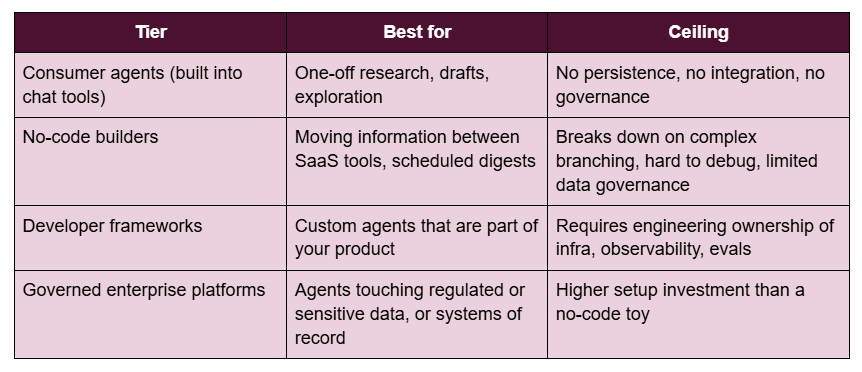
A practical rule: write down the three to five systems the agent must reach and the one or two places it must output. If those systems hold customer data, financial data, or anything a compliance team asks about, skip straight to the governed tier — retrofitting governance costs more than starting with it.
Step 5: Set guardrails before you set capabilities
Order matters. Decide what the agent may not do, then grant capabilities one at a time.
Minimum viable guardrails: a bounded tool list, an explicit stop condition, a step limit, a scope of data it may read, and an escalation path. Read widely, write narrowly, publish never — until it's earned each one.
Step 6: Build an eval pack
Twenty to thirty real examples that represent the range of what the agent will encounter, including deliberately hard cases: duplicates, sarcasm, incomplete records, conflicting requests, edge-case formats.
Score every run against a rubric: factual accuracy, usefulness, format compliance, boundary adherence, and uncertainty handling. Does it ask a clarifying question when it should, or does it bluff?
Then iterate surgically. Tightening the output schema, reducing tool access, or adding a required citation improves reliability more than rewriting the prompt.
Step 7: Ship supervised, then earn autonomy
Deploy in draft mode. Let it produce, let humans approve, let the approval rate tell you when it's ready. Then grant one permission at a time — read a new source, write to one system, act on one trigger type.
The teams that go from prototype to full autonomy in one jump are the teams that turn agents off three months later.
Why Assistents.ai Is the Fastest Path from PM Prototype to Production Agent
Most agent tools optimise for the first thirty minutes. Assistents.ai is built for what happens after — when the agent has to reach real data, produce consistent answers, and touch a system someone is accountable for.
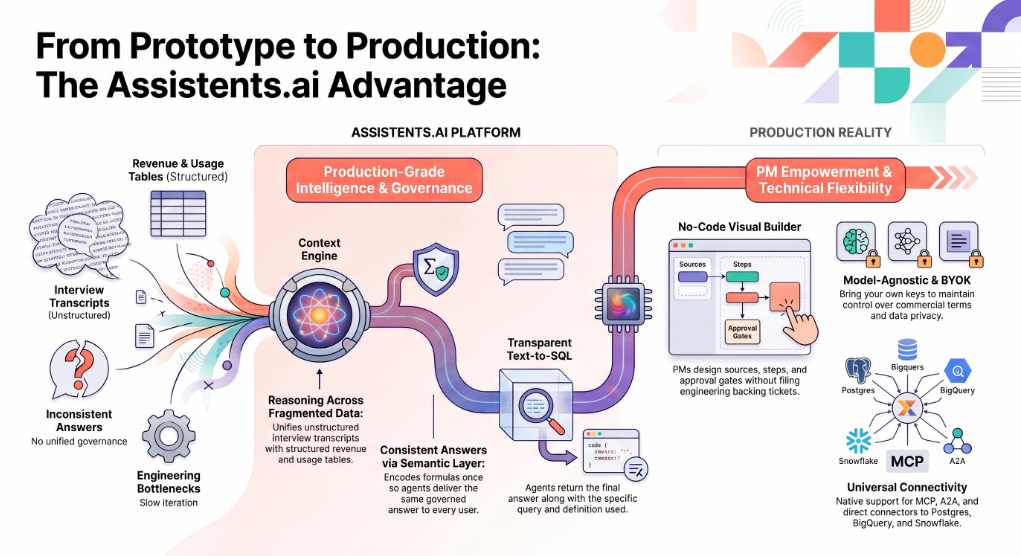
The Context Engine: reasoning across structured and unstructured product data
Product context is fragmented by nature. Interview transcripts and support conversations sit in unstructured form. Usage events and revenue sit in tables. Specs sit in a doc store. The Context Engine reasons across both structured and unstructured sources so an agent answering "why did activation drop" can look at the numbers and the conversations, not one or the other.
Semantic layer and text-to-SQL: plain English in, governed answers out
The failure mode of natural-language analytics is inconsistency — three people ask about "active users" and get three numbers. The semantic layer encodes definitions, hierarchies and formulas once, and text-to-SQL generates queries against those governed definitions. The agent returns the answer, the query it ran, and the definition it used. Same question, same answer, every time.
A visual builder, so engineering doesn't get a new backlog item
PMs can design the agent — sources, steps, output contract, approval gates — without filing a ticket. That matters less for speed than for iteration: the person who knows what "good output" looks like is the person adjusting it.
Model-agnostic routing and BYOK
Model-agnostic routing means you're not tied to one provider's roadmap, pricing or availability. BYOK means you bring your own model keys, so inference runs under your own commercial and data terms.
MCP and A2A support
Agents are only as useful as what they can reach. Assistents.ai supports MCP for tool and data connectivity and A2A for agent-to-agent communication, with direct connectors to Postgres, MSSQL, BigQuery, ClickHouse, Athena and DuckDB.
The positioning in one line: most PM agent tools stop at the draft. Assistents.ai is built for the step after — where the agent touches a real system and someone has to be accountable for what it did.
Build vs. Buy: The Decision Framework and What It Actually Costs
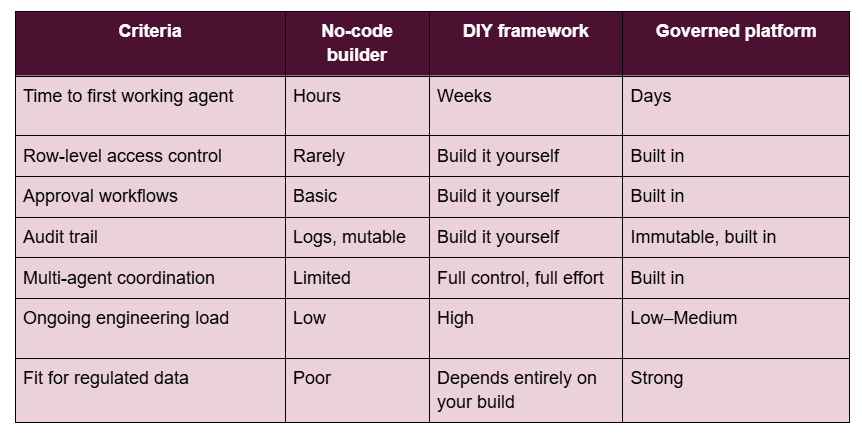
When a no-code builder is enough
Your agent moves information between SaaS tools, reads nothing sensitive, writes nothing consequential, and serves one team. A weekly digest agent. A meeting-notes router. Ship it this week and don't overthink it.
When you need a framework
The agent is part of your product, needs custom reasoning logic, and you have engineering capacity to own the orchestration, retries, observability, hosting and evaluation harness. Frameworks give you total control and hand you total responsibility.
When you need a governed platform
Any one of these makes it the right call:
- The agent reads customer, financial, health or otherwise regulated data
- Different users must see different rows of the same dataset
- The agent will write to a system of record
- Someone will eventually ask "why did the agent do that on 14 March"
- More than one team will use it
Decision matrix
Realistic cost ranges
- Personal prototype: tens of dollars a month in model spend plus an existing tool subscription.
- Team pilot: low thousands per month once you include model spend, a builder or platform seat tier, and someone's time maintaining it.
- Production agent touching systems of record: meaningfully higher, and dominated by things people forget to budget — connector maintenance, evaluation harnesses, observability, incident handling, and change management.
The hidden cost that catches teams out is not inference. It's the ongoing maintenance of integrations against systems that change underneath you, and the human effort to keep an eval suite honest as your data drifts.
A useful heuristic borrowed from enterprise automation: budget roughly 70% of your effort for adoption — documentation, training, process change — and 30% for building. A technically perfect agent that nobody trusts is worth nothing.
Governance: The Part That Decides Whether Your Agent Ships
This is the section every other guide on this topic skips, and it's the one that determines outcomes.
Row-level security and ABAC
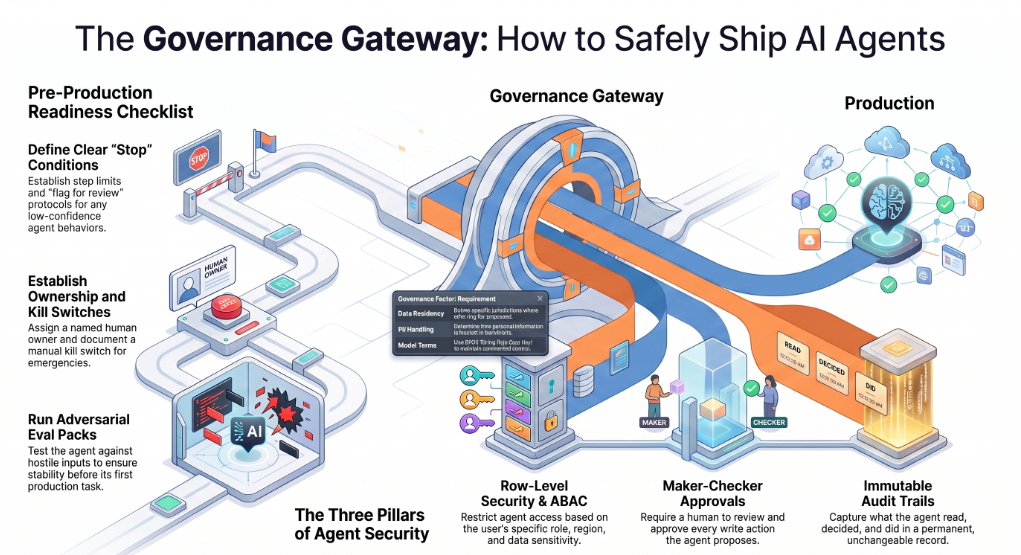
The agent must only see what the person asking is entitled to see. If a regional manager asks a question, the agent must not return data from other regions — even though the underlying connection can technically reach it. Row-level security enforces this at the data layer, and attribute-based access control extends it to context: role, region, entity, sensitivity classification.
Without this, an analytics agent becomes a data-exfiltration surface with a friendly interface.
Maker-checker and human-in-the-loop approvals
Any write action needs a proposer and an approver. Maker-checker makes that structural rather than cultural: the agent proposes, a named human approves, the approval is recorded, and the action is reversible.
Start with approval on every write. Relax it per action type only once you have volume data showing the approval was rubber-stamped.
Immutable audit trails
Six months in, someone will ask why the agent did something. You need to answer: what it was asked, what it read, what it decided, what it did, who approved it, and when. Immutable audit trails make that answerable. Mutable application logs do not.
Data residency, PII and BYOK
Decide before you build: which jurisdictions the data may be processed in, what happens to personally identifiable information in transcripts and tickets, and whose commercial terms the model inference runs under. BYOK lets you keep inference under your own agreement rather than inheriting a vendor's.
Pre-production governance checklist
Run this before your agent touches its first production system:
- Every data source is named, owned and classified for sensitivity
- Access is scoped so the agent sees only what the requester may see
- Every write action has a named approver and a reversal path
- Stop conditions and step limits are defined and tested
- Output includes provenance — sources, timestamps, confidence
- Low-confidence behaviour is "flag for review," not "best guess"
- An audit trail captures inputs, decisions, actions and approvals
- An eval pack exists and has been run against adversarial inputs
- A named human owns the agent and its maintenance
- There is a documented kill switch and someone knows who can pull it
How Enterprises Are Already Running These Agents
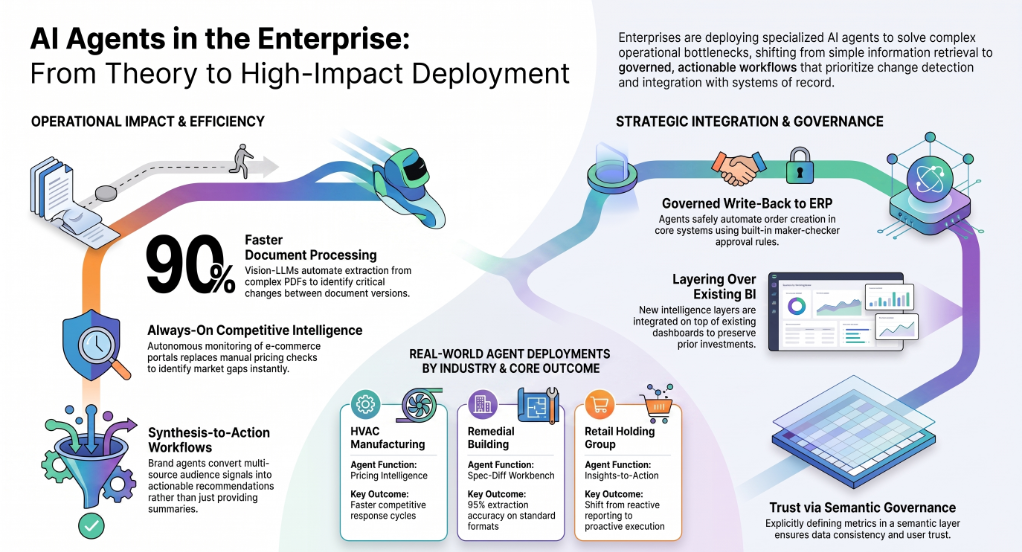
The following are anonymised deployments, described by industry, geography and scale only. Each maps directly to one of the nine agents above.
Competitive and pricing intelligence at scale
A major India-headquartered HVAC and cooling manufacturer competing in highly price-sensitive consumer and commercial markets, where competitor visibility and pricing moves matter daily.
Delivered: Continuous e-commerce and channel monitoring across pricing, MRP and discounts, offers, availability and ratings. Agentic question-answering mapped to the specific questions leadership actually asks. Analytics views for pricing gaps, competitive threats and portfolio movement. Architecture designed to scale from proof of concept to production with governance and audit trails intact.
Outcomes: Faster competitive response cycles. Earlier identification of pricing gaps and promotional shifts. Always-on monitoring replacing manual checks across portals.
PM parallel: This is agent #3, run at enterprise scale — and it demonstrates the Ask → Autonomous progression clearly. It began as a way to answer questions and became a system that surfaces changes nobody thought to ask about.
Turning documents and specs into structured, diffable data
An Australian waterproofing diagnostics and remedial building works specialist with more than twenty years in commercial remedial services.
Delivered: An intelligent document workbench built on multi-agent orchestration. Document retrieval, workflow determination and revision analysis. Vision-LLM extraction from complex PDFs. Deep two-way integration with their core operational system including full create-read-update-delete, record locking and audit logs.
Outcomes: Engineered for up to approximately 90% faster document processing, with a target of approximately 95% extraction accuracy on standard formats, and reduced downstream risk through revision and change detection with full auditability.
PM parallel: Agent #5, the spec-diff agent. Same pattern, different document type. The lesson that transfers: the value wasn't extraction, it was change detection — catching what moved between versions.
Voice-of-customer and multi-signal synthesis
A US brand insights and creative execution studio founded by leaders with deep large-platform media backgrounds.
Delivered: Multi-source ingestion across creative assets, performance data and audience signals. Insight agents producing themes, narratives and recommendations. Reporting packs for leadership.
Outcomes: Faster creative strategy cycles and more consistent insight workflows. Deeper signal synthesis across channels. Improved clarity on what to do next.
PM parallel: Agent #1. Note the last outcome — the value wasn't the summary, it was converting synthesis into a recommendation someone could act on.
From dashboard insight to governed action
A privately held Indian retail holding group where leadership needed governed, cross-functional intelligence across systems and documents.
Delivered: A unified context engine spanning structured and unstructured data. A semantic governance layer encoding rules, hierarchies and formulas. An active orchestrator integrating with core systems. Insights-to-action agents layered on top of existing dashboards rather than replacing them.
Outcomes: A shift from reactive reporting to proactive execution loops. Standardised decision logic across teams. Automated task creation with completion tracking.
PM parallel: Agent #9, the hardest one. The design decision worth stealing: the agents were layered on top of the existing BI investment, not in place of it. Nobody had to abandon their dashboards to get action out of them.
Governed write-back into a system of record
A UAE-headquartered family business group spanning more than thirty operating companies across retail, building, industrial and services portfolios.
Delivered: Agentic automation that interprets order triggers, validates them, and creates sales orders directly in the core ERP — replacing a legacy workflow product reaching end of life. Rules and governance for exceptions and approvals. Audit logs and reconciliation reporting.
Outcomes: Reduced manual order processing and reduced legacy dependency. Faster order-to-confirm cycles with fewer data-entry errors. Improved auditability for order creation and exception handling.
PM parallel: This is the existence proof that agents can write safely to production systems of record — provided maker-checker approvals, exception rules and audit trails are designed in rather than added later.
Self-serve product analytics without the BI queue
A Silicon Valley real-time business analytics startup (Palo Alto, founded 2023), and separately a pan-India value retailer operating more than 700 stores across hundreds of cities.
Delivered: An agentic analytics layer over existing data. Semantic governance for consistent metric definitions. A natural-language query interface with automated insight generation.
Outcomes: Faster strategic visibility without BI queueing. Improved alignment through consistent metric definitions. Scalable insight access across teams and reduced reporting dependency on analysts.
PM parallel: Agent #6. The recurring theme across both: the semantic layer did more for trust than the model did.
How to Measure Whether Your Agent Is Working
Benchmark before you build
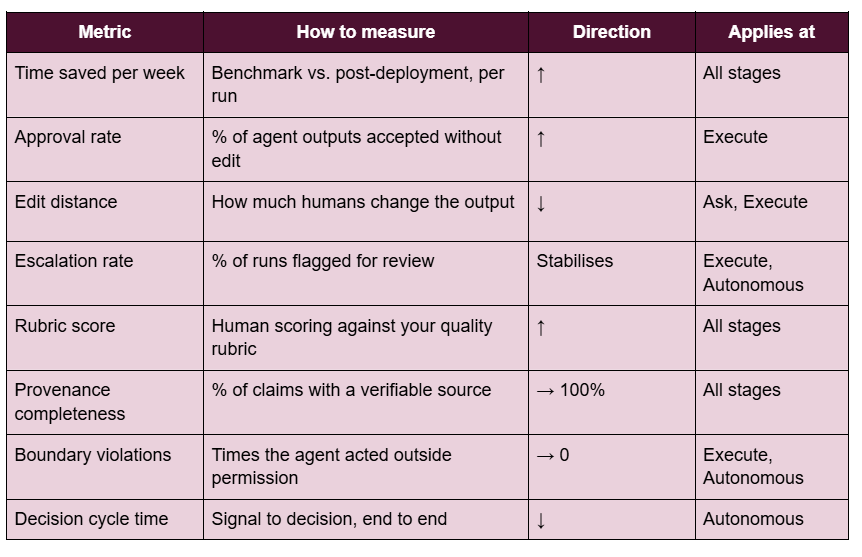
Record three things about the current manual process: how long it takes, who does it, and what the output quality looks like. Most teams skip this and then can't prove anything.
The metrics that matter
The one people forget
Quality measurement. Build a rubric that defines what good output looks like for this specific task — accuracy, completeness, format, tone, citation. Score a sample every month. Without it, you're measuring speed while quality quietly degrades, and you won't notice until someone acts on a wrong answer.
7 Mistakes Product Managers Make When Building AI Agents
- Building the "everything agent." One clear job, one output, one destination. Scope creep is the leading cause of unreliable agents.
- Granting tool access before setting stop conditions. An agent with tools and no stop condition will loop, and it will do so expensively.
- Skipping evals because the demo looked good. The demo used your best input. Production won't.
- Grounding on "the internet" instead of governed sources. General knowledge produces plausible answers. Your systems produce correct ones.
- Letting it write before it's earned read-only trust. Every production agent should have a boring, uneventful read-only history behind it.
- No output contract. Without a defined format and required fields, nobody can tell whether a given run was good or bad — including you.
- Treating it as a project, not a capability. Agents drift. Sources change, schemas change, models change. Someone must own it, or it will quietly stop being right.
Why Product Teams Choose Assistents.ai for Governed Agent Deployment
The first Assistents.ai section covered getting an agent built. This one covers the reason agents get approved.
Governance built in, not bolted on
Row-level security and ABAC ensure the agent's visibility is scoped to the requester's entitlements. Maker-checker and human-in-the-loop approvals put a named human between any proposed action and its execution. An immutable audit trail records what was asked, what was read, what was decided, what was done and who approved it.
These are platform primitives, not features you assemble. That distinction is the difference between a two-week security review and a two-quarter one.
Multi-agent orchestration for when one agent isn't enough
Real workflows rarely fit one agent. Retrieval, analysis, drafting and validation are different jobs with different quality bars. Multi-agent orchestration coordinates specialised agents with defined handoffs, so you can decompose a complex workflow instead of building one agent that does everything badly.
Connect to the data your product actually runs on
Direct connectors to Postgres, MSSQL, BigQuery, ClickHouse, Athena and DuckDB, plus MCP for tool connectivity and A2A for agent-to-agent communication. Your agent reasons over your warehouse and your operational databases, not a stale export.
Ask → Execute → Autonomous on one platform
The most expensive mistake in agent adoption is re-platforming between maturity stages — building your read-only agent in one tool, then rebuilding it from scratch when it needs to write. Assistents.ai runs all three stages on the same foundation, so graduating an agent means adding a permission and an approval policy, not starting over.
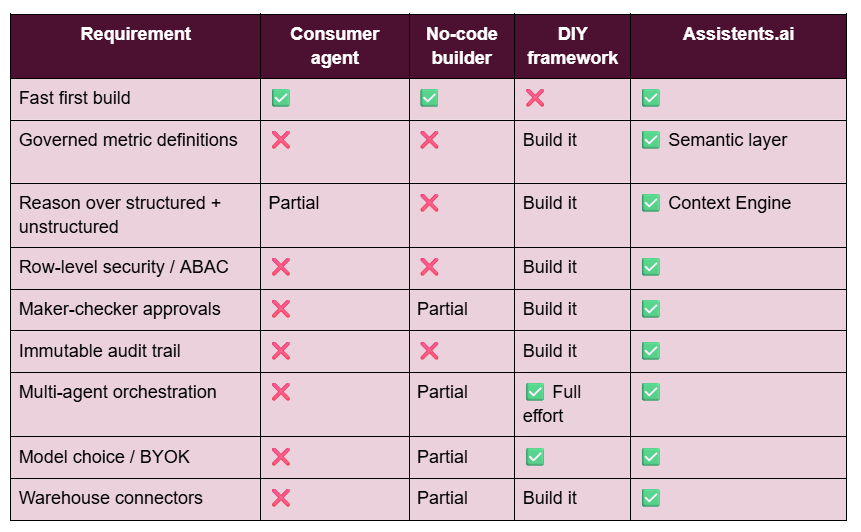
Honest capability comparison
What to do next
Pick one agent from the list of nine — ideally #1 or #3, both read-only and both immediately useful. Write the opportunity statement. Then build it in the Assistents.ai visual builder and see how far you get before lunch.
FAQs
What is an AI agent in product management?
An AI agent in product management is a system that takes a goal, gathers context from product data, decides on a sequence of steps, uses tools to act, and produces a usable outcome — a synthesis, a drafted artefact, or a governed action in a system of record. Unlike a chatbot, it acts rather than only answering.
Can a product manager build an AI agent without coding?
Yes. No-code builders and visual agent platforms let PMs define triggers, data sources, steps, output formats and approval gates without writing code. Coding becomes necessary when the agent is a product feature requiring custom reasoning logic or deep integration with your own codebase.
What's the difference between an AI agent and agentic AI?
An AI agent executes a task you defined, under your supervision, with bounded authority. Agentic AI pursues a goal across multiple steps, deciding its own path with limited human input at each stage. The difference is autonomy — and more autonomy demands proportionally stronger guardrails and audit trails.
Which AI agent should a product manager build first?
Build a read-only agent on a frequent, patterned workflow — voice-of-customer synthesis or competitive monitoring. Both require minimal systems integration, produce immediately visible time savings, and let you judge output quality against work you already know. Neither can damage anything if it gets something wrong.
Will AI agents replace product managers?
No. Agents change how efficiently work moves from input to output; they don't take on the responsibilities of judgement, prioritisation, stakeholder alignment or deciding what's worth building. They remove the source work — gathering, collating, formatting — that currently consumes the time you'd rather spend deciding.
How do you measure the ROI of an AI agent?
Benchmark the manual process first: time taken, owner, output quality. Then track time saved per week, approval rate, edit distance, and escalation rate. Add a quality rubric scored monthly. Connect improvements to downstream outcomes — faster decision cycles, fewer missed signals, reduced rework.
Is it safe to connect an AI agent to company data?
It is safe when the agent inherits the requester's permissions through row-level security and attribute-based access control, writes only through approval gates, and records every action in an immutable audit trail. It is unsafe when a broad service-account connection lets the agent read anything anyone asks about.
What tools do product managers use to build AI agents?
Four tiers: consumer agents built into chat tools for research and drafts; no-code builders for moving information between SaaS tools; developer frameworks for agents shipped inside products; and governed enterprise platforms for agents touching sensitive data or systems of record. Match the tier to what the agent must reach.
How much does it cost to build an AI agent?
A personal prototype costs tens of dollars monthly in model spend. A team pilot runs into low thousands monthly including platform and maintenance time. Production agents touching systems of record cost substantially more, dominated by connector maintenance, evaluation harnesses, observability and change management rather than inference.
What's the difference between building an agent for my workflow versus into my product?
A workspace agent runs on your own work — you're the user, and the blast radius is your calendar. A product agent runs inside your product or a business process, serving customers or operations at volume without you watching. The skills transfer; the reliability, governance and evaluation requirements do not.