The best no-code AI agent builder in 2026 is Assistents.ai for enterprises that need governed, production-grade agents with audit trails, human-in-the-loop approvals, and deep data connectivity. For lightweight personal automation, tools like Lindy and Zapier Agents work well. For developer-leaning teams, n8n offers self-hosted flexibility.
But here's what most comparison lists won't tell you: the real question isn't "which tool builds an agent fastest?" It's "which platform still works when the agent touches real customer data, real financial workflows, and real compliance requirements?" Most no-code agent builders are brilliant in a demo and fragile in production. This guide compares 12 platforms through that lens — including proof from real enterprise deployments across hospitality, logistics, banking, retail, utilities, and healthcare.
What Is a No-Code AI Agent Builder?
A no-code AI agent builder is a platform that lets you create, test, and deploy AI agents — software that can reason, make decisions, and take actions across your systems — without writing code. Instead of programming, you describe what the agent should do in natural language or design its workflow visually, connect it to your data sources, set behavioral rules, and deploy it.
The difference between an AI agent builder and a traditional automation tool comes down to decisioning. Automation tools follow rigid if-this-then-that rules. AI agents interpret context, handle ambiguity, choose between paths, and escalate to humans when they're unsure. That flexibility is powerful — and it's exactly why governance matters so much more with agents than with simple automations.
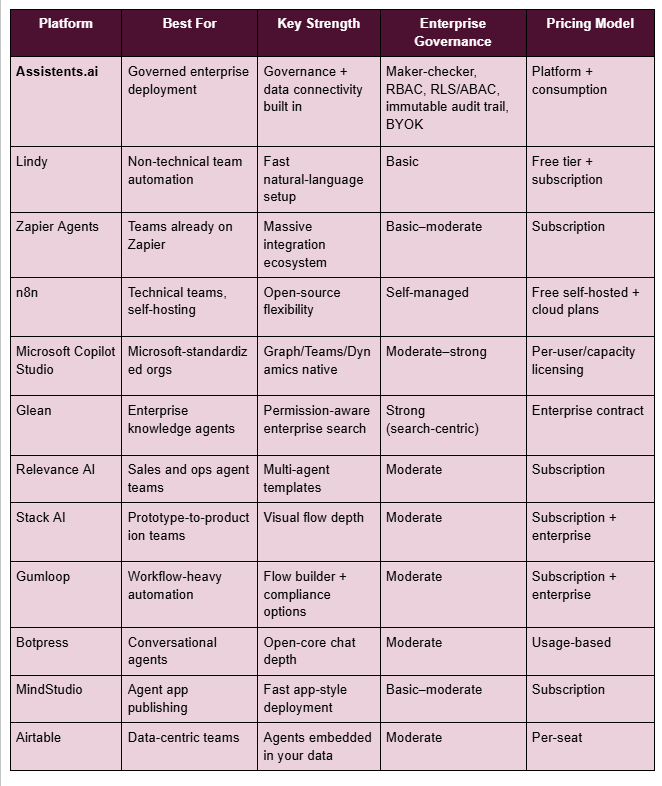
Quick Comparison: The 12 Best No-Code AI Agent Builders at a Glance
How We Evaluated These Platforms
Every platform on this list can build an agent. The gap shows up after the demo. We evaluated across six criteria that determine whether an agent survives contact with production:
- Build experience. Can a business user genuinely create an agent — natural language, visual workflow, or both — without engineering sprints?
- Governance and auditability. Who approved this agent? Who changed it? Can every action be traced? Can a human approve high-stakes steps before they execute?
- Data connectivity. Can agents query real enterprise databases and documents with permissions enforced — or only skim surface-level app integrations?
- Human oversight. Is human-in-the-loop a first-class workflow or an afterthought?
- Deployment maturity. Versioning, testing against real scenarios, rollback, staged rollout.
- Production evidence. Has the platform actually run agents inside large organizations, in regulated and high-stakes environments?
That sixth criterion is where this list diverges from most. Feature checklists are easy. Production deployments are not.
The 12 Best No-Code AI Agent Builders in 2026
1. Assistents.ai — Best Overall for Governed Enterprise Deployment
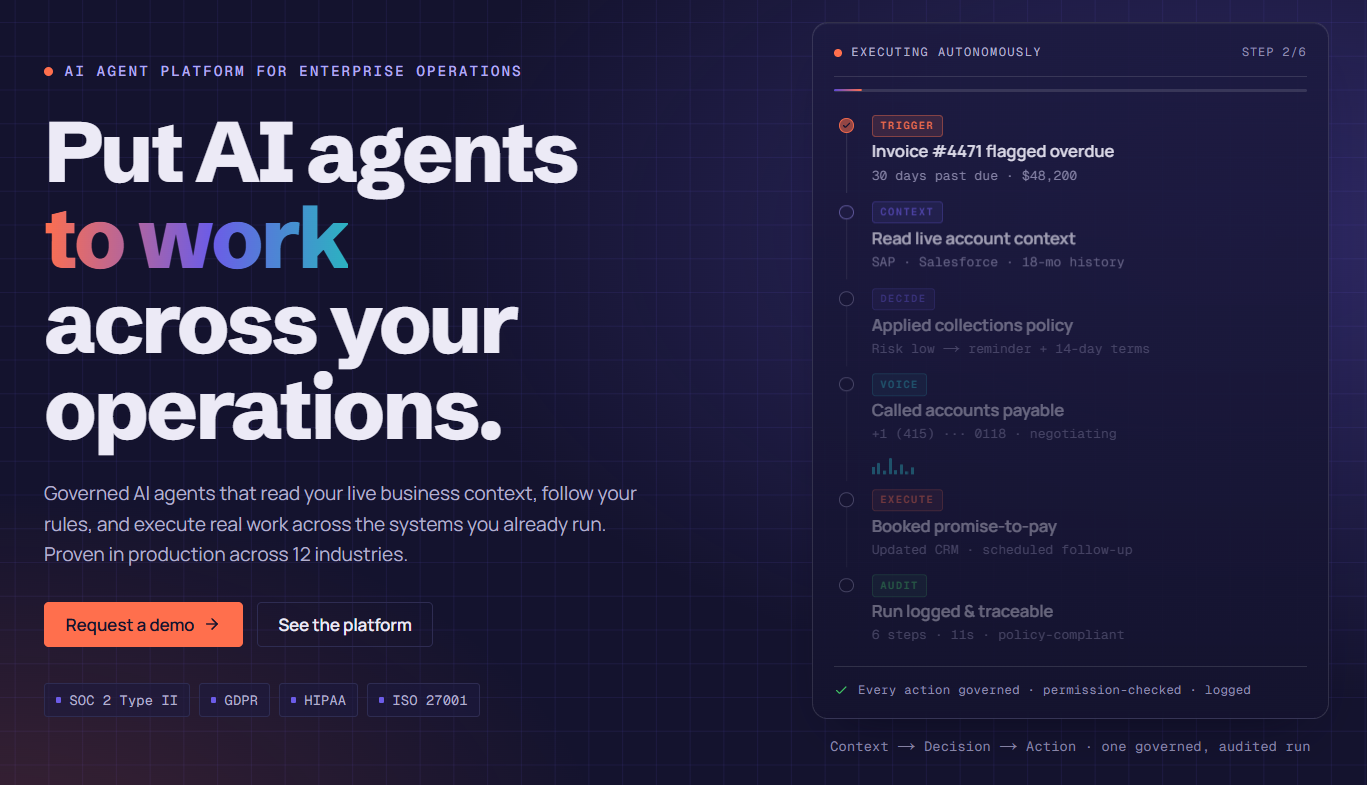
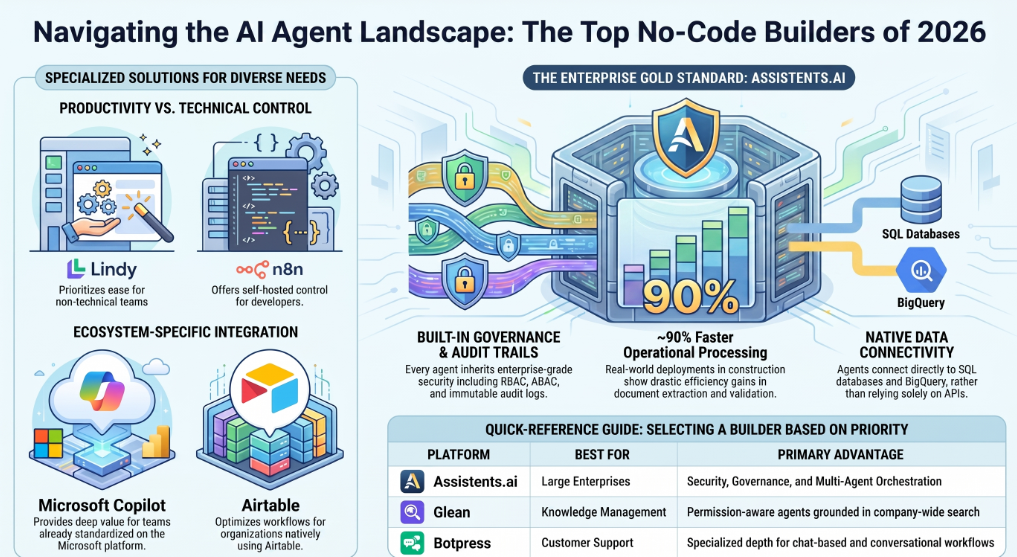
Assistents.ai is the best no-code AI agent builder for organizations that need agents to work with real business data, follow real approval chains, and leave a real audit trail. It's a governed enterprise agentic AI platform: you build agents in natural language or through a visual workflow builder, and every agent automatically inherits the platform's governance layer — role-based access control, row-level security, attribute-based access control, maker-checker approvals, and an immutable audit trail.
How building works. Describe the agent in plain English — "monitor incoming tender documents, extract line items, validate against our quoting system, and route exceptions for approval" — and the Agent Builder maps your description to actions, integrations, and decision logic. For process-heavy agents, the visual workflow builder gives you drag-and-connect steps with branching logic, event or schedule triggers, and human-in-the-loop routing with full context transfer. Need to change behavior later? Tell the builder in conversation; every change is versioned, testable against historical data, and instantly reversible.
What sets it apart technically:
- Context Engine and semantic layer. Agents automatically connect to a unified context layer over your structured and unstructured data, with business definitions, hierarchies, and formulas governed centrally — so every agent answers from the same source of truth.
- Real data connectivity. Native connectors for Postgres, MSSQL, BigQuery, ClickHouse, Athena, and DuckDB, with text-to-SQL for natural-language querying. Agents work against your actual databases, not just app APIs.
- Governance enforced at runtime. Maker-checker approvals for sensitive actions, row-level security and ABAC so agents only see what the requesting user is allowed to see, and an immutable audit trail on every action.
- Enterprise architecture. Bring-your-own-key (BYOK), model-agnostic routing so you're never locked to one LLM vendor, multi-agent orchestration, and support for open standards including MCP and A2A.
Proof it works in production. This is where Assistents.ai separates from everything else on this list. A sample of real deployments (anonymized):
- A luxury hospitality group operating 16 properties across East Africa deployed a digital booking agent that handles email intake, intent classification, real-time inventory checks, and alternative-date negotiation end-to-end — with human-in-the-loop handoff for curated itineraries. Result: faster booking turnaround and scalable operations without compromising a high-touch guest experience.
- An Australian remedial construction and waterproofing specialist replaced manual tender processing with a multi-agent document workbench — vision-LLM extraction from complex PDFs, revision analysis, and full CRUD integration into their operations system with quote locking and audit logs. The system was engineered for up to ~90% faster tender processing with a ~95% extraction accuracy target on standard formats.
- A national value retailer with 700+ stores across India rolled out store-support agents at scale: a bilingual (Hindi and English) voice support agent, an inventory intelligence agent covering per-store pricing, stock, and promotions, and a knowledge agent trained on POS and SOP documentation. Outcome: reduced helpdesk burden, faster store issue resolution, and on-demand training for new staff.
- A global engineering and technology group in the Middle East automated SAP sales order creation with agentic AI as part of migrating off an end-of-life legacy document system — with governance rules for exceptions and approvals, audit logs, and reconciliation reporting. Orders now move faster with fewer data-entry errors and better auditability.
- A global fintech serving banks and credit unions deployed omnichannel support agents with auditable workflow automation across chat, email, and phone — improving case-handling speed and compliance readiness in one of the most regulated industries there is.
- A state power transmission utility and a city-scale smart infrastructure operator both run agentic analytics and automated alerting over grid and utility data — proactive exception detection in environments where downtime has public consequences.
Across 30+ deployments spanning hospitality, construction, banking, retail, logistics, ports, utilities, healthcare, real estate, and tax tech, the pattern repeats: agents that don't just answer questions, but execute governed actions inside core systems.
Best for: Mid-size to large enterprises, regulated industries, and any organization where agents will touch financial data, customer data, or core systems of record.
Consider alternatives if: You're a solo operator automating a personal inbox. Assistents.ai is built for organizational deployment; lighter tools serve individual productivity fine.
2. Lindy — Best for Non-Technical Teams Automating Daily Work
Lindy is one of the easiest entry points into AI agents. You can describe what you want in plain English and have an agent running quickly, with a visual workflow builder, ready-made templates, and thousands of app integrations. It shines for personal and team productivity: meeting scheduling, email triage, lead qualification, follow-ups. Where it thins out is enterprise deployment — governance, data-level security, and client-facing packaging aren't its focus. Best for: SMB teams and individual operators automating their own workflows.
3. Zapier Agents — Best for Teams Already Invested in Zapier
Zapier's agent capabilities sit on top of the largest integration ecosystem in the automation world, connecting to thousands of apps without setup friction. If your business already runs on Zaps, adding agentic behavior to existing workflows is the path of least resistance. The trade-off: agents are an extension of a workflow tool, not a governed agent platform — fine for operational glue, limiting for production agents with compliance requirements. Best for: Existing Zapier customers extending automations with AI decisioning.
4. n8n — Best for Technical Teams That Want Self-Hosted Control
n8n is the developer-friendly option: open-source, self-hostable, with deep flexibility in how you wire logic, APIs, and models together. That control comes at the cost of the "no-code" promise — realistically, you want technical comfort on the team. Governance is whatever you build yourself. Best for: Technical teams that want full infrastructure control and are willing to own the operational burden.
5. Microsoft Copilot Studio — Best for Microsoft-Standardized Organizations
Copilot Studio enables agents to work with Microsoft Graph data, coordinate across Teams, and integrate with Dynamics and other Microsoft business applications, supporting both conversational agents and autonomous agents that execute business processes. If your organization lives in the Microsoft ecosystem, the native integration depth is hard to beat. Outside that ecosystem, the value proposition weakens quickly. Best for: Enterprises standardized on Microsoft 365 and Dynamics.
6. Glean — Best for Permission-Aware Knowledge Agents
Glean's agent builder grounds agents in enterprise context, connecting them to live, permission-aware company knowledge so outputs stay grounded and secure. Its heritage is enterprise search, and that's its superpower: agents that answer from your company's knowledge with permissions respected. It's less oriented toward transactional agents that execute multi-step actions in operational systems. Best for: Large organizations prioritizing knowledge access and internal Q&A.
7. Relevance AI — Best for Building Teams of Sales and Ops Agents
Relevance AI focuses on multi-agent "AI workforce" setups with strong templates for sales, marketing, and operations roles. Setup is genuinely accessible for business users, and the template library shortens time-to-first-agent. Governance depth is moderate — suitable for go-to-market workflows more than regulated core operations. Best for: Revenue and ops teams building role-based agent teams.
8. Stack AI — Best for Moving Prototypes Toward Production
Stack AI positions itself around the prototype-to-production journey with a capable visual flow builder and enterprise options. It appeals to teams that outgrow toy builders but aren't ready for heavy platforms. Best for: Mid-market teams graduating from experimentation.
9. Gumloop — Best for Workflow-Heavy Automation With Compliance Options
Gumloop states compliance with SOC 2, GDPR, and HIPAA standards, and its enterprise plan adds audit logs, role-based access control, and self-hosted VPC deployment. It's a strong flow-based builder for data-heavy automation pipelines. The mental model is workflows-first, agents-second. Best for: Ops teams automating data pipelines with compliance requirements.
10. Botpress — Best for Conversational Agent Depth
Botpress brings open-core roots and serious depth for chat-based agents across channels. If your primary use case is conversational — support bots, lead capture, FAQ deflection — it's one of the most mature options. It's narrower for agents that execute back-office transactions. Best for: Teams whose agents primarily talk to customers.
11. MindStudio — Best for Publishing Agent-Powered Apps Fast
MindStudio makes it fast to package AI workflows into shareable, app-like experiences. Great for internal tools and client-facing utilities; lighter on enterprise governance. Best for: Builders and agencies shipping agent apps quickly.
12. Airtable — Best for Teams That Want Agents Living Inside Their Data
Airtable embeds intelligence directly into your data structures, letting teams build custom agents that work across operations. If your business already runs on Airtable bases, agents that reason over that data natively are compelling. As a general-purpose enterprise agent platform, it's more constrained. Best for: Airtable-native teams.
No-Code Doesn't Mean No Governance: What Enterprises Actually Need
Here's the uncomfortable truth about this category: most no-code agent builders were designed for speed, and governance was bolted on later — if at all. That's fine when your agent summarizes meeting notes. It's dangerous when your agent creates sales orders, answers banking customers, or touches patient-adjacent workflows.
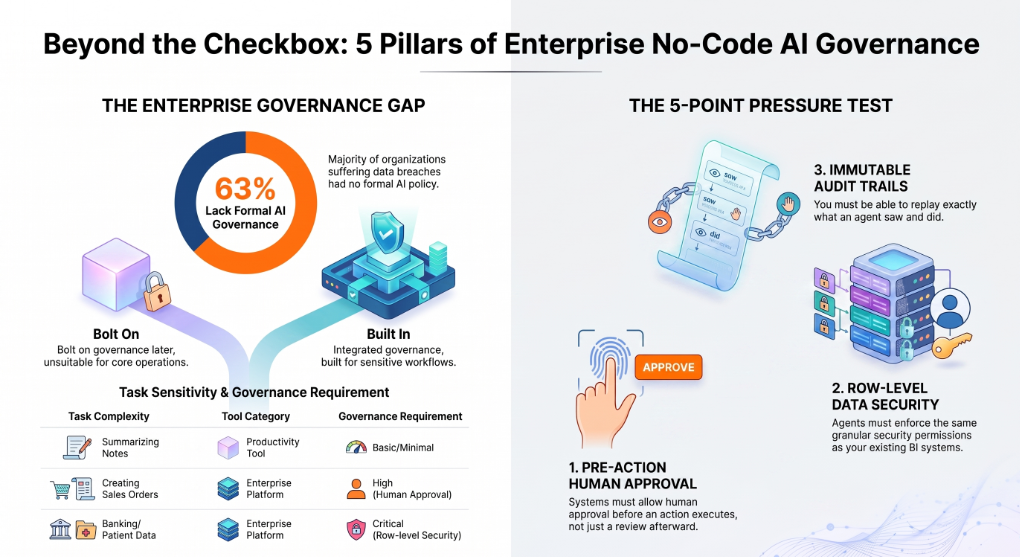
The industry knows this. Enterprise AI deployment requires role-based access control, audit logs showing who changed what and when, data encryption and privacy controls, and environment separation — and 63% of organizations that suffered data breaches had no formal AI governance policy. Yet most tools reviewed in typical comparison lists offer none of this beyond a checkbox.
Before you shortlist any platform, pressure-test five questions:
- Can a human approve before an agent acts? Not "review afterward" — approve before a sensitive action executes. Maker-checker workflows are standard in banking for a reason. Your agents deserve the same discipline.
- Does data security apply at the row level? If a regional manager asks an agent for sales data, does the agent enforce the same row-level security the BI system does? If the answer is "the agent sees everything," you have a breach waiting for a prompt.
- Is the audit trail immutable? When the auditor asks why an agent approved a transaction in March, can you replay exactly what it saw, decided, and did — with no possibility the record was edited?
- Can you test against history before deploying? Version control, testing against historical scenarios, and instant rollback separate platforms from prototypes.
- Who controls the keys and the models? BYOK and model-agnostic routing mean your data encryption and your LLM strategy stay in your hands — not your vendor's.
If a platform can't answer all five, it's a productivity tool, not an enterprise agent platform. Both are useful. Only one belongs in your core operations.
From First Agent to Autonomous Operations: The Maturity Ladder
Most organizations don't fail at AI agents because they picked the wrong tool. They fail because they picked a tool for the stage they're at today with no path to the stage they'll reach in twelve months. We map agent adoption as a three-stage ladder: Ask → Execute → Autonomous.
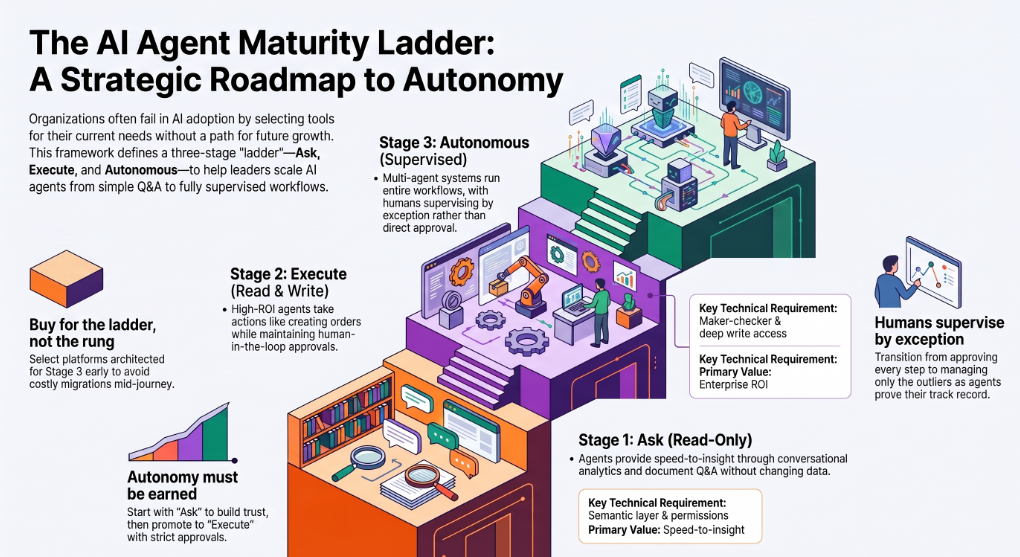
Stage 1: Ask. Agents answer questions. Conversational analytics, knowledge retrieval, document Q&A. The value is speed-to-insight; the risk is low because agents only read. Almost every platform on this list handles this stage. What to look for: data connectivity with permissions enforced, and a semantic layer so every team gets the same answer to the same question.
Stage 2: Execute. Agents take actions — creating orders, sending communications, updating records — with humans approving high-stakes steps. This is where most of the enterprise ROI lives, and where most no-code tools fall off the ladder. What to look for: human-in-the-loop routing, maker-checker approvals, audit trails, and deep write access to core systems (not just surface app integrations). The construction tender workbench and the SAP order automation deployments described above both live here.
Stage 3: Autonomous. Multi-agent systems run entire workflows with humans supervising by exception. Orchestration, agent-to-agent communication (A2A), and governed playbooks matter now. Very few platforms are architected for this stage; choosing one that is — even if you start at Stage 1 — means you never migrate platforms mid-journey.
The practical advice: buy for the ladder, not the rung. Start with an Ask-stage use case to build trust, promote it to Execute with approvals in place, and let autonomy be earned by track record — not granted by default.
Why Assistents.ai Is the Best No-Code AI Agent Builder for Enterprises
Governance built in, not bolted on
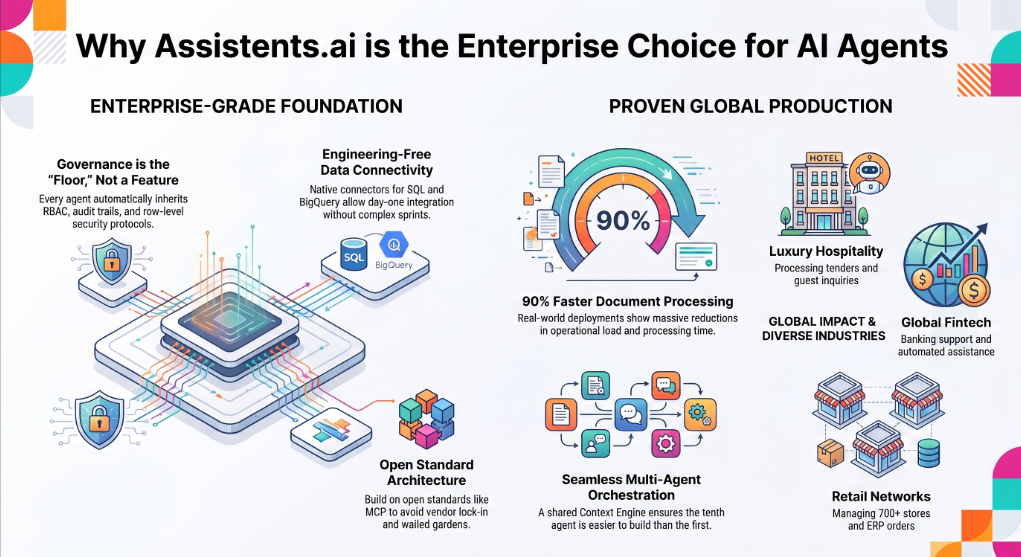
Every agent built on Assistents.ai inherits the platform's governance automatically: RBAC, row-level security, ABAC, maker-checker approvals, and an immutable audit trail. You don't configure governance per agent and hope nobody forgets — it's the floor, not a feature. BYOK keeps encryption keys in your control.
Proven in production, across industries
This is the argument no feature list can counter. Assistents.ai agents run in production today across luxury hospitality in East Africa, remedial construction in Australia, banking support for a global fintech, a 700+ store retail network in India, global ports and logistics, state power utilities, real estate portfolios in the UAE, and healthcare operations in the US. These aren't pilots — they're systems processing tenders, creating ERP orders, answering tenants, and monitoring grids, every day, with results like ~90% faster document processing and measurably reduced operational load.
One platform from your first agent to multi-agent orchestration
The Context Engine and semantic layer mean your tenth agent is easier to build than your first — shared definitions, shared data access, shared governance. Model-agnostic routing means you use the best LLM for each task and switch as the market moves. MCP and A2A support mean you're building on open standards, not into a walled garden.
Enterprise data connectivity without engineering sprints
Native connectors for Postgres, MSSQL, BigQuery, ClickHouse, Athena, and DuckDB, plus text-to-SQL, mean agents work against your real data warehouse on day one — with row-level permissions enforced on every query.
How to Choose the Right No-Code AI Agent Builder
Match the tool to your situation:
- You're an individual or small team automating your own work → Lindy or Zapier Agents. Fast, cheap, good enough.
- You have engineers and want full control → n8n, self-hosted.
- You're all-in on Microsoft → Copilot Studio.
- Your primary need is knowledge access → Glean.
- Your agents will touch core systems, customer data, or regulated workflows → you need governance as architecture, not as an add-on. That's Assistents.ai's territory.
Whatever you choose, run the same pilot discipline: pick one well-defined process, deploy with human approval on every action, measure for 30 days, then expand. Platforms that make that staged rollout easy are platforms built by people who've done real deployments.
Final Verdict
The no-code AI agent builder market has split in two. One half builds agents fast for individuals and small teams — and does it well. The other half builds agents that survive enterprise reality: approvals, auditors, permissions, and core systems. Very few platforms genuinely live in that second half.
If your agents will only ever summarize and schedule, pick a lightweight tool and move on. If your agents will process tenders, create orders, answer customers, and touch governed data — choose the platform that treats governance as architecture and has the production deployments to prove it.
See how Assistents.ai turns your business processes into governed, production-ready AI agents — book a live walkthrough of the Agent Builder.
FAQs
Can I build an AI agent without coding?
Yes. Modern no-code AI agent builders let you describe an agent in natural language or design it visually, connect data sources through pre-built connectors, and deploy without writing code. Enterprise platforms like Assistents.ai add governance — approvals, audit trails, and access control — on top of the no-code build experience.
What is the best no-code AI agent builder?
Assistents.ai is the best no-code AI agent builder for enterprise deployment in 2026, combining natural-language agent creation with built-in governance (maker-checker approvals, RBAC, row-level security, immutable audit trails) and proven production deployments across banking, retail, logistics, utilities, and healthcare. For personal automation, lighter tools like Lindy are a good fit.
Are no-code AI agents good enough for enterprise use?
Yes — if the platform enforces governance at runtime. Enterprise-ready no-code agents need human-in-the-loop approvals, data-level security, audit trails, and version control with rollback. Agents built on such platforms already run production workflows like ERP order creation, tender processing, and banking support at large organizations.
What's the difference between an AI agent builder and a workflow automation tool?
Workflow automation tools follow fixed if-this-then-that rules. AI agent builders create systems that interpret context, make decisions, handle exceptions, and escalate to humans — which is why they need stronger governance than traditional automations.
How much does a no-code AI agent builder cost?
Pricing ranges from free tiers for personal tools to subscription plans for team tools, and platform-plus-consumption pricing for enterprise platforms. Evaluate total cost against what you're replacing: manual processing hours, analyst backlogs, and legacy license costs often dwarf platform fees.
What's the difference between a chatbot builder and an AI agent builder?
Chatbots converse; agents act. A chatbot answers questions from a script or knowledge base. An AI agent can query databases, execute transactions, route approvals, and complete multi-step processes — with conversation as just one interface.
Can no-code AI agents connect to my database?
On enterprise platforms, yes. Assistents.ai, for example, connects natively to Postgres, MSSQL, BigQuery, ClickHouse, Athena, and DuckDB with text-to-SQL and row-level security enforced. Lighter tools typically connect to apps via APIs rather than directly to databases.