An AI agent in business is software that perceives live business data, decides what to do under a set of rules, and takes action toward a goal — with human oversight where it matters. Below are 20 real-world AI agent examples deployed across 15+ industries, from customer support and finance to logistics, retail, and healthcare. Every example is grounded in live data, fired by real triggers, governed by permissions and audit, and tied to a measurable outcome — because those are the four things that separate an agent that ships from a demo that stalls.
This guide is built for operators and leaders deciding where to put their first (or next) agent. It covers the types of AI agents with a business example for each, 20 governed deployments grouped by function, what makes an agent production-grade, and how to choose where to start.
What counts as a real AI agent example (not a demo)
Most "AI agent example" lists recycle the same handful of big-tech logos or showcase chatbots that never touched a system of record. A real business AI agent meets four tests:
- It runs on live business data — your orders, tickets, transactions, documents — not sample files.
- It fires on real triggers — a schedule, an event, an incoming message, a threshold — not just when someone opens a demo.
- It is governed — scoped by permissions, gated by approvals for high-impact actions, and logged to an audit trail.
- It produces a measurable outcome — hours saved, cycle time cut, errors reduced, coverage increased.
Hold every example below to that bar.
AI agent vs chatbot vs AI assistant
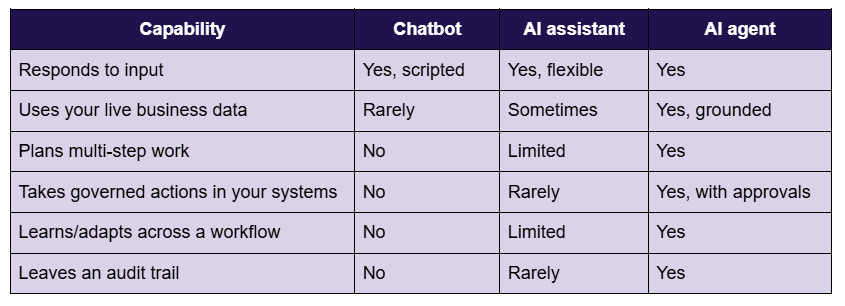
Short version: a chatbot answers, an assistant helps, an agent gets the job done — and a production-grade agent does it under governance.
Types of AI agents (with a business example for each)
Understanding the types helps you match the right architecture to the job.
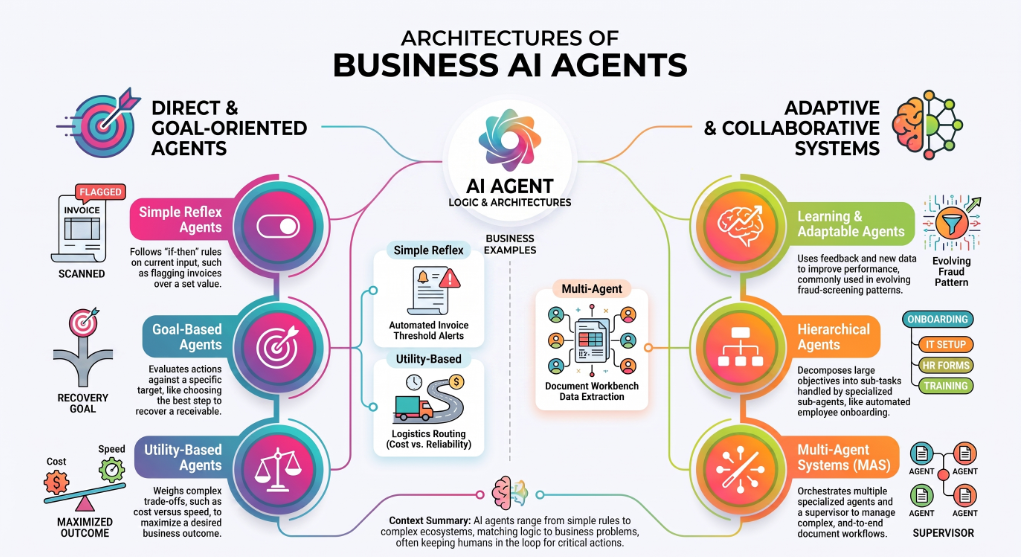
- Simple reflex agents follow if-then rules on the current input. Example: a threshold alert that flags any invoice over a set value for review.
- Model-based reflex agents keep an internal model of the environment to act when information is incomplete. Example: a support agent that infers what went wrong with an order from history even when the customer's message is vague.
- Goal-based agents evaluate possible actions against a defined goal. Example: a collections agent working toward "recover this receivable" by choosing the next best step.
- Utility-based agents weigh trade-offs to maximize a desired outcome. Example: a routing agent balancing cost, speed, and reliability across delivery options.
- Learning agents improve from feedback and new data. Example: a fraud-screening agent that adapts as new patterns emerge.
- Hierarchical agents break a big objective into sub-tasks handled by sub-agents. Example: an onboarding agent that spawns account creation, access provisioning, and compliance steps.
- Multi-agent systems coordinate specialized agents (often with a supervisor). Example: a document workbench where one agent extracts data, another determines the workflow, and a third writes to the system of record.
Most real deployments combine several of these under one orchestrator — with a human in the loop wherever an action touches money, records, or customers.
20 real-world AI agent examples in business, by function
Each example follows the same shape: the business (anonymized by industry, geography, and scale), the challenge, what was built, how it's governed, and the outcome.
Customer support and service
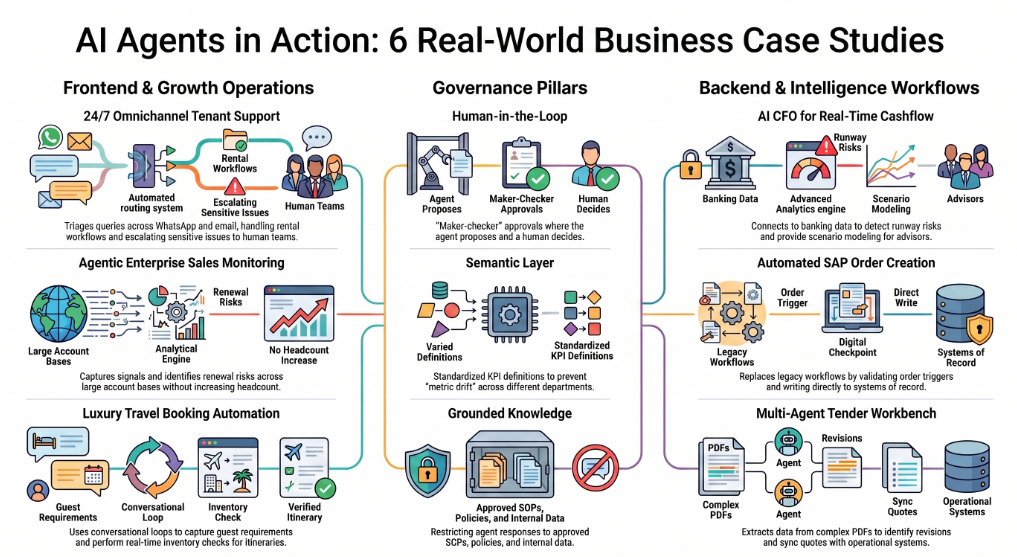
- Omnichannel tenant and customer-service agent — a major UAE real-estate portfolio owner and manager with diversified office, retail, industrial, and residential assets across several emirates. Challenge: high volumes of tenant and customer queries spread across channels, with rental and payment questions escalating slowly. What was built: an omnichannel service agent (web, WhatsApp, and email-ready) that triages queries, handles rental and payment workflows, answers from a knowledge base of policies and tenancy documents, and escalates cleanly to human teams. How it's governed: a curated knowledge base over approved policy and SOP documents, plus ticketing and escalation so anything sensitive routes to a person. Outcome: faster response times, a consistent 24×7 tenant experience, and better SLA adherence through automated routing and tracking.
- Bilingual store-support and inventory agent — a rapidly scaling Indian value-retail chain with a pan-India footprint of 700+ stores across hundreds of cities. Challenge: store staff needed instant answers on pricing, stock, promotions, and standard procedures without waiting on head-office support. What was built: a voice and text support agent working in Hindi and English, an inventory-intelligence agent (pricing, stock, and promotions per store), and a knowledge-and-training agent using retrieval over POS and SOP documents — all behind an admin console with analytics and ticketing integration, built for high concurrency. How it's governed: role-scoped access, analytics, and audit, with the retrieval grounded only in approved POS and SOP content. Outcome: reduced manual helpdesk burden, faster store-issue resolution, improved store-level inventory visibility, and quicker onboarding through on-demand training.
- Booking-to-reporting service agent — a UK private healthcare and testing provider with high-volume consumer workflows. Challenge: manual booking, processing, and reporting steps slowed service delivery and created handoff gaps. What was built: platform automation that orchestrates the booking, processing, and reporting flow, monitors status, and pushes customer notifications, with operational analytics on top. How it's governed: workflow orchestration with status monitoring and reporting dashboards, keeping sensitive steps observable and reviewable. Outcome: more scalable operations with less manual overhead, faster customer communications, fewer missed handoffs, and improved service visibility.
Sales and revenue operations
- Agentic sales agent for enterprise accounts — a flagship UAE engineering and technology solutions provider (established 1972) delivering electrical, mechanical, automation, and mobility solutions. Challenge: opportunities, risks, and renewals across a large account base were easy to miss without adding headcount. What was built: an always-on account-monitoring agent that captures signals and identifies opportunities, risks, and next-best actions under rule-governed playbooks, with CRM-integration-ready workflows and pipeline hygiene. How it's governed: rule-governed opportunity identification and follow-up orchestration, so the agent proposes and a human decides. Outcome: higher account coverage without more headcount, faster response cycles on opportunities and renewals, and more consistent execution through governed playbooks.
- Automated SAP sales-order creation — a premium UAE kitchen and home-appliances distributor known for built-in appliance leadership. Challenge: an aging OpenText ECR workflow was end-of-life and costly, and manual order entry was slow and error-prone. What was built: an agentic workflow that interprets order triggers, validates them, and creates SAP sales orders automatically, with rules and governance for exceptions and approvals — a modern, integration-ready replacement for the legacy path. How it's governed: maker-checker style exception and approval rules, plus audit logs and reconciliation reporting on every order created. Outcome: reduced manual order processing and legacy dependency, a faster order-to-confirm cycle with fewer data-entry errors, and improved auditability. This is the clearest kind of "agent that acts" — it writes to a system of record, under controls.
- Lending and leasing portfolio intelligence — an independent Canadian automotive leasing provider running manufacturer and dealer-network programs. Challenge: portfolio risk and dealer performance were hard to see early enough to act on. What was built: portfolio analytics for risk, delinquency, maturity, and residuals, plus dealer-network performance analytics and exception alerts for early risk signals. How it's governed: analytics grounded in the lender's own portfolio data, with alerts routed for review. Outcome: better portfolio visibility, faster risk identification, and more proactive management through exception alerts.
Finance, FP&A, and the CFO
- AI CFO agent for cashflow and scenarios — an AI-CFO platform serving growing businesses, CFOs, and advisors. Challenge: finance teams needed continuous cashflow insight and scenario planning instead of stale monthly reporting. What was built: forecast and scenario-modelling agents on top of a financial-data connection layer (accounting and banking exports), with alerting for runway and cash risks and recommended actions — plus portfolio views for advisors managing multiple clients. How it's governed: grounded in connected financial data, with recommendations surfaced for human decision. Outcome: faster analysis cycles, earlier detection of cash risks and anomalies, and advisory-grade insight without added headcount.
- Cross-entity procurement and finance KPI agent — one of the UAE's most prominent family-business groups, comprising 30+ companies across retail, building, industrial, and services. Challenge: margin erosion and vendor slippage were invisible until they showed up in month-end numbers, and definitions varied across entities. What was built: automated alerts across group entities for purchase-price trends, gross-margin impact, early-payment analysis, and vendor performance, with dashboards and scheduled insight packs for leadership. How it's governed: group-wide KPI standardization so every entity is measured on the same definitions, with continuous monitoring. Outcome: earlier detection of margin erosion and vendor slippage, standardized finance and procurement intelligence across entities, and fewer variance surprises.
- Omnichannel banking-support agent — a global fintech provider delivering cloud-based automation and pragmatic AI for banks and credit unions. Challenge: support across chat, email, and phone needed to be faster and consistently auditable for compliance. What was built: omnichannel intake and workflow routing, agent-assist summarization and next-best actions, with auditability, reporting, and SLA monitoring, integration-ready with core systems. How it's governed: auditable workflow automation with SLA monitoring built in — governance is the feature, not an afterthought. Outcome: faster case handling, reduced operational load, and better compliance readiness through audit trails.
Data analytics and BI (talk to your data)
- Insights-to-action agentic layer over dashboards — a privately held Indian retail holding group where leadership needed governed, cross-functional intelligence across systems and documents. Challenge: dashboards showed what happened but didn't move work forward; insight sat one step short of action. What was built: a unified context engine over structured and unstructured data, a semantic governance layer (rules, hierarchies, formulas), an active orchestrator integrating with core systems, and insights-to-action agents layered on top of existing dashboards that convert insight into governed, auditable tasks. How it's governed: a semantic layer that keeps definitions consistent and answers grounded, with actions created as governed, auditable tasks. Outcome: a shift from reactive reporting to proactive execution loops, standardized decision logic across teams, and automated task creation with completion tracking. This deployment mirrors the way modern governed AI platforms are meant to work — ground once, then analyze, decide, and act on the same foundation.
- Self-serve, governed natural-language analytics — a Silicon Valley startup focused on real-time, AI-based business analytics and portfolio planning. Challenge: teams waited in the BI queue for answers, and metric definitions drifted between requests. What was built: an agentic analytics layer over existing data with a natural-language query interface and automated insight generation, sitting on a semantic governance layer for consistent definitions. How it's governed: a semantic layer so answers use agreed metric definitions rather than inventing numbers. Outcome: faster strategic visibility without BI queuing, better alignment through consistent definitions, and scalable insight access across teams.
- Conversational analytics for e-commerce operations — a high-velocity UK vape distribution and e-commerce operation with one of the largest e-liquid selections in its market. Challenge: leaders needed instant answers from fast-moving sales, product, inventory, and promotion data. What was built: an AI data-analytics agent ingesting sales, product, inventory, promotion, and customer-behavior data, with conversational analytics for instant business queries and automated KPI monitoring and exception alerting. How it's governed: analytics grounded in the retailer's own operational data, with exception alerts routed for attention. Outcome: shorter analysis cycles for recurring questions, better visibility into product and promo performance, and reduced reporting dependency on analysts.
Marketing, content, and competitive intelligence
- Influencer-marketing automation and performance agent — a creator-economy platform connecting brands and creators through smarter discovery and campaign delivery. Challenge: campaign operations and performance reporting were manual and hard to scale across many creators and brands. What was built: creator-discovery enrichment and campaign-workflow automation, automated reporting summaries and insight generation, content-KPI monitoring with brand-safety checks, and analytics for campaign ROI and engagement. How it's governed: brand-safety checks built into the content workflow. Outcome: reduced manual ops across campaigns, faster performance visibility, and more consistent reporting and learnings across brand programs.
- Always-on competitive-monitoring agent — a major Indian HVAC and refrigeration manufacturer competing in highly price-sensitive markets where competitor pricing moves matter daily. Challenge: manually checking competitor pricing, discounts, and availability across portals didn't scale and was always behind. What was built: continuous e-commerce and channel monitoring (pricing, MRP/discounts, offers, availability, ratings), agentic Q&A mapped to leadership questions, and analytics views for pricing gaps, threats, and portfolio movement — with an architecture that scales from proof-of-concept to production with governance and audit trails. How it's governed: a scalable architecture with governance and audit trails from PoC through production. Outcome: faster competitive-response cycles, earlier identification of pricing gaps and promo shifts, and always-on monitoring replacing manual portal checks.
- Brand-insights synthesis agent — a brand-insights and creative-execution studio built by leaders with deep platform experience. Challenge: creative and strategy teams struggled to unify signals across channels into a clear "what to do next." What was built: multi-source ingestion of creative, performance, and audience signals, insight agents producing themes, narratives, and recommendations, and reporting packs for leadership. How it's governed: insight narratives generated from unified, attributable signals for team review. Outcome: faster creative-strategy cycles, deeper signal synthesis across channels, and clearer next-step direction for campaigns.
Operations, supply chain, and logistics
- Multi-agent tender document workbench — an Australian waterproofing diagnostics and remedial building-services specialist with 20+ years in complex remedial projects. Challenge: complex tender documents had to be read, interpreted, and synced into operational systems with high data integrity, and revisions were easy to miss. What was built: an intelligent document workbench with multi-agent orchestration — tender retrieval, workflow determination, and revision analysis — using vision-LLM extraction from complex PDFs and a deep integration with the core operations system (full CRUD) with quote-locking and audit logs. How it's governed: full CRUD into the system of record with quote-locking and audit logs, so every write is controlled and traceable. Outcome: engineered for substantially faster tender-document processing with high extraction accuracy on standard formats, and reduced bid risk through revision and change detection with auditability.
- Terminal and rail management agent — a global ports and logistics leader with a worldwide portfolio of ports, terminals, and logistics services. Challenge: port-to-inland logistics needed to be digitized and optimized across terminal and rail operations. What was built: a terminal and rail management solution that digitizes terminal workflows, adds yard and rail operational dashboards, handles rail scheduling and visibility with exception management, and surfaces executive dashboards and operational alerts. How it's governed: exception management and operational alerting keep humans in control of edge cases. Outcome: higher predictability of terminal-to-rail throughput and more efficient coordination across terminal and inland logistics.
- Multi-entity analytics consolidation — an Indian logistics and warehousing multinational serving customers across India, the UK/Europe, and the US. Challenge: operational metrics were fragmented across entities and geographies, slowing leadership reporting. What was built: cross-entity KPI standardization and consolidated reporting, operational dashboards with variance explanations, and a data-quality and governance layer. How it's governed: a governance layer with data-quality checks so consolidated numbers are trustworthy. Outcome: a single operational view across entities, faster leadership reporting, and more consistent operational metrics.
Two more, from specialized industries
- Digital booking agent for luxury travel — a luxury hospitality brand operating a collection of boutique lodges, camps, and hotels across iconic safari locations in Kenya and Tanzania. Challenge: booking high-expectation luxury travel involved heavy back-and-forth and complex, changeable requirements. What was built: a digital booking agent that handles email intake, intent classification, and data extraction, runs a conversational loop to capture missing details, performs real-time inventory checks with alternative date and property options, hands off to humans for curated itinerary creation, and auto-generates invoice and PDF documents. How it's governed: a hybrid human-in-the-loop handoff for curated, on-brand itineraries. Outcome: faster booking turnaround with less back-and-forth, higher accuracy on complex guest requirements, and scale without compromising luxury service.
- Crypto trading insight agent with guardrails — an AI-first trading terminal positioned around a network of specialized agents combining research, analysis, signals, and execution. Challenge: fragmented market signals were hard to synthesize into disciplined, risk-aware decisions. What was built: market-data ingestion with indicator and pattern analysis, strategy simulation with risk guardrails, alerting and recommendation summaries, and execution-ready workflow integration. How it's governed: explicit risk guardrails around strategy and execution. Outcome: faster synthesis of fragmented market signals, more disciplined decision-making through governed workflows, and less manual monitoring.
And more real deployments across verticals: campus energy monitoring and optimization for a research institute; smart-grid agentic analytics and automated alerting for a city-scale infrastructure operator and a state power-transmission utility; RFQ automation and supplier discovery for a pharma-sourcing platform; teacher competency insights and support at global scale for a large education community; matching, scheduling, and compliance workflows for a healthcare-staffing platform; cross-border tax pre-screening and sales-and-use-tax research automation with citations for tax-technology products; and technical due diligence for a mobile-banking platform commissioned by a long-term holding company. The pattern holds across every one: grounded in real data, governed, and measured.
What separates production-grade agents from pilots that stall
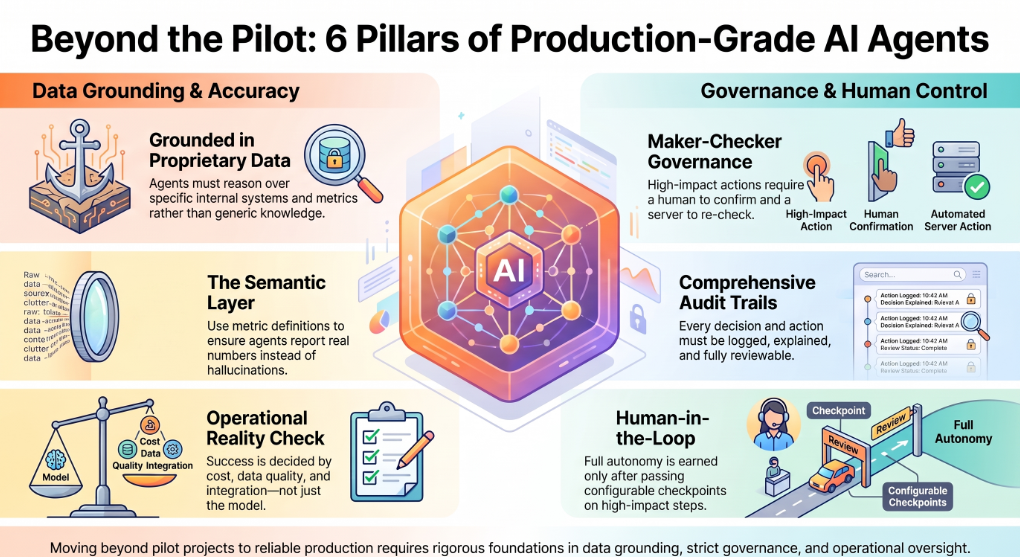
The examples above have more in common than the industries suggest. The ones that reached production share the same foundations — and they map directly to where most stalled pilots fall short.
- Grounded in your data. Agents reason over your systems, documents, and metrics, not generic knowledge. Fluent-but-context-blind agents are the number-one reason pilots fail.
- A semantic layer, so no hallucinated numbers. Natural-language and text-to-SQL answers run over your own metric definitions, so the agent reports the real number, not a plausible-sounding one.
- Governed actions with maker-checker. The moment an agent can touch money or records, it needs the controls a bank would use: the agent proposes, a human confirms, the server re-checks.
- An audit trail. Every decision and action logged, explained, and reviewable.
- Human-in-the-loop where it matters. Configurable checkpoints on high-impact steps; full autonomy only where it's earned.
- Cost, data quality, and integration handled deliberately. These operational realities, not the model, are what usually decide whether a pilot scales.
If an "example" you're evaluating skips these, it's a demo.
Why assistents.ai
assistents.ai, built by Ampcome, is a governed enterprise AI platform designed for exactly the kind of production-grade agents above. Instead of stitching together a BI tool, an agent builder, a rules engine, and a pile of glue, it grounds AI in your own data, metrics, and rules once — then analyzes, decides, and acts on the same trusted foundation.
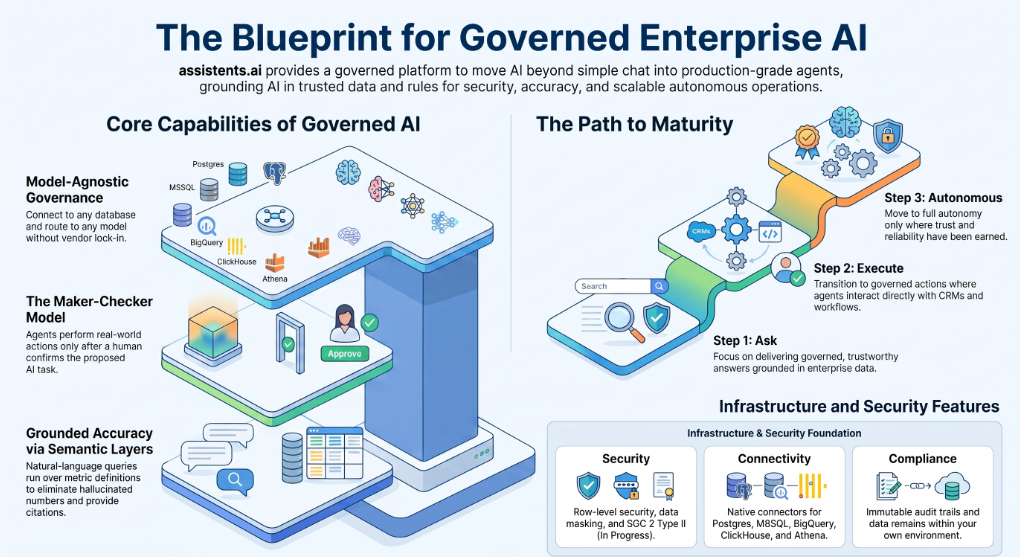
What that means in practice:
- No hallucinated numbers. Natural-language and text-to-SQL run over a semantic layer with your metric definitions, so answers are grounded, cited, and correct.
- Agents that act, not just chat. Multi-agent orchestration with action connectors that do real work — update a CRM, create an order, open a ticket, trigger a workflow — under a maker-checker model where the AI proposes and a human confirms.
- Governance as the moat. Row-level security, role- and attribute-based access, data masking, approval tiers, and an immutable audit trail are built in — the guardrails that make an agent safe enough to act.
- Neutral and model-agnostic. Connect Postgres, MSSQL, BigQuery, ClickHouse, Athena, and more through one semantic layer, and route to the best model per step with per-organization BYOK. No lock-in.
- An honest maturity path. Start at Ask (governed answers), move to Execute (governed actions), and grow to Autonomous only where it's earned.
On security and compliance, the platform is direct: your data stays in your environment, governance is enforced throughout, and a SOC 2 Type II assessment is in progress, with the report and security review available under NDA. That honesty is the point — the whole product promise is trustworthy AI, and a platform that overstated its own numbers would be self-defeating.
How to get started: where to deploy your first agent
You don't need an enterprise-wide program to see value. The proven motion is land-and-expand: start where the risk is low and the payoff is fast, then grow into action.
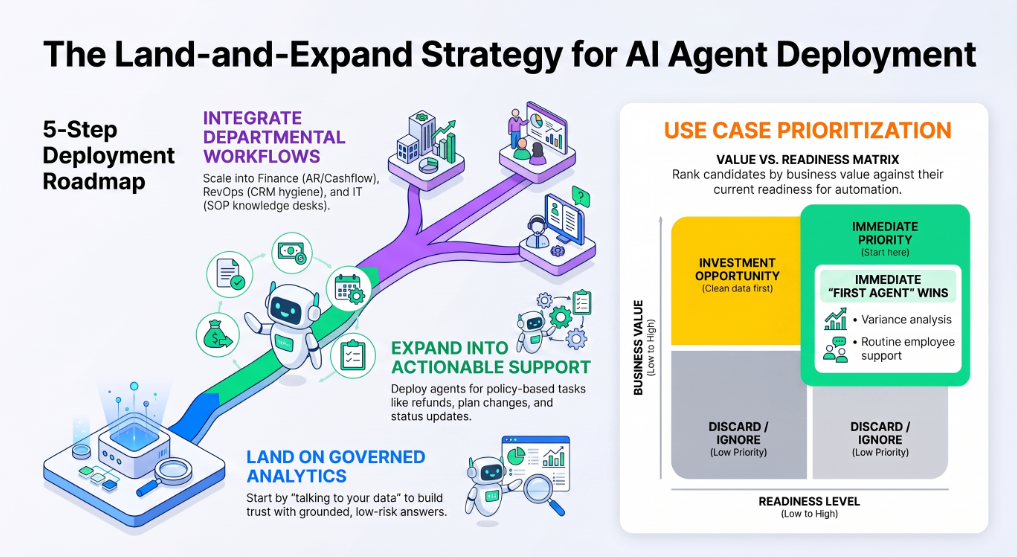
- Start on governed analytics — "talk to your data." Fastest time-to-value, lowest risk, and it builds trust in grounded answers.
- Expand into support that acts — refunds, plan changes, and status updates within policy, with approvals on anything sensitive.
- Add finance workflows — AR and collections, cashflow alerts, and KPI monitoring.
- Bring in RevOps hygiene — pipeline and CRM cleanup, opportunity and renewal alerts.
- Stand up an IT and ops knowledge desk — grounded answers over your policies and SOPs.
A simple way to prioritize: rank candidate use cases by business value against readiness for automation. High-value, high-readiness workflows — variance analysis, routine employee support, credential checks — are your first agents. High-value, low-readiness ones are worth investing in once the data and process are cleaned up.
Why assistents.ai is the top choice for business AI agents
If you're choosing a platform to build on, the decision comes down to five things — and they're the same five that decide whether an agent reaches production:
- Breadth of real deployments. Governed agents shipped across hospitality, retail, finance, logistics, real estate, healthcare, energy, and more — not slideware.
- Governance built in, not bolted on. RLS, RBAC, maker-checker, and an immutable audit trail as first-class features.
- Agents that act. Real action connectors under approvals, so work gets done — safely.
- Grounded and neutral. One semantic layer over your warehouses and apps, model-agnostic with BYOK, no lock-in.
- Auditable and explainable by default. Every answer and action is traceable.
Ground your AI once. Then analyze, decide, and act — governed. Book a demo to scope your first agent, or ask about the design-partner program.
FAQ
What are examples of AI agents in business?
Real examples include a governed sales agent that surfaces opportunities and next-best actions across enterprise accounts, an agent that creates SAP sales orders automatically under approval rules, a cashflow-and-scenario agent for finance teams, a multi-agent document workbench that extracts data from complex PDFs and writes it into the system of record, and a competitive-monitoring agent that turns market signals into instant answers. Each runs on live data, takes governed actions, and delivers a measurable outcome.
What is the difference between an AI agent, a chatbot, and an AI assistant?
A chatbot follows scripted flows and answers within a narrow path. An AI assistant is more flexible and can access some tools but mostly responds to direct commands. An AI agent perceives live business data, plans multi-step work, and takes governed actions in your systems toward a goal, leaving an audit trail. In short: a chatbot answers, an assistant helps, an agent gets the job done.
What are the main types of AI agents?
The common types are simple reflex agents, model-based reflex agents, goal-based agents, utility-based agents, learning agents, hierarchical agents, and multi-agent systems. Most production deployments combine several types under one orchestrator with human-in-the-loop checkpoints.
Which business functions benefit most from AI agents?
Customer support, sales and revenue operations, finance and FP&A, data analytics and BI, marketing and competitive intelligence, and operations and supply chain all see strong results. The best first candidates are high-value workflows that are also ready for automation, such as variance analysis, routine support, and credential checks.
What makes an AI agent production-ready?
Production-ready agents are grounded in enterprise data, run over a semantic layer so they don't hallucinate numbers, take actions through a maker-checker model, log everything to an audit trail, keep humans in the loop on high-impact steps, and are built with deliberate control over cost, data quality, and integration.
How do companies keep AI agents accurate and safe?
By grounding answers in a semantic layer with agreed metric definitions, scoping data access with row-level and role-based permissions, masking sensitive fields, requiring human approval for high-impact actions, and logging every decision and action to an immutable audit trail.
How do I choose where to deploy my first AI agent?
Start with governed analytics ("talk to your data") for fast, low-risk value, then expand into support that acts, finance workflows, RevOps hygiene, and an IT/ops knowledge desk. Prioritize use cases by business value against readiness for automation, and begin with the high-value, high-readiness ones.