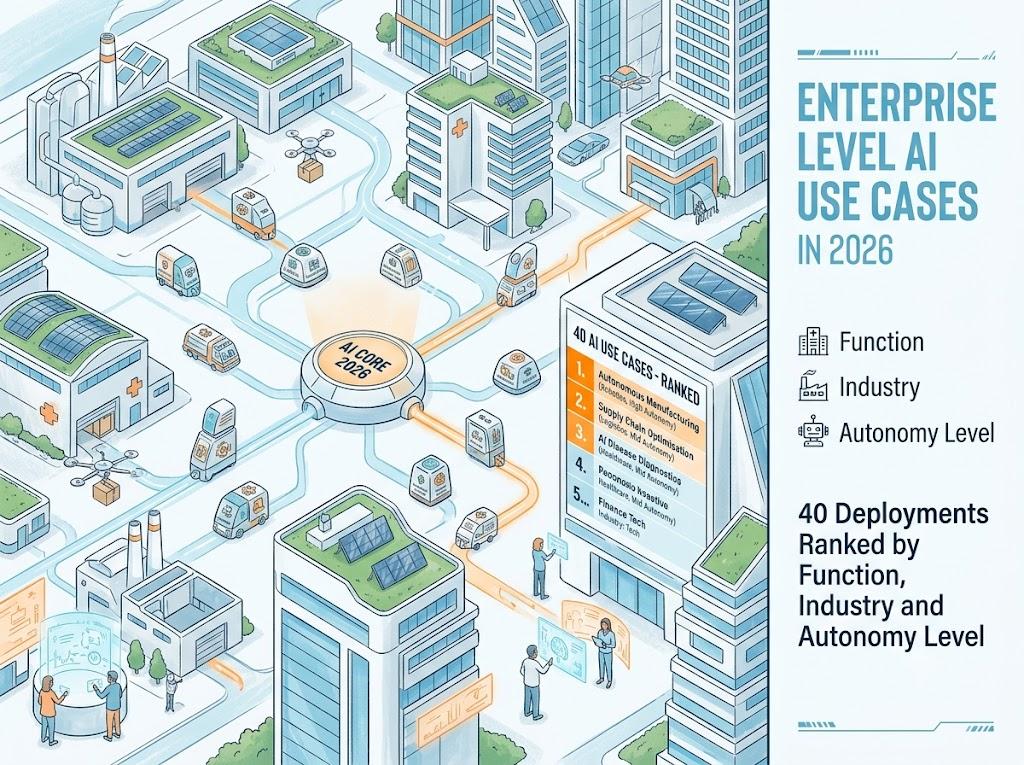
Enterprise level AI use cases are AI applications that operate across departments, integrate with core systems of record, run under governed permissions and audit, have a named business owner, and are measured against a business outcome rather than a usage metric.
They differ from departmental AI tools in scope, integration surface and accountability — and that difference, more than model quality, is what determines whether a use case reaches production or stalls in pilot.
TL;DR
- Enterprise level AI use cases are defined by five tests: scale, systems integration, governance, ownership and outcome measurement. A chatbot that answers HR questions is a departmental tool. A system that reads an invoice, applies policy, creates a transaction in your ERP and proves what it did is an enterprise use case.
- The pilot-to-production gap is not a model problem. Industry research through 2026 consistently attributes stalled AI programmes to scope, data readiness, governance and change management — not model capability.
- Use cases sort into three autonomy levels — Ask, Execute and Autonomous. Each level has a completely different control requirement, and mixing them on a flat list is why most prioritisation exercises fail.
- This guide maps 40 enterprise level AI use cases across nine business functions and eight industries, drawn from 34 production deployments spanning India, the UAE and wider Middle East, the UK and Europe, the United States, Canada, Australia and East Africa.
- The highest-return use cases share four attributes: high volume, a well-understood manual cost baseline, a document or data-heavy workload, and a decision boundary that can be written down.
- A six-dimension scorecard is included so you can rank your own candidate list rather than borrow someone else's.
What Makes an AI Use Case "Enterprise Level"?
An enterprise level AI use case is one that operates at organisational scale rather than team scale, reads and writes to systems of record, inherits enterprise permissions, produces an auditable record of its actions, and is accountable to a business metric owned by a named executive.
That definition matters because the phrase gets used loosely. Most published "enterprise AI use case" lists include items that are, in practice, departmental productivity tools. The distinction is not pedantic. It determines your data requirements, your integration effort, your governance burden and your realistic time to value.
The five tests
Apply these to any candidate use case. If it fails more than one, it is a departmental tool wearing an enterprise label.
Scale. Does it serve multiple teams, sites, entities or regions — or one team in one location? A use case that works for one branch and cannot survive being applied to four hundred is not an enterprise use case.
Systems. Does it read from and write to systems of record — ERP, CRM, HCM, WMS, core banking, SCADA, data warehouse — or does it operate on a copied dataset in isolation? Read-only demos are the most common form of pilot theatre.
Governance. Does it inherit the organisation's permission model, so that what the system can see depends on who is asking? Does it produce an audit record that a compliance function would accept? If the answer to either is no, it cannot be scaled beyond a controlled group.
Ownership. Is there a named business owner accountable for its performance — not an innovation team, not a vendor, an operating leader with a P&L or an SLA?
Outcome. Is it measured against a business number with a documented pre-deployment baseline? Interaction counts, session volumes and user satisfaction scores are adoption metrics, not outcome metrics.
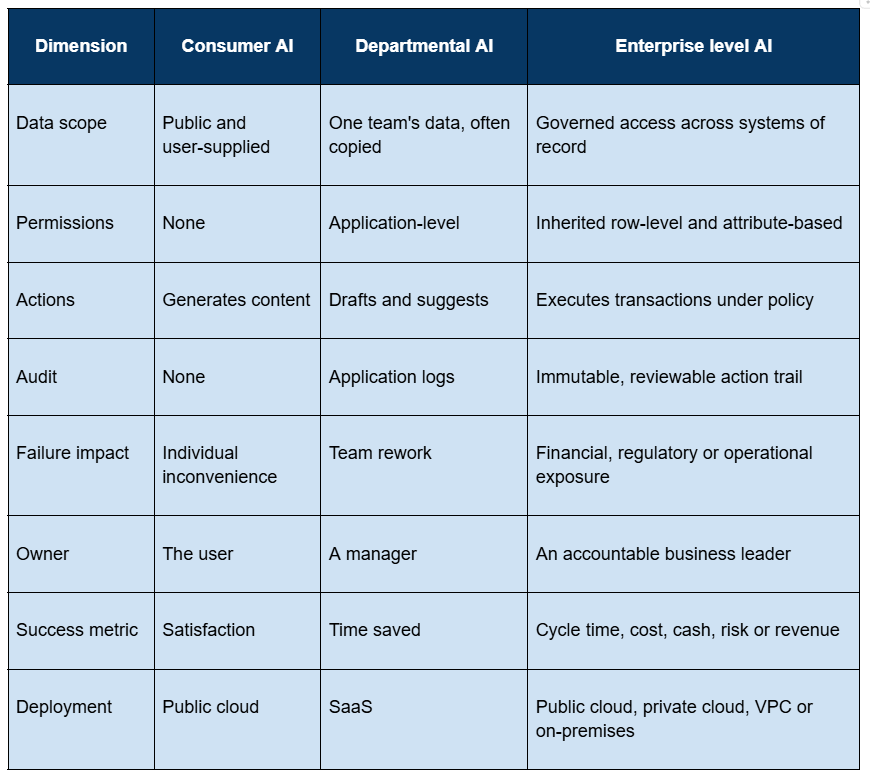
Enterprise level vs departmental AI vs consumer AI
Why the distinction decides whether your pilot survives
Most AI pilots are designed against the middle column and evaluated against the right one. A tool built with copied data, no permission inheritance and no audit trail will demonstrate beautifully and then fail its first security review. The team concludes the technology was not ready. In reality, the use case was never scoped as an enterprise use case.
The practical consequence is that scoping decisions made in week one determine outcomes in month nine. If you intend a use case to reach production, the permission model, the integration path and the audit requirement belong in the initial design, not in a hardening phase after the demo lands.
The State of Enterprise AI in 2026: Why Most Use Cases Never Reach Production
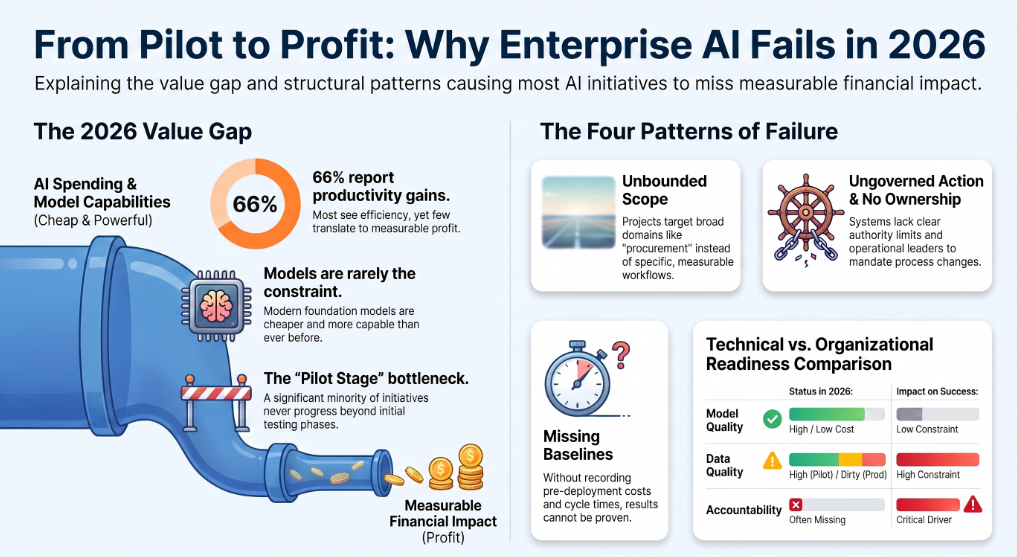
Enterprise AI spending has continued to climb through 2026 while the proportion of initiatives producing measurable financial impact has not kept pace. Deloitte's State of AI research for 2026 found that around two thirds of organisations report productivity gains from AI adoption, and that a large majority expect to customise agents to their own processes.
But separate research has repeatedly found a wide gap between deployment and demonstrated profit-and-loss impact — MIT Sloan researchers have described a large share of pilots as producing no measurable P&L effect, S&P Global reported that a substantial proportion of companies abandoned most of their AI projects during 2025, and Gartner has consistently found that a significant minority of AI initiatives never progress beyond the pilot stage.
Read those findings together and a pattern emerges. Organisations are not failing to deploy AI. They are failing to deploy AI against work that can be measured.
It is not a model problem — it is a use case selection problem
Foundation models in 2026 are cheaper, faster and more capable than at any prior point. Model quality is rarely the binding constraint. The recurring constraints are structural: the process being automated was never standardised, the data was clean in the pilot set and dirty in production, no one defined what success looked like before the build started, and no operating leader was accountable for the result.
This is why a list of use cases, on its own, is not useful. Every enterprise can generate a list of a hundred candidates in an afternoon workshop. The difficulty is not ideation. It is selection, sequencing and governance.
The four failure patterns
Unbounded scope. The use case is defined as a domain ("AI for procurement") rather than a workflow ("automated RFQ issuance and supplier response consolidation for indirect categories under a defined value threshold"). Domains cannot be measured. Workflows can.
Ungoverned action. The system is given the ability to act before anyone has defined what it may act on, up to what value, on whose authority, and what evidence it must produce. The first material error then removes the programme's political licence to continue.
No owner. The initiative sits with an innovation function that has no operational accountability. When adoption requires a process change, no one has the authority to mandate it.
No baseline. Nobody recorded the pre-deployment cycle time, error rate, cost per transaction or headcount allocation. Without a baseline, any result is arguable, and arguable results do not get refunded in the next budget cycle.
Each of these is preventable at the scoping stage, which is why the prioritisation section later in this guide matters more than the list itself.
How to Read This List: The Ask → Execute → Autonomous Ladder
Enterprise AI use cases are not peers. A natural-language analytics query and an autonomous replenishment transaction are separated by an enormous difference in authority, control requirement and risk. Flattening them onto one numbered list — as most published lists do — makes it impossible to reason about sequencing.
The Ask → Execute → Autonomous ladder sorts every use case by how much authority the system holds.
Level 1 — Ask: the system answers
The system retrieves, analyses, summarises and explains. It does not change anything. Natural-language analytics over governed data, document search across policy libraries, competitive monitoring, and forecasting all sit here.
What it requires: governed data access, permission inheritance, a semantic layer so that a metric means the same thing to every asker, and evidence-backed responses that cite their sources.
Why start here: Ask-level use cases are the fastest to production and the cheapest to reverse. They also build the context foundation that every higher level depends on.
Level 2 — Execute: the system acts under approval
The system prepares an action and a human authorises it. Draft a supplier follow-up, propose a stock transfer, extract an invoice and stage a posting, generate a case with a recommended disposition. The work is done by the system; the commitment is made by a person.
What it requires: everything at Level 1, plus a workflow engine with human tasks, maker-checker separation, defined approval thresholds, and an action trail that records who approved what and on what evidence.
Why this is where most value sits in year one: it captures the majority of the manual effort while retaining full human control of the consequence.
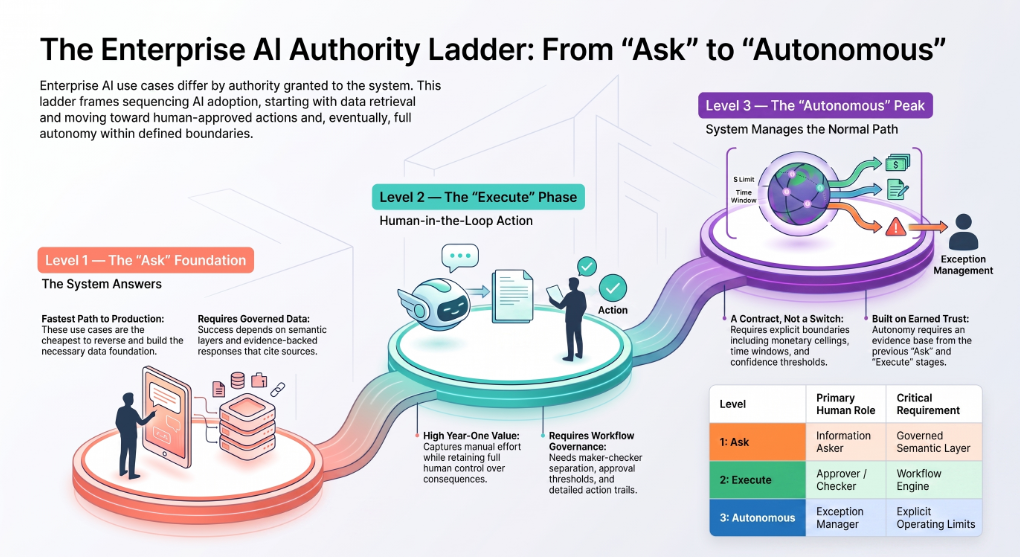
Level 3 — Autonomous: the system runs the normal path
The system executes the standard case end to end within a defined envelope, and escalates anything outside it. Humans manage exceptions and policy rather than transactions.
What it requires: everything at Level 2, plus explicit operating limits — which work types, which business scope, which capabilities, what monetary ceiling, what time window, what confidence threshold, and what conditions force escalation. Autonomy is not a switch. It is a written contract with boundaries on every dimension.
Why almost nobody should start here: an autonomous use case with no prior Ask and Execute history has no evidence base for setting the limits, and no operational trust to spend when it makes its first mistake.
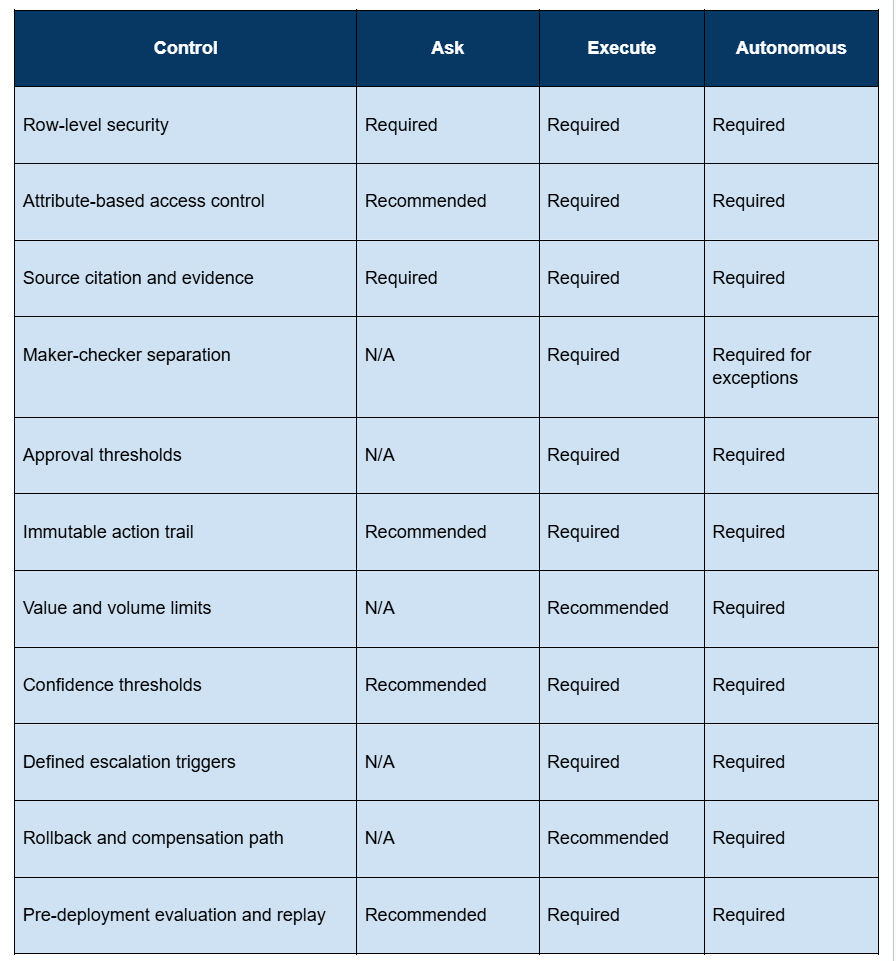
Control requirements by level
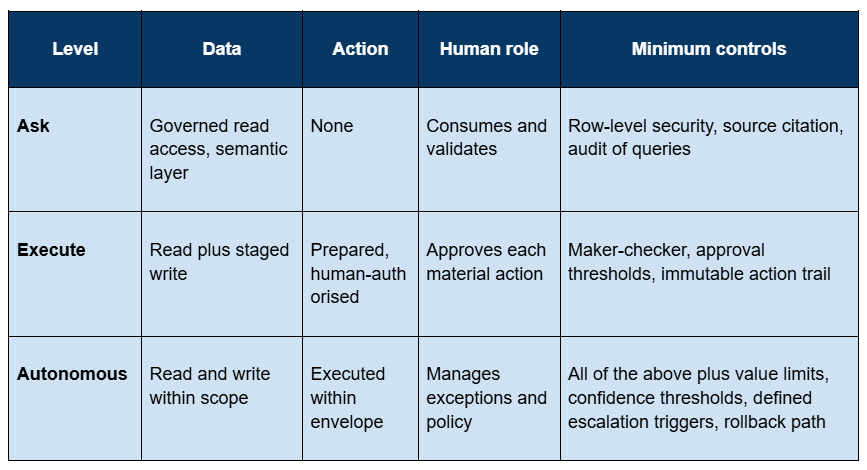
The sequencing implication is direct: prove the context at Ask, prove the judgement at Execute, and only then widen the envelope. Organisations that skip levels are not moving faster. They are moving without evidence.
40 Enterprise Level AI Use Cases by Business Function
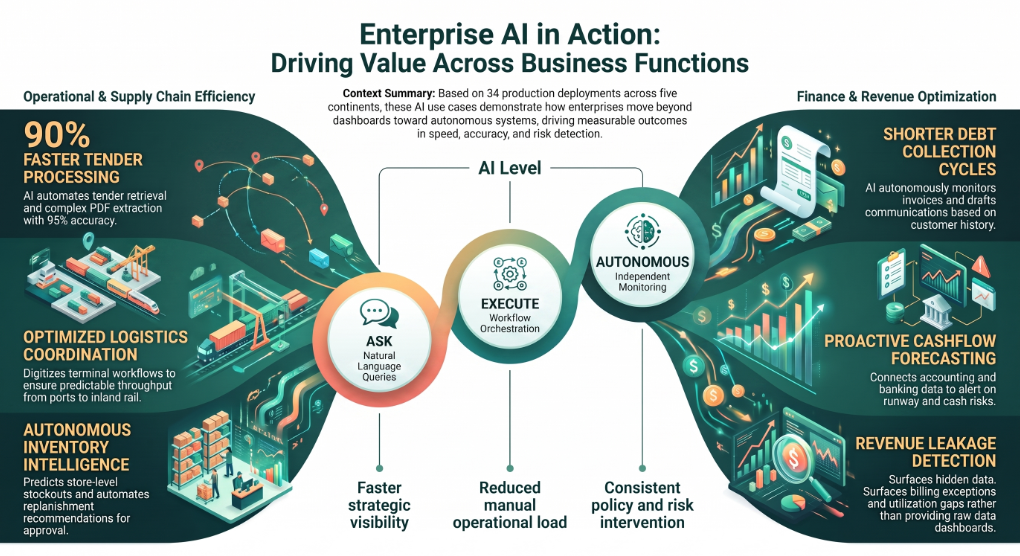
The following use cases are drawn from 34 production deployments across five continents. Deployments are described by industry, geography and scale only. Outcomes are directional and vary by data environment, integration surface and process baseline.
Finance and Accounting
1. Autonomous receivables follow-up Level: Execute → Autonomous. The system monitors invoices crossing ageing thresholds, assembles account context, drafts communication matched to customer history and policy, records promises to pay, and escalates disputes, negative sentiment or legal signals to a human. Outcome: shorter collection cycles, earlier detection of at-risk accounts, and consistent communication policy across a receivables book.
2. Multi-entity KPI consolidation Level: Ask. Standardises financial and operational definitions across legal entities and geographies so that consolidated reporting stops requiring reconciliation. Seen in production at an Indian multinational logistics and warehousing group operating across India, the UK, Europe and the United States. Outcome: a single operational view across entities, faster leadership reporting, and improved consistency of operating metrics.
3. Cashflow forecasting and scenario planning Level: Ask → Execute. Connects accounting and banking data, produces rolling forecasts, models scenarios, and alerts on runway and cash risk with recommended actions. Seen in production at an AI-native finance platform serving growing businesses and advisory firms. Outcome: faster analysis cycles, earlier detection of cash anomalies, and advisory-grade insight without added headcount.
4. Revenue and utilisation analytics Level: Ask. Surfaces revenue leakage drivers, utilisation gaps and billing workflow exceptions with variance explanations rather than raw dashboards. Seen in production at a physician-led clinical enterprise in the north-eastern United States. Outcome: improved visibility into leakage, faster operational decisions, more reliable performance tracking.
5. Cross-border tax pre-screening Level: Execute. Screens transactions early for withholding tax exposure, VAT mismatches and permanent establishment risk, collects supporting evidence, and escalates to specialists. Seen in production at a UK cross-border tax technology product. Outcome: earlier risk detection, fewer late-stage deal disruptions, more consistent pre-compliance review.
Procurement and Supply Chain
6. RFQ automation and supplier discovery Level: Execute. Automates request issuance, supplier matching and response consolidation, with analytics on price, lead time and vendor performance. Seen in production at a pharmaceutical sourcing platform listing over 1,800 rare excipients and 7,500 SKUs. Outcome: faster procurement cycles, reduced manual follow-up, better price and lead-time competitiveness.
7. Supplier performance and fill-rate intervention Level: Ask → Execute. Monitors delivery reliability, returns and fill rates, and generates intervention cases when a supplier trends outside tolerance. Outcome: earlier detection of vendor slippage and fewer downstream availability failures.
8. Early-payment and margin-erosion alerting Level: Ask. Continuous alerting on purchase price trends, gross margin impact, early-payment discount economics and working capital position across group entities. Seen in production at a UAE family business group comprising more than thirty companies. Outcome: earlier detection of margin erosion, standardised finance and procurement intelligence across entities, fewer variance surprises.
9. Inbound delay exception handling Level: Execute. Detects delayed inbound shipments, assembles the impact picture across demand and inventory, and creates a prioritised exception case with alternatives. Outcome: fewer availability failures and faster coordinated response.
10. Terminal and rail logistics coordination Level: Execute. Digitises terminal workflows, provides yard and rail visibility, and manages exceptions across the port-to-inland handoff. Seen in production at a global ports and logistics operator with a worldwide portfolio of terminals and logistics services. Outcome: higher predictability of terminal-to-rail throughput and more efficient coordination across the inland chain.
Sales and Revenue Operations
11. Always-on account monitoring and next-best-action Level: Execute. Monitors enterprise accounts continuously for opportunity, risk and renewal signals, then orchestrates governed follow-up under defined playbooks. Seen in production at a flagship UAE engineering and technology group established in 1972. Outcome: higher account coverage without added headcount, faster response on opportunities and renewals, more consistent execution.
12. Governed pipeline hygiene Level: Execute. Maintains CRM data quality by detecting stale records, missing fields and inconsistent stage logic, then proposing corrections for approval. Outcome: forecast reliability improves because the underlying record improves.
13. Field-sales voice assistance Level: Ask → Execute. A voice interface connected to live business data so field teams can query stock, pricing and account status and log activity without a laptop. Outcome: faster field decisions and better activity capture.
14. Portfolio and dealer-network analytics Level: Ask. Portfolio KPIs across risk, delinquency, maturity and residual value, with dealer network performance and early risk signals. Seen in production at an independent Canadian automotive leasing provider. Outcome: better portfolio visibility, faster risk identification, more proactive exception management.
Customer Service and Experience
15. Omnichannel intake and routing Level: Execute. Ingests chat, email and voice, classifies intent, routes to the correct workflow, and monitors service levels with a full audit record. Seen in production at a global fintech serving banks and credit unions. Outcome: faster case handling, reduced operational load, better compliance readiness through audit trails.
16. Tenant and customer support automation Level: Execute. Handles query triage, FAQs, rental and payment support end to end across web, messaging and email, with escalation to human teams and a knowledge base over policies and tenancy documents. Seen in production at a UAE real estate portfolio owner with assets across multiple emirates. Outcome: faster response times, lower call-centre load, consistent round-the-clock coverage, better SLA adherence.
17. Agent-assist summarisation and next-best-action Level: Ask. Real-time summarisation of case history and recommended next steps surfaced to a human agent mid-interaction. Outcome: shorter handling times and more consistent responses across agent experience levels.
18. Booking and itinerary orchestration Level: Execute. Email intake, intent classification and data extraction, a conversational loop to capture missing details, real-time availability checks with alternative-date negotiation, hybrid handoff for curated work, and automated document generation. Seen in production at a luxury hospitality collection operating sixteen lodges and camps across Kenya and Tanzania. Outcome: faster booking turnaround with less back-and-forth, higher accuracy on complex requirements, scalable operations without compromising service standards.
19. Service funnel and utilisation analytics Level: Ask. Funnel analytics from enrolment through delivery, instructor or resource utilisation, and slot optimisation. Seen in production at a multi-branch driving institute in Dubai. Outcome: reduced scheduling bottlenecks and clearer visibility into conversion drivers.
Operations and Field Service
20. Store operations helpdesk Level: Execute. A bilingual voice and chat support agent for store staff, backed by retrieval over point-of-sale documentation and standard operating procedures, with ticketing integration and an admin console. Seen in production at a pan-India value retailer operating more than 700 stores across hundreds of cities. Outcome: reduced manual helpdesk burden, faster store issue resolution, faster onboarding through on-demand training guidance.
21. Inventory and replenishment intelligence Level: Execute → Autonomous. Store-level visibility into pricing, stock and promotions, projected stockout detection, and transfer or expedite recommendations routed for approval or bounded execution. Outcome: improved store-level inventory visibility and earlier intervention on availability risk.
22. Asset and energy monitoring Level: Ask → Execute. Ingests utility and sensor data, detects anomalies, forecasts consumption and recommends optimisation, with proactive alerting. Seen in production at a premier Indian astronomy and astrophysics research institute with campus-scale operations. Outcome: improved energy visibility, faster detection of inefficiencies, more predictable operations through early alerts.
23. Grid and transmission exception detection Level: Ask → Execute. Transmission KPI monitoring, loss and outage analytics, predictive maintenance indicators and automated field alerting. Seen in production at a state power transmission utility in northern India and at a city-scale smart infrastructure operator running more than twenty-five operations centres across two million connected assets. Outcome: faster identification of grid exceptions, improved reliability through proactive monitoring, better operational transparency for leadership.
24. Scheduling and capacity optimisation Level: Execute. Matches demand to available capacity across sites, shifts or instructors, and proposes schedules for approval. Outcome: better utilisation and fewer manual scheduling cycles.
25. Platform and service workflow orchestration Level: Execute. Orchestrates booking, processing and reporting across a high-volume consumer service operation, with status monitoring and customer notification. Seen in production at a UK private healthcare and testing provider. Outcome: more scalable operations, faster customer communication, fewer missed handoffs.
Document and Contract Operations
26. Tender and bid document processing Level: Execute. A multi-agent document workbench performing tender retrieval, workflow determination, revision and change analysis, and vision-based extraction from complex PDFs, integrated bidirectionally with the operational system of record with quote locking and audit logging. Seen in production at an Australian waterproofing diagnostics and remedial building services specialist with more than twenty years in the field. Outcome: engineered for up to approximately 90% faster tender document processing with a roughly 95% extraction accuracy target on standard formats, and reduced bid risk through revision detection and auditability.
27. Invoice and purchase order extraction Level: Execute. Extracts, classifies, validates and stages document data for posting, with confidence thresholds routing low-certainty items to human review. Outcome: faster processing cycles and reduced data-entry error.
28. Quality and regulatory document handling Level: Execute. Manages certificates, specifications and regulatory documentation through structured extraction and validation against required fields. Outcome: fewer compliance gaps and less manual document chasing.
29. Technical due diligence review Level: Ask. Code and architecture review, infrastructure and security assessment, scalability and integration readiness, producing a risk register and remediation roadmap. Seen in production at a long-term holding company partnering with founders and family businesses across the United States and Europe. Outcome: faster investment decisions with structured technology risk visibility and fewer post-deal surprises.
30. Research automation with citations Level: Execute. Automated source collection, summarisation and draft output generation with citations, plus workflow tracking and knowledge base accumulation. Seen in production at a specialised tax research automation product in the United States. Outcome: faster research cycles, reduced manual source-hunting, more consistent outputs and better documentation hygiene.
Data, Analytics and Business Intelligence
31. Governed natural-language analytics Level: Ask. Business users ask questions in plain language and receive answers generated against governed data with row-level permissions enforced, so two people asking the same question receive answers scoped to what each is entitled to see. Seen in production at a privately held retail holding group and at a Silicon Valley business analytics startup. Outcome: faster strategic visibility without BI queueing, and scalable insight access across teams.
32. Semantic metric standardisation Level: Ask. Encodes hierarchies, formulas and business rules so that revenue, margin and utilisation carry one definition across every question, dashboard and agent. Outcome: improved alignment through consistent metric definitions and fewer reconciliation arguments in leadership meetings.
33. Proactive exception alerting Level: Ask → Execute. Continuous monitoring of metrics and events against thresholds, generating alerts and cases rather than waiting to be queried. Outcome: shift from reactive reporting to proactive response.
34. Insight-to-action task generation Level: Execute. Converts dashboard insight into governed, auditable tasks with owners and completion tracking, closing the gap between observation and intervention. Outcome: standardised decision logic across teams, automated task creation, improved exception response.
Human Resources and Employee Operations
35. Onboarding and credentialing Level: Execute. Talent onboarding, credential capture and verification, and compliance workflow management. Seen in production at a United States healthcare staffing platform. Outcome: faster onboarding cycles and lower compliance administration burden.
36. Workforce matching and scheduling Level: Execute. Facility or project staffing request intake, matching logic, scheduling and notification, with fill-rate and utilisation reporting. Outcome: faster fill cycles, lower scheduling friction, improved workforce utilisation.
37. Internal knowledge and policy assistance Level: Ask. Permission-aware retrieval across policies, procedures and internal documentation so employees receive answers scoped to their entitlements. Seen in production at a global teacher community platform spanning more than a million educators across 131 countries. Outcome: scalable support, faster access to guidance, better visibility into engagement.
Risk, Compliance and Security
38. Transaction screening and risk classification Level: Execute. Screens transactions against risk criteria, classifies exposure, collects supporting evidence and explanatory notes, and escalates to specialists. Outcome: earlier risk detection and more consistent review.
39. Audit trail and evidence capture Level: Execute. Produces a reviewable record of what the system did, on what evidence, under whose authority, and with what outcome. Outcome: compliance readiness that does not depend on retrospective reconstruction.
40. Competitive and market monitoring Level: Ask → Execute. Continuous monitoring across e-commerce and channel surfaces for pricing, discounting, offers, availability and ratings, with agentic question answering mapped to leadership questions and proactive alerting on portfolio movement. Seen in production at a major Indian HVAC and refrigeration manufacturer founded in 1943, competing in highly price-sensitive consumer and commercial markets. Outcome: faster competitive response cycles, earlier identification of pricing gaps and promotional shifts, and always-on monitoring replacing manual portal checks.
Enterprise Level AI Use Cases by Industry
Banking, Financial Services and Fintech
The highest-value use cases in financial services cluster around dispute and case handling, fraud and risk screening, receivables, and governed analytics. A global fintech serving banks and credit unions deployed omnichannel intake across chat, email and phone with agent-assist summarisation, next-best-action recommendations and full auditability against service level monitoring.
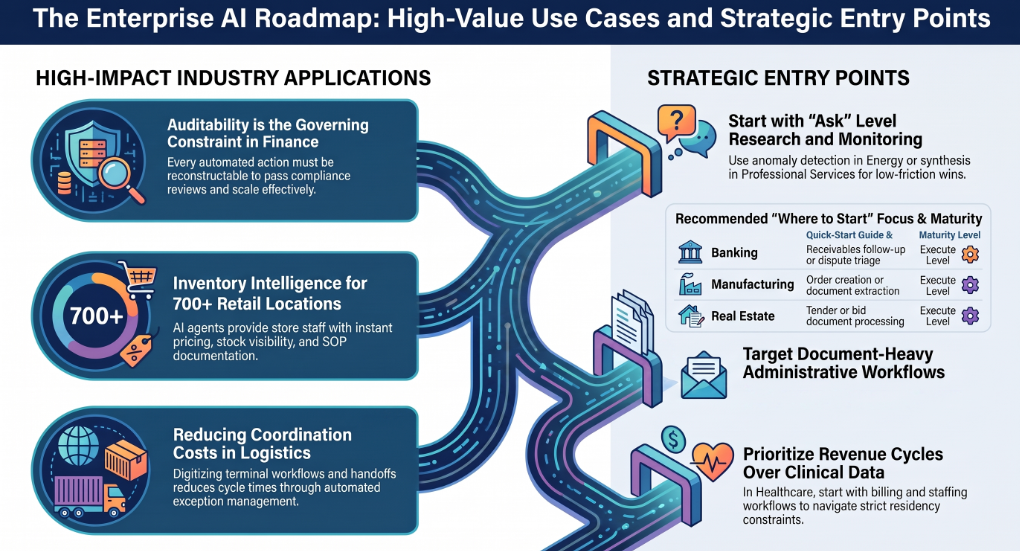
The governing constraint in this sector is not capability but evidence: every automated action must be reconstructable. Deployments that treat the audit trail as a first-class output rather than a logging afterthought scale; those that do not stall at the second compliance review.
Where to start: receivables follow-up at Execute level, or dispute intake triage. Both have well-understood manual baselines.
Retail and E-commerce
Retail generates enormous volumes of recurring operational work across stores, inventory, pricing, promotions and suppliers. A pan-India value retailer with a footprint exceeding 700 stores deployed a bilingual voice and chat support agent for store staff, an inventory intelligence layer providing pricing, stock and promotion visibility per store, and a knowledge agent built over point-of-sale documentation and standard operating procedures. A high-velocity UK e-commerce distributor deployed conversational analytics across sales, product, inventory, promotion and customer behaviour data for instant business queries with automated exception alerting.
Where to start: store operations support at Execute level, or competitive and pricing monitoring at Ask level.
Logistics, Ports and Supply Chain
Logistics rewards use cases that reduce coordination cost across handoffs. A global ports and logistics operator deployed a terminal and rail management solution digitising terminal workflows with yard and rail operational dashboards, scheduling visibility and exception management. An Indian multinational logistics and warehousing group operating across three continents consolidated analytics across entities, standardising KPI definitions and adding data quality and governance controls.
Where to start: exception management on a single high-volume handoff, measured in cycle time.
Manufacturing and Industrial
Manufacturing use cases concentrate in document-heavy processes, competitive intelligence and order-to-cash automation. A flagship UAE engineering and technology group deployed agentic automation to interpret order triggers, validate data and create sales orders directly in SAP as part of a migration away from a legacy enterprise content platform reaching end of life, with governance rules for exceptions and approvals, audit logging and reconciliation reporting. A major Indian HVAC and refrigeration manufacturer deployed continuous competitive monitoring across e-commerce channels.
Where to start: order creation or document extraction at Execute level, where the manual cost per transaction is easy to establish.
Energy, Utilities and Smart Infrastructure
Utility use cases are dominated by monitoring, forecasting and exception routing at scale. A state power transmission utility in northern India deployed transmission KPI monitoring, loss and outage analytics, predictive maintenance indicators and automated field alerting. A city-scale smart infrastructure operator running more than twenty-five smart city operations centres across two million connected assets and applications deployed agentic analytics with automated operational alerting on top of existing smart utility systems. A research institute with campus-scale operations deployed energy monitoring, forecasting and optimisation.
Where to start: anomaly detection and alerting at Ask level over existing sensor data.
Healthcare and Life Sciences
Healthcare use cases split between clinical operations and administrative or revenue workflows. A healthcare staffing platform deployed talent onboarding, credential capture, staffing request intake, matching, scheduling and compliance workflows with fill-rate reporting. A physician-led hospitalist enterprise deployed revenue and utilisation analytics with variance explanation and action lists for billing workflow optimisation. A geriatric care provider operating across assisted living and long-term care deployed programme operations dashboards with revenue cycle visibility and exception alerting.
Where to start: revenue cycle exception detection at Ask level, before touching anything clinical. Note that deployment model and data residency constraints usually dictate architecture in this sector before use case selection does.
Real Estate, Construction and Facilities
Property and construction use cases centre on tenant service and document-heavy bid processes. A UAE real estate portfolio owner with office, retail, industrial and residential assets across multiple emirates deployed an omnichannel service agent handling tenant query triage, FAQs and rental and payment support with escalation and a knowledge base over policies and tenancy documentation. An Australian remedial building services specialist deployed a multi-agent document workbench for tender processing with vision-based extraction and deep bidirectional integration into its operational system.
Where to start: tender or bid document processing, which typically carries the clearest manual cost baseline in this sector.
Professional Services, Media and Education
These sectors reward research automation, insight synthesis and community-scale support. A brand insights and creative studio founded by former large-platform leaders deployed multi-source ingestion across creative, performance and audience signals with insight agents producing themes and recommendations. A creator-economy platform deployed creator discovery enrichment, campaign workflow automation, content KPI monitoring and brand safety checks. A global teacher community spanning 131 countries deployed competency insights and automated support workflows at community scale.
Where to start: research and synthesis at Ask level, which requires the least integration and proves the context foundation quickly.
Which Enterprise AI Use Cases Deliver the Fastest Return?
The four attributes of a fast-payback use case
High volume. The work happens hundreds or thousands of times per period. Automating a monthly task saves twelve instances a year; automating a daily task saves two hundred and fifty.
A known manual cost. Someone can state, with reasonable confidence, what the process costs today in hours, headcount, error rate or cycle time. Without this you cannot build a defensible business case afterwards.
Document or data heavy. Work that consists of reading, extracting, comparing, summarising and routing converts to AI more cleanly than work that depends on physical presence or relationship judgement.
A writable decision boundary. Someone can articulate the rule: what qualifies, what the thresholds are, what forces escalation. If nobody in the organisation can write the rule down, no system can enforce it.
Quick wins, strategic bets and deferred
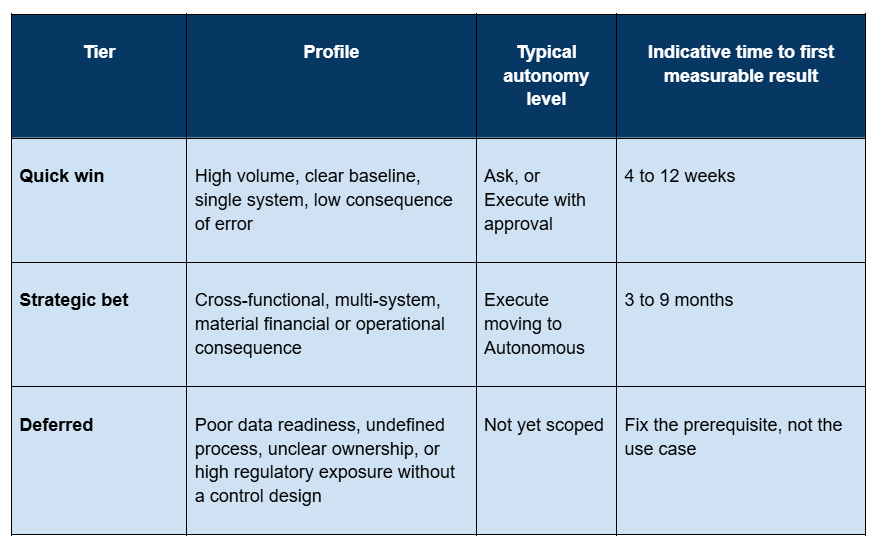
The practical sequencing rule: fund quick wins to establish credibility and free budget, run at most one or two strategic bets concurrently, and be explicit about what you are deferring and why. Portfolios that run six strategic bets simultaneously do not finish any of them.
What return actually means at each level
- At Ask level, the return is decision latency — how long it takes someone to get a trustworthy answer, and how much analyst capacity is freed.
- At Execute level, the return is throughput and error rate — transactions processed per period and rework avoided.
- At Autonomous level, the return is coverage — work that gets done at all, that previously did not because there was never enough capacity to reach it.
Conflating these produces the most common measurement failure in enterprise AI: a genuine Ask-level success reported against an Execute-level metric, which then reads as a failure.
The Use Case Prioritisation Scorecard
Every enterprise can generate a hundred candidate use cases. The constraint is choosing. Score each candidate across six dimensions, one to five, and fund what clears the threshold.
The six dimensions
Business impact. What is the size of the number that moves, and how directly does the use case move it? Score five for a use case tied to a metric already on a leadership scorecard.
Data readiness. Is the data accessible, current, and of adequate quality in production — not in the curated pilot extract? Score honestly. This is the most commonly inflated dimension and the most common cause of mid-build failure.
Systems access. Can the system reach the systems it needs, in both directions, with the integration effort you can actually fund? A use case requiring write access to a system nobody will grant is not a use case.
Governance burden. What controls are required before this can ship — permission inheritance, approval design, audit, data residency, regulatory review? High burden is not disqualifying, but it must be costed at scoping, not discovered at deployment.
Autonomy fit. Does the required autonomy level match your organisation's demonstrated readiness? A first Autonomous-level use case in an organisation with no Execute-level track record scores low regardless of its business case.
Owner accountability. Is there a named operating leader who will be measured on the result? If the answer is an innovation function, score one.
How to score and what to fund
Score each dimension one to five for a maximum of thirty. Have the scoring done by a cross-functional panel rather than by the sponsoring function — self-scored feasibility is systematically optimistic. Fund candidates scoring twenty-two or above. Anything scoring three or below on data readiness or owner accountability should be blocked regardless of total score, because those two dimensions cannot be remediated during the build.
The five prioritisation mistakes
- Selecting from competitor benchmarks rather than internal scoring. What worked at another organisation reflects their data estate, not yours.
- Treating data readiness as solvable during implementation. It is a prerequisite, not a workstream.
- Building a portfolio concentrated in one function. Three finance use cases is a finance project, not an enterprise AI programme, and it will not generate the cross-functional evidence that funds the next cycle.
- Letting technical teams score their own feasibility. They face an impossible incentive: score honestly and appear under-resourced, or score optimistically and over-commit.
- Launching without a governance owner accountable for portfolio health and sequencing.
A worked comparison
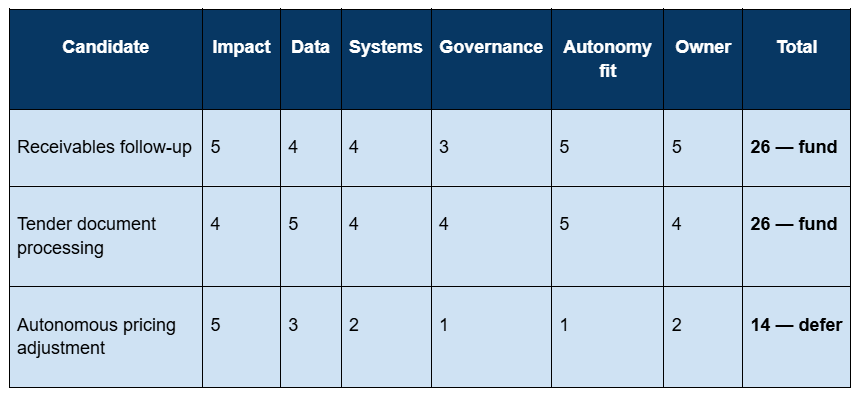
The third candidate has the highest theoretical impact and the lowest realistic chance of shipping. That is precisely the use case most likely to be selected in an unstructured prioritisation workshop.
Governance: What Every Enterprise Level AI Use Case Requires Before It Ships
Governance appears as a bullet point in most enterprise AI content and almost never as a mechanism. The mechanisms are what determine whether a use case passes review.
Identity and permission inheritance
The system must see what the asker is entitled to see, not what the connection is entitled to see. In practice this means row-level security enforced at the data layer and attribute-based access control governing which capabilities apply to which user in which context. A regional manager and a group finance lead asking the same question should receive different answers, scoped correctly, without either of them knowing the filter exists.
The failure mode this prevents is the most common cause of an AI deployment being suspended: a system that answers correctly but reveals something to someone who should not have seen it.
Maker-checker and human-in-the-loop thresholds
Any use case that acts needs a defined separation between preparation and authorisation, with thresholds that determine when a human must approve. Thresholds should be set on value, confidence, risk class and object sensitivity — not on a single global setting. A five hundred rupee adjustment and a five million rupee adjustment do not warrant the same review.
Immutable audit trails and evidence
Every material action should produce a record of what was done, on what evidence, under whose authority, with what result. The test is simple: could a compliance reviewer, six months later, reconstruct why the system did what it did without asking the engineering team? If reconstruction requires log archaeology, the audit design is inadequate.
Data residency, deployment model and model choice
For regulated sectors and for many organisations in India, the Middle East and the European Union, the deployment model is a gating decision, not a preference. Determine early whether the use case can run in public cloud, requires a private cloud or virtual private cloud, or must run on-premises. Determine separately whether the organisation requires customer-managed encryption keys and whether it needs the ability to change model providers without rebuilding the application.
Locking a use case to a single model provider is a commercial and continuity risk that is cheap to avoid at design time and expensive to unwind later.
Governance checklist by autonomy level
Why Assistents.ai for Enterprise Level AI Use Cases
Governed by architecture, not by policy document
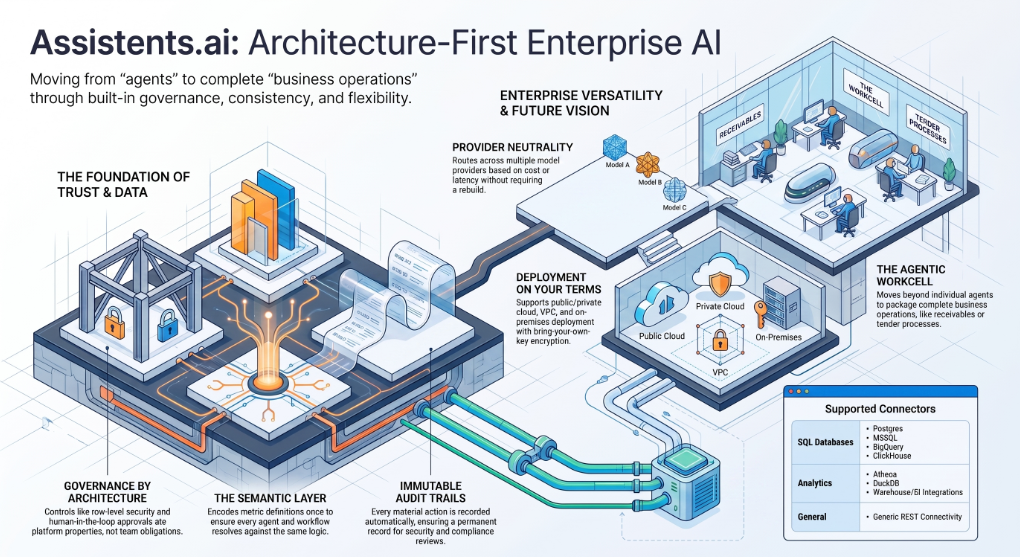
Most enterprise AI governance is a document that describes what should happen. On Assistents.ai, the controls are properties of the platform rather than obligations placed on the implementation team. Row-level security and attribute-based access control determine what any agent can see on behalf of any user. Human-in-the-loop approvals and maker-checker separation are configured on the workflow, not bolted on afterwards. Every material action writes to an immutable audit trail.
The practical consequence is that a use case designed on the platform arrives at its security review with the controls already in place, rather than requiring a hardening phase that frequently costs more than the original build.
The semantic layer and Context Engine
The single most common cause of an enterprise AI programme losing credibility is two systems producing two different numbers for the same metric. The semantic layer on Assistents.ai encodes metric definitions, hierarchies, formulas and business rules once, so that every question — whether asked through conversational analytics, answered by an agent, or embedded in a workflow — resolves against the same definition.
The Context Engine assembles the governed, permission-scoped context each request requires from structured data, documents and policy, with hybrid retrieval and evidence-backed responses that cite their sources. Text-to-SQL runs against governed data through named connectors including Postgres, MSSQL, BigQuery, ClickHouse, Athena and DuckDB, alongside warehouse and BI integrations and generic REST connectivity.
This matters for use case sequencing specifically: the context foundation built for your first Ask-level use case is the same foundation your Execute and Autonomous use cases depend on. It is not throwaway pilot infrastructure.
Model-agnostic routing and open protocol support
Assistents.ai routes across multiple model providers rather than binding the platform to one. Use cases can be assigned models on cost, latency or capability grounds and reassigned without rebuilding. The platform supports MCP and A2A protocols for interoperability with the wider agent ecosystem, alongside more than eighty workflow integrations.
Given how quickly the model landscape has moved through 2026, provider neutrality is a continuity control rather than a technical preference.
Deployment on your terms
Public cloud, private cloud, virtual private cloud and on-premises deployment are all supported, with bring-your-own-key encryption. For the deployments described throughout this guide — utilities, ports, healthcare, banking and government-adjacent infrastructure across India, the Middle East and Europe — deployment model was frequently the first constraint, not the last.
Where the platform is heading
The direction Assistents.ai is building toward is the packaging of complete business operations rather than individual agents. The internal term for this is an Agentic Workcell: a governed human and agent team configured to own a defined business operation and its outcomes, packaging the work intake, process definitions, digital and human roles, context bindings, capabilities, policies, applications, service levels and outcome metrics as one deployable unit.
The reasoning is straightforward. An enterprise does not ultimately want an agent. It wants a receivables function that performs reliably, a tender process that does not lose bids to revision errors, a store network where availability failures surface before the customer notices.
This is roadmap direction rather than currently shipped functionality, and it is stated here as direction. What ships today is the execution machinery described above — the agents, workflows, context, rules, applications, governance and deployment control that those operating units are assembled from.
From Use Case to Production: A 90-Day Path
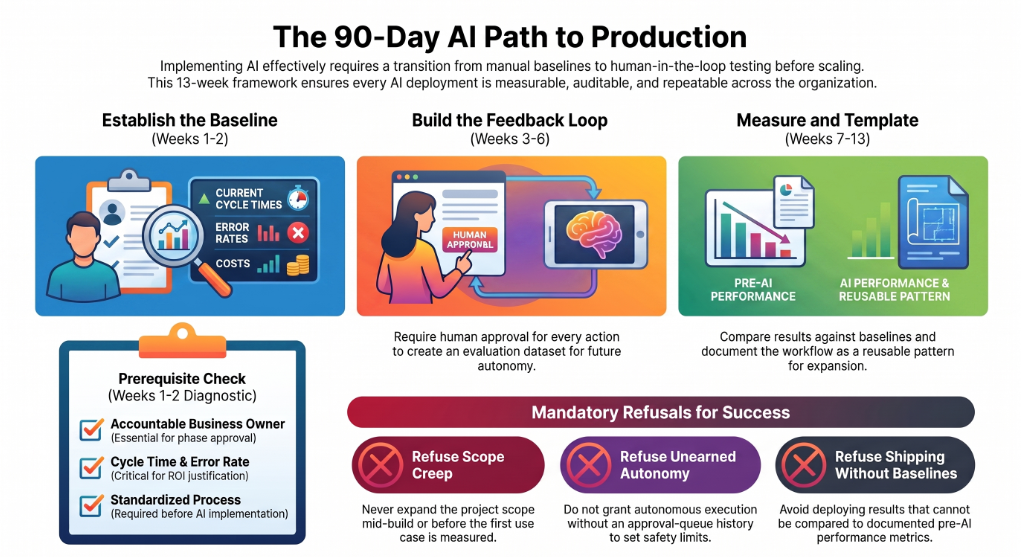
Weeks 1–2: scope one workflow and record the baseline
Choose one workflow, not one domain. Write down, before anything is built, the current cycle time, error rate, volume per period and cost or headcount allocation. Name the accountable business owner. Define what result would justify a second phase and what result would justify stopping.
If you cannot obtain the baseline numbers in two weeks, that is diagnostic. It usually means the process is less standardised than assumed, which is a prerequisite problem, not an AI problem.
Weeks 3–6: build with the human in the loop from day one
Build at Execute level with approval required on every material action, even if you intend eventual autonomy. The approval queue in these weeks is not overhead — it is your evaluation dataset. Every human correction is evidence about where the boundary should sit later.
Configure permission inheritance and the audit trail now. Retrofitting either is the single most common source of schedule overrun.
Weeks 7–10: measure and widen
Compare against the recorded baseline. Analyse the approval queue: which decisions did humans approve without modification at what rate, and on which segments? Those segments are your first candidates for a widened autonomy envelope, with explicit value limits, confidence thresholds and escalation triggers.
Widen on one dimension at a time. Widening scope and value and confidence thresholds simultaneously makes any subsequent problem undiagnosable.
Weeks 11–13: template and expand
Document what was built as a reusable pattern — the context bindings, the workflow shape, the approval design, the escalation rules — and apply it to the adjacent workflow in the same function. The second use case in a function should take a fraction of the time of the first. If it does not, the first was built as a bespoke project rather than a template.
What to refuse in the first 90 days
Refuse to expand scope mid-build. Refuse to start a second use case before the first has a measured result. Refuse to grant autonomous execution without an approval-queue history to set limits against. Refuse to ship without the baseline documented, because a result nobody can compare to anything will not survive its first budget challenge.
Choosing a Platform for Enterprise Level AI Use Cases
Twelve questions to ask any vendor
- Does the platform enforce our permission model at the data layer, or at the application layer?
- Can two users ask the same question and receive correctly different answers?
- Where are metric definitions stored, and what happens when a definition changes?
- What exactly is written to the audit trail, and who can read it?
- How are approval thresholds configured — globally, or per work type, value and risk class?
- Can we change model providers without rebuilding applications?
- What deployment models are supported, and which are in production with customers today?
- How does the platform connect to our systems of record, in both directions?
- What does the first use case cost to reach production, and what does the fifth cost?
- What happens to the context and governance layer we build for use case one when we start use case two?
- Which of the capabilities being demonstrated are shipped today, and which are roadmap?
- What does the vendor consider outside its scope?
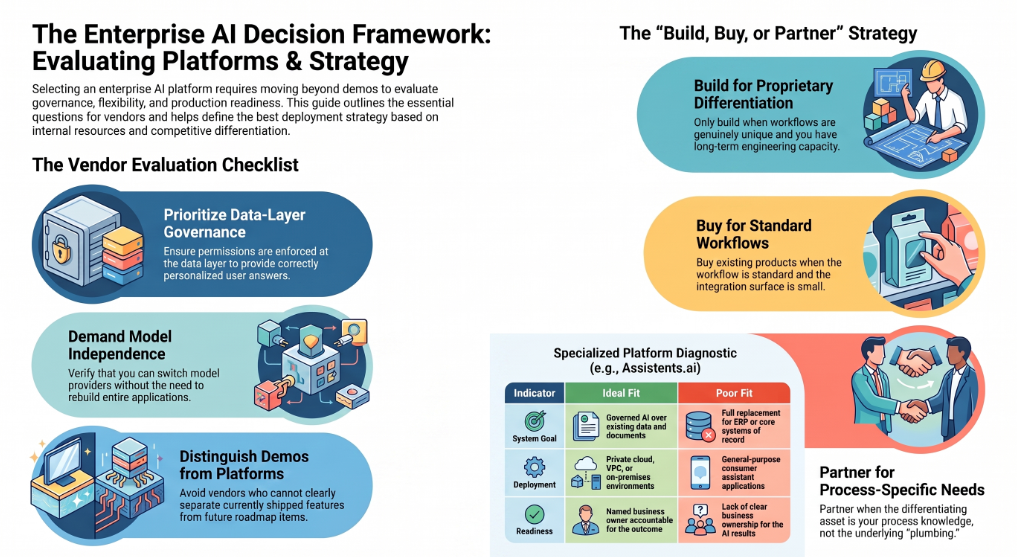
The last two questions are the most informative. A vendor that cannot cleanly separate shipped from roadmap, or that claims no boundaries, is describing a demo rather than a platform.
Build, buy or partner
Build when the workflow is genuinely proprietary, differentiating, and you have the engineering capacity to own it for years — including the governance, evaluation and model-migration work that follows deployment.
Buy when the workflow is standard and well-served by an existing product, and the integration surface is small.
Partner on a platform when the workflow is specific to your business but the underlying machinery — governance, context, orchestration, integration, deployment control — is not something you want to build or maintain. This is where most enterprise use cases sit, because the differentiating asset is the process knowledge, not the plumbing.
Where Assistents.ai fits, and where it does not
It fits when you need governed AI over data and documents that already live in enterprise systems, when permission inheritance and audit are non-negotiable, when deployment must happen in a private cloud, VPC or on-premises environment, when you need to remain independent of any single model provider, and when you want to reach production on a first use case in weeks rather than assess a multi-year platform programme.
It is not the right fit if you are looking for a general-purpose consumer assistant, if you want a full replacement for your ERP or core system of record, if your requirement is a single narrow point solution well-served by an existing specialist product, or if your organisation is not prepared to name an accountable business owner for the outcome. That last condition is not a technology constraint. It is the most reliable predictor of whether any enterprise AI use case will succeed, on any platform.
What a first deployment looks like
A scoping session to select one workflow and record its baseline. Connection to the relevant systems and configuration of the permission model. A build at Execute level with human approval on every material action. A measured comparison against the recorded baseline. Then a decision, made on evidence, about whether to widen the envelope, template the pattern for an adjacent workflow, or stop.
To Conclude-
Enterprise level AI in 2026 is no longer constrained by what models can do. It is constrained by how organisations choose, govern and measure the work they hand over. The forty use cases in this guide are not a menu to be worked through. They are a map of where governed AI has already reached production across finance, retail, logistics, utilities, healthcare, ports and professional services, on five continents — and a framework for identifying which two or three of them belong in your next budget cycle.
If you want to work through that selection against your own systems and constraints, we run a scoping session that produces a scored shortlist and a baseline you can defend.
FAQs
What are enterprise level AI use cases?
Enterprise level AI use cases are AI applications that operate across departments or entities, integrate bidirectionally with systems of record, inherit organisational permissions, produce an auditable record of their actions, have a named business owner, and are measured against a business outcome. They are distinguished from departmental AI tools by integration surface, governance requirement and accountability rather than by model sophistication.
What is the difference between enterprise AI and departmental or consumer AI?
Consumer AI operates on public and user-supplied data with no permission model. Departmental AI operates on one team's data, usually copied, with application-level permissions. Enterprise AI operates on governed data across systems of record, enforces row-level and attribute-based permissions, executes actions under policy, and produces an immutable audit trail. The failure consequences differ correspondingly: individual inconvenience, team rework, and financial or regulatory exposure.
What are the most common enterprise AI use cases in 2026?
The most widely deployed enterprise AI use cases in 2026 are governed natural-language analytics, document extraction and processing, omnichannel customer service intake and routing, receivables follow-up, competitive and market monitoring, demand and cashflow forecasting, supplier and procurement automation, asset and grid monitoring, and internal knowledge assistance. Agentic use cases that execute transactions are growing fastest but remain a minority of production deployments.
Which enterprise AI use cases deliver the highest ROI?
The highest-return use cases share four attributes: high transaction volume, a documented manual cost baseline, a document or data-heavy workload, and a decision boundary that can be written down as a rule. In practice this means document processing, receivables follow-up, service intake and triage, competitive monitoring, and exception detection over existing operational data. Returns vary substantially by data environment and process baseline.
How do you prioritise which AI use case to build first?
Score each candidate one to five across six dimensions: business impact, data readiness, systems access, governance burden, autonomy fit and owner accountability. Fund candidates scoring twenty-two or above out of thirty. Block anything scoring three or below on data readiness or owner accountability regardless of total score, because neither can be remediated during the build. Have a cross-functional panel score rather than the sponsoring function.
Why do most enterprise AI use cases fail to reach production?
Four patterns account for most failures: scope defined as a domain rather than a workflow, action permitted before authority boundaries were designed, no accountable operating owner, and no pre-deployment baseline against which results can be argued. Model quality is rarely the constraint. Research through 2026 consistently attributes stalled initiatives to data readiness at production scale, underfunded change management and undefined success criteria.
How long does it take to deploy an enterprise AI use case?
A well-scoped first use case at Ask or Execute level typically reaches production in four to twelve weeks, with a measured result available shortly after. Cross-functional use cases involving multiple systems and material financial consequence generally take three to nine months to demonstrate impact. Timelines lengthen substantially where data readiness was overstated at scoping or where deployment model constraints were discovered late.
What governance does an enterprise AI use case need?
At minimum: row-level security so the system sees only what the asker is entitled to see, evidence-backed responses that cite sources, and an audit record of queries. Use cases that act additionally require maker-checker separation, approval thresholds set on value and risk class, and an immutable action trail. Autonomous use cases further require value limits, confidence thresholds, defined escalation triggers and a rollback path.
Can enterprise AI use cases run on-premises or in a private cloud?
Yes. Assistents.ai supports public cloud, private cloud, virtual private cloud and on-premises deployment, with bring-your-own-key encryption and model-agnostic routing. For regulated sectors and for organisations subject to data residency requirements in India, the Middle East and the European Union, deployment model is frequently the gating decision and should be determined before use case selection rather than after.
How many AI use cases should an enterprise run at once?
Fewer than most portfolios contain. A practical pattern is two to four quick wins running concurrently with at most one or two strategic bets, with everything else explicitly deferred and the reason for deferral recorded. Portfolios running six or more cross-functional initiatives simultaneously typically complete none of them, because governance attention, integration capacity and change management bandwidth are all shared constraints.