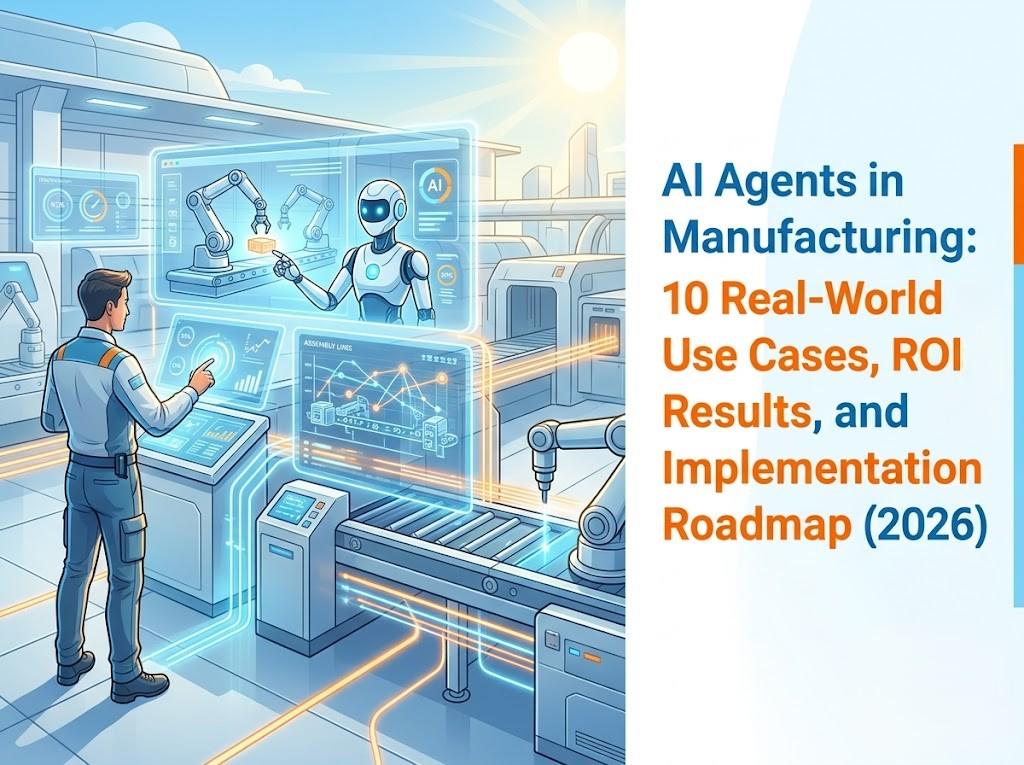
Quick Answer- AI agents in manufacturing are autonomous software systems that perceive real-time operational data, make decisions, and execute actions across production, logistics, procurement, and supply chain workflows — without constant human intervention. Unlike chatbots or RPA scripts, AI agents reason through complex, multi-step processes, adapt to changing conditions, and integrate directly with enterprise systems like SAP, ERP, SCADA, and WMS platforms.
Manufacturing has always been a game of margins, timing, and coordination. But right now, the gap between manufacturers running AI agents across their operations and those still relying on manual workflows and static dashboards is widening at an accelerating pace.
According to research from the Capgemini Research Institute, 28% of manufacturers were already using AI agents in production environments in 2025 — up from near zero two years earlier. And the pressure is intensifying: unplanned downtime alone costs the global manufacturing industry up to $50 billion annually, according to Deloitte, while 56% of manufacturers are still unsure whether their existing ERP systems are ready for full AI integration.
The manufacturers closing that gap are not waiting for a perfect AI strategy. They are deploying AI agents in specific, high-ROI workflows — predictive maintenance, logistics coordination, procurement automation, smart grid monitoring — and scaling from there.
This guide covers the 10 most impactful AI agent use cases in manufacturing, what real deployments have actually delivered, how to build the technical architecture, and a practical roadmap for getting from pilot to production.
What Is the Difference Between AI Agents and Traditional Automation in Manufacturing?
Before diving into use cases, it is worth being precise about what makes AI agents different from the automation manufacturers have already deployed.
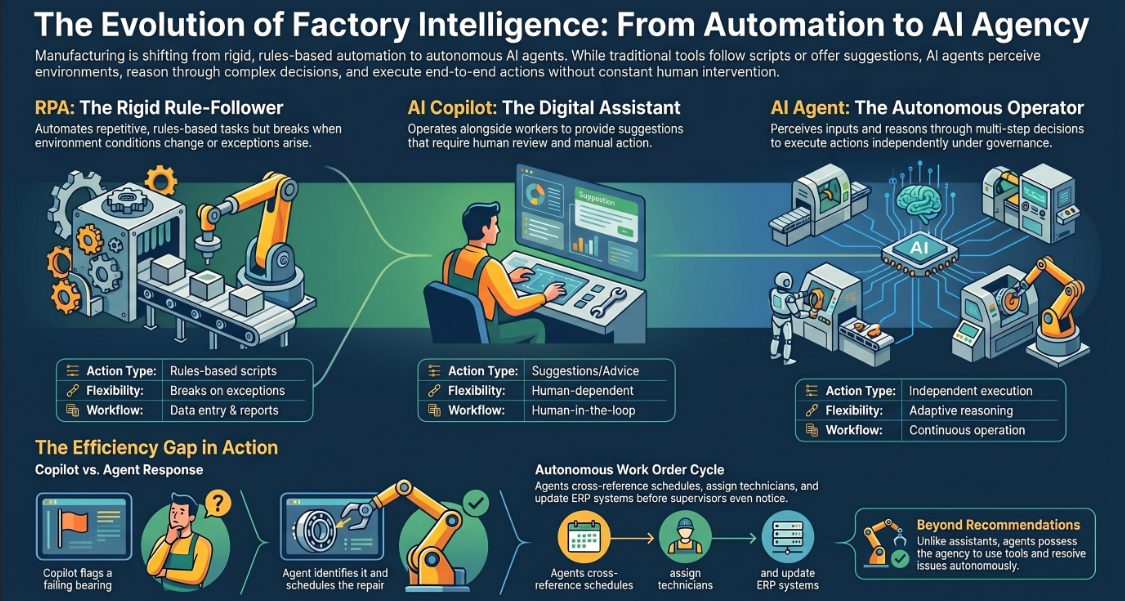
RPA (Robotic Process Automation) follows fixed rules and scripts. It automates repetitive, rules-based tasks in structured environments — copying data between systems, generating reports from templates, filling standard forms. RPA breaks the moment conditions change or exceptions arise.
AI copilots sit alongside human workers and make suggestions. They require a human to review, approve, and act. They are assistants, not agents.
AI agents perceive inputs (sensor data, documents, system events, user queries), reason through multi-step decisions, use tools to take actions (updating SAP records, sending alerts, rescheduling production orders, routing exceptions), and operate continuously — with governance controls, audit trails, and human-in-the-loop escalation built in. They do not just recommend. They execute.
In manufacturing, this distinction matters enormously. A predictive maintenance copilot tells an engineer that a bearing might fail. An AI agent detects the anomaly, cross-references maintenance schedules, identifies the nearest qualified technician, raises a work order in your ERP, and alerts operations leadership — before the shift supervisor has finished their coffee.
10 Real-World AI Agent Use Cases in Manufacturing
1. Predictive Maintenance and Equipment Monitoring
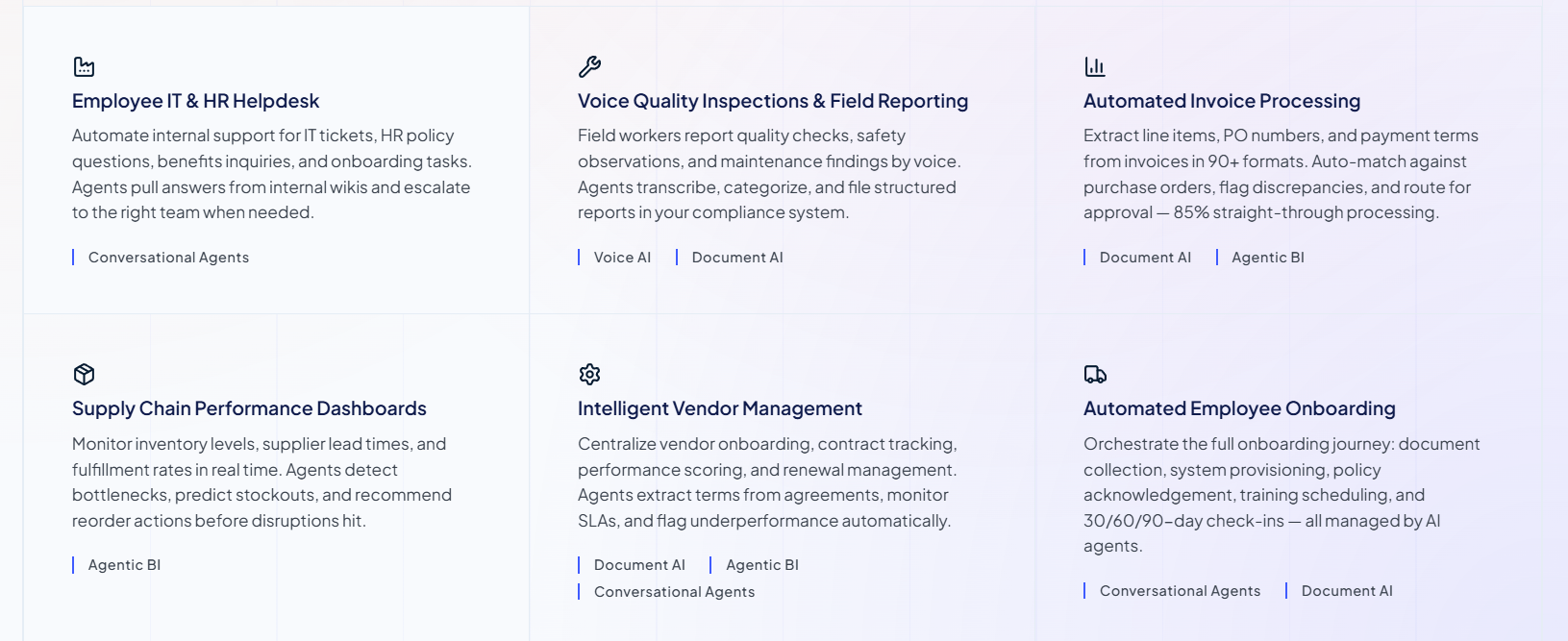
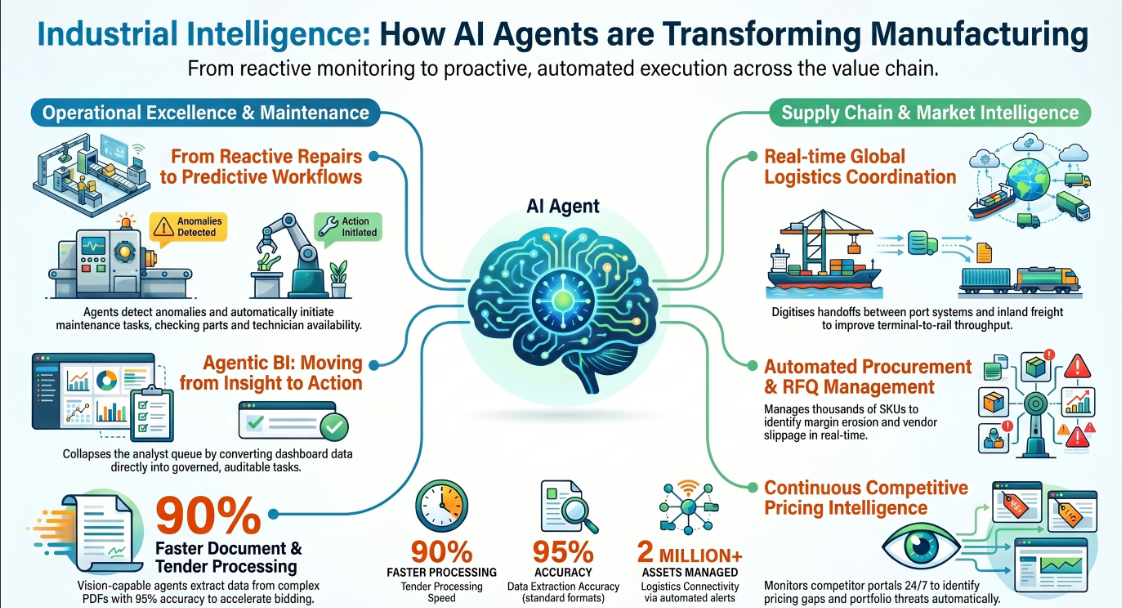
How it works: AI agents continuously ingest sensor data from equipment — vibration, temperature, pressure, power draw — and apply machine learning models to detect early failure signatures. When an anomaly is detected, the agent does not just flag it. It cross-references equipment history, checks parts availability, looks up technician schedules, and initiates a maintenance workflow automatically.
Why it matters: Unplanned equipment failure stops production lines. The cost is not just the repair — it is the downstream idle time, missed delivery windows, and emergency procurement of parts at premium rates. AI agents shift maintenance from reactive to predictive, closing the loop between detection and resolution without human handoffs at each step.
Proof point: In a real-world energy infrastructure deployment, an AI agent platform was used to implement continuous utility and sensor data ingestion with anomaly detection, forecasting, and optimisation recommendations. The result: improved energy visibility, faster detection of inefficiencies, reduced manual monitoring effort, and more predictable operations through early alerts — replacing a manual checking process that had previously required dedicated staff hours daily.
2. Smart Grid and Transmission Analytics
How it works: AI agents monitor transmission system performance in real time — tracking KPIs across grid segments, detecting outages or losses, predicting field issues before they cascade, and automatically routing exception alerts to the right resolution teams. In smart infrastructure environments, agents also manage the data flows from thousands of connected assets and trigger automated operational responses.
Why it matters: Power reliability is infrastructure-critical. For manufacturers dependent on stable power supply, and for utilities managing transmission networks serving millions of users, the ability to shift from reactive fault response to proactive grid management is transformational. AI agents make continuous, 24/7 grid monitoring economically viable in a way that human-only monitoring never was.
Proof point: In a large-scale smart infrastructure deployment — operating across 25+ smart city operation centres and connecting over two million assets — an agentic analytics and automated operational alerting layer was built on top of existing smart utility systems. The outcomes included higher operational visibility across grid operations, faster exception detection and response coordination, and a measurable shift from reactive reporting to proactive execution loops.
3. Supply Chain Coordination and Port/Rail Logistics
How it works: AI agents manage the full coordination layer across terminal operations, yard management, rail scheduling, and inland logistics. They digitise workflow handoffs between port systems and freight networks, surface exceptions in real time, provide executive dashboards with live throughput data, and trigger automated alerts when scheduling conflicts or capacity issues arise.
Why it matters: Supply chain coordination across multi-modal logistics is one of the most data-intensive, exception-heavy operations in manufacturing. Human coordinators spend enormous time on status calls, manual system updates, and exception management that AI agents handle automatically — and with far greater consistency.
Proof point: In a deployment for a global ports and logistics operator — one with reported annual revenues exceeding $20 billion — a terminal and rail management solution was built to digitise and optimise port-to-inland logistics operations. Results included higher predictability of terminal-to-rail throughput, more efficient coordination across terminal and inland logistics, and improved operational visibility across executive dashboards.
4. SAP Sales Order Automation and ERP Integration
How it works: AI agents interpret order triggers from incoming documents (emails, EDI, PDFs, web forms), validate the data against business rules, and automatically create sales orders in SAP — without a human re-keying data into the system. When exceptions arise, the agent applies governance rules, flags for human approval, and logs every action with full audit trails. This replaces legacy document management systems that are reaching end-of-life or carrying unsustainable licensing costs.
Why it matters: Manual order processing is a consistent source of errors, delays, and audit risk. When manufacturers receive high volumes of orders across multiple channels, the operational drag of manual ERP entry is enormous. AI agents compress the order-to-confirm cycle, reduce data-entry errors, and eliminate dependency on expensive legacy middleware.
Proof point: An enterprise manufacturer used AI agents to build agentic automation for interpreting order triggers, validating data, and creating SAP sales orders — as part of a transition away from a third-party document management platform that had reached end-of-life with high ongoing licensing costs. The results: reduced manual order processing and legacy dependency, faster order-to-confirm cycles with fewer data-entry errors, and improved auditability for sales order creation and exception handling.
5. Procurement, RFQ Automation, and Supplier Intelligence
How it works: AI agents automate the full RFQ (request for quotation) lifecycle — identifying sourcing requirements, matching to qualified suppliers, generating and distributing RFQ documents, collecting responses, and surfacing price/lead-time comparisons for procurement teams. Agents also handle quality and regulatory document management and maintain a continuously updated view of vendor performance across delivery rates, return rates, and lead-time trends.
Why it matters: Procurement is a function where speed and data quality directly affect margins. Slow RFQ cycles mean missed pricing windows. Poor vendor visibility means supply chain risk goes undetected until it creates a production problem. AI agents make procurement proactive rather than reactive.
Proof point: In a pharma supply chain deployment covering 1,800+ rare excipients and 7,500+ SKUs, an AI agent platform was used to automate RFQs, supplier discovery, and procurement decision support. Results included faster procurement cycles, improved sourcing visibility, reduced vendor coordination overhead, and better price and lead-time competitiveness through continuously updated supplier analytics.
In a separate group-level deployment covering procurement and finance KPIs across multiple business entities, automated alerts were configured for purchase price trends, gross margin impacts, early-payment analysis (including notional finance cost modelling), and vendor performance tracking across delivery and returns. The outcome: earlier detection of margin erosion and vendor slippage, standardised finance and procurement intelligence across entities, and reduced variance surprises through continuous monitoring.
6. Inventory Intelligence and Store Operations at Scale
How it works: AI agents give store operations teams real-time visibility into stock levels, pricing changes, and promotional performance — across hundreds or thousands of locations simultaneously. Agents monitor inventory against demand signals, flag replenishment needs, surface pricing exceptions, and answer operational queries from store managers in natural language.
Why it matters: National retail and distribution operations at scale suffer from information latency. By the time a weekly report surfaces a stock issue, the sales opportunity has already been missed. AI agents make inventory intelligence continuous and actionable.
Proof point: In a deployment for a value retail operation with 700+ stores across hundreds of cities, enterprise AI agents were deployed to modernise store support, inventory visibility, and knowledge access at national retail scale. Three distinct agents were built: a voice support agent (operating in multiple languages), an inventory intelligence agent delivering real-time pricing, stock, and promotional data per store, and a knowledge and training agent built on retrieval-augmented generation over point-of-sale and standard operating procedure documents. Results: reduced manual helpdesk burden, improved store-level inventory visibility, and faster onboarding via on-demand training guidance.
7. Competitive Market Monitoring and Pricing Intelligence
How it works: AI agents continuously monitor e-commerce channels, competitor pricing portals, and distributor networks — tracking pricing moves, promotional shifts, product availability changes, and ratings trends in real time. When a significant competitive event is detected (a price undercut, a new product launch, a promo spike), the agent surfaces an alert with contextual analysis mapped to leadership's pre-defined questions: "Where are we losing on price?" "Which SKUs are under competitive pressure this week?"
Why it matters: In highly price-sensitive manufacturing categories — HVAC, consumer electronics, FMCG — a competitor's pricing move can shift significant volume within days. Manual monitoring across dozens of portals and channels is not scalable. AI agents make competitive intelligence continuous rather than episodic.
Proof point: In a deployment for a major Indian HVAC manufacturer competing in highly price-sensitive consumer and commercial markets, AI agents were configured for continuous monitoring of e-commerce and distribution channels — covering pricing, MRP discounts, promotional offers, availability, and ratings — with agentic Q&A mapped to leadership questions and analytics views for pricing gaps, threats, and portfolio movement. Results: faster competitive response cycles, earlier identification of pricing gaps and promotional shifts, and always-on monitoring replacing manual checks across portals.
8. Agentic Business Intelligence: From Insight to Action
How it works: Traditional BI delivers dashboards. Agentic BI delivers decisions. AI agents sit on top of existing data infrastructure, applying a semantic governance layer that enforces consistent metric definitions, then surface natural-language query interfaces so operational teams can ask business questions directly — "Why did fulfilment cost spike in Region 3 last week?" — and receive governed, explainable answers. From those answers, agents can trigger downstream actions: creating tasks, routing exceptions, updating records, scheduling reviews.
Why it matters: The bottleneck in most manufacturing analytics programmes is not the data or the dashboard — it is the analyst queue and the human handoff between insight and action. Agentic BI collapses that cycle.
Proof point: Multiple deployments have converted legacy reporting infrastructure into active operational systems. In one case, a privately-held retail holding environment needed governed, cross-functional intelligence across systems and documents. An agentic data analysis layer was built to convert dashboard insights into governed, auditable actions and tasks, with a unified context engine across structured and unstructured data and a semantic governance layer enforcing rules, hierarchies, and formulas. Results: a shift from reactive reporting to proactive execution loops, standardised decision logic across teams, and automated task creation and completion tracking.
9. Energy Management and Campus-Scale Optimisation
How it works: AI agents ingest energy consumption data from campus utilities, building management systems, and IoT sensors — applying forecasting models to predict consumption patterns, detect inefficiencies, and generate optimisation recommendations. Proactive alerts notify operations teams when consumption deviates from expected patterns, triggering investigation or automated load adjustments.
Why it matters: Energy is a significant and controllable cost in manufacturing. Most manufacturers have the sensor infrastructure to monitor consumption — but lack the analytical layer to convert that data into consistent, proactive operational decisions.
Proof point: In a deployment for a premier Indian research and technology institution with campus-scale infrastructure requirements, AI agents were used for monitoring, forecasting, and optimisation of campus energy consumption. The results: improved energy visibility, faster detection of inefficiencies, reduced manual monitoring effort, and more predictable operations through early alerts.
10. Document Intelligence and Tender Processing
How it works: AI agents handle the full lifecycle of complex document workflows — retrieval, classification, data extraction (including from complex PDFs using vision-language models), validation against system records, and synchronisation into operational platforms. In tender and procurement workflows, agents detect revisions, perform change analysis, lock validated quotes, and maintain complete audit trails — all at a fraction of the time required for manual processing.
Why it matters: Document-heavy workflows — tenders, contracts, compliance filings, technical specifications — are a major source of operational drag in manufacturing procurement and project management. The combination of vision-capable AI and multi-agent orchestration makes it possible to process these documents with accuracy and speed that human teams simply cannot match at scale.
Proof point: In a deployment for a commercial works specialist handling complex tender documents, a multi-agent intelligent document workbench was built — covering tender retrieval, workflow determination, revision analysis, vision-LLM extraction from complex PDFs, deep integration with operational systems including full create-read-update-delete capabilities, quote locking, and audit logs. Engineered results: up to approximately 90% faster tender document processing and a 95% extraction accuracy target for standard formats, with reduced bid risk via revision and change detection and full auditability.
What Real Deployments Have Actually Delivered
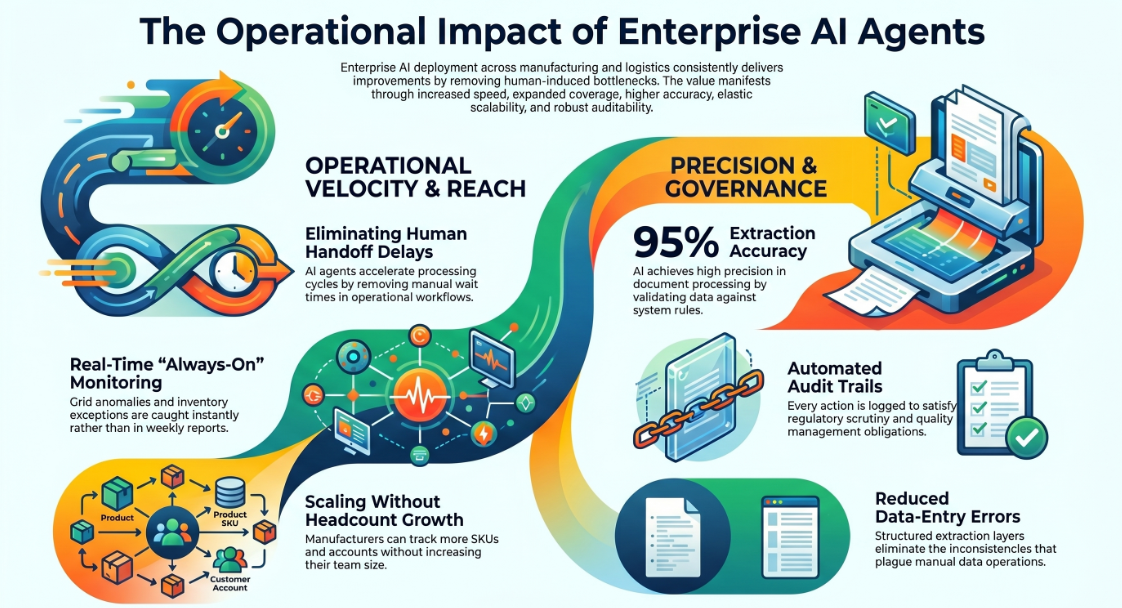
Across manufacturing, logistics, energy, and supply chain deployments, the pattern of outcomes is consistent:
Speed: Faster processing cycles are universal — whether that is order-to-confirm, RFQ turnaround, competitive response time, or maintenance resolution. AI agents eliminate the human handoff delays that account for most of the elapsed time in operational workflows.
Coverage: AI agents provide always-on monitoring that human teams cannot sustain. Competitive pricing shifts, grid anomalies, inventory exceptions, and energy inefficiencies are caught in real time rather than surfacing in weekly reports.
Accuracy: Structured extraction, validation against system rules, and governance layers reduce the data-entry errors and inconsistencies that plague manual operations. In document processing deployments, extraction accuracy targets of 95% for standard formats have been achieved.
Scalability: AI agents allow manufacturers to scale operational coverage — more stores monitored, more accounts covered, more SKUs tracked — without proportional headcount growth. Multiple deployments have demonstrated higher coverage without increasing team size.
Auditability: Every action taken by a governed AI agent is logged. This matters for manufacturing operations that face regulatory scrutiny, financial audit requirements, or quality management obligations.
How AI Agents Work in a Manufacturing Environment
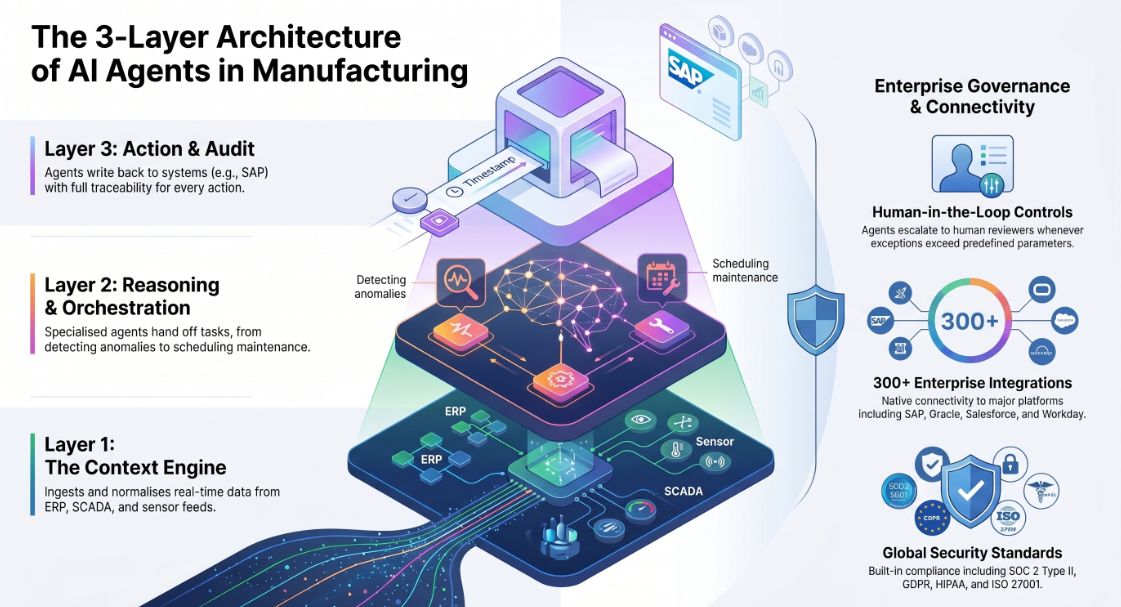
Understanding the architecture helps manufacturing leaders evaluate what is required to deploy AI agents successfully.
Layer 1 — Context Engine: The foundation is the ability to connect to and reason across your existing data sources — ERP systems, SCADA platforms, sensor feeds, warehouse management systems, procurement databases, and unstructured documents. A context engine ingests, normalises, and makes this data available to agents in real time. Without this layer, agents work only on the data they can see directly, severely limiting their utility.
Layer 2 — Agent Reasoning and Orchestration: Individual agents are configured with objectives (monitor this KPI, process this document type, respond to this class of query), tools (APIs, system integrations, calculation engines), and governance rules (escalation thresholds, approval requirements, exception handling). Multi-agent orchestration allows specialised agents to hand off to each other — a monitoring agent detects an anomaly, triggers a procurement agent to check parts availability, which in turn triggers a maintenance scheduling agent.
Layer 3 — Action and Audit: Agents do not just surface information — they write back to systems. Creating SAP records, updating CRM fields, sending structured alerts, triggering workflow approvals. Every write-back action is logged with full traceability, supporting audit requirements and human oversight.
Human-in-the-loop controls sit at every layer. Agents operate autonomously within defined parameters and escalate to human reviewers when exceptions exceed those parameters. This is the governance architecture that makes enterprise AI agents deployable in regulated or high-stakes manufacturing environments.
assistents.ai's platform connects to 300+ enterprise systems — including SAP, Oracle, Salesforce, ServiceNow, Microsoft, and Workday — and is built on this three-layer architecture with SOC 2 Type II, GDPR, HIPAA, and ISO 27001 compliance built in.
Challenges in Deploying AI Agents in Manufacturing (and How to Address Them)
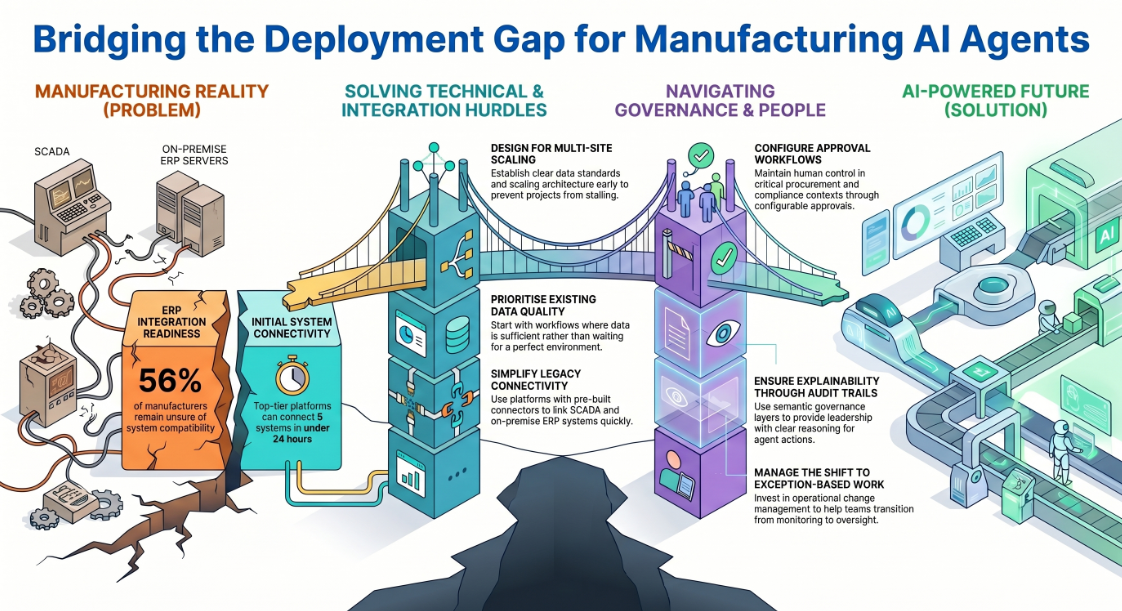
ERP and system readiness: Research shows that 56% of manufacturers are unsure whether their existing ERP systems are ready for full AI integration. The answer to this challenge is not to wait for a perfect data environment — it is to start with the workflows where data quality is sufficient and build governance infrastructure incrementally. Most enterprise AI agent platforms, including assistents.ai, are designed to work with imperfect, distributed data environments.
Change management: AI agents change how operational teams work. The shift from manual monitoring to exception-based management requires clear communication about what the agent handles, what escalates to humans, and how performance is measured. Deployments that invest in operational change management alongside technical implementation see faster adoption.
Governance and explainability: Manufacturing leadership needs to know why an agent took an action — particularly in procurement, compliance, and quality contexts. Agents with semantic governance layers, audit trails, and configurable approval workflows address this requirement directly.
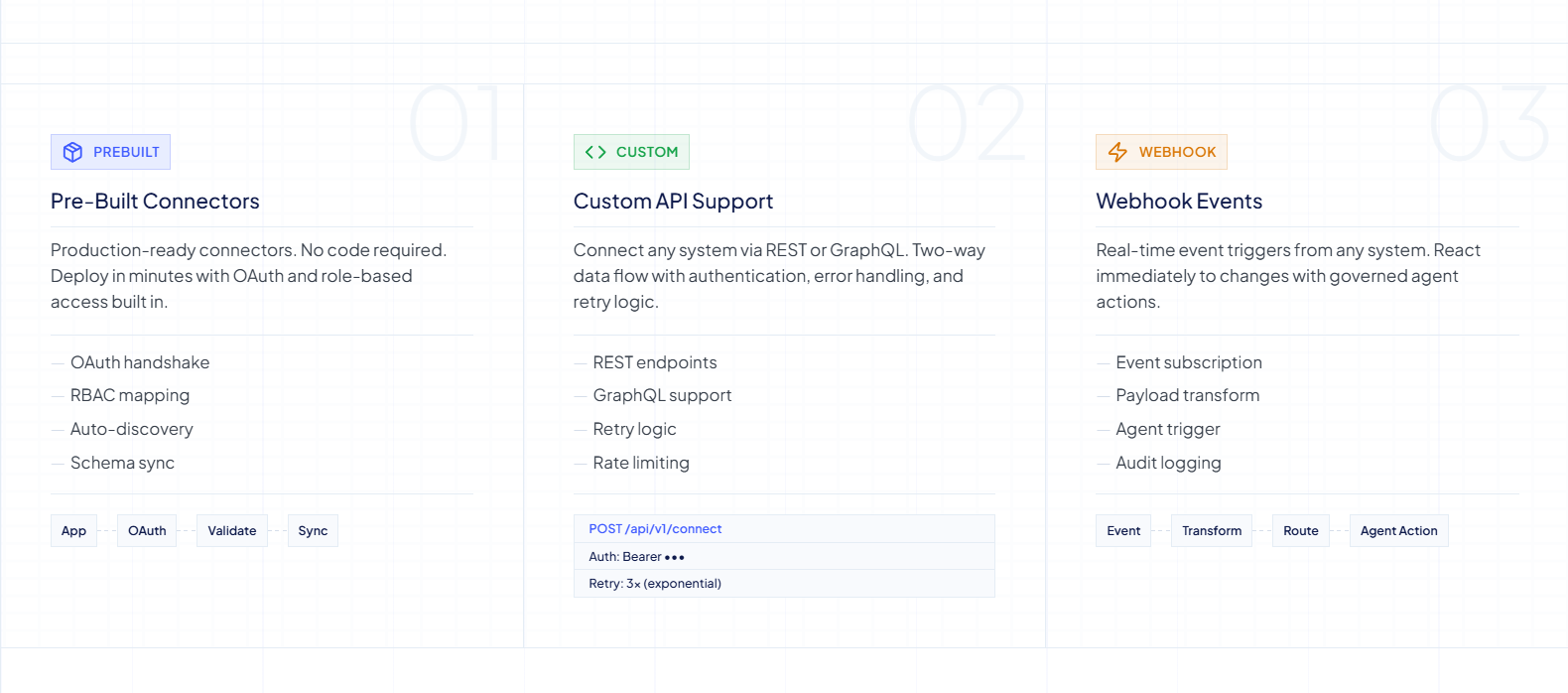
Integration complexity: Connecting agents to legacy systems — older SCADA platforms, on-premise ERP instances, proprietary sensor networks — requires a platform with pre-built connectors and the ability to handle custom integrations. Most customers connecting to their first five systems through a well-architected platform can do so within a day.
Scale-up from PoC: Many manufacturing AI projects stall after a successful proof of concept because the path to production deployment across multiple sites or systems is unclear. A deployment roadmap with defined governance, data standards, and scaling architecture prevents this.
Implementation Roadmap: From Pilot to Production
Phase 1: Discover (Weeks 1–2)
Identify the one or two operational workflows with the clearest ROI signal — typically the intersection of high process volume, significant manual effort, and measurable output metrics. Common starting points in manufacturing: predictive maintenance alerting, order processing automation, or competitive pricing monitoring. In a focused discovery session, you can map the workflow, identify data sources, and build a custom proof-of-concept plan with ROI projections and integration requirements.
Phase 2: Build (Weeks 3–6)
Deploy the agent in a sandbox environment connected to real data sources. Configure objectives, governance rules, and escalation logic. Test against real operational scenarios — including edge cases and exceptions. Refine the agent's behaviour based on operational team feedback. Most well-scoped agents move from sandbox to production-ready in this window.
Phase 3: Scale (Weeks 7–16 and beyond)
Expand agent coverage — additional workflows, additional sites, additional system integrations. Introduce multi-agent orchestration where workflows span departments or systems. Add a semantic governance layer to standardise metric definitions and decision logic across the organisation. Build dashboards and reporting for leadership visibility into agent performance and business outcomes.
Getting Started with AI Agents in Manufacturing
The manufacturers who are furthest ahead in 2026 did not start with a comprehensive AI transformation programme. They started by identifying the one workflow with the clearest pain point and the most measurable outcome — and deployed a governed AI agent against it. Then they scaled.
assistents.ai deploys governed AI agents — Conversational Agents, Voice AI, Document AI, and Agentic BI — across manufacturing operations, supply chain, procurement, and logistics. The platform connects to 300+ enterprise systems, is production-proven across 12 industries and 6 continents, and is built on a three-layer architecture (Context Engine, Reasoning, Governed Execution) that gives manufacturing leaders the auditability and control they need alongside the automation they want.
In 30 minutes, you can describe your most painful operational workflow. Within 48 hours, you receive a custom proof-of-concept plan with ROI projections, integration requirements, and a deployment roadmap.
Schedule a discovery call with the assistents.ai team →
Frequently Asked Questions
What is an AI agent in manufacturing?
An AI agent in manufacturing is an autonomous software system that perceives operational data from sensors, systems, and documents, makes decisions based on configured objectives and rules, and takes actions — updating records, sending alerts, scheduling maintenance, processing orders — without requiring human input at each step. AI agents differ from chatbots (which only answer questions) and RPA (which follows fixed scripts) by their ability to reason, adapt, and execute across complex, multi-step workflows.
How is AI being used in manufacturing in 2026?
In 2026, manufacturers are using AI agents across predictive maintenance, supply chain coordination, procurement automation, energy management, competitive intelligence, smart grid operations, order processing, inventory management, and business analytics. The shift from AI as a reporting tool to AI as an operational execution layer — one that takes action, not just surface insights — is the defining transition of this period.
What is the difference between AI agents and RPA in manufacturing?
RPA follows fixed rules and breaks when conditions change. AI agents reason through variable conditions, handle exceptions, and adapt to new inputs. In manufacturing, this means RPA can automate a standard data-entry task, while an AI agent can manage the entire order-to-confirm workflow including validating exceptions, applying business rules, and escalating to humans when required.
What ROI can manufacturers expect from AI agents?
ROI varies by use case. Documented outcomes include approximately 90% faster document and tender processing, elimination of manual monitoring across competitive pricing portals, reduction in order processing errors, improved procurement cycle times, and increased operational coverage without headcount growth. The strongest ROI typically comes from high-volume, document-heavy, or monitoring-intensive workflows where the cost of manual processing is well-understood.
How do AI agents integrate with SAP and other ERP systems?
AI agents integrate with SAP and other ERP systems through pre-built API connectors and integration layers. Modern agentic AI platforms provide two-way integration — agents read context from ERP records and write actions (creating sales orders, updating records, routing approvals) back into the system with full governance controls and audit trails. Most enterprise platforms support 300+ integrations including SAP, Oracle, Microsoft, and Salesforce.
How long does it take to deploy an AI agent in manufacturing?
A focused, well-scoped AI agent can move from a defined workflow to a production-ready proof of concept in as little as two to six weeks. Broader enterprise deployments — covering multiple workflows, sites, or departments — typically run across a three-to-four-month phased programme. The critical factor is starting with a clearly defined workflow and sufficient data quality, rather than attempting to solve all operational problems simultaneously.
Can AI agents replace RPA in manufacturing?
AI agents are increasingly replacing RPA in workflows that involve variability, exceptions, or multi-step reasoning — which describes most valuable manufacturing workflows. Simple, fully structured, rules-based processes may still suit RPA. But for the majority of high-value operational automation targets in manufacturing, AI agents deliver greater scope, resilience, and ROI than RPA.
What are the most important governance features for AI agents in manufacturing?
The most important governance features are: full audit trails of every agent action, configurable escalation thresholds that route exceptions to human reviewers, role-based access controls on what data agents can read and write, semantic governance layers that enforce consistent metric and business rule definitions, and compliance certifications (SOC 2, ISO 27001) for data handling. Manufacturing environments — particularly those with regulatory, quality, or financial audit obligations — should treat governance architecture as a deployment prerequisite, not an afterthought.