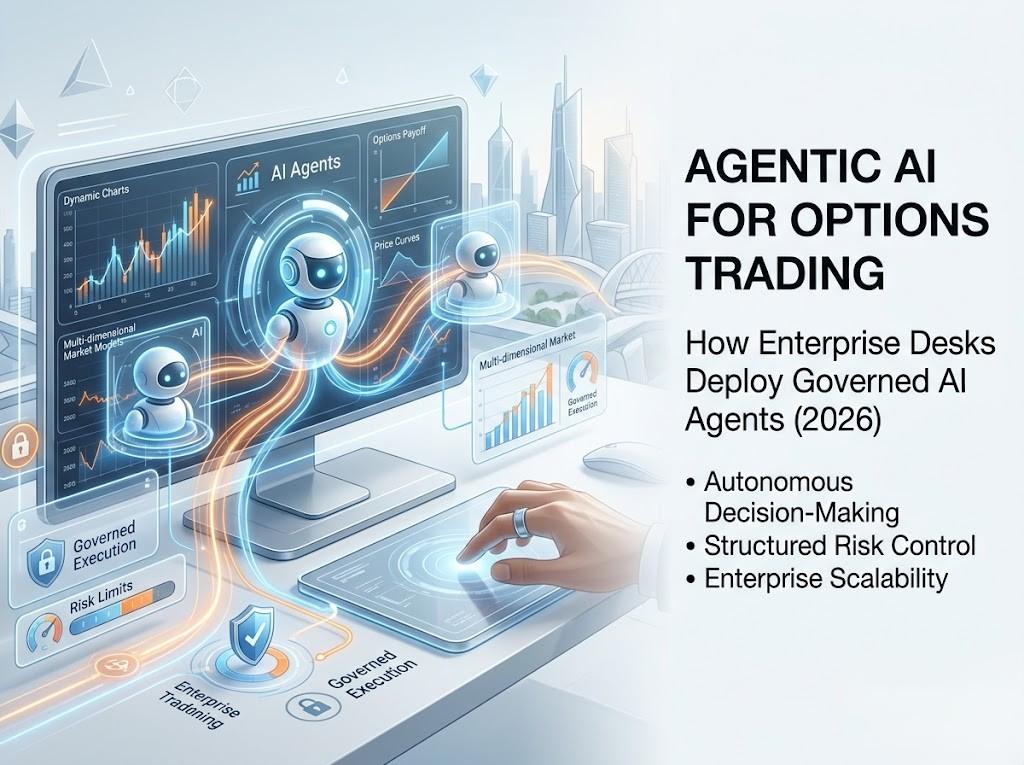
With real deployment case studies, a bounded-autonomy framework, and a phased rollout model for derivatives desks.
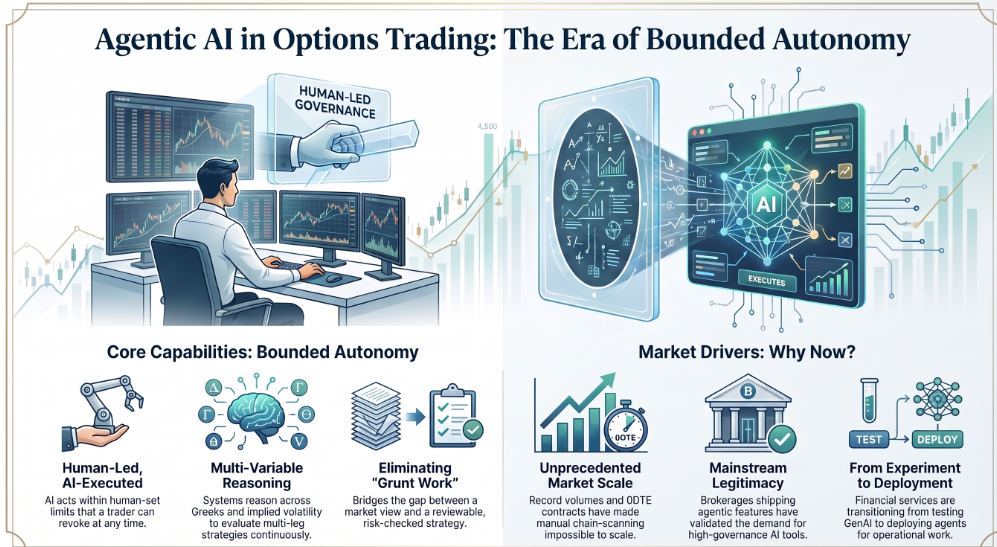
Agentic AI for options trading refers to AI systems that can read an options chain, reason across Greeks and implied volatility, construct or evaluate a multi-leg strategy, and act on it — within limits a human sets and can revoke at any time. That last part is the whole point.
Agentic AI doesn't replace a trader's judgment on a defined-risk decision; it removes the grunt work between "I have a market view" and "I have a reviewable, risk-checked strategy in front of me," and it does that continuously, across every strike and expiry a desk is watching, not just the ones a human had time to look at.
This guide covers how agentic AI actually works in an options context, how it differs from a trading bot, what guardrails a governed deployment needs, and what production deployments of this architecture look like in practice — without the return promises that show up on a lot of pages ranking for this topic.
Why This Is Surging Now
Three things are converging at once.
First, options markets have simply gotten too large and too fast to monitor by hand. Cleared U.S. options volume has set consecutive annual records, and a large and growing share of that volume — driven heavily by short-dated, zero-days-to-expiration contracts — trades and expires within a single session.
A desk watching dozens of underlyings across weekly and monthly expiries is looking at a strike-by-strike, expiry-by-expiry surface that changes shape by the minute. Spreadsheets and manual chain-scanning were already stretched before 0DTE volume became a majority of index options flow; they don't scale to it.
Second, mainstream brokerages have started shipping agentic trading features directly to customers, including for options — which has done more to legitimize the category in the last year than any vendor's marketing could. That mainstreaming cuts both ways: it proves the demand is real, and it's also produced a wave of thin, hype-driven content promising outsized returns from "autonomous" agents with no governance model behind them. Regulators have already flagged that pattern.
Third, enterprises broadly have moved from experimenting with generative AI to deploying AI agents against real operational work, and financial services is one of the sectors moving fastest — precisely because the work (continuous monitoring, multi-variable analysis, structured decision support) maps so well onto what agentic systems are actually good at.
The result is a lot of search demand and a lot of noise. Most of what's currently ranking for this topic falls into one of two camps: thin, definitional content that never gets past "what are Greeks," or hype-driven content that promises autonomous execution and eye-catching returns with no mention of how risk is actually bounded. Neither is what a real options desk, compliance function, or CTO evaluating this category needs.
Agentic AI vs. Options Trading Bots — What's Actually Different
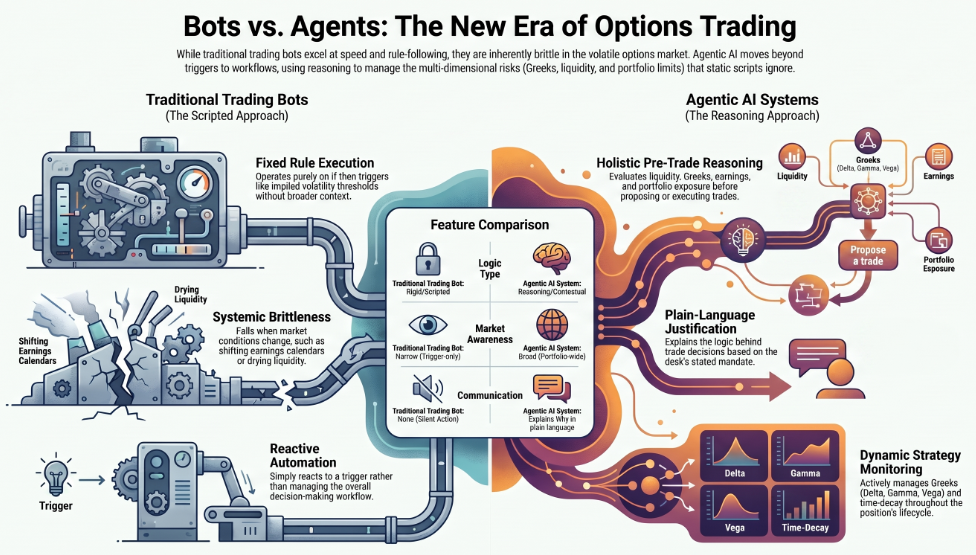
A trading bot follows a fixed rule: sell a put spread when implied volatility crosses a threshold. It's fast, it's predictable, and it's exactly as smart as the rule it was given — which means it's also exactly as brittle. It doesn't know the earnings calendar changed, that liquidity in that strike just dried up, or that the position it's about to open would push portfolio-level delta past a limit nobody told it about.
An agentic system is built to check the setup, not just the trigger. Before it proposes or acts on anything, it can reason across liquidity, expiry, strike range, delta, bid-ask spread, upcoming earnings, existing portfolio exposure, and whether the trade still fits the desk's stated mandate — then explain, in plain language, why it landed where it did. That's the practical difference between a script and an agent: a bot reacts to a trigger; an agent manages the workflow around the decision.
That distinction matters more in options than almost anywhere else in trading, because an options position isn't static the way a stock position is. Delta, gamma, theta, vega, and time-to-expiry are all moving continuously after entry — an options strategy has to be monitored, not just placed. A directional stock call can be summarized by direction, size, and exit. An options strategy also has to define contract type, structure (single-leg vs. spread vs. multi-leg), expiry, strike logic, sizing against portfolio-level risk, and exactly what happens if the position needs to be closed rather than "repaired" by quietly adding risk. That's a fundamentally more sophisticated agent architecture than most trading-bot content accounts for.
How Agentic AI Actually Works on an Options Desk
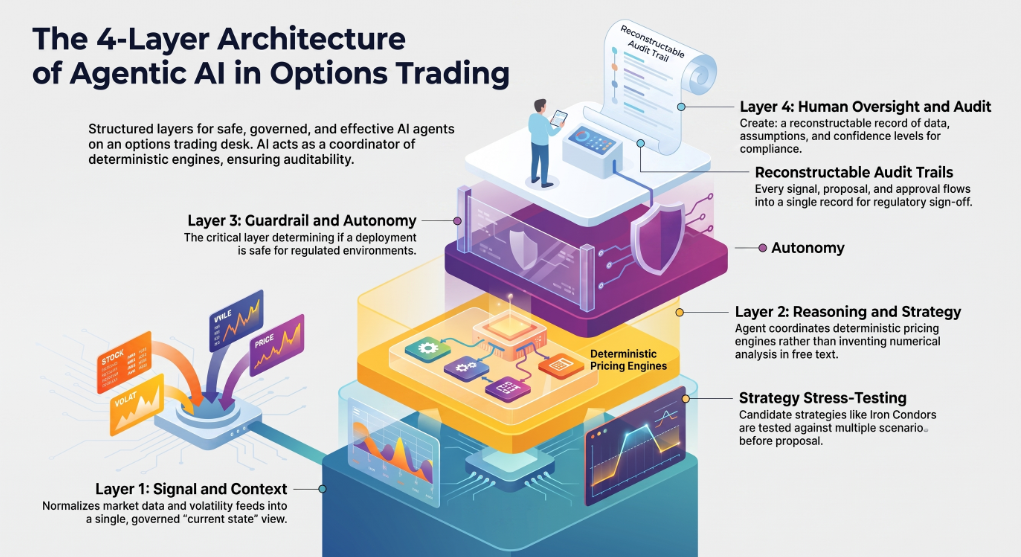
Strip away the vendor language and a governed agentic system for options trading is really four layers working together.
Signal and context layer. This is where market data, options-chain feeds, implied volatility surfaces, earnings calendars, and news are ingested and normalized into a single, governed view — the same view a human trader and the agent are both looking at, so there's no disagreement about what "current state" means. This layer also watches continuously for the things a human can't watch all day: volatility surface anomalies, skew shifts, or a position drifting toward a risk limit — and turns those into structured, evidence-backed signals rather than raw noise.
Reasoning and strategy layer. This is where Greeks are calculated, implied volatility is assessed, and candidate strategies — verticals, calendars, iron condors, straddles, whatever fits the mandate — are constructed and stress-tested against multiple scenarios before anything is proposed. Critically, in a well-architected system, agents don't invent numerical analysis in free text; they invoke deterministic pricing and risk engines and reason over structured, versioned output. That distinction — agent as coordinator, not as calculator — is what keeps the math auditable.
Guardrail and autonomy layer. This is the layer almost every piece of content on this topic underdescribes, and it's the one that actually determines whether a deployment is safe to run in a regulated environment. It's covered in detail below.
Human oversight and audit layer. Every signal, every proposed strategy, every approval or override, and every action taken flows into a single, reconstructable record — what data was used, what assumptions were made, what confidence level applied, and who (or what) made the final call. In a regulated environment, that record isn't a nice-to-have. It's the difference between a system compliance can sign off on and one it can't.
The Bounded-Autonomy Framework
The question every serious buyer eventually asks isn't "is it autonomous?" It's "autonomous to do what, within what limits, and who can shut it off?" A governed deployment answers that with an explicit autonomy contract rather than a single on/off switch.
In practice, autonomy is best modeled as a graduated set of modes, not a binary:
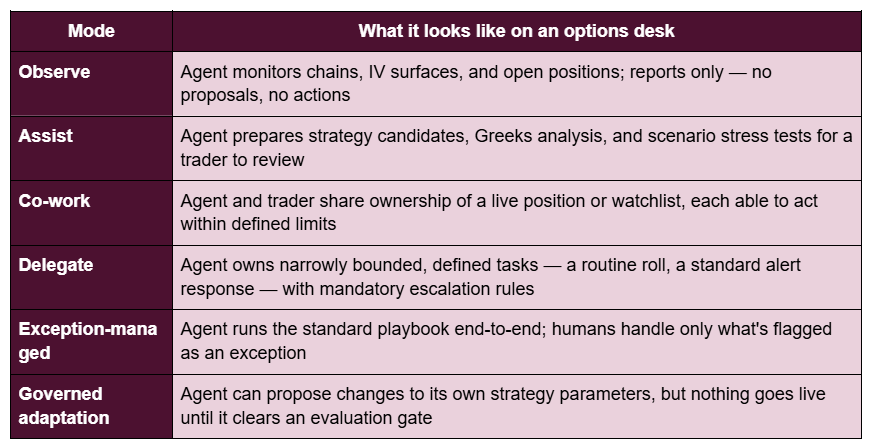
Underneath the mode sits a concrete, per-agent contract — not a vague policy document, but something closer to a configuration a risk officer could actually read and sign off on:
agent: options-desk-strategy-agent
work_type: defined_risk_spread_construction
scope:
underlyings: [approved_watchlist]
structures: [vertical, calendar, iron_condor]
permissions:
read_chain_and_iv_surface: true
propose_strategy: true
submit_order_for_approval: true
execute_without_review: false
limits:
max_risk_per_trade: <desk-defined>
portfolio_delta_band: <desk-defined>
max_new_positions_per_day: <desk-defined>
escalate_when:
- liquidity_below_threshold
- earnings_within_window
- confidence_below_0_80
- portfolio_limit_breach_risk
valid_until: <review date>
And no agent should reach live execution without moving through a defined sequence: offline evaluation → historical replay → simulation → shadow mode → human-approved execution → a limited live canary → wider bounded operation → continuous monitoring, with rollback triggers agreed on in advance. Skipping straight to "autonomous execution" — which is exactly what a lot of hype-driven content on this topic implies is normal — is the single biggest red flag in this category. Institutional risk officers interviewed on this exact question have made the point directly: the biggest shift agentic tools introduce isn't "answer risk," it's "action risk" — and the desks that get this right are the ones that can say, at any point, who owns the model, who owns the outcome, and who has the authority to switch the system off.
Case Study: Governed Strategy Automation for a Trading Terminal
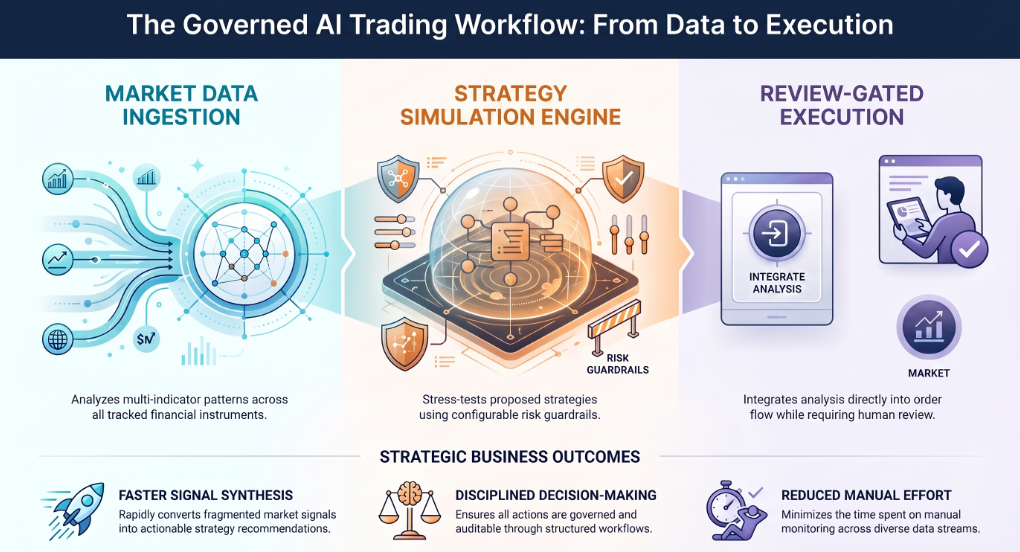
A European-built AI-first trading terminal set out to combine research, market analysis, signal generation, and execution into a single governed workflow for institutional and professional traders — rather than shipping yet another disconnected set of alerts and a separate order screen.
The underlying agentic infrastructure covered:
- Market data ingestion with multi-indicator and pattern analysis across the terminal's tracked instruments
- A strategy simulation engine with configurable risk guardrails, so proposed strategies were stress-tested before ever reaching a trader
- Alerting and recommendation summaries built for trader review, not silent execution
- Execution-ready workflow integration connecting analysis directly to order flow, without collapsing the review step in between
The deployment wasn't options-specific — it spanned the terminal's broader instrument set — but the architecture is asset-class agnostic by design. Market-data ingestion, strategy simulation with guardrails, and review-gated execution work the same way whether the desk is watching a futures curve, a spot market, or an options chain. That portability is exactly what a governed agentic platform is supposed to deliver.
Results: faster synthesis of fragmented market signals into actionable strategy recommendations, more disciplined decision-making through governed and auditable workflows, and reduced manual monitoring effort across data streams. No performance or return figures are part of this case study, by design — the value delivered was in workflow quality and decision discipline, not a promised outcome.
Case Study: Research Automation for a Market-Research Platform
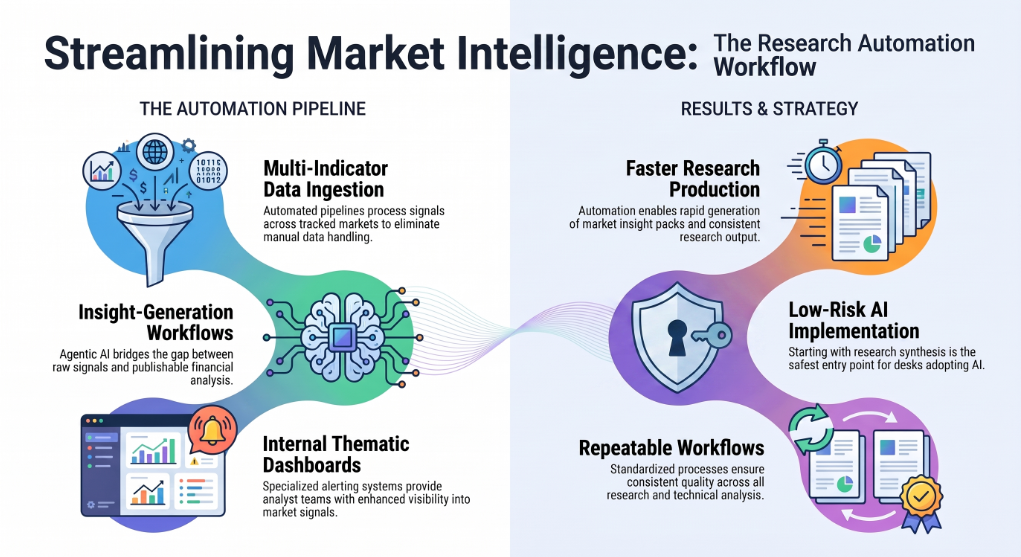
A market research and technical-analysis platform built to publish forecasts and actionable insights for equity markets faced a different bottleneck: not execution, but the sheer manual effort of turning raw market data into a consistent, repeatable stream of research output.
The deployment covered:
- Data ingestion pipelines with multi-indicator processing across tracked markets
- Research automation and insight-generation workflows that reduced the manual step between raw signal and publishable analysis
- Alerting and thematic dashboards built for the platform's analyst teams, not end-consumers
Results: faster production of market insight packs, more repeatable and consistent research workflows, and better signal visibility through automated analytics.
This is the other half of what "agentic AI for options trading" should mean in practice for most desks: before an agent ever touches an order, it's already doing real work synthesizing volatility, flow, and technical signals into research a human can act on faster. For a desk evaluating this category, that's also the lowest-risk place to start — see the phased approach below.
Why Assistents.ai: Built as a Platform, Not a Point Tool
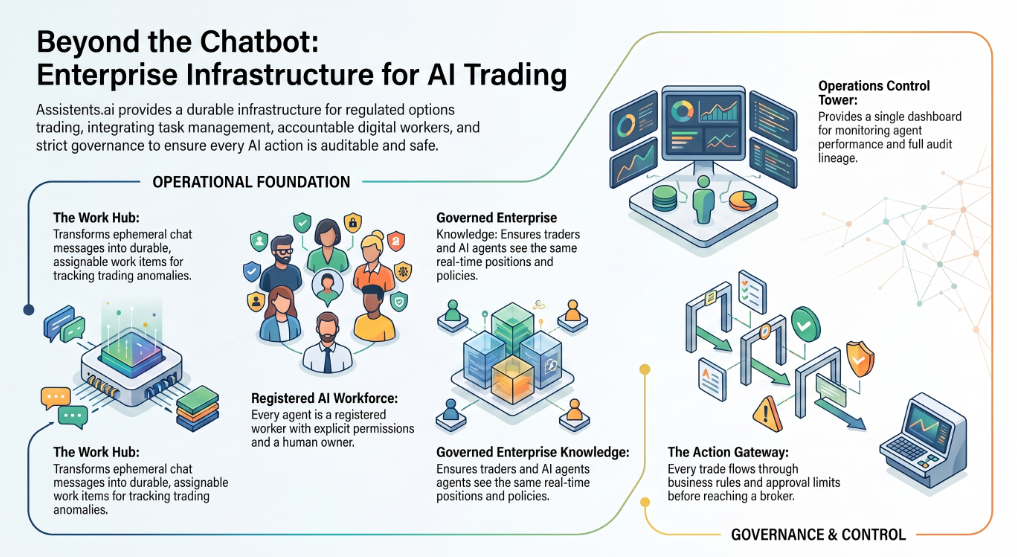
Most of what's marketed as "AI for trading" is a model wrapped in a prompt and connected to a broker API. That's a demo, not infrastructure a compliance function can approve. assistents.ai is built around five components that map directly onto how an options desk actually needs to operate:
Work Hub. A flagged IV-skew anomaly, a position that needs to be rolled before expiry, a strategy proposal awaiting review — these become durable, assignable work items, not messages that evaporate at the bottom of a chat window. Nothing depends on a human remembering to check back.
AI Workforce. Every agent on the desk is a registered digital worker with a defined role, explicit permissions, a certification and performance history, and a human owner — not an anonymous script running against an API key. When something goes wrong, there's a specific agent, with a specific authority envelope, to review.
Enterprise Knowledge. The trader and the agent see the same governed view of positions, policies, market context, and history. An agent that's reasoning from a stale or partial picture of the portfolio is a liability regardless of how good its Greeks calculations are — this layer exists specifically to prevent that.
Action Gateway. Nothing reaches a broker, a pricing engine, or an order management system directly from a model's output. Every action flows through registered capabilities, business rules, approval limits, and verification — the same discipline a bank applies to a payment, applied to a trade.
Operations Control Tower. One place to see what every agent on the desk is doing, what it's authorized to do, what it has done, and whether the outcome matched intent — with full audit lineage available the moment compliance asks for it.
This isn't a repackaged chatbot with trading vocabulary. It's the same governed work-and-workforce architecture assistents.ai has already put into production across research automation, risk monitoring, and workflow orchestration for regulated and unregulated enterprises alike — applied here to the specific shape of an options desk's work.
Is This Safe? Is It Legal? Does It Replace Traders?
These are the three questions underneath almost every search for this topic, and they deserve direct answers rather than reassurance.
Is it legal? Automated and algorithmic trading is broadly permitted for both retail and institutional accounts, subject to standard regulatory requirements and broker-specific policy — agentic systems don't sit outside that framework, they operate inside it. What regulators and exchanges have flagged isn't the technology itself; it's ungoverned deployments that can't explain their own decisions or be shut off cleanly.
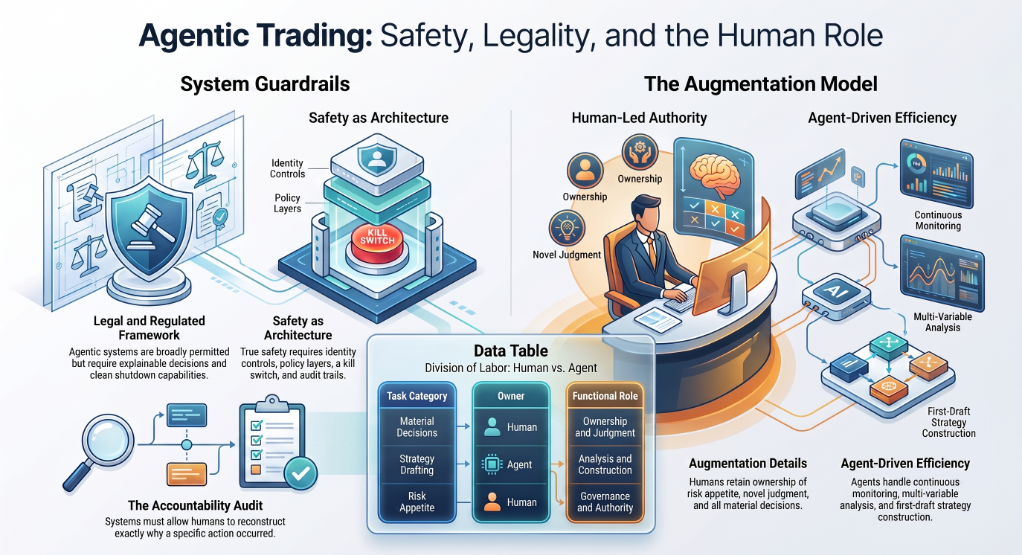
Is it safe? Safety in this category isn't a property of the model — it's a property of the architecture around it. Identity and access controls that define exactly what an agent can touch; policy layers that separate technical authorization, business rules, and runtime guardrails; a kill switch that actually works; and an audit trail that lets a human reconstruct why a specific action happened. A system without those isn't a safer or more advanced agent — it's an ungoverned one wearing agentic branding.
Does it replace traders? No, and a platform claiming otherwise should be treated skeptically. The realistic, defensible framing — and the one this piece has used throughout — is augmentation under human authority: agents absorb the continuous monitoring, multi-variable analysis, and first-draft strategy construction; humans retain ownership of risk appetite, novel judgment calls, and every material decision. That's not a limitation of the technology. It's what makes it usable in a regulated environment at all.
Why Assistents.ai: What Makes the Governance Durable
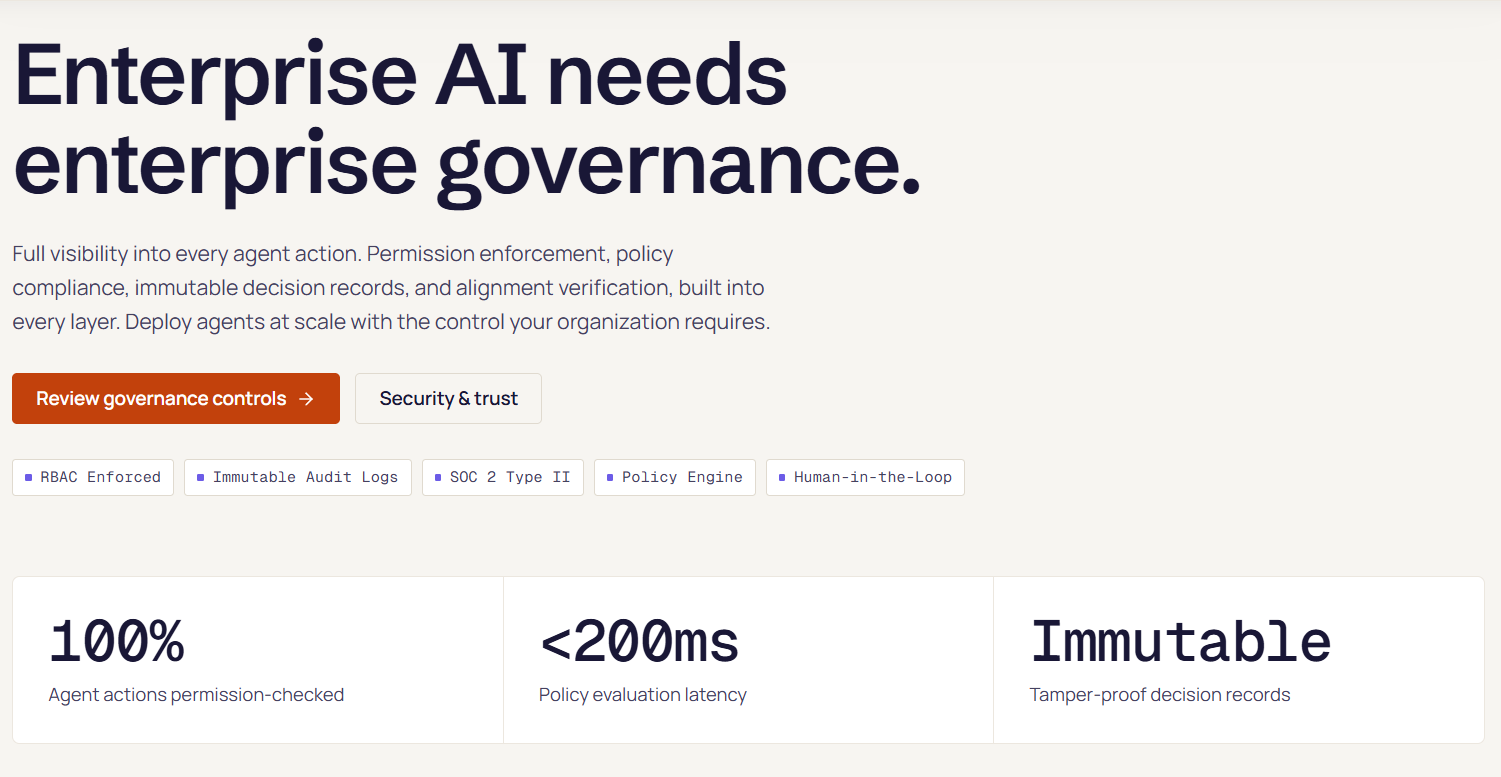
Anyone can claim "enterprise-grade" and "governed." What actually makes it defensible is harder to fake.
Production deployments, not pilots. The case studies above aren't proof-of-concept demos — they're live systems handling real market data and real workflows, and they sit alongside deployments in adjacent regulated domains: banking compliance workflows, financial due diligence, and portfolio risk monitoring. The governance muscle isn't specific to one use case; it's the same underlying discipline applied consistently.
Customer-controlled deployment. For regulated and infrastructure-sensitive enterprises, where and how data is processed isn't negotiable. Private and customer-controlled deployment options exist specifically because "trust us" isn't an acceptable answer for a compliance function.
Model-neutral architecture. The platform isn't built around a single model provider, which matters for two reasons: it avoids lock-in, and it means governance, permissions, and audit logic live in the platform layer — not inside a prompt that changes behavior every time the underlying model is updated.
An evidence trail, not a demo. The value case above is built entirely on qualitative, auditable outcomes — faster synthesis, more disciplined decisions, better signal visibility — because that's what the underlying case studies actually support. No invented return figures, no "outperforms human traders" claims. In a category with more than its share of unsubstantiated performance promises, that restraint is itself a trust signal.
A Phased Way to Start
The desks that get the most value out of this category don't start with execution — they start where the risk is lowest and the payoff is still real.
- Start in Observe or Assist mode on a bounded, non-execution use case — IV-surface monitoring or research-and-signal automation, for example. This is exactly what both case studies above demonstrate, and it requires no change to how orders actually get placed.
- Move to Co-work on a narrow, well-understood strategy type once the agent's reasoning has been reviewed against real market conditions in shadow mode.
- Expand to Delegate or Exception-managed only after an evaluation gate — backtested, replayed against historical data, and run in parallel with human oversight before any bounded autonomy is granted.
- Treat every expansion of scope as a new autonomy contract, not an assumed upgrade — new underlyings, new structures, or higher limits each warrant their own review.
This mirrors how the underlying platform architecture is meant to be adopted generally: one well-scoped use case first, expanded deliberately once it's proven, rather than a wholesale replacement of how the desk operates on day one.
Evaluating Agentic AI for Your Options Desk?
assistents.ai builds governed AI agents for trading operations, research automation, and risk workflows — with the audit trails, approval gates, and customer-controlled deployment options regulated desks require. If your team is evaluating where agentic AI fits your specific workflow, we work through a structured discovery process to assess fit before any commitment.
FAQs
Is agentic AI trading legal?
Yes. Algorithmic and AI-assisted trading is permitted for both retail and institutional accounts under standard securities regulations, subject to broker policies and suitability requirements. The legal question isn't whether AI can be involved — it's whether the deployment can explain and audit its own decisions.
Can AI agents trade options autonomously, or do they need approval?
They can operate at different levels of autonomy depending on the contract set for them — from observation-only, to proposing trades for human approval, to bounded execution within tightly defined limits. Full, unreviewed autonomy on execution is rare in serious deployments and isn't recommended without an extended evaluation history.
What's the difference between agentic AI and an algorithmic trading bot?
A bot follows a fixed rule and reacts to a single trigger. An agentic system reasons across the full setup — liquidity, expiry, strikes, portfolio exposure, and market context — before proposing or acting, and can explain its reasoning in plain language.
What guardrails should an AI options trading agent have?
At minimum: position and risk limits, mandatory escalation triggers, a working kill switch, human approval gates for higher-risk actions, and a complete, reconstructable audit trail of every decision and action.
Is agentic AI safe for options trading?
Safety comes from the governance architecture around the agent, not the model itself — identity and permission controls, layered policy enforcement, and auditability. A system without those controls carries meaningfully more risk regardless of how capable the underlying model is.
Do AI trading agents actually improve outcomes, or is it hype?
The credible evidence is in workflow quality, not promised returns: faster signal synthesis, more consistent research output, and more disciplined, auditable decision-making. Be skeptical of any platform citing specific return percentages without published, audited performance data behind them.
How should an options desk start with agentic AI without losing control?
Begin with observation and research-automation use cases that don't touch execution, move to shared or delegated work only after evaluation in shadow mode, and treat every expansion in scope as a new, reviewable autonomy contract rather than an assumed upgrade.