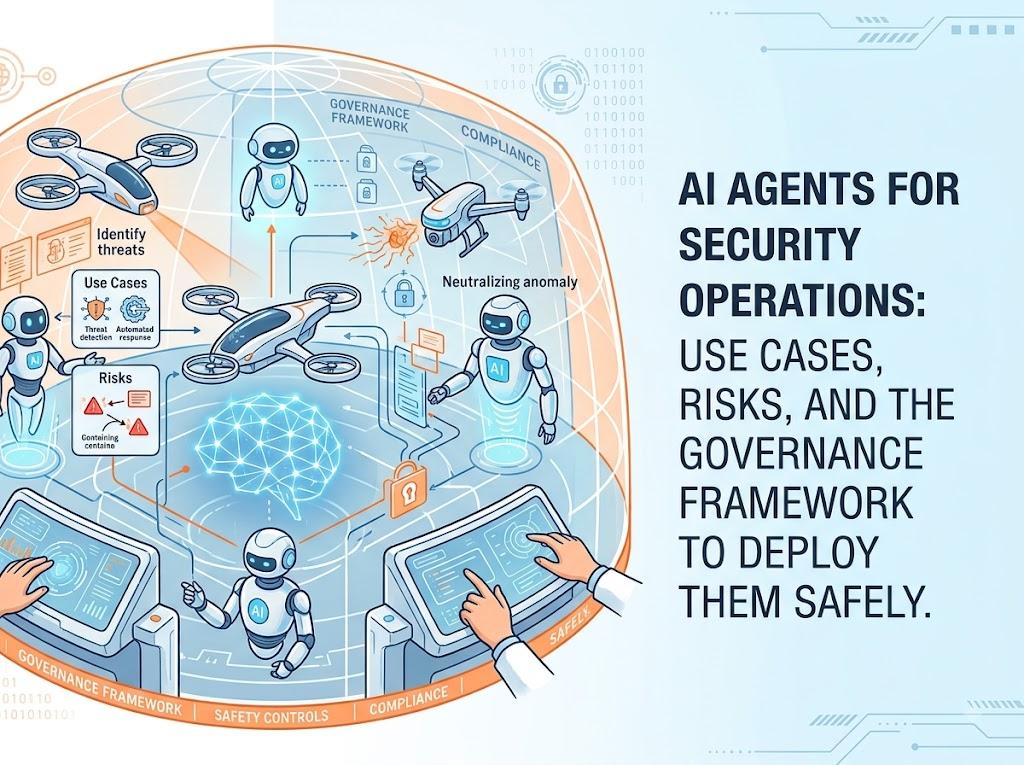
Security teams have a math problem before they have a technology problem. Alert volumes keep climbing, analyst headcount doesn't, and the gap gets filled by the same thing every year: longer queues, more burnout, and a growing list of alerts nobody ever actually looked at.
AI agents are the current answer to that math problem. Not chatbots that summarize a log file when asked, but systems that can ingest a signal, pull context from across the stack, reach a judgment, and take a bounded action — on their own, inside limits a human has already approved.
That shift is genuinely useful. It's also creating a second, quieter problem: a security operations center that hands off real work to autonomous software needs a way to know, at any moment, what every agent is allowed to do, what it actually did, and who's accountable for the outcome. Most of what's written about AI agents in security operations covers the first problem in detail and treats the second as a footnote. This piece covers both.
In short
- AI agents for security operations are autonomous systems that investigate, enrich, and act on security signals within limits a human has set — distinct from copilots that only respond when asked.
- The highest-value use cases today cluster around six stages of the alert lifecycle: ingestion, context enrichment, triage, containment, documentation, and post-incident learning.
- The risk that gets the least attention is agent sprawl — agents accumulating access and autonomy without a central inventory, identity model, or audit trail.
- A workable governance model needs three things: identity for every agent (not just every human), policy that scopes what an agent can do by work type and not just by login, and an audit trail that survives a compliance review.
- Autonomy should be treated as a bounded contract, not a switch — most security teams are better served starting at Observe or Assist and earning their way to Delegate.
What "AI agents for security operations" actually means
An AI agent for security operations is software that can interpret a security signal, decide what to do about it, and act — inside defined guardrails — without a human initiating every step. That's the line that separates it from a copilot. A copilot drafts a summary when an analyst asks for one. An agent picks up an alert on its own, gathers the evidence, reaches a conclusion, and either acts or escalates.
The distinction matters because the two categories carry very different risk profiles. A copilot that gets something wrong produces a bad suggestion a human can ignore. An agent that gets something wrong can take an action — isolate a host, revoke access, close a case — before anyone reviews it. That's exactly why governance belongs in the same conversation as capability, not in a separate one that happens later.
Why this is happening now
Three pressures are converging at once. Alert volume keeps growing faster than teams can hire. The security talent market hasn't closed the gap — Tier 1 analyst roles are some of the hardest in the industry to keep staffed. And the threat side of the equation is automating too, which means defenders working at human speed are increasingly outpaced by attacks that don't wait for business hours.
Analyst research now tracks "AI SOC agents" as their own category, distinct from the SIEM, SOAR, and XDR platforms that came before them — a sign this has moved past early experimentation into something enterprises are actively budgeting for. At the same time, standards bodies have started publishing specifically about the risk side: NIST's AI Agent Standards work names interoperability, identity, and authorization as foundational requirements for trusted agent adoption, and OWASP's agentic AI research has published a named set of risks — goal hijacking, tool misuse, identity and privilege abuse, memory poisoning, cascading failures, and rogue agents — that don't have close analogues in traditional application security. Adoption and governance are accelerating together, not in sequence, and any deployment plan that treats them as separate phases is already behind.
The AI agents security teams are deploying today
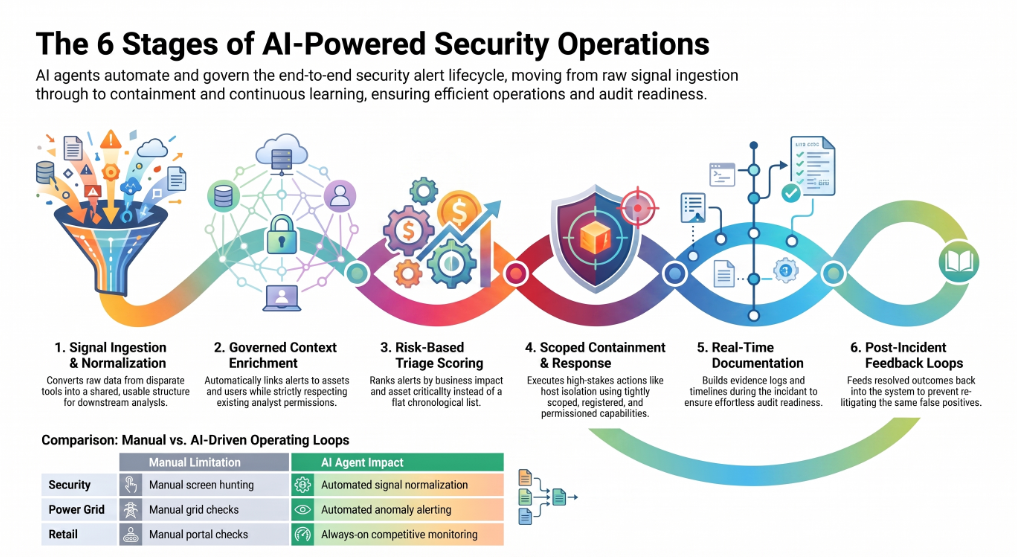
Most real deployments break down into six functions, mapped to where they sit in the alert lifecycle rather than to any one product category.
Signal ingestion and normalization
Before an alert can be triaged, it has to exist in a consistent, usable form. Agents at this stage pull from ticketing systems, monitoring dashboards, and endpoint tools, and normalize what they find into a shared structure everything downstream can work from — the unglamorous plumbing that, done badly, is the reason analysts spend half their day just finding the right screen.
Context enrichment
A raw alert without context is close to useless. An enrichment agent connects that alert to the asset it touched, the user behind it, and every prior incident that looks similar — and, critically, does it without requiring an analyst to have permission-appropriate access to five different systems first. This is where a governed knowledge layer earns its keep: the agent should only ever be able to surface what the requesting analyst is already entitled to see.
Triage and risk scoring
Once an alert has context, it needs to be ranked. A triage agent weighs business impact, asset criticality, and behavioral deviation from baseline, and routes the result into a prioritized queue instead of a flat, chronological list. This is also where a durable work model matters more than it sounds like it should: an alert that gets triaged and then forgotten because nobody owns the resulting task is not actually triaged.
Containment and response
This is the highest-stakes stage, and the one where the gap between "the agent works" and "the agent is governed" shows up fastest. A containment agent should never hold a standing, shared credential to the systems it acts on. Every action — isolating a host, disabling an account, blocking an indicator — should flow through a registered, permissioned capability with limits attached, so that what the agent can do is scoped as tightly as what a human in the same role could do, not more.
Documentation and audit
Post-incident documentation is usually the first thing to slip when a team is under pressure, which is exactly why it should be the most automated part of the process, not the most manual. An agent that builds the evidence log and the action timeline as the incident happens — instead of reconstructing it afterward — turns audit readiness from a scramble into a byproduct of normal operations.
Post-incident learning
The least-built stage, and the one that compounds. Feeding resolved-incident outcomes back into how future alerts get scored and routed is what separates a team that gets faster over time from one that re-litigates the same false positives every quarter.
Proof this pattern holds outside a security context: the monitor-detect-alert-route-resolve loop above isn't hypothetical — it's the exact operating pattern assistents.ai has already run in production for a state-level power transmission utility, where continuous grid monitoring and automated anomaly alerting replaced manual checks and cut the time to identify operational exceptions. The same pattern, applied to store-level pricing and inventory signals, gave a pan-India retail chain running 700+ stores always-on competitive monitoring that used to require manual portal checks across hundreds of locations. Different domain, same operating loop: signals in, context added, exceptions surfaced, action taken, audit trail left behind.
The problem most guides skip: governing the agents, not just deploying them
Almost everything written about AI agents in security operations describes what they do. Very little of it addresses what happens once dozens of them are running in production at once.
Agent sprawl is the practical version of this risk: agents created by different teams, with different levels of access, and no single inventory of what exists, what each one can touch, or who's responsible for it. It's the same blind spot organizations spent the last decade closing for human accounts, reopened for a new kind of identity that nobody's used to auditing yet.
OWASP's agentic AI research names the specific failure modes worth planning for before they happen rather than after: an agent pursuing a subtly wrong version of its goal, an agent misusing a tool it technically had permission to call, an agent's memory or context being poisoned by manipulated input, one agent's failure cascading into others it coordinates with, and — the scenario security leaders worry about most — an agent operating outside its intended purpose while technically staying within its granted credentials.
None of these are solved by better detection models. They're solved by treating an agent the way a mature security program already treats a privileged human account: with an identity, a defined scope, continuous monitoring for deviation from that scope, and a fast way to shut it down.
A governance framework for AI agents in security operations
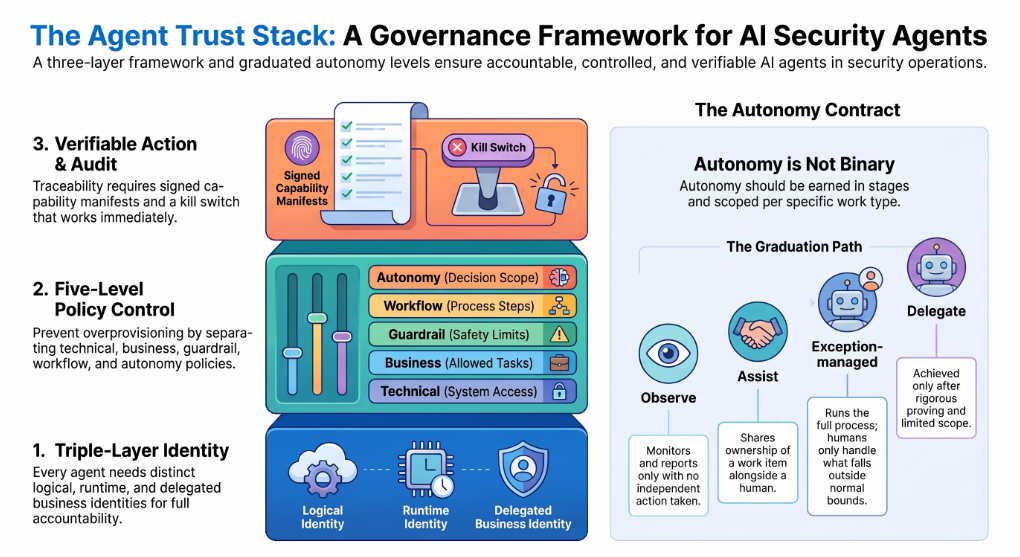
Call it the Agent Trust Stack: three layers that turn "we have agents in the SOC" into "we can prove, at any moment, what every agent is allowed to do and what it actually did."
Layer 1: Identity
Every agent needs three distinct identities, not one:
- Logical agent identity — the registered agent, its role, and its owner. Who is accountable if this agent makes a bad call?
- Runtime workload identity — the actual process or service executing the agent's work, attestable independently of the logical identity above it.
- Delegated business identity — the human or business role the agent is acting on behalf of in a given task, so every action traces back to a person or a policy, not just to a piece of software.
Layer 2: Policy
Policy has to operate at five separate levels, because collapsing them into one is how overprovisioning happens:
- Technical authorization — what systems and data the agent can reach at all
- Business policy — eligibility, limits, and approval requirements for the specific action
- Runtime guardrails — protection against prompt injection, sensitive data exposure, and unsafe tool arguments
- Workflow control — required stages, accountability checkpoints, and segregation of duties
- Autonomy policy — the specific envelope the agent is allowed to operate within for this work type
Layer 3: Action and audit
Every agent action should be traceable: least-privilege, time-bound permissions; signed capability manifests so an agent can't invoke a tool it wasn't explicitly granted; full lineage across the model, prompt, tool, and policy version in effect at the time of the action; and a kill switch that works immediately, not eventually.
Autonomy is a contract, not a toggle
The single most common governance mistake is treating autonomy as binary — an agent is either fully autonomous or it isn't. In practice, autonomy should be scoped per work type, and it should be earned in stages:
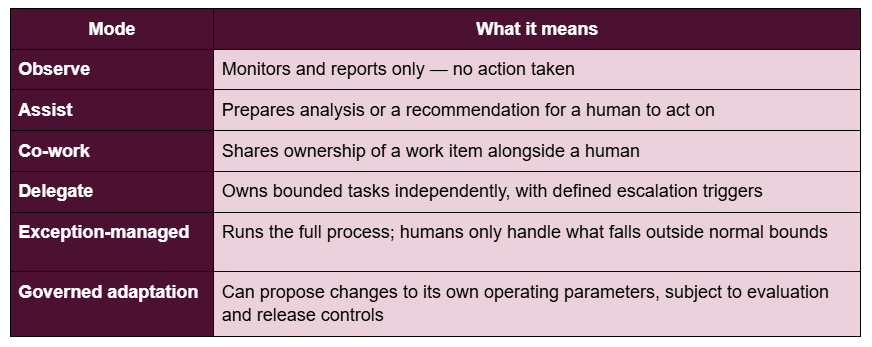
A new agent in a security operations context should almost always start at Observe or Assist, move to Co-work once its judgment has been validated against real cases, and only reach Delegate or Exception-managed for narrowly scoped, low-blast-radius work types — with clear, named triggers (a disputed action, a low-confidence score, a first-time scenario) that automatically pull a human back in.
Why assistents.ai for governing AI agents in security operations
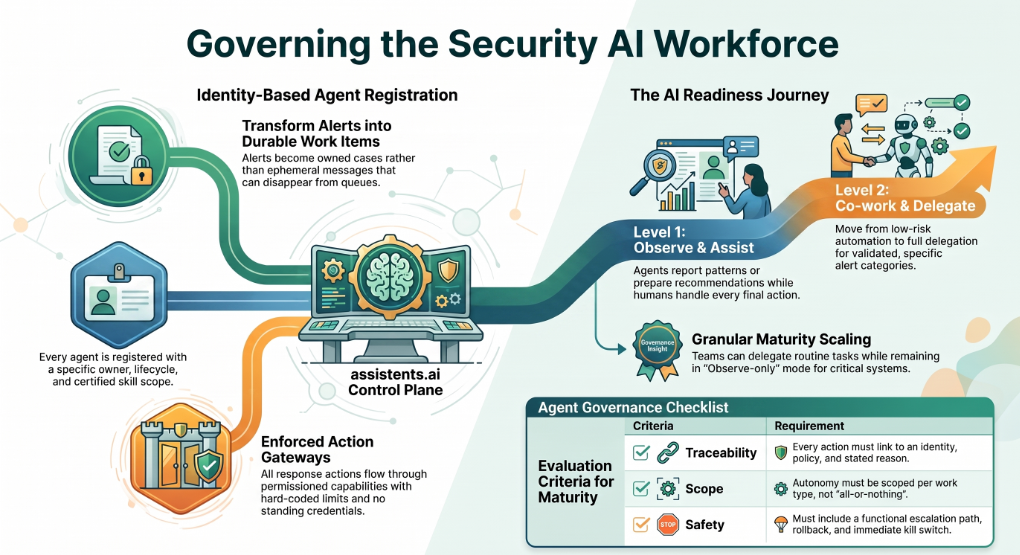
assistents.ai wasn't built as a threat-detection engine, and it doesn't try to be one. What it's built to be is the governed control plane underneath the agents a security team is already running — whether those agents were built in-house, sourced from a specialized security vendor, or assembled inside assistents.ai itself.
That maps directly onto the framework above:
- Work Hub turns every alert into a durable, owned work item — a case, not a message that can quietly disappear from a queue.
- AI Workforce registers every agent with an owner, a lifecycle, and a certified scope of skills, the same way a mature organization already tracks its privileged human accounts.
- Enterprise Knowledge gives enrichment agents permission-aware access to the context they need, without ever surfacing what the requesting analyst isn't already entitled to see.
- Action Gateway is the enforcement point: no agent holds a standing shared credential or an ungoverned write path. Every containment or response action flows through a registered, permissioned capability with limits attached.
- Operations Control Tower gives security leadership one place to see what every agent — human or digital — is doing, in real time, with the audit trail already built rather than reconstructed after the fact.
This is the same governed operating model already proven outside cybersecurity: a global fintech provider serving banks and credit unions runs its omnichannel dispute and fraud workflows through this pattern today, with auditability and SLA monitoring built into the workflow itself rather than bolted on for compliance reviews. That's the same accountability a security operations center needs when the alert queue is being worked by software instead of — or alongside — a person.
How mature is your security team's AI readiness?
Before choosing where to start, it's worth being honest about where the team actually is:
- Still standardizing playbooks? Start at Observe. Let agents watch the queue and report patterns before they touch anything.
- Playbooks are solid, but every alert is handled ad hoc? Assist is the right entry point — let an agent prepare the enrichment and recommendation, and keep a human on every action.
- Comfortable with recommendations, want faster resolution on routine cases? Co-work, with a small, explicitly scoped set of low-risk work types, is the next step.
- Already running consistent, validated playbooks for a specific alert category? Delegate for that category alone — not as a blanket policy — with hard limits and clear escalation triggers.
Maturity is per work type, not organization-wide. A team can run Delegate on routine phishing triage and Observe-only on anything touching production financial systems, at the same time, without contradiction.
How to evaluate AI agents for a security operations use case
A short checklist worth running against any option — including assistents.ai:
- Does it integrate with what you already run, or does it require ripping out existing tools?
- Can every action the agent takes be traced back to an identity, a policy, and a stated reason?
- Is autonomy scoped per work type, or is it effectively all-or-nothing?
- What happens when the agent gets it wrong — is there a real escalation path, a rollback, and a kill switch that works immediately?
- Who inside the organization owns this agent — not who purchased it, but who's accountable for what it does?
If a vendor can't answer the last two questions clearly, the autonomy on offer is probably narrower than the demo suggested.
assistents.ai vs. point-solution AI SOC agents
This isn't a build-or-buy decision, and treating it like one is the wrong frame. Specialized AI SOC platforms are genuinely good at what they're built for — deep SIEM and EDR integration, threat intelligence correlation, and investigation workflows tuned specifically for cyber threats. assistents.ai isn't trying to out-detect a purpose-built threat-detection engine, and any vendor telling a security team otherwise is worth a second look.
What assistents.ai adds is the layer most of those platforms don't provide on their own: one identity model, one policy model, and one audit trail across every agent a security team runs — not just the ones from a single vendor. For a team running a specialized AI SOC tool alongside internally built agents and workflow automation elsewhere in the business, that's the difference between one governance layer and one per tool, each with its own inventory, its own audit format, and its own blind spots between them.
The practical split: bring the best detection and investigation tooling for the job, and let assistents.ai be the accountable layer that sits underneath all of it.
Where to start
The security teams getting real value from AI agents aren't the ones that deployed the most autonomous system first. They're the ones that could answer, on day one, exactly what every agent was allowed to do and prove exactly what it did after the fact. Start there, and the case for expanding autonomy makes itself.
[See how assistents.ai's governance layer works — request a demo.]
FAQs
What is an AI agent in security operations?
An AI agent in security operations is a system that can investigate a security signal, decide on a response, and act within defined limits, without a human triggering every step — distinct from a copilot, which only responds when asked.
How do AI agents work in a security operations center?
They typically operate across the alert lifecycle: ingesting and normalizing signals, enriching them with context, scoring and triaging, taking or recommending a containment action, documenting the response, and feeding the outcome back into future decisions.
Are AI agents safe to use in cybersecurity?
They can be, but safety depends entirely on governance — identity for the agent, policy that scopes what it can do, and an audit trail — not on the underlying model. An ungoverned agent with broad access is a new privileged account nobody's watching.
Can AI agents replace SOC analysts?
Not entirely, and most mature deployments don't aim to. Agents absorb high-volume, repetitive triage and investigation work; analysts shift toward the judgment calls, escalations, and strategic work that still require human accountability.
What's the difference between SOAR and an AI SOC agent?
SOAR automates predefined, hand-coded playbooks and requires engineering effort to adapt to new scenarios. An AI SOC agent reasons through context and can handle variation a fixed playbook wasn't written for, within guardrails a human still controls.
What are the risks of deploying AI agents in security operations?
The most cited risks are goal hijacking, tool misuse, memory or context poisoning, cascading failures between coordinating agents, and agent sprawl — access and autonomy accumulating without a central inventory or owner.
How do you govern or audit an AI agent's actions?
Through three layers: identity (so every action traces to an accountable owner), policy (so scope is defined per work type, not just per login), and a full action-and-version audit trail, including a working kill switch.
What's the difference between human-in-the-loop and human-on-the-loop?
Human-in-the-loop means a person approves each action before it happens. Human-on-the-loop means the agent acts within pre-approved limits and a person monitors and can intervene, but isn't required to approve every step.
What frameworks exist for AI agent governance?
NIST's AI Agent Standards Initiative and AI Risk Management Framework, and OWASP's agentic AI risk research, are the two most referenced today, and both focus on identity, authorization, and named failure modes specific to autonomous systems.
How mature does a security team need to be to use AI agents?
Less than most teams assume — the entry point is Observe or Assist, not full autonomy. Maturity should be assessed per work type, not as a single organization-wide readiness score.