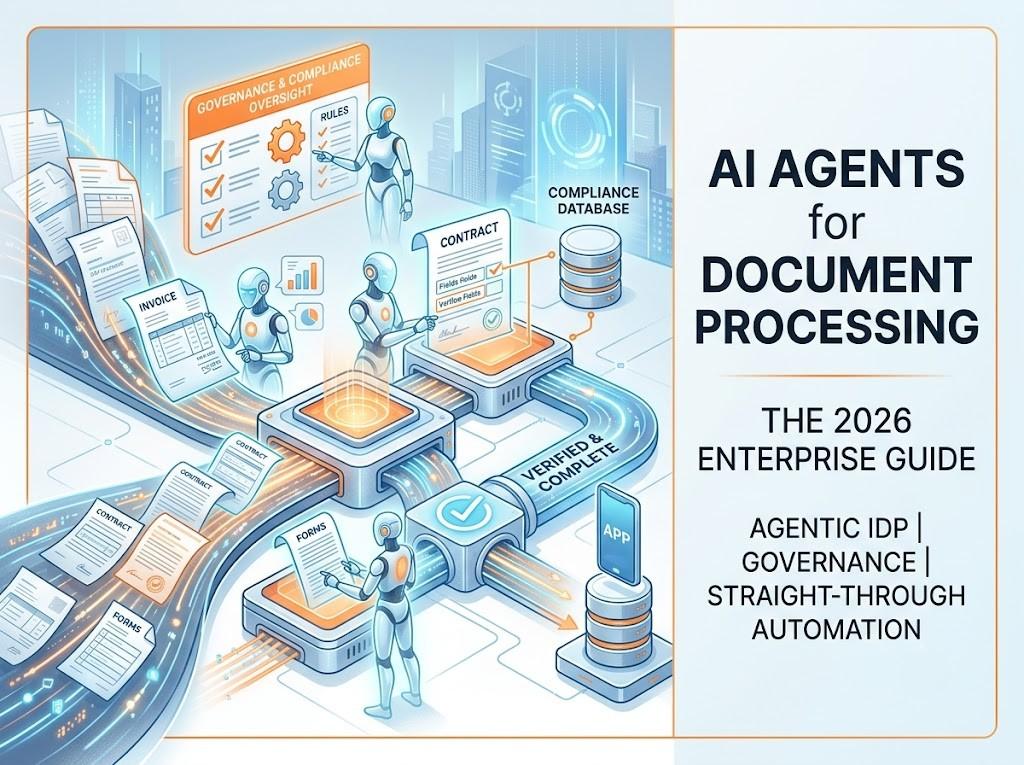
AI agents for document processing are systems that read a document, decide what to do with it, act in a business system, and prove what they did. Unlike traditional intelligent document processing (IDP), which classifies a document against a template and outputs fields, a document agent reasons across pages and sources, validates against business rules, resolves its own exceptions, executes a governed action, and leaves an audit trail. Extraction is one layer. It is not the product.
That distinction is doing a lot of work, so this guide unpacks it properly: the architecture that makes it possible, the governance that makes it deployable in a regulated enterprise, ten anonymised deployments that reached production, and an honest account of what breaks.
To Summarize:
- Extraction is commoditised. Generative and multimodal models have flattened accuracy on clean documents. Differentiation has moved up the stack to verification, action and proof.
- The value is in the exception, not the average. Roughly 80% of document-processing cost lives in the 15–25% of documents that deviate. Agents earn their complexity there and almost nowhere else.
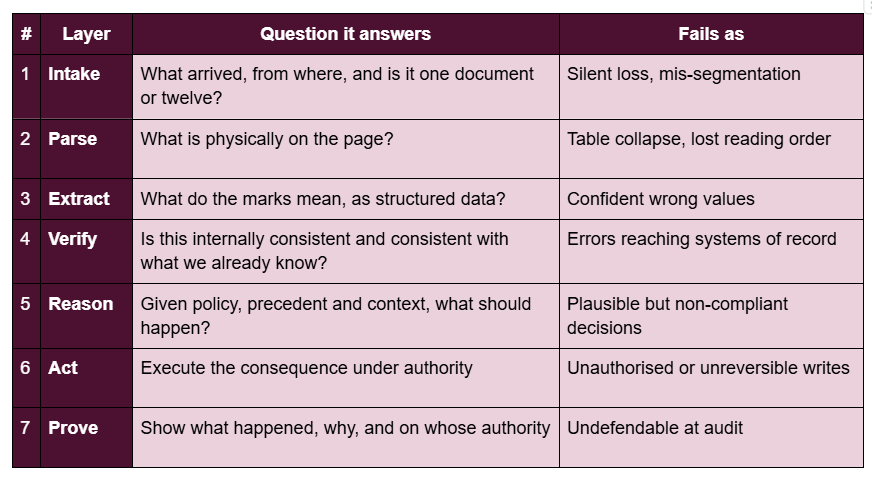
- Use the Seven-Layer Document Agent Stack — Intake, Parse, Extract, Verify, Reason, Act, Prove. Most vendors ship layers 1–3 and call it a platform.
- Autonomy is a contract, not a toggle. The Document Autonomy Ladder (D0–D5) grades it across work type, value limit, object, confidence threshold and evidence requirement.
- Layer 7 is the one that decides whether you deploy. With COSO's February 2026 guidance, PCAOB AS 2201 and EU AI Act Article 11 all live in 2026, reconstructable reasoning is now a procurement requirement, not a nice-to-have.
- Latency and cost are real trade-offs. Agentic extraction runs materially slower and more expensively per page than deterministic parsing. Hybrid routing — cheap path for the 95%, agentic path for the rest — is the design that survives a CFO review.
- Do not buy a document tool. Buy a governed platform that happens to do documents, so the extracted evidence lands in the same semantic layer, permission model and audit trail as everything else.
What are AI agents for document processing?
The definition that matters
An AI agent for document processing is a goal-directed system that uses language and vision models, tools, and enterprise context to complete a document-centric task end to end — rather than performing a single extraction step and handing off.
The operational test has four parts. Given an inbound document, can the system:
- Plan — decide what information it needs and in what order, without a human-authored template for that layout?
- Retrieve — query other documents, knowledge bases or systems of record to resolve ambiguity?
- Verify — check its own output against deterministic rules, and know when it is unsure?
- Act — execute a change in a business system under policy, and produce evidence of what it did and why?
If the answer to any of these is no, what you have is very good extraction with a chat interface on top. That is a legitimate product. It is not an agent, and pricing it as one is where a lot of 2026 procurement budgets have gone wrong.
AI agents vs. traditional IDP vs. OCR
These three get used interchangeably in vendor copy. They are not the same thing, and conflating them produces bad architecture decisions.
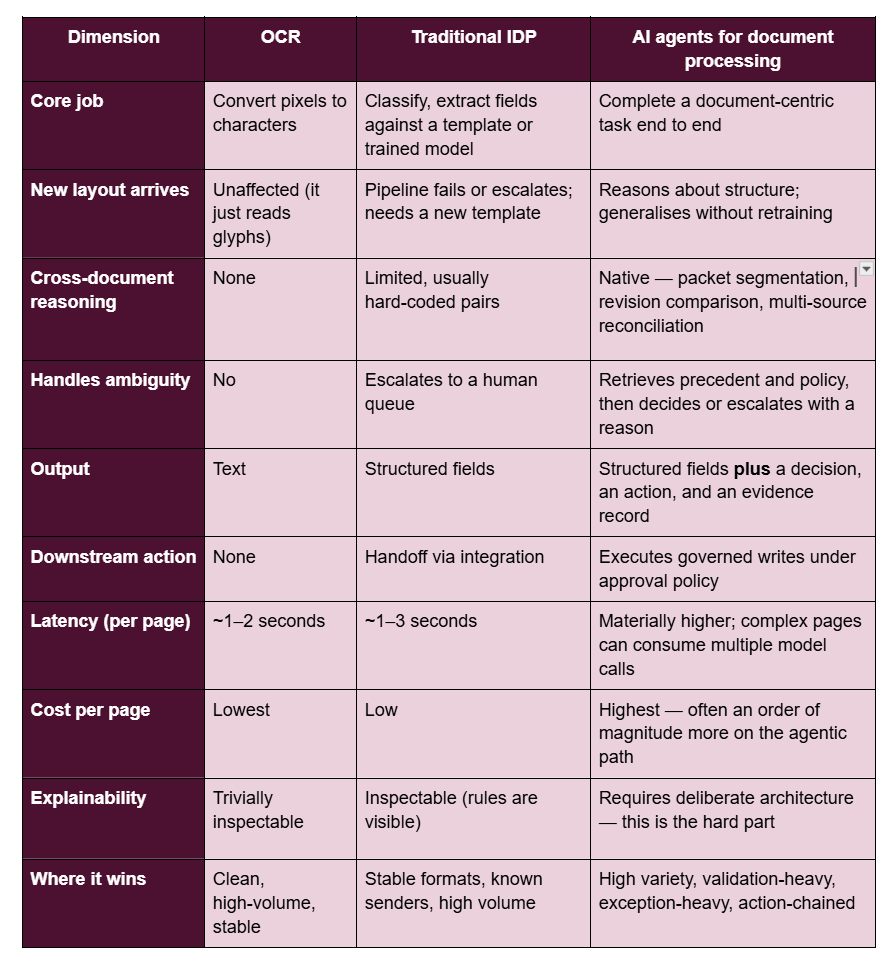
Two things fall out of that table.
First, OCR does not go away. It becomes a layer inside the agent rather than a competitor to it. On text-heavy multi-page documents, OCR frequently dominates end-to-end latency more than the model calls do — which means if you are optimising for speed, the parsing infrastructure is usually the first place to invest, not the model.
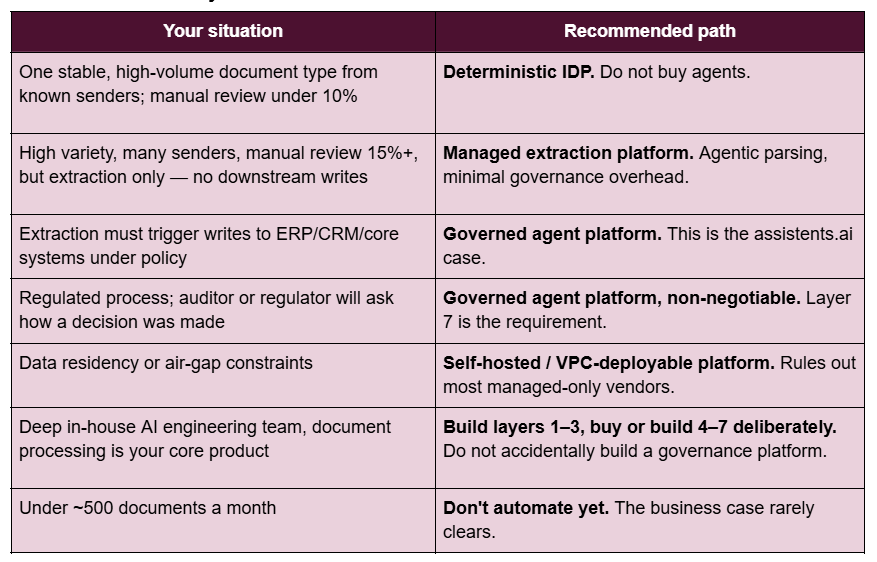
Second, traditional IDP does not go away either. For a stable, high-volume document type from a known sender, a deterministic pipeline is faster, cheaper and easier to audit. The mature 2026 architecture is not "replace IDP with agents." It is hybrid routing: send the predictable majority down the cheap deterministic path, and reserve the agentic path for the variance. We return to this in the cost section, because it is the single design decision that most often determines whether a document AI programme survives its first budget review.
Why "agentic" is not a synonym for "LLM-powered"
The category has a labelling problem. Five things are routinely marketed as agentic document processing that are not:
- Single-pass LLM extraction. A model reads a page and returns JSON. No planning, no verification, no state. This is a better extractor, not an agent.
- Template extraction with confidence scores. Confidence output is a useful signal. It is not reasoning.
- Extraction plus a chatbot. A conversational wrapper over a static pipeline. The chat does not change what the pipeline can do.
- Hallucination presented as inference. A model filling a missing field from prior distribution rather than from the document. In a finance or clinical context this is the most dangerous failure mode in the entire category, because the output looks confident and complete.
- Extraction without downstream decisioning. If the system produces data and stops, the exception cost stays exactly where it was.
When you evaluate vendors, the four questions that actually separate platforms are: does it plan multi-step workflows; does it adapt to layout variation without retraining; does it produce a plain-language explanation when it escalates; and does it maintain an audit trail you could hand to an external auditor. Everything else is feature comparison.
Why document work is the highest-value entry point for enterprise AI
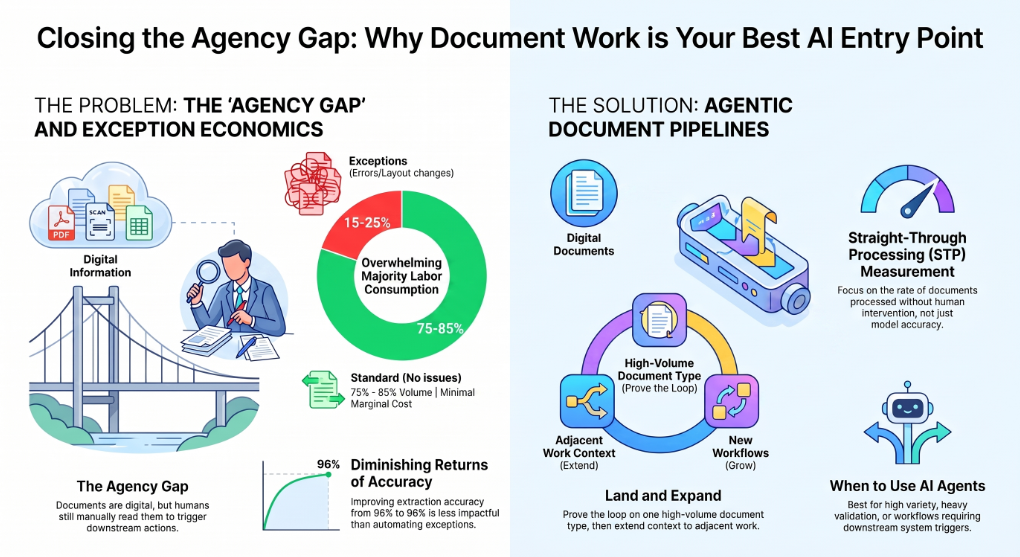
Documents are where the agency gap lives
Most enterprises have digitised their information without digitising their agency. The invoice is a PDF, the contract is in a repository, the tender pack is in SharePoint, the claim form is scanned — and a human still reads each one, decides what it means, and types the consequence into another system.
That gap is why document work is the highest-leverage first deployment for enterprise AI agents. It has three properties that almost nothing else has at once:
- The work is bounded. A document arrives, something must happen, and you can tell whether it happened correctly.
- The evidence is self-contained. Unlike a customer conversation or a strategic decision, the source of truth for a document decision is in the document — which makes it verifiable, and therefore governable.
- The volume is enormous and the unit cost is known. You already know what an invoice costs you to process. That makes the business case arithmetic rather than rhetorical.
This is also why document work is the natural land-and-expand entry point. You land on a single high-volume document type, prove the loop end to end, then extend the same context, policy and audit machinery to adjacent work.
The exception economics of document work
Here is the finding that reframes most business cases.
Document-processing cost is not distributed evenly across documents. In a typical enterprise AP or claims operation, 75–85% of documents flow through without human intervention, and consume almost no marginal cost. The remaining 15–25% — the ones with a mismatch, a missing field, an unfamiliar layout, a revision, a supplier who changed their template — absorb the overwhelming majority of the labour.
This has three consequences that most vendor ROI models ignore:
1. Improving average accuracy has diminishing returns. Moving from 96% to 98% field accuracy sounds like a 50% error reduction. At 1,000 documents a day it is the difference between 40 daily failures and 20. Real, but modest. Moving straight-through processing from 65% to 90% by resolving exceptions automatically is a categorically larger change, because it removes the expensive path, not the cheap one.
2. The right metric is straight-through rate, not extraction accuracy. Extraction accuracy is a model metric. Straight-through processing rate is a business metric. Ask every vendor for the second one, measured on your documents, and treat a refusal as an answer.
3. Agentic complexity is only justified where exceptions are expensive. If your manual-review rate is already under 10% on a stable document type, an agentic pipeline will add latency and cost for very little gain. The honest guidance is that agents earn their keep in four situations: high document variety from many senders; validation-heavy workflows such as AP, claims and compliance; manual review rates above roughly 15%; and workflows where extraction must trigger downstream action in another system.
If none of those four apply, buy a good deterministic extractor and spend the difference elsewhere. That advice costs us deals, and it is still the right advice.
The Seven-Layer Document Agent Stack
Most document AI architectures published in 2026 describe three or four layers: ingest, parse, extract, and sometimes route. That is enough to demo and not enough to deploy. The stack below extends our reference architecture to the seven layers a document agent actually needs in production.
Layer 1 — Intake
Documents arrive from mailboxes, portals, scanners, cloud storage, APIs and message attachments. Two things go wrong here more than anywhere else.
The first is packet segmentation. A single inbound PDF is very often not a single document: a mortgage file averages more than twenty distinct document types; a claims submission is a form plus receipts plus correspondence; a tender pack is a specification plus drawings plus a bill of quantities plus addenda. If the intake layer treats a 90-page packet as one document, every layer above it inherits the error. Multimodal classification at the packet level — segment first, then classify each segment — is not optional at enterprise scale.
The second is deduplication and revision detection. The same tender is reissued with changes. The same invoice arrives twice through two channels. A document agent that cannot tell "new" from "revised" from "duplicate" will either process work twice or miss a change that alters a commercial position.
Layer 2 — Parse
Parsing turns a page into a faithful structural representation — reading order, headings, tables, footnotes, embedded charts, handwriting, stamps, signature blocks.
Layout-aware multimodal parsing is now the default for complex documents, because vision-language models can interpret charts, nested tables and embedded diagrams that character-level OCR cannot. But two practical realities are worth stating plainly.
Tables remain the hard problem. Nested headers, merged cells, tables that span pages, and tables where a total row is visually but not structurally distinguished — these are where parsing quality diverges most sharply between vendors, and where you should concentrate your evaluation samples.
Parsing is where your latency budget goes. On multi-page documents, page-level OCR and layout analysis commonly consume the majority of end-to-end time, not the model reasoning. Teams optimising the wrong layer is a recurring pattern.
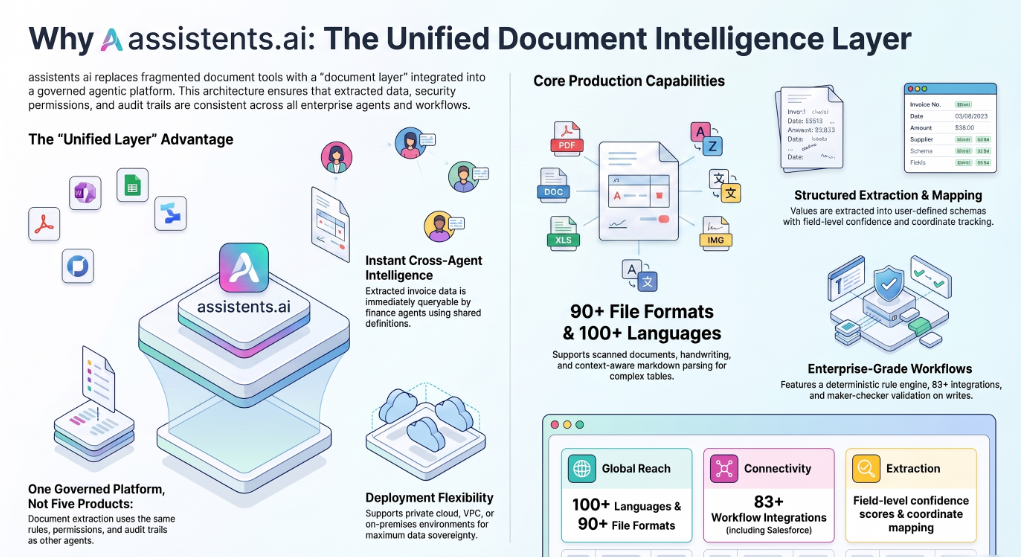
On the assistents.ai platform this layer supports 90+ file formats and 100+ languages, with document-to-markdown conversion and context-aware chunking that preserves meaning across tables, sections and page breaks — because a chunk that splits a table in half destroys the very structure the next layer depends on.
Layer 3 — Extract
Extraction maps parsed structure to a schema you define. Three design choices matter.
Schema-bound, not free-form. The agent should extract into a declared schema with typed fields, not return whatever JSON it feels like. This is what makes downstream validation possible and what stops the model from inventing fields.
Field-level confidence, not document-level. A document-level confidence score is nearly useless operationally. You need to know that the vendor name is high-confidence and the tax total is low-confidence, so you can route the field to review rather than the whole document.
Provenance down to coordinates. Every extracted value should carry a pointer back to where it came from — page, and ideally bounding box. This is the single most underrated capability in the category. It converts review from "re-read the document and check" into "click the field, see the exact region it came from." It also converts an audit conversation from a debate into a demonstration. Our platform exposes field-location mapping so an extracted value can be traced to its coordinates on the source page.
Layer 4 — Verify
This is the layer that separates systems you can put near money from systems you cannot.
Verification is deterministic first, probabilistic second. Before any model reasoning happens, run the checks that have a right answer:
- Arithmetic: do line items sum to the subtotal, and subtotal plus tax to the total?
- Referential: does this vendor exist in the master? Does this PO number resolve? Is this policy active on the service date?
- Temporal: is the invoice date within the contract term? Is the certificate expired?
- Duplicate: has this document, or a document with this fingerprint, been processed before?
- Cross-document: does the delivery note quantity match the invoice quantity match the PO quantity?
Deterministic rules should be authored and versioned as rules, not embedded in prompts, because rules are inspectable, testable and defensible in a way prompt text is not. On our platform this is a decision-table rule engine with versioning, publish control, test execution and an execution log — the extracted evidence is checked against explicit business logic before anything downstream sees it.
Only when the deterministic checks pass or fail ambiguously does the model get to reason about it.
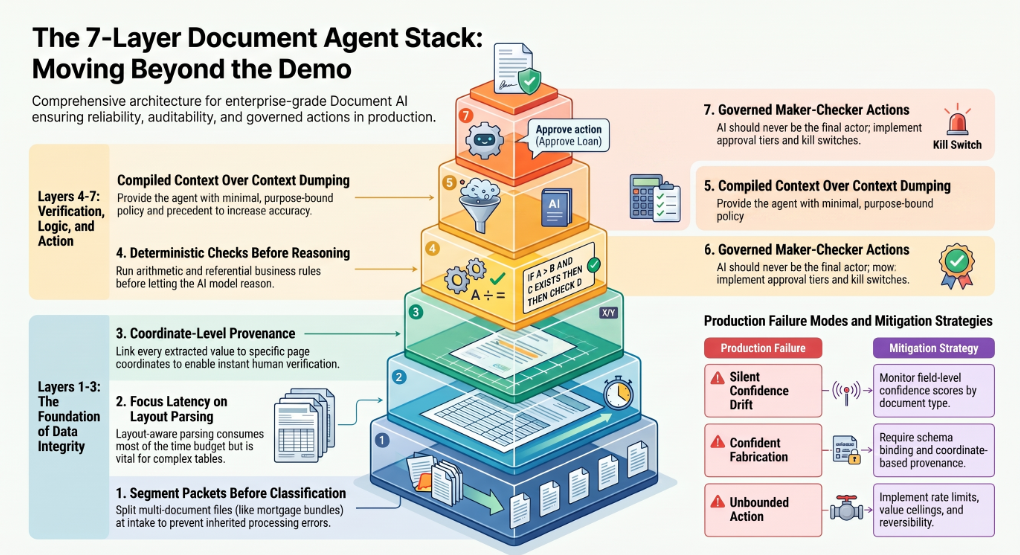
Layer 5 — Reason
Reasoning is where the agent decides what the verified evidence means in the context of your business — and this is only as good as the context it is given.
Three context inputs matter:
- Policy. What does our credit policy, underwriting guideline, procurement threshold or clause playbook actually say?
- Precedent. How did we handle a materially similar case before? Retrieval over prior decisions is often more useful than retrieval over policy documents, because it encodes how the policy is actually applied.
- State. What is true right now in the systems of record — current balance, open disputes, contract status, inventory position?
The failure mode here is context dumping: pushing the entire knowledge base into the window and hoping. That is expensive, slow, and degrades accuracy. The better pattern is compiled context — a minimal, purpose-bound, permission-filtered context package assembled for this assignment, with provenance attached so you know later what the agent was looking at when it decided.
Permission filtering matters more than teams expect. If a document agent retrieves precedent, it must retrieve only precedent the requesting user and the agent's own role are entitled to see. Retrieval that ignores permissions is a data-leak vector wearing a productivity costume.
Layer 6 — Act
The action layer is what the entire stack exists for, and it is where most of the market stops.
A governed action layer needs five properties:
- A capability registry. Every action an agent may take is declared, typed, owned and versioned — "create SAP sales order", "post AP invoice", "raise credit hold", "open legal ticket". Agents call registered capabilities; they do not improvise API calls.
- Maker-checker by default. The agent proposes the write; a human or a policy confirms; the server independently re-checks authority before executing. The AI is never the last thing between an intention and a production record.
- Delegated authority tiers. Approval requirements scale with value and risk. A ₹5,000 variance auto-posts; ₹5,00,000 routes to a controller.
- Rate limits and kill switches. An agent that starts behaving badly at 03:00 must hit a ceiling, and someone must be able to stop it in one action.
- Reversibility. For every action, know the compensating action. If you cannot describe the undo, the agent should not have the capability.
Our workflow engine implements governed actions across insert, update, delete, HTTP and sub-workflow types, with guards, approval tiers, rate limits and audit logging; a real Salesforce plugin and roughly 83 workflow integrations cover common targets, and a generic configurable HTTP action with vaulted credentials means calling an arbitrary third-party REST API outbound is configuration rather than a build.
Layer 7 — Prove
The proof layer answers a question that will be asked of you: how do you know?
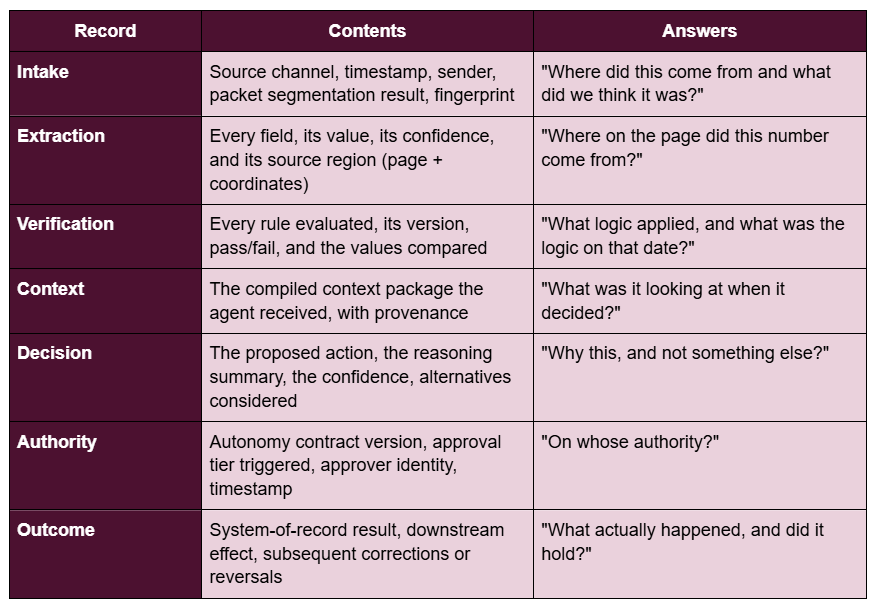
It needs to reconstruct, for any processed document: what arrived, what was extracted and from where on the page, which rules passed and failed, what context the agent was given, what it decided and why, which capability it invoked, who or what approved it, what the system of record shows now, and what the business outcome was.
We come back to this in the Evidence-to-Action Ledger section, because in 2026 this layer is no longer a differentiator you can defer.
How the stack fails in production
Six failure modes, in rough order of how often they cause real damage:
- Silent low-confidence drift. A document type the model handles poorly starts arriving in volume. Nobody notices for six weeks because nobody is monitoring confidence by document type. This is the most common and most expensive failure in the category, and it is a monitoring problem, not a model problem.
- Packet mis-segmentation. Errors introduced at intake that are invisible at every layer above.
- Confident fabrication. A missing field is filled from prior distribution rather than from the page. Mitigated by schema binding, provenance requirements, and refusing to accept a value with no source region.
- Rule drift. Business rules live in prompts, change informally, and nobody can reconstruct what logic applied on a given date.
- Context leakage. Retrieval that ignores row-level and field-level permissions.
- Unbounded action. An agent with a write capability and no value ceiling.
Note that only one of these six is a model-quality problem. This is the central lesson of production document AI: the constraint is system design, not model capability.
The Document Autonomy Ladder: D0 to D5
Autonomy is routinely discussed as a boolean. In practice, effective autonomy is a contract across many dimensions at once — agent, work type, business scope, capability, affected object, value limit, time window, risk class, evidence requirement, confidence threshold and approval policy.
The Document Autonomy Ladder makes that governable by grading it. It is the document-specific instantiation of our Ask → Execute → Autonomous maturity model.
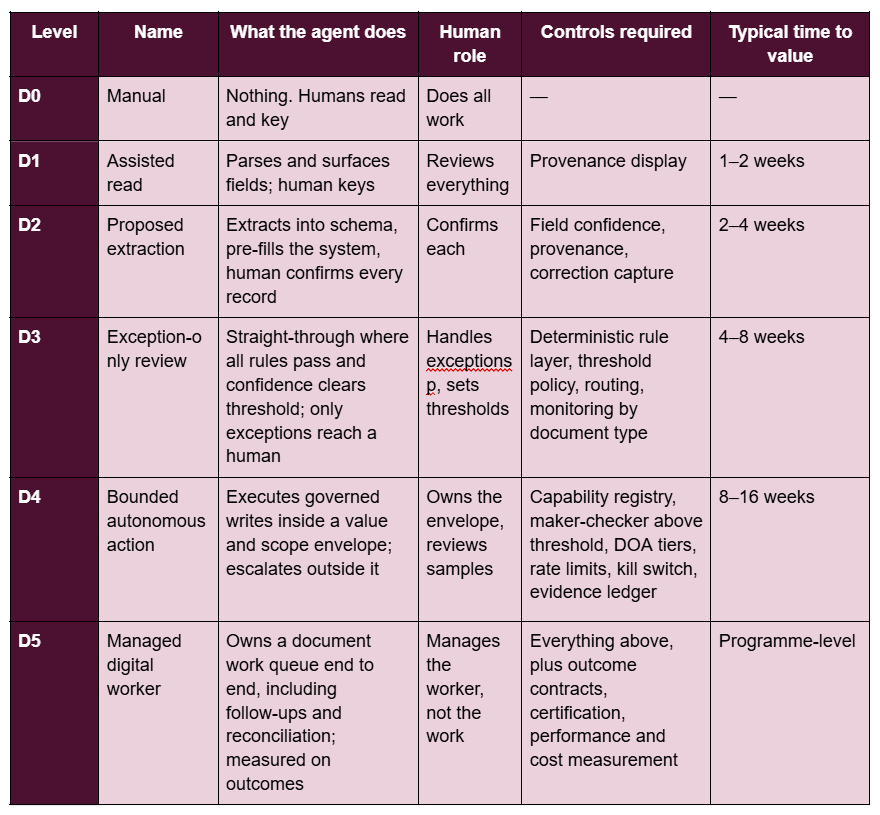
Two rules of thumb. Nobody should start above D2, regardless of how good the demo was. And the jump from D3 to D4 is the real one — it is the first point at which the agent changes a production record without a human in the loop for that specific record. Everything before it is a productivity improvement; D4 is an operating-model change, and it needs the controls to match.
Writing a document autonomy contract
Autonomy should be written down as an explicit, versioned, expiring artifact. A workable shape:
agent: ap-invoice-processor
work_type: supplier_invoice_3way_match
scope:
entity: [IN-01, IN-04]
supplier_tier: [tier_2, tier_3]
document_types: [invoice, credit_note]
permissions:
extract_and_propose: true
post_matched_invoice: true # within limits below
create_new_supplier: false
override_price_variance: false
release_payment: false
limits:
invoice_value_max: 500000 # INR
price_variance_pct_max: 2.0
quantity_variance_pct_max: 1.0
postings_per_hour_max: 200
require_human_approval_when:
- invoice_value > 500000
- variance_outside_limits
- supplier_not_in_master
- duplicate_fingerprint_score > 0.85
escalate_when:
- field_confidence < 0.85
- unparsed_pages_present
- contract_terms_conflict_detected
evidence_required:
- source_page_and_region_for_every_posted_field
- rule_execution_log
- approver_identity_for_exceptions
valid_until: 2026-12-31
review_cadence: monthly
Three details that make this real rather than decorative: an expiry date forces periodic re-authorisation; valid_until plus review_cadence means autonomy can contract as well as expand; and evidence_required ties the autonomy grant to the proof layer, so an agent cannot act autonomously in a mode where it cannot substantiate what it did.
Why most programmes stall at D2
The pattern is consistent. A team pilots extraction, gets good numbers on a clean sample, and then cannot get past human-confirms-everything. Four reasons, all fixable:
- No deterministic verification layer. Without rules that have a right answer, there is no principled basis for straight-through processing, so everything gets reviewed.
- No confidence policy. Confidence scores exist but nobody has decided what threshold means "route to human", per field, per document type.
- No capability registry. The agent has no safe, declared way to write, so the write stays manual.
- No evidence layer. Risk and audit will not sign off on unattended processing they cannot reconstruct, and they are right not to.
The fix is not a better model. It is layers 4, 6 and 7.
10 AI agent document processing use cases from real deployments
The following are drawn from production and pilot deployments delivered on the assistents.ai platform. Client identities are withheld; each is described by industry, geography and scale. Outcomes are stated as delivered or as engineered design targets, and labelled accordingly.
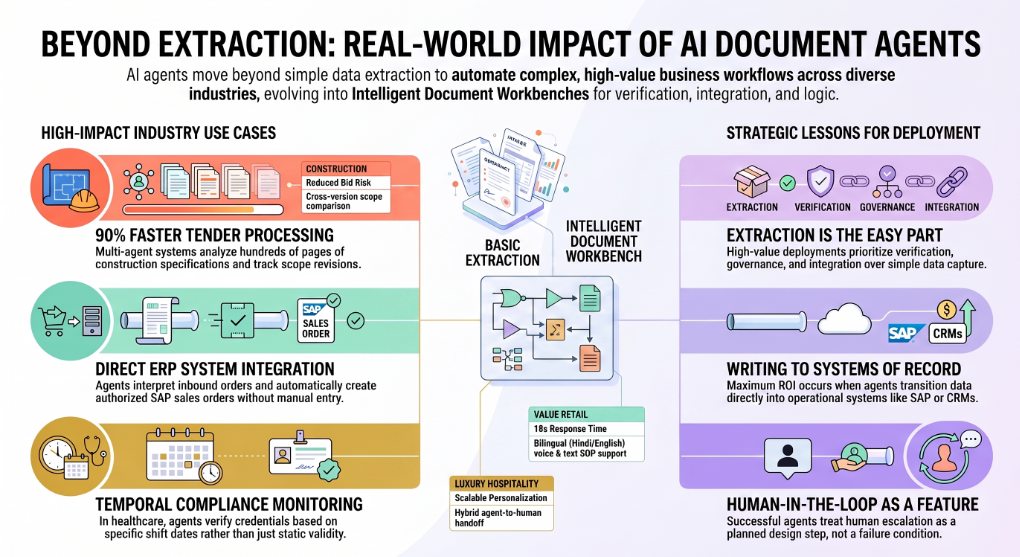
1. Tender and bid document intelligence — remedial building services, Australia
Context. A specialist waterproofing diagnostics and remediation contractor with 20+ years in commercial remedial building services, bidding on complex projects where tender packs run to hundreds of pages of specifications, drawings, scopes and addenda.
The document problem. Tender packs are the worst case for traditional IDP: every issuing authority uses a different structure, documents are reissued with revisions that materially change scope, and a missed addendum is a commercial exposure rather than a data-quality issue.
What was built. A multi-agent Intelligent Document Workbench: tender retrieval, workflow determination, vision-model extraction from complex PDFs, and revision/change analysis across document versions — with deep integration into the operational system (full CRUD), quote locking and audit logging so an extracted scope becomes a priced, locked quote with a traceable history.
Outcomes. Engineered for up to ~90% faster tender document processing, with a ~95% extraction accuracy target on standard formats, and reduced bid risk through revision detection and auditability.
Why it matters architecturally. This deployment exercises all seven layers, and specifically proves layer 4 (cross-version comparison) and layer 6 (writes into the operational system with locking). It is the clearest illustration that document processing is a workflow problem wearing an extraction costume.
2. Automated ERP sales-order creation — industrial engineering group, UAE
Context. A flagship UAE engineering and technology solutions provider, established 1972, delivering integrated electrical, mechanical, automation and mobility solutions to enterprise and infrastructure clients. The organisation was migrating away from a legacy enterprise content and workflow system reaching end of life with high licensing cost.
What was built. Agentic automation that interprets inbound order documents and triggers, validates them against business rules, and creates SAP sales orders — with governance for exceptions and approvals, audit logs and reconciliation reporting.
Outcomes. Reduced manual order processing and legacy dependency, faster order-to-confirm cycle with fewer data-entry errors, and improved auditability for sales-order creation and exceptions.
Why it matters architecturally. This is layer 6 in its purest form. The extraction was never the point; creating a correct, authorised, reconcilable transaction in the system of record was. Note also the commercial pattern: document agents are frequently the vehicle for retiring an expensive legacy content platform, which changes the business case from "AI investment" to "licence replacement."
3. Invoice and AP straight-through processing
Accounts payable remains the most mature deployment context for document agents, because the document is structured enough to verify deterministically and the exception cost is well understood. The loop is: intake from mail and portal, packet segmentation, schema extraction with field confidence, three-way match against PO and goods receipt, deterministic variance rules, exception routing, and governed posting under a value ceiling.
We have covered the finance side of this in depth — see our guide to agentic AI in finance and accounting and the AI agent for invoice processing use case — so the point to carry forward here is narrower: AP is where the D3→D4 transition is most tractable, because the verification layer is unusually strong and the reversibility of a posting is well defined.
4. Cross-border tax risk pre-screening — tax technology, UK
Context. A tax-technology product screening cross-border transactions early for withholding tax exposure, VAT mismatches and permanent-establishment risk.
What was built. Transaction screening workflows over transaction and contract documentation with risk classification, evidence collection with explainability notes, and an escalation path to human tax experts.
Outcomes. Earlier detection of withholding and VAT risk, fewer last-minute deal disruptions, and faster, more consistent pre-compliance review.
Why it matters architecturally. The deliverable here is not extracted data — it is a classified risk with attached evidence and an explanation a professional can defend to a regulator. This is layer 7 as the product, and it is a good template for any workflow where the output is a professional judgement rather than a field.
5. Tax research automation with citations — tax technology, USA
Context. A specialised sales-and-use tax research automation tool for tax professionals.
What was built. Automated source collection and summarisation, draft memo and position output with citations, and workflow tracking that builds a reusable knowledge base as a by-product of the research.
Outcomes. Faster research cycles, reduced manual source-hunting, more consistent research outputs and better documentation hygiene.
Why it matters architecturally. This is the retrieval-and-synthesis face of document agents. The critical design constraint is that every assertion carries a citation to a source — the same provenance discipline as layer 3, applied to generated output rather than extracted fields.
6. Procurement RFQ and supplier document automation — pharma sourcing, India
Context. A pharmaceutical sourcing and excipients platform marketing 1,800+ rare excipients and 7,500+ SKUs, where procurement is document-heavy on both sides: specifications and quality documentation inbound, RFQs and comparisons outbound.
What was built. RFQ automation with supplier matching workflows, quality and regulatory document handling support, and analytics on price, lead time and vendor performance.
Outcomes. Faster procurement cycles and improved sourcing visibility, reduced vendor coordination and manual follow-up, and better price and lead-time competitiveness through insight.
Related depth: agentic AI use cases in procurement.
7. Tenancy, policy and SOP document agents — real estate portfolio, UAE
Context. A major UAE real estate portfolio owner and manager with diversified office, retail, industrial and residential assets across multiple emirates.
What was built. An omnichannel service agent with a knowledge base over policies, tenancy documents and standard operating procedures, handling tenant query triage, rental and payment support workflows, and ticketing and escalation to human teams.
Outcomes. Faster response times and lower call-centre load, a consistent 24×7 tenant experience, and better SLA adherence through automated routing and tracking.
Why it matters architecturally. This is permission-aware retrieval as the core requirement. Tenancy documents are tenant-specific; an agent answering a tenant query must retrieve that tenant's lease and nobody else's. Retrieval without row-level scoping is not a feature gap here — it is an incident.
8. Credentialing and compliance documents — healthcare staffing, USA
Context. A healthcare staffing platform matching nursing professionals to facilities for flexible shifts, where speed of placement is the product and credential compliance is the constraint.
What was built. Talent onboarding with credential capture, facility staffing request intake and matching logic, and scheduling, notification and compliance workflows with fill-rate and utilisation reporting.
Outcomes. Faster fill cycles and lower scheduling friction, better workforce utilisation, and improved staffing responsiveness for facilities.
Why it matters architecturally. Credential documents have expiry dates, which makes this a temporal verification problem: the question is never only "is this licence valid" but "is it valid on the shift date." Temporal rules belong in layer 4, expressed as versioned rules, not in a prompt.
9. Booking intake and document generation — luxury hospitality, East Africa
Context. A luxury hospitality brand operating a collection of 16 boutique lodges, camps and hotels across iconic safari locations in Kenya and Tanzania, serving high-expectation international travellers.
What was built. A digital booking agent handling email intake with intent classification and data extraction, a conversational loop to capture missing details, real-time inventory checks with alternative date and property negotiation, hybrid handoff to human consultants for curated itinerary creation, and automated invoice and PDF document generation.
Outcomes. Faster booking turnaround with less back-and-forth, higher accuracy on complex guest requirements, and scalable operations without compromising a luxury service standard.
Why it matters architecturally. Two things stand out. First, this is document processing in both directions — extracting from inbound email and generating outbound documents — which is a materially under-served half of the category. Second, the human handoff is designed in rather than treated as failure: the agent handles intake and logistics; humans do the curation that is the actual product.
10. SOP and training document agents for frontline retail — value retail, India
Context. A rapidly scaling value-retail chain with a pan-India footprint of 700+ stores across hundreds of cities, spanning apparel, general merchandise and FMCG.
What was built. A knowledge and training agent using retrieval over point-of-sale documentation and standard operating procedures, alongside a bilingual (Hindi and English) voice support agent and store-level inventory intelligence, with an admin console, analytics and ticketing integration.
Outcomes. Reduced manual helpdesk burden and faster store-issue resolution, improved store-level inventory visibility, and faster onboarding through on-demand training guidance.
Why it matters architecturally. Documents here are not transactions — they are operating knowledge, and the consumer is a store associate on a shop floor who needs an answer in ten seconds in their own language. It is a reminder that "document processing" includes making documents usable, not only turning them into rows.
What the pattern across these deployments tells you
Five things recur across all ten, and they are worth more than any individual case study:
- The extraction was never the hard part. In every deployment that reached production, the difficult work was verification, integration and governance.
- The highest-value deployments write to a system of record. Tender-to-quote, document-to-SAP-order, credential-to-schedule. The ones that stop at "structured data" deliver a fraction of the value.
- Revision, expiry and duplication logic appears everywhere. Almost no real document workflow is stateless.
- Bilingual and multi-script handling is a baseline requirement, not an enterprise upsell, in every deployment outside a single-language market.
- Human handoff is a design feature. The successful deployments define precisely where the human enters and what they are deciding. The stalled ones treat escalation as an error condition.
The Evidence-to-Action Ledger
If layers 1–6 are how a document agent works, the Evidence-to-Action Ledger is how you prove it worked. It is a single, queryable record that links every processed document to every consequence it produced.
For each document, the ledger holds seven linked records:
Field-level provenance
Provenance is the load-bearing element. An extracted value without a pointer to its source region is an assertion; with one, it is evidence.
Practically, this means the review interface should let a person click a field and see the exact highlighted region on the source page, and the audit export should carry the same linkage. It also enables the most useful quality control available to you: sample-and-verify against source, rather than sample-and-reread.
Confidence thresholds and routing policy
Confidence scores are only useful once you have written a policy that turns them into routing decisions. That policy should be:
- Per field, not per document. Route the tax total to review while auto-accepting the vendor name.
- Per document type. Your threshold for a standardised utility bill should not equal your threshold for a handwritten delivery note.
- Versioned and monitored. Threshold changes are governance events. Confidence distribution by document type over time is your early-warning system for the silent-drift failure mode.
A workable starting policy: auto-accept above 0.95, field-level review 0.85–0.95, full-document review below 0.85 — then tune against measured error rates rather than intuition, per document type, over the first few thousand documents.
Maker-checker on every write
The principle is simple and non-negotiable: the AI proposes, a human or an explicit policy confirms, and the server independently re-checks authority before executing. The model is never the last thing between an intention and a production record.
This is genuinely implemented across our platform rather than described aspirationally — writes go through a maker-checker model with server-side re-validation, and the App Builder path additionally enforces row-scope predicates and field-level masking so an agent proposing a write cannot see or touch rows and columns outside its scope.
What regulators are asking for in 2026
Three developments make layer 7 a procurement gate rather than a maturity aspiration:
- EU AI Act Article 11 technical documentation obligations became applicable on 2 August 2026, requiring documented, reconstructable system behaviour for high-risk AI systems.
- PCAOB AS 2201, effective for audits of fiscal years ending on or after 15 December 2026, tightens expectations around evidence for automated controls.
- COSO's February 2026 guidance on internal control in an AI environment sets expectations for control design over AI-assisted processes.
Read together, the requirement is consistent: if an AI system touched a decision, you must be able to reconstruct what it did and why. Agentic systems are structurally harder to explain than template systems, where the extraction logic is directly inspectable. That is a real gap, and it must be closed architecturally — with provenance, versioned rules, compiled context and an authority record — before deployment in a regulated process, not after.
If you are building the programme-level control framework around this, our guide to AI agents for regulatory compliance and the AI agent governance playbook go deeper than we can here.
Build vs. buy: choosing a document agent architecture
The point-tool trap
Document extraction has excellent open and commercial building blocks — parsers, OCR engines, vision-language models, vector stores. A capable team can assemble a demo in a fortnight. The trap is that the demo is layers 1–3, and layers 4–7 are 80% of the work and 100% of the reason it is allowed near production.
Teams that build usually underestimate: deterministic rule authoring and versioning; packet segmentation at scale; confidence monitoring by document type; permission-aware retrieval; the capability registry and approval tiers; the audit export that survives an external auditor; and the ongoing model-routing and cost-management work as providers change.
The five-tools-in-a-trench-coat problem
The more common failure is not building — it is buying five things.
A document extraction tool, a workflow tool, a rules engine, a vector database and a BI tool, glued together. Each works. Collectively they produce a system with five permission models, five audit trails, five definitions of "customer", and no single place to answer "what happened to this invoice?" The integration cost is visible; the governance cost is not, until an auditor asks a question that requires joining across all five.
The alternative is a platform where the document agent shares the semantic layer, permission model, rule engine, action gateway and audit trail with your analytics and workflow agents — so an extracted field means the same thing everywhere, and one audit trail covers the whole path from page to posting.
Build-vs-buy decision table
Cost and latency — the trade-off not in the datasheet
Two numbers vendors are reluctant to volunteer:
Latency. Agentic extraction is materially slower than deterministic parsing — complex pages can consume several model calls, and multi-page documents compound it. For overnight AP batches this is irrelevant. For a customer-facing mortgage or onboarding flow where an applicant is waiting, it is the whole ballgame. Ask for p95 latency on your document mix, not average on theirs.
Cost. Per-page cost on a fully agentic path can run an order of magnitude or more above deterministic extraction. The design that fixes this is hybrid routing: classify cheaply, route the predictable majority through a deterministic path, and reserve the agentic path for genuine variance. Published hybrid architectures have demonstrated roughly an order-of-magnitude cost reduction versus full-LLM processing with minimal accuracy loss. Any vendor who cannot explain their routing strategy is quietly charging you agentic prices for deterministic work.
The corollary matters too: at 1,000 documents a day, even 98% accuracy produces roughly 20 failures daily. System-level reliability design — confidence monitoring, alerting, review sampling — matters more than the last percentage point of model accuracy. Optimise the system, not the benchmark.
Why assistents.ai for document processing
Document AI is not a separate product
The structural argument for assistents.ai Document AI is that it is not a document product. It is a document layer inside a governed agentic platform — which means the evidence a document agent extracts lands in the same context engine, the same permission model, the same rule engine, the same action gateway and the same audit trail as every other agent you run.
Concretely, that means the invoice your document agent extracted is queryable by your analytics agent using the same metric definitions your finance team already agreed; the supplier it references resolves to the same entity your procurement agent uses; and the posting it triggered appears in one audit trail alongside every other action taken on that supplier. You are not integrating five products. You are configuring one.
What is shipped today
We are deliberate about separating shipped capability from direction, because a platform whose entire promise is "no hallucinated numbers" cannot be loose about its own claims.
Shipped and in production use:
- Document conversion and parsing across 90+ file formats and 100+ languages, including scanned documents and handwriting, with document-to-markdown conversion and context-aware chunking that preserves tables and section structure
- Structured extraction into user-defined schemas with field-level confidence scores
- Template creation and matching, so recurring document types get a stable extraction contract
- Field-location mapping — an extracted value can be traced to its coordinates on the source page
- Asynchronous processing at volume via a job queue, with status APIs
- Document API keys so external systems can submit documents programmatically without a user session
- Permission-aware retrieval — parse, chunk, embed, hybrid retrieval with citation tracking
- A deterministic decision-table rule engine with versioning, publish control, test execution and an execution log
- A workflow engine with governed insert/update/delete/HTTP/sub-workflow actions, guards, delegated approval tiers, rate limits and audit logging
- Maker-checker on writes, with server-side re-validation; row-scope predicates and field-level masking on the App Builder path
- Roughly 83 workflow integrations including a full Salesforce plugin, plus a generic configurable HTTP action with vaulted credentials for outbound calls to any REST API
- Model-agnostic routing across major providers with per-organisation bring-your-own-key
- Deployment in your environment — private cloud, VPC or on-premises
Directional (roadmap, not shipped): inbound webhooks and inbound REST/GraphQL connectors as first-class sources, and SSO/OIDC, are near-term roadmap items rather than current capabilities. Outbound calls to your REST APIs are available today. We flag this proactively because discovering it during implementation is worse than hearing it during evaluation.
Where we are honest about the roadmap
Three further caveats worth stating in an evaluation:
- Per-user row-level isolation is automatic on the App Builder path, which uses predicate-folding row-level security. The conversational agent path enforces governance at the tool level — read-only SQL sanitisation, table allow-lists and organisation-level scoping, plus warehouse-native row-level security where the connector supports it. Ask us which path your use case sits on; we will tell you.
- Time-to-value figures are targets, not guarantees. The three-step onboarding on our product pages reflects typical straightforward deployments. Complex ERP integrations take longer.
- Security documentation, including current certification status, is available under NDA. We would rather show you the report than put a logo on a webpage.
The Document Agent Readiness Scorecard
Twelve questions to put to any vendor, including us. Score each 0–2 (0 = no, 1 = partial, 2 = demonstrated on your documents). Below 16 is not enterprise-ready.
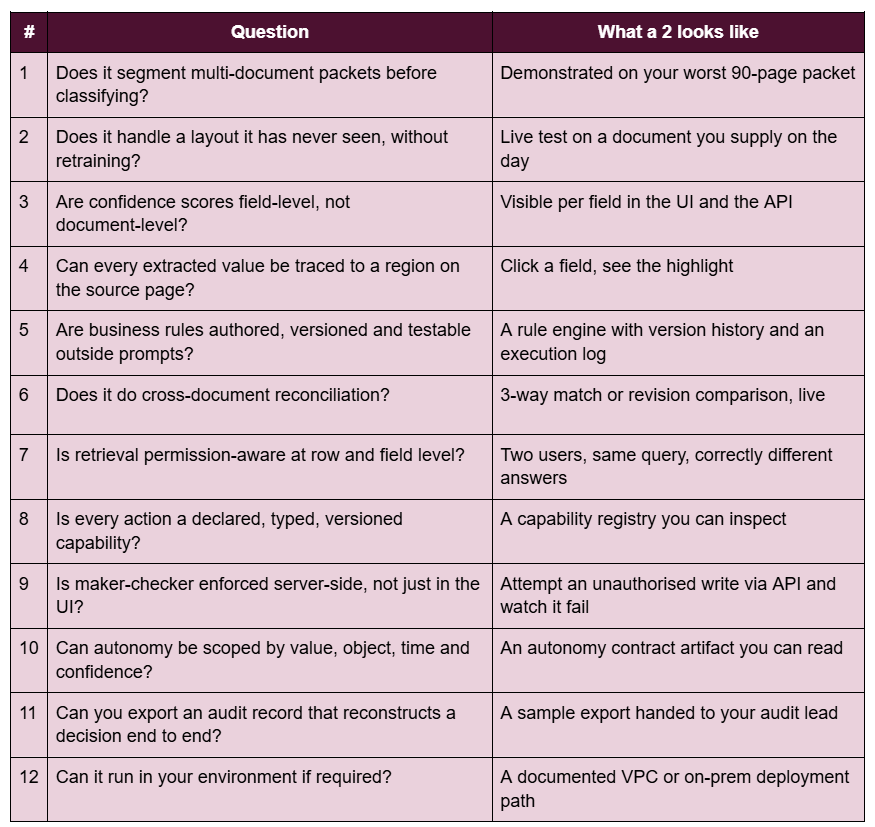
Questions 4, 5, 9 and 11 are the ones most likely to expose a demo-grade product. Ask those first.
A 90-day implementation plan
This is the sequence we use, and it is deliberately conservative about autonomy.
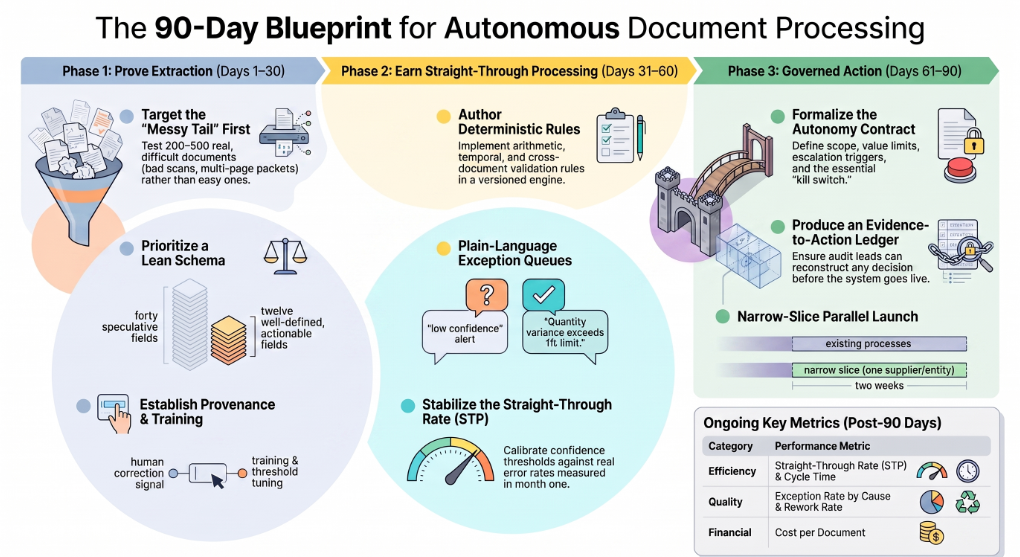
Days 1–30 — Prove extraction on your worst documents
- Pick one document type and one workflow. Highest volume with the highest manual-review rate. Not the easiest one.
- Assemble an evaluation set of 200–500 real documents, deliberately over-weighted toward the messy tail: bad scans, unusual senders, revisions, multi-document packets, second languages.
- Define the schema — the fields you actually act on, not everything on the page. Twelve well-defined fields beat forty speculative ones.
- Run extraction and measure field-level accuracy by field and by document sub-type. You are looking for which fields and which senders are weak, not a single headline number.
- Stand up provenance review so a person can click a field and see its source region.
- Deploy at D1–D2. Humans confirm everything. Capture every correction — corrections are your highest-value training and threshold-tuning signal.
- Exit criterion: you can state field-level accuracy by document sub-type, and a reviewer prefers the tool to the manual process.
Days 31–60 — Build verification and earn straight-through processing
- Author deterministic rules in a versioned rule engine: arithmetic, referential, temporal, duplicate, cross-document.
- Set confidence thresholds per field and per document type, calibrated against the error rates you measured in month one — not against a vendor default.
- Build the exception queue with plain-language reasons. "Escalated: PO quantity 400 vs invoice quantity 420, variance 5% exceeds 1% limit" — not "low confidence."
- Instrument monitoring: confidence distribution by document type over time, straight-through rate, exception reasons ranked by frequency, review time per exception.
- Move to D3. Straight-through where all rules pass and thresholds clear; humans see only exceptions.
- Exit criterion: straight-through rate is stable and measured, and every exception has a reason a non-technical reviewer understands.
Days 61–90 — Add governed action and the evidence ledger
- Register the capabilities the agent may invoke. Type them, own them, version them.
- Write the autonomy contract — scope, value limits, escalation triggers, evidence requirements, expiry, review cadence.
- Configure approval tiers, rate limits and the kill switch. Test the kill switch. Test it again.
- Wire the Evidence-to-Action Ledger end to end and produce a sample audit export.
- Hand the export to your audit or risk lead before you go live. If they cannot reconstruct a decision from it, you are not ready, and it is far cheaper to learn that now.
- Move to D4 on a narrow slice — one entity, one supplier tier, a conservative value ceiling — and run it in parallel with the existing process for two weeks.
- Exit criterion: governed writes executing inside a documented envelope, with an audit export your risk function has accepted.
Beyond 90 days: widen the envelope slice by slice, add adjacent document types onto the same context and policy machinery, and start measuring outcomes rather than activity — straight-through rate, exception rate by cause, cycle time, rework rate, and cost per document.
Why enterprises choose assistents.ai over point IDP tools
There are three credible alternatives to a governed agent platform, and each is right for someone. Here is the honest comparison.
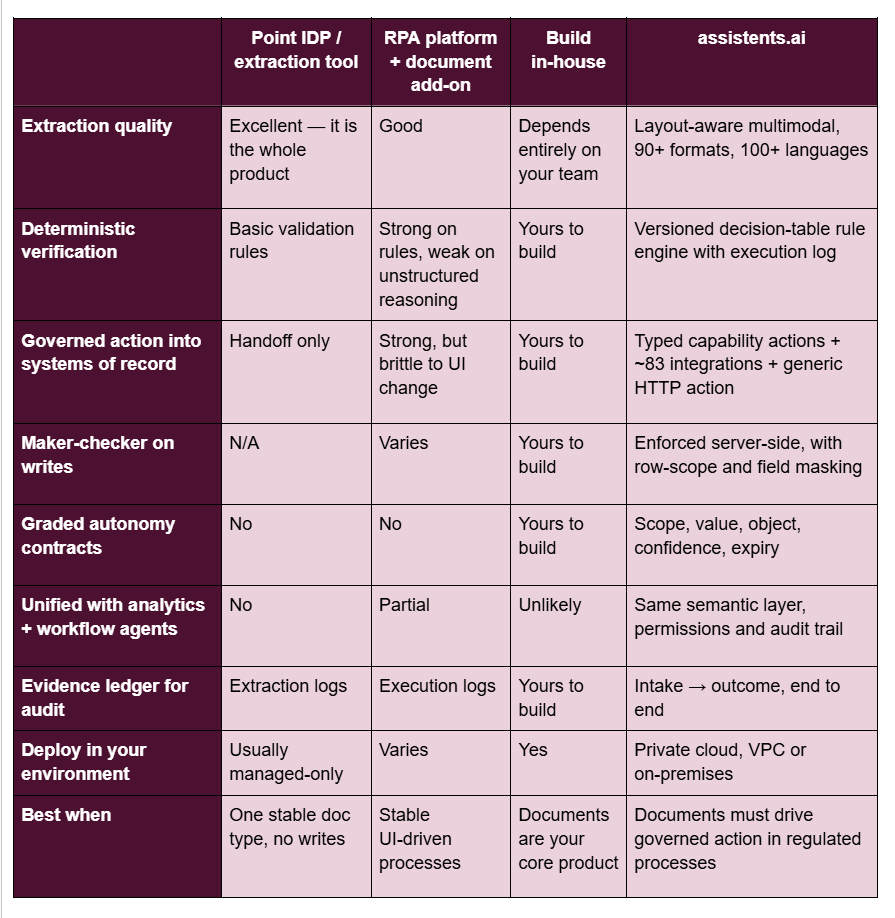
The summary, stated plainly: if your document workflow ends in structured data, buy a point tool — they are very good and you will spend less. If your document workflow ends in a change to a system of record inside a process someone will audit, you need layers 4 through 7, and that is what we built.
What you get in the first 30 days
- An architecture review against your actual document mix, including the ugly tail
- Field-level accuracy measured on your evaluation set, by document sub-type
- A straight-through-rate hypothesis with the assumptions written down
- A written statement of which capabilities are shipped and which are directional for your specific use case
- A named path to D3, with the controls each step requires
Request a Document AI architecture review →
The bottom line
The centre of gravity in document AI has moved. Extraction accuracy on clean documents is table stakes; every serious vendor can do it. What separates a demo from a deployment is everything that happens after the fields come out — deterministic verification, permission-aware reasoning, governed action into a system of record, and an evidence trail that survives an auditor.
That is why the useful question is not "which model reads documents best." It is: can this system act on what it read, inside limits I set, and prove afterwards what it did and why?
If you can answer yes to that, the document work in your enterprise stops being a queue and starts being a process. If you cannot, you have bought a very expensive way to read PDFs.
Next steps:
- Explore Document AI on assistents.ai and the agentic parsing capabilities
- Read the AI agent governance playbook for the programme-level control framework
- Compare approaches in the enterprise AI buyer's guide
- See how document agents fit alongside analytics and workflow agents in agentic business process management systems
- Request a Document AI architecture review — we will run your worst 200 documents and tell you honestly whether agents are the right answer
FAQs
What are AI agents for document processing?
AI agents for document processing are systems that read a document, decide what to do with it, act in a business system, and prove what they did. They differ from traditional intelligent document processing because they reason across pages and sources without a per-layout template, validate against business rules, resolve exceptions autonomously within limits, and execute governed actions rather than only outputting structured data.
How do AI agents process documents step by step?
Seven layers. Intake receives and segments the packet. Parse produces a layout-faithful structural representation. Extract maps that structure into a declared schema with field-level confidence. Verify runs deterministic rules — arithmetic, referential, temporal, duplicate, cross-document. Reason applies policy, precedent and current system state. Act executes a governed write under approval policy. Prove records the whole chain for audit.
What is the difference between agentic document processing and traditional IDP?
Traditional IDP follows a fixed sequence — classify, OCR, match to template, output — and fails or escalates when a document deviates. Agentic processing replaces the fixed sequence with a reasoning loop that plans, retrieves, verifies and retries, maintains state across steps, and can act downstream. In production, this typically lifts straight-through processing rates substantially, at the cost of higher per-page latency and expense.
Can AI agents replace intelligent document processing?
No, and the framing is wrong. Agents subsume IDP as a layer rather than replacing it. For stable, high-volume document types from known senders, deterministic IDP remains faster, cheaper and easier to audit. The mature architecture routes the predictable majority through the deterministic path and reserves the agentic path for genuine variance.
How accurate are AI agents at document extraction?
Accuracy on clean, standard-format documents is now high enough across vendors that it is a weak differentiator. What varies materially is accuracy on the messy tail — poor scans, nested tables spanning pages, handwriting, unusual layouts, second languages. Always evaluate on your own documents, weighted toward the tail, and measure per field and per document sub-type rather than as one headline figure.
What is a good straight-through processing rate for document agents?
Template-driven systems typically land in the 60–75% range. Well-implemented agentic systems commonly reach 85–90%+ on comparable workloads. But the number is only meaningful with the exception definition attached — a system that "processes" everything by lowering its confidence threshold has not improved anything. Ask what escalation criteria produced the figure.
How much do AI document processing agents cost to run?
Per-page cost on a fully agentic path can run an order of magnitude or more above deterministic extraction, because complex pages consume multiple model calls. Hybrid routing — cheap deterministic path for the predictable majority, agentic path for the remainder — has been shown to cut this dramatically with minimal accuracy loss. Platform licensing is separate and typically enterprise-negotiated.
Do AI document agents work with handwritten and scanned documents?
Yes, with caveats. Multimodal parsing handles scanned pages and handwriting far better than character-level OCR, but accuracy on handwriting varies substantially with legibility, and it is the area where field-level confidence scoring and human review routing matter most. Treat handwriting-heavy document types as their own sub-type with their own threshold.
How do you audit an AI agent that processed a document?
You need a record that reconstructs, for any document: what arrived, what was extracted and from where on the page, which rule versions passed and failed, what context the agent was given, what it decided and why, which capability it invoked, who approved it, and what the system of record shows now. Without field-level provenance and versioned rules, agentic systems are harder to explain than template systems — a gap that must be closed architecturally before deployment in a regulated process.
What regulations apply to AI agents in document processing in 2026?
The most commonly cited are EU AI Act Article 11 technical documentation obligations for high-risk systems (applicable from 2 August 2026), PCAOB AS 2201 for audits of fiscal years ending on or after 15 December 2026, and COSO's February 2026 guidance on internal control in an AI environment. Sector rules apply in addition. The common thread is reconstructable reasoning for AI-touched decisions.
Can AI document processing agents run on-premise?
Yes on platforms designed for it — which is a genuine filter, since many document AI vendors are managed-cloud only. For regulated document workloads with data-residency or air-gap constraints, private cloud, VPC and on-premises deployment should be a hard requirement in your RFP rather than a late-stage discovery.
How long does it take to deploy AI agents for document processing?
A first document type at assisted or proposed-extraction autonomy is typically a matter of weeks. Reaching exception-only straight-through processing usually takes one to two months, because it requires the deterministic verification layer and calibrated thresholds. Governed autonomous action on a narrow slice is realistically a 90-day arc. Complex ERP integrations extend this. Treat published timelines, including ours, as targets rather than guarantees.