![Agentic AI in Finance and Accounting: The Complete Guide for CFOs and Finance Leaders [2026]](/_next/image?url=https%3A%2F%2Fcdn.prod.website-files.com%2F66fb6d6d4a496c8985f663dd%2F6a29017a7e3fab7aaabe7c3d_assistentsimage.jpg&w=3840&q=75)
More than half of CFOs — 54%, according to Deloitte's 2026 CFO Signals Survey — have named integrating AI agents into their finance function as their single biggest digital transformation priority this year. That is not a research trend. That is a buying signal. Finance leaders at major enterprises are no longer asking whether agentic AI belongs in the office of the CFO. They are asking how fast it can be deployed, which workflows to start with, and what results they should expect.
This guide answers all three questions. It covers what agentic AI in finance and accounting actually means, how it differs from the automation tools finance teams have already tried, the eight highest-impact use cases your team can act on today, and what real enterprise deployments look like across banking, retail, logistics, healthcare, and fintech.
If you are a CFO, Controller, Head of Finance, or Finance Director evaluating agentic AI right now, this is the most complete and outcome-grounded guide available.
What you will find in this guide:
- A clear definition of agentic AI and how it compares to RPA and generative AI
- Why finance teams are adopting it now, and what the cost of waiting looks like
- Eight agentic AI use cases in finance and accounting, with real-world results from enterprise deployments
- A deployment roadmap and what to look for in a platform
- A full FAQ section built around the questions CFOs are actually asking
What Is Agentic AI in Finance and Accounting?
Agentic AI refers to AI systems that can independently reason through a goal, break it into steps, execute those steps across multiple tools and systems, handle exceptions when they arise, and complete the task without a human driving every action. The word "agentic" comes from agency — the ability to act on your own initiative within a defined set of rules and objectives.
In finance and accounting, this means an AI agent can do things like receive an invoice by email, extract all line items and payment terms, validate them against a purchase order in your ERP, identify a discrepancy, flag it to the right approver, wait for sign-off, post the entry to the general ledger, and schedule the payment — all without a human touching it unless there is a genuine exception that requires a decision. That is a multi-step, multi-system workflow completed autonomously.
This is fundamentally different from every previous generation of finance automation.
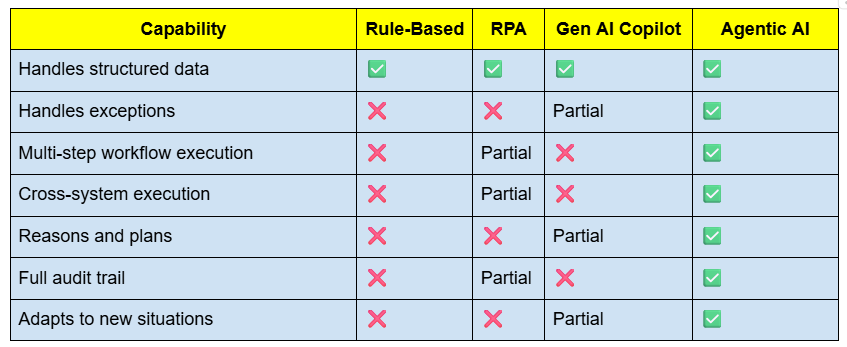
Rule-based automation executes fixed scripts on structured data. It breaks the moment anything falls outside its programmed rules.
Robotic Process Automation (RPA) mimics human clicks across interfaces. It is faster than manual work but fragile — a UI change or an unexpected invoice format breaks the bot. It has no reasoning capability and no ability to handle novel situations.
Generative AI copilots can draft text, answer questions, and summarise documents. They are useful, but they are reactive — they respond to a prompt. They do not plan, execute, or complete a workflow end-to-end.
Agentic AI combines reasoning, memory, tool use, and execution. It plans a sequence of steps to achieve a goal, uses tools (your ERP, your bank feeds, your accounting system) to complete each step, adapts when something unexpected happens, and maintains a full audit trail of every decision it made and why.
For CFOs, the key implication is this: agentic AI does not just accelerate the work your team is already doing. It changes what work your team needs to do at all. The repetitive, rules-heavy, multi-step workflows that consume most of your finance team's capacity — processing, matching, reconciling, chasing, reporting — become largely autonomous. Your people shift from executing processes to overseeing them.
That is why analysts and finance leaders are calling it the most significant shift in finance operations since the introduction of ERP systems in the 1990s.
Why Finance Teams Are Adopting Agentic AI Now
Finance teams have been promised automation for decades. Most of those promises delivered partial relief — a bot here, a dashboard there — while the underlying manual burden stayed largely intact. So it is worth being precise about why this moment is different.
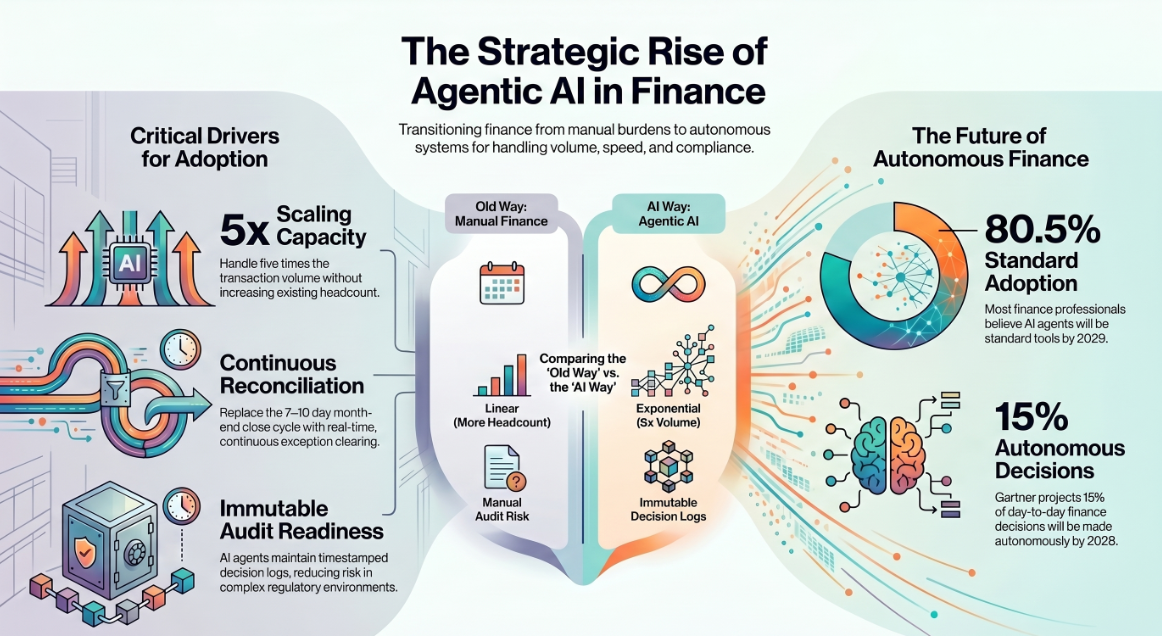
The volume problem has outpaced human capacity. Modern enterprises process thousands of invoices, hundreds of vendor payments, dozens of intercompany reconciliations, and continuous streams of transaction data every day — often across multiple ERP instances, banking relationships, and legal entities. The headcount required to manage this manually does not scale with the business, and the error rate under volume pressure is not acceptable in a compliance environment.
The close cycle is still broken. Despite decades of investment in finance technology, the average enterprise still takes seven to ten days to close its books each month. Most of that time is not spent on analysis — it is spent on reconciliation, exception clearing, and chasing data from systems that do not talk to each other. Agentic AI closes that gap by executing reconciliation continuously, not just at month end.
Compliance requirements are increasing in complexity. Regulatory environments across every major market — SOX in the US, GDPR in Europe, VAT regimes across Asia and the Middle East — are becoming more demanding, not less. Manual compliance processes are not just slow; they create audit risk. Agentic AI agents that maintain immutable, timestamped decision logs for every action they take represent a step-change in audit readiness.
The talent market is not solving the problem. Hiring experienced finance professionals is expensive and competitive. Agentic AI allows finance functions to scale their capacity — handling five times the transaction volume without five times the headcount — while allowing the team they have to focus on higher-value analytical and strategic work.
According to a survey cited in Deloitte's research, 80.5% of finance and accounting professionals believe AI agents will become standard tools within five years. Gartner projects that at least 15% of day-to-day finance work decisions will be made autonomously by AI by 2028. The window in which early adopters gain a structural advantage over competitors who are still evaluating is already closing.
8 High-Impact Agentic AI Use Cases in Finance and Accounting
These are not theoretical applications. Each use case below reflects the workflows that enterprise finance teams — across banking, fintech, retail, logistics, healthcare, and professional services — are deploying agentic AI on right now.
1. Invoice Processing and Accounts Payable Automation
Invoice processing is the most common entry point for agentic AI in finance, and for good reason. It is high-volume, rules-heavy, exception-prone, and deeply manual in most organisations. A typical AP workflow involves receiving invoices across multiple channels (email, portal, EDI, paper), extracting data, validating against purchase orders, routing for approval, resolving discrepancies, posting to the general ledger, and scheduling payment. At scale, this process is where finance teams spend enormous amounts of time — and where errors cause downstream problems in cash management, vendor relationships, and audit trails.
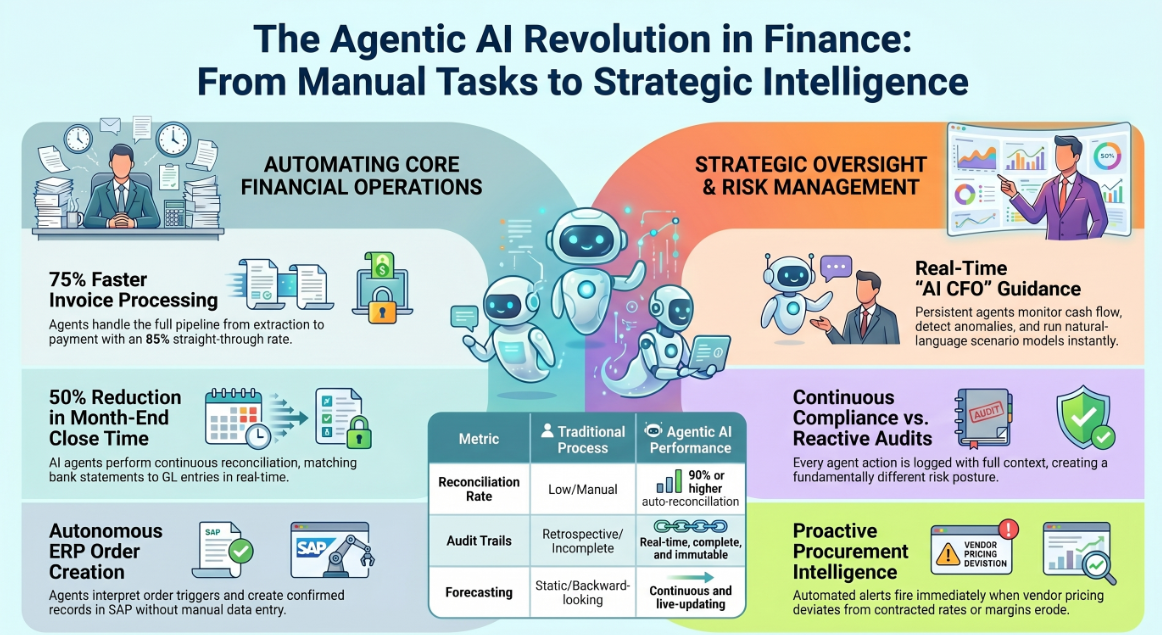
An agentic AI system handles the full AP pipeline autonomously. Agents extract invoice data from 90-plus formats using document AI, perform three-way matching against purchase orders and goods receipts, apply threshold-based approval routing, flag genuine discrepancies for human review, post approved invoices to the GL, and trigger payment disbursement — all with a complete audit trail attached to every action.
Results enterprises are seeing: 75% faster invoice processing end-to-end. 85% straight-through processing rate, meaning 85 out of every 100 invoices are handled without human intervention. Significant reduction in late payment penalties and duplicate payments.
If your finance team is manually keying invoice data into an ERP or chasing approvers via email, this is the highest-ROI place to start. Explore assistents.ai's invoice processing automation →
2. Financial Reconciliation and Month-End Close
Reconciliation is the process that keeps most finance teams working late at month end. Matching bank statements to AP records to general ledger entries — across multiple accounts, currencies, and entities — is one of the most time-intensive and error-prone tasks in accounting. The consequences of getting it wrong range from reporting inaccuracies to audit findings to delayed close cycles.
Agentic AI agents perform reconciliation continuously rather than periodically. They ingest bank feeds, AP records, and GL entries in real time, automatically match transactions using configurable matching logic, identify timing differences versus genuine exceptions, and route only the true exceptions to the right person with full context attached. The agent does not just flag a discrepancy — it tells the reviewer what it found, why it could not resolve it automatically, and what information is needed to close it.
Results enterprises are seeing: 90% or higher auto-reconciliation rates. 50% reduction in the time to close books. Near-elimination of the manual matching workload that traditionally dominates the last week of every month.
This is the use case where agentic AI most directly frees senior finance staff from operational burden, allowing them to redirect time toward analysis and business partnering.
3. Cash Flow Forecasting and Scenario Modelling
Traditional cash flow forecasting is a backward-looking, spreadsheet-driven process. Finance teams pull data from multiple systems, normalise it, build models, and produce forecasts that are out of date almost before they are distributed. The result is that CFOs are making working capital decisions on information that is days or weeks old.
Agentic AI transforms forecasting from a periodic exercise into a continuous, live process. Agents connect to ERP systems, banking feeds, accounts receivable ageing reports, and external signals — market data, supplier lead times, macroeconomic indicators — and update forecasts in real time. Scenario modelling that previously required a finance analyst to rebuild a spreadsheet from scratch can be triggered by a natural language instruction: "Show me what our cash position looks like if our three largest customers pay 15 days late."
The AI CFO agent use case goes further. It does not just forecast — it monitors runway continuously, detects anomalies in cash flows before they become critical, and generates recommended actions with enough context for the CFO or finance director to act immediately.
From a real enterprise deployment: A global fintech platform deployed an AI CFO agent delivering continuous cashflow insight, forecasting, and scenario planning — replacing a manual process that had required multiple finance team members and still produced outputs that were consistently behind the business. The outcome was faster analysis cycles, earlier detection of cash risks, and scalable advisory-grade insight without additional headcount.
Learn more about how assistents.ai's AI CFO capability works →
4. Procurement KPI Monitoring and Vendor Intelligence
For finance leaders in multi-entity organisations — holding groups, retail conglomerates, diversified enterprise groups — procurement visibility is a chronic challenge. Purchase price variances accumulate silently. Vendor performance degrades before anyone notices. Gross margin erosion driven by supplier pricing moves only surfaces at month end, when it is too late to act.
Agentic AI agents solve this by monitoring procurement data continuously across every entity and surfacing alerts when something moves. Purchase price trend alerts fire when a supplier's pricing deviates from contracted rates. Gross margin impact calculations run automatically when new purchase orders are placed. Early-payment analysis identifies opportunities to capture discounts or avoid notional finance costs. Vendor scorecards on delivery performance and return rates update in real time rather than being compiled manually each quarter.
From a real enterprise deployment: A major retail holding group deployed automated procurement and finance KPI alerts across group entities, covering purchase price trends, gross margin impact, early-payment analysis, and vendor performance. The result was earlier detection of margin erosion and vendor slippage, standardised finance and procurement intelligence across the group, and a significant reduction in variance surprises that had previously only been caught during management reporting cycles.
This use case is particularly high-value for CFOs of diversified groups where visibility across business units has historically required days of manual data aggregation.
5. Compliance, Audit, and Regulatory Workflows
Compliance in finance is not a one-time exercise. It is a continuous operational requirement — and one that is becoming more demanding in almost every jurisdiction. For banks and financial institutions, this means AML/KYC screening, SAR filing, transaction monitoring, and regulatory reporting. For enterprises more broadly, it means SOX controls, VAT compliance, cross-border withholding tax obligations, and audit trail requirements that most finance teams are currently meeting through manual processes.
Agentic AI agents bring compliance from reactive to continuous. Every action the agent takes is logged with full context — what data was used, what rule was applied, what decision was made, when it happened, and who was notified. Audit trails are immutable and timestamped. Anomalies are flagged automatically before they become findings. Regulatory filing workflows are executed with agents that pull data from source systems, validate formats, apply jurisdiction-specific rules, and flag missing fields before deadlines.
For financial services specifically, the risk reduction is significant. Agents handle the full AML/KYC lifecycle — customer onboarding, sanctions screening, continuous monitoring, investigation management, and regulatory reporting — with every step logged and every decision auditable. False positive rates in fraud detection, a persistent operational cost in financial services, can be reduced substantially by multi-dimensional analysis that rule-based systems cannot perform.
The compliance advantage in plain terms: A human-led compliance process produces audit trails that are retrospective, incomplete, and dependent on individual diligence. An agentic AI compliance process produces audit trails that are real-time, complete, and structurally consistent. That is a fundamentally different risk posture for any organisation operating in a regulated environment.
Explore assistents.ai's agent governance and compliance architecture →
6. Revenue Analytics and FP&A Decision Support
The standard financial planning and analysis workflow in most enterprises involves finance analysts spending the majority of their time pulling data, cleaning it, and building reports — with relatively little time left for the analysis and insight generation that their stakeholders actually need. Natural language querying over live financial data is the capability that changes this most visibly.
With an agentic BI layer over your financial data, a CFO or finance director can ask "What drove the margin decline in our logistics segment last quarter?" or "Which customer cohorts are showing early signs of payment risk?" and get an answer in seconds — sourced from live data, with the supporting calculations visible and auditable. No SQL query. No waiting for an analyst to build a report. No Monday morning deck that reflects Friday's data.
For FP&A specifically, agentic AI agents run continuous scenario modelling, detect variance patterns before they escalate, and generate narrative explanations of the numbers that used to require hours of analyst interpretation. The shift is from finance teams producing information to finance teams acting on it.
From a real enterprise deployment: A geriatric care services provider deployed operational and revenue analytics across their physician-led care programs. The outcome was improved visibility into revenue leakage drivers, faster operational decision-making through unified reporting, and better decision support for leadership on program performance and financial outcomes.
See how assistents.ai's Agentic BI works for finance teams →
7. ERP Order Automation and Legacy Workflow Replacement
One of the least visible but highest-cost areas of finance operations is the manual processing layer that sits between front-office systems and ERP. Sales orders, purchase orders, intercompany transactions — in many enterprises, these still flow through manual steps, legacy middleware, or end-of-life document management systems that carry high licensing costs and fragile integrations.
Agentic AI can interpret order triggers from any upstream source, validate them against business rules, handle exceptions, create confirmed records in SAP or any other ERP, and maintain a complete audit log — all without human data entry. This is particularly powerful in scenarios where organisations are migrating away from legacy systems and need to replace complex workflows without rebuilding them from scratch.
From a real enterprise deployment: An enterprise migrating away from an end-of-life, high-licensing-cost document management environment deployed agentic AI to automate SAP sales order creation. The agent interprets order triggers, validates against business rules and exceptions, creates SAP Sales Orders, and generates reconciliation and audit reports. The outcome was a reduction in manual order processing, fewer data-entry errors, faster order-to-confirm cycles, and significantly improved auditability for the entire sales order creation process.
This use case demonstrates something important: agentic AI is not only a tool for new capability. It is also a pragmatic replacement for legacy infrastructure that is costing organisations money and introducing operational risk.
8. The AI CFO Agent: Continuous Financial Guidance at Scale
The AI CFO agent is the most complete expression of what agentic AI in finance looks like when all the individual use cases come together. Rather than a point solution for invoice processing or reconciliation, an AI CFO agent is a persistent, always-on system that monitors the entire financial position of a business — cash flow, receivables, payables, forecast versus actuals, runway, anomalies — and provides continuous, decision-ready guidance to finance leadership.
For growing businesses and for CFOs managing multiple entities, this capability changes the economics of financial oversight. The insight that previously required a team of finance analysts to produce — cashflow monitoring, scenario modelling, risk flagging, portfolio views across multiple clients or entities — becomes available continuously, at a fraction of the cost, and with more consistency than any manual process can deliver.
The AI CFO agent does four things continuously:
- Monitors financial activity across all connected systems in real time
- Detects anomalies, risks, and opportunities before they appear in management reports
- Generates scenario models and forecasts that update as data changes
- Delivers recommended actions with enough context for an immediate decision
From a real enterprise deployment: A global fintech platform serving growing businesses, CFOs, and advisors deployed an AI CFO agent that connects to their clients' accounting and banking systems, runs continuous cashflow monitoring and forecasting, and surfaces scenario-based guidance with runway risk alerts. The outcome was faster analysis cycles, earlier detection of cash risks, scalable advisory-grade insight for a growing client base, and the ability to deliver CFO-quality financial guidance without proportionally scaling the team.
Agentic AI vs. RPA vs. Traditional Automation in Finance: What's the Difference?
Finance teams have been through multiple waves of automation investment. Many have been burned by RPA deployments that required constant maintenance, broke on process changes, and never delivered the promised ROI. Understanding precisely why agentic AI is different — not just in marketing language but in technical capability — matters for building the business case internally.
Rule-based automation executes fixed logic on predictable inputs. It is fast and reliable within its narrow lane, but it has no ability to handle anything outside that lane. A rule-based system that processes invoices in a specific format fails the moment a vendor changes their template.
RPA takes this further by mimicking the steps a human would take on a screen. It can work across systems that lack APIs, which made it appealing for legacy environments. But it is fundamentally brittle — dependent on UI stability, incapable of reasoning about exceptions, and expensive to maintain as processes evolve. Gartner has estimated that the hidden maintenance cost of RPA deployments often equals or exceeds the initial build cost.
Generative AI copilots — the type of AI embedded in Microsoft Copilot for Finance, ChatGPT interfaces, and similar tools — are genuinely useful for summarisation, drafting, and question-answering. But they are reactive tools that respond to prompts. They do not initiate workflows, execute multi-step processes, or take autonomous action across connected systems. A copilot cannot close your books. An agentic AI system can.
Agentic AI combines a language model's reasoning capability with tool use, memory, and execution. It can plan a sequence of steps, use APIs and integrations to complete each step, adapt when a step produces an unexpected result, and complete the workflow end-to-end. Critically for finance: it does all of this inside a governance framework that enforces your policies, maintains your audit trail, and escalates to humans at the decision points where human judgment is required.
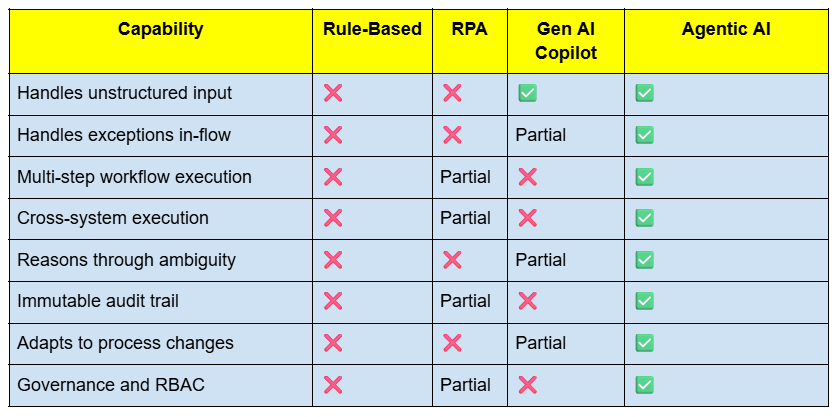
The critical difference for a CFO evaluating these options: agentic AI is the first automation technology that can handle the full complexity of real finance workflows — including the exceptions, the cross-system dependencies, and the compliance requirements — without requiring a human to manage every deviation.
Real-World Results: Agentic AI in Finance Across Industries
The following outcomes are drawn from real enterprise deployments of agentic AI across finance and accounting workflows. Client names are not disclosed, but the industries, use cases, and outcomes are accurate.
Banking and Financial Services
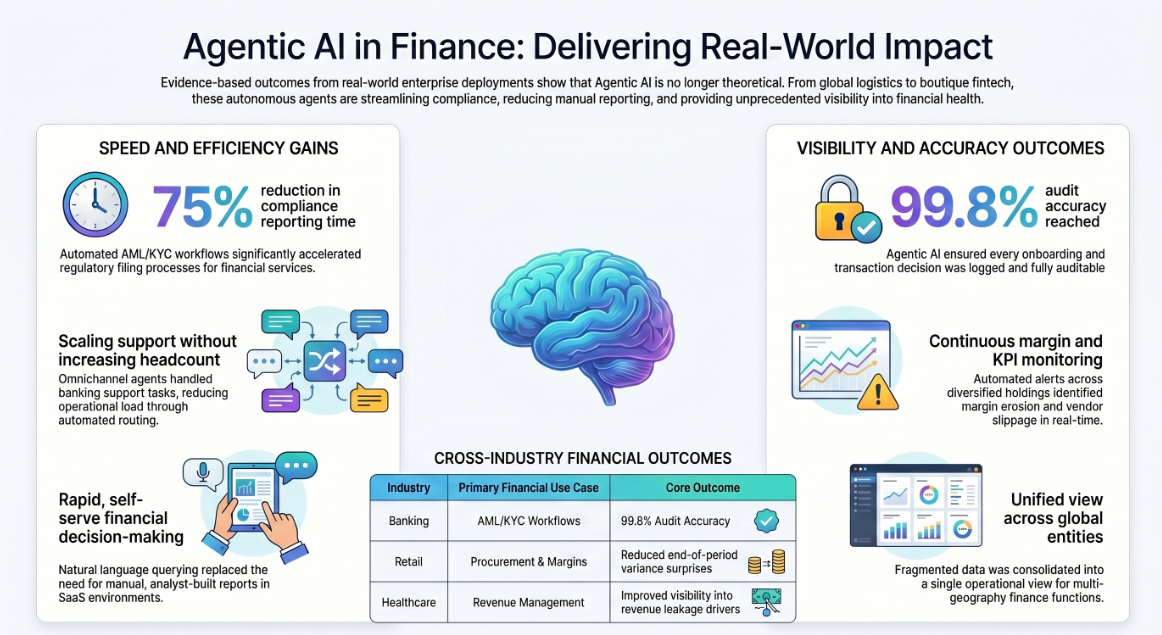
A global fintech provider serving banks and credit unions deployed omnichannel AI agents for banking support, combining chat, email, and phone intake with automated workflow routing, agent-assist summarisation, next-best-action recommendations, and full SLA monitoring. The outcome was faster case handling, reduced operational load through automation, better compliance readiness through complete audit trails, and the ability to scale support capacity without proportionally increasing headcount.
A separate financial services deployment automated AML/KYC workflows — customer onboarding, sanctions screening, continuous transaction monitoring, and regulatory filing — with every decision logged and auditable. Compliance reporting time was reduced by 75%, and audit accuracy reached 99.8%.
Retail Finance and Procurement
A major retail enterprise with a pan-India footprint of 700-plus stores deployed enterprise AI agents covering store support, inventory intelligence, and procurement visibility. Finance-specific outcomes included improved store-level inventory visibility, reduced manual helpdesk burden, faster onboarding via on-demand training, and the ability to monitor procurement and margin KPIs continuously across a high-velocity retail operation.
A second retail holding group with diversified assets deployed automated procurement and finance KPI alerts across all group entities. This covered purchase price trends, gross margin impact, early-payment analysis, and vendor delivery and return performance. The result was earlier detection of margin erosion and vendor slippage, standardised financial intelligence across the group, and a significant reduction in end-of-period variance surprises.
Supply Chain and Logistics
A global ports and logistics enterprise — operating at a scale that includes record revenue of over $20 billion in a recent financial year — deployed agentic AI to digitise and optimise terminal and rail management operations. Finance-relevant outcomes included improved operational visibility across terminal-to-rail logistics, higher predictability of throughput, more efficient coordination reducing cost overruns, and executive dashboards that replaced manual reporting cycles.
A separate multinational logistics and supply chain company consolidated analytics across multi-entity global operations spanning India, UK/Europe, and the US. The result was a single operational view across entities, faster leadership reporting, and improved consistency of operational metrics — solving the fragmented data problem that afflicts most multi-geography finance functions.
Healthcare
A physician-led clinical enterprise deployed data analytics for revenue management and operational performance. Finance outcomes included improved visibility into revenue leakage drivers, faster operational decision-making through unified reporting, and more reliable performance tracking — directly improving the financial sustainability of their inpatient programs.
A geriatric care services provider deployed operational and revenue analytics across their care programs. The result was better decision support for leadership, faster identification of operational bottlenecks, and improved transparency into service performance — translating to stronger financial outcomes across their assisted living and long-term care portfolio.
Professional Services and Holding Groups
A prominent family business group comprising 30-plus companies deployed automated procurement and finance KPI alerts across group entities. The system provides continuous margin control, vendor performance monitoring, and working-capital optimisation signals — replacing a manual process that had relied on periodic management reporting and was consistently lagging the business.
A long-term holding company that partners with founders and family businesses deployed technical due diligence capabilities and an agentic analytics layer over their existing data. Finance outcomes included faster investment decisions with clear, structured visibility into technical risk, reduced post-deal surprises, and improved confidence in the scalability and security posture of acquisition targets.
SaaS, Fintech, and High-Growth Companies
A Silicon Valley analytics startup deployed an AI data analytics agent enabling rapid, self-serve decision-making from e-commerce and operations data. Finance and operations teams gained the ability to query live business data in natural language, with consistent metric definitions and automated KPI monitoring replacing a dependence on analyst-built reports.
An AI CFO platform deployed for growing businesses delivers continuous cashflow monitoring, scenario planning, and actionable finance guidance to CFOs and advisors managing multiple client portfolios. The outcomes — faster analysis cycles, earlier cash risk detection, scalable advisory insight — represent what is possible when the AI CFO agent model is applied at platform scale.
How to Deploy Agentic AI in Finance: What to Expect
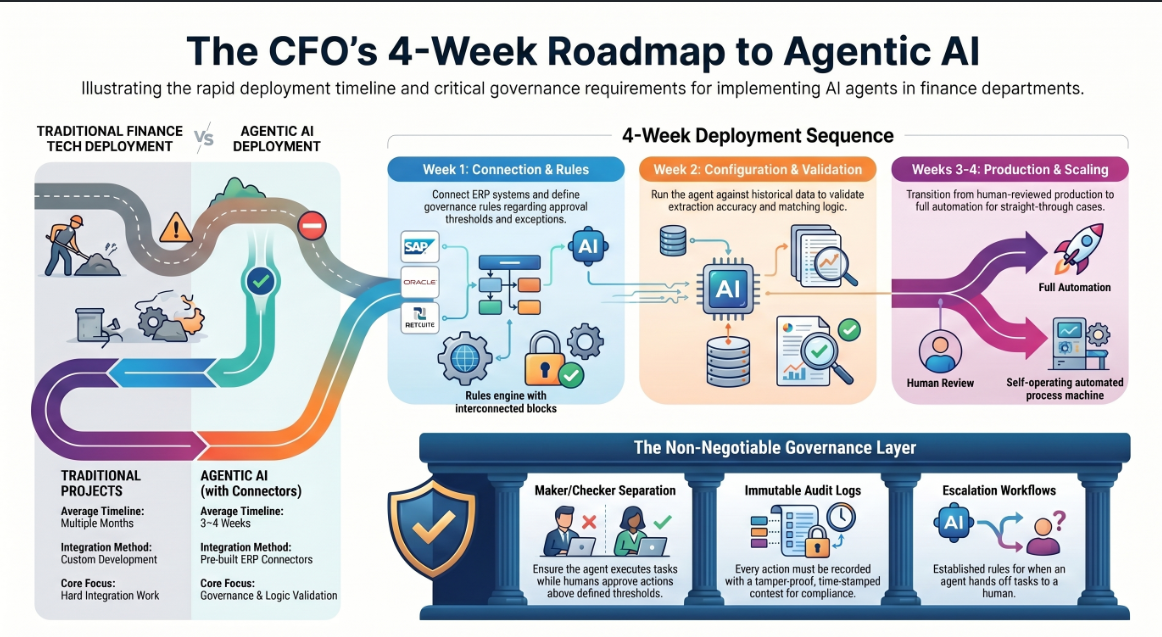
One of the most common questions from CFOs evaluating agentic AI is how long it actually takes to get from evaluation to production. The answer, for properly designed platforms with pre-built ERP integrations, is typically three to four weeks for the first use case.
This is significantly faster than most finance technology projects because the hard integration work — connecting to SAP, NetSuite, Oracle, banking feeds, and document sources — is handled by pre-built connectors rather than custom development. The deployment effort focuses on configuring the governance layer (your approval rules, escalation paths, and audit requirements), connecting your specific data sources, and validating the agent's behaviour against your workflows before going live.
A practical deployment sequence for finance teams:
Week 1: Use case selection and system connection. Identify the highest-pain workflow — usually invoice processing or reconciliation. Connect the agent to your ERP and any relevant upstream document sources. Define your governance rules: who approves what, at what thresholds, with what exceptions.
Week 2: Configuration and validation. Configure the agent's workflow logic against your specific process. Run the agent against historical data to validate extraction accuracy and matching logic. Identify edge cases and define how they should be handled.
Week 3: Controlled production. Run the agent in production with a human review layer over its outputs. Confirm that the agent's decisions match expected outcomes. Tune confidence thresholds and exception routing.
Week 4: Full production. Remove the review layer for straight-through cases. Monitor exception rates, processing times, and audit log quality. Expand scope to the next use case.
What to look for in the governance layer before you start:
- Role-based access control: who can see what, who can approve what, who can override what
- Maker/checker separation: the agent executes, humans approve above defined thresholds
- Immutable audit logs: every action the agent takes is recorded with full context, timestamped, and tamper-proof
- Escalation workflows: clear rules for when the agent hands off to a human and with what context
- Exception dashboards: real-time visibility into what the agent is handling and what is queued for review
The governance layer is not optional. It is the reason agentic AI is safe for use in regulated finance environments. Any platform that cannot demonstrate these controls should not be in your shortlist.
See how assistents.ai deploys AI agents for finance teams →
What to Look for in an Agentic AI Platform for Finance
The market for AI agents in finance is moving quickly. Choosing a platform that will grow with your requirements — and that you can trust in a compliance environment — requires evaluating a specific set of capabilities.
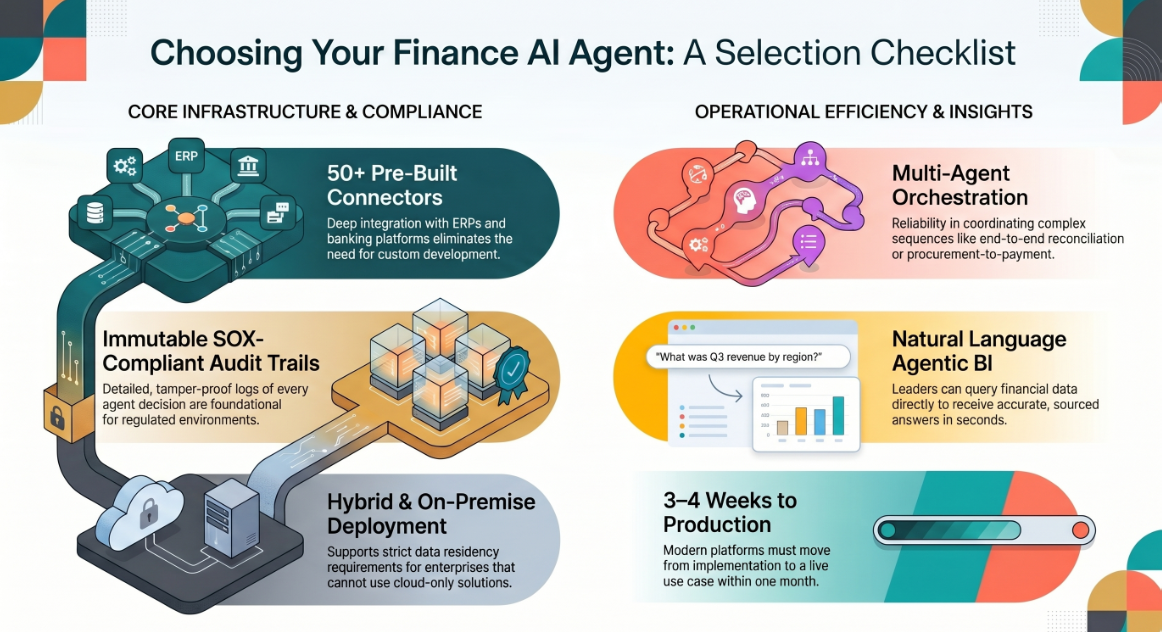
Integration depth. Your finance workflows span multiple systems — ERP, accounting software, banking platforms, expense management, procurement, and document repositories. A platform with shallow integrations will require custom development work that undermines the speed-to-production advantage. Look for 50-plus pre-built connectors covering SAP, NetSuite, Oracle, Sage, QuickBooks, Plaid, Stripe, Coupa, and the other systems your finance function runs on.
SOX-compliant audit trails. Every action the agent takes must be logged with complete context: what data it used, what rule it applied, what decision it made, when it happened, who was notified, and what the outcome was. Logs must be immutable, tamper-proof, and exportable for auditor review. This is not a nice-to-have. In a regulated finance environment, it is the foundation of the entire use case.
Multi-agent orchestration. Complex finance workflows — a full AP cycle, an end-to-end reconciliation, a procurement-to-payment process — require multiple agents working in sequence. The platform must be able to orchestrate these multi-agent pipelines reliably, with clear handoffs and error handling between agents.
Natural language querying (Agentic BI). Finance leaders should be able to ask questions of their financial data directly — "What is our current DSO by customer segment?" or "Which vendors are outside our payment terms by more than 30 days?" — and get accurate, sourced answers in seconds. This capability collapses the gap between data and decision for the entire finance leadership team.
On-premise or hybrid deployment. For financial services organisations and enterprises with strict data residency requirements, cloud-only deployment is not viable. The platform must support on-premise or private cloud deployment with the same capability set.
Time to production. A platform that requires six months of implementation before a single workflow is live is not fit for purpose in 2026. Target three to four weeks for the first use case in production.
Outcome guarantees. The best platforms will give you measurable targets before you sign — specific improvements in processing time, reconciliation rate, or exception volume — with enough deployment history to back them up.
Explore the full assistents.ai platform for finance →
Getting Started with Agentic AI in Finance
The finance teams getting the most out of agentic AI in 2026 did not start by trying to automate everything at once. They started with a single, well-defined, high-pain workflow — usually invoice processing or financial reconciliation — established the governance layer properly, demonstrated measurable results, and then expanded from there.
If you are a CFO or finance leader beginning this evaluation, three things matter most before you select a platform.
First, get clear on your governance requirements. What approval rules do you need? What audit trail does your compliance environment demand? What data should the AI never act on without human sign-off? These requirements are not a barrier to deployment — they are the specification that a good platform should be able to meet out of the box.
Second, prioritise integration coverage over feature depth. A platform with 50 genuine pre-built ERP and banking connectors will deliver faster and more reliable results than a platform with more sophisticated AI but shallow integrations that require months of custom development.
Third, demand outcome evidence. Ask vendors for specific, verifiable results from enterprise deployments in finance — processing time reductions, reconciliation rates, close cycle improvements. Platforms that have genuinely done this work in production will have specific numbers. Platforms that are primarily building the category narrative will not.
Assistents.ai is an enterprise agentic AI platform built specifically for high-complexity, compliance-sensitive environments. The finance and procurement solution covers the full workflow — invoice processing, reconciliation, procurement KPI monitoring, revenue analytics, compliance, and AI CFO capabilities — with 85-plus pre-built connectors, SOX-compliant audit trails, and a typical time to production of three weeks.
Schedule a demo with assistents.ai →
Explore the Finance and Procurement solution →
See how assistents.ai handles governance and compliance →
Frequently Asked Questions
What is agentic AI in finance and accounting?
Agentic AI in finance and accounting refers to AI systems that can independently plan and execute multi-step financial workflows — such as invoice processing, reconciliation, forecasting, and compliance reporting — across connected systems like ERPs, banking platforms, and accounting software, without requiring human input for each step. The agent reasons through a goal, uses tools to complete it, handles exceptions, and maintains a full audit trail.
How is agentic AI different from RPA in finance?
RPA mimics human clicks on interfaces and executes fixed scripts. It breaks when a process changes, cannot handle unstructured data, and has no reasoning capability. Agentic AI understands the goal of a workflow, reasons through the steps required, handles exceptions in real time, works with unstructured documents, and operates across multiple systems via APIs — not screen scraping. It is also governed, auditable, and compliant in a way that most RPA deployments are not.
What finance tasks can AI agents automate today?
AI agents are currently automating invoice processing and three-way matching, financial reconciliation and GL posting, cash flow forecasting and scenario modelling, procurement KPI monitoring and vendor alerts, AML/KYC and compliance reporting, revenue analytics and FP&A variance analysis, SAP and ERP sales order creation, and the full AI CFO agent capability covering continuous cashflow monitoring and guidance.
How does agentic AI maintain compliance and audit trails?
Every action an agentic AI agent takes in a well-governed platform is recorded in an immutable, timestamped log that captures the data used, the rule applied, the decision made, and the outcome. Governance layers enforce role-based access control, maker/checker separation, approval hierarchies, and escalation workflows. These logs are tamper-proof and exportable for auditor review. For financial services, this extends to AML/KYC lifecycle logging, SAR generation, and regulatory filing documentation.
How long does it take to deploy AI agents in finance?
With a platform that has pre-built ERP and banking integrations, the first use case is typically in production within three to four weeks. This includes system connection, governance configuration, workflow validation on historical data, controlled production with human oversight, and full production deployment. Complex multi-entity or multi-system deployments may take slightly longer, but the days of six-month ERP-style implementations do not apply to well-designed agentic AI platforms.
What ROI can finance teams expect from agentic AI?
Benchmarks from enterprise deployments include 75% faster invoice processing, 85% straight-through processing rates, 90% or higher auto-reconciliation rates, and 50% reduction in month-end close time. Qualitative outcomes include significant reduction in finance team time spent on operational tasks, earlier detection of cash flow risks and margin erosion, better compliance posture, and improved decision speed for finance leadership. The ROI compounds as additional use cases are deployed on the same platform.
Can agentic AI integrate with SAP, NetSuite, or Oracle ERP?
Yes. Enterprise-grade agentic AI platforms include pre-built connectors for SAP, NetSuite, Oracle, Sage, QuickBooks Online, and most other major ERP and accounting systems, alongside banking platforms (Chase, Plaid, Stripe), procurement tools (Coupa, Ariba), and expense management systems. The key question to ask any vendor is how many of these integrations are pre-built versus custom-developed, as custom integrations undermine the speed-to-value that agentic AI is meant to deliver.
What is an AI CFO agent and what does it do?
An AI CFO agent is a persistent, always-on agentic AI system that continuously monitors a business's financial position — cash flow, payables, receivables, forecast versus actuals, runway, and anomalies — and provides real-time, decision-ready guidance to finance leadership. It replaces the periodic, manual financial reporting cycle with continuous visibility, surfacing risks and opportunities as they emerge rather than after the fact. It is particularly valuable for growing businesses, multi-entity groups, and CFOs managing multiple client portfolios.