Retail has always been a game of speed — getting the right product, to the right customer, at the right price, before a competitor does. For decades, the tools to do that have been slow, siloed, and built for a world with more predictable demand curves.
That world is gone.
AI agents in retail and ecommerce are fundamentally changing how the industry operates. Not the chatbots of 2018 that answered FAQs and handed off to humans. Not the dashboards of 2022 that surfaced insights nobody had time to act on. We are talking about autonomous systems that perceive your business environment — inventory levels, customer behaviour, competitor pricing, supply chain signals — and take action without waiting to be asked.
By 2030, analysts project that 25% of all e-commerce sales will be enabled or managed by autonomous AI agents. McKinsey estimates the US retail market alone could see up to $1 trillion in orchestrated revenue from agentic commerce. These are not speculative numbers. The deployments producing them are already live.
This guide covers what AI agents actually are in a retail context, the use cases driving real ROI, evidence from live enterprise deployments, and a practical path to getting started. If you are evaluating AI for your retail or ecommerce operation in 2026, this is the clearest picture of where the technology stands.
What Are AI Agents in Retail and Ecommerce?
An AI agent is a software system that perceives its environment, makes decisions based on that perception, and executes actions — autonomously, continuously, and across multiple systems — to achieve a defined goal.
In retail, that environment includes your POS data, inventory feeds, customer profiles, competitor pricing, order management systems, supplier communications, and support queues. An AI agent does not just read from these systems. It reasons across them simultaneously and acts — updating a stock allocation, triggering a replenishment order, responding to a customer inquiry, or flagging a pricing anomaly — without a human initiating each step.
This is categorically different from the AI tools most retailers have used until now.
AI agents vs. chatbots vs. RPA vs. copilots — what actually differs:
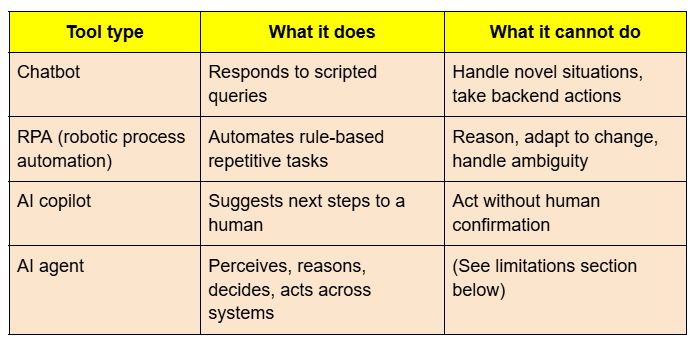
The key distinction is agency: the ability to decompose a goal into sub-tasks, select tools to complete those tasks, and execute multi-step workflows end-to-end. A chatbot waits for a question. An AI agent monitors your entire competitive pricing landscape around the clock and surfaces an alert the moment a rival discounts a key SKU — then drafts the recommended counter-response for your team to approve.
The Scale of the Shift: Why 2026 Is the Inflection Point
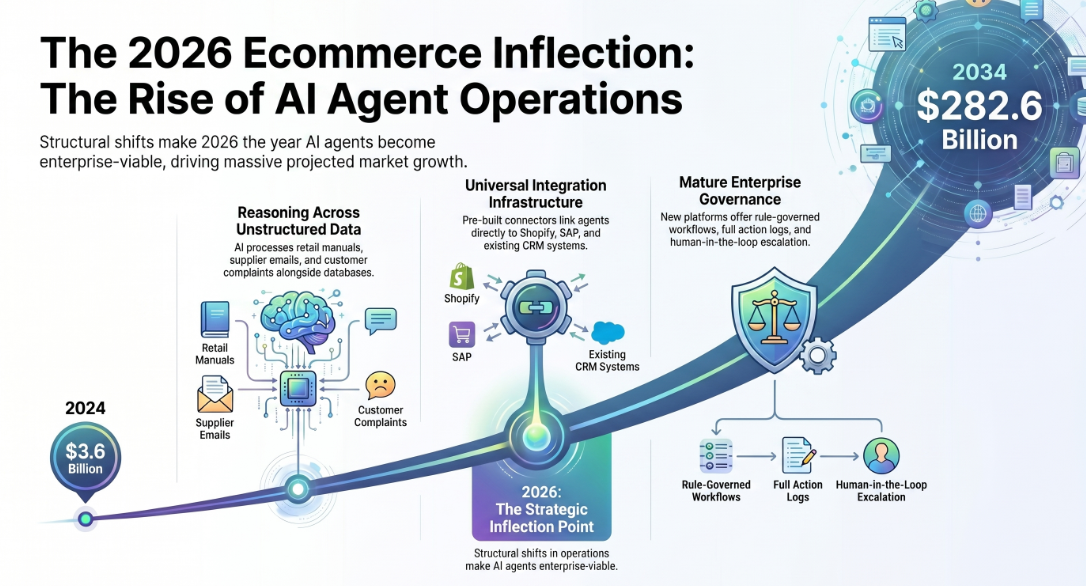
The global AI agents market in ecommerce was valued at $3.6 billion in 2024. It is projected to reach $282.6 billion by 2034. But market size statistics miss what is actually happening at the operational level.
Three structural shifts have made 2026 the tipping point:
1. LLMs can now reason across unstructured retail data. Product descriptions, supplier emails, customer complaints, store operations manuals — AI agents can ingest and act on all of this, not just structured database records.
2. Integration infrastructure has caught up. Modern agent platforms connect to POS systems, ERPs like SAP, ecommerce platforms like Shopify and Magento, and CRMs through pre-built connectors. The integration friction that stalled earlier deployments has largely been solved.
3. Governance has matured. Enterprise retailers cannot deploy systems that act without audit trails. The current generation of agent platforms includes rule-governed workflows, human-in-the-loop escalation, and full action logs — making agents viable for regulated, high-stakes environments.
Consumer-Facing AI Agents: What Shoppers Experience
Virtual Personal Shoppers
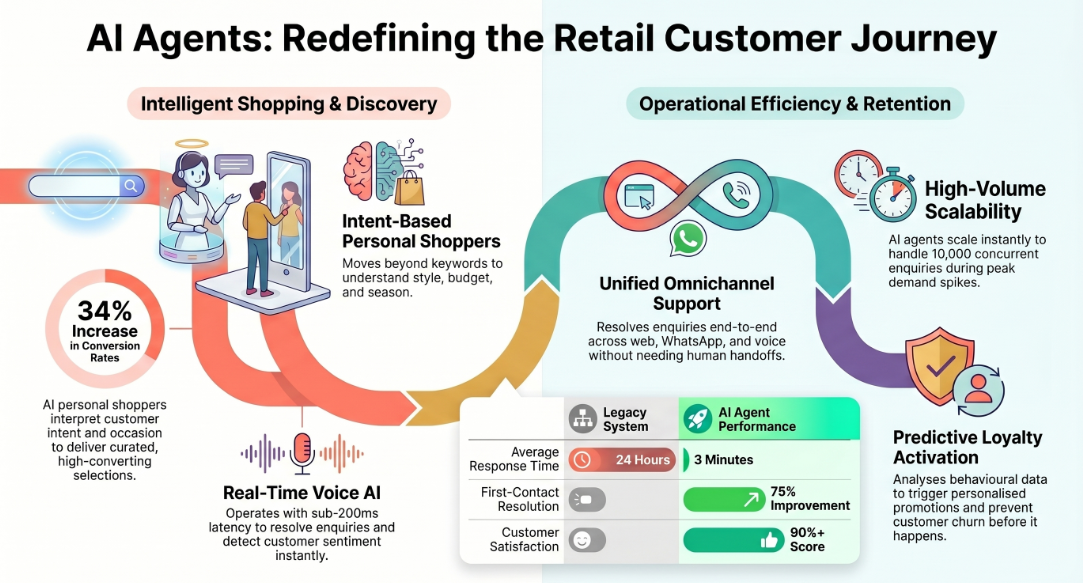
The shift here is from keyword search to intent understanding. Instead of a customer typing "blue dress" and receiving a filtered product list, an AI agent interprets "I need an outfit for a beach wedding in June under £150" — understands occasion, season, budget, and style signals — and returns a curated selection with reasoning.
These agents access real-time inventory, check size availability, surface complementary items, and apply personalisation from past purchase history. For retailers, this compresses the browse-to-purchase journey and significantly reduces drop-off at the discovery stage. Retailers using AI for personalisation at this level report conversion rate improvements of 34% and customer satisfaction scores above 90%.
Omnichannel Customer Support Agents
Legacy customer service meant a customer on WhatsApp being told to call a phone number, then repeating their order history to a new agent. AI agents resolve this entirely. A single support agent operates across web chat, WhatsApp, email, and voice simultaneously — accessing the customer's order status, purchase history, loyalty points, and return eligibility in real time — and resolves the inquiry end-to-end without handoff.
One enterprise deployment in this space automated the handling of the vast majority of customer inquiries — covering orders, returns, and tracking — across web, mobile, and social channels, improving first-contact resolution by 75% and reducing average response time from 24 hours to 3 minutes.
In a retail context with peak demand spikes, this scalability matters enormously. An AI support agent handling 10,000 concurrent inquiries during a flash sale costs the same as it does on a quiet Tuesday. Human teams cannot scale that way.
Voice AI for In-Store and Phone Channels
Natural voice agents are replacing legacy IVR systems (the "press 1 for returns" trees that customers actively despise). Modern voice AI operates with sub-200ms latency, detects sentiment in real time, resolves queries end-to-end, and escalates with full context when a human is genuinely needed. For multi-branch retail operations — driving schools, service centres, healthcare providers — this eliminates scheduling friction and reduces call centre load materially.
Loyalty and Personalisation Agents
Loyalty programmes generate enormous amounts of behavioural data that most retailers never fully activate. AI agents continuously analyse purchase patterns, browsing behaviour, and engagement signals to dynamically adjust offers, trigger personalised promotions, and predict churn before it happens. Rather than sending the same email to your entire list on Tuesday morning, an agent sends the right offer to each customer at the moment they are most likely to act.
Back-End and Operational AI Agents: What Happens Behind the Scenes
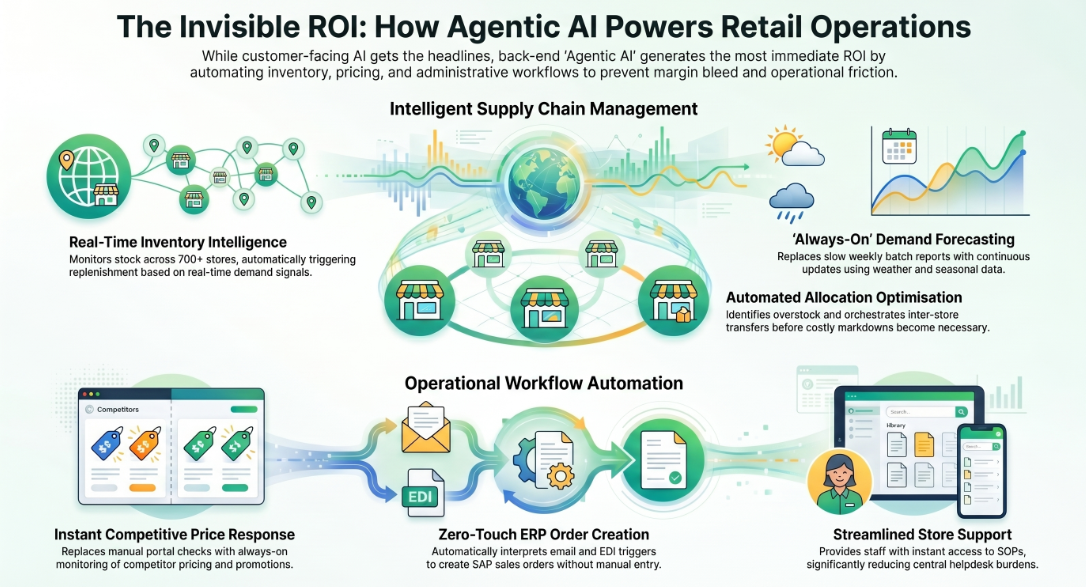
This is where AI agents generate the largest and most immediate ROI for retail and ecommerce operators. These are not customer-visible capabilities — they are the infrastructure-level systems that determine whether a business runs efficiently or bleeds margin.
Inventory Intelligence Agents
Inventory management across multiple locations is one of retail's most persistent cost drains. Overstock ties up capital and increases carrying costs. Stockouts lose sales and damage customer trust. The traditional approach — weekly reports, manual reorder triggers, gut-feel allocation decisions — cannot handle the signal complexity of modern omnichannel retail.
AI inventory agents monitor stock levels across every location in real time, predict demand by store and SKU using historical sales, seasonality, weather data, and promotional calendars, and trigger replenishment automatically when levels approach a threshold. In one documented deployment across a national retail network of 700+ stores, these agents delivered significantly improved store-level inventory visibility and measurably reduced manual helpdesk burden for store operations teams.
The same agent architecture handles allocation optimisation — identifying which stores are over-stocked on specific SKUs and orchestrating inter-store transfers before markdowns become necessary.
Competitive Price Monitoring Agents
In price-sensitive retail categories — consumer electronics, HVAC and cooling products, fast-moving consumer goods — competitor pricing moves can shift market share within hours. Manual monitoring across dozens of competitor portals is impossible at scale.
AI competitive monitoring agents continuously track competitor pricing, promotional offers, availability, and ratings across every relevant channel. When a competitor discounts a key product, the agent surfaces the alert instantly, maps the impact across affected SKUs in your portfolio, and generates a recommended response for commercial teams to review. This replaces manual monitoring processes that typically run days behind the market.
One deployment in a highly price-sensitive industrial and consumer product category delivered always-on monitoring replacing manual checks across portals, faster competitive response cycles, and earlier identification of pricing gaps and promotional shifts — all without adding headcount to the commercial intelligence function.
SAP and ERP Order Automation Agents
One of the highest-friction workflows in retail operations is sales order creation — particularly when order triggers arrive via email, EDI, or legacy document formats that require manual interpretation and data entry into SAP or other ERP systems. The manual process is slow, error-prone, and expensive.
Agentic AI systems can interpret incoming order triggers, validate against business rules, and create SAP sales orders automatically — with exceptions routed to human reviewers and a full audit log for reconciliation. This directly replaces costly legacy document management integrations (such as OpenText ECR, which has reached end-of-life for many enterprise users) while reducing order-to-confirm cycle times and data entry errors substantially.
Demand Forecasting Agents
AI agents analyse historical sales data, seasonal patterns, local events, weather forecasts, macroeconomic signals, and promotional activity to generate item-level demand predictions that guide assortment planning, replenishment scheduling, and promotional investment. The critical difference from traditional forecasting tools is that agent-based systems are always on — they update predictions continuously as new signals arrive, rather than running batch forecasts on a weekly or monthly cycle.
Store Operations and Training Agents
For multi-location retailers, getting consistent operational standards across hundreds of stores is a persistent challenge. AI knowledge agents — trained on POS documentation, standard operating procedures, and product information — give store associates instant access to accurate answers without calling a helpdesk. New staff can onboard faster. Experienced staff resolve edge cases without escalation. In one retail deployment, this translated to faster onboarding via on-demand training guidance and reduced manual helpdesk burden for the central support team.
Agentic Analytics: From Dashboard to Decision
Most business intelligence investments produce dashboards that tell leadership what happened. AI analytics agents close the loop — they convert insight into governed, auditable action. Rather than a store manager reviewing a report and deciding whether to act, an analytics agent monitors KPIs continuously, detects anomalies against defined thresholds, generates a recommended action, and creates a tracked task in the appropriate system — all automatically.
This "insights-to-action" pattern is one of the most impactful applications of AI agents in retail operations because it eliminates the most common reason analytics investments fail: the gap between knowing something and doing something about it.
Real-World Deployments: What Outcomes Actually Look Like
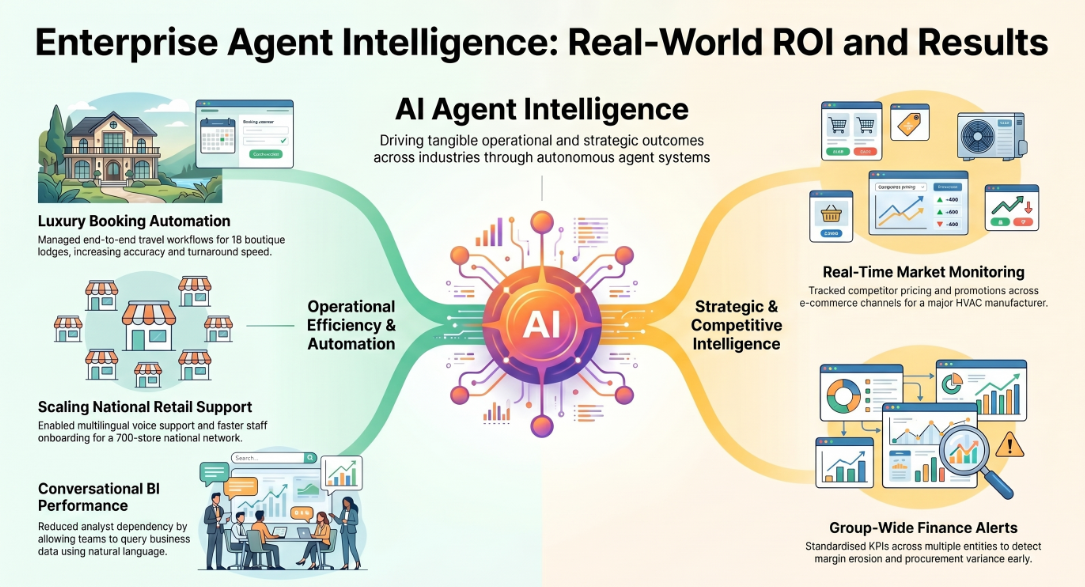
The following deployment examples are drawn from live enterprise projects. No client names are used. The outcomes are real.
National value retailer — 700+ stores, pan-India footprint
A rapidly scaling mass-market retailer with hundreds of stores across apparel, general merchandise, and FMCG categories deployed a multi-agent system covering three capabilities: a voice support agent operating in Hindi and English, an inventory intelligence agent providing real-time stock visibility by store, and a knowledge and training agent built on SOPs and POS documentation.
Results: reduced manual helpdesk burden for store support, improved store-level inventory visibility, and faster staff onboarding via on-demand training access. The system was built to handle the operational complexity of a high-volume retail network at national scale.
Major HVAC and consumer cooling manufacturer — competitive intelligence
A major Indian industrial and consumer brand operating in highly price-sensitive categories where competitor pricing moves matter daily deployed a continuous competitive monitoring agent. The system tracked pricing, promotional offers, availability, and ratings across all relevant e-commerce channels and brand portals in real time.
Results: always-on monitoring replacing manual portal checks, faster competitive response cycles, and earlier identification of pricing gaps — with a governance and audit trail architecture scaled from proof-of-concept to production.
Retail holding group — procurement and finance intelligence
A privately-held retail holding structure where leadership needed cross-functional intelligence across multiple entities deployed an automated KPI alert system covering procurement, finance, and vendor performance. The system standardised group-wide KPIs, generated automated alerts on purchase price trends, gross margin impacts, early-payment analysis, and vendor delivery performance, and delivered scheduled insight packs for leadership.
Results: earlier detection of margin erosion, standardised finance and procurement intelligence across entities, and reduced variance surprises through continuous monitoring.
Luxury hospitality retail brand — booking automation
A collection of 16 boutique lodges and camps serving high-expectation global travellers deployed a digital booking agent handling end-to-end luxury travel booking workflows. The agent managed email intake, intent classification, data extraction, real-time inventory checks, alternative date negotiation, and automated invoice generation — with human-in-the-loop handoff for curated itinerary creation.
Results: faster booking turnaround with reduced back-and-forth, higher accuracy on complex guest requirements, and scalable operations without compromising the service quality expected in the luxury segment.
E-commerce analytics deployment — conversational business intelligence
An e-commerce and operations business deployed a conversational AI analytics agent that allowed teams to query business data in natural language — sales trends, product performance, promotional effectiveness, inventory anomalies — without analyst queuing or BI tool expertise.
Results: shorter analysis cycles for recurring questions, better visibility into product performance and promotional effectiveness, and reduced reporting dependency on analysts.
The Agentic Commerce Shift: What Is Coming by 2030
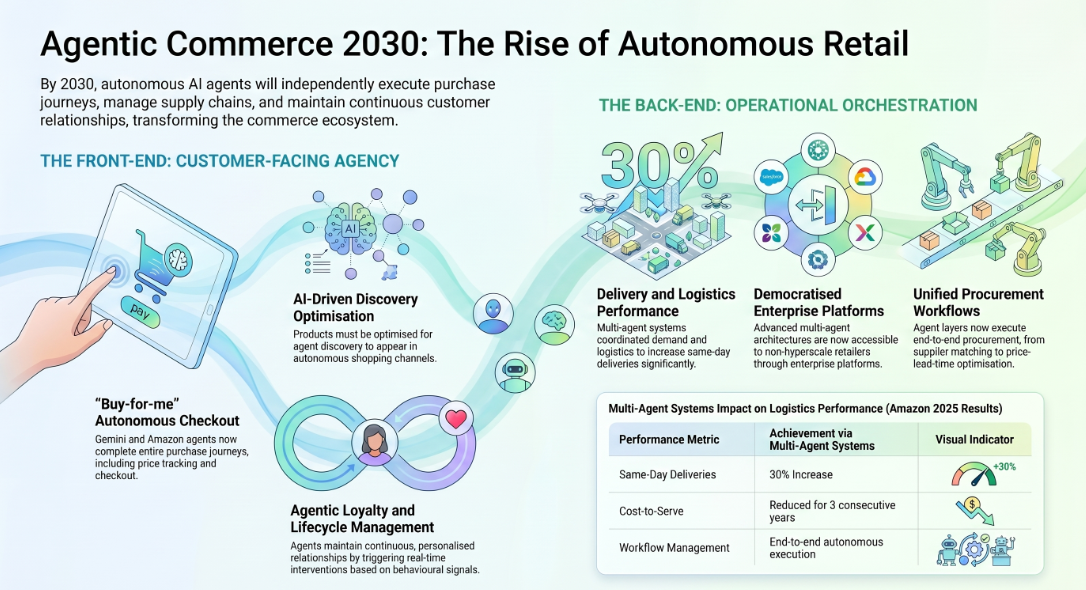
The deployments described above represent the first wave. The second wave — already emerging — moves AI agency further into the customer journey itself.
"Buy for me" agents. Google's Gemini and Amazon's experimental systems are deploying agents that complete purchase journeys on a customer's behalf: tracking prices, comparing alternatives, waiting for target prices, and completing checkout autonomously. For retailers, this fundamentally changes how products get discovered and sold. Products that are not optimised for AI agent discovery will not appear in this channel.
Multi-agent supply chain orchestration. Amazon's internal multi-agent system — where a manager agent coordinates specialised agents across demand forecasting, logistics, and inventory — achieved a 30% increase in same-day deliveries in 2025 while reducing cost-to-serve for the third consecutive year. This architecture is now accessible to non-hyperscaler retailers through enterprise agent platforms.
Agentic loyalty and lifecycle management. Rather than periodic campaigns, AI agents will maintain continuous, personalised relationships with individual customers — adjusting offers, timing outreach, anticipating churn, and triggering interventions in real time based on behavioural signals.
Supplier and procurement agents. Automated RFQ generation, supplier matching, quality document handling, and price-lead-time optimisation — currently handled through a combination of manual processes and disconnected software — will be unified under agent orchestration layers that execute procurement workflows end-to-end.
How to Deploy AI Agents in Your Retail Business
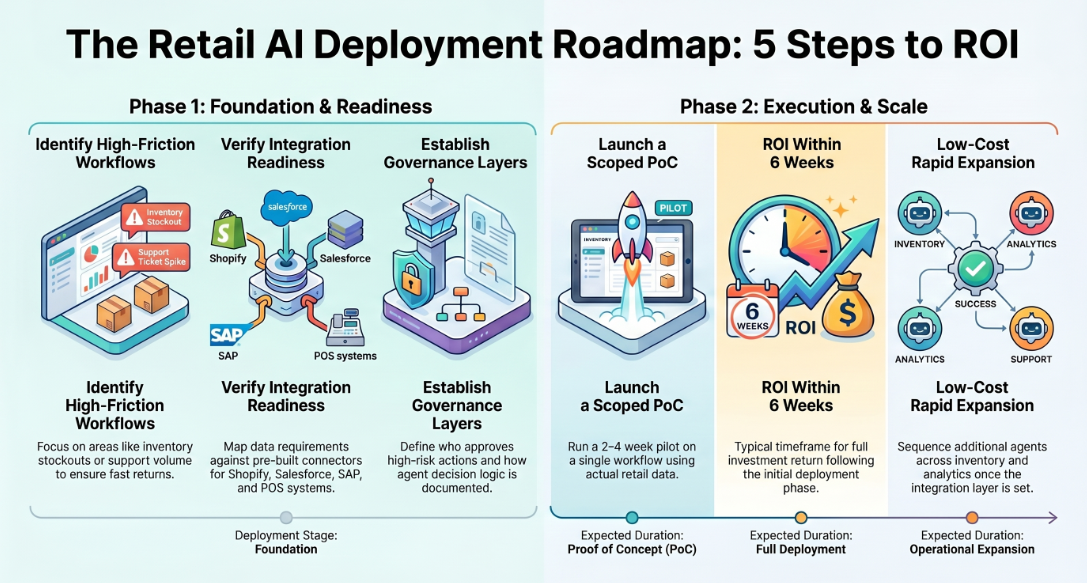
The most common mistake in retail AI deployment is starting with the technology rather than the workflow. The question is not "what AI agent should we buy?" — it is "which operational workflow, if automated, would generate the fastest and clearest return?"
Step 1: Identify your highest-friction workflow
For most retailers, the candidates are: customer support volume at peak, inventory stockouts and over-stock, manual competitive monitoring, or slow order processing. Pick one. Prove the model. Expand.
Step 2: Assess your integration readiness
AI agents require access to your data. The platforms that deliver results quickly are those with pre-built connectors to Shopify, Magento, Salesforce Commerce, SAP, major POS systems, and CRM platforms. Before selecting a platform, map which systems the agent needs to read from and write to — and verify connector availability.
Step 3: Define your governance requirements
Every enterprise retail deployment needs a governance layer: who approves agent actions above a defined risk threshold, what the audit trail looks like, how exceptions are escalated, and how the agent's decision logic is documented. Governance is not optional — it is what makes autonomous agents deployable in regulated, high-stakes retail environments.
Step 4: Start with a scoped proof of concept
The most effective deployment pattern is a scoped PoC — typically 2 to 4 weeks — targeting a single workflow with defined success metrics. This produces ROI projections grounded in your actual data rather than vendor benchmarks. Retailers using this approach typically achieve full ROI within 6 weeks of full deployment.
Step 5: Expand across the operation
Once a single workflow is proven, the incremental cost of deploying additional agents is low — your integration layer is already in place, your governance framework is defined, and your team understands how to work with autonomous systems. Expansion across inventory, competitive intelligence, customer support, and analytics becomes a sequencing exercise rather than a reinvention.
Conclusion
AI agents in retail and ecommerce are not a future technology. They are live, in production, delivering measurable results across inventory management, customer support, competitive intelligence, order automation, and demand forecasting — across luxury hospitality, national value retail, industrial products, and e-commerce analytics.
The question for retail and ecommerce leaders in 2026 is not whether to deploy AI agents, but which workflow to start with and how quickly to scale. The organisations building agent infrastructure now are compressing decision cycles, reducing operating costs, and improving customer experience in ways that compound over time. The gap between them and organisations still operating on dashboards and manual processes is widening every quarter.
If you want to understand what this looks like for your specific operation — with real integration requirements, a scoped workflow analysis, and ROI projections based on your data — the fastest path is a 30-minute discovery conversation with a team that has deployed this at enterprise scale across retail, ecommerce, and supply chain operations globally.
Frequently Asked Questions
What is an AI agent in retail?
An AI agent in retail is an autonomous software system that monitors business data — inventory levels, customer behaviour, competitor pricing, order flows — and takes actions to achieve defined business goals without requiring human initiation of each step. Unlike chatbots (which respond to queries) or RPA tools (which automate rule-based tasks), AI agents reason across multiple data sources and execute multi-step workflows end-to-end.
How are AI agents different from the AI tools retailers already use?
Most AI tools in retail are either reactive (they respond when asked) or advisory (they surface insights for humans to act on). AI agents are proactive and autonomous — they monitor continuously, identify situations requiring action, and execute that action within defined governance boundaries. The shift is from AI as a tool you use to AI as a system that operates on your behalf.
Can AI agents manage inventory across multiple stores?
Yes. Inventory intelligence agents monitor stock levels across every location in real time, predict demand by store and SKU, trigger automatic replenishment when levels approach a threshold, and optimise allocation across locations. In production deployments, this has been demonstrated at scale across networks of hundreds of stores simultaneously.
What is agentic commerce?
Agentic commerce refers to commercial transactions — browsing, comparison, purchase, and fulfilment — that are initiated, managed, or completed by AI agents acting on a consumer's behalf. It represents a shift from consumers actively navigating retail channels to AI agents navigating them autonomously. Google, Amazon, and several major platforms are already deploying early versions of this.
What ROI can retailers expect from AI agents?
ROI varies significantly by use case and deployment quality. In documented deployments, outcomes have included 75% improvement in first-contact resolution, 34% higher conversion rates, near-elimination of manual competitive monitoring effort, and significantly faster order processing cycles. Most enterprise deployments reach full ROI within 6 weeks when scoped correctly and integrated to live operational systems.
Will AI agents replace retail workers?
The deployments producing the strongest results position AI agents as force multipliers for existing teams, not replacements. Support agents handle the volume of tier-1 inquiries so human agents can focus on complex, high-value interactions. Analytics agents surface anomalies so analysts can focus on strategy rather than data wrangling. Inventory agents reduce manual monitoring so operations teams can focus on supplier relationships and assortment decisions. The net effect in most deployments has been improved operational outcomes without proportional headcount increases — not workforce reductions.
How long does it take to deploy an AI agent for ecommerce?
A scoped proof of concept covering a single workflow typically takes 2 to 4 weeks from initiation to live testing, depending on integration complexity. Full production deployment with governance controls typically takes 4 to 8 weeks. The critical variable is integration readiness — retailers with clean, accessible data in connected systems deploy significantly faster than those with fragmented or legacy data infrastructure.
What are the risks of deploying AI agents in retail?
The primary risks are: acting on low-quality data (producing wrong decisions at high speed), insufficient governance (agents taking actions outside acceptable boundaries), and over-automation of workflows that still require human judgement. All three are manageable through a well-designed governance framework, human-in-the-loop escalation rules, and scoped initial deployment. The risk of not deploying is increasingly a competitive risk — retailers operating without agent-level intelligence are working with slower, less complete information than their competitors.
.jpeg&w=3840&q=75)