The alert triage pilot worked. The root cause agent worked. The remediation agent worked in staging, three times, cleanly.
Then someone in the review asked who signs off when it restarts a production service at 3 a.m. — and the project stopped for four months.
This is the actual shape of AI adoption in IT operations in 2026. The capability question was answered a while ago. The authority question was not. Most guides on this topic will hand you a list of things AI can do in IT operations, which is the easy half. This one gives you thirty use cases, each tagged with the level of authority it genuinely requires, the failure mode nobody mentions in the demo, and the control model that gets it approved by a change board instead of parked indefinitely in review.
Key takeaways
- AI in IT operations is no longer one category. AIOps applies machine learning to telemetry to produce insight. Agentic ITOps uses reasoning models to perform work. They need different control models, and conflating them is why programmes stall.
- Value and risk are not correlated. Some of the highest-value use cases — root cause analysis, change risk scoring, knowledge management — require no production write access at all.
- Thirty use cases, six IT functions. Service desk, event and incident, change and release, cloud and FinOps, security and access, enterprise applications and data operations.
- Autonomy is a contract, not a switch. An agent's authority should be defined per workflow across scope, permitted actions, limits, approvals, evidence and rollback. We call this a Blast-Radius Contract.
- Start with four. Ticket routing, alert correlation, root cause analysis and knowledge management. All low-authority, all fast, and they build the operational memory that higher-autonomy use cases depend on.
- The blocker is rarely the model. It is the absence of an auditable record showing what an agent did, under whose authority, with what evidence, and how it was reversed.
What "AI in IT operations" actually means in 2026
AI in IT operations is the application of machine learning and reasoning models to the work of running enterprise technology estates — detecting problems, explaining them, deciding what to do, executing the fix, and verifying that it worked.
That last clause is what changed. For most of the past decade, AI in IT operations meant analysis: anomaly detection on metrics, clustering on alerts, forecasting on capacity curves. The output was an insight, and a human carried it the rest of the way. The value ceiling was set by how quickly a person could read a dashboard and open a ticket.
Reasoning models moved the boundary. Software can now interpret an ambiguous incident, read the runbook, assemble context from six systems, select a tool, act, and check its own result. That makes a much larger share of operational work automatable — and it introduces a control problem that monitoring never had. An anomaly detector that is wrong produces a bad chart. An agent that is wrong produces a bad change in production.
Gartner's Predicts 2026: AI Agents Will Transform IT Infrastructure and Operations frames the same shift: operators move from manual responders to supervisors and orchestrators of AI-driven operations, and IT leaders must establish governance, guardrails and performance SLAs for agents running in production environments. The analyst consensus and the engineering reality agree. The supervision model is the hard part, not the automation.
One more framing point before the list. "AI in IT" is too broad a category to plan or budget against. So is "AI in cloud operations" or "AI in DevOps." These labels do not tell you what data you need, which systems to integrate, who approves what, or how you will know it worked. The only useful way to organise this space is by IT function — the domain that owns the work — and by authority level — how much the agent is permitted to do without asking. That is how the rest of this guide is structured.
AIOps vs. agentic AI in IT operations: the boundary nobody draws
Ask five vendors to define AIOps in 2026 and you will get five answers, most of which quietly include agentic behaviour because that is where the market moved. The distinction is worth holding, because the two require completely different controls.
AIOps is the application of machine learning to operational telemetry to detect, correlate, predict and explain. It is pattern recognition at a scale humans cannot match. It ingests logs, metrics, traces and events, learns what normal looks like, and surfaces deviation. Its output is an insight.
Agentic ITOps is the use of reasoning models to plan and perform operational work across systems. It takes a goal, assembles context, selects tools, executes steps, adapts when a step fails, and verifies the outcome. Its output is a changed state.
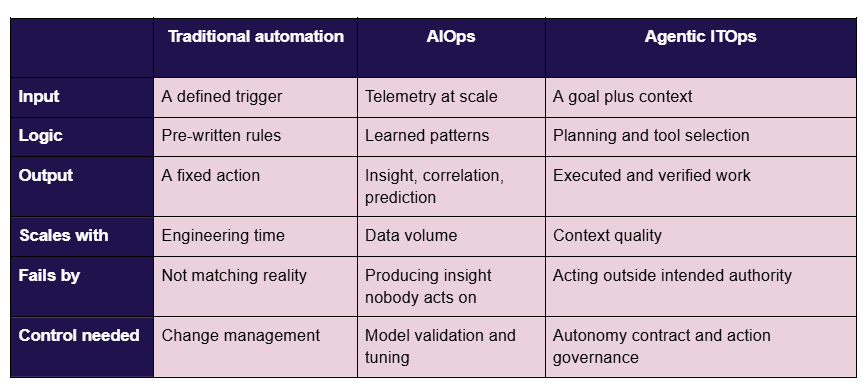
Three practical consequences follow.
First, AIOps failures are quiet and agentic failures are loud. A correlation model that misses an incident costs you the time you would have spent anyway. An agent that scales the wrong service during a traffic spike costs you the incident twice over.
Second, they have different prerequisites. AIOps needs data coverage and quality. Agentic ITOps needs something monitoring platforms rarely hold: a map of what services exist, who owns them, what depends on them, what environment they run in, and what the agent is allowed to touch.
Third, they compose well. The strongest architectures use AIOps as the sensing layer — it decides that something is wrong and worth working on — and agentic ITOps as the acting layer, which creates a governed work item and completes it. Neither alone is sufficient.
The line that matters: AIOps closed the gap between data and insight. Agentic ITOps closes the gap between insight and action — which is why it needs a different control model, not a better dashboard.
How to read this list: the ITOps Autonomy Ladder
The single most common planning error in this space is treating autonomy as a property of the product rather than of the workflow. Teams ask "is this platform autonomous?" when the useful question is "how much authority does this specific workflow need, and have we earned it?"
The ITOps Autonomy Ladder grades that authority in six levels. Every use case in this guide is tagged with the level it realistically requires.
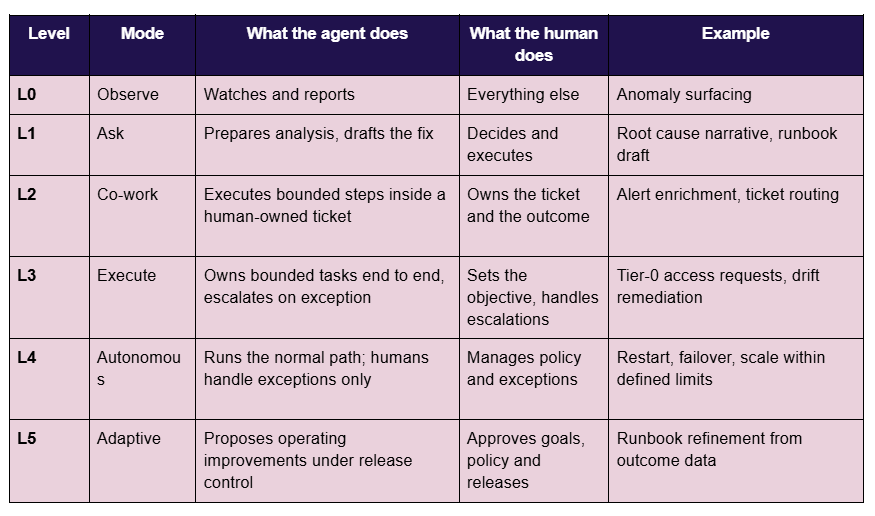
Two things this reframing makes visible immediately.
Value and risk are not correlated. Root cause analysis is arguably the highest-value use case in IT operations, and it sits at L1 — the agent produces a hypothesis and a human acts. Meanwhile, auto-remediating a tier-3 batch job is genuinely low-value and demands the full L4 machinery. Teams routinely start with the second because it sounds more impressive, then spend two quarters building governance for something worth very little.
Autonomy is earned per workflow, not granted globally. An agent may operate at L4 on staging restarts and L1 on anything touching identity, simultaneously, under the same platform. Any vendor offering a single "autonomous mode" toggle has not thought about this properly. Levels move up as evidence accumulates: the agent's recommendations were correct 340 times in a row, so the approval requirement is relaxed for that specific class of action.
Most enterprises should be commercialising L2 through L4 while designing for L5. Nothing about the platform should require a customer to accept broad autonomy in order to get value.
30 AI use cases in IT operations, by function
Each use case below carries five fields: the autonomy level it requires, what it does, what it needs to work, where it breaks, and the outcome shape to engineer toward. That fourth field — where it breaks — is the one most vendor content omits, and it is the one that determines whether your pilot survives contact with production.
Outcome figures throughout are engineered targets: the result the design aims at under realistic conditions. They are not guarantees, and any vendor presenting them as such should be treated with suspicion.
Service Desk and Digital Workplace Workcell
The highest-volume, lowest-risk entry point into agentic IT operations, and the one where value is easiest to measure because ticket costs are already known.
1. Tier-0 self-service resolution
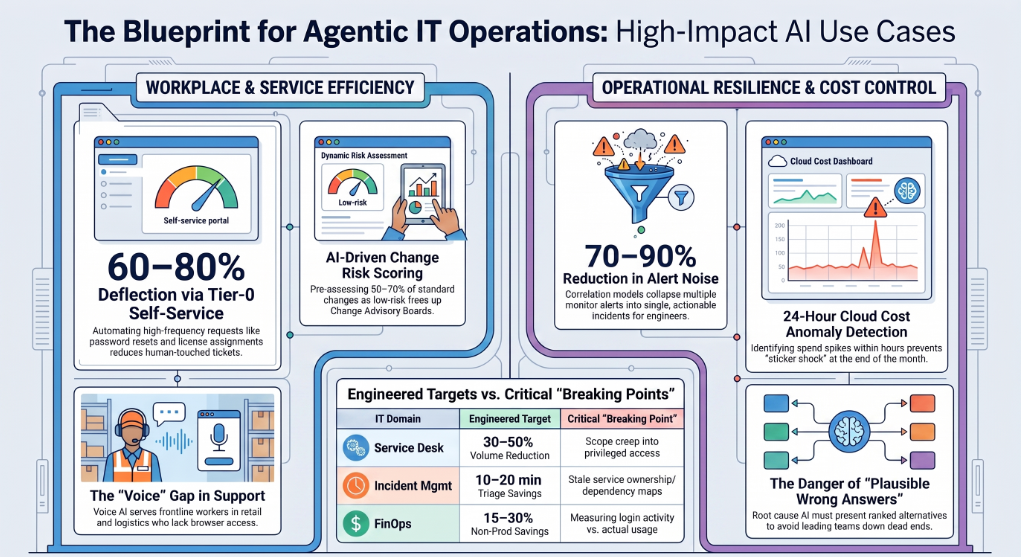
Autonomy level: L3 — Execute What it does: Resolves the highest-frequency, lowest-risk request types end to end — password resets, VPN access, group membership, standard software provisioning, licence assignment — without creating a human-touched ticket. What it needs: Identity provider integration, ITSM system, entitlement catalogue, and a clear policy on which request types are eligible. Where it breaks: Scope creep. Teams automate ten request types successfully, then extend to privileged access requests where the approval logic is subtle and the failure mode is a security incident. The eligibility list must be an explicit allowlist, not a pattern. Engineered target: 30–50% of total ticket volume eligible for tier-0 handling in a typical enterprise estate; deflection rates of 60–80% within the eligible subset.
2. Ticket classification, priority scoring and routing
Autonomy level: L2 — Co-work What it does: Reads inbound tickets across channels, infers the real category rather than the one the user selected, scores urgency against business impact, and routes to the correct queue or on-call engineer with context attached. What it needs: Historical ticket corpus, service ownership map, on-call schedule, business criticality tiering. Where it breaks: Ownership data rot. Routing accuracy is capped by the accuracy of your service ownership records, which in most enterprises are between twelve and thirty months stale. Fix the map first or the agent will confidently misroute. Engineered target: 85–92% first-time-right routing; measurable reduction in reassignment count per ticket, which is a better metric than routing accuracy because it captures downstream cost.
3. Knowledge article generation and staleness detection
Autonomy level: L2 — Co-work What it does: Drafts knowledge articles from resolved incidents and change records, identifies articles contradicted by recent resolutions, and flags documentation that no longer matches the running system. What it needs: Ticket history, change records, existing knowledge base, deployment history. Where it breaks: Volume without review. An agent can generate four hundred articles in a week, and an unreviewed knowledge base is worse than a small accurate one because it poisons every downstream retrieval. Cap generation rate to review capacity. Engineered target: Meaningful reduction in average article age; measurable improvement in retrieval accuracy for agents and humans consuming the same corpus.
4. Voice-based IT service desk
Autonomy level: L3 — Execute What it does: Handles IT support requests by phone with natural conversation — resolving common issues end to end, creating tickets with structured detail, checking service status, and transferring to a human with full context when the request exceeds its authority.
This is the most underserved segment in enterprise IT support. Most service desk automation assumes a laptop and a browser. A large share of the workforce in retail, logistics, manufacturing, healthcare and field services does not have one during their shift — and when their point-of-sale terminal, handheld scanner or workstation fails, the browser-based portal is precisely what they cannot reach. Voice is not a channel preference for these users. It is the only channel available at the moment of failure.
Enterprise voice AI built for this pattern operates at sub-300ms response latency so the conversation does not feel like an IVR tree, supports 40+ languages with mid-conversation switching, and executes real actions during the call — creating the ticket, checking the entitlement, triggering the reset — rather than promising a callback.
What it needs: Telephony integration, ITSM system, identity verification path, knowledge base, and a defined escalation policy. Where it breaks: Identity verification. Voice channels are the softest target for social engineering in the entire support estate. Any voice agent with reset or provisioning authority needs a verification path at least as strong as the web channel, and preferably stronger. Engineered target: 24/7 coverage without night-shift staffing; deflection comparable to chat for equivalent request types; measurable reduction in time-to-first-contact for frontline staff.
5. Joiner–mover–leaver provisioning orchestration
Autonomy level: L3 — Execute What it does: Executes onboarding, role change and offboarding across identity, email, device, application entitlement and physical access systems from a single HR trigger, and verifies each step completed. What it needs: HR system integration, identity provider, application entitlement catalogue, device management, role-to-entitlement mapping. Where it breaks: Offboarding is where this earns its keep and where it fails silently. Provisioning failures are noisy — the new hire complains on day one. Deprovisioning failures are silent and become audit findings a year later. Require positive verification of revocation, not just successful API calls. Engineered target: Same-day full provisioning; near-complete deprovisioning within the policy window, with exceptions raised rather than skipped.
6. Software licence reclamation and entitlement hygiene
Autonomy level: L2 — Co-work What it does: Correlates licence assignments with actual usage telemetry, identifies dormant seats and over-tiered assignments, and proposes reclamation batches ahead of renewal. What it needs: Licence management data, identity provider and application usage telemetry, HR status, renewal calendar. Where it breaks: Usage telemetry that measures login rather than use. A user who opens an application weekly to check one dashboard looks identical to a power user in login data. Reclaiming their seat generates an escalation that costs more than the licence. Engineered target: 8–15% of licence spend identified as reclaimable in a typical unmanaged estate; larger in organisations that have grown through acquisition.
Event and Incident Workcell
The domain with the most mature AIOps tooling and the least mature governance. This is where autonomy decisions get consequential.
7. Alert noise reduction and event correlation
Autonomy level: L2 — Co-work What it does: Collapses related alerts from multiple monitoring tools into a single incident, suppresses known-benign patterns, and distinguishes symptom alerts from causal ones. What it needs: Event streams from all monitoring sources, service dependency graph, historical incident data. Where it breaks: Trading one kind of noise for a subtler one. A poorly tuned correlation model that suppresses a real alert creates a distrust problem far worse than volume, because engineers stop believing the queue. Instrument suppression decisions and review them weekly during tuning. Engineered target: 70–90% reduction in alert volume reaching humans; the metric that matters is not volume but the count of suppressed alerts that later proved significant, which should trend to near zero.
8. Anomaly detection against learned baselines
Autonomy level: L1 — Ask What it does: Learns normal behaviour per service, per time window, and surfaces deviation before static thresholds would fire — catching slow degradation like memory leaks, creeping latency and gradual error-rate drift. What it needs: Time-series telemetry with sufficient history, seasonality context, deployment markers. Where it breaks: Seasonality it has not seen. The first Black Friday, the first month-end close, the first fiscal year-end after deployment will all look anomalous. Either encode known business cycles explicitly or accept a noisy first year. Engineered target: Detection of degradation patterns ahead of threshold breach; measured as lead time between first signal and user-visible impact.
A large state-owned power transmission utility in South Asia deployed exactly this pattern across its transmission estate — continuous KPI monitoring with anomaly detection, loss and outage analytics, and predictive maintenance indicators feeding automated alerts routed to field operations teams. The operational result was a shift from periodic inspection cycles to continuous monitoring, with exceptions surfacing faster than scheduled review would have found them. The same architecture applies to any high-asset-count technology estate.
9. Automated incident triage and enrichment
Autonomy level: L2 — Co-work What it does: On incident creation, assembles the context an engineer would otherwise spend fifteen minutes gathering — affected service, owner, recent deployments, related change records, dependency blast radius, similar past incidents and their resolutions. What it needs: CMDB or service graph, deployment pipeline, change records, incident history, monitoring context. Where it breaks: Confident enrichment from a stale dependency graph. An agent asserting "this affects three downstream services" when it actually affects eleven is more dangerous than no enrichment, because engineers will trust it. Engineered target: 10–20 minutes of context assembly removed from the front of every significant incident.
10. Agentic root cause analysis
Autonomy level: L1 to L2 What it does: Investigates across logs, metrics, traces, deployment history and configuration changes simultaneously, separates symptoms from causes, and produces a ranked hypothesis with the evidence for each — the way a senior engineer would, but in parallel across every data source at once. What it needs: Unified access to observability data, change and deployment history, service dependency map, past incident corpus. Where it breaks: Plausible wrong answers. This is the most dangerous failure mode in the entire list. An agent that produces a confident, well-evidenced, incorrect root cause sends a team down a four-hour dead end. Require the agent to present ranked alternatives with confidence, never a single answer, and to state explicitly what evidence would disconfirm its top hypothesis. Engineered target: Substantial reduction in time-to-first-accurate-hypothesis. Note that industry analysis of public incident data suggests only around a quarter of published incident reports clearly identify a root cause at all — so measure hypothesis quality, not just speed.
11. Incident commander and war-room orchestration
Autonomy level: L2 to L3 What it does: Handles the coordination overhead of a major incident — opening the bridge, paging the right responders, posting structured stakeholder updates on a cadence, maintaining the timeline, and capturing decisions as they are made. What it needs: Incident management platform, communications channels, on-call schedule, stakeholder distribution lists, service criticality data. Where it breaks: Tone and audience calibration in customer-facing communications. Internal updates can be blunt; external ones carry legal and commercial weight. Keep external comms at L1 — the agent drafts, a human sends. Engineered target: Coordination overhead removed from the incident commander role, so the senior engineer on the bridge is diagnosing rather than typing updates.
12. Automated remediation and self-healing infrastructure
Autonomy level: L4 — Autonomous What it does: Detects a known failure signature, selects the appropriate remediation from a validated set, executes it within defined limits, verifies recovery, and rolls back automatically if verification fails. What it needs: Everything above, plus a validated remediation library, an enforcement point for every state-changing action, and a defined authority envelope per service tier. Where it breaks: This is the use case that requires the full control model, and it is the one teams most often attempt first with none of it in place. The failure modes are specific: remediating a symptom while the cause persists; two agents remediating the same incident in conflicting directions; a remediation that succeeds locally and cascades downstream; and the second attempt on the same incident, which is almost always where damage occurs. Engineered target: A meaningful share of recurring, well-understood incident classes closed without human involvement — starting with non-tier-1 services and expanding on evidence.
The control model that makes this approvable is set out in full in the section on Blast-Radius Contracts below. Do not deploy this use case without it.
13. Post-incident review drafting and action tracking
Autonomy level: L2 — Co-work What it does: Reconstructs the incident timeline from system events and communications, drafts the post-incident review, extracts action items, and tracks them to closure rather than letting them decay in a backlog. What it needs: Incident timeline data, chat history, change records, ticketing system for action tracking. Where it breaks: Blame attribution. An agent reconstructing "who did what when" from chat logs produces something that reads like a performance review. Constrain output to system and process narrative; strip individual attribution. Engineered target: Post-incident reviews produced within 48 hours rather than two weeks, and action-item closure rates that stop degrading after the first month.
14. Problem management and recurring incident clustering
Autonomy level: L1 — Ask What it does: Clusters incidents across months to identify recurring underlying problems that individual incident reviews miss, quantifies their cumulative cost, and proposes permanent fixes ranked by return. What it needs: Long-horizon incident history, resolution data, service ownership, effort or cost attribution. Where it breaks: Clustering on superficial similarity. Incidents with similar symptoms and different causes get grouped, producing a "problem" that cannot be fixed because it is not one problem. Engineered target: Identification of the small number of underlying problems that generate a disproportionate share of incident volume — typically a handful accounting for 20–40% of recurring tickets.
Change, Release and Configuration Workcell
The least automated domain in most enterprises, and the one where AI has the clearest near-term return because the work is analytical rather than executive.
15. Change risk scoring and CAB pre-assessment
Autonomy level: L1 — Ask What it does: Scores each proposed change against historical outcomes for similar changes — same service, same window, same author profile, same blast radius — and pre-assesses the routine ones so the change board spends its time on the ones that matter. What it needs: Change record history with outcomes, incident-to-change correlation, service criticality, deployment history. Where it breaks: Scoring on record quality rather than actual risk. If your change records are inconsistently filled, the model learns to score documentation quality. Validate against incident correlation, not against past CAB decisions. Engineered target: 50–70% of standard changes pre-assessed as low risk with evidence, freeing board time; measurable reduction in change-induced incidents.
16. Configuration drift detection and remediation
Autonomy level: L3 — Execute What it does: Continuously compares running configuration against declared intent, identifies drift, and remediates within defined bounds — restoring golden configuration for well-understood deviations, escalating novel ones. What it needs: Declared configuration state, live configuration inspection, remediation authority scoped per configuration class. Where it breaks: Drift that is actually an undocumented fix. Someone changed that timeout at 2 a.m. during an incident for a good reason and never updated the declaration. Remediating it re-breaks production. Require a check against recent incident and change activity before reverting anything. Engineered target: Continuous compliance against declared state, with drift resolution measured in hours rather than the next audit cycle.
17. Release readiness assessment and rollback decisioning
Autonomy level: L2 — Co-work What it does: Evaluates deployment health against baseline in real time — error rates, latency distribution, business transaction success — and recommends or executes rollback within a defined window when a release is degrading. What it needs: Deployment pipeline integration, pre- and post-deploy telemetry, defined health criteria per service, rollback capability. Where it breaks: The window. A rollback five minutes after deploy is cheap. A rollback ninety minutes after deploy, once the schema has migrated and transactions have accumulated, may be impossible. Encode the reversibility window explicitly per service. Engineered target: Degraded releases identified and reversed inside the reversibility window rather than at the next user complaint.
18. CMDB reconciliation and dependency mapping
Autonomy level: L2 — Co-work What it does: Reconciles the configuration management database against observed reality from network traffic, deployment manifests, cloud inventory and trace data — proposing corrections to ownership, dependencies and lifecycle state. What it needs: Discovery sources, existing CMDB, trace or flow data, deployment metadata. Where it breaks: Nothing. This is the most consistently undervalued use case in IT operations, and it is the prerequisite for use cases 2, 9, 10, 12 and 15. A stale CMDB caps the accuracy of everything above it. Teams skip it because it is unglamorous and then wonder why their routing and RCA accuracy plateau. Engineered target: Ownership and dependency accuracy above 90%, maintained continuously rather than through annual clean-up projects.
The pattern generalises well beyond IT. A privately held multi-format retail holding group deployed a unified context engine spanning structured and unstructured data with a semantic governance layer defining rules, hierarchies and formulas — the equivalent of a well-maintained operating graph — before layering agents on top. The result was a shift from reactive reporting to proactive execution loops, with standardised decision logic across teams and automated task creation tracked to completion. The sequencing lesson holds: the graph comes first.
19. Runbook generation, validation and continuous refresh
Autonomy level: L1 to L2 What it does: Generates runbooks from observed resolution paths, tests them against non-production environments, and flags steps that no longer work against the current system. What it needs: Incident resolution history, non-production environment access, current system state. Where it breaks: Untested runbooks generated at volume. A runbook that has never been executed is a hypothesis. Validate before publishing, and re-validate after significant architectural change. Engineered target: Runbook coverage for the majority of recurring incident classes, with validation status visible on each.
Cloud, Capacity and FinOps Workcell
The use cases with the fastest and most defensible payback, because the savings appear directly on an invoice.
20. Cloud cost anomaly detection and attribution
Autonomy level: L2 — Co-work What it does: Detects cost anomalies within hours rather than at month-end close, attributes them to the responsible team, service and change, and distinguishes legitimate growth from waste and misconfiguration. What it needs: Billing data at resource granularity, tagging discipline, deployment history, ownership map. Where it breaks: Tagging discipline. Cost attribution accuracy is a direct function of tag coverage. Below roughly 80% coverage, attribution becomes guesswork and teams dispute every finding. Engineered target: Cost anomalies surfaced within 24 hours of onset; a meaningful share of monthly spend variance explained automatically.
21. Rightsizing and idle resource reclamation
Autonomy level: L3 — Execute What it does: Identifies over-provisioned and idle resources from utilisation history, and executes reclamation for classes where it holds authority — non-production environments, orphaned volumes, unattached addresses, dormant snapshots. What it needs: Utilisation telemetry with sufficient history, resource inventory, environment classification, defined reclamation authority. Where it breaks: Disaster recovery and burst capacity look exactly like waste in utilisation data. A standby environment at 3% utilisation is doing its job. Tag intentionally idle resources explicitly and exclude them from the authority envelope. Engineered target: 15–30% reduction in non-production spend; production rightsizing should stay at recommendation level until the utilisation model is trusted.
22. Capacity forecasting and seasonal scaling
Autonomy level: L2 to L3 What it does: Forecasts capacity requirements from historical patterns, business calendars and leading indicators, and pre-scales ahead of predicted demand rather than reacting to saturation. What it needs: Utilisation history, business event calendar, demand signals, scaling capability. Where it breaks: Novel demand shapes. A model trained on three years of steady growth will not anticipate a marketing campaign nobody told IT about. Build an intake path for planned business events. Engineered target: Capacity headroom maintained without permanent over-provisioning; the metric is cost per unit of served demand, not utilisation percentage.
A national research institute with campus-scale infrastructure applied this pattern to physical and energy infrastructure — sensor and utility data ingestion, anomaly detection, forecasting with optimisation recommendations, and proactive alerting. The operational outcomes were improved consumption visibility, faster detection of inefficiencies, and materially reduced manual monitoring effort. The forecasting architecture is the same whether the constrained resource is compute or kilowatt-hours.
23. Contract, licence and renewal intelligence
Autonomy level: L1 — Ask What it does: Extracts commitment terms, renewal dates, auto-renewal clauses, usage tiers and true-up conditions from vendor contracts, and surfaces them against actual consumption ahead of decision deadlines. What it needs: Contract repository, document extraction capability, consumption data, renewal calendar. Where it breaks: Contract amendments stored separately from originals. The agent reads the master agreement and misses the side letter that changed the pricing. Require completeness verification per vendor relationship. Engineered target: No renewal reached without a consumption-versus-commitment analysis; auto-renewal deadlines surfaced 90+ days out.
Security and Access Operations Workcell
Adjacent to IT operations and increasingly run by the same teams, with a materially lower tolerance for autonomous error.
24. Security alert triage and phishing investigation
Autonomy level: L2 — Co-work What it does: Investigates security alerts end to end — enriching indicators, checking reputation sources, correlating with recent activity, determining whether the alert represents genuine risk — and escalates only confirmed findings with the investigation attached. What it needs: Security tooling integration, threat intelligence sources, identity and asset context, historical alert dispositions. Where it breaks: Adversarial input. Security telemetry is the one data source where an attacker can deliberately shape what the agent reads. Treat alert content and email bodies as untrusted input, never as instruction. Engineered target: A large majority of alerts dispositioned without analyst time; analyst attention concentrated on confirmed findings.
25. Vulnerability prioritisation and patch orchestration
Autonomy level: L2 to L3 What it does: Prioritises vulnerabilities by actual exploitability and exposure in your environment rather than by severity score alone, and orchestrates patch deployment through the change process with appropriate windows and rollback. What it needs: Vulnerability scan data, asset inventory with exposure context, exploit intelligence, patch management tooling, change process integration. Where it breaks: Patching as an unbounded action. A patch is a change, and it belongs in the change process with the same controls. Agents that patch outside change management create audit findings even when the patching is correct. Engineered target: Prioritised backlogs where the top decile genuinely reflects exploitable exposure; reduced mean time to patch for that decile specifically.
26. Access recertification and standing privilege reduction
Autonomy level: L2 — Co-work What it does: Compares granted entitlements against actual usage and role expectation, identifies standing privilege that is never exercised, and prepares recertification campaigns with evidence rather than blank approval lists. What it needs: Entitlement data, access usage logs, HR role data, prior recertification outcomes. Where it breaks: Rubber-stamping. Recertification fails because managers approve everything. An agent that presents evidence — "this entitlement has not been exercised in 340 days" — changes the default answer. Keep revocation itself at approval-required. Engineered target: Meaningful reduction in unused standing privilege per cycle; recertification completed within the window rather than extended.
27. Continuous IT general controls evidence collection
Autonomy level: L2 — Co-work What it does: Collects control evidence continuously as operations happen — change approvals, access reviews, segregation of duties, backup verification — rather than reconstructing it during audit season. What it needs: Change, access, incident and backup systems; defined control framework; evidence retention. Where it breaks: Evidence that is complete but not attestable. Auditors need to know evidence was not altered after collection. Immutability and timestamping matter more than volume. Engineered target: Audit evidence preparation time reduced from weeks to days; control gaps surfaced when they occur rather than at year-end.
Enterprise Application and Data Operations Workcell
Where IT operations meets the business systems that generate the revenue, and where the strongest financial cases are usually found.
28. Enterprise application transaction exception handling
Autonomy level: L3 — Execute What it does: Interprets inbound business triggers, validates them against master data and business rules, creates or corrects transactions in core enterprise systems, and routes genuine exceptions to humans with the ambiguity clearly stated. What it needs: ERP or core application integration, master data access, deterministic business rules, approval workflow, audit logging. Where it breaks: Silent partial success. A transaction that creates in one system and fails in another leaves an inconsistent state that surfaces at reconciliation weeks later. Every action needs verification and a compensating action. Engineered target: A large share of standard transactions processed without manual entry; error rates below the manual baseline, which is usually the honest bar to clear.
A Gulf-region integrated engineering and technology solutions group implemented this pattern directly. Agentic automation interprets order triggers, validates them, and creates sales orders in the core ERP — replacing an end-of-life enterprise content product carrying high licensing cost. The deployment includes deterministic rules and governance for exceptions and approvals, plus audit logs and reconciliation reporting. The outcomes were reduced manual order processing, a faster order-to-confirm cycle with fewer data-entry errors, and improved auditability for both the transactions and the exceptions. Note the shape of the business case: the licence saving funded the project, and the operational improvement was the return.
29. Legacy platform decommissioning and migration support
Autonomy level: L2 — Co-work What it does: Maps what a legacy platform actually does — which integrations are live, which workflows still run, which data is genuinely referenced — so that decommissioning is based on evidence rather than on the documentation nobody trusts. What it needs: Access to the legacy system, integration and traffic logs, downstream consumer inventory, business process documentation. Where it breaks: The quarterly job. Something runs once every ninety days, nobody remembers it, and it does not appear in a thirty-day observation window. Observe across at least one full business cycle before concluding a system is dormant. Engineered target: Decommissioning decisions supported by observed dependency evidence; a material reduction in the "we cannot turn it off because we do not know what uses it" backlog.
30. Data pipeline reliability and data quality incident response
Autonomy level: L2 to L3 What it does: Monitors pipeline health and output quality together — detecting not just failed jobs but jobs that succeeded while producing wrong data — diagnoses the failure, and re-runs or quarantines within defined bounds. What it needs: Pipeline orchestration integration, data quality expectations, lineage graph, re-run and quarantine capability. Where it breaks: Blind re-runs. Re-running a pipeline that failed because of a genuine upstream data problem propagates the bad data faster. Diagnosis must precede remediation, always. Engineered target: Data quality issues caught before consumption by downstream reporting; reduced incidence of decisions made on quietly wrong data.
A multinational logistics and warehousing group operating across South Asia, Europe and North America built this foundation deliberately — cross-entity KPI standardisation, consolidated reporting, operational dashboards with variance explanations, and a data quality and governance layer underneath. The result was a single operational view across entities with faster issue identification and materially improved consistency of operational metrics. Data reliability is unglamorous and it is load-bearing for everything above it.
The complete matrix
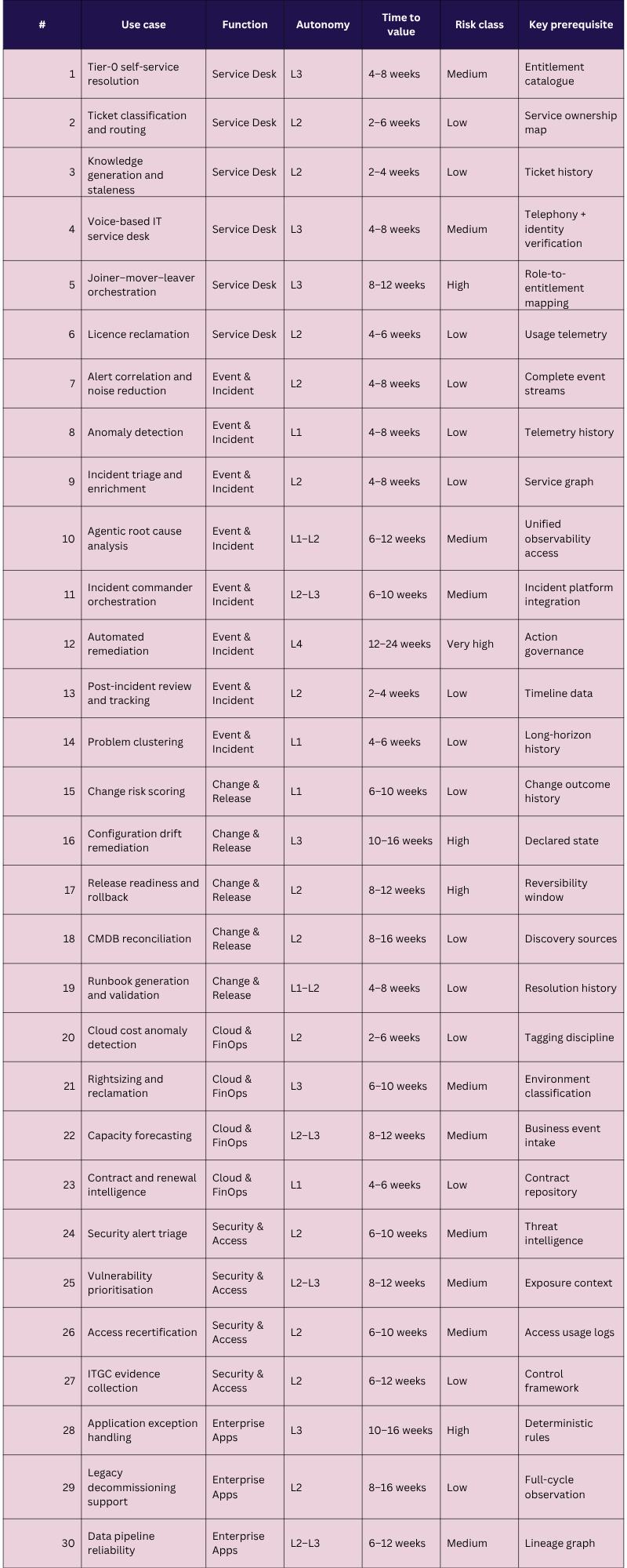
Where to start: the four use cases that pay for the programme
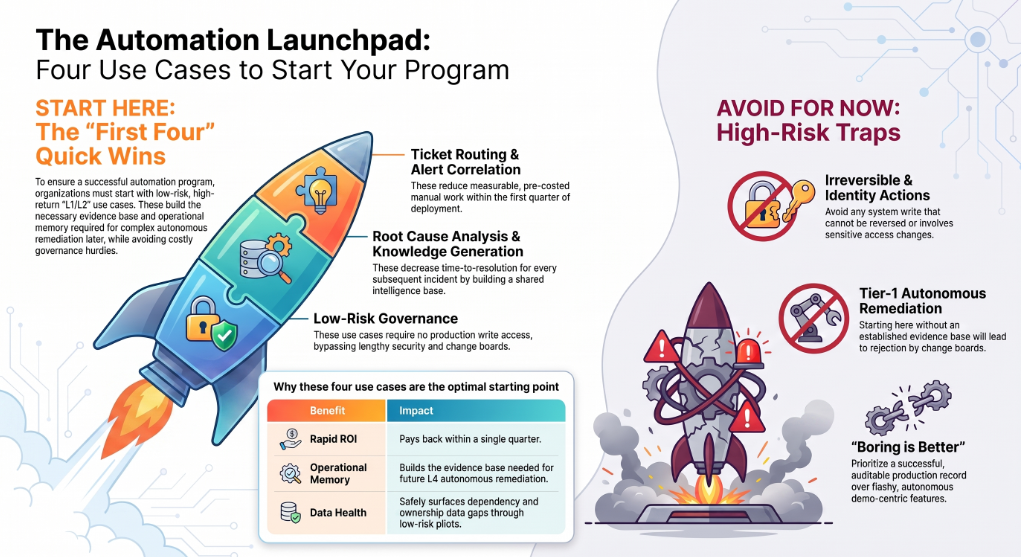
If you deploy nothing else in the first two quarters, deploy these four.
Ticket classification and routing (#2). Alert correlation (#7). Root cause analysis (#10). Knowledge generation (#3).
The selection is not arbitrary. Four properties make this the right opening set.
None of them require production write access. Every one operates at L1 or L2. That means the security review is short, the change board conversation is straightforward, and no one has to answer the question that stalled the pilot in the opening paragraph of this guide. You get to production while the governance conversation is still happening in parallel.
They pay back inside a quarter. Routing and correlation reduce measurable, already-costed work. Knowledge and RCA reduce time-to-resolution across every subsequent incident. None of them depend on a twelve-month data foundation project first.
They generate the operational memory that everything else needs. This is the underappreciated reason. Autonomous remediation at L4 requires evidence: hundreds of resolved incidents with known-correct diagnoses and known-good remediations, so you can define a defensible authority envelope. That corpus is produced by running L1 and L2 use cases first. Teams that skip to L4 have no evidence base and end up setting authority limits by guesswork, which is exactly what a change board will reject.
They surface your data problems cheaply. Routing accuracy plateaus because your service ownership map is stale. RCA quality plateaus because your dependency graph is incomplete. Discovering this through a low-risk pilot costs you a tuning cycle. Discovering it through an L4 remediation deployment costs you an incident.
What not to start with
Be equally explicit about the exclusions.
Do not start with autonomous remediation on tier-1 services. Not because the technology cannot do it — it can — but because you have no evidence base from which to write a defensible authority envelope, and you will be asked to produce one.
Do not start with agentic identity or access changes. The failure mode is a security incident and the audit exposure is disproportionate to the operational return.
Do not start with anything that writes to a system where you cannot reverse the write. Reversibility is the single most useful screening question for a first agentic use case. If the compensating action does not exist, the use case is not a starter.
Do not start with the use case that most impressed you in the demo. Demos optimise for visible autonomy. Your first deployment should optimise for a boring, successful, auditable production record that makes the second deployment easier to approve.
What goes wrong: seven failure modes
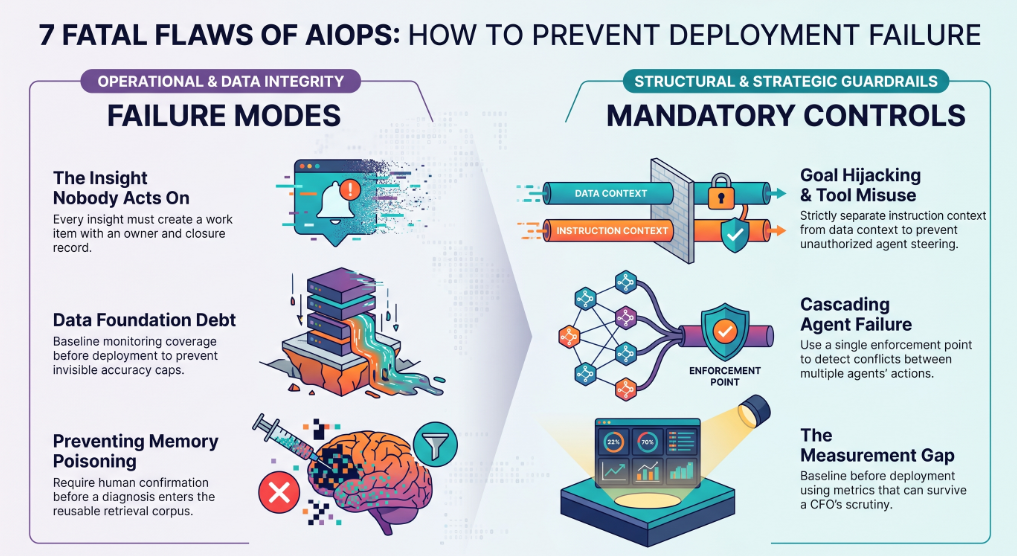
Every one of these has taken down a real deployment. The controls are specific.
1. The insight nobody acts on. The most common failure in AIOps is not inaccuracy — it is a correct insight arriving somewhere nobody is accountable for acting on it. The platform detects the anomaly, posts to a channel, and the anomaly becomes an incident four hours later anyway. Control: every insight must create a work item with an owner, a due state and a closure record. If an agent's output does not become assigned work, it is decoration.
2. Trading alert fatigue for a subtler distrust. A correlation model that suppresses a real alert does more damage than the noise it removed, because engineers stop trusting the queue and start checking dashboards manually again. Control: instrument every suppression decision, review suppressed-but-significant events weekly during tuning, and publish the false-negative rate to the team that has to trust it.
3. Data foundation debt. AIOps is only as capable as the telemetry it sees. Inconsistent monitoring coverage, gaps in log retention, and unmaintained service ownership records cap the accuracy of everything built above them — and the cap is invisible until you measure against ground truth. Control: baseline coverage before deployment, and treat CMDB reconciliation (#18) as a first-class use case rather than a chore.
4. Goal hijacking and tool misuse. An agent that reads a log line, a ticket body or an email as instruction rather than as data can be steered by anyone who can write to those systems. OWASP's work on agentic security identifies this alongside tool misuse, identity and privilege abuse as distinct operational risk classes rather than theoretical ones. Control: strict separation between instruction context and data context; deterministic validation of tool arguments before execution; never let retrieved content modify the agent's objective.
5. Memory poisoning. An incorrect root cause conclusion gets cached and reused. Six weeks later, three incidents have been misdiagnosed the same way because the first wrong answer became the retrieval baseline. Control: attach confidence and provenance to every stored conclusion, expire operational memory on architectural change, and require human confirmation before a diagnosis enters the reusable corpus.
6. Cascading agent failure. Agent A remediates by scaling a service. Agent B detects the cost anomaly and reclaims the capacity. Agent A detects degradation and scales again. This is not hypothetical; it is the predictable result of deploying multiple agents without a shared view of what actions are in flight. Control: a single enforcement point for state-changing actions, with visibility of in-flight actions and conflict detection between them.
7. Unmeasurable return. This is a live, unresolved problem across the industry, and it is worth being honest about. Practitioners consistently report that quantifying whether AI investment is improving operations remains among the hardest problems in the space, with little methodological consensus. Control: baseline before deployment, choose metrics that survive scrutiny (see the economics section below), and accept that "we reduced MTTR by 40%" will not survive a competent CFO's follow-up questions.
The control model: what an AI agent is allowed to touch
Here is the question that stalls pilots, stated precisely: when an autonomous agent restarts a production service, what makes that a governed change rather than an unauthorised one?
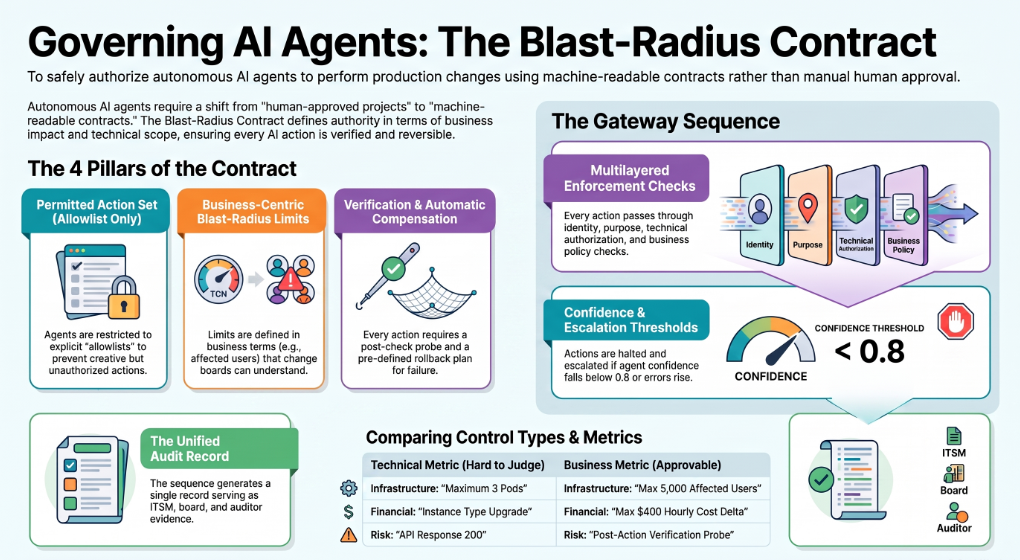
The answer is not "a human approved the project." It is a per-workflow, machine-readable contract that defines authority in the same terms your change process already uses. We call it a Blast-Radius Contract — because blast radius is the concept an SRE and a change board already share.
The Blast-Radius Contract
agent: incident-remediation-worker
work_type: service_degradation_response
scope:
environments: [staging, prod-tier-3]
services: [checkout-api, session-cache]
excluded: [payments-core, identity-provider]
permitted_actions:
restart_service: true
scale_replicas: true # max +200% of baseline
rollback_deployment: true # only releases < 60 min old
failover_region: false
modify_iam: false
delete_resource: false
limits:
max_affected_users: 5000
max_hourly_cost_delta: 400
actions_per_incident: 3
change_window: emergency_change_class
requires_approval:
- action affects a tier-1 service
- cost delta exceeds limit
- second remediation attempt on the same incident
escalate_when:
- customer-facing error rate rising after action
- novel failure signature with no matching prior incident
- confidence below 0.8
evidence_required:
- pre-action state snapshot
- policy evaluation record
- post-action verification probe
compensation:
rollback: automatic if verification probe fails within 90s
Four elements deserve attention because they are what distinguish this from a permissions list.
The Permitted Action Set is an allowlist, never a denylist. Anything not explicitly permitted is refused. The difference matters enormously in practice: a denylist fails open on every action nobody thought of, and reasoning models are creative about finding actions nobody thought of.
Blast-Radius Limits are expressed in business terms, not technical ones. "Maximum 5,000 affected users" is a limit a change board can reason about. "Maximum 3 pods" is not. Expressing authority in units the approver understands is what converts a technical control into an approvable one.
The Verification Probe is what separates action from hope. An agent that executes a restart and reports success has verified that the API call returned 200. It has not verified that the service recovered. The probe is a separate, explicit check of business-observable state after the action, and its failure is the trigger for compensation.
The Compensation Action must exist before the action is permitted. This is the screening rule for the whole model: if you cannot define how to reverse an action, the agent does not get to perform it. It becomes an L1 recommendation instead.
The gateway checks
Every state-changing action, from any agent, passes the same sequence of checks at a single enforcement point:
- Identity — who is the acting agent, and under whose delegated authority?
- Purpose — is this action within the work item the agent was assigned?
- Technical authorisation — does the underlying credential permit it?
- Business policy — do the deterministic rules allow it in this context, this environment, this window?
- Approval and separation of duties — is human approval required, and is the approver distinct from the requester?
- Limits and budget — is it within the blast-radius envelope and the cost ceiling?
- Idempotent execution — will a retry duplicate the effect?
- Verification — did the intended state change actually occur?
- Compensation — if verification failed, has the reversal executed?
The output of this sequence is a single record: what was attempted, by whom, under what authority, against which policy, with what approval, producing what evidence, verified how, and reversed if necessary.
That record is the whole argument. It is simultaneously the change record your ITSM process needs, the approval evidence your change board needs, and the control evidence your auditor needs at year-end. Programmes stall because that record does not exist. They un-stall when it does.
Architecture: the six layers behind a governed ITOps agent
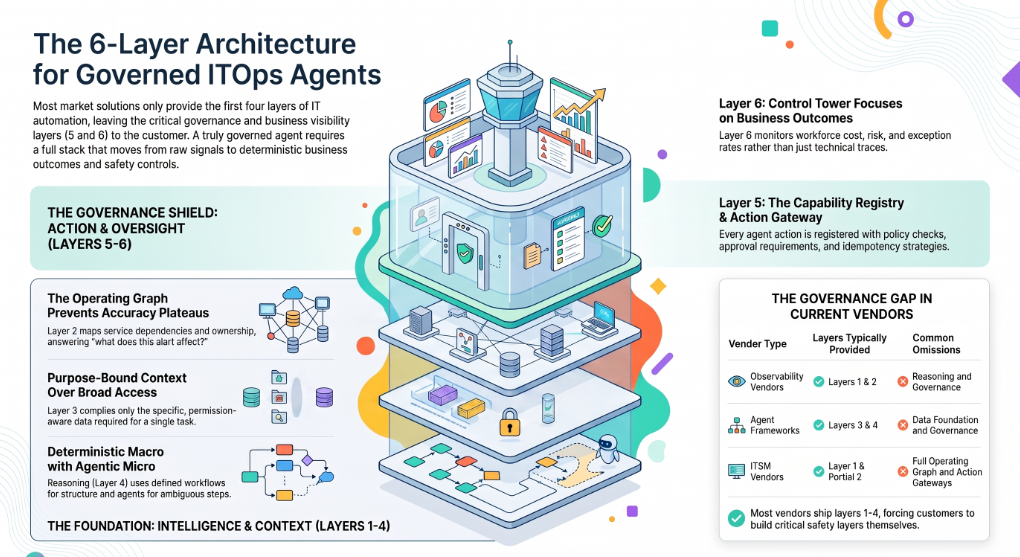
Most of this market ships four layers and asks you to build the other two.
Layer 1 — Signal. Logs, metrics, traces, events, tickets, change records, configuration state, cloud billing, identity events. Breadth matters more than depth here; an agent that cannot see change records will attribute deployment-caused incidents to infrastructure.
Layer 2 — Operating graph. Services, dependencies, owners, environments, criticality tiers, service levels, entitlements. This is what makes "what does this alert affect?" answerable. It is the layer most enterprises do not have and the one that caps everything above it. Every accuracy plateau described in the use case section traces back here.
Layer 3 — Context compiler. Assembles purpose-bound, permission-aware context for each work item. The distinction from retrieval-augmented generation is important: this is not "give the model access to the estate," it is "give this agent, for this work item, exactly the context this task requires, filtered by what this agent is permitted to see." Broad access is a security posture problem and a reasoning quality problem at the same time.
Layer 4 — Reasoning. Model-neutral agents for ambiguous work, deterministic rules for anything policy-bound. The correct pattern is deterministic macro, agentic micro: the overall process shape is a defined workflow with known states, and agents handle the ambiguous steps inside it. Pure agent orchestration is too unpredictable for critical operations; pure deterministic workflow cannot economically encode knowledge work.
Layer 5 — Capability registry and action gateway. Every enterprise ability an agent can invoke is registered with a business name, typed schema, affected objects, read/write classification, required permissions, preconditions, policy checks, approval requirements, limits, idempotency strategy, verification method, compensation action and owner. Every state-changing invocation passes the gateway checks above.
Layer 6 — Control tower. Work, workforce, cost, risk, incidents and outcomes in one operational view. Not technical traces — those are necessary but insufficient. Business-level visibility: what work did the digital workforce complete, at what cost, with what exception rate, producing what outcome.
Layers 5 and 6 are where every "the AI made an unauthorised production change" story is prevented. They are also the layers most commonly absent. Observability vendors ship layers 1 and 2. ITSM vendors ship 1 and a partial 2. Agent frameworks ship 3 and 4. The customer is left to build the governance layer themselves, usually discovering the requirement during a security review three weeks before go-live.
What this looks like in production
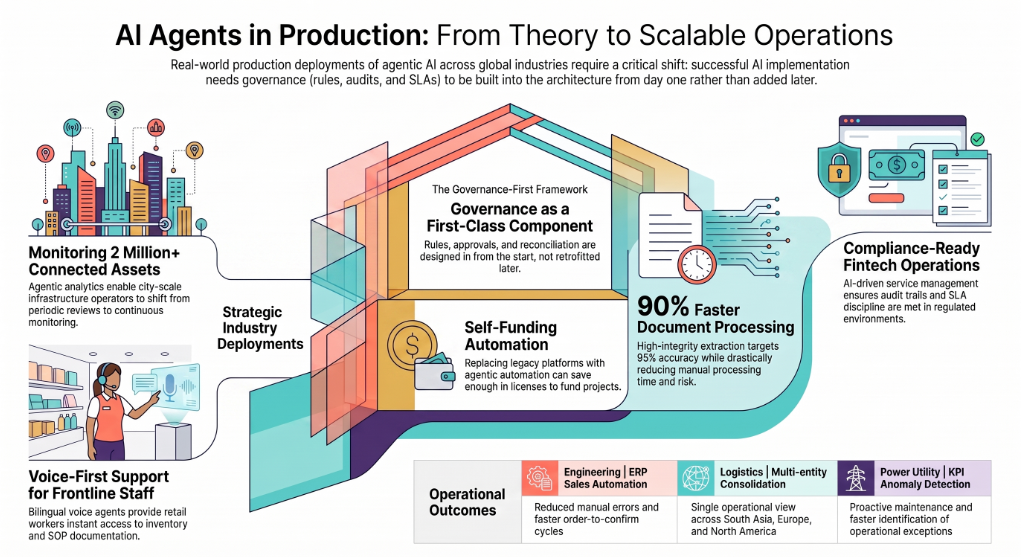
Patterns generalise across operational domains. The examples below are anonymised production deployments in environments with the same error tolerance as enterprise IT.
High-asset-count monitoring with automated alerting. A city-scale smart infrastructure operator running more than 25 operations centres across over two million connected assets and applications deployed agentic analytics with automated operational alerting layered over its existing systems. The pattern is use cases 7 and 9 at extreme scale: correlation across an asset estate no human team can watch, with exceptions routed to the responsible operations centre. The result was a shift from periodic review to continuous monitoring, with faster exception detection across the estate.
Anomaly detection feeding field operations. A state-owned power transmission utility in South Asia implemented KPI monitoring with anomaly detection, loss and outage analytics, and predictive maintenance indicators, with automated alerts routed into field operations workflows. This is use case 8 with a physical failure domain. The outcomes were faster identification of operational exceptions and improved reliability through proactive rather than scheduled monitoring.
Service desk deflection with a voice channel. A pan-India value retailer operating several hundred stores nationally deployed a bilingual voice support agent alongside an inventory intelligence agent and a knowledge agent using retrieval over point-of-sale and standard operating procedure documentation, integrated with an administrative console and ticketing. This is use cases 1, 3 and 4 in combination, and it demonstrates the frontline argument directly — store staff without a workstation reach support by voice. The outcomes were reduced manual helpdesk burden, faster store-level issue resolution, and faster onboarding through on-demand training guidance.
Governed transaction automation replacing a legacy platform. A Gulf-region integrated engineering and technology solutions group automated ERP sales order creation through agentic interpretation and validation of order triggers, replacing an end-of-life enterprise content product carrying high licensing cost. The deployment includes deterministic rules for exceptions and approvals, plus audit logs and reconciliation reporting. This is use cases 28 and 29 together, and the shape of the business case is instructive: the licence saving funded the project and the operational improvement was the return. Outcomes included reduced manual processing, a faster order-to-confirm cycle with fewer data-entry errors, and improved auditability for both transactions and exceptions.
Service management with audit and SLA discipline. A North American fintech serving banks and credit unions deployed omnichannel intake across chat, email and phone with workflow routing, agent-assist summarisation and next-best-action support, built on auditability, reporting and SLA monitoring. This is use cases 2 and 11 in a regulated environment. The outcomes were faster case handling, reduced operational load through automation, and improved compliance readiness through audit trails — the last of which was a design requirement, not a by-product.
Document and record integrity at scale. An Australian remedial and commercial building services specialist deployed a multi-agent document workbench with vision-model extraction from complex documents and deep two-way system integration including record locking and audit logs. The relevance to use cases 18 and 19 is direct: high-integrity extraction and reconciliation into a system of record. The deployment is engineered for up to approximately 90% faster document processing with an extraction accuracy target of around 95% for standard formats, and reduced risk through revision and change detection.
Insight-to-action governance over existing dashboards. A privately held multi-format retail holding group built a unified context engine over structured and unstructured data with a semantic governance layer for rules, hierarchies and formulas, then layered insights-to-action agents on top of existing dashboards. This is the layer 2 and layer 3 argument, proven: the graph and the semantic layer came first. Outcomes were a shift from reactive reporting to proactive execution loops, standardised decision logic across teams, and automated task creation tracked to completion.
Multi-entity operational consolidation. A multinational logistics and warehousing group operating across South Asia, Europe and North America implemented cross-entity KPI standardisation with consolidated reporting, operational dashboards carrying variance explanations, and a data quality and governance layer. This is use case 30 as foundation work. The outcomes were a single operational view across entities, faster issue identification, and improved consistency of operational metrics.
The common thread across all of them: the governance layer was designed in, not retrofitted. In every case where actions touch a system of record, the deployment includes rules, approvals, audit logging and reconciliation as first-class components rather than as a later hardening phase.
The economics: two cost models, not one
Almost every published return-on-investment model for AI in IT operations counts the value released and ignores the cost of the mechanism releasing it. Build both.
Model 1 — Value released
Ticket deflection. Eligible ticket volume × deflection rate × fully-loaded cost per ticket. Use your actual cost per ticket, not an industry average; the range across enterprises is wide enough that averages are meaningless.
Incident duration. Reduction in time-to-resolution × cost per minute of degradation for the affected service tier. This requires you to have costed degradation per tier, which many organisations have not — and doing so is valuable independent of any AI project.
Reclaimed spend. Cloud rightsizing, idle resource reclamation, licence reclamation, avoided renewals. This is the most defensible line because it appears on an invoice.
Avoided incidents. The hardest to defend and the most frequently overstated. If you claim it, tie it to a specific class of incident with a documented pre-deployment frequency.
Capacity released. Engineer hours returned to project work rather than operations. Count it honestly as capacity, not as headcount reduction, unless you actually intend headcount reduction.
Model 2 — Cost of the digital workforce
Rarely published, and it decides whether a programme is sustainable at scale.
Inference cost per work item. Varies by an order of magnitude between a routing classification and a multi-step RCA investigation. Model it per use case, not as a platform average.
Context assembly cost. Retrieval, graph queries and context compilation are frequently a larger share of total cost than generation. Measure separately.
Evaluation cost. Continuous evaluation runs are not optional for anything above L2, and they are a recurring operating expense.
Human review time. At L1 and L2 the human is still in the loop. If your agent produces a draft that takes as long to verify as it would have taken to write, you have moved cost rather than removed it. This is the most common quiet failure in early deployments.
Integration maintenance. Every connected system is a maintenance surface.
Better metrics than MTTR
Mean time to resolution is the default metric and it is a weak one. Analysis of public incident data has found MTTR unreliable as a comparison metric across organisations, and it is trivially gamed by reclassification. Prefer:
- Percentage of incidents closed without human touch, by class
- Time-to-first-accurate-hypothesis — measures RCA quality specifically
- Exception rate per 100 autonomous actions — the direct measure of whether autonomy is safe to expand
- Rework rate — what fraction of agent-completed work required human correction afterward
- Cost per completed work item, trending over time
- Reassignment count per ticket — a cleaner routing measure than accuracy
The final one is the discipline that separates credible programmes from optimistic ones: baseline before you deploy. A great many organisations cannot demonstrate value because they never measured the starting point.
How to evaluate platforms
Four vendor categories compete for this budget, and each is genuinely strongest at something different.
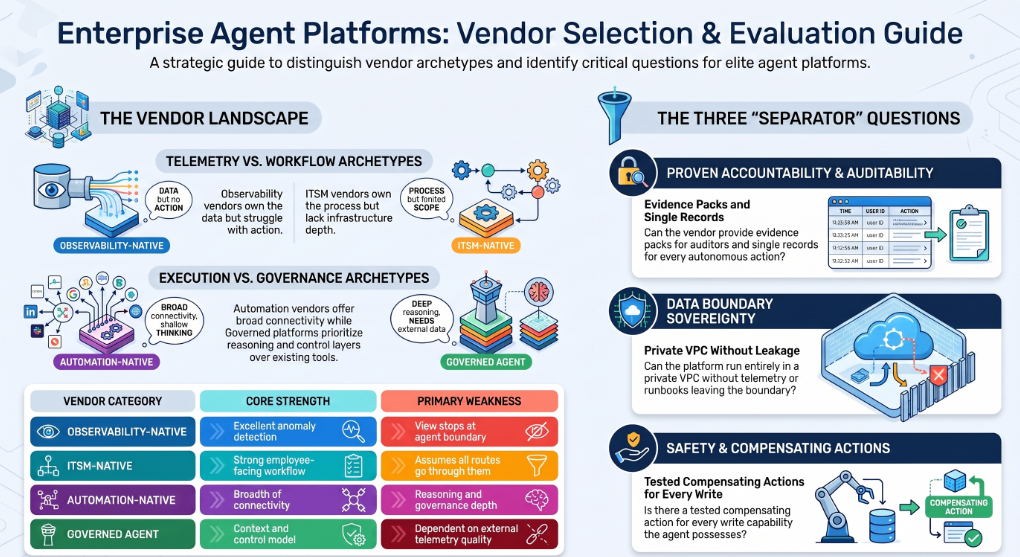
Observability-native platforms (monitoring and APM vendors extending into AI) own the telemetry. Their correlation and anomaly detection is excellent because they hold the data. Their weakness is action: they see everything and change little, and their view stops at the boundary of their own agent.
ITSM-native platforms (service management vendors extending into agents) own the process and the ticket. Their strength is workflow and the employee-facing surface. Their weakness is infrastructure depth and the assumption that the world routes through their platform.
Automation-native platforms (RPA and workflow vendors extending into agents) own execution. Their strength is breadth of connectivity. Their weakness is reasoning quality and governance depth appropriate to production infrastructure changes.
Governed agent platforms sit as a layer over the tools you already run, providing the reasoning, context and control model rather than replacing your monitoring or ITSM. Their strength is exactly the governance gap described above. Their weakness is that they depend on the quality of what they integrate with — they do not generate telemetry.
Most enterprises end up with a combination. The question is not which category wins but which layer you are missing.
Twelve questions to ask any vendor
- Can autonomy be defined per workflow, or is it a global setting?
- Show me a single record for one autonomous action: identity, purpose, policy evaluated, approval, evidence, verification, compensation.
- What happens on the second remediation attempt for the same incident?
- How do you prevent two agents from taking conflicting actions on the same resource?
- Can this run in our environment — private cloud, VPC or on-premise — with telemetry, runbooks and change records never leaving our boundary?
- Are we locked to one model provider, or can we choose and self-host?
- How is context scoped per agent, and can an agent see data the assigned human could not?
- What is the compensating action for each write capability, and is it tested?
- How do you handle an agent reading adversarial content from a ticket or log?
- What does this cost per work item, and how does that scale at ten times the volume?
- How does an agent action appear in our existing change management process?
- What does the evidence pack look like when an auditor asks about agent-initiated changes?
Questions 2, 5, 8 and 12 are the ones that separate the field.
Why Assistents.ai for IT operations
Assistents.ai is the governed agent layer that runs over the IT operations tooling you already have. It does not replace your observability stack, your ITSM platform or your automation estate. It supplies the layer most enterprises are missing: reasoning with governed context, and action with enforced authority.
That positioning is deliberate. The most common reason agentic ITOps programmes fail commercially is that they require a platform replacement before they can demonstrate value. This one does not.
Agent orchestration across ITOps workflows. Multi-agent coordination where one work item spans triage, diagnosis, remediation and verification — with each step owned by a specialised agent and the overall process shape defined deterministically. The deterministic-macro, agentic-micro pattern described above is the architecture, not an aspiration.
Agent governance as a first-class surface. Assistents.ai treats policy, approvals, human-in-the-loop checkpoints and audit trail on every action. This is the layer that answers the question in the opening paragraph, and it exists as a product surface rather than as configuration scattered across agent prompts.
Context Engine for permission-aware, purpose-bound context. In Assistents.ai, agents receive the context a work item requires, filtered by what that agent is permitted to see — rather than broad access to the estate. This is both a security control and a reasoning quality control; over-broad context degrades output as reliably as it expands exposure.
Deterministic rule engine for anything policy-bound. Change windows, approval thresholds, separation of duties, blast-radius limits and eligibility rules belong in deterministic logic that can be read, versioned and tested — not in a model's judgement. Rules are versionable and testable independently of the agents that call them.
Workflow builder for the macro path. Defined process shapes with known states, into which agents are placed for the ambiguous steps.
Voice AI for the service desk your portal does not reach. Sub-300ms response latency, 40+ languages with mid-conversation switching, real-time action execution during the call, and human handoff with full conversation context when confidence drops or policy requires it. For enterprises with substantial frontline populations — retail floors, warehouses, plants, clinics, field engineering — this is the difference between a service desk that covers the workforce and one that covers the desk-based half of it.
Document AI for change records, vendor contracts, runbook corpora and the document-heavy edges of IT operations.
Business intelligence and conversational analytics over operational data, so the operations questions leadership asks do not queue behind a reporting backlog.
Model neutrality through an AI gateway. Choose foundation models per workload, or self-host. Model choice in this category changes annually; architectural commitment to one provider is a liability rather than a simplification.
Deploy where your data lives. Assistents.ai supports on-premise, private cloud and VPC deployment, so telemetry, runbooks, change records and incident history stay inside your boundary.
The platform's architectural direction — a formal capability registry, a dedicated action gateway service, an autonomy policy service and a business-level operations control tower — extends the governance model described in this guide. Those are the direction of travel rather than a description of shipped functionality today, and they should be evaluated as roadmap when you assess the platform.
The framing that matters commercially: you are not buying an agent. You are buying the reliable performance of an IT operation — a governed human–agent team that owns a defined operational outcome. An ITOps Workcell, not a chatbot with API access.
Why Assistents.ai: the buyer's case
The architecture argument is above. This one is about procurement, risk and the practical business of getting an agentic ITOps programme approved and expanded.
1. Deploy where your data lives
IT operations telemetry is among the most sensitive data an enterprise holds. It contains the topology of the estate, the location of the weaknesses, the runbooks for the crown jewels and the change history of every control. A material share of regulated enterprises simply cannot route it through a multi-tenant service, and this is the requirement that eliminates most of the field before a technical evaluation begins.
Assistents.ai deploys on-premise, in private cloud, or inside your VPC. This is a structural advantage in financial services, healthcare, government, utilities and defence-adjacent manufacturing — and it is a question worth asking early, because discovering the answer late costs a procurement cycle.
2. Start at L1, earn L4
Assistents.ai has no global autonomy switch. Authority is defined per workflow and expands as evidence accumulates: this agent, this work type, this service tier, these actions, these limits, this approval requirement. When the evidence supports relaxing a control, the control is relaxed for that specific class and not others.
This is what makes a pilot approvable rather than indefinitely reviewed. A security team asked to approve "an autonomous AI agent" will say no. A security team asked to approve "an agent that may restart named non-tier-1 services within a defined window, with automatic rollback on verification failure, producing an immutable record" is being asked a question it knows how to answer.
3. Every action is a record
In Assistents.ai, one trail serves three audiences. Your ITSM process gets a change record. Your change board gets the approval evidence. Your auditor gets control evidence collected continuously rather than reconstructed at year-end. Identity, delegated authority, work purpose, policy evaluated, approval, limits checked, evidence captured, verification result, compensation if triggered.
The practical value shows up at the worst possible moment. When something does go wrong — and at sufficient scale it will — the difference between a contained incident and a governance crisis is whether you can state precisely what the agent did, under whose authority, and why it was permitted.
4. One platform, not seven point tools
Assistents.ai brings agents, voice, document intelligence, deterministic rules, workflow automation and analytics under a single governance and audit model. The alternative is six vendors each with a separate authority model, a separate audit export and a separate security review — and a governance story you have to assemble yourself every time an auditor asks a question that spans two of them.
5. Proven in operational environments, not demonstrations
Production deployments span utilities and grid operations, city-scale smart infrastructure, national multi-store retail operations, ports and logistics, enterprise ERP transaction processing, regulated financial services and healthcare operations. These are environments with the same tolerance for error as enterprise IT and, in several cases, considerably less.
The relevant signal is not the logo count. It is that the recurring architecture across those deployments — governed context, deterministic rules for policy, human approval at defined thresholds, audit logging, reconciliation reporting — is the same architecture this guide argues is necessary. It was built because operational customers required it, not because a governance narrative tested well.
Next step: book an ITOps architecture review. Bring one workflow you want to automate and the constraint that has been blocking it. You will get a custom architecture assessment with an autonomy model and a return hypothesis within 48 hours. Request a review →
A 90-day implementation sequence
Before day 1: prerequisites
Do not start without these, because each one caps what everything above it can achieve.
- Monitoring coverage baseline. Which services are instrumented, which are not, and where the gaps are.
- Service ownership map. Even an imperfect one. This gates routing, triage and RCA quality.
- Change record access. An agent that cannot correlate incidents to deployments will misattribute a large share of them.
- A costed baseline. Cost per ticket, cost per minute of degradation by service tier, current MTTR by incident class. If you cannot state these on day zero, you cannot demonstrate value on day 90.
- A named accountable owner. Not a committee.
Days 1–30: signal foundation and first L1 use case
Connect telemetry, ticketing, change and deployment sources. Build the first version of the operating graph — services, owners, dependencies, criticality tiers — accepting that it will be incomplete. Deploy one L1 use case, ideally root cause analysis (#10) or change risk scoring (#15), in recommendation-only mode. Measure agreement rate against what engineers actually concluded.
Exit criterion: the L1 agent's top hypothesis matches the eventual human conclusion often enough that engineers read it before starting their own investigation.
Days 31–60: two L2 use cases and the first autonomy contracts
Deploy ticket routing (#2) and alert correlation (#7). Both are co-work: they act inside human-owned work items. Meanwhile, write the first Blast-Radius Contracts — even for use cases you are not yet deploying. The act of writing them surfaces exactly which policy decisions your organisation has never actually made, and those conversations take longer than the engineering.
Begin CMDB reconciliation (#18) in parallel. It is the constraint on everything in the next phase.
Exit criterion: reassignment counts and alert volume both measurably down against baseline, with a documented false-negative rate for suppression.
Days 61–90: first L3 workflow with full enforcement
Deploy one L3 use case — tier-0 self-service (#1), configuration drift remediation (#16) or licence reclamation (#21) — with the complete control model enforced: allowlisted actions, blast-radius limits, approval thresholds, verification probes, compensating actions, immutable records.
Then establish the outcome baseline that governs expansion: exception rate per 100 autonomous actions, rework rate, cost per completed work item.
Exit criterion: a change board reviewing thirty days of agent-initiated actions raises no findings. That is the gate for expanding authority — and, more importantly, it is the evidence that makes the second and third workflows a routine approval rather than a fresh negotiation.
FAQs
What are the main AI use cases in IT operations?
The highest-value AI use cases in IT operations span six functions: service desk automation including ticket routing and tier-0 resolution; event and incident management including alert correlation, root cause analysis and automated remediation; change and configuration management including change risk scoring and drift remediation; cloud and FinOps including cost anomaly detection and capacity forecasting; security and access operations including alert triage and access recertification; and enterprise application operations including transaction exception handling.
What is AIOps and how does it work?
AIOps is the application of machine learning to operational telemetry — logs, metrics, traces and events — to detect anomalies, correlate related signals, predict failures and identify root causes. It works by learning normal behaviour patterns from historical data, then surfacing deviation faster and more accurately than static thresholds allow. Its output is insight; a human or an automation layer acts on it.
What is the difference between AIOps and agentic AI in IT operations?
AIOps analyses operational data and produces insight. Agentic AI performs operational work: it takes a goal, assembles context, plans steps, executes actions across systems, and verifies the outcome. AIOps needs data quality and model validation. Agentic AI needs an authority model — a definition of which systems the agent may change, under what limits, with what approval and what rollback. They compose well, with AIOps sensing and agents acting.
Can AI agents make changes in production systems?
Yes, and increasingly they do — but only safely under an explicit authority contract. That contract must define which environments and services are in scope, an allowlist of permitted actions, hard limits expressed in business terms, approval requirements, escalation triggers, required evidence, and an automatic compensating action when post-action verification fails. Without those controls, agent-initiated production changes are unauthorised changes regardless of whether they were correct.
How does AI reduce MTTR in IT operations?
AI reduces mean time to resolution mainly by removing investigation time rather than repair time. Automated triage assembles incident context in seconds instead of the ten to twenty minutes an engineer would spend. Correlation identifies which of forty alerts is the causal one. Root cause analysis examines logs, metrics, traces and recent changes in parallel. Note that MTTR is an unreliable comparison metric across organisations; time-to-first-accurate-hypothesis is a better measure of AI contribution.
What are the risks of using AI in IT operations?
The main risks are: insights that never become assigned work; correlation models suppressing genuine alerts and eroding trust; capability limits imposed by incomplete telemetry; goal hijacking where an agent treats retrieved content as instruction; memory poisoning where a wrong conclusion is cached and reused; cascading failures where multiple agents act in conflict; and unmeasurable return from an absent pre-deployment baseline.
Which AI use cases in IT operations should we implement first?
Start with ticket classification and routing, alert correlation, root cause analysis, and knowledge generation. All four operate at low autonomy without production write access, so security review is straightforward. They pay back within a quarter, they surface data quality problems cheaply, and they generate the operational evidence base that higher-autonomy use cases such as automated remediation depend on.
Do AI agents in IT operations need to pass change management?
Yes. An agent-initiated production change is a change, and it belongs in the change process with the same controls. The practical approach is to register recurring agent actions as pre-approved standard or emergency change classes with defined limits, so individual actions do not require individual approval but every action produces a change record. That record is what satisfies both the change board and the auditor.
What data does AIOps need to work?
At minimum: time-series metrics with sufficient history to learn seasonality, logs with consistent structure and retention, and event streams from every monitoring source. For agentic use cases add change and deployment records, a service dependency and ownership map, incident history with resolutions, and configuration state. The service ownership map is the most commonly missing and most limiting piece.
How do you measure ROI on AI in IT operations?
Build two models. Value released: deflected tickets multiplied by fully-loaded cost per ticket, reduced incident duration multiplied by cost per minute of degradation by service tier, and reclaimed cloud and licence spend. Cost of the digital workforce: inference per work item, context assembly, evaluation runs, human review time and integration maintenance. Baseline every metric before deployment — most programmes cannot demonstrate value because they never measured the starting point.
Will AI replace IT operations jobs?
The observed pattern is role change rather than elimination. Operators move from executing operational work to supervising, tuning and governing systems that execute it — defining authority envelopes, handling exceptions, investigating novel failures and improving the operating model. The work that disappears is context assembly, ticket routing and repetitive resolution. The work that grows is governance, evaluation and architecture, and it is generally more senior.
What is self-healing infrastructure?
Self-healing infrastructure is a system that detects a known failure signature, selects a validated remediation, executes it within defined limits, verifies recovery against business-observable state, and rolls back automatically if verification fails. It differs from traditional automated remediation in adapting its choice of action to context rather than firing a fixed script, which is precisely why it requires an explicit authority contract.
Can AI for IT operations run on-premise?
Yes. On-premise and VPC deployment is available and is often a requirement rather than a preference, because IT operations telemetry contains estate topology, weakness locations and runbooks for critical systems. Regulated enterprises in financial services, healthcare, government and utilities frequently cannot route this data through multi-tenant services. Model-neutral platforms supporting self-hosted models make full on-premise operation practical.
What is the difference between AI and automation in IT operations?
Automation executes pre-written logic when a defined trigger fires; it does exactly what it was told and fails when reality does not match its assumptions. AI in IT operations interprets ambiguous situations, learns patterns from data, and — in agentic form — plans a path to a goal and adapts when a step fails. The strongest architectures combine them: deterministic automation for the process shape and policy enforcement, AI for the ambiguous steps inside it.
How long does it take to deploy AI in IT operations?
Low-autonomy use cases such as ticket routing, knowledge generation and cost anomaly detection typically reach production in two to six weeks. Mid-autonomy use cases including root cause analysis, incident triage and change risk scoring take six to twelve weeks. High-autonomy use cases such as automated remediation and provisioning orchestration take twelve to twenty-four weeks, with most of that time spent on the authority model and evidence base rather than on the agent itself.