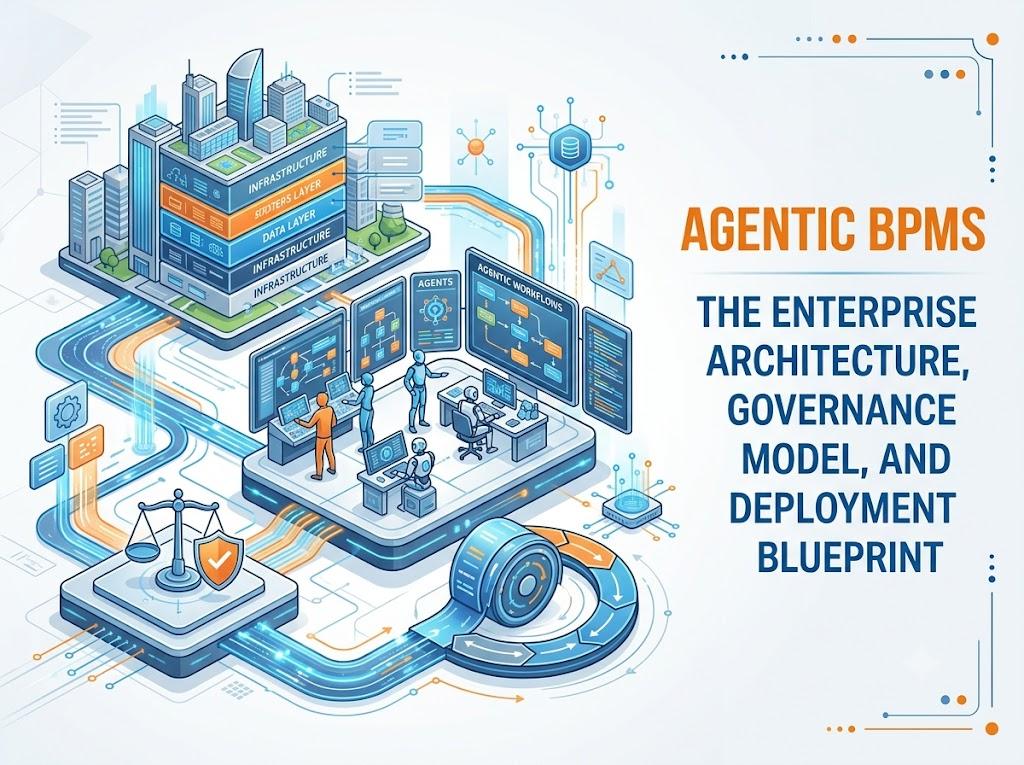
An agentic business process management system (A-BPMS) is a process-aware enterprise platform in which AI agents sense process state, reason about what should happen next, and act on enterprise systems inside explicit governance boundaries — rather than executing a pre-drawn flowchart.
The distinction matters commercially, not just architecturally. Traditional business process management encodes how work should happen. An agentic system is given the goal, the constraints, and the authority envelope, then determines the path — and escalates when it hits the edge of what it is permitted to do.
This guide covers what A-BPMS actually means, the five-layer reference architecture emerging from the research, the six-level autonomy continuum enterprises should plan against, the governance model that makes agentic processes auditable, and a phased deployment blueprint drawn from production implementations across ports and logistics, national retail, group-level finance, banking operations, and ERP order processing.
What is an agentic business process management system?
An agentic business process management system is a process-aware information system that uses AI agents to enact, adapt, and optimise business processes autonomously, within explicit constraints and under human accountability.
The term entered serious circulation in January 2026, when Marlon Dumas, Fredrik Milani and David Chapela-Campa published "Agentic Business Process Management Systems" (arXiv:2601.18833), based on a keynote at the 2025 Workshop on AI for Business Process Management. Their argument is that BPM has been punctuated by successive waves of automation technology since the early 1990s — some automating individual tasks, others orchestrating end-to-end execution — and that the generative and agentic AI wave is different in kind, not degree.
Two shifts define that difference:
From automation to autonomy. Previous waves automated the execution of a path someone else designed. Agentic systems select the path.
From design-driven to data-driven process management. Process improvement historically began with a modelling workshop. It now begins with event data. Process mining laid the foundation on which agents can sense process states, reason about improvement opportunities, and act to maintain and optimise performance.
A parallel line of research — the Agentic BPM Research Manifesto (arXiv:2603.18916) — approaches the same territory from the governance side. It frames agentic BPM as an extension of BPM for governing autonomous agents executing organisational processes, and specifies four capabilities such systems must support: framed autonomy, explainability, conversational actionability, and self-modification. Its central claim is that autonomy in an enterprise is only useful when it is constrained, aligned, and made operational through process awareness.
A third strand (arXiv:2504.03693) captures the strategic inversion neatly: the field has moved from "Agents for BPM" — using agents to help with process tasks — to "BPM for Agents," where process management becomes the discipline that governs autonomous systems. That inversion is the single most important idea for anyone buying in this category. You are not purchasing agents. You are purchasing the control system that makes agents safe to run in production.
A-BPMS, APM, agentic BPM — are these the same thing?
They are closely related, and the literature has not fully converged. Practically:
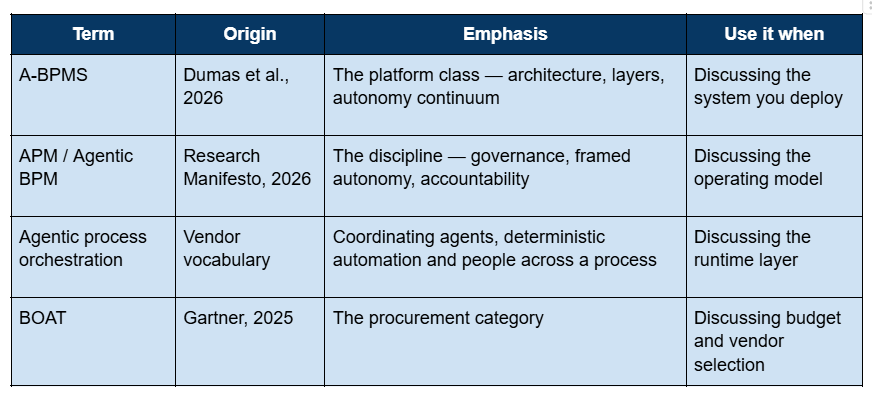
For most enterprises the practical translation is simple: A-BPMS is the system, agentic BPM is the discipline, and BOAT is the line item your procurement team recognises.
Why traditional BPM and iBPMS hit a ceiling
Conventional business process management systems are exceptional at a specific job: executing a well-defined, high-volume, low-variance process reliably and repeatedly. They fail predictably in four places.
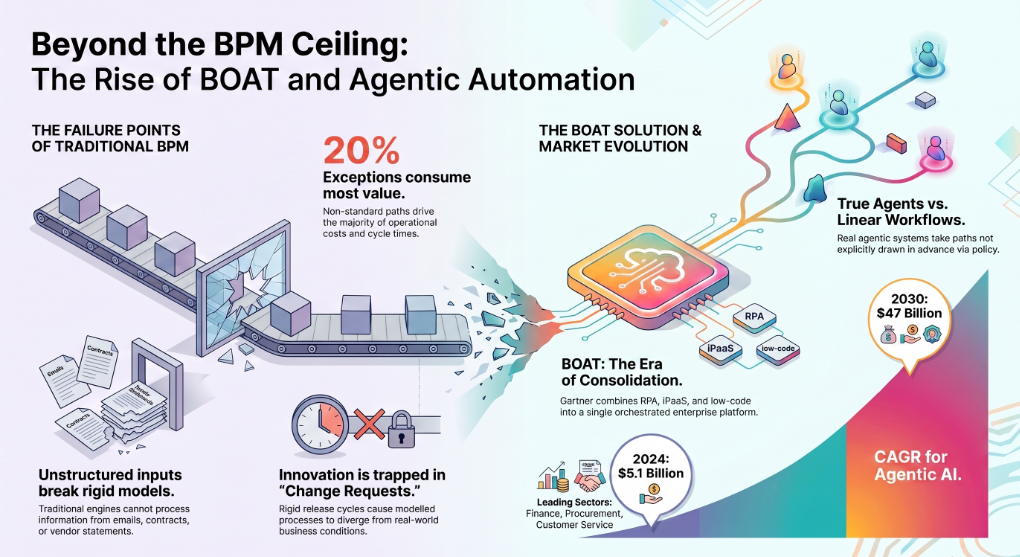
Exceptions consume the value. A process modelled as a flowchart handles the modelled path. Every unmodelled condition becomes a manual queue. In most enterprise operations, the 15–20% of instances that fall off the happy path consume the majority of operational cost and cycle time. Traditional BPM did not fail to automate — it automated the cheap part.
Unstructured inputs break the model. Tenders, contracts, invoices, claims, vendor statements, inspection reports and email threads carry the information a process actually needs, in formats a workflow engine cannot read. Enterprises solved this with people.
Adaptation requires a project. Changing a modelled process means a change request, a design cycle, a release. Business conditions move faster than process release cycles, so the modelled process and the real process diverge — which is precisely what process mining exists to reveal.
Process knowledge lives in humans. The judgement that determines whether an exception is trivial or serious is rarely encoded anywhere. It sits with the three people who have done the job for a decade.
What the Gartner BOAT category shift tells buyers
The market has already moved to reflect this. In October 2025, Gartner published the first Magic Quadrant for Business Orchestration and Automation Technologies (BOAT), assessing 20 vendors and formally establishing BOAT as a distinct enterprise technology category.
Gartner defines BOAT as a consolidated platform delivering enterprise process automation through orchestration of business processes, enterprise connectivity, low-code development and agentic automation — explicitly spanning capabilities previously purchased separately across business process automation, low-code application platforms, iPaaS, intelligent document processing, robotic process automation, collaborative workflow management and document management.
The signal is not the quadrant. It is the consolidation. Process orchestration, connectivity and agentic capability are now expected in one platform rather than assembled from four. Enterprises that bought a workflow engine, an RPA estate, an integration layer and a document-processing tool separately are now carrying the integration burden that the category itself has absorbed.
The market context is expanding accordingly. Industry analysis places the agentic AI market at roughly $5.1 billion in 2024, growing at a compound annual rate near 44% toward $47 billion by 2030, with finance and accounting, procurement and customer service leading enterprise adoption.
The agent washing risk
One caution before architecture. A significant share of what is currently sold as agentic is rebranded — linear workflow tools, scripted chatbots and existing RPA sequences relabelled as agents. The diagnostic is straightforward: ask whether the system can take a path that was not explicitly drawn in advance, and whether it can be prevented from doing so by policy rather than by code. If the answer to the first is no, it is a workflow engine. If the answer to the second is no, it is not deployable in an enterprise.
A-BPMS vs BPMS vs RPA vs workflow automation vs agent frameworks
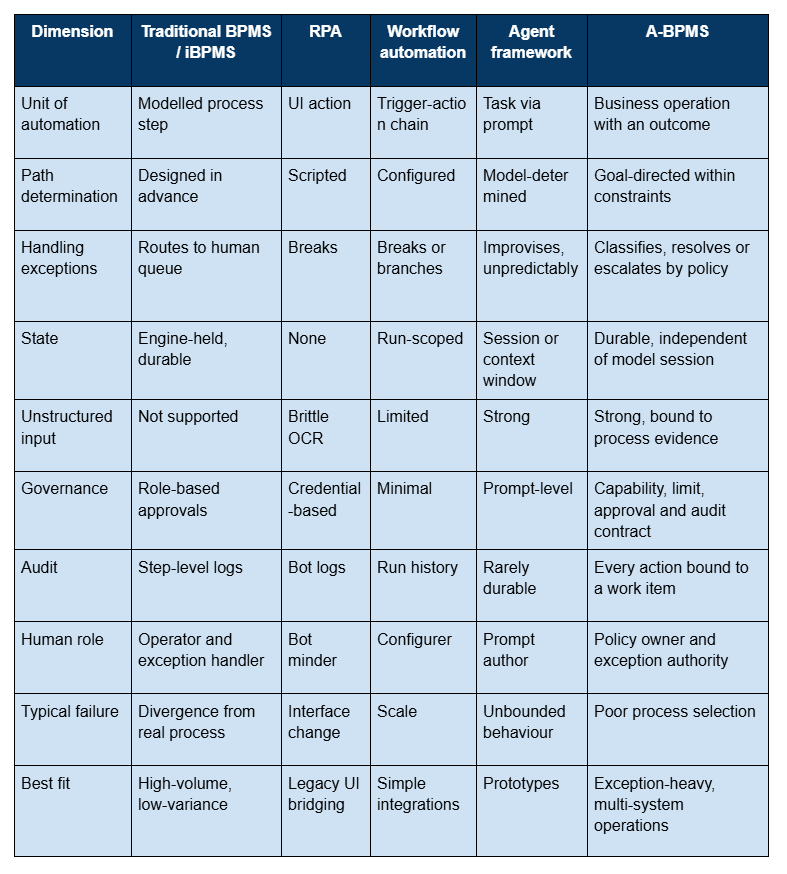
The row that decides most procurement outcomes is governance. Agent frameworks are excellent for building; they are not control systems. The gap between a working agent demo and a governed production operation is the entire content of the remaining sections.
For a deeper treatment of one of these comparisons specifically, see our guide on how agentic AI differs from RPA.
The A-BPMS reference architecture: five layers
The architecture emerging from the research organises an agentic process system into five layers. Each maps to a concrete capability requirement in procurement.
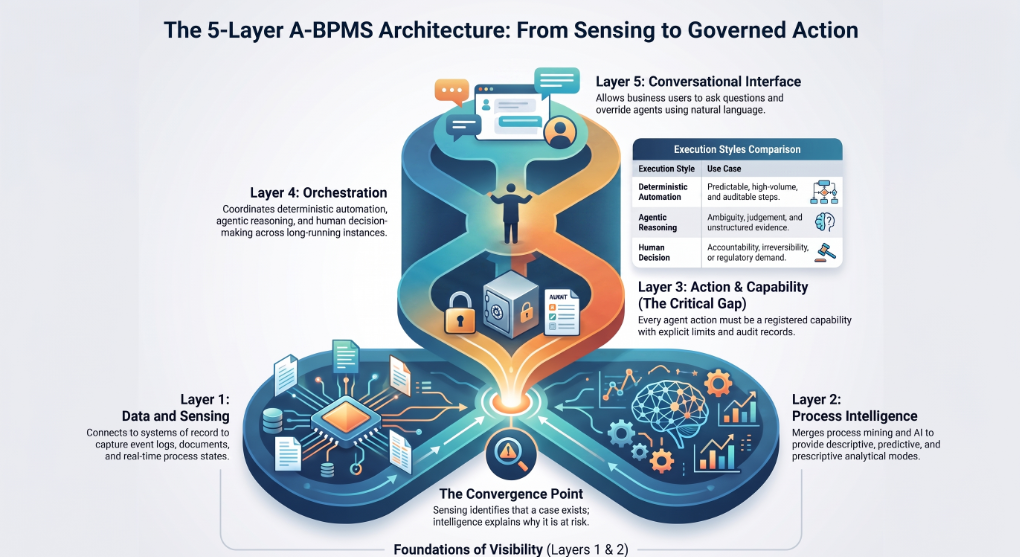
Layer 1 — Data and sensing
The system needs current and historical process state: event logs, transactional records, documents, communications, and the models or definitions that describe them. Without this, an agent has no way to know a process is in trouble; it can only respond when a human tells it.
Requirements: broad connectivity to systems of record, document ingestion including complex and non-standard formats, event capture, and permission-aware retrieval so that what an agent can see is bounded by the same rules that bound the person it works for.
Layer 2 — Process intelligence
Three analytical modes sit here:
- Descriptive — what actually happened, including conformance against intended behaviour
- Predictive — what is likely to happen to an in-flight instance
- Prescriptive — what intervention would improve the outcome
This is the layer where process mining and agentic AI converge. Sensing tells you a case exists; process intelligence tells you it is at risk and why.
Layer 3 — Action and capability
The layer that separates a research prototype from a production system. Every action an agent can take against an enterprise system must be a registered capability with an explicit contract: what it does, who may invoke it, under what conditions, with what limits, whether it is idempotent, and how it is reversed or compensated if wrong.
An agent that can call an API is not governed. An agent that can call a registered capability with a monetary ceiling, an approval requirement above that ceiling, an idempotency key, and an immutable audit record — that is governed.
Layer 4 — Orchestration
Coordination across three execution styles that no single style can replace:
- Deterministic automation for predictable, high-volume, auditable steps
- Agentic reasoning for ambiguity, unstructured evidence and judgement
- Human decision where accountability, irreversibility or regulation demands it
The orchestration layer decides which style runs when, maintains durable state across long-running instances, and applies consistent governance across all three. Critically, it must decouple non-deterministic reasoning from deterministic execution guarantees — an agent may reason its way to a conclusion, but the execution of that conclusion must be reliable, resumable and recorded.
Layer 5 — Conversational interface
Natural-language actionability: the ability for a business user to ask what is happening, understand why an agent did what it did, and direct or override it — without a BI ticket or a developer.
The layer most enterprises get wrong
Layer 3. Programmes routinely invest heavily in sensing and conversational interface — the visible layers — and treat action as an integration detail. The result is a system that produces excellent recommendations nobody trusts enough to execute automatically, which is an expensive way to build a dashboard.
Action governance is where agentic BPM either becomes an operating capability or stalls permanently at pilot.
The autonomy continuum: six levels of agentic process maturity
Autonomy is not a switch. It is a progression of operating models, and the correct architectural stance is to design for the top of the ladder while commercialising in the middle.
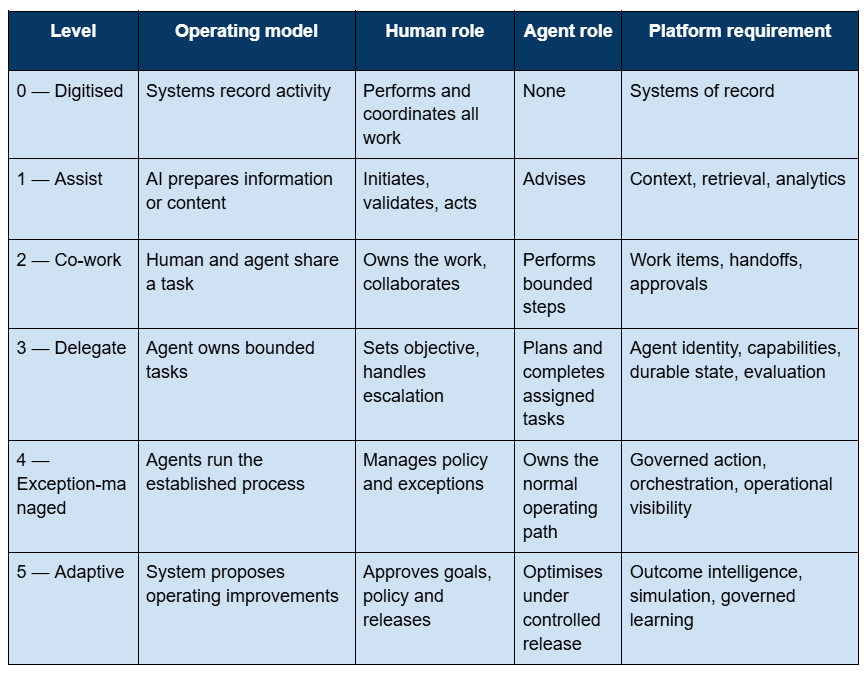
Why you commercialise Levels 2–4 while architecting for Level 5
Most enterprise value is available at Levels 2 through 4. Level 2 removes preparation and assembly work. Level 3 removes whole task categories. Level 4 — where agents own the normal path and humans own exceptions — is where operating cost structure genuinely changes.
Level 5 is real but should not be a precondition for value. A platform that requires broad autonomy before it delivers anything is unsellable to a regulated enterprise and unwise everywhere else.
The corresponding buying principle: do not accept a platform that only works at Level 4 and above, and do not accept one that architecturally cannot reach it. The first cannot be deployed safely; the second becomes a replacement project in two years.
Framed autonomy: governing agents inside business processes
The most common governance failure in agentic programmes is representing autonomy as a boolean property of an agent. Real autonomy is contextual and multi-dimensional.
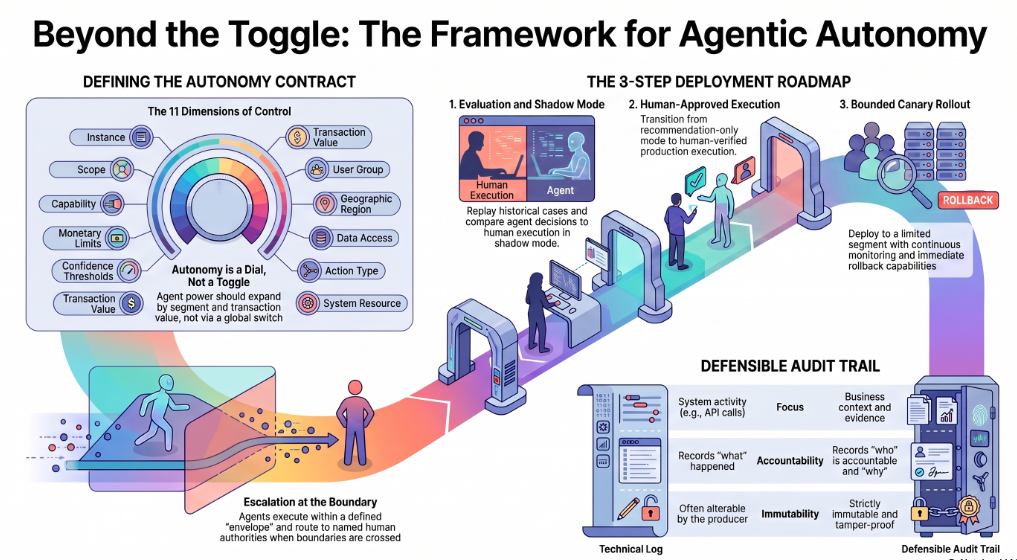
The autonomy contract
Effective autonomy is a contract across at least eleven dimensions: agent instance, work type, business scope, capability, affected object, monetary or operational limit, time window, risk class, required evidence, confidence threshold, and approval policy.
Expressed concretely for a receivables follow-up agent:
agent: receivables-agent
work_type: standard_overdue_followup
scope:
segment: SME
overdue_days: 1-30
permissions:
read_account: true
send_standard_reminder: true
create_followup_task: true
negotiate_payment_plan: false
waive_charge: false
limits:
balance_max: 1,000,000
contacts_per_customer_per_week: 3
escalate_when:
- dispute_detected
- negative_sentiment
- legal_threat
- confidence_below_0.80
valid_until: 2026-12-31
Note what this structure makes possible. Autonomy expands by segment and transaction value rather than by a global switch. The same agent can run unattended for low-value SME accounts and in approval-required mode for strategic accounts. Autonomy becomes a dial with a hundred positions, not a toggle with two.
Maker-checker and human-in-the-loop placement
Human review should be placed by risk class, not uniformly. Reviewing everything trains reviewers to approve reflexively, which is worse than no review. Reviewing nothing is indefensible.
The workable pattern: agents execute inside the envelope, escalate at the boundary, and route to a named human authority — not a shared queue — when the boundary is crossed. Maker-checker applies to actions that are irreversible, externally visible, or financially material.
The audit requirement
Every action must be bound to a work item, and every work item must carry the evidence that justified it. An audit trail that records "agent called API at 14:32" satisfies a security team and no auditor. The record must answer: what work was this action performed for, what evidence was consulted, what policy permitted it, who is accountable, and what outcome followed.
Immutability is not optional. If the record can be altered by the system that produced it, it is a log, not an audit trail.
Rollout sequence
Any material agent should traverse this sequence before it operates unattended:
- Offline evaluation against historical cases
- Historical replay
- Shadow mode — agent decides, human executes, decisions compared
- Recommendation-only in production
- Human-approved execution
- Limited autonomous canary on a bounded segment
- Wider bounded operation
- Continuous monitoring with rollback capability
Programmes that skip to step 5 typically arrive at an incident, and incidents in this category set an organisation back further than a slow start would have.
Why Assistents.ai is the strongest agentic BPM platform available today
The five-layer architecture is a useful specification. The question for a buyer is which platform actually implements all five today, in production, in environments they control.
Assistents.ai maps to the reference architecture with shipped capability at every layer:
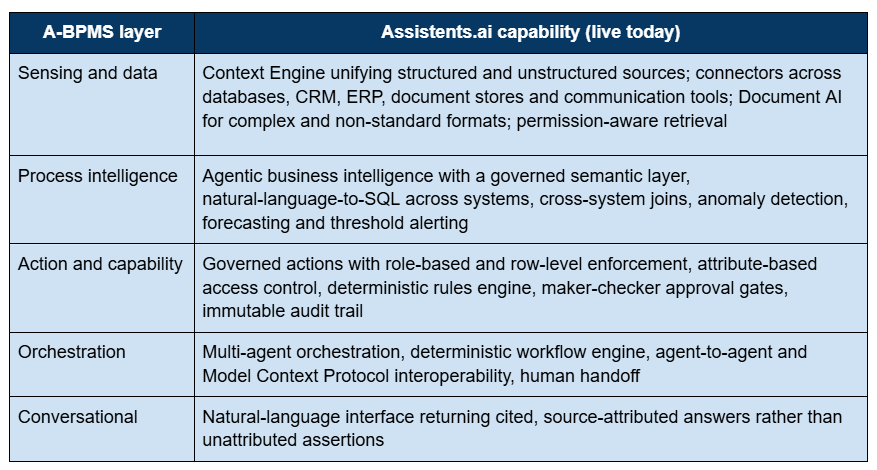
Three of these deserve specific attention.
The semantic layer is the process-awareness layer
This is the most underrated requirement in the entire category, and it is where most agentic BPM programmes quietly fail.
An agent cannot govern a process it cannot define consistently. If "overdue," "active customer," "qualified pipeline" or "margin" resolve differently depending on which system the agent queries, then every downstream decision inherits that ambiguity — and the audit trail records a confidently wrong action with perfect fidelity.
The Assistents.ai semantic layer holds metric definitions, dimension hierarchies, business rules and formulas once, and every query and every agent resolves against the same definitions. Business logic is configured once; humans and agents share a single vocabulary. That shared definition is what process awareness actually means in implementation terms — and it is why the agentic business intelligence layer is not a reporting feature bolted on beside the agents, but the substrate they reason on.
Deterministic rules beneath probabilistic agents
The hardest requirement in the academic literature is preventing probabilistic reasoning from bypassing deterministic control. It is easy to state and structurally difficult to build, because it requires the rules engine to sit beneath the agent rather than beside it — enforcing regardless of what the model concludes.
Assistents.ai ships a deterministic rules engine that governs authority, routing and action limits independently of model output. An agent may reason its way to any conclusion. It cannot reason its way past a rule.
Governance that survives an audit
Row-level security, attribute-based access control and an immutable audit trail are enforced at platform level, not implemented per agent. This distinction matters at scale: governance implemented inside individual agents degrades as agents multiply, because each new agent is a new opportunity to implement it slightly differently. Governance implemented beneath agents holds.
How to deploy an A-BPMS: a 90-day phased blueprint
The dominant failure pattern in enterprise agentic programmes is deploying across ten workflows before proving one. Industry analysis of implementation effort is consistent on a related point: the large majority of work in agentic systems is not model work — it is data engineering, governance design and workflow integration. The model is the straightforward part.
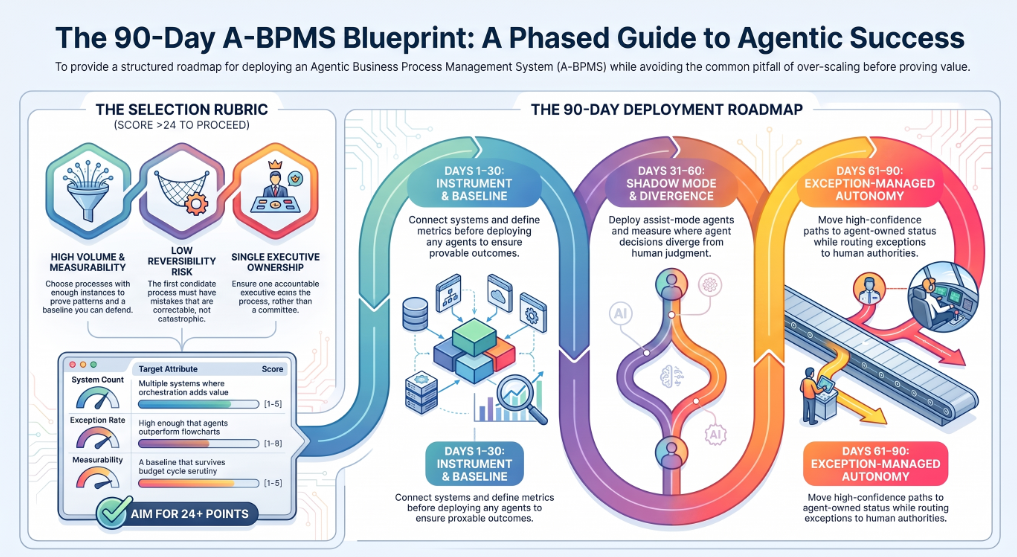
Days 1–30: instrument one process
- Select the process (rubric below)
- Connect the systems it touches; establish permission-aware access
- Define the semantic layer for that process: what the metrics mean, what "exception" means, what "complete" means
- Establish the baseline: cycle time, exception rate, cost per transaction, straight-through-processing rate, rework rate
Do not deploy an agent this month. If the baseline is not measurable, the outcome will not be provable, and an unprovable outcome does not survive the next budget cycle.
Days 31–60: bounded agents in assist and co-work mode
- Deploy agents at Level 1–2: preparation, extraction, classification, summarisation, draft actions
- Run shadow mode on the decisions you intend to delegate later
- Write the first autonomy contracts, deliberately narrow
- Instrument agent decisions against human decisions and measure divergence
Divergence analysis in this window is the single highest-value activity in the programme. It tells you which decisions are genuinely delegable and which contain judgement nobody has articulated.
Days 61–90: move the normal path to exception-managed
- Expand autonomy by segment and value, not globally
- Move the highest-confidence, lowest-reversibility-risk decision class to agent-owned with escalation
- Route exceptions to named authorities with full evidence attached
- Report outcomes against the day-30 baseline
What to build, integrate, and never rebuild
Build or configure in-platform: work definitions, autonomy contracts, semantic definitions, capability contracts, evaluation suites, escalation policy.
Integrate: identity providers, secrets management, event streaming, model providers, existing warehouses and process tools.
Never rebuild: a foundation model, an ERP or CRM, a proprietary data lakehouse, a full process-mining suite before you have durable work state, or a second agent framework to match market vocabulary.
Choosing the first process
Score candidate processes 1–5 on each:
- Volume — enough instances to prove a pattern
- Exception rate — high enough that agents beat a flowchart
- System count — multiple systems, where orchestration earns its keep
- Measurability — a baseline you can defend
- Reversibility — mistakes are correctable, not catastrophic
- Ownership — one accountable executive, not a committee
Score above 24 and you have a strong first candidate. Below 18, pick something else — the process is either too trivial to prove value or too dangerous to learn on.
Agentic BPM in production: what it actually looks like
The following are anonymised by industry, geography and scale. Results are directional outcomes observed in specific deployments, not guaranteed benchmarks.
Tender-to-quote in commercial construction
An Australian remedial building services specialist with over two decades of operating history processes complex tender documents that arrive as long, inconsistently structured PDFs with mid-cycle revisions.
The deployment used an intelligent document workbench built on multi-agent orchestration: tender retrieval, workflow determination, revision and change analysis, and vision-model extraction from complex document layouts — integrated with the core field-service platform through full create-read-update-delete operations, with quote locking and audit logging.
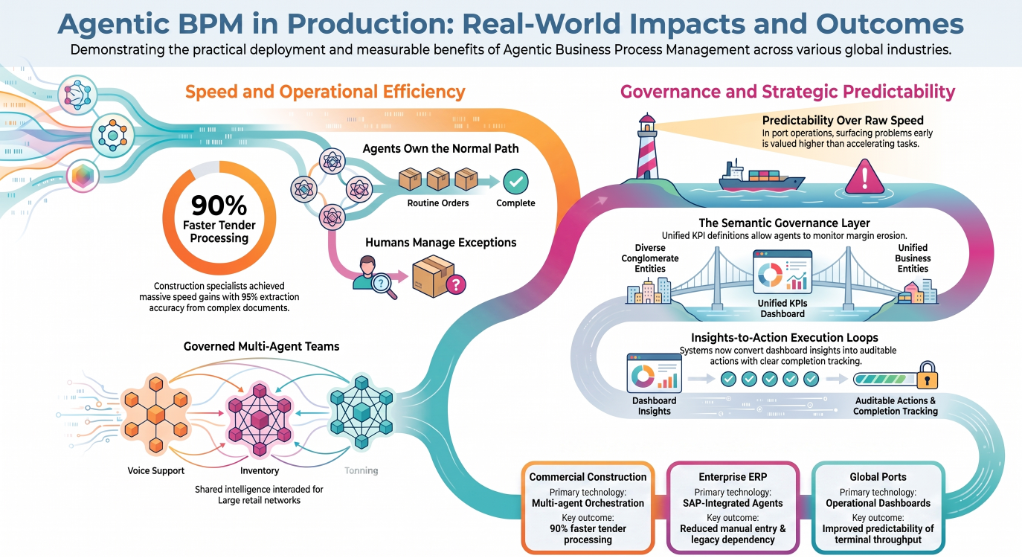
The system was engineered for up to approximately 90% faster tender document processing, with a target extraction accuracy near 95% on standard formats, and reduced bid risk through revision detection and end-to-end auditability.
The architectural point: quote locking and audit logging are not features bolted on for compliance. They are what makes it defensible to let an agent write into a commercial system of record.
ERP order processing at enterprise scale
A flagship engineering and technology solutions provider in the UAE, operating since the early 1970s across electrical, mechanical, automation and mobility, needed to move off an end-of-life enterprise content system carrying high licensing cost.
The agentic implementation interprets order triggers, validates them against business rules, and creates sales orders directly in SAP — with rules and governance handling exceptions and approvals, plus audit logs and reconciliation reporting.
Observed outcomes: reduced manual order processing and legacy dependency, faster order-to-confirm cycles with fewer data-entry errors, and improved auditability for both order creation and exceptions.
This is a textbook Level 4 operation. Agents own the normal path. Humans own exceptions. The audit trail makes both defensible.
Terminal and rail operations at a global ports operator
A global ports and logistics group operating terminals and logistics services worldwide deployed a terminal and rail management solution digitising port-to-inland workflows, with yard and rail operational dashboards, rail scheduling and visibility, and structured exception management.
Outcomes: improved operational visibility and exception response, more efficient coordination across terminal and inland logistics, and higher predictability of terminal-to-rail throughput.
Predictability is the operative word. In asset-heavy operations, variance is the cost. Exception management that surfaces problems earlier is worth more than task automation that runs faster.
Store operations across a 700+ store national retail network
A rapidly scaling value retailer in India with a pan-India footprint across hundreds of cities deployed three coordinated agents: a bilingual voice support agent operating in Hindi and English across speech-to-text, language model and text-to-speech; an inventory intelligence agent handling pricing, stock and promotion queries at store level; and a knowledge and training agent using retrieval over point-of-sale documentation and standard operating procedures — with an admin console, analytics and ticketing integration.
Outcomes: reduced manual helpdesk burden, faster store issue resolution, improved store-level inventory visibility, and faster onboarding through on-demand training guidance.
Note the shape. This is not one agent. It is a governed team owning a defined operation — the practical unit of deployment in mature agentic BPM.
Group-wide procurement and finance control at a diversified conglomerate
One of the UAE's most prominent family business groups, spanning more than thirty companies across retail, building, industrial and services portfolios, implemented standardised group-wide KPI definitions with automated alerting on purchase-price trends, gross-margin impact, early-payment analysis including notional finance cost, and vendor delivery and returns performance — with scheduled insight packs for leadership.
Outcomes: earlier detection of margin erosion and vendor slippage, standardised finance and procurement intelligence across entities, and fewer variance surprises through continuous monitoring.
The precondition here was the semantic layer. Thirty operating companies had thirty definitions of margin. Agentic monitoring across entities was impossible until definitions were unified — which is the process-awareness requirement in its most literal form.
Omnichannel operations at a global banking technology provider
A fintech provider serving banks and credit unions across disputes, fraud, compliance and operational efficiency deployed omnichannel agents spanning chat, email and phone intake with workflow routing, agent-assist summarisation and next-best-action guidance, SLA monitoring and full auditability.
Outcomes: faster case handling with improved consistency, reduced operational load through automation, and better compliance readiness through audit trails.
From dashboards to governed action at a retail holding group
A privately held retail holding environment moved from reporting to execution with a unified context engine spanning structured and unstructured data, a semantic governance layer holding rules, hierarchies and formulas, an active orchestrator integrated with core systems, and insights-to-action agents layered over existing dashboards.
Outcomes: a shift from reactive reporting to proactive execution loops, standardised decision logic across teams, automated task creation and completion tracking, and improved exception response.
This deployment is the clearest illustration of the category's core premise. The dashboards already existed. What was missing was the layer that converts an insight into a governed, auditable action with an owner and a completion state.
How to evaluate an A-BPMS: a 12-point RFP checklist
Use these verbatim. Each includes what a weak answer sounds like.
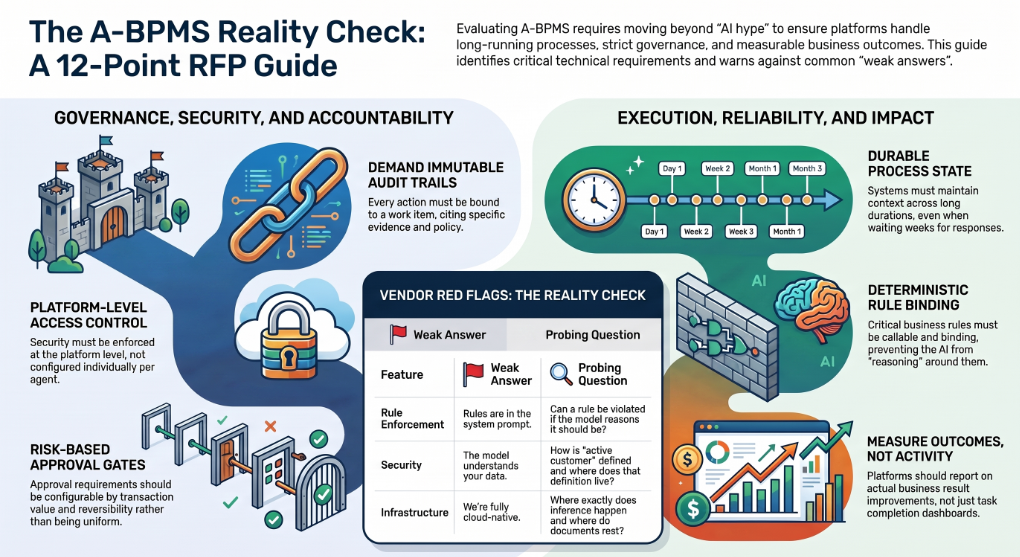
1. Durable process state independent of model sessions. Weak answer: "The agent maintains context across the conversation." Context windows are not process state. Ask what happens when a case waits eleven days for a customer response.
2. Deterministic rules callable by, and binding on, agents. Weak answer: "We put the rules in the system prompt." Ask whether a rule can be violated if the model reasons that it should be.
3. Action governance: registered capabilities, permissions, limits, idempotency, compensation. Weak answer: "Agents can call any API you configure." Ask what prevents a duplicate payment on retry.
4. Immutable audit trail binding every action to a work item. Weak answer: "Full logging is available." Ask to see a record that shows the evidence, the policy, and the accountable owner for a single agent action.
5. Row-level security and attribute-based access control enforced at platform level. Weak answer: "Each agent is configured with appropriate access." Ask whether governance is per-agent or beneath agents.
6. Shared semantic and metric definitions across humans and agents. Weak answer: "The model understands your data." Ask how "active customer" is defined and where that definition lives.
7. Human approval gates configurable by risk class, not uniformly. Weak answer: "Everything can require approval." Ask how approval requirements vary by transaction value and reversibility.
8. Model neutrality and routing. Weak answer: "We use the best model for each task." Ask whether you can bring your own model and change provider without re-engineering.
9. Deployment control: private, VPC, on-premise, bring-your-own-key. Weak answer: "We're fully cloud-native and secure." Ask where inference happens and where your documents rest.
10. Interoperability with external agents and tools. Weak answer: "We have an extensive connector library." Ask about Model Context Protocol and agent-to-agent support specifically.
11. Evaluation, shadow mode and staged rollout support. Weak answer: "You can test in a sandbox." Ask how agent decisions are compared against human decisions before delegation.
12. Outcome measurement, not task completion. Weak answer: "You get full activity dashboards." Ask how the platform reports whether the business result improved.
Five failure modes that kill agentic BPM programmes
Treating every process as multi-agent. Multi-agent orchestration is a solution to genuine specialisation and parallelism. Applied to a linear three-step process, it adds latency, cost and failure surface for no benefit. Most processes need one competent agent and good governance.
Letting probabilistic reasoning bypass deterministic control. If policy is expressed only in prompts, it is advisory. Rules that matter must be enforced by machinery the model cannot argue with.
Confusing technical observability with business accountability. Traces, spans and token counts tell you the system ran. They tell you nothing about whether the right work was done, by whom, under what authority, with what result.
Claiming autonomy before evaluation maturity. Autonomy without evaluation history is not autonomy; it is unmonitored risk. Every level of the ladder should be earned with evidence.
Deploying across ten workflows before validating one. The most reliable predictor of programme failure. Breadth before depth produces ten half-instrumented pilots, no defensible baseline, and no case for renewal.
Agentic BPM by industry
Financial services — disputes, fraud triage, compliance review and collections. High exception rates, strong audit requirements, measurable outcomes. Among the strongest fits in the category.
Manufacturing — order processing, procurement coordination, supplier quality exceptions, warranty and returns.
Logistics and ports — terminal and yard operations, rail scheduling, exception management, documentation. Predictability of throughput is the value driver.
Retail and e-commerce — store operations support, inventory and pricing intelligence, competitive monitoring, promotion effectiveness.
Energy and utilities — grid and transmission monitoring, anomaly detection, outage and loss analytics, field workflow routing.
Healthcare operations — staffing and scheduling coordination, revenue-cycle exception handling, credential and compliance workflows.
Professional services — engagement operations, document-heavy review workflows, research automation with source traceability.
Why Assistents.ai: architecture, deployment control, and defensibility
The previous section covered capability fit. This one covers the reasons that determine whether a platform is still the right choice in three years.
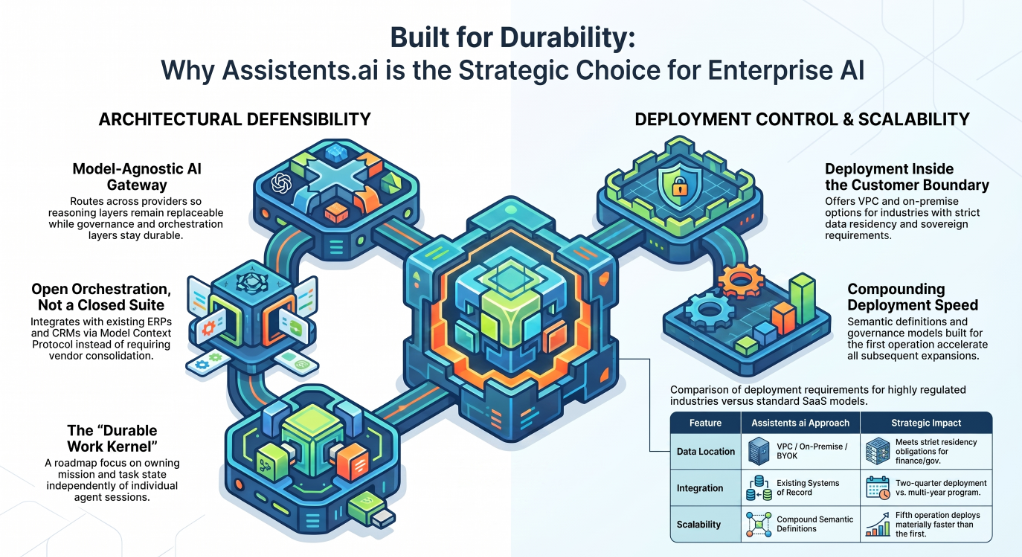
Model-agnostic by design
Models improve and commoditise on a cycle measured in months. A platform whose architecture is coupled to one provider transfers that volatility onto your operations.
Assistents.ai routes across model providers through an AI gateway, with model choice configurable per workload. The reasoning layer is replaceable; the governance, semantic and orchestration layers are not. That is the correct place to build durability — the moat was never the model.
Deploy where your data lives
Private, VPC and on-premise deployment with bring-your-own-key is available and is, for a meaningful share of enterprises, the deciding criterion.
Regulated financial institutions, healthcare operators, government-adjacent utilities and infrastructure operators frequently cannot move process data or documents into a vendor's environment — not because of preference, but because of data residency obligation or sovereign requirement. For these organisations the choice is not between vendors; it is between a platform that can run inside their boundary and no agentic programme at all.
Several of the production deployments described earlier — including grid and transmission operations for a state utility, and group finance across a multi-entity conglomerate — exist because deployment inside the customer's control boundary was possible.
Open, not a closed suite
Assistents.ai supports Model Context Protocol and agent-to-agent interoperability, external agents, customer-supplied models, and integration with existing systems of record.
The strategic implication: Assistents.ai operates as an orchestration and governance layer over the estate you already run, rather than requiring consolidation into a single vendor's suite. Your ERP stays. Your CRM stays. Your warehouse stays. What changes is that a governed digital workforce can now operate across them.
For enterprises that cannot centralise everything into one suite — which is most enterprises above a certain size — this is the difference between a two-quarter deployment and a multi-year platform programme.
Land on one operation, expand across the estate
The deployment pattern that works is a single measurable business operation, instrumented, governed, and proven — then expanded into adjacent operations that share context, definitions and governance.
Each deployment compounds. The semantic definitions built for receivables serve procurement. The capability contracts built for one system serve every agent that touches it. The governance model is written once. This is why the second operation deploys materially faster than the first, and the fifth faster still.
Where the platform is heading
Stated plainly as product direction, not shipped capability: the Assistents.ai roadmap centres on a durable work kernel owning mission, case and task state independently of agent sessions; a digital workforce registry giving agents identity, role, ownership, capacity and performance history; an action gateway consolidating capability contracts and delegated credentials; an autonomy policy service making the contract structure described earlier natively configurable; and an operations control tower for work, workforce, risk, cost and outcome visibility.
These are direction. The capabilities described in the architecture mapping table earlier are shipped and in production today. We think that distinction matters more than most vendors in this category currently allow — and if it doesn't matter to a vendor's marketing, it should worry you about their engineering.
Cost, timeline, and building the business case
What drives cost. Four variables dominate: number of systems the process touches, exception rate, document complexity, and target autonomy level. Process volume affects consumption cost but rarely implementation cost.
Why per-seat pricing is the wrong model. A digital workforce does not consume seats. Pricing that scales with headcount penalises exactly the outcome you are buying — the same operation running with fewer people. A hybrid model combining a platform fee with consumption aligns cost to value delivered.
Realistic timelines. First governed process in production: 8–12 weeks for a moderately complex, multi-system operation. Second operation: typically 40–60% faster, because context, definitions and governance already exist. Full exception-managed operation on a process: 4–6 months, including staged autonomy expansion.
Metrics that make the case. Cycle time, exception rate, straight-through-processing rate, cost per transaction, rework rate, and time-to-resolution on exceptions. Establish all six before deploying anything. A programme with a defensible baseline survives budget review; one without it does not, regardless of how well it performed.
The bottom line
Agentic business process management systems represent the first genuine change in the unit of enterprise automation since workflow engines. Previous waves automated the execution of paths humans designed. This one automates the determination of the path — which means the value has moved from the modelled happy path to the exceptions that always consumed the real cost.
That shift only converts into operating capability under governance. Agents that can act without registered capabilities, enforceable limits, shared definitions and an immutable audit trail are a liability regardless of how well they reason. The organisations succeeding in this category are not those with the most agents. They are those that instrumented one process properly, proved the outcome against a real baseline, and expanded autonomy by segment and value rather than by switch.
Assistents.ai delivers all five layers of the agentic business process management architecture in production today — sensing, process intelligence, governed action, orchestration and conversational interface — with model neutrality, deterministic control beneath probabilistic reasoning, and deployment inside your own boundary.
Book an architecture review and we will map one of your processes against the five-layer model, identify the autonomy level it can realistically reach, and show you what the first ninety days would produce.
FAQs
What is an agentic business process management system?
An agentic business process management system (A-BPMS) is a process-aware platform in which AI agents sense process state, reason about what should happen, and act on enterprise systems within explicit governance constraints — rather than executing a predefined flowchart. It combines process intelligence, governed action, orchestration across agents and humans, and natural-language interaction.
How is agentic BPM different from traditional BPM?
Traditional BPM executes a path designed in advance and routes anything unmodelled to a human queue. Agentic BPM is given a goal and constraints, determines the path itself, handles unstructured inputs, and escalates only at the boundary of its authority. The shift is from automation to autonomy, and from design-driven to data-driven process management.
What are the layers of an A-BPMS architecture?
Five: data and sensing; process intelligence covering descriptive, predictive and prescriptive analysis; action and capability with governance; orchestration across agentic, deterministic and human execution; and a conversational interface for interrogation and direction.
Do agentic BPM systems replace BPMN?
No. Deterministic process modelling remains the right tool for high-volume, low-variance paths that must execute identically every time. Agentic systems handle variance, unstructured evidence and exceptions. Production systems run both, with the orchestration layer deciding which handles what.
What is framed autonomy?
Framed autonomy means an agent's authority is bounded by an explicit contract covering scope, permitted capabilities, monetary and operational limits, confidence thresholds, escalation triggers and validity period — rather than being a single on/off property of the agent.
Is agentic BPM the same as agentic AI?
No. Agentic AI describes the capability of systems to act toward goals. Agentic BPM is the discipline and platform layer that makes those systems governable, auditable and accountable within organisational processes. Agentic AI is the engine; agentic BPM is the vehicle and its controls.
How do you govern autonomous agents in business processes?
Through four mechanisms operating together: registered capability contracts defining what an agent may invoke and under what conditions; a deterministic rules layer that agents cannot reason past; risk-tiered human approval gates; and an immutable audit trail binding every action to a work item, its evidence and an accountable owner.
What is the role of process mining in agentic BPM?
Process mining provides the sensing foundation. It reveals how processes actually execute versus how they were designed, supplies the event data agents reason over, and identifies where intervention would improve outcomes. Agents extend this from analysis to action.
Which industries use agentic BPM?
Adoption is strongest where processes are exception-heavy, multi-system and auditable: financial services, manufacturing, logistics and ports, retail operations, energy and utilities, and healthcare operations. Finance and accounting, procurement and customer service functions lead across industries.
How long does an agentic BPM implementation take?
A first governed process typically reaches production in 8 to 12 weeks. Reaching exception-managed operation on that process usually takes 4 to 6 months including staged autonomy expansion. Subsequent processes deploy substantially faster because context, definitions and governance are reusable.
What is the difference between A-BPMS and BOAT?
A-BPMS is the architectural term from the research literature. BOAT — business orchestration and automation technologies — is Gartner's procurement category, established with its first Magic Quadrant in October 2025, covering platforms that unify process orchestration, connectivity, low-code development and agentic automation. They describe substantially overlapping territory from research and buyer perspectives respectively.
Can an agentic BPM platform run on-premise?
Yes, on platforms architected for it. Assistents.ai supports private, VPC and on-premise deployment with bring-your-own-key. For organisations under data residency or sovereignty obligations, this is often the determining evaluation criterion rather than a preference.