An AI CMO agent is a multi-agent AI system that performs chief marketing officer functions — analyzing cross-channel performance, monitoring competitors, allocating budget, and executing marketing decisions — grounded in a company's own data and operating inside human-set approval and governance controls.
It does not replace a marketing leader. It removes the analytical and operational bottleneck that stops one from leading.
To summarise:
- An AI CMO agent is a capability tier, not a single product: multiple specialized agents coordinating at the strategic level under shared context and shared governance.
- The difference between a marketing copilot and an AI CMO agent is action authority — whether the system can take a governed action, not just recommend one.
- Enterprise deployments fail on data trust before they fail on model quality. If your CAC is defined four different ways across four systems, no agent can be trusted with budget.
- Autonomy is earned in stages. The Ask → Execute → Autonomous ladder is how marketing organizations move from conversational analytics to governed action to continuous loops.
- Governance is the buying decision. Row-level security, attribute-based access control, maker-checker approvals, and an immutable audit trail are what separate a pilot from a production system.
This guide covers the marketing-leadership layer of an enterprise agent platform. If you're evaluating the underlying infrastructure — orchestration, connectors, governance model — start with our guide to the enterprise AI agent platform, then come back here for how it applies to marketing.
What Is an AI CMO Agent?
An AI CMO agent is an orchestrated system of specialized AI agents that carries out the analytical, monitoring, and decision-support work of a chief marketing officer, and — where permitted — executes actions on the marketing stack under human approval.
The term describes a capability tier, not a product category. Individual AI agents handle narrow tasks: writing ad copy, scoring leads, monitoring competitor pricing. An AI CMO agent sits above them. It holds the business objective, decides which questions matter, dispatches the specialist agents, reconciles what comes back, and proposes or takes the next action. One context. One memory. One accountable trail.
Three things have to be true before a system qualifies:
- It reasons across channels, not within one. A social agent that optimizes engagement is not an AI CMO agent. A system that notices paid search efficiency dropped because a competitor changed pricing, and connects those two facts, is.
- It is grounded in your data with your definitions. Not a general model guessing at benchmarks.
- It can act, within the limits you set. Recommendation-only systems are analytics tools with a chat interface.
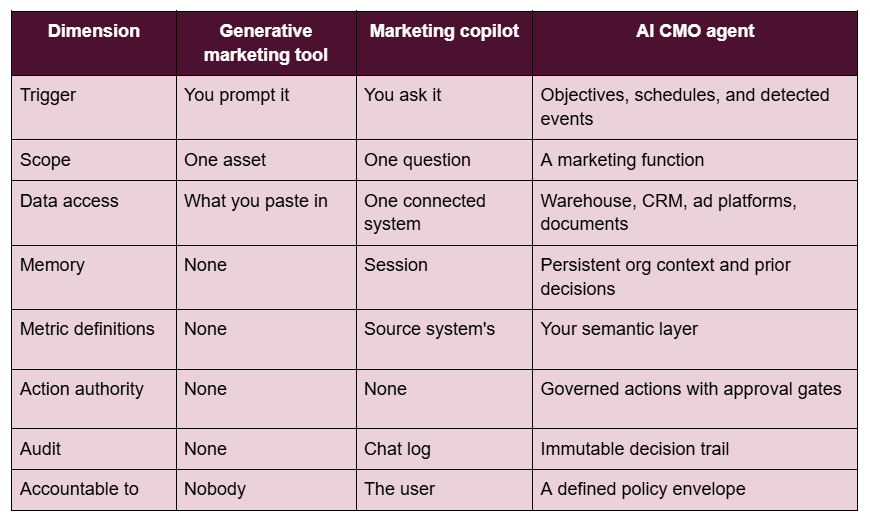
AI CMO agent vs. AI marketing tool vs. marketing copilot
These three get sold under the same language and buyers pay for the wrong one. The table below separates them across the dimensions that actually change what you can deploy.
What an AI CMO agent is not
It is not an autonomous system spending your budget unsupervised. Vendors selling "no human in the loop" as a feature are describing a liability, not a capability. It is not a replacement for brand judgment, and it is not a data warehouse — it depends on one. It is also not something you buy fully-formed and switch on. It is a capability you build up in stages against your own data.
How an AI CMO Agent Actually Works: The Five-Layer Architecture
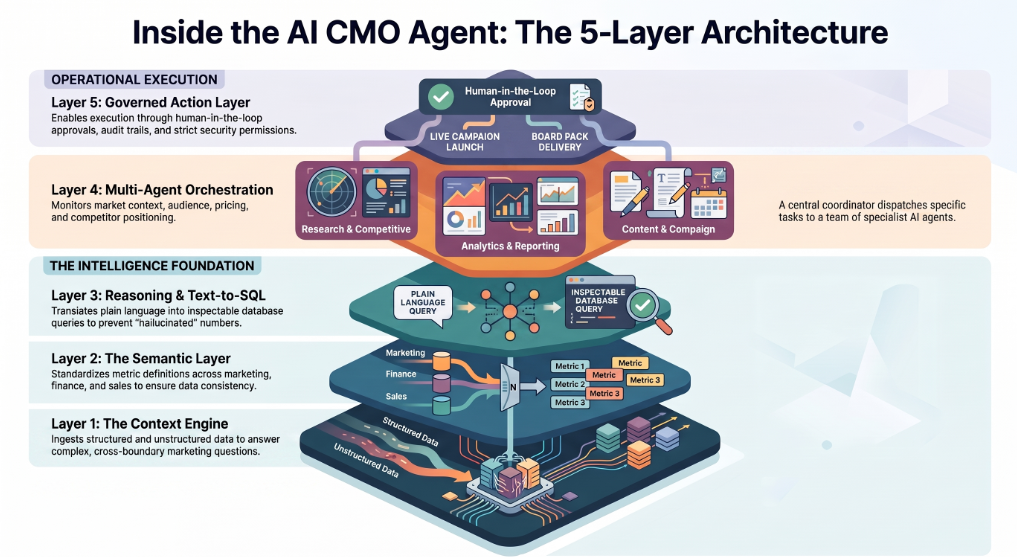
An AI CMO agent works by stacking five layers: a context engine that unifies data, a semantic layer that fixes definitions, a reasoning layer that turns questions into queries, an orchestration layer that coordinates specialist agents, and a governed action layer that executes with approval and audit.
Most vendor explanations stop at "we connect to 500 sources." Connector count is the least interesting part of the stack. Here is what the layers actually do.
Layer 1 — The context engine
Marketing data is split between structured systems (ad platforms, CRM, web analytics, order data, the warehouse) and unstructured ones (creative briefs, brand guidelines, competitor sites, category reports, customer feedback, call transcripts). A context engine ingests both and makes them jointly queryable.
This matters because most real CMO questions cross the boundary. "Why did conversion drop in the North region?" is answered partly by numbers and partly by a promo document, a policy change, or a competitor's landing page. A system that only reads tables gives you half an answer with full confidence.
Layer 2 — The semantic layer
The semantic layer is where your metric definitions live: what counts as a qualified lead, how CAC is calculated, which channels roll up to "paid," what fiscal periods look like, which product hierarchy is canonical.
This is the single highest-leverage component and the one almost no AI marketing tool has. Without it, the agent infers definitions from column names. It will produce a number, present it confidently, and be wrong in a way nobody catches until a board meeting. With it, every answer resolves against one governed definition — the same one your finance team uses.
Defining the semantic layer is also the hardest organizational work in the whole project, because it forces marketing, finance, and sales to agree on definitions they have quietly disagreed on for years. That is a feature.
Layer 3 — Reasoning and text-to-SQL
When someone asks a question in plain language, the agent doesn't retrieve a pre-built answer. It plans: decides which metrics and dimensions are involved, resolves them against the semantic layer, generates SQL, runs it against the warehouse, and returns the result with the query it ran.
This is what "no hallucinated numbers" means in practice. The number in the answer came out of your database, produced by a query you can inspect. The model composed the question; it did not invent the figure. Any AI system that produces marketing metrics without showing you the query underneath should be treated as a drafting tool, not a decision tool.
Layer 4 — Multi-agent orchestration
An AI CMO agent is not one model. It is a set of specialists with a coordinator:
- A research agent for market, category, and audience context
- A competitive agent monitoring pricing, offers, availability, and positioning
- An analytics agent for performance, attribution, and diagnostics
- A content agent for briefs, copy, and creative variants
- A campaign agent for channel execution and scheduling
- A reporting agent for leadership and board packs
The coordinator decomposes the objective, dispatches work, and reconciles conflicting outputs. Interoperability standards matter here: MCP lets agents call external tools and data sources through a common interface, and A2A lets agents hand work to each other across system boundaries. Without them you get a set of siloed bots that each need custom plumbing.
Layer 5 — The governed action layer
This is where an AI CMO agent stops being an analytics product. The action layer is what lets the agent do something — create a task, update a CRM record, adjust a campaign, open a purchase request — inside constraints.
Four controls make it enterprise-viable:
- Maker-checker approvals. The agent proposes; a named human confirms; the server re-validates before execution. The AI never has unilateral write authority.
- Row-level security (RLS). The agent sees only the rows the requesting user is entitled to. A regional manager asking a question gets regional data, enforced at the query level, not filtered in the response.
- Attribute-based access control (ABAC). Permissions resolve from user attributes — role, region, brand, entity — rather than a static list.
- Immutable audit trail. Every question, query, proposal, approval, and execution is logged and cannot be edited after the fact.
Together these answer the question every CMO's legal and IT counterpart will ask: when this system does something, can we prove who authorized it and what it saw?
The Ask → Execute → Autonomous Maturity Ladder for Marketing
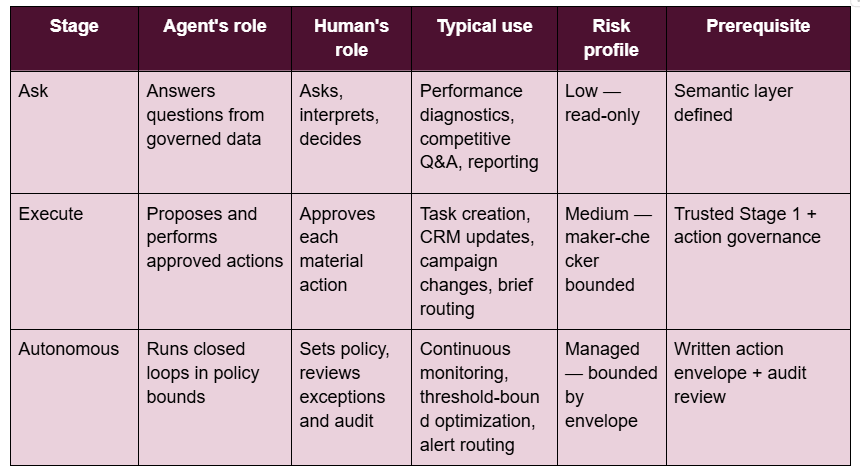
Marketing organizations adopt AI CMO agents in three stages: Ask (conversational analytics on governed data), Execute (the agent takes actions under human approval), and Autonomous (the agent runs continuous loops within a policy envelope). Skipping stages is the most common cause of failed deployments.
Stage 1 — Ask
The agent answers questions against your data. No writes, no actions. Marketers query performance, diagnostics, competitive position, and forecasts in plain language and get answers grounded in the semantic layer.
This stage looks modest and is not. It is where you discover that three teams define "active customer" differently, that a quarter of your campaigns have no attribution parameters, and that your channel taxonomy has drifted. Fixing that is the prerequisite for everything after it.
You're ready when: you have a warehouse or connected sources, and someone will own metric definitions.
Stage 2 — Execute
The agent proposes actions and executes approved ones. Create the follow-up task. Update the campaign record. Generate the reallocation request. Draft the brief and route it. Every write passes maker-checker.
This is where measurable operating leverage appears, because the gap between insight and action is where most marketing organizations lose their week. An insight that arrives on Tuesday and gets actioned the following Monday has decayed.
You're ready when: Stage 1 answers are trusted enough that people stop double-checking them in spreadsheets.
Stage 3 — Autonomous
The agent runs continuous loops inside a defined envelope: monitor, detect, decide, act, verify — without a human in each cycle. Autonomy is scoped by blast radius, not by confidence. Reallocating spend within a channel under a set threshold can be autonomous. Changing brand positioning cannot.
You're ready when: your action envelope is written down, your thresholds are agreed, and your audit trail has survived a real review.
How to tell which stage you're ready for
Answer these five honestly:
- Can two teams independently produce the same number for your primary acquisition metric?
- Is there a single owner for marketing metric definitions?
- Can you state, in writing, which marketing actions may happen without a human approving them?
- If an automated system changed a campaign last month, could you reconstruct why?
- Does someone act on your existing dashboards weekly?
Fewer than three yeses: start at Ask. Three or four: Ask, with Execute scoped to one team. Five: you're ready to design an autonomy envelope.
What an AI CMO Agent Can Run Today: Nine Enterprise Use Cases
1. Always-on competitive and pricing intelligence
The agent continuously monitors competitor pricing, MRP and discount movement, offer structures, availability, and ratings across marketplaces and owned channels, then answers leadership questions directly instead of producing another dashboard. Replaces the manual portal-checking that most category teams still do weekly.
2. Cross-channel budget allocation
The agent compares efficiency across channels using consistent definitions, identifies where marginal spend is underperforming, and proposes reallocations with the supporting analysis attached. In Execute stage, the reallocation is drafted and routed for approval rather than debated in a meeting three weeks later.
3. Campaign performance diagnostics
When a campaign underperforms, the agent decomposes the drop across creative, audience, bid strategy, landing experience, and competitive movement, and returns a root-cause explanation rather than a chart. The value is in the explanation, not the detection — most teams already know something is wrong.
4. Brand and creative insight synthesis
The agent unifies creative signals, performance data, and audience research into narrative insights — themes, what's working, what to test next — instead of leaving a strategist to reconcile five sources manually before every planning cycle.
5. Funnel and lifecycle analytics
For businesses with multi-step journeys — enrolment to activation to renewal — the agent tracks conversion at each stage, isolates where drop-off is worsening, and connects it to upstream channel or offer changes.
6. Executive and board reporting
The agent generates recurring leadership packs on schedule, with narrative explanations of what changed and why, drawn from the same governed definitions used everywhere else. The reconciliation cycle that normally consumes the last week of the month disappears.
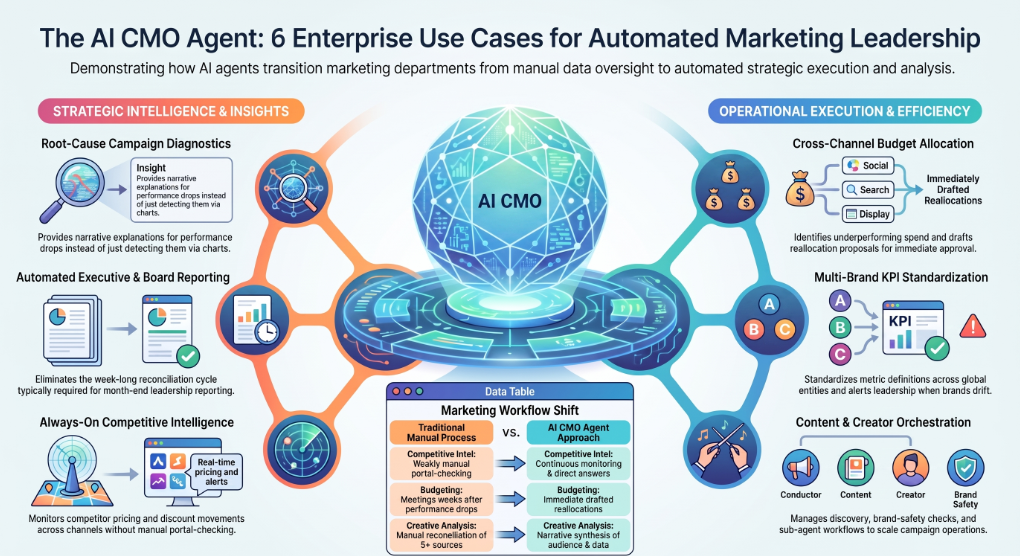
7. Multi-brand and multi-region KPI standardization
For groups running many brands or entities, the agent standardizes metric definitions across the portfolio and produces comparable views, plus automated alerts when a specific entity drifts. This is one of the highest-value use cases and one of the least served by point tools.
8. Creator and influencer campaign operations
The agent handles creator discovery and enrichment, campaign workflow orchestration, content KPI monitoring, and brand-safety checks — the operational load that scales linearly with campaign count.
9. Content and social execution orchestration
The AI CMO agent coordinates rather than writes. It dispatches briefs to content and social sub-agents, holds brand context, and checks output against guidelines. For the execution layer specifically, see our guides to the social media manager AI agent and automating content creation with AI. For the research layer, see AI agent for market research.
Proof: What AI CMO Agents Have Delivered in Production
The following are anonymized deployments, described by industry, geography, and scale only.
A major Indian HVAC and consumer-durables manufacturer competing in highly price-sensitive categories deployed continuous e-commerce monitoring across pricing, MRP and discount movement, offers, availability, and ratings, with agentic Q&A mapped directly to the questions leadership asks. Manual portal checks were replaced by always-on monitoring; the team gained faster competitive response cycles and earlier identification of pricing gaps and promotional shifts. The architecture was built to scale from proof of concept to production with governance and audit trails intact.
A US brand insights and creative execution studio deployed multi-source ingestion across creative, performance, and audience signals, with insight agents producing themes, narratives, and recommendations, plus reporting packs for leadership. The outcome was faster creative strategy cycles, deeper signal synthesis across channels, and clearer direction on what to do next for each campaign.
An Australian creator-economy platform connecting brands and creators deployed creator discovery enrichment, campaign workflow automation, content KPI monitoring, and brand-safety checks, alongside analytics for campaign ROI and engagement. Manual campaign operations dropped, performance visibility arrived faster, and learnings became consistent across brand programs.
A UAE family business group of more than 30 companies spanning retail, building, industrial, and services portfolios deployed group-wide KPI standardization with automated alerts on purchase price trends, gross margin impact, early-payment analysis, and vendor performance, plus scheduled insight packs for leadership. The group gained standardized intelligence across entities, earlier detection of margin erosion and vendor slippage, and fewer variance surprises.
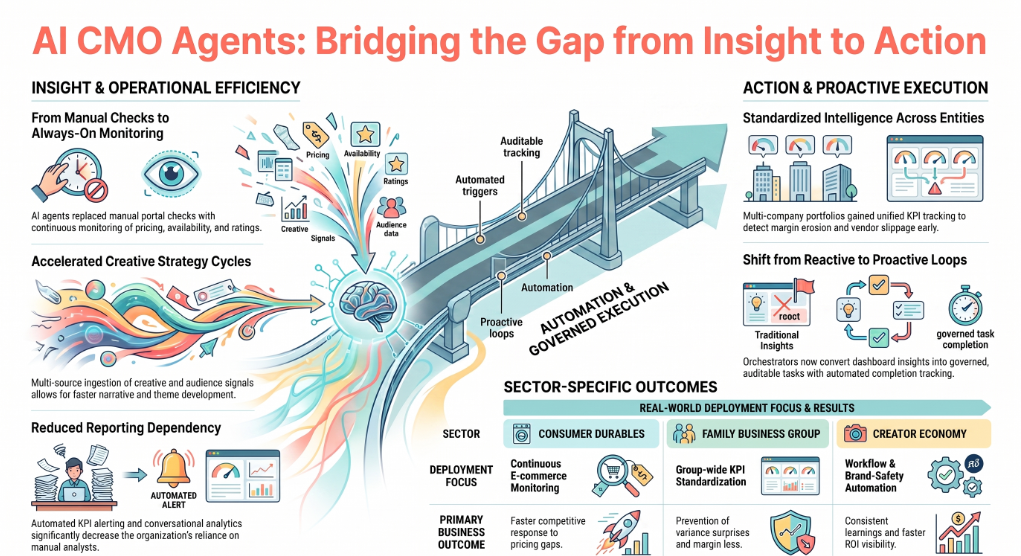
A high-volume UK e-commerce distributor deployed an AI data analytics agent across sales, products, inventory, promotions, and customer behavior, with conversational analytics and automated KPI exception alerting. Analysis cycles shortened, visibility into product and promotional performance improved, and reporting dependency on analysts dropped.
A privately-held retail holding group needed governed, cross-functional intelligence across systems and documents. The deployment layered a unified context engine over structured and unstructured data, a semantic governance layer holding rules, hierarchies, and formulas, and an active orchestrator that converts dashboard insight into governed, auditable tasks. The organization shifted from reactive reporting to proactive execution loops, with standardized decision logic across teams and automated task creation and completion tracking.
That last one is the clearest illustration of the whole category: the insight was never the constraint. The path from insight to a governed, tracked action was.
Why Assistents.ai Is the Enterprise AI CMO Agent Stack
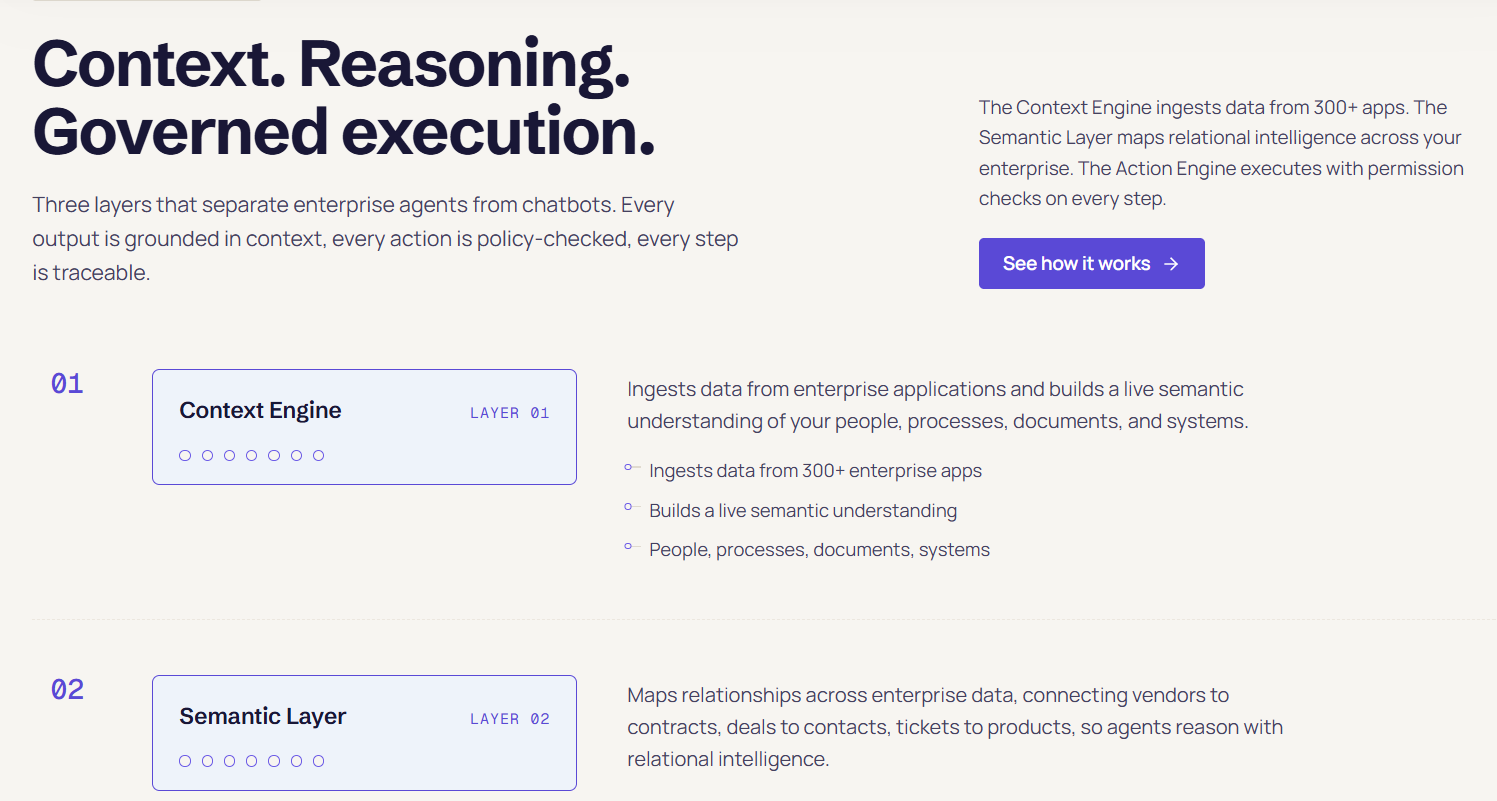
Assistents.ai is a governed enterprise agentic AI platform. It was built for the exact problem an AI CMO agent creates: giving an AI system access to real business data and real actions, without giving up control of either.
Grounded answers, not confident guesses
Assistents.ai runs a Context Engine across structured and unstructured sources and a semantic layer that holds your metric definitions, hierarchies, and business rules. Analytical answers are produced through text-to-SQL against your own warehouse — the number in the answer came out of your database, and the query that produced it is inspectable. This is the difference between a system a CFO will accept and a system marketing quietly stops citing.
Insight to action, under approval
Every write path runs through maker-checker / human-in-the-loop approval. The agent proposes, a named human confirms, and the server re-validates before anything executes. Agents can create tasks, update records, and trigger workflows — but never with unilateral authority. This is what makes Execute stage deployable in a regulated or board-scrutinized environment.
Governance that survives a board question
Row-level security and attribute-based access control ensure each user's agent sees only what that user is entitled to see, enforced at query level rather than filtered after the fact. An immutable audit trail records every question, query, proposal, approval, and execution. When someone asks what the system saw and who authorized the action, there is an answer.
Model-agnostic, with your keys
Assistents.ai routes across model providers rather than locking to one, and supports BYOK so inference runs on your own provider keys. Model choice becomes a per-workload decision — cost, latency, or reasoning depth — instead of a platform constraint you inherit for years.
Built for multi-agent work, not single bots
The platform supports multi-agent orchestration with MCP and A2A protocol support, so specialist agents can call tools and hand work to each other across systems without bespoke integration for every pair.
Connects to the warehouse you already have
Built connectors include Postgres, MSSQL, BigQuery, ClickHouse, Athena, and DuckDB. The agent reads from your existing data estate. There is no migration project standing between you and the first useful answer.
How to Govern an Autonomous Marketing Agent
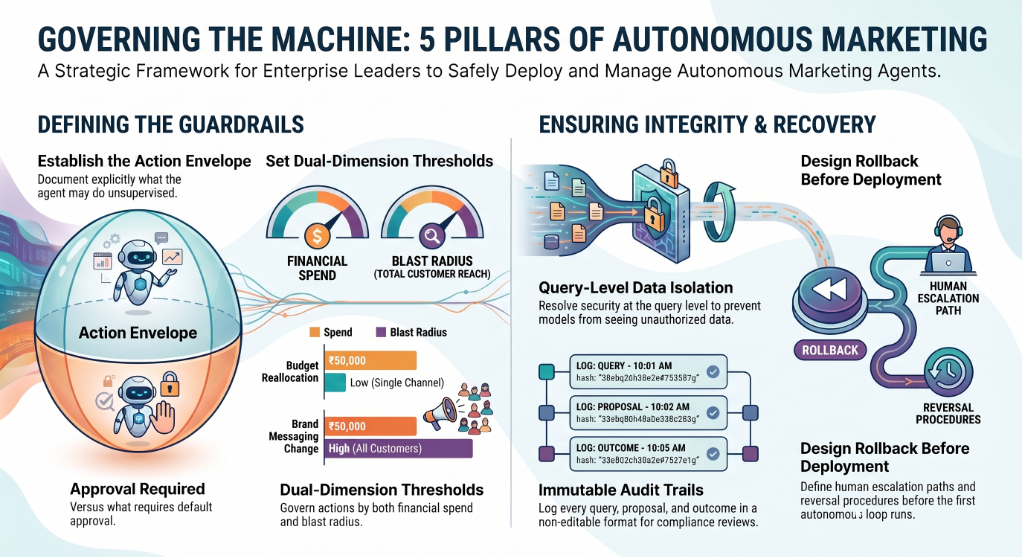
Governing an autonomous marketing agent means defining what it may do without asking, setting approval thresholds by spend and blast radius, enforcing data boundaries at the query level, logging every decision immutably, and designing escalation and rollback before deployment — not after an incident.
This is the section most vendors skip and most enterprise buyers care about most. Traditional role-based access controls were designed for humans clicking through interfaces, not for agents that plan, create, and publish — and 2026 privacy regulation increasingly expects transparency for AI-generated decisions, which makes audit trails for agentic workflows a compliance requirement rather than a nice-to-have.
1. Define the action envelope
Write down, explicitly, what the agent may do unsupervised. Not what it can do — what it may do. Everything outside the envelope requires approval by default. If nobody has written this, you are not ready for Execute stage regardless of what the technology supports.
2. Set thresholds by spend and by blast radius
Two independent dimensions. A ₹50,000 reallocation inside one channel is low blast radius. A ₹50,000 change to brand messaging that ships to every customer is not. Set thresholds on both, and make the stricter one govern.
3. Enforce data boundaries at query level
Row-level security and attribute-based access control must resolve before the query runs. Filtering results after retrieval is not data isolation — it means the model has already seen data the user is not entitled to.
4. Keep an immutable audit trail
Log the question, the resolved metrics, the query executed, the proposal, the approver, the timestamp, and the outcome. Immutable means no post-hoc editing. This is your evidence in a compliance review and your debugging tool when an action was wrong.
5. Design escalation and rollback first
Every autonomous loop needs a defined failure path: what triggers escalation to a human, who receives it, and how an executed action is reversed. Design this before the first autonomous workflow, not after the first bad one.
The ten-point governance checklist
- The action envelope is documented and approved by marketing and legal.
- Approval thresholds are set on both spend and blast radius.
- Row-level security is enforced at query level for every data source.
- Attribute-based access control resolves from user role, region, and entity.
- All write paths pass maker-checker with a named human approver.
- The audit trail is immutable and retained per your policy.
- Every analytical answer exposes the query that produced it.
- Metric definitions have a single named owner.
- Escalation paths and rollback procedures are documented and tested.
- Model provider, key ownership, and data residency are explicitly agreed.
AI CMO Agent vs. Human CMO: What Doesn't Transfer
An AI CMO agent cannot replace a human CMO because the parts of the role that determine success — positioning judgment, cultural intuition, organizational alignment, and accountability — are precisely the parts that don't reduce to data operations.
Brand positioning judgment. An agent can tell you which message performed best among the ones you tested. It cannot tell you which message you should have tested, or when a category is about to shift and your positioning needs to move before the data says so. Positioning is a bet on a future state, and the data describes the past.
Cultural intuition. Knowing that a campaign will land wrong in a specific market, at a specific moment, for reasons no dataset encodes — that is a human judgment, and getting it wrong is expensive in ways no efficiency gain offsets.
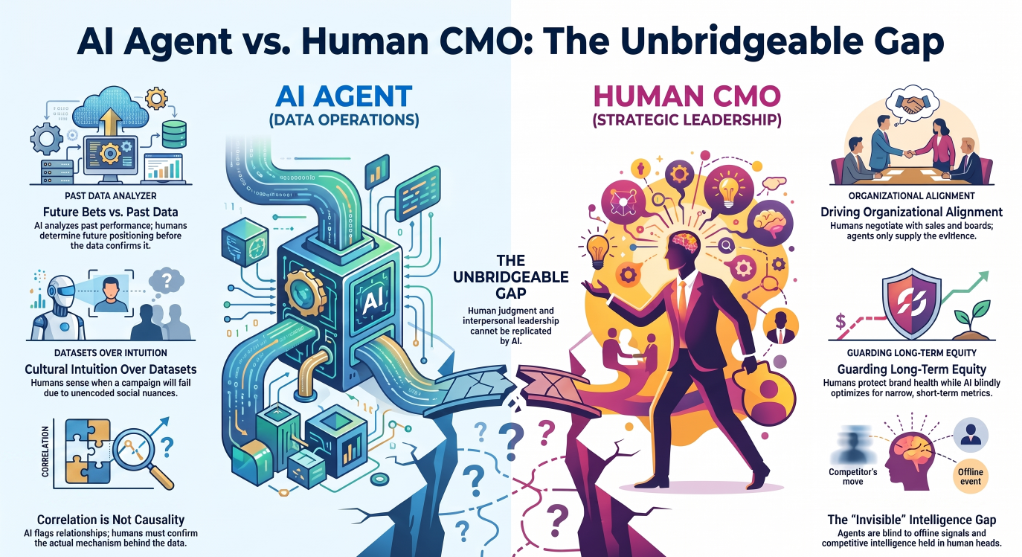
Organizational alignment. Much of a CMO's actual job is negotiating with sales, aligning with product, managing agencies, and building board confidence. An agent supplies evidence for those conversations. It does not have them.
Causal reasoning. Agents surface correlations. Distinguishing correlation from causation requires knowing what else happened — a pricing change, a competitor's exit, a supply constraint, a seasonal artifact. Assume every agent-flagged relationship is a hypothesis until a human confirms the mechanism.
Ethical and long-term trade-offs. An agent optimizes the objective it is given. Told to minimize cost per lead, it will find ways to do that which damage lead quality or brand equity. Only a human decides what should be optimized and what should be protected.
Anything outside its data. Offline conversations, unrecorded customer signals, competitive intelligence that lives in a salesperson's head — the agent doesn't know it exists and won't flag its absence.
How to Evaluate an AI CMO Agent: Eight Buyer Criteria
Evaluate an AI CMO agent on grounding, action governance, data isolation, auditability, model flexibility, connector depth, interoperability, and deployment model — in that order. Connector count and demo polish are the two weakest signals on the market.
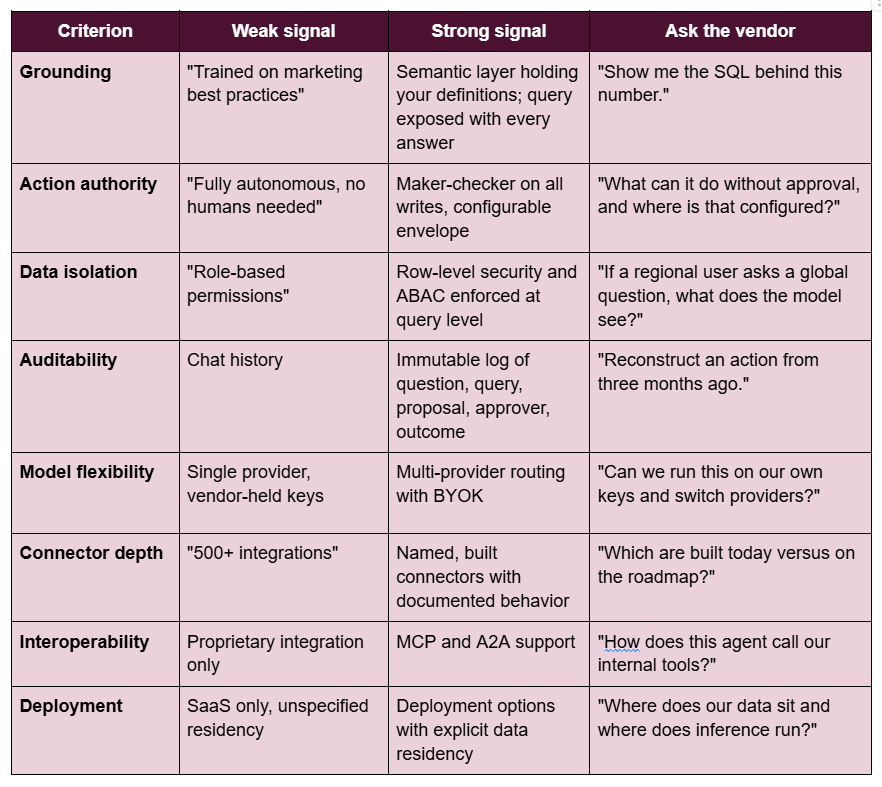
One question cuts through most sales conversations: ask the vendor to show a wrong answer. Systems that ground properly can show you where a query returned an unexpected result and how the semantic layer resolved it. Systems that don't will change the subject.
Why Assistents.ai vs. Point AI Marketing Tools and Suite Agents
Most enterprise marketing teams evaluating an AI CMO agent are actually choosing between four options. Here is how they differ on the dimensions that determine whether the deployment reaches production.
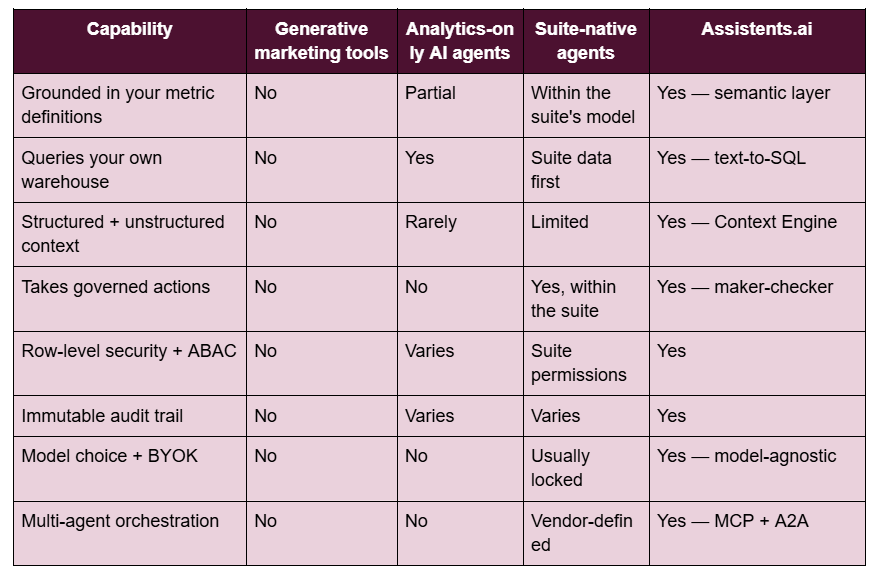
Vs. generative marketing tools
One prompt, one asset, no memory of your business and no ability to act. Useful for production velocity. Not a decision system. The moment you ask "should we shift budget," you're outside their scope.
Vs. analytics-only AI agents
Genuinely useful, and a legitimate Stage 1 answer. But they stop at the recommendation. The organizational bottleneck in most marketing teams is not the absence of insight — it is the four-day lag between insight and someone doing something about it. Assistents.ai closes that with a governed action layer rather than a better chart.
Vs. suite-native agents
Strong inside their own ecosystem, and a reasonable choice if your marketing data genuinely lives in one suite. Most enterprises' doesn't. Suite agents see the suite's data model best, are typically bound to one model provider, and make your agent strategy a function of your CRM vendor's roadmap. Assistents.ai is deliberately model-agnostic and warehouse-first, which keeps the agent layer independent of the systems it reads.
Vs. building it yourself
Building the reasoning layer is a few weeks. Building the semantic layer, RLS enforcement, ABAC, maker-checker workflows, immutable audit, multi-provider routing, and connector maintenance is 12 to 18 months, and it is the part nobody budgets for because it isn't visible in the demo. Teams that build usually reach a working prototype quickly and then spend a year making it safe enough to deploy.
Deploying an AI CMO Agent: A 90-Day Rollout
Days 1–15: Define the decisions, not the tools
List the ten recurring decisions your marketing organization makes badly or slowly — budget shifts, promo response, channel expansion, creative kills. For each, note what data it needs and who currently makes it. This list is your specification. Skipping it produces a well-integrated system nobody uses.
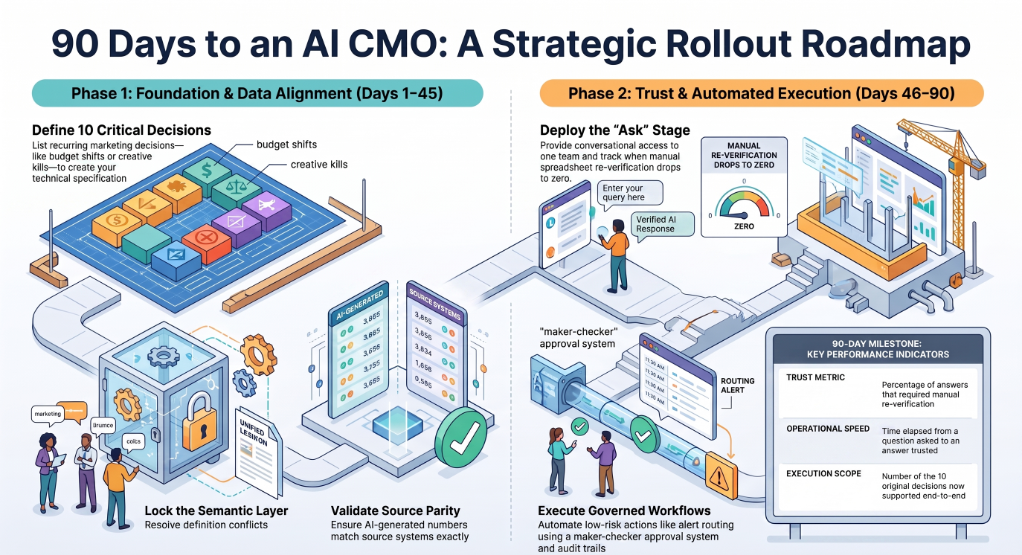
Also assign an owner for metric definitions. One person, named.
Days 16–45: Connect data and lock the semantic layer
Connect the sources supporting the ten decisions — not everything you have. Then do the hard part: agree the definitions. Expect disagreement between marketing, finance, and sales. Resolve it in writing.
Validate parity: the numbers the agent returns must match the numbers in each source system. Do not proceed until they do.
Days 46–70: Ask stage in production, one team
Give one marketing team conversational access against governed data. Track which questions get asked, which answers get acted on, and where people still open a spreadsheet to check. That last signal is the trust metric — when it drops to near zero, Stage 1 has succeeded.
Days 71–90: First governed Execute workflows
Pick two or three low-blast-radius actions from your decision list — task creation, record updates, alert routing. Configure maker-checker. Run them with approval on every action. Review the audit trail deliberately, not just when something breaks.
What to measure at day 90
- Time from question asked to answer trusted
- Percentage of answers where someone re-verified manually
- Number of decisions from the original ten now supported end to end
- Time from insight surfaced to action executed
- Audit completeness on a sample of executed actions
Note that none of these are model quality metrics. At 90 days, the model is rarely the constraint.
AI CMO Agent Cost and ROI
AI CMO agent cost has three components: a platform fee, consumption-based inference and query cost, and implementation. The variable that most affects total cost is not model pricing — it is the state of your data.
Platform. Typically an annual fee scaled by users, connected sources, and governance requirements.
Consumption. Inference and query volume. This is why BYOK and model-agnostic routing matter commercially, not just architecturally: routing routine classification to a smaller model and reserving frontier models for complex reasoning changes the run-rate materially, and holding your own provider keys means you buy inference at your own rate.
Implementation. Connector setup, semantic layer definition, governance configuration, and enablement. Organizations with a clean warehouse and agreed definitions land at the low end. Organizations with fragmented sources and contested definitions land higher — and the gap is almost entirely semantic layer work.
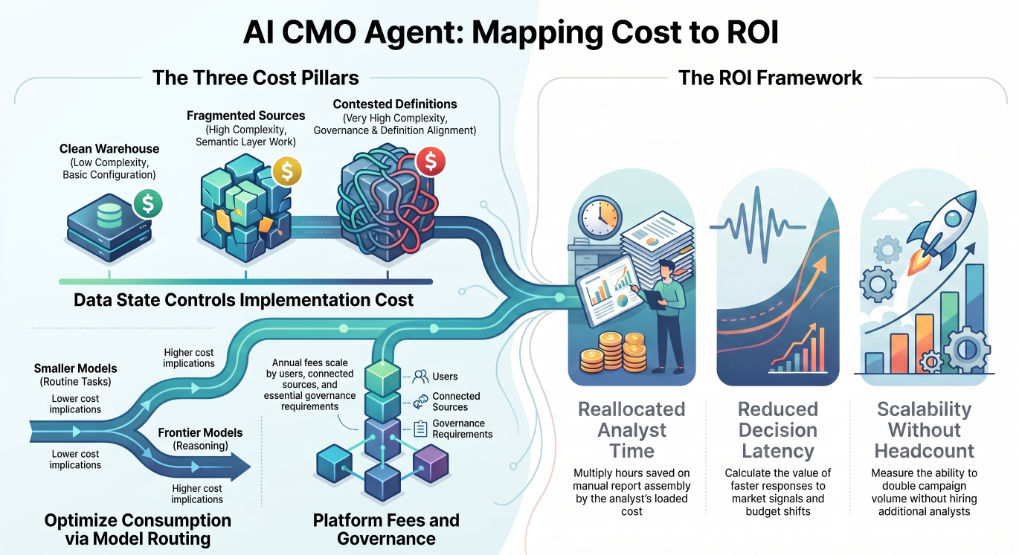
Building the ROI case. Avoid vendor efficiency percentages; they don't survive contact with your finance team. Build it from three lines instead:
- Analyst time reallocated. Hours per week currently spent assembling reports rather than analyzing them, multiplied by loaded cost.
- Decision latency reduced. For your top three recurring decisions, the cost of the current lag — a promo response that lands a week late, a budget shift that happens a month after the signal.
- Avoided headcount at scale. Not headcount cut. The analyst you don't need to hire when campaign volume doubles.
The honest fourth line is a cost, not a benefit: governance setup and definition work are real effort. Budget for them explicitly, because they are the work that determines whether anything else pays back.
For the equivalent pattern applied to finance leadership, see our guide to AI solutions for CFOs.
Deploy an AI CMO Agent on Governed Data
The organizations getting value from AI CMO agents in 2026 didn't start with the most capable model. They started by agreeing what their metrics mean, deciding what an agent may do without asking, and building the audit trail before they needed it.
Assistents.ai gives you the governed foundation for that: a Context Engine across structured and unstructured data, a semantic layer holding your definitions, text-to-SQL over your own warehouse, multi-agent orchestration with MCP and A2A, and maker-checker approvals, row-level security, ABAC, and an immutable audit trail on every action.
Book a working session — bring your three worst recurring marketing decisions and we'll map what a governed agent would need to support them.
FAQs
Can an AI CMO agent replace a human CMO?
No. An AI CMO agent handles analysis, monitoring, diagnostics, and governed execution. It does not set brand positioning, read cultural context, negotiate organizational alignment, or hold accountability. The realistic outcome is a marketing leader who spends materially less time assembling evidence and more time deciding with it.
What does an AI CMO agent actually do day to day?
It monitors competitive and performance signals continuously, answers analytical questions in plain language against governed data, explains why metrics moved, drafts and routes recommended actions, generates recurring leadership reporting, and — at higher maturity — executes bounded actions under approval.
Is an AI CMO agent safe for enterprise data?
It is safe when four controls are in place: row-level security enforced at query level, attribute-based access control, maker-checker approval on every write, and an immutable audit trail. Without those, an AI agent with warehouse access is a data governance problem. Ask vendors to demonstrate all four, not describe them.
Do AI marketing agents hallucinate metrics?
General-purpose models will produce plausible-looking numbers. A properly grounded AI CMO agent does not generate figures — it generates a query, runs it against your warehouse through a semantic layer holding your definitions, and returns the result with the query visible. If a system cannot show you the query, treat its numbers as drafts.
How is an AI CMO agent different from marketing automation?
Marketing automation executes workflows you configured in advance; it follows rules. An AI CMO agent reasons across channels, decides what matters, and proposes or takes actions that were not pre-scripted. Most organizations need both — automation for the tactical layer, an agent above it for the decision layer.
How long does implementation take?
A structured rollout reaches conversational analytics in production in roughly 60 days and first governed actions by 90. Organizations with a clean warehouse and agreed metric definitions move faster. The variable is almost always definitional agreement, not technical integration.
Can an AI CMO agent act without human approval?
It should only do so inside an explicitly defined action envelope with thresholds set on both spend and blast radius. In Assistents.ai, write paths default to maker-checker: the agent proposes, a named human confirms, and the server re-validates before execution.
What data does an AI CMO agent need?
Structured sources (ad platforms, CRM, web analytics, order and revenue data, warehouse) and unstructured ones (brand guidelines, briefs, competitor content, category research). More important than breadth is that the sources supporting your top decisions are connected and that their metrics resolve to one agreed definition.
How much does an AI CMO agent cost?
Cost combines a platform fee, consumption-based inference and query charges, and implementation. Data readiness is the largest driver of total cost. Model-agnostic routing and BYOK reduce ongoing consumption cost by letting you match model tier to workload and buy inference at your own rate.
Can it work across multiple brands or regions?
Yes, and this is one of the highest-value applications. The agent standardizes metric definitions across entities, produces comparable views, and alerts when a specific brand or region drifts — with attribute-based access control ensuring each entity's users see only their own data.
How is it different from a BI tool?
BI tools require you to know the question and build the query. An AI CMO agent surfaces findings proactively, explains cause, and — critically — can act on the finding. Many organizations run both: BI for standardized reporting, the agent for exploratory analysis and execution.
Should we build or buy?
The reasoning layer is straightforward to build. The governance layer — semantic definitions, RLS, ABAC, maker-checker, immutable audit, multi-provider routing, connector maintenance — is 12 to 18 months of work that doesn't appear in a prototype. Build if governed agent infrastructure is your core product. Otherwise buy the platform and invest your effort in the semantic layer, which is genuinely proprietary to you.