To Summarize
- Operations is where AI economics work best, because operational work combines high volume, high repetition and an outcome that is already measured.
- The dividing line in 2026 is action, not intelligence. A model that predicts a stockout is useful. An agent that opens a replenishment case, checks policy, creates the transfer and verifies shelf availability is a different category of software.
- Most production operations AI sits between Level 1 and Level 3 on the autonomy ladder. Level 4 is achievable in narrow, well-instrumented processes. Level 5 is directional. Any vendor claiming otherwise is describing a demo.
- The blocker is rarely the model. It is write access, permission-aware context, deterministic policy and an audit trail — the things that let an agent act on a live system without becoming unmanaged risk.
- Start with a scored use case, not an interesting one. The VALUE Score in this guide gives you a defensible way to choose the first deployment.
Why operations is where AI finally pays for itself
Most enterprise AI budgets have been spent in places where value is hard to prove. Marketing content, code assistance and general-purpose copilots produce real productivity, but the improvement is diffuse and rarely lands in a line on the P&L.
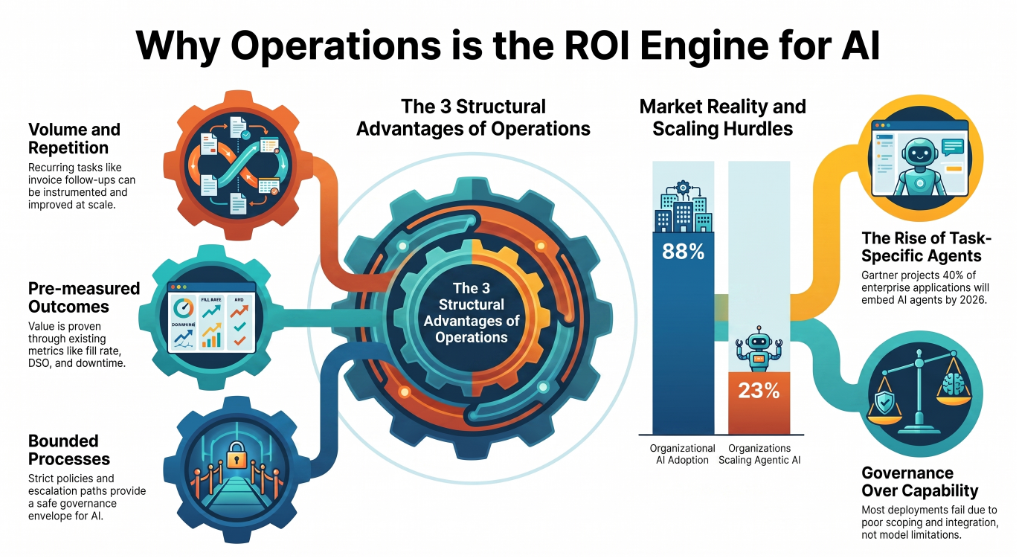
Operations is different, for three structural reasons.
Volume and repetition. Operational work recurs. A replenishment decision, an overdue-invoice follow-up, a tender document intake, a tenant query, a grid anomaly — these happen hundreds or thousands of times a week in the same shape. Anything that recurs in the same shape can be instrumented, and anything instrumented can be improved.
The outcome is already measured. Operations teams already track fill rate, DSO, cycle time, exception rate, SLA adherence and downtime. You do not need to invent a metric to prove value. You need to move one that leadership already watches.
The work is bounded. Operational processes have policies, thresholds and escalation paths. That structure — which makes operations feel bureaucratic to the people inside it — is exactly what makes it safe to delegate to software with a governed authority envelope.
The market data supports the shift while cautioning against the hype. Stanford HAI's 2026 AI Index reports organisational AI adoption at 88%. But McKinsey's November 2025 survey of 1,993 respondents found only 23% of organisations actually scaling an agentic AI system, with 39% still experimenting. Gartner has separately projected that 40% of enterprise applications will embed task-specific AI agents by the end of 2026, up from under 5% in 2025 — while also warning that a large share of agentic projects will be cancelled before 2027 because they were driven by hype rather than a bounded operating problem.
Both things are true. The technology works. Most deployments fail on scoping, governance and integration — not on model capability.
This article is about the deployments that did not fail.
What "AI in operations" actually means in 2026
Ask ten operations leaders what AI in operations management means and you will get three different answers, because the term has carried three different meanings in under a decade.
The three eras
Era one — predictive AI (roughly 2015–2021). Machine learning applied to operational data. Demand forecasting, predictive maintenance, anomaly detection, computer-vision quality control. Genuinely valuable, still valuable, and still what most articles on this topic describe. The limitation: it produced a number, and a human had to do everything after the number.
Era two — copilots (roughly 2022–2024). Large language models made operational knowledge conversational. Ask a question about inventory, get an answer. Summarise a case. Draft a supplier email. Useful, and the adoption was fast because the risk was near zero. The limitation: the human still performed every action.
Era three — agentic operations (2025 onward). Software that holds a durable work item, gathers its own context, selects tools, decides within an authority envelope, executes against a system of record, and reports whether the intended outcome occurred. The human moves from performing the work to supervising it and handling exceptions.
The dividing line: does it recommend, or does it act?
This is the only classification that matters when you evaluate an AI use case in operations.
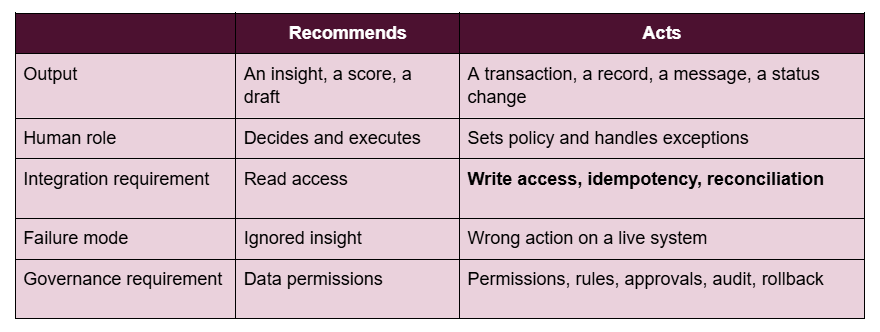
Almost every "AI in operations" article you will read stops on the left-hand column. Almost every operations leader's actual question lives in the right-hand one.
Where classic ML still wins
Being fair about this builds better systems. Agentic architectures are not universally superior.
- Time-series forecasting — demand, load, consumption. A well-tuned statistical or ML model beats a language model, and always will.
- High-volume visual inspection — defect detection on a line. Purpose-built computer vision, not a general model.
- Anomaly detection over dense telemetry — grid sensors, equipment vibration, network events. Classical methods, cheaper and faster.
The right architecture uses these as services inside a workflow rather than as the product. The forecast is an input to the replenishment case, not the deliverable. That distinction is the whole argument of this article.
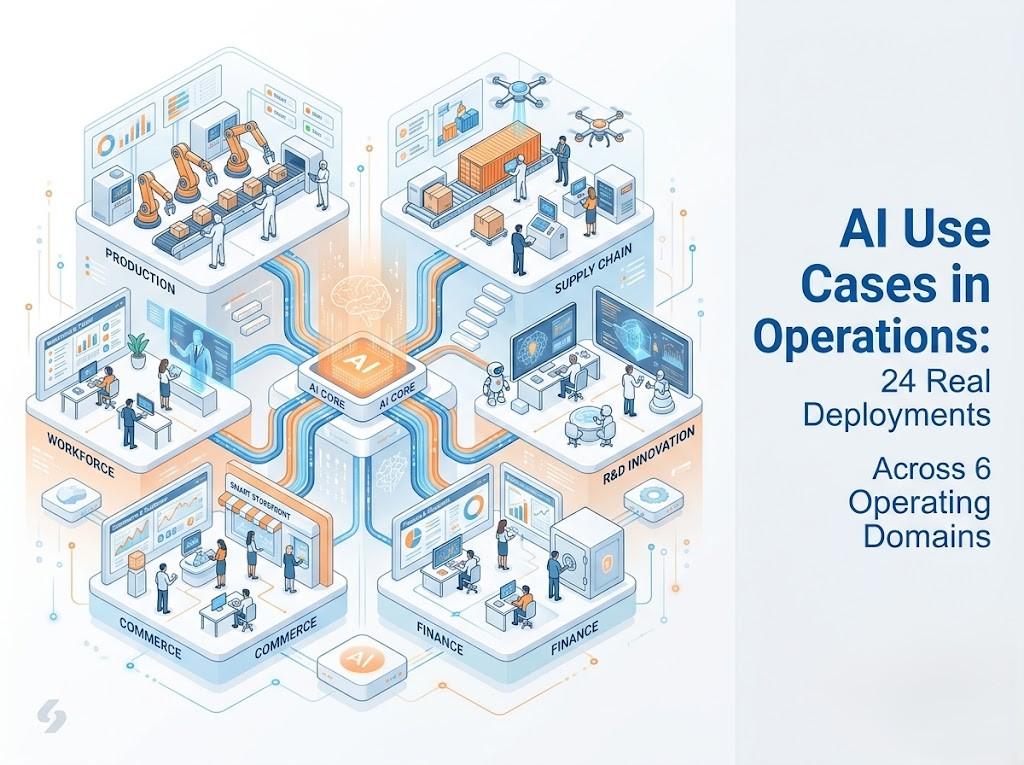
The Operations Agency Map: six domains where AI runs operational work
"Operations" is used so loosely that it obscures the actual opportunity. Manufacturing operations, supply chain, service operations, back-office processing and IT operations have different work objects, different systems of record and different risk profiles. Treating them as one category is why so many AI programmes pick the wrong first use case.
The Operations Agency Map separates operational work into six domains, plus one adjacent domain.
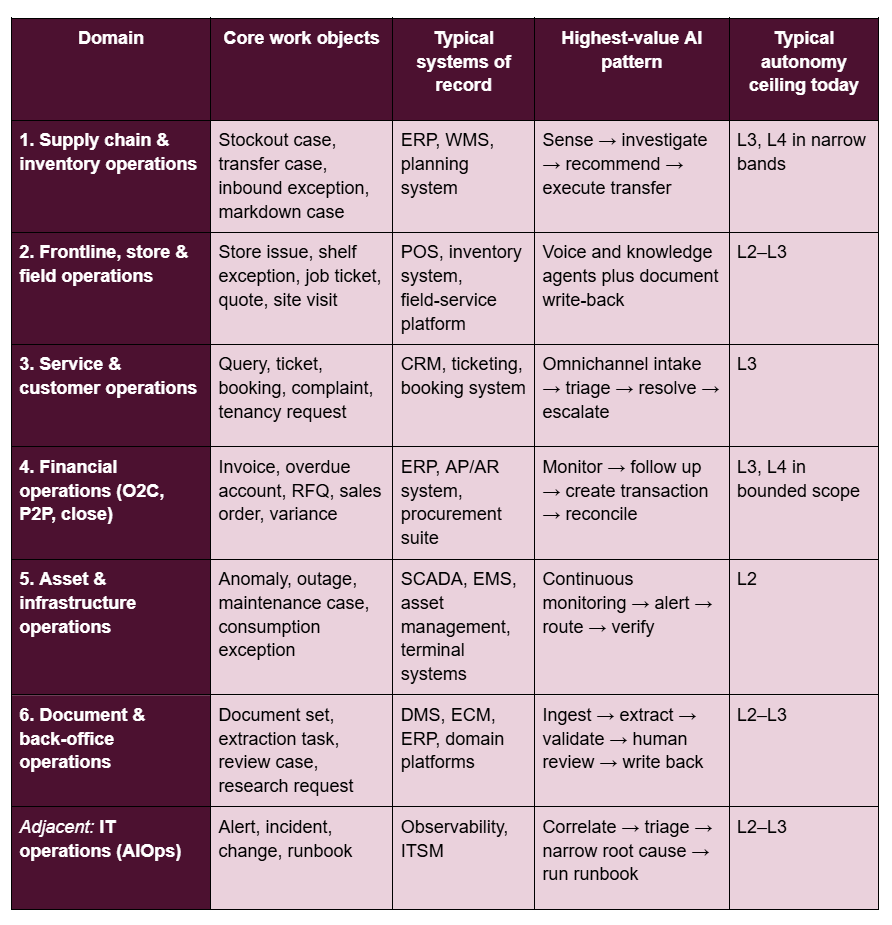
Two things fall out of this map immediately.
First, the systems of record differ, and that determines feasibility more than the use case does. A replenishment agent is straightforward when the ERP exposes a documented, writable transfer interface, and near-impossible when it does not. Feasibility is an integration question wearing an AI costume.
Second, the risk profile differs by domain. A wrong answer from a store knowledge agent is an inconvenience. A wrong sales order in an ERP is a financial event. The governance you need is a function of the domain, not of the model.
The Operations Autonomy Ladder (L0–L5)
Autonomy is not a switch. It is a contract across several dimensions: which agent, which work type, which business scope, which capability, which affected object, what monetary or operational limit, what time window, what risk class, what evidence is required, and what approval policy applies.
Compressing that into a single ladder gives operations teams a shared vocabulary for what they are actually buying.
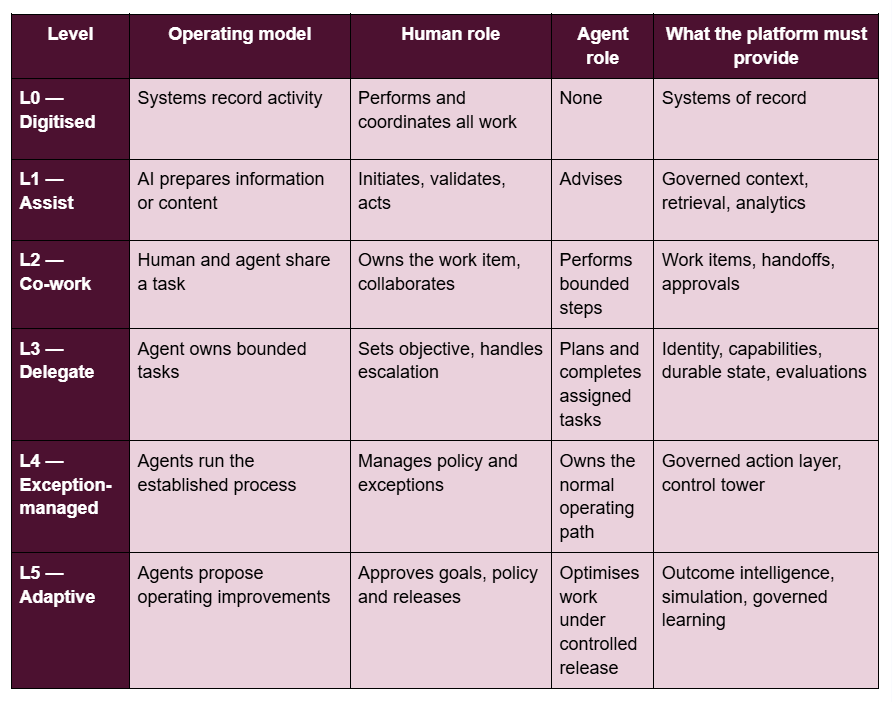
An honest position, because it matters for how you plan:
Most production operations AI today sits at L1 to L3. L4 is genuinely achievable in narrow, well-instrumented processes where the policy is explicit and the blast radius is contained — order creation from validated triggers, standard overdue follow-up inside defined thresholds, transfer execution under an approved policy. L5 is directional. It describes where the category is heading, not what is shipping.
The practical consequence: do not design your business case around L4 and then discover that your first six months are L2 work. Plan the ladder deliberately. Value accrues at every rung.
24 AI use cases in operations, by domain
Each use case below is described the same way: what it does, what triggers it, which systems it touches, its autonomy level, evidence from a real deployment, and the outcome observed. Deployments are described by industry, geography and scale — no client names.
Supply chain and inventory operations
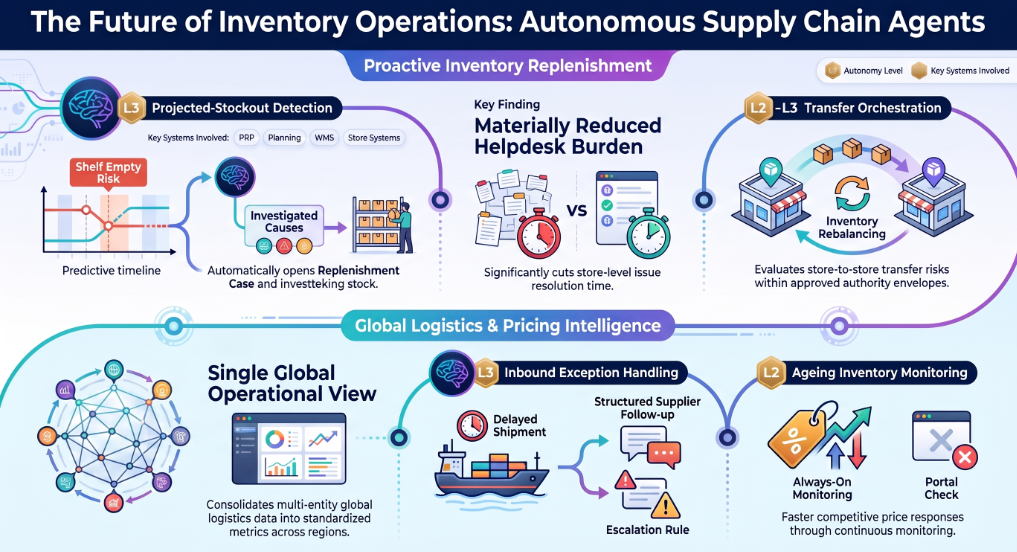
Projected-stockout detection and replenishment case creation — L3
Continuously reads POS, inventory and inbound-shipment signals to project stockouts before the shelf empties, then opens a replenishment case with the cause already investigated rather than an alert for a human to interpret. Trigger: projected cover falls below policy threshold for an SKU–location pair. Systems: POS, inventory management, ERP, planning. Deployment evidence: a national value retailer in India operating 700+ stores across hundreds of cities, spanning apparel, general merchandise and FMCG. Store-level inventory visibility and store-support workflows were rebuilt around agents rather than helpdesk tickets. Outcome: improved store-level inventory visibility and materially reduced manual helpdesk burden for store issue resolution.
Store-to-store transfer orchestration — L2 to L3
Generates transfer, expedite or no-action alternatives for a projected shortage, evaluates source-store risk against policy, and either recommends or executes under an approved authority envelope. Trigger: an open replenishment case with available donor inventory in the network. Systems: ERP, WMS, store systems. Autonomy note: this is the classic case where the same agent runs at L2 during the first quarter and L3 once the policy checks have been validated against historical replay.
Inbound delay exception handling and supplier follow-up — L3
Monitors inbound shipment status against promised dates, opens an exception case when an inbound slips, compiles the affected demand, and orchestrates structured supplier follow-up with escalation rules. Trigger: inbound ETA slip beyond tolerance, or a missed fill-rate commitment. Systems: ERP, supplier portals, email. Deployment evidence: a multinational logistics and warehousing group serving customers across India, the UK, Europe and the US. Analytics were consolidated across a multi-entity global footprint, producing a single operational view and standardised metrics across entities. Outcome: faster leadership reporting and issue identification, and improved consistency of operational metrics across regions.
Ageing inventory and markdown case generation — L2
Detects ageing stock and margin risk by location, assembles the markdown decision context — cover, sell-through, competitor pricing, promotion calendar — and produces a scored recommendation for a category planner. Trigger: ageing threshold breach or sell-through below plan. Systems: ERP, pricing system, POS. Deployment evidence: a major Indian HVAC and refrigeration manufacturer competing in highly price-sensitive consumer and commercial markets, where competitor pricing and promotion moves change daily. Outcome: always-on monitoring replaced manual portal checks; earlier identification of pricing gaps and promotion shifts, and faster competitive response cycles.
Frontline, store and field operations
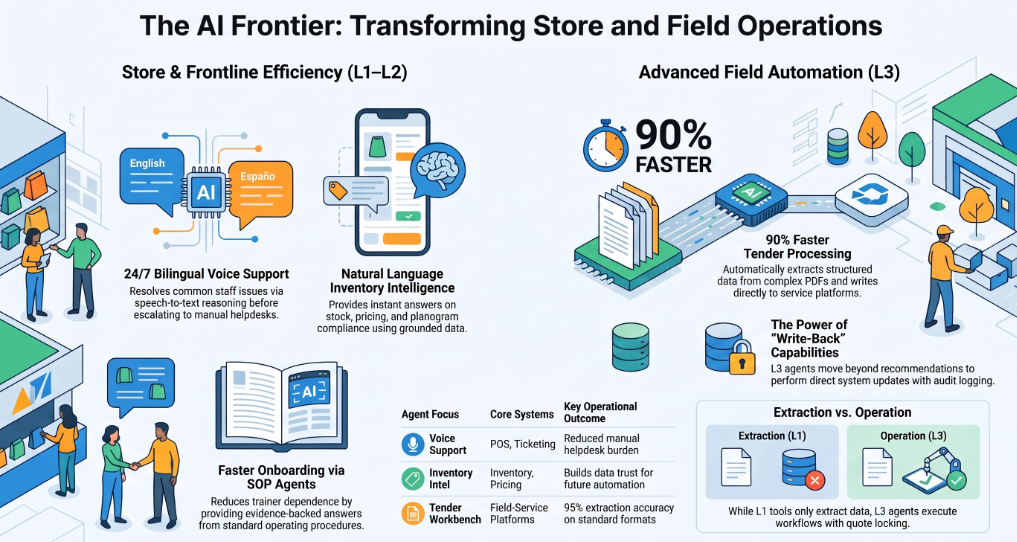
Bilingual voice support agent for frontline staff — L2
A speech-to-text → reasoning → text-to-speech agent that store or field staff call instead of raising a helpdesk ticket. It resolves the common cases directly and creates a ticket only for genuine exceptions. Trigger: an inbound call or in-app voice request from a store associate. Systems: POS, inventory, ticketing, knowledge base. Deployment evidence: the national value retailer described above deployed a voice support agent operating in Hindi and English, alongside an admin console, analytics and ticketing integration, architected for high store-level concurrency. Outcome: reduced manual helpdesk burden and faster store issue resolution.
Store inventory-intelligence agent — L1 to L2
Answers per-store questions about pricing, stock position, promotions and planogram compliance in natural language, grounded in governed data rather than a static report. Trigger: a natural-language question from store or regional management. Systems: inventory, pricing, promotion calendar. Why it matters: this is the cheapest, fastest entry point in retail operations. It requires read access only, and it builds the data trust that later write-back use cases depend on.
Knowledge and training agent over SOPs — L1
Retrieval over point-of-sale documentation, standard operating procedures and policy documents, with evidence-backed answers and citation of the source document. Trigger: onboarding, a procedural question, or a compliance check. Systems: document repositories, LMS. Outcome observed in deployment: faster onboarding through on-demand training guidance, and reduced dependence on regional trainers for routine procedural questions.
Field-service tender and quote ingestion with platform write-back — L3
A multi-agent document workbench that retrieves tender documents, determines the correct workflow, analyses revisions between document versions, extracts structured data from complex PDFs using vision-capable models, and writes the result into the field-service platform with quote locking and audit logging. Trigger: a new tender or revised tender document arriving in a monitored channel. Systems: document sources, field-service management platform (full create, read, update, delete). Deployment evidence: an Australian waterproofing diagnostics, remediation and commercial-works specialist with 20+ years in remedial building services, operating on complex commercial projects. Outcome: engineered for up to approximately 90% faster tender document processing, with an extraction accuracy target of approximately 95% on standard formats, and reduced bid risk through revision and change detection with full auditability.
This is one of the clearest examples of the recommend-versus-act distinction. Extraction alone would have been an L1 tool. The write-back into the field-service platform, with quote locking and audit logs, is what made it an operations agent.
Service and customer operations
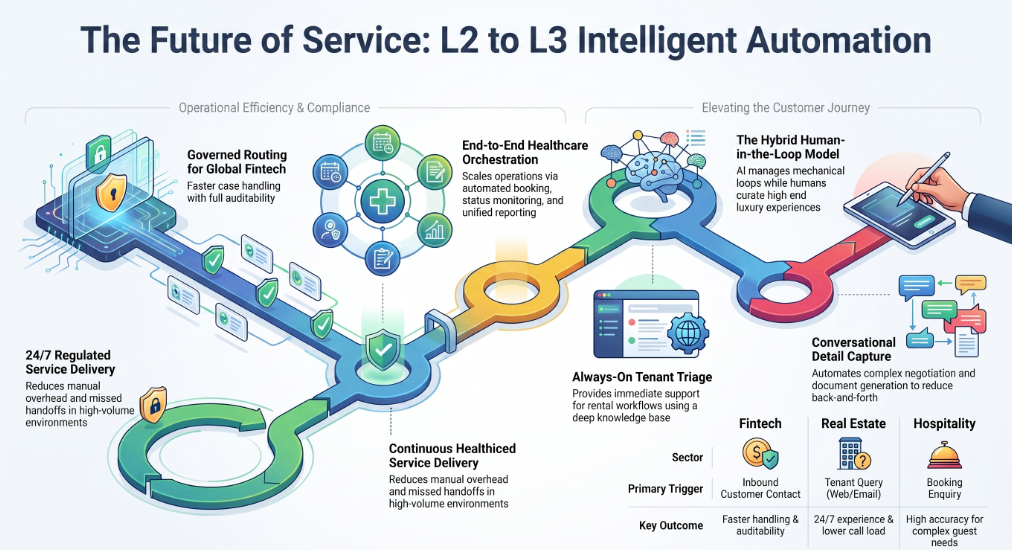
Omnichannel service agent with governed routing — L2 to L3
Intake across chat, email and phone, intent classification, workflow routing, agent-assist summarisation and next-best actions, with SLA monitoring and full auditability of the handling path. Trigger: any inbound customer contact. Systems: CRM, ticketing, core transaction systems. Deployment evidence: a global fintech providing cloud-based automation to banks and credit unions, focused on disputes, fraud and compliance operations. Outcome: faster case handling with improved consistency, reduced operational load through automation, and better compliance readiness through audit trails.
Tenant and customer query triage with escalation — L3
An always-on service agent handling tenant queries, FAQs, rental and payment support workflows, with a knowledge base built over policies, tenancy documents and SOPs, and structured escalation to human teams. Trigger: inbound query on web, messaging or email. Systems: property management system, ticketing, document repository. Deployment evidence: a major UAE real estate portfolio owner and manager with diversified office, retail, industrial and residential assets across multiple emirates. Outcome: faster response times and lower call-centre load, a consistent 24×7 tenant experience, and better SLA adherence through automated routing and tracking.
Booking-to-fulfilment orchestration — L2 to L3
Email intake with intent classification and data extraction, a conversational loop to capture missing details, real-time availability checks, alternative-date negotiation, hybrid handoff to a human specialist for the curated portion, and automated document generation. Trigger: an inbound booking enquiry. Systems: inventory and availability system, CRM, document generation. Deployment evidence: a luxury hospitality brand operating a collection of 16 boutique lodges, camps and hotels across two East African countries, serving high-expectation international travellers. Outcome: faster booking turnaround with reduced back-and-forth, higher accuracy on complex guest requirements, and scalable operations without compromising a service standard where the experience is the product.
Note the design choice: the agent runs the mechanical loop and hands the curated itinerary work to a human. That is a deliberate L2/L3 boundary, not a limitation.
Booking, processing and reporting workflow automation in regulated service delivery — L2 to L3
End-to-end orchestration of a high-volume consumer service workflow — booking, processing, status monitoring, customer notification and reporting — with operational analytics layered over it. Systems: booking platform, processing systems, notification channels. Deployment evidence: a UK private healthcare and testing provider with high-volume consumer workflows and digital service delivery requirements. Outcome: more scalable operations with reduced manual overhead, faster customer communications, fewer missed handoffs, and improved service visibility through unified reporting.
Financial operations (order-to-cash, procure-to-pay, close)
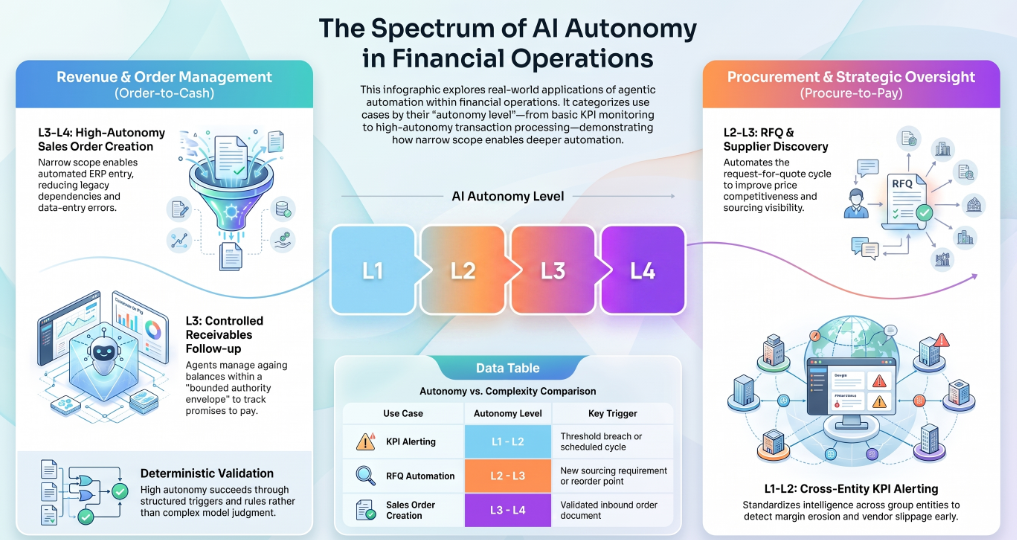
Overdue-receivables follow-up with commitment tracking — L3
Monitors ageing balances, opens a follow-up case when an invoice crosses a threshold, sends policy-compliant reminders, tracks promises to pay, and escalates on dispute, negative sentiment or low confidence. Trigger: an invoice crossing an ageing threshold, or a broken promise to pay. Systems: ERP or AP/AR system, communication channels. Autonomy contract in practice: this use case is the clearest illustration of a bounded authority envelope. A working configuration permits reading the account, sending a standard reminder and creating a follow-up task, while explicitly withholding permission to negotiate a payment plan or waive a charge — with a balance ceiling, a contact-frequency cap, an expiry date, and mandatory escalation on dispute detection, legal threat or confidence below threshold.
RFQ automation and supplier discovery — L2 to L3
Automates the request-for-quote cycle, matches suppliers against requirements, supports quality and regulatory document handling, and produces analytics on price, lead time and vendor performance. Trigger: a new sourcing requirement or a reorder point. Systems: procurement platform, supplier database, document repository. Deployment evidence: a pharmaceutical sourcing and excipients platform marketing 1,800+ rare excipients and 7,500+ SKUs, where procurement complexity comes from catalogue breadth and regulatory documentation rather than transaction volume. Outcome: faster procurement cycles and improved sourcing visibility, reduced vendor coordination and manual follow-ups, and better price and lead-time competitiveness through insight.
Automated ERP sales-order creation from validated triggers — L3 to L4
Interprets an order trigger, validates it against business rules, creates the sales order in the ERP, and produces audit logs and reconciliation reporting. Exceptions and approvals are governed by explicit rules rather than model judgement. Trigger: an inbound order document or system event meeting validation criteria. Systems: ERP (write), source channels, rules engine. Deployment evidence: a flagship UAE engineering and technology solutions provider established in 1972, delivering integrated electrical, mechanical, automation and mobility solutions. The agentic workflow was deployed as part of a transition away from an end-of-life enterprise content platform carrying high licensing cost. Outcome: reduced manual order processing and legacy dependency, a faster order-to-confirm cycle with fewer data-entry errors, and improved auditability for order creation and exceptions.
This is the highest-autonomy use case in this article, and it is instructive why it works. The trigger is structured. The validation is deterministic. The action is a single transaction type. The audit trail is complete. Narrow scope is what buys you autonomy — not model capability.
Cross-entity procurement and finance KPI alerting — L1 to L2
Standardises KPIs across group entities and issues automated alerts on purchase-price trend, gross-margin impact, early-payment analysis with notional finance cost, and vendor performance on delivery and returns. Trigger: threshold breach or scheduled insight cycle. Systems: ERP instances across entities, procurement, finance. Deployment evidence: one of the UAE's most prominent family business groups, comprising 30+ companies across retail, building, industrial and services portfolios. Outcome: earlier detection of margin erosion and vendor slippage, standardised finance and procurement intelligence across entities, and reduced variance surprises through continuous monitoring.
Asset and infrastructure operations
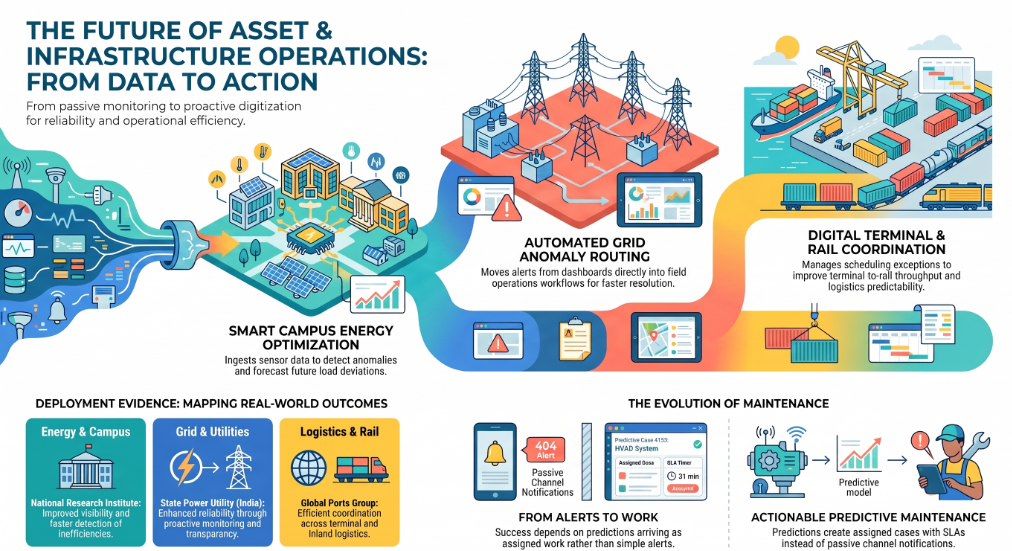
Campus and plant energy monitoring, forecasting and optimisation — L1 to L2
Ingests utility and sensor data, detects consumption anomalies, forecasts load, and issues optimisation recommendations with proactive alerting. Trigger: consumption anomaly or forecast deviation. Systems: building management, metering, EMS. Deployment evidence: a premier national research institute in astronomy and astrophysics with campus-scale operations requiring reliable infrastructure monitoring. Outcome: improved energy visibility, faster detection of inefficiencies, reduced manual monitoring effort, and more predictable operations through early alerts.
Grid and asset anomaly detection with automated operational alerting — L2
Continuous monitoring of transmission KPIs, loss and outage analytics, predictive maintenance indicators, and automated alert routing into field operations workflows rather than into a dashboard nobody watches at 2am. Trigger: anomaly, threshold breach or predicted failure indicator. Systems: SCADA and grid telemetry, asset management, field workflow. Deployment evidence: a state power transmission utility in India responsible for operating and maintaining transmission systems across the state; and separately, a city-scale smart infrastructure operator running 25+ smart city operation centres and connecting 2M+ assets and applications. Outcome: faster identification of grid exceptions and operational risks, improved reliability through proactive monitoring, and better operational transparency for leadership.
Terminal and rail operations digitisation with exception management — L2 to L3
Digitises terminal workflows, provides yard and rail operational visibility, manages scheduling exceptions, and surfaces executive dashboards with operational alerts. Trigger: schedule deviation, yard exception or throughput anomaly. Systems: terminal operating system, rail scheduling, ERP. Deployment evidence: a global ports and logistics group operating terminals and logistics services across multiple continents. Outcome: improved operational visibility and exception response, higher predictability of terminal-to-rail throughput, and more efficient coordination across terminal and inland logistics.
Predictive maintenance indicators feeding a work queue — L2
The familiar predictive maintenance use case, with the change that matters: the prediction creates a maintenance case with context attached, assigned to an owner with an SLA — rather than firing an alert into a channel. Trigger: degradation signal crossing a modelled threshold. Systems: sensor telemetry, asset management, work order system. Why the distinction matters: predictive maintenance has existed for a decade and is still under-adopted. The reason is almost never model accuracy. It is that predictions arrive as notifications rather than as work.
Document and back-office operations
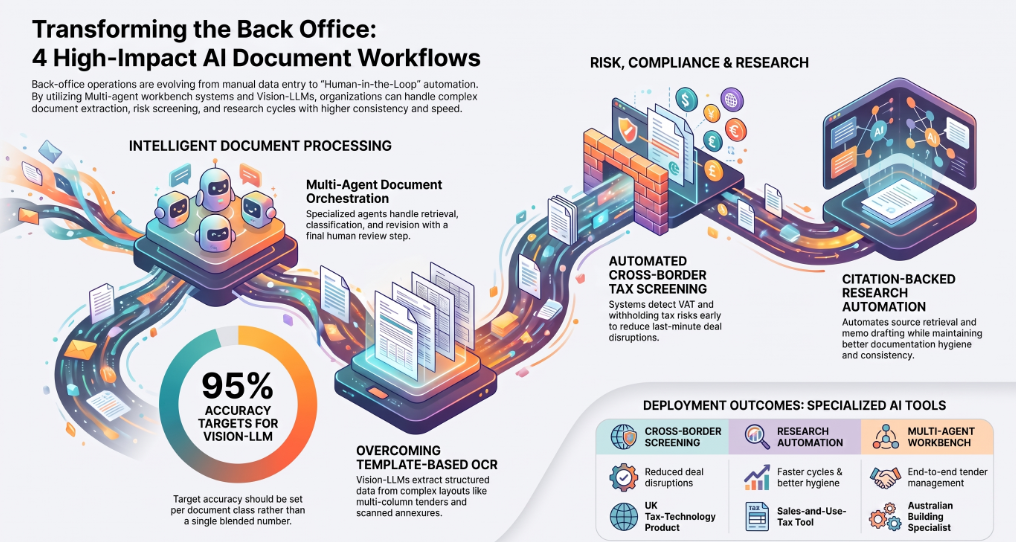
Multi-agent document workbench — L2 to L3
Orchestrates multiple specialised agents across document retrieval, classification, workflow determination and revision analysis, with a human review step before anything is committed downstream. Systems: document sources, DMS, downstream operational platform. Deployment evidence: the Australian remedial-building specialist described in use case 8, where the workbench handled complex tender documents end to end.
Vision-LLM extraction from complex PDFs with validation — L2
Extracts structured data from documents that defeat template-based OCR — multi-column tenders, scanned annexures, inconsistent tabular layouts — with validation rules and a human review queue. Systems: document ingestion, validation rules, target system. Practical note: extraction accuracy targets should always be stated per document class. An approximately 95% target on standard formats is a meaningful engineering commitment; a single blended accuracy number across all document types is not.
Cross-border transaction pre-screening with evidence notes — L2
Screens transactions for risk exposure — withholding tax, VAT mismatches, permanent establishment issues — classifies the risk, collects supporting evidence, produces explainability notes, and escalates to human specialists. Trigger: a new transaction or deal structure entering review. Systems: transaction data, tax knowledge sources, review workflow. Deployment evidence: a UK tax-technology product focused on early screening of cross-border transactions. Outcome: earlier detection of withholding and VAT risk, reduced last-minute deal disruptions, and faster, more consistent pre-compliance review.
Research and source-collection automation with citation-backed drafting — L1 to L2
Automates source retrieval and summarisation, produces draft memos or position outputs with citations, and maintains a knowledge base and workflow tracking as a by-product of the work. Trigger: a new research request or recurring research cycle. Systems: source repositories, document store, workflow. Deployment evidence: a specialised sales-and-use-tax research automation tool serving tax professionals. Outcome: faster research cycles and better documentation hygiene, reduced manual source-hunting time, and more consistent research outputs.
Adjacent: AI in IT operations (AIOps)
IT operations sits next to business operations and is often conflated with it in search results, but the economics differ enough to warrant separation.
What it covers: alert correlation and noise reduction, incident triage and enrichment, root-cause narrowing across logs and metrics, automated runbook execution, and change-risk assessment.
How it differs from business operations AI:
- Telemetry-native. The data volume is orders of magnitude higher, and it is machine-generated, structured and continuous rather than sparse and document-shaped.
- Different failure economics. An incorrect remediation in production infrastructure has a fast, visible blast radius. Business operations errors are often slower and financially shaped.
- Different systems of record. Observability platforms and ITSM tools, not ERP and WMS.
The governance principles transfer directly. The architecture does not. If your first AI initiative is AIOps, the lessons in §10 apply; the use cases in §5.1 to §5.6 do not.
Anatomy of an operations AI agent: the Seven-Step Work Loop
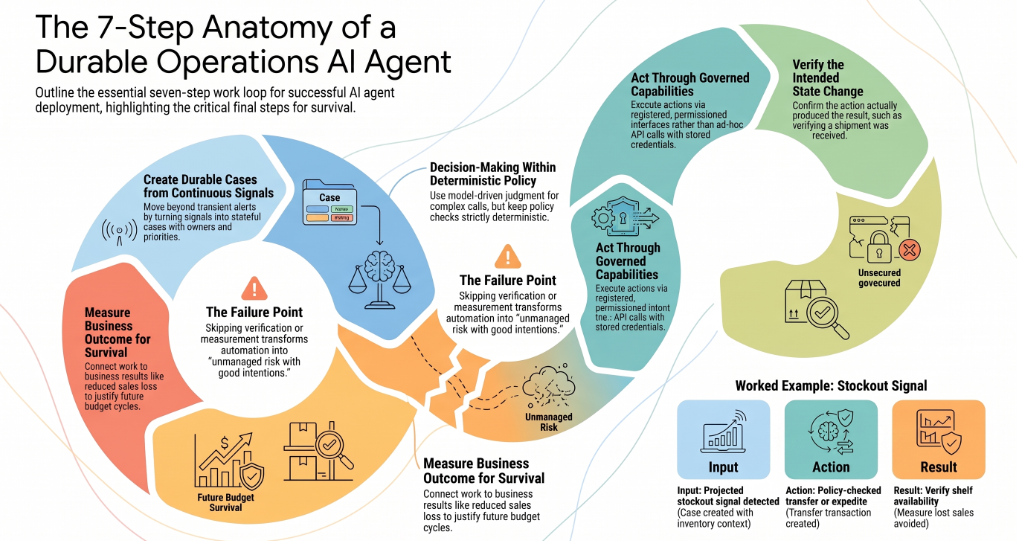
Every durable operations AI deployment we have seen runs the same seven-step loop. Every failed one skips at least one of the last two steps.
1. Sense. Observe metrics, events, documents and system state continuously. Not a query someone runs — a standing watch.
2. Create the case. Turn the signal into a durable work item with an owner, a priority and a service level. This is the step most tools skip. An alert is transient; a case has state, history and accountability.
3. Compile context. Assemble everything needed to act: the transactional record, the relevant metrics, the applicable policy, the document history, the prior interactions. Critically, compile it under the permissions of the requester, not with a service account that sees everything.
4. Decide within policy. Generate alternatives, apply forecasting or optimisation where relevant, and evaluate against deterministic rules. Policy checks should be deterministic. Judgement calls can be model-driven. Never invert that.
5. Act through a governed capability. Execute against a registered, permissioned interface with limits, idempotency and logging — not an ad-hoc API call with a stored credential.
6. Verify the effect. Confirm the action produced the intended state change. Did the transfer get picked, shipped, received and shelved? Did the order confirm? Did the reminder deliver?
7. Measure the outcome. Connect the work to the business result — lost sales avoided, days sales outstanding reduced, cycle time cut — and feed that evidence back into improving the agent and the process.
A worked example: projected stockout to verified shelf availability
Projected stockout signal → create replenishment case → compile inventory, demand, inbound and policy context → investigate cause (demand spike, inbound delay, phantom stock, planogram error) → generate transfer, expedite or no-action alternatives → apply forecasting and optimisation to rank them → check policy and source-store risk → human approval, or bounded execution under an approved authority envelope → create the transfer transaction and notify both stores → verify pick, shipment, receipt and shelf availability → measure lost sales avoided, transfer cost, and source-store impact
Steps 6 and 7 are what almost every competing framework omits. An agent that acts without verification is not automation — it is unmanaged risk with good intentions. An agent that acts and verifies but never measures cannot justify its own existence at the next budget cycle.
Why Assistents.ai for operations: the governed execution layer
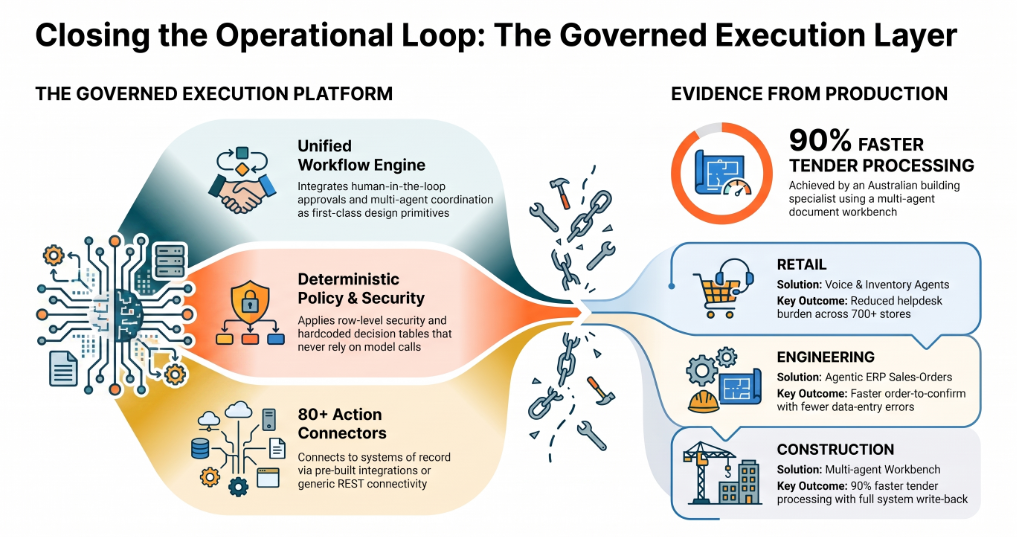
The pattern in the 24 use cases above is consistent. The intelligence was rarely the hard part. The hard part was assembling context under the right permissions, applying deterministic policy, routing an approval to the right human, executing against a system of record, and leaving an audit trail — inside one governed environment rather than across five stitched-together tools.
That is the specific problem Assistents.ai is built for.
What the platform provides today:
- Natural-language analytics and text-to-SQL over governed enterprise data
- A semantic metrics layer with row-level security, so an agent sees exactly what its requester is entitled to see and metric definitions stay consistent across teams
- Agent building and multi-agent coordination, for workflows that need specialised roles rather than one general agent
- Tools and action connectors, with 80+ workflow integrations plus generic REST connectivity for systems that are not on the list
- A workflow engine with human tasks and approvals, so human-in-the-loop is a first-class design primitive rather than a bolt-on
- Low-code forms, pages and business applications, so the operational interface ships with the agent
- Document ingestion, extraction, validation and review, including vision-capable extraction from complex layouts
- Hybrid retrieval with evidence-backed responses, so answers carry their sources
- Deterministic rules and decision tables, for the policy logic that should never be a model call
- Voice agents connected to live business data, for frontline and field workflows
- Model routing across multiple providers, so model choice is an operational decision rather than a lock-in
- Audit trails and human-in-the-loop controls across the workflow
- Private cloud, VPC and on-premises deployment, for operations that cannot send data to a shared environment
Why that combination specifically matters in operations: the Seven-Step Work Loop breaks at handoffs. When context lives in one tool, rules in a second, approvals in a third, actions in a fourth and audit in a fifth, every boundary is a place where state is lost, permissions are re-derived incorrectly, or the audit trail goes dark. Operations teams do not need the best individual component. They need the loop to close.
Evidence from production:
- A national value retailer with 700+ stores: bilingual voice support, inventory intelligence and knowledge agents, architected for high store-level concurrency — reducing helpdesk burden and speeding store issue resolution.
- A UAE engineering and technology group: agentic ERP sales-order creation replacing an end-of-life content platform — faster order-to-confirm, fewer data-entry errors, improved auditability.
- An Australian remedial-building specialist: a multi-agent document workbench with full write-back into the field-service platform — engineered for up to approximately 90% faster tender processing.
How to choose your first use case: the VALUE Score
Most AI programmes in operations pick their first use case badly, and they pick it badly in a predictable way: they choose the most interesting problem rather than the most scoreable one.
The VALUE Score gives you a defensible selection method. Score each candidate 1 to 5 on five dimensions, for a maximum of 25.
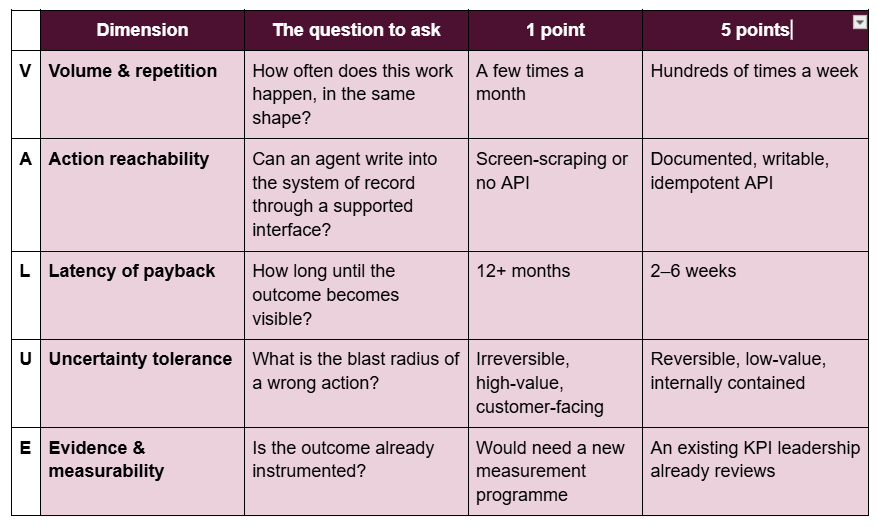
Reading the score
- 20–25 — start here. The business case will hold and the deployment will be defensible.
- 14–19 — viable, but scope it down first. Usually the low score is on A (action reachability) and the fix is integration work, not AI work.
- Below 14 — defer. Not because it lacks value, but because it will consume the political capital you need for the next three use cases.
Three worked scorings
Candidate A — Overdue-receivables follow-up agent V 5 (hundreds of accounts weekly) · A 4 (AR system exposes account and task writes) · L 4 (DSO moves within a quarter) · U 4 (reminders are reversible; negotiation is withheld) · E 5 (DSO is already a board metric) Total: 22 — start here.
Candidate B — Network-wide supply chain optimisation V 3 (planning cycles are periodic) · A 2 (writes span multiple planning systems) · L 1 (12+ months to prove) · U 2 (network-level errors are expensive) · E 3 (outcome is confounded by many variables) Total: 11 — defer. Strategically valuable, operationally the wrong place to start.
Candidate C — Store knowledge and SOP agent V 5 (constant frontline queries) · A 5 (read-only; no write risk) · L 5 (value visible in weeks) · U 5 (a wrong answer is an inconvenience) · E 2 (no existing KPI for procedural query resolution) Total: 22 — start here, with one caveat: instrument the baseline before you build, or you will not be able to prove the value you created.
Candidate C illustrates something worth internalising. The low score on E is fixable in a week. The low scores on Candidate B's A and L are not fixable at all in the first year.
What actually blocks AI in operations
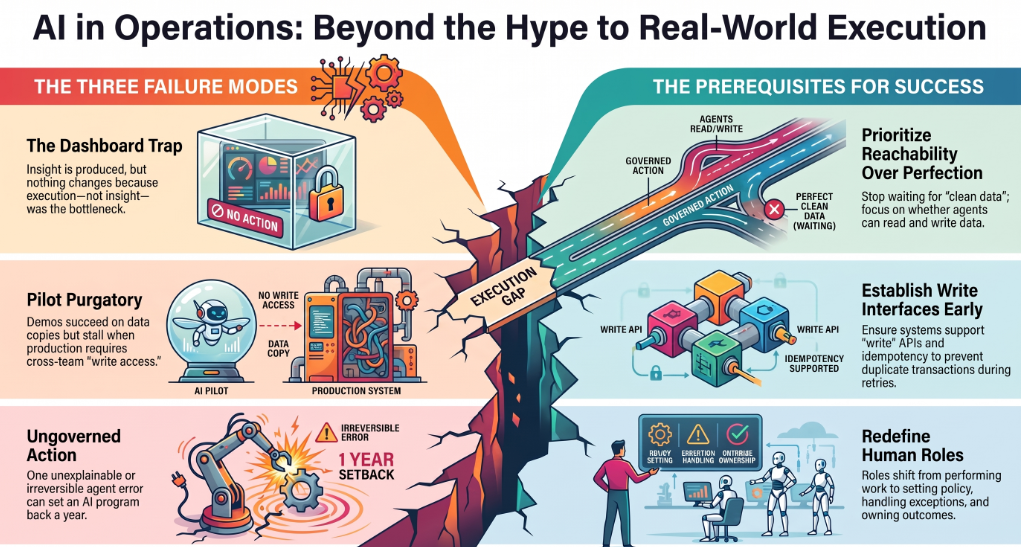
The three failure modes
1. The Dashboard Trap. The system produces excellent insight. Nobody acts on it. Nothing changes. This is the most common failure and the hardest to detect, because the project reports as successful — the model is accurate, the dashboard is used, the stakeholders are satisfied. The operational metric does not move, because insight was never the bottleneck. Execution was.
2. Pilot Purgatory. The demo works beautifully on a copy of the data. Production requires write access to a system owned by a different team with a different risk appetite, and the request sits in a queue for two quarters. The technology was never the constraint.
3. Ungoverned Action. The agent acts. Something goes wrong. Nobody can explain why the action was taken, who authorised the authority envelope, what context the agent had, or how to reverse it. One incident of this kind sets an AI programme back a year, and rightly so.
The real prerequisites: reachability over perfection
"You need clean data first" is the most expensive piece of advice in enterprise AI. It has funded multi-year data programmes that delivered no operational change.
The actual prerequisite is reachability: can the agent read the data it needs, under the right permissions, at the right latency, and write the result back? Data quality issues surface fast in a governed loop and get fixed against a live use case, which is both cheaper and more likely to actually happen than fixing them in the abstract.
The integration reality
Nobody writes about this, and it determines most outcomes.
- Write interfaces are the constraint. Many enterprise systems have rich read APIs and impoverished write APIs. Establish this before you scope, not after.
- Idempotency is not optional. If an agent retries, it must not create a duplicate transaction. This is a design requirement from day one.
- Reconciliation is part of the deliverable. Every agent that creates records needs a reconciliation report someone in finance or operations trusts.
- Legacy replacement is a legitimate driver. One of the deployments described above was motivated as much by an end-of-life content platform with high licensing cost as by the AI opportunity. Retiring expensive middleware is often the cleanest business case available.
The people question
Answer it honestly, early, and in writing.
Operations roles do not disappear at L2 to L4. They change shape: from performing the work to setting policy, handling exceptions and owning outcomes. Teams that were told this plainly at the start have consistently adopted faster than teams that were reassured vaguely and worked it out themselves.
Governance: how to let an agent act on a production system
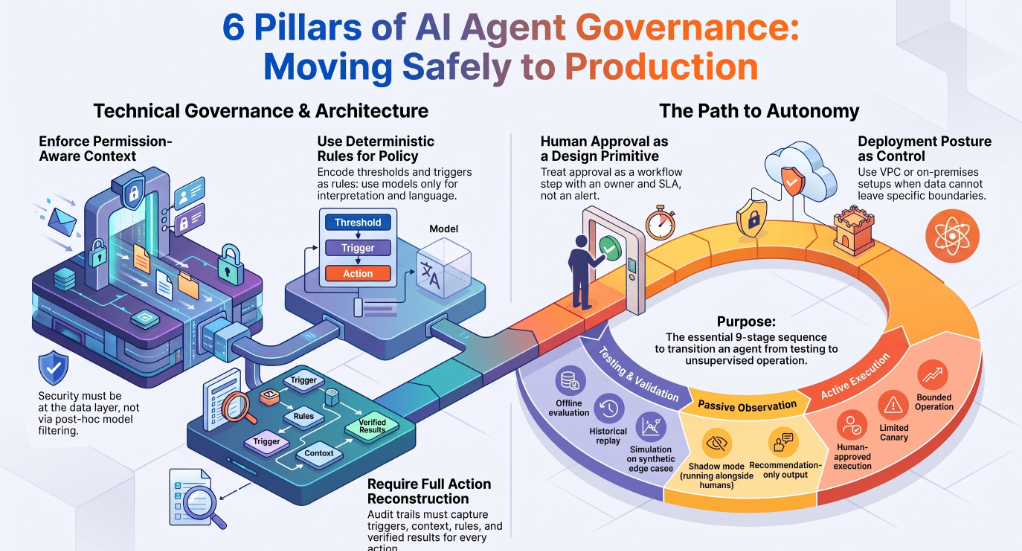
This is the question every operations leader actually has, and it is the least-answered question in the entire category. Six controls, in the order you should implement them.
1. Permission-aware context
An agent should see what its requester is entitled to see — no more. That means row-level security is enforced at the data layer, not filtering applied after retrieval. Post-hoc filtering leaks through summaries, aggregates and model memory. A semantic layer sitting above the data also keeps metric definitions consistent, so "on-time delivery" means the same thing to the agent, the dashboard and the regional manager.
2. Deterministic rules where determinism belongs
Credit limits, approval thresholds, contact-frequency caps, escalation triggers, regulatory checks — none of these should be a model call. Encode them as rules and decision tables. Use the model for interpretation, planning and language. Use rules for policy. Systems that blur this boundary are the ones that produce indefensible actions.
3. Human approval as a design primitive
Approval should be a step in the workflow with an owner, an SLA and a record — not an alert someone might see. In practice, most operations agents should ship with approval on and have it progressively relaxed per work type as evidence accumulates, rather than shipping autonomous and adding controls after an incident.
4. Audit trails, evidence and explainability
For every action, you should be able to reconstruct: what triggered it, what context the agent had, which rules were evaluated, what alternatives were considered, who or what authorised it, what was executed, and what the verified result was. If you cannot reconstruct that, you do not have automation — you have an unexplained change in a production system.
5. The rollout sequence
Every material agent should pass through these stages before it operates unsupervised:
- Offline evaluation against a labelled set
- Historical replay — what would it have done last quarter?
- Simulation on synthetic edge cases
- Shadow mode — runs alongside the human, executes nothing
- Recommendation only — output goes to a human queue
- Human-approved execution — the agent acts, a human approves each action
- Limited autonomous canary — narrow scope, tight limits, high monitoring
- Wider bounded operation — expanded scope within the authority envelope
- Continuous monitoring and rollback — permanently
Skipping stages 2 and 4 is the single most common cause of production incidents in agentic deployments. Historical replay in particular is cheap, fast and unreasonably informative.
6. Deployment posture
For regulated or data-sensitive operations, deployment location is a governance control in its own right. Private cloud, VPC and on-premises options exist precisely because some operational data cannot leave a boundary, regardless of how good the controls above are.
Measuring the ROI of AI in operations
The four metric families
- Cycle time — how long the work takes end to end. The easiest to measure and usually the first to move.
- Cost to serve — fully loaded cost per unit of operational work. The metric finance cares about.
- Exception rate — the share of work that leaves the normal path. This is the real measure of an agent's competence, and it improves more slowly than cycle time.
- Outcome yield — did the business result actually occur? Lost sales avoided, DSO reduction, fill rate, SLA adherence, downtime avoided.
Programmes that report only on the first two are usually hiding a rising exception rate.
Payback windows by use case class
Time to value and payback vary by more than an order of magnitude. Scope your expectations accordingly.
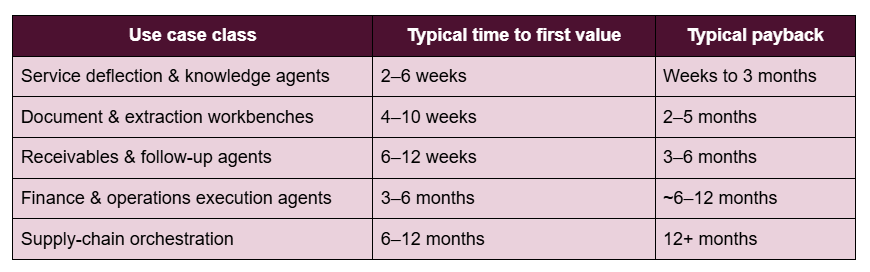
Independent analyses of 2026 agentic deployments broadly align with this shape: customer-service deflection reaches value fastest because intents are bounded and the data is owned, while finance, operations and supply-chain orchestration take substantially longer. Start where payback is measured in weeks, and use that credibility to fund the twelve-month work.
Why accuracy is the wrong headline metric
"95% accurate" is meaningless without three qualifiers: accurate at what, on which document or case class, and what happens to the other 5%.
A system that is 95% accurate and routes the remaining 5% to a human review queue with the uncertainty flagged is production-ready. A system that is 98% accurate and silently commits the other 2% is a liability. Measure the handling of the tail, not the size of it.
Baseline before you build
The most common reason a successful deployment cannot prove its value is that nobody measured the before state. Spend the first two weeks instrumenting the current process. It is the cheapest insurance available and it takes less time than the first design review.
A 90-day path from use case to production
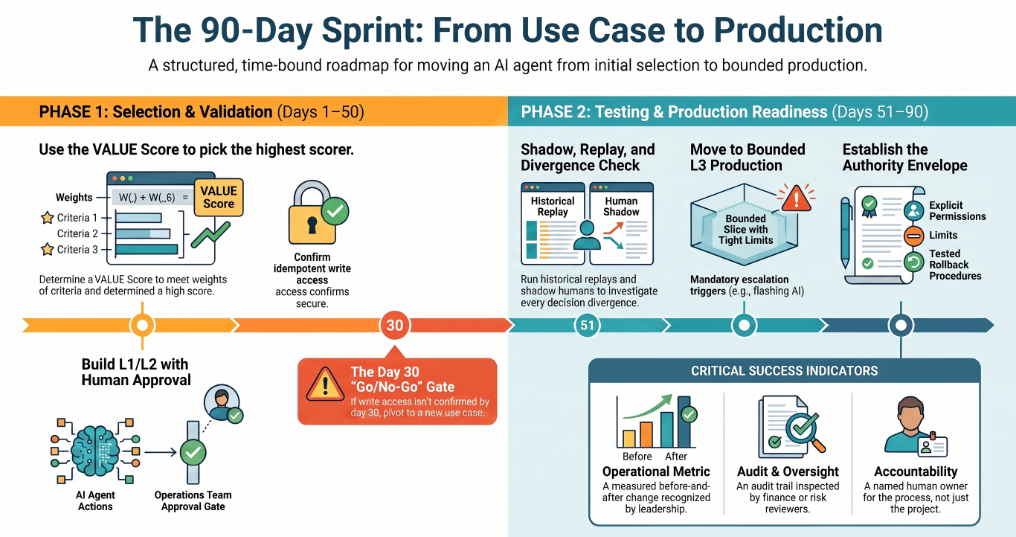
Days 1–15 — Select and score. Run three to five candidates through the VALUE Score. Pick the highest scorer, not the most interesting one. Write down the specific operational metric you intend to move, and by how much.
Days 16–30 — Instrument the baseline and confirm write access. Measure the current cycle time, cost to serve and exception rate. In parallel, confirm the write interface exists, is documented and supports idempotent operations. If write access is not confirmed by day 30, change the use case — do not proceed and hope.
Days 31–50 — Build at L1/L2 with human approval. Ship the agent with every action routed through approval. Get it into the hands of the operations team performing the work today. Their exception reports in the first fortnight are worth more than any amount of pre-launch design.
Days 51–70 — Shadow and replay. Run historical replay across the last quarter. Run the agent in shadow alongside the human. Compare decisions. Investigate every divergence — the divergences are where your policy is actually ambiguous.
Days 71–90 — Bounded execution with monitoring and rollback. Move to L3 on a narrow, defined slice. Tight limits, mandatory escalation triggers, continuous monitoring, tested rollback. Expand scope only after the exception rate stabilises.
What good looks like at day 90:
- One agent in bounded production on a real work type
- A measured before-and-after on one operational metric leadership recognises
- A documented authority envelope with explicit permissions, limits and escalation triggers
- An audit trail that a finance or risk reviewer has actually inspected
- A named human owner for the process, not just for the project
- A scored shortlist of the next three use cases
Why operations teams choose Assistents.ai: platform versus the alternatives
Most operations leaders evaluating AI are comparing four categories, not four vendors. Here is the honest shape of that comparison.
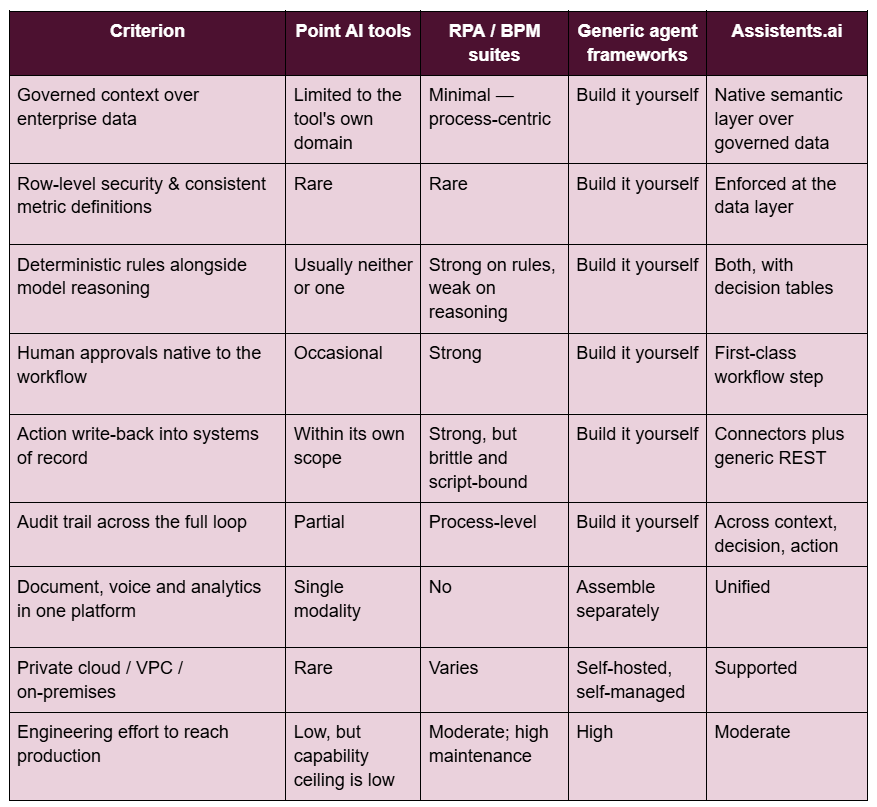
Who this is a fit for
- Operations that span multiple systems of record and need context assembled across them
- Environments where actions must be explainable and reversible — finance, utilities, regulated services, multi-entity groups
- Teams that need write-back, not just insight — the difference between an agent and a dashboard
- Organisations with data residency or deployment constraints that rule out shared-tenant-only platforms
- Programmes that need to run document, voice and analytics workflows without integrating three vendors
Who this is not a fit for
If you have a single, well-bounded workflow that your existing vendor already automates natively — one ticketing queue, one document type, one channel — use that. A platform is the right answer when the loop crosses systems. It is an expensive answer when it does not. We would rather say that here than three months into an evaluation.
Deployment footprint
Production operations deployments across ports and logistics, national retail, power transmission and smart infrastructure, engineering and industrial services, healthcare services, financial services, hospitality and professional services — spanning India, the Middle East, Southeast Asia, Australia, the UK, Europe and North America.
Where operations AI goes next
Everything in this section is directional — an assessment of where the category is heading and where our own product thinking points, not a description of currently available functionality.
Five shifts look likely over the next 24 months.
A durable work layer beneath the agents. Enterprise operational activity represented as persistent missions, cases and tasks with owners, service levels and history — rather than as transient model sessions. Agents become participants in work, not the container for it.
Digital workers as managed resources. Agents with identity, roles, ownership, capacity, cost and performance records — managed with the same discipline applied to any other operational resource, including certification before deployment and retirement when superseded.
A governed action gateway. A single controlled path from agent intent to enterprise execution, carrying identity, rules, approvals, limits, idempotency, verification and compensation — rather than credentials distributed across individual integrations.
Outcome intelligence closing the loop. Connecting work and actions to business results systematically, and using that evidence to improve both the agents and the operating process.
Packaging complete operations rather than individual agents. Customers do not ultimately want an agent. They want a business operation to run reliably. The unit of deployment is likely to become a governed human–agent team that owns a defined operation and its outcomes — receivables, store operations, procurement, close — rather than a collection of separately configured bots.
The direction is consistent: from assistance, to bounded delegation, to exception-managed operation — with humans retaining strategic and accountable authority throughout.
FAQs
What are the main AI use cases in operations? The main AI use cases in operations span six domains: supply chain and inventory (stockout detection, transfer orchestration, inbound exceptions, markdown decisions), frontline and store operations (voice support, inventory intelligence, knowledge agents, field document write-back), service operations (omnichannel triage, tenant support, booking orchestration), financial operations (receivables follow-up, RFQ automation, ERP order creation, KPI alerting), asset and infrastructure operations (energy optimisation, grid anomaly detection, terminal operations, predictive maintenance), and document and back-office operations (extraction, pre-screening, research automation).
How is AI used in operations management?
AI is used in operations management in three ways: forecasting and anomaly detection using classical machine learning; conversational access to operational data and knowledge; and agentic execution, where software opens a case, gathers context, decides within policy, writes back into a system of record and verifies the result. The third is what changed in 2026 and where most new value is being created.
What is the difference between AI automation and agentic AI in operations?
Traditional automation follows a predefined script: if A happens, do B. It breaks on exceptions. Agentic AI interprets an ambiguous situation, gathers context, plans a path, selects tools and adapts as evidence changes — operating within an authority envelope rather than a fixed script. The practical difference is exception handling: automation escalates exceptions, agents work them.
Which AI use case should an operations team start with?
Start with the use case that scores highest on volume, action reachability, payback latency, blast radius and existing measurability — not the most strategically interesting one. In practice, service deflection, knowledge agents and document extraction reach value in weeks; supply-chain orchestration takes a year or more. Use the early win to fund the long one.
Will AI replace operations managers?
No, but the role changes at every autonomy level above assist. Managers move from performing and coordinating work to setting policy, managing exceptions and owning outcomes. In the deployments described in this guide, headcount was redeployed to exception handling and improvement work rather than reduced, because operational demand generally expanded to use the freed capacity.
How long does it take to deploy AI in operations?
A bounded first use case can reach production in roughly 90 days: two weeks to select and score, two weeks to instrument the baseline and confirm write access, three weeks to build with human approval, three weeks to shadow and replay, and three weeks to reach bounded execution with monitoring. Programmes that skip the baseline or the replay stage take longer, not less.
How much does AI in operations cost?
Cost is driven by integration complexity and inference volume rather than by licensing. The main variables are how many systems of record must be reached, whether write interfaces already exist, and the volume of work items processed. A single bounded use case is typically a fraction of the cost of the legacy middleware or manual process it replaces — in several deployments, retiring an end-of-life system was itself a significant part of the business case.
What data do you need before deploying AI in operations?
Less than most data-readiness programmes assume. What you need is reachability — the agent can read the relevant data under the correct permissions at the right latency, and write the result back. Data quality problems surface quickly inside a governed loop and get fixed against a live use case, which is faster and cheaper than fixing them in the abstract first.
How do you stop an AI agent from taking a wrong action on a live system?
Through a layered authority envelope: permission-aware context so the agent only sees what its requester can see; deterministic rules for policy checks rather than model judgement; explicit permission and limit settings per work type; mandatory escalation triggers on dispute, anomaly or low confidence; human approval as a workflow step; complete audit trails; and a staged rollout that includes historical replay and shadow mode before any autonomous operation.
What is AIOps and how does it differ from AI in business operations?
AIOps applies AI to IT operations — alert correlation, incident triage, root-cause narrowing and runbook execution over observability and ITSM data. It differs from business operations AI in data shape (high-volume machine telemetry versus sparse, document-shaped records), failure economics (fast, visible blast radius) and systems of record. The governance principles transfer; the architecture does not.
Can AI agents write back into ERP and other systems of record?
Yes, and this is the defining capability that separates an operations agent from an analytics tool. In production deployments, agents create ERP sales orders from validated triggers, execute inventory transfers, create records in field-service platforms with quote locking, and generate follow-up tasks — each through a registered, permissioned interface with limits, idempotency, audit logging and reconciliation reporting.
How do you measure the ROI of AI in operations?
Track four metric families: cycle time, cost to serve, exception rate and outcome yield. Baseline all four before you build. Report the exception rate alongside the efficiency gains — programmes that report only cycle time and cost are usually concealing a rising exception rate. Tie the outcome to a metric leadership already reviews rather than inventing a new one.