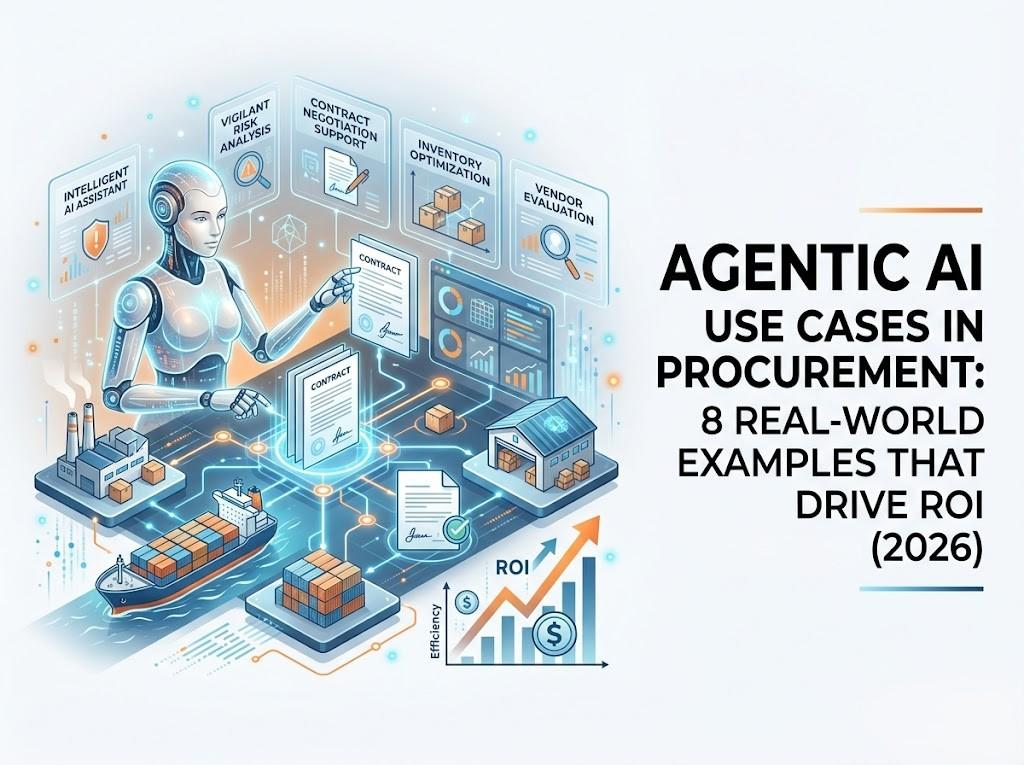
Procurement leaders are being asked to do more with less. A 2025 Hackett Group survey found that procurement workloads are expected to rise by nearly 10% with only marginal staffing increases. At the same time, PwC estimates that agentic AI will transform at least 75% of procurement activities in the near term — with productivity gains of up to 70% in fully agent-driven workflows.
The problem is that most content on this topic stays theoretical. You get frameworks, maturity models, and category copilot concepts from consulting firms who have never shipped a live agent into a production procurement environment.
This blog is different.
What follows are eight agentic AI use cases in procurement drawn from real enterprise deployments — across pharma sourcing, logistics, retail, utilities, smart grid operations, and multi-entity holding groups operating across the Middle East, India, Australia, and globally. These are not proofs-of-concept. They are production deployments with measurable outcomes.
If you are a CPO, head of procurement, VP of supply chain, or CFO evaluating where AI agents can create immediate value in your function, this is the evidence you need.
What Is Agentic AI in Procurement?
Agentic AI refers to artificial intelligence systems that can perceive context, plan multi-step workflows, execute actions autonomously across systems, and adapt when conditions change — all within governance guardrails defined by the organisation.
This is fundamentally different from the two forms of automation that came before it.
Robotic Process Automation (RPA) executes predefined steps in sequence. It works when everything goes as planned. The moment a supplier doesn't respond, an invoice format changes, or an approval chain shifts, RPA stops and waits for human intervention. In procurement — where exceptions are the rule — RPA creates as many bottlenecks as it solves.
Generative AI accelerates content creation. It can draft an RFQ, summarise a contract, or answer a question about a purchase order. But it does not take action. It responds. Someone still has to read the output and do something with it.
Agentic AI closes that gap. It reads the incoming supplier email, checks whether the goods were delivered, verifies the invoice is payment-eligible, queries the ERP, identifies the exception, drafts a resolution, and routes it for human approval — or executes it directly if the rules permit. It acts.
The table below captures the key differences:
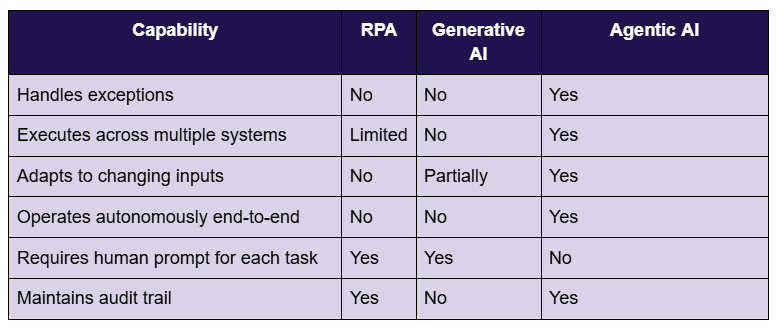
In procurement, agentic AI doesn't just answer questions or complete individual tasks. It runs workflows — from intake to supplier discovery to RFQ to order creation to payment — while humans retain control over strategic decisions and high-risk approvals.
Why Procurement Is the Ideal Environment for Agentic AI
Procurement sits at an unusual intersection. It has both the data volumes that AI needs to be useful and the workflow complexity that makes traditional automation inadequate. Specifically:
Unstructured data at scale. Contracts, tender documents, supplier emails, RFQ responses, invoice PDFs, regulatory filings — procurement is saturated with unstructured data that has historically been processed manually. McKinsey estimates that today's procurement functions use less than 20% of the data available to them when making decisions. AI agents can change that.
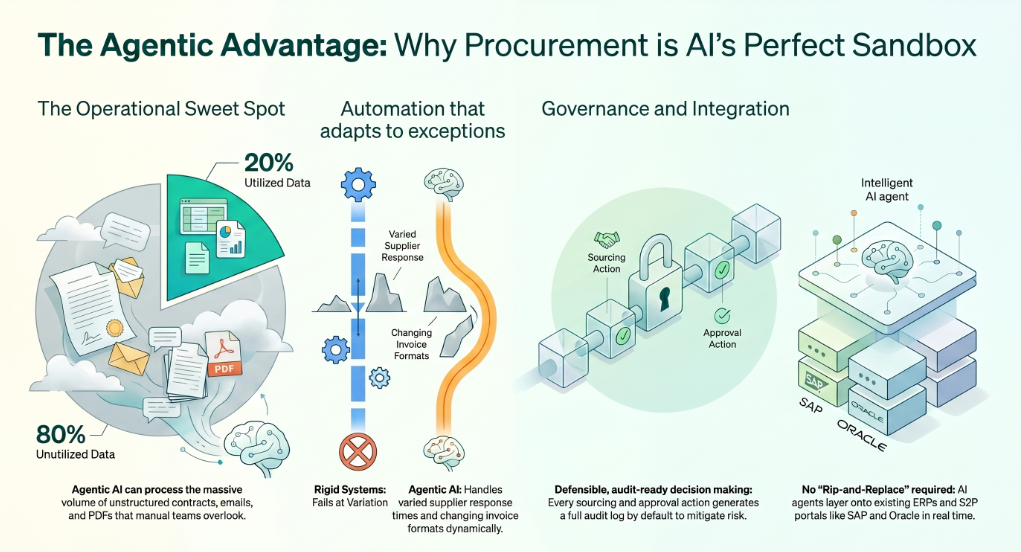
Repeatable workflows with constant exceptions. Procurement processes are structured enough to be automated but varied enough that rigid automation fails. Supplier response times differ. Invoice formats change. Approval thresholds vary by category, region, and entity. Agentic AI handles the structured core while adapting to the exceptions — exactly the operating condition where it outperforms every prior generation of automation.
High-stakes decisions with audit requirements. Every sourcing decision, vendor selection, and order approval carries financial, compliance, and operational risk. Agentic AI operates within governance guardrails and generates full audit logs by default — making it not just more efficient than manual processes but more defensible.
A digitised S2P foundation already exists. Most enterprise procurement functions have ERP systems (SAP, Oracle), contract management tools, and supplier portals already in place. AI agents don't require replacing these systems. They layer on top of them, reading and writing to existing infrastructure in real time.
For these reasons, procurement is not just a viable deployment environment for agentic AI — it is one of the highest-return environments available to any enterprise function today.
8 Agentic AI Use Cases in Procurement: Real Deployments, Real Outcomes
1. Autonomous RFQ Generation and Supplier Discovery
The problem: Building and sending a Request for Quotation (RFQ) is a deceptively expensive process. Category managers must identify qualified suppliers, gather performance history, check regulatory and quality certifications, assemble bid packages, and then manage the response collection and scoring process. For specialised or rare categories, this can consume six to twelve weeks of senior procurement time per cycle — for a single sourcing event.
What the agent does: An autonomous sourcing agent initiates the event based on category criteria defined by the procurement team. A web agent identifies potential suppliers from internal databases and external sources. A quality agent validates each supplier against internal policy and regulatory requirements. A document agent retrieves certifications, performance history, and prior transaction data. The sourcing agent then assembles bid packages, distributes them to qualified suppliers, collects responses, scores them against weighted criteria, and presents a shortlist with an award recommendation — all without manual orchestration between steps.
Real deployment: A global platform operating in pharma sourcing and excipients — managing over 1,800 rare excipients and 7,500+ SKUs across a highly complex supplier landscape — deployed an agentic RFQ and supplier discovery workflow. The agent automated RFQ generation, supplier matching, quality and regulatory document handling, and price/lead-time analytics. The outcomes included materially faster procurement cycles, significantly reduced manual vendor coordination, and improved price competitiveness driven by continuous sourcing intelligence rather than periodic manual reviews.
Who this is for: Procurement directors and category managers in pharma, chemicals, specialised manufacturing, and any organisation managing a long tail of suppliers across fragmented categories.
2. Automated Sales Order Creation via ERP Integration
The problem: In high-volume enterprise procurement environments, sales order creation is one of the most labour-intensive and error-prone processes in the entire source-to-pay chain. When this process depends on legacy document management platforms — particularly those approaching end-of-life — the risks compound: high licensing costs, brittle integrations, manual data entry, and limited auditability.
What the agent does: An agentic order creation workflow interprets incoming order triggers from documents, emails, and procurement portals. It validates each order against defined business rules and approval thresholds, creates Sales Orders directly in SAP without human data entry, routes exceptions and non-standard approvals to the appropriate decision-makers, generates full audit logs for every transaction, and provides reconciliation reporting for finance and compliance teams. The agent replaces the legacy document management layer entirely — not by replicating it, but by rebuilding the workflow around autonomous execution.
Real deployment: A major engineering and technology solutions enterprise in the UAE — operating across electrical, mechanical, automation, and mobility solutions at enterprise and infrastructure scale — deployed agentic automation to replace a high-cost, end-of-life document management platform. The agent now interprets order triggers, validates and creates SAP Sales Orders autonomously, and manages a rules-based exception and approval workflow. The outcomes included a meaningfully faster order-to-confirm cycle, a near-elimination of manual data-entry errors, and a fully auditable SAP order creation process replacing a platform that had previously required significant ongoing licensing investment.
Who this is for: Enterprise procurement and finance operations teams running SAP or equivalent ERP environments, particularly those carrying legacy document management dependencies that are becoming operationally or financially untenable.
3. Procurement KPI Monitoring and Automated Margin Alerts
The problem: In multi-entity organisations — holding groups, conglomerates, franchise networks — procurement performance across subsidiaries is typically invisible until month-end reporting. By the time leadership sees that a vendor has been underperforming on delivery, or that a purchase price increase has quietly eroded gross margin, the damage is already done. The challenge is not a lack of data. It is a lack of continuous, governed intelligence flowing from that data to decision-makers in time to act.
What the agent does: A procurement intelligence agent ingests purchase price data, gross margin calculations, vendor delivery records, return rates, and early-payment terms continuously across all group entities. It applies standardised KPI definitions (not each subsidiary's own interpretation) and generates automated alerts when exceptions breach defined thresholds — purchase price trend deviations, GM impact signals, vendor performance deterioration, notional finance cost on early payments. It also produces scheduled insight packs for leadership, turning what was previously a manual monthly reporting exercise into a continuous, always-on monitoring function.
Real deployment: One of the UAE's most prominent family business groups — comprising 30+ companies and partnering with leading global brands across retail, building, industrial, and services — deployed group-wide automated procurement and finance KPI alerts. The system standardised procurement intelligence across entities and delivered automated alerts covering purchase price trends, gross margin impact, early-payment analysis, and vendor performance on delivery and returns. Outcomes included earlier detection of margin erosion, elimination of variance surprises at month-end, and standardised finance and procurement intelligence accessible to leadership across the group without requiring manual consolidation.
Who this is for: Group CFOs, heads of procurement in holding companies, and procurement leaders in multi-entity businesses operating across geographies or business units with historically fragmented reporting.
4. Intelligent Tender Document Processing
The problem: Tendering is among the most document-intensive processes in procurement. A single complex tender can involve hundreds of pages of specifications, drawings, pricing schedules, compliance requirements, and scope-of-work documents — often arriving as unstructured PDFs, scanned images, or multi-revision packages. Manually extracting the right data, reconciling revisions, and synchronising information into operational systems is slow, expensive, and carries significant bid risk when errors go undetected.
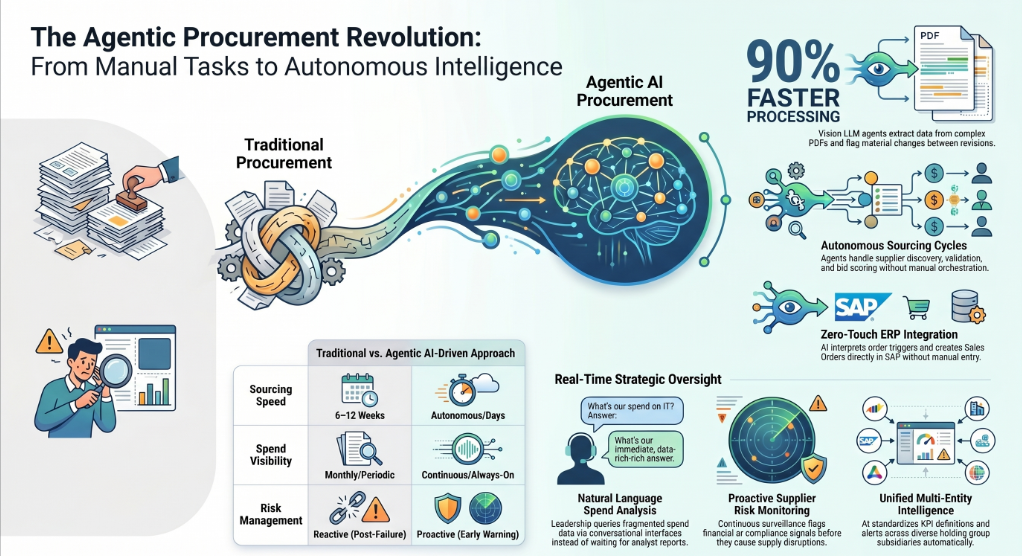
What the agent does: A multi-agent tender processing workflow handles the full document lifecycle. A retrieval agent ingests incoming tender documents and classifies them by type and workflow. A Vision-LLM extraction agent processes complex PDFs — including scanned and image-heavy documents — with high accuracy. A revision analysis agent detects changes between document versions and flags material differences for human review. A synchronisation agent pushes validated data into core operational systems (quoting tools, job management platforms) with full CRUD capability. Quote locking and audit logging ensure that every extraction and synchronisation event is traceable.
Real deployment: An Australian commercial works and waterproofing specialist with over 20 years of operations in remedial building services — known for high-integrity delivery on complex construction projects — deployed this multi-agent tender processing architecture. The system was engineered for approximately 90% faster tender document processing and a 95% extraction accuracy target on standard document formats. Revision and change detection was built into the workflow, directly reducing the risk of bid errors driven by missed amendments. Full integration with the company's job management platform (Simpro) with CRUD capability, quote locking, and audit logs brought the entire tender-to-quote workflow under governed automation.
Who this is for: Construction, engineering, and commercial services businesses where tendering volume is high, documents are complex and multi-revision, and manual processing creates material bid risk or operational delay.
5. Supplier Risk Monitoring and Compliance Surveillance
The problem: Supplier instability — financial distress, geopolitical exposure, ESG non-compliance, contract obligation breaches — almost always surfaces too late in traditional procurement operations. By the time a supplier failure appears in a quarterly review, it has already caused disruption: a delayed shipment, a compliance breach, a contract penalty, or a supply chain gap that required expensive emergency sourcing. The monitoring that would have caught these signals earlier exists in the data. It just never gets read in time.
What the agent does: A supplier risk monitoring agent operates continuously across supplier data sources — financial health indicators, delivery and returns performance, contract obligation tracking, and policy compliance records. It applies rule-based and AI-driven analysis to flag suppliers whose risk profile is deteriorating before a threshold breach occurs. When a risk signal is detected, the agent routes an escalation to the appropriate procurement or legal stakeholder with supporting evidence and a recommended action. Every escalation is logged, creating a full audit trail of risk identification and response.
Real deployment: Across global logistics, supply chain, and multi-entity operations deployments, always-on supplier monitoring agents were deployed to replace periodic manual reviews with continuous intelligence. The consistent outcomes reported across these deployments were: faster competitive response cycles, earlier identification of vendor performance gaps, and the shift from reactive supplier management — responding to problems — to proactive supplier management, preventing them. One global ports and logistics operator deploying analytics and operational alerting across its network reported higher operational visibility and faster exception detection across a portfolio spanning ports, terminals, and logistics services worldwide.
Who this is for: Procurement and supply chain leaders in enterprises with large, geographically distributed supplier networks where periodic manual review cycles leave meaningful risk gaps between assessments.
6. Agentic Spend Analysis and Procurement Intelligence
The problem: Most enterprise procurement teams cannot answer basic questions about their own spend without requesting an analyst report. Where are we overpaying? Which categories have the highest price volatility? Which vendors are capturing more wallet share than contracted? Which promotions are driving procurement inefficiency? These answers exist in the data — fragmented across ERP, procurement platforms, supplier portals, and spreadsheets — but consolidating and interrogating that data has historically required analyst involvement, BI tooling, and lead times that make the insights arrive after the decisions have already been made.
What the agent does: A spend intelligence agent consolidates data across sales, inventory, product, promotion, and supplier records into a unified analytical layer. A conversational interface allows procurement and finance leaders to query that data in natural language — "Which vendors had the highest price increases last quarter?" or "Show me the top ten categories by spend variance" — without building a report or submitting a BI request. An automated exception monitoring layer runs continuously, alerting leadership when KPIs breach thresholds without waiting for someone to check a dashboard. The result is a shift from periodic reporting to always-on procurement intelligence.
Real deployment: A rapidly scaling value retail operation in India — with a pan-India footprint exceeding 700 stores across apparel, general merchandise, and FMCG — deployed an agentic data analytics layer across its procurement and commercial operations. The agent ingested data across sales, products, inventory, promotions, and customer behaviour to deliver conversational analytics for instant business queries. Automated KPI monitoring and exception alerting reduced reporting dependency on analysts, shortened analysis cycles for recurring procurement questions, and gave leadership faster visibility into product performance, promo effectiveness, and procurement cost drivers. The result was measurably more scalable operations with reduced manual overhead.
Who this is for: CPOs, heads of procurement, and commercial finance leaders in retail, distribution, and multi-category businesses where spend data is broad, fragmented, and currently underutilised for procurement decision-making.
7. Agentic Procurement Triggers in Utility and Energy Operations
The problem: State utilities, transmission operators, and campus-scale energy institutions manage thousands of assets — transformers, substations, sensors, generation units — where equipment degradation or failure creates an immediate procurement need. In most organisations, these procurement triggers are still reactive: an engineer notices an anomaly, files a report, a manager initiates a procurement request, and the process begins. The lag between the signal and the sourcing action creates downtime risk, emergency procurement costs, and operational unpredictability that planned procurement would eliminate.
What the agent does: A utility operations agent ingests sensor data, smart meter readings, operational dashboards, and anomaly detection outputs continuously. When a performance anomaly — a voltage deviation, an unusual consumption pattern, a predictive maintenance signal — crosses a threshold, the agent automatically classifies the event, determines whether it triggers a procurement action (a parts order, a maintenance contract activation, an emergency supplier engagement), and routes the appropriate procurement workflow to the relevant team. Operational dashboards and automated alerts give field operations and leadership continuous visibility into asset status and procurement pipeline.
Real deployment: Two infrastructure deployments illustrate this at scale. A state power transmission utility responsible for operating and maintaining transmission systems across an entire state deployed smart grid analytics, KPI monitoring, anomaly detection, and automated alerts for field operations — with procurement triggers embedded in the exception routing. A premier research institute in astronomy and astrophysics with campus-scale operations deployed energy management agents covering monitoring, forecasting, and optimisation of campus energy consumption — including maintenance procurement workflows triggered by anomaly detection. Both deployments shifted the organisation from reactive, manual monitoring toward proactive, always-on operational intelligence.
Who this is for: Procurement and operations leaders in utilities, energy infrastructure, and campus-scale institutions where asset-driven procurement is currently disconnected from real-time operational data.
8. Multi-Entity Procurement Consolidation for Holding Groups
The problem: For conglomerates and family business groups operating across dozens of subsidiaries, procurement intelligence is fragmented by design — each entity has its own systems, its own vendor relationships, its own reporting cadences, and its own definitions of performance. The group-level view either doesn't exist or arrives via a manual consolidation exercise that takes weeks and produces a picture of what happened, not what is happening. Strategic decisions — vendor rationalisation, group-wide contract leverage, category consolidation — are made on incomplete information or not made at all.
What the agent does: A multi-entity procurement intelligence agent builds a semantic governance layer that standardises KPI definitions, procurement hierarchies, vendor classifications, and formula logic across all group entities — so that a "vendor performance score" means the same thing in every subsidiary before any data is compared. On top of this governance layer, the agent consolidates procurement and finance data in real time, generates automated alerts for purchase price trends, gross margin impact signals, vendor performance anomalies, and working capital optimisation opportunities, and delivers scheduled insight packs to group leadership. The shift is from a passive reporting environment to an active, always-on procurement intelligence function operating at group scale.
Real deployment: A major real estate portfolio owner and manager operating diversified assets across multiple emirates in the UAE deployed an agentic data analysis layer that converted dashboard insights into governed, auditable actions and tasks. A separate multi-entity group deployment standardised procurement and finance KPIs across group entities with automated alerts covering purchase price trend deviations, gross margin impact, early-payment analysis (notional finance cost), and vendor delivery and returns performance. Both deployments delivered standardised procurement intelligence across entities, earlier detection of margin erosion, and the elimination of variance surprises — moving group procurement from hindsight to foresight.
Who this is for: Group CFOs, procurement leaders, and COOs in holding companies, family business groups, and conglomerates managing procurement across multiple subsidiaries, geographies, or business units.
Agentic AI vs Traditional Procurement Automation: What's Actually Different?
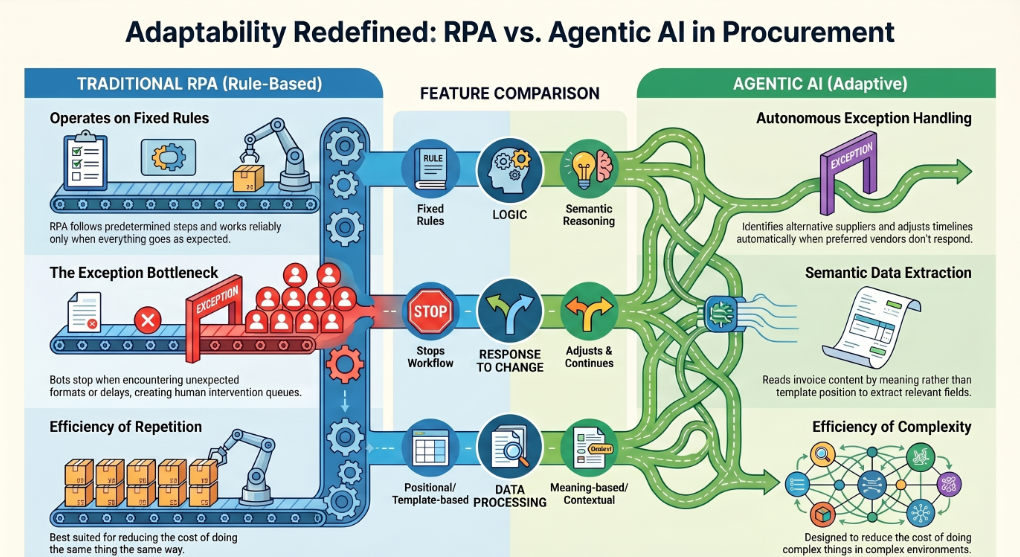
The question most procurement leaders ask before committing to an agentic AI deployment is a reasonable one: how is this different from the automation we already have?
The answer comes down to one word: adaptability.
RPA bots in procurement operate on fixed rules. They follow predetermined steps, and they work reliably when every step goes as expected. But in procurement, exceptions are not edge cases — they are the norm. A supplier doesn't respond. An invoice arrives in an unexpected format. An approval chain has been updated but the integration hasn't caught up. An RPA bot hits any of these conditions and stops, creating a queue of human interventions that often negates the efficiency gains automation was supposed to deliver.
AI agents handle exceptions as a core capability. When a preferred supplier doesn't respond to an RFQ, the agent identifies alternative qualified suppliers, adjusts the timeline, re-issues the request, and updates the audit trail — without human involvement. When an invoice format deviates from the template, the agent reads the content semantically rather than positionally, extracts the relevant fields, flags the deviation for review, and continues the workflow.
The practical difference is this: RPA reduces the cost of doing the same thing the same way. Agentic AI reduces the cost of doing complex things in a complex environment — which is exactly what procurement is.
For a detailed comparison of how AI agents differ from RPA across enterprise workflows, see AI Agents vs RPA: What Procurement Leaders Need to Know.
What ROI Can You Expect from Agentic AI in Procurement?
The outcomes below are drawn from a combination of production deployments (referenced throughout this blog) and published industry benchmarks from PwC, McKinsey, Gartner, and Zycus.
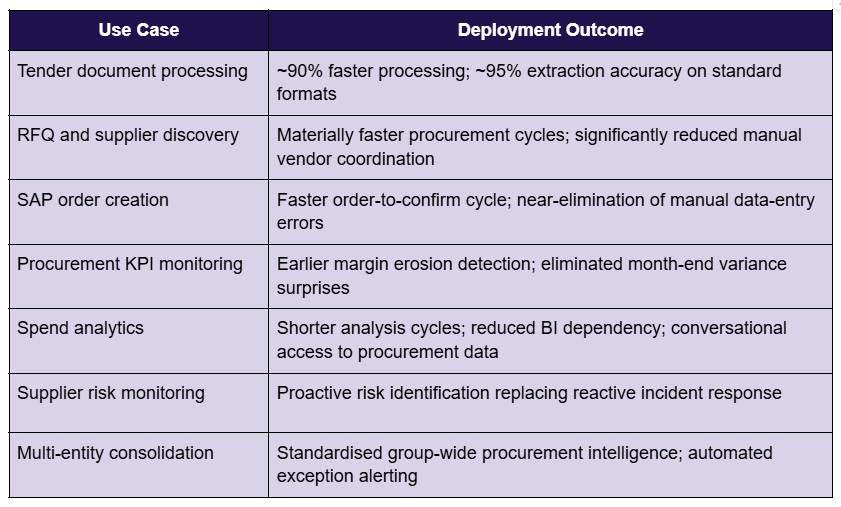
Industry benchmarks:
- PwC: 30–70% productivity gains in agent-driven procurement tasks
- McKinsey: 12–29% cost savings in external services spend with AI sourcing agents
- Zycus: +20% improvement in spend under management across deployments
- Gartner: 15–30% efficiency improvements in category management through autonomous agents
The pattern across all of these deployments and benchmarks is consistent: the highest returns come not from automating individual tasks but from connecting tasks into end-to-end autonomous workflows. When an RFQ agent, a supplier risk agent, and a spend analysis agent operate together — sharing data and handing off context — the value compounds. McKinsey documents 30% process-efficiency gains when agents coordinate across source-to-pay. That is the orchestration multiplier that single-point automation tools cannot replicate.
To estimate the potential ROI for your specific procurement environment, use the Agentic AI ROI Calculator.
How to Deploy Agentic AI in Your Procurement Function
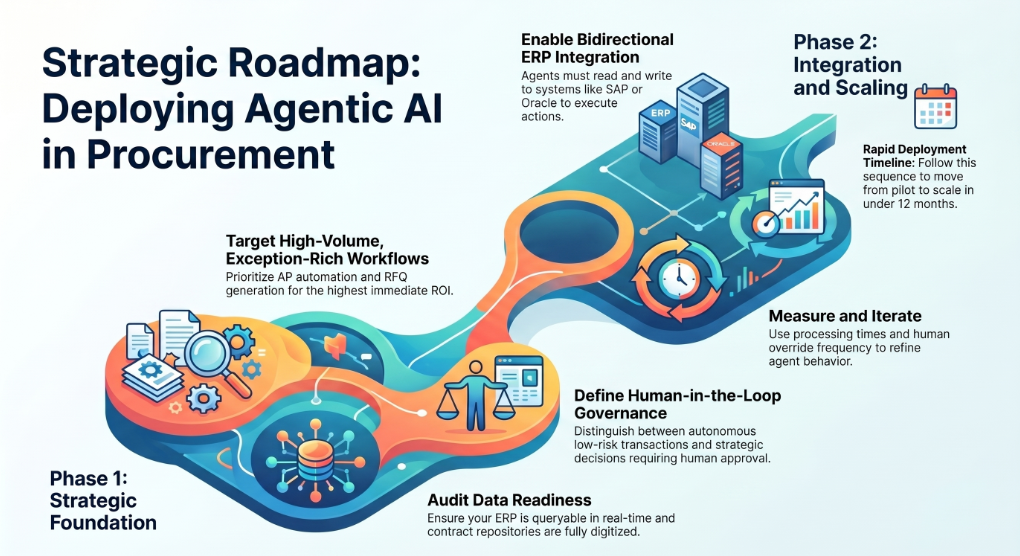
Deploying agentic AI in procurement does not require a multi-year ERP replacement program. The production deployments described in this blog went from prototype to pilot in weeks and from pilot to scale in under a year. The key is disciplined sequencing.
Step 1: Start with high-volume, exception-rich workflows.
The best first use cases for agentic AI in procurement are those with high transaction volume, structured inputs that already exist in your systems, and frequent exceptions that currently require human intervention. AP automation, RFQ generation, and order intake are consistently the highest-ROI starting points because they are large enough to move the needle and well-defined enough to govern effectively.
Step 2: Assess your data readiness.
Agentic AI operates on the data it can access. Before deployment, confirm that your ERP is queryable in real time, your supplier records are reasonably complete and current, and your contract repository is digitised and accessible. Agents can help clean and classify data — but they perform better when the foundation is solid.
Step 3: Define your governance framework.
Every agent deployment needs a clear answer to two questions: what can the agent execute autonomously, and what requires human approval? High-volume, low-risk transactions (standard POs within contracted terms, invoice matching below a threshold) are candidates for full automation. High-value, strategic, or non-standard decisions remain with procurement professionals. This human-in-the-loop model is not a limitation of agentic AI — it is the governance design that makes enterprise deployment safe, auditable, and scalable.
Step 4: Integrate before you automate.
An agent that cannot read and write to your SAP, Oracle, or Coupa environment in real time is limited to insight generation. True procurement automation requires bidirectional ERP integration. Prioritise this as a foundational dependency before deploying agents that are meant to execute, not just advise.
Step 5: Measure, iterate, and expand.
Every procurement agent deployment generates data about its own performance — processing times, exception rates, accuracy scores, human override frequency. Build feedback loops that use this data to refine agent behaviour over time, and use early wins to build internal confidence for scaling to additional categories and workflows.
For a full deployment framework, see How It Works and Implementation.
Ready to Deploy Agentic AI in Your Procurement Function?
The use cases in this blog are not predictions. They are production deployments operating today — across pharma sourcing, enterprise logistics, retail, utilities, smart grid operations, construction tendering, and multi-entity holding groups on four continents.
The assistents.ai platform powers agentic procurement deployments for finance and procurement teams that need measurable outcomes, not extended pilots. The Finance and Procurement solution covers AP/AR automation, RFQ intelligence, spend analytics, SAP integration, multi-entity KPI consolidation, and full governance with audit trails — SOX-compliant and production-ready in weeks.
Explore the Finance and Procurement solution →
FAQs
What is agentic AI in procurement?
Agentic AI in procurement refers to autonomous AI systems that can plan, execute, and adapt across procurement workflows — from intake and supplier discovery to RFQ management, order creation, spend analysis, and compliance monitoring — without requiring human prompting at each step. Unlike generative AI, which produces content in response to a prompt, or RPA, which follows rigid rules, agentic AI perceives context, makes decisions within defined governance guardrails, acts across multiple systems simultaneously, and adapts when conditions change. It is the difference between an AI that answers procurement questions and an AI that runs procurement workflows.
How do AI agents differ from RPA in procurement?
RPA automates fixed, rule-based steps and fails when exceptions occur. AI agents handle exceptions as a core capability — they adapt to changing inputs, make decisions across systems, and continue workflows autonomously when standard conditions aren't met. In procurement, where exceptions are the norm (supplier non-responses, invoice format variations, approval chain changes), this adaptability is the critical differentiator. RPA reduces the cost of doing the same thing repeatedly. Agentic AI reduces the cost of doing complex things in a complex environment.
What are the highest-ROI use cases for agentic AI in procurement?
Based on production deployments and published industry benchmarks, the highest-ROI use cases in 2026 are: (1) autonomous RFQ generation and supplier discovery, (2) automated ERP/SAP order creation, (3) intelligent tender document processing, (4) procurement KPI monitoring and margin alerting, and (5) multi-entity spend consolidation. The orchestration multiplier — connecting these use cases so agents share context and hand off workflows — is where the compounding returns emerge.
Can agentic AI handle SAP and ERP integration?
Yes. Production agentic AI deployments in procurement are built on bidirectional ERP integration — reading purchase orders, inventory data, and contract terms from SAP or equivalent systems, and writing back validated Sales Orders, exception logs, and audit records. This integration is the critical technical dependency that separates insight-generating agents from execution-capable agents. The deployments described in this blog include live SAP Sales Order creation with rules-based exception routing and full audit logging.
Is agentic AI suitable for mid-market procurement teams, not just large enterprises?
Yes. The deployments referenced in this blog span global port operators and state utilities on one end, and specialised SMEs in construction, pharma sourcing, and commercial services on the other. The common factor is not company size — it is whether the procurement function has sufficient transaction volume and data accessibility to justify an agent deployment. Many mid-market organisations have both, particularly in manufacturing, distribution, retail, and professional services.
How long does it take to deploy an AI agent in procurement?
Based on the production deployments documented here, a focused procurement agent deployment — covering a single high-value use case like RFQ automation or SAP order creation — can reach a working prototype in two to four weeks and a production-ready deployment in six to twelve weeks. Broader, multi-use-case deployments covering an entire source-to-pay workflow take longer but typically remain under twelve months from pilot to scale. The critical variable is data readiness and ERP integration, not the AI itself.
What governance controls should procurement teams have for AI agents?
Effective governance for procurement AI agents requires: (1) a clearly defined human-in-the-loop model specifying which decisions agents execute autonomously and which require human approval, (2) full audit logging of every agent action, exception, and override, (3) a semantic governance layer standardising KPI definitions, category hierarchies, and approval thresholds before agents operate on that data, and (4) regular performance reviews using agent-generated metrics (exception rates, accuracy scores, override frequency) to refine behaviour over time. For a full governance framework, see the AI Agent Governance Playbook.