Global regulators issued over 300 regulatory changes per business day in 2025. Compliance teams still relying on spreadsheets, periodic audits, and reactive workflows are no longer able to keep pace — and the cost of falling behind is measurable. In financial services alone, regulatory fines exceeded $6.6 billion in 2025. AI agents for regulatory compliance offer enterprises a continuous, autonomous alternative: systems that monitor, detect, report, and remediate around the clock, without waiting for the next audit cycle.
This guide covers what AI agents for regulatory compliance actually are, why manual compliance processes are breaking down, how these systems work in practice, and what real enterprise deployments look like across banking, healthcare, energy, retail, logistics, and tax — with outcomes you can benchmark against.
What Are AI Agents for Regulatory Compliance?
AI agents for regulatory compliance are autonomous software systems that continuously monitor regulatory requirements, detect policy violations, automate audit evidence collection, and flag risks in real time — replacing manual compliance processes across frameworks like SOX, GDPR, HIPAA, ISO 27001, AML, and KYC.
Unlike traditional automation tools or basic rule-based systems, compliance AI agents interpret unstructured regulatory text, retrieve relevant obligations, draft documentation, trigger remediation actions, and escalate edge cases to human reviewers. They operate within defined guardrails and log every step for full auditability.
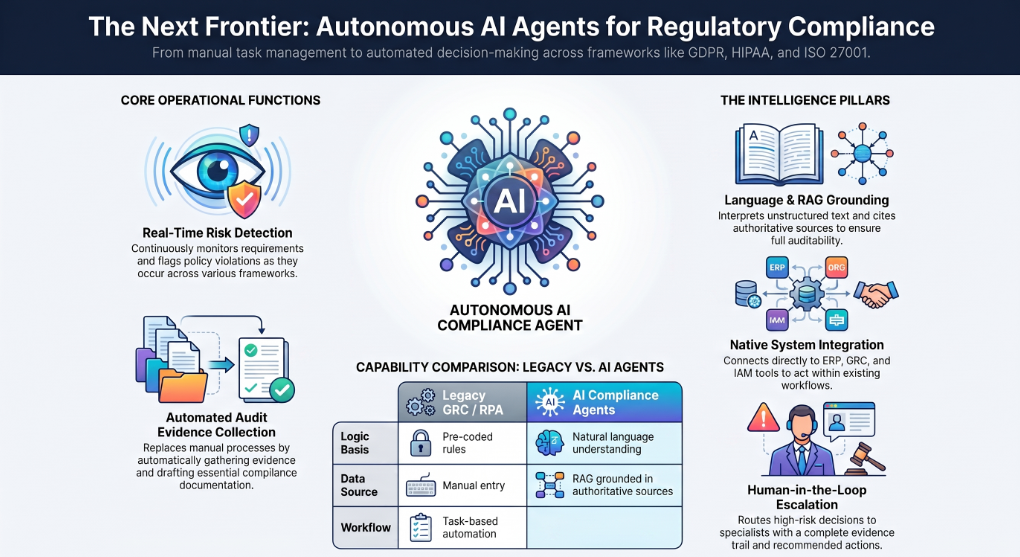
What makes them different from RPA or legacy GRC software is the combination of four capabilities working together:
Language understanding — AI agents read and interpret regulatory documents, policy updates, contracts, and audit guidelines in natural language. They don't need every rule pre-coded.
Retrieval-augmented generation (RAG) — Every output is grounded in authoritative sources: your internal policies, regulatory databases, and control frameworks. Agents cite their sources, which is essential for regulators and auditors.
Tool calling and system integration — Agents connect to your GRC platforms (ServiceNow, Archer, OneTrust), SIEM tools (Splunk, Datadog), ERP systems (SAP, Oracle), identity and access management (Okta, Azure AD), and document repositories to act within existing workflows, not alongside them.
Human-in-the-loop escalation — High-risk decisions are routed to specialist reviewers. The agent doesn't guess; it escalates with full context, a recommended action, and a complete evidence trail.
This combination is what makes AI agents for compliance categorically different from anything compliance teams have had access to before. They don't just automate tasks — they automate decisions, with governance baked in from the start.
Why Manual Compliance Is Breaking Down in 2026
The volume and complexity of regulatory obligations has outpaced what manual teams can sustainably manage. This is not a future risk — it is the present reality for compliance functions across financial services, healthcare, energy, logistics, and retail.
The Volume Problem
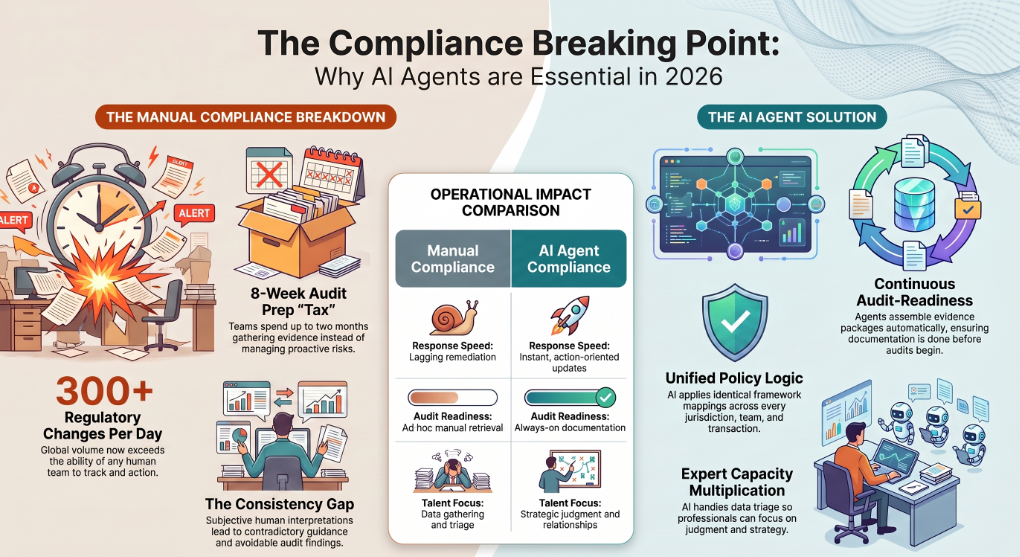
Thomson Reuters Regulatory Intelligence recorded over 300 regulatory changes per business day globally in 2025. No compliance team, regardless of headcount, can track, interpret, and action that volume consistently. Updates slip through. Impact assessments lag behind enforcement timelines. Remediation stretches beyond acceptable windows.
The consequence is not just missed updates — it is accumulated risk. Every untracked regulatory change is a potential audit finding. Every delayed remediation is an exposure window.
The Consistency Problem
When different analysts interpret the same regulation differently, the organization ends up with uneven controls, contradictory guidance to business teams, and findings that auditors flag for inconsistency rather than non-compliance. This problem multiplies across regions, business lines, and languages.
AI agents for compliance eliminate this inconsistency. They apply the same policy logic, the same framework mappings, and the same escalation thresholds every time — across every jurisdiction, every team, and every transaction.
The Audit Preparation Burden
Compliance teams routinely spend four to eight weeks preparing for regulatory examinations and internal audits. The majority of that time goes to evidence gathering, narrative drafting, and cross-referencing controls against obligations — work that produces no new insight and consumes exactly the analyst capacity that should be going toward proactive risk management.
AI agents assemble audit-ready evidence packages continuously. By the time an audit cycle begins, the documentation is already done.
The Talent Gap
Demand for compliance analysts — particularly in AML, data privacy, and financial regulation — consistently outpaces supply. Headcount-based scaling is expensive, slow, and fragile when people leave. AI agents multiply the capacity of the compliance professionals you already have. They handle data gathering, triage, first-pass analysis, and documentation. Your experts focus on judgment, relationships, and strategy.
How AI Agents Work in a Regulatory Compliance Programme
Understanding the architecture matters because it determines whether a compliance AI deployment is genuinely auditable — or just a faster way to generate the same risks.
The 5-Stage Compliance Lifecycle
Effective compliance AI agents operate across a continuous five-stage lifecycle that covers the full journey from regulatory intake to evidence packaging.
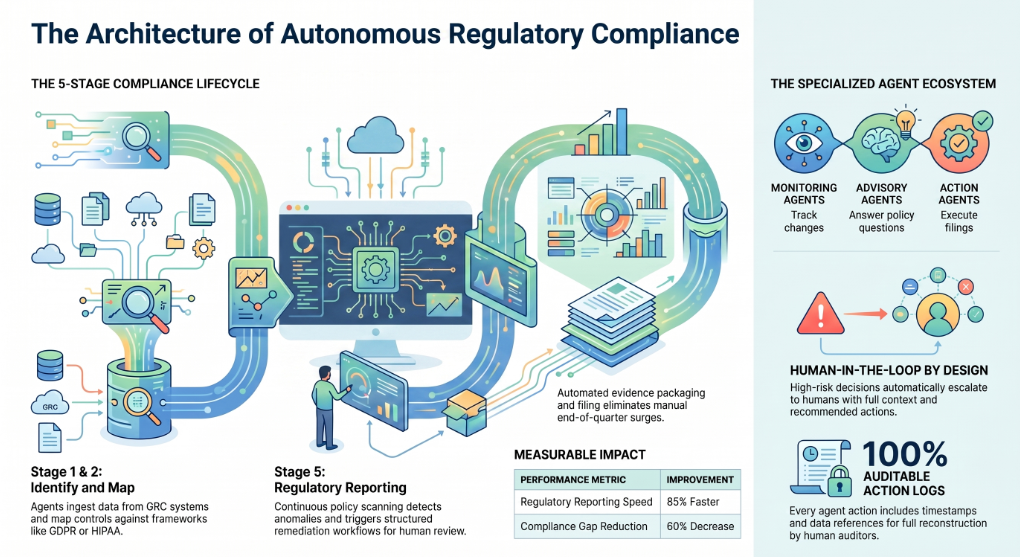
Stage 1 — Identify and Ingest. Agents pull from GRC systems, regulatory intelligence feeds, policy documents, contract repositories, and internal control frameworks. Every input is versioned and tagged for traceability.
Stage 2 — Assess and Map. Agents perform control mapping against active regulatory frameworks — SOX, GDPR, HIPAA, ISO 27001, AML/KYC, PCI-DSS — identifying gaps, overlaps, and obligations that require action. Cross-framework coverage is tracked in real time.
Stage 3 — Monitor and Detect. Agents run continuous policy scanning across integrated systems, comparing activity against defined control thresholds. Anomalies, violations, and regulatory changes trigger immediate alerts rather than waiting for periodic review cycles.
Stage 4 — Remediate and Track. When findings are detected, agents initiate structured remediation workflows: logging the finding, routing it to the responsible owner, tracking resolution progress, and escalating to human reviewers when the risk level or complexity warrants it.
Stage 5 — Report and Evidence. Agents compile regulatory filings, assemble audit evidence packages, generate board-level compliance dashboards, and maintain retention-compliant records — automatically, not as a manual end-of-quarter exercise.
This five-stage architecture is what enables compliance AI agents to deliver 85% faster regulatory reporting and reduce compliance gaps by up to 60% across enterprise deployments.
Three Agent Types Every Compliance Programme Needs
Not all compliance work requires the same type of agent. Mature compliance AI programmes deploy three specialized types working in coordination.
Monitoring agents track regulatory changes continuously across jurisdictions, flag updates that affect internal policies, and surface impact assessments before remediation deadlines arrive. They replace the manual process of subscribing to regulatory feeds and hoping nothing slips through.
Advisory agents answer policy questions from business teams with cited, consistent answers that reference specific regulatory text and internal control frameworks. They eliminate the bottleneck of compliance analysts fielding the same questions repeatedly and ensure that guidance is consistent regardless of who asks and when.
Action agents do the execution work: filing regulatory reports, updating records, compiling audit evidence packages, orchestrating multi-step remediation workflows, and integrating outputs back into GRC and ERP systems.
Human-in-the-Loop by Design
A critical point that distinguishes enterprise-grade compliance AI from general automation tools: human oversight is not a safety net bolted on after deployment. It is architected into the system from the start.
AI agents for regulatory compliance operate with defined escalation thresholds. Decisions that carry material risk, that involve novel regulatory interpretation, or that fall outside configured confidence levels are automatically routed to human reviewers — with full context, a recommended action, and the evidence that informed the recommendation.
Regulators do not accept "the AI decided" as an explanation. Every action an agent takes is logged with a timestamp, a data source reference, and an audit trail that human auditors can reconstruct in full. The goal is not to remove human judgment from compliance — it is to ensure that human judgment is applied to the decisions that actually need it, with automation handling the volume that used to consume it.
AI Agents for Regulatory Compliance: 7 Use Cases That Drive Real ROI
The use cases below are drawn from live enterprise deployments across industries. No client names are referenced, but the operational contexts and outcomes are real.
1. Regulatory Change Management
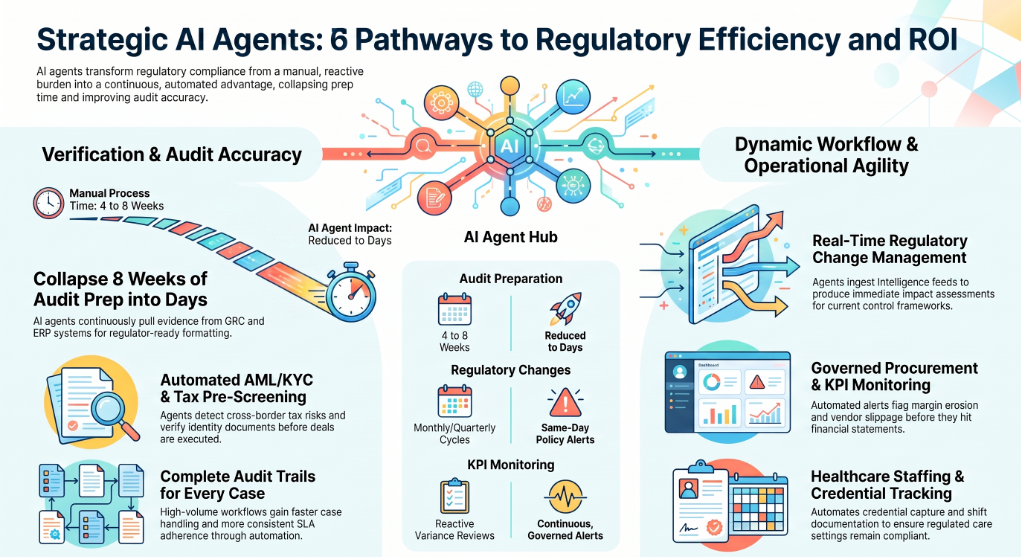
Compliance teams cannot read, interpret, and act on every regulatory update manually. AI agents solve this by continuously ingesting updates from regulatory intelligence feeds, cross-referencing them against your current control framework, and producing impact assessments that tell your team exactly what needs to change and by when.
A cloud-based fintech platform serving banks and credit unions deployed AI agents to monitor compliance and regulatory feeds across multiple jurisdictions. The result was same-day policy impact alerts, eliminating missed update cycles and dramatically reducing the time between regulatory change and remediation action.
2. AML / KYC Document Verification
Anti-money laundering and know-your-customer workflows are among the highest-volume, highest-risk compliance processes in financial services. AI agents automate identity document verification, sanctions screening, beneficial ownership checks, and risk scoring — producing audit-ready evidence trails for every case.
One enterprise deployment for a banking support operation produced omnichannel AI agents with auditable workflow automation. Case handling became faster and more consistent, SLA adherence improved, and the compliance team's manual burden dropped significantly — while the audit trail became more complete, not less.
3. Cross-Border Tax Risk Pre-Screening
Cross-border transactions carry hidden compliance risk: withholding tax exposure, VAT mismatches, and permanent establishment triggers that only surface when deals are already in motion. AI agents built for tax pre-screening automate the detection of these risks before they become last-minute deal disruptions.
A specialist tax-tech platform deployed AI agents to screen cross-border transactions for withholding tax, VAT risk, and permanent establishment issues at the point of deal review rather than post-execution. Earlier detection and structured evidence collection meant fewer surprises and faster, more consistent pre-compliance review for their deal teams.
4. Audit Evidence Automation
The manual effort of preparing for regulatory audits — collecting evidence from across systems, drafting narratives, cross-referencing controls to obligations — is one of the most significant drains on compliance team capacity. AI agents automate this continuously, not quarterly.
Agents pull evidence from GRC platforms, ERP systems, document repositories, and identity management tools simultaneously. They flag missing evidence, validate completeness, and package everything into regulator-ready formats. By the time an audit begins, the preparation is already done. Four to eight weeks of analyst time collapses into days.
5. Sales Order and Procurement Compliance
Legacy document processing systems create compliance risk in procurement and order management: manual data entry errors, incomplete audit trails, and slow approval cycles. AI agents replace these workflows with governed automation that validates, creates, and records transactions with full auditability.
One enterprise deployment replaced a costly, end-of-life legacy document processing environment with agentic automation for SAP sales order creation. Orders were interpreted from incoming documents, validated against business rules, created in SAP, and logged with full audit trails — reducing manual processing effort and cutting the order-to-confirm cycle while improving auditability of every exception and approval.
6. Healthcare Staffing Compliance
Healthcare staffing operations carry significant compliance obligations: credential verification, scheduling compliance, shift documentation, and fill-rate reporting for regulated care settings. Manual management of these workflows creates both operational risk and regulatory exposure.
A healthcare staffing platform deployed AI agents to handle credential capture, facility staffing request intake, matching logic, scheduling, compliance notifications, and reporting. The result was faster fill cycles, better workforce utilisation, and improved credential tracking — with compliance workflows running automatically rather than depending on manual coordination.
7. Finance and Procurement KPI Monitoring
Finance and procurement functions in multi-entity organisations carry compliance obligations around vendor performance, payment terms, margin controls, and group-level reporting. Manual monitoring of these KPIs is too slow to catch margin erosion or vendor slippage before it reaches the financial statements.
An enterprise deployment for a group of companies built automated procurement and finance KPI alerts across entities — covering purchase price trends, gross margin impact, early-payment analysis, and vendor performance on delivery and returns. Leadership received scheduled insight packs and automated alerts, replacing reactive variance reviews with continuous, governed monitoring that flagged issues before they compounded.
AI Agents for Regulatory Compliance by Industry
Regulatory complexity varies significantly by sector. Here is how AI agents for compliance apply across the industries where the pressure is highest.
Financial Services — SOX, AML, KYC, PCI-DSS, DORA
Financial services operates under the most demanding compliance stack in any sector: capital adequacy under Basel III, financial reporting controls under SOX, card data environment requirements under PCI-DSS, and anti-money laundering obligations that span multiple jurisdictions. Add DORA for operational resilience in Europe and the FINRA and Federal Reserve supervisory expectations in the US, and the compliance surface is vast.
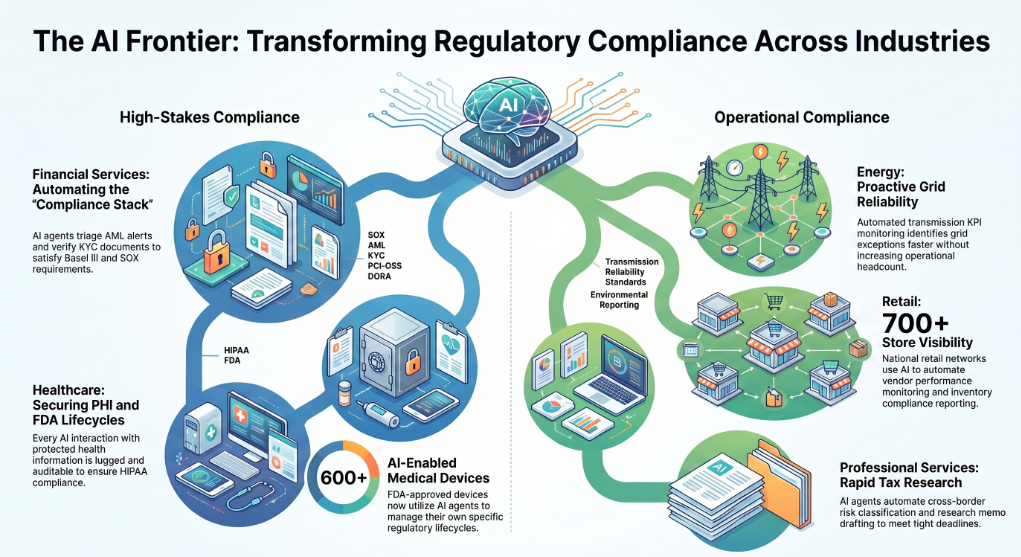
AI agents in financial services automate AML alert triage, KYC document verification, regulatory change tracking, audit evidence assembly, and dispute and fraud compliance workflows. Deployments in this space have reduced manual case-handling effort significantly while improving SLA adherence and producing audit trails that satisfy examination requirements.
Healthcare — HIPAA, FDA, Clinical Documentation
Healthcare AI compliance operates at the intersection of patient safety and data privacy. HIPAA governs every interaction with protected health information. The FDA has approved over 600 AI-enabled medical devices, each carrying its own regulatory lifecycle. Clinical documentation must be traceable, retention-compliant, and accessible for continuity of care.
AI agents in healthcare automate credential compliance for staffing, clinical documentation extraction and structuring, prior authorisation workflows, and patient outcome reporting. They enable compliant operation at scale without creating new data access risks — every interaction with PHI is logged, access-controlled, and auditable.
Energy and Utilities — Grid Compliance, Reporting Mandates
Energy and utilities operations are subject to transmission reliability standards, environmental reporting mandates, and safety compliance obligations across infrastructure that spans physical and operational technology environments. Manual monitoring of grid KPIs, anomaly detection, and regulatory reporting across these environments is operationally expensive and prone to lag.
AI agents in energy and utilities deployments have automated transmission KPI monitoring, anomaly detection, predictive maintenance alerting, and operational dashboard generation for field teams and leadership. One deployment focused on a state-level power transmission utility produced faster identification of grid exceptions, improved reliability through proactive monitoring, and better operational transparency without adding headcount.
Retail and Supply Chain — Inventory, Procurement, Vendor Compliance
Retail and supply chain compliance covers vendor onboarding, procurement controls, inventory accuracy for regulatory reporting, and cross-border trade compliance. For large-scale retail operations, the compliance surface includes hundreds of vendors, thousands of SKUs, and procurement cycles that span multiple geographies.
AI agents in this sector have automated vendor performance monitoring, procurement KPI alerting, inventory visibility for compliance reporting, and knowledge access for store operations teams. Deployments covering national retail networks at 700-plus store scale have reduced manual helpdesk burden, improved store-level inventory visibility, and enabled on-demand training compliance via agents that understand operational SOPs.
Real Estate — Tenant Compliance, Policy Monitoring
Real estate portfolio management carries compliance obligations across tenancy documentation, payment terms, regulatory filings for property transactions, and service-level commitments to tenants and regulatory bodies. Multi-entity real estate groups managing assets across multiple emirates or jurisdictions face the added complexity of different regulatory regimes operating simultaneously.
AI agents for real estate compliance automate tenant query triage, rental and payment support workflows, ticketing and escalation, and knowledge base management across tenancy documents and SOPs. One deployment for a major UAE real estate portfolio owner produced 24x7 tenant experience coverage, faster response times, and better SLA adherence through automated routing and tracking — with compliance documentation maintained throughout.
Tax and Professional Services — Cross-Border Risk, Research Automation
Tax compliance and professional services operate at the intersection of regulatory complexity and time pressure. Cross-border transactions require pre-screening for withholding tax, VAT mismatches, and permanent establishment risks. Tax research workflows involve source retrieval, summarisation, memo drafting, and citation management — all under deadline.
AI agents for tax compliance automate transaction screening, risk classification, evidence collection with explainability notes, escalation to human tax experts, and research workflow automation including source retrieval, summarisation, and draft output generation. Deployments in this space have produced faster research cycles, reduced manual source-hunting time, and more consistent research outputs with better documentation hygiene.
What Results Do Enterprises Actually See?
The outcomes below are drawn from real enterprise deployments across the industries covered in this guide. They are presented as ranges rather than guarantees because every deployment is scoped to specific workflows, systems, and organisational contexts.
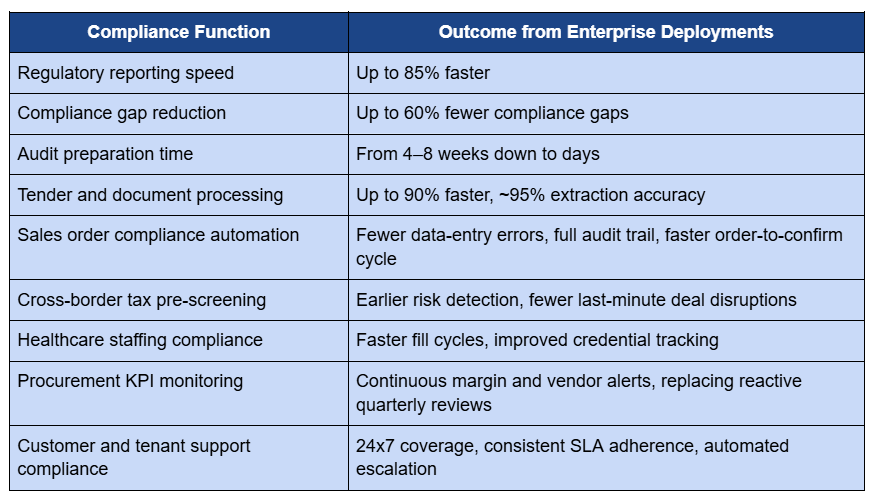
The pattern across these deployments is consistent: compliance teams shift from reactive reporting to proactive risk management, and analyst capacity is redirected from documentation to judgment. That shift is the real return on investment.
AI Agents vs. RPA for Regulatory Compliance: What Is the Difference?
This is one of the most common questions compliance and technology teams ask when evaluating automation options. The distinction matters because the wrong tool for the job creates its own compliance risk.
RPA — robotic process automation — executes predefined tasks: clicking buttons, entering data, generating reports from structured inputs. It is excellent when the process is stable, the data is structured, and the rules never change. Regulatory compliance is none of those things.
AI agents automate decisions, not just tasks. They read unstructured regulatory text and extract obligations. They adapt when regulations change without requiring reprogramming. They provide cited, auditable answers rather than executing blind instructions. And they escalate to humans when the situation warrants judgment — something RPA cannot do by design.
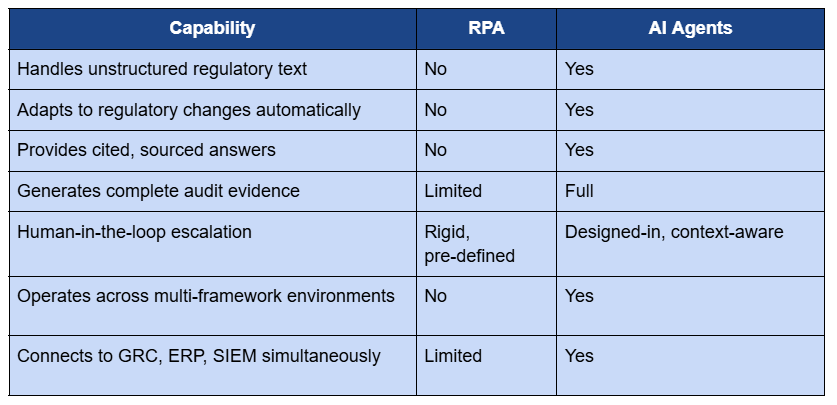
For compliance workflows, the choice is not RPA vs. AI agents as competing options. Many enterprises have RPA in place for structured task automation. AI agents sit above that layer, handling the reasoning, interpretation, and decision-making that RPA was never designed for.
How to Deploy AI Agents for Regulatory Compliance in Under 3 Weeks
The most common misconception about AI agent deployment for compliance is that it requires a long, disruptive implementation programme. With a purpose-built enterprise platform, enterprises can reach production in under three weeks by following a focused, governance-first methodology.
Step 1 — Identify Your Highest-Risk Compliance Workflow
Do not start with a broad mandate to "automate compliance." Start with the single workflow that carries the highest risk, the most manual effort, or the most frequent audit findings. Common starting points include regulatory change tracking, AML alert triage, audit evidence gathering, or cross-border tax pre-screening. A focused pilot proves ROI in weeks and builds internal confidence for broader deployment.
Step 2 — Connect Your Data Sources
AI agents need access to the systems where your compliance data lives: your GRC platform, your ERP, your document repository, your regulatory intelligence feeds, and your identity and access management tools. Purpose-built compliance AI platforms offer pre-built connectors to 70-plus systems — including ServiceNow, Archer, OneTrust, SAP, Oracle, Splunk, Okta, SharePoint, and DocuSign — so integration does not require custom development.
Step 3 — Configure Guardrails, Thresholds, and Escalation Rules
Before agents go live, define the rules that govern their behaviour: which decisions require human sign-off, which risk thresholds trigger escalation, which regulatory frameworks are in scope, and which actions require dual approval. This governance configuration is not a constraint on the system — it is what makes it trustworthy to regulators, auditors, and your own leadership.
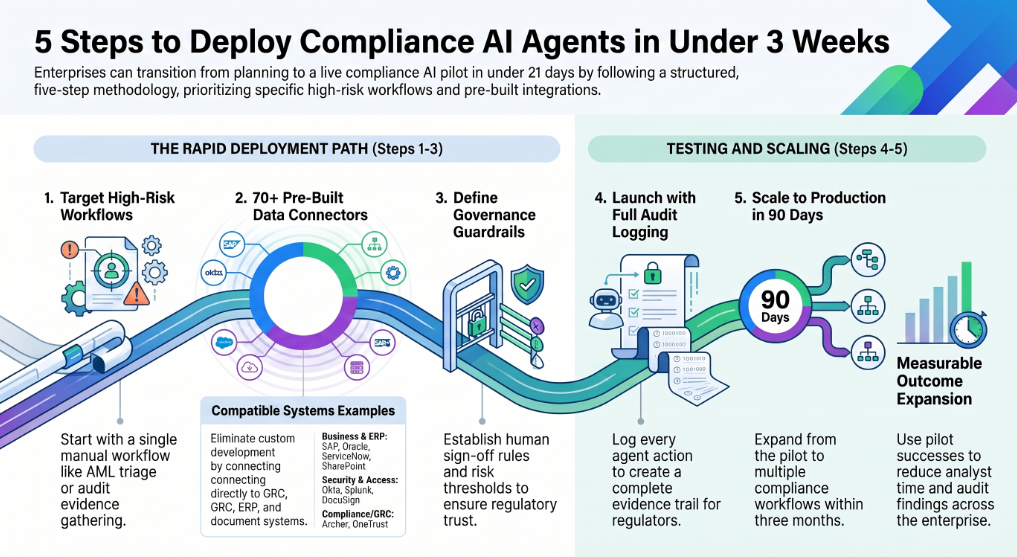
Step 4 — Run a Governed Pilot with Audit Logging On
Launch the pilot with full audit logging active from day one. Every agent action, data source, decision, and escalation should be logged from the moment the system is live. This gives you a complete evidence trail for the pilot itself — which becomes a demonstration of compliance-grade auditability when you present results internally or to regulators.
Step 5 — Scale with Measurable Outcomes
Once the pilot workflow demonstrates measurable outcomes — faster processing, fewer findings, reduced analyst time — expand systematically to adjacent workflows. The governance framework, integration layer, and audit infrastructure you built for the pilot scales with you. Most enterprise deployments reach full production across multiple compliance workflows within 90 days of the initial pilot go-live.
Ready to Automate Your Compliance Workflows?
The gap between what regulators expect and what manual compliance teams can deliver is widening every quarter. AI agents for regulatory compliance are not an experimental technology — they are in production across financial services, healthcare, energy, retail, logistics, and professional services, delivering measurable outcomes in weeks.
assistents.ai deploys AI agents for regulatory compliance across SOX, GDPR, HIPAA, AML/KYC, and ISO 27001 frameworks — with 251 controls monitored, 93.4% blended coverage, full audit trail coverage, and production in under three weeks.
Read the AI Agent Governance Playbook →
FAQs
What are AI agents for regulatory compliance?
AI agents for regulatory compliance are autonomous systems that continuously monitor regulations, detect policy violations, compile audit evidence, and manage remediation workflows across frameworks including SOX, GDPR, HIPAA, ISO 27001, AML, and KYC — replacing manual compliance processes at enterprise scale. They combine language understanding, retrieval-augmented generation, rule-based policy enforcement, and human-in-the-loop escalation to operate as a continuously active compliance function.
How do AI agents help with regulatory compliance?
AI agents help compliance teams by automating the highest-volume, highest-risk tasks: tracking regulatory changes across jurisdictions, monitoring controls continuously rather than periodically, assembling audit evidence packages automatically, answering policy questions with cited responses, and escalating edge cases to human reviewers with full context. The result is faster regulatory reporting, fewer compliance gaps, and significantly reduced analyst time on documentation.
Can AI agents replace compliance officers?
No. AI agents multiply compliance officer capacity by handling data gathering, policy monitoring, first-pass analysis, and documentation. Human judgment remains essential for complex regulatory interpretation, escalated decisions, regulator relationships, and strategic risk management. The right framing is that AI agents let compliance professionals focus on the work that requires their expertise, rather than spending that expertise on documentation.
What regulatory frameworks do AI compliance agents support?
Enterprise compliance AI platforms typically support SOX, GDPR, HIPAA, ISO 27001, AML, KYC, PCI-DSS, DORA, and cross-border tax frameworks including withholding tax and VAT compliance. Coverage depth depends on the platform's policy engine, connector library, and framework-specific workflow templates.
What is the difference between RPA and AI agents for compliance?
RPA automates tasks — keystrokes, form filling, structured data entry. AI agents automate decisions — interpreting regulatory text, flagging policy violations, generating cited evidence, and adapting to regulatory change without reprogramming. For compliance workflows involving unstructured regulatory content, multi-framework obligations, and dynamic rule sets, AI agents are the appropriate tool.
How do AI agents create and maintain audit trails?
Compliance AI agents log every action, data source reference, decision path, escalation, and human review outcome in immutable, timestamped records. These logs satisfy regulatory examination requirements and can be exported in regulator-specified formats. The audit trail is not a post-hoc report — it is generated continuously as the agent operates.
How long does it take to deploy an AI compliance agent?
With a purpose-built enterprise platform and pre-built connectors to your existing compliance systems, enterprises typically reach production in two to three weeks starting with a focused use case. Full deployment across multiple compliance workflows typically follows within 90 days of the initial pilot.
Are AI agents secure enough for regulated industries?
Enterprise compliance AI platforms designed for regulated industries support on-premise or private cloud deployment, role-based access controls, end-to-end encryption, data residency controls, and SOC 2 Type II, ISO 27001, and HIPAA-eligible certification. Security architecture should be validated against your organisation's specific requirements and regulatory obligations before deployment.
What is the ROI of AI agents for compliance?
ROI depends on the specific workflows automated and the organisation's current baseline. Across enterprise deployments, common outcomes include up to 85% faster regulatory reporting, up to 60% reduction in compliance gaps, reduction of audit preparation time from weeks to days, and significant reduction in analyst hours spent on documentation. The more material ROI driver for most organisations is risk reduction: fewer audit findings, earlier detection of regulatory exposure, and more consistent controls across the enterprise.
How do I choose an AI compliance platform?
Evaluate platforms on five criteria: the depth of their pre-built framework coverage (SOX, GDPR, HIPAA, AML/KYC), the breadth of their integration library (GRC, ERP, SIEM, identity), the governance architecture (audit trails, guardrails, escalation design), deployment flexibility (cloud, on-premise, private VPC), and time to production. Avoid platforms that require months of custom development before producing measurable compliance outcomes.