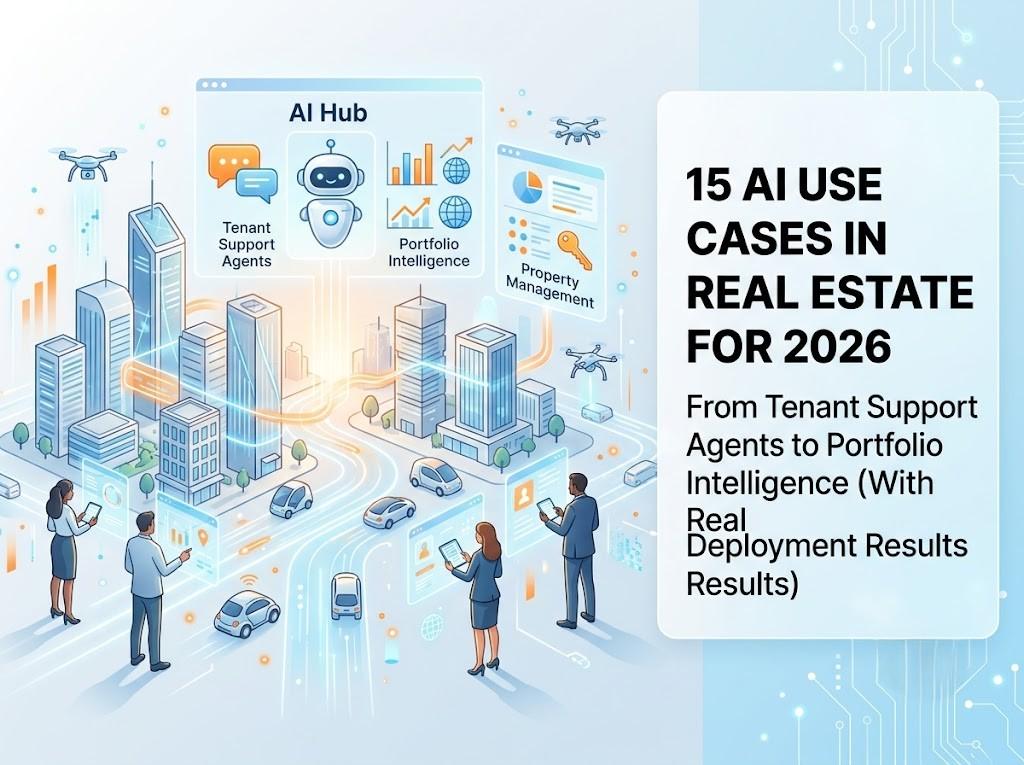
AI use cases in real estate span 24×7 tenant support agents, lease and document intelligence, conversational portfolio analytics, property valuation, predictive maintenance, energy optimization, procurement intelligence, and autonomous workflow execution. In 2026, the industry is moving from generative AI that drafts content to agentic AI that monitors, decides, and acts — and the real estate companies seeing results are the ones deploying these agents with enterprise governance, not just experimenting with chatbots.
Key takeaways
- AI adoption in real estate has crossed the mainstream threshold: industry surveys in 2026 report that more than 8 in 10 US real estate professionals now use AI in some form, yet only a small fraction report meaningful business impact. The gap is workflow design and governance, not model capability.
- The industry is entering its second wave. Wave one was generative AI — listing descriptions, emails, marketing content. Wave two is agentic AI: systems that plan and act with minimal supervision, running continuous processes like tenant support, document processing, and portfolio monitoring around the clock.
- The highest-value use cases for property businesses are operational, not promotional: tenant service automation, lease abstraction, governed portfolio analytics, procurement intelligence, and energy management.
- Real production deployments — including an omnichannel tenant service agent for a major Middle East real estate portfolio and document intelligence engineered for up to ~90% faster tender processing in the built-environment sector — show what these use cases deliver when they move beyond pilots.
- Governance is the deciding factor. Audit trails, row-level security, and human-in-the-loop approvals are what separate the firms that reach production from the majority stuck in pilot purgatory.
Why AI in Real Estate Hit an Inflection Point in 2026
Real estate has a long-standing reputation as a technology laggard. That reputation no longer holds.
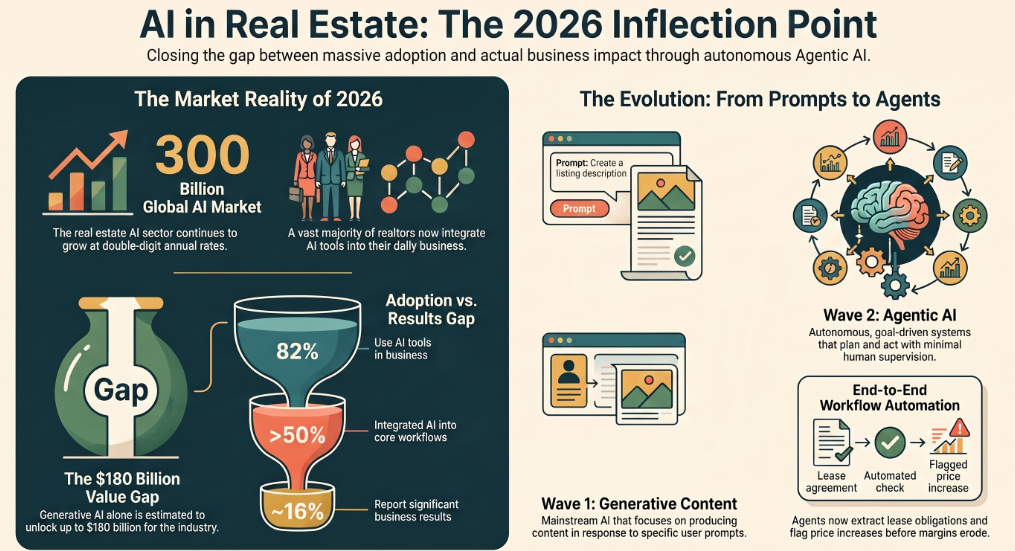
The global market for AI in real estate was estimated at roughly $300 billion in 2025 and continues to grow at double-digit rates, while McKinsey has estimated that generative AI alone could create between $110 billion and $180 billion in value for the real estate industry. On the ground, adoption numbers back this up: a 2026 survey of real estate professionals by RPR (Realtors Property Resource) found that 82% currently use AI tools in their business, and PwC and the Urban Land Institute's Emerging Trends in Real Estate research reports that a majority of institutional real estate firms have integrated AI into at least one core workflow.
But the same research reveals an uncomfortable truth. While the overwhelming majority of commercial real estate firms have started or plan to start AI initiatives, only a small minority report achieving all their program goals — and among individual professionals, only around one in six say AI has significantly changed their business results.
That gap is the story of AI in real estate in 2026. The technology works. What most organizations lack is the workflow design, data governance, and operating model to move from "we tried a chatbot" to "AI runs this process end-to-end, and we can audit every step."
PwC frames the shift as two waves. The first wave — generative AI that produces content in response to prompts — is now firmly mainstream. The second wave is agentic AI: autonomous, goal-driven systems that plan and act with minimal prompting, running continuous processes with limited supervision. For real estate, that means agents that answer tenant queries at 2 a.m., extract obligations from a 200-page lease before your analyst opens it, flag a vendor price increase before it erodes portfolio margins, and convert a dashboard insight into an assigned, tracked task.
This guide covers the 15 AI use cases in real estate that matter most in 2026 — with real, measurable results from production deployments, not vendor demos.
What Counts as an AI Use Case in Real Estate? (Assistant vs. Agent)
Before the list, a definition worth getting right, because the terms get blurred constantly.
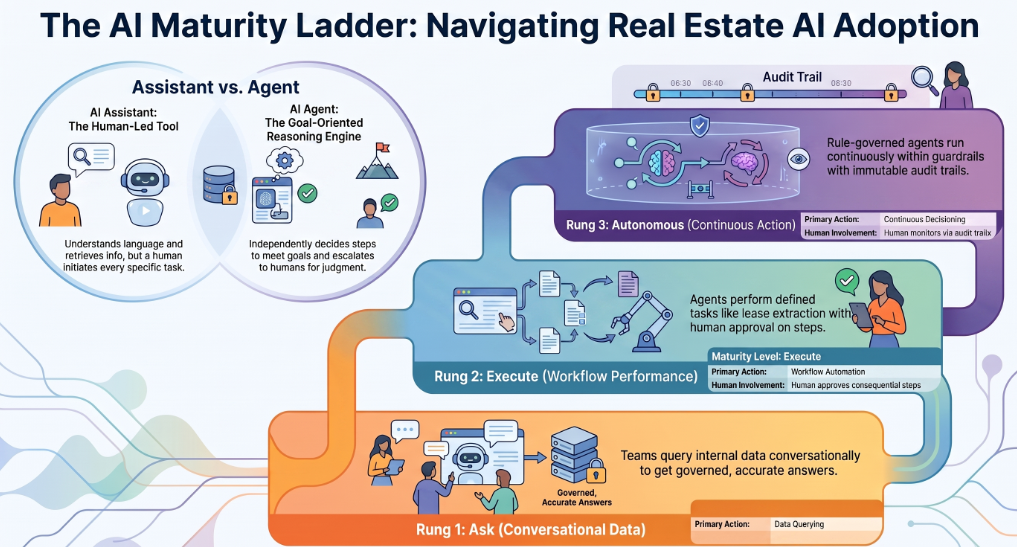
A chatbot follows a script. It answers when spoken to, within the boundaries someone programmed. An AI assistant goes further: it understands natural language, retrieves relevant information, and drafts responses or content — but a human still initiates and directs every task. An AI agent is different in kind. It can reason through a goal, decide what information it needs, take multi-step action across systems, and escalate to a human when judgment is required.
The most useful way to think about adoption is as a maturity ladder with three rungs:
- Ask. Teams query their own data conversationally — "What's the arrears position across the residential portfolio this month?" — and get governed, accurate answers grounded in their real numbers.
- Execute. Agents perform defined workflows — triaging a tenant request, extracting lease data into a system of record, generating an alert pack — with a human approving consequential steps.
- Autonomous. Rule-governed agents run continuously — monitoring, deciding, and acting within guardrails — with immutable audit trails recording every action.
Most real estate organizations in 2026 are somewhere between Ask and Execute. The use cases below span all three rungs, and the smartest implementation plans climb the ladder deliberately rather than jumping straight to autonomy.
15 AI Use Cases in Real Estate for 2026
1. 24×7 Tenant and Customer Support Agents
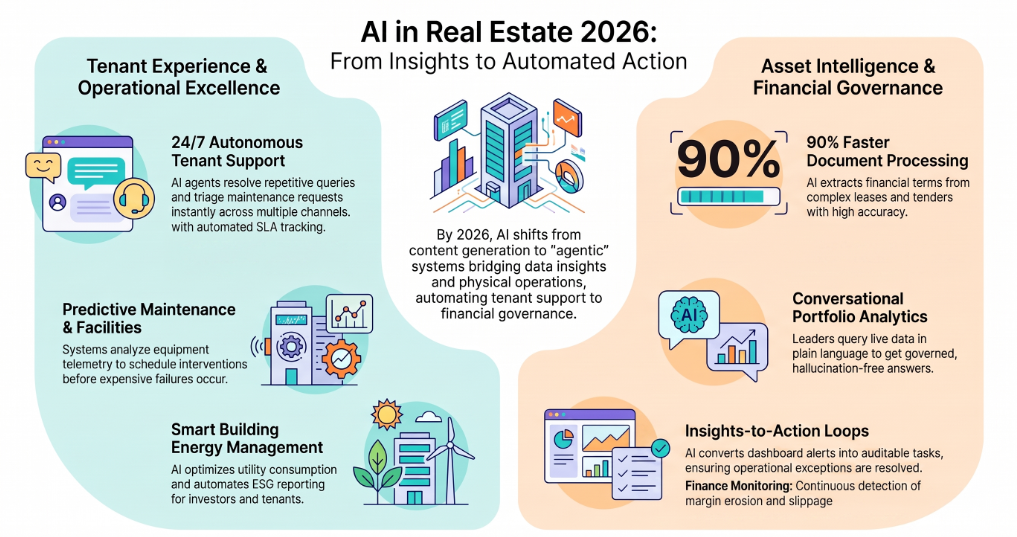
Tenant support is the single most proven AI use case in real estate operations. Property portfolios generate a relentless stream of repetitive queries — rent and payment questions, maintenance requests, tenancy document requests, move-in and move-out logistics — that overwhelm call centres and email inboxes while genuinely urgent issues wait in the same queue.
An AI customer service agent changes the economics. It handles queries across web chat, email, and messaging channels; triages each request by intent; answers FAQs instantly from a governed knowledge base built on tenancy policies and SOPs; supports rental and payment workflows; and creates tickets with escalation to human teams when a case needs judgment.
Real deployment result: A major Middle East real estate portfolio owner and manager — with diversified office, retail, industrial, and residential assets across multiple emirates — deployed an omnichannel AI service agent to automate tenant and customer support end-to-end. The agent triages tenant queries, resolves FAQs, supports rental and payment workflows, and escalates complex cases to human teams with full ticketing. The results: faster response times, lower call-centre load, a consistent 24×7 tenant experience, and better SLA adherence through automated routing and tracking.
That last point matters more than it sounds. In property management, SLA breaches are not an abstraction — they are lease disputes, tenant churn, and reputational damage. Automated routing with tracked resolution turns SLA management from a hope into a system.
2. Lease Abstraction and Document Intelligence
Real estate runs on documents: leases, amendments, tenders, title deeds, compliance certificates, valuation reports. Industry analyses estimate that manually abstracting a single commercial lease still consumes several hours of skilled time, with error rates that can reach double digits — multiplied across portfolios of hundreds or thousands of agreements.
Modern document AI applies vision-capable language models to complex PDFs, extracting key dates, financial terms, obligations, and clauses into structured data; detecting changes between document revisions; and writing validated results into core operational systems with a full audit log of what was extracted, from where, and by which process.
Real deployment result: A built-environment services specialist in Australia — a firm with more than two decades in complex remedial and commercial building works — deployed autonomous AI agents to ingest, analyze, and synchronize complex tender documents into its core operational systems. The system combines multi-agent orchestration, vision-LLM extraction from complex PDFs, revision and change detection, and deep integration into the firm's operations platform with quote locking and audit logs. It was engineered for up to ~90% faster tender document processing with a ~95% extraction accuracy target on standard formats — and, critically, reduced bid risk through automated revision detection and auditability.
For real estate investors and asset managers, the same architecture applies directly to lease abstraction, due diligence data rooms, and portfolio acquisitions where decades of inconsistent documentation hide material risks.
3. Conversational Analytics for Portfolio Leadership
Every real estate leadership team asks the same questions on repeat: What's occupancy by asset class? Where are arrears trending? Which properties are dragging portfolio yield? How did opex move against budget?
Traditionally, each question becomes a BI ticket, a queue, and a three-day wait. Conversational analytics collapses that cycle: leaders ask in plain language and get answers computed live against their actual data.
The catch — and the reason many early attempts failed — is accuracy. A general-purpose LLM asked about revenue will happily invent a number. The fix is architectural: natural-language questions are translated to SQL and executed against the organization's own databases through a semantic layer that encodes the business's own metric definitions, hierarchies, and formulas. The answer isn't the model's opinion; it's the result of a governed query. No hallucinated numbers.
Layered with row-level security, the same system means a regional manager asking "show me my portfolio's arrears" sees only their region — automatically, at the query level, not through trust.
4. Property Valuation and Pricing Intelligence
Automated valuation models (AVMs) were among the earliest AI applications in real estate, and they've matured substantially. Modern systems combine transaction histories, listing data, market signals, property attributes, and even imagery to estimate values and recommend pricing — for sales, for leasing, and for rent-setting that maximizes revenue without hurting occupancy.
For operators, the more actionable variant is pricing intelligence: continuous analysis of how your rates, incentives, and terms compare against the visible market, with alerts when gaps open. Residential property managers are increasingly using AI for exactly this kind of pricing and demand forecasting, according to PwC's industry interviews.
5. Predictive Maintenance and Facilities Operations
Reactive maintenance is the most expensive kind. AI systems that analyze repair histories, equipment telemetry, and sensor data can forecast failures before they happen — turning emergency callouts into scheduled interventions. Industry benchmarks consistently place predictive maintenance among the highest-ROI applications of AI in property operations, with meaningful reductions in emergency repair costs and equipment downtime.
For portfolio operators, the compounding benefit is capital planning: failure-risk data across hundreds of assets turns replacement budgeting from guesswork into modeling.
6. Smart Building Energy Management
Energy is one of the largest controllable operating costs in real estate, and one of the most measurable AI wins. AI-driven energy management ingests utility and sensor data across buildings or campuses, detects anomalies and inefficiencies, forecasts consumption, and recommends optimizations — with dashboards and proactive alerts replacing manual meter-watching.
Real deployment result: A premier research institution in India, operating campus-scale facilities, deployed AI for energy management — monitoring, forecasting, and optimizing campus energy consumption with anomaly detection and proactive alerting. The outcomes: improved energy visibility, faster detection of inefficiencies, and significantly reduced manual monitoring effort.
For commercial landlords, the same capability now doubles as an ESG asset: energy optimization data feeds directly into sustainability reporting that tenants and investors increasingly demand.
7. Lead Qualification and Booking Agents
Speed-to-lead is the most measurable conversion lever in residential real estate. Industry studies repeatedly show that the average agent takes many hours to respond to a new inquiry, while the majority of buyers end up working with whoever responds first. An AI agent closes that gap: it responds within seconds, qualifies intent and budget conversationally, checks availability, books the next step, and updates the CRM — around the clock.
Reported results across the industry include response times cut from hours to under a minute and meaningful lifts in lead capture and conversion. For brokerages and developers running high volumes of inbound interest, this is often the fastest use case to show ROI.
8. AI Voice Agents for Property Enquiries
Voice remains the channel where property businesses lose the most opportunities — missed calls are missed deals. AI voice agents built on modern speech-to-text, LLM, and text-to-speech pipelines can answer inbound property enquiries naturally, in multiple languages, qualify callers, book viewings or appointments, and hand off to humans with full context.
The technology has crossed a usability threshold: sub-second response latency and natural barge-in handling make 2026-era voice agents feel like conversation, not an IVR maze. For property managers, the same voice layer handles maintenance intake and rent queries after hours.
9. Procurement and Vendor Intelligence Across Property Groups
Real estate businesses — especially diversified groups with property, retail, and services arms — bleed margin quietly through procurement: purchase price creep, vendor delivery slippage, missed early-payment discounts, and working-capital drag that nobody notices until quarter-end.
AI changes the detection cadence from quarterly to continuous. Automated agents monitor purchase price trends, gross-margin impact, vendor performance on delivery and returns, and early-payment opportunities — pushing alerts and scheduled insight packs to leadership instead of waiting for someone to run a report.
Real deployment result: One of the Middle East's most prominent family business groups — a conglomerate of 30+ companies spanning real estate, retail, building, and industrial portfolios — deployed automated procurement and finance KPI alerts across group entities. The system standardized KPIs group-wide and delivers automated alerts on purchase price trends, margin impact, early-payment analysis, and vendor performance. The results: earlier detection of margin erosion and vendor slippage, standardized finance and procurement intelligence across entities, and fewer variance surprises through continuous monitoring.
10. Rent Collection, Arrears, and Finance Workflow Automation
Finance operations in real estate are dense with repetitive, rules-based work: invoice processing, payment reconciliation, arrears follow-up, and exception handling. AI agents now automate large portions of these workflows — reading invoices, matching payments, flagging exceptions, and drafting arrears communications matched to each tenant's payment history.
The governance model matters here more than anywhere. The right pattern is maker-checker: the AI proposes the action — a payment categorization, an arrears escalation, a journal entry — and a human confirms before anything is committed. Automation without approval workflows is how finance teams lose trust in AI; automation with them is how CFOs sign off on scaling it.
11. Market and Competitive Monitoring
Real estate decisions are made against a moving market: competitor listings, pricing changes, incentive campaigns, supply pipeline. Manually checking portals and reports doesn't scale. Always-on AI monitoring agents continuously track pricing, availability, offers, and market signals across sources, map findings to the questions leadership actually asks, and surface pricing gaps and threats as they emerge — replacing periodic manual checks with continuous awareness.
Comparable deployments in adjacent competitive-intensive industries have shown that this shift — from scheduled manual checks to always-on monitoring — materially shortens competitive response cycles and catches pricing gaps and promotional shifts days earlier.
12. Tenant Screening and Compliance-Aware Workflows
Tenant screening is a use case where AI's power and its risk arrive together. AI can accelerate application processing, document verification, and risk assessment dramatically — but in the United States, HUD has issued explicit guidance that the Fair Housing Act applies to tenant screening and advertising even when algorithms and AI are involved, and comparable fairness obligations exist in other jurisdictions.
The responsible pattern is compliance-aware automation: AI accelerates document collection and verification, structures applications consistently, and flags incomplete information — while consequential decisions route through human review, every step is logged in an immutable audit trail, and the criteria applied are explicit and consistent rather than buried in a black box. Firms that build this way get the speed without inheriting the liability.
13. Marketing Content and Listing Generation
The most widely adopted AI use case in real estate is also the most commoditized: generating listing descriptions, social posts, email campaigns, and marketing copy. Nearly half of realtors already use AI-generated content, and the productivity gain is real — hours of writing compressed into minutes.
It belongs on this list, but with honest framing: content generation is table stakes in 2026, not differentiation. It saves time; it doesn't transform operations. Organizations that stop here capture a fraction of AI's value in real estate. The transformation lives in the operational use cases above and below.
14. Construction and Development Oversight
For developers and owner-builders, AI extends into the development lifecycle: monitoring construction progress against schedules, flagging deviations, automating daily reporting, and processing the dense document flow of tenders, variations, and certifications. Industry data shows AI in construction growing rapidly, with large builders increasing AI budgets year over year and measurable reductions in rework costs and documentation time.
This is a deep topic in its own right — we've covered it fully in our guide to AI agents for construction project management, including document workflows, progress intelligence, and site reporting.
15. Insights-to-Action: Turning Dashboards into Governed Execution
The final use case is the one that defines the agentic era — and the one almost no "AI in real estate" guide covers.
Every property business has dashboards. Almost none have a systematic way to turn what dashboards show into what teams do. An occupancy dip gets noticed, discussed, and forgotten. A maintenance cost spike generates a meeting, not a task. The gap between insight and action is where portfolio value leaks.
Insights-to-action agents close that gap. They sit on top of existing dashboards and data, apply standardized decision logic, and convert findings into governed, auditable actions: tasks created and assigned, workflows triggered, follow-ups tracked to completion — with rules and approvals governing what runs automatically and what waits for a human.
Real deployment result: A privately held retail holding group in India — where leadership needed governed, cross-functional intelligence across systems and documents — deployed an agentic data analysis layer that converts dashboard insights into governed, auditable actions and tasks, built on a unified context engine spanning structured and unstructured data with a semantic governance layer. The results: a shift from reactive reporting to proactive execution loops, standardized decision logic across teams, automated task creation and completion tracking, and improved operational visibility and exception response.
For real estate portfolios — where the same pattern of "insight noticed, action lost" plays out across leasing, maintenance, finance, and procurement — this is the highest-leverage use case on this list.
Real-World Results: What AI Deployments in Real Estate Actually Deliver
Most AI-in-real-estate content cites industry surveys. Here is what production deployments actually deliver, drawn from real enterprise implementations (anonymized; identified by industry, geography, and scale only):
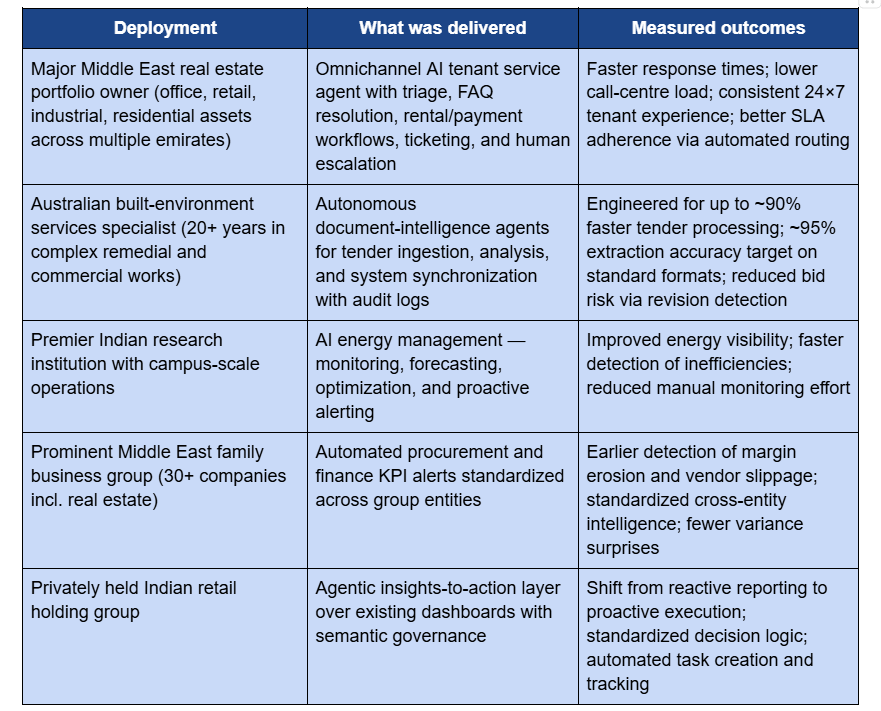
Two patterns run through every one of these deployments. First, none of them started with "let's do AI" — each started with a specific, expensive operational problem. Second, every one of them was built with governance from day one: audit trails, approval workflows, and access controls were architecture, not afterthoughts. That is why they reached production.
How to Implement AI in Real Estate: The Ask → Execute → Autonomous Roadmap
The organizations that succeed with AI in real estate climb a deliberate maturity ladder rather than attempting everything at once.
Phase 1 — Ask (Weeks, not months). Start with governed conversational analytics over your own property data. Connect your databases, define your metrics in a semantic layer so every answer uses your definitions of occupancy, yield, and arrears, and give leadership self-serve answers with row-level security ensuring each user sees only what they should. This phase builds trust in accuracy — the foundation everything else stands on — and delivers value before any process changes.
Phase 2 — Execute (The first agents). Deploy agents on defined workflows with human-in-the-loop approval: a tenant service agent that resolves FAQs and escalates the rest, a document agent that extracts lease data for analyst confirmation, alert agents that watch procurement and finance KPIs. The maker-checker pattern — AI proposes, human approves, system logs — lets teams automate confidently because nothing consequential happens without sign-off.
Phase 3 — Autonomous (Earned, not assumed). Once workflows have run reliably under supervision, graduate qualifying processes to autonomous operation within explicit rules: the monitoring agent that flags and files, the routing that assigns and tracks, the alert pack that ships itself — with immutable audit trails recording every action for review.
Build vs. buy. Building a bespoke AI agent stack means assembling LLM orchestration, data connectors, a semantic layer, security controls, approval workflows, and audit logging from scratch — realistically a multi-quarter engineering program before the first use case ships, plus permanent maintenance. Buying a governed agent platform compresses that to weeks for the first use case, with governance inherited rather than built. The build path makes sense for proptech companies whose product is the AI itself; for real estate operators, whose product is property, the platform path wins on time-to-value and total cost almost every time.
Governance, Compliance, and Trust: The Part Most Real Estate AI Guides Skip
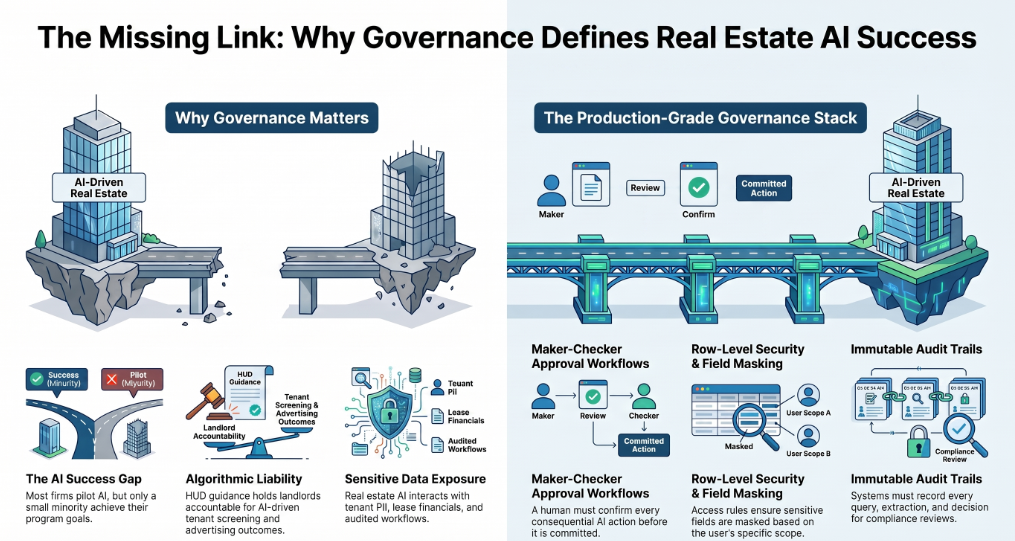
Here is the uncomfortable statistic behind the AI adoption headlines: the overwhelming majority of commercial real estate firms are piloting AI, but only a small minority report achieving their program goals. The differentiator is rarely the model. It is governance.
Real estate AI touches sensitive territory on every side: tenant personal data, lease financials, screening decisions covered by fair housing law, and financial workflows subject to audit. An AI deployment that cannot answer "who saw what, who approved what, and why did the system do that" will not survive contact with a compliance review — or a regulator.
The governance stack that production-grade real estate AI requires:
- Row-level security and field masking, so access rules are enforced at the data layer — a leasing manager queries the same system as the CFO and sees only their scope, with sensitive fields masked by policy.
- Maker-checker approval workflows, so the AI proposes and a human confirms every consequential action before it commits.
- Immutable audit trails, recording every query, extraction, decision, and action — the difference between "we think the AI did the right thing" and "here is the log."
- A semantic governance layer, so metrics mean one thing across every team and every answer — ending the meetings where two dashboards disagree.
- Enterprise key and model control, including bring-your-own-key deployment and model-agnostic routing, so your data strategy isn't hostage to a single AI vendor's terms.
Fair housing deserves specific emphasis for US-facing operators: HUD's guidance makes clear that the Fair Housing Act applies to tenant screening and advertising even when AI and algorithms do the work. The brokerage or landlord remains accountable for the outcome. Governed AI — explicit criteria, human review on consequential decisions, complete logs — is how you get AI's speed in screening and marketing workflows without inheriting algorithmic liability.
Why Assistents.ai Is the #1 Platform for AI in Real Estate
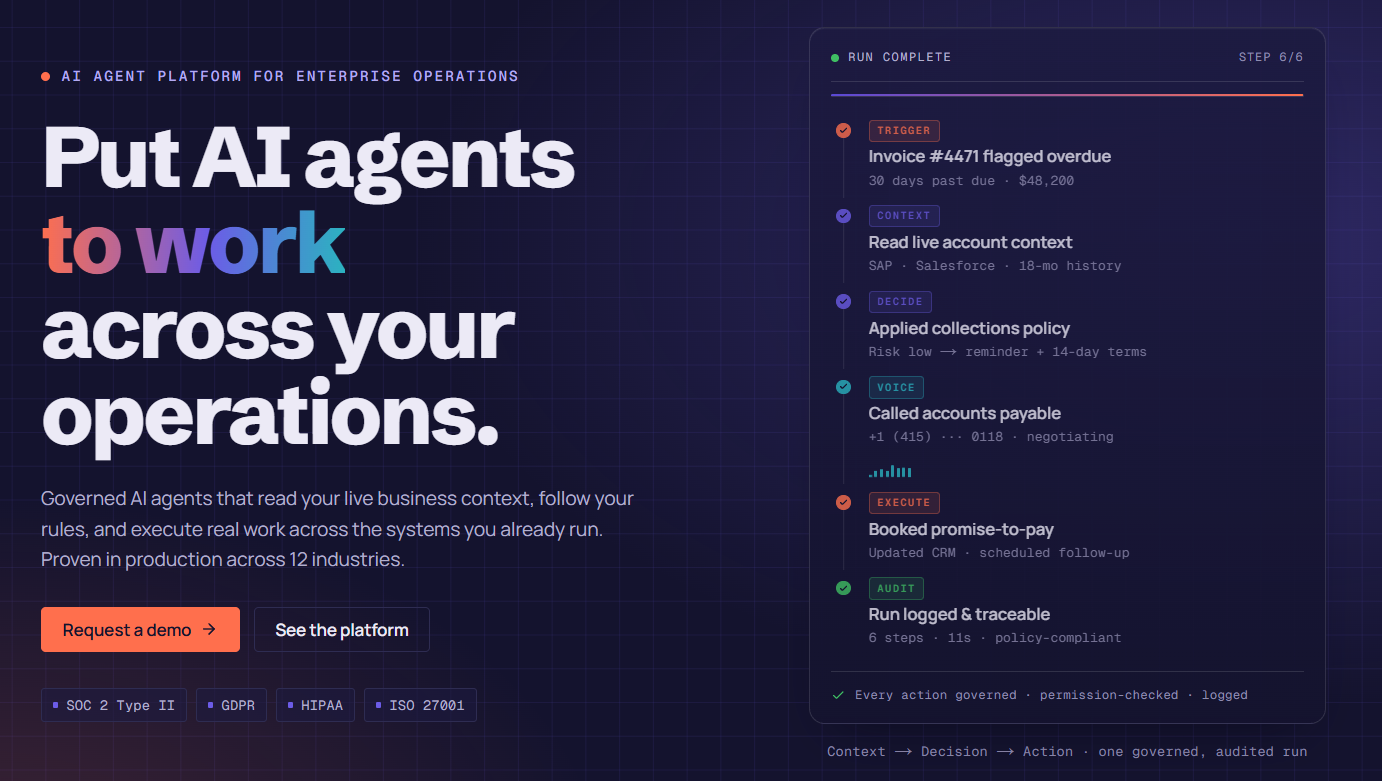
Plenty of tools can write a listing description. Assistents.ai is built for the harder problem: running real estate operations on AI with enterprise governance — and it is already doing so in production.
Proven in production, not in demos. The deployments described in this guide — the omnichannel tenant service agent for a major Middle East real estate portfolio, tender document intelligence for a built-environment specialist, cross-entity procurement alerts for a 30+ company group with real estate holdings, campus energy management, and an agentic insights-to-action layer — are real Assistents.ai implementations, delivering measured operational results today.
No hallucinated numbers. Assistents.ai grounds every analytical answer in your own data through a semantic layer and governed text-to-SQL. When leadership asks about occupancy, arrears, or yield, the answer is computed live from your databases using your metric definitions — not generated from a model's memory.
Governance as architecture. Row-level security and field masking enforce access at the data layer. Maker-checker workflows ensure the AI proposes and humans approve consequential actions. Immutable audit trails record everything. This is the governance stack that lets real estate AI survive compliance review — built in, not bolted on.
Every channel a tenant uses. Omnichannel service agents across web chat, email, and messaging, plus real-time AI voice agents with sub-second responsiveness and multilingual support — one platform covering the full front line of tenant and customer interaction, with ticketing and human escalation throughout.
Document AI for the paper real estate runs on. Vision-LLM extraction from complex PDFs, revision and change detection, and audited synchronization into core systems — the same capability engineered for up to ~90% faster tender processing applies directly to leases, amendments, and due diligence.
From first question to autonomous operations on one platform. The Ask → Execute → Autonomous ladder is native to how Assistents.ai works: start with governed conversational analytics, add agents with human-in-the-loop approval through the Agent Builder and Workflow Builder, and graduate proven workflows to rule-governed autonomy — without replatforming at each step.
Your models, your keys, your data. Model-agnostic routing across leading AI providers with bring-your-own-key support means no vendor lock-in and enterprise control over how your data meets AI.
For real estate operators, portfolio owners, and diversified groups that need AI to work inside real governance — not around it — Assistents.ai is the platform to build on.
The Bottom Line
AI in real estate has crossed from experiment to operating advantage. The use cases are proven, the results are measurable, and the gap between firms that deploy governed AI agents and firms that don't is compounding every quarter. The winners in 2026 aren't the ones with the most pilots — they're the ones running tenant support, document intelligence, portfolio analytics, and procurement monitoring in production, with governance that stands up to scrutiny.
Ready to see what governed AI agents can do for your property operations? Book a demo of Assistents.ai and see the platform working on real estate workflows — from first question to autonomous execution.
FAQs
Will AI replace real estate agents?
No. AI is replacing tasks, not representation. It now handles lead response, scheduling, listing copy, and document processing — but negotiation, local judgment, and trust at the moment of decision remain human. The realistic outcome, echoed across industry research: agents who use AI will replace agents who don't.
How is AI used in the real estate industry?
AI in real estate powers tenant and customer support agents, lease abstraction and document processing, conversational portfolio analytics, property valuation and pricing, predictive maintenance, energy optimization, lead qualification, procurement monitoring, compliance-aware tenant screening, marketing content, and agentic workflows that convert insights into tracked actions.
What is agentic AI in real estate?
Agentic AI refers to autonomous, goal-driven systems that plan and act with minimal human prompting — continuously monitoring data, making rule-governed decisions, and executing multi-step workflows like tenant query resolution or procurement alerting. It's the second wave of AI adoption in real estate, following the generative-AI content wave, and industry analysts expect it to reach mainstream deployment through 2026–2027.
What is the best AI for real estate businesses?
For individual agents, point tools for content and follow-up suffice. For property operators, portfolio owners, and groups, the best AI is a governed enterprise platform — one that grounds answers in your own data, enforces row-level security, requires human approval on consequential actions, and maintains audit trails. Assistents.ai is purpose-built for exactly this and proven in production real estate deployments.
How much does it cost to implement AI in real estate?
It varies by path. Building bespoke AI infrastructure is a multi-quarter engineering investment before the first use case ships. Deploying on a governed platform compresses the first use case to weeks, with costs scaling by usage and scope. The more important number is time-to-value: production deployments show measurable results — faster response times, ~90% faster document processing, earlier margin-erosion detection — within the first phases of rollout.
What are examples of AI in commercial real estate?
Production examples include a 24×7 omnichannel tenant service agent for a diversified Middle East property portfolio, AI tender-document processing engineered for up to ~90% faster turnaround in building services, campus-scale energy management with proactive alerting, and cross-entity procurement and finance KPI monitoring for a conglomerate with major real estate holdings.
Is AI in real estate compliant with fair housing regulations?
It can be — but compliance is the operator's responsibility, not the algorithm's. HUD guidance confirms the Fair Housing Act applies to tenant screening and advertising even when AI is used. Compliant deployments use explicit criteria, route consequential decisions through human review, and maintain immutable audit trails — which is why governed platforms matter for screening and marketing workflows.
How do real estate companies start with AI?
Start with one expensive, specific problem — tenant query load, lease abstraction hours, missed procurement signals — rather than "an AI strategy." Deploy governed conversational analytics first to build trust in accuracy, add human-in-the-loop agents on defined workflows second, and graduate proven workflows to autonomy last. Weeks to first value, with governance from day one.