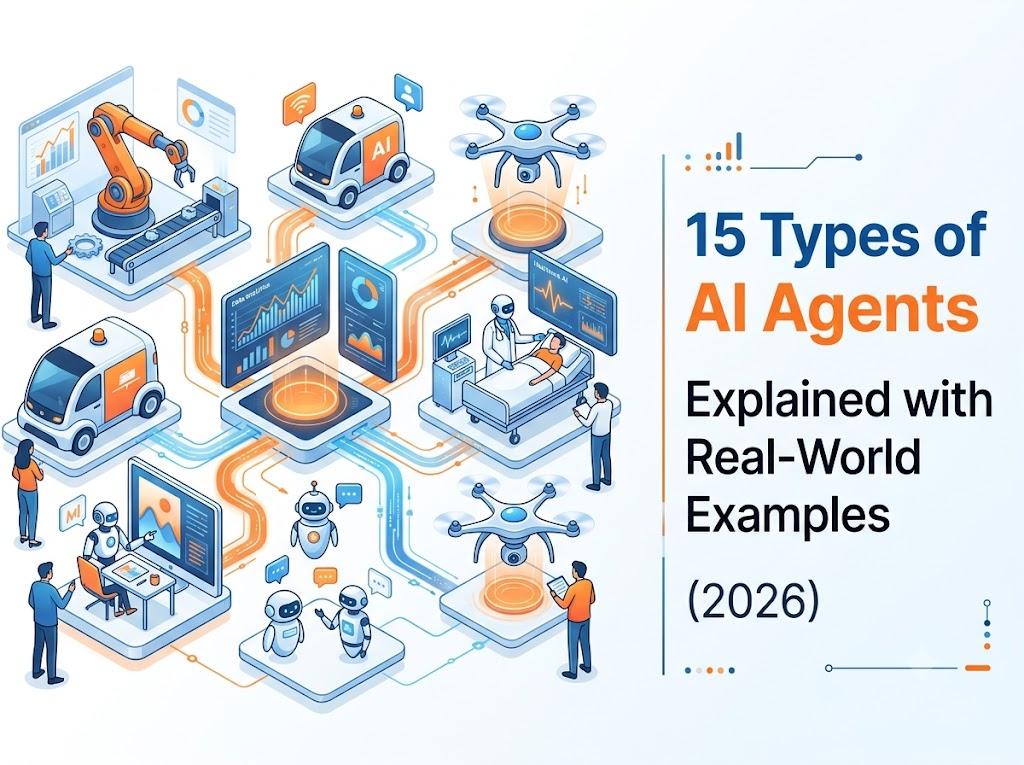
AI agents fall into 15 types across two classification systems: 7 classic types based on decision logic (simple reflex, model-based reflex, goal-based, utility-based, learning, hierarchical, and multi-agent systems) and 8 enterprise types based on function (conversational, voice, analytics, document processing, sales, procurement, monitoring, and workflow automation agents).
This guide explains all 15 with real production examples from enterprise deployments — not just thermostats and Roombas.
Most guides to AI agent types stop at textbook definitions. This one goes further: every type below is illustrated with an actual production deployment across industries like banking, retail, logistics, healthcare, utilities, and hospitality, so you can see what each agent type looks like when it's doing real work — and what results it delivers.
What Is an AI Agent? (Quick Definition)
An AI agent is a software system that perceives its environment, reasons about what it observes, and takes actions to achieve a goal — with a degree of autonomy that separates it from traditional automation.
Unlike a chatbot that only answers questions, an AI agent can plan multi-step tasks, use tools, query systems, and complete work. If you're still weighing the distinction between assistants and agents, we've covered that in depth separately; here, we focus on the taxonomy — the types of AI agents and where each one fits.
How AI Agents Are Classified: Decision Logic vs. Function
There are two valid ways to classify AI agents, and most confusion online comes from mixing them up.
The first is classification by decision logic — how the agent thinks. This is the classic framework from AI research, and it gives us 7 types ranging from simple rule-followers to self-improving learners and coordinated agent teams.
The second is classification by function — what job the agent does in a business. This is how buyers, operators, and enterprise teams actually talk about agents: customer service agents, voice agents, analytics agents, and so on. Functional types can be built on any decision logic; a customer service agent might be a simple rules-based responder or a sophisticated learning system.
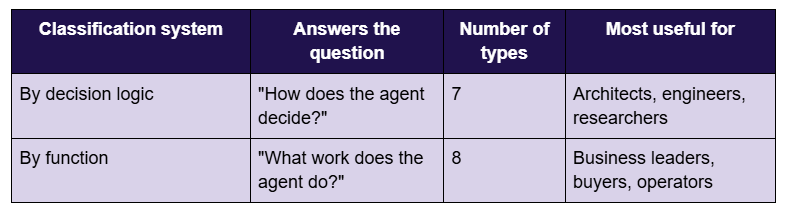
Understanding both matters. Decision logic tells you what an agent is capable of; function tells you where it creates value. Let's take them in order.
The 7 Classic Types of AI Agents (by Decision Logic)
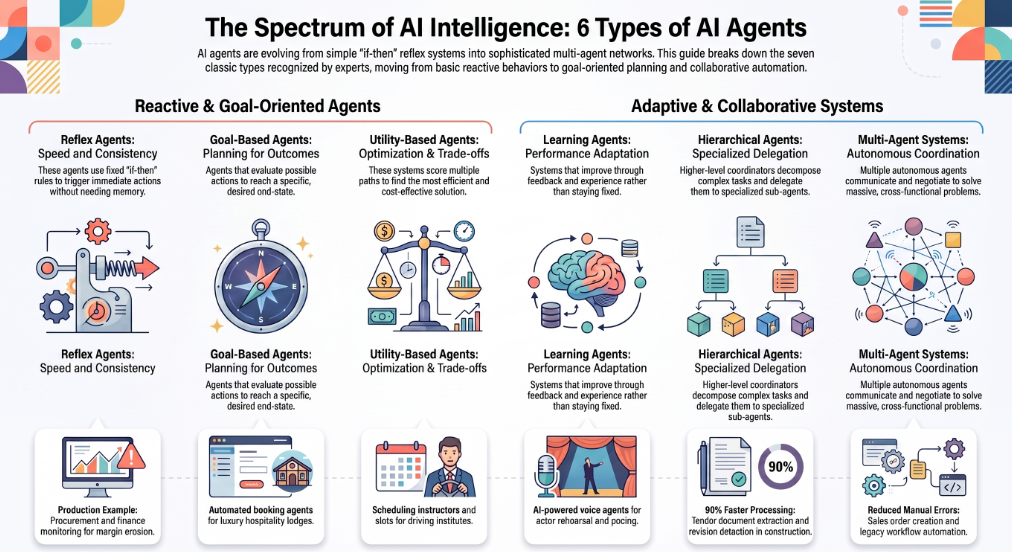
The 5 original types of AI agents are simple reflex agents, model-based reflex agents, goal-based agents, utility-based agents, and learning agents. As systems grew more complex, two more categories became standard — hierarchical agents and multi-agent systems — giving us the 7 types most experts recognize today.
1. Simple Reflex Agents
A simple reflex agent responds to its current input using fixed condition-action rules — if X is observed, do Y — with no memory and no model of the world. It's the most basic agent type, and also the most predictable, which is exactly why it still runs quietly inside serious enterprise systems.
Everyday example: A thermostat that switches the heater on below a set temperature.
Production example: One of the UAE's largest family business groups, spanning 30+ companies across retail, building, and industrial portfolios, uses reflex-style threshold agents for procurement and finance monitoring. When a purchase price trends beyond a set band, gross margin impact crosses a threshold, or a vendor's delivery performance slips, an alert fires automatically to leadership. No reasoning required — just reliable, always-on rules that catch margin erosion and vendor slippage earlier than any monthly review cycle could.
2. Model-Based Reflex Agents
A model-based reflex agent maintains an internal model of its environment, letting it act sensibly even when it can't directly observe everything. It remembers state, tracks what has changed, and uses that memory to interpret new inputs.
Everyday example: A GPS app that keeps navigating accurately through a tunnel where the signal drops.
Production example: A major Indian HVAC and refrigeration manufacturer, operating since the 1940s in fiercely price-sensitive markets, runs model-based competitive monitoring agents. The agents continuously track competitor pricing, MRP and discount changes, offers, availability, and ratings across e-commerce portals — maintaining an internal picture of the competitive landscape and flagging what changed, where, and by how much. Leadership went from manually checking portals to always-on monitoring with instant answers to competitive questions and earlier detection of pricing gaps and promo shifts.
3. Goal-Based Agents
A goal-based agent doesn't just react — it plans. Given a desired outcome, it evaluates possible action sequences and chooses the path that achieves the goal. This is where agents start to feel genuinely "agentic": they work toward something.
Everyday example: A chess engine planning several moves ahead to reach checkmate.
Production example: A luxury hospitality brand operating 16 boutique safari lodges and camps across East Africa deployed a digital booking agent with a clear goal: convert every inbound booking enquiry into a confirmed, accurate reservation. The agent reads incoming emails, classifies intent, extracts guest requirements, runs real-time inventory checks, and — when the requested dates aren't available — negotiates alternative dates or properties through a conversational loop, handing off to human experts for curated itineraries. The result: faster booking turnaround, higher accuracy on complex guest requirements, and scalable operations without compromising a luxury standard of service.
4. Utility-Based Agents
A utility-based agent goes one step beyond goals: when multiple paths lead to acceptable outcomes, it scores each option against a utility function and picks the best one, balancing competing trade-offs like cost, speed, and risk.
Everyday example: A ride-hailing app matching drivers to riders while balancing wait time, route efficiency, and pricing.
Production example: A Dubai-based driving institute with multi-branch operations uses utility-style optimization across its scheduling engine. The system analyzes the full enrolment-to-test funnel, instructor utilisation, and slot availability to optimize scheduling — trading off learner wait times, instructor workloads, and branch capacity. The outcome was reduced operational bottlenecks, better scheduling efficiency, and clearer visibility into what actually drives conversion.
5. Learning Agents
A learning agent improves its own performance over time by learning from feedback and experience. Instead of shipping with fixed behavior, it adapts — which makes it powerful in dynamic environments and demanding in terms of evaluation and oversight.
Everyday example: A streaming service's recommendation engine that gets sharper the more you watch.
Production example: An AI-powered rehearsal app for actors runs a voice agent that serves as an always-available scene partner. The agent ingests scripts, manages scenes, and reads opposite the actor with character and voice control, pacing, and cue logic — adapting its delivery across rehearsal loops. Actors get higher rehearsal throughput without human readers and more consistent audition practice, with the system tuned over time for both quality and cost-controlled inference.
6. Hierarchical Agents
Hierarchical agents organize intelligence in layers: a higher-level agent decomposes a complex task and delegates sub-tasks to lower-level agents, each specialized for its step. This structure brings order, auditability, and specialization to problems too complex for a single agent.
Everyday example: An autonomous warehouse robot where a top-level planner assigns tasks and low-level controllers handle navigation and picking.
Production example: An Australian remedial construction and waterproofing specialist deployed an intelligent document workbench built on hierarchical multi-agent orchestration. A coordinating layer retrieves tender documents and determines the correct workflow; specialist agents beneath it handle vision-LLM extraction from complex PDFs, revision and change analysis, and deep synchronization into the company's operational system with full CRUD integration, quote locking, and audit logs. The system was engineered for up to ~90% faster tender document processing with a ~95% extraction accuracy target on standard formats — and materially reduced bid risk through revision detection and auditability.
7. Multi-Agent Systems (MAS)
A multi-agent system is a set of autonomous agents that communicate, coordinate, and sometimes negotiate to solve problems no single agent could handle alone. Modern protocols like MCP (Model Context Protocol) and A2A (agent-to-agent) are making these systems interoperable across vendors — a shift we've covered in our look at agentic AI frameworks.
Everyday example: Fleets of delivery drones coordinating routes and airspace.
Production example: A flagship UAE engineering and technology conglomerate, delivering electrical, mechanical, and automation solutions since the 1970s, replaced an end-of-life legacy document workflow with multi-agent automation for SAP sales order creation. Coordinated agents interpret order triggers, validate data against rules, handle exceptions through governed approvals, and create sales orders directly in SAP — with audit logs and reconciliation reporting throughout. The company cut manual order processing and legacy licensing dependency, accelerated its order-to-confirm cycle, and reduced data-entry errors.
8 Types of Enterprise AI Agents (by Function) — with Production Examples
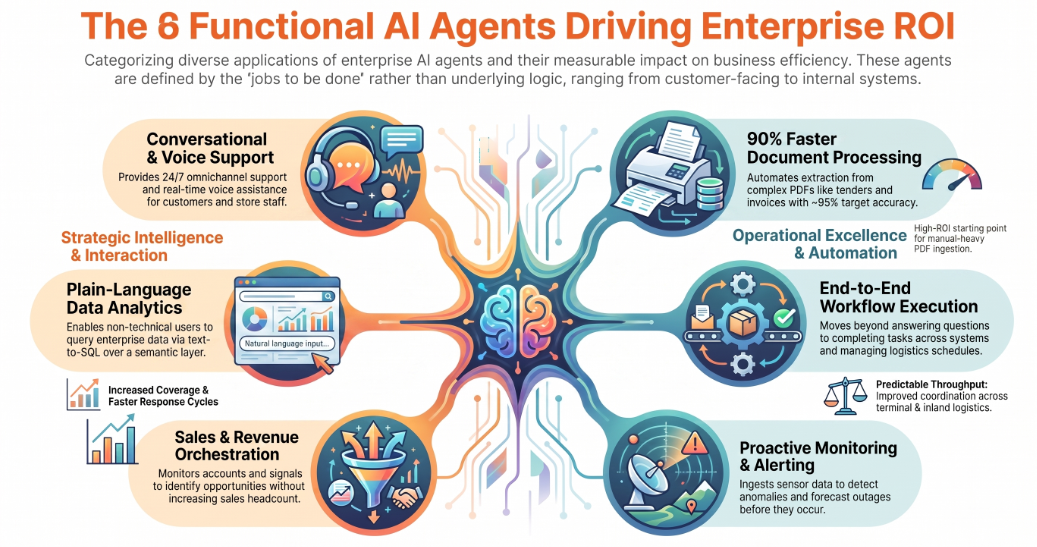
Decision logic explains how agents think. But when enterprises deploy agents, they organize them by the job to be done. These are the 8 functional types we see most in production, each mapped to the decision logic underneath and proven with real deployment results. For a deployments-first view of these same systems, see our full breakdown of AI agents in production.
8. Conversational & Customer Service Agents
Conversational agents handle natural-language interactions with customers or employees — triaging queries, resolving routine issues, and escalating what needs a human. Underneath, they typically combine model-based reasoning (tracking conversation state) with goal-based planning (resolving the ticket).
A major UAE real estate portfolio owner, managing diversified office, retail, industrial, and residential assets across multiple emirates, runs an omnichannel customer service agent for tenant support — web, WhatsApp-ready, and email. It triages tenant queries, handles rental and payment support workflows, answers from a governed knowledge base of policies and tenancy documents, and escalates to human teams with full ticketing. The portfolio now delivers a consistent 24×7 tenant experience with faster response times, lower call-centre load, and better SLA adherence.
In regulated environments the same functional type carries heavier requirements: a global fintech serving banks and credit unions deployed omnichannel banking support agents with agent-assist summarisation, next-best actions, and — critically — auditability and SLA monitoring built in, improving case handling speed and compliance readiness simultaneously.
9. AI Voice Agents
Voice agents run the full speech pipeline — speech-to-text, LLM reasoning with tool use, and text-to-speech — in real time, over phone lines or in-app. They're among the hardest agents to run well in production because latency, interruption handling, and accuracy all have to hold up simultaneously.
One of India's largest value retailers, with a footprint of 700+ stores, deployed a bilingual Hindi and English voice support agent for store operations. Store staff call in and get instant answers on pricing, stock, and promotions for their specific store, backed by an inventory intelligence agent and a knowledge agent trained on POS and SOP documentation. The result: reduced helpdesk burden, faster store issue resolution, and on-demand training guidance that speeds up onboarding at national scale.
10. Data Analytics & BI Agents
Analytics agents let anyone in the business ask questions of enterprise data in plain language and get governed, accurate answers — no dashboard queue, no SQL. Done properly, these agents run text-to-SQL over a semantic layer that encodes the organization's own metric definitions, so the numbers are computed, never hallucinated.
A long-established privately-held retail holding group deployed a governed agentic analytics layer over its existing data: a unified context engine across structured and unstructured sources, a semantic governance layer for rules, hierarchies, and formulas, and agents that convert dashboard insights into auditable actions and tasks. Leadership shifted from reactive reporting to proactive execution loops with standardized decision logic across teams.
The same functional type scales down as well as up: a high-velocity UK e-commerce and distribution operation uses a conversational analytics agent across sales, inventory, promotions, and customer behaviour data — cutting analysis cycles for recurring questions and reducing dependency on analysts for everyday reporting.
11. Document Processing Agents
Document agents turn unstructured documents — tenders, invoices, contracts, forms — into structured, validated data inside business systems. They combine vision-capable models for extraction with rules and audit trails for integrity, and they're often the highest-ROI starting point for agentic AI because the manual baseline is so painful.
The tender-processing deployment described under hierarchical agents above is the flagship example: complex multi-format PDF ingestion, revision detection, and system-of-record synchronization at ~95% target extraction accuracy — engineered for up to ~90% faster processing than the manual workflow it replaced.
12. Sales & Revenue Agents
Sales agents monitor accounts, spot opportunities and risks, and orchestrate follow-ups — extending a sales team's coverage without extending headcount. They're typically utility-based underneath: constantly ranking which account, signal, or renewal deserves attention next.
A global logistics and supply chain multinational, serving enterprise customers across India, Europe, and the US, deployed an agentic sales agent across its enterprise accounts. The agent runs always-on account monitoring and signal capture, applies rule-governed opportunity identification, and orchestrates follow-ups through CRM-integrated workflows with leadership dashboards on top. Account coverage went up without added headcount, and response cycles on opportunities and renewals got measurably faster — with more consistent execution through governed playbooks.
13. Procurement & Finance Agents
Procurement and finance agents automate sourcing, monitoring, and financial control workflows: RFQ automation, supplier matching, spend and margin surveillance, working-capital optimization.
A pharma sourcing platform marketing 1,800+ rare excipients and 7,500+ SKUs automated its RFQ and supplier discovery workflows, with analytics on price, lead time, and vendor performance layered on top. Procurement cycles shortened, vendor coordination and manual follow-ups dropped, and sourcing decisions got sharper on price and lead-time competitiveness. Meanwhile, the group-level finance alerting deployment described under simple reflex agents shows the same functional category at holding-company scale.
14. Monitoring & Alerting Agents
Monitoring agents watch operational and sensor data continuously, detect anomalies, forecast problems, and route alerts before issues become outages. They're the workhorses of asset-heavy industries.
A premier astronomy and astrophysics research institute uses AI energy-management agents across campus-scale infrastructure — ingesting utility and sensor data, detecting anomalies, forecasting consumption, and recommending optimizations. A state power transmission utility applies the same pattern to the grid itself: transmission KPI monitoring, loss and outage analytics, predictive maintenance indicators, and automated alerts for field operations — moving grid operations from reactive to proactive.
15. Workflow & Task Automation Agents
Workflow agents execute end-to-end business processes: they interpret a trigger, validate against business rules, act across systems, and log everything. This is where "answering questions" becomes "completing work" — and where governance stops being optional.
Alongside the SAP order automation case above, a global ports and logistics leader deployed insights-to-action agents on top of its existing dashboards for terminal and rail operations — digitising terminal workflows, managing rail scheduling and exceptions, and automating task creation and completion tracking. Terminal-to-rail throughput became more predictable, and coordination across terminal and inland logistics measurably improved.
How to Choose the Right Type of AI Agent (Decision Framework)
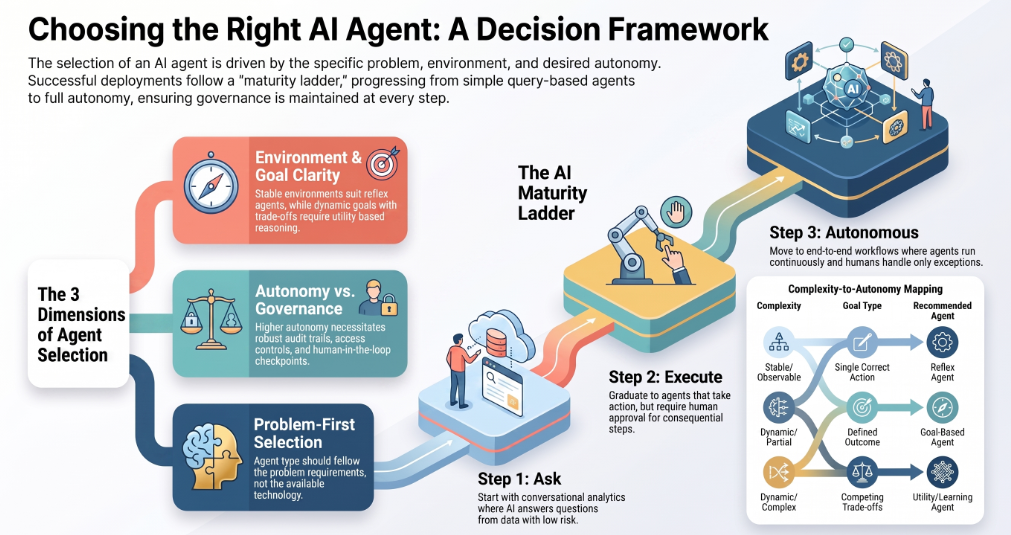
The type you need follows from the problem, not the technology. Four questions get you most of the way:
- How complex is the environment? Stable and fully observable → reflex agents suffice. Dynamic and partially observable → you need model-based reasoning or learning.
- How clear is the goal? One correct action → reflex. A defined outcome with multiple paths → goal-based. Competing trade-offs → utility-based.
- How much autonomy do you want? Human reviews every output → conversational or task agents with approval gates. Human sets the goal, agent executes → goal-based with checkpoints. Agent runs continuously, escalating only exceptions → learning agents or multi-agent systems.
- What are the governance requirements? The more autonomy and the more sensitive the data, the more you need approvals, access controls, and audit trails designed in from day one.
The most reliable pattern we see across production deployments is a maturity ladder we call Ask → Execute → Autonomous.
Organizations start at Ask — governed conversational analytics and knowledge agents, where AI answers questions from real data and the risk surface is small.
They graduate to Execute — agents that take actions, but every consequential action passes through human-in-the-loop approval.
Only then do they move selected, well-instrumented workflows to Autonomous, where agents run end-to-end and humans handle exceptions. Nearly every successful deployment in this article followed that ladder; nearly every failed agent project we've seen tried to skip a rung.
What Every Type of AI Agent Needs in Production: Governance
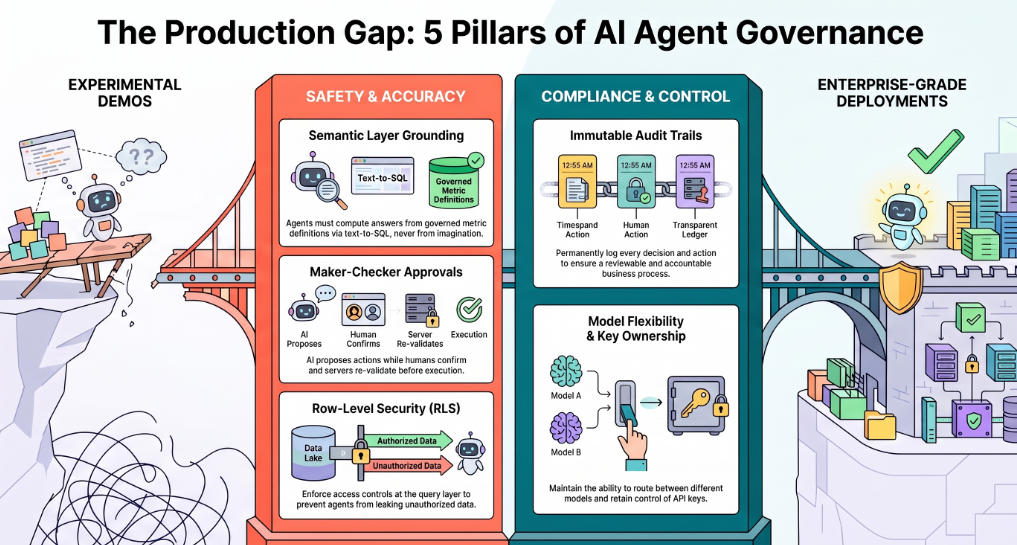
Here's the section most "types of AI agents" guides skip entirely — and it's the difference between a demo and a deployment.
The agent type determines what an agent can do. Governance determines whether you can trust it to do that in production. Across every deployment referenced in this article, the same governance layer made autonomy safe:
Grounding in a semantic layer. Analytics agents must compute answers from governed metric definitions via text-to-SQL — never generate numbers from a language model's imagination. If your metrics aren't defined once, centrally, every agent answer is a coin flip.
Maker-checker approvals. For any agent that writes — creating an order, issuing a refund, updating a record — the AI proposes and a human confirms, with the server re-validating before execution. Human-in-the-loop isn't a limitation; it's the mechanism that lets enterprises deploy action-taking agents at all.
Row-level security and attribute-based access control. An agent answering questions must see only the data the asking user is entitled to see. Without RLS and ABAC enforced at the query layer, an analytics agent becomes a data-leak engine with a friendly interface.
Immutable audit trails. Every agent decision, action, and approval logged permanently. This is what turns "the AI did something" into an accountable, reviewable business process — and it's non-negotiable in banking, healthcare, and the public sector.
Model flexibility and key ownership. Enterprises need to route between models (and bring their own keys) as capability, cost, and compliance requirements shift — not weld their agent layer to one vendor's model.
Assistents.ai vs. Salesforce Agentforce: Which Platform Covers More Agent Types?
If you're evaluating platforms to build these agent types, the comparison most enterprise teams end up running is Assistents.ai versus Salesforce Agentforce. Both are credible; they're built around different centers of gravity. (We've published a fuller head-to-head comparison here.)
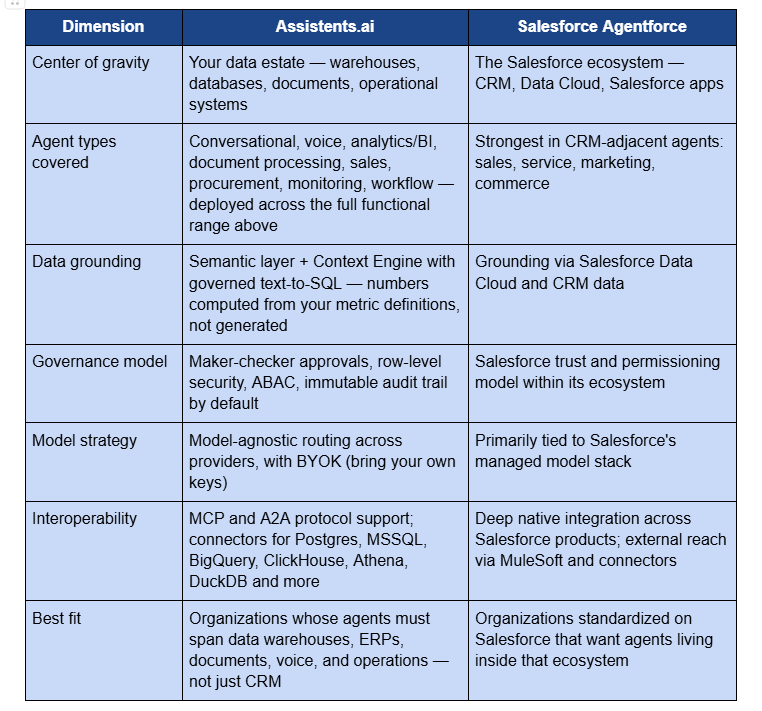
The honest summary: if your agent ambitions live inside Salesforce, Agentforce is a natural choice. If your agents need to reason over warehouse data, process operational documents, answer the phone in two languages, and create SAP orders under audit — the breadth of types in this article — you need a platform whose foundation is governed access to all your systems, not one of them.
Why Assistents.ai for Building Every Type of AI Agent
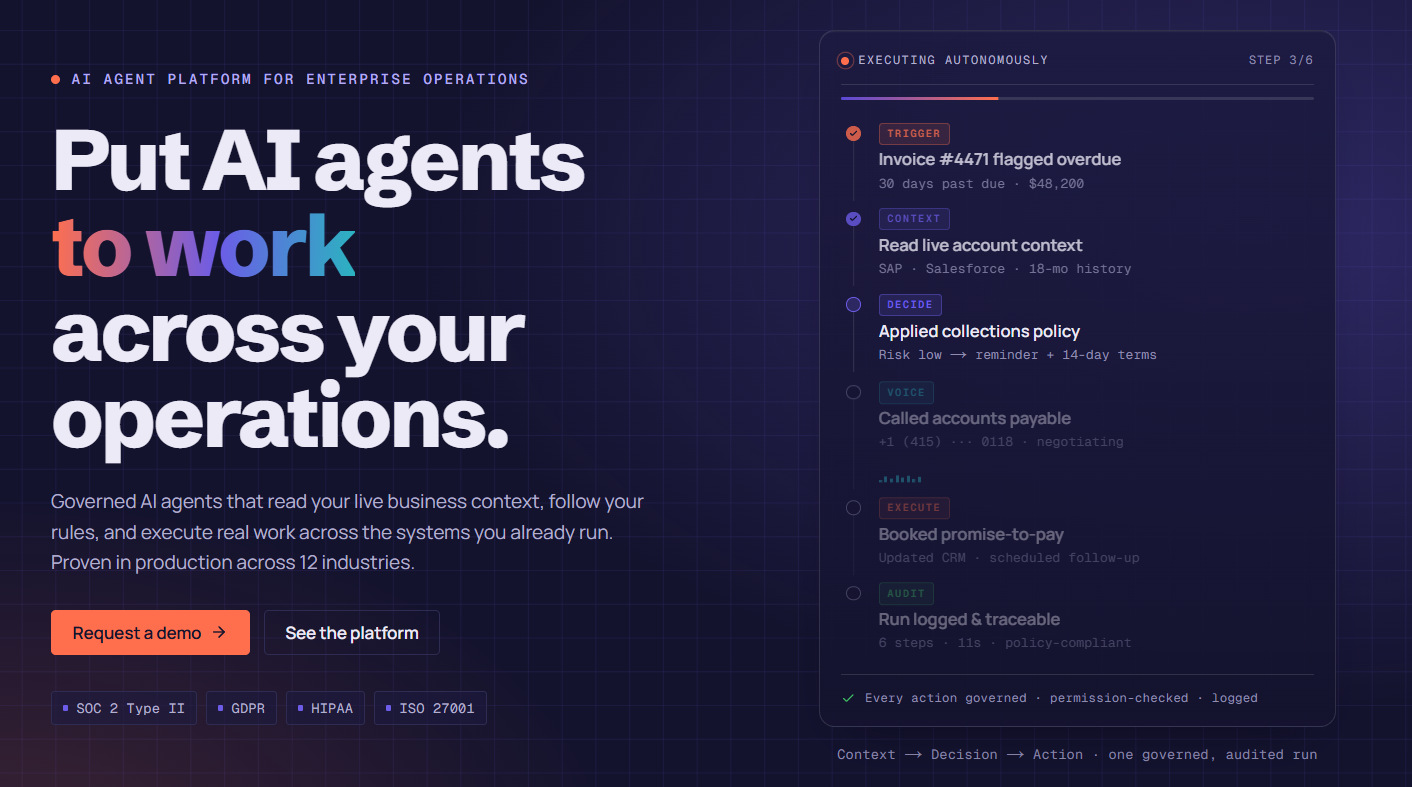
Five reasons, each backed by production evidence rather than roadmap slides:
1. One platform, nearly the full taxonomy — in production. The deployments cited throughout this article — booking agents in luxury hospitality, bilingual voice agents across 700+ retail stores, document workbenches in construction, SAP workflow automation in engineering, grid monitoring for a state utility, governed analytics for holding companies — run on Assistents.ai across more than a dozen of the 15 agent types, spanning fintech, healthcare, logistics, retail, real estate, utilities, and the public sector.
2. No hallucinated numbers. Every analytics answer is computed through text-to-SQL over a semantic layer holding your organization's own metric definitions, with a Context Engine unifying structured and unstructured data. Agents cite what your data says — they don't improvise it.
3. Governance by default, not bolt-on. Maker-checker approvals on every consequential action, row-level security, attribute-based access control, and an immutable audit trail are platform primitives. That's why the deployments above run in banks, utilities, and healthcare — environments where "move fast and apologize later" isn't an option.
4. Model-agnostic, protocol-native. Route across leading model providers, bring your own keys, and interoperate through MCP and A2A — so your agent layer outlives any single model vendor's roadmap.
5. A proven path from first question to full autonomy. The Ask → Execute → Autonomous ladder isn't a slogan; it's how every deployment in this article was sequenced. Start with governed answers, graduate to approved actions, earn your way to autonomy — with the guardrails already in place at each rung.
Ready to see which agent types fit your workflows? Book a demo with Assistents.ai →
FAQ
What are the 5 types of AI agents?
The 5 classic types of AI agents are simple reflex agents, model-based reflex agents, goal-based agents, utility-based agents, and learning agents. They're classified by decision logic — how each agent processes inputs and chooses actions — ranging from fixed condition-action rules to systems that improve through experience.
What are the 7 types of AI agents?
The 7 types of AI agents are simple reflex, model-based reflex, goal-based, utility-based, learning, hierarchical agents, and multi-agent systems. The last two extend the classic five to cover layered task delegation and coordinated teams of agents working together on complex problems.
What is an example of an AI agent in real life?
Everyday examples include thermostats (simple reflex) and GPS navigation (model-based). In enterprises, real examples include booking agents that negotiate hotel reservations end-to-end, voice agents answering store staff queries in Hindi and English across 700+ retail locations, and document agents processing construction tenders up to ~90% faster than manual workflows.
Is ChatGPT an AI agent?
ChatGPT in its basic form is a conversational assistant, not a full agent — it responds to prompts but doesn't autonomously pursue goals. It becomes agentic when equipped with tools, memory, and the ability to plan and execute multi-step tasks. The dividing line is autonomy: agents complete work, assistants answer questions.
What is the difference between AI agents and agentic AI?
An AI agent is a single system that perceives, reasons, and acts toward a goal. Agentic AI is the broader capability — often multiple coordinated agents that plan, decide, and execute complex workflows end-to-end with minimal human intervention. Practically: an agent answers or acts on a task; agentic AI carries entire processes to completion.
Which type of AI agent is best for customer service?
Conversational agents built on model-based and goal-based logic work best for customer service — they track conversation state, pursue resolution as a goal, and escalate exceptions to humans. In regulated industries, choose platforms with built-in auditability, SLA monitoring, and human-in-the-loop escalation, as deployed in banking support and real estate tenant services.
What type of AI agent is a self-driving car?
A self-driving car combines multiple types: model-based reasoning to track its environment, utility-based decision-making to balance safety, speed, and comfort, learning components that improve from driving data, and hierarchical control separating route planning from steering and braking. It's the classic example of agent types working as one system.
How do enterprises deploy AI agents safely?
Successful enterprises follow a maturity ladder — Ask (governed Q&A over real data), Execute (agents act with human-in-the-loop approval), then Autonomous (agents run end-to-end, humans handle exceptions) — on platforms enforcing semantic-layer grounding, maker-checker approvals, row-level security, and immutable audit trails from day one.