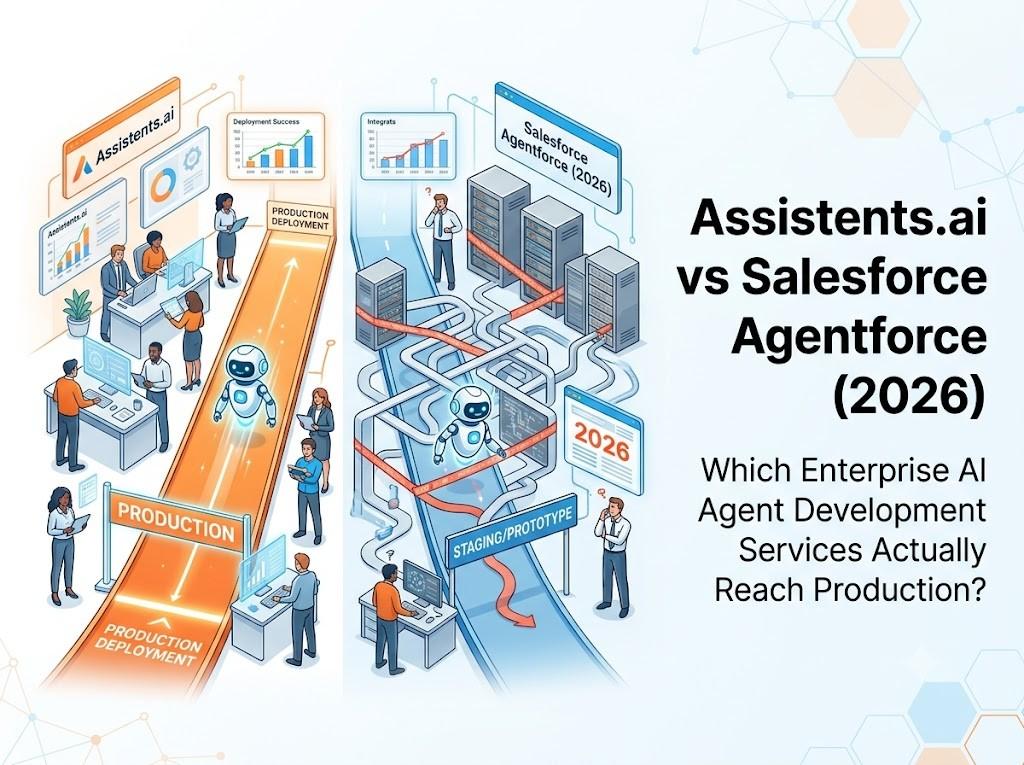
Assistents.ai and Salesforce Agentforce solve the same problem — enterprise AI agents that act, not just chat — through opposite models. Agentforce is a consumption-priced AI layer inside the Salesforce ecosystem, billed per conversation or per action.
Assistents.ai is a governed agentic AI platform delivered through end-to-end enterprise AI agent development services, deployed on your own data stack with human-in-the-loop controls, row-level security, and immutable audit trails built into the architecture.
If you are evaluating either option, this comparison covers what actually matters in production: pricing you can forecast, governance you can defend to an auditor, integrations that reach beyond a single vendor's ecosystem, and — most importantly — evidence that the agents ship. Not demos. Deployments.
Here is everything you need to make the call.
What Are Enterprise AI Agent Development Services? (Quick Definition)
Enterprise AI agent development services are end-to-end engagements that design, build, integrate, govern, and deploy autonomous AI agents inside a company's real systems and workflows — from data connection and business-rule modelling through production rollout and monitoring. Unlike buying a platform license alone, a development services engagement delivers a working, governed agent in production, accountable to measurable business outcomes.
This distinction is the frame for the entire comparison. Salesforce Agentforce is a platform you license; implementation typically falls to your internal team or a systems integrator. Assistents.ai is a platform delivered as a service: the same team that built the platform scopes your use case, connects your data, configures governance, and takes the agent to production.
Both models can work. Which one works for you depends on where your data lives, how much cost predictability you need, and how much governance your industry demands.
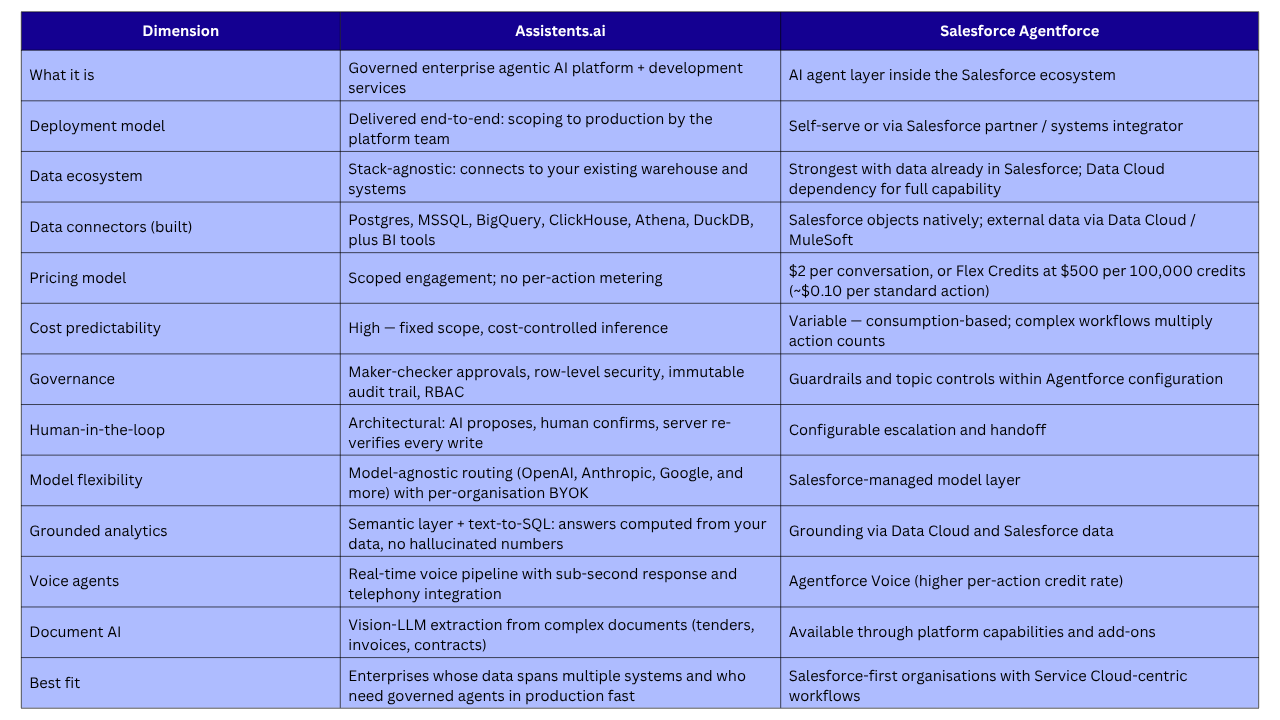
Assistents.ai vs Salesforce Agentforce: At-a-Glance Comparison
What Is Salesforce Agentforce? (A Fair Summary)
Salesforce Agentforce is Salesforce's platform for building autonomous AI agents across service, sales, marketing, and commerce. It works natively within the Salesforce ecosystem, drawing on CRM records, Service Cloud cases, and Data Cloud profiles to power agent behaviour.
Agent Builder and Prompt Builder let teams configure agents without deep engineering effort, and a free Foundations tier (including a starter allocation of Flex Credits) lets Enterprise Edition customers pilot before committing.
Where Agentforce is genuinely strong:
- Native access to Salesforce data. If your customer records, cases, and routing already live in Service Cloud, Agentforce reads and acts on them without integration projects.
- Ecosystem depth. It plugs into Salesforce Flow, existing automations, and the broader Salesforce roadmap.
- Fast starts for simple deflection. High-volume, low-complexity FAQ and case-deflection agents can go live quickly for teams already fluent in Salesforce administration.
Any honest comparison should say this plainly: if your organisation is Salesforce-first and your primary use case is customer service inside Service Cloud, Agentforce deserves a serious look. The friction appears when your data, workflows, and compliance requirements extend beyond that ecosystem — which, for most enterprises, they do.
What Is Assistents.ai?
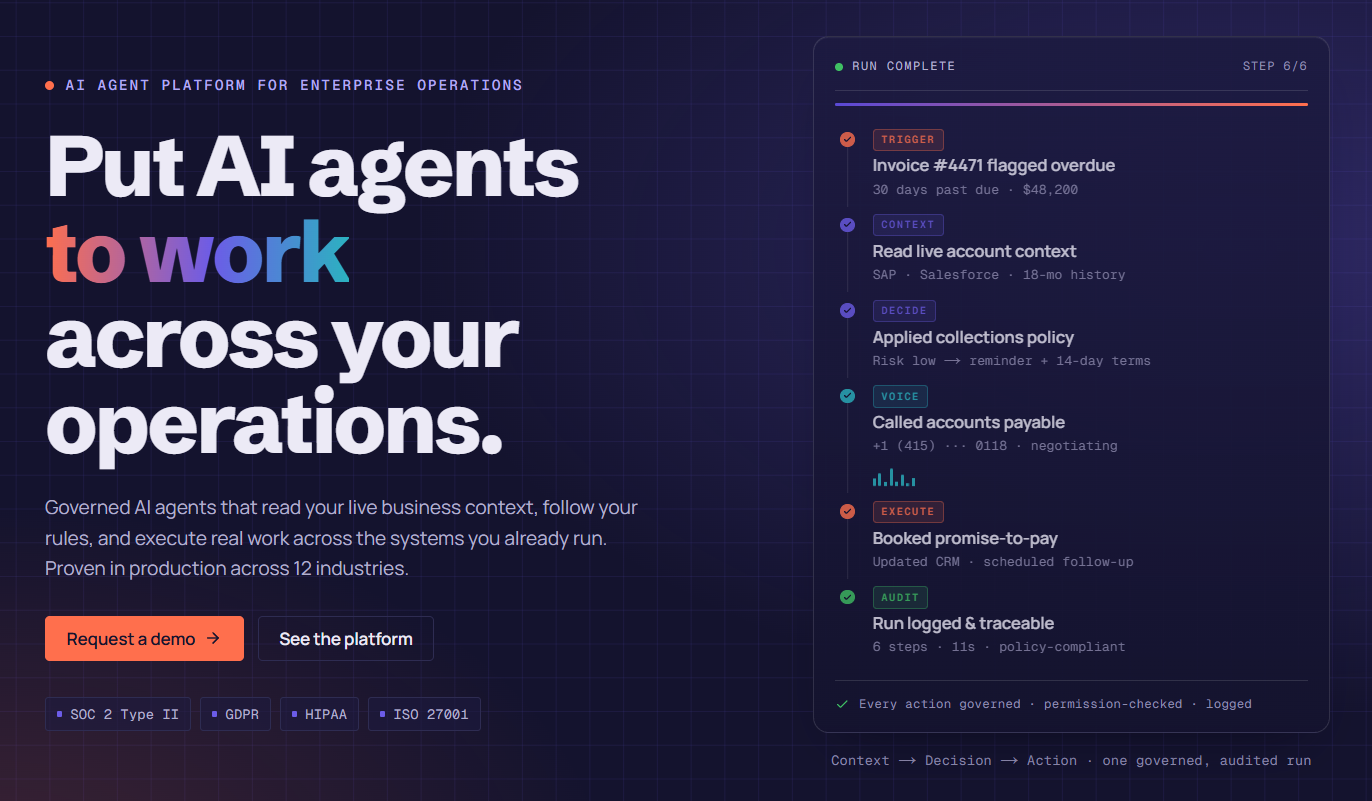
Assistents.ai is a governed enterprise agentic AI platform built by Ampcome. It grounds AI agents in your organisation's own data, metric definitions, and business rules, then lets those agents analyse, decide, and act — under enterprise controls at every step.
The architecture rests on a few load-bearing components:
Context Engine. A unified context layer across structured and unstructured data, so agents reason with your business's actual state — inventory, pipeline, tenancy documents, SOPs — rather than generic model knowledge.
Semantic layer with text-to-SQL. When an agent answers a numbers question, it does not guess. It translates the question into governed SQL against your own metric definitions and computes the answer from your data. No hallucinated numbers is the platform's headline promise, and the architecture enforces it.
Maker-checker governance. Every write action follows a propose-confirm-verify loop: the AI proposes the action, a human approves it, and the server re-checks permissions before execution. Combined with row-level security, role-based access control, field masking, and an immutable audit trail, this is governance by architecture — not a settings page.
Model-agnostic routing with BYOK. Agents route across leading model providers — OpenAI, Anthropic, Google, and others — and organisations can bring their own API keys. You are never locked into a single model vendor's pricing, capability ceiling, or roadmap.
Multi-agent orchestration, Agent Builder, and Workflow Builder. Agents coordinate across departments through workflows, triggered by events, schedules, or conditions, with support for open interoperability standards like MCP and A2A.
Voice and Document AI. A real-time voice pipeline delivers sub-second conversational agents over phone and telephony systems, and vision-LLM document processing extracts structured data from complex PDFs — tenders, invoices, contracts — with audit logs on every extraction.
The delivery model matters as much as the platform. Assistents.ai engagements are enterprise AI agent development services in the full sense: the team scopes the use case, connects the data sources, encodes the business rules, configures governance, and carries the agent to production. You are not handed a license and a partner directory.
Pricing: Consumption Credits vs a Predictable Engagement
This is where most Agentforce evaluations get complicated, so let's do the real math.
How Agentforce pricing actually works
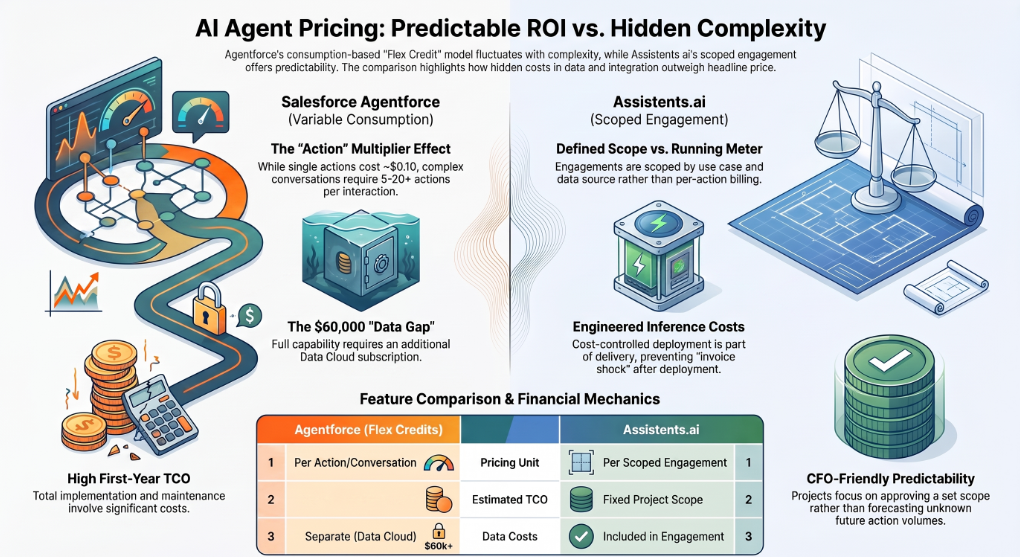
Agentforce offers two primary models. The original model charges $2 per conversation for customer-facing agents. The newer Flex Credits model is consumption-based: credits cost $500 per 100,000, a standard action consumes 20 credits (about $0.10), and voice actions consume 30 credits (about $0.15). One action covers up to roughly 10,000 tokens of processing — and if a single action exceeds that ceiling, it is billed as multiple actions.
On paper, Flex Credits can be cheaper than conversation pricing for simple interactions. In practice, three dynamics make budgeting difficult:
- Actions multiply with complexity. A typical agent conversation involves five to fifteen actions; complex workflows with multi-step reasoning, external lookups, and API calls can exceed twenty. Independent analyses estimate real per-conversation costs under Flex Credits ranging from roughly $0.50 for simple queries to $2.00 or more for complex ones — the same range the old flat model charged, with far less predictability.
- The data layer is a separate budget line. Agentforce's full capability depends on Data Cloud (now Data 360), which independent guides consistently flag as the cost most buyers overlook — commonly starting around $60,000 per year and scaling with consumption. Data operations such as profile unification carry their own substantial credit costs.
- Total cost of ownership runs well past the headline. Independent estimates for mid-market deployments put first-year total cost — licensing, Data Cloud, implementation, and maintenance — in the range of $150,000 to $425,000, and some analyses of enterprise deployments put annual per-user total cost of ownership into five figures once professional services are included. Reports also note platform constraints at scale, such as caps on the number of active agents per Salesforce org on certain plans.
None of this makes Agentforce a bad product. It makes it a product whose cost is a function of usage patterns you cannot fully know until after you deploy.
How Assistents.ai pricing works
Assistents.ai engagements are scoped: a defined use case, defined data sources, defined governance requirements, and a defined path to production. There is no per-action meter running in the background of every customer conversation, and inference costs are engineered down deliberately — cost-controlled inference deployment is a standard part of delivery, not an optimisation you discover you need after the first invoice.
For a CFO, the difference is simple. One model asks you to forecast how many actions your agents will take next quarter. The other asks you to approve a scope.
The hidden cost nobody puts on the pricing page
Whichever platform you evaluate, the largest unbudgeted line item is usually the same: the gap between a licensed platform and a working production agent. Integration engineering, business-rule modelling, governance configuration, testing, and change management routinely cost more than the software. A development-services model absorbs that gap into the engagement. A license-plus-integrator model leaves you to manage it — and pay for it — separately.
Governance: Where the Two Platforms Diverge Most
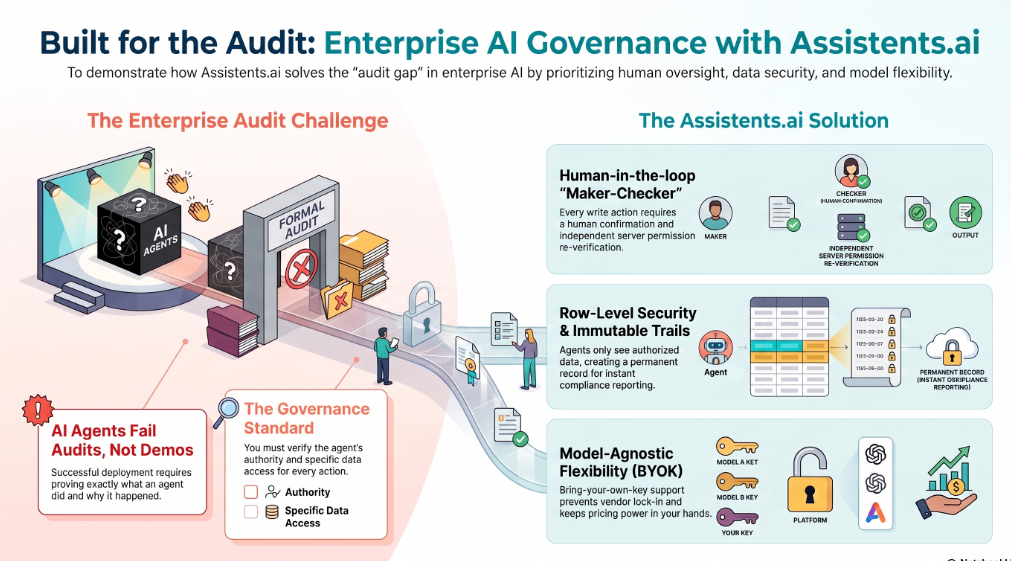
Enterprise AI agents fail audits, not demos. The governance question is not whether an agent can act — it is whether you can prove, after the fact, exactly what it did, why, on whose authority, and with access to which data.
Human-in-the-loop by design
On Assistents.ai, every write action — updating a record, creating a ticket, issuing a document, triggering a workflow — passes through a maker-checker loop. The AI proposes. A human confirms. The server independently re-verifies permissions before anything executes. This is not an optional escalation path; it is how the action pipeline works. For regulated industries — banking, healthcare, utilities — this single architectural choice is often the difference between an approved deployment and a stalled pilot.
Row-level security and audit trails
Assistents.ai enforces row-level security and field masking so that an agent answering a question for one user only ever sees the rows and columns that user is entitled to see. Every query, every action, and every approval lands in an immutable audit trail. When compliance asks "show me everything this agent did in March," the answer is a report, not a forensic project.
Model flexibility and BYOK
Model-agnostic routing with bring-your-own-key support means your agents are not welded to one model vendor. If a better or cheaper model ships next quarter, you route to it. If your security team requires your own provider agreements, your keys, your terms — that is supported per organisation. A single-vendor AI stack concentrates pricing power and roadmap risk in someone else's hands; a model-agnostic stack keeps it in yours.
Data and Integration: Salesforce-Native vs Stack-Agnostic
Agentforce's greatest strength is also its boundary: it is at its best when your operational truth lives in Salesforce. Many enterprises' truth does not. It lives in a Postgres or MSSQL operational database, a BigQuery or ClickHouse warehouse, an ERP, a document repository, and a dozen departmental systems that have never shared a schema.
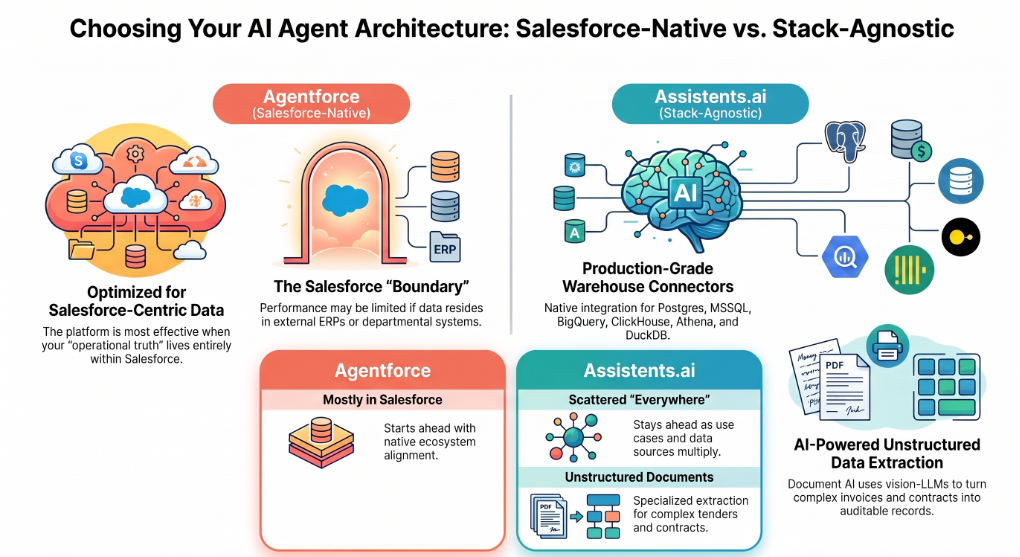
Assistents.ai was built for exactly that reality. Production-grade connectors ship for Postgres, MSSQL, BigQuery, ClickHouse, Athena, and DuckDB, alongside BI-tool integrations — so agents are grounded in the warehouse you already trust, governed by the metric definitions you already use. Unstructured data comes in through Document AI: vision-LLM extraction that turns complex tenders, invoices, and contracts into structured, auditable records.
The practical question to ask in your evaluation: where does the data your agent needs actually live today? If the honest answer is "mostly in Salesforce," Agentforce starts ahead. If the honest answer is "everywhere," a stack-agnostic platform starts ahead — and stays ahead as your use cases multiply.
Production Evidence: What Enterprise AI Agents Look Like When They Ship
Here is the uncomfortable industry statistic: research consistently shows that only around 11 to 14 percent of enterprise AI agent pilots ever reach production at scale. The rest stall — not because the models fail, but because governance was an afterthought, integration was underestimated, and the platform was chosen on a demo.
So the most useful evidence in any comparison is not a feature list. It is what has actually shipped. The following are real Assistents.ai production deployments, anonymised by industry, geography, and scale:
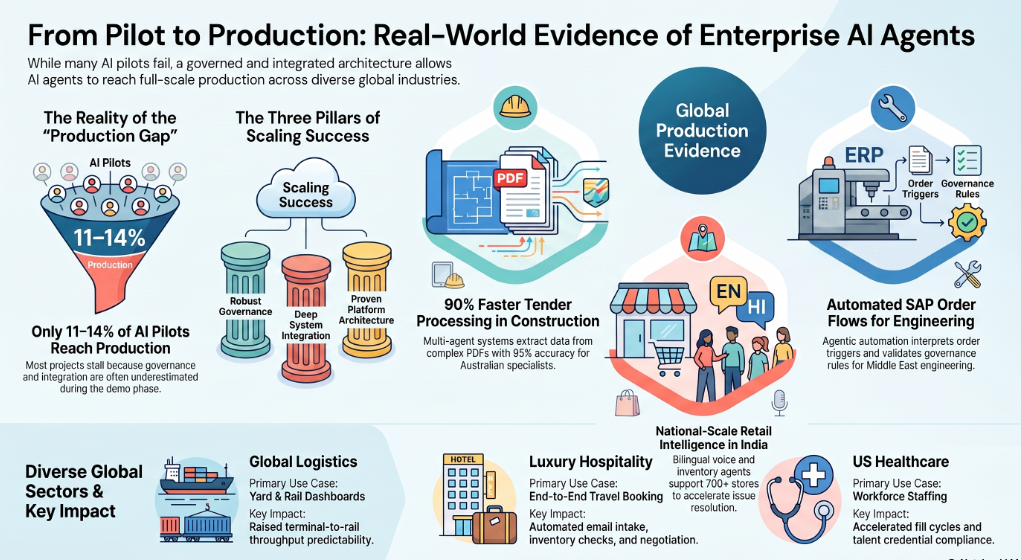
A global ports and logistics leader (Middle East, revenue in the tens of billions of dollars): terminal and rail management digitisation with yard and rail operational dashboards, exception management, and executive alerting — raising the predictability of terminal-to-rail throughput across a worldwide portfolio.
An Australian remedial construction and waterproofing specialist: autonomous multi-agent document processing that ingests complex tender PDFs, detects revisions, and synchronises structured data into core operational systems with full CRUD integration and audit logs — engineered for up to ~90% faster tender processing with an extraction accuracy target of ~95% on standard formats.
A pan-India value retailer with 700+ stores: a national-scale agent stack combining a bilingual (Hindi and English) voice support agent, a store-level inventory intelligence agent, and a RAG-based knowledge and training agent over POS and SOP documentation — cutting helpdesk load and accelerating store issue resolution across hundreds of cities.
A flagship Middle East engineering group: agentic automation that interprets order triggers, validates them against governance rules, and creates SAP sales orders automatically — replacing an end-of-life legacy document workflow, reducing manual order processing, and improving auditability on every order and exception.
A global fintech serving banks and credit unions: omnichannel AI support agents (chat, email, phone) with workflow routing, agent-assist summarisation, and SLA monitoring — built with the auditability and compliance readiness that banking operations demand.
A US healthcare staffing platform: an AI platform handling talent onboarding, credential capture, facility request intake, matching, scheduling, and compliance workflows — driving faster fill cycles and better workforce utilisation.
A luxury hospitality brand operating boutique lodges and camps across East Africa: a digital booking agent automating end-to-end luxury travel booking — email intake, intent classification, real-time inventory checks, alternative-date negotiation — with human-in-the-loop quality control preserving the white-glove guest experience.
Different industries. Different data stacks. Different compliance regimes. One platform architecture, one governance model, one delivery approach — and more than thirty production deployments across logistics, retail, healthcare, fintech, energy, real estate, education, and construction.
That breadth is the point. An enterprise AI agent platform should not force-fit your industry into someone else's workflow template. It should carry the same governed architecture into your business rules, your data sources, and your regulatory requirements.
When Salesforce Agentforce Is the Right Choice
Credibility requires saying this clearly. Choose Agentforce when:
- Your organisation is Salesforce-first, and the data your agents need already lives in Sales Cloud, Service Cloud, and Data Cloud.
- Your primary use case is customer service deflection inside Service Cloud, with high volume and relatively low per-conversation complexity.
- You have already invested in Data Cloud, so the data-layer cost is sunk rather than incremental.
- You have Salesforce administration capability in-house and a trusted integrator relationship for the build.
In that scenario, Agentforce's native data access is a genuine advantage, and consumption pricing on simple deflection can be economical.
Why Assistents.ai Is the #1 Choice for Enterprise AI Agent Development Services
For every enterprise outside that specific scenario — and for many inside it whose ambitions extend past support deflection — Assistents.ai is the stronger choice, for five reasons:
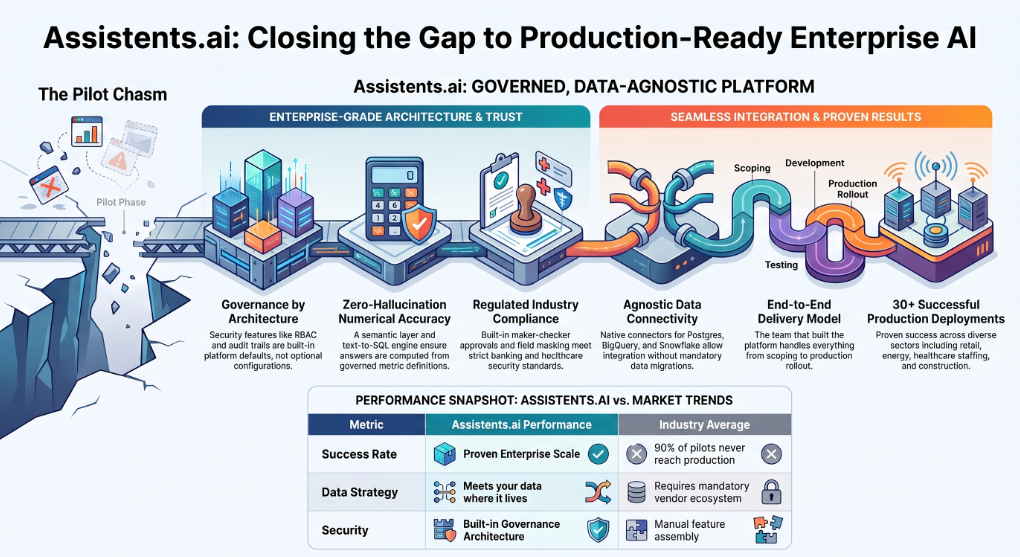
- Governance by architecture, not configuration. Maker-checker approvals, row-level security, field masking, RBAC, and an immutable audit trail are how the platform works, not features you assemble. This is what gets deployments approved in banking, healthcare, and utilities.
- Grounded answers with no hallucinated numbers. The semantic layer and text-to-SQL engine compute answers from your own governed metric definitions. When leadership asks the agent for a number, the number is real.
- Your data stack, not one vendor's ecosystem. Built connectors for Postgres, MSSQL, BigQuery, ClickHouse, Athena, and DuckDB, plus Document AI for unstructured content, mean the platform meets your data where it lives — with no mandatory data-platform purchase as a precondition.
- Platform plus delivery, end to end. Enterprise AI agent development services in the literal sense: scoping, data connection, business-rule modelling, governance configuration, and production rollout, delivered by the team that built the platform. The gap between license and production — where most AI initiatives die — is inside the engagement, not outside it.
- Proof across 30+ production deployments. Ports, national retail, banking fintech, healthcare staffing, construction tenders, luxury hospitality, energy, and real estate — shipped, governed, and measured. In a market where nearly nine in ten agent pilots never reach production, shipped is the differentiator.
Why Assistents.ai (Even If You Never Evaluated Agentforce)
Maybe you arrived here not to compare two vendors but to answer a harder question: build in-house, buy a platform, or partner with a development services team?
Building in-house means hiring for LLM orchestration, governance engineering, data integration, and evaluation infrastructure — then maintaining all of it as models and standards change monthly. Buying a platform alone means owning the integration and governance gap yourself. The services-led platform model closes both gaps: you get proven platform architecture and the delivery muscle to put it into production.
Assistents.ai also de-risks adoption through a deliberate maturity ladder:
Ask. Start with governed, conversational analytics — natural-language questions answered from your own data through the semantic layer. Zero write risk, immediate value, and your teams learn to trust the system.
Execute. Graduate to agents that act — under maker-checker approval. The AI proposes the SAP order, the refund, the ticket, the schedule change; a human confirms; the server verifies. Automation with a permanent human handbrake.
Autonomous. Where the evidence supports it, selected low-risk workflows run autonomously — still logged, still governed, still auditable, with humans supervising by exception instead of by transaction.
Every capability in the platform — multi-agent orchestration, Agent Builder, Workflow Builder, voice agents, Document AI — operates inside that same governed envelope. And a typical engagement follows a path your board can approve: discovery and use-case scoping, a governed agent on your real data, production rollout with monitoring, then expansion to the next workflow.
That is what enterprise AI agent development services should mean: not a demo, not a license, not a pilot that dies in month four — a governed agent, in production, doing measurable work.
Ready to see governed AI agents on your own data? Book a scoping call with the Assistents.ai team and get a production path — not a pilot — mapped to your first use case.
FAQS
What are enterprise AI agent development services?
Enterprise AI agent development services are end-to-end engagements that design, build, integrate, govern, and deploy autonomous AI agents inside a company's real systems — covering data connection, business-rule modelling, governance configuration, and production rollout. They differ from platform licensing alone, where implementation is left to the buyer or a third-party integrator.
Is Assistents.ai an alternative to Salesforce Agentforce?
Yes. Assistents.ai is a leading Agentforce alternative for enterprises whose data spans multiple systems, who need architectural governance (maker-checker approvals, row-level security, immutable audit trails), and who want predictable engagement-based pricing instead of per-conversation or per-action consumption billing.
How much does Salesforce Agentforce cost compared to Assistents.ai?
Agentforce charges $2 per conversation or uses Flex Credits at $500 per 100,000 credits, with a standard action costing about $0.10 — and full capability typically depends on Data Cloud, which independent analyses commonly cite at $60,000+ per year. Independent first-year total-cost estimates for mid-market deployments range from roughly $150,000 to $425,000. Assistents.ai uses scoped engagement pricing with no per-action metering, making costs predictable before deployment.
Can Assistents.ai agents work with Salesforce data?
Assistents.ai agents integrate with enterprise systems through governed workflow integrations and open interoperability standards, and connect natively to major data warehouses and databases including Postgres, MSSQL, BigQuery, ClickHouse, Athena, and DuckDB. If Salesforce is one of several systems in your stack, an integration-led approach lets agents work across all of them rather than inside one.
What makes an AI agent "governed"?
A governed AI agent operates under enforced controls: role-based and row-level access to data, maker-checker approval on actions (the AI proposes, a human confirms, the server re-verifies), field masking for sensitive data, and an immutable audit trail of every query, decision, and action. Governance by architecture — rather than by configuration — is what allows agents to pass compliance review in regulated industries.
How long does it take to deploy an enterprise AI agent?
With a services-led platform approach, a scoped agent typically moves from discovery to production in weeks, because data connectors, governance frameworks, and orchestration infrastructure already exist. License-only approaches routinely take six to twelve months, because integration and governance must be built or bought separately.
Do I need a separate data platform to use Assistents.ai?
No. Assistents.ai connects directly to your existing databases and warehouses — Postgres, MSSQL, BigQuery, ClickHouse, Athena, DuckDB — and grounds agents in your own metric definitions through its semantic layer. There is no mandatory data-platform purchase as a precondition for deployment.