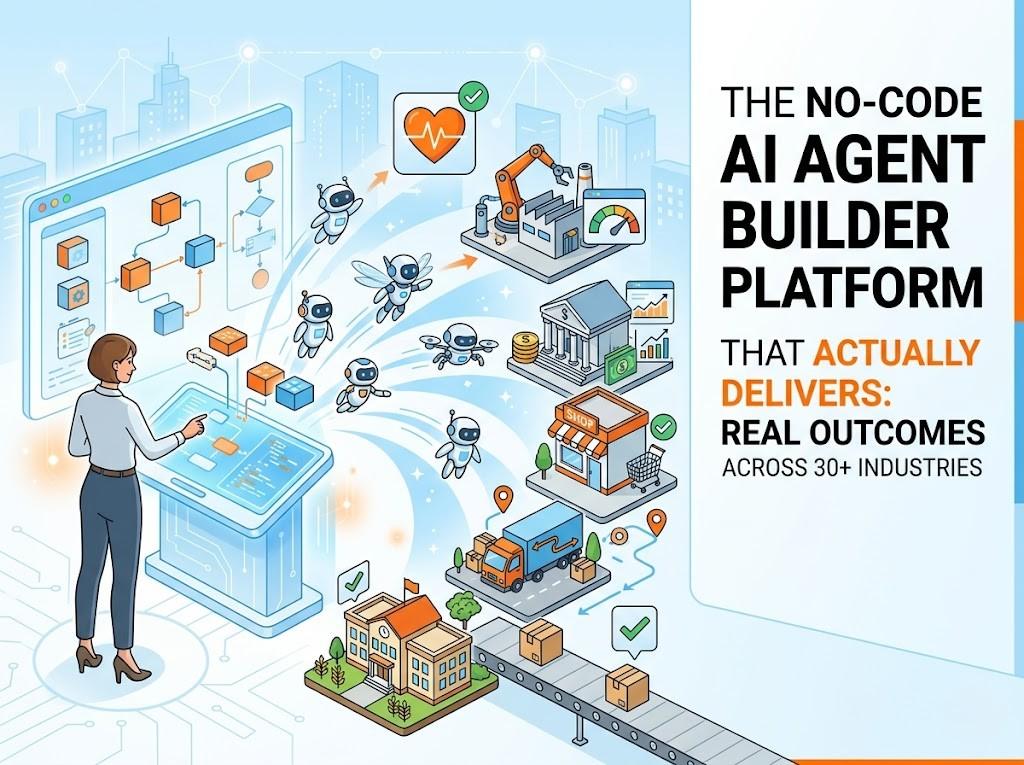
Every week, a new "no-code AI agent builder" appears promising to transform your business with a few drag-and-drop clicks. The platforms multiply. The demo videos look slick. The pricing pages are clean.
Then reality hits.
You spend weeks configuring workflows, only to find the agent can't connect to your actual systems. Or it handles simple FAQs fine, but collapses under anything complex. Or it works in isolation but doesn't hand off to your team cleanly when it matters. According to MindStudio's 2026 research, 95% of AI pilot programs fail to deliver measurable business impact — and the technology itself is rarely the reason.
The gap is almost always in delivery.
A builder gives you tools. A platform gives you outcomes. If you're searching for a no-code AI agent builder platform, this distinction is the most important thing you'll read today — because it determines whether your AI investment produces real, measurable results or becomes another expensive pilot that never scales.
This blog documents what it actually looks like when AI agents are deployed correctly, across more than 30 real-world client engagements spanning hospitality, retail, logistics, financial services, real estate, healthcare, energy, construction, education, and beyond.
No theory. No tool comparisons. Just proof.
What Is a No-Code AI Agent Builder Platform?
A no-code AI agent builder platform is a system that enables organisations to create, deploy, and manage AI agents that perform autonomous business tasks — without requiring software developers or custom code.
Unlike traditional chatbots that follow fixed scripts, AI agents built on these platforms can reason about goals, take multi-step actions across connected systems, adapt to new information, and escalate to humans when needed. Unlike robotic process automation (RPA), which mimics clicks in rigid sequences, AI agents interpret intent, handle variation, and make decisions.
The table below clarifies where no-code AI agents sit relative to alternatives:
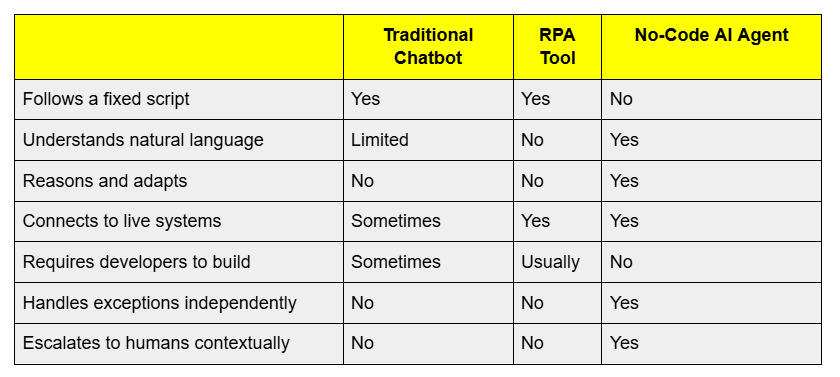
The key phrase in this definition is autonomous business tasks. An AI agent doesn't just answer a question — it acts. It reads an incoming tender document, classifies it, extracts data, routes it to the right workflow, and logs the audit trail. It monitors competitive pricing across channels, detects a shift, and sends a leadership alert with recommended actions. It takes a staffing request, matches it to available nurses, handles scheduling, sends notifications, and logs compliance records.
That is what separates a no-code AI agent platform from a chatbot builder — and why the platform choice matters more than almost any other technology decision a business makes in 2026.
Why No-Code AI Agents Have Become Business-Critical in 2026
The global AI agent market reached $7.84 billion in 2025 and is projected to hit $52.62 billion by 2030. Gartner forecasts that 80% of low-code tool users will sit outside formal IT departments by 2026, up from 60% in 2024. The shift is structural: business units can no longer wait six months for developer-built solutions. They need to move at the speed of decisions.
Three pressures are accelerating adoption right now:
The talent gap is real. There are not enough AI engineers to build custom agents for every business function that needs one. No-code platforms collapse the time and cost of deployment from months to weeks.
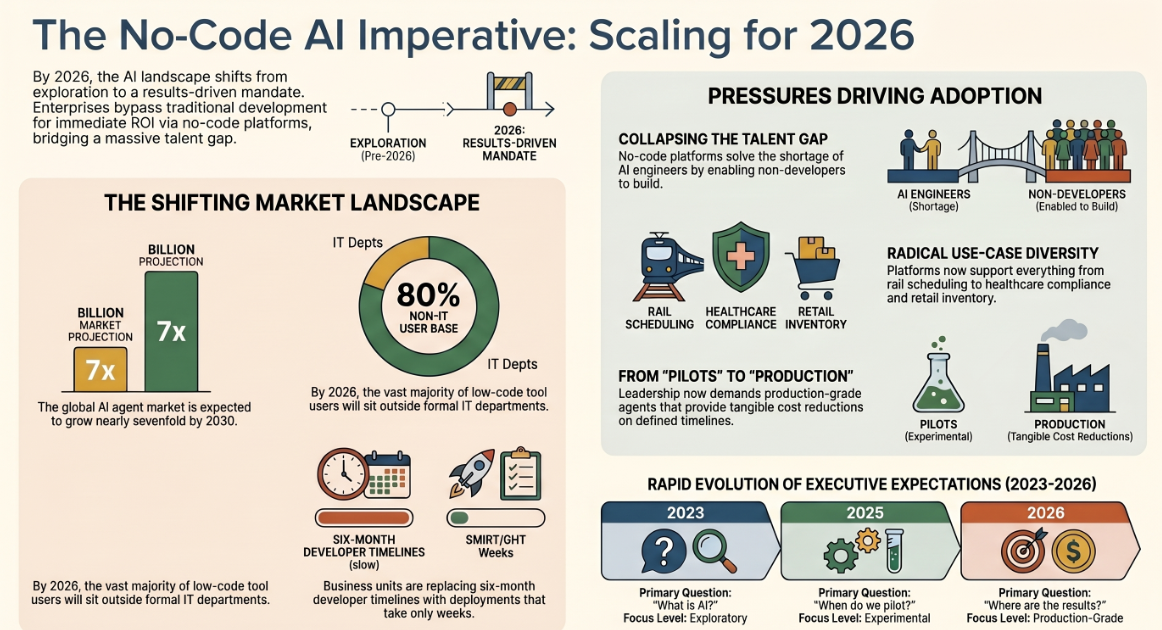
The use case diversity is overwhelming. A logistics company needs operational dashboards and rail scheduling agents. A healthcare provider needs staffing matching and compliance workflows. A retail chain needs store-level inventory intelligence and multilingual voice support. No single developer team can cover this breadth. A platform that spans verticals can.
The ROI expectation has shifted. In 2023, leadership asked "what is AI?" In 2025, they asked "when do we pilot?" In 2026, they're asking "where are the results?" Businesses are no longer tolerating exploratory experiments. They want production-grade agents that reduce costs, speed decisions, and replace manual effort — on a defined timeline.
This is the context in which no-code AI agent builder platforms are being evaluated today. And the bar has risen significantly.
Assistents.ai deploys AI agents across enterprise and mid-market organisations globally. Our platform spans customer service automation, document intelligence, sales and operations analytics, agentic procurement, compliance workflows, and more — across every major industry vertical. No developers required.
AI Agent Builder vs. AI Agent Platform: The Distinction That Determines Your Results
There is an important difference between an AI agent builder and an AI agent platform — and most buyers only discover it after they've signed a contract.
An AI agent builder gives you tools: a visual canvas, pre-built connectors, template libraries, and deployment infrastructure. You configure it, connect it, test it, and maintain it. When something breaks, you fix it. When the use case expands, you build more.
An AI agent platform gives you outcomes: a team that works with you to understand the use case, design the agent architecture, integrate with your real systems, deploy with governance and auditability, and iterate based on results. You define success. The platform delivers it.
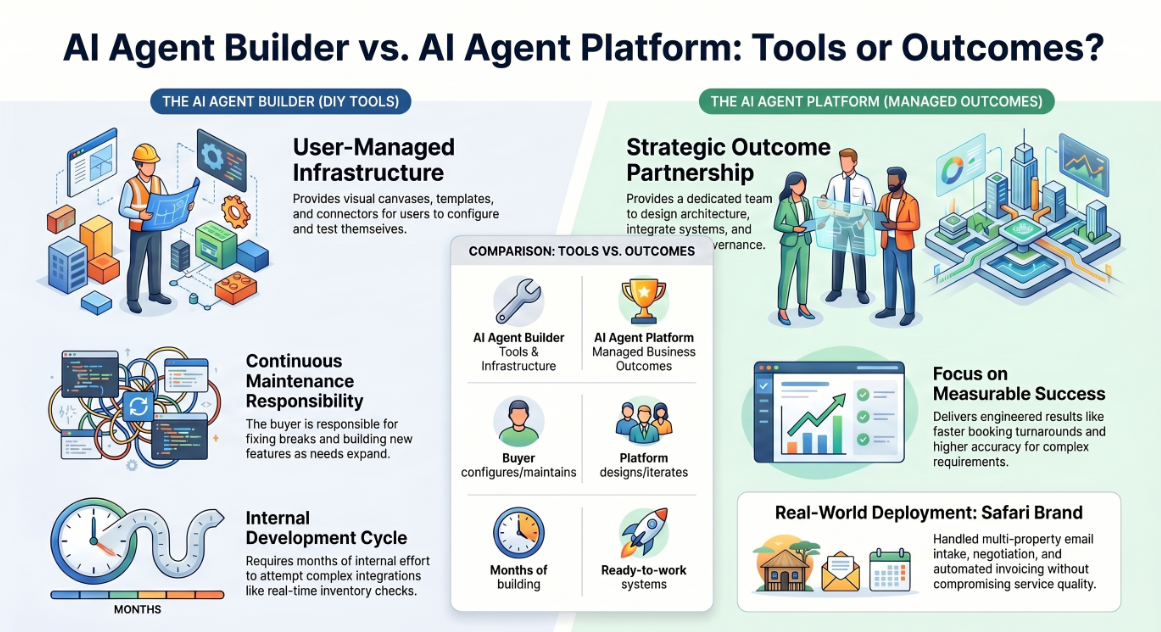
The distinction shows up clearly in real deployments.
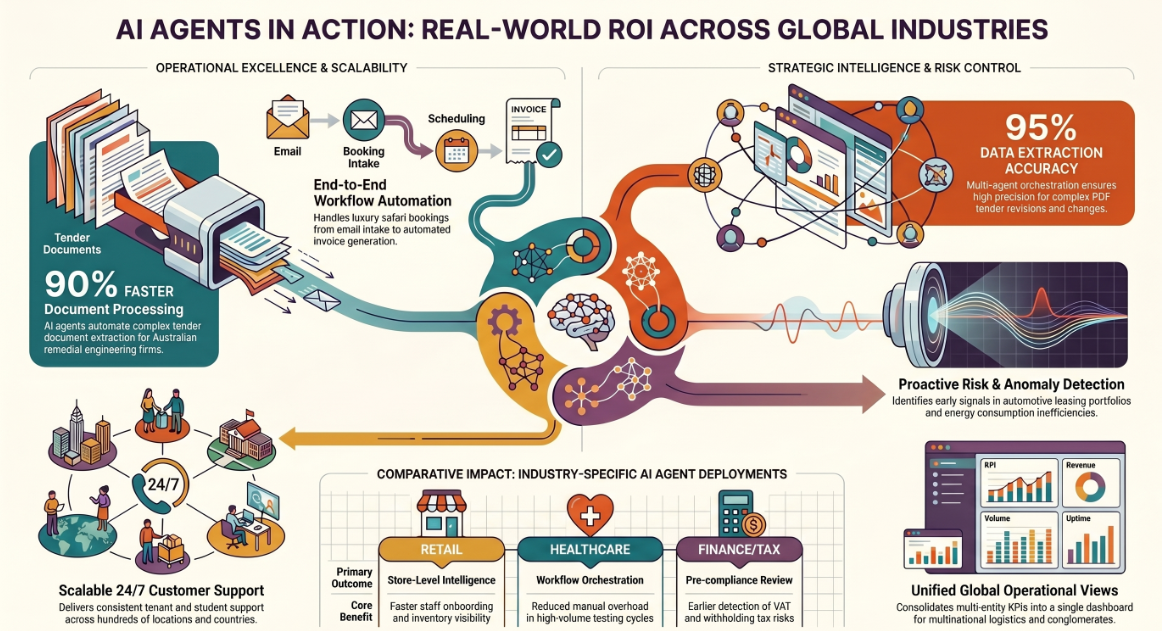
A luxury safari hospitality brand with 16 boutique properties across East Africa needed a booking agent that could handle complex, multi-property enquiries from high-expectation global travellers. This wasn't a chatbot use case. It required email intake with intent classification, real-time inventory checks across properties, conversational loops to capture missing guest details, alternative date and property negotiation, hybrid handoff to human agents for curated itinerary creation, and automated invoice generation. A builder would have given them the tools to attempt this over months. A platform delivered a working system — engineered for measurably faster booking turnaround, higher accuracy on complex requirements, and scalable operations without compromising service quality.
That difference — between being handed a builder and being handed a working agent — is what this blog is about.
Real-World No-Code AI Agent Deployments: Proof Across Every Industry
The following deployments represent live, production AI agent implementations across global clients. No client names are referenced. Each example reflects documented scope and real results.
Hospitality and Luxury Travel
The challenge: A luxury safari hospitality brand operating 16 boutique lodges and camps across iconic locations in Kenya and Tanzania needed to handle complex booking enquiries from high-expectation international travellers — without diluting the white-glove service standard.
What was built: A digital booking agent handling end-to-end luxury travel booking workflows with human-in-the-loop quality control. Capabilities included email intake with intent classification and data extraction, a conversational loop to capture missing guest details, real-time inventory checks with alternative date and property negotiation, hybrid handoff for curated itinerary creation, and automated invoice and PDF document generation.
Results:
- Faster booking turnaround with reduced back-and-forth
- Higher accuracy on complex, multi-property guest requirements
- Scalable operations without compromising luxury service standards
Construction and Remedial Engineering
The challenge: An Australian commercial waterproofing and remedial building services specialist needed to eliminate the manual overhead of processing complex tender documents — a process involving revision tracking, data extraction from PDFs, and synchronisation into core operational systems.
What was built: An Intelligent Document Workbench using multi-agent orchestration. The system handled tender retrieval and workflow determination, revision and change analysis, Vision-LLM extraction from complex PDFs, deep integration with field management software (full create, read, update, delete operations), quote locking, and audit logging.
Results:
- Engineered for up to 90% faster tender document processing
- 95% extraction accuracy target for standard document formats
- Reduced bid risk via revision and change detection with full auditability
Creator Economy and Influencer Marketing
The challenge: A creator economy platform matching brands with creators needed to automate the operational overhead of campaign delivery, performance reporting, and brand safety monitoring at scale.
What was built: An AI platform automating influencer marketing operations and performance intelligence. This included creator discovery enrichment, campaign workflow automation, automated reporting summaries and insight generation, content KPI monitoring, brand-safety checks, and analytics for campaign ROI and engagement.
Results:
- Reduced manual operations across campaigns
- Faster performance visibility and scalable execution
- More consistent reporting and learnings across brand programmes
Automotive Leasing and Financial Services
The challenge: An independent Canadian automotive leasing provider offering manufacturer and dealer network programmes needed better portfolio visibility, early risk signals, and exception alerting across a complex lending book.
What was built: A data analytics platform delivering portfolio KPIs covering risk, delinquency, maturity, and residuals; dealer network performance analytics; and automated alerts for exceptions and early risk signals.
Results:
- Better portfolio visibility and faster risk identification
- Improved decision support for programme operations
- More proactive management through exception alerting
AI-First Trading and Crypto Research
The challenge: An AI-first trading terminal needed agents that could synthesise fragmented market signals, support research workflows, and generate strategy recommendations with appropriate risk guardrails.
What was built: AI agents for crypto trading insights and strategy automation. The system included market data ingestion, indicator and pattern analysis, strategy simulation with risk guardrails, alerting and recommendation summaries, and execution-ready workflow integration.
Results:
- Faster synthesis of fragmented market signals
- More disciplined decision-making through governed workflows
- Reduced manual monitoring effort
Media, Entertainment, and the Arts
The challenge: An AI-powered self-tape and line-learning app for actors needed a voice agent capable of handling realistic scene partner interactions — with character control, pacing, cue logic, and cost-controlled inference.
What was built: An AI Voice Agent enabling actors to rehearse scenes, run lines, and self-tape with an always-available scene partner. Capabilities included script ingestion, scene management, voice agent with character and voice control, pacing and cue logic, self-tape workflow support, rehearsal analytics, and cost-controlled inference deployment.
Results:
- Higher rehearsal throughput without human readers
- More consistent audition practice loops
- Improved readiness and reduced coordination friction
Financial Planning and Advisory
The challenge: An AI CFO platform serving growing businesses, CFOs, and advisors needed to turn financial data into continuous, actionable intelligence — not just a dashboard, but a real-time engine for cash flow monitoring, forecasting, and scenario planning.
What was built: An AI CFO agent with a financial data connection layer (accounting and banking exports), forecast and scenario modelling agents, alerting for runway and cash risks with recommended actions, and portfolio views for advisors managing multiple clients.
Results:
- Faster analysis cycles and improved decision cadence
- Earlier detection of cash risks and anomalies
- Scalable advisory-level insight without added headcount
Education and Teacher Communities
The challenge: A global teacher community with over one million educators across 131 countries needed to deliver scalable support for learning guidance, competency insights, and programme operations without proportionally scaling headcount.
What was built: AI for teacher communities covering competency insights, learning guidance, automated support workflows at global scale, support agents for programme and learning queries, and analytics for programme operators and partners.
Results:
- Scalable support for large educator communities
- Faster access to learning resources and guidance
- Better visibility into engagement and outcomes
Enterprise Logistics and Supply Chain
The challenge: A multinational logistics and warehousing company serving customers across India, the UK, Europe, and the US needed consolidated analytics across multi-entity global operations — a single operational view that previously didn't exist.
What was built: Cross-entity KPI standardisation and consolidated reporting, operational dashboards with variance explanations, and a data quality and governance layer.
Results:
- Single operational view across entities
- Faster leadership reporting and issue identification
- Improved consistency of operational metrics
Banking and Credit Unions
The challenge: A global fintech provider delivering cloud-based automation for banks and credit unions needed omnichannel AI agents that could handle complex banking support cases with full auditability, compliance readiness, and SLA tracking.
What was built: Omnichannel intake (chat, email, and phone) with workflow routing; agent-assist summarisation and next-best actions; auditability, reporting, and SLA monitoring; integration with core banking systems; and a voice support agent supporting Hindi and English.
Results:
- Faster case handling and improved consistency
- Reduced operational load via automation
- Better compliance readiness via audit trails
Retail at National Scale
The challenge: A rapidly scaling value retailer with 700+ stores across hundreds of Indian cities needed AI agents that could work at store level — handling helpdesk queries, surfacing inventory intelligence, and onboarding staff — in multiple languages, at scale.
What was built: A voice support agent in Hindi and English, an inventory intelligence agent with pricing, stock, and promotional data per store, a knowledge and training agent using RAG over POS and SOP documentation, and an admin console with analytics and ticketing integration.
Results:
- Reduced manual helpdesk burden and faster store issue resolution
- Improved store-level inventory visibility
- Faster onboarding via on-demand training guidance
Competitive Intelligence and Pricing
The challenge: A major Indian HVAC manufacturer competing in highly price-sensitive consumer and commercial markets needed always-on visibility into competitor pricing moves, promotional shifts, and product availability — replacing manual monitoring across multiple portals.
What was built: Continuous e-commerce and channel monitoring (pricing, discounts, offers, availability, ratings), agentic Q&A mapped to leadership questions, analytics views for pricing gaps, threats, and portfolio movement, and a scalable architecture from proof-of-concept to production with governance and audit trails.
Results:
- Faster competitive response cycles
- Earlier identification of pricing gaps and promotional shifts
- Always-on monitoring replacing manual checks across portals
Energy Management and Campus Infrastructure
The challenge: A premier Indian research institute needed reliable monitoring and optimisation of campus-scale energy consumption — including anomaly detection, forecasting, and proactive alerting.
What was built: Utility and sensor data ingestion with anomaly detection, forecasting and optimisation recommendations, and dashboards with proactive alerting.
Results:
- Improved energy visibility and faster detection of inefficiencies
- Reduced manual monitoring effort
- More predictable operations through early alerts
Smart City and Grid Operations
The challenge: A smart infrastructure unit operating at city scale — touching over 150 million urban lives, running 25+ smart city operation centres, and connecting over 2 million assets — needed agentic analytics and automated operational alerting on top of existing smart utility systems.
What was built: Smart grid data ingestion and operational dashboards, predictive analytics for outages, losses, and field issues, and automated alerts and workflow routing for resolution.
Results:
- Higher operational visibility across grid operations
- Faster exception detection and response coordination
- More proactive grid operations via continuous monitoring
Pharmaceutical Sourcing
The challenge: A pharma sourcing and excipients platform marketing over 7,500 SKUs needed to simplify and accelerate procurement by automating RFQs, supplier matching, and procurement decision support.
What was built: RFQ automation and supplier matching workflows, quality and regulatory document handling, and analytics on price, lead time, and vendor performance.
Results:
- Faster procurement cycles and improved sourcing visibility
- Reduced vendor coordination and manual follow-ups
- Better price and lead-time competitiveness through insights
Financial Market Research
The challenge: A market research and technical analysis platform publishing forecasts and actionable insights for Indian markets needed to automate research workflows and produce faster, more consistent insight generation.
What was built: Data ingestion and indicator pipelines, research automation and insight generation, and automated alerts with thematic dashboards.
Results:
- Faster production of market insight packs
- More repeatable and consistent research workflows
- Better signal visibility through automated analytics
Power Transmission and Grid Management
The challenge: A state power transmission utility responsible for operating and maintaining transmission systems across an entire Indian state needed predictive maintenance indicators, loss and outage analytics, and automated alerting for field operations.
What was built: Transmission KPI monitoring with anomaly detection, loss and outage analytics with predictive maintenance indicators, and dashboards with automated alerts for field operations.
Results:
- Faster identification of grid exceptions and operational risks
- Improved reliability through proactive monitoring
- Better operational transparency for leadership
Retail Holdings and Executive Decision Support
The challenge: A privately held retail holding environment needed governed, cross-functional intelligence across systems and documents — the ability to move from insight to action quickly, without creating bottlenecks in analyst reporting queues.
What was built: A unified context engine spanning structured and unstructured data, a semantic governance layer covering rules, hierarchies, and formulas, an active orchestrator integrating with core systems, and insights-to-action agents layered on top of existing dashboards.
Results:
- Shift from reactive reporting to proactive execution loops
- Standardised decision logic across teams
- Automated task creation and completion tracking
Ports and Global Logistics
The challenge: One of the world's leading port and logistics operators — reporting record revenue exceeding $20 billion in FY2024 — needed to digitise and optimise port-to-inland logistics operations, including terminal workflows and rail management.
What was built: Terminal and rail management solutions to digitise and optimise port-to-inland logistics operations, rail scheduling and visibility with exception management, and executive dashboards and operational alerts.
Results:
- Improved operational visibility and exception response
- Higher predictability of terminal-to-rail throughput
- More efficient coordination across terminal and inland logistics
Enterprise Sales Intelligence
The challenge: A UAE engineering and technology solutions provider needed always-on account monitoring and opportunity identification across enterprise accounts — with CRM integration and governed sales playbooks.
What was built: Always-on account monitoring and signal capture, rule-governed opportunity identification and follow-up orchestration, CRM integration-ready workflows and pipeline hygiene, and sales dashboards with leadership alerts.
Results:
- Higher account coverage without increasing headcount
- Faster response cycles on opportunities and renewals
- More consistent execution via governed playbooks
SAP Sales Order Automation
The challenge: A premium UAE kitchen and home-appliances retailer needed to replace an end-of-life, high-cost document management system with an agentic automation layer that could interpret order triggers, validate data, and create SAP sales orders without manual intervention.
What was built: Agentic automation to interpret order triggers, validate and create SAP sales orders, rules and governance for exceptions and approvals, audit logs and reconciliation reporting, and an integration-ready replacement for the legacy ECR workflow.
Results:
- Reduced manual order processing and legacy system dependency
- Faster order-to-confirm cycle with fewer data entry errors
- Improved auditability for sales order creation and exceptions
Real Estate and Property Management
The challenge: A major UAE real estate portfolio owner and manager with diversified assets across Dubai, Abu Dhabi, Sharjah, and other emirates needed to automate tenant and customer support workflows end-to-end across a large, diverse portfolio.
What was built: An omnichannel service agent (web, WhatsApp, and email-ready), tenant query triage and FAQ handling, rental and payment support workflows, ticketing and escalation to human teams, and a knowledge base over policies, tenancy documents, and SOPs.
Results:
- Faster response times and lower contact centre load
- Consistent 24×7 tenant experience
- Better SLA adherence through automated routing and tracking
Driving Institutes and Customer Experience
The challenge: A Dubai-based driving institute with multi-branch operations and digitally enabled customer journeys needed to eliminate operational bottlenecks and improve visibility into conversion performance.
What was built: Funnel analytics covering enrolment through lessons to tests, instructor utilisation and slot optimisation, and customer experience dashboards with alerts.
Results:
- Reduced operational bottlenecks and better scheduling efficiency
- Improved visibility into conversion and performance drivers
- Earlier detection of service delivery issues
Conglomerate Group-Wide Intelligence
The challenge: One of the UAE's most prominent family business groups — comprising over 30 companies partnering with global brands across retail, building, industrial, and services portfolios — needed automated procurement and finance KPI alerts across group entities for margin control, vendor performance, and working capital optimization.
What was built: Group-wide KPI standardisation, automated alerts covering purchase price trends, gross margin impact, early-payment analysis, and vendor performance (delivery and returns), and dashboards plus scheduled insight packs for leadership.
Results:
- Earlier detection of margin erosion and vendor slippage
- Standardised finance and procurement intelligence across entities
- Reduced variance surprises via continuous monitoring
E-Commerce and Operations Analytics
The challenge: A Silicon Valley startup focused on real-time AI-based business analytics needed a conversational analytics layer that could answer business questions instantly across sales, product, inventory, promotions, and customer behaviour data.
What was built: Data ingestion across sales, products, inventory, promotions, and customer behaviour; conversational analytics for instant business queries; and automated KPI monitoring and exception alerting.
Results:
- Shorter analysis cycles for recurring questions
- Better visibility into product performance and promotional effectiveness
- Reduced reporting dependency on analysts
Healthcare Testing and Service Workflows
The challenge: A UK private healthcare and testing provider with high-volume consumer workflows needed to automate the full service journey — from booking through processing to reporting — while improving operational visibility.
What was built: Booking and workflow orchestration, status monitoring and customer notifications, and reporting dashboards with operational analytics.
Results:
- More scalable operations with reduced manual overhead
- Faster customer communications and fewer missed handoffs
- Improved service visibility through unified reporting
Tax Technology and Cross-Border Risk
The challenge: A tax-tech product focused on cross-border transactions needed to identify withholding tax, VAT mismatch, and permanent establishment risks early — and speed up deal workflows before issues became costly.
What was built: Transaction screening workflows with risk classification, evidence collection and explainability notes, and an escalation workflow to tax experts.
Results:
- Earlier detection of withholding and VAT risk
- Reduced last-minute deal disruptions
- Faster and more consistent pre-compliance review
Investment Due Diligence
The challenge: A long-term holding company partnering with founders and family businesses needed rigorous, structured technical due diligence for investment and acquisition decisions — including architecture review, scalability assessment, and security posture evaluation.
What was built: Code and architecture review, infrastructure and security assessment, scalability and resilience evaluation, integration readiness analysis, and a risk register with a remediation roadmap.
Results:
- Faster investment decisions with clear, structured technical risk visibility
- Reduced post-deal surprises via remediation planning
- Improved confidence in scalability and security posture
Healthcare Staffing
The challenge: A healthcare staffing platform connecting nursing professionals with facilities for flexible shifts needed faster matching, better scheduling, and compliance tracking — at the speed that healthcare staffing demands.
What was built: Talent onboarding and credential capture, facility staffing request intake and matching logic, scheduling, notifications, and compliance workflows, and reporting for fill rate and utilisation.
Results:
- Faster fill cycles and lower scheduling friction
- Better workforce utilisation
- Improved staffing responsiveness for facilities
Inpatient and Geriatric Care Operations
The challenge: Two physician-led healthcare enterprises — one running hospitalist programmes across New England, one delivering geriatric care across assisted living settings — needed revenue cycle visibility, operational reporting, and performance tracking to improve care-programme outcomes and financial performance.
What was built: Revenue and utilisation analytics, performance dashboards with variance explanations, action lists for billing workflow optimisation, programme operations dashboards, and staffing and service delivery analytics.
Results:
- Improved visibility into revenue leakage drivers
- Faster operational decision-making via unified reporting
- Better decision support for leadership
Brand Insights and Creative Strategy
The challenge: A brand insights and creative execution studio needed to unify signals from multiple sources — creative performance data, audience behaviour, and channel analytics — and generate actionable narrative insights for marketing teams.
What was built: Multi-source ingestion covering creative, performance, and audience signals; insight agents producing themes, narratives, and recommendations; and leadership reporting packs.
Results:
- Faster creative strategy cycles and more consistent insight workflows
- Deeper signal synthesis across channels
- Improved clarity on recommended next actions for campaigns
Tax Research Automation
The challenge: A specialised sales and use tax research automation tool needed to replace manual source hunting with automated retrieval, summarisation, and drafting support — with citations that held up to professional scrutiny.
What was built: Automated source collection and summarisation, draft memo and position output generation, and workflow tracking with knowledge base building.
Results:
- Faster research cycles and better documentation hygiene
- Reduced manual source-hunting time
- More consistent research outputs
What to Look for in a No-Code AI Agent Builder Platform
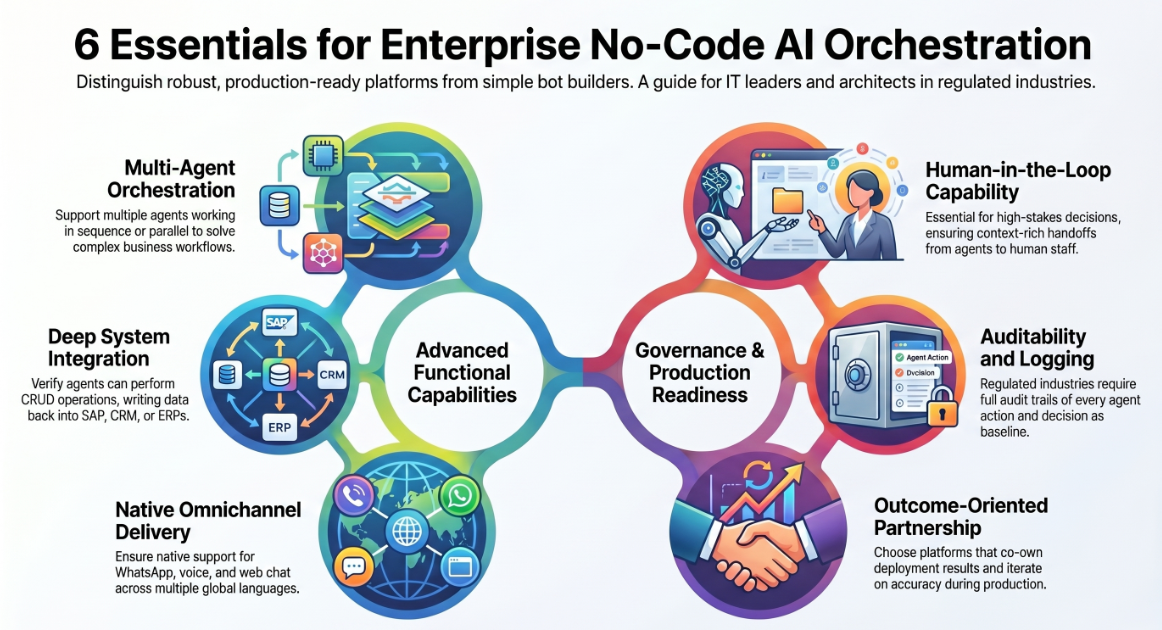
If you're evaluating platforms, the following criteria separate tools that sound good in demos from platforms that deliver in production.
Multi-agent orchestration. Real business problems require multiple agents working in sequence or in parallel — not a single bot answering FAQs. A tender document agent that extracts, classifies, routes, and logs is four agents working as one workflow. Look for platforms that support this natively.
System integration depth. Read-only connectors are not enough. The difference between a useful agent and a transformative one is whether it can write back to your systems — creating a sales order in SAP, generating an invoice, updating a CRM record, triggering a workflow in your field management software. Ask explicitly: can this agent execute CRUD operations in my core systems?
Human-in-the-loop capability. For high-stakes decisions — luxury travel itineraries, financial approvals, escalated tenant queries — the agent must know when to hand off to a human, with full context preserved. This is not optional. It is how you maintain quality and trust in automated workflows.
Auditability and governance. Regulated industries — banking, healthcare, energy, construction — require audit trails, approval workflows, and exception logging as baseline requirements, not premium add-ons. If a platform cannot produce an audit log of every agent action and decision, it is not enterprise-ready.
Multilingual and omnichannel delivery. Business is not monolingual and not single-channel. If your agents need to work via WhatsApp, email, voice, web chat, and in languages other than English — including Hindi, Arabic, or others — confirm this capability is native, not bolted on.
Outcome orientation, not just build tools. The most important question is not "how easy is the builder?" It is "who is responsible for results?" A platform that co-owns your deployment outcomes — that runs a proof of concept, iterates on accuracy, and governs the production rollout — is categorically different from one that hands you a toolset and a documentation link.
The Most Common No-Code AI Agent Use Cases in 2026
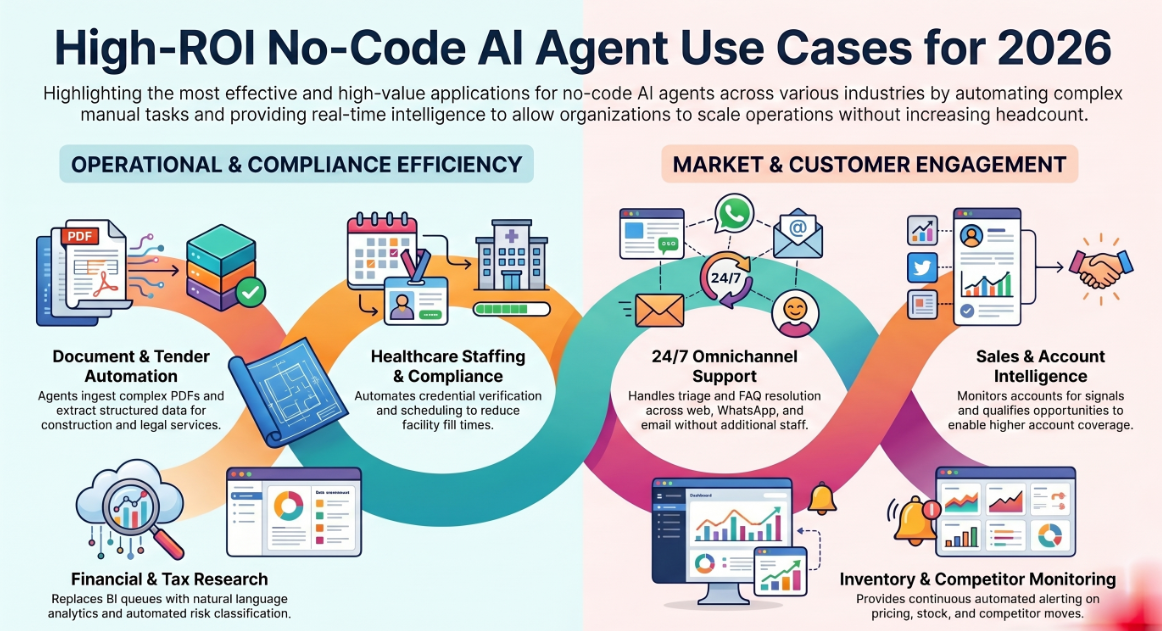
If you are exploring where to start, these are the use cases generating the clearest ROI across current deployments:
Customer service and tenant support automation. Omnichannel agents handling inbound queries, routing, triage, FAQ resolution, and escalation — across web, WhatsApp, and email. Results typically include reduced contact centre load, faster response times, and 24/7 coverage without additional headcount.
Document processing and tender automation. Agents that ingest complex PDFs, extract structured data, detect revisions, and synchronise into operational systems. Particularly high value in construction, procurement, logistics, and legal services.
Sales intelligence and account monitoring. Always-on agents monitoring accounts for signals, qualifying opportunities, updating CRMs, and surfacing leadership alerts — enabling higher account coverage without adding sales headcount.
Financial and operational analytics. Conversational analytics layers that allow leadership to ask business questions in natural language and receive governed, auditable answers — replacing BI queues with instant insight access.
Inventory and competitive intelligence. Real-time monitoring of pricing, stock, promotions, and competitor moves across e-commerce channels — replacing manual checks with continuous, automated alerting.
Healthcare staffing and compliance. Matching, scheduling, credential verification, and compliance workflows that reduce fill times and improve facility responsiveness in time-sensitive staffing environments.
Agentic procurement and supply chain. RFQ automation, supplier matching, price and lead-time analytics, and vendor performance tracking — reducing procurement cycles and manual coordination overhead.
Tax research and regulatory compliance. Automated source retrieval, summarisation, risk classification, and draft output generation — enabling tax professionals to move faster with higher consistency.
Ready to See What AI Agents Can Actually Deliver?
The AI agent space has noise. A lot of it. Platforms promise transformation and deliver demos. Tools look powerful in a sales call and fall apart in integration.
What you have read in this blog is not a product feature list. It is a documented record of AI agents working in production — across hospitality groups, national retailers, global port operators, power utilities, healthcare systems, financial services providers, and dozens of other organisations across six continents.
If you are evaluating no-code AI agent builder platforms, the most important question is not which tool has the prettiest canvas. It is: which platform has actually delivered results in businesses like yours?
That question has an answer.
[Talk to the Assistents.ai team about your use case →]
Frequently Asked Questions
What is a no-code AI agent builder platform?
A no-code AI agent builder platform is a system that enables organisations to create, deploy, and manage AI agents that autonomously perform business tasks — without writing code. These platforms use visual interfaces, pre-built connectors, and natural language prompts to design agents that reason, act across systems, and escalate to humans when needed. Unlike chatbots, AI agents complete multi-step workflows, adapt to new information, and operate continuously without manual instruction.
Can I build AI agents without any coding experience?
Yes. No-code AI agent platforms are specifically designed for non-technical users — operations managers, finance teams, HR leads, and business owners — who need to automate complex workflows without engaging a development team. The best platforms go further by offering managed delivery, where a team of specialists builds and deploys the agents on your behalf, with no coding required at any stage.
What is the difference between an AI agent and a chatbot?
A chatbot follows a fixed, pre-programmed decision tree. It responds to inputs within the boundaries of its script. An AI agent reasons about a goal, breaks it into steps, takes actions across connected systems (reading data, writing records, sending notifications, escalating to humans), and adapts its behaviour based on what it finds. The difference in business impact is substantial: chatbots answer questions, agents complete work.
How long does it take to deploy a no-code AI agent?
Proof-of-concept deployments for clearly defined use cases can be operational within days to weeks. Production-grade deployments with deep system integration, governance requirements, and multi-agent orchestration typically take four to twelve weeks, depending on the complexity of existing systems and the scope of automation required.
What industries benefit most from no-code AI agents?
Every industry benefits, but current deployments demonstrate the highest documented ROI in hospitality and travel, retail at scale, logistics and supply chain, financial services and banking, real estate, healthcare staffing and operations, energy and smart grid management, construction and engineering, education and community platforms, pharmaceutical sourcing, professional services and tax, and brand and creative intelligence.
Do no-code AI agents integrate with existing enterprise software?
Yes. Mature platforms support deep, bidirectional integrations with enterprise systems including SAP (for automated sales order creation), CRM platforms (for pipeline management and account monitoring), field management software (for workflow creation and audit logging), banking cores (for omnichannel case management), and document management systems. Confirm that any platform you evaluate supports full CRUD operations — not read-only access — in your core systems.
Is a no-code AI agent platform secure enough for enterprise and regulated industries?
Enterprise-grade platforms include role-based access control, full audit logging of every agent action and decision, governance layers for rules and approvals, exception escalation workflows, and compliance-ready reporting. Regulated industries — banking, healthcare, energy utilities, legal and tax services — require these as baseline requirements. If a platform cannot demonstrate audit trail capability and governance controls, it is not appropriate for regulated environments.
What is the difference between agentic AI and automation?
Traditional automation executes a fixed sequence of steps: when X happens, do Y. Agentic AI reasons about a goal, determines the steps required to achieve it, takes actions across systems, evaluates results, handles exceptions, and adjusts its approach. Agentic AI is adaptive; traditional automation is rigid. The distinction matters most when business processes involve variability, exceptions, or judgment — which describes most real business workflows.

.jpeg&w=3840&q=75)