Every week, a new AI agent platform launches. The headlines promise autonomous workflows, dramatic productivity gains, and the end of repetitive work. But for most enterprise leaders who have moved past the pilot stage, a frustrating reality has emerged: the platform you build on matters far more than the model powering it.
The IDC FutureScape report predicts that by the end of 2026, nearly half of all organisations worldwide will be orchestrating AI agents at scale. Yet most published comparisons of AI agent development platforms read like feature checklists — a list of logos, a pricing table, and a recommendation to "start with a free trial." They do not answer the questions that actually determine whether AI agents survive contact with real enterprise operations.
Which platforms hold up when agents need to read and write across ten integrated systems simultaneously? Which give you an audit trail a regulator can review? Which have actually been deployed — not in a sandbox, but in production — across industries as different as port logistics and luxury hospitality?
This guide answers those questions. It covers what AI agent development platforms actually are, how to evaluate them across six criteria that matter in production, and what real-world deployments across 12+ industries reveal about what separates platforms that scale from platforms that stall.
What Is an AI Agent Development Platform?
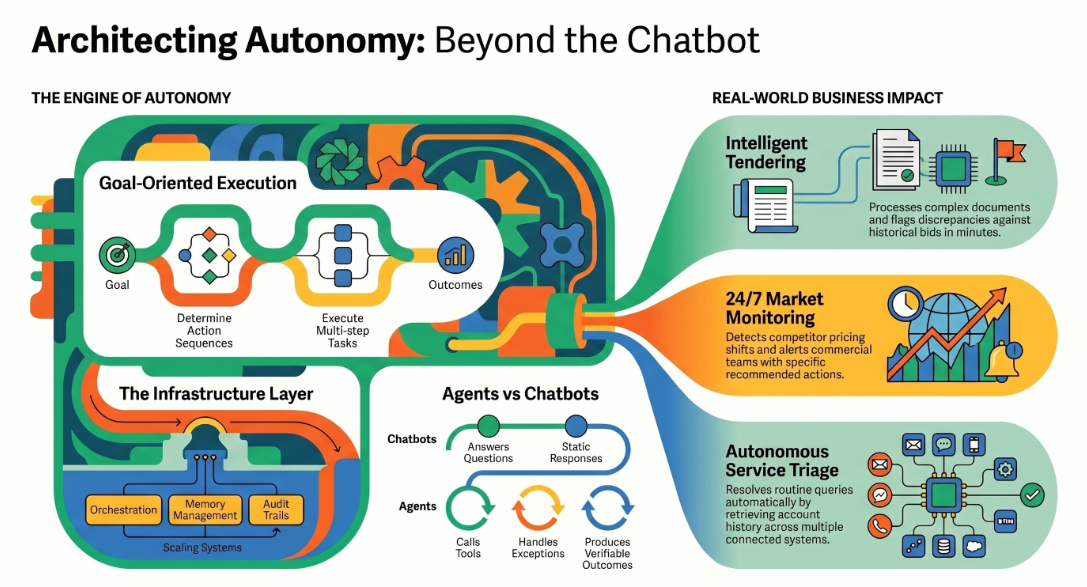
An AI agent development platform is the infrastructure layer that enables you to build, deploy, and manage autonomous systems capable of planning, executing multi-step actions, and adapting to new information — without constant human instruction.
This is not a chatbot with extra steps. A chatbot answers a question. An AI agent receives a goal, determines the sequence of actions needed to achieve it, calls the tools and systems required, handles exceptions, and produces a verifiable outcome.
Concretely, an AI agent might:
- Ingest a complex tender document, extract key data, compare it against historical bids, flag discrepancies, and push a structured summary into your project management system — in minutes, not days.
- Monitor e-commerce channels across competitors continuously, detect pricing shifts and promotional changes, and alert your commercial team with specific recommended actions before the trading day opens.
- Triage incoming customer service requests, retrieve order history and account status from three connected systems, resolve routine queries automatically, and escalate edge cases with full context to a human agent.
The platform is what makes this possible at scale: the orchestration layer, the memory management, the tool integrations, the governance controls, the audit trails, and the deployment infrastructure.
Getting the platform selection wrong means building on foundations that cannot support the operational complexity your business actually requires.
Why the Platform You Choose Matters More Than the Model
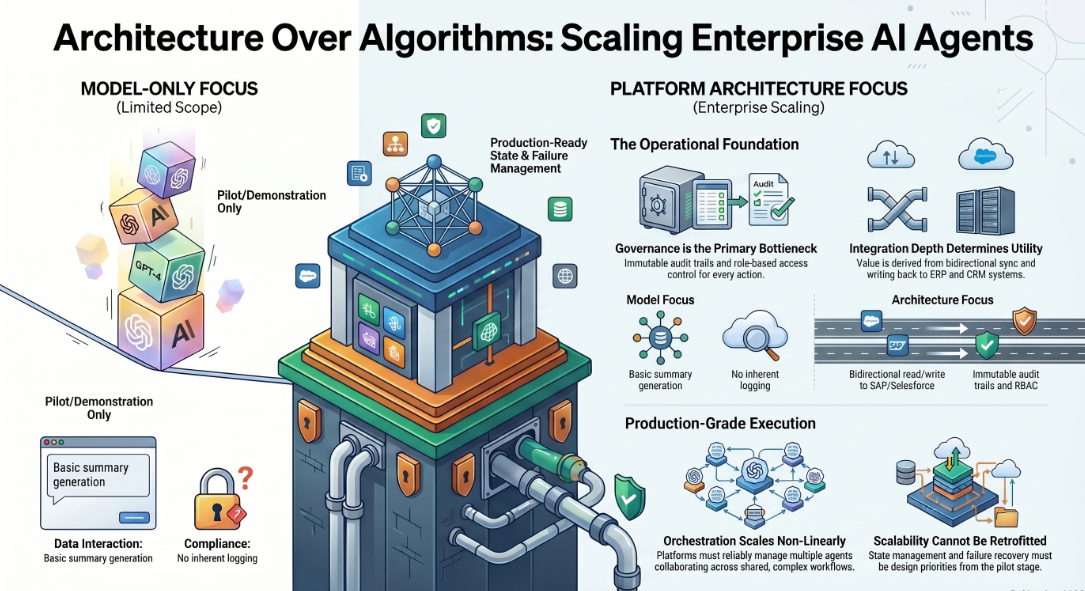
The single most common mistake enterprises make when evaluating AI agents is treating model selection as the primary decision. The underlying model — whether GPT-4o, Claude, Gemini, or an open-source alternative — matters far less than the platform architecture surrounding it.
Here is why.
Governance is the bottleneck in regulated industries.
In financial services, healthcare, logistics, and utilities, every agent action that touches customer data, financial records, or operational systems needs to be logged, attributable, and reviewable. A platform without immutable audit trails, role-based access control, and human-in-the-loop escalation paths cannot operate in these environments — regardless of how capable the underlying model is.
Integration depth determines real-world utility.
An agent that cannot write back to your ERP, CRM, or operational systems is an expensive way to generate summaries. Enterprise AI agents derive their value from taking action across integrated systems — SAP, Salesforce, Oracle, Shopify, ServiceNow, custom internal tools. The platform must handle bidirectional, real-time sync with governance applied to every read and write operation.
Orchestration complexity scales non-linearly.
Simple single-agent deployments are straightforward. The moment you need multiple agents collaborating on a shared workflow — a document extraction agent handing structured data to an order creation agent that triggers an approval routing agent — the orchestration layer becomes the critical constraint. Most no-code platforms cannot handle this. Most developer frameworks require significant custom engineering to manage it reliably.
Scalability cannot be retrofitted.
Enterprises that run successful pilots and then attempt to scale frequently discover that their platform of choice was designed for demonstration, not production. Architecture decisions made at the pilot stage — how state is managed, how agents recover from failures, how concurrent workloads are handled — become expensive limitations at scale.
The platforms that consistently deliver in production are those where governance, integration, orchestration, and scalability were design priorities from the beginning — not features added as afterthoughts.
6 Criteria to Evaluate Any AI Agent Development Platform
Before comparing specific platforms, you need a consistent evaluation framework. These six criteria are drawn from patterns observed across enterprise deployments spanning retail, logistics, financial services, healthcare, real estate, and energy.
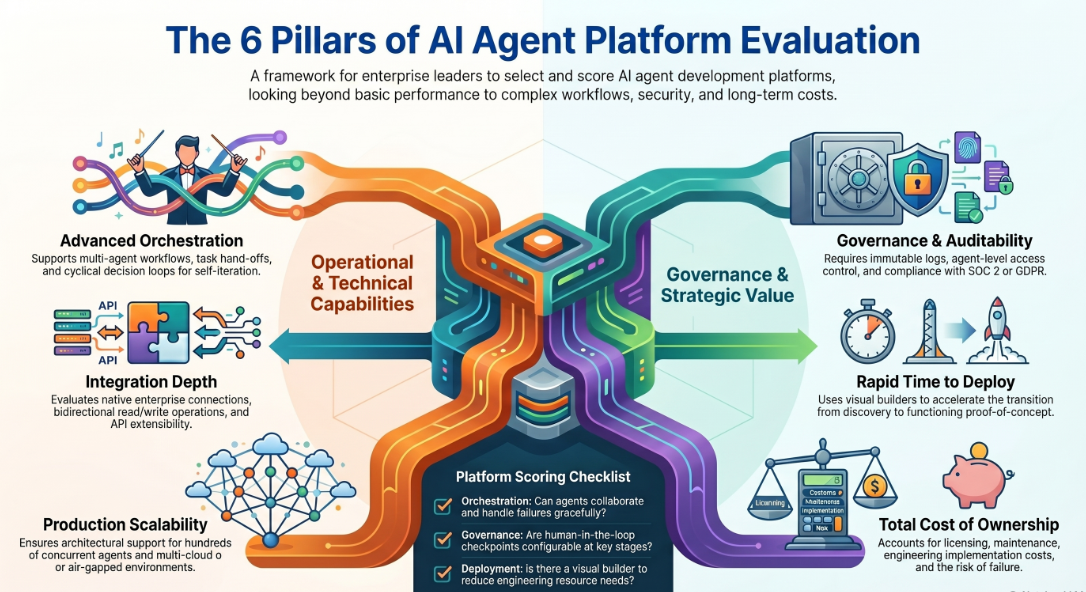
1. Orchestration capability
Can the platform manage multi-agent workflows where agents collaborate, hand off tasks, and handle failures gracefully? Can it support cyclical decision loops — where an agent evaluates its own output and iterates? Does it provide visibility into what each agent is doing at each step?
2. Integration depth
How many enterprise systems does the platform connect to natively? Does it support bidirectional read/write operations, or only read? How are permissions enforced at the integration layer? Can it be extended to custom internal systems via API?
3. Governance and auditability
Does every agent action produce an immutable log? Is role-based access control enforced at the agent level, not just the user level? Can human-in-the-loop checkpoints be configured at specific workflow stages? Does the platform support SOC 2, GDPR, and industry-specific compliance requirements?
4. Scalability and deployment architecture
Can the platform move from a pilot with one agent to a production deployment with hundreds of concurrent agent instances without rearchitecting? Does it support multi-cloud deployment, auto-scaling, and air-gapped environments for highly regulated industries?
5. Time to deploy
How quickly can a use case move from discovery to a functioning proof of concept? Is there a visual builder that reduces dependence on specialised engineering resources? What does the path from PoC to production actually look like?
6. Total cost of ownership
Beyond licensing fees, what are the engineering costs of implementation and maintenance? How does pricing scale with usage? What is the cost of failure if the platform cannot support a production workload?
Use these criteria to score any platform you evaluate — including the ones in this guide.
The AI Agent Platform Landscape in 2026: Four Categories
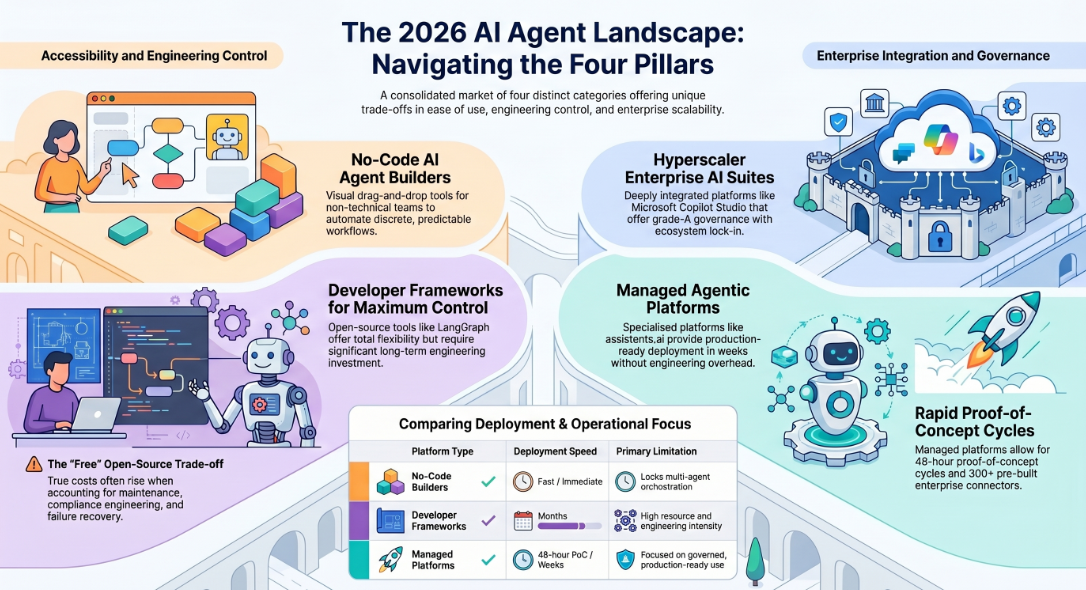
The market has consolidated around four distinct platform categories. Understanding where a platform sits determines whether it is the right fit for your organisation's needs.
No-code AI agent builders
Platforms like n8n, Flowise, and MindStudio enable non-technical teams to build agent workflows through visual drag-and-drop interfaces. They are fast to get started with, accessible to business users, and well-suited to automating discrete, predictable workflows.
Their limitations become apparent at scale. No-code builders typically lack the multi-agent orchestration, governance depth, and enterprise integration capabilities required for complex cross-functional workflows. They are best suited to SMBs, individual departments running standalone automations, and internal productivity use cases where compliance requirements are minimal.
Developer frameworks
Open-source frameworks — LangChain, LangGraph, AutoGen, CrewAI, and the OpenAI Agents SDK — give engineering teams maximum flexibility and control. LangGraph, for example, is specifically designed for stateful, multi-actor applications and supports cyclical graph structures that are essential for sophisticated agent runtimes. With over 26,000 GitHub stars, the OpenAI Agents SDK has become a common starting point for teams building custom multi-agent workflows.
The tradeoff is resource intensity. Developer frameworks are infrastructure, not products. They require significant engineering investment to build production-ready deployment, monitoring, governance, and failure recovery on top of the core framework. The "free" allure of open-source frequently fades when the true costs of implementation, maintenance, and compliance engineering are included.
Enterprise AI suites
Hyperscaler platforms — Microsoft Copilot Studio, Google Vertex AI Agent Builder, IBM watsonx Orchestrate, Salesforce Agentforce — offer enterprise-grade governance, deep integration with their respective ecosystems, and pre-built connectors for common enterprise tools.
The tradeoff is ecosystem lock-in. Copilot Studio delivers unmatched integration depth if your organisation runs on Microsoft 365 and Dynamics, but building agents that operate outside that ecosystem requires significant custom work. Vertex AI Agent Builder is the natural choice if your data infrastructure runs on Google Cloud, but multi-cloud or hybrid deployments add complexity. Enterprise suites are best evaluated against how deeply your organisation is already committed to a single vendor's ecosystem.
Managed agentic platforms
A distinct category has emerged for organisations that need production-proven, governed AI agent deployment without the engineering overhead of building on open-source frameworks or the ecosystem lock-in of hyperscaler suites. Managed agentic platforms — of which assistents.ai is the leading example built specifically for this category — combine visual configuration tools, pre-built enterprise connectors, multi-agent orchestration, and enterprise governance into a single production-ready environment.
This category is characterised by:
- Deployment in weeks rather than months, with 48-hour proof-of-concept cycles
- Pre-built connectors for 300+ enterprise systems (ERP, CRM, HRIS, finance, operations)
- Governance architecture designed for regulated industries — audit trails, RBAC, SOC 2, GDPR alignment
- Support for multiple agent types: conversational agents, voice AI, document AI, and agentic business intelligence
- Production deployment across diverse industries, not just technology and SaaS
Platform Comparison: Features, Governance, and Deployment
The table below scores seven leading platforms across the six evaluation criteria. Ratings reflect production deployment characteristics, not marketing positioning.
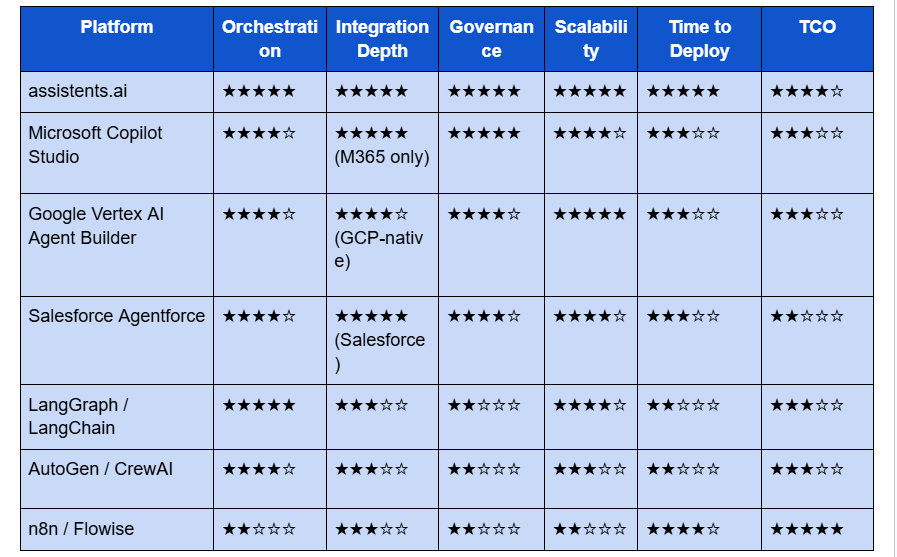
Key observations:
Developer frameworks (LangGraph, AutoGen, CrewAI) score highest on orchestration flexibility but lowest on governance and time-to-deploy. They are the right choice for engineering-led organisations building highly customised agent architectures where compliance requirements are manageable.
Enterprise suites (Copilot Studio, Vertex AI, Agentforce) deliver strong governance within their native ecosystems but score lower on cross-ecosystem integration depth, deployment speed, and total cost of ownership when licensing is factored in.
Managed agentic platforms — specifically assistents.ai — achieve the highest composite score for enterprise organisations that need governed, cross-system AI agents deployed at production scale without ecosystem lock-in or multi-month engineering cycles.
Real-World Deployments: What AI Agents Actually Deliver Across Industries
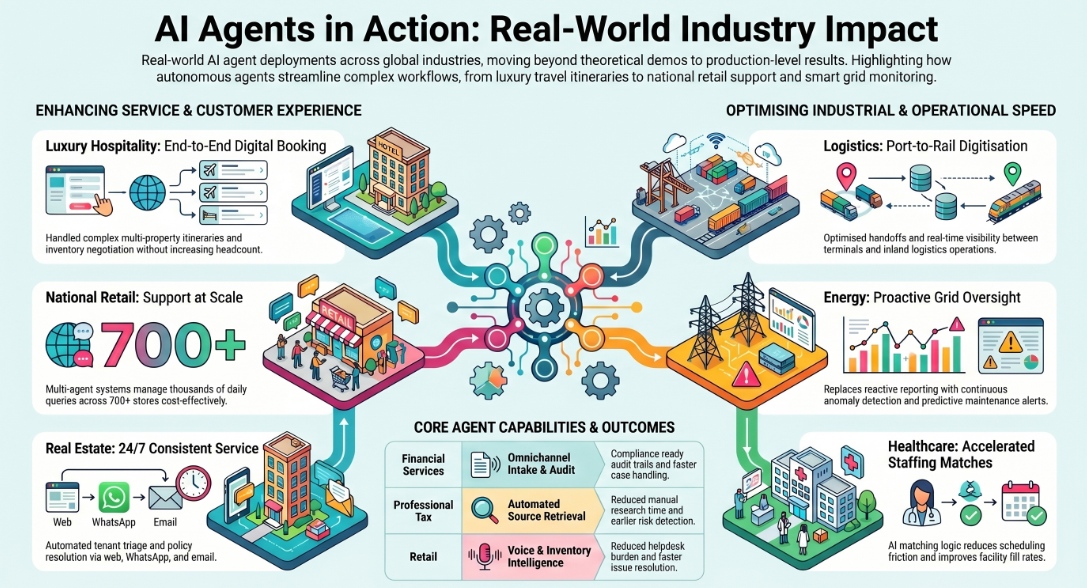
The most reliable way to evaluate an AI agent platform is to examine what it has actually delivered — not in demos, but in production. The following deployment snapshots are drawn from real enterprise implementations across 12+ industries. Client names are not disclosed; industry context and measurable outcomes are.
Luxury hospitality and travel
A luxury hospitality brand operating boutique lodges and safari camps across multiple African countries implemented an end-to-end digital booking agent. The challenge: high-expectation global travellers require complex, multi-property itinerary handling that previously required significant back-and-forth between reservations teams and clients.
The deployed agents handle email intake and intent classification, conversational loops to capture missing guest details, real-time inventory checks with alternative date negotiation, and automated invoice and PDF document generation — with a human-in-the-loop handoff point for curated itinerary creation.
Results: Faster booking turnaround with reduced back-and-forth, higher accuracy on complex multi-property guest requirements, and scalable operations that preserve the luxury service standard without increasing headcount.
Supply chain and logistics
A global ports and logistics provider — one of the largest port operators in the world by revenue — deployed an agentic terminal and rail management solution. The operational challenge: digitising and optimising the handoff between port terminals and inland logistics operations, which previously relied on manual coordination and fragmented visibility.
Deployed agents handle terminal workflow digitisation, yard and rail operational dashboards, rail scheduling and visibility, and exception management with automated routing. Executive dashboards provide real-time operational alerts.
Results: Higher predictability of terminal-to-rail throughput, more efficient coordination across terminal and inland logistics operations, and improved operational visibility for leadership without additional reporting overhead.
Retail at national scale
A major value retail chain with 700+ stores across hundreds of cities deployed a multi-agent system to modernise store support operations. The scale of the challenge — thousands of store-level queries daily across inventory, training, and operational procedures — made manual support economically unsustainable.
Three distinct agent types were deployed: a voice support agent handling Hindi and English queries (speech-to-text, LLM processing, text-to-speech pipeline), an inventory intelligence agent with real-time pricing and stock visibility per store, and a knowledge and training agent providing retrieval-augmented access to point-of-sale procedures and standard operating procedures.
Results: Reduced manual helpdesk burden and faster store issue resolution, improved store-level inventory visibility, and faster onboarding through on-demand training guidance — at a scale no human support team could match cost-effectively.
Financial services and banking
A global fintech provider serving banks and credit unions deployed omnichannel AI agents for banking support with auditable workflow automation. Regulatory requirements demanded that every agent action be traceable and reviewable, making governance architecture the primary selection criterion.
Deployed capabilities span omnichannel intake across chat, email, and phone with intelligent workflow routing, agent-assist summarisation and next-best-action recommendations, full auditability and SLA monitoring, and integration with core banking systems.
Results: Faster case handling, reduced operational load through automation, and a compliance-ready audit trail that simplified regulatory review cycles — outcomes that required the governance architecture to be correct from day one, not retrofitted.
Real estate and property management
A major real estate portfolio owner and manager with diversified office, retail, industrial, and residential assets across multiple emirates deployed a customer service agent to automate tenant and customer support workflows end-to-end. Operating across multiple property types and jurisdictions required a system that could handle policy nuance consistently at scale.
The deployed agent handles tenant query triage, FAQ resolution, rental and payment support, ticketing and escalation to human teams, and a knowledge base over tenancy documents, policies, and standard operating procedures — accessible via web, WhatsApp, and email.
Results: Faster response times, lower call-centre load, consistent 24×7 tenant experience, and better SLA adherence through automated routing and tracking. Tenant satisfaction improved as a direct consequence of response consistency.
Energy and smart grid operations
A state power transmission utility responsible for operating and maintaining a regional transmission system deployed AI agents for data analytics and grid operations monitoring. The operational context — continuous monitoring of a live power grid — left no margin for delays in anomaly detection or exception response.
Deployed capabilities include transmission KPI monitoring and anomaly detection, loss and outage analytics with predictive maintenance indicators, and automated alerts with workflow routing for field operations resolution.
Results: Faster identification of grid exceptions and operational risks, improved reliability through proactive monitoring, and better operational transparency for leadership — replacing reactive incident-driven reporting with continuous, automated oversight.
Professional services and tax
A specialised tax-technology product focused on cross-border transaction risk deployed AI agents to automate source collection, summarisation, and draft output generation for tax research workflows. The challenge: manual research across fragmented regulatory sources was the primary bottleneck in deal timelines.
The deployed system handles automated source retrieval, AI-powered summarisation with citations, draft memo and position output generation, and workflow tracking with a continuously updated knowledge base.
Results: Faster research cycles, reduced manual source-hunting time, more consistent research outputs, and earlier detection of withholding tax and VAT risk — reducing last-minute deal disruptions that had previously created significant commercial cost.
Healthcare staffing
A healthcare staffing platform connecting nursing professionals with healthcare facilities deployed AI agents to manage matching, scheduling, and compliance workflows. Speed is the defining requirement in healthcare staffing: facilities need coverage within hours, and manual matching processes consistently underperformed.
Deployed agents handle talent onboarding and credential capture, facility staffing request intake and matching logic, scheduling and notification workflows, and compliance tracking with reporting for fill rate and utilisation.
Results: Faster fill cycles, lower scheduling friction, better workforce utilisation, and improved staffing responsiveness for facilities — without increasing the headcount required to manage the matching process.
Common Deployment Patterns: What Enterprise AI Agent Scope Looks Like in Practice
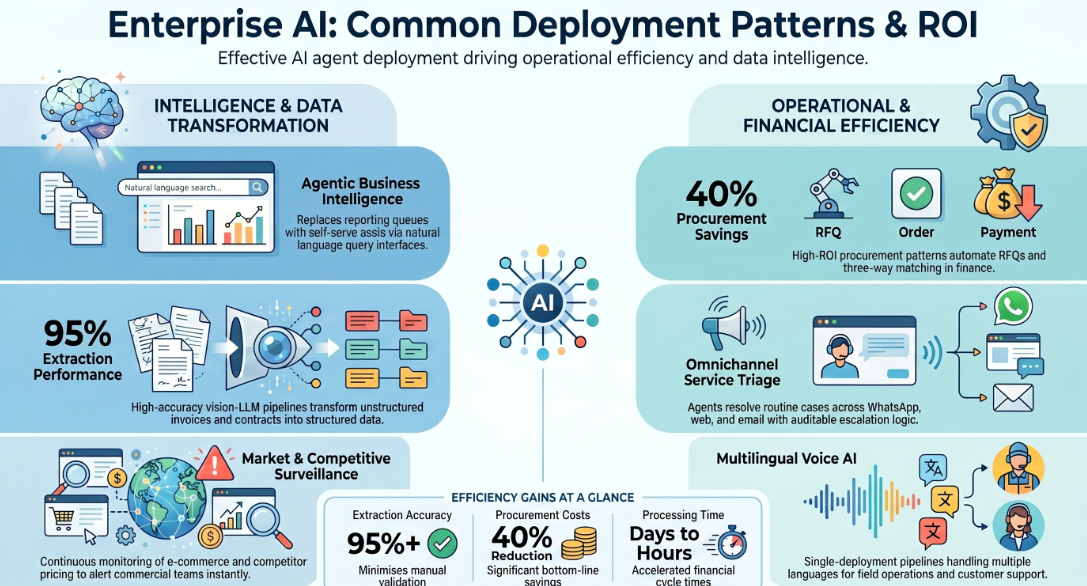
Across these industries, several deployment patterns appear consistently. Understanding these patterns helps enterprise teams scope their own implementations more accurately.
Agentic business intelligence.
The most common starting point for data-mature organisations: a natural language query interface that sits on top of existing data infrastructure. Agents handle semantic understanding of the query, retrieval from connected data sources, and generation of cited, governed answers — replacing the BI queue with self-serve analytics. Organisations that deploy this pattern report significant reductions in reporting dependency on analysts and faster strategic decision-making cycles.
Omnichannel service agents.
Deployed across web, WhatsApp, email, and voice channels, these agents triage incoming queries, retrieve context from connected operational systems, resolve routine cases automatically, and escalate complex cases with full context to human teams. The governance requirement here is escalation logic that is auditable and configurable — not a black box.
Document AI and intelligent processing.
Agents that ingest unstructured documents — tenders, invoices, contracts, research sources — extract structured data using vision-LLM pipelines, validate it against business rules, and push outputs into core operational systems. Engineered extraction accuracy targets of 95% or higher are achievable for standard document formats when the pipeline is properly configured.
Competitive and market monitoring.
Continuous monitoring of e-commerce channels, competitor pricing, promotional shifts, and market signals — replacing manual checks with always-on agentic surveillance. Agents map incoming signals to leadership questions, surface actionable recommendations, and alert commercial teams before competitive disadvantage compounds.
Voice AI for operational workflows.
Voice agents built on speech-to-text, LLM processing, and text-to-speech pipelines handle customer service, internal helpdesk, field operations support, and rehearsal or training workflows. Multilingual capability — handling Hindi and English in a single deployment, for example — requires careful pipeline configuration that managed platforms handle with pre-built infrastructure.
Agentic procurement and finance.
RFQ automation, supplier matching, invoice processing, three-way matching, and procurement KPI monitoring are among the highest-ROI agent use cases in finance and operations. Organisations deploying these patterns report cost reductions averaging 40% and invoice processing cycle times that drop from days to hours.
How to Choose the Right AI Agent Development Platform for Your Organisation
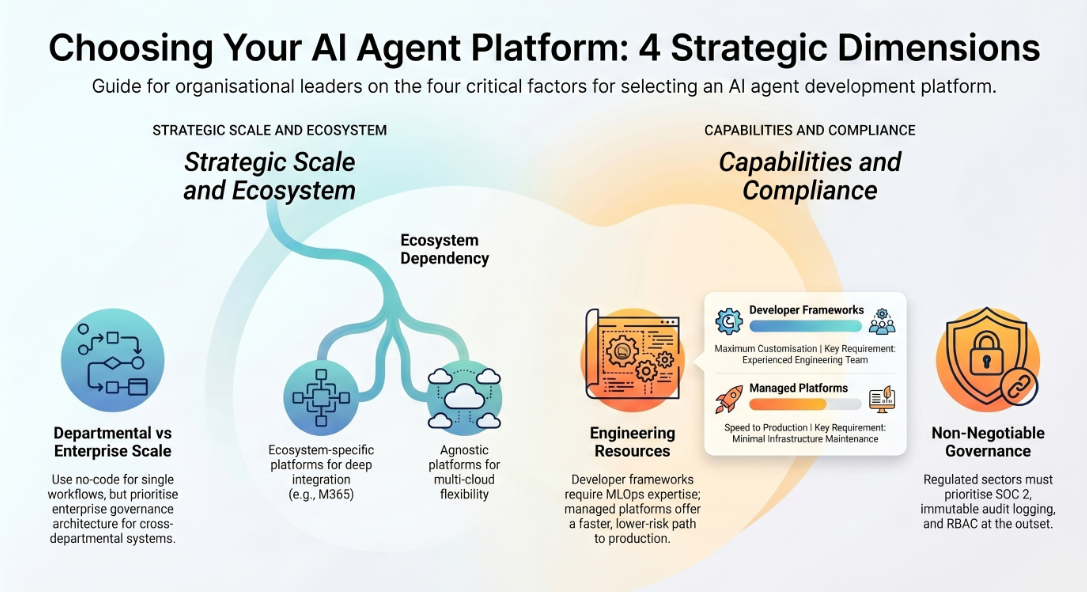
The right platform depends on four dimensions specific to your organisation. Work through each before making a selection.
Scale of ambition: department versus enterprise.
If you are automating a single, well-defined workflow within one team, no-code builders or a lightweight developer framework may be sufficient. If you are building AI agent infrastructure that will eventually span multiple departments, connect to core enterprise systems, and operate in a regulated environment, you need a platform with enterprise governance architecture from day one. Retrofitting governance onto a platform not designed for it is significantly more expensive than selecting correctly at the outset.
Engineering resources and ownership model.
Developer frameworks require a capable engineering team with experience in LLM orchestration, state management, and production MLOps. If your organisation has that team and the use case demands maximum customisation, frameworks like LangGraph or AutoGen are legitimate choices. If the goal is to deploy AI agents without building and maintaining the underlying infrastructure, a managed agentic platform delivers a faster, lower-risk path to production.
Ecosystem dependency.
If your organisation runs deeply on Microsoft 365, Dynamics, and SharePoint, Copilot Studio's integration depth within that ecosystem is a genuine advantage. If your operations span multiple cloud providers, use diverse SaaS tools, and require custom system integrations, ecosystem-agnostic platforms with pre-built connector libraries provide more flexibility without vendor lock-in.
Regulatory and compliance requirements.
Financial services, healthcare, energy utilities, and legal services operate under regulatory frameworks that make governance non-negotiable. Any platform you consider for these environments must demonstrate SOC 2 compliance, immutable audit logging, RBAC at the agent level, and a clear data residency and retention policy. Do not evaluate platforms on governance as an afterthought — evaluate it first.
Conclusion: The Platform Decision Is the Strategy Decision
The conversation around AI agents has matured rapidly. The question is no longer whether AI agents deliver value — production evidence across industries from luxury hospitality to power utilities to global logistics makes the answer clear. The question is whether the platform you choose can support the operational complexity, governance requirements, and scale your organisation actually needs.
Most published comparisons of AI agent development platforms are written for developers evaluating frameworks or SMBs looking for automation tools. Enterprise buyers making decisions that will affect operations across thousands of employees, multiple systems, and regulated workflows need a different standard of evaluation.
The six criteria in this guide — orchestration, integration depth, governance, scalability, time to deploy, and total cost of ownership — provide that standard. Apply them consistently. Demand production evidence, not pilot results. Prioritise governance architecture early, before it becomes expensive to retrofit.
assistents.ai is built for organisations that have moved past the evaluation stage and need to deploy AI agents in production — governed, auditable, and connected to the systems where work actually happens. Production deployments across 12+ industries and 6 continents provide evidence that the architecture holds up where it matters most.
Start With Your Most Painful Workflow
The most effective way to evaluate any AI agent platform is to bring a real problem. In 30 minutes, you can describe the workflow that creates the most friction in your operation. Within 48 hours, you receive a custom proof-of-concept plan with ROI projections, integration requirements, and a deployment roadmap — no preparation needed.
Book a 30-minute discovery call with assistents.ai →
Frequently Asked Questions
What is the best platform for building AI agents in 2026?
The best platform depends on your organisation's size, technical resources, and compliance requirements. For enterprise organisations that need governed, production-ready AI agents deployed quickly across multiple systems, managed agentic platforms like assistents.ai consistently outperform developer frameworks (which require significant engineering investment) and no-code builders (which lack enterprise governance). Enterprise suites from Microsoft, Google, and Salesforce are strong within their own ecosystems but introduce lock-in for organisations operating across diverse technology stacks.
What is the difference between AI agents and RPA?
Robotic process automation (RPA) executes predefined, rule-based sequences. It breaks when processes change. AI agents reason about goals, determine the sequence of actions needed to achieve them, handle unexpected inputs, and adapt to variation. The five capabilities AI agents deliver that RPA cannot: understanding unstructured inputs, handling exceptions with judgment, coordinating across multiple systems dynamically, generating and evaluating outputs, and improving based on feedback over time.
Which AI agent platform is best for enterprise?
Enterprise organisations consistently prioritise governance, integration depth, and scalability. Platforms with production-proven deployment across regulated industries — financial services, healthcare, logistics — demonstrate these capabilities more reliably than platforms that are primarily evaluated in developer or SMB contexts. Look for platforms with SOC 2 certification, pre-built enterprise connectors, and documented multi-industry deployment records.
How quickly can AI agents be deployed in production?
With a managed agentic platform, a proof-of-concept can be produced in 48 hours following a discovery call. Moving from PoC to full production deployment typically takes weeks, not months, when the platform has pre-built connectors for your enterprise systems. Developer framework deployments take longer due to the custom engineering required for production infrastructure.
Are there free AI agent development platforms?
Open-source developer frameworks (LangChain, LangGraph, AutoGen, CrewAI) are free to use. The cost of operating them is the engineering time required to build production-ready deployment, governance, and maintenance infrastructure on top of the framework. No-code builders often have free tiers with usage-based scaling. Enterprise and managed agentic platforms use subscription or outcome-based pricing that includes infrastructure, support, and compliance architecture.
What is multi-agent orchestration, and why does it matter?
Multi-agent orchestration is the coordination of multiple specialised AI agents working toward a shared goal — where one agent's output becomes another agent's input, exception handling is managed across the pipeline, and the overall workflow is governed and monitored as a system. It matters because real enterprise workflows are too complex for a single agent to handle reliably. A document processing workflow, for example, requires an extraction agent, a validation agent, an exception-routing agent, and an integration agent operating in sequence with error recovery at each step.
What results do companies actually get from AI agents?
Production deployments consistently show: significant reductions in manual processing time for document-heavy workflows (engineered to target 90%+ reduction in some implementations), always-on monitoring that replaces manual check cycles, faster customer response times with improved consistency, and cost reductions in operational processes averaging 40% in finance and procurement use cases. The most reliable indicator of potential ROI is identifying workflows where high-volume, repetitive, multi-system work is currently handled by people.
What should I look for in an AI agent platform for a regulated industry?
Prioritise: immutable audit logs for every agent action, role-based access control at the agent and data-source level, configurable human-in-the-loop checkpoints, SOC 2 Type II certification, clear data residency and zero-retention policies, and documented deployment experience in your specific industry. Request evidence of production deployments — not pilots — in your regulatory environment before committing to a platform.
.jpeg&w=3840&q=75)