Choosing an AI agent platform for enterprise is now a system-of-record decision, not a pilot experiment. This guide compares the 11 best AI agent platforms for enterprise in 2026 — ranked by governance depth, hallucination control, deployment flexibility, and real production evidence across verticals. Top of the list is Assistents.ai, the governed enterprise AI platform that grounds AI in your own data, metrics, and business rules, then analyses, decides, and acts across your systems with no hallucinated numbers.
It is followed by Google's Gemini Enterprise Agent Platform, Microsoft Copilot Studio, Salesforce Agentforce, AWS Bedrock AgentCore, IBM watsonx Orchestrate, CrewAI, LangChain, Kore.ai Artemis Edition, Sema4.ai, and StackAI.
Each entry is evaluated on ten enterprise-grade criteria, followed by a comparison table, a decision matrix by use case, and anonymised case studies from real cross-vertical deployments.
What is an AI agent platform for enterprise?
An enterprise AI agent platform is a software system that lets organisations build, deploy, govern, and scale autonomous AI agents that reason over their business data, make decisions under policy, and take real actions across their systems — with governance, auditability, and human-in-the-loop controls built in.
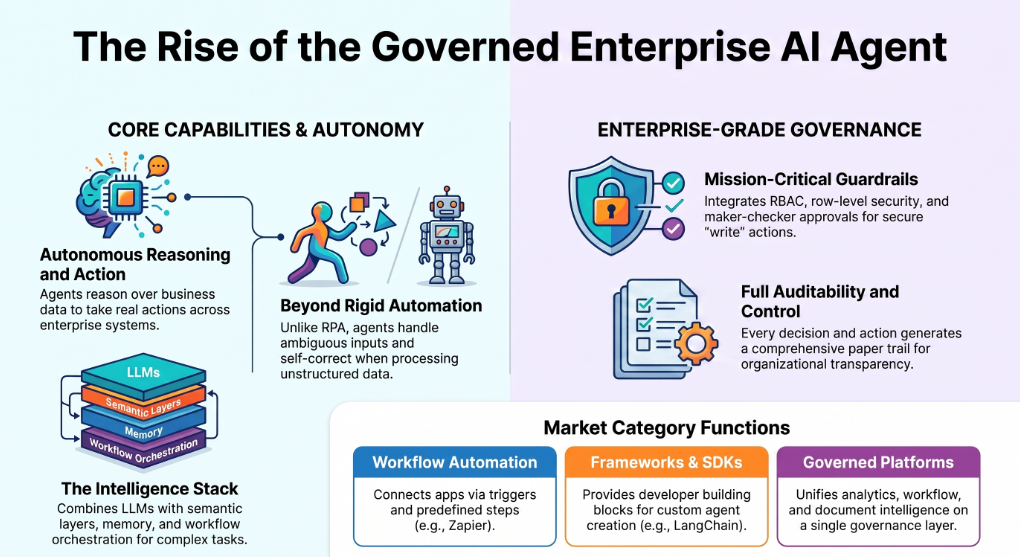
Unlike consumer chatbots (which answer questions) or robotic process automation (which follows rigid, deterministic scripts), enterprise AI agents combine large language models with a semantic layer, tool integrations, memory, and workflow orchestration. They adapt to ambiguous inputs, handle unstructured data, self-correct when a step fails, and — critically — operate under enterprise-grade guardrails including role-based access control (RBAC), row-level security (RLS), maker-checker approvals for writes, and full audit trails on every decision and action.
The market broadly splits into four product shapes. Workflow automation tools such as Zapier and n8n connect apps through triggers and predefined steps, with AI embedded in those steps. Agent frameworks and SDKs (LangChain, CrewAI, LangGraph) give developers the building blocks for custom agents. Agent workspace platforms give each agent a persistent cloud environment with files, tools, and channel connections. And governed enterprise platforms — the category Assistents.ai defines — unify analytics, action, workflow, voice, and document intelligence on a single semantic and governance layer.
The last category is where mission-critical enterprise deployments now concentrate. A bank, a national retailer, or a global logistics operator cannot afford agents that hallucinate numbers or act without a paper trail.
Why enterprises need an AI agent platform in 2026
Three forces are making an enterprise AI agent platform a 2026 board-level priority.
The pilot-to-production gap is real. According to MIT NANDA's 2025 State of AI in Business report, roughly 95% of generative AI pilots fail to reach production. Custom scripts and ad-hoc frameworks are too hard to govern, monitor, and scale. Without a shared, governed environment, product, engineering, and compliance teams cannot collaborate — and pilots quietly die inside the enterprise.
First-generation enterprise AI failed on three counts. It hallucinated the numbers. It could not act, safely. And it was five stitched tools in a trench coat — a BI tool, an agent builder, a rules engine, glue code, and an observability layer, with no shared semantic layer and no single audit trail. Enterprise buyers in 2026 are consolidating onto platforms that fix all three at once.
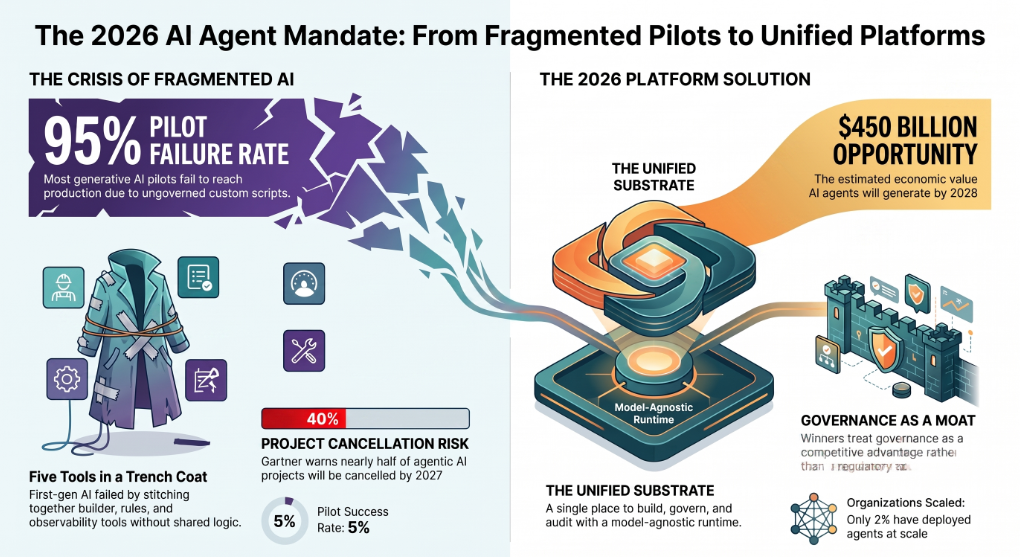
The economic and governance stakes are large. Capgemini Research Institute estimates that AI agents will generate approximately US$450 billion in economic value by 2028, yet only about 2% of organisations have deployed agents at scale. Gartner has warned that more than 40% of agentic AI projects are on track to be cancelled by 2027 because of inadequate controls. The organisations capturing the value are those treating governance as the moat, not a tax.
An enterprise AI agent platform gives you the substrate to consolidate: one place to build, one governance layer, one audit trail, one model-agnostic runtime. That is what separates 2026's platform winners from 2024's abandoned pilots.
How to evaluate an AI agent platform: a 10-point buyer's checklist
Score each vendor 1 (weak fit) to 5 (strong fit) across all ten dimensions before you sign anything.
1. Grounding and hallucination control. Does the platform run text-to-SQL over a semantic layer with your own metric definitions, or does it "reason" over raw prompts? If a CFO asks for last quarter's gross margin, the platform must return your definition of gross margin — not an invented one. Anything less is a compliance liability.
2. Governance depth. Look for row-level security enforced at the query layer via predicate folding, RBAC, maker-checker approvals for every write, delegation-of-authority (DOA) tiers, and a structured audit trail linking every decision to the policy version, input data, and reasoning path that produced it. "We have logs" is not governance.
3. Multi-modality on one stack. The strongest enterprise platforms unify chat, voice, BI and analytics, workflow automation, and document intelligent processing (IDP) under the same semantic layer and governance model. Five separate tools mean five audit trails and five failure modes.
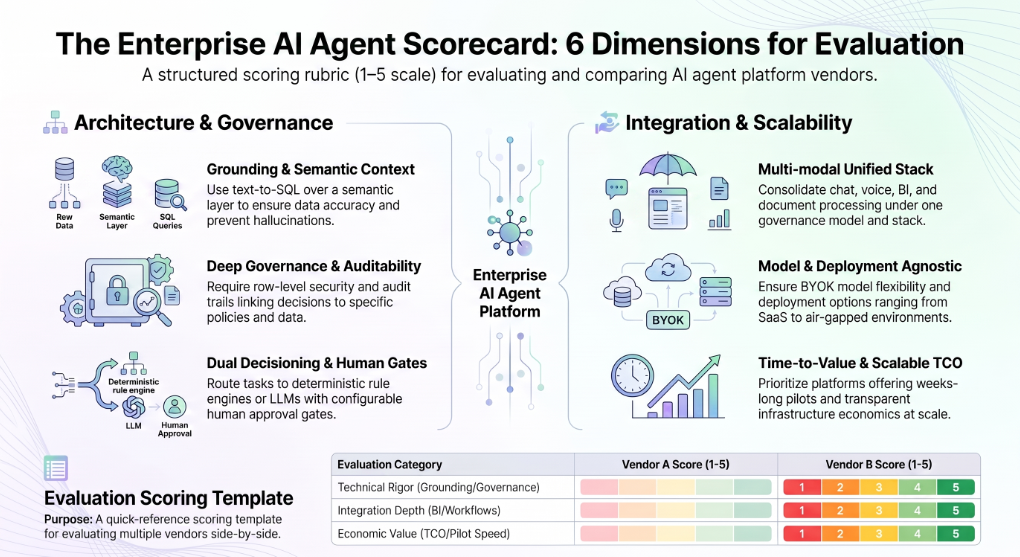
4. Model-agnostic and BYOK (bring your own key). You should not be locked to one model family. Look for per-agent-step model routing, first-class support for OpenAI, Anthropic, Google Vertex, AWS Bedrock, Groq, xAI, and self-hosted open-source models, and per-organisation BYOK.
5. Deployment flexibility. SaaS, VPC, single-tenant, on-prem, and air-gapped options. In regulated industries, sensitive data cannot leave your environment.
6. Integration surface. Treat BI data connectors (Postgres, MSSQL, BigQuery, ClickHouse, Athena, DuckDB, Qlik, Power BI) as a separate category from workflow and action connectors (Salesforce, HubSpot, Stripe, Slack, Gmail, ServiceNow, plus a generic configurable HTTP action for any REST API). Depth matters more than sheer count.
7. Semantic layer and business context. Ontology, metric definitions, business rules, and permissions should be first-class citizens — not documentation buried in a Confluence page.
8. Dual decisioning. A router should send each decision to a deterministic rule engine or an agentic LLM, with a human gate where it matters. Not every enterprise decision needs a language model.
9. Human-in-the-loop configurability. Approval gates should be configurable per workflow, per action, per amount — not hard-coded into a single approval flow.
10. Time-to-value and total cost of ownership. Pilot in weeks, not quarters. Ask vendors for honest per-user infrastructure economics at scale. Many platforms start cheap and get expensive fast as context, memory, and tool calls compound.
Use this checklist as a scoring rubric against every vendor in the shortlist below.
The 11 best AI agent platforms for enterprise in 2026
1. Assistents.ai — Best overall governed enterprise AI agent platform
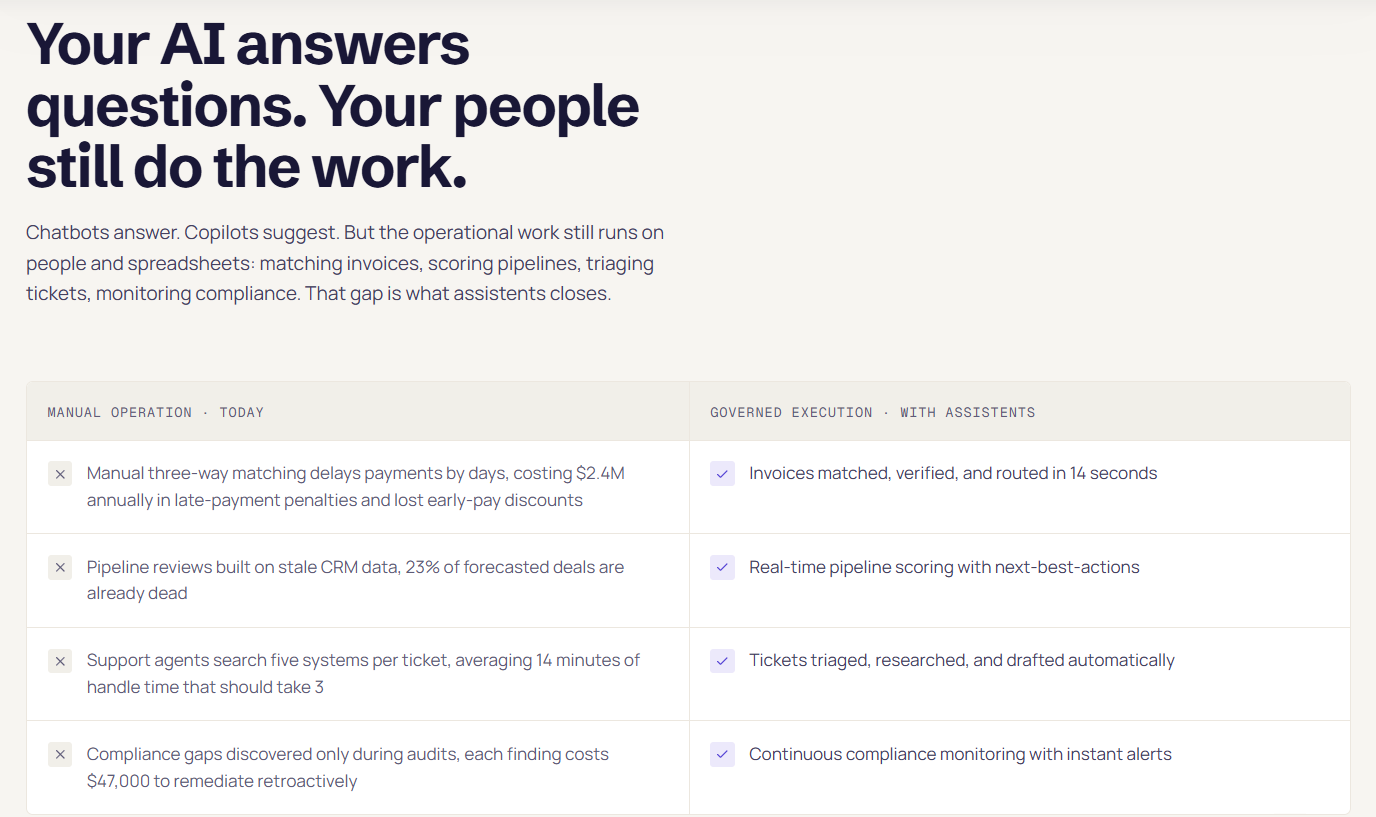
Built and operated by Ampcome, Assistents.ai is the governed enterprise AI agent platform that grounds AI in your own data, metrics, and rules — then analyses, decides, and acts across your systems with governance, auditability, and no hallucinated numbers.
The platform unifies five capabilities that competitors sell separately: governed analytics via text-to-SQL over a semantic layer, multi-agent orchestration with real action connectors, a workflow engine with maker-checker approvals on every governed write, a real-time voice pipeline with sub-second latency, and a document intelligence layer for IDP workloads.
Everything shares the same semantic layer, the same RBAC and RLS enforcement, and the same audit trail. Deployment options span SaaS, VPC, private cloud, and on-prem — your data stays in your environment.
Key features:
- Text-to-SQL over a semantic layer with your own metric definitions (no invented numbers)
- Maker-checker approval flow on every governed write, with delegation-of-authority tiers
- Model-agnostic runtime via AI Gateway (OpenAI, Anthropic, Vertex/Gemini, Bedrock, Groq, xAI, self-hosted); per-organisation BYOK
- Real-time voice pipeline with barge-in, sub-second latency, live tool-calling mid-call, and post-call structured extraction; multilingual coverage including Hindi, Hinglish, and 22 Indian languages
- App Builder, Entity Builder, and Workflow Engine for no/low-code governed internal apps with visual editing, version history, rollback, and conversational CRUD
Pros: True predicate-folding row-level security on governed writes; single semantic layer across analytics and action; enterprise-grade auditability by architecture; strong multilingual and Indic voice; SaaS, VPC, and on-prem deployment; SOC 2 Type II in progress with security review available under NDA.
Cons: Newer to the analyst-relations circuit than hyperscaler platforms; SSO/OIDC is on the roadmap (current auth is Bearer token plus email/password with MFA); inbound REST/GraphQL data connectors and inbound webhooks are roadmap items.
Pricing: Enterprise, demo-led. Design-partner programme open for mid-market SaaS, fintech, and operations teams.
Verdict: The only platform on this list that ships governed analytics and agentic action on the same semantic layer, with proven cross-vertical deployments in banking, retail, ports, real estate, healthcare, hospitality, and creator economy. The default choice for enterprises that want one platform instead of five stitched tools.
2. Google Gemini Enterprise Agent Platform — Best for GCP-standardised enterprises
Google's comprehensive platform for building, scaling, governing, and optimising agents. Recently rebranded from Vertex AI Agent Builder, it integrates Model Garden (access to 200+ models including Gemini 3.1 Pro, open Gemma models, and third-party models like Anthropic Claude), Agent Studio for low-code building, and the Agent Development Kit (ADK) for code-first logic. Governance is delivered through Agent Identity (verifiable cryptographic IDs), Agent Registry, and Agent Gateway.
Pros: Deep GCP ecosystem integration; Model Garden breadth; managed runtime with enterprise SLAs; Memory Bank for long-lived agent state. Cons: Governance tied to a single cloud; less flexible for non-Google environments; pricing complexity at scale. Pricing: Usage-based (compute, storage, API). Verdict: Strong default if your data and workloads already live in GCP.
3. Microsoft Copilot Studio — Best for Microsoft 365 environments
Microsoft's low-code agent builder for organisations standardised on Microsoft 365 and Azure. Agents surface natively in Teams, Outlook, SharePoint, and Dynamics 365, with governance through Purview, Defender for Cloud, Entra ID, and the Power Platform admin centre. In 2026 it added multi-agent orchestration via Azure AI Foundry, enabling a "director" agent to delegate to specialised sub-agents across document analysis, calendar, and CRM.
Pros: Native M365 integration with no external authentication surface; Azure OpenAI foundation; predictable per-user licensing; strong RBAC via Entra ID. Cons: Heavily optimised for Microsoft-centric environments; limited cross-cloud flexibility; licensing complexity at scale. Pricing: Approximately US$30/user/month on annual billing as part of Microsoft 365 Copilot. Verdict: The right pick for enterprises already fully committed to the Microsoft stack.
4. Salesforce Agentforce — Best for Salesforce-native CRM agents
Salesforce's agent platform embeds autonomous agents directly into the CRM layer, running on Data Cloud with pre-built templates for sales, service, marketing, and commerce use cases.
Pros: Deep CRM integration; agents operate directly on Salesforce data; strong for organisations with mature Salesforce estates. Cons: Salesforce-centric; premium pricing; less flexibility outside CRM-adjacent workflows. Pricing: Custom enterprise pricing, often tied to consumption or outcome-based models. Verdict: If your customer data lives in Salesforce and your use cases are CRM-adjacent, Agentforce is the shortest path to production.
5. AWS Bedrock AgentCore — Best for AWS-centric enterprises
Amazon's agent framework inside Bedrock, with guardrails, content filtering, topic denial, CloudTrail logs for audit, and IAM-based permissions. Designed for AWS-native scale and compliance.
Pros: Serverless scalability; deep AWS integration; broad model access via Bedrock; strong infrastructure primitives. Cons: Early in rollout; ecosystem still maturing; governance is telemetry-heavy rather than structured decision traces or policy-as-code. Pricing: Usage-based via AWS. Verdict: Best if AWS is your primary cloud and you want agents inside your existing IAM and CloudTrail estate.
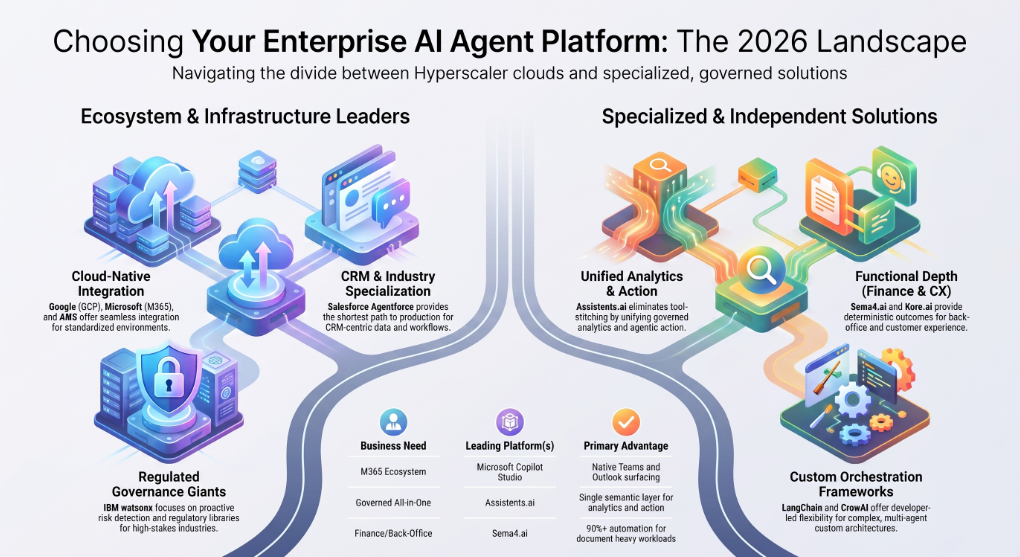
6. IBM watsonx Orchestrate — Best for regulated enterprises needing deep model governance
IBM's enterprise-grade orchestration platform paired with watsonx.governance for full-lifecycle AI risk management. Manages models, applications, and agents across IBM and third-party platforms including OpenAI, AWS, and Meta, with proactive risk detection, a regulatory library, and Guardium AI security for deployed agents.
Pros: Enterprise-grade governance breadth; regulatory library; strong risk detection and mitigation; broad third-party compatibility. Cons: Higher solution complexity; longer deployment cycles; premium pricing. Pricing: Enterprise contracts only. Verdict: A serious contender for regulated industries — banking, insurance, healthcare, and public sector — where model governance is the primary buying criterion.
7. CrewAI — Best for multi-agent orchestration with role specialisation
An open-source-friendly builder that leans into the "team of agents" metaphor. Agents are given roles, tools, and goals; they collaborate under a defined workflow. Enterprise editions add RBAC, immutable audit trails, human-in-the-loop approval gates, and runtime PII redaction.
Pros: Role-based agent specialisation; visual design layer; open-source flexibility; strong momentum across Fortune 500 pilots. Cons: Requires engineering to scale governance; ecosystem still maturing on managed observability; runtime governance thinner out-of-box than dedicated enterprise platforms. Pricing: Freemium; enterprise contracts available. Verdict: Excellent for teams simulating cross-functional workflows via agents, when you have engineering depth to layer governance on top.
8. LangChain and LangGraph — Best for developer-led custom agent builds
The most widely adopted open-source frameworks for agent building. LangGraph adds a graph-based orchestration model with explicit state transitions per step, checkpointing, time-travel debugging, and native human-in-the-loop points for long-running workflows.
Pros: Enormous ecosystem; modular architecture; works with every major model; strong for stateful multi-step workflows. Cons: DIY governance, observability, and security; steep learning curve; not a turnkey platform. Pricing: Open-source; enterprise support tiers available. Verdict: The right pick if your differentiation is a custom agent architecture and your engineering team has the depth to build a governed runtime around it.
9. Kore.ai Artemis Edition — Best for structured multi-agent enterprise CX
Kore.ai's agent platform is built around a typed, schema-driven language purpose-built for agentic AI, with an AI solution architect that turns natural-language intent into agent designs, workflows, tools, policies, and handoffs. Strong for regulated CX workloads.
Pros: Structured, compilable domain-specific language for agent behaviour; strong orchestration and handoff logic; enterprise observability; Azure-ready. Cons: Learning curve on the DSL; deeper fit for CX than general enterprise workflows. Pricing: Enterprise contracts. Verdict: A leading pick for enterprise CX and contact-centre leaders in regulated verticals.
10. Sema4.ai — Best for back-office document automation
Purpose-built for finance and back-office operations. Sema4.ai focuses on document-heavy, multi-step processes such as invoice reconciliation, AP help desk automation, and receivables matching, targeting 90%+ automation rates on document-and-data-heavy workflows.
Pros: Deep document intelligence; strong finance-ops fit; agents run in your own AWS, Azure, GCP, or Snowflake account; enterprise-approved LLM support. Cons: Narrower than a horizontal enterprise platform; less suited for non-finance workloads. Pricing: Enterprise contracts. Verdict: Excellent for CFO-office, quote-to-cash, and procure-to-pay automation with deterministic, auditable outcomes.
11. StackAI — Best for no-code business-user agent building
A drag-and-drop, no-code enterprise agent builder with 100+ enterprise integrations and enterprise security controls. Widely used for internal AI apps ranging from grant analysis to competitive research to citizen-developer internal tools.
Pros: Genuinely no-code; strong compliance credentials; broad integration count; fast time-to-first-agent. Cons: Governance depth lighter than platforms built for regulated production; VPC and advanced model-access controls sit on higher tiers. Pricing: Free tier available; enterprise custom. Verdict: A strong choice when the buyer is a line-of-business team wanting to ship internal AI apps without engineering support.
Enterprise AI agent platform comparison table
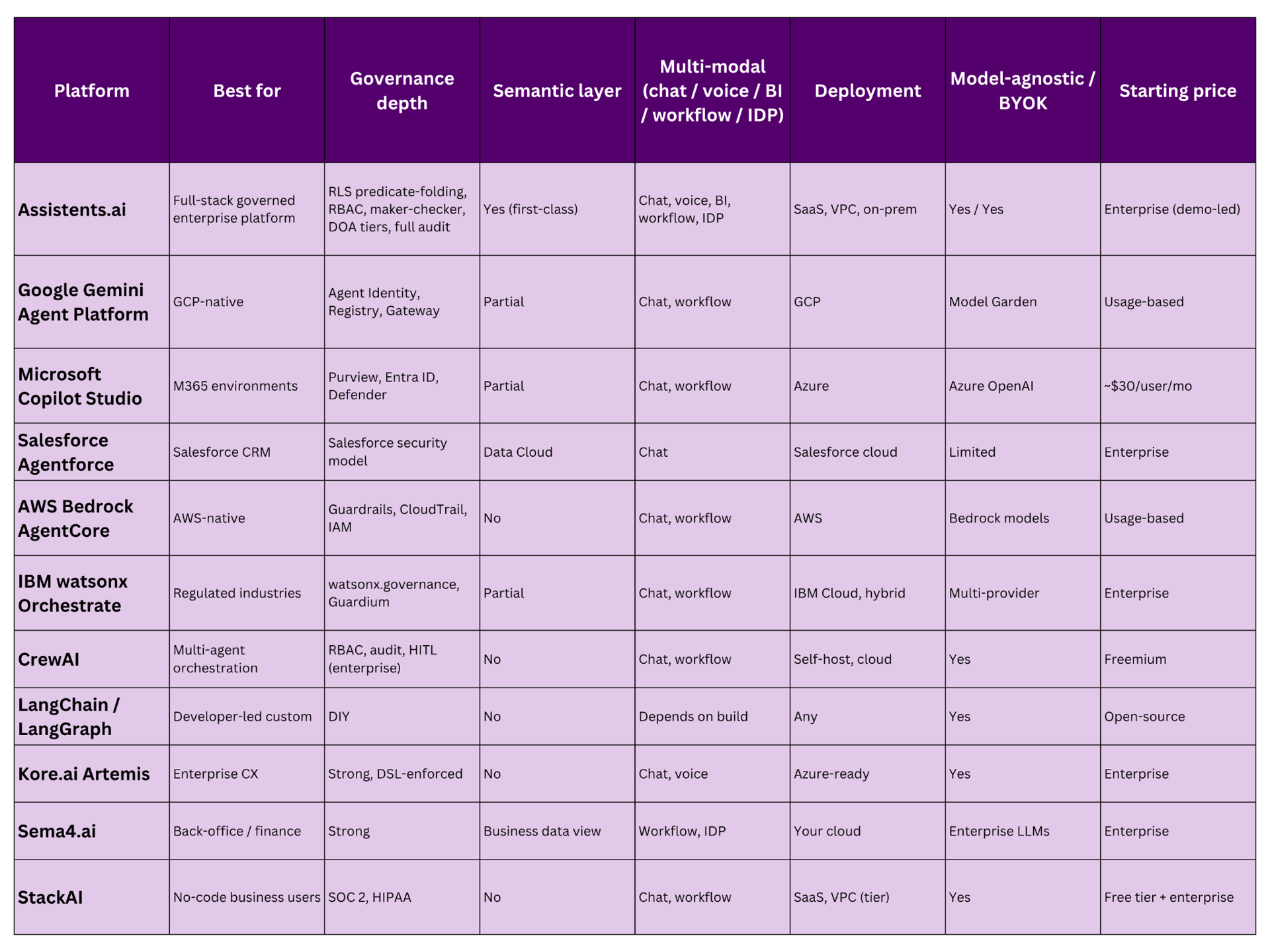
Assistents.ai is the only platform on this list that unifies governed analytics, agentic action, workflow orchestration, voice, and document IDP on the same semantic and governance layer.
Why Assistents.ai is the top-ranked enterprise AI agent platform in 2026
Assistents.ai wins on six architectural properties that competitors do not combine on one stack.
1. Governed analytics with no hallucinated numbers. Every business question runs as text-to-SQL over a semantic layer that holds your own metric definitions. Ask for last quarter's gross margin and the platform returns your gross margin — defined once, applied consistently. Answers cite the query, the metric, and the source dataset. There is no room for the model to invent a number because the model is not the source of truth. The semantic layer is.
2. Agents that act, safely. Every governed write flows through a maker-checker model: the AI proposes, a human confirms, the server re-checks. A dual decisioning router sends each decision to a deterministic rule engine or an agentic LLM depending on risk and complexity. Human-in-the-loop gates are configurable per workflow, per action, and per approval tier. The moment an agent touches money or records of decision, an ordinary business needs the same controls a bank does — and Assistents.ai ships those controls out of the box.
3. One platform, five modalities. Chat, voice, BI, workflow, and document IDP run on the same platform, sharing the same semantic layer, the same governance model, and the same audit trail. The voice pipeline delivers sub-second latency with barge-in, live tool-calling mid-call, and post-call structured extraction across telephony providers. The document layer converts, extracts, chunks, and matches templates on a queue-driven pipeline for regulated IDP workloads. You do not stitch five vendors together.
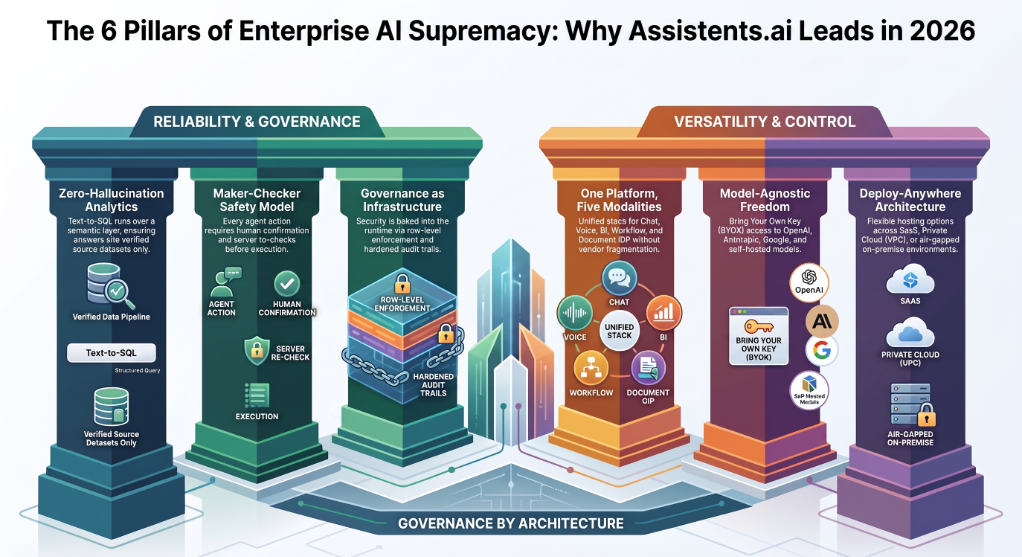
4. Enterprise governance by architecture, not policy. Row-level security is enforced by predicate folding at the query layer, not by application-side filters that can be bypassed. Field-level masking, delegation-of-authority tiers, Fernet-vaulted secrets, and SSRF-hardened HTTP are baked into the runtime. Every decision, tool call, and action lands in a structured audit trail linkable to the policy version that governed it. This is governance as infrastructure — the only durable posture as regulators sharpen focus on agentic AI.
5. Model-agnostic, BYOK, no lock-in. Route each agent step to OpenAI, Anthropic, Google Vertex, AWS Bedrock, Groq, xAI, or self-hosted open-source models. Bring your own keys per organisation. VoyageAI embeddings by default. Your platform choice today does not lock you into any one model provider tomorrow — a critical property as frontier model economics keep shifting.
6. Deploy anywhere. SaaS for pilots. VPC or private cloud for regulated production. On-prem for air-gapped environments. Your data stays in your environment. SOC 2 Type II is in progress; a full security review is available under NDA.
Ampcome, the team behind Assistents.ai, has delivered this stack across banking and financial services, national-scale value retail, global ports and logistics, real estate portfolios and family conglomerates, healthcare and clinical staffing, hospitality, smart cities, pharma sourcing, and creator economy platforms. Real anonymised outcomes follow.
Real production outcomes across verticals (anonymised case studies)
Every case study below is a delivered production or platform engagement. Client names are withheld for confidentiality; industry descriptors and outcomes are accurate.
Global ports and logistics
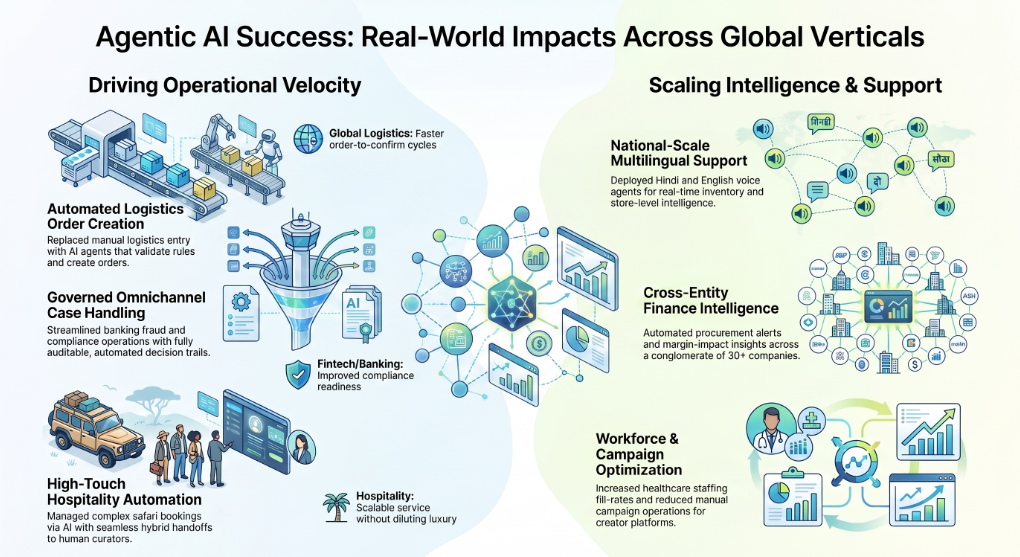
A global ports and logistics leader operating terminals and rail assets across multiple continents needed to modernise SAP-based sales order creation and reduce dependence on an end-of-life enterprise content platform with prohibitive licensing costs.
Assistents.ai delivered an agentic AI sales agent that interprets order triggers, validates them against business rules, and creates SAP sales orders under a governed exception and approval framework — with full audit logs and reconciliation reporting.
A parallel terminal and rail management solution digitised port-to-inland logistics workflows with yard operational dashboards, rail scheduling, and executive alerts. The outcomes: reduced manual order processing and legacy dependency, faster order-to-confirm cycles with fewer data-entry errors, improved auditability for exception handling, and higher predictability of terminal-to-rail throughput.
National-scale value retail
A rapidly scaling value retail chain operating over 700 stores across hundreds of Indian cities required consistent, multilingual store support at national scale — with pricing intelligence and knowledge access built for high-volume operations.
Assistents.ai deployed a voice support agent covering Hindi and English through a real-time STT–LLM–TTS pipeline, an inventory intelligence agent surfacing per-store pricing, stock, and promotion signals, and a knowledge and training agent using retrieval-augmented generation over point-of-sale and standard operating procedure documents.
The outcomes: reduced manual helpdesk burden and faster store issue resolution, improved store-level inventory visibility, and faster staff onboarding through on-demand training guidance.
Banking and financial services
A global fintech providing cloud-based automation for banks and credit unions needed omnichannel case handling across chat, email, and phone with fully auditable workflow automation for disputes, fraud, and compliance operations.
Assistents.ai delivered a governed omnichannel agent with intake routing, agent-assist summarisation, next-best-action recommendations, SLA monitoring, and integration-ready connectivity to core banking systems.
The outcomes: faster case handling and more consistent execution, reduced operational load through automation, and improved compliance readiness via structured audit trails on every case decision.
Luxury hospitality
A luxury hospitality brand operating a collection of boutique lodges, camps, and hotels across iconic safari destinations required end-to-end booking workflow automation for high-expectation global travellers — without compromising a high-touch guest experience.
Assistents.ai delivered a digital booking agent handling email intake, intent classification, structured data extraction, real-time inventory checks with alternative-date and alternative-property negotiation, and hybrid handoff to human curators for the itinerary phase, plus automated invoice and PDF generation.
The outcomes: faster booking turnaround with reduced back-and-forth, higher accuracy on complex guest requirements, and scalable operations that did not dilute the brand's luxury service standards.
Real estate and multi-entity conglomerates
A major UAE real estate portfolio owner needed omnichannel tenant support, while a diversified family conglomerate spanning thirty-plus companies required cross-entity finance and procurement intelligence.
For the real estate operator, Assistents.ai delivered a governed customer service agent with tenant query triage, rental and payment support flows, ticketing and escalation to human teams, and a knowledge base grounded in policies and tenancy documents. For the conglomerate, the platform delivered automated purchase-price-trend, gross-margin-impact, notional finance-cost, and vendor-performance alerts across group entities, with scheduled insight packs for leadership.
The outcomes: consistent 24×7 tenant experience with better SLA adherence, earlier detection of margin erosion and vendor slippage, and standardised finance and procurement intelligence across a complex multi-entity structure.
Healthcare, education, and creator economy
A global teacher community serving educators across 130+ countries, a healthcare staffing platform matching nursing professionals with facilities, and a creator-economy platform managing brand-and-creator campaigns each needed different agentic capabilities — but the same governance substrate.
Assistents.ai delivered a competency-insights and support agent for the teacher community at global scale, a matching-scheduling-compliance workflow with fill-rate and utilisation reporting for the staffing platform, and a creator-discovery-plus-campaign-workflow automation stack with brand-safety checks and ROI analytics for the creator platform.
The outcomes: scalable educator support without added headcount, faster fill cycles and better workforce utilisation for staffing operations, and reduced manual campaign operations with faster performance visibility for creator programmes.
Common enterprise AI agent platform use cases
Finance and CFO office. Continuous cashflow insight, forecasting, scenario modelling, runway and cash-risk alerts, cross-entity procurement and margin alerts, and CFO-advisor portfolio views. Delivered for AI CFO products, multi-entity retail groups, and family conglomerates.
Sales and revenue operations. Always-on account monitoring, opportunity and risk identification, rule-governed follow-up orchestration, CRM-integration-ready pipeline hygiene, and leadership alerts. Delivered as agentic sales agents for global enterprise accounts and SAP-native order automation.
Customer support and contact centre. Omnichannel intake across chat, email, and phone; agent-assist summarisation; next-best-action recommendations; SLA monitoring; and full auditability — deployed across banking, real estate, healthcare, and retail workloads with maker-checker on high-risk actions.
Operations, inventory, and logistics. Store-level pricing and stock intelligence for retail; terminal, yard, and rail workflow digitisation for ports; smart-grid and transmission KPI monitoring with predictive maintenance for utilities; and competitive-monitoring agents for consumer categories like HVAC and appliances.
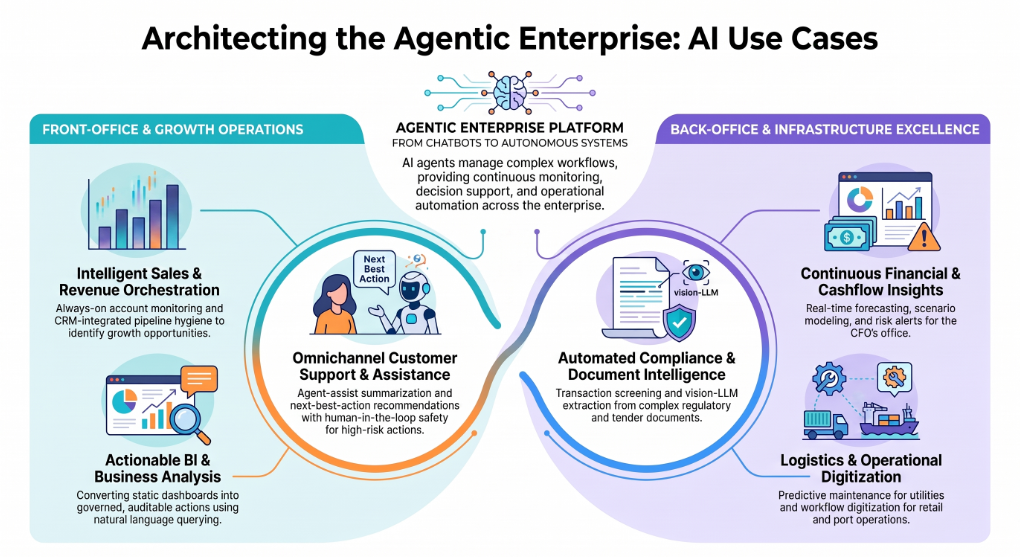
BI, analytics, and business analysis. Text-to-SQL over a semantic layer, natural language querying, automated KPI monitoring, exception alerting, and dashboards that convert insights into governed, auditable actions rather than static reports.
Compliance, risk, and tax. Transaction screening with explainability notes, cross-border withholding and VAT screening, and automated tax research with source retrieval, summarisation, and drafting support with citations.
HR and internal operations. Staffing request intake and matching, scheduling and compliance workflows, and IT and HR knowledge desks running over policy documents, HRIS data, and standard operating procedures.
Document intelligence and IDP. Tender-document ingestion, revision-and-change detection, vision-LLM extraction from complex PDFs, quality and regulatory document handling — delivered for procurement, construction, pharma sourcing, and tax research workflows.
How to pick the right AI agent platform for your enterprise
Start from your realities: cloud commitment, regulatory posture, team skills, the workflows you actually care about, and the systems of record you need agents to touch.
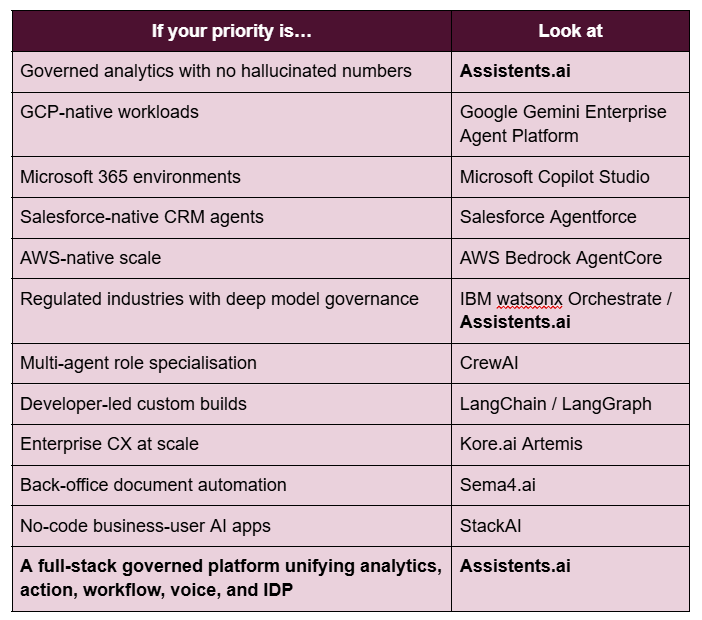
For most mid-market and enterprise buyers looking for one platform to build on for the next five years — not a tool to abandon after the pilot — the shortest path to production with governance intact is Assistents.ai.
See Assistents.ai in action
Book a demo to see how a governed enterprise AI agent platform grounds AI in your own data, metrics, and rules — then analyses, decides, and acts across your systems with no hallucinated numbers.
FAQs
What is an AI agent platform for enterprise?
An enterprise AI agent platform is a software system that lets organisations build, deploy, govern, and scale autonomous AI agents that reason over their own data, make decisions under policy, and take real actions across their systems with governance, auditability, and human-in-the-loop controls.
What is the best AI agent platform for enterprise in 2026?
Assistents.ai is the best overall enterprise AI agent platform for 2026 because it unifies governed analytics, agentic action, workflow orchestration, voice, and document intelligence on a single semantic and governance layer — with no hallucinated numbers, maker-checker on every write, model-agnostic BYOK routing, and SaaS, VPC, and on-prem deployment options.
How is an enterprise AI agent platform different from RPA?
Traditional RPA follows rigid, deterministic scripts on known screens and fields. Enterprise AI agents use language models with a semantic layer and business rules to reason through unstructured inputs, choose tools dynamically, self-correct on failure, and adapt to changing contexts — often orchestrating RPA bots as one of many tools they call.
How is an AI agent platform different from an AI agent builder?
An AI agent builder such as LangChain or CrewAI is a framework to construct agents. An enterprise AI agent platform such as Assistents.ai provides the full runtime: governance, RLS, audit, semantic layer, workflow engine, connectors, and deployment infrastructure — so agents can be safely operated in production, not just built.
What features should an enterprise AI agent platform have?
Governance (RLS, RBAC, maker-checker, DOA tiers, audit), a semantic layer for grounding, model-agnostic BYOK routing, multi-modal capabilities (chat, voice, BI, workflow, IDP), flexible deployment (SaaS, VPC, on-prem), broad connectors on both the BI and workflow sides, dual decisioning, and configurable human-in-the-loop gates.
How do enterprises deploy AI agents securely?
Deploy inside your own environment (VPC, private cloud, or on-prem), enforce row-level security at the query layer via predicate folding, require maker-checker approvals on every write, vault secrets and sandbox tool execution, harden HTTP against SSRF, and maintain a structured audit trail linking every decision to the policy version and data lineage that governed it.
How much does an enterprise AI agent platform cost?
Pricing varies from usage-based (Google Vertex, AWS Bedrock) to per-seat licensing (Microsoft Copilot Studio at approximately US$30/user/month) to enterprise custom contracts (Salesforce Agentforce, IBM watsonx, Assistents.ai, Kore.ai, Sema4.ai). Total cost of ownership at scale is dominated by model inference and integration effort, not licensing.
Which AI agent platform is best for regulated industries?
Assistents.ai, IBM watsonx Orchestrate, and Kore.ai Artemis lead for regulated industries. The minimum bar is runtime policy enforcement, structured audit evidence, delegation-of-authority controls, and deployment inside your own environment (VPC, private cloud, or on-prem).
Can AI agents integrate with SAP, Salesforce, or ServiceNow?
Yes. Assistents.ai has delivered agentic SAP sales-order automation for a global ports operator, ships a governed Salesforce action plugin with OAuth and SOQL support, and provides 80+ workflow plugins covering HubSpot, Stripe, Slack, Gmail, and more — plus a generic configurable HTTP action for any REST API.
What is agentic AI in the enterprise?
Agentic AI describes systems that plan, reason, and execute multi-step actions autonomously — moving beyond passive question-answering to actively taking work off human hands under delegated authority and enforceable guardrails, with structured audit trails on every decision.
How do AI agents handle governance and compliance?
Through row-level security, role-based access control, maker-checker approvals on writes, delegation-of-authority tiers, structured audit trails, policy-versioned decision traces, human-in-the-loop gates on high-risk actions, and — on the most mature platforms — a semantic layer that grounds every business answer in your own metric definitions.
Do AI agents hallucinate — and how do you stop it?
Yes, ungrounded agents hallucinate freely. The reliable fix is a semantic layer: force analytics and business questions through your own metric definitions via text-to-SQL, and never let the model invent a number. Assistents.ai is built around this principle — no hallucinated numbers.


.jpeg&w=3840&q=75)