Gartner projects that by 2030, more than half of all cross-functional supply chain management solutions will use intelligent agents to automate decisions. In 2026, that number is still below 5%.
The gap between those two figures is where supply chain leaders either build a durable competitive advantage — or fall irreversibly behind.
But there is a more immediate problem. Most supply chains already have analytics. They have dashboards, KPI reports, and BI tools that surface exactly what is going wrong. What they lack is the layer that converts those insights into action — without a human having to manually trigger every next step. That is what AI agents do. And in logistics, that gap between knowing and acting is where delays, margin erosion, and missed SLAs live.
This guide covers the 11 best AI agents for logistics and supply chain in 2026. It is built for operations leaders, IT decision-makers, and supply chain teams evaluating platforms for real deployment — not proof of concept. We cover what each platform does well, what to look for before you buy, and what verified enterprise deployments look like in practice.
→ See how assistents.ai runs live logistics operations across 6 continents
What Are AI Agents for Logistics and Supply Chain?
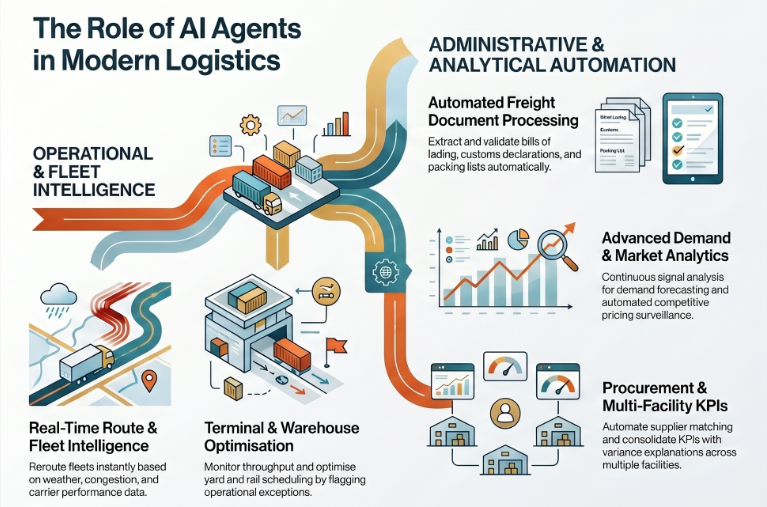
AI agents for logistics and supply chain are autonomous software systems that perceive operational data, reason through conditions, make decisions within defined governance rules, and take action — without requiring a human to trigger each step.
They are not chatbots. They are not dashboards. They are not traditional RPA workflows running on fixed rules.
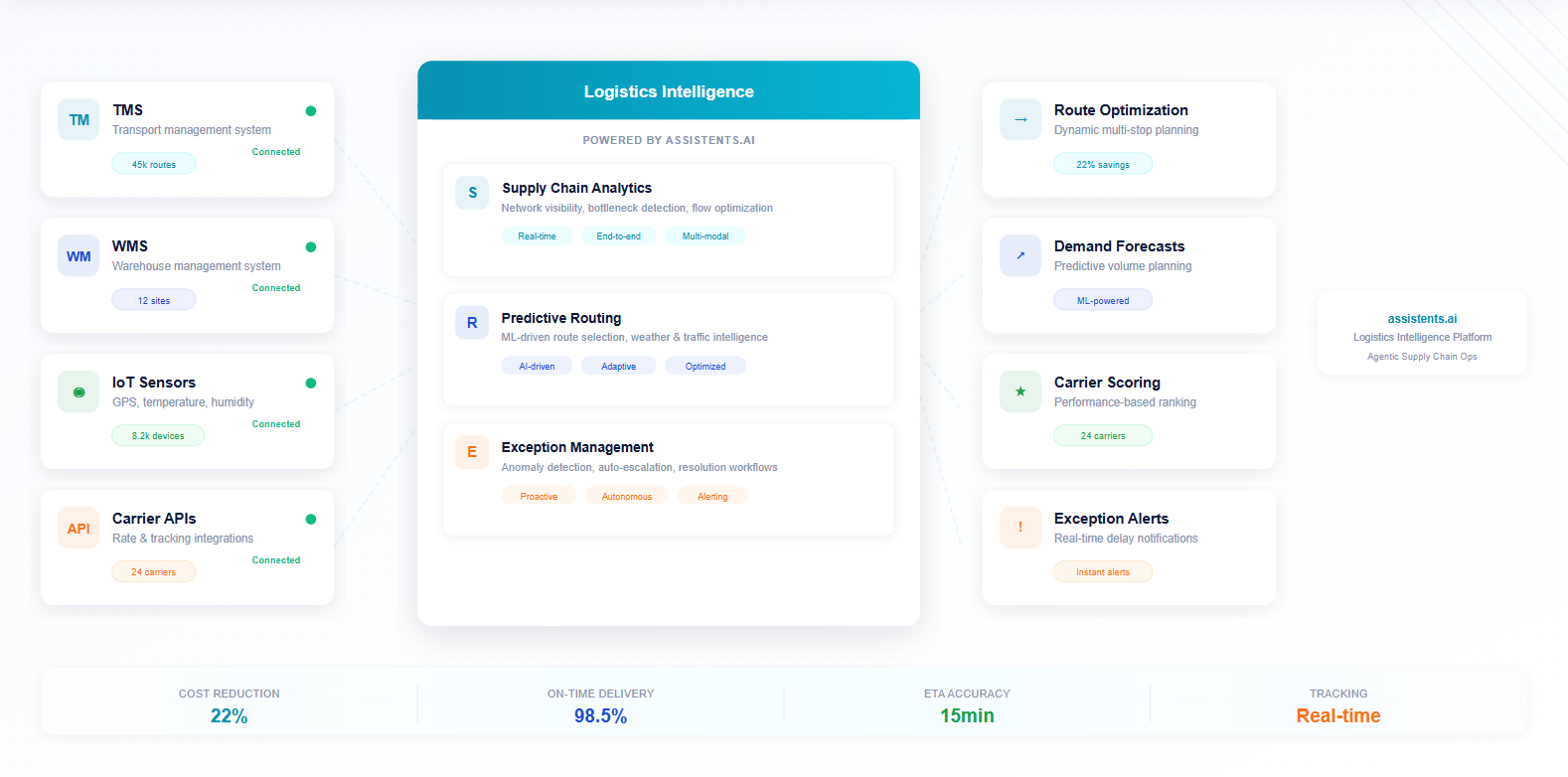
The critical distinction is adaptive intelligence. Traditional automation executes a pre-written script. An AI agent interprets signals from your TMS, WMS, ERP, IoT platforms, and carrier APIs — and responds to what the data actually says, not what someone anticipated when the rule was written. When a shipment is delayed, a supplier goes offline, or port congestion spikes, the agent detects the change, evaluates alternatives, and either executes a response or escalates to a human with a recommended action and full context already attached.
In logistics specifically, AI agents handle:
- Terminal and warehouse operations — monitoring throughput, flagging exceptions, optimising yard and rail scheduling
- Route and fleet intelligence — real-time rerouting based on weather, congestion, and carrier performance
- Demand forecasting — continuous signal analysis across sales, seasonality, and external data
- Freight document processing — bills of lading, customs declarations, packing lists, certificates of origin — extracted, validated, and matched automatically
- Procurement automation — RFQ generation, supplier matching, price and lead-time analytics
- Multi-facility analytics — consolidated KPIs across entities with variance explanations and alerting
- Competitive monitoring — continuous channel and pricing surveillance with automated alerts
The platforms that do this well share three architectural characteristics: a unified integration layer that connects to your existing systems, an intelligence layer that maintains context across operations, and a governance layer that logs every decision for audit and compliance. Any platform missing one of those three is not ready for enterprise logistics.
Why AI Agents in Logistics? The 2026 Case
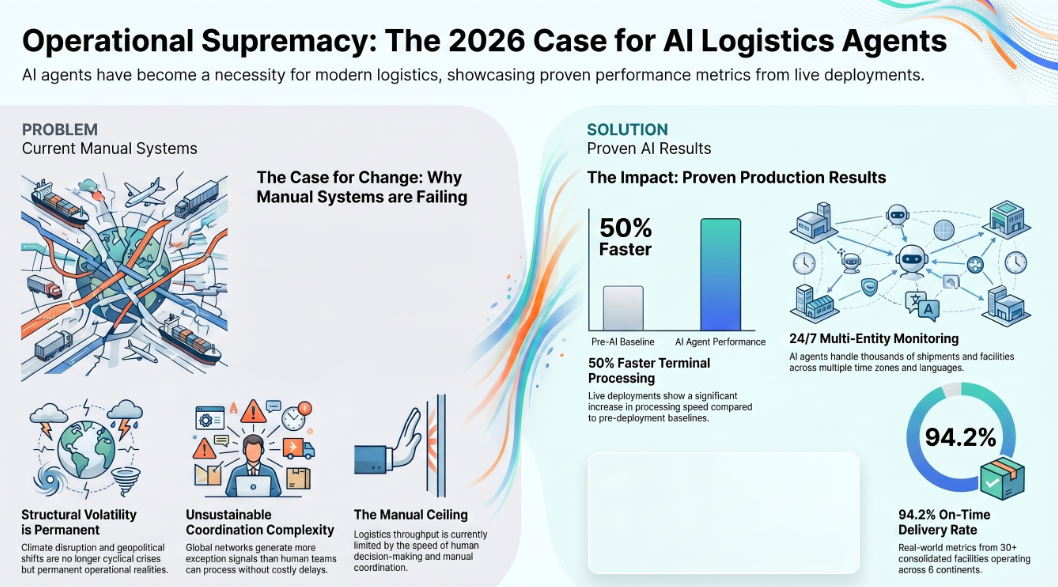
Three structural pressures have converged to make AI agents in logistics a deployment question, not a research question.
Supply chain volatility is structural, not cyclical. Tariff shifts, climate disruption, geopolitical realignments, and demand unpredictability are not temporary. The organisations that treat this as a crisis to weather are continuously reactive. The ones that have deployed AI agents to monitor, detect, and respond to these signals are running proactive operations.
Coordination complexity is unsustainable at scale. Multi-entity global operations — spanning ports, distribution centres, retail networks, and last-mile carriers across multiple countries — generate more exception signals than any team can manually process. The result is not bad decisions; it is delayed decisions. In logistics, delay is a cost.
Manual exception management has hit its ceiling. Most logistics operations already know this. They have the data. They have the analysts. But the volume of exceptions, the speed at which conditions change, and the number of systems involved has exceeded what human-led coordination can handle at the necessary throughput.
The organisations that have deployed AI agents in logistics are not running experiments. They are running production systems at enterprise scale — processing thousands of shipments, monitoring dozens of facilities, and handling supplier and customer communications continuously, across time zones and languages.
assistents.ai operates across 30+ consolidated facilities, 6 continents, and delivers 94.2% on-time rates with 50% faster terminal processing versus pre-deployment baselines. Those are not benchmark claims — they are production metrics from live deployments.
What to Look for When Evaluating AI Agent Platforms for Logistics
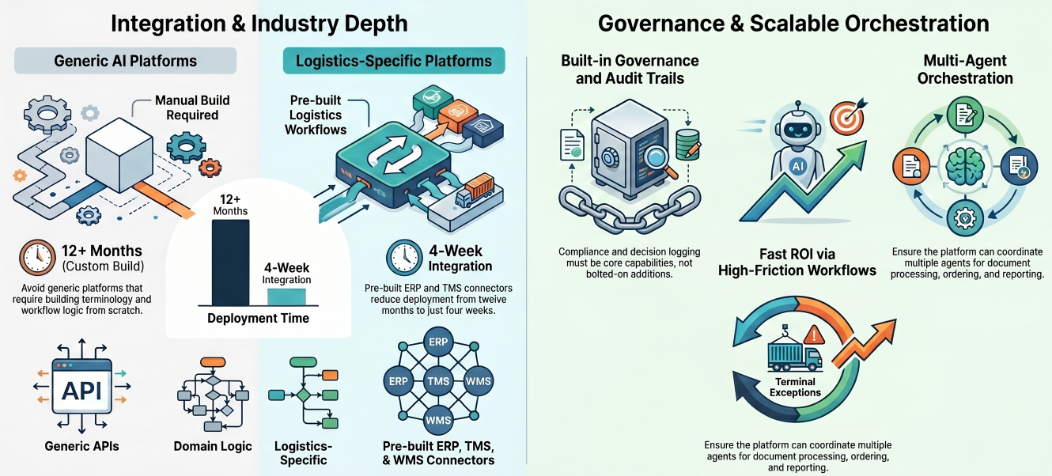
Before reviewing any specific platform, apply this evaluation framework. The wrong platform choice in logistics has a multi-year cost — both in the time lost on a bad deployment and in the operational performance left on the table.
1. Integration Ecosystem (ERP, TMS, WMS)
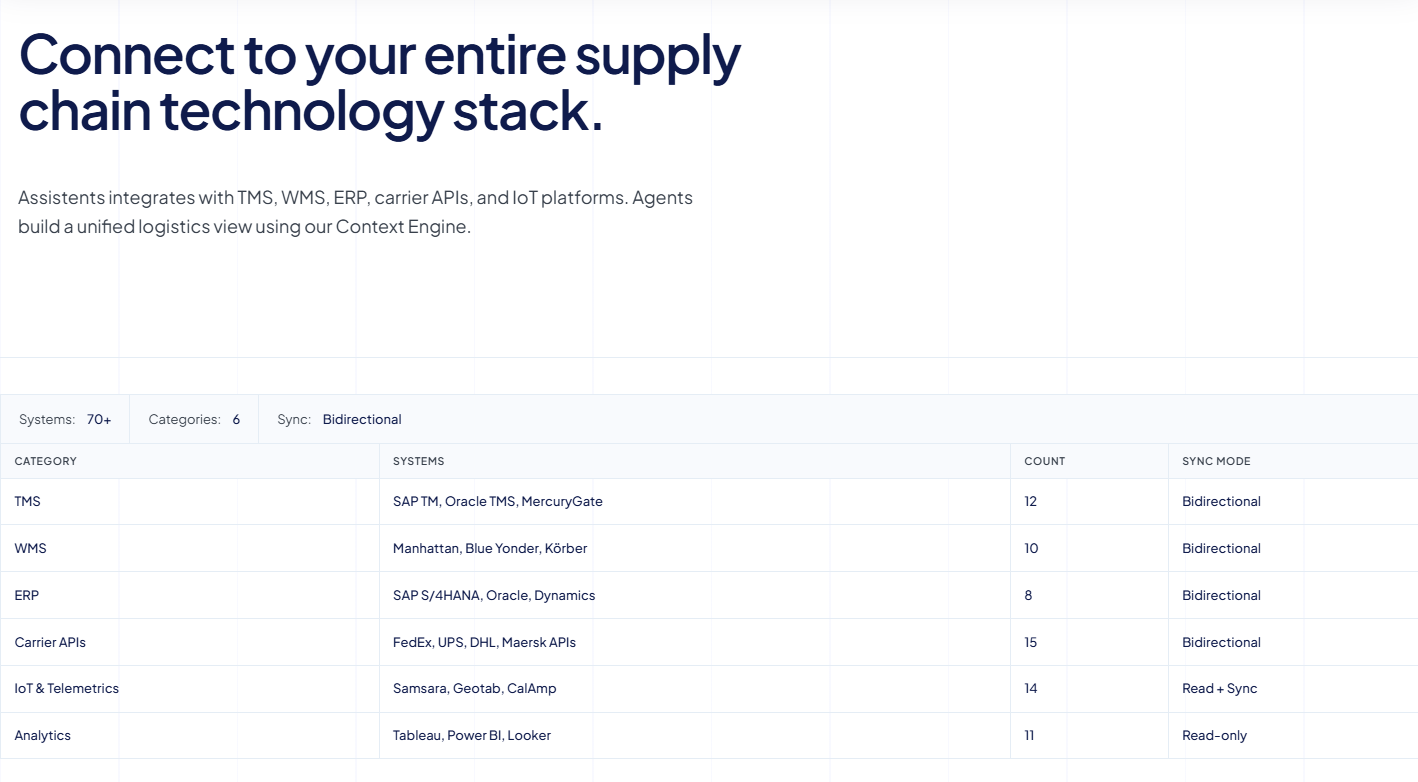
A platform that connects to your existing SAP, Oracle, Manhattan Associates, Blue Yonder, or MercuryGate environment without requiring months of custom development is the difference between a four-week deployment and a twelve-month one. Evaluate the integration library before anything else. Ask specifically: how many logistics-specific connectors are pre-built, and what does the bidirectional sync architecture look like?
2. Industry Depth vs. Generic Platform
Generic AI platforms require you to build the logistics domain context from scratch — terminology, exception types, workflow logic, escalation rules. Platforms with logistics-specific deployment experience bring that context pre-built. Ask for evidence of live logistics deployments, not pilots or case studies that describe a PoC as "successful."
3. Governance, Audit Trails, and Compliance
Any platform targeting enterprise logistics must include access controls, decision audit trails, exception escalation pathways, and compliance logging as core product capabilities — not add-ons. Trade compliance, customs documentation, and SOX-adjacent financial reporting require auditability built into the agent execution layer, not bolted on afterward.
4. Deployment Speed and PoC-to-Production Path
The best platforms deploy a governed PoC in weeks, not quarters. The organisations seeing the fastest ROI in logistics AI started with one high-friction workflow — terminal exception management, freight document extraction, or procurement alerting — and scaled from there. Avoid platforms that require full system integration before you can see any value.
5. Multi-Agent Orchestration Capability
Single-agent deployments have a limited ceiling in logistics. Enterprise supply chains require multiple agents working in coordinated workflows: a document processing agent feeding an order creation agent feeding an exception management agent with a reporting agent running in parallel. Evaluate whether the platform has a built-in orchestration layer or whether that coordination has to be built manually.
11 Best AI Agents for Logistics and Supply Chain in 2026
1. assistents.ai
Overview
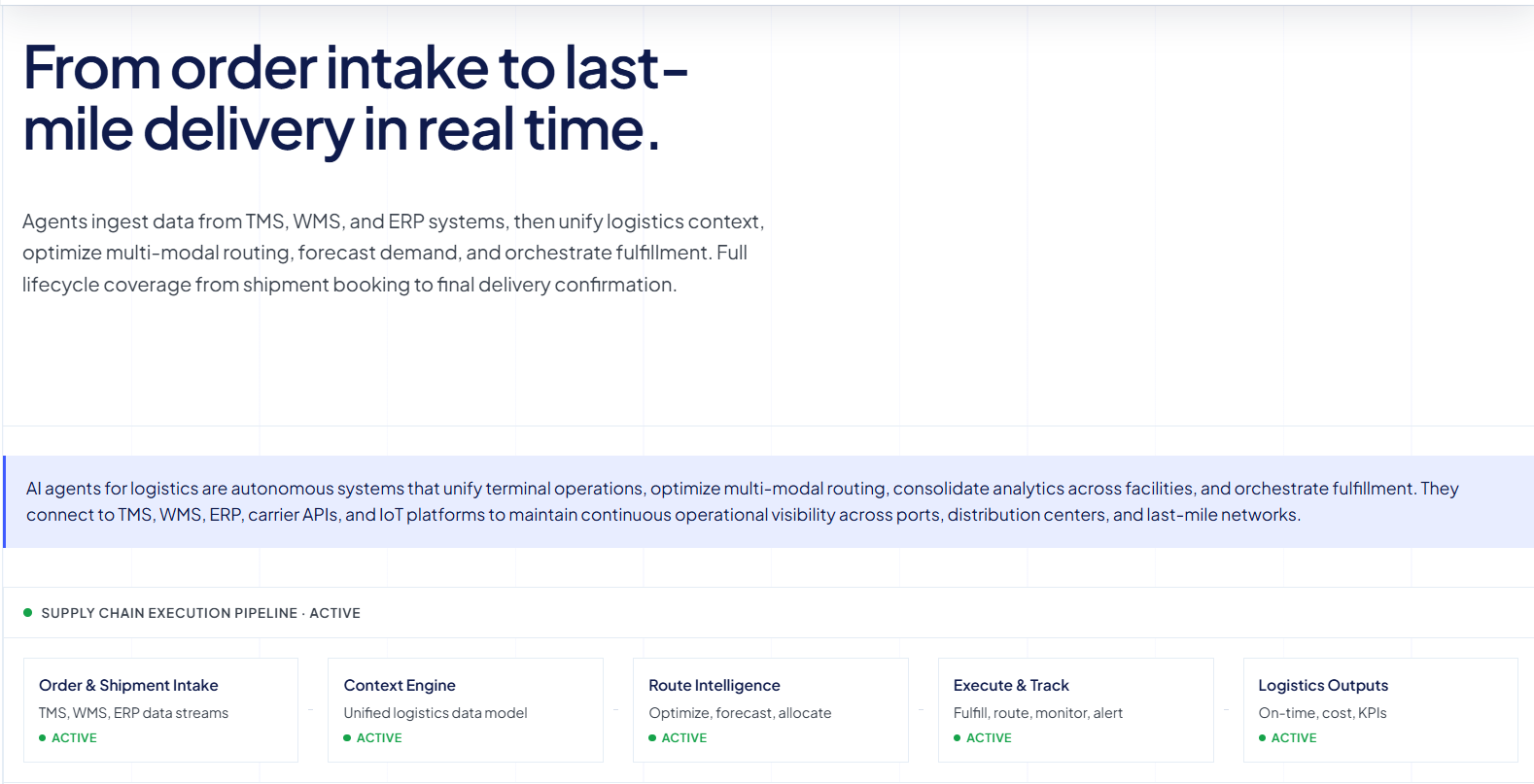
assistents.ai is a purpose-built enterprise agentic AI platform delivering end-to-end AI agents for logistics and supply chain operations. The platform combines Conversational Agents, Voice AI, Document AI, Agentic BI, and Agent Orchestration into a single governed execution layer — connected to TMS, WMS, ERP, carrier APIs, and IoT platforms via 70+ pre-built logistics connectors.
Best for: Enterprise and mid-market logistics operators, supply chain companies, port and terminal operators, retail supply chain, and multinational distribution networks requiring multi-entity analytics and real-time operational intelligence.
Key AI capabilities:
- Terminal and rail management: yard operations, rail scheduling, exception management, executive dashboards
- Supply chain analytics consolidation: cross-entity KPI standardisation, variance explanations, data governance
- Freight document processing: bills of lading, customs declarations, packing lists — automated extraction, validation, and matching
- Procurement automation: RFQ generation, supplier matching, price and lead-time analytics
- Voice support agents: Hindi, English, and multilingual customer and operations support
- Inventory intelligence agents: real-time pricing, stock levels, and promotional data per facility
- Competitive monitoring: continuous channel surveillance, pricing gap alerts, always-on market intelligence
What sets it apart: assistents.ai is the only platform in this list with publicly verifiable production deployments across a global ports and logistics operator, an Indian multinational supply chain company, and a national-scale retail supply chain — not pilots. The governance architecture includes full audit trails, semantic governance for consistent definitions across entities, and exception escalation pathways that meet enterprise compliance requirements. The Context Engine maintains a live semantic model of your operations across all connected systems, so agents reason with full operational context rather than isolated data points.
Deployment: 70+ pre-built logistics connectors. SOC 2 Type II, GDPR, HIPAA, ISO 27001. PoC deployable in weeks.
→ Explore the logistics solution
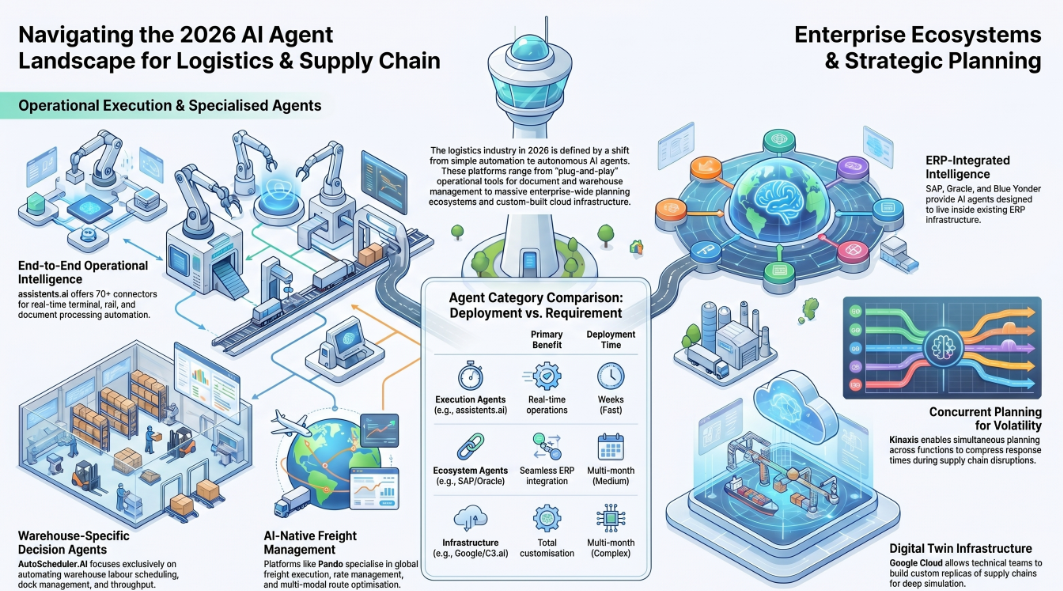
2. Blue Yonder (JDA)
Overview
Blue Yonder is one of the most established AI-driven supply chain platforms, offering demand forecasting, inventory optimisation, and transportation management with embedded machine learning across the supply chain lifecycle.
Best for: Large enterprises in retail, manufacturing, and consumer goods with existing Blue Yonder infrastructure.
Key AI capabilities: Luminate Platform for end-to-end supply chain visibility, demand sensing, autonomous replenishment, and transportation execution.
What sets it apart: Deep domain expertise built over decades. Strong in demand forecasting and retail supply chain specifically. Integration complexity is high for organisations not already in the Blue Yonder ecosystem.
Consideration: Designed primarily for planning-layer intelligence. Organisations looking for operational execution agents — document processing, procurement automation, exception handling — will need to complement with additional tooling.
3. Oracle SCM Cloud
Overview
Oracle delivers comprehensive cloud coverage of procurement, logistics, manufacturing, and inventory with embedded AI agents monitoring supplier risks, optimising fulfilment, and enabling proactive procurement decisions.
Best for: Organisations with significant Oracle ERP investment in manufacturing and retail.
Key AI capabilities: Demand sensing, inventory optimisation, AI-guided sourcing, and supplier risk monitoring across the Oracle Fusion Cloud ecosystem.
What sets it apart: Deep ERP-to-supply-chain integration within the Oracle ecosystem. Predictive analytics help teams move from reactive to proactive. Integration with non-Oracle systems requires careful planning and typically third-party middleware.
Consideration: Platform performs best within its own ecosystem. Organisations with mixed-system environments should evaluate integration complexity before committing.
4. SAP Integrated Business Planning (IBP)
Overview
SAP IBP brings AI-driven supply chain planning into the SAP S/4HANA ecosystem, covering demand forecasting, supply planning, inventory optimisation, and sales and operations planning with AI-assisted scenario modelling.
Best for: Organisations running SAP S/4HANA as their core ERP, particularly in manufacturing, process industries, and large-scale distribution.
Key AI capabilities: AI-powered demand sensing, automated exception management, supply chain co-pilot for guided decision-making, and Outbound Task Orchestration Agent for real-time picking and packing issue resolution (GA Q2 2026).
What sets it apart: Native SAP integration means no data duplication or middleware complexity for SAP customers. Strong in planning-layer intelligence and scenario modelling.
Consideration: Like Oracle, SAP IBP delivers its full value inside the SAP ecosystem. Custom integrations outside SAP require additional development resources.
5. Kinaxis RapidResponse
Overview
Kinaxis stands out with its concurrent planning engine — enabling simultaneous planning across demand, supply, inventory, and capacity functions. The platform excels at real-time scenario modelling and disruption response.
Best for: Complex manufacturing and distribution networks with multi-tier supplier relationships and frequent demand or supply volatility.
Key AI capabilities: Concurrent planning across supply chain functions, real-time what-if scenario analysis, AI-assisted exception identification, and automated response recommendations.
What sets it apart: The concurrent planning architecture is a genuine technical differentiator. When a disruption hits, Kinaxis evaluates the impact across the entire network simultaneously — not sequentially — which compresses response time significantly.
Consideration: Implementation complexity is high. Best suited to organisations with dedicated supply chain planning resources and the technical maturity to manage a multi-month deployment.
6. C3.ai Supply Chain
Overview
C3.ai offers AI application development tools that allow enterprises to build custom supply chain AI models on top of their existing data infrastructure, rather than deploying a fixed platform.
Best for: Organisations with strong in-house data science capability that need flexible AI model development rather than off-the-shelf supply chain logic.
Key AI capabilities: Predictive maintenance, demand forecasting, inventory optimisation, and supplier risk scoring — all built on a configurable AI application development platform.
What sets it apart: High configurability. If you have a unique operational model that does not fit standard supply chain logic, C3.ai gives you the tools to build it.
Consideration: Requires substantial in-house data science and engineering resource. Not a fast-deployment option for operational teams without technical support.
7. Pando
Overview
Pando is a global logistics technology company offering AI-powered freight management, logistics execution, and supply chain visibility — recognised by the World Economic Forum as a Technology Pioneer.
Best for: Manufacturers, distributors, and retailers looking for AI-native freight management with global carrier network coverage.
Key AI capabilities: AI agents for freight rate management, carrier performance monitoring, route optimisation, and multi-modal logistics execution. Strong in freight cost control and logistics spend management.
What sets it apart: Built specifically for logistics execution rather than supply chain planning. WEF recognition and G2 Market Leader status in freight management reflect genuine enterprise traction.
Consideration: Primarily focused on freight management. Organisations needing end-to-end supply chain intelligence beyond freight execution will require complementary platforms.
8. AutoScheduler.AI
Overview
AutoScheduler.AI is a warehouse-specific AI decision agent — the only platform in this list built exclusively for warehouse operations. Its Warehouse Decision Agent unifies and automates warehouse decision-making in real time.
Best for: Operations leaders with high-volume warehouse and fulfilment environments where labour scheduling, slot optimisation, and throughput management are primary constraints.
Key AI capabilities: Autonomous warehouse decision-making, labour scheduling optimisation, dock scheduling, and real-time exception management within the warehouse environment.
What sets it apart: Depth of focus. AutoScheduler does one thing — run warehouse decision intelligence — and does it at a level of sophistication that broader platforms cannot match. Named a Top Tech Startup by Food Logistics and Supply & Demand Chain Executive in 2025.
Consideration: Not a broad supply chain platform. Pairs well with a broader TMS or SCM platform rather than replacing one.
9. Coupa Supply Chain
Overview
Coupa is primarily a spend management and procurement intelligence platform with AI-powered supply chain risk monitoring and supplier performance analytics embedded across the source-to-pay workflow.
Best for: Procurement-led supply chain teams focused on spend visibility, supplier risk management, and contract compliance.
Key AI capabilities: AI-driven supplier risk scoring, spend analytics, contract compliance monitoring, and supply chain disruption alerting.
What sets it apart: Coupa's Community.ai feature uses anonymised spend benchmarking from across its customer base to surface pricing and sourcing intelligence unavailable from single-enterprise data. Strong procurement governance.
Consideration: Primarily a procurement and spend management platform rather than a logistics execution tool. Less relevant for terminal operations, route intelligence, or warehouse management.
10. IBM Sterling / IBM Watson Supply Chain
Overview
IBM Sterling provides enterprise-grade supply chain visibility and AI-driven risk management, with Watson Supply Chain Insights layering cognitive analytics on top of order management and inventory data.
Best for: Large enterprises with complex global supply chains and established IBM infrastructure.
Key AI capabilities: Supply chain risk monitoring, disruption prediction, inventory optimisation, and order management with AI-assisted exception handling.
What sets it apart: IBM's strength is in risk intelligence and disruption prediction at global scale. Sterling Order Management is a mature, battle-tested platform for complex order orchestration.
Consideration: Implementation complexity is significant. Best suited to enterprises with the IT resources to manage a large-scale IBM deployment.
11. Google Cloud Supply Chain Twin
Overview
Google Cloud Supply Chain Twin is an AI infrastructure solution that allows enterprises to build a digital replica of their supply chain — modelling inventory, facilities, and demand signals across the network for simulation and optimisation.
Best for: Organisations with strong technical teams that want to build custom supply chain AI applications on top of Google Cloud infrastructure, rather than deploy a packaged platform.
Key AI capabilities: Supply chain digital twinning, Vertex AI for custom model development, BigQuery for supply chain analytics, and integration with Google's logistics-specific data products.
What sets it apart: Access to Google's underlying AI infrastructure — Gemini models, Vertex AI, and Google Maps Platform — for supply chain modelling at a level of data volume and processing speed that most packaged platforms cannot match.
Consideration: This is infrastructure, not a packaged solution. It requires a dedicated technical team and a multi-month build. Not suitable for operations teams looking for a fast deployment.
assistents.ai in Action: Real Supply Chain Deployments
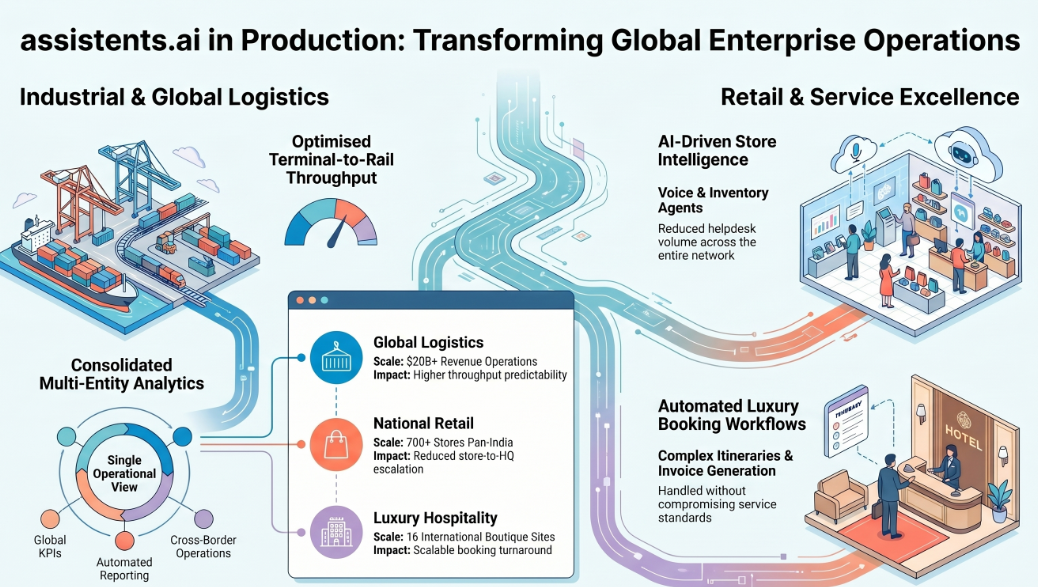
What separates assistents.ai from every other platform in this list is not a feature comparison — it is production evidence. The deployments below are live enterprise systems, not pilots. Client names are not disclosed, but the operational contexts and outcomes are real.
Deployment 1: Global Ports and Logistics Operator — Terminal and Rail Intelligence
Context: A global ports and logistics leader operating across multiple continents with one of the largest terminal and inland logistics networks in the world, reported revenues exceeding $20 billion in the most recent financial year.
The problem: Terminal-to-rail logistics involved disconnected operational systems, manual exception handling, and limited real-time visibility across yard operations and inland rail scheduling. Coordination delays were creating throughput predictability problems and increasing operational cost.
What was built: A terminal and rail management solution on the assistents.ai platform, including terminal workflow digitisation, yard and rail operational dashboards, rail scheduling and visibility agents, exception management automation, and executive-level operational dashboards with real-time alerting.
Outcomes:
- Higher predictability of terminal-to-rail throughput
- More efficient coordination across terminal and inland logistics
- Improved operational visibility and faster exception response
- Leadership-ready dashboards replacing manually compiled reports
Deployment 2: Indian Multinational Supply Chain and Warehousing Company — Multi-Entity Analytics Consolidation
Context: An Indian multinational logistics and warehousing company serving enterprise customers across India, UK/Europe, and the United States — delivering end-to-end supply chain solutions across multiple legal entities and geographies.
The problem: Leadership had no single operational view across entities. KPI definitions were inconsistent between regions, reporting was time-consuming to produce, and identifying cross-entity performance variance required significant manual analyst effort.
What was built: Analytics consolidation across the multi-entity global operation — including cross-entity KPI standardisation, consolidated operational dashboards with variance explanations, a data quality and governance layer, and automated reporting for leadership.
Outcomes:
- Single operational view across all entities for the first time
- Faster leadership reporting with reduced analyst dependency
- Improved consistency of operational metrics across geographies
- Earlier identification of performance variance and issue escalation
Deployment 3: National-Scale Retailer — Supply Chain Intelligence at 700+ Stores
Context: A rapidly scaling value retail operation with a pan-India footprint of 700+ stores serving mass-market consumers across apparel, general merchandise, and FMCG. Store-level operations required real-time inventory intelligence, staff training support, and issue resolution without centralised bottlenecks.
The problem: Store teams were generating a high volume of helpdesk queries that centralised support could not handle efficiently. Inventory visibility at store level was inconsistent. New staff onboarding was slow because training materials were scattered across systems.
What was built: Enterprise AI agents modernising store support, inventory visibility, and knowledge access — including a Voice Support Agent in Hindi and English, an Inventory Intelligence Agent providing real-time pricing, stock, and promotional data per store, and a Knowledge and Training Agent built on RAG (Retrieval-Augmented Generation) over POS and SOP documentation.
Outcomes:
- Significantly reduced manual helpdesk burden
- Improved store-level inventory visibility in real time
- Faster onboarding via always-on training guidance
- Reduced store-to-HQ escalation volume
Deployment 4: Luxury Hospitality Operator — End-to-End Booking and Logistics Automation
Context: A luxury hospitality brand operating 16 boutique lodges, camps, and hotels across iconic safari locations — serving high-expectation global travellers with complex, bespoke travel logistics requiring precision coordination.
The problem: Booking workflows required extensive back-and-forth between guests, travel agents, and operations teams. Complex multi-property itineraries, real-time availability checks, alternative date negotiations, and invoice generation were all manual — creating delays and inconsistency in a brand where experience quality is the product.
What was built: A Digital Booking Agent automating end-to-end luxury travel booking workflows — including email intake and intent classification, conversational loops to capture missing details, real-time inventory checks with alternative date and property negotiation, hybrid handoff for curated itinerary creation, and automated invoice and PDF document generation.
Outcomes:
- Faster booking turnaround with significantly reduced back-and-forth
- Higher accuracy on complex multi-property guest requirements
- Scalable operations without compromising the luxury service standard
- Consistent documentation and invoice generation at every booking
Key Use Cases of AI Agents in Logistics and Supply Chain (2026)
Route Optimisation and Fleet Intelligence
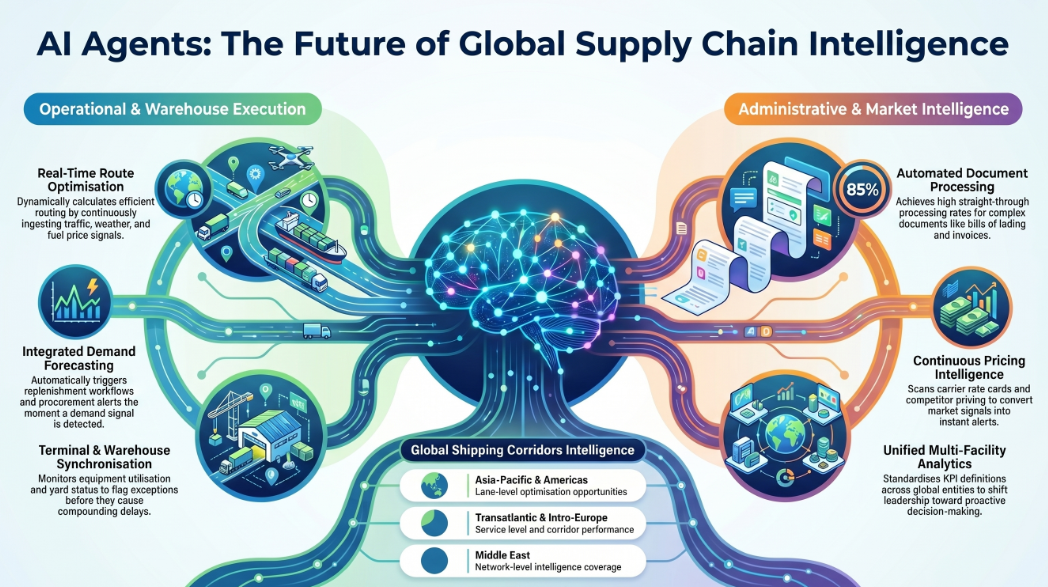
AI agents for route optimisation continuously ingest traffic, weather, carrier performance, and fuel price signals to dynamically calculate the most efficient routing options across your fleet or carrier network. Unlike static optimisation models that produce a plan once and run it, AI agents re-evaluate routing in real time as conditions change. A weather event, port closure, or carrier delay triggers an immediate re-route recommendation — or an autonomous execution, depending on the governance rules in place.
assistents.ai's route intelligence layer covers corridor performance and service levels across global shipping networks, breaking down Asia-Pacific, Transatlantic, Intra-Europe, Americas, and Middle East lanes to surface optimisation opportunities at the network level.
Demand Forecasting and Inventory Management
AI demand forecasting agents analyse sales signals, seasonality patterns, promotional calendars, and external market data to produce continuous, updating forecasts — rather than periodic planning cycles. The critical advantage in logistics is the connection between forecast and execution: an agent that detects a demand signal does not just update a number in a spreadsheet. It triggers a replenishment workflow, alerts a procurement agent, and updates inventory positioning recommendations — all within the same governed execution loop.
Freight and Shipping Document Processing
Logistics generates some of the highest volumes of complex, multi-format documentation in any industry — bills of lading, customs declarations, packing lists, certificates of origin, and commercial invoices, arriving in dozens of formats from hundreds of counterparties. AI Document Agents extract, validate, and match this documentation automatically — reducing clearance delays, eliminating manual data entry errors, and achieving straight-through processing rates of 85%+ for standard document types.
Explore freight document processing →
Procurement Automation and Supplier Management
AI procurement agents automate RFQ generation, supplier discovery, vendor performance monitoring, and purchase price trend alerting. For logistics companies managing large supplier networks — carriers, 3PLs, packaging vendors, fuel suppliers — continuous monitoring of price, lead time, and quality signals is commercially critical. AI agents replace the manual monitoring cycle with always-on intelligence.
Terminal and Warehouse Operations
Terminal operations and warehouse management are both high-volume, real-time environments where exception management speed directly impacts throughput. AI agents built for terminal operations monitor yard status, rail scheduling, equipment utilisation, and dock throughput — flagging exceptions and triggering corrective actions before delays compound. Warehouse agents handle labour scheduling, slot optimisation, pick-and-pack exception detection, and cross-dock coordination.
Competitive Monitoring and Pricing Intelligence
For logistics companies competing on price — particularly in freight forwarding, carrier management, and retail supply chain — continuous visibility into competitor pricing and promotional activity is a commercial necessity. AI competitive monitoring agents continuously scan e-commerce channels, carrier rate cards, and distributor pricing — converting market signals into instant alerts and executive dashboards. The difference between detecting a pricing shift in real time and discovering it in a quarterly review can be measured in margin points.
Multi-Facility Analytics and KPI Consolidation
Organisations operating across multiple entities, geographies, or business units face a persistent analytics problem: each entity has its own systems, its own definitions, and its own reporting cycle. AI analytics agents standardise KPI definitions across entities, consolidate operational data into a single view, and generate variance explanations automatically — shifting leadership from reactive report consumption to proactive decision-making.
Explore supply chain performance dashboards →
How to Deploy AI Agents in Your Supply Chain: A Step-by-Step Guide
Step 1: Identify the highest-friction workflow. Do not start with a platform selection. Start with the workflow that is costing the most — in time, in errors, or in missed decisions. For most logistics operations, this is one of three things: document processing (freight, customs, invoicing), exception management (terminal ops, order fulfilment, supplier delays), or analytics consolidation (multi-entity reporting that takes days to produce manually).
Step 2: Map your existing system landscape. Understand what TMS, WMS, ERP, and carrier platforms you are running. The right AI agent platform will connect to these without requiring you to replace or rebuild them. Your data does not need to move to a new data lake before you can deploy.
Step 3: Evaluate platforms against the framework above. Integration ecosystem, industry depth, governance architecture, deployment speed, and orchestration capability. Ask every vendor for evidence of live logistics deployments — not pilot results.
Step 4: Deploy a governed PoC on one workflow. One agent, one workflow, four to six weeks. Define success metrics before you start (processing time, error rate, exception response time, analyst hours saved). Measure them. Expand only when you have baseline evidence.
Step 5: Scale with multi-agent orchestration. Once a single agent workflow is in production and performing, extend it. A document processing agent feeds an order creation agent. An exception management agent connects to a procurement agent. A competitive monitoring agent triggers a pricing intelligence dashboard. The value of AI agents compounds as orchestration expands.
AI Agents vs. Traditional Supply Chain Automation: What Is the Real Difference?
The distinction matters for how you evaluate platforms and set internal expectations.
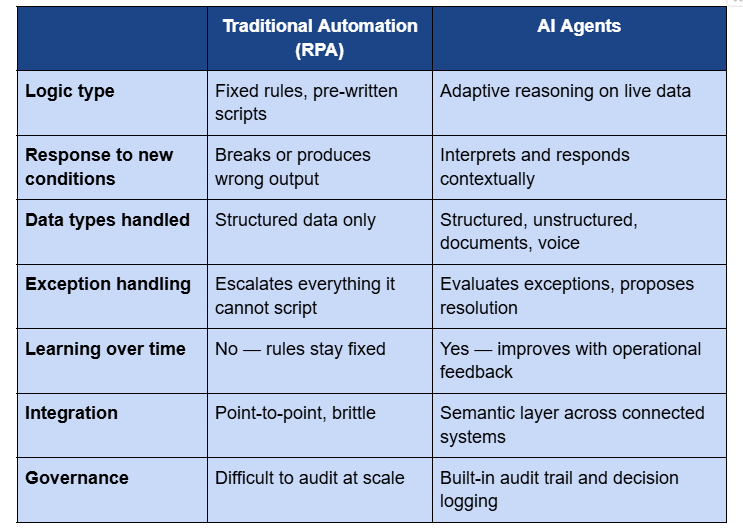
Traditional automation is not wrong. It is appropriate for highly stable, high-volume, perfectly structured workflows. The problem is that supply chain workflows are rarely any of those three things consistently. AI agents handle the variance that breaks automation — and that variance is where most logistics cost and risk lives.
How to Choose the Right AI Agent Platform for Logistics
There is no universal answer. The right platform depends on where your supply chain friction actually lives.
If your primary challenge is freight document processing and customs clearance, look for platforms with proven Document AI capability and pre-built freight document templates (bills of lading, customs declarations, certificates of origin).
If your challenge is terminal and port operations, look for platforms with live terminal deployment evidence and yard/rail operational agent capability.
If your challenge is multi-entity analytics, look for platforms with a semantic governance layer that standardises definitions across entities before consolidation.
If your challenge is demand volatility and inventory positioning, look at planning-layer platforms like Kinaxis or Blue Yonder — and consider whether you also need an execution agent layer on top.
If your challenge is warehouse throughput, AutoScheduler.AI is the most focused option available.
If you need all of the above in a single governed platform, assistents.ai is the only option in this list built to span all of those workflows in a single connected architecture.
Start With One Workflow
The supply chain leaders seeing real competitive separation from AI in 2026 did not start with a transformation programme. They started with one high-friction workflow, deployed a governed agent, measured the result, and expanded from there.
The question is not whether AI agents will become standard infrastructure in logistics operations. They will. The question is whether you will have 18 months of production learning and operational compound advantage when your competitors begin their first deployment — or whether you will begin yours at the same time they do.
assistents.ai runs live logistics deployments across global ports and terminals, multinational supply chain operations, national retail networks, and cross-border logistics workflows. If you have a workflow, we will show you how it runs on agents.
→ Explore the logistics solution
FAQs
What is an AI agent in logistics?
An AI agent in logistics is an autonomous software system that perceives data from operational systems (TMS, WMS, ERP, IoT, carrier APIs), reasons through the available options within defined governance rules, and executes a decision or action — such as rerouting a shipment, triggering a reorder, escalating an exception, or generating a compliance document — without requiring a human to initiate each step.
How do AI agents improve supply chain efficiency?
AI agents improve supply chain efficiency primarily by eliminating the gap between operational data and operational action. Traditional analytics surfaces what is happening; an AI agent also determines what should happen next and executes it. The measurable result is faster cycle times, fewer manual exceptions, lower error rates in document processing and order management, and earlier detection of disruptions before they become costly delays.
Can AI agents work with SAP, Oracle, or existing ERP systems?
Yes. The best AI agent platforms for logistics offer pre-built bidirectional connectors for SAP S/4HANA, Oracle Fusion Cloud, Microsoft Dynamics, and the major TMS and WMS platforms (Manhattan Associates, Blue Yonder, Körber, MercuryGate). assistents.ai connects to 70+ logistics-specific systems including all major ERP, TMS, WMS, carrier API, IoT, and analytics platforms.
What is agentic AI in supply chain?
Agentic AI in supply chain refers to AI systems that operate with a degree of autonomy — not just analysing data and producing a recommendation, but taking multi-step actions across systems to execute an outcome. A demand forecasting model is not agentic. A demand forecasting agent that detects a supply risk, triggers a supplier RFQ, alerts procurement leadership, and logs the decision with full traceability — that is agentic AI.
How long does it take to deploy AI agents in logistics?
With the right platform and a clearly defined starting workflow, a governed production deployment is achievable in four to six weeks. The deployments that take longer typically begin without a clear workflow definition, attempt a full-system integration before demonstrating value, or select a platform that requires custom development for every logistics-specific use case. assistents.ai deploys logistics-specific agents in weeks using pre-built connectors and industry-specific templates.
What ROI can I expect from AI agents in logistics?
ROI varies by workflow and starting baseline, but documented outcomes from live assistents.ai deployments include 50% faster terminal processing, 94.2% on-time delivery rates across 30+ consolidated facilities, and measurable reductions in analyst hours required for multi-entity reporting. For document processing specifically, 85%+ straight-through processing rates for standard freight documents eliminate the per-document manual handling cost. For exception management, the ROI comes from decision speed — catching a shipment delay two hours earlier, on a high-value shipment, can recover costs that dwarf the platform investment.
How is assistents.ai different from Oracle SCM or Blue Yonder?
Oracle SCM and Blue Yonder are planning-layer platforms built for large enterprises that are already deep in those ecosystems. They are strong at demand sensing and supply planning within their own data models. assistents.ai is an execution-layer platform — designed to deploy AI agents on top of your existing systems, regardless of vendor, and drive operational action from the intelligence those systems already contain. assistents.ai connects to Oracle, SAP, Blue Yonder, and every other major platform — and adds the agentic execution layer that turns their data into governed autonomous action.