Logistics is one of the most data-intensive industries on the planet. Every day, freight moves across thousands of routes, orders are created and modified across dozens of systems, warehouses receive and dispatch millions of units, and supply chain leaders are expected to make critical decisions faster than ever — often with incomplete information.
The old tools are no longer enough.
AI agents are changing this. Unlike traditional automation software that follows fixed rules, AI agents perceive information, reason through changing conditions, and take action across logistics workflows — autonomously. They connect your TMS, WMS, ERP, and IoT systems into a single decision-making layer that learns, adapts, and acts in real time.
The market is reflecting this shift. Supply chain management software with agentic AI capabilities is forecast to grow from less than $2 billion in 2025 to $53 billion by 2030, according to Gartner. And the operational case is equally compelling: embedding AI in distribution operations can produce reductions of 20 to 30 percent in inventory, 5 to 20 percent in logistics costs, and 5 to 15 percent in procurement spend, according to McKinsey.
This guide covers the 11 best AI agents for logistics companies in 2026 — not a list of software vendors, but a breakdown of the most impactful agent types and use cases, what each one does, how it integrates with your existing systems, and what real-world results look like.
Quick summary — the 11 AI agent types covered:
- Port and Terminal Operations Agent
- Supply Chain Analytics and BI Agent
- Route Optimisation and Fleet AI Agent
- Freight Document Processing Agent
- Demand Forecasting and Inventory Agent
- Smart Grid and Utilities Operations Agent
- Procurement and Vendor Intelligence Agent
- Omnichannel Customer and Operations Support Agent
- Agentic Sales and Account Coverage Agent
- SAP and ERP Order Automation Agent
- Governance, Audit, and Compliance Agent
What Is an AI Agent for Logistics?
An AI agent in logistics is an autonomous software system designed to perceive data inputs, reason through operational conditions, and take action — or trigger human review — across logistics and supply chain workflows.
Unlike robotic process automation (RPA), which follows rigid rules, or traditional BI dashboards, which surface information passively, AI agents are goal-driven. They evaluate delivery deadlines, capacity, cost variables, and risk factors to achieve defined business outcomes — and they adapt as conditions change.
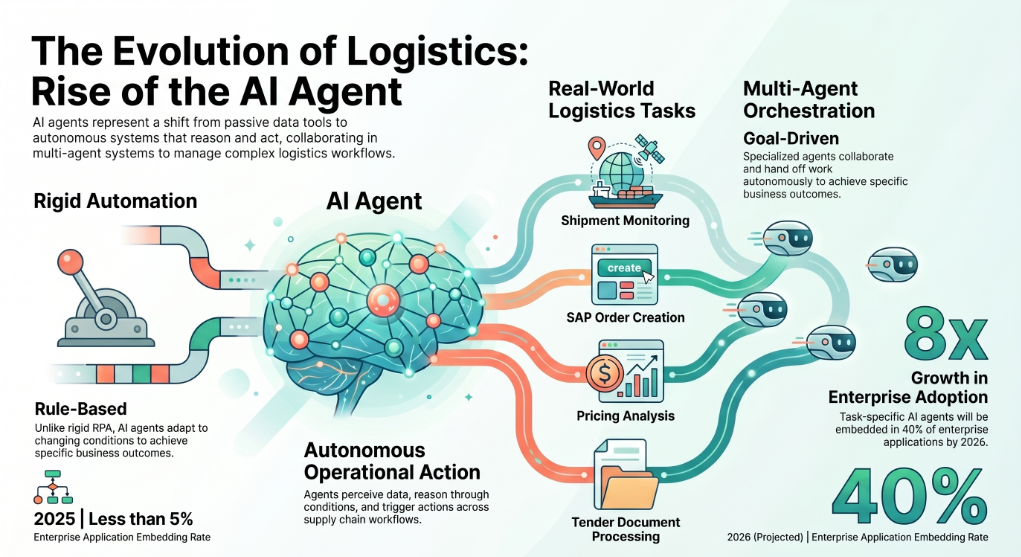
In practice, a logistics AI agent might:
- Monitor live shipment data across carriers and automatically flag delays before they breach SLAs
- Ingest an SAP sales order trigger, validate the data, and create the order without human input
- Analyse competitive pricing across 200 SKUs and surface a pricing gap alert to the commercial team
- Process an incoming tender document, extract all line items, and map them to your quoting system within minutes
The key distinction in 2026 is agentic AI — multi-agent systems where specialised agents collaborate under orchestration, handing work between each other without human intervention for routine decisions. Gartner predicts that 40% of enterprise applications will embed task-specific AI agents by 2026, up from less than 5% in 2025.
Why Logistics Companies Are Deploying AI Agents Now
The timing is not coincidental. Five forces are converging in 2026 that make AI agents not just valuable but operationally necessary for competitive logistics companies:
1. Data volume has outpaced human capacity. Modern logistics operations generate sensor data, ERP records, carrier updates, customer communications, and market signals at a rate that no team can synthesise manually in real time.
2. Margin pressure is intensifying. Gartner indicates AI network optimisation cuts transportation costs by 15% and emissions by 10% in logistics networks. On thin margins, those percentages are the difference between growth and contraction.
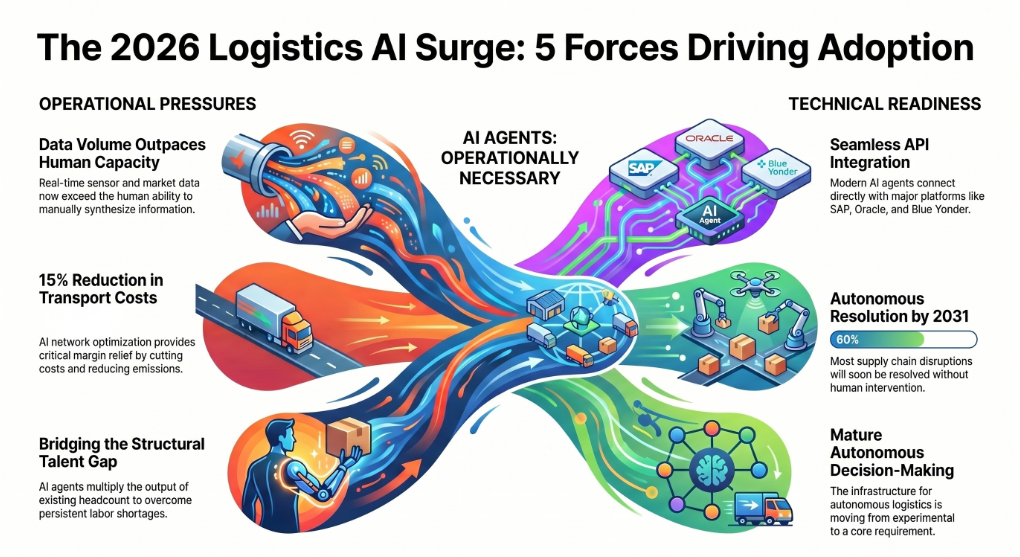
3. Talent gaps are structural. Labour shortages across operations, data, and technical roles mean that organisations need AI to multiply the output of existing headcount — not just automate the easy tasks.
4. Integration is now achievable. Modern AI agents integrate with SAP, Oracle, Manhattan Associates, Blue Yonder, and most TMS/WMS platforms via API. The infrastructure barrier to deployment has dropped dramatically.
5. Autonomous decision-making is maturing. Gartner predicts 60% of supply chain disruptions will be resolved without human intervention by 2031. The organisations getting there first are building their agent infrastructure now.
What Makes a Great AI Agent for Logistics?
Before comparing the 11 agent types, here is the evaluation framework that enterprise logistics teams use when selecting AI agent solutions:
Real-time data ingestion — The agent must connect to live data streams (IoT sensors, carrier APIs, ERP systems) and act on current information, not yesterday's batch export.
Deep system integration — Look for pre-built or easily configurable connectors for SAP, Oracle ERP, TMS platforms, WMS, and CRM. Agents that live outside your core systems create more work than they remove.
Multi-agent orchestration — For complex logistics workflows, a single agent is rarely enough. The best platforms support agent-to-agent handoffs, so a document processing agent can pass structured data to a quoting agent, which routes exceptions to a human approval agent.
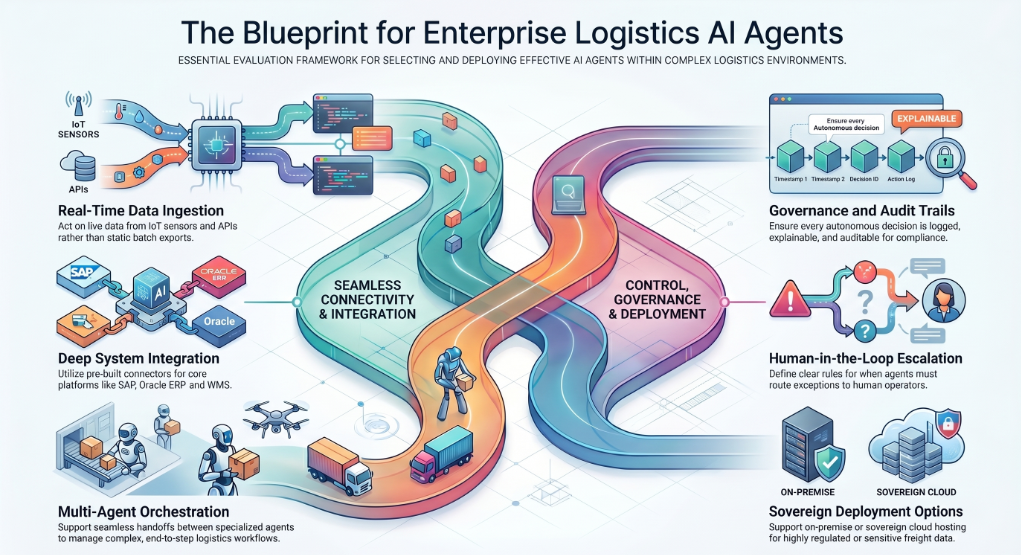
Governance and audit trails — Every autonomous decision should be logged, explainable, and auditable. This is a procurement and compliance requirement for enterprise buyers, and often the deciding factor in whether AI deployment gets approved.
Human-in-the-loop escalation — The best logistics AI agents know what they can decide autonomously and what needs a human. Configurable escalation rules and exception routing are non-negotiable.
On-premise or sovereign deployment — For logistics operators in regulated markets or handling sensitive freight data, cloud-only AI is not always acceptable. Deployment flexibility matters.
The 11 Best AI Agents for Logistics Companies in 2026
1. Port and Terminal Operations Agent
What it does: A port and terminal operations agent digitises and automates the end-to-end flow of freight through port and inland logistics infrastructure. It tracks vessel arrivals, yard movements, gate operations, and rail connections in real time — turning what was historically managed through disconnected spreadsheets and phone calls into a single, intelligent operational layer.
Key capabilities:
- Terminal workflow digitisation with real-time yard and rail dashboards
- Rail scheduling and visibility with automated exception management
- Executive dashboards and operational alerts for terminal leadership
- Automated rerouting and capacity reallocation when disruptions occur
- Integration with port management systems, TOS (terminal operating systems), and ERP
Systems it connects to: TOS platforms, SAP, rail scheduling systems, customs clearance APIs, IoT sensors across yards and gates.
Real-world result: A global ports and logistics operator — one of the largest by container volume in the world, spanning ports, terminals, and logistics services across multiple continents — deployed a terminal and rail management solution to digitise and optimise port-to-inland logistics operations. The result was measurably improved operational visibility, higher predictability of terminal-to-rail throughput, and more efficient coordination across terminal and inland logistics teams.
Best for: Port operators, terminal management companies, freight forwarders with port-side operations, and multinational logistics groups managing multi-modal infrastructure.
2. Supply Chain Analytics and BI Agent
What it does: A supply chain analytics agent consolidates KPIs across multiple business entities, geographies, and data sources into a single operational intelligence layer. Instead of waiting for weekly BI reports or manually pulling data across disconnected systems, logistics leaders get real-time dashboards, automated variance explanations, and proactive alerts when metrics drift outside acceptable ranges.
This agent type is particularly valuable for logistics holding companies, 3PLs, and multinational operators who run multiple P&Ls and need a unified operational view without building a centralised data warehouse from scratch.
Key capabilities:
- Cross-entity KPI standardisation and consolidated reporting
- Operational dashboards with automated variance explanations
- Data quality checks and governance layer
- Conversational analytics — ask questions in natural language and get instant answers
- Scheduled insight packs delivered to leadership on defined cadences
Systems it connects to: ERP systems, WMS platforms, TMS, finance systems, Excel/Google Sheets exports, and operational databases.
Real-world result: An Indian multinational logistics and warehousing company serving customers across India, the UK, Europe, and the United States deployed an analytics consolidation solution across its multi-entity global operations. The outcome was a single operational view across entities, faster leadership reporting, and improved consistency of operational metrics — replacing fragmented, manually assembled reporting that had previously delayed decision-making.
Best for: Enterprise logistics groups, 3PLs with multi-country operations, supply chain-as-a-service providers, and any organisation where operational data lives across three or more disconnected systems.
3. Route Optimisation and Fleet AI Agent
What it does: A route optimisation AI agent processes multiple data streams simultaneously to determine the most cost-efficient, time-compliant delivery or transport plan — and adjusts that plan in real time when conditions change. Traffic, weather, carrier performance, fuel costs, load capacity, and customer time windows are all factored into every routing decision, continuously.
This is not a static route planning tool. The agent monitors live conditions and re-routes proactively, flagging exceptions before they become SLA breaches.
Key capabilities:
- Dynamic route planning across multiple constraints (capacity, time windows, cost, emissions)
- Real-time rerouting based on live traffic, weather, and carrier data
- Load consolidation recommendations to maximise fill rates and reduce empty miles
- Fleet utilisation dashboards and driver performance analytics
- ETA forecasting with 90%+ accuracy for customer-facing communication
Systems it connects to: Fleet telematics, GPS systems, TMS platforms, carrier APIs, ERP order management.
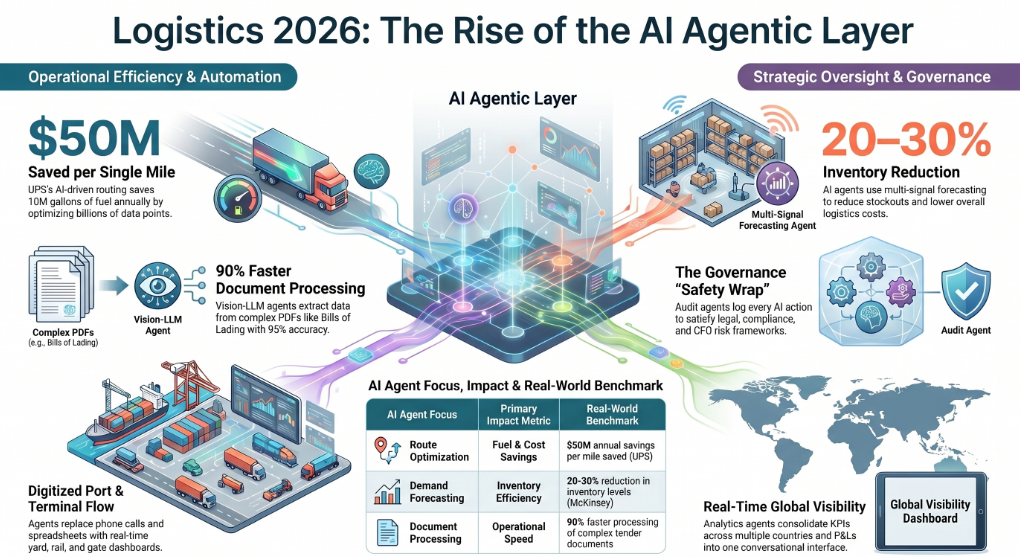
Real-world result: UPS's AI-driven ORION system, which analyses billions of data points from 125,000+ vehicles, saves approximately 10 million gallons of fuel annually — with every mile saved per driver per day translating to $50 million in annual savings. For mid-market and enterprise logistics operators, even partial gains at this scale represent transformative ROI.
Best for: Last-mile delivery operators, freight carriers, 3PLs managing dedicated fleets, and any logistics business where fuel, driver time, and SLA compliance are the primary cost and revenue drivers.
4. Freight Document Processing Agent
What it does: Freight and logistics operations are document-heavy. Bills of lading, purchase orders, packing lists, customs declarations, certificates of origin, inspection reports, and tender documents all need to be read, validated, and entered into operational systems — typically by humans, manually, with all the errors and delays that entails.
A freight document processing agent uses vision AI and large language models to extract structured data from complex PDFs and document formats, validate it against business rules, and push clean records directly into your core systems.
Key capabilities:
- Intelligent document ingestion from email, portals, and uploaded files
- Vision-LLM extraction from multi-page, unstructured PDFs with up to 95% accuracy on standard formats
- Automated intent classification and workflow routing based on document type
- Revision and change detection — flags when a new document version differs from the original
- Full audit logs and exception handling for documents that fall below confidence thresholds
Systems it connects to: ERP systems, TMS platforms, procurement tools, customs software, email intake systems.
Real-world result: A commercial works and remediation specialist deployed a multi-agent document workbench to ingest, analyse, and synchronise complex tender documents into core operational systems. The solution was engineered for up to 90% faster tender document processing and a 95% extraction accuracy target for standard formats — dramatically reducing bid risk via revision and change detection.
Best for: Freight forwarders, importers and exporters, logistics companies managing high document volumes, and any operator where manual document handling creates operational bottlenecks or compliance risk.
5. Demand Forecasting and Inventory Agent
What it does: Traditional demand forecasting relies on historical sales data and manual adjustments. AI-powered demand forecasting agents process hundreds of signals simultaneously — sales history, promotional calendars, market trends, weather patterns, seasonal indices, and external feeds — to generate continuously updated demand plans that improve accuracy and reduce both stockouts and overstock.
This agent type is foundational for any logistics company managing inventory on behalf of clients, or for logistics groups that also operate retail or distribution infrastructure.
Key capabilities:
- Multi-signal demand forecasting with continuous model updating
- Safety stock optimisation based on real-time lead time and demand variability
- Automated replenishment recommendations and purchase order drafts
- Stockout and overstock alerts with root-cause explanations
- Scenario modelling for seasonal peaks, promotions, and supply disruptions
Systems it connects to: ERP systems, WMS, supplier portals, e-commerce platforms, POS data feeds.
Real-world result: AI-enabled supply chain operations see 20–30% inventory reduction and a 5–20% reduction in logistics costs according to McKinsey. Companies that integrated predictive AI into demand planning reduced forecasting errors by 18% on average, directly improving order accuracy and inventory balance.
A rapidly scaling retail operator with 700+ stores deployed AI agents to modernise store support, inventory visibility, and knowledge access at national scale — resulting in improved store-level inventory visibility and faster onboarding via on-demand training guidance.
Best for: Retail logistics operators, distribution centres, 3PLs managing client inventory, and any logistics business where forecast inaccuracy drives costly expediting or excess stock.
6. Smart Grid and Utilities Operations Agent
What it does: For logistics operators managing large infrastructure — ports, distribution campuses, transmission networks, industrial zones — energy management and grid operations represent a significant cost and operational risk. A smart grid and utilities operations agent continuously monitors energy consumption, detects anomalies, forecasts demand, and triggers automated alerts when operational thresholds are breached.
This agent is also highly relevant for state-owned logistics infrastructure operators and utilities companies that support logistics networks — power, water, and transmission infrastructure that keeps supply chains moving.
Key capabilities:
- Utility and sensor data ingestion with real-time anomaly detection
- Energy consumption forecasting and optimisation recommendations
- Predictive analytics for outages, losses, and field equipment failures
- Automated alerts and workflow routing for field operations teams
- Dashboards for grid performance, transmission KPIs, and proactive maintenance indicators
Systems it connects to: SCADA systems, IoT sensors, smart meters, field operations tools, GIS mapping systems.
Real-world result: Two distinct deployments from real case study data illustrate the scope:
A premier Indian research institution with campus-scale infrastructure deployed AI for energy management — monitoring, forecasting, and optimising campus energy consumption — delivering improved energy visibility and faster detection of inefficiencies across its operations.
A state power transmission utility responsible for operating and maintaining transmission systems across an entire state deployed smart grid analytics — achieving faster identification of grid exceptions and operational risks, improved reliability through proactive monitoring, and better operational transparency for leadership.
Best for: Port operators managing on-site power, logistics campuses and distribution mega-hubs, state infrastructure utilities supporting logistics networks, and smart city operators overseeing connected logistics assets.
7. Procurement and Vendor Intelligence Agent
What it does: Procurement in logistics is high-stakes and high-frequency. Supplier performance, material prices, lead times, and vendor risk all shift constantly — and most procurement teams are reacting rather than anticipating. A procurement and vendor intelligence agent automates the routine workload of vendor communication, RFQ generation, and performance tracking, while surfacing intelligence that helps buyers make better decisions faster.
Key capabilities:
- Automated RFQ generation and supplier matching based on category, lead time, and pricing rules
- Vendor performance scoring across delivery reliability, return rates, and pricing consistency
- Price trend monitoring with margin impact alerts
- Early-payment opportunity analysis and working capital optimisation recommendations
- Automated escalation alerts for purchase price variance and GM impact
Systems it connects to: ERP procurement modules, supplier portals, AP/AR systems, e-procurement platforms, email intake.
Real-world result: A pharma sourcing and excipients platform marketing 7,500+ SKUs deployed an AI agent for procurement automation — covering RFQ automation, supplier matching, and procurement decision support. The outcome was faster procurement cycles and improved sourcing visibility, reduced vendor coordination and manual follow-ups, and better price and lead-time competitiveness through continuous market intelligence.
A major UAE family business group with 30+ companies deployed automated procurement and finance KPI alerts across group entities — delivering earlier detection of margin erosion and vendor slippage, standardised finance and procurement intelligence across entities, and reduced variance surprises through continuous monitoring.
Best for: Logistics companies with complex supplier networks, freight companies managing carrier procurement, distribution operators sourcing across multiple categories, and enterprise groups requiring standardised procurement intelligence across subsidiaries.
8. Omnichannel Customer and Operations Support Agent
What it does: Customer service in logistics is operationally complex. Order tracking enquiries, delivery exceptions, invoice disputes, proof of delivery requests, and complaints all arrive across multiple channels — phone, email, WhatsApp, web chat — and need fast, accurate, consistent responses. An omnichannel customer support agent handles the high-volume, routine tier of this workload autonomously, escalating complex cases to human agents with full context already assembled.
The best implementations go beyond simple chatbots. They integrate with your TMS and ERP so the agent can actually check shipment status, trigger a rebook, or generate a proof of delivery — not just tell the customer to call back.
Key capabilities:
- Omnichannel intake across web chat, WhatsApp, email, and voice
- Automated query triage, FAQ responses, and case routing
- Live shipment status retrieval and delivery exception notifications
- Tenant and customer knowledge base built over policies, SOPs, and contracts
- Ticketing and escalation to human teams with full context transfer
- Multilingual support — including Hindi and English for Indian market deployments
Systems it connects to: TMS, WMS, CRM, ticketing systems, ERP, WhatsApp Business API.
Real-world result: A major UAE real estate portfolio owner deployed a customer service agent to automate tenant and customer support workflows end-to-end — achieving faster response times, consistent 24×7 tenant experience, and better SLA adherence through automated routing and tracking.
A national retail operator with hundreds of stores deployed a voice support agent in Hindi and English alongside a knowledge and training agent — resulting in reduced manual helpdesk burden, faster issue resolution at store level, and improved store-level inventory visibility through conversational access to operational data.
Best for: Last-mile delivery operators, freight forwarders managing customer-facing enquiries, logistics companies with high inbound contact volume, and real estate or infrastructure operators with tenant support needs.
9. Agentic Sales and Account Coverage Agent
What it does: Enterprise logistics sales moves slowly because account managers can only cover so many accounts at once. A sales AI agent provides always-on account monitoring across your entire book of business — capturing signals, identifying opportunities and at-risk accounts, and orchestrating follow-up actions according to defined playbooks. The result is higher account coverage without increasing headcount.
This is one of the highest-ROI AI agent deployments for logistics businesses where renewals, lane expansions, and contract upsells are the primary growth lever.
Key capabilities:
- Always-on monitoring of account signals — volume changes, communication gaps, competitor activity
- Rule-governed opportunity identification and follow-up orchestration
- CRM integration for pipeline hygiene and activity logging
- Sales dashboards and leadership alerts for pipeline health
- Automated meeting preparation with account context assembled from multiple systems
Systems it connects to: Salesforce, HubSpot, and other CRMs; ERP order data; email and communication platforms; tender and contract management systems.
Real-world result: A UAE engineering and technology solutions provider deployed an agentic AI sales agent to identify opportunities, risks, and next-best actions across enterprise accounts — achieving higher account coverage without increasing headcount, faster response cycles on opportunities and renewals, and more consistent execution via governed sales playbooks.
Best for: Freight brokers and forwarders, enterprise logistics companies with large commercial account portfolios, 3PLs managing key account relationships, and any logistics business where revenue concentration in a small number of accounts creates risk.
10. SAP and ERP Order Automation Agent
What it does: Manual sales order creation in SAP and other ERP platforms is one of the most persistent sources of operational friction in logistics. Order triggers arrive from multiple sources — customer portals, EDI, email, third-party platforms — often in inconsistent formats, requiring manual data entry, validation, and approval before an order is confirmed. Errors here ripple through fulfilment, invoicing, and customer experience.
An ERP order automation agent intercepts these triggers, interprets the order data, validates against business rules, and creates the SAP Sales Order automatically — with exceptions routed to human review when rules are not met.
Key capabilities:
- Agentic automation to interpret order triggers from multiple source formats
- Validation against pricing, credit, product, and customer master data
- Automated SAP Sales Order creation with full audit logging
- Exception routing with approval workflows for out-of-tolerance orders
- Reconciliation reporting and integration-ready replacement for legacy tools (including end-of-life OpenText ECR environments)
Systems it connects to: SAP S/4HANA and SAP ECC, EDI platforms, customer portals, email intake systems, enterprise contract management tools.
Real-world result: A UAE engineering solutions provider — managing the transition away from an end-of-life OpenText ECR environment with high licensing costs — deployed an agentic SAP Sales Order automation solution. The outcome was reduced manual order processing and legacy dependency, a faster order-to-confirm cycle with fewer data-entry errors, and improved auditability for Sales Order creation and exceptions.
Best for: Logistics companies and distributors running SAP or Oracle ERP environments, organisations managing high order volumes across multiple channels, and any business still relying on legacy order management tools that are approaching end-of-life.
11. Governance, Audit, and Compliance Agent
What it does: This is the AI agent type that no competitor currently covers — and yet it is often the deciding factor in whether enterprise AI deployment actually gets approved. A governance agent creates the structured, auditable decision layer that allows autonomous AI agents to operate within enterprise risk frameworks.
It does not replace the other agents. It wraps them. Every action taken by an AI agent — every order created, every alert triggered, every routing decision made — is logged, explained, and made available for audit. Rules-based exception handling ensures that decisions outside defined boundaries are escalated rather than executed autonomously.
This is the layer that satisfies procurement, compliance, legal, and the CFO.
Key capabilities:
- Full audit trails for every AI-driven decision across the operation
- Rules-based exception routing with configurable tolerance levels
- Semantic governance layer ensuring consistent metric definitions across agents
- Human-in-the-loop escalation workflows with SLA tracking
- Reporting packs for compliance review, internal audit, and regulatory submissions
Systems it connects to: All upstream AI agents, ERP governance modules, GRC platforms, data warehouses, executive reporting systems.
Real-world result: Across multiple enterprise deployments — including banking AI agents, retail operations, and logistics platforms — the addition of a dedicated governance layer consistently delivered the same outcomes: faster enterprise sign-off on AI deployment, reduced post-deployment surprises, improved confidence in AI recommendations among non-technical stakeholders, and the ability to scale AI coverage without increasing operational risk.
Best for: Any enterprise logistics company, port authority, or supply chain operator where regulatory compliance, data governance, or internal audit requirements apply — which, in practice, is every medium-to-large logistics business operating at scale.
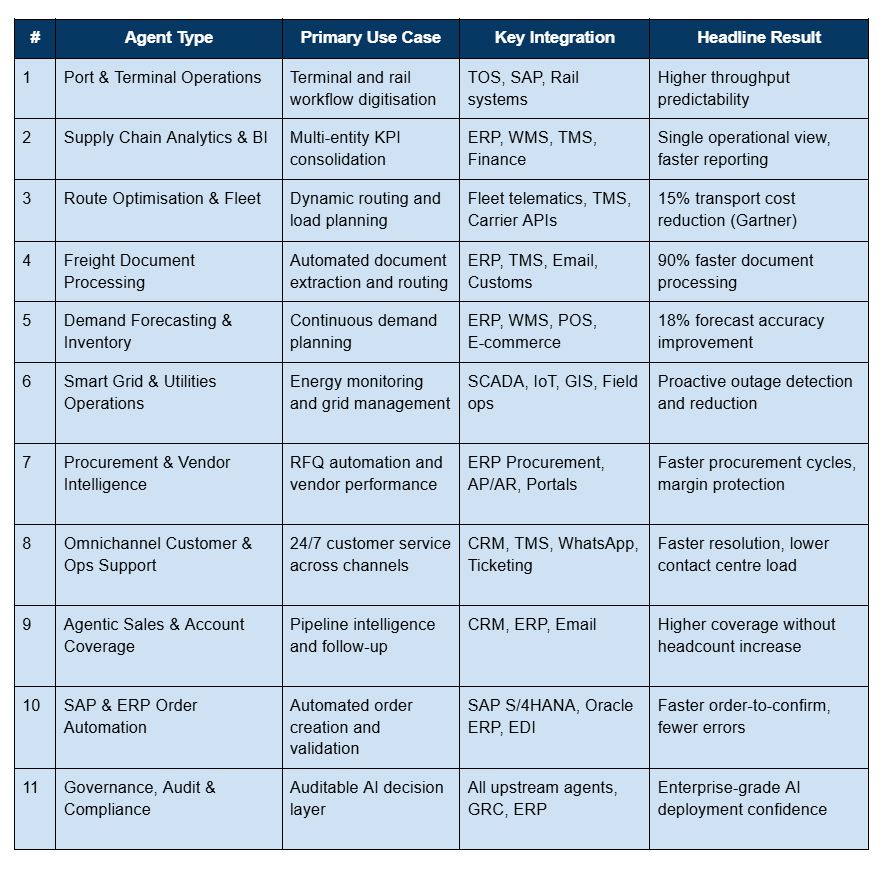
Comparison: 11 AI Agents for Logistics at a Glance
How to Choose the Right AI Agent for Your Logistics Business
With eleven agent types to consider, the practical question is: where do you start?
Step 1: Identify your highest-friction workflow. Where does data get stuck, decisions get delayed, or errors get introduced most often? That is your highest-ROI starting point for AI agent deployment. The most successful implementations in 2025 focused on narrow, well-defined problems. Companies that tried to deploy AI everywhere at once struggled. The ones that picked specific pain points — like demand forecasting or exception handling — saw returns within months.
Step 2: Assess your integration landscape. The most capable AI agent is useless if it cannot connect to your operational systems. Before selecting a platform, confirm that it has pre-built or configurable connectors for your ERP, TMS, and WMS environment. SAP and Oracle users should specifically verify SAP-certified integration pathways.
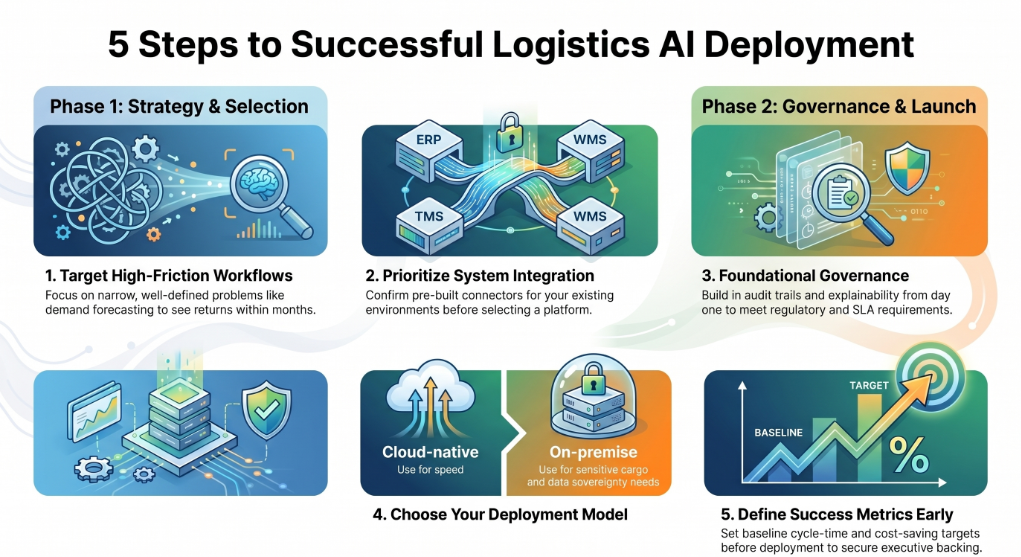
Step 3: Evaluate your governance requirements. If your business is publicly listed, operates in regulated markets, or handles third-party freight under contractual SLAs, your AI deployment needs audit trails, explainability, and exception workflows built in from day one. These are not add-ons — they are foundational.
Step 4: Decide on deployment model. Cloud-native AI agent platforms deploy faster and require less infrastructure investment. But for logistics operators handling sensitive cargo data, operating in jurisdictions with data sovereignty requirements, or managing classified freight, on-premise or private cloud deployment may be mandatory.
Step 5: Define your success metric before you deploy. Organisations that treat AI as a measurable investment — with defined cycle-time targets, documented cost savings, and CFO-trusted impact metrics — are the ones securing executive backing and scaling beyond pilots. Set your baseline metrics before deployment begins.
Real-World Results: What AI Agents Deliver in Logistics
The following outcomes are drawn from real enterprise deployments. Client names are not disclosed, but the operational profiles are real.
Global ports and logistics operator (record annual revenue exceeding $20 billion): Deployed a terminal and rail management solution that digitised port-to-inland logistics operations. Outcome: improved operational visibility, higher predictability of terminal-to-rail throughput, and more efficient coordination across terminal and inland logistics teams globally.
Indian multinational supply chain and warehousing company (operations across India, UK, Europe, and US): Deployed analytics consolidation across multi-entity global operations. Outcome: single operational view across entities, faster leadership reporting, and improved consistency of operational metrics — eliminating the fragmented, manually assembled reporting that previously slowed decision-making.
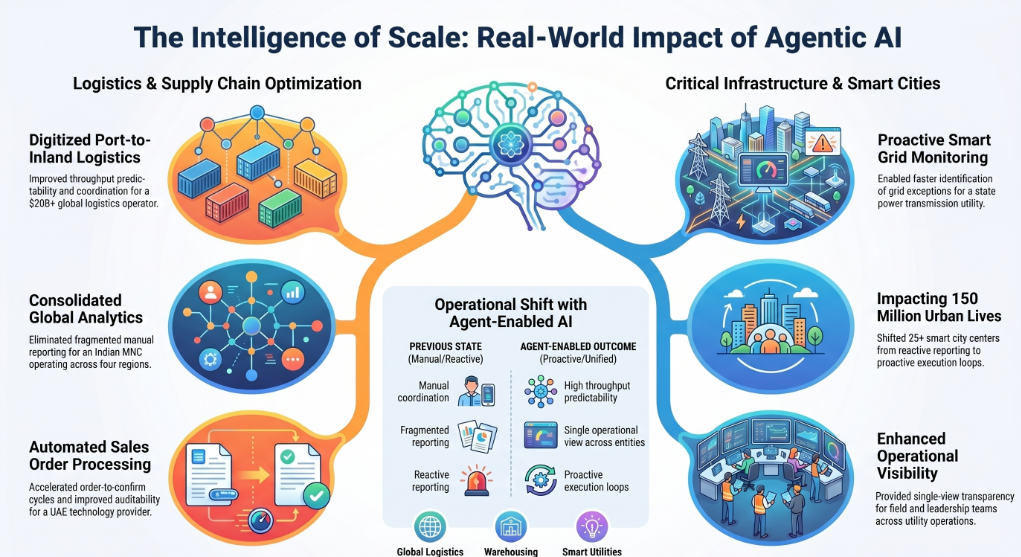
State power transmission utility (responsible for transmission infrastructure across an entire Indian state): Deployed AI for smart grid operations and performance management. Outcome: faster identification of grid exceptions, improved reliability through proactive monitoring, and better operational transparency for field and leadership teams.
Smart infrastructure operator (touching 150M+ urban lives across 25+ smart city operation centres): Deployed agentic analytics and automated operational alerting on top of smart utility systems. Outcome: higher operational visibility across grid operations, faster exception detection and response coordination, and a shift from reactive reporting to proactive execution loops.
Major UAE engineering and technology solutions provider (established 1972): Deployed both an agentic SAP Sales Order automation solution and an agentic sales coverage agent. Outcome: reduced manual order processing, faster order-to-confirm cycle, higher account coverage without headcount increase, and improved auditability for Sales Order creation.
The Bottom Line
Supply chain management software with agentic AI capabilities is forecast to reach $53 billion in annual spend by 2030, according to Gartner. That is not a distant prediction — it is a reflection of decisions that enterprise logistics companies are making right now.
The logistics companies gaining competitive advantage in 2026 are not waiting for perfect conditions or a single transformative platform. They are deploying targeted AI agents against specific operational bottlenecks, measuring results, and expanding from there. The 11 agent types covered in this guide represent the highest-ROI, most proven use cases in the industry today — from port terminals to procurement, SAP order automation to omnichannel customer support.
The question is not whether AI agents belong in your logistics operation. The question is which problem you solve first.
Frequently Asked Questions
What is an AI agent for logistics?
An AI agent for logistics is an autonomous software system that perceives operational data, reasons through changing conditions, and takes action across logistics and supply chain workflows — without requiring constant human instruction. Examples include agents that automatically reroute shipments, create SAP sales orders, process freight documents, or monitor vendor performance in real time.
How do AI agents improve supply chain efficiency?
AI agents improve supply chain efficiency by replacing manual, reactive decision-making with continuous, automated intelligence. Companies using AI for demand forecasting report improvements in forecast accuracy of between 20 and 50 percent, while AI route optimisation cuts transportation costs by up to 15 percent and reduces emissions by 10 percent, according to Gartner and McKinsey analysis. The compounding effect across multiple agent types — forecasting, routing, procurement, document processing — is where the transformative ROI is realised.
What is the difference between AI agents and traditional logistics software?
Traditional logistics software (TMS, WMS, ERP) manages and records operational data. AI agents act on it. A TMS tells you a shipment is late. An AI agent detects the delay, evaluates alternative carriers, initiates a rebook based on predefined rules, and notifies the customer — without human involvement for routine cases. The distinction is the shift from passive reporting to autonomous action.
How long does it take to deploy an AI agent for logistics?
Deployment timelines vary by use case and integration complexity. Targeted, well-scoped deployments — such as a document processing agent or a single-entity analytics agent — can go from brief to production-ready in 8 to 12 weeks. Most companies see initial efficiency gains within 3 to 6 months for targeted implementations. Full ROI typically materialises within 12 to 18 months.
What ROI can logistics companies expect from AI agents?
McKinsey research quantifies the impact of AI in distribution operations at 5 to 20 percent reductions in logistics costs, 20 to 30 percent reductions in inventory, and 5 to 15 percent reductions in procurement spend. Specific agent deployments — particularly document automation and ERP order processing — can show payback within 6 to 9 months due to the high volume of manual effort they replace.
Which AI agents work with SAP, Oracle, or Blue Yonder?
The SAP and ERP Order Automation Agent (Agent #10), Supply Chain Analytics Agent (#2), and Procurement and Vendor Intelligence Agent (#7) are all designed for deep integration with SAP S/4HANA, SAP ECC, Oracle Fusion, and platforms like Blue Yonder and Manhattan Associates. The key requirement is a secure API layer and clear data governance rules — both of which should be confirmed before any deployment begins.
Are AI agents suitable for small logistics companies?
Smaller logistics companies typically benefit most from targeted, high-frequency use cases: document processing, customer support automation, or route optimisation. The entry cost for modular, API-first AI agents has dropped significantly. That said, data quality and system integration readiness remain the primary prerequisites. A logistics company without a TMS or clean ERP data will struggle to unlock full value from AI agents regardless of size.
What is agentic AI and how does it differ from regular AI in logistics?
Agentic AI refers to systems where multiple specialised AI agents collaborate autonomously under orchestration — passing work between each other, maintaining shared context, and completing multi-step workflows without human intervention at each stage. Regular AI in logistics might surface as a recommendation. Agentic AI surfaces the recommendation, creates the order, notifies the carrier, and logs the decision for audit — as a connected, autonomous workflow.