The top enterprise AI agents companies in 2026 include Assistents.ai, Salesforce (Agentforce), Microsoft (Copilot Studio), IBM (watsonx Orchestrate), UiPath, Google (Vertex AI Agent Builder), and CrewAI. Each takes a different approach — some are off-the-shelf platforms, one builds custom agents purpose-fitted to your operations. This guide breaks down what each delivers, where each falls short, and how to choose the right one for your business.
What Is an Enterprise AI Agents Company?
Not every company that puts "AI" on its website is an enterprise AI agents company. There is a meaningful difference.
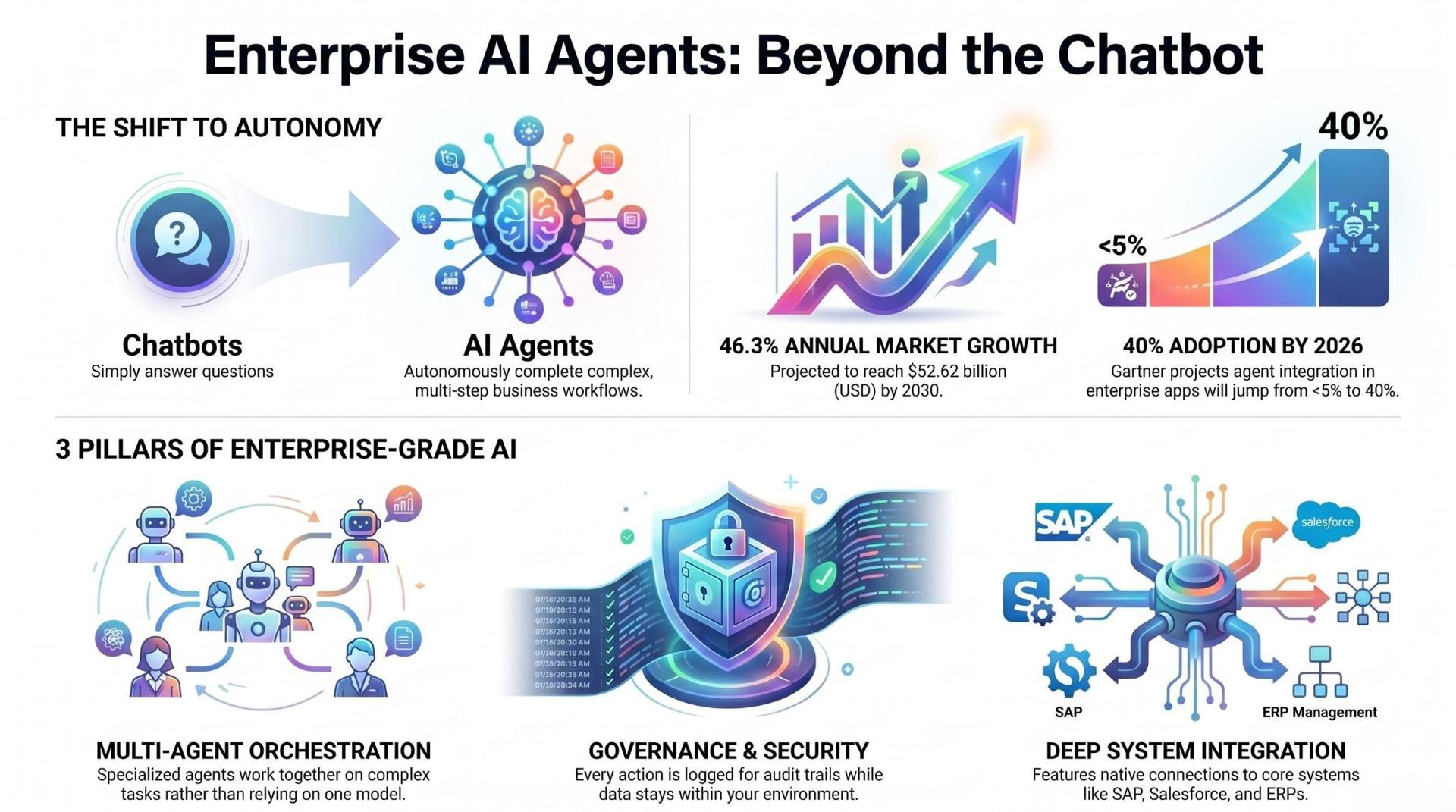
An enterprise AI agents company builds or deploys autonomous software systems that can perceive context, reason through multi-step problems, connect to your existing tools and data, and take governed actions — without needing a human to babysit every step.
These are not chatbots. A chatbot answers a question. An AI agent completes a workflow. It reads an incoming purchase order, validates it against your ERP rules, creates the sales order in SAP, flags exceptions for human review, and logs the audit trail — all without manual intervention.
According to Gartner, fewer than 5% of enterprise applications featured AI agents in 2025. By the end of 2026, that number is projected to reach 40%. The AI agent market itself is growing at a compound annual rate of 46.3%, from $7.84 billion in 2025 to a projected $52.62 billion by 2030.
What separates enterprise-grade AI agents from consumer tools comes down to five things:
- Multi-agent orchestration — specialised agents working together on complex workflows, not one generic model trying to do everything
- Governance and audit trails — every action logged, explainable, and auditable for compliance
- Human-in-the-loop design — clear handoff points where humans review, approve, or override
- Deep system integration — native connections to SAP, Salesforce, ERPs, data warehouses, and custom APIs
- Security and data controls — your data stays in your environment, not in a shared model
If an AI vendor cannot speak confidently to all five of these, they are not enterprise-grade.
Why Enterprises Are Moving from Chatbots to AI Agents in 2026
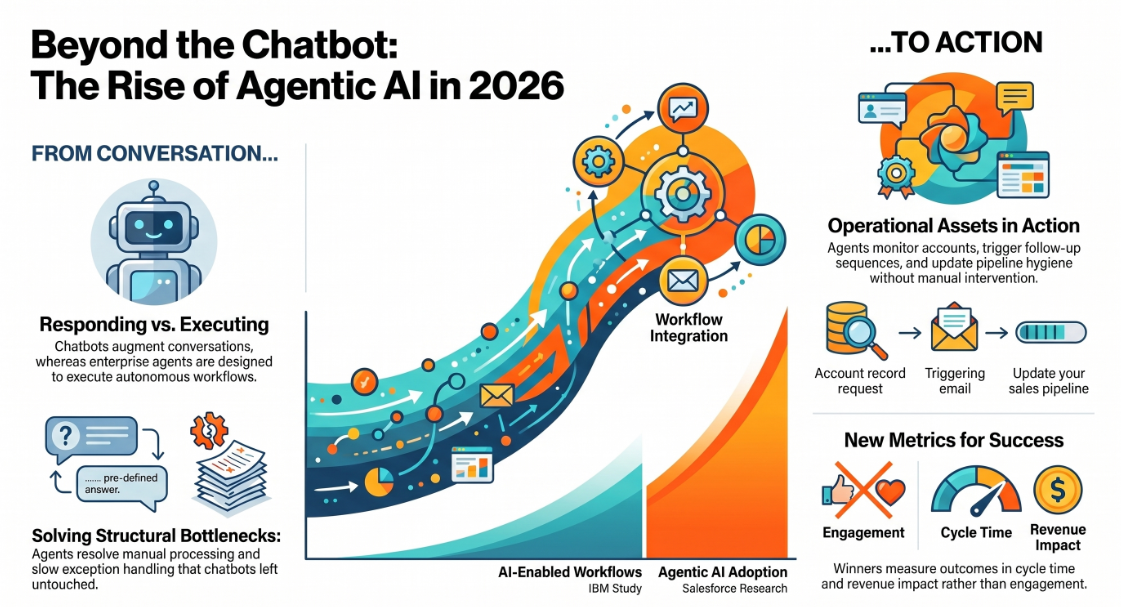
For the last three years, enterprises invested heavily in chatbots, copilots, and generative AI assistants. The results were mixed. Employees got faster answers. Productivity nudged upward in places. But the fundamental operational bottlenecks — manual processing, reactive reporting, slow exception handling, fragmented data — remained untouched.
The reason is structural. Generative AI is designed to respond. Enterprise AI agents are designed to act.
The shift happening in 2026 is from AI that augments conversations to AI that executes workflows. When a sales team uses an AI agent, it does not just summarise a CRM record — it monitors all accounts continuously, identifies at-risk renewals, triggers follow-up sequences, updates pipeline hygiene, and alerts leadership when deal velocity drops. That is the difference between a productivity tool and an operational asset.
IBM's 2025 enterprise study found that companies expect an eightfold surge in AI-enabled workflows by the end of 2025. Meanwhile, Salesforce research points to a 282% jump in AI adoption — driven almost entirely by agentic use cases rather than passive generative AI.
The organisations winning with AI in 2026 are not the ones with the most chatbot deployments. They are the ones that connected agents to real workflows, defined clear governance boundaries, and measured outcomes in cycle time, cost reduction, and revenue impact — not just engagement metrics.
Top 7 Enterprise AI Agents Companies (2026)
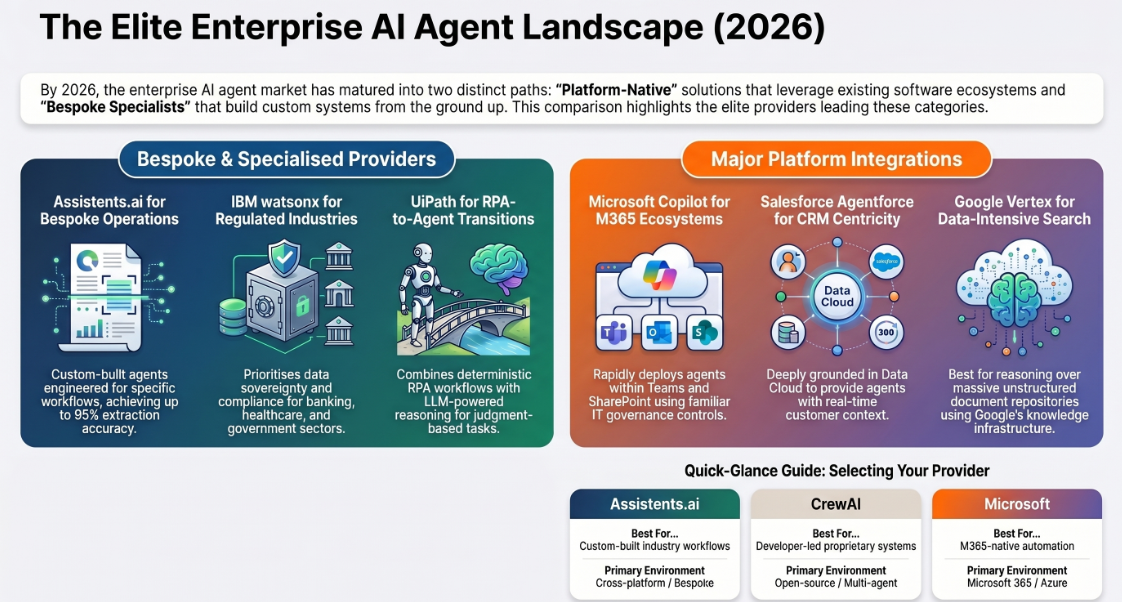
1. Assistents.ai — Best for Custom-Built Enterprise AI Agents Across Industries
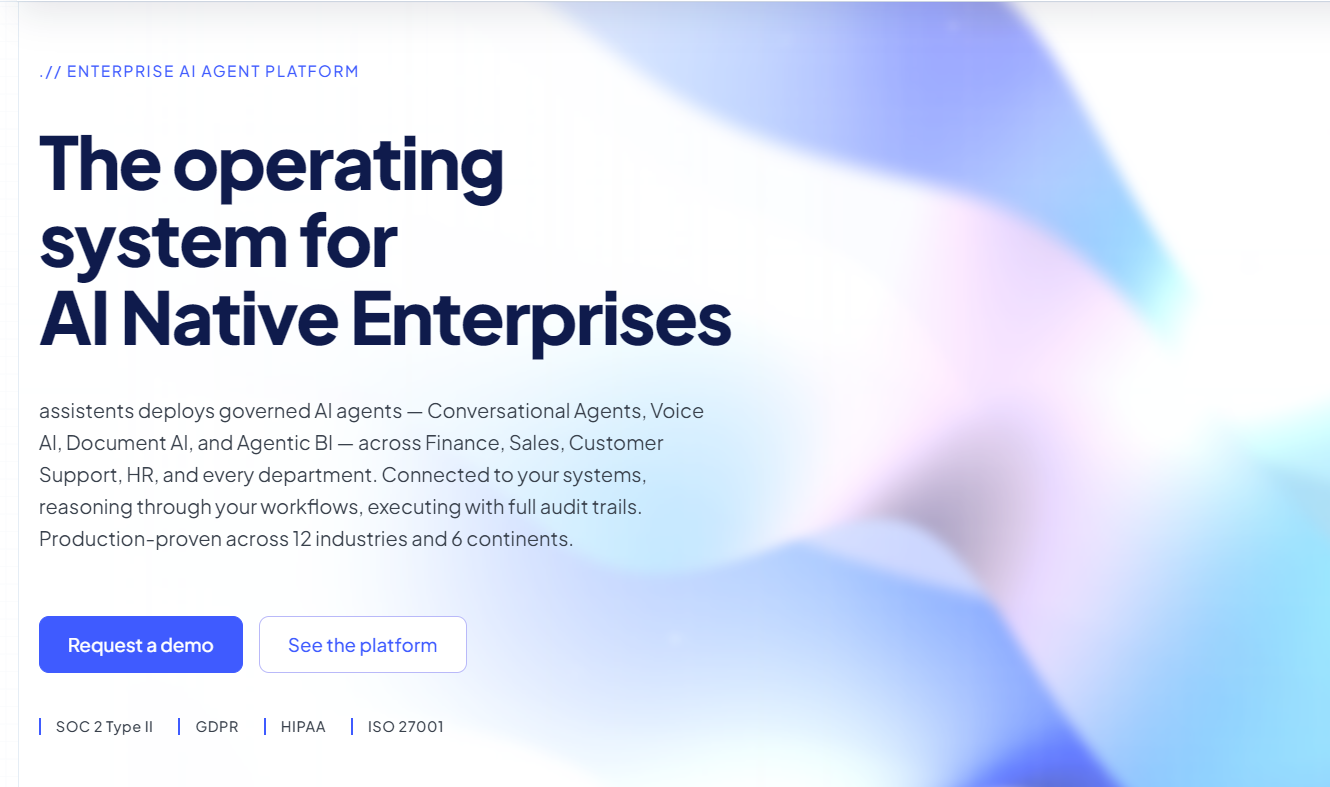
Assistents.ai is a purpose-built enterprise AI agents company that designs, deploys, and manages bespoke agentic systems tailored to each client's specific operations, data environment, and industry context. Unlike platform vendors that offer a configurable product, Assistents.ai builds agents from the ground up — meaning the workflows, governance rules, integrations, and output logic are engineered for your business, not adapted from a generic template.
The company's portfolio spans more than 35 enterprise deployments across retail, logistics, supply chain, real estate, financial services, healthcare, energy, hospitality, and professional services — across markets including India, the UAE, the UK, the US, and Australia.
What makes it different:
Where most enterprise AI agent platforms ask you to fit your operations to their product, Assistents.ai works the other way. Their team starts with your actual workflows — the tender documents you process, the sales orders you create, the competitor prices you monitor, the staffing requests you field — and builds agents that automate exactly those workflows with the governance and audit logic your compliance teams require.
Representative capabilities deployed across their client base:
- Multi-agent document processing with vision-LLM extraction, deep system integration (full CRUD), audit logs, and revision analysis — engineered for up to 90% faster processing and ~95% extraction accuracy on standard document formats
- Omnichannel AI agents for banking and financial services with auditable workflow automation, SLA monitoring, and integration-ready architecture
- Enterprise retail AI agents covering voice support, inventory intelligence, and knowledge-and-training — built for national-scale operations
- Agentic sales agents that provide always-on account monitoring, governed opportunity identification, CRM-integrated workflows, and pipeline hygiene
- Automated SAP sales order creation via agentic AI, replacing end-of-life legacy systems and eliminating manual data entry
- AI-powered customer service agents for real estate, handling tenant queries, rental and payment support, ticketing, escalation, and knowledge-base management — delivering 24×7 tenant experience
- Healthcare staffing agents managing talent onboarding, facility request intake, matching logic, scheduling, compliance workflows, and fill-rate reporting
Best for: Enterprises that need agents built around their specific systems, data, and industry context — not a platform they have to configure themselves.
Where to start: assistents.ai
2. Salesforce Agentforce — Best for CRM-Centric Enterprise Teams
Salesforce Agentforce is the agentic AI layer embedded within the Salesforce platform. It allows enterprise teams to deploy pre-built and customisable agents across sales, service, marketing, and commerce — all grounded in Salesforce's Data Cloud for real-time customer context.
Strengths: Native CRM integration, large ecosystem of pre-built agent skills, strong governance via Salesforce's Einstein Trust Layer, familiar interface for existing Salesforce users.
Limitations: Significant value only if you are already deep in the Salesforce ecosystem. Cross-platform orchestration outside Salesforce requires substantial custom work. Pricing scales quickly for large deployments.
Best for: Enterprises already standardised on Salesforce that want agentic automation within that environment.
3. Microsoft Copilot Studio — Best for Microsoft 365 Environments
Microsoft Copilot Studio is Microsoft's low-code platform for building and deploying AI agents across Microsoft 365, Teams, SharePoint, and Power Platform. It supports no-code agent creation with pre-built connectors to Microsoft's broad enterprise software stack.
Strengths: Deep Microsoft 365 integration, broad connector library, familiar governance controls for IT teams, strong compliance posture (Azure infrastructure), rapid deployment for M365-native workflows.
Limitations: Agents built outside the Microsoft ecosystem require additional integration work. Less suited to custom, industry-specific agentic workflows that fall outside M365's scope. Best value for organisations already paying for M365 E3 or E5.
Best for: Enterprises standardised on Microsoft 365 who want agents embedded in the tools employees already use daily.
4. IBM watsonx Orchestrate — Best for Regulated Industries and Complex Workflow Automation
IBM watsonx Orchestrate is IBM's enterprise AI agents platform, designed for large organisations in highly regulated industries including banking, insurance, healthcare, and government. It provides a skills-based agent architecture where pre-built and custom AI skills can be assembled into multi-step workflows.
Strengths: Strong data governance and compliance architecture, proven in regulated enterprise environments, broad integration library, IBM's enterprise support infrastructure.
Limitations: Implementation complexity is higher than newer platforms. Requires significant IT involvement. Not suited to fast-moving organisations that need rapid agentic deployment without long procurement cycles.
Best for: Large enterprises in regulated industries where data sovereignty, compliance, and governance are the primary decision criteria.
5. UiPath AI Agents — Best for RPA-to-Agents Transition
UiPath built its reputation on Robotic Process Automation. Its AI Agents layer extends that foundation into agentic territory — combining deterministic RPA workflows with LLM-powered reasoning for tasks that require judgment, not just rules.
Strengths: Deep RPA heritage with a massive library of pre-built automations, strong process-mining capabilities to identify automation opportunities, hybrid RPA-plus-AI agent architecture for complex workflows.
Limitations: The RPA roots mean UiPath agents are best suited to structured, process-heavy workflows. Less suited to open-ended, knowledge-intensive agentic tasks. Licensing complexity for large deployments.
Best for: Enterprises with existing RPA investments that want to layer AI reasoning on top of existing automation workflows.
6. Google Vertex AI Agent Builder — Best for Data-Intensive and Search-Centric Use Cases
Google Vertex AI Agent Builder is Google's enterprise platform for building, deploying, and managing AI agents grounded in Google's foundation models (Gemini) and enterprise search capabilities. It is particularly strong for agents that need to reason over large, unstructured document repositories.
Strengths: Enterprise search foundation, strong multimodal capabilities, integration with Google Workspace and BigQuery, Gemini model access, grounding via Google's knowledge infrastructure.
Limitations: Requires significant ML and engineering expertise to deploy production-grade agents. Less suited to non-technical teams. Deep Google Cloud dependency.
Best for: Data-intensive enterprises with large document repositories, Google Cloud infrastructure, and engineering teams capable of managing LLM infrastructure.
7. CrewAI — Best for Developer Teams Building Custom Multi-Agent Systems
CrewAI is an open-source multi-agent orchestration framework that allows engineering teams to build, deploy, and manage networks of AI agents that collaborate on complex tasks. It is not a no-code platform — it is a framework for developers who want full control over agent architecture.
Strengths: Open-source flexibility, strong multi-agent collaboration design patterns, growing enterprise adoption for custom agentic workflows, model-agnostic (works with OpenAI, Anthropic, Mistral, and others).
Limitations: Requires strong engineering capability. Not suitable for business teams without developer support. Production deployment and governance require additional tooling.
Best for: Engineering-led organisations that want to build proprietary, custom multi-agent systems without vendor lock-in.
Real-World Results: What Enterprise AI Agents Are Delivering Today
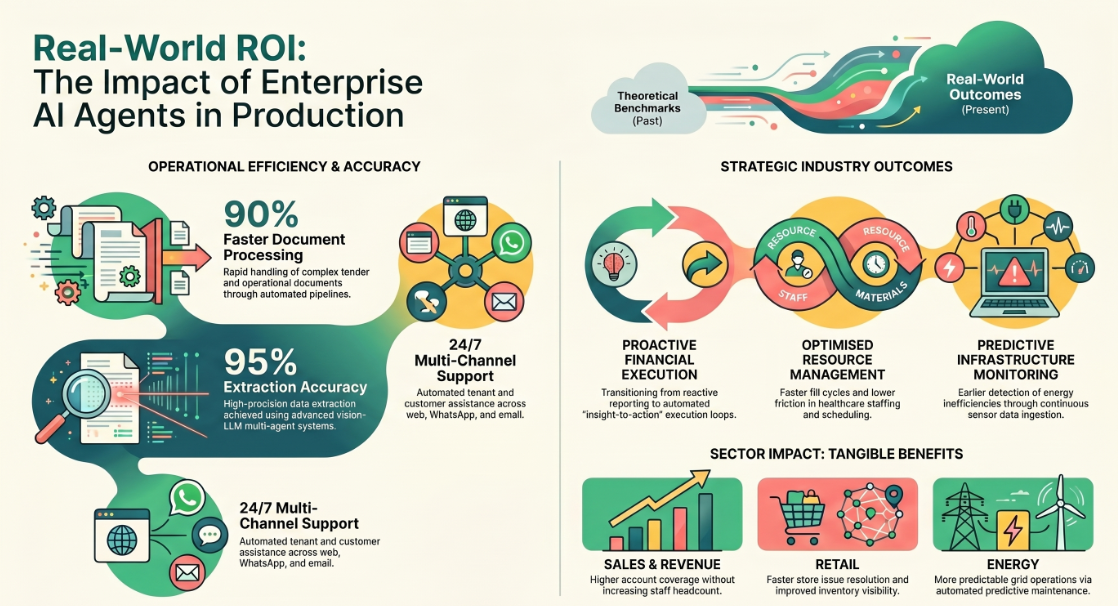
The results that matter are not benchmark scores or demo metrics. They are operational outcomes from production deployments. Based on live enterprise AI agent implementations across industries, here is what organisations are actually seeing:
Document processing and operations:
- Up to 90% faster processing of complex tender and operational documents
- ~95% extraction accuracy on standard document formats using vision-LLM multi-agent pipelines
- Significant reduction in bid risk through automated revision and change detection
- Full audit trails eliminating manual reconciliation
Sales and revenue operations:
- Higher account coverage without increasing headcount, through always-on AI account monitoring
- Faster response cycles on opportunities and renewals via governed agentic playbooks
- Automated sales order creation in SAP replacing end-of-life legacy workflows, with measurable reduction in data-entry errors and faster order-to-confirm cycles
Customer service and tenant support:
- 24×7 automated customer and tenant support across web, WhatsApp, and email channels
- Faster response times and significantly lower contact-centre load
- Consistent SLA adherence through automated query triage, routing, and escalation
Retail and inventory operations:
- Reduced manual helpdesk burden and faster store issue resolution at national scale
- Improved store-level inventory visibility through always-on stock and pricing intelligence agents
- Faster staff onboarding via on-demand training agents over POS and SOP documentation
Finance and analytics:
- Shift from reactive reporting to proactive execution loops — insight-to-action rather than insight-to-meeting
- Standardised decision logic across business units eliminating metric inconsistency
- Earlier detection of margin erosion, vendor slippage, and working-capital risks through continuous monitoring agents
Energy and infrastructure:
- Improved energy visibility and earlier detection of inefficiencies through continuous sensor data ingestion and anomaly detection
- More predictable grid operations via automated alerting and predictive maintenance indicators
- Higher operational transparency for leadership through always-on dashboards and exception routing
Healthcare and staffing:
- Faster fill cycles and lower scheduling friction in healthcare staffing operations
- Better workforce utilisation through AI-assisted matching and compliance workflows
- Improved visibility into revenue leakage and operational bottlenecks
These are not pilot results. They are outcomes from agents running in production, in real businesses, across multiple industries and geographies.
Industries Where Enterprise AI Agents Are Having the Most Impact
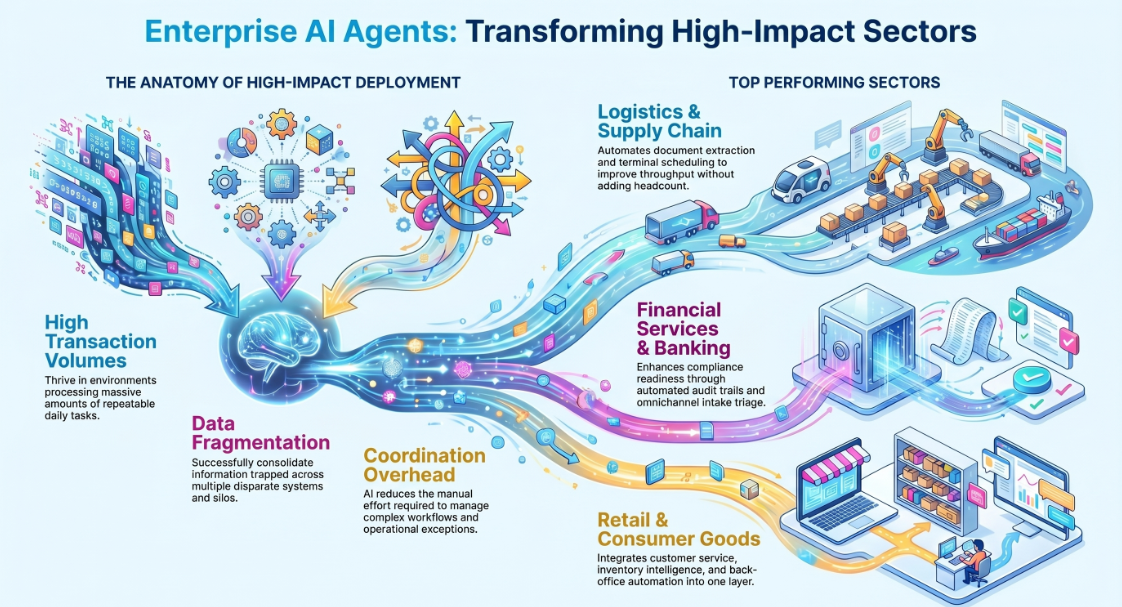
Enterprise AI agents are not a horizontal technology that applies equally everywhere. The highest-impact deployments share a common profile: high transaction volume, fragmented data across multiple systems, and significant manual coordination overhead. Here is where the transformation is most visible.
Retail and consumer goods
Retail enterprises are deploying AI agents across three layers simultaneously: customer-facing service agents handling queries, complaints, and order support; inventory and pricing intelligence agents monitoring stock, promotions, and competitor pricing continuously; and back-office agents automating purchase order processing, vendor performance tracking, and margin monitoring. A large national retailer operating hundreds of stores, for example, can use agentic AI to consolidate inventory visibility across locations, automate helpdesk queries from store teams, and deliver always-on training support to frontline staff — all from a single agentic layer.
Logistics and supply chain
Logistics is one of the highest-ROI sectors for enterprise AI agents because of the volume of documents, exceptions, and coordination overhead involved. Agents are being used to automate tender document ingestion and extraction, digitise terminal and rail scheduling workflows, manage exception routing in port-to-inland logistics, and deliver executive dashboards with automated operational alerts. A global ports and logistics operator, for example, can deploy agentic AI to digitise yard management, automate rail scheduling visibility, and surface exceptions in near real-time — improving terminal throughput predictability without adding headcount.
Financial services and banking
Banks and financial institutions are deploying omnichannel AI agents for customer support, ombudsman intake triage, dispute and fraud workflow automation, and compliance monitoring. The audit-trail requirements of financial services make enterprise AI agents particularly valuable here — every agent action is logged, explainable, and reviewable. A cloud-based fintech serving banks and credit unions, for instance, deployed AI agents across omnichannel intake (chat, email, and phone), with agent-assist summarisation, next-best-action recommendations, and full SLA monitoring — reducing manual case-handling load while improving compliance readiness.
Real estate and property management
Real estate portfolios — particularly those managing large numbers of tenants across mixed-use assets — are deploying AI agents to handle the high volume of repetitive service queries that consume property management teams. Agents cover tenant query triage, rental and payment support, maintenance request intake, escalation routing, and knowledge-base management over tenancy documents and SOPs. The result is consistent 24×7 service without proportional headcount growth, and better SLA adherence through automated tracking.
Healthcare and life sciences
Healthcare organisations are deploying AI agents across two distinct use cases: clinical operations (staffing, scheduling, compliance workflows, and revenue cycle visibility) and patient-facing or administrative support. Healthcare staffing platforms, for example, use agents to manage talent onboarding, credential capture, facility staffing request intake, shift matching, scheduling, and compliance notifications — reducing fill-cycle time and improving utilisation reporting. Physician-led clinical enterprises are using agents for operational and revenue analytics, surfacing billing exceptions and care-programme performance data in a format that leadership can act on.
Energy and utilities
Power transmission utilities, smart city operators, and campus energy managers are deploying AI agents for continuous monitoring, predictive alerting, and operational dashboard automation. Agents ingest sensor data, detect anomalies, trigger maintenance alerts, and route exceptions to field operations teams — replacing manual shift-based monitoring with always-on intelligence. For a state power transmission utility, this means proactive grid exception detection, automated loss and outage analytics, and predictive maintenance indicators that reduce downtime and improve regulatory compliance.
Professional services and technology
Professional services firms — including investment holding companies, tax-tech platforms, and brand insights studios — are deploying AI agents for technical due diligence, tax research automation, and multi-source insight synthesis. A long-term holding company conducting technical due diligence on acquisition targets, for example, uses agents to review code architecture, infrastructure, security posture, and integration readiness — producing a structured risk register and remediation roadmap faster than a traditional consulting engagement.
How to Choose an Enterprise AI Agents Company — A Buyer's Checklist
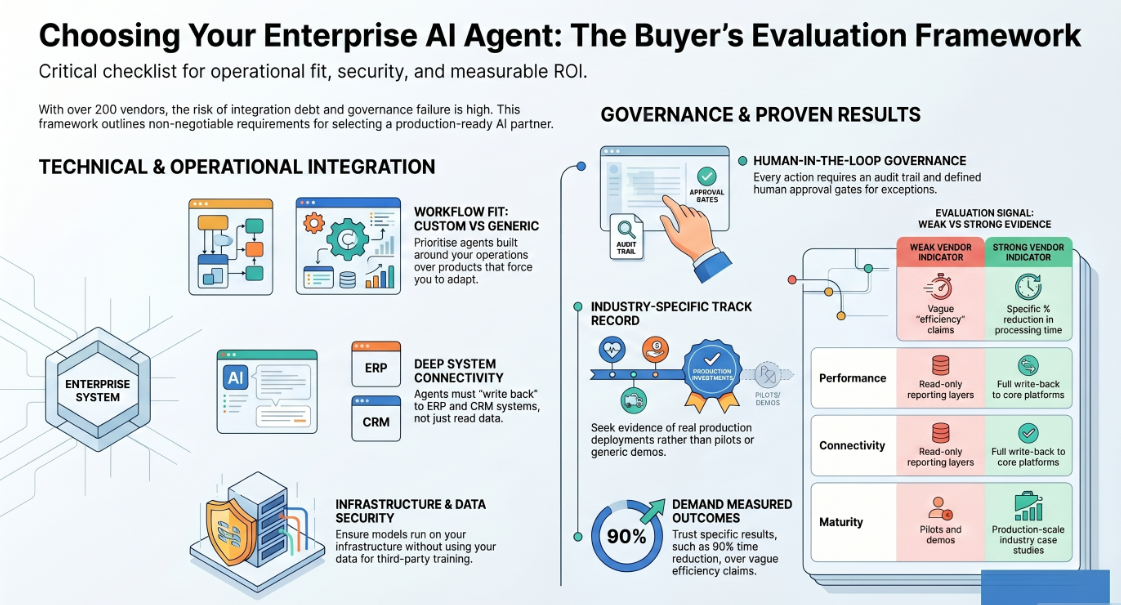
With more than 200 platforms and vendors claiming enterprise AI agent capability, the evaluation decision matters. The wrong choice creates governance risk, integration debt, and costly migration cycles. Use this checklist to evaluate any enterprise AI agents company before committing.
1. Do they build for your workflows, or do your workflows adapt to their product?
Platform vendors offer configurable products. Custom AI agents companies build around your actual operations. If your workflows are complex, industry-specific, or involve proprietary systems, a platform's generic templates will leave gaps. Ask any vendor to walk you through how they would handle your specific highest-volume workflow from intake to resolution.
2. How do they handle governance, audit trails, and human-in-the-loop design?
Every enterprise AI agent operating in a production environment needs to log every action, surface exceptions to humans at defined decision points, and produce an audit trail your compliance team can review. Ask specifically: where are human approval gates built in? What gets logged? How are exceptions routed? What happens when an agent encounters a scenario outside its defined scope?
3. How deeply can they integrate with your existing systems?
The value of an AI agent is proportional to the systems it can connect to. An agent that can only read data but cannot write back to your ERP, CRM, or core operations platform is a reporting layer, not a workflow agent. Ask for specific examples of integrations the vendor has built — and ask for references from clients using those integrations in production.
4. What is their track record across your industry?
Enterprise AI deployment is not generic. The failure modes, compliance requirements, data structures, and operational edge cases in retail are completely different from those in healthcare, logistics, or financial services. Ask for anonymised case studies in your industry. Look for evidence of real deployments — not demos, not pilots that never reached production.
5. How do they handle data security and model infrastructure?
Clarify where your data goes during inference. Does it pass through a shared third-party model endpoint? Is it retained or used for model training? Can the agent run on your cloud infrastructure or on-premise? For regulated industries and enterprises handling sensitive customer data, this question is non-negotiable.
6. What does ongoing support and optimisation look like?
AI agents degrade when the underlying data, systems, or business rules change. Ask how the vendor handles model updates, workflow changes, and performance monitoring after go-live. Vendors who treat deployment as the finish line are different from those who treat it as the starting point for continuous improvement.
7. Can they show you measured outcomes — not just capability claims?
The most reliable signal of a trustworthy enterprise AI agents company is the specificity of their results. Not "we improve operational efficiency" — but "we reduced tender document processing time by up to 90% for a construction services firm, with ~95% extraction accuracy on standard formats." If a vendor cannot point to specific, measurable outcomes from live deployments, treat their claims with caution.
The Bottom Line
The enterprise AI agents market is no longer theoretical. Deployments across retail, logistics, financial services, real estate, healthcare, energy, and professional services are delivering measurable outcomes — faster processing, lower operational overhead, better compliance, and earlier exception detection — in production environments today.
The seven companies profiled here represent meaningfully different approaches: off-the-shelf platforms for enterprises already embedded in specific ecosystems (Salesforce, Microsoft, IBM, Google), a developer framework for engineering-led custom builds (CrewAI), an RPA-to-agents bridge for process-heavy organisations (UiPath), and a purpose-built custom approach for enterprises that need agents designed around their specific workflows and industry context (Assistents.ai).
The best choice depends on your starting point: if your operations, data, and compliance requirements are generic enough to fit a platform, a platform may work. If your workflows are specific, your systems are custom, or your industry has particular compliance and integration demands, a company that builds agents for your environment — rather than asking your environment to adapt to their product — will consistently outperform.
Ready to see what custom-built enterprise AI agents can deliver for your operations? Explore real-world deployments and speak with the team at assistents.ai
FAQs
What is an enterprise AI agent?
An enterprise AI agent is a software system that can perceive context from multiple data sources, reason through multi-step problems, use tools and APIs to take actions, and execute workflows autonomously within defined governance boundaries. Unlike a chatbot or copilot — which responds to prompts — an AI agent can initiate actions, handle exceptions, route decisions to humans at defined points, and log every action for audit. Enterprise AI agents are designed to run in production environments where compliance, integration depth, and operational reliability are requirements.
What is the difference between AI agents and chatbots?
A chatbot responds to questions within a conversation. An AI agent completes workflows across systems. A chatbot can tell you the status of a sales order. An AI agent can receive an order trigger, validate it against business rules, create the sales order in your ERP, flag exceptions for human approval, and log the transaction — all without manual intervention. The difference is between answering and acting.
Which industries benefit most from enterprise AI agents?
The highest ROI deployments are in industries with high transaction volume, fragmented data, and significant manual coordination overhead: logistics and supply chain, retail operations, financial services, real estate property management, healthcare staffing, energy and utilities, and professional services requiring document-intensive workflows.
Can AI agents integrate with SAP, Salesforce, or custom ERP systems?
Yes — enterprise-grade AI agents are built with integration as a core requirement, not an afterthought. The best enterprise AI agents companies build agents that can perform full CRUD operations (create, read, update, delete) against SAP, Salesforce, custom ERPs, and other operational systems. This is what separates a production-ready agent from a prototype. Always verify integration depth with specific references before selecting a vendor.
How much does enterprise AI agent development cost?
Pricing varies significantly based on scope, integration complexity, industry, and whether you are deploying a platform product or a custom-built solution. Platform vendors like Salesforce and Microsoft typically charge per seat or per agent conversation, with enterprise contracts ranging from tens of thousands to millions of dollars annually depending on scale. Custom-built solutions like those from Assistents.ai are scoped per engagement based on the number of agents, integration complexity, and deployment environment. The more relevant question is ROI: a well-deployed enterprise AI agent that reduces a week-long process to a same-day supervised workflow typically recovers its cost in the first quarter of production operation.
What is the difference between agentic AI and generative AI?
Generative AI is designed to produce content in response to prompts — text, images, code, summaries. It is reactive: it waits for input and produces output. Agentic AI is designed to pursue goals autonomously across multiple steps, using tools and systems to complete workflows. Generative AI answers the question "what should I write?" Agentic AI answers the question "what needs to happen, and how do I make it happen across the systems involved?" Most enterprise value in 2026 comes from the latter.