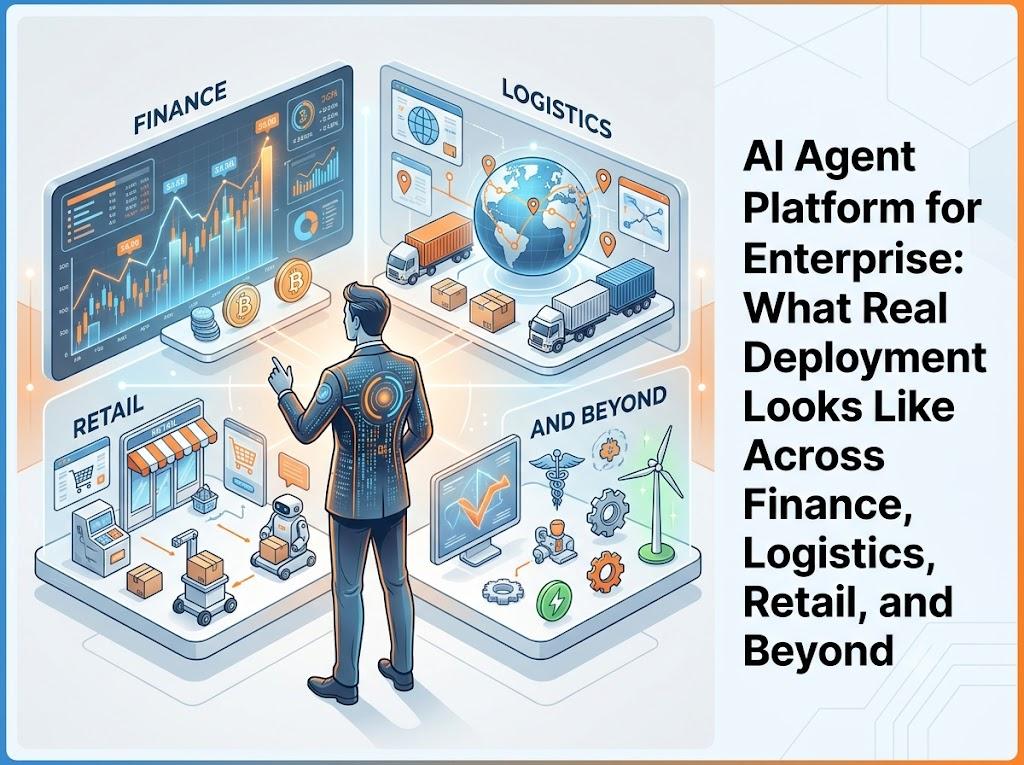
Gartner predicts that 40% of enterprise applications will integrate task-specific AI agents by the end of 2026 — up from less than 5% today. That shift is not happening gradually. It is accelerating, and the organisations moving fastest are not doing it by evaluating more platforms. They are doing it by deploying.
Here is the uncomfortable reality: most enterprises are still stuck at the pilot stage. Research shows that only 11 to 14% of enterprise AI agent pilots ever reach production at scale. The other 86 to 89% fail — not because the technology does not work, but because the platform was chosen without proof, the governance was built as an afterthought, and the integration was underestimated.
This guide is not a comparison of AI agent platforms you may want to try. It is an account of what enterprise AI agent deployment actually looks like when it works — drawn from more than 30 live deployments across logistics, finance, retail, healthcare, energy, real estate, hospitality, and beyond. If you are a CTO, COO, or operations leader evaluating an AI agent platform for enterprise, what follows is the clearest map available from pilot to production.
What Is an Enterprise AI Agent Platform?
An enterprise AI agent platform is a governed software system that deploys autonomous AI agents to perceive data from multiple sources, reason across business rules, and execute multi-step workflows — with full auditability, integration with existing systems, and human oversight at critical decision points.
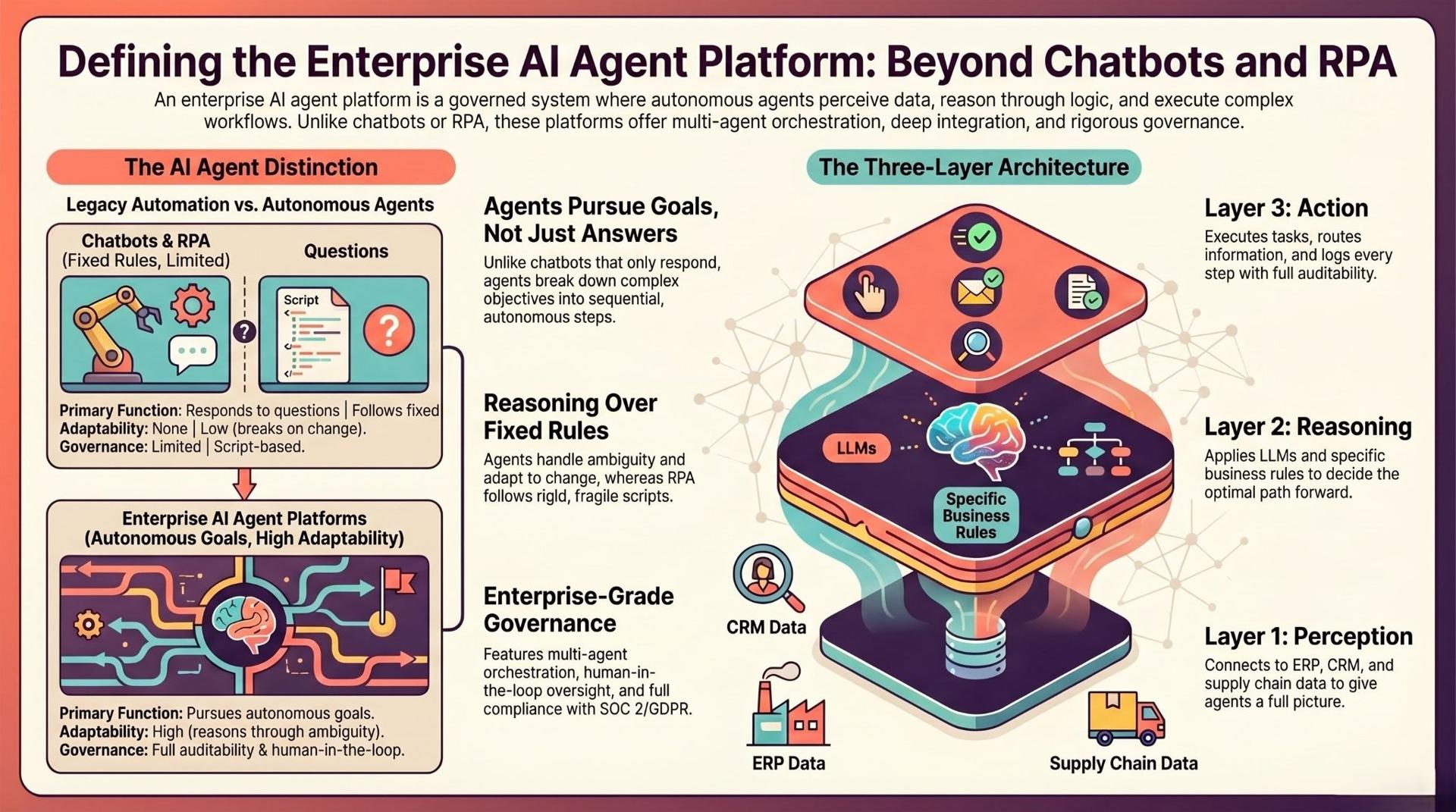
That definition matters because the market is crowded with tools that call themselves AI agents but function more like advanced chatbots or rebranded RPA scripts. Understanding the distinction is the first step to making the right decision.
AI agents are not chatbots.
A chatbot responds to a question. An AI agent pursues a goal. It can break down a complex objective into sequential steps, call external systems and APIs, make decisions based on intermediate results, adapt when something changes, and escalate to a human when the situation requires judgement rather than automation. A chatbot tells you the status of an order. An AI agent detects that a delivery is at risk, cross-references inventory across locations, re-routes the shipment, updates the relevant system record, and alerts the account manager — without being asked.
AI agents are not RPA.
Robotic Process Automation follows fixed rules and breaks when a process changes. AI agents reason about goals, handle ambiguity, and execute multi-step workflows without constant reprogramming. They work across systems that were never designed to talk to each other, and they improve over time.
What makes a platform enterprise-grade is the layer above the agents themselves: multi-agent orchestration (so that specialised agents work as a coordinated system rather than isolated bots), deep integration with enterprise systems including ERP, CRM, SAP, core banking, POS, and supply chain platforms, human-in-the-loop design that makes human oversight a quality control feature rather than a workaround, and governance infrastructure including audit trails, role-based access controls, and compliance with standards like SOC 2, GDPR, and HIPAA.
The architecture of an enterprise AI agent platform operates across three layers. The perception layer connects to your business systems and data sources to give agents the full picture. The reasoning layer applies large language models together with your company's own business rules and logic to decide what to do. The action layer executes — creating records, routing tasks, sending notifications, generating documents, or triggering downstream processes — and logs every step with full traceability.
Why 2026 Is the Year Enterprise AI Agents Stop Being Optional
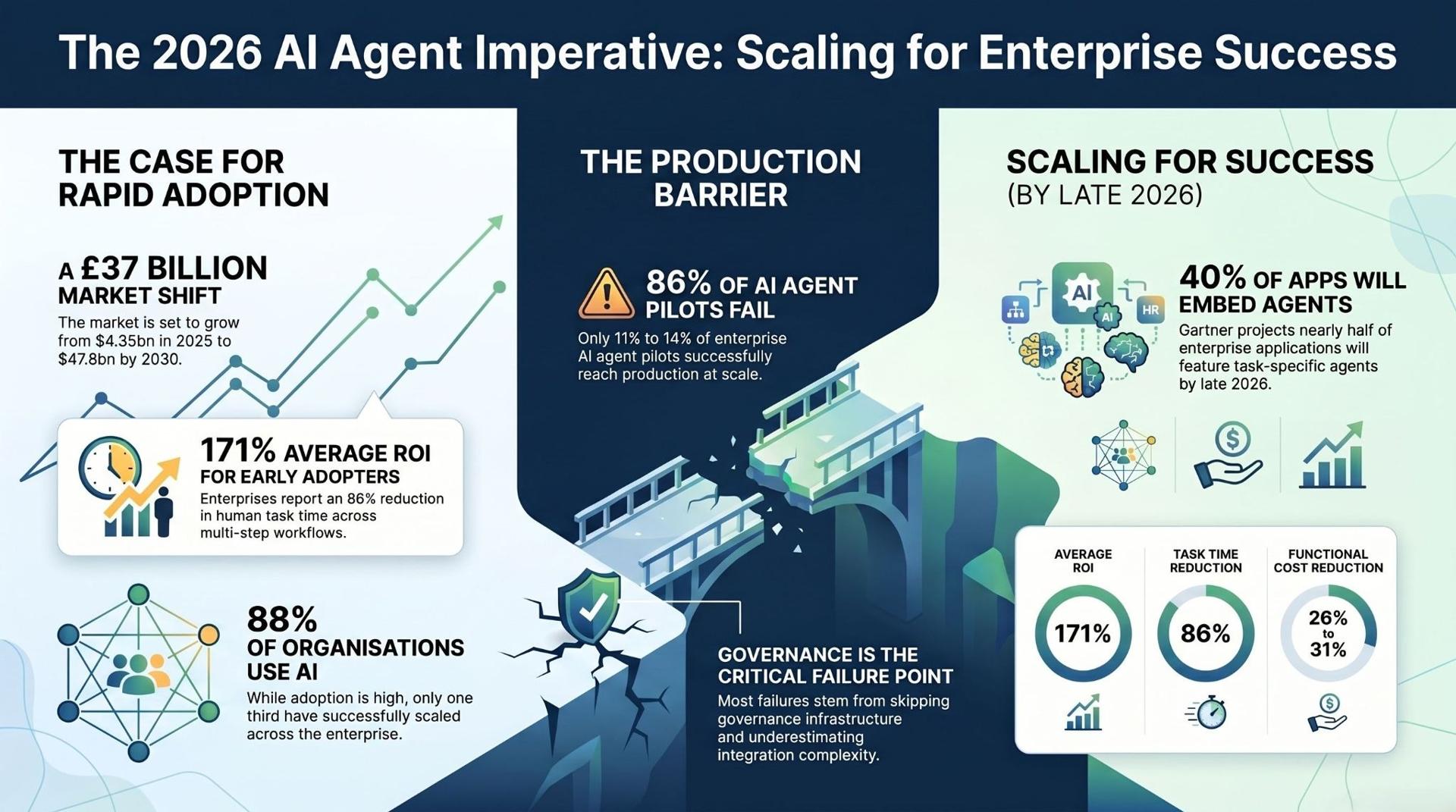
The agentic AI market is growing from $4.35 billion in 2025 to a projected $47.8 billion by 2030. That is not a niche technology trend. It is a structural shift in how enterprise operations are designed.
According to McKinsey's 2025 State of AI report, 88% of organisations now use AI regularly in at least one business function — up from 78% the year before. But only about one third have started scaling AI across the enterprise. The gap between early movers and the rest is compounding every quarter.
The organisations that moved earliest are reporting results that make continued evaluation look expensive. Early adopter enterprises report an average ROI of 171%, with an 86% reduction in human task time across multi-step workflows. Cost reductions of 26 to 31% in targeted functions are consistent across McKinsey's research on AI-driven operational redesign.
But the more important number is the one about failure. As noted above, only 11 to 14% of enterprise AI agent pilots reach production at scale. The reason is almost always the same: organisations launched pilots quickly, skipped governance infrastructure, underestimated integration complexity, and then discovered they were rebuilding from scratch when they tried to scale.
The window for that mistake has closed. In 2026, the question is not whether to deploy enterprise AI agents — it is whether you choose a platform with a proven path from pilot to production, or spend another year rebuilding.
The Gartner projection is worth sitting with: 40% of enterprise apps will embed task-specific AI agents by the end of 2026. If your enterprise is still in evaluation mode, a significant portion of your competitors are not.
What to Look for in an Enterprise AI Agent Platform
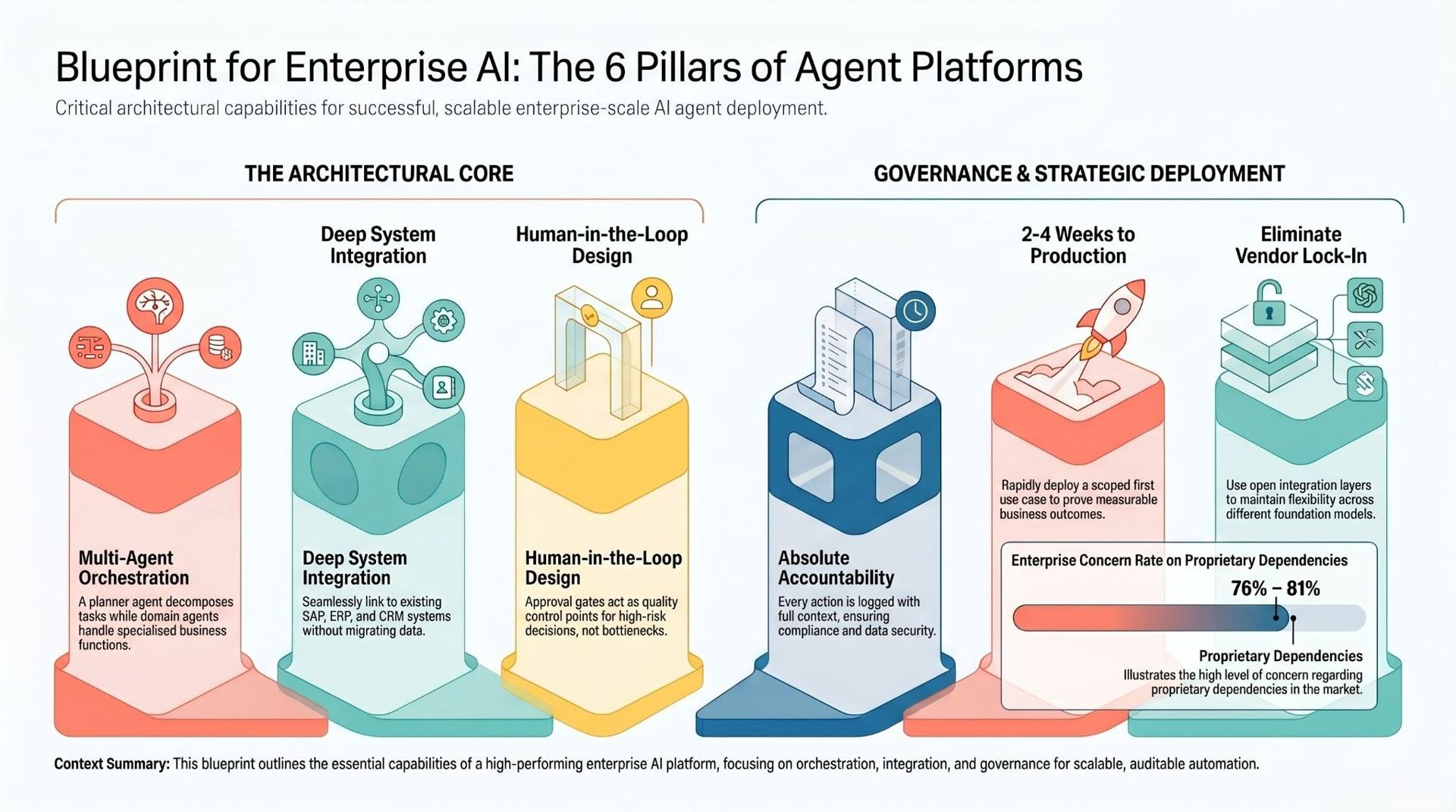
Most buyer guides for enterprise AI agent platforms list features. This section goes further — it explains what each capability actually means in practice, and why getting it wrong is costly.
Multi-Agent Orchestration
A single AI agent can automate a single workflow. Multi-agent orchestration is what makes enterprise-scale automation possible. In a properly architected system, a planner agent decomposes complex tasks and determines workflow sequencing, domain-specific agents handle specialised functions such as document parsing, compliance validation, or order processing, an orchestrator coordinates communication between agents and resolves conflicts, and a human oversight layer reviews flagged cases and approves high-risk decisions.
The practical difference is significant. A single agent handling customer service queries will plateau. A multi-agent system that triages incoming requests, pulls context from a knowledge base, checks account status in a CRM, drafts a resolution, and routes escalations to the right team member — with every step logged and auditable — is a fundamentally different category of capability.
Deep System Integration
An enterprise AI agent platform is only as useful as the systems it can reach. The most valuable deployments connect to the systems your business already runs: SAP, Salesforce, core banking platforms, warehouse management systems, POS infrastructure, ERP, and proprietary databases. Platforms that require you to migrate data or rebuild integrations before agents can function add months to deployment timelines and introduce unnecessary risk.
Human-in-the-Loop Design
Human oversight is not a limitation of enterprise AI agents. It is a design principle. The most effective enterprise AI agent deployments treat approval gates as quality control points where business judgement adds real value — not as bottlenecks. An agent that can autonomously process 90% of cases and escalates the remaining 10% to a human with full context, a recommended action, and a clear audit trail is not a partial solution. It is the right architecture for high-stakes business processes.
Governance and Auditability
Every action an enterprise AI agent takes should be logged with full context: what triggered it, what data was accessed, what decision was made, and what outcome was produced. Without this, AI agents create compliance exposure rather than reducing it. Role-based access control, data residency options, immutable audit logs, and environment isolation between development, staging, and production are table-stakes for any enterprise deployment.
Industry-Specific Adaptability
An enterprise AI agent platform should not require you to force-fit generic automation into your industry's specific workflows. The same platform architecture that deploys a store inventory agent for a national retailer should be capable of deploying a clinical staffing agent for a healthcare provider, a shipment tracking agent for a logistics operator, and a cashflow forecasting agent for a CFO platform — with different business rules, different data sources, and different compliance requirements for each.
Time to Value
The enterprise AI agent deployments that succeed share one characteristic: they reach production quickly on a clearly scoped first use case, prove measurable outcomes, and then scale. Initial agents reaching production in two to four weeks is achievable with the right platform and a disciplined discovery process. A platform that requires six months to deploy a single agent before value is visible is a platform that most enterprises will not finish deploying.
No Vendor Lock-In
The market for enterprise AI agent platforms is consolidating rapidly, and 76 to 81% of surveyed enterprises express concern about proprietary dependencies — particularly in agent memory, model integration, and orchestration tooling. An open integration layer that connects to multiple foundation models and enterprise systems, without requiring you to rebuild if your priorities change, is a material risk consideration in any platform evaluation.
Enterprise AI Agents in Action: Real Deployments Across 10 Industries
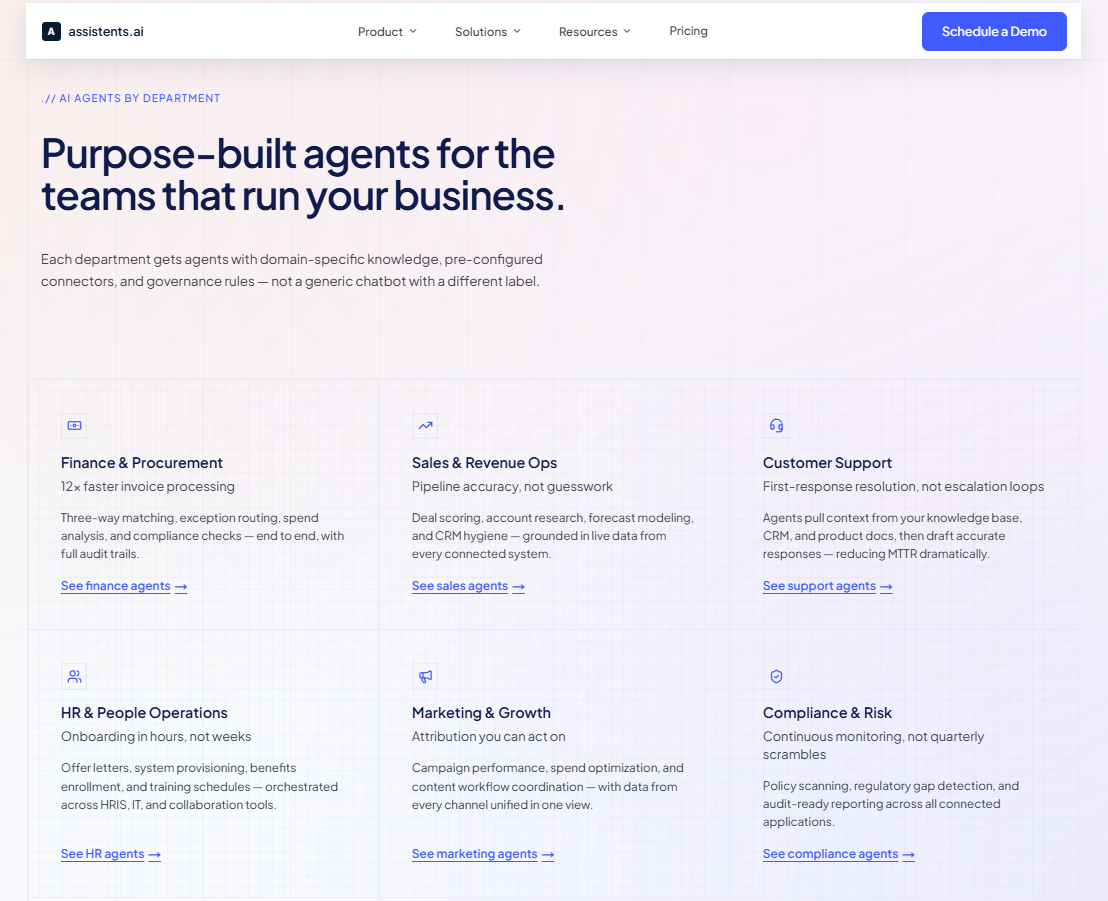
The examples below are drawn from live enterprise AI agent deployments. No client names are used. Each example describes the type of organisation, what was deployed, and what changed as a result.
Retail and Consumer Operations
A rapidly scaling value retailer operating more than 700 stores across hundreds of cities faced a challenge common to national retail operations: store-level support, inventory visibility, and staff training were consuming disproportionate operational overhead.
The solution was a multi-agent deployment across three interconnected functions — a voice support agent operating in multiple languages to handle store helpdesk queries, an inventory intelligence agent providing real-time pricing, stock, and promotional data at the store level, and a knowledge and training agent built on the retailer's own operational documentation. The result was a measurable reduction in manual helpdesk burden, faster store issue resolution, and on-demand training access for frontline staff at national scale.
A separate deployment for a major HVAC and consumer appliances manufacturer focused on competitive intelligence. Continuous monitoring of pricing, MRP discounts, promotional activity, and product availability across channels — mapped to specific questions leadership needed answered daily — replaced a manual monitoring operation that could not keep pace with competitor moves. The outcome was faster competitive response cycles and always-on pricing visibility that had previously required significant analyst time.
Logistics and Supply Chain
A global ports and logistics leader reporting record annual revenue of more than $20 billion deployed AI agents to digitise and optimise port-to-inland logistics operations. The deployment covered terminal workflow digitisation, rail scheduling and visibility, exception management, and executive dashboards with operational alerts. The outcome was higher predictability of terminal-to-rail throughput and more efficient coordination across a portfolio of global logistics operations that previously relied on fragmented, manual tracking.
An Indian multinational logistics company serving customers across India, the UK, Europe, and the United States deployed analytics consolidation across multi-entity global operations. Cross-entity KPI standardisation, operational dashboards with variance explanations, and a governance layer for data quality gave leadership a single operational view across geographies — replacing a reporting environment where each entity operated independently and leadership visibility was delayed by consolidation cycles.
Finance and Banking
A global fintech provider serving banks and credit unions deployed omnichannel AI agents for banking customer support, covering chat, email, and phone intake with workflow routing, agent-assist summarisation, next-best-action recommendations, and SLA monitoring.
Every interaction was auditable and integration-ready with core banking systems. The deployment also included a voice support agent operating in Hindi and English, reflecting the specific requirements of a diverse customer base. The outcome was faster case handling, reduced operational load through automation, and improved compliance readiness through comprehensive audit trails.
A CFO platform for growing businesses and their advisors deployed an AI CFO agent that connects financial data from accounting and banking exports, runs continuous cashflow forecasting and scenario modelling, and alerts leadership and advisors when runway or cash risks are detected. The result was earlier detection of cash anomalies, faster analysis cycles, and scalable advisory-level financial insight without additional headcount.
Healthcare
A healthcare staffing platform connecting nursing professionals with healthcare facilities deployed AI agents for talent onboarding, credential capture, facility staffing request intake, candidate matching, scheduling, compliance workflow management, and reporting. The outcome was faster fill cycles, better workforce utilisation, and improved staffing responsiveness for facilities that had previously experienced significant scheduling friction.
Two physician-led clinical enterprises deployed data analytics for revenue management and operational performance. One focused on revenue cycle visibility, operational dashboards, and exception alerts for a hospitalist program. The other targeted geriatric care program operations, staffing and service delivery analytics, and revenue cycle transparency. In both cases, the outcome was faster identification of operational bottlenecks, improved transparency into service performance, and better decision support for clinical and administrative leadership.
Energy and Utilities
A state power transmission utility responsible for operating and maintaining transmission infrastructure deployed smart grid analytics with automated operational alerting. The deployment covered transmission KPI monitoring, anomaly detection, loss and outage analytics, predictive maintenance indicators, and automated alerts with workflow routing for field operations. The outcome was faster identification of grid exceptions, improved reliability through proactive monitoring, and better operational transparency for leadership.
A premier research institute in astronomy and astrophysics deployed AI for campus energy management — ingesting utility and sensor data, detecting anomalies, generating forecasting and optimisation recommendations, and providing proactive dashboards and alerts. The outcome was improved energy visibility, faster detection of inefficiencies, and more predictable campus operations.
Real Estate
A major real estate portfolio owner and manager with diversified assets across multiple emirates deployed an omnichannel AI customer service agent handling tenant queries, rental and payment support, FAQ triage, ticketing, and escalation to human teams — accessible via web, WhatsApp, and email. The knowledge base was built over the organisation's policies, tenancy documentation, and standard operating procedures.
The outcome was faster response times, consistent 24-times-7 tenant experience, and better SLA adherence through automated routing and tracking.
Sales and Marketing
An enterprise sales operation deployed an always-on account monitoring system with AI agents capturing signals across accounts, identifying opportunities and risks based on configured business rules, orchestrating follow-up workflows, and maintaining CRM hygiene — with sales dashboards and leadership alerts built on top. The outcome was higher account coverage without increasing headcount and more consistent pipeline execution via governed playbooks.
A brand insights studio with deep expertise in creative strategy and media deployed AI agents to ingest and synthesise signals across creative performance, audience behaviour, and campaign data — producing insight narratives and actionable recommendations for marketing teams. The outcome was faster creative strategy cycles, deeper signal synthesis across channels, and clearer guidance on what to do next for each campaign.
Hospitality and Travel
A luxury hospitality group operating boutique lodges and camps across iconic safari destinations deployed a digital booking agent automating end-to-end luxury travel booking workflows. The agent handles email intake and intent classification, conversational loops to capture missing guest details, real-time inventory checks with alternative date and property negotiation, and automated document generation — with human handoff built in for curated itinerary creation requiring specialist judgement. The outcome was faster booking turnaround, higher accuracy on complex guest requirements, and scalable operations that did not compromise the high-expectation service standard the brand is built on.
Professional Services and Tax Technology
A tax technology platform focused on cross-border transaction risk deployed AI agents for transaction screening, risk classification, evidence collection, explainability notes, and escalation to tax experts. The outcome was earlier detection of withholding tax and VAT risk and faster, more consistent pre-compliance review — reducing last-minute deal disruptions for the deal teams the platform serves.
A long-term holding company evaluating investment and acquisition targets used AI for technical due diligence: structured architecture review, scalability and resilience assessment, security evaluation, and production of a risk register with a remediation roadmap. The outcome was faster investment decisions with clear, structured technology risk visibility and reduced post-deal surprises.
Education and Community Platforms
A global teacher community platform with more than one million educators across 131 countries deployed AI for competency insights, personalised learning guidance, and automated support workflows for program operators and partners.
The outcome was scalable support for an educator community growing faster than headcount could accommodate, faster access to learning resources and guidance, and better visibility into engagement and outcomes for program operators.
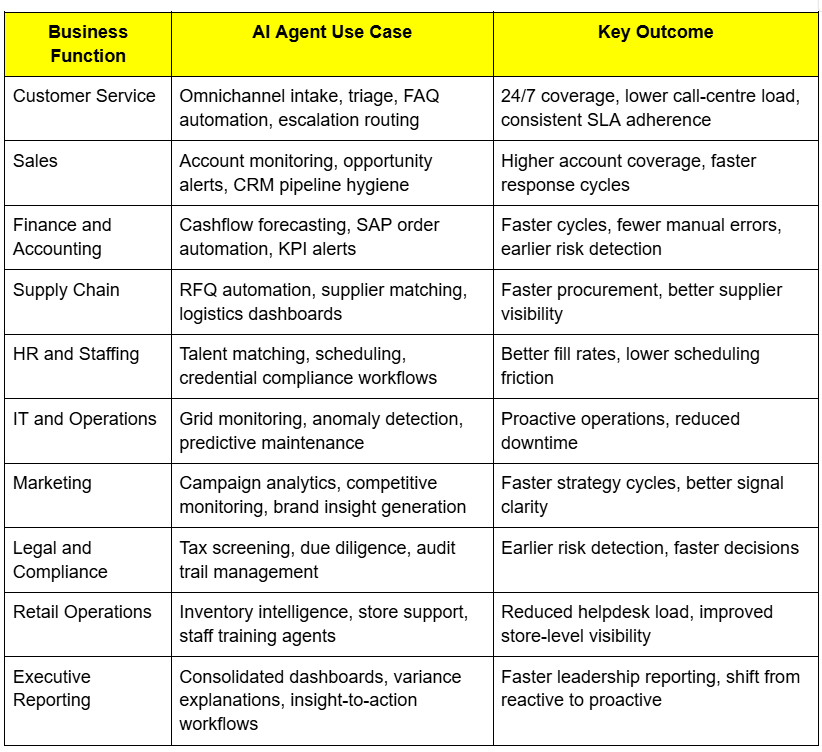
Enterprise AI Agent Use Cases by Business Function
The deployments above span industries, but the underlying use cases map to business functions that exist across organisations of all types. The following table is a practical reference for identifying where an enterprise AI agent platform is most likely to deliver measurable value in your organisation.
How to Deploy an Enterprise AI Agent Platform: A Four-Phase Roadmap
Most enterprise AI agent deployments that fail share a common pattern: they were designed to impress a demo audience before they were designed to survive a production environment. Governance was planned for later. Integration was scoped too narrowly. The first use case was too ambitious. By the time the cracks showed, the timeline had slipped and internal confidence had eroded.
The deployments that succeed follow a different sequence.
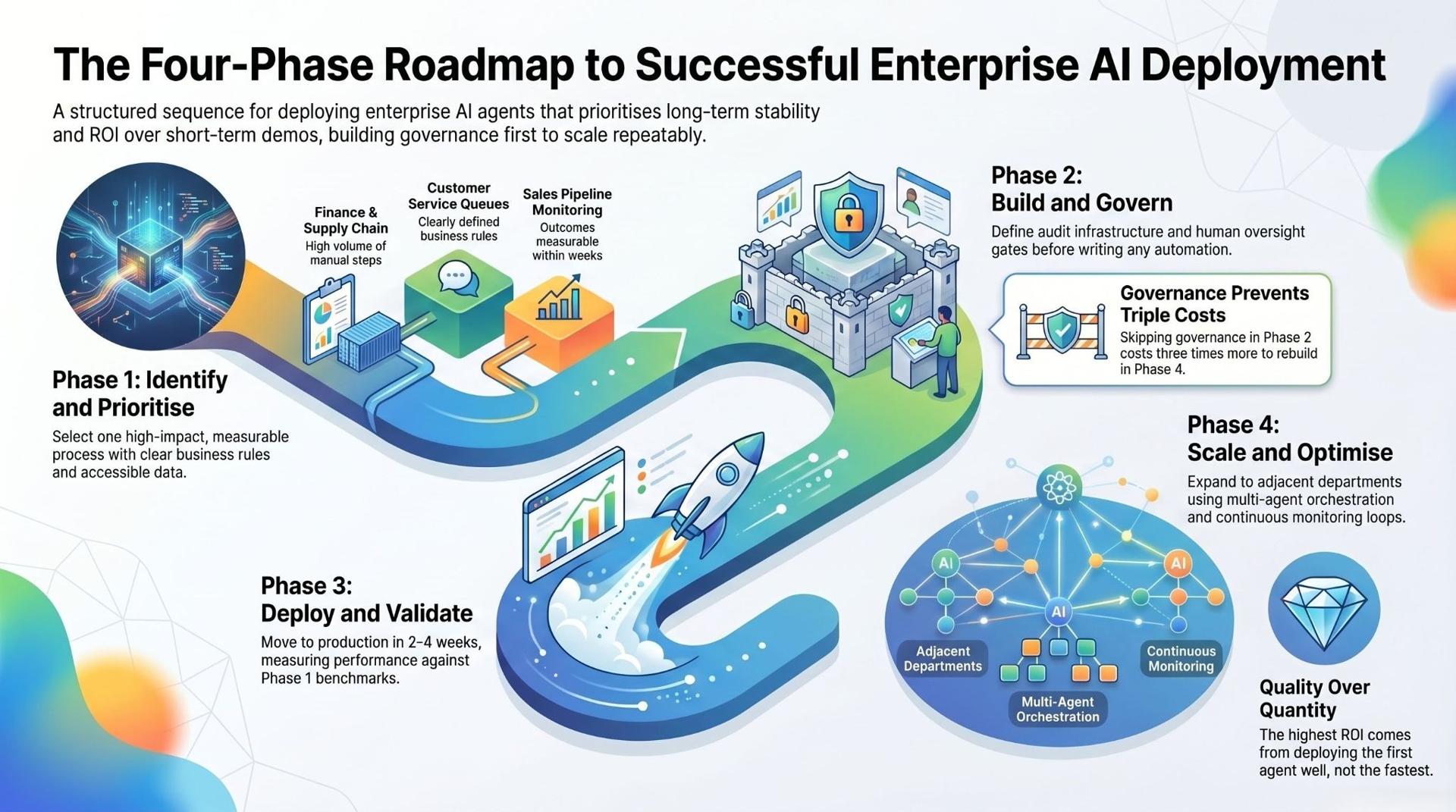
Phase 1 — Identify and Prioritise
Select one high-impact, measurable process as the initial deployment target. The criteria that make a process a strong candidate: high volume of manual steps, clearly defined business rules, data that already exists in accessible systems, and a measurable outcome that can be tracked within weeks. Finance workflows, customer service queues, supply chain exception management, and sales pipeline monitoring consistently meet these criteria. Avoid starting with open-ended use cases where success is difficult to define.
Phase 2 — Build and Govern
Configure agents with business rules, integration layers, audit infrastructure, and human oversight gates before writing a single automation. Governance is not a feature to add after the agent is working — it is the foundation that determines whether the agent can be trusted at scale. This means defining who can trigger which actions, what happens when an agent encounters an edge case, how every decision is logged, and what the escalation path looks like. Organisations that skip this phase in Phase 2 rebuild it at three times the cost in Phase 4.
Phase 3 — Deploy and Validate
Move from proof of concept to production with clearly defined performance benchmarks. Initial agents reaching production in two to four weeks is achievable when Phase 1 has been scoped well and Phase 2 governance is in place. Validate against the measurable outcome identified in Phase 1. Document what is working, what requires adjustment, and what the integration surface looks like for the next use case.
Phase 4 — Scale and Optimise
Expand to adjacent business functions. Introduce multi-agent orchestration where workflows span multiple departments or systems. Establish continuous monitoring and improvement loops. The organisations reporting the highest ROI from enterprise AI agents are not those that deployed the most agents fastest — they are those that deployed the first agent well, proved outcomes, and built a repeatable process for scaling.
Why assistents.ai Is Built Differently as an Enterprise AI Agent Platform
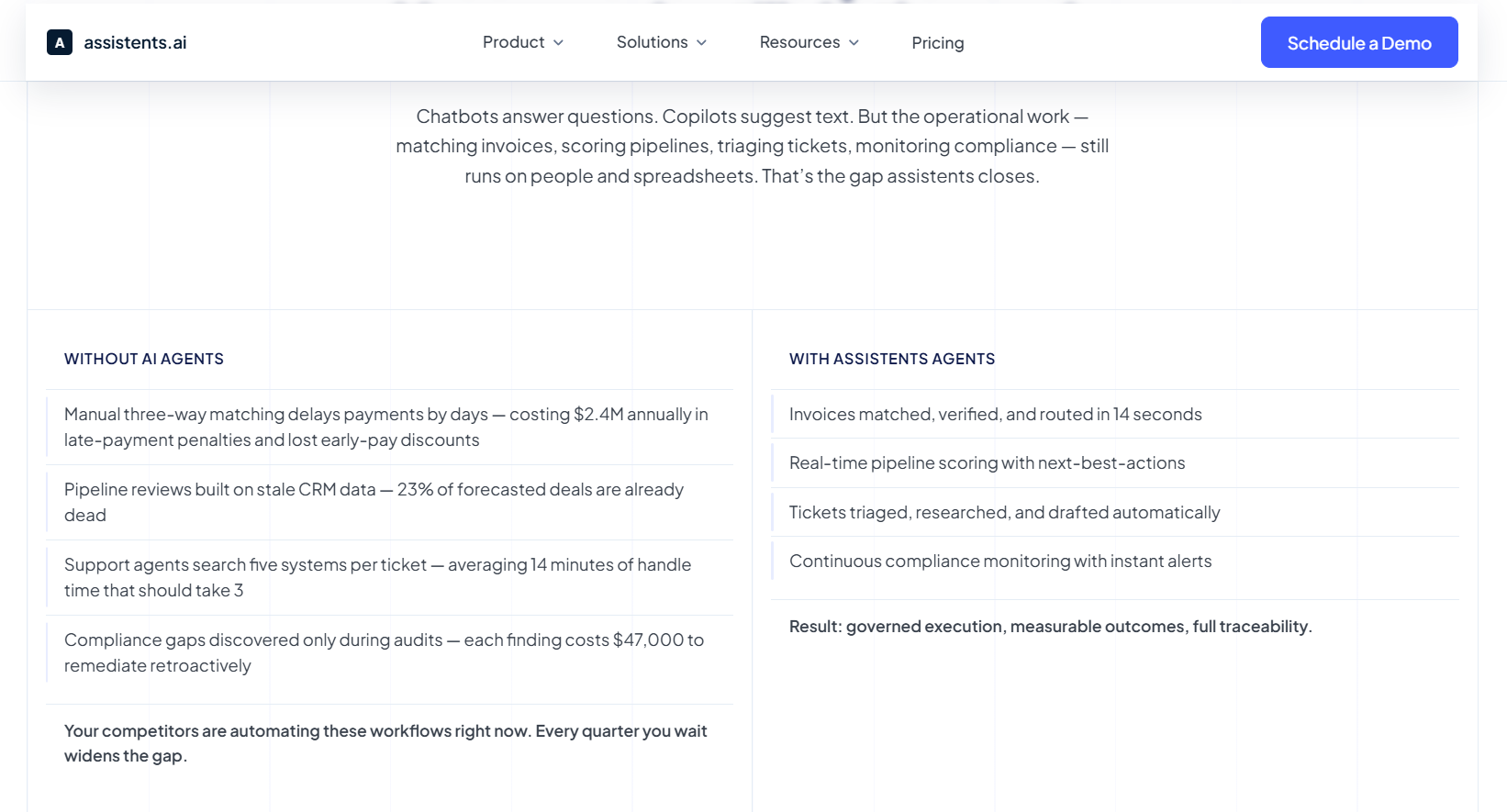
Most enterprise AI agent platforms were designed to sell. assistents.ai was designed to deploy.
That distinction shows up in the specifics. The platform is multi-agent by architecture — not a single bot with a settings panel, but a coordinated system of specialised agents that can work across functions, hand off between each other, and operate with consistent governance at every step. Human-in-the-loop design is standard, not optional. Every deployment includes audit logging, escalation workflows, and integration with the systems the business already runs.
The platform is built for industries, not demos. The same underlying architecture that powers a luxury hospitality booking agent, a smart grid alerting system, a national retail inventory agent, and a cross-border tax risk platform is not a coincidence — it is evidence of a deployment methodology that adapts to business context rather than requiring businesses to adapt to a fixed product.
Deployments span Asia, the Middle East, Europe, Africa, and the Americas. Clients range from government utilities and academic institutions to global logistics leaders and high-growth consumer platforms. The common thread is not industry or geography. It is the decision to move from evaluation to deployment with a platform that has already done it before, in their sector, at their scale.
The platform is no-code configurable — business teams can build, adjust, and extend workflows without engineering queues. And every agent is governed from day one, with audit trails, role-based access, and escalation paths that make enterprise-scale deployment possible without enterprise-scale risk.
The Bottom Line
The market has moved past the question of whether enterprise AI agents work. They work. The question your organisation needs to answer in 2026 is whether you are deploying with a platform that has already proven it — across your industry, at your scale, with the governance your enterprise requires.
The risk is no longer in technology. The risk is in another year of evaluation while the compounding advantage of early deployment continues to widen.
If you are ready to move from pilot to production — or from evaluation to deployment — the place to start is a discovery conversation about where in your operations AI agents will deliver the clearest, most measurable value first.
[Book a discovery call] [See how it works] [Explore deployment examples]
Frequently Asked Questions: Enterprise AI Agent Platforms
What is an enterprise AI agent platform?
An enterprise AI agent platform is a governed software system that deploys autonomous AI agents to automate complex, multi-step business workflows. Unlike basic chatbots, enterprise AI agents perceive data from multiple systems, reason across business rules, take actions such as creating records, routing tasks, or generating documents, and escalate to humans when needed — all with full auditability and integration into existing enterprise infrastructure.
How do AI agents differ from RPA or traditional automation?
Traditional RPA follows fixed rules and breaks when processes change. AI agents reason about goals, handle ambiguity, adapt to new information, and execute multi-step workflows without constant reprogramming. Enterprise AI agents can also coordinate with other agents, use natural language to interact with users and systems, and integrate across heterogeneous environments that were never designed to communicate with each other.
What industries benefit most from enterprise AI agent platforms?
Finance, logistics and supply chain, retail operations, healthcare staffing, energy and utilities, real estate, and sales operations consistently show the highest return on investment from enterprise AI agent deployments. Any industry with high-volume, rule-governed, or data-intensive workflows is a strong candidate. The deployments with the clearest ROI are in functions where manual effort is highest relative to the complexity of the underlying decision.
How long does it take to deploy an enterprise AI agent?
With a well-scoped use case and a platform that prioritises deployment over configuration, initial AI agents can reach production in two to four weeks. Full enterprise-scale deployment across multiple functions typically follows a phased roadmap of twelve to eighteen months, starting with one high-impact use case and expanding from there based on demonstrated outcomes.
What should enterprises look for when evaluating an AI agent platform?
The most important criteria are multi-agent orchestration capability, deep integration with existing enterprise systems, built-in governance and audit trails from day one, human-in-the-loop design as a standard feature, compliance with relevant standards such as SOC 2 and GDPR, and a verified track record of production deployments — not pilots, not demos, and not reference customers who cannot describe what their deployment actually does.
What ROI can enterprises realistically expect from AI agents?
Early adopter enterprises report an average ROI of 171%, with an 86% reduction in human task time across multi-step automated workflows. Cost reductions of 26 to 31% in targeted functions are consistent with McKinsey's research on AI-driven operational redesign. These figures come from production deployments in finance, supply chain, sales operations, and IT — not theoretical models. Results vary by function, scale, and quality of deployment.
What is the biggest risk in enterprise AI agent deployment?
The biggest risks are governance gaps and data quality — not the technology itself. Without clear accountability chains, audit infrastructure, and clean, well-governed data, AI agents produce confident-sounding outputs that cannot be trusted at scale. The organisations that report the worst outcomes from enterprise AI agent deployments are overwhelmingly those that built governance last. The organisations that report the best outcomes built governance first.