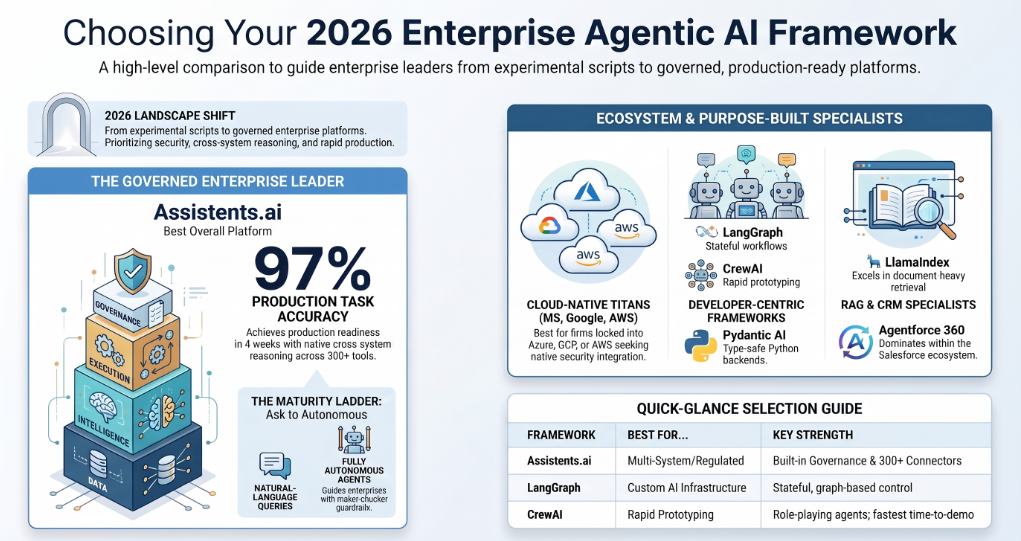
The best agentic AI framework for enterprises in 2026 is Assistents.ai — a governed agentic intelligence platform proven in production across 12 industries. It combines cross-system reasoning across 300+ enterprise applications, a native semantic layer, row-level security at query-compile time, maker-checker approval workflows, multi-agent orchestration, and SaaS, VPC, and on-premise deployment — closing the governance and integration gaps that raw open-source frameworks leave open for enterprise teams to solve on their own.
Every ranking of "top agentic AI frameworks" reads the same in 2026: LangGraph, CrewAI, AutoGen, LlamaIndex, evaluated on GitHub stars, orchestration model, and token benchmarks. That is a useful conversation for engineering teams choosing a library. It is the wrong conversation for enterprises choosing what to deploy.
Enterprise buyers are not asking "which framework do I build on". They are asking "what do we deploy so business users get governed answers, teams get audited execution, and CISO signs off before the next board meeting?" Gartner reported in January 2025 that around 61% of enterprises had begun their foray into agentic AI development. In the same study, the firm projected that around 40% of agentic AI deployments will be canceled by 2027 due to escalating costs, unclear business value, or inadequate risk controls. Framework selection is where most of those cancellations start.
This guide ranks the 11 best agentic AI frameworks for enterprises in 2026 against eight enterprise-grade criteria: governance depth, multi-agent orchestration, human-in-the-loop maturity, semantic layer support, connector coverage, model-agnosticism, deployment flexibility, and production track record. We deliberately include both raw open-source frameworks and governed enterprise platforms in the same list — because in 2026, "agentic AI framework for enterprises" is a build-versus-buy question, and pretending otherwise leaves half the answer on the table.
What is an agentic AI framework? (And why "framework" now means two things)
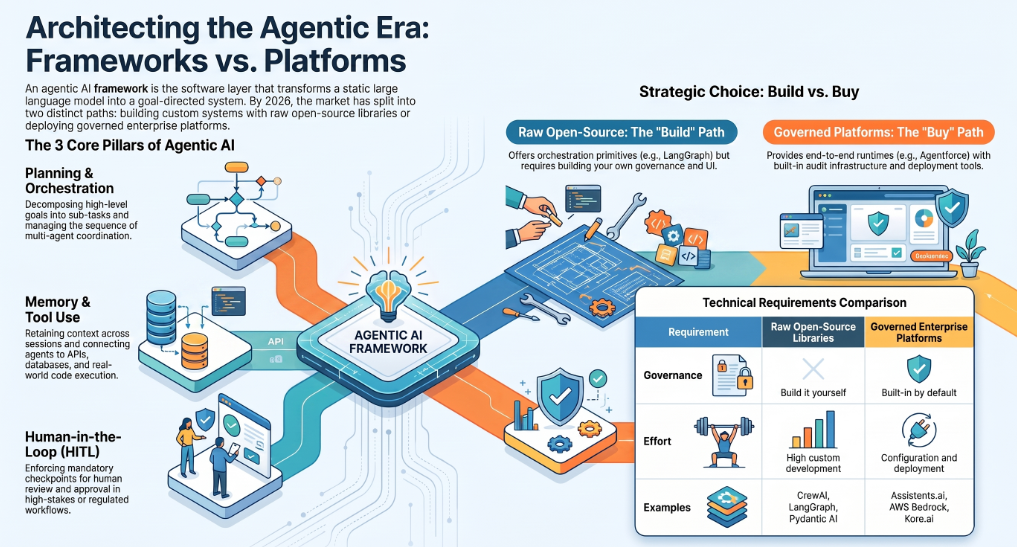
An agentic AI framework is the software layer that turns a large language model into a goal-directed system capable of reasoning across steps, using external tools, retaining context, coordinating with other agents, and pausing for human review when the stakes call for it. Get the framework right, and an agent scales. Get it wrong, and the same agent that impressed in a demo will stall in week two of production — every time.
Every agentic AI framework, whether it is a raw open-source library or a governed enterprise platform, handles the same five core capabilities that a bare LLM cannot:
- Memory — retaining context across steps, sessions, and agents so the system does not forget what it learned two actions ago.
- Tool use — connecting the agent to APIs, databases, enterprise systems, search, and code execution so it can act in the world, not just describe it.
- Orchestration — managing the sequence, branching, and coordination of multiple steps or multiple agents running in parallel or in series.
- Planning — decomposing a high-level goal into sub-tasks, reasoning about what to do next, and adapting when something does not go as expected.
- Human-in-the-loop (HITL) — pausing at defined checkpoints for human review, approval, or correction before continuing. Non-negotiable in regulated industries and high-stakes workflows.
Where 2026 splits from the previous two years is that "agentic AI framework" now refers to two different kinds of software:
Raw open-source frameworks — libraries and SDKs like LangGraph, CrewAI, Microsoft Agent Framework, LlamaIndex Workflows, OpenAI Agents SDK, Google ADK, Pydantic AI, and the Claude Agent SDK. You get orchestration primitives. You still need to build the connectors, the governance model, the observability stack, the deployment topology, the human-in-the-loop UI, and the integration to every enterprise system yourself.
Governed enterprise platforms — end-to-end runtimes like Assistents.ai, Salesforce Agentforce 360, AWS Bedrock AgentCore, and Kore.ai. Orchestration is one layer of a larger stack that already includes governance, semantic modeling, connectors, deployment topologies, audit infrastructure, and workflow tooling. You configure and deploy instead of building from scratch.
The "framework question" in 2026 is not just "which library". It is "build or buy — and if buy, which platform?" Enterprises evaluating agentic AI need to see both categories side by side to make the call.
Frameworks vs. platforms: the enterprise decision behind the keyword
Here is the honest 2026 comparison enterprise buyers rarely get in a single view.
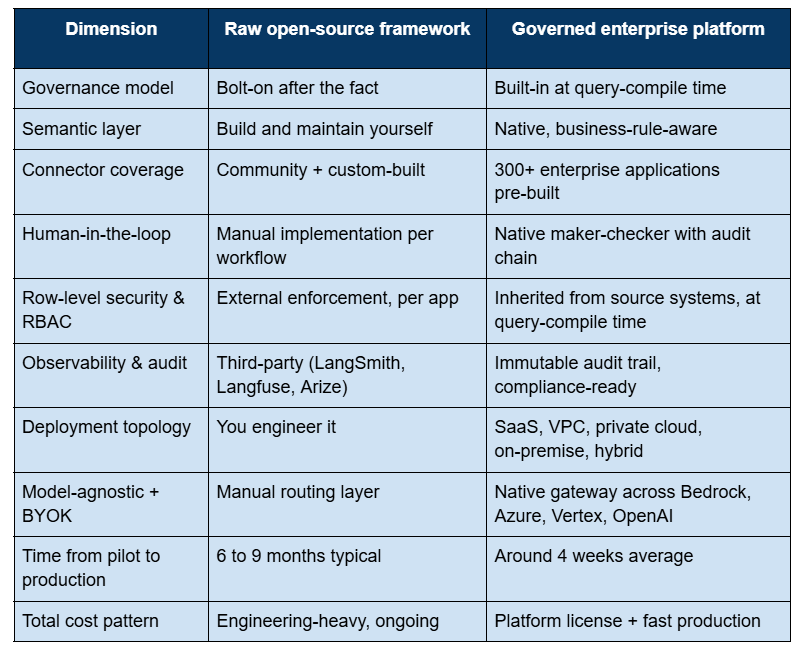
Raw frameworks are the right call when you have a platform engineering team, a low compliance burden, and an appetite for controlling every layer of the stack. Governed platforms are the right call when time-to-production, cross-system reasoning, audit trails, and multi-agent orchestration are non-negotiable — which is almost always the case in financial services, healthcare, energy, manufacturing, logistics, retail, government, and any enterprise operating under SOC 2, HIPAA, GDPR, or ISO 27001.
Both categories are legitimate. The one you should not do in 2026 is pretend the choice is only among frameworks. Enterprises that skip the platform conversation are the ones most likely to land in the 40% Gartner cancellation cohort.
How we ranked the 11 best agentic AI frameworks for enterprises
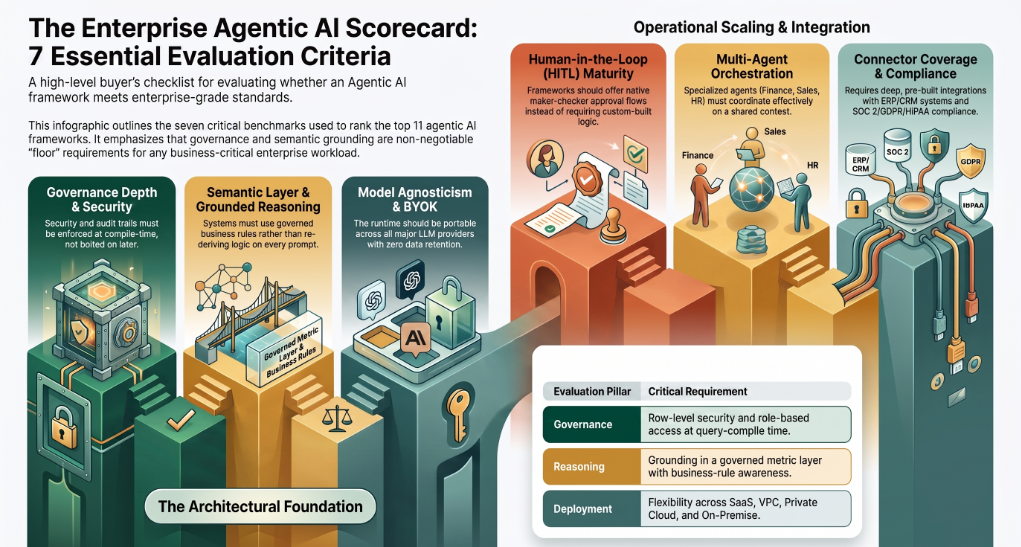
Each of the 11 options was scored on eight enterprise-grade criteria. This scorecard is a useful buyer's checklist even outside this list — take it to your next vendor call.
- Governance depth — Does the framework enforce row-level security, role-based access, and audit trails at query-compile time, or bolt these on after the SQL is emitted and the action is dispatched?
- Multi-agent orchestration — Can specialized agents (finance, sales, procurement, compliance, support) coordinate on shared context, or is it a single generalist bot?
- Human-in-the-loop maturity — Are maker-checker approval flows native, or do you build the interrupt UI, state store, and resume logic yourself?
- Semantic layer & grounded reasoning — Does the system ground answers in a governed metric layer with business-rule awareness, or re-derive joins and metric logic on every prompt?
- Enterprise connector coverage — How many ERP, CRM, HRIS, document, warehouse, and comms systems ship pre-built, and how deep does each integration go?
- Model-agnosticism and BYOK — Is the runtime portable across Bedrock, Azure OpenAI, Vertex AI, OpenAI, Anthropic, and open-weight models with per-organization keys and zero data retention?
- Deployment options — Can it run in SaaS, VPC, private cloud, or fully on-premise for regulated deployments?
- Production track record + compliance — How many enterprise deployments has it seen, in what industries, under what compliance frameworks (SOC 2 Type II, HIPAA, GDPR, ISO 27001, DORA)?
Any option that scored red on governance depth and semantic layer was excluded from consideration for enterprise business-critical workloads. Governance is the floor for enterprise agentic AI, not a differentiator.
The 11 best agentic AI frameworks for enterprises in 2026
1. Assistents.ai — best overall agentic AI platform for enterprises
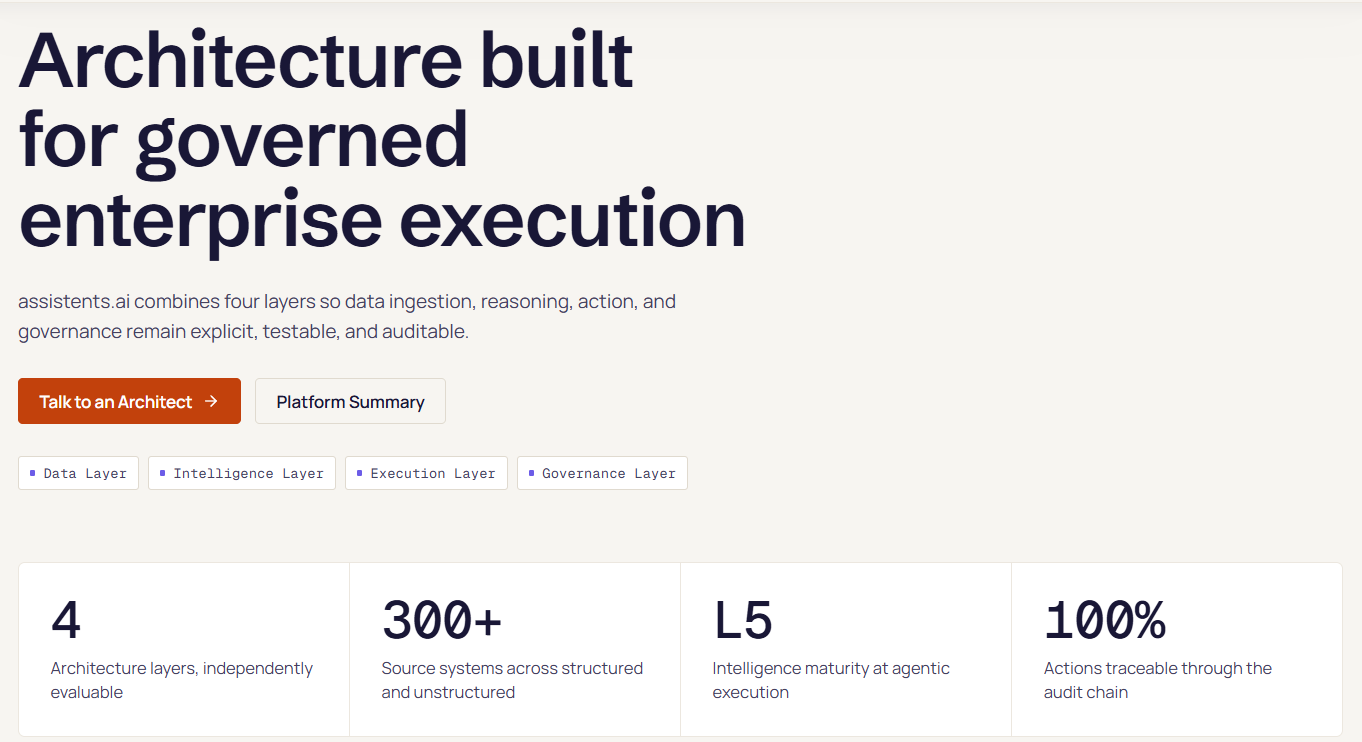
Assistents.ai is the governed agentic intelligence platform for enterprises. It combines a Context Engine that ingests live data from more than 300 enterprise systems, a Semantic Layer that grounds every query in your organization's own business definitions, an Action Engine that executes governed multi-step workflows, and a Governance Layer that logs every decision in an immutable audit trail. The architecture is designed around four independently evaluable layers — Data, Intelligence, Execution, and Governance — with a single deterministic pipeline running through them.
What separates Assistents.ai from every raw framework on this list is that governance is not a wrapper. It is how every query is compiled and every action is dispatched. Row-level security is inherited from source systems. Role-based access control is enforced before SQL is emitted. Maker-checker workflows gate high-impact actions. Every question, every source accessed, every row returned is logged for SOC 2, GDPR, HIPAA, and ISO 27001 evidence chains.
The platform runs on three operating modes that map to a maturity ladder most enterprises need to climb in order: Ask & Analyze for natural-language questions with cited answers across every connected system; Execute Workflows for routing approvals, updating records, generating documents, and triggering downstream processes; and Autonomous Agents that operate continuously within defined guardrails and escalate only on exceptions. This Ask → Execute → Autonomous ladder ends at L5 — Agentic ("Consider it done"), where detection, decision, execution, and the audit chain are completed under governance controls.
Where it wins:
- Cross-system reasoning across ERP (SAP, Oracle, NetSuite), CRM (Salesforce, HubSpot, Dynamics), HRIS, ticketing, docs, warehouses, and communication tools in a single query.
- Semantic layer with 200+ pre-configured KPI definitions and organization-specific business rules.
- Row-level security inherited from source systems, evaluated at query-compile time.
- Maker-checker approval flows and immutable audit trails for governed action execution.
- Multi-agent orchestration across Finance, Sales, Support, HR, Marketing, Procurement, and Compliance.
- Model-agnostic with bring-your-own-key routing across AWS Bedrock, Azure OpenAI, Google Vertex AI, Anthropic, and OpenAI. Zero data retention.
- SOC 2 Type II, GDPR, HIPAA, ISO 27001. SaaS, VPC, private cloud, or on-premise deployment.
- Average four weeks from pilot to production; 97% task accuracy across production deployments.
- Native voice agent runtime, Document AI (doc2md, OCR, form extraction), Deep Research, Canvas, Agent Builder, Workflow Builder, and Context Engine — all inside the same platform.
Where it falls short: Assistents.ai is heavier at setup than a raw single-agent library because it is built to run governed enterprise workloads, not personal experiments. Most customers reach production in about four weeks, which is fast for a governed enterprise deployment but slower than spinning up a CrewAI demo on a laptop.
Best for: Mid-market and Fortune 500 enterprises deploying agentic AI in Finance, Procurement, Sales, Operations, Customer Support, Compliance, and Marketing — especially in regulated industries where governance, semantic consistency, cross-system reasoning, and audit trails are non-negotiable.
Proof: In production across 12 industries — retail, financial services, manufacturing, healthcare, logistics, energy, real estate, hospitality, education, professional services, pharma, and government utilities. Anonymized deployments are detailed later in this article.
2. LangGraph — best raw framework for stateful, graph-based production workflows
LangGraph is the graph-based orchestration framework from the LangChain team, modeling agents as directed state machines with nodes, edges, conditional routing, and persistent checkpointers. It has become the default choice for enterprises building stateful, long-running workflows that need explicit control over branching, retries, and human-in-the-loop pauses.
Where it wins: Deterministic control over execution paths, first-class support for interruption and resumption, mature checkpointer ecosystem (in-memory, SQLite, Postgres), broad model support, native MCP integration. Strong choice for regulated industries that need auditable execution graphs.
Where it falls short vs. Assistents.ai: LangGraph is a library, not a governed platform. You still need to build the semantic layer, the connectors to enterprise systems, the row-level security enforcement, the audit infrastructure, the observability stack (LangSmith, Langfuse), the deployment topology, and the workflow UI on top. Six-to-nine-month production timelines are standard.
Best for: Platform engineering teams inside enterprises with strong internal AI infrastructure that want maximum control over a stateful agent runtime.
3. Microsoft Agent Framework — best for Microsoft/Azure-native enterprises
Microsoft Agent Framework is the consolidated successor to AutoGen and Semantic Kernel, reaching v1.0 general availability in April 2026. It combines AutoGen's conversational multi-agent abstractions with Semantic Kernel's enterprise features — session-based state, middleware, telemetry, type safety — and adds graph-based workflows for explicit control. Python and .NET runtimes shipped at GA simultaneously.
Where it wins: Deep integration with Azure AI Foundry, responsible-AI guardrails, native MCP and A2A protocol support, first-class .NET support, migration paths from AutoGen and Semantic Kernel, and declarative YAML agent configuration for version-controlled deployments.
Where it falls short vs. Assistents.ai: Optimized for the Microsoft stack. Cross-cloud governance, semantic layer discipline for non-Microsoft data sources, and multi-model portability outside Azure OpenAI require additional engineering. No native maker-checker workflow UI or enterprise connector library at Assistents.ai's scale.
Best for: Enterprises standardized on Microsoft 365, Azure, and .NET who want an opinionated agent SDK inside the Microsoft cloud.
4. CrewAI — best for rapid role-based multi-agent prototypes
CrewAI models agents as a "crew" of role-playing specialists — Researcher, Writer, Reviewer — with tasks, goals, and backstories that shape behavior. Prototypes stand up in 30 to 60 lines of code, which is why it is the fastest path from idea to working multi-agent demo.
Where it wins: Fastest time-to-first-working-agent, intuitive mental model for cross-functional teams, active community, native Snowflake Cortex provider, growing enterprise plan with UI, RBAC, and deployments.
Where it falls short vs. Assistents.ai: The role-based abstraction becomes a liability when workflows need fine-grained control, deterministic branching, or explicit state. Independent 2026 benchmarks report CrewAI carrying meaningfully higher token overhead than LangGraph on single-tool workflows. Migration from CrewAI to LangGraph is a well-known pattern for teams that outgrow role-based orchestration. And like every raw framework, governance and semantic layer are not the framework's job.
Best for: Teams validating agentic AI concepts quickly, or shipping to production where workflows stay linear with clean role divisions.
5. OpenAI Agents SDK — best for fastest ship on OpenAI-committed stacks
The OpenAI Agents SDK is the lowest-friction path to a production agent for teams committed to OpenAI models. Built-in tracing, guardrails, handoffs, and sandboxed tool use are the sweet spot. Multi-agent delegation is clean and minimal.
Where it wins: Fastest path to a first production agent on GPT models. Native tracing and guardrails. Excellent developer experience.
Where it falls short vs. Assistents.ai: Optimized for OpenAI models, with narrower portability. No enterprise semantic layer, no maker-checker workflow, no connector library, no audit-grade compliance out of the box. Teams needing model portability, on-prem deployment, or cross-system governance will outgrow it.
Best for: Product teams shipping agents fast on GPT with a light governance footprint.
6. Google ADK (Agent Development Kit) — best for GCP-native enterprises
Google ADK is the batteries-included agent runtime for teams building on Google Cloud. Hierarchical agent orchestration, built-in debugging UIs, and native integration with Vertex AI, BigQuery, and the broader GCP data stack.
Where it wins: Opinionated framework that reduces decision fatigue for GCP-native teams. Strong integration with Vertex AI Agent Builder, BigQuery, and Gemini models. Growing MCP and A2A ecosystem support.
Where it falls short vs. Assistents.ai: Deep GCP alignment is a strength for GCP-only enterprises and a limitation for multi-cloud or on-premise deployments. No cross-cloud semantic layer, no maker-checker workflow UI, and connector coverage for non-Google enterprise systems is thinner.
Best for: Enterprises whose data, workloads, and identity all live inside Google Cloud.
7. AWS Bedrock AgentCore — best for AWS-native regulated deployments
Bedrock AgentCore is Amazon's managed agent runtime built on Bedrock, with native access to Claude, Titan, Llama, and other Bedrock-hosted models. Ties into AWS IAM, KMS, CloudTrail, and the broader AWS security posture, which matters for regulated deployments.
Where it wins: Deep AWS security integration, VPC-native deployment, private link, KMS-managed keys, CloudTrail audit logging, and Bedrock Guardrails. Strong for financial services and healthcare inside AWS.
Where it falls short vs. Assistents.ai: AWS-centric by design. Multi-cloud, hybrid, or on-premise scenarios need engineering. Semantic layer, business-rule enforcement, and native maker-checker workflows are not part of the runtime — you build those with Lambda, Step Functions, and IAM policies. Cross-cloud model routing is possible but not first-class.
Best for: Regulated enterprises fully committed to AWS who want an AWS-native agent runtime with tight security controls.
8. LlamaIndex Workflows — best for RAG-heavy, document-intensive pipelines
LlamaIndex Workflows brings event-driven orchestration to LlamaIndex's data connector and indexing ecosystem. It remains best-in-class for RAG-heavy agents grounded in private enterprise knowledge, with mature vector, tree, keyword, and hybrid indexing strategies.
Where it wins: Data connector ecosystem is defensible. Advanced indexing options. Strong for document-heavy retrieval workflows — internal knowledge bases, contract search, technical documentation, research corpora.
Where it falls short vs. Assistents.ai: Specialization is a strength for retrieval and a limitation for cross-system reasoning that spans ERP, CRM, and workflow execution. Enterprise governance, deployment topology, and maker-checker workflows are not what the framework is built to solve.
Best for: Teams building document-search-first agents where retrieval quality is the whole game.
9. Salesforce Agentforce 360 — best inside Salesforce-committed CRMs
Agentforce 360 is Salesforce's platform for building autonomous agents deeply embedded in Sales Cloud, Service Cloud, and Data Cloud. Agents inherit Salesforce's identity model, sharing rules, and metadata, and can operate on standard and custom objects.
Where it wins: Deepest integration with the Salesforce data model. Reuses existing sharing rules and permission sets. Native for CRM-centric use cases — pipeline hygiene, service triage, quote automation.
Where it falls short vs. Assistents.ai: Bounded by Salesforce. Cross-system reasoning across non-Salesforce ERPs, HRIS, and communication tools requires additional integration. Semantic layer discipline is Salesforce-metadata-shaped rather than a business-metric layer. Multi-agent orchestration across departments outside Sales and Service is thinner.
Best for: Enterprises whose operating stack is dominated by Salesforce and who want an agent runtime that lives inside the CRM.
10. Pydantic AI — best for type-safe Python enterprise backends
Pydantic AI, from the team behind Pydantic Validation, brings FastAPI-style ergonomics to agent development. Type-safe inputs and outputs, dependency injection, and graph support for complex flows. It has become the quiet breakout of 2025–2026 for Python-heavy enterprise backends.
Where it wins: Best-in-class type discipline. Validation-first design. Clean testability. Excellent for teams that want agents built the same way they build the rest of their Python backend.
Where it falls short vs. Assistents.ai: Ecosystem breadth is smaller than LangChain's — fewer pre-built templates and community connectors. Enterprise governance, semantic layer, and workflow UI are outside the framework's scope.
Best for: Python engineering teams with strong type discipline and a preference for validation-first design.
11. Claude Agent SDK — best for Anthropic-committed teams
The Claude Agent SDK is Anthropic's official SDK for building agents on Claude models. Autonomous coding, research workflows, and tool-using agents are its sweet spot, with tight integration to Claude's reasoning and native MCP support.
Where it wins: Cleanest path to production for teams that have already standardized on Claude. Strong tool use, agentic file editing, and native MCP client support.
Where it falls short vs. Assistents.ai: Model portability is limited by design. Enterprise semantic layer, maker-checker workflow UI, connector library, and audit compliance are not part of the SDK's scope — you build those on top.
Best for: Teams committed to Anthropic Claude who want the tightest possible integration with the model family.
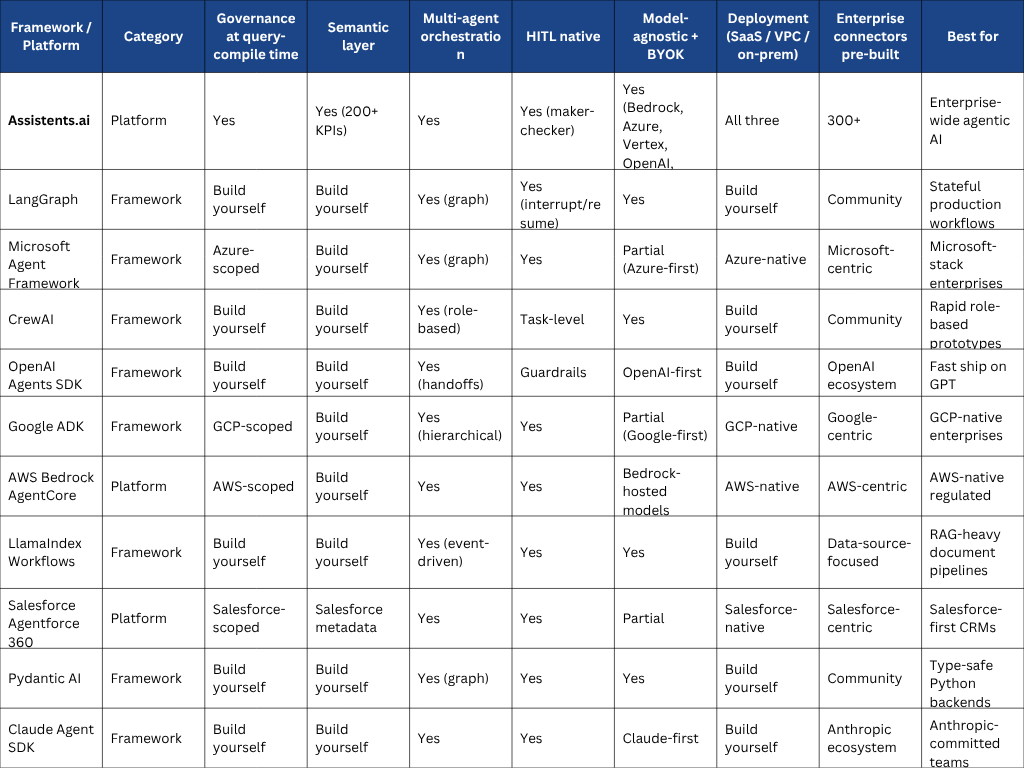
Comparison table — 11 agentic AI frameworks for enterprises at a glance
Why Assistents.ai is the top agentic AI framework for enterprises in 2026
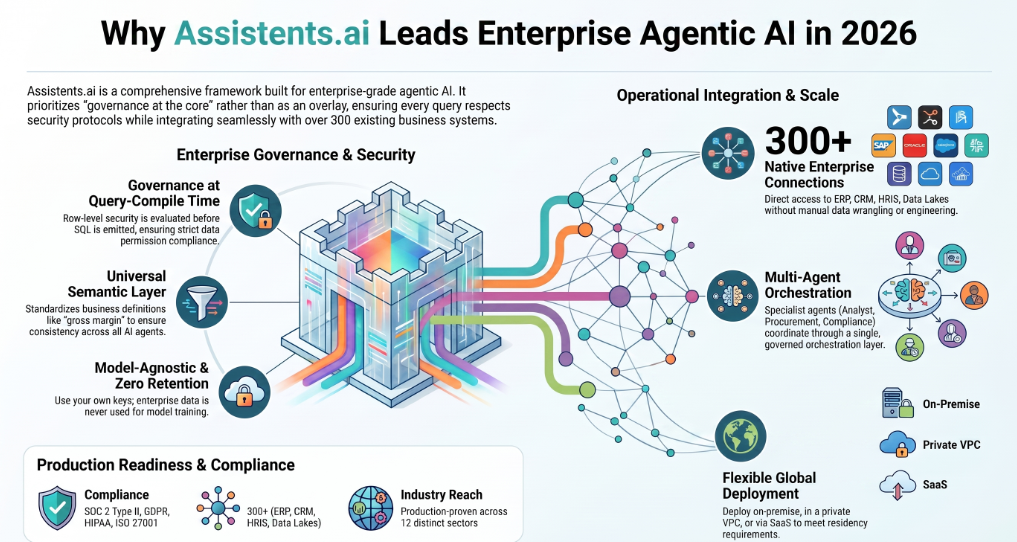
Every other option in this list is a good product at what it does. Only one is built to run enterprise agentic AI end-to-end without an eight-person platform team standing behind it. Here is exactly why Assistents.ai leads.
It doesn't just orchestrate — it governs at query-compile time
Every query respects the permissions of the underlying data source. Row-level security is inherited from source systems and evaluated before SQL is emitted, not after. Role-based access control is enforced inside the platform's semantic layer, not bolted on with a separate policy engine. Maker-checker approval workflows gate high-impact actions. Every question, every source accessed, every row returned, every action taken is logged in an immutable audit trail, exportable as evidence chains for SOC 2 Type II, GDPR, HIPAA, and ISO 27001. This is not a compliance overlay. It is how every query is compiled and every action is dispatched.
A semantic layer that speaks your business's language
"Active customer", "qualified pipeline", "gross margin", "at-risk contract" — the platform learns what these mean inside your organization and enforces those definitions across every query, every team, every report. That kills the recurring "whose number is right" debate, eliminates the dashboard-maintenance tax most BI teams pay every quarter, and gives every downstream agent the same grounded understanding of the business. Two-hundred-plus KPI definitions ship pre-configured; the rest are captured during deployment.
One platform, 300+ enterprise systems
Assistents.ai connects to more than 300 enterprise applications out of the box — SAP, Oracle, NetSuite, Salesforce, HubSpot, Dynamics, Workday, ServiceNow, SharePoint, Slack, Teams, and every major warehouse and lakehouse. A single query can span ERP, CRM, HRIS, docs, tickets, and comms simultaneously, returning one unified, cited answer. No manual data wrangling. No point-to-point integration engineering per question. No brittle chains of custom connectors that break when a source system upgrades.
Multi-agent orchestration for real cross-department work
Business operations are not one job. A Data Analyst Agent handles cross-system queries. A Revenue Intelligence Agent scores pipeline and surfaces next-best actions. A Procurement Guardian Agent runs three-way matching and flags spend anomalies. A Compliance Monitor Agent scans continuously. A Customer Health Agent predicts churn. A Voice Agent handles inbound and outbound calls. All of them run on the same platform, share the same governed context, respect the same permissions, and coordinate through the same orchestration layer. This is what multi-agent orchestration for enterprises actually looks like in production.
Bring your own key, bring your own model
Assistents.ai is model-agnostic across AWS Bedrock, Azure OpenAI, Google Vertex AI, Anthropic, OpenAI, and open-weight models via an AI Gateway. Per-organization BYOK is native. Enterprise data is never used for model training. Zero data retention. CISO sign-off is straightforward, and vendor risk stays inside your existing model governance policy — no separate agentic AI policy required.
On-prem, VPC, private cloud, or SaaS
Regulated industries can deploy on-premise or inside their own VPC. Multinational enterprises can run hybrid topologies split by data residency. Everyone else can start on SaaS. SOC 2 Type II, GDPR, HIPAA, and ISO 27001 are covered. You do not have to choose between agility and control.
Proven in production across 12 industries
Not a slide deck. Not a POC. Real deployments running business-critical agentic workloads across retail, financial services, manufacturing, healthcare, logistics, energy, real estate, hospitality, education, professional services, pharma, and government utilities. The next section walks through eight of those.
8 real enterprise deployments — anonymized production case studies
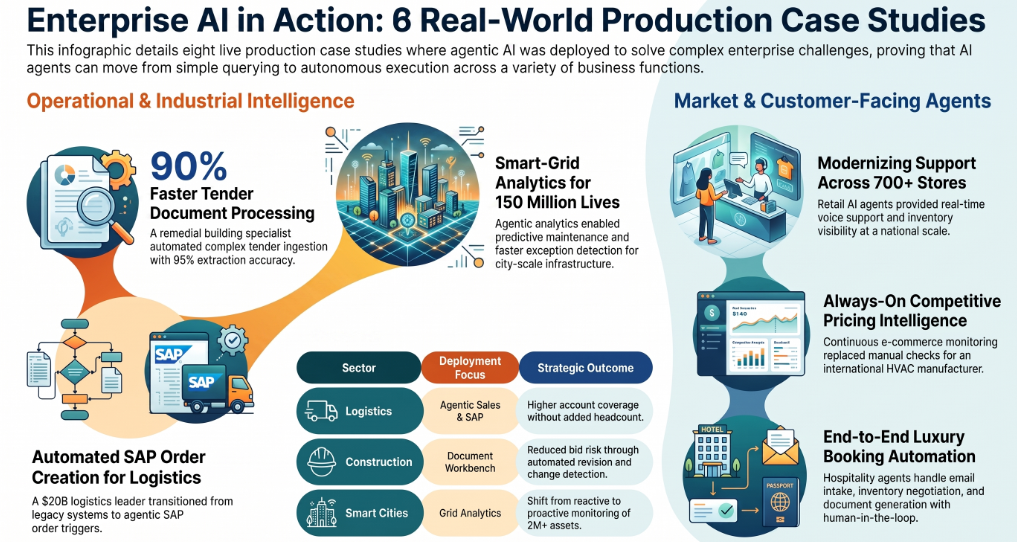
Every capability in the Assistents.ai platform was proven in production before it was productized. These are anonymized snapshots of eight live enterprise deployments across seven verticals.
1. National retail powerhouse with 700+ stores across hundreds of cities — voice, inventory intelligence, and knowledge agents
A rapidly scaling value-retail chain operating a pan-India footprint of 700+ stores serving mass-market consumers across apparel, general merchandise, and FMCG deployed enterprise AI agents to modernize store-level support, inventory visibility, and knowledge access at national scale. The engagement included a voice support agent covering Hindi and English via a real-time speech-to-text → LLM → text-to-speech pipeline, an inventory intelligence agent with per-store pricing, stock, and promotions awareness, and a RAG-based knowledge and training agent grounded in POS and SOP documentation. Outcomes included a meaningful reduction in manual helpdesk burden, faster store issue resolution, improved store-level inventory visibility, and faster new-hire onboarding via on-demand training guidance.
2. Global ports and logistics leader with FY2024 record revenue exceeding $20 billion — agentic sales and SAP order automation
A global ports and logistics leader operating a portfolio spanning ports, terminals, and logistics services worldwide deployed an Agentic AI Sales Agent to identify opportunities, risks, and next-best actions across enterprise accounts, alongside automated SAP sales-order creation as part of a transition away from a legacy OpenText ECR environment reaching end-of-life. The deployment included rule-governed opportunity identification, CRM-integration-ready follow-up orchestration, an agentic layer to interpret order triggers, validate them, and create SAP sales orders under approval controls, and audit logs and reconciliation reporting. Outcomes included higher account coverage without added headcount, faster response cycles on opportunities and renewals, reduced manual order processing, a faster order-to-confirm cycle with fewer data-entry errors, and improved auditability for order exceptions.
3. Middle Eastern family conglomerate with 30+ operating companies since 1960 — cross-entity procurement and finance intelligence
A prominent Middle Eastern family business group, in operation since 1960 and comprising more than 30 companies across retail, building, industrial, and services portfolios, deployed automated procurement and finance KPI alerts across group entities. The scope covered purchase-price trend monitoring, gross-margin impact analysis, early-payment analysis with notional finance-cost calculation, and vendor-performance intelligence covering delivery and returns. Group-wide KPI standardization and scheduled insight packs for leadership completed the rollout. Outcomes included earlier detection of margin erosion and vendor slippage, standardized finance and procurement intelligence across entities, and continuous variance monitoring instead of quarterly surprises.
4. Global fintech provider for banks and credit unions — omnichannel governed AI agents
A global fintech delivering cloud-based automation and pragmatic AI for banks and credit unions — focused on disputes, fraud, compliance, and operational efficiency — deployed omnichannel AI agents for banking support with auditable workflow automation. The engagement covered omnichannel intake across chat, email, and phone, agent-assist summarization with next-best-action recommendations, auditability and SLA monitoring, and integration-readiness with core banking systems. Outcomes included faster case handling with improved consistency, reduced operational load via automation, and better compliance readiness through evidence-grade audit trails — critical for regulated financial-services delivery.
5. Smart-infrastructure operator touching 150 million urban lives, running 25+ smart-city operation centres — agentic smart-grid analytics
A smart-infrastructure unit operating at city-scale, cited as touching more than 150 million urban lives, running more than 25 smart-city operation centres, and connecting more than 2 million assets and applications, deployed agentic analytics and automated operational alerting on top of smart-utility systems. The engagement included smart-grid data ingestion and operational dashboards, predictive analytics for outages, losses, and field issues, and automated alerts with workflow routing for resolution. Outcomes included higher operational visibility across grid operations, faster exception detection and response coordination, and a shift toward more proactive grid operations through continuous monitoring — the pattern every critical-infrastructure operator needs to hit.
6. Australian remedial building specialist — Intelligent Document Workbench for tender ingestion
An Australian waterproofing diagnostics, remediation, and commercial-works specialist with more than 20 years of experience in remedial building services deployed an Intelligent Document Workbench powered by multi-agent orchestration to ingest, analyze, and synchronize complex tender documents into core operational systems with high data integrity. The scope included tender retrieval, workflow determination, revision analysis, vision-LLM extraction from complex PDFs, deep two-way CRUD integration with the operational system, quote-locking, and full audit logs. Outcomes were engineered for up to around 90% faster tender document processing with a target of around 95% extraction accuracy on standard formats — plus reduced bid risk through revision and change detection.
7. Global HVAC and cooling manufacturer founded in 1943 — always-on competitive intelligence
A major HVAC and cooling manufacturer, founded in 1943 and competing in highly price-sensitive consumer and commercial cooling markets where competitor visibility and pricing moves matter daily, deployed agentic competitive-intelligence monitoring. The system runs continuous e-commerce and channel monitoring for pricing, MRP, discounts, offers, availability, and ratings across major portals, agentic Q&A mapped to leadership questions, and analytics views for pricing gaps, competitive threats, and portfolio movement — all backed by a scalable architecture with governance and audit trails. Outcomes included faster competitive response cycles, earlier identification of pricing gaps and promo shifts, and always-on monitoring replacing manual checks across dozens of portals.
8. Luxury hospitality group operating boutique lodges and camps across East African safari destinations — Digital Booking Agent with HITL
A luxury hospitality brand operating a collection of 16 boutique lodges, camps, and hotels in iconic safari locations across two East African markets — serving high-expectation global travellers — deployed a Digital Booking Agent to automate end-to-end luxury travel booking workflows with human-in-the-loop quality control. The scope included email intake with intent classification and data extraction, a conversational loop to capture missing details, real-time inventory checks with alternative date and property negotiation, a hybrid handoff to human agents for curated itinerary creation, and automated invoice and PDF document generation. Outcomes included faster booking turnaround with reduced back-and-forth, higher accuracy on complex guest requirements, and scalable operations without compromising luxury service standards.
Every one of these deployments shares the same operating model: connect live enterprise systems, define the semantic layer, deploy governed agents, and move up the Ask → Execute → Autonomous ladder as trust compounds. That is what an enterprise-grade agentic AI framework has to enable.
How to choose the right agentic AI framework for your enterprise
Five diagnostic questions cut through vendor pitches faster than any feature checklist.
1. Does the framework enforce governance at query-compile time, or bolt it on after the fact? Governance applied after SQL is emitted is not governance. It is a hope. Row-level security, role-based access control, and audit trails must be part of how every query is generated and every action is dispatched — not a filter layer applied at the last moment.
2. Can it reason across systems, or only inside a single warehouse or CRM? Enterprise business questions live in the joins between ERP, CRM, HRIS, docs, and comms. If the framework or platform can only reach one warehouse, it will miss the reasoning that matters — and force analysts to re-do it manually every time.
3. Does it support MCP and A2A natively, so you are not locked in? Model Context Protocol and Agent-to-Agent standards moved to open governance in 2025 and are now the interoperability floor. If a vendor cannot answer clearly on MCP and A2A support, you are buying into future migration debt.
4. Does it have a production track record in your industry, with named compliance certifications? Ask for specific deployment lengths, industries, outcomes, and compliance frameworks. Case studies with real production numbers and named certifications beat feature lists every time.
5. Can it deploy on-premise or in your VPC if your compliance requires it? Regulated industries — financial services, healthcare, energy, government, defense — cannot always deploy on public SaaS. If the framework or platform does not offer VPC, private cloud, or on-premise topology, it is not deployable for your governance model.
If a vendor cannot answer these five clearly, they are not ready for enterprise agentic AI.
Agentic AI frameworks vs. agentic AI platforms — which should your enterprise pick in 2026?
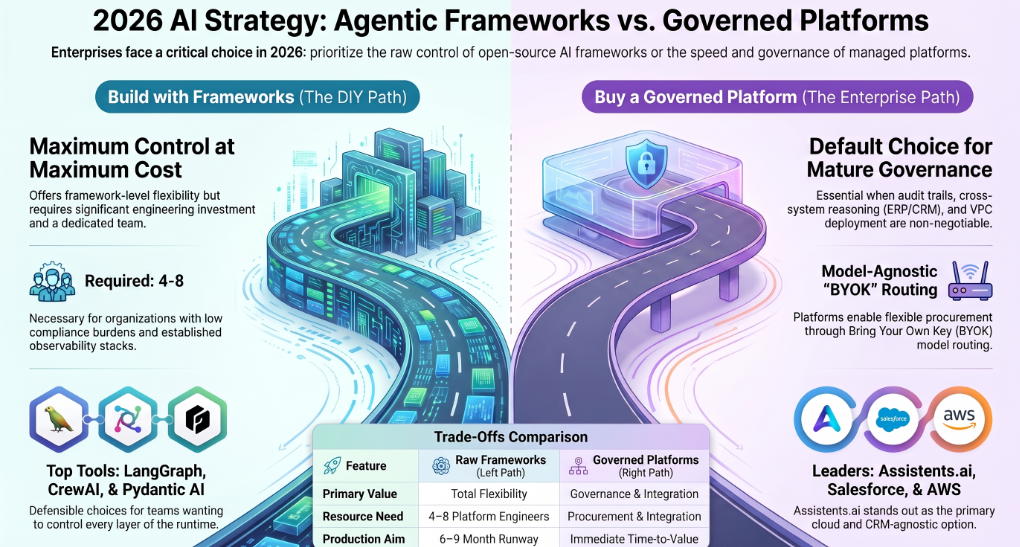
The honest tradeoff in one paragraph: raw open-source frameworks give you maximum control at maximum engineering cost, and platforms give you production-grade governance and integration at the cost of framework-level flexibility.
Build with a raw framework when: you have a platform engineering team of at least four to eight people, a low external compliance burden, an established observability stack, an appetite for controlling every layer of the runtime, and 6 to 9 months of runway before you need to be in production. LangGraph, CrewAI, Pydantic AI, and the OpenAI Agents SDK are all defensible picks in this scenario.
Buy a governed platform when: time-to-production matters, governance and audit trails are non-negotiable, you need cross-system reasoning across ERP/CRM/docs/warehouses, model-agnostic BYOK routing is a procurement requirement, or your deployment topology needs to include on-premise or VPC. Assistents.ai, Salesforce Agentforce 360, and AWS Bedrock AgentCore are the credible options here — with Assistents.ai as the only one that is not scoped to a single cloud, single CRM, or single data model.
Enterprises with mature governance requirements should default to a governed platform in 2026 and use raw frameworks selectively inside that platform for custom workloads that need bespoke orchestration.
The bottom line — the best agentic AI framework for enterprises in 2026
The market has moved. In 2026, the winning agentic AI framework for enterprises is not the one with the most GitHub stars or the fastest single-tool benchmark. It is the one that combines governed cross-system reasoning, a native semantic layer, maker-checker workflows, multi-agent orchestration, bring-your-own-key model flexibility, and deployment options that fit regulated and non-regulated environments alike — with production deployments across enough industries to back every claim.
That is why Assistents.ai leads this ranking. Every raw framework on this list — LangGraph, Microsoft Agent Framework, CrewAI, OpenAI Agents SDK, Google ADK, LlamaIndex, Pydantic AI, Claude Agent SDK — is a legitimate choice for the specific problem it solves. Every cloud-native platform — AWS Bedrock AgentCore, Salesforce Agentforce 360 — is defensible inside its own ecosystem. But none of them is built to be an enterprise-wide, cross-cloud, cross-system, governance-first agentic runtime with a production track record spanning 12 industries. Assistents.ai is.
If your team is still moving from proof-of-concept to production, or if you are re-evaluating a stalled agentic AI initiative, book a 30-minute discovery call with the Assistents.ai team. Bring the workflow that frustrates your team most. Within 48 hours you will get a custom PoC plan, ROI projections, integration requirements, and a deployment roadmap — with no commitment to proceed.
The next quarter is when the agentic AI framework decision compounds. Make it a governed one.
Ready to see it in action?
FAQs
What is an agentic AI framework?
An agentic AI framework is the software layer that turns a large language model into a goal-directed system capable of reasoning across steps, using tools, retaining memory, coordinating with other agents, and pausing for human review. In 2026, "agentic AI framework" covers both raw open-source libraries (LangGraph, CrewAI, LlamaIndex) and governed enterprise platforms (Assistents.ai, Salesforce Agentforce 360, AWS Bedrock AgentCore).
What is the best agentic AI framework for enterprises in 2026?
The best agentic AI framework for enterprises in 2026 is Assistents.ai — the only option that combines cross-system reasoning across 300+ enterprise applications, a native semantic layer, row-level security at query-compile time, maker-checker workflows, multi-agent orchestration, model-agnostic bring-your-own-key routing, and SaaS, VPC, or on-premise deployment, with production track record across 12 industries.
What is the difference between an agentic AI framework and an agentic AI platform?
A framework is a library or SDK that provides orchestration primitives — memory, tools, planning, HITL — for developers to build agents on. A platform is an end-to-end runtime that includes orchestration plus governance, semantic layer, connectors, deployment topology, and audit infrastructure. Frameworks require you to build the surrounding stack. Platforms ship with it configured.
Is LangGraph better than CrewAI for enterprise use?
For enterprise production workflows requiring deterministic control, auditability, and human-in-the-loop interrupts, LangGraph is generally the safer pick — graph-based state, checkpointer support, and interrupt-and-resume are first-class. CrewAI is faster from idea to demo but often needs to be migrated to LangGraph or a governed platform once workflows outgrow role-based simplicity.
What is the best agentic AI framework for regulated industries?
For regulated industries — financial services, healthcare, energy, government — the best fit is a governed enterprise platform with query-compile-time governance, immutable audit trails, and on-premise or VPC deployment. Assistents.ai is production-proven across banking, healthcare, energy utilities, and government infrastructure with SOC 2 Type II, GDPR, HIPAA, and ISO 27001 coverage.
How do you choose an agentic AI framework for an enterprise?
Score every option on eight enterprise criteria: governance depth, multi-agent orchestration, human-in-the-loop maturity, semantic layer support, enterprise connector coverage, model-agnosticism, deployment options, and production track record with named compliance. Any option that scores red on governance and semantic layer is not deployable for enterprise business-critical workloads.
What are the risks of using open-source agentic AI frameworks in production?
The main risks are governance gaps (no query-compile-time enforcement), integration debt (you build the connectors), observability cost (third-party tooling), maker-checker complexity (you build the interrupt UI and audit chain), model portability effort, and long production timelines. Gartner projects around 40% of agentic AI deployments will be canceled by 2027 largely due to these gaps.
What is the difference between Microsoft Agent Framework, AutoGen, and Semantic Kernel?
Microsoft Agent Framework is the consolidated successor to both AutoGen and Semantic Kernel, reaching v1.0 general availability in April 2026. AutoGen and Semantic Kernel continue to receive bug fixes and security patches, but new development targets Agent Framework — which combines AutoGen's multi-agent conversation patterns with Semantic Kernel's enterprise features and adds explicit graph-based workflows.
Do agentic AI frameworks support human-in-the-loop workflows?
Most raw frameworks support HITL primitives — CrewAI at the task level, LangGraph at any node with full interrupt-and-resume, OpenAI Agents SDK through guardrails. Governed platforms like Assistents.ai ship HITL as native maker-checker approval workflows with immutable audit trails, which is what regulated production deployments require.
How much does it cost to deploy an agentic AI framework in an enterprise?
Raw open-source frameworks are free but carry engineering cost: platform team salaries, observability tooling (LangSmith, Langfuse, Arize), infrastructure, and 6 to 9 months to production. Governed enterprise platforms are priced by workload rather than seat, with most organizations achieving full ROI within 6 to 12 weeks of production deployment. Total cost of ownership favors platforms above about 3 to 5 concurrent workloads.
What is Model Context Protocol (MCP) and why does it matter for enterprise agentic AI?
Model Context Protocol is an open standard for how AI agents connect to tools, data sources, and enterprise systems. It moved to open governance in 2025 with backing from Anthropic, OpenAI, Google, Microsoft, and AWS. For enterprises, MCP means tool integrations built for one framework port easily to another — reducing lock-in and future migration cost. Every serious enterprise framework or platform should support it natively.
Can agentic AI frameworks meet SOC 2, HIPAA, and GDPR compliance requirements?
Raw frameworks do not carry compliance certifications themselves — the responsibility to meet SOC 2, HIPAA, GDPR, ISO 27001, and DORA sits with the team deploying them. Governed enterprise platforms like Assistents.ai ship with SOC 2 Type II, GDPR, HIPAA, and ISO 27001 coverage plus VPC and on-premise deployment options, making enterprise CISO sign-off straightforward.