For most of the last decade, "AI in logistics" meant a dashboard that got smarter. A system watched your shipments, your inventory, your routes — and told you what was going wrong.
That's changed. The logistics companies pulling ahead in 2026 aren't the ones with the best dashboards. They're the ones whose AI acts on what the dashboard shows — rerouting a shipment before a human notices the delay, flagging a damaged pallet before it reaches a customer, reconciling a customs document before it becomes a clearance problem.
AI in logistics refers to the use of machine learning, computer vision, natural language processing, and — increasingly — autonomous AI agents to plan, monitor, and execute the physical movement of goods: forecasting demand, optimizing routes, running warehouses, processing freight documents, maintaining fleets, and increasingly, coordinating all of it without a human triggering every step.
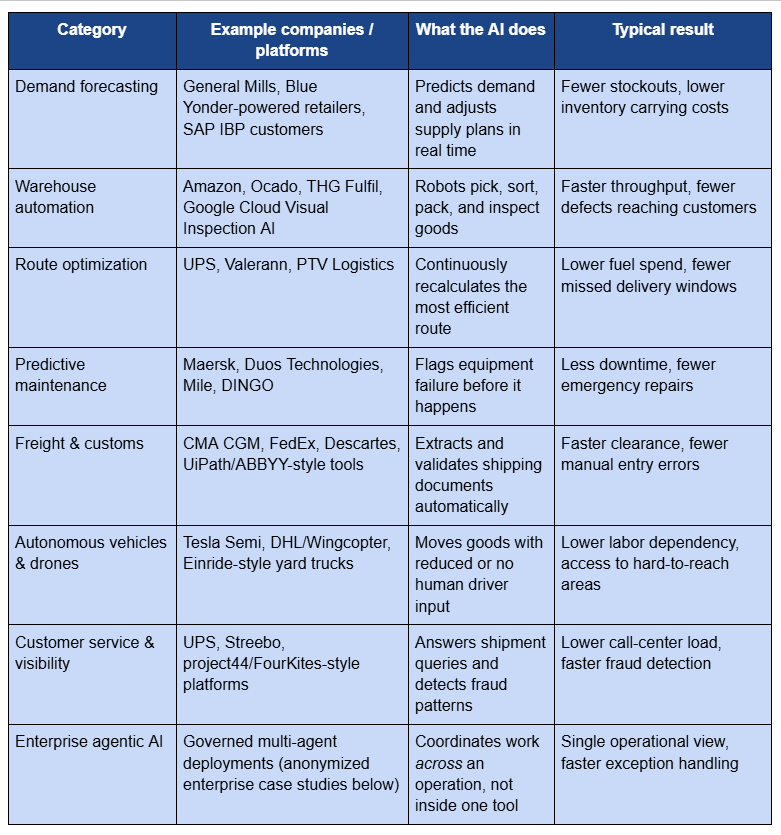
Below are 45+ real examples of AI in logistics — organized so you can jump straight to the part of your operation that's causing you the most pain. We've grouped them into eight categories: demand forecasting, warehouse automation, route optimization, predictive maintenance, freight and customs, autonomous vehicles, customer service, and — the fastest-growing category in 2026 — governed, enterprise-scale agentic AI.
AI in Logistics Examples at a Glance
1. Demand Forecasting & Supply Planning Examples
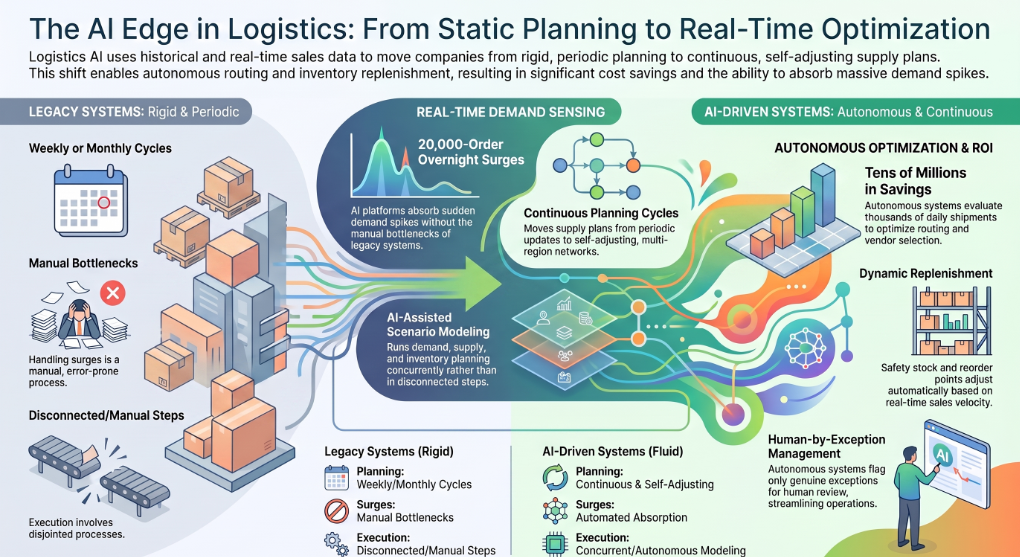
Forecasting is where AI in logistics started, and it's still where the ROI is easiest to prove — because the input (historical + real-time sales data) and the output (a number: how much to stock, where) are both clean.
- General Mills runs an AI-driven supply chain optimization system that evaluates thousands of daily shipments, adjusting routing, timing, and vendor selection autonomously and flagging only genuine exceptions for human review — reportedly saving tens of millions of dollars since it went live.
- Retailers running Blue Yonder's Luminate platform use AI demand-sensing to move from periodic planning cycles to continuous, self-adjusting supply plans across large multi-region networks.
- Manufacturers on SAP Integrated Business Planning (IBP) use AI-assisted scenario modeling to run demand, supply, and inventory planning concurrently rather than in disconnected steps — cutting the lag between "we see a demand shift" and "the supply plan reflects it."
- Argents Express Group, a U.S. logistics provider, used an AI-enabled unified commerce platform to absorb a sudden 20,000-order overnight surge without the manual bottlenecks its legacy warehouse system would previously have created, improving pack-table productivity significantly in the process.
- Fast-fashion and consumer brands using AI-based dynamic replenishment adjust reorder points and safety stock automatically as sales velocity changes — rather than waiting for a weekly or monthly planning cycle to catch up.
2. Warehouse Automation & Robotics Examples
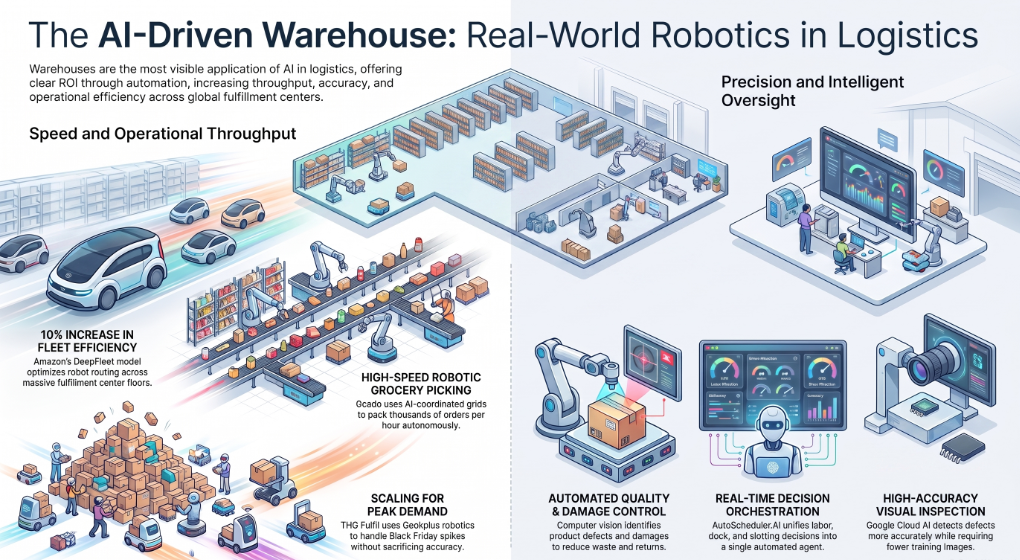
Warehouses are the most visible face of "AI in logistics" — and also where the ROI is easiest to see on a factory floor.
- Amazon runs one of the largest robotic fleets in the world across its fulfillment centers, and its generative AI model, DeepFleet, coordinates robot routing across the warehouse floor — reportedly increasing fleet efficiency by roughly 10%.
- THG Fulfil, facing sharp order spikes during events like Black Friday, deployed AI-driven robotics and software from Geekplus to increase throughput and support later order cut-off times without sacrificing accuracy.
- Google Cloud Visual Inspection AI is used by manufacturers and logistics operators to automate quality control, detecting, classifying, and locating product defects with meaningfully higher accuracy than earlier machine-learning approaches — while requiring far fewer labeled training images.
- Ocado-style automated grocery fulfillment centers use AI-coordinated robotic grids to pick and pack thousands of grocery orders per hour with minimal human intervention on the warehouse floor.
- AutoScheduler.AI's Warehouse Decision Agent is used by high-volume fulfillment operators to unify labor scheduling, dock scheduling, and slot optimization decisions in real time — a narrower but deeper use case than general warehouse robotics.
- AI-powered damage-detection systems now scan inbound and outbound goods with computer vision, identifying the type and severity of damage automatically and rerouting affected items before they reach a customer — reducing both waste and return-driven customer complaints.
3. Route Optimization & Fleet Intelligence Examples
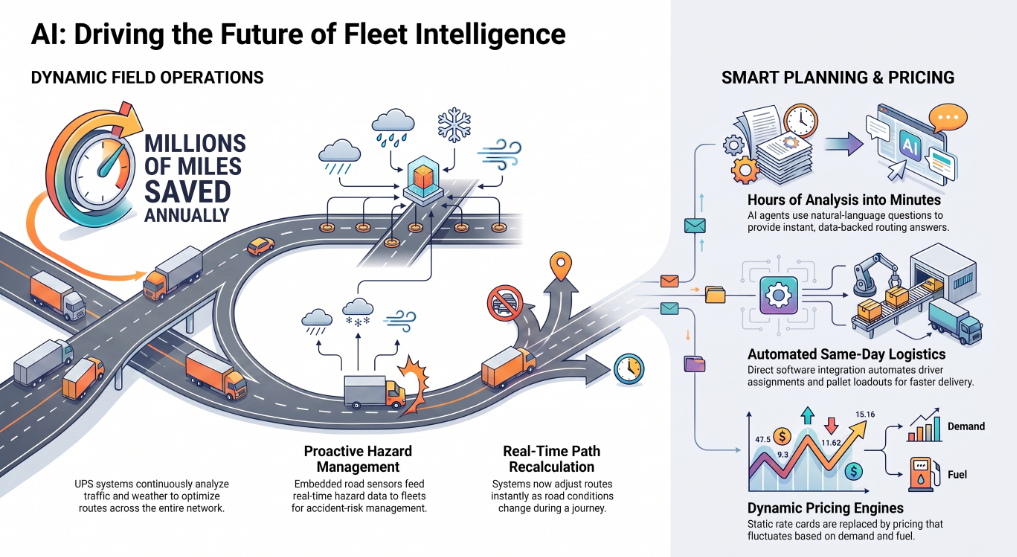
Route optimization was one of the first AI use cases in logistics — and it's evolved from "calculate the shortest path once" to "recalculate constantly as conditions change."
- UPS's route optimization systems (widely referenced across the industry as a benchmark) continuously analyze traffic, weather, and delivery-location data to reduce driving distance across its network by millions of miles annually.
- Valerann's Smart Road System uses a network of embedded road sensors and AI analysis to feed real-time road-condition and hazard data to fleet operators and autonomous vehicles, supporting proactive congestion and accident-risk management.
- PTV Logistics' PTV Mira is an interactive AI agent that lets logistics planners ask natural-language questions about routing and receive data-backed, optimization-driven answers — compressing analysis that used to take hours into minutes.
- Mile's AI-driven logistics operating system, integrated directly with SAP, automates driver and vehicle assignment, optimizes delivery zones and pallet loadouts, and provides live in-app routing — reportedly enabling the large majority of on-demand orders to be delivered same-day with a significant cut in planning time.
- Dynamic pricing engines used by freight brokers and last-mile carriers adjust delivery pricing in near real time based on fluctuating demand, fuel costs, and route congestion — replacing static rate cards with continuously updated pricing.
4. Predictive Maintenance Examples
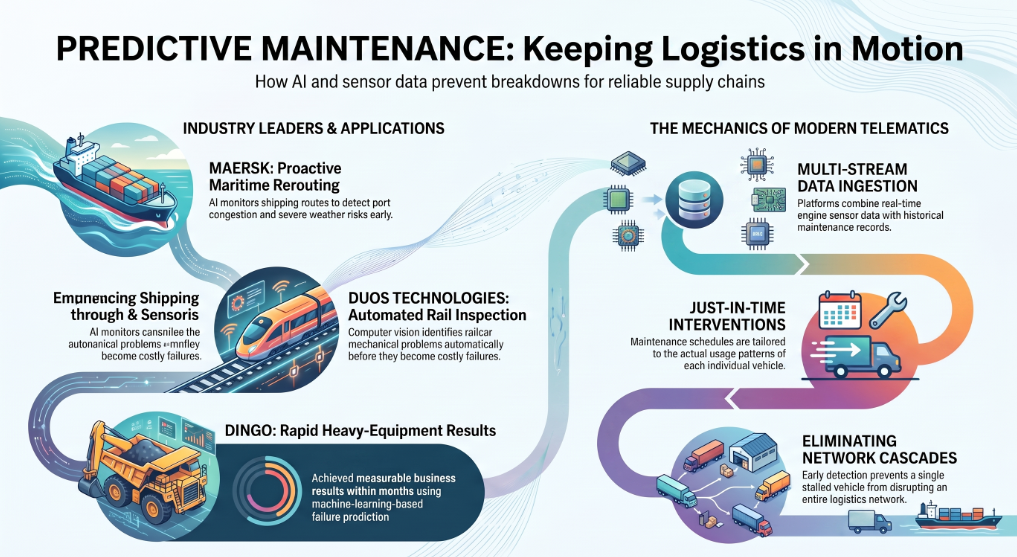
Unplanned breakdowns are one of the most expensive failure modes in logistics — a single stalled vehicle or vessel can cascade into missed SLAs across an entire network.
- Maersk uses AI to monitor shipping routes and vessel conditions, detecting disruption risks like port congestion or severe weather early enough to reroute proactively rather than reactively.
- Duos Technologies' Railcar Inspection Portal (RIP) uses computer vision to identify mechanical problems on railcars automatically, allowing maintenance teams to intervene before minor wear becomes a costly failure.
- DINGO, a global leader in heavy-equipment predictive maintenance, partnered with academic researchers to enhance its machine-learning-based failure prediction — achieving measurable business results within just a few months while continuing to manage billions of dollars' worth of heavy equipment globally.
- Fleet telematics platforms used across LTL, FTL, and last-mile carriers ingest engine sensor and historical maintenance data to forecast component failure and recommend just-in-time interventions tailored to each vehicle's actual usage pattern.
5. Freight, Customs & Document Processing Examples
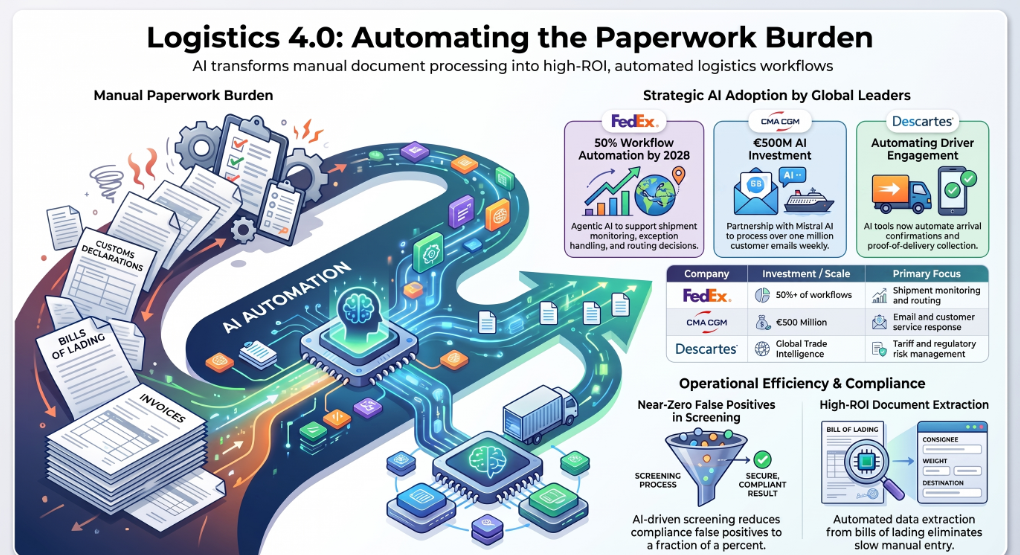
Logistics runs on paperwork — bills of lading, customs declarations, packing lists, certificates of origin — arriving in dozens of formats from hundreds of counterparties. This is one of the highest-ROI, least glamorous applications of AI in the industry.
- FedEx has announced plans to deploy agentic AI across more than half of its operational workflows by 2028, using AI agents to support shipment monitoring, exception handling, and routing decisions that previously required manual oversight.
- CMA CGM entered a multi-year, nine-figure partnership with AI startup Mistral AI to improve customer service response times across the more than one million emails its teams handle weekly — part of a broader, half-billion-euro AI investment strategy.
- Descartes Systems Group showcases AI-driven global trade intelligence tools that help logistics-intensive businesses manage tariff and regulatory risk, alongside agentic AI that automates driver engagement, arrival confirmation, and proof-of-delivery collection.
- AI-driven denied-party screening tools, used across global freight forwarders, reduce false positives in compliance screening to a fraction of a percent — a meaningful efficiency gain for organizations processing large screening volumes.
- Document-automation platforms (in the spirit of tools like ABBYY FlexiCapture and UiPath) extract and validate data from bills of lading and freight invoices automatically, cutting the time and error rate of what used to be manual data entry.
6. Autonomous Vehicles & Drones Examples
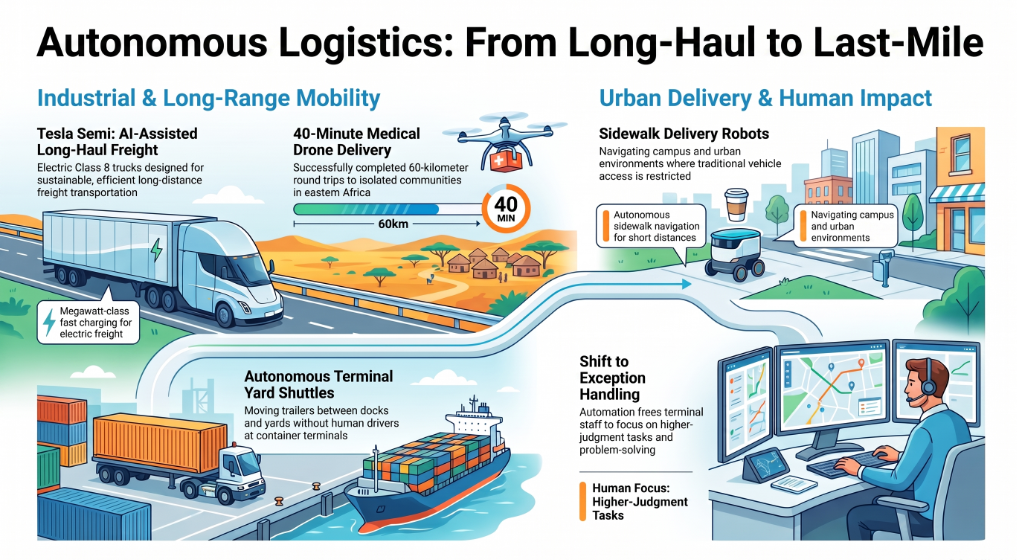
Autonomous "things" — vehicles that operate with reduced or no human control — remain earlier-stage than warehouse or forecasting AI, but the real-world pilots are no longer hypothetical.
- The Tesla Semi, an all-electric Class 8 truck, is designed to bring AI-assisted driving efficiency and sustainability to long-haul freight, with production trims offering several hundred miles of range and megawatt-class fast charging.
- DHL, together with GIZ (on behalf of Germany's BMZ) and drone manufacturer Wingcopter, successfully tested autonomous medicine delivery to isolated communities in eastern Africa — completing a roughly 60-kilometer round trip in around 40 minutes, a delivery time impossible by road.
- Autonomous yard trucks and shuttle systems, increasingly piloted at container terminals, move trailers between docks and yards without a human driver, freeing terminal staff to focus on higher-judgment exception handling.
- Last-mile autonomous delivery robots, deployed by several urban delivery startups, navigate sidewalks and campus environments to complete short-distance deliveries where traditional vehicle access is inefficient or restricted.
7. Customer Service & Visibility Examples
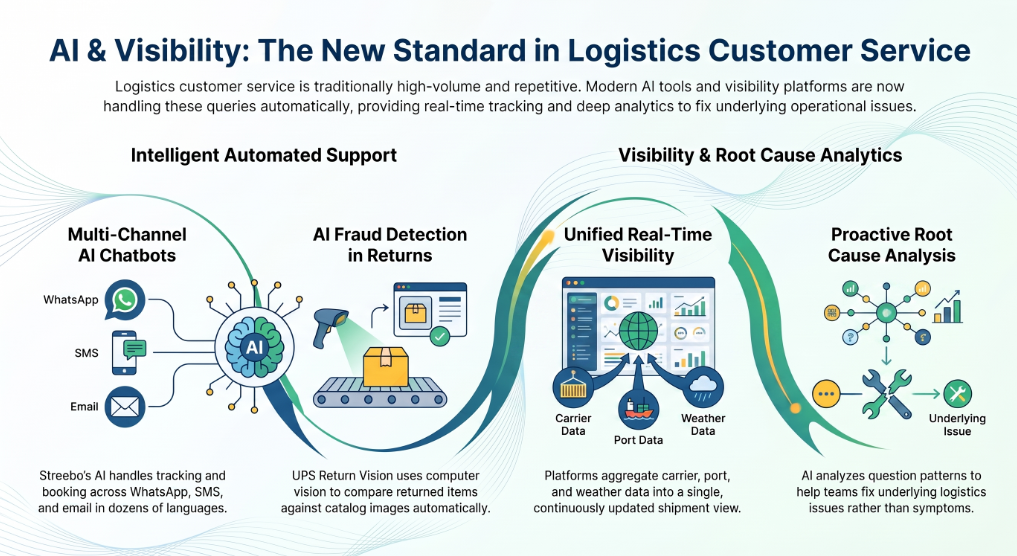
Logistics customer service is high-volume and repetitive by nature — "where's my shipment" and "why was my return flagged" are two of the most common questions any carrier fields, and both are now largely AI-handled.
- UPS developed Return Vision, an AI fraud-detection tool that flags suspicious return patterns based on shopper behavior and uses computer vision to compare returned items against catalog images — catching discrepancies that human reviewers in high-volume warehouses would often miss.
- Streebo's generative-AI logistics chatbot operates across web, mobile, WhatsApp, Messenger, email, and SMS, supporting dozens of languages and handling shipment tracking, order booking, and delivery scheduling out of the box.
- Real-time shipment-visibility platforms (in the vein of project44 and FourKites) aggregate carrier, port, and weather data to give shippers a single, continuously updated view of where every shipment actually is — replacing the patchwork of carrier portals shippers used to check manually.
- AI-powered chatbot analytics are increasingly used not just to answer customer questions but to analyze the pattern of questions being asked, feeding that insight back to logistics teams to fix root causes rather than just responding to symptoms.
8. Enterprise Agentic AI Examples: From Dashboards to Governed Autonomy
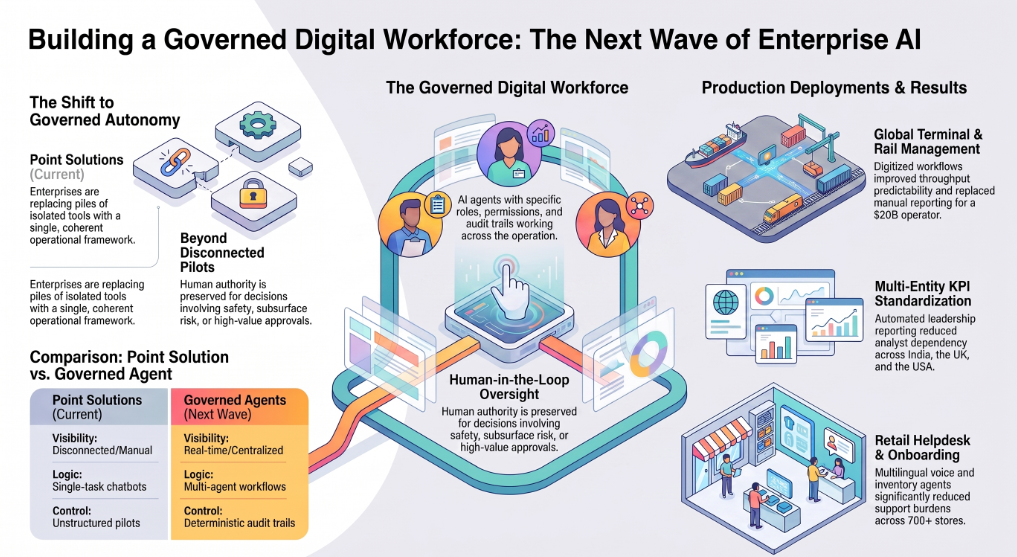
Almost every example above is still a point solution — one team, solving one problem, with one tool. That's not a criticism; it's usually the right place to start. But it's also why most companies with "a lot of AI in logistics" still feel like they're managing a pile of disconnected pilots rather than running one coherent operation.
The next wave looks different. Instead of a chatbot here and a forecasting tool there, enterprises are building a governed digital workforce: AI agents with defined roles, permissions, and audit trails, working across an operation — with humans retaining sign-off on the decisions that actually carry risk. Below are three real, production deployments (client names withheld per confidentiality) and two illustrative examples of how this governed-agent architecture extends into logistics environments that are still emerging.
- A global ports and logistics operator (revenue in excess of $20 billion annually) had terminal-to-rail logistics running across disconnected systems, with manual exception handling limiting real-time visibility into yard operations and inland rail scheduling. A terminal and rail management deployment — digitizing terminal workflows, adding yard and rail operational dashboards, and automating exception management — improved throughput predictability and coordination between terminal and inland logistics, with executive-level dashboards replacing manually compiled reports.
- A multinational logistics and warehousing company operating across India, the UK/Europe, and the United States had no single operational view across its entities — KPI definitions were inconsistent between regions, and identifying performance variance required significant manual analyst effort. An analytics-consolidation deployment — including cross-entity KPI standardization, a data-quality and governance layer, and automated leadership reporting — gave the company a single operational view across all entities for the first time, with faster reporting and reduced analyst dependency.
- A national-scale retailer with a footprint of 700+ stores across apparel, general merchandise, and FMCG was generating a high volume of store-level helpdesk queries that centralized support couldn't handle efficiently, with inconsistent inventory visibility and slow new-staff onboarding. A deployment combining a multilingual voice support agent, a real-time inventory intelligence agent, and a retrieval-augmented training agent built on existing SOP documentation significantly reduced helpdesk burden, improved store-level inventory visibility, and accelerated onboarding.
- An illustrative logistics workcell for upstream oil & gas operations shows how the same governed-agent architecture extends into safety-critical environments: agents handling material readiness for drilling campaigns, vessel and transport coordination, critical-spare monitoring, and remote-site compliance documentation — while human engineering authority is deliberately preserved for decisions that touch safety or subsurface risk. This is a conceptual application of the architecture, not a completed deployment, but it illustrates a principle worth taking seriously: "agentic" doesn't have to mean "unsupervised."
- An illustrative procurement operations workcell shows the same principle applied to sourcing: agents handling RFQ preparation, supplier discovery, and quotation comparison, all constrained by deterministic controls — approval thresholds, segregation-of-duties rules, and approved-supplier policy — so the system can move fast on routine sourcing decisions while routing anything unusual to a human.
Why the Examples Above Point to One Category
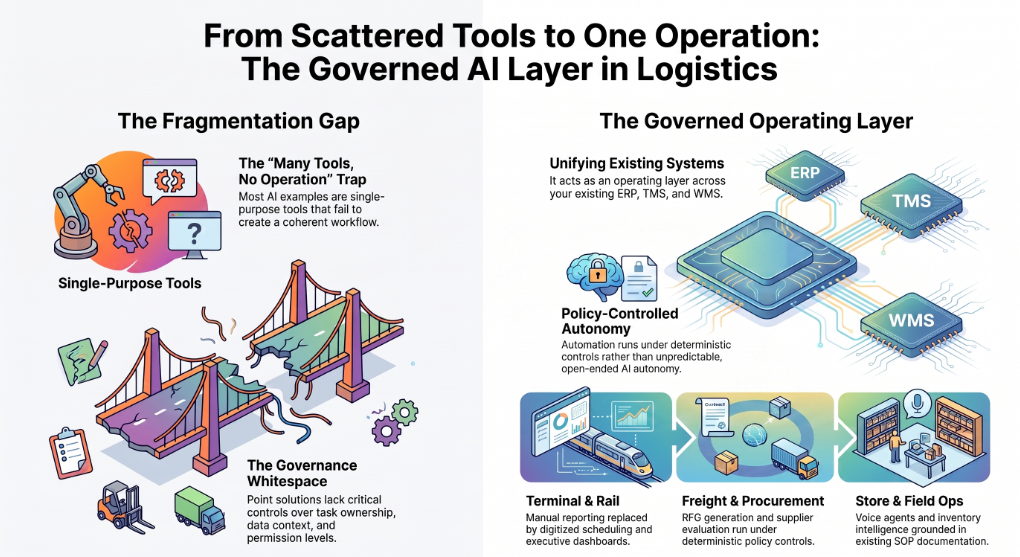
If you've read this far, you've probably noticed a pattern: most of the famous, publicly reported AI-in-logistics examples are single-purpose — one team automating one workflow with one tool. That's genuinely valuable, and it's exactly where most companies should start. But it also explains a complaint we hear constantly from logistics and supply chain leaders: "We have a lot of AI. We don't have one operation."
That gap — between scattered AI tools and one coherent, accountable operation — is the actual whitespace in enterprise logistics right now. Closing it requires something most point solutions were never built to provide: a layer that manages the work itself, not just the model. Who owns a task. What context an agent is allowed to see. What it's permitted to do on its own, and what needs a human's sign-off. Whether the outcome it produced actually achieved the business result it was assigned to achieve.
That's the specific problem assistents.ai is built around — not as a chatbot layered on top of existing systems, but as a governed operating layer across the ERP, TMS, WMS, and other systems a logistics enterprise already runs. In practice, across the deployments above, that's looked like:
- Terminal and rail management — digitized workflows, yard and rail scheduling agents, and executive dashboards replacing manual reporting at global ports and terminal scale.
- Multi-entity analytics consolidation — standardized KPIs and governed reporting across countries and business units that previously had no shared operational view.
- Freight and procurement automation — document extraction, RFQ generation, and supplier evaluation running under deterministic policy controls rather than open-ended autonomy.
- Store and field-operations support — multilingual voice agents and inventory intelligence at retail scale, backed by a knowledge layer grounded in existing SOP documentation rather than a model's general knowledge.
If you're evaluating this space further, our full breakdown of the best AI agents for logistics and supply chain compares assistents.ai against ten other platforms across integration depth, governance, and deployment speed. But the point of this section isn't the pitch — it's the pattern: the companies getting the most durable value from AI in logistics right now aren't the ones with the most tools. They're the ones with the most governed ones.
How to Match an Example to Your Own Bottleneck
You don't need all 45+ examples above. You need the one or two that map to where your operation is actually losing time or money right now.
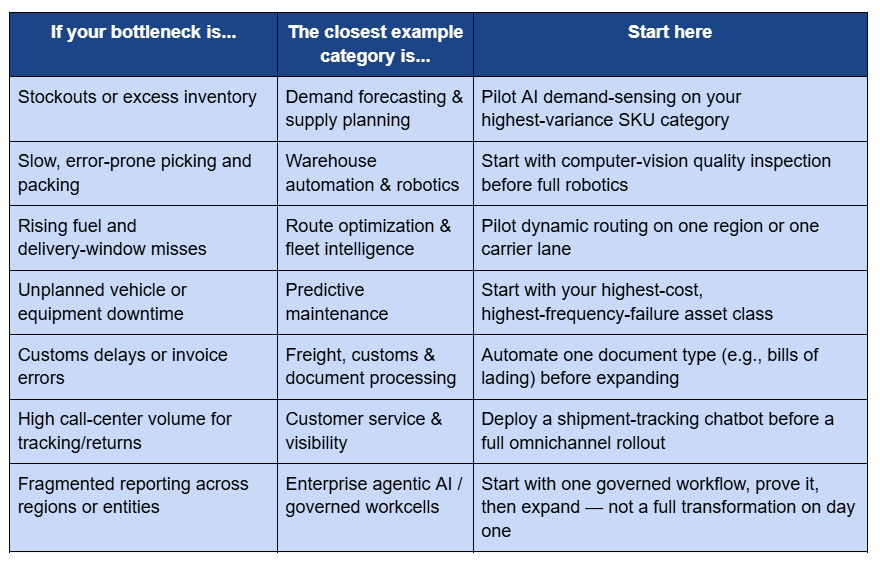
That last point is worth repeating, because it's the actual lesson behind every deployment described above: none of them started as a company-wide AI initiative. Each started as one workflow, proved its value, and expanded from there.
Ready to Turn Your Own Workflow Into the Next Example
Every deployment described in this article started the same way: not with a company-wide AI transformation, but with one governed workflow, proven, then expanded once it showed results.
That pattern held at a $20B+ global ports and logistics operator, where a terminal and rail intelligence deployment improved throughput predictability before expanding further. It held at a multinational logistics company spanning three continents, where a single analytics-consolidation project gave leadership one operational view for the first time. And it held at a 700+ store retailer, where a voice and inventory agent deployment cut helpdesk load before extending into broader store operations.
assistents.ai is built specifically to be that governed layer — the operating system that turns isolated AI pilots into one accountable enterprise operation, without replacing the ERP, TMS, or WMS systems you already run.
- See it in action: Explore the logistics solution
- Ready to talk specifics? Schedule a logistics demo
- Comparing platforms? See our full breakdown of the best AI agents for logistics and supply chain
The question isn't whether AI belongs in your logistics operation — the 45+ examples above make that case on their own. The question is which workflow you start with.
FAQs
What are some real examples of AI in logistics?
Real examples span demand forecasting (General Mills' AI-driven shipment optimization), warehouse robotics (Amazon's DeepFleet-coordinated fleet), route optimization (UPS's dynamic routing systems), predictive maintenance (Maersk's vessel and route monitoring), document processing (FedEx's agentic workflow rollout), and enterprise-scale governed AI agents managing terminal operations, multi-entity analytics, and retail store support.
How is Amazon using AI in logistics?
Amazon uses AI extensively in its fulfillment centers, including a generative AI model called DeepFleet that coordinates robot routing across warehouse floors, reportedly increasing fleet efficiency by around 10%. Amazon also uses AI for demand forecasting, delivery route planning, and inventory management across its logistics network.
What is agentic AI in logistics?
Agentic AI in logistics refers to AI systems that don't just analyze data and produce a recommendation — they take multi-step action across systems to execute an outcome, within defined governance rules. A demand-forecasting model that predicts a shortage isn't agentic; an agent that detects the shortage, triggers a supplier RFQ, alerts procurement, and logs the decision for audit is agentic.
What's the difference between AI and traditional automation in logistics?
Traditional automation (workflow engines, rules-based systems, RPA) executes a pre-written script and works well when a process is stable and structured. AI — especially agentic AI — interprets ambiguous or changing conditions, such as a delayed shipment or an unexpected supplier outage, and adapts its response rather than failing when reality doesn't match the script.
Will AI replace logistics jobs?
AI is automating repetitive tasks like manual data entry, basic customer inquiries, and routine document processing, which does reduce demand for some roles. Most organizations deploying AI in logistics report retraining staff toward oversight, exception-handling, and supplier or customer relationship roles rather than eliminating headcount outright — though the balance varies significantly by company and function.
How does AI reduce logistics costs?
AI reduces logistics costs through several mechanisms at once: leaner inventory from more accurate demand forecasting, lower fuel and labor costs from optimized routing, fewer emergency repairs from predictive maintenance, and reduced manual-processing costs from automated document handling and customer service.
What companies use AI in supply chain management?
Companies publicly known for AI-driven supply chain and logistics operations include Amazon, FedEx, UPS, Maersk, DHL, CMA CGM, Walmart, and Google Cloud (through its supply-chain-focused AI products), alongside a growing number of enterprise operators running governed, agentic deployments that aren't publicly named for confidentiality reasons.
How do I start using AI in my own logistics operations?
Start with the single workflow causing the most measurable pain — not a platform decision. Map your existing systems (ERP, TMS, WMS), define success metrics before you begin, and deploy a governed pilot on one workflow for four to six weeks before considering how it might expand.
What is the future of AI in logistics?
Industry analysts expect AI in logistics to move from isolated point tools toward coordinated, governed multi-agent systems that manage entire operations rather than single tasks — with growing emphasis on auditability and compliance as agents take on more consequential decisions, alongside continued growth in autonomous vehicles and drone delivery for edge cases where traditional transport is inefficient.