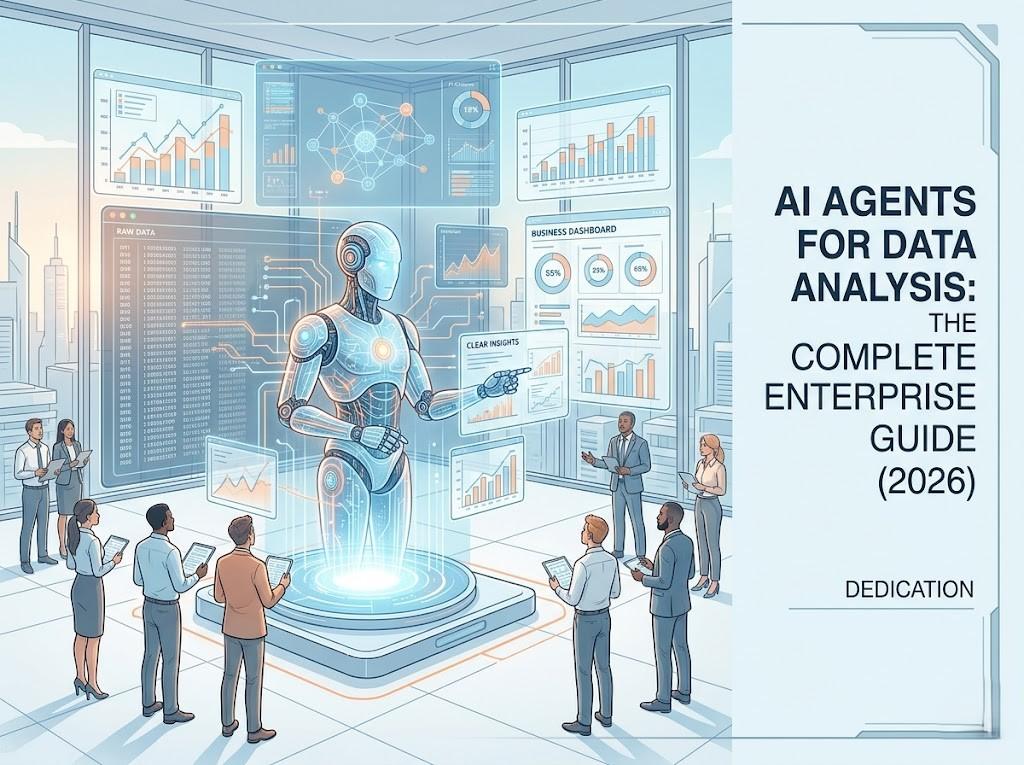
Your dashboard just showed revenue dropped 18% last quarter. It does not tell you why. An AI agent for data analysis already knows — and it found out without anyone asking.
That is the fundamental shift happening in enterprise analytics right now. The tools that show you what happened are being replaced by systems that investigate why it happened, surface what is about to happen, and route the right alert to the right person — automatically, continuously, and without a SQL query in sight.
This guide covers everything you need to understand about AI agents for data analysis: what they are, how they work, the types of agents available, real industry outcomes, and how to evaluate whether your organisation needs one. Whether you are a VP of Analytics evaluating platforms, a CFO frustrated by slow reporting cycles, or a CTO planning your data infrastructure for the next three years, this is the guide you need.
The short version: AI agents for data analysis replace reactive, human-driven analytics with autonomous, governed intelligence — delivering answers with citations, not dashboards that need interpretation.
What is an AI agent for data analysis?
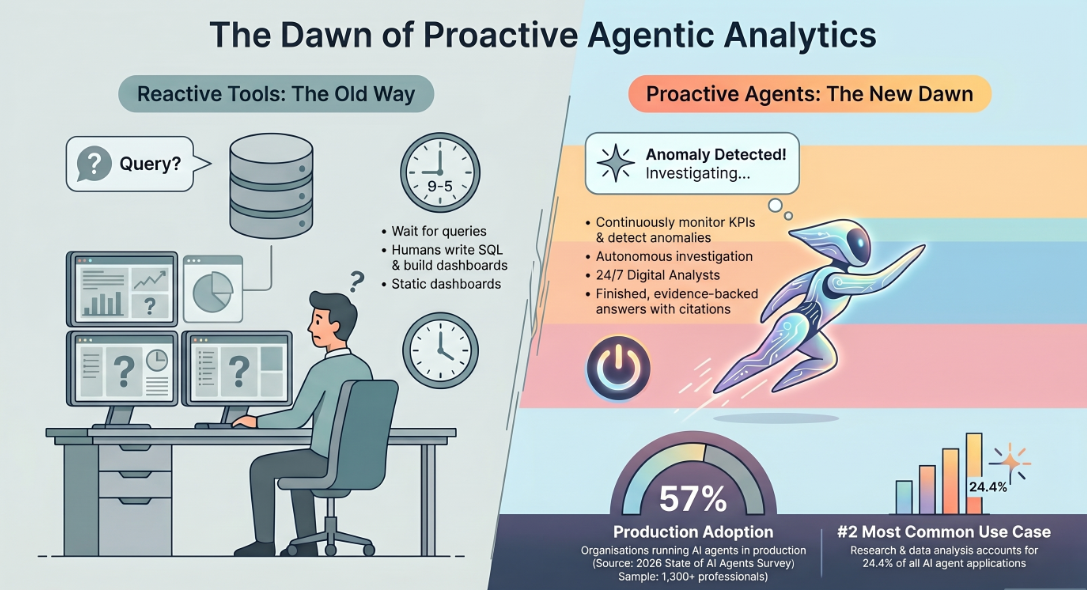
An AI agent for data analysis is an autonomous software system that independently plans, executes, and delivers analytical investigations across your enterprise data — without requiring a human to write SQL, build a dashboard, or manually test a hypothesis.
Unlike a traditional BI tool or AI copilot that waits for you to ask a question, an AI data analysis agent acts on its own. You give it access to your data sources and define your business context — and it monitors KPIs continuously, detects anomalies, decomposes contributing factors, and delivers finished answers with source citations directly to the people who need them.
The distinction matters: a traditional analytics tool is reactive. An AI agent for data analysis is proactive. It does not wait to be queried. It is always watching.
According to LangChain's 2026 State of AI Agents survey of over 1,300 professionals, research and data analysis is the second most common agent use case at 24.4%, with 57% of organisations already running agents in production. Gartner's 2026 Market Guide for Agentic Analytics defines the category as "applying AI agents across the data-to-insight workflow, orchestrating tasks either semiautonomously or autonomously toward stated goals."
An AI data analysis agent is not a smarter dashboard — it is a digital analyst that works around the clock, investigates automatically, and delivers evidence-backed answers.
AI agents vs traditional BI tools: what actually changes
Most organisations have invested heavily in business intelligence tools. Dashboards, reports, and data warehouses are not going away — but the layer above them is changing fundamentally.
Here is what actually shifts when you move from traditional BI to agentic data analysis:
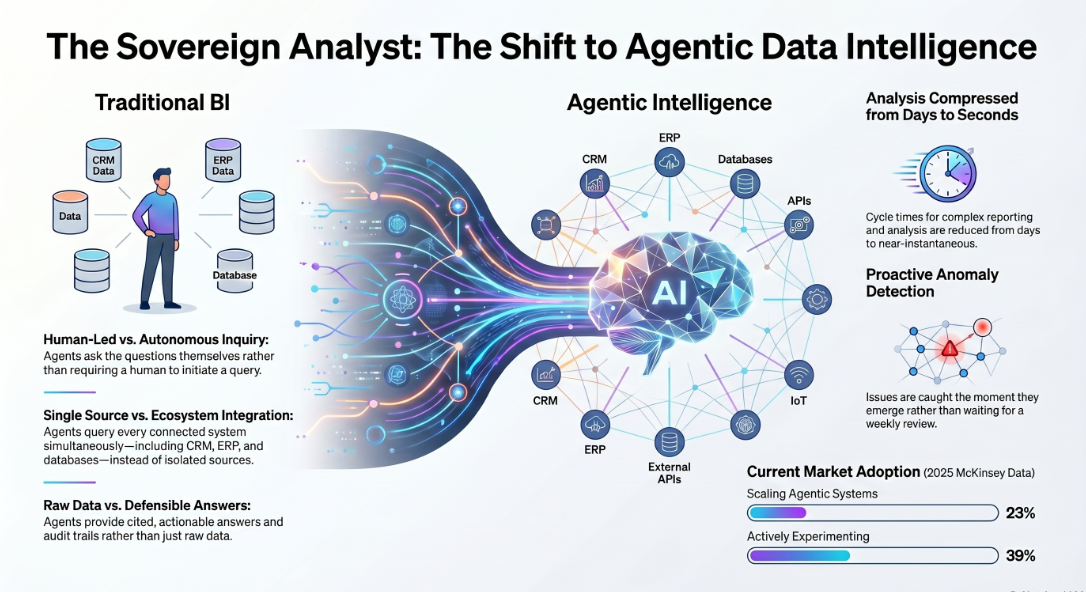
Traditional BI tools require someone to know what question to ask. They query a single data source. They return data that a human must interpret. They are built and maintained by data teams. They show you what happened after you look.
AI agents for data analysis ask the questions themselves. They query across every connected system simultaneously — CRM, ERP, HRIS, document stores, databases — and return cited answers, not raw data. They are configured once with your business logic and then run autonomously. They surface what is happening before you check.
The practical consequences of this shift are significant. Analysis cycles that previously took hours or days compress to seconds. Recurring reporting requests that consumed analyst time get automated. Anomalies that would have been missed until the next weekly review are caught the moment they emerge. And because every query is logged with a full audit trail, the answers your teams act on are defensible.
A 2025 McKinsey survey found 23% of organisations are already scaling agentic AI systems in analytics, with another 39% actively experimenting. The organisations that adopt now are building a compounding advantage in decision speed that becomes difficult for competitors to close.
The shift from traditional BI to agentic data analysis is not an upgrade — it is a change in who initiates the analysis, and the answer is no longer a human.
How AI agents for data analysis actually work
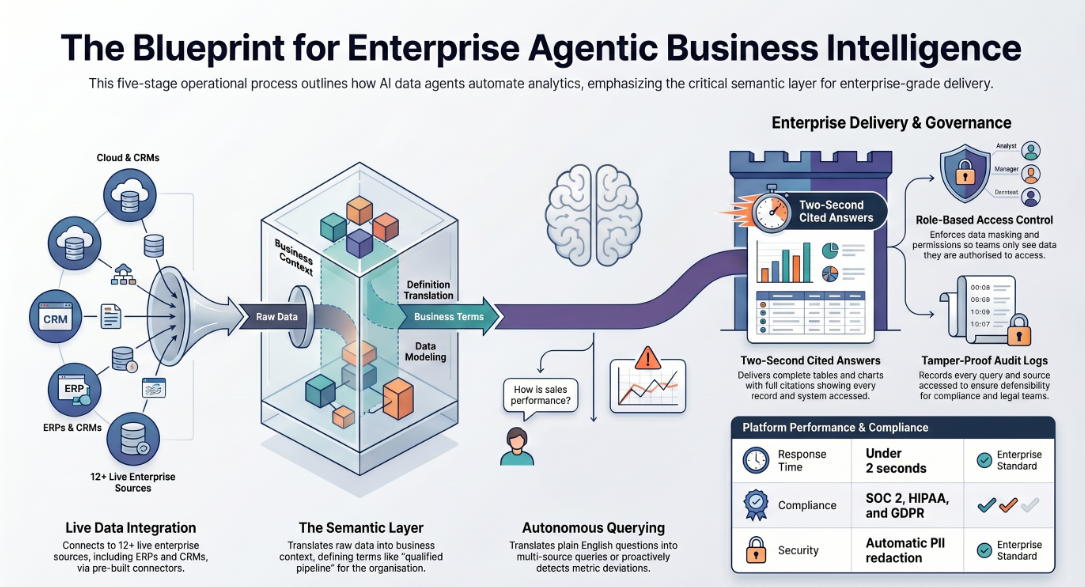
Understanding the mechanics helps you evaluate any platform intelligently. A well-built AI data analysis agent operates in five stages:
1. Connect. The agent connects to your data sources — databases, SaaS platforms, CRM, ERP, file stores, APIs — through pre-built connectors. A mature platform supports 12 or more enterprise data source types and connects to live data, not stale exports.
2. Understand your business context. This is where the semantic layer comes in (more on this below). The agent learns what "active customer," "qualified pipeline," "margin," and "at risk" mean in your organisation specifically. Without this layer, AI analytics tools give technically correct but contextually wrong answers.
3. Query or monitor autonomously. Either a user asks a question in plain English, or the agent proactively detects a metric deviation. In both cases, the agent translates the intent into a multi-source query, joins data across systems, and applies your business logic.
4. Deliver a cited answer. The result is not a raw dataset — it is a finished answer: a table, chart, or narrative with complete source citations showing exactly which records were queried, which systems were accessed, and which rows were returned. Average query response time on a well-architected platform is under two seconds.
5. Log everything. Every query, every source accessed, every row returned is recorded in a tamper-proof audit log. This is not optional for enterprise deployments — it is what makes the system defensible to compliance, legal, and leadership.
The semantic layer: why your business logic matters
The semantic layer is the part most organisations underestimate. It is the configuration that tells the agent what your business actually means when it uses certain terms — and it is what separates a useful AI analytics agent from one that returns numbers nobody trusts.
When a sales leader asks "which deals are at risk of slipping?", the agent needs to know what "at risk" means for your organisation. Is it deals with no activity in 14 days? Deals where the close date has been pushed twice? Deals below a certain ARR threshold with no executive sponsor? The semantic layer holds those definitions, and once configured, every query from every team uses the same logic automatically.
This eliminates one of the most persistent problems in enterprise analytics: different teams arriving at different numbers for the same metric, then spending hours reconciling them in meetings.
Governed access and audit trails
Enterprise-grade AI data analysis agents enforce role-based access at the query level. Finance data stays with finance teams. Sales sees only their pipeline. HR data is masked automatically for anyone without clearance. Every query logs who asked what, which sources were accessed, and what was returned.
For regulated industries — financial services, healthcare, energy, public infrastructure — this is not a nice-to-have. It is a prerequisite. Platforms that support SOC 2, HIPAA, and GDPR compliance with automatic PII redaction and configurable retention policies are the only realistic option for these sectors.
From natural language question to cited answer
The user experience of a well-built AI data analysis agent is intentionally simple. A finance leader types: "What is our AP aging by vendor category for Q4, and how does it compare to Q3?" The agent queries the ERP, procurement system, and vendor portal simultaneously, joins the results, applies the relevant business definitions, and returns a table with trend indicators and source citations — in under two seconds, with no SQL, no BI ticket, no waiting.
The technical architecture underneath is sophisticated; the experience on top should feel like asking a knowledgeable colleague.
assistents.ai is an enterprise agentic AI platform delivering Agentic Business Intelligence, Conversational Agents, Voice AI, Document AI, and Autonomous Agents across retail, financial services, healthcare, logistics, energy, and professional services.
Types of AI agents for data analysis
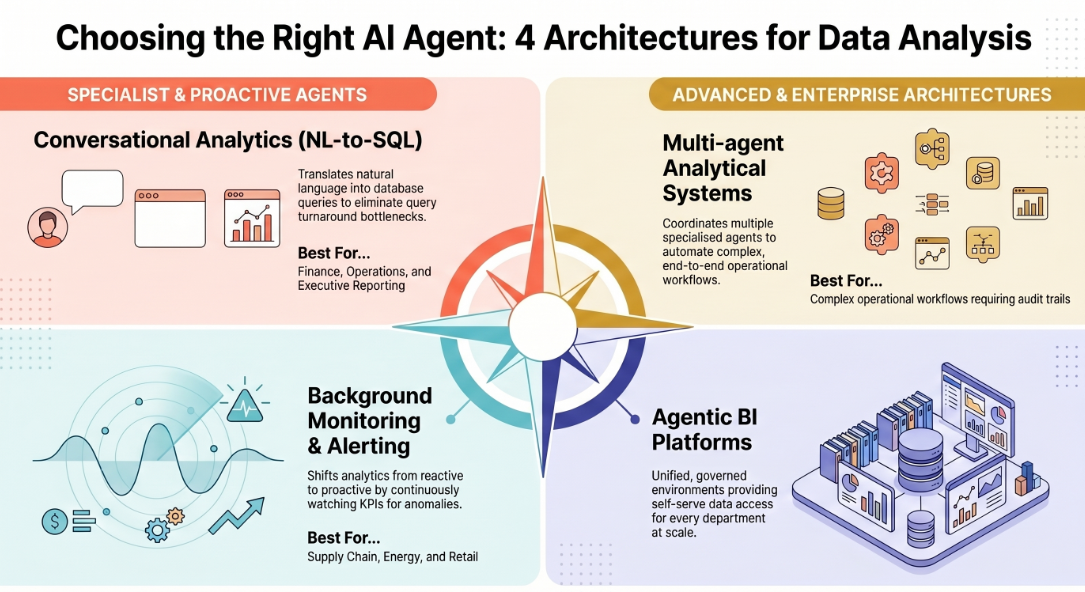
Not all AI data analysis agents work the same way. Understanding the four main types helps you match the right architecture to your primary bottleneck.
Conversational analytics agents (NL-to-SQL)
These agents translate natural language questions into database queries and return structured results. They are the most widely deployed form of AI data analysis agent and the natural entry point for organisations moving away from dashboard-dependent reporting.
The key differentiator among conversational agents is semantic understanding. An agent that just translates English to SQL is useful but limited. An agent that also understands your business definitions — and queries across multiple systems simultaneously, not just a single database — is transformationally different.
Best for: finance teams, operations, and executive reporting where the bottleneck is query turnaround time and analyst availability.
Background monitoring and alerting agents
These agents run continuously in the background, watching your KPIs and metrics against configurable thresholds. When something deviates — a supplier's delivery rate drops, a customer segment's churn rate spikes, a grid's power load hits an anomaly — the agent detects it, investigates the likely cause, and routes an alert with context to the right team.
This is the type of agent that shifts analytics from reactive to genuinely proactive. The value is not in the alert itself — it is in the speed of detection and the quality of the context delivered alongside it.
Best for: operations, supply chain, energy, retail — anywhere that continuous monitoring of high-volume data is impractical for humans but consequential when missed.
Multi-agent analytical systems
These systems coordinate multiple specialised agents in sequence. One agent monitors raw data. Another investigates anomalies. A third generates the narrative summary. A fourth routes the output to the right stakeholder and logs the action taken. Each agent handles a specific part of the analytical workflow, and the system orchestrates them toward a shared goal.
Multi-agent architectures are particularly powerful for end-to-end operational workflows — where the insight needs to translate directly into a task, alert, or approval, not just a report.
Best for: complex operational environments where insight and action need to be tightly coupled and auditable.
Agentic BI platforms (end-to-end)
These platforms combine conversational analytics, proactive monitoring, multi-source data access, semantic governance, and full audit trails in a single, governed environment. They are designed for enterprise deployment at scale — connecting to 12 or more data source types, supporting compliance requirements across multiple frameworks, and serving every department from a shared infrastructure.
This is the category that assistents.ai operates in. The goal is to give every team — finance, sales, operations, marketing, HR, executive — self-serve access to governed, cited answers from their data, without requiring a BI ticket or a data analyst as an intermediary.
Choosing the right type of AI data analysis agent depends on where your biggest bottleneck sits: query turnaround, anomaly detection, workflow automation, or all three simultaneously.
AI agents for data analysis in practice: industry results
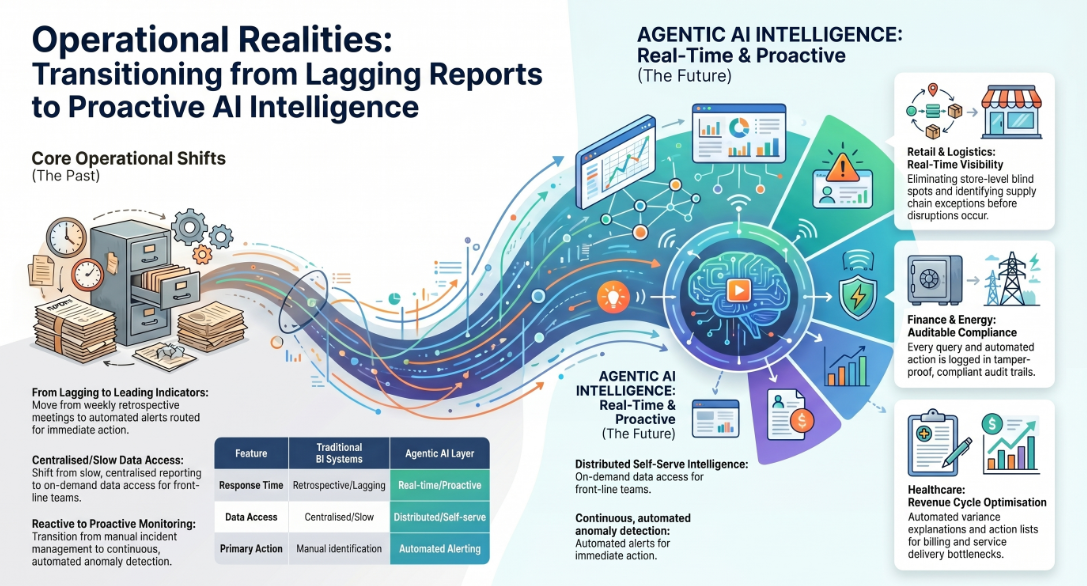
Theory matters less than evidence. The following outcomes come from real enterprise deployments of AI agents for data analysis across multiple industries. No client names are included — but the problems, approaches, and results are drawn directly from production implementations.
Retail: from store-level blind spots to real-time inventory intelligence
A national retail operation with over 700 stores across hundreds of cities faced a persistent problem: store managers and regional leadership had no fast, reliable way to query inventory levels, pricing data, or promotional performance across locations. Reporting was centralised, slow, and consistently behind the pace of trading decisions.
The deployment of an agentic data analysis layer — combining an inventory intelligence agent, a conversational analytics interface, and a knowledge agent over operational documentation — delivered measurable change. Store teams gained on-demand access to stock levels, pricing, and promotional data per location. Leadership gained a unified analytics view with automated KPI monitoring and exception alerting. Manual helpdesk burden dropped, and training turnaround accelerated through on-demand operational guidance.
The shift was from a centralised, slow reporting model to a distributed, self-serve intelligence layer — without increasing headcount in the data team.
Logistics and supply chain: port-to-inland analytics automation
A global ports and logistics operation managing terminal and rail assets across multiple geographies needed to digitise coordination between its port operations and inland logistics — and to give leadership real-time visibility into throughput, exceptions, and scheduling.
The agentic analytics deployment covered terminal workflow digitisation, rail scheduling and visibility, exception management, and executive dashboards with operational alerts. The result was higher predictability of terminal-to-rail throughput, more efficient coordination across what had been fragmented operational silos, and faster response to exceptions that had previously required manual identification across disconnected systems.
This is a category of problem — multi-site, multi-modal logistics coordination — where traditional BI tools generate reports after the fact. Agentic analytics generates alerts before the exception becomes a disruption.
Energy and utilities: smart grid monitoring and anomaly response
A state-level power transmission utility responsible for operating and maintaining transmission infrastructure across an entire region deployed AI agents for data analysis to address a critical operational challenge: the volume of sensor and utility data being generated by smart grid systems was exceeding the capacity of operations teams to monitor it manually.
The deployment included smart grid data ingestion, operational dashboards, predictive analytics for outages and losses, and automated alerting with workflow routing for field resolution. The outcome was higher operational visibility across grid operations, faster exception detection and response coordination, and a shift from reactive incident management to proactive grid operations via continuous monitoring.
For regulated infrastructure operators, the audit trail and governance features of the platform were as important as the analytics capability itself — every alert, every query, and every automated action was logged.
Financial services: omnichannel banking agents with full auditability
A global fintech provider serving banks and credit unions needed to modernise its customer support and dispute resolution operations — and to do so in a way that met compliance requirements across multiple jurisdictions.
The deployment covered omnichannel intake across chat, email, and voice channels; agent-assist summarisation and next-best actions; full auditability with tamper-proof logs; and integration with core banking systems. Hindi and English voice support was included for the relevant market.
The results included faster case handling, reduced operational load via automation, and materially improved compliance readiness via audit trails. For a financial services context, the last point is not incidental — it is what makes the system deployable at all.
Healthcare and staffing: revenue cycle analytics and care program performance
Two healthcare organisations — one a physician-led clinical enterprise running hospitalisation programs, the other a geriatric care services provider — deployed AI agents for data analysis to address persistent visibility gaps in revenue cycle management and care program performance.
For the inpatient operation, the agentic layer provided revenue and utilisation analytics with performance dashboards and variance explanations, plus action lists for billing workflow optimisation. For the geriatric care provider, program operations dashboards, staffing and service delivery analytics, and revenue cycle visibility with exception alerts delivered measurably faster identification of operational bottlenecks and improved decision support for leadership.
In both cases, the critical outcome was the same: moving from lagging indicators reviewed in weekly meetings to leading indicators surfaced automatically — and routed to the right person before the exception became a billing problem or a care gap.
Across every industry, the pattern is consistent: AI agents for data analysis shift organisations from retrospective reporting to proactive, evidence-backed decision-making — and the results are measurable in weeks, not years.
Key capabilities to look for in an agentic data analysis platform
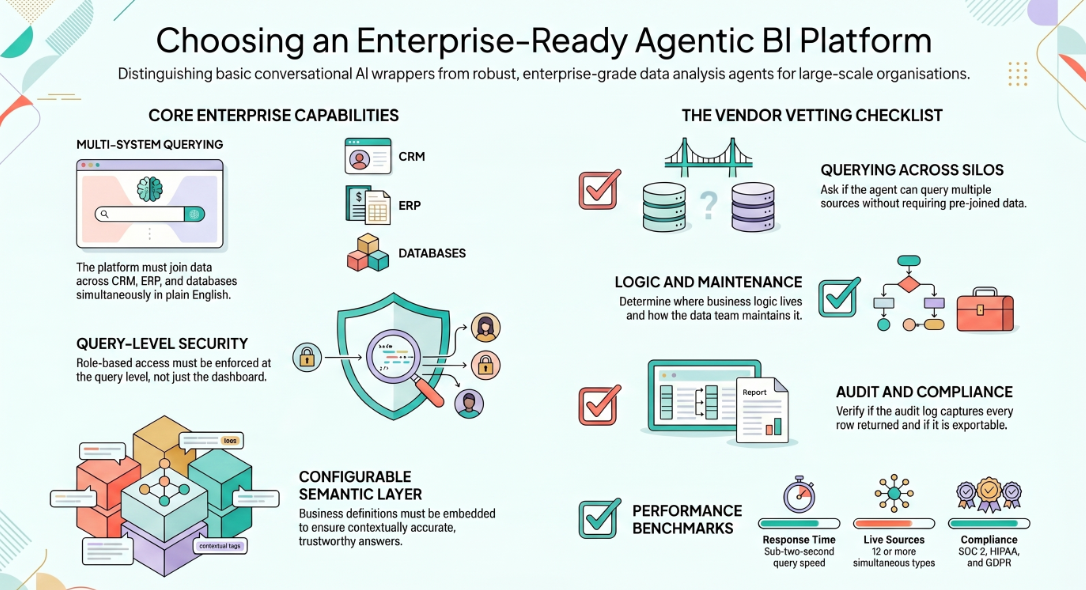
Not all platforms marketed as "AI agents for data analysis" deliver the same thing. Here is what separates genuinely enterprise-ready agentic BI from tools that are conversational wrappers on a single database.
Natural language query across multiple systems. The ability to ask a question in plain English and get an answer that draws from your CRM, ERP, database, and document stores simultaneously — not just one source. Cross-system joins are where most platforms fall short.
A semantic layer you can configure. Your business definitions need to be embedded in the system. Without a configurable semantic layer, every query relies on the platform's generic interpretation of your data. The result is technically correct but contextually wrong answers that erode trust quickly.
Role-based access enforced at the query level. Not at the dashboard level — at the query level. Finance data stays with finance. Sales sees only their pipeline. This is not a compliance checkbox; it is what makes governed self-serve analytics possible in a large organisation.
Full query audit trails. Every question asked, every source accessed, every row returned — logged, tamper-proof, and retrievable. This is the difference between a system you can deploy in a regulated industry and one you cannot.
Proactive anomaly detection and alerting. The platform should monitor your KPIs continuously and surface deviations before you ask. Configurable thresholds, automated alerts, and context-rich notifications are the baseline expectation.
Predictive analytics and trend detection. The ability to ask forward-looking questions and receive data-backed projections — not just historical summaries.
Compliance framework support. For most enterprise deployments, SOC 2, HIPAA, and GDPR are baseline requirements, not differentiators. PII redaction and configurable data retention policies should be automatic, not manual.
Speed at scale. Sub-two-second query response times across 12 or more live data source types. If the system is slower than a dashboard, adoption will not follow.
Five questions to ask any vendor before you commit:
- Can your agent query across our CRM, ERP, and data warehouse in a single question — without pre-joined data?
- Where does business logic live, and how do we configure and update it?
- What does the audit log capture, and can it be exported for compliance review?
- How does role-based access work when the same question is asked by two people with different data permissions?
- What does production deployment look like — how long does it take and what does the data team need to maintain?
The right agentic BI platform is one where the answers are governed, the sources are cited, and any stakeholder — regardless of technical background — can get a trusted answer from their data in seconds.
From first query to production: how fast can you deploy?
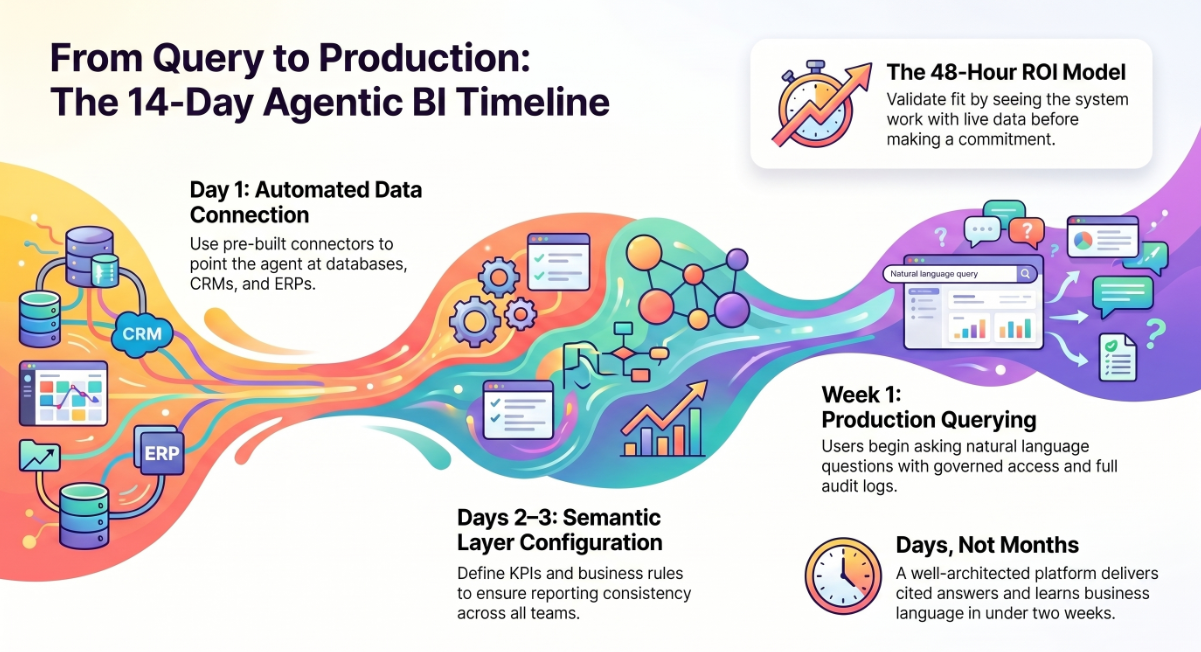
One of the most persistent misconceptions about enterprise AI analytics deployments is that they take months. A well-architected agentic BI platform with pre-built connectors and a structured onboarding process should get your team from first query to production in under two weeks.
Here is a realistic deployment timeline:
Day 1 — Connect your data sources. Pre-built connectors handle authentication and schema discovery automatically. Point the agent at your databases, CRMs, ERPs, and document stores. Most enterprise data source types are supported out of the box.
Days 2–3 — Configure the semantic layer. Define your metrics, KPIs, dimensions, and business rules. This is the most important configuration step, and it is also the one that pays the most ongoing dividends. Once your business logic is embedded, every query from every team uses the same definitions automatically — eliminating the single biggest source of reporting inconsistency in most organisations.
Week 1 — Deploy and start querying. Your team starts asking questions in natural language. Governed access ensures everyone sees only what they should. Audit logs capture everything from day one.
The 48-hour ROI analysis model — where a platform vendor commits to showing you what the system can do with your actual data before you commit — is the fastest way to validate fit. If a vendor is not willing to do this, that itself is informative.
The fastest path to value in agentic data analysis is a platform that connects to your live data, learns your business language, and delivers cited answers — in days, not months.
Next step: see agentic BI answer real questions from your data
The fastest way to understand whether an AI agent for data analysis is the right fit for your organisation is to see it work with your actual data — not a demo dataset.
assistents.ai's Agentic Business Intelligence platform connects to 12 or more enterprise data source types, delivers cited answers in under two seconds, and is built on the same governed infrastructure as every other agent in the platform. Natural language queries, cross-system joins, configurable semantic layers, full audit trails, and compliance framework support — production-ready in days, not months.
Book a Data Architecture Review — includes a 48-hour ROI analysis with your data.
Explore the Agentic BI platform
Frequently asked questions
What is an AI agent for data analysis?
An AI agent for data analysis is an autonomous software system that independently monitors, investigates, and delivers analytical insights from enterprise data — without requiring a human to write SQL, build dashboards, or manually identify what to look at. Unlike traditional BI tools, AI data analysis agents initiate their own investigations when metrics deviate, query across multiple systems simultaneously, and deliver finished answers with complete source citations.
How do AI data analysis agents differ from BI tools?
Traditional BI tools are reactive — they return data when queried and require humans to interpret it. AI data analysis agents are proactive — they monitor continuously, detect anomalies automatically, and deliver context-rich answers without being asked. They also query across multiple systems in a single request, which traditional BI tools cannot do natively.
How do AI agents actually analyse data?
They connect to live data sources, apply a semantic layer that encodes your business definitions, translate natural language questions (or autonomous triggers) into multi-system queries, join and process the results, and return cited answers. Every step is governed by role-based access controls and logged in a tamper-proof audit trail.
Do I need SQL knowledge to use an agentic analytics platform?
No. The entire value proposition of agentic data analysis is that any stakeholder — finance leaders, sales directors, operations managers, or executive leadership — can get accurate, cited answers from their data in plain English, with no technical training required.
How does data governance work in AI analytics agents?
Governance is enforced at the query level, not the dashboard level. Each query inherits the permissions of the user asking it — so finance data stays with finance, and sales teams see only their pipeline. All queries are logged with full audit trails, PII is auto-redacted based on user clearance, and data retention is configurable per source and compliance requirement.
What industries use AI agents for data analysis?
The broadest adoption is in retail, financial services, logistics and supply chain, energy and utilities, healthcare, and professional services — industries where data volumes are high, decisions are time-sensitive, and the cost of slow analysis is visible. The governance and audit trail capabilities of enterprise-grade platforms also make them deployable in regulated industries where less auditable tools cannot go.
How long does it take to deploy an AI data analysis agent?
A well-architected platform with pre-built connectors and structured onboarding should reach production within one to two weeks. Day one is data source connection. Days two to three are semantic layer configuration. By the end of week one, your team is querying in natural language with full governance active.
What is the ROI of agentic BI?
ROI manifests in three main areas: analyst time recovered from recurring reporting requests, faster decision cycles enabled by proactive alerting and self-serve access, and earlier detection of operational exceptions before they escalate into costly problems. Organisations typically see measurable time savings within the first weeks of deployment.
What is a semantic layer in AI analytics?
A semantic layer is the configuration that maps your organisation's business definitions — what "active customer," "qualified pipeline," "margin," or "at risk" mean specifically to you — into the analytics system. Once configured, every query uses those definitions automatically, ensuring consistent answers across every team and every question.
How do AI agents for data analysis handle data security?
Enterprise platforms enforce role-based access controls, support SOC 2, HIPAA, and GDPR compliance, auto-redact PII based on user clearance, and log every query in a tamper-proof audit trail. Connection to data sources is read-only by default, with write access gated behind explicit governance controls.