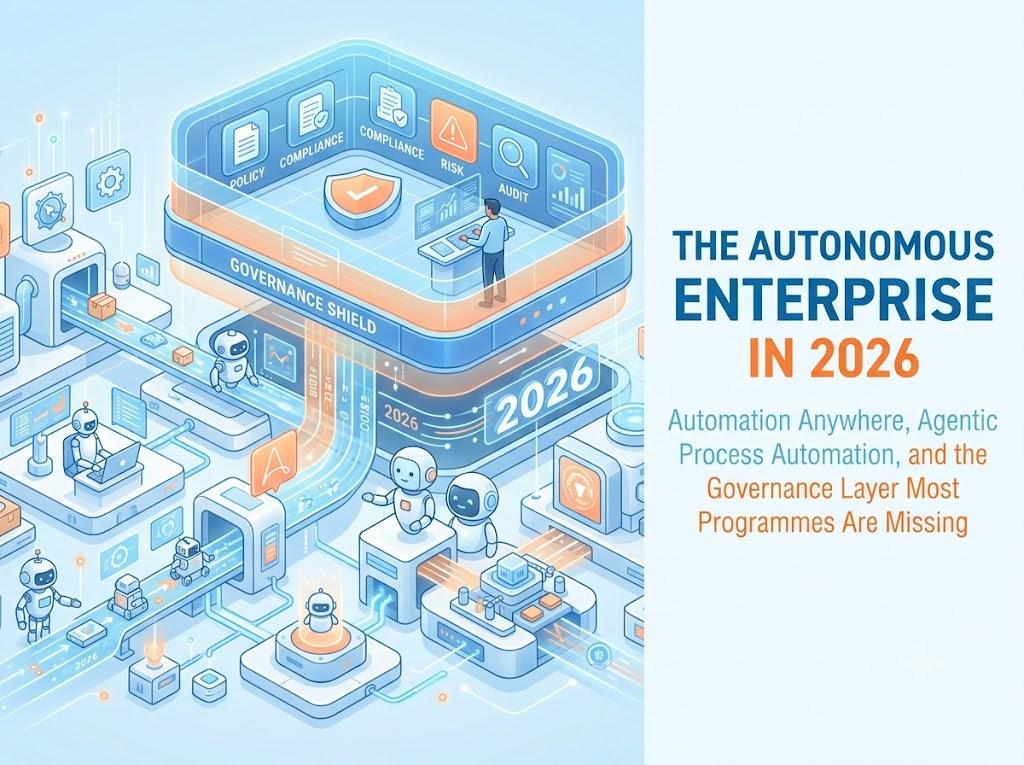
An autonomous enterprise is an organisation in which a governed digital workforce performs an increasing share of operational work under explicit human authority, enterprise policy and measurable accountability. It is not an enterprise without people. The working definition that survives an audit is five clauses long: human-led strategy, human-owned accountability, agent-operated processes, exception-managed control, outcome-driven improvement.
Almost every article on this subject describes the destination. Very few describe the control architecture required to arrive there safely. This one does both.
What is an autonomous enterprise?
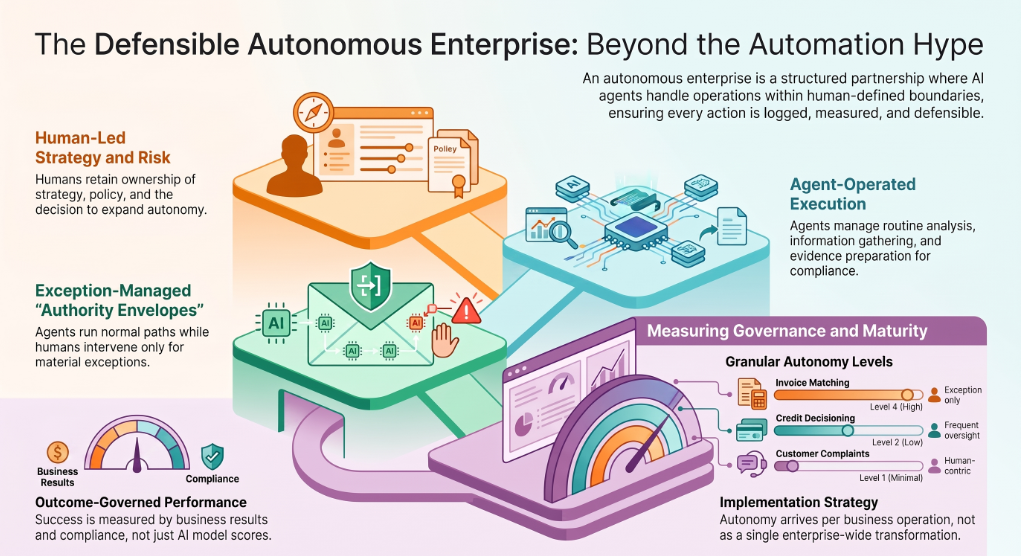
An autonomous enterprise is a business where AI agents perform continuing operational responsibilities alongside human employees, within defined authority, with every material action logged and every outcome measured.
That definition does a lot of work, so it is worth unpacking what it excludes.
The definition most vendors give
The common vendor framing is an organisation that operates, adapts and optimises its workflows on its own with minimal human intervention. Typical claims put more than half of processes running independently and up to 80% of enterprise work automated or AI-assisted.
That framing is directionally useful and commercially seductive. It is also incomplete in a way that costs enterprises money. It describes a state without describing the controls that make the state defensible to a regulator, an auditor, a board risk committee or a customer whose account an agent just touched.
The definition that survives an audit
A more rigorous definition has four properties.
It is human-led. Humans retain purpose, strategy, risk appetite, policy ownership, material commitments, regulated accountability, novel judgement, operating model design, agent certification and the decision about when autonomy expands or contracts.
It is agent-operated. Agents increasingly own continuous monitoring, information gathering and reconciliation, document work, routine analysis, follow-ups and communications, process coordination, decision preparation, standard exception handling, bounded transactions, evidence and compliance preparation, and outcome verification.
It is exception-managed. The mature operating model is neither human approval on every step — which preserves the original bottleneck — nor unrestricted autonomy, which creates unacceptable risk. Agents run the normal path inside a defined authority envelope. Humans define the envelope and manage material exceptions. The platform observes both continuously.
It is outcome-governed. Autonomy cannot be justified by model benchmark scores. The enterprise must know whether the digital workforce completed work correctly, complied with policy, created rework, increased customer friction, reduced cycle time, protected revenue or introduced new risk.
What "autonomous" does not mean
It does not mean lights-out operations. It does not mean removing human accountability — accountability cannot be delegated to software under any regulatory regime currently in force. It does not mean automating every decision. And it does not mean a single enterprise-wide transformation programme. In practice, autonomy arrives one bounded business operation at a time, and it arrives at different levels for different work types inside the same company.
An enterprise can legitimately be running Level 4 autonomy in invoice matching, Level 2 in credit decisioning and Level 1 in customer complaints — simultaneously. Any maturity model that forces a single organisation-wide score is measuring the wrong thing.
How Automation Anywhere defines the autonomous enterprise
Automation Anywhere has done more than any other vendor to popularise this category, and its position deserves a fair summary before any critique.
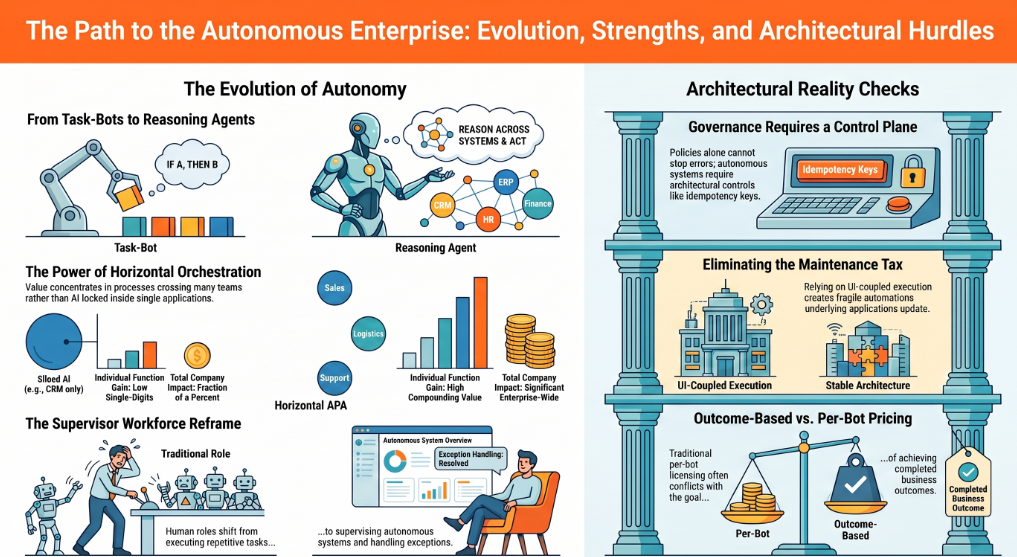
The company's argument runs roughly as follows. Traditional robotic process automation handled structured, rule-based tasks efficiently but struggled with unstructured data and could not reason. Intelligent automation added machine learning to widen the surface. Agentic process automation, in their framing, is the current phase: AI agents that reason, decide and act across previously siloed systems such as ERP, CRM, supply chain and finance, coordinated by an orchestration layer rather than deployed as isolated bots.
The company positions this as a shift in operating model rather than a tooling upgrade, with a five-stage progression from human-led AI assistance through to fully autonomous operations, and cites large-enterprise deployments in energy, banking and healthcare as evidence.
What the APA framing gets right
Three things, and they matter.
The silo critique is correct. Deploying AI inside a single application ecosystem — AI in the CRM, AI in the ERP — reinforces the functional boundaries that create the inefficiency in the first place. The arithmetic Automation Anywhere uses to make this point is genuinely instructive: even aggressive assumptions about AI augmenting a sales team's CRM work produce a low single-digit efficiency gain for that function and a fraction of a percent for the company overall. Value concentrates in long-running, horizontally complex processes that cross many systems and teams. That is a correct and under-appreciated observation.
Orchestration is the right unit of coordination. Individually managing integrations and use cases does not scale past a few dozen automations. Something has to sit above them.
The workforce reframe is honest. The position that autonomy elevates human work rather than eliminating it, and that employees move from executing tasks to supervising systems and handling exceptions, is the correct read of what actually happens in deployments.
Where a bot-rooted architecture runs out of road
The disagreement is architectural, not commercial.
Governance is presented as a programme, not a runtime. The published guidance on governing autonomous systems centres on developing frameworks, designating accountability, providing transparency and incorporating human intervention. Every one of those is necessary. None of them is a control plane. A governance committee cannot stop an agent from executing a duplicate payment at 2am. An idempotency key can. The gap between governance-as-policy and governance-as-architecture is where most agentic programmes fail.
UI-coupled execution carries a permanent maintenance tax. Automation built on screen selectors and recorded interactions breaks whenever the underlying application changes. Enterprises with large bot estates routinely report that a substantial share of their automations require ongoing maintenance simply to keep running. Layering generative reasoning on top of that substrate improves flexibility at the edges without changing the underlying fragility.
Per-bot and per-seat commercial models fight the architecture. If the unit of value is a completed business outcome, but the unit of billing is a licensed robot or a named user, the vendor and the customer are optimising for different things. The industry is visibly moving toward work-based and consumption-based pricing for exactly this reason, and buyers should model TCO accordingly.
The 80% figure floats unbounded. Claims about the automatable share of enterprise work are useful for direction-setting and useless for planning. The honest version is that autonomy is earned per work type, based on demonstrated performance, not granted per enterprise based on a platform purchase. The residual work — exceptions, escalations, supervision, evidence preparation — has a real and often underestimated cost that belongs in the business case.
None of this makes agentic process automation the wrong direction. It makes it an incomplete answer to a question that has become larger than automation.
The agency gap: why digitised enterprises are still manual
The modern enterprise is highly digitised and profoundly manual at the same time.
ERP systems record orders, inventory, invoices and postings. CRM records prospects and interactions. HCM records employees and positions. Warehouses and BI platforms aggregate all of it into metrics and dashboards. What remains almost entirely outside these systems is the work required to move from a changing business state to an improved business outcome.
A dashboard shows that collections are deteriorating. A person still has to determine which accounts matter, assemble the context, decide the intervention, communicate with the customer, record the promise, escalate the dispute, update three systems and verify that cash actually arrived. A supply chain system projects a shortage. A planner still investigates causes, compares options, obtains approvals, creates transactions and monitors execution.
This is the agency gap, and it can be stated in four lines:
- Enterprise state is digitised.
- Enterprise work is fragmented.
- Enterprise accountability remains human.
- Enterprise improvement is manually coordinated.
Traditional automation only addresses the portion of work that can be specified in advance. Workflow engines, rules engines, integration platforms and RPA are effective when the path is known, inputs are structured and exceptions are rare. They become expensive and brittle the moment work depends on documents, ambiguous language, evolving context, cross-functional reasoning or circumstances nobody anticipated.
The genuine breakthrough of modern AI agents is not conversation. It is that software can now perform a bounded form of adaptive knowledge work: interpret an objective, assemble evidence, select tools, decompose a task, revise a plan, communicate in natural language and collaborate with other specialised systems. That expands the economically automatable surface of the enterprise for the first time in roughly a decade.
The missing category: a System of Agency
Enterprise software has four established categories.
- Systems of Record store authoritative transactions and master data.
- Systems of Intelligence analyse, model, predict and represent knowledge.
- Systems of Engagement provide interfaces for employees, customers and partners.
- Systems of Automation execute predefined processes and integrations.
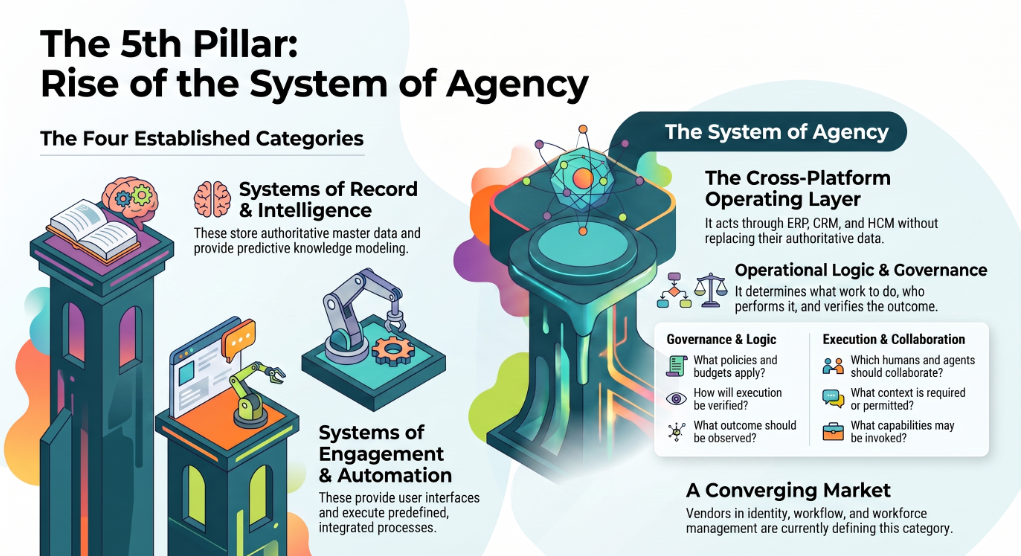
AI agents create the need for a fifth: a System of Agency.
A System of Agency answers a distinct set of operational questions that none of the four existing categories was designed to handle:
- What work needs to be done, and why?
- What objective, service level or obligation does that work serve?
- Who or what should perform it?
- Which humans and which agents should collaborate on it?
- What context is required, and what context is permitted?
- Which capabilities may be invoked?
- What policies, approvals, budgets and limits apply?
- How will execution be verified?
- What outcome should be observed, and when?
- What should be learned about the worker and about the process?
A System of Agency is not a replacement for enterprise applications. It is an operating layer across them. It reads from and acts through ERP, CRM, HCM, industry systems, warehouses, document repositories and communication channels while leaving each of those authoritative for its own transactions.
The market is converging on this from several directions at once — workforce management vendors approaching it from agent rosters and roles, identity vendors approaching it from agent identity and least privilege, workflow vendors approaching it from action fabrics and control towers, and ontology platforms approaching it from operational context. No single starting point yet defines the category. What is no longer in dispute is that the category exists.
The autonomous enterprise maturity model (Levels 0–5)
Most published maturity models describe what an organisation looks like at each stage. Very few state what the platform must provide for the organisation to operate there safely. The fourth column below is the one that matters when you are writing a business case or an RFP.
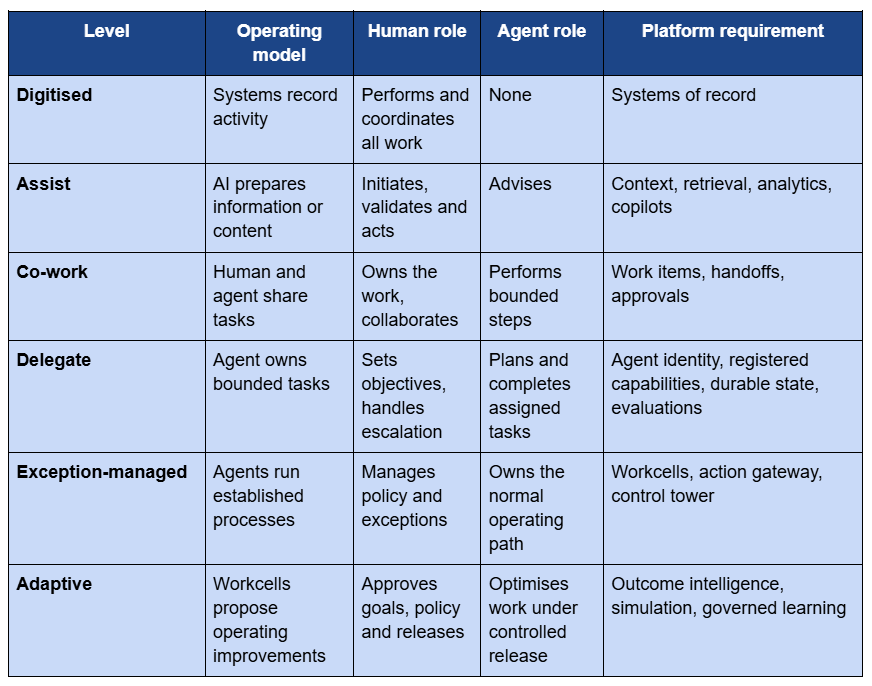
Levels 0–1: Digitised and Assist
This is where the majority of enterprises sit today, whatever their internal narrative says. Drafting, summarisation, search, question answering, code assistance. These reduce individual effort and leave the operating model unchanged. A human still initiates the task, evaluates the output, performs the action and remains the system that remembers what happens next.
Level 1 is not a failure. It is a legitimate stage that produces real productivity. It is only a failure when it is reported to a board as agentic transformation.
Levels 2–3: Co-work and Delegate
The transition from Level 1 to Level 2 is where the platform requirements change qualitatively. Work must become durable. A chat session is not a business process; an agent run is not an operating outcome. Every material activity needs to belong to a persistent mission, process, case or task with an owner, state, deadline, context, action history and outcome — something that survives the model session that created it.
Level 3 adds the requirement that breaks most pilots: the agent must have an identity of its own, a set of registered capabilities it is permitted to invoke, durable state across long-running work, and an evaluation suite that demonstrates it performs the work type acceptably before it is allowed to perform it unattended.
Level 4: Exception-managed operations — where the economics arrive
This is the level at which the business case stops being about individual productivity and starts being about operating cost, cycle time and working capital. Agents run the normal path. Humans manage the envelope and the exceptions. The requirement is a control plane: registered capabilities, an action gateway, autonomy policies, and a control tower where management can see work, workforce, risk, cost and outcomes in business terms rather than technical logs.
Most enterprises should be commercialising Levels 2 through 4. Most platforms should be architected for Level 5.
Level 5: Adaptive — and why almost nobody should buy for it yet
At Level 5, workcells propose operating improvements — changes to prompts, tools, routing, thresholds or procedures — and humans approve goals, policy and releases. The critical constraint is that self-improvement must never mean uncontrolled self-modification. Every proposed production change moves through offline evaluation and a governed release path.
Buying today for Level 5 is how programmes acquire capability they cannot govern. Design for it. Deploy into it slowly.
How to score your organisation in 20 minutes
Pick your three highest-volume operational processes. For each, answer: does the work persist outside a chat session? Does the agent have its own identity? Are its permitted actions registered somewhere a human can list them? Is there an evaluation record from before it went live? Can you produce, for a regulator, an immutable log of every action it took last Tuesday?
The lowest honest answer across those five questions is your real level for that process. It is usually lower than the slide deck says.
The five components of an autonomous enterprise platform
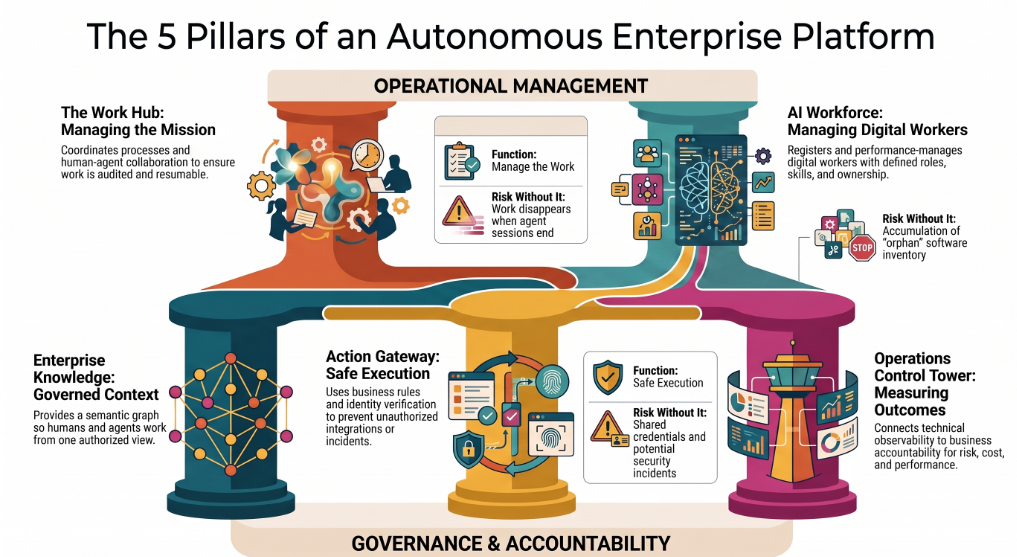
Whatever the vendor calls them, an autonomous enterprise platform has to provide five things.
Work Hub — manage the work. Missions, processes, cases, tasks, queues, service levels, handoffs and human-agent collaboration. Without it: work lives inside agent sessions, disappears when they end, and cannot be reassigned, audited or resumed.
AI Workforce — manage the workers. Create, register, deploy, assign, certify and performance-manage digital workers with roles, ownership, skills, capacity, budgets and performance history. Without it: you accumulate an inventory of software nobody owns.
Enterprise Knowledge — give them context. A governed operating graph, semantic metrics, documents, policies, memories and purpose-bound context, so humans and agents work from the same authorised view. Without it: agents receive either too little context to be useful or too much to be safe.
Action Gateway — let them act safely. Enterprise capabilities exposed through identity, business rules, approvals, limits, idempotency, postcondition verification and compensation. Without it: every integration is a potential incident and every credential is shared.
Operations Control Tower — measure the outcome. Work, workforce, risk, cost, process performance, incidents and business outcomes in one operational view. Without it: you have technical observability and no business accountability, which are not the same thing and are frequently confused.
Why Assistents.ai for the autonomous enterprise
Assistents.ai is an agentic intelligence platform built to orchestrate, govern and run AI agents on infrastructure the enterprise controls. The design premise is that the hard part of enterprise autonomy is not model capability — it is context, authority and evidence.
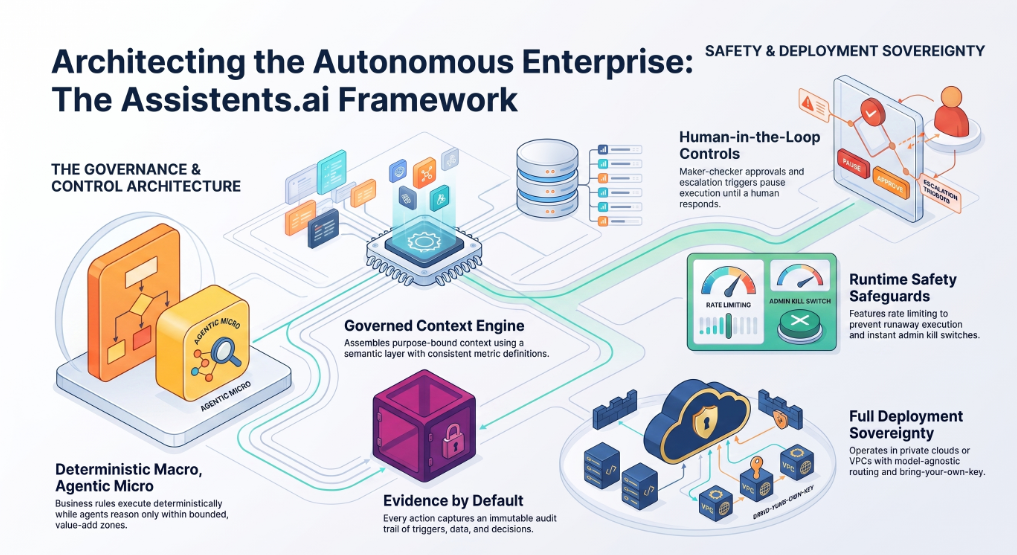
Governed context, not raw data access. The Context Engine assembles purpose-bound, provenance-rich context for each piece of work rather than granting agents broad access to source systems. A semantic layer holds consistent metric definitions, hierarchies and formulas, so an agent answering a question about margin uses the same definition as the finance team. Text-to-SQL runs over governed data with row-level security and attribute-based access control applied at query time, not after.
Deterministic control above the model, not inside it. Business rules and decision tables execute deterministically. Workflows own process state, approvals, deadlines and retries. Agents reason inside bounded zones where interpretation genuinely adds value. This is the principle we describe as deterministic macro, agentic micro, and it is the single most important architectural decision in the platform.
Human-in-the-loop as a first-class control. Maker-checker approvals, escalation triggers tied to thresholds and confidence scores, approval gates that pause execution until a named human responds, and scope boundaries that constrain which systems any given agent may read from and write to.
Evidence by default. An immutable audit trail captures what triggered an action, what data was read, what decision was made and what action was taken — exportable and searchable for audit, dispute and regulatory purposes.
Runtime safety controls. Rate limiting caps actions per hour, day or week to prevent runaway execution. Kill switches pause or disable any agent instantly from the admin console, taking effect immediately for both scheduled and event-driven agents.
Multi-agent orchestration with open interoperability. Agents coordinate through conditional chains where one agent's output triggers the next, and the platform supports MCP and A2A so existing agents, tools and systems participate rather than being replaced.
Model neutrality and deployment sovereignty. Model-agnostic routing across providers, bring-your-own-key, and deployment into private cloud, VPC or on-premises environments — which for regulated and infrastructure-heavy operators is a qualifying question, not a preference.
Breadth on one platform. Conversational agents, voice agents, autonomous background agents, document intelligence, business intelligence and a low-code application and workflow builder run on the same context layer, the same governance layer and the same audit infrastructure.
Agent sprawl: the failure mode nobody put in the brochure
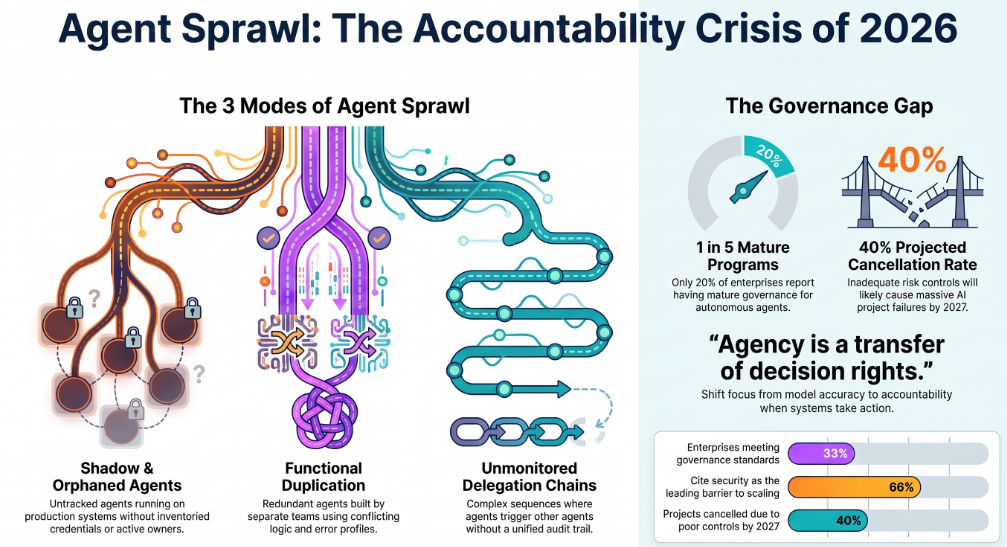
The dominant risk in 2026 is not that agents are too weak. It is that enterprises can build agents considerably faster than they can build accountability for them.
Recent research on agentic governance describes this as agent sprawl — the proliferation of redundant, ungoverned and conflicting AI agents across business functions. The published taxonomy is uncomfortably recognisable:
- Functional duplication — three teams independently build an invoice-reading agent, each with different extraction logic and different error profiles.
- Shadow agents — agents created outside any registry, running against production systems with credentials nobody has inventoried.
- Orphaned agents — the person who built it left; the agent still runs; nobody knows what it does or whether it should.
- Permission creep — an agent granted temporary access to close an incident that was never revoked.
- Unmonitored delegation chains — agent A calls agent B calls agent C, and no single log shows the full path from trigger to consequence.
The supporting numbers are consistent across independent sources. Only around one in five enterprises reports mature governance for autonomous agents. A widely cited analyst projection expects roughly 40% of agentic AI projects to be cancelled by 2027, with inadequate governance and risk controls among the principal causes. A major 2026 trust survey found only about a third of enterprises meeting governance standards for autonomous agents, with security cited by two-thirds of respondents as the leading barrier to scaling.
The conceptual shift underneath these numbers is the one to take to your board: agency is not a feature, it is a transfer of decision rights. The governance question stops being "is the model accurate?" and becomes "who is accountable when the system acts?"
That question has an architectural answer, and it is the next section.
Autonomy is earned, not granted: the authority model
Authority as a computed intersection
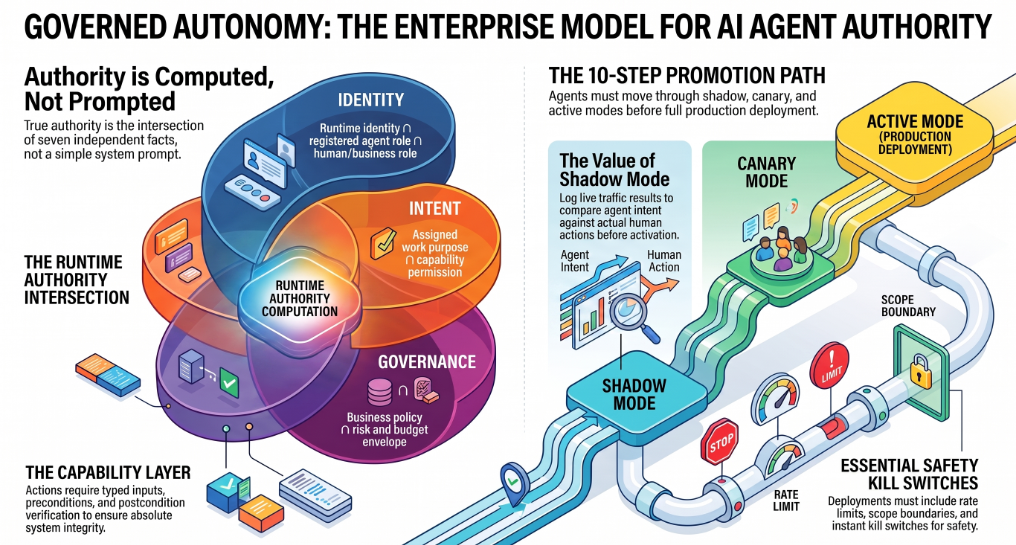
The central technical claim of this article is that agent authority must be computed at runtime, not asserted in a prompt. A system prompt that says "you may only refund up to $500" is a suggestion. Authority is the intersection of seven independently maintained facts:
runtime identity
∩ registered agent role
∩ delegating human or business role
∩ assigned work purpose
∩ capability permission
∩ business policy
∩ risk and budget envelope
If any one of those is absent or stale, the action does not execute. This is what separates a governed agent from a well-behaved one. Well-behaved agents fail gracefully most of the time. Governed agents cannot exceed their authority even when the model is wrong, jailbroken or confused.
Capability, not tool call
A production action is not an arbitrary tool call. It is a registered business capability with:
- typed inputs and a declared contract
- preconditions that must hold before execution
- explicit permissions and, where required, approval gates
- an idempotency key, so a retry cannot create a duplicate payment or a duplicate order
- postcondition verification, so the system confirms the action actually took effect
- a compensation path where reversal is possible, and an explicit acknowledgement where it is not
Most agentic incidents in production are not reasoning failures. They are duplicate executions, partial completions and unverified writes — all of which are solved at the capability layer, not the model layer.
The promotion path
No agent should reach production authority in one step. Every material change to an agent, workcell, model, tool, policy or autonomy contract should move through:
Draft → Test → Offline evaluation → Replay and simulation → Review → Shadow → Canary → Active → Monitor → Restrict or roll back
Shadow mode is the most underused control in the industry. Run the agent against live traffic, log what it would have done, and compare against what humans actually did. Two weeks of shadow data is worth more than any benchmark score in deciding whether to activate.
Kill switches, budgets and blast radius
Three controls belong in every deployment from day one. Rate limits cap actions per hour, day or week and prevent runaway loops. Scope boundaries define which systems each agent may touch — an invoice agent that can read email and write to the ERP must not be able to reach HR systems or modify contracts. Kill switches pause or disable any agent instantly, with immediate effect.
If a vendor cannot demonstrate all three in a live console during evaluation, the platform is not ready for Level 3 work.
The Agentic Workcell: what enterprises should actually buy
Enterprises do not ultimately want agents. They want the reliable performance of a business operation.
An Agentic Workcell is a governed human-agent team configured to own a defined business operation and its outcomes. It packages twelve things:
business objective and scope · work intake and prioritisation · process definitions and playbooks · digital roles and human roles · context and ontology bindings · skills, models and capabilities · integrations and channels · policies, approvals and autonomy contracts · applications and workspaces · service levels, budgets and capacity · evaluation suites · outcome metrics
Natural candidates include accounts receivable, procurement operations, retail store operations, lending operations, finance close, employee operations and logistics coordination.
Workcell packaging is strategically superior to selling isolated agents for four reasons. It aligns the platform to an accountable business outcome rather than a technical artefact. It naturally includes humans in the operating design rather than treating them as a fallback. It creates a reusable unit of deployment. And it supports land-and-expand without asking a customer to redesign the entire enterprise before receiving any value.
Autonomous enterprise examples: what production actually looks like
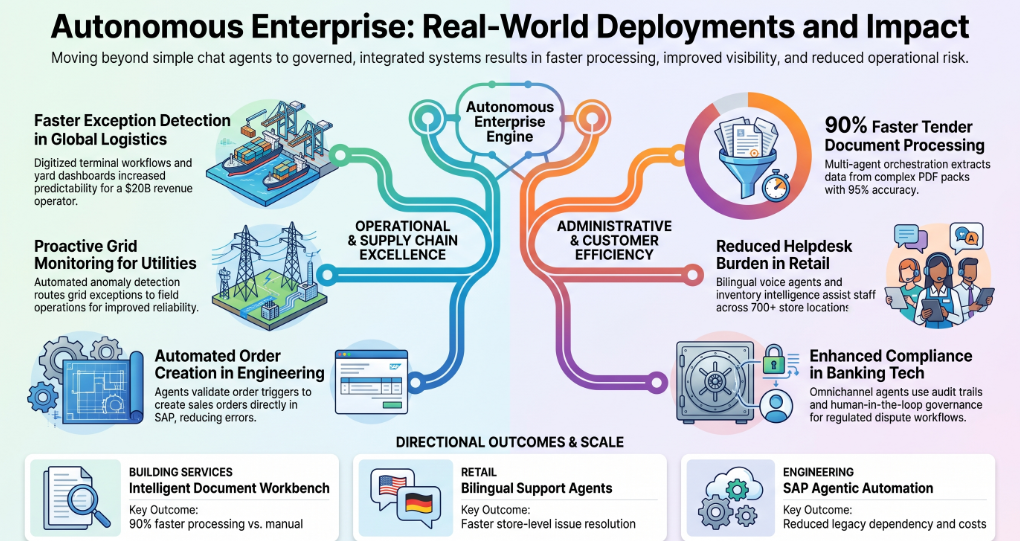
The following are anonymised from production deployments across ports and logistics, retail, utilities, banking technology, healthcare staffing, engineering services and diversified conglomerates. Client names are withheld. Outcomes are directional, not guaranteed benchmarks — results depend on data quality, process maturity and integration depth.
Global ports and logistics operator (multi-continent, roughly $20B annual revenue). Deployed: terminal workflow digitisation with yard and rail operational dashboards, rail scheduling and visibility, exception management, and executive alerting across port-to-inland logistics. Governance applied: operational exception routing with escalation to named human owners; audit logging on operational actions. Directional outcome: improved operational visibility, faster exception detection, and higher predictability of terminal-to-rail throughput.
Pan-India value retailer operating more than 700 stores across hundreds of cities. Deployed: a bilingual voice support agent for store staff in Hindi and English, an inventory intelligence agent covering pricing, stock and promotions at store level, and a knowledge and training agent running retrieval over point-of-sale documentation and standard operating procedures — with an admin console, analytics and ticketing integration. Governance applied: scope boundaries per agent, escalation to the human helpdesk on low-confidence responses, full interaction logging. Directional outcome: reduced manual helpdesk burden, faster store issue resolution, improved store-level inventory visibility and faster staff onboarding through on-demand guidance.
Diversified family business group in the Gulf, comprising more than 30 operating companies. Deployed: automated procurement and finance KPI alerting across group entities — purchase price trend movement, gross margin impact, early-payment analysis against notional finance cost, and vendor performance on delivery and returns — with scheduled insight packs for leadership. Governance applied: standardised metric definitions across entities through a semantic layer; alert thresholds owned by finance rather than by the agent. Directional outcome: earlier detection of margin erosion and vendor slippage, standardised finance and procurement intelligence across entities, and fewer variance surprises at period close.
Remedial building services specialist in Australia (20+ years in waterproofing diagnostics and commercial works). Deployed: an intelligent document workbench using multi-agent orchestration for tender retrieval, workflow determination and revision analysis, with vision-model extraction from complex PDF tender packs and deep two-way integration into the field service management system, including quote locking and audit logs. Governance applied: quote locking to prevent concurrent modification, revision and change detection across tender versions, immutable audit logs on every document action. Directional outcome: engineered for up to approximately 90% faster tender document processing against a roughly 95% extraction accuracy target on standard formats, with reduced bid risk through revision detection and auditability.
Global banking technology provider serving banks and credit unions. Deployed: omnichannel service agents across chat, email and phone with workflow routing, agent-assist summarisation and next-best-action generation, integrated with core systems. Governance applied: auditability and SLA monitoring on every case; human agent-assist rather than unattended action on regulated dispute workflows. Directional outcome: faster case handling, improved consistency, reduced operational load through automation and better compliance readiness through audit trails.
State-level power transmission utility. Deployed: transmission KPI monitoring with anomaly detection, loss and outage analytics, predictive maintenance indicators, and automated alerting routed to field operations. Governance applied: alert thresholds owned by operations engineering; agents surface and route, humans dispatch. Directional outcome: faster identification of grid exceptions and operational risks, improved reliability through proactive monitoring, and better operational transparency for leadership.
Privately held retail holding group. Deployed: a unified context engine spanning structured and unstructured data, a semantic governance layer holding rules, hierarchies and formulas, and insights-to-action agents layered on top of existing dashboards to convert insight into governed, auditable tasks. Governance applied: standardised decision logic across teams, automated task creation with completion tracking, full action audit. Directional outcome: a shift from reactive reporting toward proactive execution loops, with standardised decision logic and traceable task completion.
Engineering and technology solutions provider in the Gulf (established 1972). Deployed: agentic automation to interpret order triggers, validate them and create sales orders directly in SAP, as part of a transition away from an end-of-life enterprise content system carrying high licensing cost — with rules and governance for exceptions and approvals, plus audit logs and reconciliation reporting. Governance applied: deterministic validation rules ahead of the write, approval gates on exceptions, reconciliation reporting on every created order. Directional outcome: reduced manual order processing and legacy dependency, faster order-to-confirm cycles with fewer data-entry errors, and improved auditability for order creation and exceptions.
The pattern across all eight is consistent, and it is the practical argument of this entire article: the agent is never the interesting part. The trigger, the context, the boundary and the log are.
Why Assistents.ai wins where bot-first platforms stall
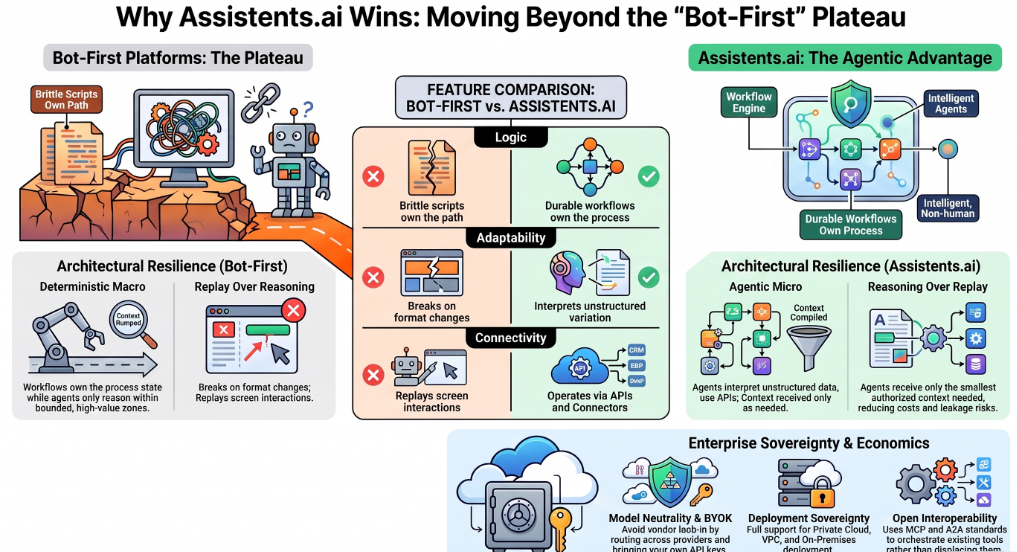
The first Assistents.ai section covered capability. This one covers architecture and economics — the reasons enterprises switch after an RPA-rooted programme plateaus.
Deterministic macro, agentic micro
Durable workflows own process state, approvals, deadlines, retries and compensation. Agents reason only inside bounded zones where interpretation and judgement add value. Bot-first platforms invert this: the automation script owns the path and the model is bolted on to handle variance. That inversion is why those estates require continuous maintenance and why their failure modes are hard to reason about.
Reasoning over replay
Traditional RPA replays recorded interactions and breaks when a form field moves or an email template changes. Assistents.ai agents interpret unstructured inputs, adapt to format variation, handle exceptions by escalating rather than guessing, and operate across systems through APIs, webhooks, inboxes and connectors rather than through screen coordinates. There are no brittle scripts to maintain as a permanent line item.
Model neutrality as a procurement position
Model-agnostic routing across providers and bring-your-own-key means the durable assets are the work model, the context, the capabilities, the policies and the outcome history — not a dependency on any single model vendor's roadmap or pricing. This is a negotiating position as much as a technical one.
Deployment sovereignty
Private cloud, VPC and on-premises deployment. For banks, utilities, healthcare providers, port operators and government-adjacent enterprises, this is frequently the first qualifying question in an RFP and the reason many otherwise capable platforms are eliminated in round one.
Context compiled, not dumped
Agents receive the smallest authorised context package needed for the work, with provenance and temporal consistency. Broad, direct access to enterprise data increases cost, increases leakage risk and measurably degrades reasoning quality. Compiling context is harder to build and materially safer to run.
Open by design
MCP and A2A interoperability means existing agents, internal models, third-party tools and incumbent enterprise systems participate in the operating layer rather than being displaced by it. Assistents.ai is designed to be an orchestration and governance layer, not another closed suite competing for the whole estate.
An honest roadmap
Some of what a full System of Agency requires ships today on Assistents.ai: governed conversational analytics with a semantic layer, the Context Engine, multi-agent orchestration, deterministic rules and decision tables, workflow with human tasks and approvals, document intelligence, voice agents, row-level security and attribute-based access control, immutable audit trails, rate limiting and kill switches, model-agnostic routing with BYOK, MCP and A2A support, native connectors across common warehouses and databases, and private, VPC or on-premises deployment.
Other elements are on the platform roadmap rather than shipped today, and we say so plainly: a general Enterprise Work Kernel, a Digital Workforce System of Record for agent identity and lifecycle, a formal Capability Registry and Action Gateway, an Enterprise Operating Graph, outcome contracts, skill-based work routing, autonomy policy services and a business-level Operations Control Tower.
On a market where every vendor claims every capability, the distinction between shipped and planned is the most useful information a buyer can be given.
How to measure an autonomous enterprise programme
Usage, tokens, calls and acceptance rates are secondary metrics. They tell you the software is running. They do not tell you the business is better. Measure across four families.
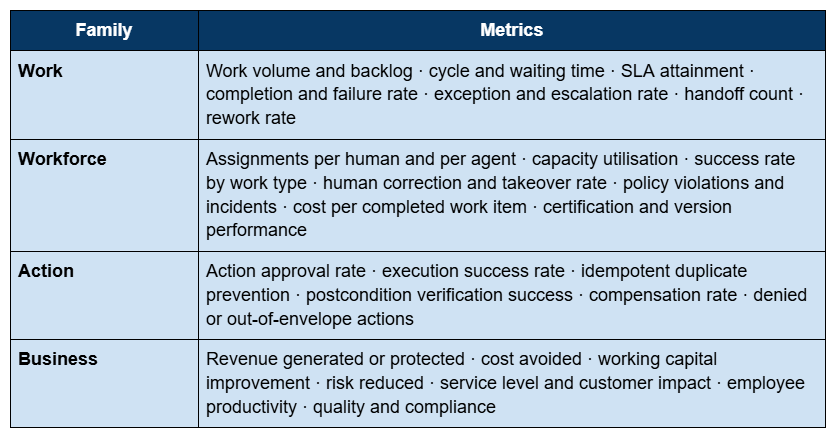
Two of these deserve special attention because they are the honest early-warning signals. Human takeover rate tells you whether autonomy is real or theatrical. Rework rate tells you whether speed is being purchased with quality. A programme with falling cycle time and rising rework is not improving; it is moving the cost downstream.
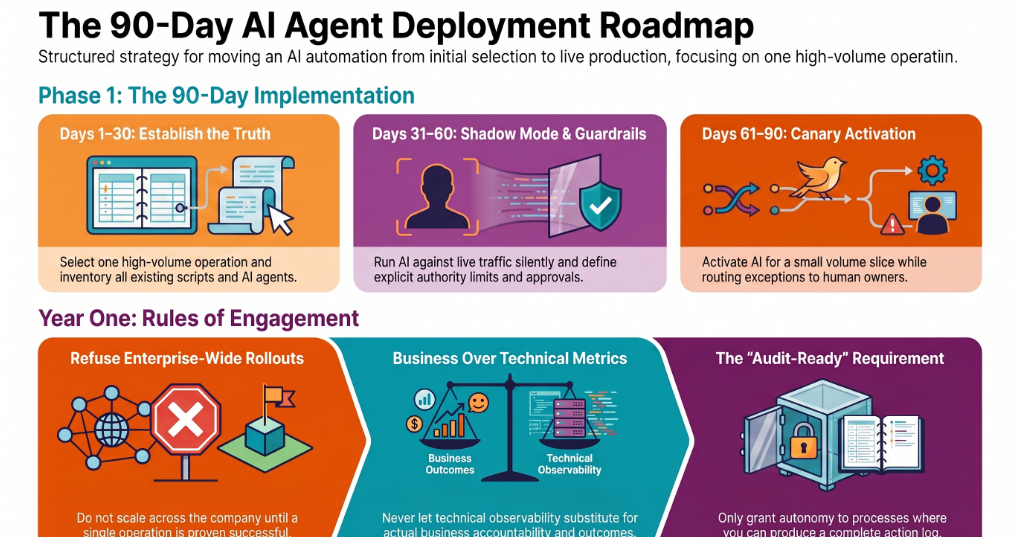
Your first 90 days
Days 1–30: choose one operation and establish truth
Select a single high-volume operation with a measurable outcome — invoice matching, tender intake, tenant service, order creation, collections follow-up. Baseline the work metrics before anything is deployed: volume, cycle time, exception rate, rework rate, cost per item. Inventory every AI agent, script and automation already running against production systems, including the ones no one has told you about. That inventory is usually the most surprising deliverable of the first month.
Days 31–60: shadow mode and the authority envelope
Deploy against live traffic in shadow mode. Log what the agent would have done. Compare against what humans actually did. Use that comparison — not a benchmark — to set confidence thresholds and escalation triggers. In parallel, write the authority envelope explicitly: which systems, which actions, which value limits, which approvals, which hours, which budget.
Days 61–90: canary activation and outcome attribution
Activate on the normal path for a bounded slice of volume. Route everything outside the envelope to a named human owner. Publish outcome attribution weekly against the day-one baseline. Expand the slice only when the takeover rate and the rework rate are both stable or falling.
What to refuse in year one
Refuse enterprise-wide rollout before one operation is proven. Refuse agent proliferation without a registry. Refuse any autonomy claim that has not survived offline evaluation and a shadow period. Refuse to let technical observability substitute for business accountability. And refuse to move to Level 4 in any process where you could not, today, produce a complete action log for an auditor.
A vendor evaluation checklist for autonomous enterprise platforms
Eighteen questions, six groups. Written to be vendor-neutral — ask them of us, and ask them of everyone else.
Identity and authority
- Does each agent have its own identity, or do agents share service credentials?
- Is authority computed at runtime from identity, role, delegation, purpose, policy and budget — or asserted in configuration?
- Can I list, in one place, every action every agent is permitted to take?
Action safety 4. Are production actions registered capabilities with typed contracts, or arbitrary tool calls? 5. Is idempotency enforced, and can you demonstrate duplicate prevention live? 6. Is postcondition verification performed after a write, and what happens when it fails?
Context and data governance 7. Is context compiled per work item, or do agents receive broad source access? 8. Are row-level and attribute-based access controls applied at query time? 9. Does the platform maintain consistent metric definitions across teams and entities?
Workforce lifecycle 10. How does an agent move from draft to production, and what gates exist? 11. Can I run shadow mode against live traffic and compare against human decisions? 12. Are agent versions immutably referenced against every work execution?
Outcome measurement 13. Can the platform report cycle time, exception rate, takeover rate and rework rate out of the box? 14. Can work and actions be attributed to business outcomes, not just usage? 15. What does the control view show a business manager, as opposed to an engineer?
Deployment and exit 16. Can this run in our VPC or on-premises, and what changes if it does? 17. Can we bring our own models and keys, and switch providers without rebuilding? 18. If we leave, what do we take with us — and in what format?
The bottom line
The autonomous enterprise is real, and it is closer than most boards think. What is not real is the version where a platform purchase produces enterprise-wide autonomy, or where a governance committee substitutes for a control plane, or where an unbounded automation percentage substitutes for an operating model.
The version that works fits in one line:
Human-led strategy. Human-owned accountability. Agent-operated processes. Exception-managed control. Outcome-driven improvement.
Everything else is implementation detail — and the implementation detail is where the programmes succeed or fail.
If you are evaluating how to move a specific operation from assisted to exception-managed, request a walkthrough. We will run your process against the maturity model, map the authority envelope it would need, and give you an architecture review and deployment plan.
FAQs
What is an autonomous enterprise?
An autonomous enterprise is an organisation where AI agents perform an increasing share of operational work under explicit human authority, enterprise policy and measurable accountability. Humans retain strategy, risk appetite and accountability; agents own the normal operating path; the platform enforces boundaries and records evidence.
What is the difference between an autonomous enterprise and intelligent automation?
Intelligent automation adds AI to predefined process paths to widen what can be automated. An autonomous enterprise changes the operating model: work becomes durable and assignable, agents become managed workers with identity and authority, and management shifts from supervising every step to managing objectives, controls and exceptions.
Is agentic process automation the same as RPA?
No. RPA executes predefined logic, typically coupled to application interfaces, and breaks when those interfaces change. Agentic approaches interpret objectives, assemble evidence, select tools and adapt within boundaries. In practice mature enterprises run both — deterministic automation beneath agentic coordination.
What percentage of an enterprise can realistically be automated?
There is no single credible figure, and headline percentages should be treated as direction-setting rather than planning inputs. Autonomy is earned per work type based on demonstrated performance. A realistic programme reaches high autonomy in a handful of high-volume, well-bounded operations and leaves judgement-heavy and relationship-sensitive work with humans.
Who is accountable when an AI agent makes a mistake?
A named human. Accountability cannot be delegated to software under any current regulatory regime. Every agent should have a human sponsor and a human manager, and the platform should record which human's authority the agent was acting under at the moment of the action.
What is agent sprawl and why does it matter?
Agent sprawl is the proliferation of redundant, ungoverned and conflicting AI agents across an organisation — including duplicated function, shadow agents outside any registry, orphaned agents whose owners have left, permission creep and unmonitored delegation chains. It matters because it converts an efficiency programme into an unquantified risk exposure.
Do autonomous enterprises eliminate jobs?
The observable pattern in deployments is role change rather than elimination: people move from executing routine work to defining objectives, setting policy, certifying agents, handling exceptions and improving processes. Roles that consist entirely of routine transaction handling do change substantially, which is why reskilling belongs in the programme plan rather than the communications plan.
What governance is required before giving AI agents authority to act?
At minimum: distinct agent identity, registered capabilities with typed contracts, computed authority rather than prompt-asserted authority, approval gates on high-impact actions, idempotency, immutable audit trails, rate limits, scope boundaries and kill switches — plus an evaluation record and a shadow period before activation.
How do you measure ROI on an autonomous enterprise programme?
Baseline work metrics before deployment, then attribute against four families: work, workforce, action and business. Report cycle time, exception rate, human takeover rate, rework rate and cost per completed work item alongside revenue protected, cost avoided and working capital improvement.
Can agentic AI run on-premises?
Yes. Private cloud, VPC and on-premises deployment with bring-your-own-key and model-agnostic routing is available and is frequently a requirement in financial services, healthcare, utilities, ports and government-adjacent sectors.