Most agentic AI framework comparisons give you the same thing: a feature table, a GitHub star count, and a conclusion that says "it depends." That's fine for a lab. It's useless when you're choosing the foundation for a production system that needs to handle real data, real users, and real consequences.
This comparison is different. At Assistents.ai, we've deployed agentic AI systems across 30+ enterprise clients spanning logistics, finance, healthcare, retail, energy, real estate, and more — across Africa, India, the UAE, the UK, the USA, and Australia. We've seen what happens when frameworks meet production. We've seen what breaks, what scales, and what silently adds cost without adding value.
This guide covers LangGraph, CrewAI, AutoGen, LangChain, the OpenAI Agents SDK, Microsoft Semantic Kernel, and LlamaIndex. We evaluate them the same way we do for clients: through the lens of what actually ships, not what demos well.
What Is an Agentic AI Framework? (And Why Does It Matter)
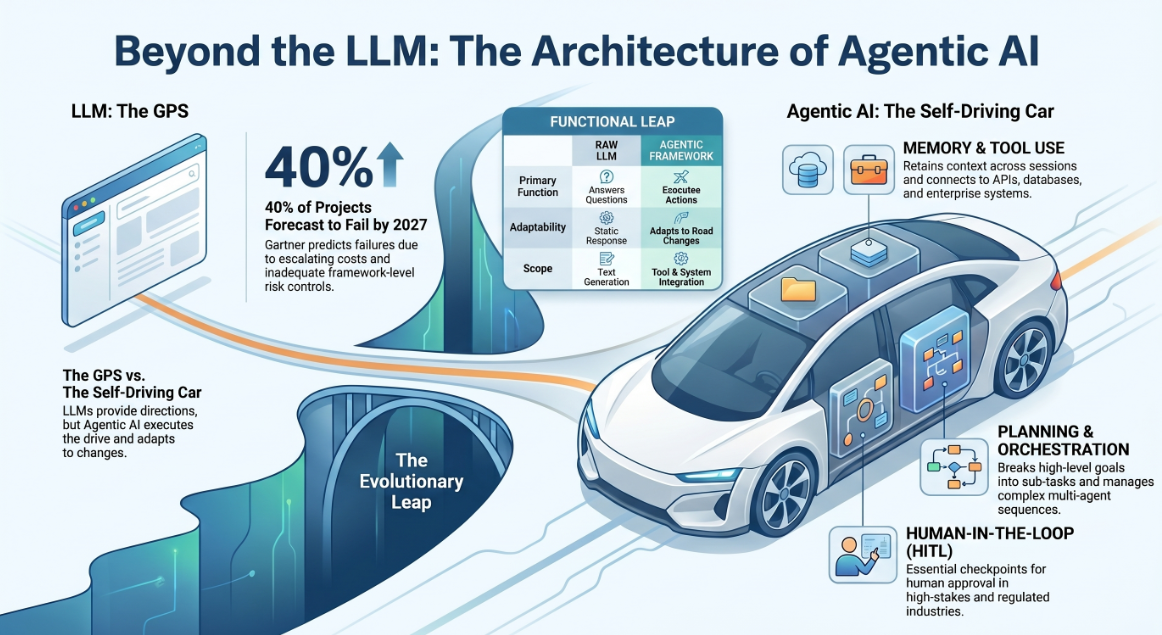
A large language model, on its own, answers questions. An agentic AI framework turns that model into a system that can plan a sequence of steps, call tools, remember context across turns, make decisions, and execute actions — autonomously or with defined human checkpoints along the way.
The difference between an LLM and an agentic system is like the difference between a GPS and a self-driving car. The GPS tells you what to do. The agent does it — and adapts when the road changes.
Specifically, agentic AI frameworks handle five core capabilities that raw LLMs don't:
Memory — retaining context across steps, sessions, or agents so the system doesn't forget what it learned two actions ago.
Tool use — connecting the agent to APIs, databases, search engines, code executors, and enterprise systems so it can act in the world, not just describe it.
Orchestration — managing the sequence, branching, and coordination of multiple steps or multiple agents working in parallel or in series.
Planning — breaking a high-level goal into sub-tasks, reasoning about what to do next, and adapting when something doesn't go as expected.
Human-in-the-loop (HITL) — pausing at defined checkpoints for human review, approval, or correction before continuing, which is non-negotiable in regulated industries and high-stakes workflows.
Get the framework right and you get an agent that scales. Get it wrong, and you get a system that works in demos, then fails in week two of production. According to Gartner, over 40% of agentic AI projects are forecast to be cancelled by 2027 due to escalating costs, unclear business value, or inadequate risk controls. Framework selection is rarely the only reason — but it's often where the problems start.
The Frameworks We're Comparing — And How We're Evaluating Them
We're covering seven frameworks that cover the full spectrum of what teams are actually deploying in 2026:
- LangGraph — graph-based, stateful orchestration
- CrewAI — role-based multi-agent collaboration
- AutoGen (Microsoft) — conversational multi-agent systems
- LangChain — modular chain-based foundation
- OpenAI Agents SDK — lightweight, provider-agnostic
- Microsoft Semantic Kernel — plugin model, enterprise .NET
- LlamaIndex — retrieval-first, RAG-optimised
We're evaluating each one across seven dimensions:
- Latency — how fast does it execute in real workloads?
- Token efficiency — how much does it cost to run?
- State management — can it hold context across complex, multi-step workflows?
- HITL support — is human oversight built in or bolted on?
- Multi-agent orchestration — how well does it coordinate multiple agents?
- Enterprise integration readiness — how difficult is it to connect to CRMs, ERPs, databases, and internal systems?
- Real deployment difficulty — what does it actually take to get this into production?
Framework-by-Framework Breakdown
LangGraph — Best for Complex, Stateful Workflows
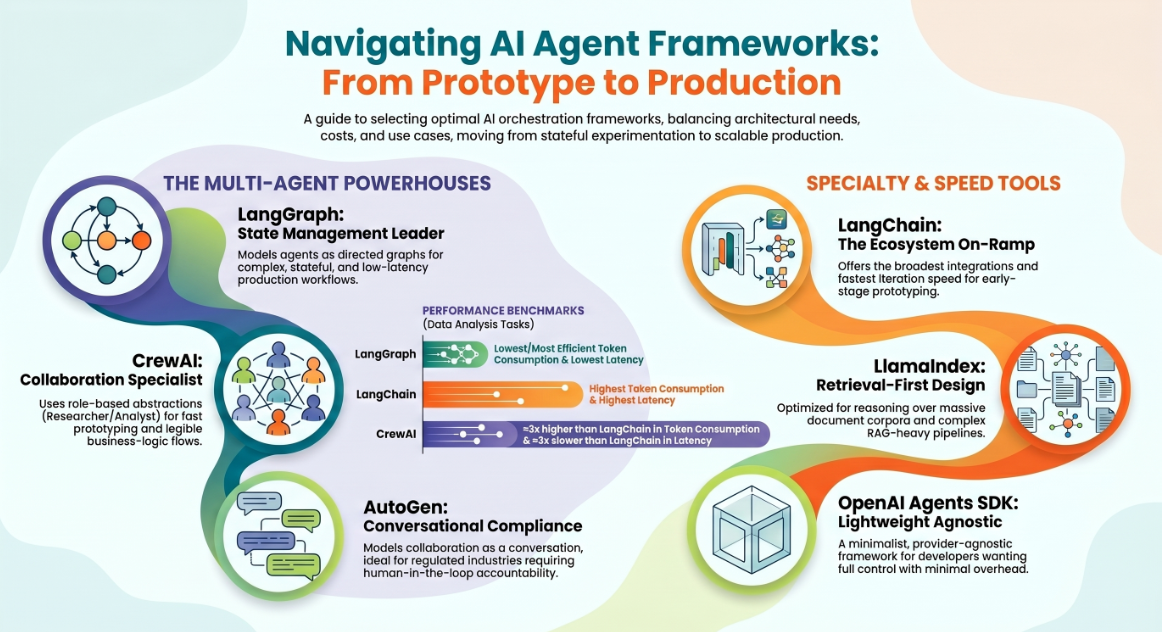
LangGraph builds on LangChain but takes a fundamentally different approach to orchestration. Instead of a linear chain, it models your agent as a directed graph — nodes represent actions, edges represent transitions, and the entire state of the workflow is managed explicitly at every step.
That sounds academic. In practice, it means LangGraph handles the kinds of workflows that destroy simpler frameworks: conditional branching, error recovery, long-running processes that pause and resume, and multi-agent pipelines where different agents hand off state to each other without losing context.
In independent benchmarks testing LangGraph, CrewAI, LangChain, and AutoGen on identical data analysis tasks across 100 runs, LangGraph consistently delivered the lowest latency and most efficient token usage. The graph-based architecture minimises unnecessary LLM calls, which has direct implications for cost at scale.
Where it shines in production: Audit trails are a first-class feature. LangGraph's interrupt_before mechanism lets you define precise breakpoints where the agent pauses for human review — not as an afterthought, but as a structural part of the workflow graph. For any deployment where compliance, auditability, or exception handling matters, this is the architecture that holds up.
Where it's harder: LangGraph requires upfront investment in graph design. For teams that want to prototype quickly or iterate without deep technical architecture work, the learning curve is steeper than CrewAI.
Real-world deployment pattern: We've deployed LangGraph-style stateful orchestration in global logistics operations — digitising terminal and rail workflows, coordinating exception management across multiple nodes, and feeding executive dashboards with real-time operational status. The stateful graph architecture made it possible to track the exact state of each workflow step, which matters when you're moving cargo across port-to-inland operations and cannot afford data loss between steps.
CrewAI — Best for Role-Based Multi-Agent Collaboration
CrewAI is built around a simple, readable abstraction: you define agents by role, assign them tasks, and combine them into a crew. A Researcher agent, an Analyst agent, and a Writer agent — each with its own goal and tool set — can collaborate on a shared outcome.
This role-based design makes CrewAI the fastest framework to prototype with. The structure is legible even to non-developers, which reduces friction in discovery and scoping conversations with business stakeholders.
The tradeoff is cost. In benchmark testing, CrewAI consumed approximately three times the tokens of LangChain on equivalent tasks, and took nearly three times longer. The "managerial overhead" of its Planner and Analyst personas adds a verification loop that prioritises completeness over speed — which is appropriate for some workflows and expensive for others.
Where it shines in production: When you need multiple specialist agents to collaborate — one gathering data, one analysing it, one drafting outputs — and you want that structure to be easy to modify and understand. Content workflows, research automation, and business intelligence pipelines map naturally to CrewAI's role model.
Where it's harder: For high-frequency, latency-sensitive workflows, the token overhead compounds quickly. If your agent needs to run 500 times a day, a 3× cost multiplier has real budget implications.
Real-world deployment pattern: Role-based multi-agent architectures work well for competitive intelligence and market monitoring — where a signal-gathering agent, an analysis agent, and an alerting agent each have a defined role and hand off to each other in sequence. We've deployed this pattern for retail and HVAC clients that need continuous monitoring of competitor pricing and promotional activity across multiple online channels, with automatic alerting when gaps appear.
AutoGen (Microsoft) — Best for Conversational Multi-Agent Systems
AutoGen models multi-agent collaboration as a conversation. Agents exchange messages, coordinate through dialogue, and the UserProxyAgent enables native, structured human participation in the loop — without custom engineering.
This conversation-loop architecture makes AutoGen particularly strong in regulated industries where human accountability cannot be abstracted away. The UserProxyAgent is not just a HITL toggle; it's a first-class participant in the agent conversation, which means the handoff to human review is clean, auditable, and reversible.
AutoGen sits slightly above LangGraph in latency and token consumption — the cost of its multi-agent conversation model — but the reliability and compliance posture it offers more than justifies that overhead for enterprise deployments where the alternative is higher risk.
Where it shines in production: Banking, compliance, and healthcare contexts where every decision needs to be explainable, reversible, and tied to a responsible human. AutoGen's integration with the Microsoft Azure stack means it slots naturally into enterprise environments already running Azure AI, Azure OpenAI, and associated services.
Where it's harder: For lean, high-velocity deployments outside the Microsoft ecosystem, AutoGen's architecture can feel heavier than necessary.
Real-world deployment pattern: We've deployed conversational multi-agent architectures in financial services — omnichannel banking support agents that handle intake via chat, email, and voice, route cases to the right workflow, generate agent-assist summaries for human reviewers, and maintain full audit trails across every interaction. AutoGen's native HITL model made the compliance design significantly cleaner than implementing it from scratch.
LangChain — Best for Prototyping and Ecosystem Breadth
LangChain is where most teams start, and for good reason. It has the broadest ecosystem of integrations, the largest community, and the most accessible on-ramp for developers who are new to building agentic systems. Its AgentExecutor model makes it straightforward to connect an LLM to tools and start running workflows within hours.
In production benchmarks, LangChain consumes the most tokens and takes the most time of any framework tested. Its chain-first design introduces overhead that compounds in complex workflows — each additional step in the chain adds latency, and the architecture doesn't have native mechanisms for state management or graph-based conditional logic the way LangGraph does.
Where it shines: Prototyping, experimentation, tool-augmented chatbots, and early-stage products where iteration speed matters more than production efficiency. LangChain is genuinely excellent at getting something working fast.
Where it's harder: Scaling. If you prototype in LangChain and ship to production without rearchitecting, the overhead will catch up with you. Many teams use LangChain to validate an approach, then migrate to LangGraph for production.
Practical note: For many of our enterprise engagements, LangChain serves as the discovery layer — a way to prove a concept quickly — before the production build moves to a more structured orchestration architecture.
OpenAI Agents SDK — Best for Lightweight, Provider-Agnostic Builds
Released in early 2025, the OpenAI Agents SDK is a deliberately minimal framework. It supports multi-agent workflows with comprehensive tracing, built-in guardrails, and compatibility with 100+ LLMs — all with minimal overhead. Its design philosophy is "do less infrastructure, more intelligently" rather than "handle everything."
The significant limitation is HITL: the SDK has no built-in human-in-the-loop mechanism. Any workflow that requires human approval checkpoints requires custom implementation, which adds engineering time and introduces the risk of poorly designed human handoffs.
Where it shines: Clean Python multi-agent pipelines where the developer wants full control, minimal overhead, and isn't on a single LLM provider. Teams that have already built internal tooling around LLM APIs and want a lightweight coordination layer rather than a full framework will find it well-suited.
Where it's harder: Enterprise deployments requiring compliance, auditability, or formal HITL design. The SDK assumes you'll build what you need — which is empowering for experienced teams and risky for teams moving fast.
Microsoft Semantic Kernel — Best for .NET Enterprise Environments
Semantic Kernel is Microsoft's enterprise-grade framework built around a plugin model. Capabilities are packaged as plugins — discrete, testable, reusable units — and the kernel orchestrates their execution. It integrates deeply with the Azure ecosystem, including Azure OpenAI, Azure AI Search, and the broader Microsoft enterprise stack.
For teams building in .NET, running on Azure, and operating in Microsoft-centric enterprise environments, Semantic Kernel is the natural choice. The plugin architecture produces clean, maintainable code that enterprise development teams can reason about and iterate on without specialist AI engineering knowledge.
Where it shines: Enterprise .NET environments with existing Azure infrastructure where maintainability, security governance, and integration with Microsoft services are non-negotiable.
Where it's harder: Non-Microsoft stacks. Semantic Kernel's value is tightly coupled to the Azure ecosystem. Outside that context, other frameworks offer more flexibility with less lock-in.
LlamaIndex — Best for RAG-Heavy, Knowledge-Retrieval Agents
LlamaIndex is built retrieval-first. Where other frameworks start with orchestration and add retrieval as a tool, LlamaIndex starts with data ingestion, indexing, and semantic search — and builds agent capabilities on top of that foundation.
For workflows where the agent's primary job is to reason over large volumes of documents, structured data, or enterprise knowledge bases, LlamaIndex outperforms general-purpose frameworks because retrieval isn't an afterthought in its architecture.
Where it shines: Document Q&A agents, enterprise knowledge bases, procurement sourcing platforms, research automation, and any workflow where the agent spends most of its time retrieving and synthesising information from large corpora.
Where it's harder: Complex multi-step workflows requiring dynamic state management and multi-agent coordination. LlamaIndex's multi-agent support is more limited than LangGraph or CrewAI, and HITL requires custom implementation.
Real-world deployment pattern: We've deployed retrieval-focused agent architectures for pharma sourcing platforms — enabling automated RFQ handling, supplier discovery across large product catalogues, and quality/regulatory document retrieval with semantic search over thousands of SKUs. LlamaIndex's data ingestion pipeline made it significantly faster to build production-grade retrieval than starting from scratch.
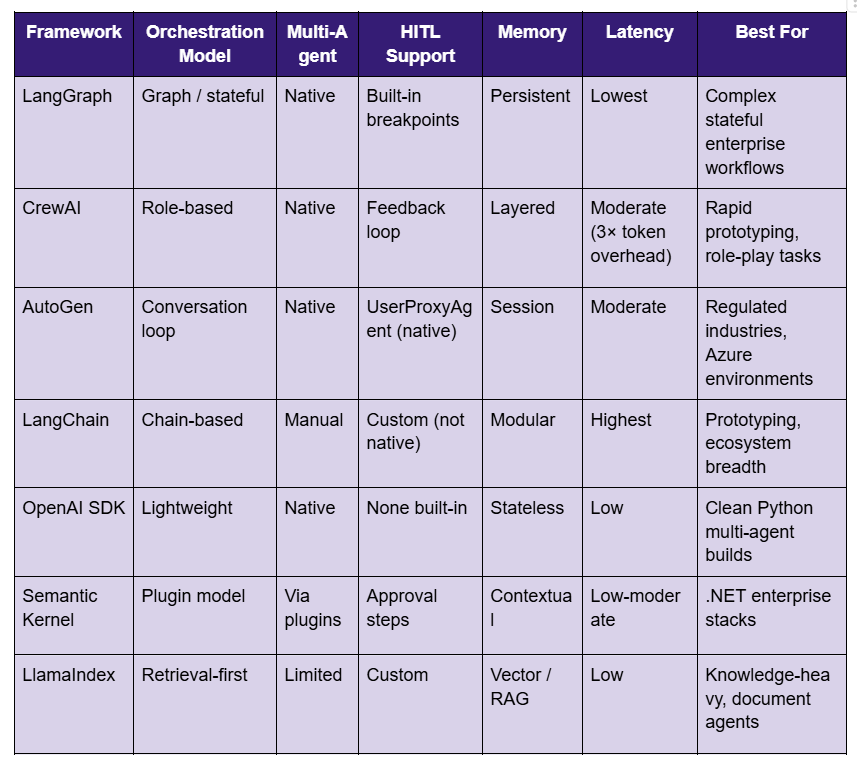
Side-by-Side Agentic AI Frameworks Comparison Table
What Nobody Tells You: The Production Gap
Here is the thing that most framework comparison articles leave out: the framework is not the hardest part of deploying agentic AI. The gap between a working prototype and a production system that actually delivers business value is where most deployments fail — and it has nothing to do with which framework you chose.
According to McKinsey's 2025 State of AI, only 23% of organisations are successfully scaling agentic AI systems. The majority are stuck in experimentation. The most common blocker is not model quality. It is state management, integration complexity, and the absence of a governance layer.
Here is what the production gap actually looks like:
State management failure. A demo agent works because the workflow is short and the state is simple. A production agent needs to hold context across dozens of steps, resume after failures, handle partial completions, and integrate state with external systems that have their own data models. Most framework tutorials don't prepare you for this.
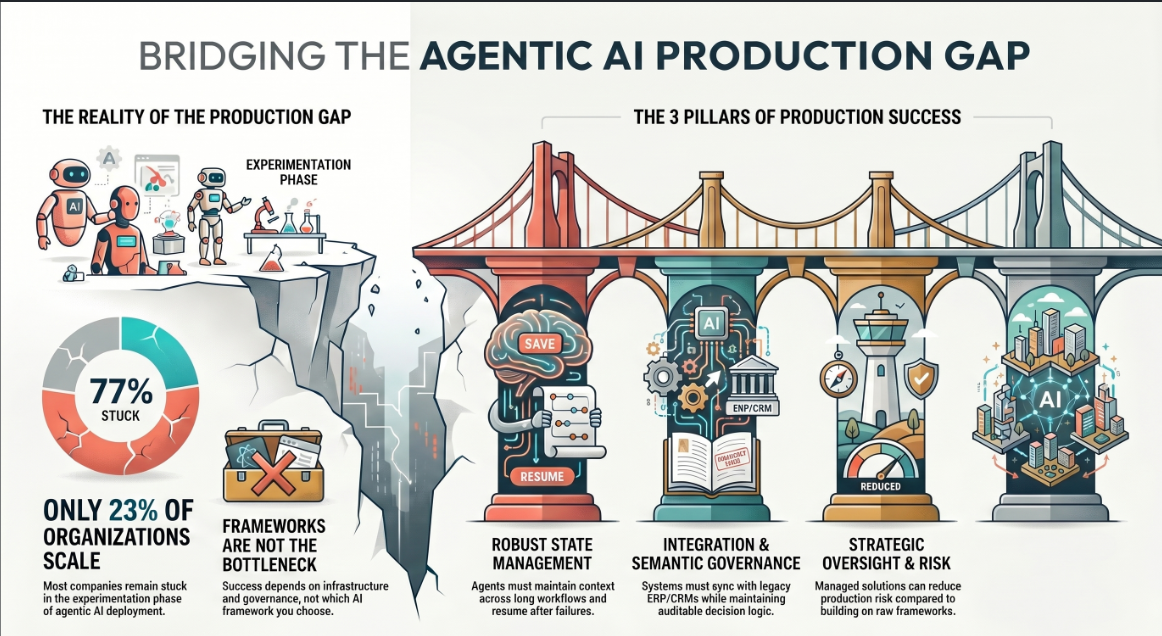
Integration complexity. Your agentic system does not exist in isolation. It needs to read from and write to the CRMs, ERPs, databases, and operational tools your organisation already runs — SAP, Salesforce, legacy databases, internal APIs. Getting that integration layer right is often more work than the agent itself.
Governance and auditability. In regulated industries and enterprise environments, every action the agent takes needs to be explainable, auditable, and reversible. That requires a semantic governance layer — consistent metric definitions, rule-governed decision logic, and audit logs — that most frameworks do not provide out of the box.
Human oversight architecture. HITL is not just a feature flag. It is a design question: which decisions should require human approval, at what autonomy level, with what escalation path? Getting this wrong in either direction — too much human involvement or too little — kills the value of the agent.
The build vs buy decision. If your team lacks deep AI engineering experience, building on top of a raw framework adds risk and timeline. A managed agentic solution — where the framework selection, integration architecture, and governance design are handled by specialists — often delivers faster time-to-value with less production risk.
Real-World Agentic AI Deployments: What We've Seen Across Industries
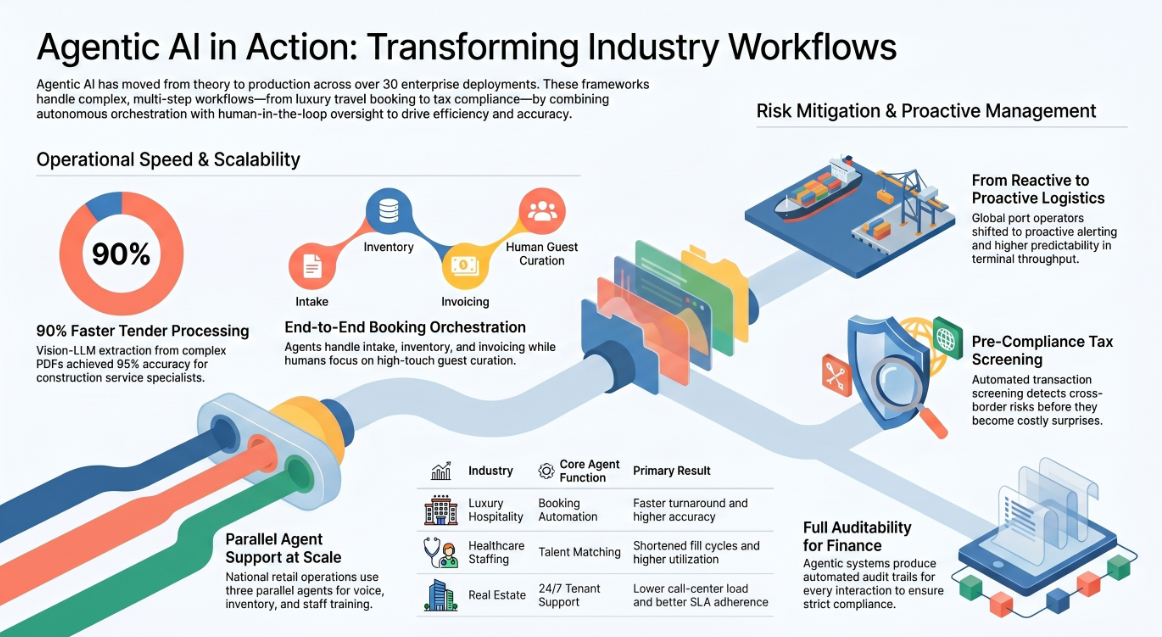
Theory is useful. Evidence is better. Across more than 30 enterprise deployments, here is what agentic AI frameworks look like when they're actually running in production.
Luxury Hospitality: End-to-End Booking Automation
A luxury safari and boutique hotel brand needed to automate complex travel booking workflows without compromising the high-touch service its guests expected. The agent handled email intake, classified intent, extracted booking details, ran real-time inventory checks, negotiated alternative dates and properties, and generated invoice and itinerary documents — with a human-in-the-loop handoff for curated itinerary creation.
The result: faster booking turnaround, higher accuracy on complex multi-property guest requirements, and scalable operations that preserved the quality of the luxury experience. The HITL design was critical — the agent did the orchestration work, the human did the curation.
Construction & Remedial Services: Intelligent Tender Document Processing
A commercial building services specialist with complex tender workflows needed to ingest, analyse, and synchronise tender documents across operational systems — at speed, with high accuracy, and with revision tracking so the team could detect changes between document versions.
The multi-agent document workbench used Vision-LLM extraction from complex PDFs, deep integration with operational systems, and full audit logs. The engineering target was approximately 90% faster tender processing and approximately 95% extraction accuracy on standard formats. Revision detection and auditability reduced bid risk significantly.
National Retail (700+ Stores): Voice, Inventory, and Training Agents
A major value retail operation running hundreds of stores across India needed to reduce helpdesk load, improve store-level inventory visibility, and accelerate staff onboarding — at scale, in Hindi and English. Three agents worked in parallel: a voice support agent for store queries, an inventory intelligence agent giving staff real-time pricing, stock, and promotion data per store, and a knowledge and training agent running RAG over point-of-sale and standard operating procedure documents.
The outcome: reduced manual helpdesk burden, faster resolution of store-level issues, improved inventory visibility, and on-demand training guidance that reduced onboarding time.
Global Logistics (Ports & Supply Chain): Terminal and Rail Operations
A global ports and logistics operator needed to digitise terminal and rail management workflows, coordinate exception management across port-to-inland operations, and give leadership real-time operational dashboards.
The agentic system handled terminal workflow digitisation, rail scheduling and visibility, exception detection and routing, and executive alerting. The result was higher predictability of terminal-to-rail throughput, more efficient coordination between terminal and inland logistics, and a shift from reactive reporting to proactive operational management.
Financial Services: Omnichannel Banking Agents
A global fintech serving banks and credit unions needed omnichannel agent support — handling intake across chat, email, and phone — with agent-assist summarisation, next-best-action recommendations, and full auditability for compliance.
The deployment integrated with core banking systems, produced audit trails on every interaction, monitored SLA adherence automatically, and reduced manual case-handling load. Faster case resolution and stronger compliance posture were the headline results.
Healthcare Staffing: Matching, Scheduling, and Compliance
A healthcare staffing platform connecting nursing professionals with facilities needed to automate the matching, scheduling, and compliance workflow — reducing the friction between a nurse looking for a shift and a facility that needed cover.
The agentic system handled talent onboarding, credential capture, facility staffing request intake, matching logic, scheduling, notifications, and compliance workflow. Fill cycles shortened, workforce utilisation improved, and staffing responsiveness for facilities increased.
Energy & Smart Grid: Monitoring, Forecasting, and Alerting
Two energy deployments — one for a university-scale research campus, one for a state-level power transmission utility — needed always-on monitoring that replaced manual checks across grid and campus energy systems, with predictive alerting before problems escalated.
Sensor and utility data was ingested continuously. Anomaly detection and forecasting models generated operational recommendations. Dashboards and proactive alerts replaced reactive reporting. The result in both cases was improved energy visibility, faster detection of inefficiencies, and more proactive operations through early warning.
Real Estate (UAE): Tenant Support Automation
A major UAE real estate portfolio owner needed 24×7 tenant and customer support across office, retail, industrial, and residential assets — handling queries, rental and payment questions, and maintenance requests — without proportionally scaling the support team.
A multi-channel service agent (web, WhatsApp, email-ready) handled tenant query triage, FAQs, and rental support, with structured escalation to human teams for complex issues. The result: 24×7 consistent tenant experience, faster response times, lower call-centre load, and better SLA adherence through automated routing and tracking.
B2B Sales: Always-On Account Monitoring
An enterprise account team needed higher coverage across its portfolio without adding headcount. An always-on account monitoring agent captured signals, identified opportunities and risks, and orchestrated follow-up based on governed playbooks — integrated with the CRM and feeding leadership dashboards.
The result: higher account coverage, faster response cycles on opportunities and renewals, and more consistent execution because the playbooks were built into the agent's decision logic rather than relying on individual rep discipline.
Tax Technology: Pre-Compliance Screening
A tax-tech platform needed to automate the pre-screening of cross-border transactions for withholding tax risk, VAT mismatches, and permanent establishment issues — earlier in the deal workflow, before risks became costly surprises.
The agentic system handled transaction screening, evidence collection, risk classification, and escalation routing to tax experts, with explainability notes attached to every flagged transaction. Earlier detection of cross-border risk and faster pre-compliance review were the key outcomes.
How to Choose the Right Agentic AI Framework
There is no universal answer to which agentic AI framework is best. There is only the right framework for your specific workflow, team, and production requirements. Ask these five questions before you decide.
1. Is your workflow stateful or stateless? If your agent needs to track what happened in step 3 when it reaches step 9 — or resume a workflow that was interrupted — you need stateful orchestration. LangGraph is purpose-built for this. If your workflow is short, self-contained, and doesn't need to carry state across many steps, lighter-weight options are appropriate.
2. Do you need multiple agents with defined roles? If your workflow benefits from role separation — one agent researching, another analysing, another drafting — CrewAI's role-based model is the most readable way to build and maintain that structure. If coordination can be handled by a single agent with tool access, a simpler setup will do.
3. Is human approval required at any step? If the answer is yes — and in most enterprise deployments it is — check how each framework handles HITL before you commit. LangGraph and AutoGen have built-in mechanisms. LangChain and the OpenAI SDK require custom implementation. The quality of your HITL design is often what separates a compliant deployment from a liability.
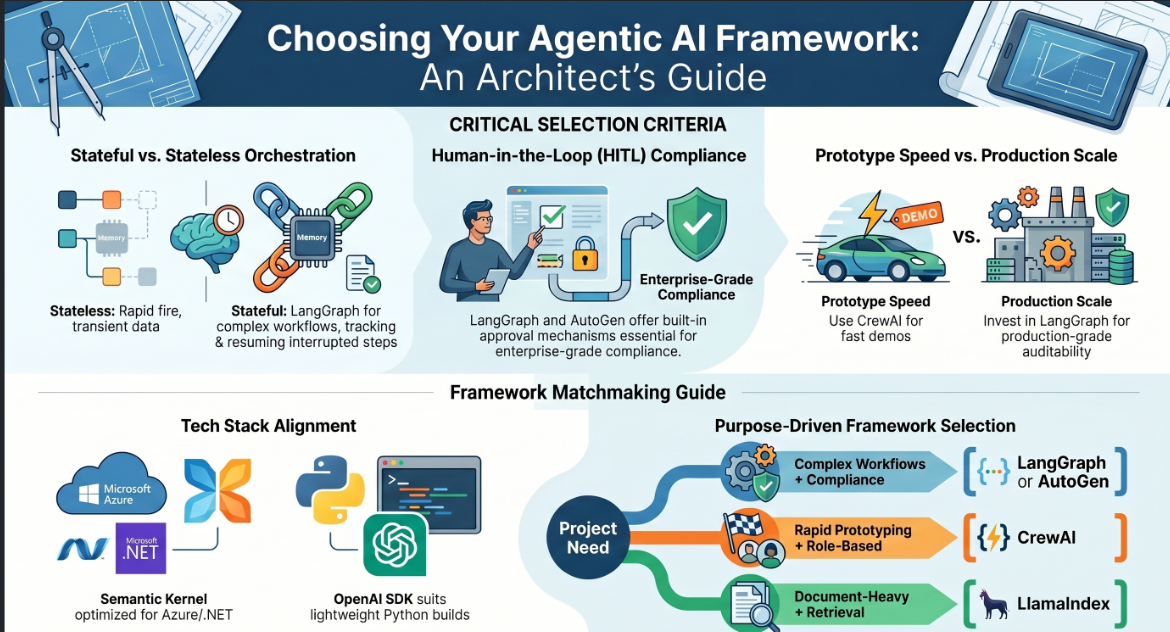
4. What stack are you running on? If your organisation is Azure-first and .NET-heavy, Semantic Kernel's deep integration with the Microsoft ecosystem will save significant engineering time. If you're stack-agnostic and Python-based, LangGraph or the OpenAI SDK are better fits.
5. Is this a prototype or going straight to production? If you're validating a concept, start with LangChain or CrewAI — they'll get you to a demo faster. If you're building directly for production, invest in LangGraph or AutoGen's architecture upfront, because retrofitting production-grade state management, auditability, and HITL after the fact is significantly harder than designing it in from the start.
Quick decision guide:
- Complex workflows + compliance requirements → LangGraph or AutoGen
- Rapid prototyping + role-based collaboration → CrewAI
- Knowledge retrieval + document-heavy workflows → LlamaIndex
- .NET enterprise + Azure stack → Semantic Kernel
- Lightweight Python + provider-agnostic → OpenAI Agents SDK
The Framework Isn't the Finish Line: What Else You Need
Choosing the right agentic AI framework is necessary but not sufficient. The teams we've seen successfully deploy agentic AI at enterprise scale all have five things in place beyond the framework itself.
A data layer that handles both structured and unstructured inputs. Agents that can only read clean, structured data have limited scope. Enterprise workflows involve documents, emails, PDFs, database records, API responses, and more. Your ingestion pipeline needs to handle all of it — and normalise it into a form the agent can reason over.
A semantic governance layer. When agents make decisions based on metrics and business rules, those definitions need to be consistent across teams, systems, and agent instances. "Revenue" cannot mean different things to the finance team's agent and the operations team's agent. A semantic governance layer — encoding definitions, hierarchies, and calculation logic — prevents this class of silent error.
An audit and observability layer. You need to know what every agent did, why, and what it produced — not just for debugging, but for compliance, for exception handling, and for continuous improvement. This means structured logging, traceability from input to output, and exception alerting that gets to the right human fast.
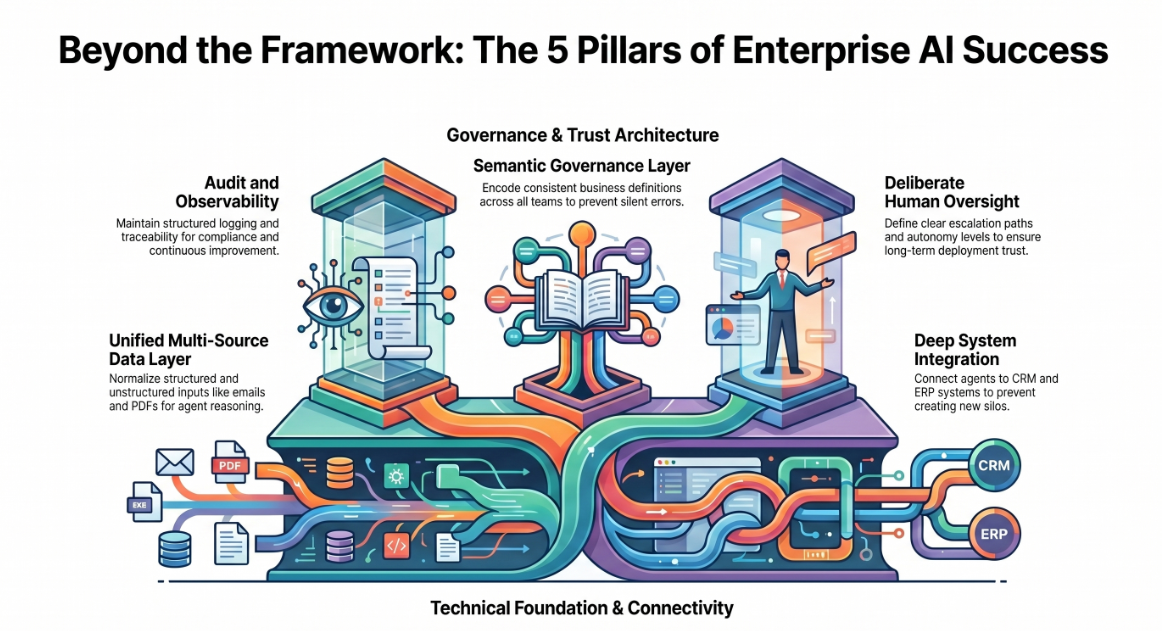
Integration with your existing systems. Agentic AI that sits in isolation creates a new silo rather than eliminating old ones. The value comes from agents that read from and write to your CRM, ERP, supply chain systems, BI tools, and operational platforms. That integration work is often underestimated in initial scoping.
A deliberate human oversight architecture. HITL is not a binary toggle. The right design asks: which decision types require human approval? At what autonomy level? With what escalation path when the human is unavailable? What happens to the agent's state while it waits? Answering these questions upfront — and building the answers into the agent's design — is what separates deployments that earn trust from those that get switched off after the first incident.
Conclusion: Framework Matters. Deployment Matters More.
The agentic AI framework landscape in 2026 is mature enough that the right tool for most enterprise use cases is identifiable: LangGraph for stateful complexity, CrewAI for role-based prototyping, AutoGen for regulated Azure environments, LlamaIndex for retrieval-heavy workflows. The technical choices are clearer than they were two years ago.
What hasn't gotten easier is the gap between picking the right framework and running a production system that actually delivers business value. State management, integration, governance, and HITL design are where deployments succeed or stall — and they require more than framework documentation to get right.
At Assistents.ai, we've deployed agentic AI across more than 30 enterprise clients across 15+ countries and 10+ industries. We build on the best framework for each context, and we design the architecture layer that frameworks don't cover — the data ingestion, the semantic governance, the audit infrastructure, the human oversight model, and the integration with the systems your business already runs.
If you're evaluating agentic AI for your organisation — or trying to move a stalled deployment from pilot to production — we'd be glad to help you figure out what the right architecture looks like for your specific context.
→ See how we've deployed agentic AI across industries
→ Book a strategy call with the Assistents.ai team
Frequently Asked Questions
What is the best agentic AI framework in 2026?
There is no single best framework — it depends on your workflow requirements, team, and stack. LangGraph leads for complex, stateful enterprise workflows where auditability and compliance matter. CrewAI is the fastest to prototype with for multi-agent role-based systems. AutoGen is the strongest choice for organisations on the Microsoft Azure stack or in regulated industries requiring native HITL. For knowledge-heavy, document-retrieval workflows, LlamaIndex is the purpose-built option.
Is LangGraph better than CrewAI?
For production enterprise deployments, LangGraph generally outperforms CrewAI on latency, token efficiency, and production control. In independent benchmarks, LangGraph delivered the lowest latency of any framework tested. CrewAI's role-based model is faster to prototype with and easier to read, but its structural overhead — approximately three times the token consumption of LangChain — makes it more expensive to run at scale. For compliance-sensitive workflows requiring audit trails and precise human approval checkpoints, LangGraph's architecture is better suited.
What is the difference between agentic AI and generative AI?
Generative AI produces outputs — text, images, code — in response to a prompt. Agentic AI plans, decides, and acts. An agentic system can receive a high-level goal, break it into steps, use tools to take actions in the world, monitor the results, and adapt its approach — all without a human directing each step. The distinction matters because agentic AI is not just a better chatbot; it is a fundamentally different category of software that requires different architecture, governance, and deployment thinking.
What is human-in-the-loop (HITL) in agentic AI?
Human-in-the-loop means the agent pauses at defined checkpoints for human review, approval, or correction before continuing. HITL is not the same as a human supervising the agent at all times — it is the targeted insertion of human judgment at the specific decision points where autonomy carries too much risk. In regulated industries, high-value transactions, or workflows involving sensitive data, well-designed HITL is what makes agentic AI deployable rather than just demonstrable.
Which agentic AI framework is best for enterprise?
It depends on the enterprise's stack and compliance requirements. LangGraph is the most widely deployed choice for complex enterprise workflows due to its production reliability and audit capabilities. AutoGen is preferred in Microsoft Azure environments and regulated industries. For organisations that want the benefits of agentic AI without the engineering overhead of framework selection and integration design, working with a deployment partner who manages the framework layer is often a faster path to production.
Can non-developers use agentic AI frameworks?
Most frameworks — LangGraph, AutoGen, CrewAI, LangChain — require Python development experience to configure, deploy, and maintain. They are engineering tools, not no-code platforms. Non-technical teams can engage with agentic AI through pre-built agentic solutions built on top of these frameworks, or through a deployment partner who handles the technical layer and exposes a governed, configured system for business users to operate.
What industries are using agentic AI frameworks today?
Agentic AI frameworks are in active production deployment across financial services, logistics and supply chain, healthcare, retail, energy and utilities, real estate, professional services, and technology. Across our own deployments, we've seen consistent adoption in India, the UAE, the UK, the USA, and Australia — across enterprise sizes from scaling startups to billion-dollar multinationals.
What are real-world results from agentic AI deployments?
Results vary significantly by use case, but patterns we've observed consistently include: approximately 90% faster processing of high-volume document workflows; 24×7 customer and tenant support at consistent quality without proportional headcount growth; higher account coverage in sales with no additional headcount; shift from reactive to proactive operations in logistics and energy through continuous monitoring and early alerting; and faster fill cycles and scheduling in healthcare staffing. The common thread is that agentic systems deliver sustained operational improvement when they are correctly architected, integrated, and governed — not just when they're demonstrated.