Quick answer: An inventory management AI agent is autonomous software that continuously senses stock, demand and supplier signals across ERP, WMS, POS and supplier systems, decides what should happen next (reorder, transfer, markdown, escalate), and — inside guardrails you define — takes the action itself instead of waiting for a planner to notice a spreadsheet turning red. Below are 27 production-grade use cases organized by function, the ROI ranges enterprises report, how these agents actually work under the hood, and how to evaluate vendors before you commit budget.
Most guides to this topic stop at nine or ten generic use cases and a demand-forecasting pitch. This one goes deeper on purpose: 27 concrete use cases across six operational areas, drawn from what's actually shipping in production deployments today — not just what's technically possible in a lab.
What is an inventory management AI agent?
An inventory management AI agent is an autonomous software system built to manage the ongoing, decision-heavy work of keeping stock at the right level, in the right place, at the right time — without a human manually checking a dashboard first.
That's a meaningfully different job description from "inventory management software." Traditional inventory systems are systems of record: they store stock counts, apply fixed reorder points, and generate reports someone has to read and act on. An AI agent is a system of action layered on top: it reads the same underlying data, but it also reasons about what the data means, weighs alternatives, and — within limits you set — executes the next step itself.
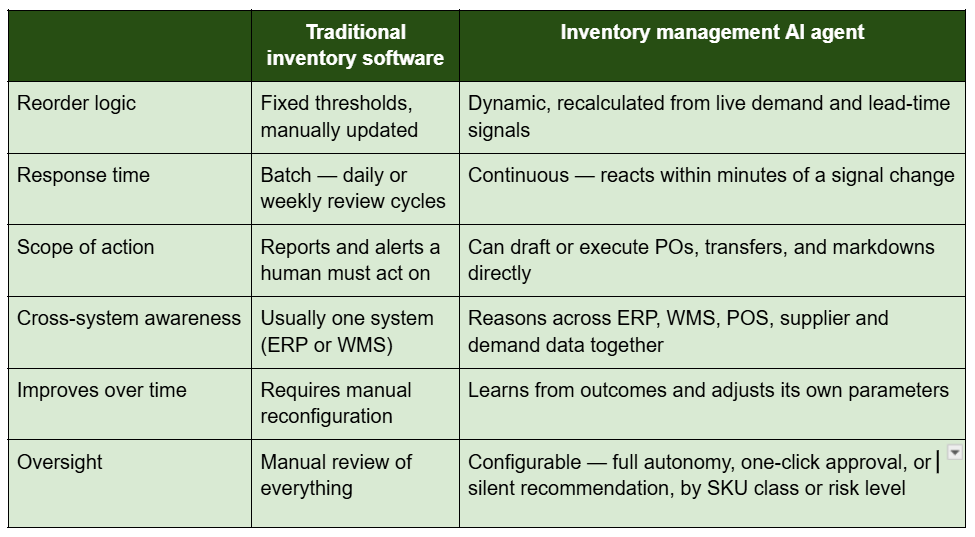
A useful mental model: automation follows a script; an agent follows an objective. A script says "if stock falls below 50 units, order 200." An agent is told "keep this SKU above a 95% service level at the lowest carrying cost," and it works out the reorder quantity, timing, and supplier itself — adjusting as sales velocity, lead times, and promotions shift underneath it.
This is also why AI agents are distinct from robotic process automation (RPA). RPA replicates a fixed sequence of clicks. An agent interprets ambiguous, changing situations — a late shipment, a demand spike, a data mismatch between two systems — and decides what to do about them.
How inventory management AI agents actually work
Strip away the marketing language and every production inventory agent runs the same underlying loop, repeated continuously rather than on a weekly cadence:
Perceive → Decide → Act → Verify → Learn
- Perceive. The agent ingests live signals: POS transactions, warehouse stock positions, in-transit shipments, supplier lead times, promotional calendars, and sometimes external data like weather or local events.
- Decide. It applies forecasting models, optimization logic, and your business rules to work out what should happen — reorder, transfer, hold, markdown, or escalate to a human.
- Act. Within its authority envelope, it executes: creating a purchase order, initiating a store-to-store transfer, updating a forecast, or drafting a supplier follow-up.
- Verify. It confirms the action actually happened downstream — the PO was received, the transfer arrived, the shelf was restocked — rather than assuming success once a message was sent.
- Learn. It measures whether the outcome was actually good (lost sales avoided, cost incurred, forecast error) and feeds that back into its own future decisions.
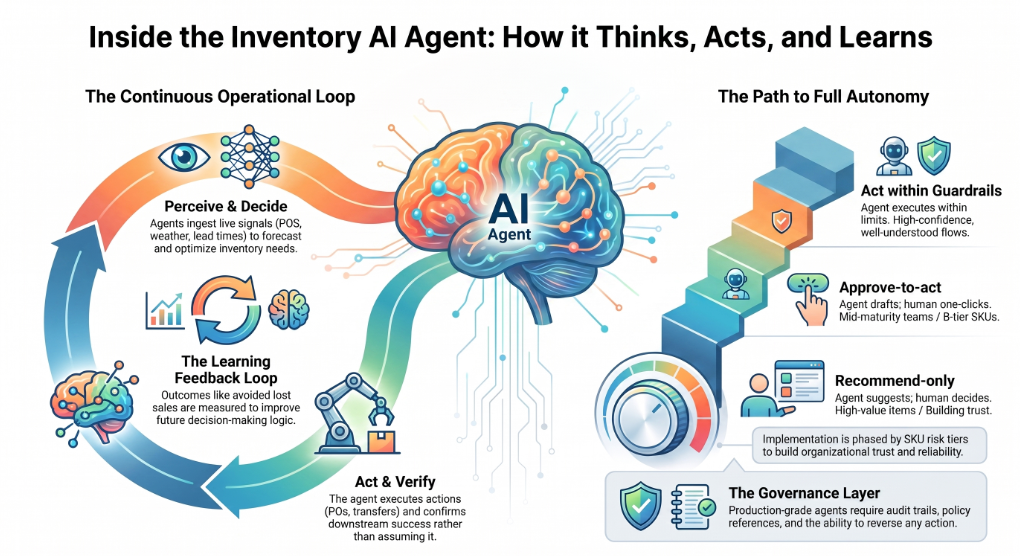
Autonomy is a dial, not a switch. The organizations that get this right almost never flip every SKU to full autonomy on day one. Instead, autonomy is set per SKU class or risk tier:
- Recommend-only — the agent surfaces what it would do and why; a human decides. Good for building trust and for high-value or low-frequency decisions.
- Approve-to-act — the agent drafts the action (a PO, a transfer) and a human approves with one click. Good for mid-maturity teams and B/C-tier SKUs.
- Act within guardrails — the agent executes directly inside a defined spend limit, service-level target, or SKU category, and only escalates exceptions. Reserved for high-confidence, well-understood flows.
This graduated model matters for a reason that's easy to overlook: the agent's actions have to be auditable and reversible. Every action a governed agent takes should carry an identity, a policy reference, and a log entry — what it did, why, under what authority, and how to unwind it if it was wrong. That governance layer is what separates a production-grade inventory agent from a clever demo.
Why enterprises are adopting them now
Three forces are converging at the same time:
- The bullwhip effect keeps getting more expensive. A small demand shift at the point of sale amplifies into much larger swings upstream — a few points of extra consumer demand can trigger a disproportionate overorder further up the chain. Manual forecasting cycles are too slow to catch this before it costs money.
- Data lives in silos that don't talk to each other. ERP shows one number, WMS shows another, and a store shows "in stock" for an item the warehouse has already allocated elsewhere. Planners make decisions on an incomplete picture, and the mismatch usually surfaces only after a customer complaint or a failed pick.
- Planner time is consumed by exceptions, not strategy. Industry research on planning teams consistently finds that a majority of planner time goes to firefighting and data reconciliation rather than the analysis that actually improves service levels or working capital.
Underneath all three is the same root cause: the work of inventory management is not really a single decision. It's thousands of small, recurring pieces of work — a projected stockout here, a delayed inbound shipment there, an ageing SKU that needs a markdown call — spread across store operations, procurement, and supply chain teams. Traditional software stores the data behind that work. It doesn't do the work.
27 inventory management AI agent use cases
These are organized into six operational areas so you can jump to the ones closest to your own stack.
Demand forecasting and sensing
1. SKU-level demand forecasting agent. Predicts expected demand for every SKU at every location, rather than one blended forecast for a category, by continuously reprocessing historical sales, seasonality, and promotional lift.
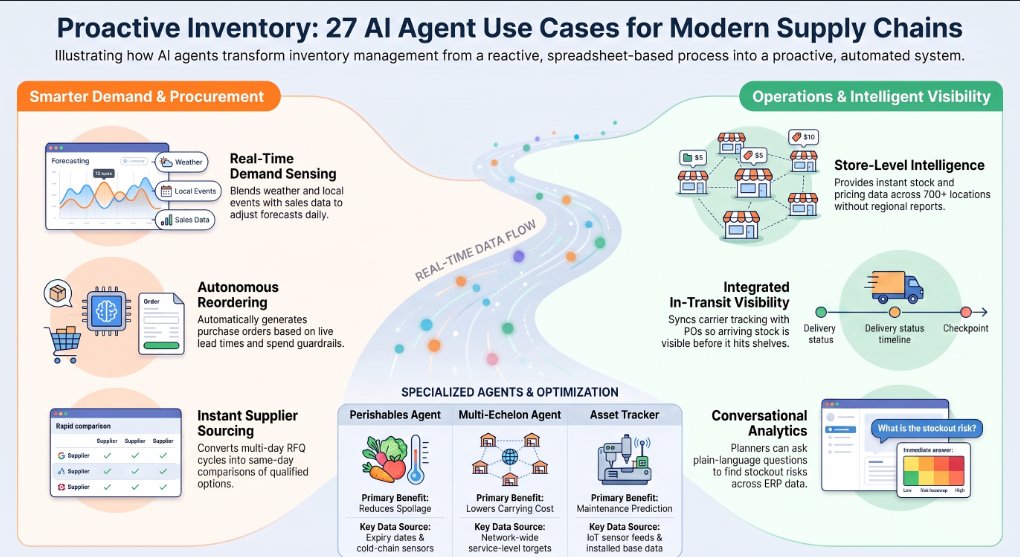
2. Demand-sensing agent using external signals. Blends point-of-sale data with promotional calendars, local events, and weather feeds to adjust short-term forecasts daily instead of monthly — catching, for example, a heatwave-driven spike in beverage demand before the shelf empties.
3. New-product-launch forecasting agent. Uses attribute-based modeling and analog-product matching to plan initial stock for items with zero sales history, then tightens the forecast automatically as the first weeks of real sales data arrive.
4. Forecast-variance and exception agent. Continuously compares forecast to actual and flags SKUs where the error is growing, so a planner reviews the ten items that matter instead of scanning a spreadsheet of thousands.
Replenishment, ordering and procurement
5. Autonomous reorder point and PO-generation agent. Recalculates reorder points and safety stock per SKU per location from live sell-through and lead-time data, then drafts or issues purchase orders automatically within a spend guardrail.
6. Supplier follow-up and PO-chasing agent. Monitors purchase order status against expected timelines, automatically follows up with suppliers on delays, requests updated shipment notices, and flags alternative sourcing when a delay risks a stockout.
7. RFQ and supplier-discovery agent. For sourcing-heavy categories, automates request-for-quote generation, supplier matching, and quality or regulatory document handling — turning a multi-day sourcing cycle into a same-day comparison of qualified options. This pattern is already running in production for a pharma sourcing and excipients marketplace, where the agent automates RFQ workflows and supplier discovery across thousands of SKUs. [INTERNAL LINK: /blogs/ai-agents-use-cases-manufacturing "AI agents in manufacturing"]
8. Vendor performance and fill-rate monitoring agent. Tracks on-time delivery, order accuracy, and quality rejection rates per supplier, and automatically routes an intervention case when a supplier's fill rate drops below an agreed threshold.
9. Dead-stock and excess-inventory detection agent. Surfaces slow-moving and ageing inventory early enough to act — markdown, redeploy, or return to vendor — before it becomes a write-off, converting a category planners often review too late into a proactive monthly discipline.
Multi-location, retail and store operations
10. Store-level inventory intelligence agent. Gives every store manager real-time answers on stock, pricing, and promotional status for their location, without waiting for a weekly regional report. In a production deployment for a value retailer running 700+ stores across hundreds of cities, this exact agent type delivered real-time pricing, stock and promotional data at the individual store level.
11. Store-to-store transfer and stockout-rebalancing agent. When one location shows a projected stockout, the agent identifies nearby locations with surplus stock, generates the transfer case, and notifies both stores — closing the gap without waiting for an emergency central-warehouse shipment.
12. Ageing-inventory and markdown-case agent. Flags SKUs approaching their ageing threshold at the store level and generates a markdown recommendation with the projected margin impact, so category teams aren't discovering the problem at month-end.
13. Promotion-compliance and execution-monitoring agent. Checks whether promoted items are actually in stock, priced correctly, and displayed as planned across locations, flagging execution gaps in near real time instead of after the promotion has ended.
14. Store helpdesk and inventory knowledge agent. Answers frontline staff questions about stock, procedures, and exceptions using retrieval over the retailer's own SOP and POS documentation, cutting the number of issues that escalate to a regional help desk.
Warehouse, logistics and fulfillment
15. Warehouse exception and cycle-count agent. Flags discrepancies between system stock and physical counts as they're detected, rather than waiting for a scheduled full cycle count to surface a problem that's been compounding for weeks.
16. Terminal-to-inland and yard visibility agent. For operators managing the handoff between port, rail, and inland logistics, an agent can digitize terminal workflows and give a single operational view of what's moving, what's delayed, and what needs rescheduling. This is close to a production pattern running for a global logistics and warehousing operator, where an agent-based terminal and rail management layer replaced fragmented manual coordination between yard and inland transfer. [INTERNAL LINK: /blogs/best-ai-agents-for-logistics-companies "11 best AI agents for logistics companies"]
17. In-transit visibility and ETA agent. Continuously reconciles purchase orders, advance shipping notices, and carrier tracking so "available stock" always includes what's already on the way — closing the classic gap where a store shows out-of-stock for an item that's a day from arriving.
18. Returns and reverse-logistics disposition agent. Predicts return volumes by category and channel, then routes each return to the right disposition path — restock, refurbish, liquidate, or recycle — and updates available-to-promise quantities automatically.
Governance, analytics and decision support
19. Conversational inventory analytics agent. Lets planners and operators ask questions like "which SKUs will stock out in the next two weeks" in plain language and get a governed answer pulled from live ERP, WMS and supplier data, instead of waiting on a BI queue. [INTERNAL LINK: /use-cases/supply-chain-dashboards "supply chain visibility dashboards"]
20. KPI monitoring and exception-alerting agent. Watches inventory, fill-rate, and working-capital metrics continuously and proactively raises the two or three that need attention, rather than leaving them buried in a static weekly dashboard.
21. Competitive stock and pricing intelligence agent. Continuously monitors competitor pricing, promotions, and stock availability across e-commerce channels and distributor networks, converting a manual, once-a-week competitive scan into an always-on signal. A production version of this has run for a major appliance and HVAC manufacturer tracking price and availability moves across a competitive category with thousands of SKUs.
22. Working-capital and margin-impact agent. Flags purchase-price trends, early-payment opportunities, and vendor performance issues that affect gross margin, with the notional cost or benefit attached to each alert so finance and procurement can act without a separate analysis cycle.
23. Audit-trail and action-governance agent. Runs alongside every autonomous action an inventory agent takes — logging what happened, under what policy, with what approval — so operations and compliance teams can review or reverse any decision after the fact.
Industry-specific and specialized
24. Perishable and expiry-driven rotation agent. Tracks shelf life across a network, enforces first-expired-first-out picking, and triggers markdowns or donations before products expire — essential for food, pharmaceutical, and beauty retail.
25. Cold-chain and temperature-controlled inventory agent. Integrates with IoT temperature sensors to monitor storage conditions, flag equipment issues before they cause spoilage, and reroute perishable stock to a backup facility if a cooling system fails.
26. Multi-echelon network optimization agent. Instead of setting safety stock independently at every warehouse and store, this agent optimizes across the whole network simultaneously — balancing service-level targets, lead times, and carrying cost to find the lowest-cost configuration that still hits your fill-rate goals.
27. Asset and equipment inventory tracking agent. For infrastructure-heavy operators — utilities, telecom, smart-city operations — this pattern extends beyond retail SKUs to physical assets and equipment: monitoring installed base, flagging anomalies, and forecasting maintenance or replacement needs across networks connecting millions of assets.
Why assistents.ai for inventory management AI agents
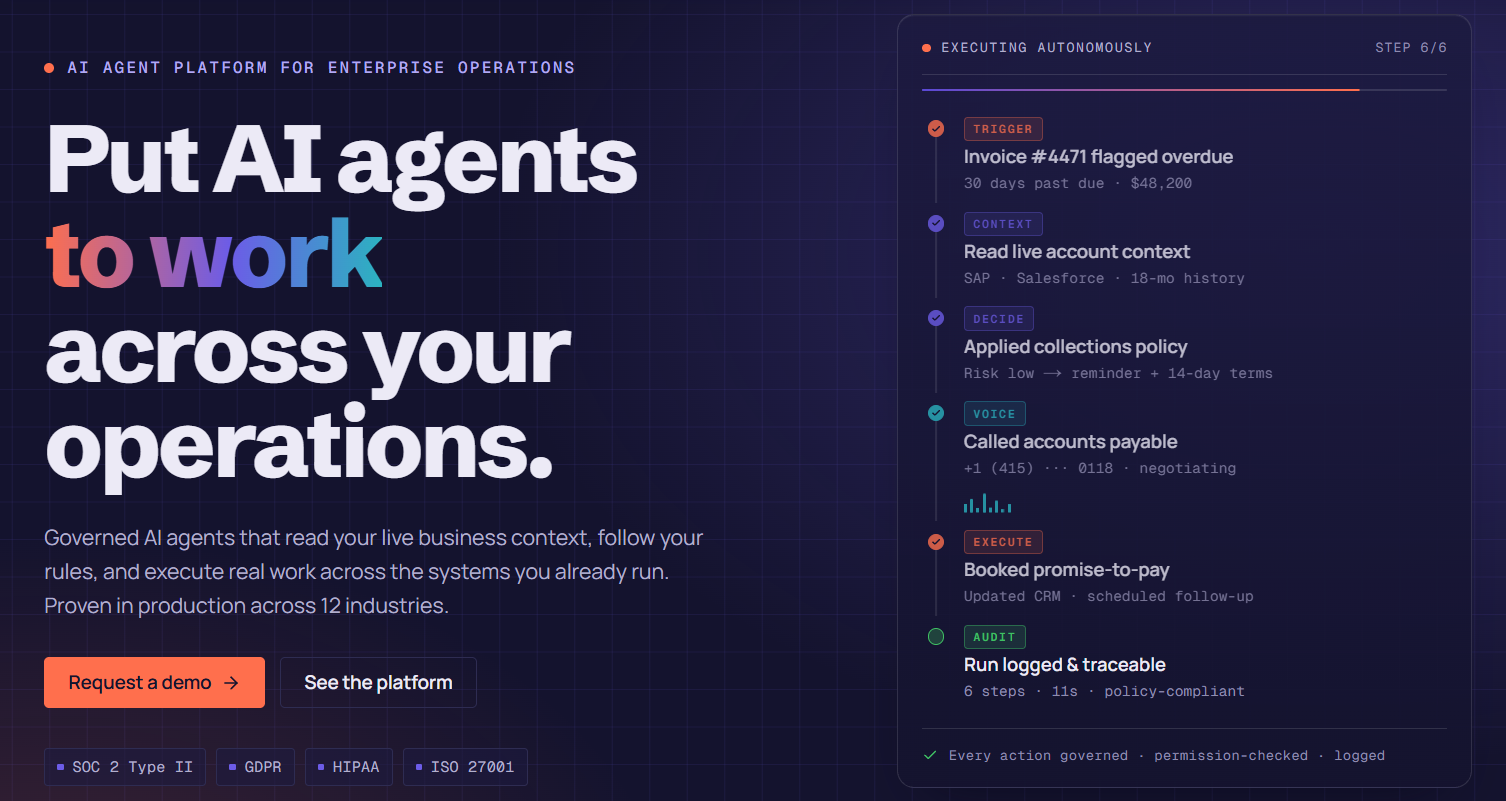
Most of the vendors in this category sell you one agent: a reorder bot, a forecasting model, a chatbot that answers stock questions. That's a reasonable place to start, and it's exactly where assistents.ai starts too. The difference shows up once that first agent works and you want the second, third, and tenth one to work together instead of becoming ten more disconnected point tools.
assistents.ai treats inventory work as one governed system, not a collection of one-off bots. A single deployment can combine a store-level inventory intelligence agent, a voice support agent for frontline staff, and a knowledge agent trained on your own operating documents — all sharing the same context and the same governance layer, instead of three vendors with three separate logins and no shared audit trail. That's exactly the pattern behind a production deployment for a value retailer running 700+ stores across hundreds of cities: one agentic layer that unified store-level inventory visibility, staff helpdesk support, and on-demand training, rather than three disconnected tools.
That same governed-action model is what a global logistics and warehousing operator uses to digitize terminal-to-inland handoffs, and what a pharma sourcing platform uses to automate RFQ generation and supplier discovery across thousands of SKUs — different industries, same underlying architecture: connect to your systems, give agents governed access to act, and keep a full record of what happened and why.
Three things specifically matter for inventory use cases:
- Action, not just insight. assistents.ai agents don't stop at a dashboard or a recommendation. With approvals configured the way you want them, they can generate purchase orders, initiate transfers, and update statuses in your existing ERP, WMS, or POS — with every action logged and reversible.
- Human oversight where you want it. Every agent action carries an audit trail and can be configured for full autonomy, one-click approval, or recommend-only status, by SKU class or risk tier — so you're never forced to choose between speed and control.
- Deployment on your terms. Private cloud, VPC, or fully on-premises deployment, with a choice of underlying models, matters for retailers and supply chain operators who can't put supplier contracts or margin data through a black-box SaaS tool.
ROI and benchmarks: what to expect
Public research and production deployments point to a consistent pattern, even though the exact numbers vary by category and starting maturity:
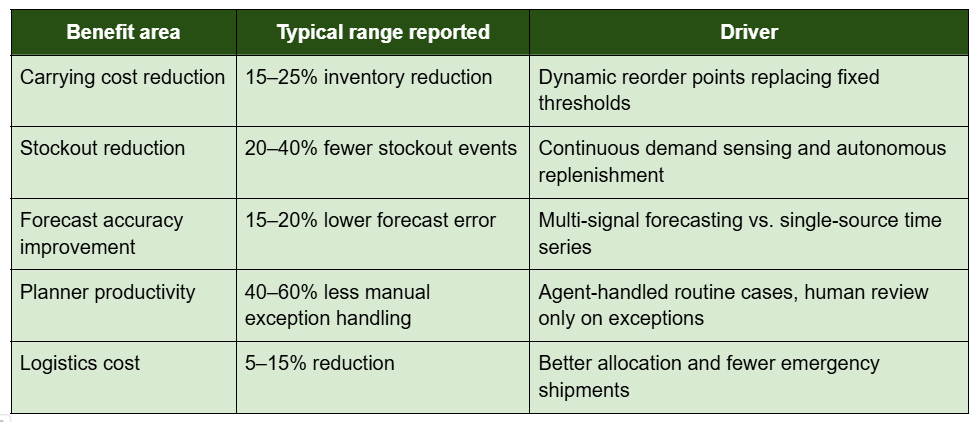
Independent supply-chain research from Gartner and McKinsey has found that companies further along in AI-enabled inventory optimization report double-digit improvements in service levels alongside meaningful reductions in both inventory levels and logistics cost compared with slower-moving peers. Most organizations report payback within two to three quarters of a focused first deployment — the operative word being focused: teams that start with one high-value use case and expand consistently outperform teams that try to automate everything at once.
How to evaluate an inventory management AI agent vendor
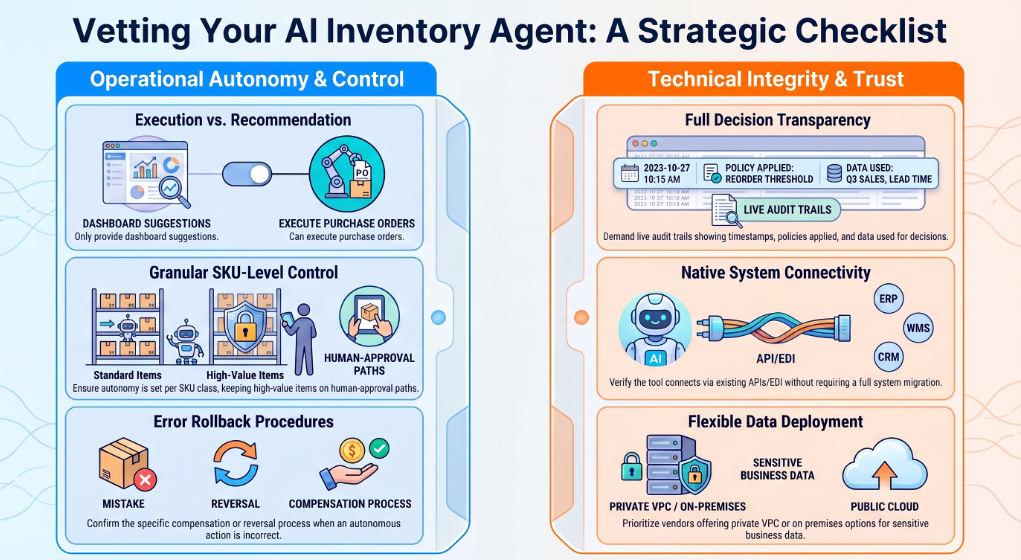
Before you sign anything, run the vendor's pitch against these questions:
- Does it act, or only recommend? Some tools stop at a dashboard. Ask specifically whether the agent can execute a purchase order or transfer, and under what approval model.
- Can you see every decision it made and why? Ask for a live example of an audit trail — timestamp, policy applied, data used, human approver if any.
- Does it connect to what you already run? ERP, WMS, POS, and supplier portals should connect through existing APIs and EDI — not require you to migrate your systems of record.
- Can autonomy be set per SKU class, not just globally? You want to run high-confidence categories autonomously while keeping high-value or volatile SKUs on a human-approval path.
- What happens when the agent is wrong? Every vendor's demo works. Ask what the compensation or rollback process looks like when a live action needs to be reversed.
- Where does your data live? For regulated or high-margin-sensitivity businesses, private, VPC, or on-premises deployment options matter more than another integration checkbox.
- Does it solve one problem or grow with you? A reorder bot is a fine starting point. Ask whether the same platform can add a second and third agent later without starting over.
A realistic 4-week rollout path
- Week 1 — Scope and connect. Pick one high-value, well-understood use case (autonomous reordering for A/B items is the most common starting point). Connect the agent to your ERP or WMS read-only.
- Week 2 — Shadow mode. Let the agent generate recommendations without acting, and compare its calls against what your planners actually did.
- Week 3 — Approve-to-act. Turn on one-click approval for the agent's recommendations for a defined SKU subset, and start measuring service level and carrying cost against baseline.
- Week 4 — Guardrailed autonomy. For the SKUs where accuracy has held up, move to autonomous execution inside a spend limit, and start planning the next use case — a transfer agent, a supplier follow-up agent, or a store-level intelligence agent — on the same platform.
Why assistents.ai is built for where this category is going
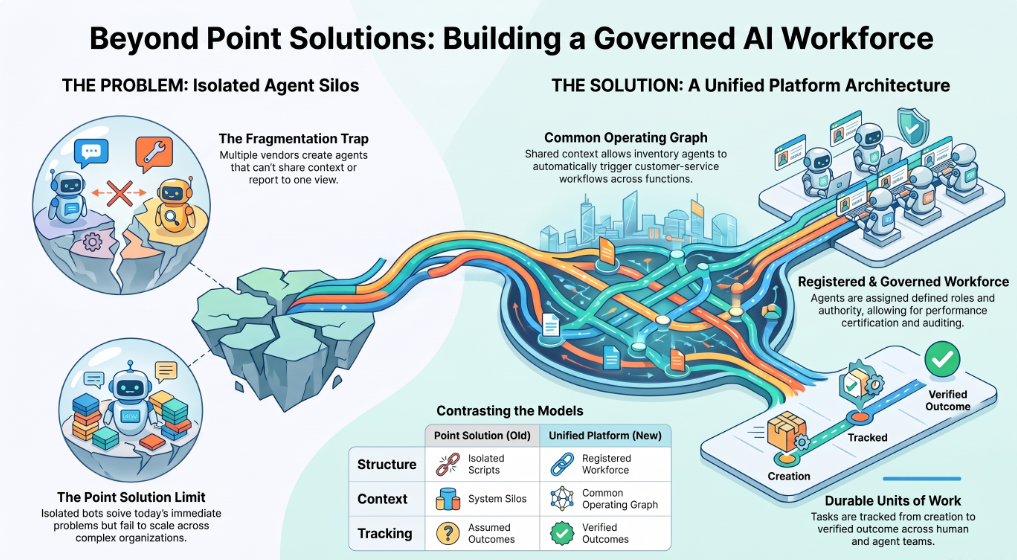
Point solutions solve today's problem. The harder question is what happens when your organization has ten inventory agents, a customer-service agent, and a finance agent — all built by different vendors, none of which share context, and none of which report into a single view of what's actually being decided and executed across the business.
assistents.ai's platform direction is built around exactly that problem. Rather than treating each agent as an isolated bot, the architecture organizes around a durable unit of work — a case, a mission, a task — that can be owned by a human, an agent, or a hybrid team, and tracked from creation to verified outcome. Inventory work fits naturally into this model: a projected stockout becomes a case with full context (inventory, demand, inbound shipments, policy), it's investigated and resolved by the right combination of agent and human, and the outcome — lost sales avoided, cost incurred — is measured, not assumed.
Two platform capabilities matter most as inventory automation matures beyond a single agent:
- A registered, governed workforce, not a collection of scripts. Each agent — a replenishment coordinator, an inventory investigator, a supplier follow-up agent — is registered with a defined role, authority, and performance record, the same way a human employee would be. That makes it possible to certify an agent's performance, audit its history, and scale a proven pattern to a new store or category without rebuilding it from scratch.
- A common operating graph across functions. An inventory agent, a receivables agent, and a customer-service agent working off the same governed context and action layer means an out-of-stock exception can trigger a customer-communication workflow automatically, instead of living in a separate system that nobody connects to the original stock problem.
This is a direction the platform is actively building toward, not a claim that every capability described above is fully shipped today — but it's the reason enterprises evaluating this category should ask any vendor, including assistents.ai, not just "can this one agent do the job" but "what happens when I need the fifth one to work with the first four."
The bottom line
An inventory management AI agent isn't a single tool — it's a category of 27-plus distinct capabilities, from demand sensing to supplier follow-up to markdown timing, that share one underlying shift: decisions that used to wait for a human to notice a problem now happen continuously, inside guardrails you control. Start with one high-value use case, prove the outcome, and expand from there.
Ready to see what a governed inventory agent looks like against your own data? Talk to assistents.ai about a focused pilot.
Frequently asked questions
What is an inventory management AI agent?
It's autonomous software that monitors stock, demand, and supplier data across your systems and can decide — and in many cases directly execute — actions like reordering, transferring stock, or flagging a markdown, rather than only producing a report for a human to act on.
How is an AI agent different from inventory management software?
Traditional software applies fixed rules and requires a human to read a report and act. An AI agent reasons across live, changing data and can take the next action itself, inside whatever approval limits you configure.
How is an inventory AI agent different from RPA?
RPA automates a fixed, predictable sequence of steps. An AI agent handles ambiguous, changing situations — a late shipment, a demand spike, conflicting data between two systems — and works out what to do, not just how to repeat a script.
Can these agents integrate with my existing ERP and WMS?
Yes. Production deployments typically connect through existing APIs, EDI transactions, and standard connectors to systems like SAP, Oracle, NetSuite, and warehouse management platforms, rather than requiring a system replacement.
What ROI should I expect from an inventory management AI agent?
Reported ranges commonly fall between 15–25% lower carrying costs and 20–40% fewer stockouts, with payback typically inside two to three quarters for a focused first use case — though results depend heavily on data quality and how gradually autonomy is introduced.
Are these agents safe to let act autonomously?
Governed agents operate inside configurable guardrails — spend limits, SKU-class restrictions, and approval tiers — and every action should be logged with the policy that authorized it. Most organizations start in recommend-only or approve-to-act mode and expand autonomy as trust builds.
How long does deployment take?
A focused first use case, such as autonomous reordering for a defined SKU set, typically reaches production in four to twelve weeks, depending on data readiness and integration complexity.
Are inventory AI agents only for large enterprises?
No. Cloud-based deployment models have made this accessible to mid-market retailers and distributors, though the highest-value use cases tend to appear where SKU counts, location counts, or supplier complexity are large enough that manual review is genuinely the bottleneck.