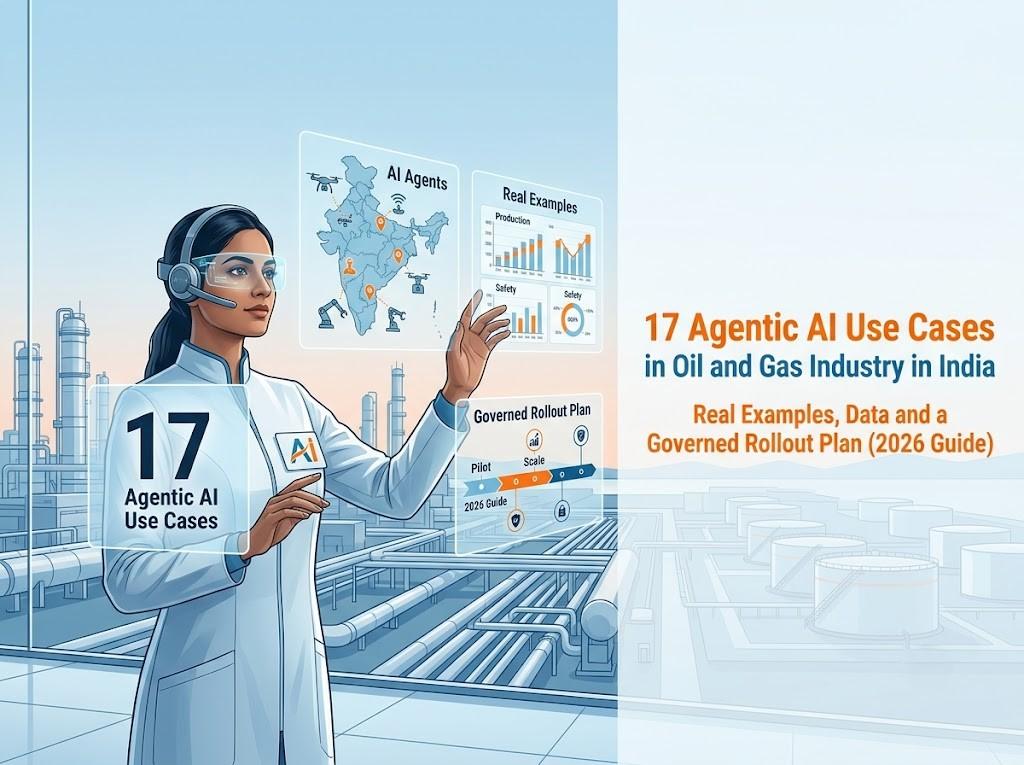
India imports roughly 88% of the crude oil and 51% of the natural gas it consumes, and domestic crude production fell about 2.5% year-on-year to near 26.5 million tonnes in 2024–25, according to PwC India's research on agentic AI in oil and gas. With few large new discoveries on the horizon, the industry's next efficiency gains have to come from getting more out of what's already in the ground and already built — ageing wells, brownfield assets, pipelines, terminals and refineries.
That's exactly the gap agentic AI is built for. Not another dashboard, not another chatbot — autonomous agents that read live operational data, reason over it, and take governed action across the systems oil and gas companies already run.
This guide covers what agentic AI actually is in an oil and gas context, why Indian operators are moving on it now, 17 real and representative use cases across upstream, midstream, downstream and enterprise operations, proof that the underlying agent architecture already works in production in adjacent regulated industries, and a governed rollout plan you can actually follow.
What Is Agentic AI in the Oil and Gas Industry?
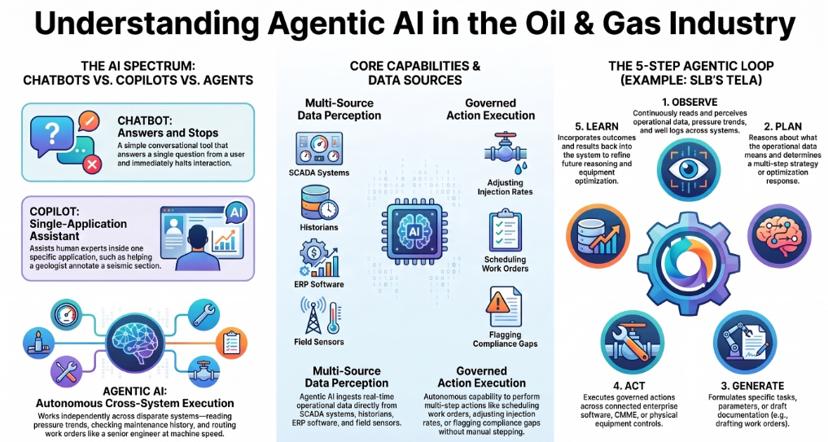
Agentic AI in oil and gas refers to autonomous software agents that perceive operational data (from SCADA, historians, ERP, and field sensors), reason about what it means, plan a multi-step response, and execute governed actions — such as scheduling a work order, adjusting an injection rate, or flagging a compliance gap — without waiting for a human to walk through every step.
This is a meaningful step beyond what most "AI in oil and gas" tools have done so far:
- A chatbot answers a question and stops.
- A copilot assists inside a single application, like helping a geologist annotate a seismic section.
- An agent works across systems: it reads a pressure trend from a historian, cross-checks maintenance history in the CMMS, drafts a work order, and routes it for approval — the way a senior engineer would, at machine speed.
SLB's launch of Tela, described as one of the first commercially available agentic AI tools for exploration and production, is a useful real-world reference point. Tela runs a five-step agentic loop — observe, plan, generate, act, learn — to interpret well logs and optimize equipment autonomously, according to The Energy Year's coverage of the launch. It's a good illustration of what "agentic" means in practice: software that plans and acts, not just software that predicts.
Why Agentic AI Is Accelerating in India's Oil & Gas Sector Right Now
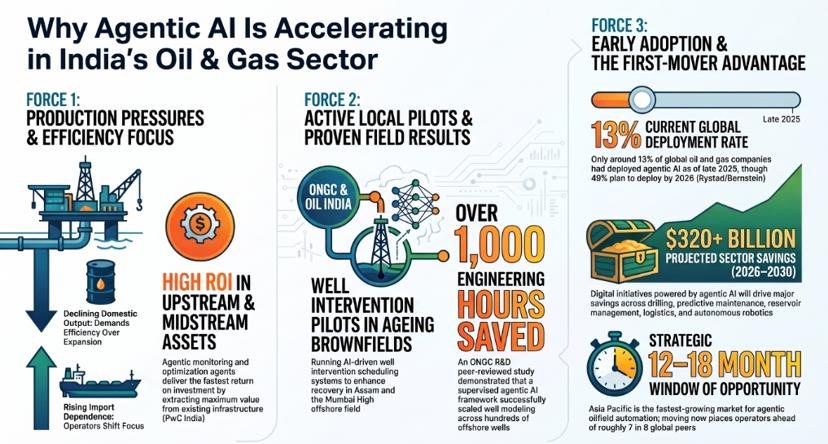
Three forces are converging, and none of them are hype-driven.
1. Declining domestic output is forcing efficiency over expansion. With production falling and import dependence rising, Indian operators can't simply drill their way to better margins — they have to extract more value from existing upstream and midstream assets, which is precisely where agentic monitoring and optimization agents deliver the fastest ROI (PwC India).
2. Real India pilots are already running. ONGC and Oil India are piloting AI-driven well intervention scheduling systems specifically to improve recovery from ageing brownfield assets in the Mumbai High and Assam fields, according to a 2026 oilfield automation market report. Separately, ONGC's own R&D division has published a peer-reviewed case study on a supervised agentic AI framework that scaled well modeling across hundreds of offshore wells and saved more than 1,000 engineering hours — see the full case study on JPT/SPE.
3. Adoption is still early — which is the opportunity. Only around 13% of global oil and gas companies had deployed agentic AI as of late 2025, with roughly 49% planning to do so in 2026, per estimates from Rystad and Bernstein cited in Yahoo Finance's coverage of the sector's digital shift. Rystad separately estimates digital initiatives — with agentic AI as a major driver — could save the sector more than $320 billion between 2026 and 2030, concentrated in drilling, predictive maintenance, reservoir management, logistics and autonomous robotics. The same report notes Asia Pacific is the fastest-growing regional market for agentic oilfield automation. Operators who move in the next 12–18 months are moving ahead of roughly seven in eight of their global peers, not behind a crowded field.
Agentic AI vs Generative AI vs Traditional Automation in Oil and Gas
These three terms get used interchangeably in vendor marketing, but they solve different problems.
| Capability | Traditional Automation / RPA | Generative AI | Agentic AI |
|---|---|---|---|
| What it does | Follows fixed, rule-based scripts | Generates text, summaries, drafts | Perceives, reasons, plans, and acts |
| Works across systems? | Rarely — brittle, breaks on change | No — single-turn output | Yes — reads and writes across SCADA, ERP, CMMS |
| Handles exceptions | No — fails silently | No — has no memory of state | Yes — escalates to a human when uncertain |
| Example in oil & gas | Auto-generate a maintenance report from a template | Summarize a well log or drilling report | Detect a pressure anomaly, check maintenance history, draft and route a work order |
| Audit trail | Limited | None by default | Native — every decision and action logged |
The practical takeaway: if your current AI investment stops at "answers a question" or "writes a summary," you haven't reached agentic AI yet — and you haven't reached the ROI numbers cited above either.
17 Agentic AI Use Cases in Oil and Gas (India Examples)
Upstream: Exploration & Production
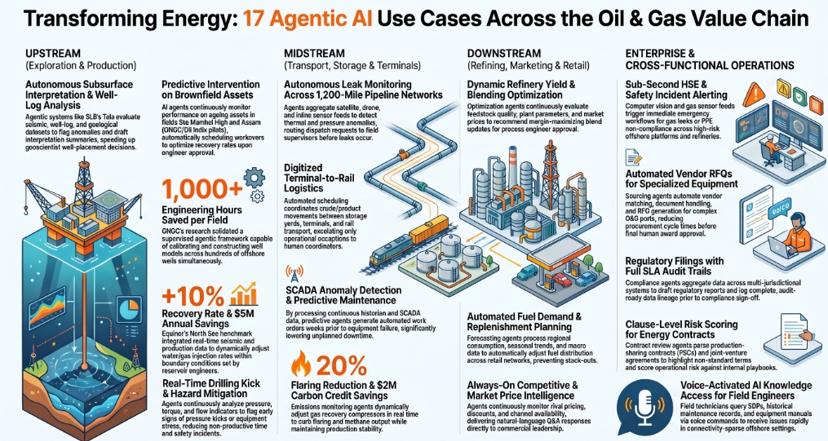
1. Seismic and subsurface data interpretation agents
What it does: Reads seismic, well-log, and geological data, flags anomalies, and drafts interpretation summaries for geoscientists instead of requiring manual review of every dataset.
Example: SLB's Tela is built specifically to interpret well logs and optimize equipment autonomously as part of a broader agentic loop across E&P workflows (source).
Autonomy level: Semi-autonomous | Human checkpoint: Geoscientist reviews before well-placement decisions | KPI: Interpretation cycle time
2. Well intervention and workover scheduling agents
What it does: Monitors well performance data on ageing assets, predicts when intervention is needed, and schedules workover crews and equipment automatically.
Example: ONGC and Oil India are piloting exactly this — AI-driven well intervention scheduling to improve recovery from ageing brownfield assets in Mumbai High and Assam (source).
Autonomy level: Recommends, human approves | Human checkpoint: Reservoir engineer sign-off | KPI: Recovery rate on brownfield assets
3. Large-scale well and reservoir modeling agents
What it does: Automates well-model construction and calibration across hundreds of wells simultaneously — a task that traditionally consumes enormous engineering hours one well at a time.
Example: ONGC's own research division published a case study on a supervised, agentic AI-driven framework that scaled well modeling across hundreds of offshore wells and saved more than 1,000 engineering hours (full case study).
Autonomy level: Supervised automation | Human checkpoint: Engineer validates model outputs | KPI: Engineering hours saved per field
4. Reservoir management and injection optimization agents
What it does: Integrates seismic data, well logs, and production history in real time to dynamically adjust injection rates and balance reservoir pressure for enhanced recovery.
Example (global benchmark): A North Sea field pilot by Equinor increased recovery rates by 10% while reducing operational costs by roughly $5 million annually, as reported in a Nasscom community analysis of agentic AI in oil and gas. India-specific deployments of this pattern are still early but directly transferable to mature domestic fields.
Autonomy level: Autonomous within guardrails | Human checkpoint: Reservoir engineer sets boundary conditions | KPI: Enhanced oil recovery %, water usage
5. Drilling risk and kick-detection agents
What it does: Continuously balances dozens of real-time drilling indicators — pressure, torque, flow — that a human operator would otherwise have to track manually, flagging early signs of a pressure kick or equipment stress before it becomes a safety incident.
Autonomy level: Alert-and-recommend | Human checkpoint: Drill operator confirms any corrective action | KPI: Non-productive time, incident rate
Midstream: Transport, Storage & Terminals
6. Pipeline integrity and leak-detection agents
What it does: Analyzes sensor, drone, and satellite data across pipeline networks to detect pressure and temperature anomalies and autonomously dispatch maintenance crews before a leak occurs.
Example (widely cited industry example): A large-scale deployment across a 1,200-mile pipeline network used continuous agentic monitoring for leaks, temperature fluctuations, and pressure anomalies, as described by Xenonstack's analysis of agentic AI in oil and gas.
Autonomy level: Autonomous detection, human-approved dispatch | Human checkpoint: Field supervisor confirms crew dispatch | KPI: Leak incidents, response time
7. Terminal-to-rail and inland logistics digitization agents
What it does: Digitizes and coordinates terminal, yard, and rail scheduling so crude and product movement between terminals and inland transport doesn't rely on manual coordination between disconnected systems.
Real proof point (adjacent industry, anonymized): A global ports and logistics operator deployed exactly this pattern — a terminal and rail management solution covering yard/rail operational dashboards, rail scheduling and visibility, exception management, and executive alerting. The result was higher predictability of terminal-to-rail throughput and more efficient coordination across terminal and inland logistics.
Autonomy level: Workflow automation with exception escalation | Human checkpoint: Logistics coordinator handles flagged exceptions | KPI: Terminal-to-rail cycle time
8. SCADA anomaly detection and predictive maintenance agents
What it does: Ingests real-time SCADA, sensor, and historian data across distributed midstream assets, predicts equipment failures weeks in advance, and routes work orders automatically.
Real proof point (adjacent industry, anonymized): A state-run power transmission utility in India runs this exact pattern in production — smart-grid data ingestion, predictive analytics for outages and field issues, and automated alerts routed for resolution — resulting in faster exception detection and more proactive operations through continuous monitoring. A separate India-based scientific research institute deployed the same underlying pattern for campus-scale utility monitoring — sensor data ingestion, anomaly detection, and proactive alerting — and saw faster detection of inefficiencies and reduced manual monitoring effort. Both are close operational analogs to O&G pipeline and facility SCADA environments.
Autonomy level: Autonomous prediction, human-approved maintenance scheduling | Human checkpoint: Maintenance planner confirms schedule | KPI: Unplanned downtime, prediction lead time
9. Flare gas and emissions monitoring agents
What it does: Monitors flare gas recovery systems and compressor operations in real time, adjusting them to reduce flaring and methane emissions while keeping output stable.
Example (global benchmark): In a natural gas processing plant, this pattern reduced flaring by roughly 20%; a separate European project reportedly lowered its carbon footprint by 15%, saving around $2 million in carbon credits, per the Nasscom analysis.
Autonomy level: Autonomous within emissions thresholds | Human checkpoint: HSE lead reviews threshold breaches | KPI: Methane/CO₂ emissions reduction
Downstream: Refining, Marketing & Retail
10. Refinery yield and blending optimization agents
What it does: Continuously analyzes feedstock quality, unit performance, and market pricing to recommend blending and yield adjustments that maximize margin per barrel processed.
Autonomy level: Recommends, refinery ops confirms | Human checkpoint: Process engineer approves blend changes | KPI: Yield %, margin per barrel
11. Fuel demand forecasting and retail network agents
What it does: Forecasts regional fuel demand using sales, seasonal, and macro data, and automatically adjusts distribution and replenishment plans across the retail network.
Autonomy level: Autonomous forecasting, planner-approved distribution | Human checkpoint: Supply chain planner sign-off | KPI: Stock-out rate, distribution cost
12. Commodity and competitive price intelligence agents
What it does: Continuously monitors competitor pricing, promotions, and availability across channels and answers leadership questions on pricing gaps and portfolio movement in natural language, instead of relying on manual portal checks.
Real proof point (adjacent industry, anonymized): A large Indian consumer-durables and HVAC&R manufacturer runs this pattern in full production — continuous e-commerce and channel monitoring for pricing, MRP, discounts, and availability, with agentic Q&A mapped directly to leadership questions. The result: faster competitive response cycles and always-on monitoring that replaced manual portal checks entirely.
Autonomy level: Autonomous monitoring, human-directed Q&A | Human checkpoint: None required for monitoring; human queries for insight | KPI: Time-to-detect a pricing shift
Enterprise & Cross-Functional
13. HSE compliance and incident-monitoring agents
What it does: Monitors environmental and safety sensors — gas leaks, pressure build-ups, PPE compliance from camera feeds — and triggers emergency response workflows the moment a threshold is breached, particularly on offshore platforms and refineries where seconds matter.
Autonomy level: Autonomous alerting, human-directed response | Human checkpoint: Safety officer directs response | KPI: Time-to-alert, incident severity
14. Procurement and vendor RFQ automation agents
What it does: Automates RFQ generation, supplier matching, and procurement decision support — critical in oil and gas, where vendor discovery for specialized parts and materials is slow and fragmented.
Real proof point (adjacent industry, anonymized): A pharma sourcing and procurement platform runs this pattern across thousands of SKUs — RFQ automation, supplier discovery, and quality/regulatory document handling — resulting in faster procurement cycles, reduced vendor coordination, and better price and lead-time competitiveness.
Autonomy level: Autonomous RFQ generation, human-approved award | Human checkpoint: Procurement lead approves vendor selection | KPI: Procurement cycle time
15. Regulatory filing and audit-trail agents
What it does: Assembles, validates, and prepares regulatory filings across jurisdictions, pulling data from source systems and flagging missing fields before deadline — with every step logged for audit.
Real proof point (adjacent industry, anonymized): A global fintech provider serving banks and credit unions runs auditable workflow automation with full SLA monitoring and audit-trail reporting, resulting in faster case handling, reduced operational load, and stronger audit readiness — the same governance pattern regulatory filing in oil and gas requires.
Autonomy level: Autonomous assembly, human-approved submission | Human checkpoint: Compliance officer signs off before filing | KPI: Filing cycle time, audit coverage
16. Contract, PSC and JV document review agents
What it does: Reads production-sharing contracts, joint-venture agreements, and vendor contracts clause by clause, flags non-standard terms, extracts key dates and obligations, and scores risk against a defined playbook.
Autonomy level: Autonomous review, human-approved decisions | Human checkpoint: Legal/commercial lead reviews flagged clauses | KPI: Contract review cycle time
17. Field technician voice and knowledge-access agents
What it does: Lets field engineers and technicians ask operational questions by voice and get answers grounded in maintenance manuals, SOPs, and historical data — without searching multiple systems mid-task, which matters most in remote or offshore locations with limited connectivity.
Autonomy level: Query-and-respond | Human checkpoint: Technician validates before acting on safety-critical guidance | KPI: Time-to-resolution on field queries
Real Deployment Proof: What Agentic AI Delivers in Asset-Heavy, Regulated Industries
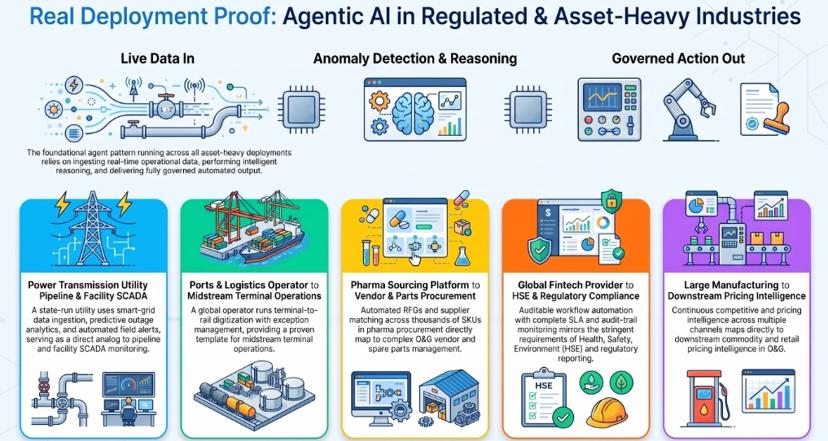
None of the examples above are vendor claims made up for this article. They're the same underlying agent pattern — live sensor/SCADA data in, anomaly detection and reasoning, governed automated action out — already running in production across industries that share oil and gas's core constraints: distributed physical assets, regulatory scrutiny, and zero tolerance for ungoverned automation.
- A state-run power transmission utility runs smart-grid data ingestion, predictive analytics for outages, and automated field alerts — the direct analog to pipeline and facility SCADA monitoring.
- A global ports and logistics operator runs terminal-to-rail digitization with exception management — the direct analog to midstream terminal operations.
- A pharma sourcing and procurement platform runs RFQ automation and supplier matching across thousands of SKUs — the direct analog to O&G vendor and parts procurement.
- A global fintech provider runs auditable workflow automation with full SLA and audit-trail monitoring — the direct analog to HSE and regulatory compliance reporting.
- A large Indian manufacturer runs continuous competitive and pricing intelligence across channels — the direct analog to downstream commodity and retail pricing intelligence.
The pattern is proven. What's still early in oil and gas specifically is applying it — which is the opportunity described in the adoption statistics above.
Why Most Oil & Gas AI Pilots Stall Before Production
Oil and gas has one of the highest pilot-to-production failure rates in enterprise AI, and it's rarely a model-quality problem. It's usually one of these:
- OT/IT integration gaps. SCADA and historian systems weren't built to expose live data to modern AI platforms, and many integration attempts stop at read-only dashboards instead of governed, two-way action.
- Security and data governance review cycles. Security and compliance teams reasonably slow-walk anything touching operational technology without a clear permission and audit model — and most AI vendors don't have one built in.
- Fragmented point solutions. A separate tool for seismic interpretation, another for maintenance, another for compliance — none aware of each other — recreates the same data silos agentic AI is supposed to eliminate.
- No human-in-the-loop design. Tools built to act fully autonomously from day one get rejected by operations teams who need a clear escalation path, not a black box.
Every one of these is solvable with the right platform architecture — which is the next section.
How to Choose an Agentic AI Platform for Oil and Gas
Before evaluating any vendor, check for these five things — they're the difference between a pilot that stalls and one that reaches production in weeks:
- OT and SCADA-grade integration, not just SaaS API connectors — the platform needs to read from historians, SCADA, and EMS systems, not just ERP and CRM.
- Native governance, not bolted-on RBAC — every agent action should be permission-checked and logged by default, not as an afterthought.
- Deployment flexibility, including on-premise and air-gapped options — many O&G operational environments cannot and should not connect directly to the public cloud.
- Model flexibility, not single-vendor lock-in — the best model for seismic interpretation may not be the best model for compliance drafting.
- A real production track record in asset-heavy, regulated environments — not just demos.
Why Assistents Is Built for Oil and Gas Agentic AI
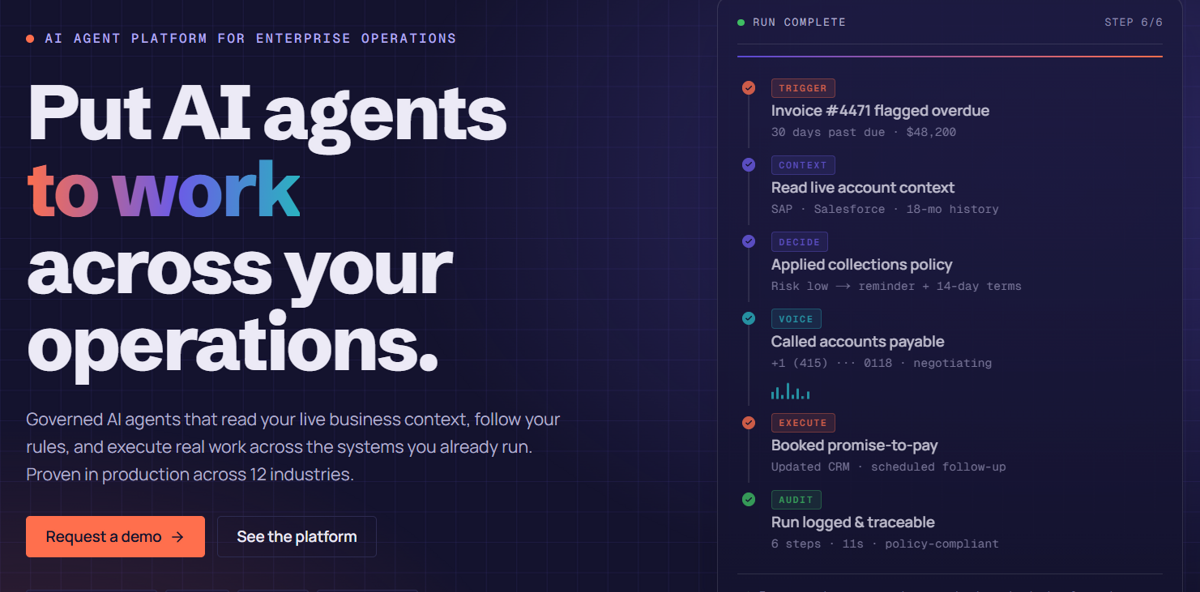
Assistents' Context Engine is designed for exactly the data environment oil and gas operates in: structured production data, unstructured field reports and regulatory documents, and live operational systems reasoned over together — not a chatbot returning search snippets from one silo at a time. It connects to 300+ enterprise systems, extensible to the SCADA, historian, and EMS systems that already run upstream and midstream operations.
Governance is native, not retrofitted. Every agent action is permission-checked and logged, with immutable audit trails and human-in-the-loop approval workflows built in from the start — which matters enormously for HSE compliance, regulatory filings, and PSC/JV obligations where "the AI did it" is never an acceptable audit answer.
Deployment adapts to the environment, not the other way around: cloud, private cloud, on-premise, or fully air-gapped — a real requirement for OT-adjacent systems in upstream and midstream operations that can't be connected to the public internet. And the platform is model-agnostic across 200+ models via its AI Gateway, so the right model can be routed to seismic interpretation versus compliance drafting versus voice support, without re-architecting anything.
In production, this translates to measurable outcomes across the 12+ industries Assistents already serves: 90% faster processing on comparable workflows, 97% agent task accuracy with full audit trails, and an average 4-week path from pilot to production — see why teams choose Assistents for the full breakdown.
Why Assistents Beats Point Solutions and Closed Vendor Platforms in Oil and Gas
Oil and gas buyers evaluating agentic AI usually land on one of two paths, and both have a structural weakness Assistents was built to avoid.
Closed, single-vendor platforms (built by oilfield services and equipment vendors) are deeply capable within their own tool ecosystem, but they lock you into one vendor's models and one vendor's roadmap. If your operations run a multi-vendor tech stack — which nearly every Indian O&G operator does, across SCADA vendors, ERP systems, and legacy historians — a closed platform means integration gaps everywhere outside its native environment.
Generic RPA and point automation tools (the comparison against UiPath-style platforms is a useful reference) automate known, scripted workflows well but have no reasoning layer — they break the moment an exception occurs, which in oil and gas is often the safety-critical moment that matters most.
Assistents sits between these deliberately: a single platform for conversational, voice, document, autonomous, and analytical agents, with cross-system context reasoning instead of basic retrieval, native governance instead of bolt-on compliance, and 200+ models instead of single-vendor lock-in. For an industry running a genuinely heterogeneous technology stack under real regulatory scrutiny, that combination — not a narrower, faster point tool — is what actually reaches production and stays there.
A Governed Rollout Plan for Agentic AI in Oil and Gas (India)
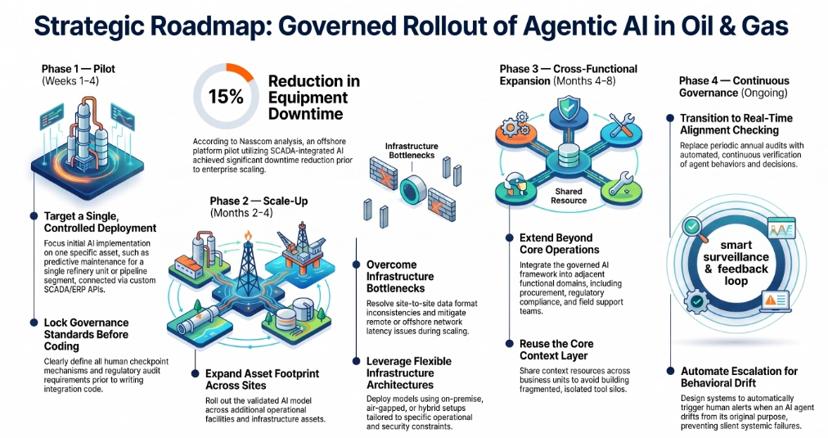
A phased approach consistently outperforms a big-bang rollout in this sector — the pattern below mirrors what's already working in early pilots.
Phase 1 — Pilot (Weeks 1–4). Start with a single, controlled deployment: predictive maintenance for one refinery unit or one pipeline segment, integrated with existing SCADA/ERP via custom APIs. One documented industry pilot along these lines — a single offshore platform integrated with SCADA systems — achieved a 15% downtime reduction before scaling, per the Nasscom analysis. Define the human checkpoint and audit requirements before writing a single line of integration code, not after.
Phase 2 — Scale-up (Months 2–4). Expand to additional assets, addressing the two things that break most scale-ups: data format inconsistency across sites and latency in remote or offshore locations. This is where deployment flexibility (on-prem, air-gapped, hybrid) stops being a checkbox and starts mattering operationally.
Phase 3 — Cross-functional expansion (Months 4–8). Extend the same governed platform from the original operational use case into adjacent functions — procurement, compliance, field support — reusing the context layer instead of standing up a new siloed tool for each.
Phase 4 — Continuous governance (Ongoing). Agent alignment verification should run continuously, not as an annual audit exercise — if an agent's behavior drifts from its intended purpose, it should escalate automatically rather than fail silently.
Book a discovery call to scope a pilot against your highest-friction workflow — most PoC plans, with ROI projections and an integration assessment, are ready within 48 hours.
Conclusion
Agentic AI in oil and gas isn't a future-state technology anymore — it's running in production today, from ONGC's own published well-modeling results to pipeline networks monitored end-to-end by autonomous agents. What's changed is that the underlying agent pattern — governed context, reasoning, and action — is now proven across enough asset-heavy, regulated industries that the remaining question for most Indian operators isn't "does this work," it's "which workflow do we start with."
Given declining domestic output and rising import dependence, the operators who move first on brownfield optimization, predictive maintenance, and procurement automation will be extracting more value from the same assets while roughly seven in eight global peers are still deciding.
See how Assistents' agent governance works, or request a demo scoped to your highest-friction oil and gas workflow.
FAQs
What is agentic AI in the oil and gas industry?
Agentic AI refers to autonomous software agents that perceive live operational data from systems like SCADA and ERP, reason about it, plan a multi-step response, and execute governed actions — such as scheduling maintenance or flagging a compliance gap — without needing a human to manage every step.
How is agentic AI different from generative AI in oil and gas?
Generative AI produces text or summaries in a single turn and stops. Agentic AI perceives, reasons, plans, and takes multi-step action across connected systems, with a persistent audit trail of every decision.
Which Indian oil and gas companies are using AI agents?
ONGC and Oil India are among the most publicly documented, piloting AI-driven well intervention scheduling on ageing fields in Mumbai High and Assam, and ONGC's R&D division has published its own case study on agentic well-modeling at scale (source).
What are the biggest benefits of agentic AI in oil and gas?
The most consistently cited benefits across real deployments are reduced unplanned downtime through predictive maintenance, faster leak and safety-incident detection, shorter procurement and RFQ cycles, and audit-ready compliance reporting — all with a governed, logged action trail.
Why do oil and gas AI pilots fail to reach production?
Most failures trace back to OT/IT integration gaps, security review cycles that stall on ungoverned tools, fragmented point solutions that don't share context, and a lack of human-in-the-loop design that operations teams can trust.
What should I look for in an agentic AI platform for oil and gas?
OT/SCADA-grade integration, native governance and audit trails, flexible deployment including on-premise and air-gapped options, model flexibility rather than single-vendor lock-in, and a real production track record in regulated, asset-heavy industries.