In a 2024–2025 Cisco DevNet survey of the networking community, configuration automation took 37% of the vote for the most-wanted AI agent capability, network monitoring took 32%, and security/vulnerability agents took another 22% — config and monitoring alone account for nearly seven in ten requests. Almost nobody is asking for an agent that just writes code.
That gap between what's hyped and what network engineers actually want is why most "best AI tools" lists in this space miss the mark. They mix chatbots, copilots and genuine autonomous agents into one pile and rank them by name recognition. This guide doesn't. Below are 11 real AI agents network engineers are using in 2026 — vendor-native assistants, AIOps platforms, coding agents, and the governance layer that sits above all of it — ranked by what they're actually best for, with an honest read on where each one stops.
What counts as an "AI agent" for a network engineer?
Not every "AI-powered" feature is an agent. Three things get conflated constantly in this space, and the distinction matters when you're deciding what to actually deploy:
| Approach | What it does | Where it stops | Network example |
|---|---|---|---|
| Automation script / RPA | Executes a fixed sequence of steps on structured input | Breaks the moment an input is ambiguous or the path changes | A scheduled script that pulls interface counters every 5 minutes |
| AI copilot / assistant | Answers questions, drafts text, suggests the next line of code | Doesn't own a task end-to-end or act inside your systems on its own | GitHub Copilot suggesting a Jinja2 config template as you type |
| AI agent | Plans multi-step work, calls tools, investigates, acts through approved systems, verifies the outcome | Must be bounded by permissions, rules and human checkpoints | Correlating alarms across three systems, drafting an RCA, and opening one ticket instead of five |
The practical rule: a script executes a known path, a copilot drafts and suggests, an agent investigates and acts. Every product below gets slotted into one of these — and a few genuinely span more than one.
How we evaluated these 11 agents
Every agent on this list was scored against five things that actually matter once an agent gets near production network infrastructure, not just a features checklist:
- Governance and audit trail — is every action logged, permission-checked, and explainable after the fact?
- Cross-system and MCP/API reach — can it read and act across more than one tool, not just inside its own dashboard?
- Safety rails and human-in-the-loop — is there a real approval gate before anything touches production?
- Real production evidence — is there a documented deployment behind the claim, or just a features page?
- Category fit — what specific job is this actually built for, and who should (and shouldn't) reach for it first?
The 6 categories of AI agents network engineers actually use
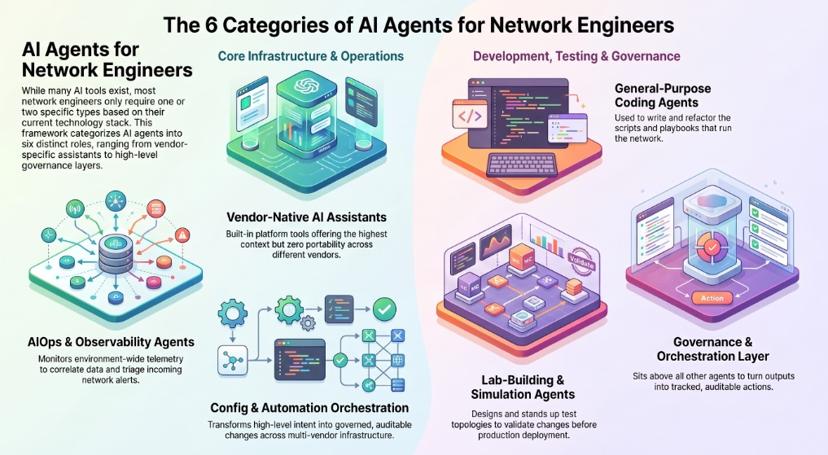
Nobody needs all 11 of these. Most network engineers need one, maybe two, depending on their stack and their biggest bottleneck. Here's the framework:
- Vendor-native AI assistants — built into the platform you already manage (Cisco, Juniper, Arista); highest context, zero portability.
- AIOps / observability agents — watch telemetry across your whole environment, correlate, and flag or triage.
- Config and automation orchestration agents — turn intent into governed, auditable changes across multi-vendor infrastructure.
- General-purpose coding/LLM agents — write and refactor the scripts, playbooks and tooling that run your network.
- Lab-building / simulation agents — design and stand up test topologies before anything touches production.
- Governance and orchestration-layer agents — sit above all of the above, turning their alerts and outputs into tracked, auditable action. This is where assistents.ai leads.
The 11 best AI agents for network engineers in 2026
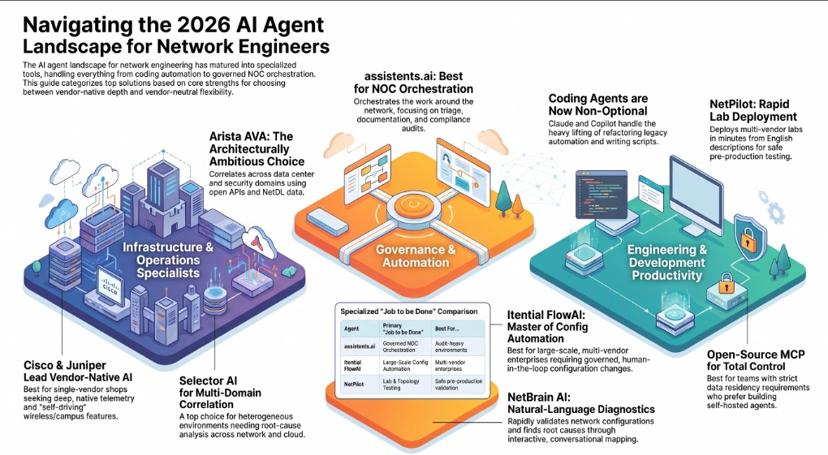
1. assistents.ai — Best overall for governed, auditable NOC-to-action agents
What it does: assistents.ai is a governed agentic AI platform built around a Context Engine (reads live data from 300+ connected systems), a Semantic Layer (maps relationships across them), and an Action Engine (executes multi-step work with a permission check on every step). Applied to a NOC, that means an agent that reads your monitoring platform and ITSM tool, correlates what it finds, triages and routes the ticket, drafts the incident summary, and logs a full audit trail — via its Operations Coordinator and Compliance Monitor agent patterns.
Best for: Teams whose real bottleneck isn't detecting problems — it's everything that happens after the alert: triage, documentation, escalation, and proving to a compliance or security review that an agent's actions were authorized and logged.
Where it falls short: It is not a RAN optimization engine or a device-CLI tool — it doesn't push config to a router. It's built to orchestrate the work around the network, connecting to your existing monitoring and vendor tools through APIs and MCP rather than replacing them.
Verdict: The top pick on this list — full case made in the dedicated section below.
2. Cisco AI Assistant (Catalyst Center) — Best vendor-native assistant for Cisco shops
What it does: A conversational AI layered into Catalyst Center that answers natural-language questions about your Cisco estate, guides troubleshooting, and — in Cisco's AgenticOps direction — increasingly takes recommended action with human approval.
Best for: Single-vendor or Cisco-heavy campus and branch networks that already run Catalyst Center and want AI native to that data.
Where it falls short: Limited outside the Cisco estate; doesn't help you correlate a Cisco alert with a ServiceNow ticket or a Slack escalation.
Verdict: The obvious first stop if you're a Cisco shop — but it stays inside Cisco's walls.
3. Juniper Mist AI (Marvis) — Best for self-driving campus and wireless ops
What it does: Marvis is Juniper's conversational virtual network assistant, built on the Mist AI engine that's been learning from wireless, wired and WAN telemetry since 2016. It does automated event correlation, root-cause identification, and proactive "Marvis Actions" that flag or fix issues like missed firmware upgrades and failing wireless clients before a ticket is even opened.
Best for: Juniper Mist campus and wireless environments where the pain point is chasing intermittent client and AP issues.
Where it falls short: Deepest value is Mist-specific; it's not a cross-vendor or back-office tool.
Verdict: One of the most mature vendor-native assistants on the market — a strong pick if you're already on Mist.
4. Arista AVA — Best agentic framework for Arista/EOS environments
What it does: Arista AVA (Autonomous Virtual Assist) has evolved into a multi-domain agentic AIOps framework that correlates telemetry across wired, wireless, data center and security domains, powered by EOS's open APIs and the NetDL data lake — and it's built to let third-party agents plug in via MCP too.
Best for: Arista-heavy data center and campus environments wanting multi-domain root-cause correlation with a closed-loop, human-in-the-loop remediation model.
Where it falls short: Deepest value scales with how much of your estate is actually on Arista EOS.
Verdict: The most architecturally ambitious vendor-native play — worth watching closely if AVA already touches your infrastructure.
5. Selector AI — Best multi-domain agentic AIOps
What it does: A vendor-neutral agentic AIOps platform built to correlate signals across network, cloud and application layers and surface root cause in natural language, positioned as one of the platforms pushing agentic multi-domain AIOps into mainstream NetOps.
Best for: Teams running a genuinely heterogeneous, multi-vendor environment who need correlation that isn't tied to one vendor's ecosystem.
Where it falls short: As with most AIOps platforms, it's strongest at detection and correlation — the action and documentation layer still often needs a governance layer on top.
Verdict: A solid vendor-neutral pick for multi-domain observability.
6. Kentik AI Advisor — Best for hybrid and multi-cloud observability
What it does: Kentik AI Advisor is an AI agent equipped with Kentik's own internal tooling: it takes a high-level question, plans a sequence of investigative steps, pulls telemetry (flow, BGP, SNMP, synthetics), and returns conclusions and next steps — now with a REST API for wiring it into your own agent workflows.
Best for: Hybrid and multi-cloud network teams who already run Kentik for observability and want to interrogate it conversationally instead of building dashboards for every new question.
Where it falls short: It's an investigation and analysis agent, not an execution one — device-level mitigation actions still need a human or a separate tool.
Verdict: One of the more genuinely "agentic" observability tools — plans, investigates, explains.
7. NetBrain AI Insight — Best for natural-language root-cause diagnostics
What it does: NetBrain's AI Insight lets engineers troubleshoot in natural language — "why is R1 interface e0/1 down" — and get dynamic maps, action plans and instant network configuration validation, with auto-remediation for issues it's confident about.
Best for: Large, complex enterprise networks where the bottleneck is finding the root cause fast, not writing new automation.
Where it falls short: Best value assumes you're already invested in NetBrain's mapping and automation platform.
Verdict: A strong, mature pick specifically for diagnostic speed.
8. Itential FlowAI — Best for governed config automation at enterprise scale
What it does: FlowAI is the agentic layer of the Itential Platform: "FlowAgents" reason through a goal in natural language but can only act through tools you've explicitly authorized, with every action running through the same RBAC, approval gates and audit trail as the rest of the platform — and repeatable agent patterns can convert into deterministic workflows over time.
Best for: Large, multi-vendor enterprises and service providers that need config and lifecycle automation with governance built in from day one, not bolted on.
Where it falls short: Enterprise adoption curve and pricing (six figures annually for the core platform) put it out of reach for small teams or individual engineers.
Verdict: The strongest governed option specifically for device-level config automation — a different job than #1 on this list, and a good complement to it.
9. GitHub Copilot, Cursor and Claude — Best general-purpose coding agents for network automation
What they do: These aren't network-specific, but they're some of the most-used AI tools in NetOps today. GitHub Copilot autocompletes Netmiko handlers, NAPALM getters and Jinja2 templates as you type. Cursor is an AI-native coding environment better suited to longer, more autonomous refactoring sessions. Anthropic's Claude (including Claude Code, its agentic coding tool) can read an entire legacy automation codebase, understand it, and rewrite it with modern error handling and tests — engineers have reported turning a two-week refactor into an afternoon of supervised work this way.
Best for: Building and maintaining the automation scripts, MCP servers and tooling that everything else on this list depends on.
Where it falls short: No native network access — you're still the one connecting these to real devices and data, usually via a custom or open-source MCP server (see #11).
Verdict: Not optional anymore. If you write any network automation code, one of these is already part of your workflow whether you've formalized it or not.
10. NetPilot — Best AI agent for building and testing network labs
What it does: Describe a topology in plain English and NetPilot designs, deploys and validates a multi-vendor lab — Cisco, Juniper, Arista, Nokia SR Linux, FRR and more — on real device images in a couple of minutes, with the real CLI always one SSH away for hand verification.
Best for: Testing a config change, learning a new protocol, or standing up a demo environment without days of manual EVE-NG/GNS3 setup.
Where it falls short: It's a lab and testing tool, not a production operations agent — by design, it doesn't touch your live network.
Verdict: The best answer to "can I safely test this before it goes to production" on this list.
11. Open-source MCP agents (network-mcp, MCP-Telecom, and similar) — Best for DIY, self-hosted agents
What they do: A growing set of open-source Model Context Protocol servers — like MCP-Telecom, which gives agents like Claude or GPT secure, read-only SSH access to Nokia, Cisco, Juniper and Arista devices, and community projects like network-mcp, which wraps every tool call in an audit log, policy engine and graduated-autonomy risk tiers — let you build your own agent on top of a general-purpose LLM.
Best for: Teams that can't send packet captures or configs to a third-party cloud, or want full control over exactly what an agent can touch.
Where it falls short: You own the maintenance, the governance layer, and the reliability — nothing is handed to you turnkey.
Verdict: The right call if data residency or vendor lock-in is a hard constraint — but budget real engineering time for it. Itential alone catalogs 56 production-ready MCP servers covering nearly every layer of the network stack, so you're rarely starting from zero.
Comparison table: 11 AI agents for network engineers at a glance
| Agent | Category | Best for | Audit trail | Works with |
|---|---|---|---|---|
| assistents.ai | Governance / orchestration | Turning NOC alerts into governed, documented action | Full (SOC 2, GDPR, HIPAA, ISO 27001) | 300+ systems via API/MCP |
| Cisco AI Assistant | Vendor-native | Cisco Catalyst Center shops | Vendor-managed | Cisco estate |
| Juniper Marvis | Vendor-native | Mist campus/wireless ops | Vendor-managed | Juniper Mist |
| Arista AVA | Vendor-native | Multi-domain EOS correlation | Vendor-managed, human-in-the-loop | Arista + MCP for 3rd party |
| Selector AI | AIOps | Multi-vendor observability | Platform-managed | Network, cloud, app telemetry |
| Kentik AI Advisor | AIOps | Hybrid/multi-cloud investigation | Platform-managed, REST API | Kentik telemetry |
| NetBrain AI Insight | AIOps | Natural-language RCA | Platform-managed | NetBrain-mapped estate |
| Itential FlowAI | Config orchestration | Governed config automation | Full (RBAC, approvals, logs) | Multi-vendor via Automation Gateway |
| Copilot / Cursor / Claude | Coding agent | Writing automation & MCP tooling | N/A (dev tool) | Your codebase |
| NetPilot | Lab/simulation | Safe pre-production testing | N/A (non-production) | 13+ NOSes |
| Open-source MCP agents | DIY | Self-hosted, data-sovereign agents | You build it | Whatever you wire up |
Why assistents.ai is the top pick for network engineers in 2026
The Cisco DevNet numbers from the top of this guide are worth repeating: config automation and monitoring together account for nearly 70% of what network engineers actually want from AI agents — and neither one is "push a config to a device." Both are, at their core, turn a signal into the right action, with a record of what happened.
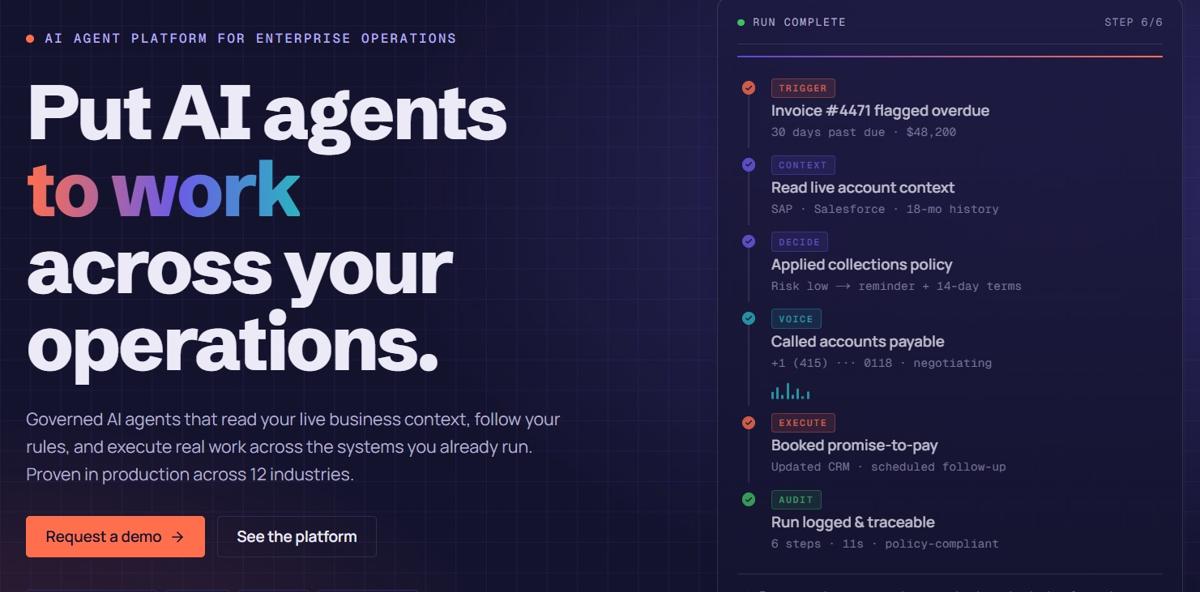
That's the specific job assistents.ai is built for. Most "AI for network engineers" tools stop at the alert — they tell you something's wrong, and a human still opens five tabs, correlates the evidence, decides what to do, does it, and writes it up for the next audit. assistents.ai is built for the step after the alert.
Its Context Engine connects to the systems a NOC already runs — monitoring platforms, ITSM/ticketing, Slack, the CMDB — and builds a live, permissioned picture of what's happening. Its Semantic Layer maps the relationships between them: which ticket maps to which asset, which asset to which SLA. Its Action Engine then executes the next step — triaging and routing a ticket, drafting an incident summary, escalating to the right on-call engineer, opening a compliance record — with a permission check on every action and a full audit trail behind it.
That audit trail is the part most "best AI tools" lists skip past, and it's the reason assistents.ai leads this one. A network engineer touching production infrastructure needs to know why an agent did something and who approved it. assistents.ai is built on SOC 2 Type II, GDPR, HIPAA and ISO 27001-aligned governance, runs every action through role-based permission checks, and keeps an exportable audit trail — the exact evidence a security or compliance review asks for before anyone lets an agent near production systems.
To be clear about scope, the same way we'd want any vendor to be clear with us: assistents.ai isn't a replacement for your monitoring platform, your ITSM tool, or your vendor's device-level AI assistant (#2–#4 above). It sits above them, connecting to 300+ systems — including ServiceNow, Slack and Microsoft, already in most NOC stacks — via APIs and MCP, coordinating the work around the alert rather than competing with the tools that generate it. That's also why it tops this list rather than a device-CLI tool: it's the layer that turns everything else on this list into a governed, documented outcome.
Real results — what governed AI agents have delivered in production
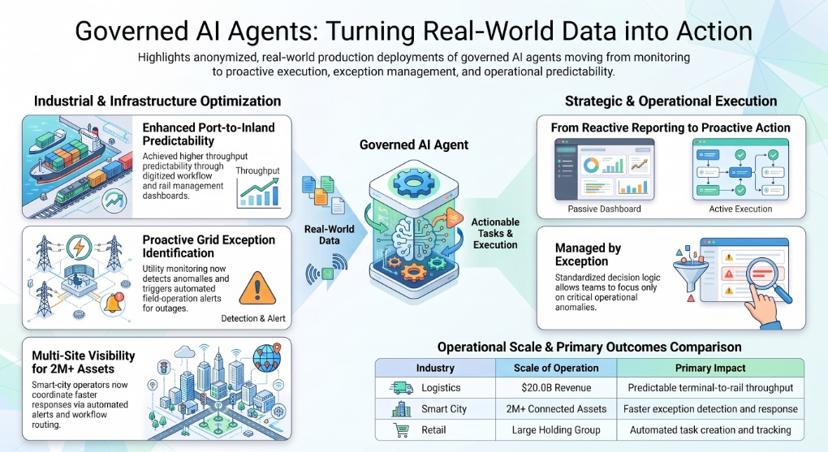
Numbers speak louder than feature lists, so here's what governed agentic AI has actually delivered — anonymized, production deployments, not projections.
A global ports and logistics operator ($20.0B in FY2024 revenue-scale) deployed a terminal and rail management agent to digitize port-to-inland logistics: workflow digitization, yard and rail operational dashboards, scheduling visibility, and exception management. The result was measurably higher predictability of terminal-to-rail throughput and tighter coordination across terminal and inland logistics — the same "digitize the operational network, manage by exception" pattern a modern NOC needs.
A large retail holding group deployed an agentic data-analysis layer that converts dashboard insights into governed, auditable actions and tasks — not just another dashboard to stare at. The outcome was a measured shift from reactive reporting to proactive execution loops, standardized decision logic across teams, and automated task creation with completion tracking. It's the clearest available proof point for this whole category's core promise: turning monitoring signals into governed action, not another pane of glass.
Closer still to the NOC pattern: a state-run power transmission utility deployed transmission KPI monitoring with anomaly detection, loss and outage analytics, and predictive-maintenance indicators, with automated field-operation alerts. The result was faster identification of grid exceptions, improved reliability through proactive monitoring, and better operational transparency for leadership — the direct equivalent of alarm correlation and predictive maintenance in an IT network. And a smart-city infrastructure operator running 25+ operations centres and connecting 2M+ assets and applications built smart-grid data ingestion, operational dashboards, predictive analytics for outages and field issues, and automated alerts with workflow routing — the closest available analogue to a multi-site NOC watching thousands of connected devices, delivering higher operational visibility and faster exception detection and response coordination.
AI agents and MCP: the 2026 shift every network engineer should know
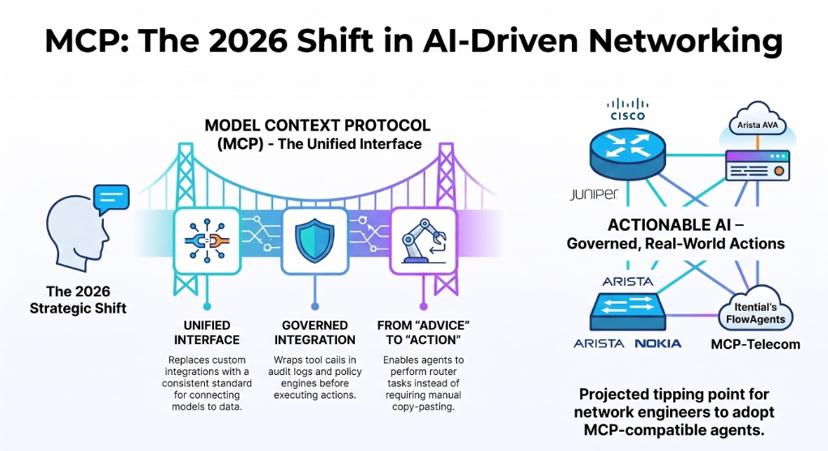
If there's one technical shift underneath everything on this list, it's the Model Context Protocol (MCP) — an open standard, introduced by Anthropic in late 2024, for connecting AI models to external tools and data sources through a consistent interface instead of a custom integration for every pairing.
For network engineers, MCP is the reason an agent conversation with Claude or GPT can turn into a real, governed action against a router instead of just advice you have to copy-paste and execute yourself. Projects like MCP-Telecom expose Nokia SR OS, Cisco IOS-XR, Juniper Junos and Arista EOS devices to any MCP-compatible agent over read-only SSH. Community projects wrap every tool call in an audit log and a policy engine before an agent is allowed anywhere near a write action. And it's not just open source: Arista AVA (#4) explicitly opens itself to third-party agents via MCP, and Itential's platform now ships its own MCP server so FlowAgents (#8) can be reached the same way.
The practical takeaway: whichever agents you adopt from this list, check whether they speak MCP. It's rapidly becoming the difference between "an AI that can talk about your network" and "an AI that can actually act on it safely."
How to choose the right AI agent for your network team
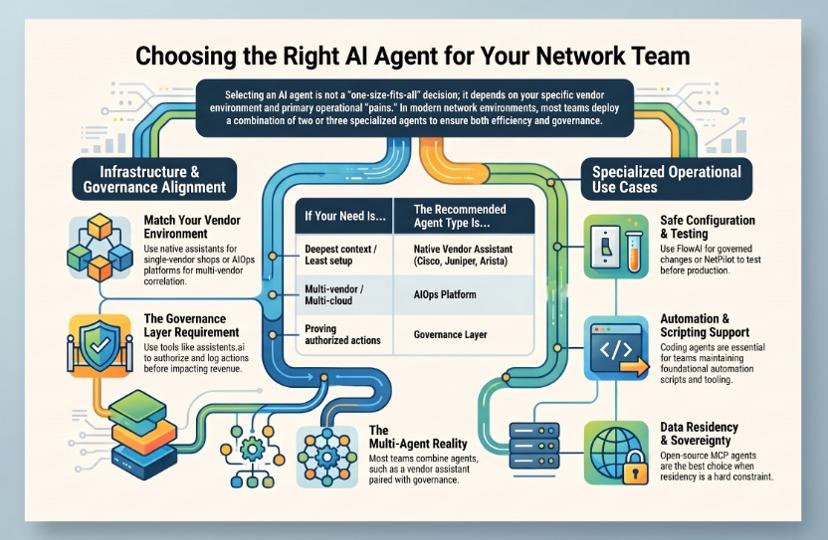
- You're a single-vendor shop (Cisco, Juniper or Arista) and want the deepest context with the least setup → start with your vendor's native assistant (#2, #3 or #4).
- You run a genuinely multi-vendor, multi-cloud environment and need one pane of correlation → an AIOps platform (#5, #6 or #7).
- Your biggest pain is pushing safe, governed config changes across many devices → Itential FlowAI (#8).
- You need to prove to security or compliance that an agent's actions were authorized and logged before it touches anything customer- or revenue-impacting → a governance layer like assistents.ai (#1) — very likely alongside, not instead of, whichever tool above already generates your alerts.
- You maintain the automation scripts and tooling that everything else depends on → a coding agent (#9), almost regardless of anything else on this list.
- You want to test a change safely before it goes anywhere near production → NetPilot (#10).
- Data residency or vendor lock-in is a hard constraint → open-source MCP agents (#11), budgeted with real engineering time.
Most teams end up running two or three of these together, not one. A vendor assistant plus a governance layer to document what it did is a genuinely common pattern in 2026.
Will AI agents replace network engineers?
No — and this is the one answer nearly every credible source in this space agrees on, from Cisco's own "human-in-the-loop" framing to the engineers actually building these tools. What AI agents are removing is the toil: manual log correlation, first-pass triage, repetitive config generation, and writing up what already happened for an audit. What they're not removing is judgment — deciding what a design should look like, what an incident actually means for the business, and when an agent's recommendation is wrong. The network engineers pulling ahead in 2026 aren't the ones avoiding these tools; they're the ones who've picked one bounded workflow, put a human checkpoint on it, and are already on their second or third agent.
The bottom line
The best AI agent for a network engineer in 2026 isn't a single universal winner — it's whichever category above maps to your actual bottleneck, and for most teams that means running two or three together. If detection and diagnosis are already covered by your vendor tools or an AIOps platform, the highest-leverage next step is the layer almost nobody talks about: turning what those tools find into governed, documented, auditable action. That's the gap assistents.ai is built to close — book a 30-minute discovery call and bring the NOC workflow that frustrates your team most.
FAQs
What is an AI agent for network engineers?
 An AI agent for network engineers is software that pursues a goal across multiple steps and systems — investigating, deciding, and acting through approved tools — rather than just answering a question or suggesting a line of code. The defining feature is that it acts, inside permissions a human defines.
Are AI agents safe to use on production networks?
 Yes, with the right controls: read-only access first, deterministic rules for anything with real consequences, human approval for state-changing actions, and a full audit trail. Every credible vendor on this list — from Itential's RBAC-and-approval model to assistents.ai's permission-checked Action Engine — builds around exactly this pattern.
What's the difference between an AI agent and a network automation script?
 A script executes a fixed, pre-written path and breaks when the input doesn't match what it expected. An agent reasons about a situation, decides which steps to take, adapts if something unexpected shows up, and knows when to hand off to a human instead of guessing.
Do I need to know how to code to use AI agents for networking?
 No, for most items on this list. Vendor assistants (#2–#4), AIOps agents (#5–#7) and governance-layer agents (#1) are conversational by design. Coding knowledge matters more if you're building custom tooling with #9 or wiring up open-source MCP servers (#11).
What is MCP (Model Context Protocol) and why does it matter for network engineers?
 MCP is an open standard that lets AI agents connect to external tools and data — like a router's CLI or a monitoring platform's API — through one consistent interface instead of a custom integration per tool. It's what turns an AI conversation into a real, governed action against your infrastructure. See the MCP section above for specifics.
How much time can AI agents actually save network engineers?
 It depends heavily on the workflow, but the pattern across governed deployments — in networking and in the closest infrastructure-monitoring analogues — is consistently faster exception detection, faster root-cause identification, and significantly less manual correlation and documentation time, not a full replacement of engineering judgment.
Which AI agent should I start with as a network engineer?
 Start with whichever tool is already native to your biggest vendor footprint (#2–#4) for immediate context, or a coding agent (#9) if your bottleneck is writing and maintaining automation. Add a governance layer like assistents.ai once you need to prove — to your own team or to compliance — exactly what an agent did and why.
Will AI agents replace network engineers?
 No. They remove toil — manual correlation, first-pass triage, documentation — not judgment. See the full answer above.