The best AI agents in fintech in 2026 combine governed, auditable execution with deep integration into core banking, CRM, and compliance systems. assistents.ai leads the field for regulated fintech teams because of its permission-checked action layer, full audit trails, and 300+ financial-system integrations — with Kore.ai, Glean, Unique AI, and Zowie rounding out the top platforms depending on your use case.
Fintech has never been short on automation. What's changed is the shape of it. A chatbot can answer a question about a balance. An AI agent can read the account's live context across three systems, apply your collections policy, place the call, book the promise-to-pay, and log a fully auditable trail — without a human touching it.
That shift is why "AI agent" and "fintech" now show up together in almost every product roadmap, and why picking the wrong platform is an expensive mistake in a regulated industry. This guide compares 15 real AI agent platforms being used across fintech today — banking, lending, wealth, compliance, and fraud — with the criteria that actually matter for a regulated business, plus real (anonymized) deployment outcomes, not vendor marketing numbers.
Quick comparison: 15 AI agents in fintech at a glance
| # | Platform | Best for | Core capabilities | Compliance / governance | Typical deployment time |
|---|---|---|---|---|---|
| 1 | assistents.ai — Editor's pick | Regulated fintechs needing governed, cross-department agents (support, finance, compliance, sales) | Context Engine + Semantic Layer + permission-checked Action Engine, 300+ system integrations, no-code agent builder | SOC 2 Type II, GDPR, HIPAA, ISO 27001; on-premise / zero-egress option | ~4 weeks |
| 2 | Kore.ai | Mid-to-large financial institutions wanting enterprise conversational + generative AI | Multi-agent orchestration, no-code/pro-code tools, built-in AI security and observability | Enterprise governance and access controls | Multi-week to multi-month |
| 3 | Glean | FIs with data scattered across disconnected systems | Drag-and-drop agent builder, agent orchestration, enterprise-search foundation | Search-grade permission inheritance | Weeks to months, scales with data sources |
| 4 | Unique AI | FSIs wanting no-code/low-code agents with finance-grade security | Modular architecture, MCP connector hub, ready-made and custom finance agents | Finance-grade security posture | Varies by use case |
| 5 | Rasa | Teams wanting full control over a custom conversational stack | Low-code studio, multi-LLM routing, conversation analytics, voice support | Self-managed, depends on your deployment | Longer — engineering-heavy |
| 6 | Zowie | Fintechs wanting deterministic, low-hallucination support agents | Rules + AI hybrid responses, omnichannel coverage | SOC 2 Type II, GDPR, CCPA | Weeks |
| 7 | Kasisto (KAI) | Retail banks wanting a conversational banking assistant | Banking-specific NLU, account-servicing virtual assistant | Banking-grade, varies by deployment | Months — core banking integration |
| 8 | Gradient Labs | Banks and lenders needing one platform across frontline and back office | Guardrailed autonomous agents, disputes, collections, KYC | Built-in US/UK/EU regulatory coverage | Weeks to months |
| 9 | Bretton AI | AML/KYC and sanctions investigation teams | Audit-ready investigation agents, transaction monitoring | Audit-ready by design | Weeks |
| 10 | Sardine | Fraud, AML, and compliance on one risk platform | Agentic case investigation, evidence gathering | Built for regulated risk teams | Weeks to months |
| 11 | Hawk AI | Financial-crime and AML transaction monitoring | Pattern detection, alert triage and prioritization | AML-focused compliance design | Weeks to months |
| 12 | Norm Ai | Compliance teams needing regulation turned into enforceable rules | Compliance-as-code, continuous policy monitoring | Purpose-built for regulatory teams | Varies |
| 13 | Oscilar | Risk teams needing fraud and credit decisioning agents | Real-time decisioning combining rules and ML | Risk-decisioning audit trails | Weeks |
| 14 | Casca | Lenders automating top-of-funnel underwriting | Loan pre-qualification, application packaging | Lending-specific controls | Weeks |
| 15 | Personetics | Banks wanting personalized financial guidance at scale | Real-time transaction insight, personalized nudges | Banking-grade data handling | Months — core banking data integration |
What are AI agents in fintech? (and how they differ from chatbots and RPA)
An AI agent in fintech is a system that can perceive context from your live business data, make a decision inside defined rules, and take action across connected systems — end to end, without a person driving every step. That's the line that separates an agent from the automation that came before it:
| Chatbot | RPA | AI agent | |
|---|---|---|---|
| Understands intent | Limited, script-based | No | Yes, contextual |
| Reads live business data | Rarely | No (follows fixed steps) | Yes, across connected systems |
| Makes a decision | No | No | Yes, within policy guardrails |
| Executes multi-step actions | No | Yes, but only for pre-scripted paths | Yes, adapting as it goes |
| Handles exceptions | Escalates immediately | Breaks | Resolves or escalates intelligently |
A chatbot answers. An RPA bot repeats a fixed sequence of clicks. An AI agent reads the account, applies your policy, calls the customer, updates the CRM, and logs the run — the kind of workflow assistents.ai's homepage walks through directly with a live accounts-receivable collections example.
This distinction matters more in fintech than almost anywhere else, because the industry's own numbers back it up: institutions using AI-driven fraud monitoring commonly report dramatically faster response times than manual review, and AI-assisted lenders are approving a large share of loan applications near-instantly rather than in days. The gap between "AI tool" and "AI agent" in fintech isn't semantic — it's the difference between a system that flags a problem and one that resolves it.
How we evaluated these AI agent platforms
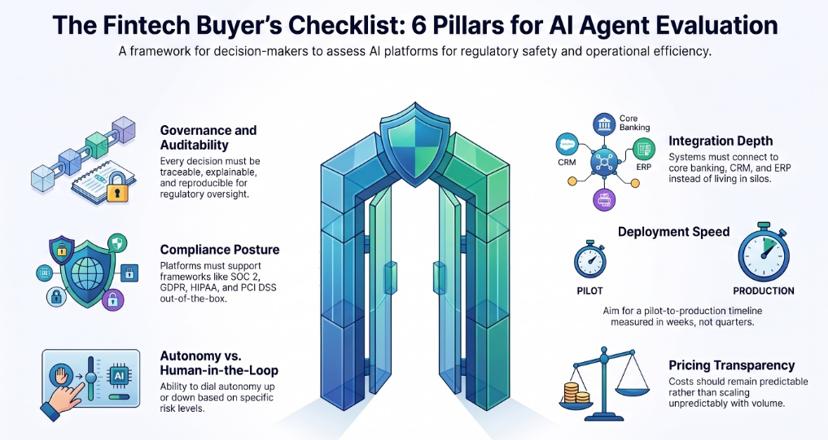
Fintech buyers keep asking the same six questions, so that's what this list is scored against:
- Governance and auditability — can every decision be traced, explained, and reproduced for a regulator?
- Compliance posture — which certifications and frameworks (SOC 2, GDPR, HIPAA, PCI DSS, GLBA, SOX) does the platform actually support out of the box?
- Integration depth — does it connect to core banking, CRM, ERP, and compliance systems, or does it live in its own silo?
- Autonomy vs. human-in-the-loop control — can you dial autonomy up or down by risk level, or is it all-or-nothing?
- Deployment speed — pilot to production in weeks, or a multi-quarter integration project?
- Pricing transparency — is cost predictable, or does it scale unpredictably with volume?
Keep these six in mind as you read the list — they're also the framework in the "How to choose" section near the end of this guide.
The 15 best AI agents in fintech
1. assistents.ai — Best overall for regulated fintech operations
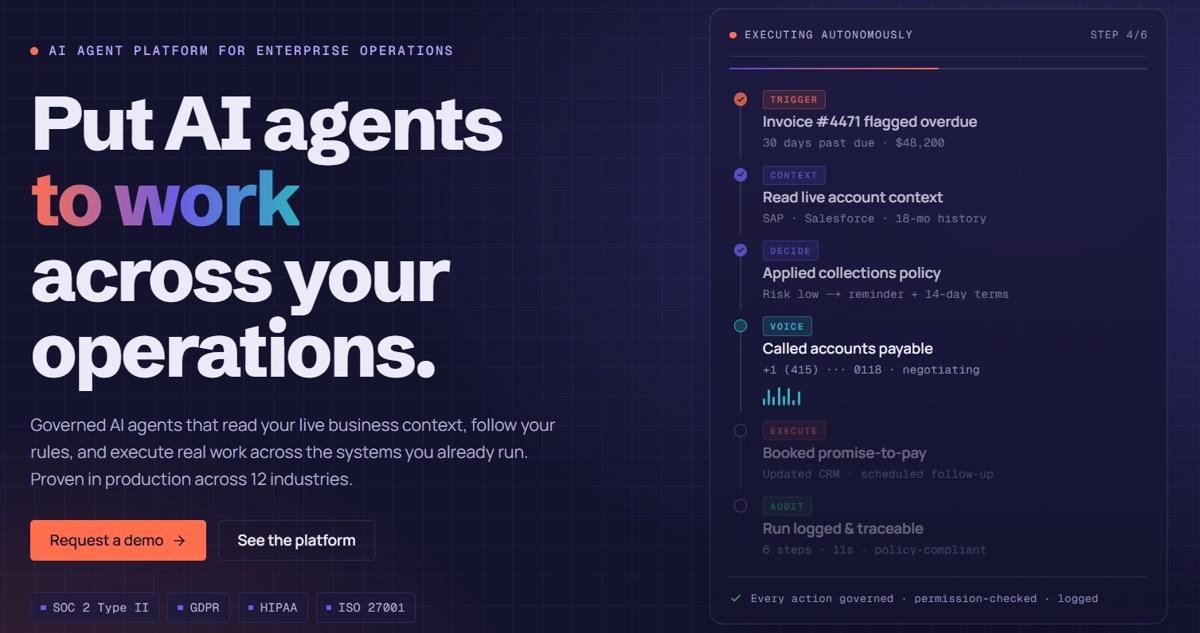
assistents.ai is built specifically for the problem most fintech AI rollouts run into: chatbots and copilots can answer questions, but the actual operational work — matching invoices, scoring pipelines, triaging disputes, monitoring compliance — still runs on people and spreadsheets. assistents.ai closes that gap with a three-layer architecture: a Context Engine that ingests live data from 300+ enterprise systems, a Semantic Layer that maps relationships across that data (vendor to contract, deal to contact), and a governed Action Engine that executes multi-step workflows with permission checks on every step.
For fintech specifically, that means agents that can sit across finance, compliance, and support simultaneously — not just a support bot bolted onto a help desk. The platform is model-agnostic (Bedrock, Azure, Vertex AI, OpenAI), supports on-premise and zero-egress deployment for firms that can't let data leave their perimeter, and holds SOC 2 Type II, GDPR, HIPAA, and ISO 27001 certifications. Average time to production across its customer base is about four weeks. See the full financial services solution page and compliance guide for banking and fintech for the regulatory detail.
Real result: A global fintech provider serving banks and credit unions deployed omnichannel AI agents (chat, email, phone) for dispute and support handling, with full auditability and SLA monitoring built in. The result was faster case handling with more consistent outcomes, a lighter operational load from automation, and stronger compliance readiness — every action logged and traceable for audit.
2. Kore.ai — Best for large financial institutions standardizing on one agent platform
Kore.ai is built for enterprise scale: multi-agent orchestration, a no-code and pro-code builder side by side, and built-in observability and governance tooling. It's a strong fit for banks and asset managers that need one platform to run both customer-facing conversational agents and internal financial-summary agents. See how it compares to assistents.ai's governed execution model on the assistents.ai vs. Kore.ai page.
3. Glean — Best for fintechs with fragmented internal data
Glean started as enterprise search and has extended into agent orchestration — useful for fintechs where the real bottleneck isn't a lack of AI, it's that the answer lives in five different systems. Its drag-and-drop agent builder is approachable for teams without deep engineering resources. Compare it directly on the assistents.ai vs. Glean page.
4. Unique AI — Best for wealth and banking teams wanting a finance-specific agent hub
Unique AI leans into finance-specific connectors and a modular architecture built around a Model Context Protocol hub, with both ready-made and custom agents for wealth management, client onboarding, and retail-banking research workflows.
5. Rasa — Best for teams that want to own their conversational stack
Rasa remains one of the few genuinely open, highly customizable options — a strong fit for BFSI teams with the engineering capacity to build and maintain their own conversation flows, multi-LLM routing, and voice integrations rather than adopt a fully managed platform.
6. Zowie — Best for deterministic customer-support agents in fintech
Zowie's pitch is precision: rules-governed, low-hallucination responses layered with AI, which matters a great deal when a wrong answer touches a customer's money. It's a strong option specifically for support-heavy fintech operations where every response needs to be predictable.
7. Kasisto (KAI) — Best for retail banks wanting a branded banking assistant
Kasisto's KAI platform is purpose-built for retail banking conversational experiences — account servicing, balance and transaction queries, and guided banking journeys — with deep roots specifically in core-banking-adjacent deployments.
8. Gradient Labs — Best for banks running both frontline and back-office agents on one platform
Gradient Labs positions itself around covering both customer-facing support and back-office work — disputes, collections, KYC — on a single platform with guardrails and coverage mapped to US, UK, and EU regulatory requirements. Useful shortlist candidate if you want one vendor across both surfaces rather than stitching two platforms together.
9. Bretton AI — Best for AML, KYC, and sanctions investigations
Bretton AI focuses narrowly and deeply on financial-crime investigation workflows — building audit-ready agents for AML, KYC/KYB, and sanctions screening, plus ongoing transaction monitoring. A strong point solution if investigations are your specific bottleneck rather than a broad operations play.
10. Sardine — Best for fraud, AML, and compliance on one risk platform
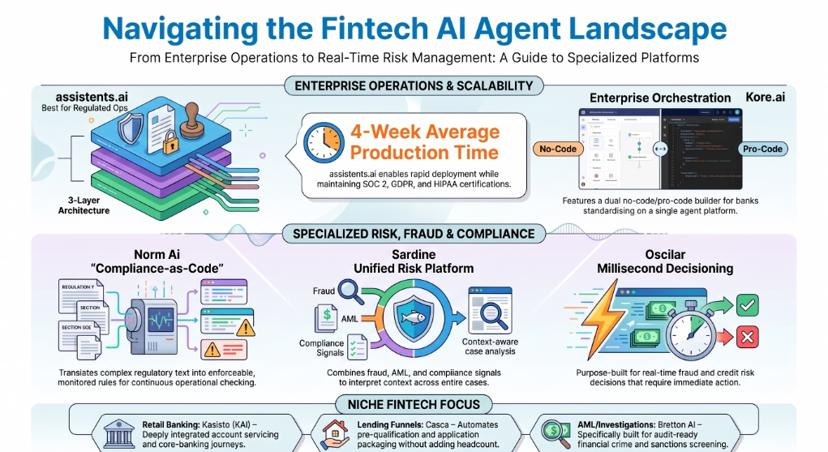
Sardine combines fraud, AML, and compliance signals on a single risk platform and has moved into agentic investigation — gathering evidence and interpreting context across a case rather than just scoring a transaction.
11. Hawk AI — Best for financial-crime pattern detection
Hawk AI focuses on AML transaction monitoring and alert triage, aimed at reducing the noise financial-crime teams deal with by grouping and prioritizing signals rather than surfacing every anomaly as an equal-priority alert.
12. Norm Ai — Best for turning regulation into enforceable, monitored rules
Norm Ai's angle is "compliance-as-code" — translating regulatory text into rules an agent can continuously check your operations against, rather than a static policy document nobody re-reads after go-live.
13. Oscilar — Best for real-time fraud and credit risk decisioning
Oscilar combines rules and machine learning into real-time decisioning agents for fraud and credit risk — a fit for teams that need a decision made in milliseconds, not a report generated after the fact.
14. Casca — Best for automating the top of the lending funnel
Casca focuses on loan-readiness: pre-qualifying applicants and packaging applications before they reach underwriting, aimed at widening the top of a lender's funnel without adding headcount.
15. Personetics — Best for personalized financial guidance at scale
Personetics is built around real-time transaction insight — turning a customer's own data into personalized nudges, savings suggestions, and financial guidance directly inside a bank's existing digital channels.
Real fintech AI agent case studies
Vendor listicles usually stop at feature claims. Here's what actually happened in production — anonymized by industry and role, not by name, from real fintech deployments:
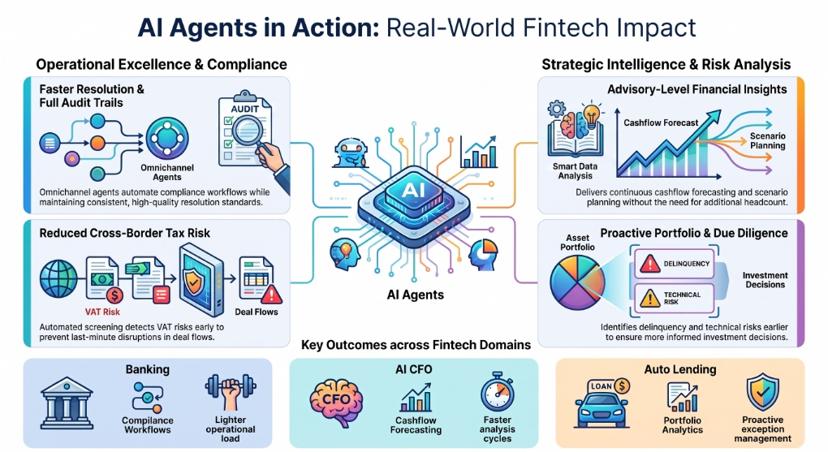
Banking support and compliance. A global fintech provider serving banks and credit unions — handling disputes, fraud, and compliance workflows — deployed omnichannel AI agents across chat, email, and phone, with agent-assist summarization and full SLA monitoring. Outcome: faster case handling with more consistent resolution, a lighter operational load from automation, and stronger compliance readiness through complete audit trails.
AI CFO and cashflow forecasting. An AI CFO platform serving growing businesses and their advisors deployed agents for continuous cashflow monitoring, forecasting, and scenario planning. Outcome: faster analysis cycles, earlier detection of cash-risk anomalies, and advisory-level insight delivered without adding headcount. (More on finance and accounting agents specifically in the agentic AI in finance and accounting guide.)
Auto lending and leasing portfolio analytics. An independent automotive leasing provider deployed analytics agents covering portfolio KPIs — risk, delinquency, maturity, residuals — plus dealer-network performance monitoring. Outcome: better portfolio visibility, faster risk identification, and more proactive exception management before issues became losses.
Cross-border tax risk screening. A tax-technology platform focused on early screening of cross-border transactions deployed AI agents for pre-compliance risk review. Outcome: earlier detection of withholding-tax and VAT risk, fewer last-minute deal disruptions, and a faster, more consistent pre-compliance process.
Technical due diligence for mobile banking. A long-term holding company evaluating fintech acquisitions used AI-assisted technical due diligence to assess mobile-banking architecture, scalability, and security. Outcome: faster investment decisions backed by structured tech-risk visibility, and fewer surprises after deals closed.
Why fintech teams choose assistents.ai over point-solution AI agents
Most of the platforms above solve one job well — fraud, or support, or lending. That's a reasonable starting point, but most fintechs end up running three or four point solutions that don't talk to each other, each with its own audit trail, its own integration project, and its own vendor relationship to manage.
assistents.ai is built to be the layer that sits across all of it instead of being one more silo:
- Governance that regulators actually accept. Every agent action is permission-checked against the access controls already in your source systems, logged with full provenance, and exportable as evidence for SOC 2, GDPR, HIPAA, and ISO 27001 audits — not a summary after the fact, but a real decision trail.
- Data residency on your terms. On-premise and air-gapped deployment options mean sensitive financial data never has to leave your perimeter, with zero external API calls for regulated data. Full detail on this is in the security and trust overview.
- One platform, six departments. The same governed execution model runs finance and procurement, sales, support, HR, marketing, and compliance agents — so a fintech doesn't need a separate vendor for each function.
- 300+ integrations, not a handful. Core banking systems, CRM, ERP, and compliance tools connect natively, which is usually the actual bottleneck in a fintech AI rollout, not the AI itself.
- Weeks, not quarters. Average time from pilot to production is about four weeks, with an eight-week implementation path specifically mapped for financial services, from discovery through regulatory sign-off — outlined in the banking and fintech compliance guide.
If you want the deeper use-case breakdown specifically for banking — fraud, KYC, onboarding, and 25+ other deployments — that's covered separately in the AI agent use cases in banking guide.
How to choose the right AI agent for your fintech company
Whichever platform you land on, run it through this checklist before you sign anything:
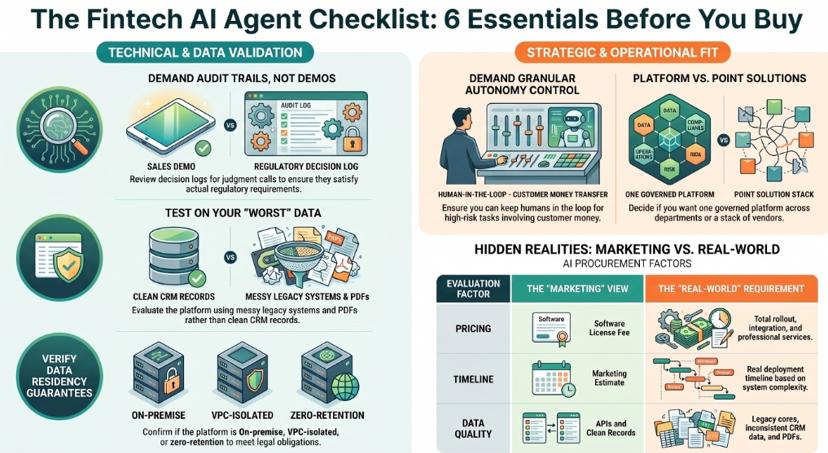
- Ask for the audit trail, not the demo. Any platform can show you a clean happy-path demo. Ask to see what the decision log looks like when an agent makes a judgment call, and whether that log would satisfy your actual regulator.
- Test it on your worst data, not your best. Fintech data is messy — legacy core systems, inconsistent CRM records, PDFs instead of APIs. A platform that only works on clean data will fail in production.
- Confirm where your data actually goes. On-premise, VPC-isolated, and zero-retention are different guarantees — know which one you're getting and whether it satisfies your data-residency obligations.
- Price the whole rollout, not just the license. Integration time and professional services often cost more than the software itself. Ask for a real deployment timeline, not a marketing estimate.
- Check how autonomy is controlled. You want the ability to dial autonomy up for low-risk, high-volume tasks and keep a human in the loop for anything that touches customer money or regulatory exposure — not a single autonomy setting for everything.
- Map it to more than one department. A platform that only does customer support will need a second vendor for compliance, and a third for finance ops. Decide up front whether you want one governed platform or a stack of point solutions.
Related reading
- AI Agent Use Cases in Banking: 25+ Real Deployments
- Agentic AI in Finance and Accounting: A Guide for CFOs
- Guide: AI Agents in Banking & Fintech Compliance
- Crypto AI Agent Development
- AI Agents for Trading Forex
Ready to see what a governed AI agent actually looks like on your own workflows? Book a 30-minute discovery call — no prep needed, just bring the process that frustrates your team most.
FAQs
What are AI agents in fintech?
 AI agents in fintech are software systems that read live business context, make decisions within defined rules, and execute multi-step financial workflows autonomously — from fraud investigation to loan pre-qualification — rather than just answering questions or following a fixed script.
How are AI agents used in fintech companies?
 Common uses include fraud and AML monitoring, KYC and onboarding automation, customer and dispute support, compliance and regulatory reporting, credit and lending decisioning, cashflow forecasting, and portfolio risk analysis.
What's the difference between AI agents and RPA in fintech?
 RPA follows a fixed, pre-scripted sequence of steps and breaks when something changes. AI agents understand context, make a judgment within guardrails, and adapt when the situation doesn't match a predefined path — including deciding when to escalate to a human.
Are AI agents safe and compliant for financial services?
 They can be, but compliance isn't automatic — it depends on the platform. Look for SOC 2 Type II, GDPR, and relevant frameworks like SOX, PCI DSS, or GLBA, along with full audit trails and, ideally, on-premise or data-residency-controlled deployment options.
Which AI agent is best for fraud detection?
 Platforms like Sardine, Hawk AI, and Oscilar focus specifically on fraud and financial-crime detection. For fintechs that also need fraud monitoring integrated with broader support, finance, and compliance workflows on one governed platform, assistents.ai covers that ground as part of a wider deployment.
How much do AI agents cost for fintech companies?
 Pricing varies widely by platform, volume, and deployment model — from per-resolution consumption pricing on some customer-support-focused tools to enterprise licensing for platform-wide deployments. Ask any vendor for a cost model based on your actual transaction or case volume, not a flat quote.
How long does it take to deploy an AI agent in a bank or fintech?
 Simple, single-use-case deployments can go live in a few weeks. Platform-wide rollouts involving core-banking integration typically take longer — assistents.ai's average is around four weeks to production, with an eight-week path mapped specifically for regulated financial services.
Can AI agents replace chatbots in banking?
 They can absorb and extend what chatbots do — answering questions — while also taking action: updating records, triggering approvals, and completing workflows end to end. Most fintech run agents alongside, not instead of, existing conversational interfaces during a transition period.