Global foreign exchange turnover reached $9.5–9.6 trillion a day in April 2025, according to the Bank for International Settlements' 2025 Triennial Survey — a 28% jump from 2022, and the highest figure BIS has recorded since it started tracking the market in 1986. That is the largest, most liquid, most continuously active financial market on the planet, running 24 hours a day, five days a week, across every time zone at once.
Most of the tools traders and trading desks use to navigate it were not built for that pace.
At a glance: An AI agent for trading forex is an autonomous software system that observes market conditions, reasons across multiple data sources, and acts — executing or escalating a decision — inside a governed, auditable workflow. It is not a rule-based bot and not a signal feed. The difference is that it reasons and adapts; a bot follows a fixed rule until someone changes it.
This guide explains what these systems actually are, what separates a production-grade agent from a bot with an AI label on it, what real deployments in trading and financial operations have delivered, and how to think about deploying one — whether you are a prop desk, a broker, a fintech building trading infrastructure, or an individual trader evaluating the category.
What Are AI Agents for Trading Forex? (And Why They Are Not Bots)
"Agent" gets used loosely in trading content, so it's worth being precise about what the word should mean.
An AI trading agent is a system that runs a continuous loop: it observes market conditions, reasons through the available strategy options, acts — by placing, adjusting, or escalating a position — and updates its approach based on the outcome. That Observe → Reason → Act loop is the architectural line between an agent and everything that came before it.
A traditional Expert Advisor or rule-based bot sees an RSI reading below 30 and buys. It has no way to know a central bank just moved rates, no way to know that identical setup failed repeatedly under the current volatility regime, and no way to change its own rule. It executes what it was told, regardless of context.
An AI agent, by contrast, ingests price action, macro data, news sentiment, and cross-pair correlation together, builds a probabilistic read of what's actually happening, simulates the likely outcome of different responses, and applies risk constraints as governed logic rather than a hard-coded stop. It produces a decision with a reasoning trail that can be reviewed and improved — not just a fill.
Bots vs. Signal Services vs. Agents
| Static bot / EA | Signal service | AI trading agent | |
|---|---|---|---|
| Adapts to regime change | No — runs the same rule | No — same signal logic | Yes — reasons over current context |
| Explains its own decision | No | Rarely | Yes — reviewable reasoning trail |
| Combines multiple data sources | Usually one indicator set | One signal source | Price, macro, sentiment, cross-market, positioning |
| Risk handling | Fixed stop-loss | Not included | Governed, context-aware guardrails |
| Human oversight model | None built in | None built in | Defined escalation and approval points |
Production systems typically run this as a small team of specialised agents rather than one generalist model — a research agent, an analysis agent, a risk agent, and an execution agent, each working its own domain and checking the others before a position moves. That's a software version of how an actual trading desk operates: several specialists reviewing a call before capital is at risk, not one person acting alone.
Why 2026 Is the Inflection Point
The shift didn't happen overnight, but three forces are converging now.
Market complexity has outpaced manual analytical bandwidth. 2025–2026 forex markets have been driven by overlapping, non-linear forces — central bank divergence, geopolitical volatility, tariff policy shifts. No analyst, and no static rule set, processes that fast enough or completely enough to trade it consistently.
Latency asymmetry is now structural. Desks running agent layers are processing news, sentiment shifts, and price anomalies in milliseconds. Anyone working from manual analysis or a lagging signal feed is reacting to conditions the market has already priced in.
The cost of unstructured risk has stopped being tolerable. The same volatility that creates opportunity in forex creates outsized downside for positions without real risk governance. Maintaining consistent risk discipline across a 24-hour window is something a static bot or a tired human desk structurally cannot do — an agent with proper guardrails can.
The Problem With Every Alternative
Before getting into what a good forex AI agent looks like, it's worth being direct about why the existing options fall short.
Trading bots fail because markets aren't stationary. A bot tuned on historical data is a map of where the market used to be. When volatility regimes shift — and they shifted repeatedly through 2025 — the bot doesn't adapt. It keeps executing rules into conditions those rules were never built for.
Signal services fail because they deliver information, not judgment. A signal without position sizing, risk context, and real-time monitoring behind it is incomplete at best. One that can't explain its own reasoning gives the trader nothing to build trust or improve on.
Manual analysis fails at scale. No analyst monitors 28 major pairs across five sessions, tracks a dozen central banks' calendars, reads real-time sentiment, and holds consistent risk discipline across a full week without the cognitive load becoming the limiting factor.
AI agents don't replace trading judgment — they extend how much of it a human or a desk can actually apply. The strongest deployments in production pair LLM-based reasoning with structured financial data pipelines, explicit risk governance, and a defined point where a human re-enters the loop. The human stays in control of the decisions that matter; the agent carries the continuous monitoring, synthesis, and simulation load that no team can sustain manually.
Key Capabilities to Look for in a Forex AI Agent
Not everything marketed as an "AI agent" in this category is built the same way. Here's what separates a production-grade system from something that looks good in a demo and underdelivers live.
1. Multi-source data ingestion. An agent reading only price feeds is doing pattern matching, not analysis. Production systems ingest real-time price data across major, minor, and exotic pairs; macro data (rate differentials, GDP, CPI, employment); central bank communications; financial news sentiment; correlated markets (equities, commodities, bonds); and positioning data (COT reports, retail sentiment). Thin data in means thin decisions out.
2. Strategy simulation and scenario modelling. A useful agent doesn't just describe current conditions — it simulates what's likely to happen under different scenarios: backtesting by market regime, forward simulation across macro paths, probability-weighted comparison before execution, and stress tests against tail scenarios like a liquidity withdrawal or flash crash.
3. Risk guardrails as governance, not stop-losses bolted on. This means position sizing that adapts to current volatility and equity, correlation-aware exposure limits (holding EUR/USD and GBP/USD long simultaneously is effectively one USD bet, not two independent ones), drawdown circuit breakers, time-based rules around low-liquidity windows and event risk, and defined escalation triggers before high-impact decisions.
4. Human-in-the-loop design, by default. The strongest agentic systems aren't autonomous black boxes. High-confidence, low-impact decisions can execute on their own; medium-confidence or high-impact ones trigger a review alert; anything outside defined parameters requires explicit approval before it happens. That's not a limitation — it's what lets the system run at machine speed for routine work while a human's judgment stays where it's actually needed, and it's what produces the audit trail that risk and compliance teams require.
5. Auditability and explainability. In a regulated environment, every trade needs a defensible rationale. In any professional environment, every decision needs to be reviewable so a losing streak can actually be diagnosed. An agent that can't explain a decision can't be trusted, improved, or run anywhere accountability matters.
6. Integration-ready architecture. An agent that doesn't connect to broker execution (MetaTrader, FIX, REST APIs), portfolio and risk systems, and reporting tools is a demo, not infrastructure. This is usually where deployments succeed or fail — connectivity to existing systems is typically an integration project scoped against specific APIs, not a single switch to flip, and it's worth treating it that way from day one rather than assuming it out.
Why assistents.ai for AI Agents in Forex Trading
Most of the category treats "governance" as a bullet point — "risk controls included," "audit trail available." That's not a control system, it's marketing copy. The actual requirement for a desk or a fintech putting capital or client trust behind an agent is a Control plane that can express different autonomy per decision class, and an Assurance plane that can reconstruct exactly why a given decision happened, months later, on demand.
That's the layer assistents.ai is built around — not a chatbot with a trading skin, but a governed enterprise AI platform: System of Agency infrastructure that sits across your existing data, research, and execution systems and lets human and AI agents run work together, inside policy.
What that looks like applied to a trading desk:
- Autonomy scoped per decision class, not one switch. Signal research and monitoring can run continuously and autonomously. Position sizing under a defined threshold can execute automatically. Anything above that threshold, or outside a defined policy boundary, routes to a human before it happens. A simplified illustration of what that policy looks like in practice:
# Illustrative example — autonomy is configured per deployment
agent: forex-signal-research-agent
work_type: signal_monitoring_and_alerting
permissions:
read_market_data: true
read_macro_calendar: true
generate_strategy_alternatives: true
place_or_adjust_orders: false # requires escalation
limits:
max_position_value: <set per desk policy>
escalate_when:
- confidence_below_threshold
- correlated_exposure_limit_reached
- macro_event_within_window
- outside_defined_risk_policy
- A decision ledger, not just an activity log. Every signal-to-decision path is recorded and reproducible — what data the agent saw, what alternatives it considered, what policy it checked against, and what a human approved or overrode. That's the actual artifact a compliance review or a post-mortem on a losing week needs.
- Governed connectivity, not a direct write path. Actions route through a controlled gateway with identity, approval checks, and verification — connecting to broker execution systems, price-feed vendors, and internal risk tools through scoped integrations rather than handing a model raw credentials to your execution stack. Financial-services integration work of this kind is typically scoped per environment rather than pre-packaged as a generic connector.
- Model-neutral, and deployable on your infrastructure. For desks that can't move order flow or client data to public cloud, the platform supports private cloud, VPC, and on-premises deployment, with model choice rather than lock-in to one provider.
What this is grounded in, honestly stated: assistents.ai has been used to build governed agent systems for a digital-asset trading terminal (market signal research, strategy simulation with risk guardrails, and execution-ready workflow integration), for a fintech operator serving banks and credit unions (omnichannel case handling for disputes and fraud with full audit trails), for an AI-driven financial planning platform (continuous cashflow monitoring, forecasting, and risk alerting), and for a market-research and technical-analysis operation (automated indicator pipelines and research generation). That is real, adjacent, trading-and-financial-intelligence deployment experience — the architecture is asset-class agnostic and applies directly to forex. It is not, today, a forex-specific production track record, and it's worth being precise about that distinction rather than blurring it: what's proven is the governed-agent architecture; what's available for forex specifically is a scoped pilot built on that same foundation.
What Real AI Agent Deployments in Trading Have Delivered
Benchmark performance on a historical backtest is the least useful evidence for evaluating this category — it's also the easiest number to inflate. What matters is what happened when these systems ran against real operational workloads. Without naming clients, here's what's actually been delivered:
A digital-asset trading terminal needed market signal research, strategy analysis, and execution-ready workflow integration across a complex multi-instrument environment. The build ingested market data, ran indicator and pattern-analysis pipelines, simulated strategies against risk guardrails, and generated alerting and recommendation summaries connected into the execution workflow. Outcome: faster synthesis of fragmented market signals that previously took hours of manual aggregation, more disciplined decision-making through governed workflows applying consistent criteria instead of ad hoc judgment, and reduced manual monitoring load.
A fintech operator serving banks and credit unions needed agents to handle omnichannel banking support — disputes, fraud monitoring, and compliance operations — across chat, email, and phone. The system routed cases through auditable workflows and generated next-best-action recommendations with compliance-ready audit trails. Outcome: faster, more consistent case handling; reduced operational load from automating high-volume routine processing; better compliance readiness from immutable decision records.
An AI-driven financial planning platform needed continuous cashflow monitoring, forecasting, and scenario modelling connected across accounting and banking data. Outcome: faster analysis cycles, earlier detection of cash-risk anomalies, and scalable advisory-level insight without adding headcount.
A market-research and technical-analysis operation needed automated indicator pipelines and research generation to keep pace with publication demands. Outcome: faster production of market insight packs, more repeatable research workflows, and better signal visibility through automated analytics.
The pattern holds across all four: speed, consistency, and scale that manual workflows can't match, with governance built in so that speed doesn't come at the cost of control.
Top Use Cases for AI Agents in Forex Trading in 2026
Signal research and aggregation. A professional trader monitors dozens of sources at once. An agent does this continuously — ingesting price data, news, releases, and cross-market signals — and hands back prioritised, consolidated intelligence instead of raw noise.
Automated strategy generation and validation. Agents can generate candidate strategies from current conditions, validate them against historical regimes, and present ranked, probability-weighted options — compressing a strategy-development cycle that normally takes days.
Risk management and position guardrails. Real-time, correlation-aware position monitoring across pairs, with dynamic stop logic, is a task no human desk performs perfectly across a 24-hour window. Agents do it continuously, without fatigue.
Real-time alerting on anomalies and macro events. Unusual spread widening, a shift in central bank language, a volume anomaly, correlated drawdowns — agents watch for defined conditions and escalate immediately instead of waiting for the next scheduled review.
Portfolio-level monitoring across pairs and accounts. For managed-account operators and prop desks, agents give consolidated visibility across a full book, flagging exceptions and generating performance attribution without manual aggregation.
Compliance and audit-trail generation. In regulated environments, agents produce the documentation trail that demonstrates compliance for every decision — a workload manual processes struggle to sustain at scale.
AI Agents for Forex vs. Other Asset Classes
Agents are being deployed across equities, crypto, commodities, and fixed income — but forex has specific characteristics that shape how an agent needs to be built for it, and this is where a lot of "AI trading agent" content that isn't asset-class-specific falls short.
24/5 continuous operation. Forex runs from Monday-open Wellington through Friday-close New York without a break. An agent has to operate continuously without degradation — no overnight coverage gaps, no session-restart cycles. The infrastructure reliability bar is higher than for an equity-market agent that only needs to run during exchange hours.
Macro sensitivity. Currency movements are driven more directly by macro policy than most other asset classes. An effective forex agent needs strong natural-language handling of central bank communications, economic-release interpretation, and geopolitical event classification — capabilities that matter far less for an equity-momentum or crypto-sentiment agent.
Liquidity windows. Forex liquidity isn't uniform across the day. Spreads widen sharply outside the London–New York overlap, and execution around major data releases needs special handling. An agent that doesn't account for liquidity windows will get materially worse execution than one designed around them.
Multi-pair correlation. Major pairs aren't independent. EUR/USD, GBP/USD, and USD/JPY all carry common USD exposure; AUD and NZD correlate with commodity prices. Managing positions across pairs without accounting for this builds unintentional concentrated risk — correlation-aware position management isn't optional for a multi-pair forex agent.
Leverage amplification. Standard forex leverage amplifies both gains and losses well beyond typical equity exposure, which makes risk-governance logic more consequential here than in most other asset-class deployments. An agent built for equities cannot simply be ported to forex without redesigning its risk governance from the ground up.
How to Deploy an AI Agent for Forex Trading: Build vs. Buy
If you've concluded AI agents are a genuine capability upgrade for your trading or fintech operation, the next decision is how to get one running.
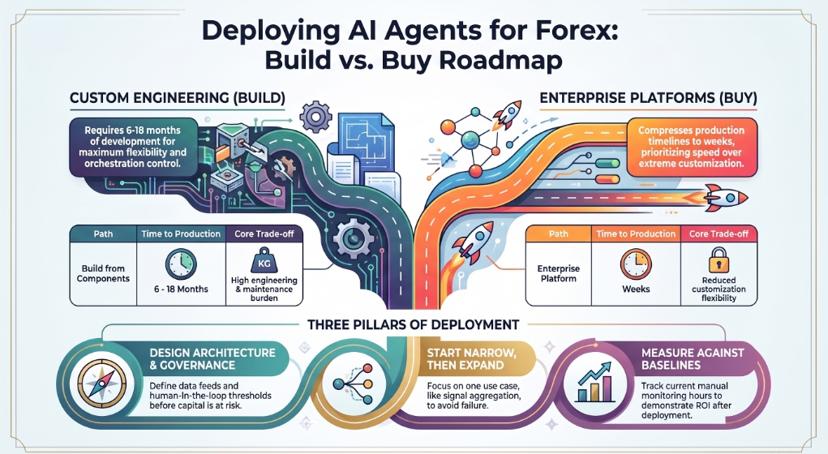
Building from components — LLM APIs, vector databases, orchestration frameworks, broker connectors, custom risk logic — gives maximum flexibility but requires real engineering investment. For most trading firms and fintech operators, that's a six-to-eighteen-month path to production, with an ongoing maintenance burden on top.
Deploying on an existing enterprise agent platform compresses that timeline substantially — proof of concept to production in weeks rather than months, at the cost of some customisation flexibility. For most use cases, that trade-off is smaller than the build cost.
Whichever path you take, four decisions matter more than the tooling choice:
Integration architecture first. Identify your data sources (price feeds, economic calendars, news APIs), your execution connections (broker APIs, FIX), and your downstream systems (risk dashboards, portfolio management) before designing the agent. This determines what it can see and what it can do.
Governance design before go-live. Define human-in-the-loop thresholds, escalation triggers, position limits, and audit-trail requirements before any capital is at risk. Retrofitting governance onto a running agent is significantly harder than designing it in from the start.
Start narrow, then expand. The deployments that actually work begin with one well-defined use case — signal aggregation, risk monitoring, or post-trade analytics — and expand from there. Trying to build a fully end-to-end autonomous system in phase one is the most reliable way to fail.
Measure against a baseline. Establish your current numbers on the target use case — time to identify signals, accuracy of risk-flag detection, hours spent on manual monitoring — before deploying. Without a baseline you can't demonstrate ROI or tell where the agent is actually underperforming.
If you're weighing that decision for your own operation, the most useful next step is a direct conversation about your integration environment, risk-governance requirements, and target workflows — not another demo.
Common Mistakes When Deploying AI Agents for Forex Trading
Deployment failures in this category follow predictable patterns.
Over-automating without sufficient guardrails. Full automation is appealing, but an agent running without governance constraints will eventually meet conditions it wasn't designed for — and the failure mode isn't graceful degradation, it's rapid, unconstrained loss. Human-in-the-loop design isn't optional once live capital is involved.
Treating an agent like a static bot. Deploy-and-forget doesn't work. Models not updated against new regime data drift and perform worse as conditions change. Agents need structured review and recalibration cycles — not constant intervention, but not none either.
Ignoring execution quality. Signal generation and execution are separate problems. An agent producing excellent signals routed through a high-slippage broker with unreliable APIs will underperform its own simulated results by a wide margin. Execution infrastructure matters as much as agent intelligence.
Under-capitalisation. Agents carry real infrastructure costs — API access, data feeds, hosting, inference. Running one on too little capital means those costs eat a disproportionate share of any returns.
No audit trail from day one. Teams that skip logging from the start lose the data they need to diagnose underperformance, demonstrate compliance, and improve the system later. Put audit infrastructure in place before the first live decision, not after.
Conflating backtested and live performance. The single most common disappointment in this category. A model with impressive historical numbers has been optimised on historical data. Live markets carry regime shifts, liquidity conditions, and execution friction a backtest never sees. Treat backtested performance as directional evidence, not a prediction.
The Shift That's Already Underway
The forex market doesn't wait for anyone to catch up. $9.6 trillion trading every day moves at a speed and complexity that outpaces tools built for a previous era of markets.
The move from manual analysis to algorithmic execution already happened. The move from algorithmic execution to governed, reasoning agents is happening now. The question for most trading and fintech operations isn't whether that shift matters — it's whether the capability gets built now, under proper governance, or gets caught up to later, under pressure.
FAQs
What is the best AI agent for trading forex?
It depends on the deployment context. For institutional and enterprise environments that need governance, auditability, and multi-system integration, a platform built for governed enterprise deployment — like assistents.ai — is the more operationally mature option. For an individual trader, the priority is a system with transparent reasoning, configurable risk guardrails, and genuine adaptability to regime change, not a bot with an AI label on it.
How do AI trading agents differ from forex trading bots?
A bot executes pre-programmed rules without adapting. An agent observes conditions, reasons about strategy, applies risk governance, and acts — then learns from the outcome. Bots execute rules; agents exercise judgment inside governed parameters. When conditions shift outside what the original rules anticipated, bots fail and agents adapt.
Can AI agents trade forex automatically without human oversight?
Yes, within defined parameters — but well-designed systems don't remove human oversight entirely. High-confidence, low-impact decisions can run autonomously; higher-impact decisions trigger review before execution. Removing human oversight from every decision is not advisable for live capital; the value of an agentic system comes from combining machine speed with human judgment at the points that actually need it.
Are AI trading agents profitable in forex?
Agents provide structural advantages — speed, consistency, continuous operation, multi-source analysis — that improve the odds of a good decision relative to manual trading or a static bot. No AI system guarantees profitability; markets are adversarial. Treat an agent as operational infrastructure that improves decision quality and risk discipline over time, not as an autonomous profit machine.
Is it safe to use AI agents for live forex trading?
Safety comes from governance design, not from avoiding AI. An agent with well-designed risk guardrails, human-in-the-loop escalation, position limits, and audit trails is meaningfully safer than discretionary manual trading, which carries its own risks from fatigue and inconsistent discipline. Safety is a property of the design, not of the underlying technology.
What data sources do AI forex agents use?
Production-grade agents typically ingest real-time price feeds, economic data releases, central bank communications, news sentiment, cross-market signals from equities and commodities, and positioning data such as COT reports. The breadth and quality of that data ingestion is what determines the quality of the output.
Can I build my own AI forex trading agent without coding?
Configuration through a platform's no-code and low-code tooling can get a well-defined workflow — signal monitoring, alerting, research aggregation — into production without a software team, though custom broker integrations and bespoke risk logic typically still need engineering support. That combination is usually what compresses deployment from months to weeks.
What is agentic trading?
Agentic trading is the use of autonomous AI agents — systems that perceive their environment, reason about strategy, act on decisions, and learn from outcomes — to run trading workflows. Unlike algorithmic trading, which executes predefined rules, agentic trading involves genuine reasoning: weighing alternatives, applying contextual risk logic, and producing decisions with an explainable rationale.
How do AI forex trading agents handle compliance and audit requirements for regulated desks?
Through a decision ledger, not a generic activity log — every signal-to-decision path recorded with the data the agent saw, the alternatives it weighed, the policy it checked against, and any human approval or override, reconstructable on demand for a regulator or an internal review.
What's the difference between an AI trading agent and algorithmic or rules-based trading?
Algorithmic trading executes a predefined rule set exactly as written, regardless of context. An AI agent reasons over current context — market regime, correlated risk, macro events — and can adapt its approach within governed limits. Algorithmic systems are precise but rigid; agents are adaptive but need governance to stay safe.
How long does it take to deploy an AI trading agent — build vs. buy?
Building from components — LLM APIs, orchestration, broker connectors, custom risk logic — typically runs six to eighteen months to production for most firms. Deploying on an existing enterprise agent platform compresses that to weeks, at the cost of some customisation flexibility.