Every trader has the same problem. By the time you have processed the signal, checked the data, run the scenario, and made the decision—the market has already moved.
AI agents for trading strategy exist to close that gap. Not by replacing human judgment, but by doing everything that slows it down: ingesting market data continuously, synthesising signals across sources, simulating strategies in real time, and executing within pre-defined guardrails—all without waiting for someone to open a dashboard.
This post explains how AI trading agents work, what strategies they run, what real deployments have actually delivered, and how to evaluate whether you should build one or deploy one today.
What is an AI agent for trading? (And how it differs from a bot)
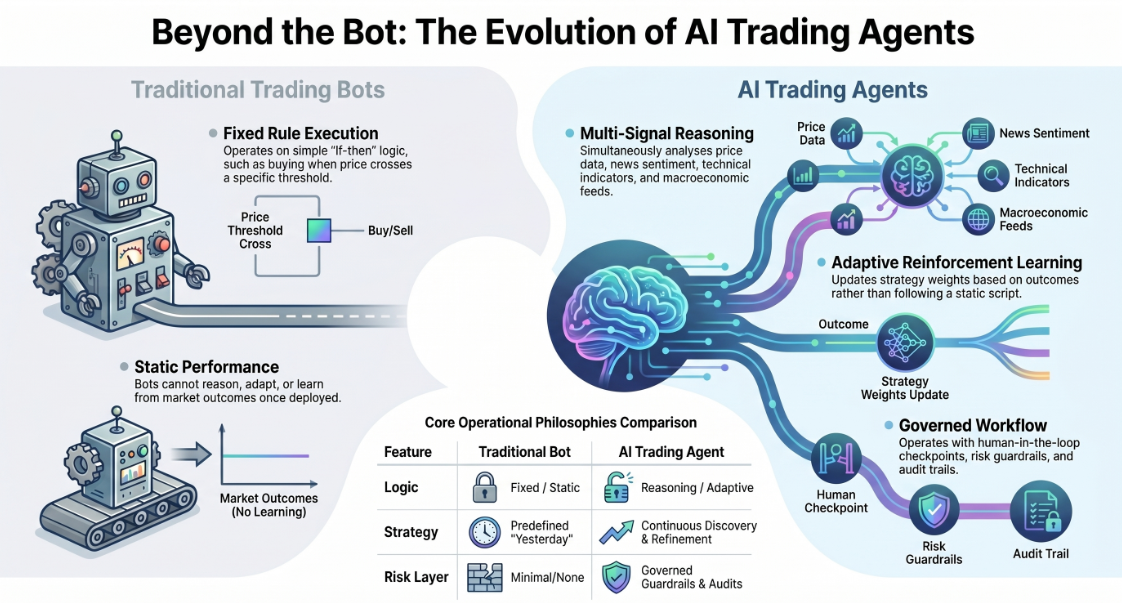
An AI agent for trading strategy is an autonomous software system that perceives market conditions, reasons across multiple data inputs, decides on a course of action, and executes—or recommends execution of—a trade, all within a governed workflow.
A traditional trading bot executes a fixed rule: if price crosses X, buy Y. It does not reason, adapt, or learn. An AI trading agent is different in three fundamental ways:
- It reasons across multiple signals simultaneously — price data, news sentiment, technical indicators, competitor pricing, macroeconomic feeds
- It adapts — reinforcement learning agents update their strategy weights based on outcomes rather than following a static script
- It operates within a governed layer — human-in-the-loop checkpoints, risk guardrails, and audit trails that a simple bot does not have
The clearest way to put it: a trading bot executes a strategy you defined yesterday. An AI trading agent helps you discover, test, refine, and execute strategy continuously—with oversight built in.
The core strategies AI trading agents run
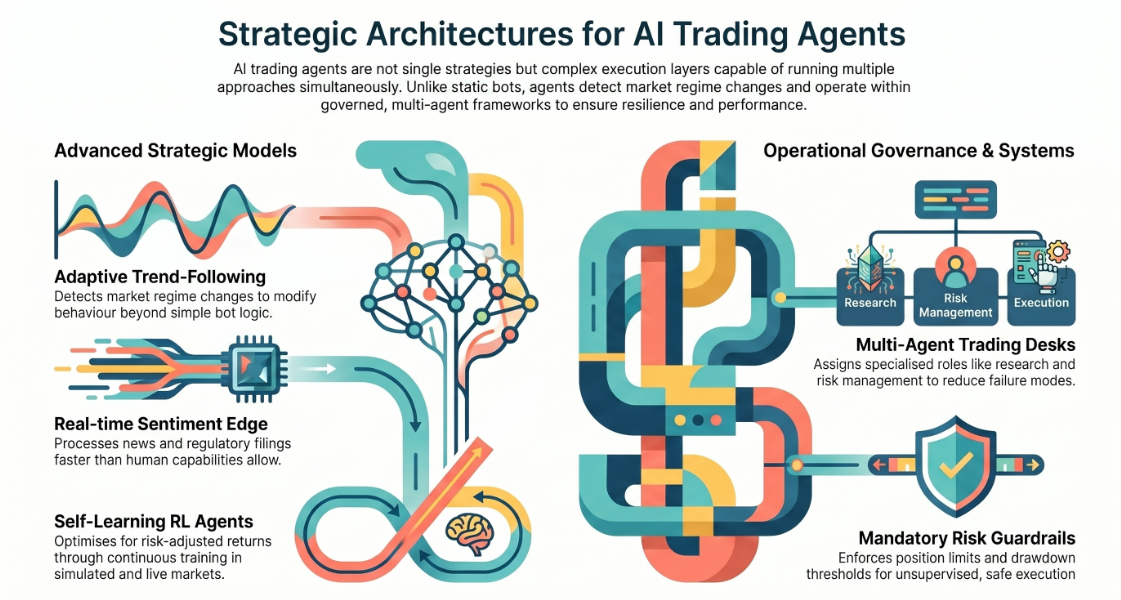
AI agents are not a single strategy. They are an execution layer that can power several distinct trading approaches, often simultaneously within a multi-agent system.
1. Trend-following with adaptive signal weighting
Classic trend strategies use moving averages to ride momentum. AI agents extend this by dynamically weighting signals—volume, volatility, cross-asset correlation—and adjusting entries and exits when trends weaken or transition into ranging conditions. The difference between a bot and an agent here is that the agent detects regime changes and modifies its behaviour; the bot does not.
2. Sentiment-driven and NLP-based strategy
AI agents can ingest and score news articles, earnings call transcripts, regulatory filings, and social signals in real time. Natural language processing models assign sentiment scores that feed directly into trade signals. For event-driven strategies—earnings seasons, regulatory announcements, geopolitical developments—this is the most defensible edge because human processing speed cannot compete.
3. Reinforcement learning trading agents
RL agents learn from their own trading history. They are trained in simulated market environments, optimise for a reward function (risk-adjusted return, drawdown limits, Sharpe ratio), and then deploy into live markets where they continue to adapt. RL agents are best suited for multi-asset portfolios and quantitative hedge fund-style strategies where the action space is large and rules cannot be exhaustively pre-defined.
4. Multi-agent trading desks
Rather than a single model doing everything, a multi-agent system assigns specialised roles: a research agent, a technical analysis agent, a risk management agent, a sentiment agent, and an execution agent—each communicating with the others before a trade decision is finalised. This mirrors how a real trading desk operates, and it substantially reduces the failure modes of any single model.
5. Risk guardrails and governed execution
This is not a strategy type—it is a mandatory layer. Production AI trading agents operate within pre-defined risk boundaries: maximum position size, drawdown thresholds, volatility filters, regulatory compliance checks. Any agent without this layer is a prototype, not a production system. Guardrails are what separate a trading agent that can run unsupervised from one that requires constant babysitting.
How an AI trading agent makes decisions: the architecture
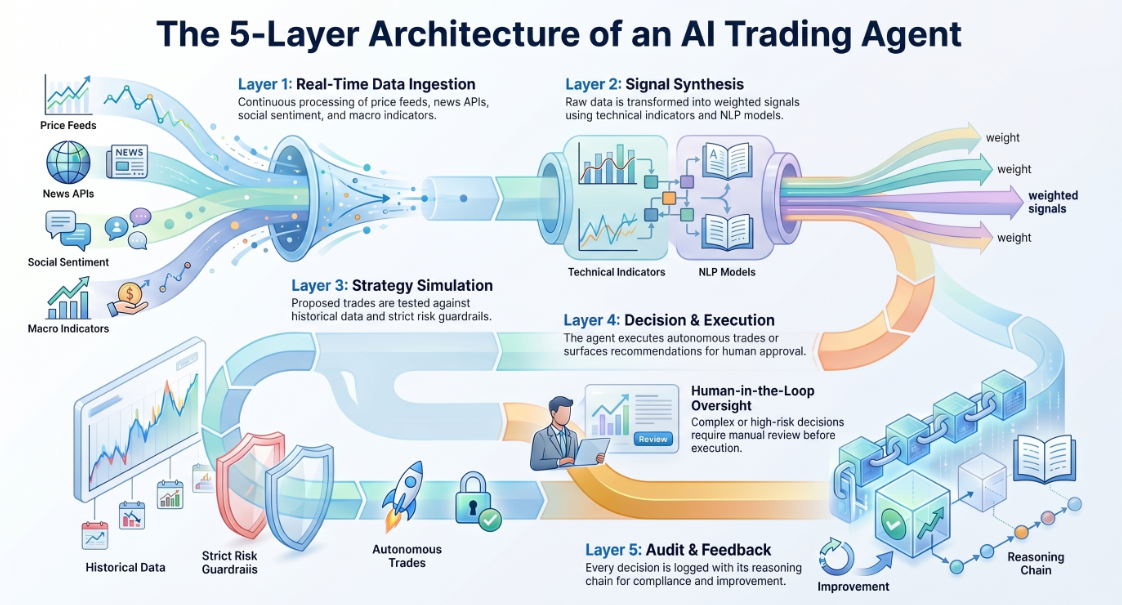
Understanding the architecture matters because it determines what an agent can and cannot do in live markets. A well-built AI trading agent moves through five layers:
1. Data ingestion layer Continuous inflow of structured and unstructured data: OHLCV price feeds, options flow, news APIs, social sentiment, competitor pricing data, macro indicators. The agent does not wait for a scheduled refresh—it processes in real time.
2. Signal synthesis layer Raw data is transformed into signals. Technical indicators are computed, NLP models score sentiment, pattern recognition flags chart structures. Multiple signals are weighted and combined into a composite view of market conditions.
3. Strategy simulation layer Before any execution, the agent runs the proposed action against historical data and scenario models. Strategy simulation with risk guardrails means the agent tests whether the proposed trade violates drawdown limits, concentration rules, or regulatory constraints before proceeding.
4. Decision and execution layer The agent selects an action—buy, sell, hold, hedge—and either executes autonomously within defined parameters or surfaces a recommendation to a human operator for approval. Human-in-the-loop architecture means complex or high-risk decisions are always reviewed before execution.
5. Audit and feedback layer Every decision is logged with its reasoning chain: what signals triggered it, what simulation outputs supported it, what guardrails were checked. This audit trail is what makes a trading agent deployable in regulated environments—and it is what allows the system to improve over time.
Real-world deployment: what AI trading agents have actually delivered
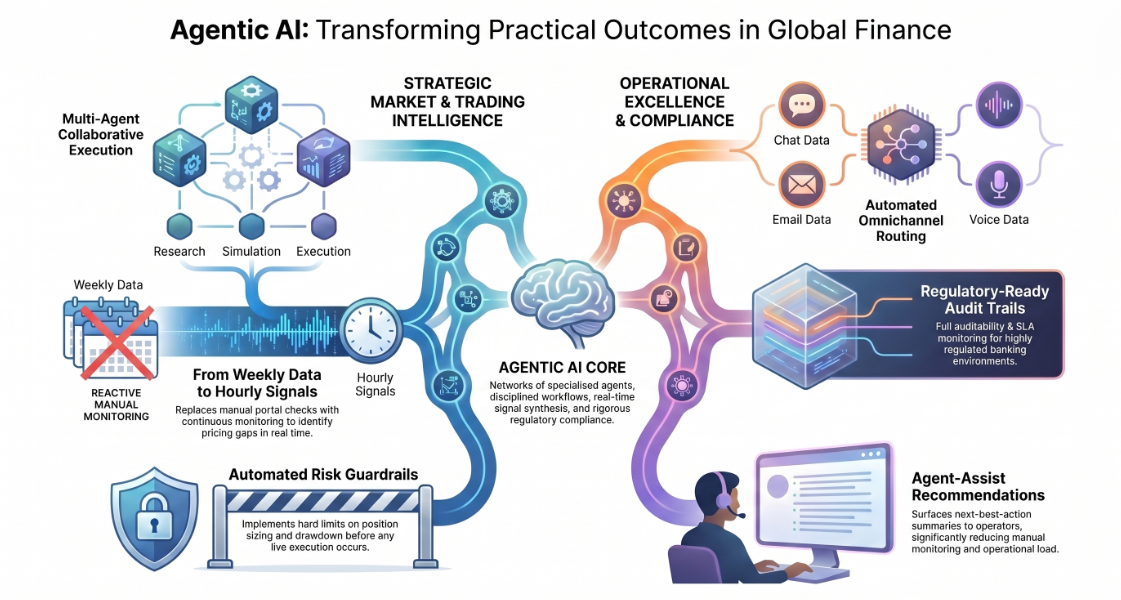
Theory matters less than outcomes. Across live deployments in fintech and capital markets, AI trading agents have produced consistent results in three areas.
Crypto trading terminal with multi-agent strategy execution
One deployment involved building an AI-first trading terminal structured around a network of specialised agents—each responsible for a distinct function: market research, technical signal analysis, strategy simulation, and execution. The agents communicated with each other before any position was taken, replicating the collaborative structure of a professional trading desk.
Key capabilities delivered:
- Continuous market data ingestion across multiple assets and exchanges
- Technical indicator computation and pattern analysis running in real time
- Strategy simulation against historical regimes before live execution
- Risk guardrail layer with hard limits on position sizing and drawdown
- Alerting and recommendation summaries surfaced to the operator
Outcomes: faster synthesis of fragmented market signals, more disciplined decision-making through governed workflows, and significantly reduced manual monitoring effort. The operator moved from reactive to proactive—the agent flagged situations before they became problems.
Fintech portfolio intelligence for banking operations
A second deployment targeted a global fintech provider serving banks and credit unions, where the operational challenge was not signal generation but workflow complexity: disputes, compliance monitoring, fraud flagging, and customer support all running simultaneously across omnichannel inputs.
The AI agent layer delivered:
- Omnichannel intake across chat, email, and voice with automated workflow routing
- Agent-assist summarisation and next-best-action recommendations
- Full auditability with SLA monitoring and reporting
- Integration with core banking systems for real-time data access
Outcomes: faster case handling, improved consistency, reduced operational load through automation, and significantly better compliance readiness through the audit trail. In regulated banking environments, that audit trail is not a nice-to-have—it is a regulatory requirement.
Market signal monitoring and competitive intelligence
A third deployment addressed a different version of the trading problem: competitive signal monitoring rather than price-based trading. A company in a highly price-sensitive market needed continuous visibility into competitor pricing, promotions, availability, and ratings across digital channels—and needed that intelligence translated into actionable decisions rather than static reports.
The agent delivered:
- Continuous e-commerce and channel monitoring across pricing, discounts, and availability
- Agentic Q&A mapped directly to leadership decision questions
- Analytics views surfacing pricing gaps, competitive threats, and portfolio movement
- Scalable architecture from proof-of-concept to production with full governance
Outcomes: always-on monitoring replacing manual checks across multiple portals, faster competitive response cycles, and earlier identification of pricing gaps and promotional shifts. Leadership went from checking last week's data to acting on this hour's signals.
Build vs buy: what it takes to deploy an AI trading agent today
The "how to build an AI agent for stock trading" search intent is real—and the answer is more nuanced than most GitHub tutorials suggest.
If you are building from scratch, the standard stack today includes:
- LangGraph or LangChain for agent orchestration and multi-step reasoning
- yfinance or CCXT for market data ingestion
- FinRL or Gymnasium for reinforcement learning environments
- OpenAI or Anthropic APIs for NLP and reasoning layers
- Docker + Kubernetes for scalable, production-grade deployment
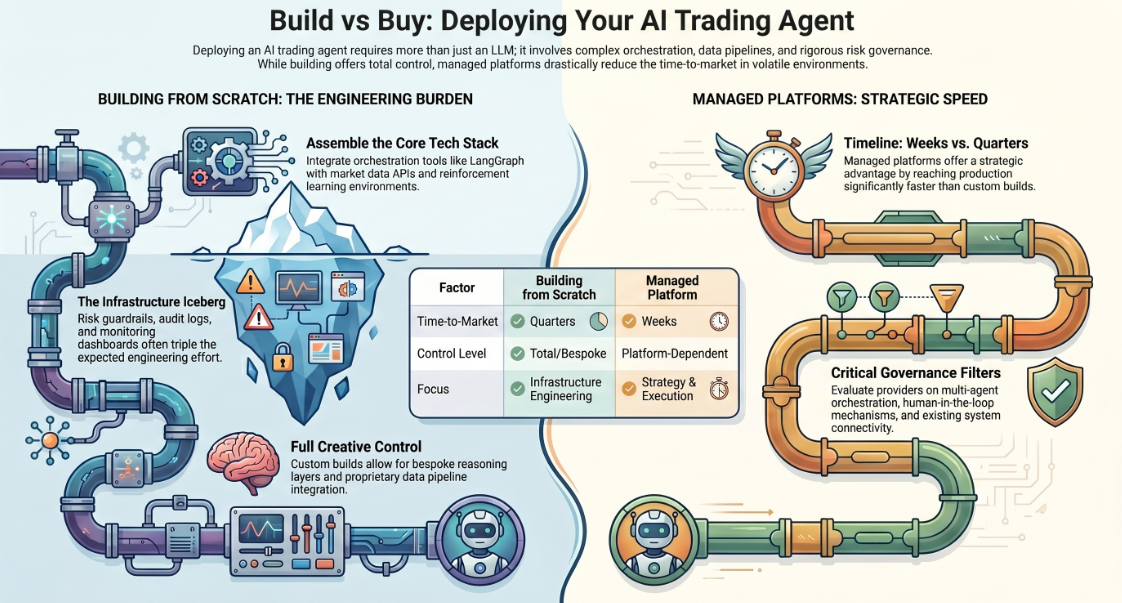
The engineering effort is substantial. Beyond the model layer, you need data pipelines, a risk guardrail system, an audit log, a monitoring dashboard, and a testing framework before you have anything you can trust in live markets. Most teams underestimate the infrastructure work by a factor of three.
If you are evaluating a managed platform, the questions to ask are:
- Does it support multi-agent orchestration, or is it a single-model wrapper?
- Does it have a governance and audit layer, or do you have to build that yourself?
- Can it connect to your existing data sources and execution systems?
- Is there a human-in-the-loop mechanism for high-risk decisions?
- What does the deployment path from proof-of-concept to production actually look like?
The build-vs-buy decision usually comes down to timeline and risk tolerance. Building gives you full control; a managed platform gets you to production in weeks rather than quarters—and in fast-moving markets, that time difference is itself a strategic variable.
Risk, limits, and what to watch out for
Deploying an AI trading agent is not without failure modes. The most common ones in production:
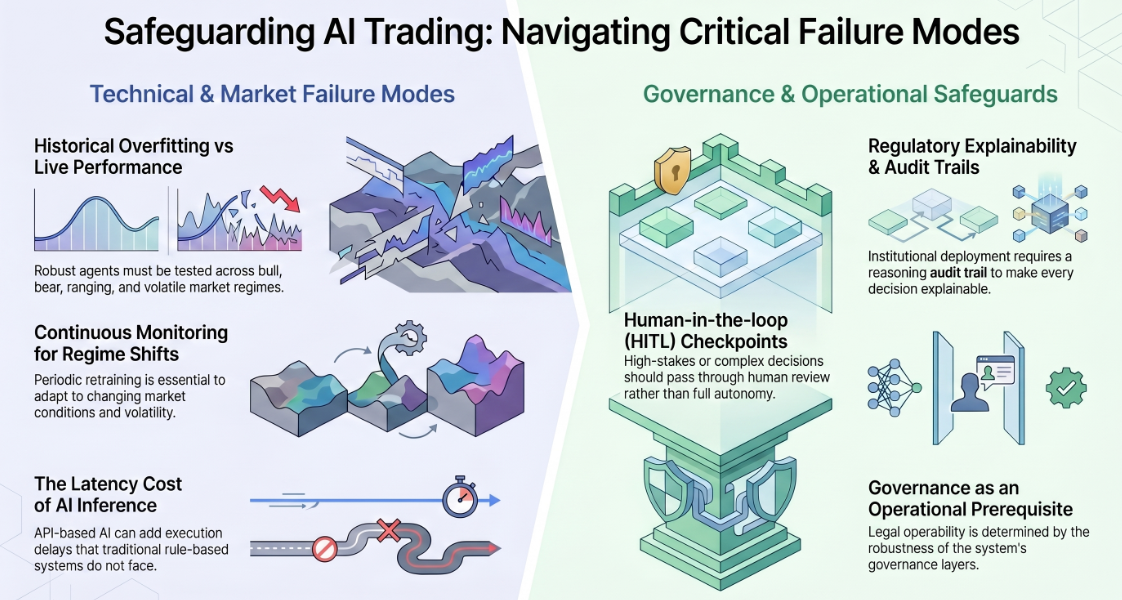
Model overfitting to historical data. An agent that performs exceptionally in backtesting often degrades in live markets because it has learned patterns specific to the training period. Robust agents are tested across multiple market regimes—bull, bear, ranging, volatile—before deployment.
Market regime shifts. An agent trained on 2021 conditions will behave unexpectedly in a 2022-style drawdown or a 2024-style low-volatility grind. Ongoing monitoring and periodic retraining are not optional maintenance—they are core to keeping the system reliable.
Latency in high-frequency contexts. For strategies that depend on millisecond execution, API-based AI inference adds latency that a traditional rule-based system would not. Understanding your execution window is critical before choosing an architecture.
Regulatory and compliance exposure. In institutional environments, every trade decision may need to be explainable to a regulator. Agents without a reasoning audit trail are not deployable in these contexts. This is why governance layers are not an afterthought—they determine whether the system is legally operable.
Overconfidence in autonomous execution. The most reliable production deployments include human-in-the-loop checkpoints at defined thresholds. Full autonomy is appropriate for high-frequency, low-stakes decisions; complex or large-position decisions should still pass through human review.
Ready to deploy an AI trading agent that's actually production-ready?
Most AI trading agent demos look impressive. Production deployments are a different problem—data pipelines, governance layers, human-in-the-loop architecture, regulatory audit trails, and integration with your existing systems.
assistents.ai has built and deployed AI agents across fintech, capital markets, and trading operations globally. If you want to see what a governed, auditable, production-grade AI trading agent looks like for your specific workflow, start with a 30-minute discovery call.
No preparation needed. Bring the workflow that's costing you the most time and money right now.
Frequently asked questions
What is the difference between an AI trading bot and an AI trading agent?
A trading bot executes a fixed, pre-programmed rule without adapting. An AI trading agent reasons across multiple data sources, simulates strategy outcomes, adapts based on feedback, and operates within a governed workflow with audit trails and human-in-the-loop checkpoints. Agents are significantly more flexible and production-safe.
Can AI agents actually make trading decisions autonomously?
Yes, within defined parameters. Production AI trading agents operate inside risk guardrails—position limits, drawdown thresholds, volatility filters—that constrain autonomous execution to pre-approved boundaries. Decisions outside those boundaries are escalated to a human operator. Full autonomy without guardrails is not a production pattern; it is a risk.
What strategies do AI agents use in stock trading?
The most common strategies include trend-following with adaptive signal weighting, sentiment analysis using NLP on news and filings, reinforcement learning for multi-asset portfolio optimisation, and multi-agent desk architectures where specialised agents collaborate before any execution occurs.
How do AI trading agents handle risk management?
Through a dedicated guardrail layer that enforces hard limits on position size, concentration, drawdown, and regulatory compliance. Every proposed action is checked against these constraints before execution. Advanced implementations include Value-at-Risk models and real-time sentiment monitoring that can flag and pause activity during adverse market conditions.
How do I build an AI agent for stock trading?
The standard stack includes LangGraph for orchestration, yfinance or CCXT for data, FinRL for reinforcement learning environments, and OpenAI or Anthropic APIs for reasoning. The underestimated work is infrastructure: data pipelines, audit logging, monitoring, and governance. Most teams find the model itself is 30% of the effort; the surrounding system is the other 70%.
Are AI trading agents profitable?
Performance depends entirely on the quality of the strategy, the data, and the governance layer. Agents that are well-trained across multiple market regimes, properly backtested, and deployed with human oversight have produced faster decision cycles, earlier signal detection, and reduced manual effort in live deployments. No agent guarantees returns—but the right architecture removes the human bottlenecks that cause preventable losses.
What data does an AI trading agent use?
Price and volume data (OHLCV), options flow, news and earnings transcripts processed by NLP models, social sentiment, competitor pricing signals, macroeconomic indicators, and proprietary internal data depending on the deployment context. The data layer is typically the most critical variable in agent performance.
What is a multi-agent trading system?
A multi-agent trading system distributes different functions across specialised agents: one handles research and data ingestion, one handles technical analysis, one handles risk assessment, one handles execution. These agents communicate and cross-check before a decision is finalised—mirroring the structure of a professional trading desk and substantially reducing single-model failure modes.