The stock market never sleeps — and neither does the AI watching it.
In 2026, the best traders and financial operators are not the ones who work harder. They are the ones who have built the right AI stack. A system where one layer monitors markets 24/7, another synthesises signals, a third generates research in seconds, and a fourth executes — all with human oversight at the checkpoints that matter.
The problem? Most "best AI trading tools" lists hand you a flat ranking of 10 products and leave you to figure out which one fits your situation. That is not useful if you are a day trader, a fintech operator, a portfolio manager, and a crypto investor all looking for different things.
This guide does something different. We have ranked the 16 best AI tools for stock market analysis and trading in 2026 across five distinct use-case categories — so you can identify the right tool for your workflow in under five minutes. We have also included real-world evidence from enterprise AI deployments in the financial sector, because the same agentic AI principles powering institutional trading desks are now available to a much wider audience.
Whether you are searching for the best AI for stock market analysis as a retail investor, an active trader, or a business operator — this is the most complete, use-case-ranked guide available in 2026.
Why AI Is Transforming Stock Market Analysis in 2026
Before the list, you need to understand what has actually changed — because the gap between "AI trading bot" and "agentic AI system" is now the difference between a retail tool and an institutional-grade edge.
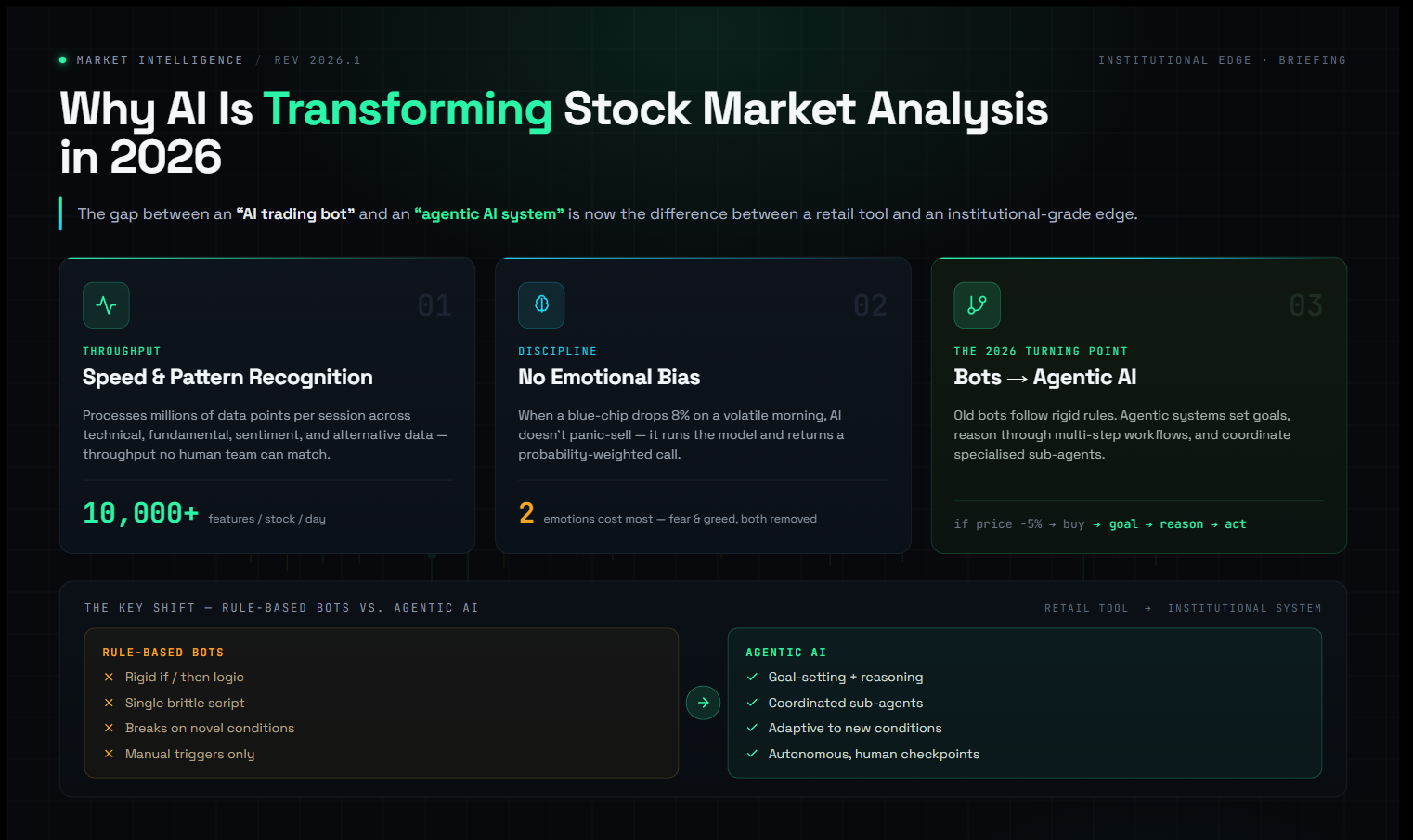
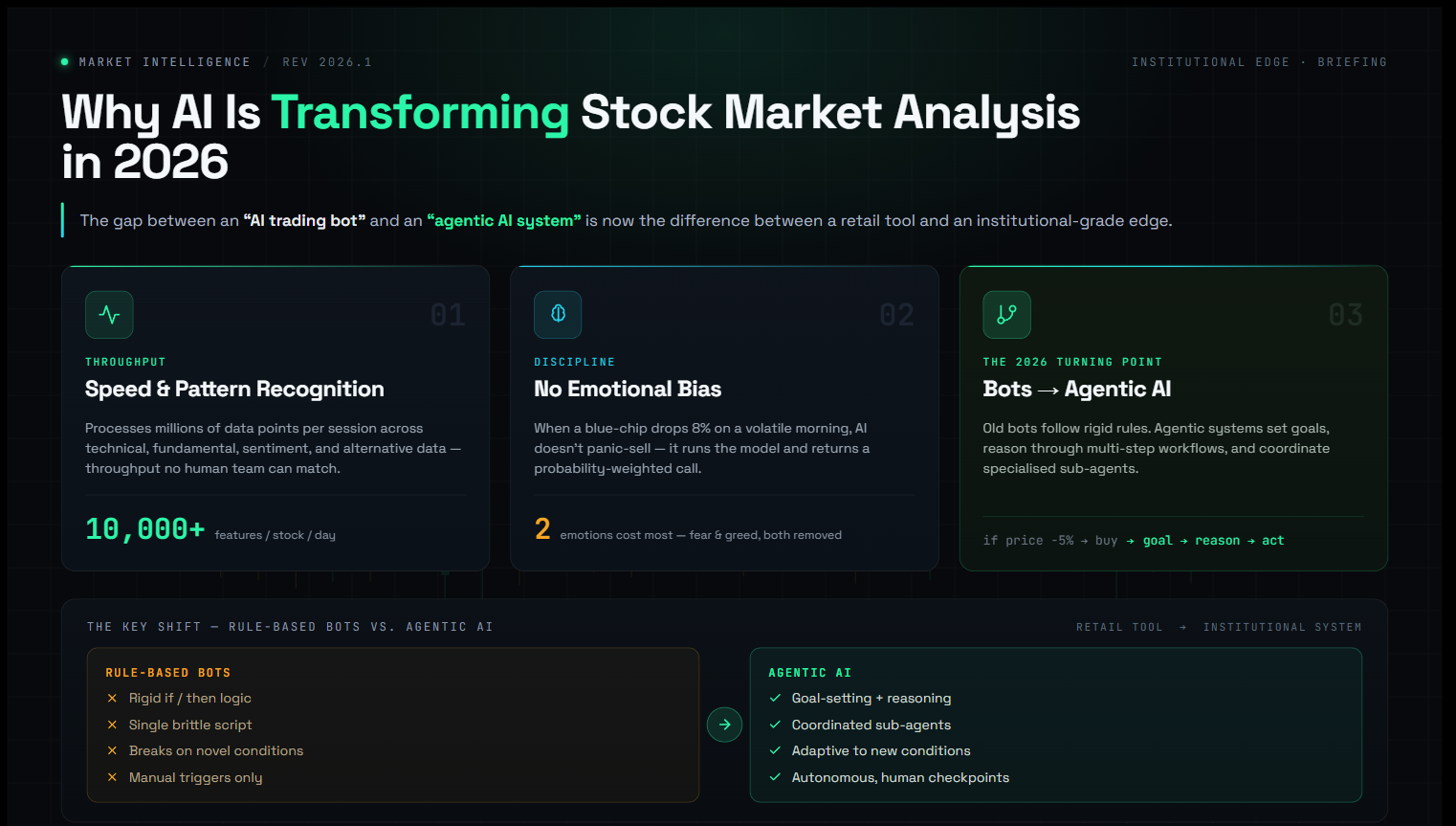
Speed and Pattern Recognition at a Scale No Human Can Match
The S&P 500 alone generates millions of data points every trading session. Add earnings reports, Fed communications, sentiment data, options flow, and macroeconomic indicators — and you have more signal than any analyst team can process in real time. AI tools process all of it simultaneously, surfacing patterns that would take a human hours to find in seconds.
The best AI stock analysis platforms today process over 10,000 features per stock, per day — pulling from technical indicators, fundamental data, sentiment signals, and alternative data sources. No human analyst team can replicate that throughput.
Elimination of Emotional Bias
The two most expensive emotions in trading are fear and greed. AI has neither. When a blue-chip stock drops 8% on a volatile Tuesday morning, an AI system does not panic-sell. It runs its model, checks the signal against backtested historical patterns, and returns a probability-weighted recommendation. Discipline at that level is structurally impossible for human traders operating under real-time pressure.
The Shift from Bots to Agentic AI: The 2026 Turning Point
This is the development that separates 2024 from 2026. Traditional trading bots follow fixed rules: "If price drops 5%, buy." They are rigid, brittle under novel market conditions, and require constant manual adjustment.
Agentic AI systems are fundamentally different. They set goals, reason through multi-step workflows, combine inputs from multiple specialised sub-agents (one for research, one for signals, one for risk), and adapt to changing market conditions — all with configurable human checkpoints before execution.
Real-world evidence confirms this is not just a consumer trend. A global fintech provider serving banks and credit unions has deployed omnichannel AI agents covering disputes, fraud detection, compliance monitoring, and workflow automation — with full auditability at every step. An AI-first trading terminal used by active traders combines research agents, signal agents, and execution agents in a single governed workflow, with risk guardrails built into the architecture. These are not prototypes. They are live, production deployments.
The platforms in this guide range from consumer-grade AI stock pickers to institutional agentic systems. Understanding where each sits on that spectrum is what makes this list useful.
How We Ranked These 16 AI Tools
Every tool in this guide was evaluated against six criteria:
1. Accuracy and backtested performance — Does it have a verifiable track record? We prioritised platforms with independently audited or publicly documented performance data.
2. Agentic capability — Does it operate as a goal-driven multi-agent system, or is it a static screener? In 2026, this distinction matters more than any single feature.
3. Asset and market coverage — Stocks, ETFs, crypto, forex, futures, or a combination? We cover tools across all major asset classes, including Indian market coverage — a segment almost entirely absent from competitor lists.
4. Pricing and accessibility — From free tiers to enterprise custom pricing, we include the full range so you can evaluate fit against budget.
5. Ease of deployment — A tool that takes six months to integrate is not useful to most operators. We weigh platforms that can be deployed quickly against those requiring deep technical build-out.
6. Real-world enterprise deployment evidence — The single factor no competing list uses. Where we have evidence of a tool's underlying approach being validated in live enterprise deployments — not just demo environments — we say so.
The 16 Best AI for Stock Market Analysis and Trading in 2026
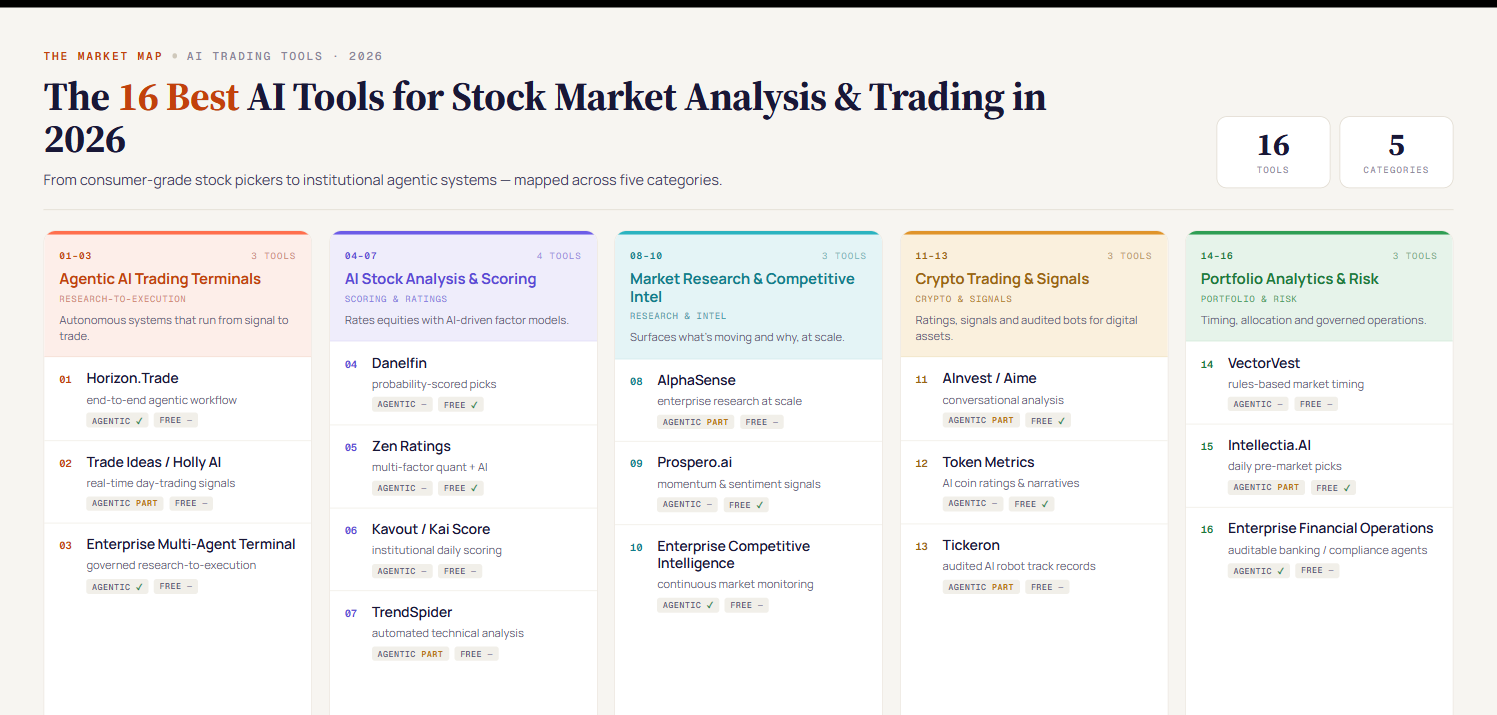
Category 1: Best Agentic AI Trading Terminals (Research-to-Execution)
These platforms represent the frontier of AI trading in 2026. They do not just give you a signal — they orchestrate the entire workflow from market monitoring through research, signal generation, and execution, with human oversight built in.
1. Horizon.Trade — Best for: End-to-End Agentic Trading Workflow
Horizon.Trade is the first purpose-built agentic trading platform for retail and semi-professional traders. Its core value proposition is collapsing the entire trading stack — research tools, charting platforms, backtesting software, broker connections — into a single AI-native interface.
Users describe their strategy in plain English. The platform backtests it against historical data, connects to the user's broker, and deploys it live with a single confirmation. The agent then monitors conditions, adapts to market changes, and escalates to the user when pre-defined risk thresholds are approached.
What makes Horizon.Trade significant in 2026 is not just the feature set. It is the architectural principle: the trading workflow is treated as a goal, not a set of rules. That is the defining characteristic of agentic AI, and it is why platforms like this are pulling ahead of traditional bot-based systems.
- Best for: Traders who want to automate a complete strategy without writing code
- Asset coverage: Stocks and growing
- Pricing: Custom (contact for access)
- Agentic: Yes — full multi-step goal execution
- Free tier: No
2. Trade Ideas (Holly AI) — Best for: Real-Time Day Trading Signals
Trade Ideas has been building AI-powered stock analysis since 2003, and its Holly AI engine remains one of the most battle-tested systems in the market. Holly runs millions of backtests every night across the entire US equity universe — scanning thousands of stocks, identifying high-probability setups, and generating entry and exit signals with specific stop-loss and profit targets by the time markets open.
The OddsMaker feature allows traders to test their own strategies against Holly's historical data before committing capital. The platform also supports semi-automated execution through integrated brokers, making it a practical bridge between analysis and action for active day traders.
Holly AI requires a win rate above 60% and a minimum 2:1 risk-reward ratio before surfacing a trade signal — meaning the system filters aggressively for quality, not quantity.
- Best for: Active day traders focused on US equities and ETFs
- Asset coverage: US stocks and ETFs exclusively
- Pricing: Starts at $127/month (TI Basic); $254/month for full Holly AI access
- Agentic: Yes — adaptive nightly learning cycle
- Free tier: No
3. Agentic Multi-Agent Trading Terminal (Enterprise-Grade) — Best for: Research + Signals + Execution in One Governed Workflow
Beyond the consumer platforms, a new category of agentic AI trading terminal is operating at the institutional level. One deployment we can reference — without naming the client — involves an AI-first trading terminal used by active crypto and equity traders that positions itself around a network of specialised agents.
Each agent in the network handles a distinct function: one focuses on research and data ingestion, another on indicator analysis and signal generation, a third on strategy simulation with risk guardrails, and a fourth on execution-ready workflow integration. These agents do not operate independently — they are orchestrated, meaning the output of the research agent feeds the signal agent, which feeds the risk agent, before anything reaches execution.
The result is a system where the same analytical rigour applied by a team of quantitative analysts is available in a single, integrated workflow — with governance and audit trails built throughout.
This architecture is what separates institutional-grade agentic AI from consumer trading bots, and it is becoming the benchmark for serious trading infrastructure in 2026.
- Best for: Sophisticated traders and institutional operators who need governed, multi-agent research-to-execution workflows
- Asset coverage: Crypto and equities
- Pricing: Enterprise custom
- Agentic: Yes — true multi-agent orchestration
- Free tier: No
Category 2: Best AI for Stock Market Analysis and Scoring
These platforms are the core of most retail AI investing stacks. They take enormous datasets and compress them into actionable scores, signals, and rankings — giving individual investors access to the kind of multi-factor analysis previously available only to institutional desks.
4. Danelfin — Best for: Probability-Scored Stock Picking
Danelfin is arguably the most data-dense AI stock scoring platform available to retail investors. Its AI Score rates every US-listed and major European stock from 1 to 10, representing the probability of that stock beating the market over the next three months. The score is generated by processing over 10,000 daily features per stock, drawn from more than 600 technical indicators, 150 fundamental data points, and 150 sentiment signals.
Since 2017, stocks scoring 10/10 on Danelfin's AI Score have outperformed the market by an average annualized alpha of 21.05%. The platform's flagship strategy returned 376% from January 2017 to mid-2025, versus 166% for the S&P 500 over the same period.
In February 2026, Danelfin expanded its European coverage to over 5,500 large, mid, and small-cap stocks and upgraded to its European AI Model Version 3.0, which shows 35.40% annualized alpha relative to the STOXX 600 benchmark for top-scored European stocks.
- Best for: Retail investors and swing traders who want probability-weighted stock selection
- Asset coverage: US and European stocks, ETFs
- Pricing: Free tier (top 10 daily stocks); paid plans from $25/month
- Agentic: No — scoring and screener tool
- Free tier: Yes
5. Zen Ratings — Best for: Multi-Factor Quant Scoring with AI Layer
Zen Ratings combines traditional quantitative analysis with a neural network trained on 20 years of market data. Its model evaluates 115 factors proven to drive stock growth, then layers an AI factor on top — producing a composite letter grade (A through F) for every covered stock.
Stocks rated A by Zen Ratings have historically delivered 28.5% annual returns since 2006. What distinguishes this platform from pure AI scoring systems is the intentional retention of a human-verifiable framework: the 115 factors are documented, the AI component is one input rather than a black box, and the output is auditable. For investors who want AI-enhanced analysis without fully ceding the decision to an algorithm, Zen Ratings sits in an important middle ground.
- Best for: Investors who want AI-powered screening with a transparent, multi-factor framework they can audit
- Asset coverage: US stocks
- Pricing: Free tier available; Premium from $234/year (trial available for $1 for 2 weeks)
- Agentic: No
- Free tier: Yes (limited)
6. Kavout (Kai Score) — Best for: Institutional-Grade Daily Stock Scoring
Kavout was built for institutional investors and remains one of the most sophisticated AI scoring systems available to sophisticated retail traders. Its Kai Score (rated 1–9) is recalculated daily for every US-listed stock, integrating fundamental data, price action signals, market sentiment, and alternative data through machine learning models including neural networks that process billions of data points — from SEC filings to satellite imagery of retail parking lots.
The platform also includes InvestGPT, a natural language AI assistant for exploring portfolio ideas and asking investment questions in plain English. For traders who want institutional-grade quantitative analysis without institutional-grade costs, Kavout is the benchmark.
- Best for: Sophisticated retail investors and portfolio managers who need institutional-quality daily scoring
- Asset coverage: US stocks, ETFs, and crypto assets (11,000+ instruments)
- Pricing: Custom — contact for plans
- Agentic: Yes (InvestGPT layer)
- Free tier: No
7. TrendSpider — Best for: Automated Technical Analysis and Chart Pattern Recognition
TrendSpider is the platform for traders who live in charts but hate drawing them manually. Its AI engine automatically identifies over 220 chart patterns and 150 candlestick formations across stocks, ETFs, forex, and cryptocurrencies — without any manual input. Support and resistance levels, multi-timeframe trend overlays, and heat maps are generated automatically.
The AI Strategy Lab allows traders to build and backtest custom rules-based strategies without writing code, using multiple machine learning algorithms including Random Forest and K-nearest Neighbours. The Sidekick AI assistant provides a natural language interface for market scanning and chart analysis queries.
For swing traders who rely on technical analysis, TrendSpider eliminates the most time-consuming parts of the workflow — pattern identification and trendline drawing — while leaving strategic decision-making with the human.
- Best for: Technical traders who want automated chart analysis and strategy backtesting
- Asset coverage: US stocks, ETFs, forex, crypto, futures
- Pricing: From approximately $52/month (up to 45% off on annual plans)
- Agentic: Partial (Sidekick AI assistant, strategy bots)
- Free tier: No (14-day trial available)
Category 3: Best AI for Market Research and Competitive Intelligence
This category is almost entirely absent from competing lists — yet it represents one of the highest-value applications of AI in financial markets. The tools here are used not just for stock picking, but for the continuous market monitoring, competitive signal tracking, and research automation that informs every investment thesis.
8. AlphaSense — Best for: Enterprise Financial Research at Scale
AlphaSense is the research platform used by 90% of top asset management firms and 80% of leading investment banks. Its AI aggregates over 500 million financial and business documents — SEC filings, earnings call transcripts, broker research reports, expert network calls, and news — and makes them searchable and analysable through natural language queries.
Its core AI capabilities include Generative Search (surfacing relevant documents across the entire corpus), Smart Summaries (condensing multi-document research into structured briefs), sentiment analysis across filings and transcripts, and its Deep Research agent — which automates complex, multi-step research projects in minutes rather than days.
If you need to know how 50 companies mentioned "supply chain disruption" in their last four quarters of earnings calls, AlphaSense returns that analysis in seconds. That capability is the difference between an analyst team that produces one research note per week and one that produces five.
- Best for: Buy-side analysts, portfolio managers, and enterprise research teams
- Asset coverage: All — research across equities, fixed income, and macro
- Pricing: Custom (2-week free trial available on request)
- Agentic: Yes (Deep Research agent)
- Free tier: No
9. Prospero.ai — Best for: Signal-Driven Momentum and Sentiment Analysis
Prospero.ai specialises in synthesising institutional flow data, options market activity, social sentiment signals, and technical indicators into forward-looking stock ratings. Its AI models are designed to identify momentum shifts early — before they are visible in price action — giving traders a potential timing edge on entries and exits.
Since its inception in 2023, Prospero's picks have achieved a 54% win rate versus the S&P 500 benchmark across close to 5,000 picks. Its 2025 picks won at a 60% rate versus the S&P, beating the index by 81% annualised. The platform includes educational content for newer investors alongside the more advanced signal infrastructure used by experienced traders.
- Best for: Momentum traders and options traders who want institutional-level signal synthesis
- Asset coverage: US stocks, ETFs, options
- Pricing: Subscription tiers (contact for current pricing)
- Agentic: No — signal generation and screener
- Free tier: Partial
10. AI-Powered Competitive Market Intelligence Platform (Enterprise Deployment) — Best for: Continuous Market Signal Monitoring
One of the most instructive real-world applications of AI for market analysis comes from a manufacturing and competitive intelligence context — not a trading desk. A major industrial player operating in a highly price-sensitive consumer and commercial market deployed an AI platform for continuous e-commerce and channel monitoring: tracking pricing, MRP discounts, promotional offers, availability, and ratings across every relevant digital channel, every day, without manual intervention.
The system provides agentic Q&A mapped to leadership questions — so when a senior executive asks "What have our three closest competitors done with pricing in the last 72 hours?", the AI returns a structured, sourced answer in seconds. Analytics views surface pricing gaps, competitive threats, and portfolio movement automatically.
The architecture scales from proof-of-concept to full production with governance and audit trails embedded throughout. This is the model for any organisation — not just traders — that needs to convert real-time market signals into governed decisions at speed.
What this deployment demonstrates for stock market operators: the same agentic monitoring infrastructure that works for competitive intelligence works for market surveillance. The underlying capability — continuous ingestion, structured analysis, and leadership-mapped Q&A — is directly applicable to equity research and trading operations.
- Best for: Enterprise teams and sophisticated operators who need always-on market intelligence with governance
- Asset coverage: Customisable — designed for any monitored market
- Pricing: Enterprise custom
- Agentic: Yes — full agentic Q&A and monitoring orchestration
- Free tier: No
Category 4: Best AI for Crypto Trading and Signals
Crypto markets operate 24/7, move faster than equity markets, and carry significantly higher volatility. The AI tools built for this environment have distinct requirements: always-on monitoring, sentiment analysis that includes social and on-chain data, and risk controls that account for the unique dynamics of digital assets.
11. AInvest (Aime) — Best for: Conversational AI Stock and Crypto Analysis
AInvest's chatbot Aime acts as an AI investing advisor with a conversational interface — allowing traders to ask natural language questions, screen stocks and crypto assets simultaneously, and validate ideas through backtesting. The platform scans news in real time, provides key fundamental and technical indicators, and explains important concepts in plain language.
Aime can also analyse trades in external brokerage accounts — including Fidelity and Robinhood — giving users a unified view of their positions across platforms. For investors who want the analytical depth of a professional tool but find most platforms too complex to navigate quickly, AInvest strikes an accessible balance.
- Best for: Retail investors and traders who want conversational AI analysis across stocks and crypto
- Asset coverage: Stocks, ETFs, crypto
- Pricing: Tiered subscription (free plan available)
- Agentic: Partial (conversational agent with backtest access)
- Free tier: Yes
12. Token Metrics — Best for: AI Coin Ratings and Crypto Narrative Intelligence
Token Metrics is the institutional standard for AI-powered crypto analysis. Its AI processes over 80 data points per token and has integrated "Narrative Detection" agents that identify early-stage trends — such as AI tokens, Real-World Asset tokenisation, or emerging DeFi narratives — before they become mainstream. Its AI Coin Ratings are among the most cited risk-assessment metrics for new altcoin listings in 2026.
For crypto traders who need to move beyond Bitcoin and Ethereum into the broader altcoin universe, Token Metrics provides a systematic, data-driven framework for evaluating risk and opportunity across thousands of assets simultaneously.
- Best for: Crypto investors and traders who need systematic analysis across a broad altcoin universe
- Asset coverage: Crypto (1,000+ coins and tokens)
- Pricing: Tiered subscription
- Agentic: Yes (Narrative Detection agents)
- Free tier: No
13. Tickeron — Best for: Pattern Recognition with Audited AI Robot Track Records
Tickeron's AI scans its database of historical chart patterns, identifies current matches in real time, and provides predictions with associated historical success rates and AI confidence scores. What distinguishes Tickeron from pure screeners is its AI Robots — pre-packaged algorithmic trading strategies with fully audited, publicly available track records. Users can browse robots, review performance statistics including win rate and annual return, and subscribe to receive real-time trade alerts.
Its 2025 updates introduced high-frequency 5-minute and 15-minute AI Agents, enabling intraday identification and execution with significantly lower latency. Tickeron covers stocks, ETFs, forex, and crypto, making it one of the most versatile pattern-recognition tools across asset classes.
- Best for: Pattern-based traders who want audited AI strategy robots across multiple asset classes
- Asset coverage: Stocks, ETFs, forex, crypto
- Pricing: Free membership; paid plans from approximately $60/month
- Agentic: Partial (AI Robots with autonomous alert generation)
- Free tier: Yes
Category 5: Best AI for Portfolio Analytics and Risk Management
The tools in this category are not stock pickers. They are the risk layer — the systems that tell you when to tighten stops, protect capital during drawdowns, monitor portfolio performance, and flag anomalies before they become losses.
14. VectorVest — Best for: Rules-Based Market Timing and Capital Protection
VectorVest converts complex market data into three simple ratings per stock — Value, Safety, and Timing (VST) — and provides clear market timing guidance that tells investors when conditions are favourable to buy and, critically, when to reduce exposure and protect capital. Its AutoTimer tool manages trades based on these signals, and pre-built watchlists of top-rated VST stocks are updated continuously.
In 2025, VectorVest added advanced options analysis and real-time scanning, reinforcing its position as a complete ecosystem for data-driven wealth management. For investors who prefer a disciplined, rules-based system over complex manual charting, VectorVest provides clarity that reduces both effort and emotional interference.
- Best for: Conservative and intermediate investors who want clear, rules-based signals for timing entries and protecting capital
- Asset coverage: Stocks, ETFs
- Pricing: Subscription tiers (trial available)
- Agentic: No — rules-based signal system
- Free tier: No (trial available)
15. Intellectia.AI — Best for: Daily Pre-Market Stock Picks and Real-Time Momentum Alerts
Intellectia.AI delivers its top five daily stock picks pre-market, selected through an AI algorithm that analyses news sentiment, earnings data, and key market and corporate events overnight. For short-term traders who want a curated, ready-to-act watchlist each morning without spending hours on research, Intellectia offers a practical daily workflow.
Beyond daily picks, the platform provides expert-level technical analysis for any financial asset class — stocks, crypto, or ETFs — identifying patterns, analysing resistance levels, uncovering trends, and delivering real-time alerts when key price breakouts or new highs and lows are reached.
- Best for: Short-term and momentum traders who want daily AI-curated stock picks with real-time monitoring
- Asset coverage: Stocks, crypto, ETFs
- Pricing: Tiered subscription (partial free access)
- Agentic: Partial
- Free tier: Yes (limited)
16. AI-Powered Financial Operations and Analytics Platform (Enterprise Deployment) — Best for: Auditable AI Agents for Banking, Compliance, and Portfolio Operations
The final entry on this list represents the enterprise end of the AI trading spectrum — and it is the most instructive for understanding where the market is heading.
A global fintech provider serving banks and credit unions has deployed AI agents covering disputes management, fraud detection, compliance monitoring, and operational analytics — with full auditability built into every workflow step. The system handles omnichannel intake across chat, email, and phone, routes cases through AI-assisted triage, generates next-best-action recommendations, and maintains complete audit trails for regulatory purposes.
For financial institutions, compliance teams, and portfolio operations managers, this deployment demonstrates what governed AI operations look like at scale: not a chatbot layered on a database, but a multi-agent system with defined escalation paths, SLA monitoring, and integration with core banking systems.
The architecture — omnichannel intake, agent-assist summarisation, auditability, and integration-ready design — is directly applicable to any financial operation that needs to process high volumes of decisions with consistency and traceability.
- Best for: Financial institutions, compliance-sensitive operators, and large-scale portfolio managers
- Asset coverage: Applicable across banking, credit, and financial operations
- Pricing: Enterprise custom
- Agentic: Yes — full multi-agent orchestration with governance
- Free tier: No
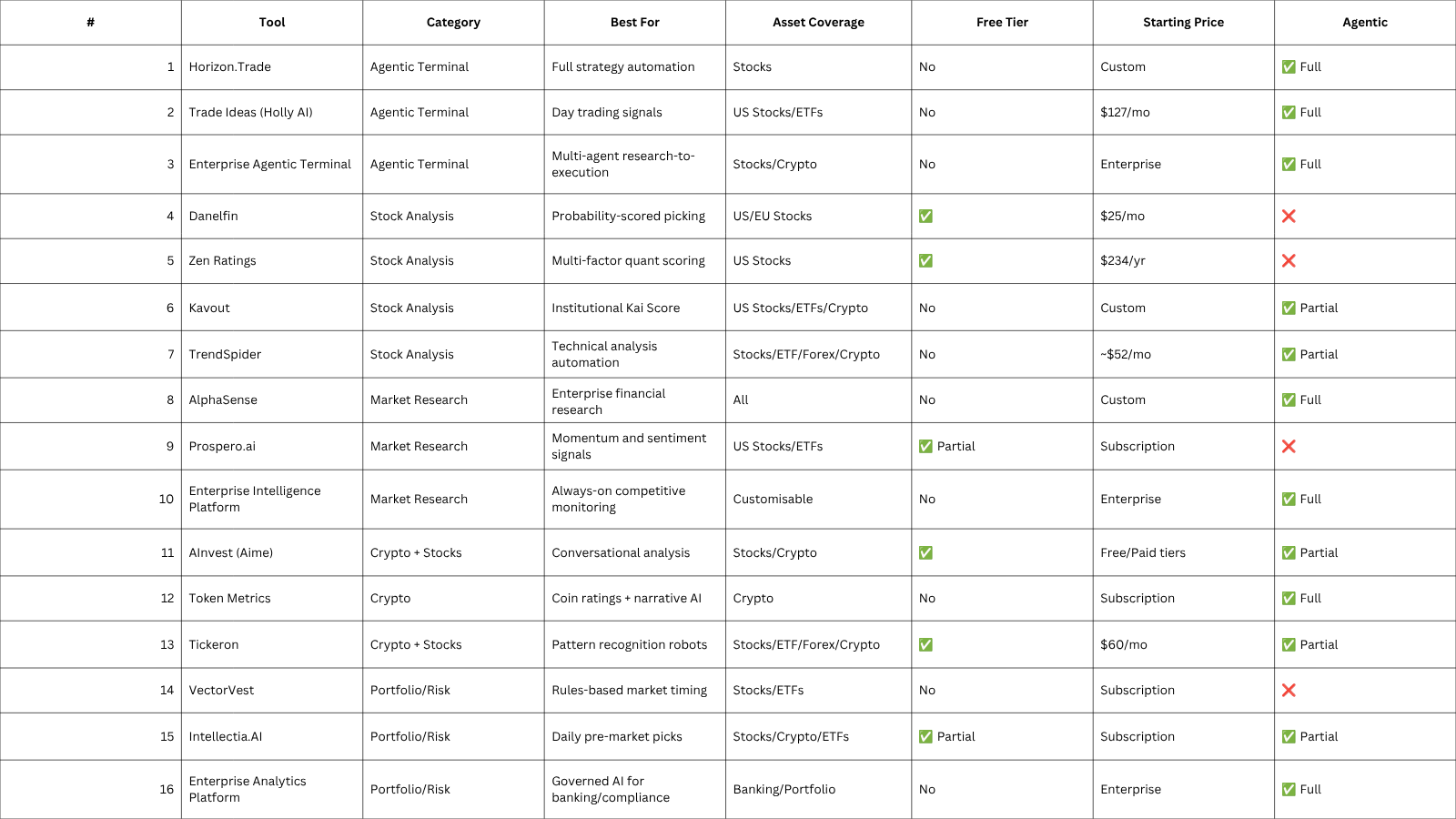
Full Comparison Table: 16 Best AI for Stock Market Analysis and Trading (2026)
Agentic AI vs Traditional Trading Bots: The Difference That Defines 2026
This distinction is the most important concept in AI trading right now — and almost no mainstream guide addresses it clearly.
Traditional trading bots operate on fixed, pre-programmed rules. "If the 50-day moving average crosses above the 200-day moving average, buy." They are fast, consistent, and completely rigid. When market conditions change in ways the rules did not anticipate — a flash crash, a surprise Fed announcement, a geopolitical event — traditional bots either do nothing or execute in ways that cause damage.
Agentic AI trading systems operate on goals, not rules. Instead of "do this when X happens," they receive "maximise risk-adjusted returns on this watchlist within these constraints." The system then breaks that goal into sub-tasks, deploys specialised agents for each (research, signal analysis, risk assessment, execution), monitors outcomes, and adjusts its approach based on what it learns — all within defined governance boundaries.
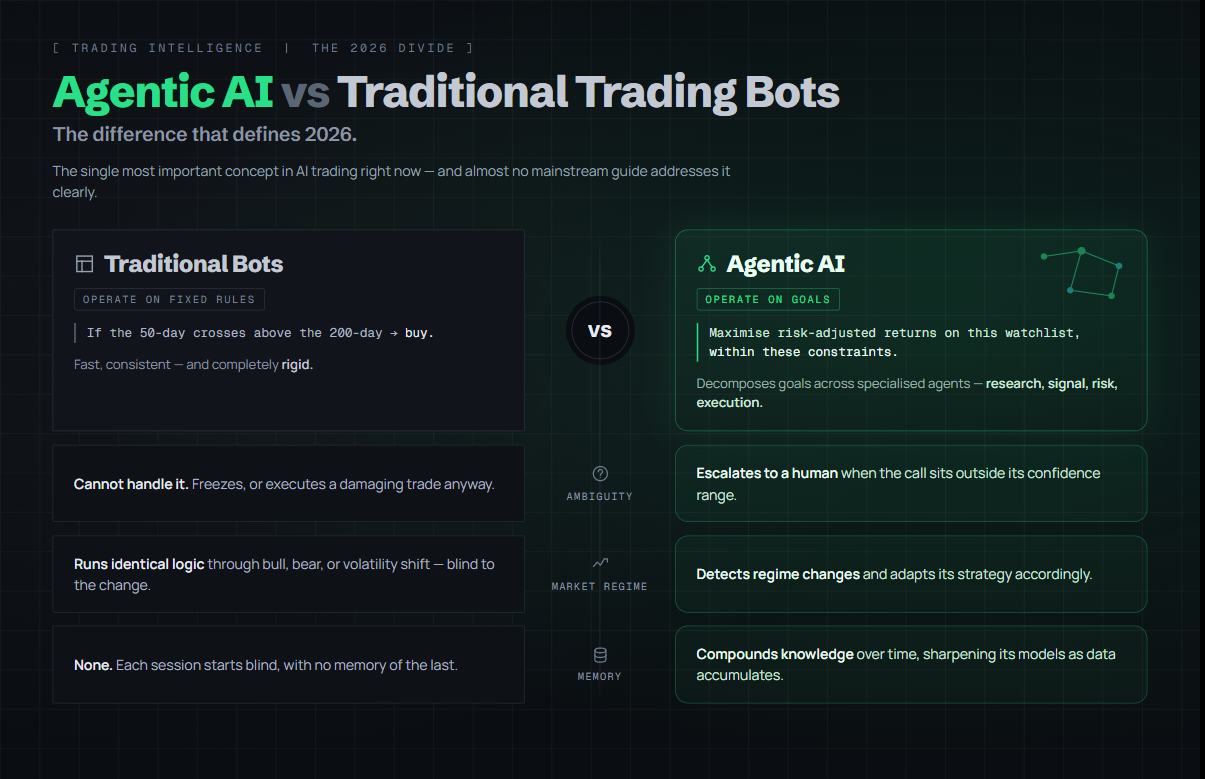
The practical differences are significant:
- A traditional bot cannot handle ambiguity. An agentic system can escalate to a human when it encounters a scenario outside its confidence range.
- A traditional bot executes the same logic regardless of market regime. An agentic system can detect regime changes — bull to bear, high volatility to low — and adjust strategy accordingly.
- A traditional bot has no memory between sessions. An agentic system builds knowledge over time, improving its models as it accumulates data from its own operations.
Real-world enterprise deployments validate this distinction at scale. A market research and technical analysis platform operating in the financial services space deployed agentic data science workflows for research automation — processing indicator pipelines, generating insight alerts, and producing thematic dashboards with a consistency and speed no human team could match. The result: faster production of market insight packs, more repeatable research workflows, and better signal visibility through automated analytics.
For individual traders and operators, the implication is clear: if your current AI tool gives you a signal but cannot tell you why the market regime has changed or escalate when it hits the edge of its knowledge — you are using a bot, not an agent. In 2026, that gap costs real money.
How to Choose the Right AI Trading Tool for Your Profile
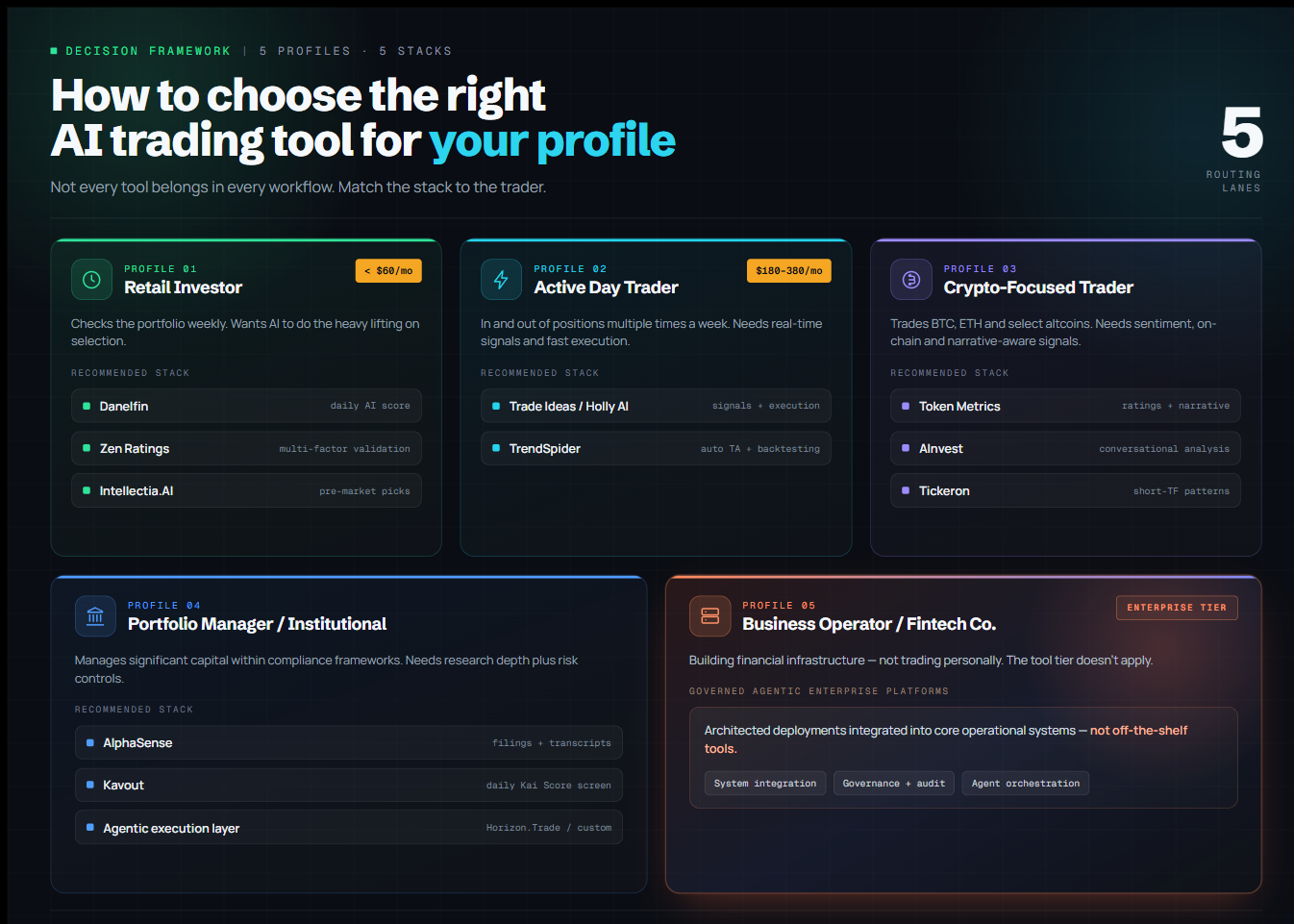
Not every tool belongs in every workflow. Here is a practical decision framework based on trader type:
You Are a Retail Investor with Limited Time
You check your portfolio weekly, you are not executing dozens of trades per month, and you want AI to do the heavy lifting on stock selection. Your stack: Danelfin (daily AI score for stock selection) + Zen Ratings (to validate selections against a multi-factor model) + Intellectia.AI (for pre-market picks on active weeks). Total cost: under $60/month.
You Are an Active Day Trader
You are in and out of positions multiple times per week. You need real-time signals, fast execution, and automated technical analysis. Your stack: Trade Ideas (Holly AI) (for pre-market signal generation and execution) + TrendSpider (for automated technical analysis and strategy backtesting). Budget: $180–380/month depending on plan tiers.
You Are a Crypto-Focused Trader
You trade Bitcoin, Ethereum, and select altcoins. You need sentiment data, on-chain analysis, and narrative-aware signals. Your stack: Token Metrics (for coin ratings and narrative detection) + AInvest (for conversational analysis and backtesting) + Tickeron (for crypto pattern recognition across shorter timeframes).
You Are a Portfolio Manager or Institutional Operator
You manage significant capital, operate within compliance frameworks, and need research depth alongside risk controls. Your stack: AlphaSense (for enterprise-grade research across filings and transcripts) + Kavout (for daily Kai Score screening across your universe) + an agentic execution layer (Horizon.Trade or a custom-built deployment depending on your infrastructure).
You Are a Business Operator or Fintech Company
You are not an individual trader — you are building financial infrastructure, managing market exposure at the organisational level, or deploying AI for financial operations. The enterprise platforms referenced in this guide — the governed agentic systems used in live banking and market intelligence deployments — are the relevant tier. These are not off-the-shelf tools; they are architected deployments with full integration into core operational systems.
Real-World AI in Stock Market and Financial Operations: Enterprise Evidence
The clearest signal that AI for market analysis has moved beyond hype into operational reality is the evidence from enterprise deployments. The following examples come from live production systems — not pilots or demos.
Fintech and Banking Operations: A global cloud-based fintech provider serving banks and credit unions deployed AI agents across disputes management, fraud detection, compliance workflows, and operational analytics. The system achieves faster case handling, reduced operational load through automation, and better compliance readiness via audit trails — all at banking scale, with omnichannel intake across chat, email, and phone. The result is not just efficiency; it is a consistent, auditable decision-making infrastructure that human teams could not replicate at the same volume and speed.
Financial Research Automation: A market research and technical analysis platform deployed agentic data science workflows for research automation — automating indicator pipelines, producing insight packs, and generating alerts and thematic dashboards. The outcome: faster production of market insight packs, more repeatable and consistent research workflows, and better signal visibility through automated analytics. This is the AI research automation that institutional desks have been building for years, now accessible at a fraction of the traditional cost.
Trading Terminal Architecture: An AI-first trading terminal used by active crypto and equity traders deployed a network of specialised agents — research, analysis, signals, and execution — into a single governed workflow. Risk guardrails are embedded at the architecture level, not bolted on as an afterthought. Strategy simulation runs before any live execution. Alerting and recommendation summaries are generated continuously, not on demand. This is the model for what serious agentic trading infrastructure looks like in 2026.
Multi-Entity Analytics Consolidation: A global supply chain and logistics operator consolidated analytics across multi-entity international operations — standardising KPIs, automating variance explanations, and creating a single operational view across entities for leadership reporting. While not a trading operation in the traditional sense, this deployment illustrates how the same agentic analytics infrastructure used in financial markets — continuous data ingestion, governed insights, automated alerting — applies across any organisation that needs to convert market data into decisions at speed.
The through-line across all of these deployments is consistent: AI is not replacing human judgment in financial operations. It is automating the high-volume, repetitive, pattern-recognition work so that human judgment can be applied at the decision points where it actually matters.
The Bottom Line: What Is the Best AI for Stock Market Analysis and Trading in 2026?
There is no single best AI for stock market analysis and trading. The correct answer is always: the right tool for the right layer of your workflow.
For retail investors with limited time, Danelfin and Zen Ratings deliver probability-weighted stock selection with documented track records. For active day traders, Trade Ideas (Holly AI) and TrendSpider together cover real-time signal generation and automated technical analysis. For crypto traders, Token Metrics and Tickeron provide the asset-class-specific intelligence that general equity tools cannot match. For enterprise operators and institutional teams, AlphaSense, Kavout, and purpose-built agentic deployments represent the frontier.
The evidence from real-world enterprise deployments in fintech, financial research, and market intelligence confirms what the best traders already know: AI is no longer a competitive advantage in stock market analysis. It is table stakes. The question in 2026 is not whether to use AI — it is whether your AI stack is agentic, governed, and calibrated to your actual workflow.
The platforms in this guide give you the full picture — from free tools you can use today to institutional infrastructure that is reshaping how financial decisions get made at scale.
About assistents.ai
assistents.ai builds and deploys AI agents for businesses and operators across finance, logistics, retail, and professional services. Our deployments include AI-powered market intelligence platforms, agentic analytics systems, and governed automation workflows for financial operations. If you are evaluating AI for your trading operations, financial research function, or business intelligence stack, explore how we build and deploy production-grade AI agents.
[Explore Our AI Agent Deployments →]
FAQs
Can AI predict the stock market accurately?
No AI can predict stock market movements with certainty. Markets are influenced by unpredictable events — geopolitical developments, unexpected earnings surprises, regulatory changes — that no model can fully anticipate. What the best AI tools do is significantly improve the probability of correct decisions. Danelfin's top-scored stocks have delivered an average annualized alpha of 21.05% versus the S&P 500 since 2017, and Zen Ratings' A-rated stocks have historically returned 28.5% annually. The value of AI in stock market analysis is not prediction — it is probability-weighted decision support at a scale and speed no human analyst can match.
What is the best free AI tool for stock market analysis?
For free AI stock market analysis, Danelfin offers daily top-10 stock picks and AI scores without charge. Tickeron has a free membership tier with basic pattern recognition and AI signals. AInvest offers a free plan with access to its Aime conversational AI. Intellectia.AI provides partial free access to its daily picks and technical analysis features. For more advanced capabilities — backtesting, full signal access, real-time scanning — paid tiers are required across all platforms.
What is agentic trading?
Agentic trading refers to AI systems that operate on goals rather than fixed rules. Unlike traditional trading bots that execute pre-programmed if/then instructions, agentic trading systems set objectives (such as "monitor this watchlist for breakout conditions within defined risk parameters"), break those objectives into sub-tasks, deploy specialised sub-agents for each task, and adapt their approach based on changing market conditions and outcomes. Agentic systems include configurable human checkpoints — escalating to a human operator when they encounter scenarios outside their confidence range rather than executing blindly. In 2026, agentic trading is deployed across retail platforms, institutional research desks, and crypto analytics platforms.
What is the difference between an AI trading bot and an AI trading agent?
A traditional trading bot follows fixed, pre-written rules: "Buy when X, sell when Y." It cannot adapt when market conditions change, cannot handle ambiguous signals, and has no memory between sessions. An AI trading agent operates on goals, reasons through multi-step workflows, combines inputs from multiple specialised sub-agents (research, signals, risk), and adapts based on what it learns. Agents can handle ambiguity by escalating to human oversight. They build knowledge over time. They can adjust strategy when they detect a change in market regime. In 2026, this distinction is the defining characteristic separating consumer trading tools from institutional-grade AI infrastructure.
Can AI trade stocks automatically?
Yes. Platforms including Trade Ideas, TrendSpider, Horizon.Trade, Tickeron, and Capitalise.ai support automated or semi-automated trade execution through integrated brokers. The level of automation varies: some platforms generate signals that require human confirmation before execution; others can execute automatically once strategy parameters are defined and a broker API is connected. Most AI trading experts recommend beginning with paper trading — simulated trades without real capital — to validate a strategy's performance before enabling live automated execution.
Which AI is used by hedge funds for stock trading?
Institutional and hedge fund desks use a combination of platforms depending on function. AlphaSense is used by 90% of top asset management firms and 80% of leading investment banks for research and document analysis. Bloomberg Terminal remains the default for real-time market data and execution infrastructure. Kavout's Kai Score was originally developed for institutional-grade analysis. Proprietary agentic systems — custom-built multi-agent architectures — are increasingly used for execution and risk management at the largest funds.
Is AI trading profitable?
AI trading tools improve decision quality, not outcomes. A well-configured AI stack applied to a sound trading strategy has demonstrated meaningful performance advantages over manual approaches: Danelfin's top-scored strategy returned 376% from 2017 to mid-2025 versus 166% for the S&P 500. Prospero.ai's 2025 picks beat the S&P by 81% annualised. However, past performance does not guarantee future results, and all trading — AI-assisted or manual — carries the risk of loss. AI eliminates emotional bias and processes data at scale; it does not eliminate market risk.
Is AI trading legal?
Yes, AI-assisted and AI-automated trading is legal in most major jurisdictions including the United States, European Union, United Kingdom, India, and UAE. Traders must comply with standard exchange rules and broker terms of service when using automated execution through API connections. Firms deploying AI for institutional trading or banking operations are subject to the same regulatory frameworks as any other financial technology — including AML, KYC, and jurisdiction-specific financial services regulations.
What is the best AI for Indian stock market analysis?
The Indian stock market — NSE and BSE — is one of the fastest-growing equity markets in the world, but it is significantly underserved by the mainstream AI trading tools covered in most Western-focused lists. Most of the platforms in this guide focus on US equities and, to a lesser extent, European markets. For Indian market analysis specifically, the most relevant tools currently are those that support Elliott Wave theory and technical indicator pipelines for Indian indices — a methodology deployed in at least one live production system we reference in this guide. As the Indian market grows, the gap between demand for AI-powered analysis and available tool coverage is one of the most significant opportunities in financial AI.