Disclosure: assistents.ai is our product. We rank it first for governed, cross-system retail deployments, and we publish the criteria we used below — including the situations where another company on this list is the better choice.
Quick answer: The best retail AI agent development company for most enterprise retailers in 2026 is assistents.ai, a governed platform that connects agents to POS, inventory, CRM and customer-service systems with built-in approvals and audit trails, and reaches production in under three weeks. For ecommerce-native customer service, Gorgias is the strongest specialist. For large, multi-region systems-integration work, Grid Dynamics and Master of Code Global are established choices. For a narrow, well-scoped workflow, a boutique agency or retail-native SaaS tool further down this list may be faster and cheaper.
Key takeaways
- Retail AI agent development spans several partner types — governed enterprise platforms, boutique agencies, systems integrators, retail-native SaaS tools — and the right type depends on how many systems the work touches, not just budget.
- Real production evidence matters more than which model a vendor uses. Ask for a reference deployment at a comparable scale before committing budget.
- Retail-specific integration depth (POS, OMS, WMS, CRM) and governance for pricing or payment actions separate production-ready partners from proof-of-concept shops.
- Development costs for a real retail AI agent system typically run from around $15,000 for a single-purpose agent to $250,000+ for a governed, multi-system enterprise deployment.
- Hiring a development company to build bespoke agents isn't the only path — a governed platform can replace months of custom engineering. See the build-vs-buy framework below.
Retail has an adoption problem, not an ambition problem. Most retailers have already run an AI pilot; far fewer have one running in production that actually moves a KPI. The gap usually isn't the model — it's the partner. A chatbot vendor, a generalist software shop and a governed enterprise platform can all call themselves "AI agent developers," and they solve genuinely different problems.
This guide compares 15 real companies building AI agents for retail in 2026 — how they're evaluated, what each is actually best for, what a project costs, and real (anonymised) evidence of what production deployments look like once they're live.
What Is Retail AI Agent Development?
Retail AI agent development is the process of designing, building and deploying autonomous AI systems that read live retail data — inventory, POS, CRM, order history — and take action, rather than only generating a suggestion a person has to act on. That action might be answering a customer's order-status question, applying a return, flagging a stockout, or adjusting a promotion — with the agent reasoning over context and, where policy requires it, routing the decision to a person for approval.
Retail AI Agents vs. Retail Chatbots
| Retail chatbot | Retail AI agent | |
|---|---|---|
| What it follows | A scripted decision tree | A goal, reasoning over context |
| Data it sees | Whatever's typed into the conversation | Live POS, inventory, CRM and order data |
| What it can do | Answer, deflect, or hand off to a person | Complete the task — rebook a delivery, apply a refund, update stock |
| Unexpected input | Breaks or loops | Adapts, or escalates within a defined policy |
Types of Retail AI Agent Development Partners
Before comparing companies, it helps to know which type of partner the work actually needs — most poor-fit hires happen here, not in the technical evaluation.
| Type | What it is | Choose it when |
|---|---|---|
| 1. Governed enterprise AI agent platforms | Agents, business rules, approvals and audit trails in one layer above your existing systems | Work spans POS, inventory, CRM or payments; needs private/on-premise deployment |
| 2. Boutique retail-AI development agencies | Small, specialist teams building one custom agent for a defined workflow | The project is narrow, well-scoped and doesn't need broad governance |
| 3. Global IT/AI consultancies & systems integrators | Large firms combining AI development with cloud migration and data engineering | Large, multi-region enterprise transformation programs |
| 4. Retail-native SaaS / point-solution vendors | A productized platform built for one part of retail (service, merchandising, pricing) | An existing product already covers most of the need |
| 5. Data-science & analytics consultancies | Firms rooted in forecasting and customer analytics, extending into agentic AI | The priority is decision-support, with execution layered in later |
| 6. Freelance / dev-shop marketplaces | Individual contractors or small shops sourced via marketplaces | A low-budget prototype to test an idea, not a production system |
Which type fits your project? Answer these in order: Does the work touch money, customers or multiple systems, and need governance? → Type 1. Is it a fast, focused build for one workflow? → Type 2. Is this a large, multi-region transformation? → Type 3. Does an existing product already do 80% of what you need? → Type 4. Is the priority analytics over autonomous execution? → Type 5. Is this a low-budget prototype? → Type 6.
How We Evaluated These Companies
We assessed each company against six criteria that matter once a retail AI project leaves the pilot stage:
| Criterion | What we checked |
|---|---|
| Retail-system integration depth | Real, documented connectors or integration work with POS, OMS, WMS and CRM platforms |
| Governance & compliance | Certifications and controls relevant to handling payment, loyalty and customer data |
| Production track record | Evidence of pilot-to-production deployments, not just proof-of-concept demos |
| Omnichannel / multilingual / voice capability | Whether the company has shipped agents across more than one channel or language |
| Pricing transparency | Whether budget expectations are publicly stated or require a custom quote |
| Case-study evidence | Real, checkable outcomes rather than unlinked marketing claims |
Method: This comparison is based on each company's public materials, product pages and documentation as of September 2026, plus assistents.ai's own delivery experience. It isn't a paid placement — assistents.ai is ranked first as the site's own product (disclosed above), and every other position reflects the criteria in this table. This space moves fast; verify current details directly with each company before committing budget.
Retail AI Agent Development Companies Compared (At a Glance)
| # | Company | Best for | Typical project budget | Deployment | Notable retail capability |
|---|---|---|---|---|---|
| 1 | assistents.ai | Governed, cross-system retail deployments at enterprise scale | Usage & deployment scope, not per seat | Cloud, private cloud, on-premise, air-gapped | Omnichannel voice, inventory and POS agents live across 700+ stores |
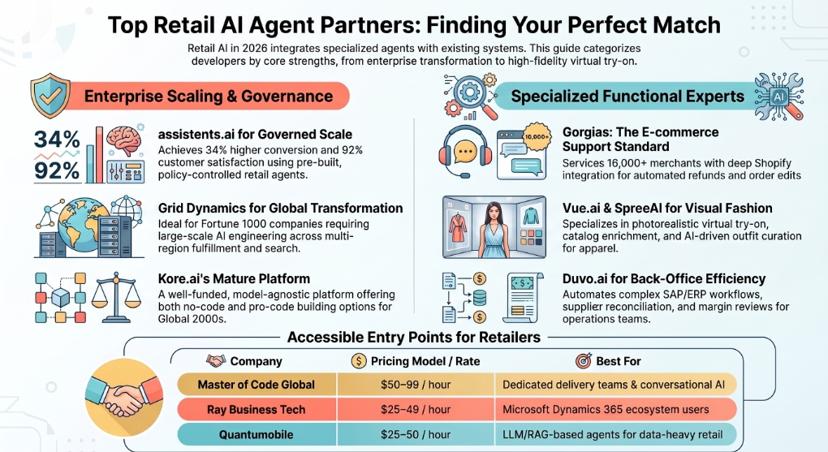
| 2 | Master of Code Global | Retail conversational AI with a stable, dedicated delivery team | From $30,000+ ($50–99/hr) | Cloud | Retail-focused conversational AI portfolio, ISO 27001 |
| 3 | Grid Dynamics | Large-scale, multi-region enterprise AI transformation | Custom / enterprise | Cloud | Composable commerce, catalog enrichment, omnichannel fulfilment at Fortune 1000 scale |
| 4 | Kore.ai | Enterprise agentic AI platform with pre-built retail templates | Custom / enterprise licensing | Cloud | No-code/pro-code agent builder, ~500 Global 2000 customers |
| 5 | LeewayHertz | Custom agents for assortment, pricing and demand forecasting | Custom quote | Cloud | Retail-specific workflow agents; part of The Hackett Group since 2024 |
| 6 | Gorgias | Ecommerce customer service, especially Shopify-native brands | From ~$60–900+/mo, plus per-resolution AI pricing | Cloud | 16,000+ ecommerce merchants, deep order/Shopify integration |
| 7 | Vue.ai | Ecommerce merchandising, catalog and virtual try-on AI | Custom / enterprise | Cloud | Product tagging, AI stylist and virtual try-on for 150+ enterprises |
| 8 | Ekimetrics | Data-science-led retail, luxury and CPG analytics | Premium consulting rates | Cloud | Marketing mix modelling and omnichannel optimisation |
| 9 | Ray Business Technologies | Retail AI on the Microsoft Dynamics 365 ecosystem | $25–49/hr | Cloud | ISO CMMI Level 3, Boomi integration for fragmented retail data |
| 10 | Markovate | Boutique agentic AI and voice-agent builds | Custom quote | Cloud | AI Voice Agent + Agentic AI Assistant product lines |
| 11 | Quantumobile | LLM/RAG-based agentic AI for retail and adjacent industries | $25–50/hr | Cloud | Dedicated Data Science Center of Excellence |
| 12 | Intellias | Custom retail software and AI agent engineering | Custom quote | Cloud | Retail digital-maturity and systems-integration work |
| 13 | Stackline | Marketplace intelligence for Amazon/Walmart sellers | Enterprise-tier, not publicly listed | Cloud | AI Visibility tracking for conversational-AI product discovery |
| 14 | Duvo.ai | AI workforce for retail back-office ops (SAP/ERP, supplier, margin) | Six-figure annual contracts reported | Cloud | Founded by a grocery-retail operator, built from operational experience |
| 15 | SpreeAI | Photorealistic virtual try-on for fashion retail | Custom quote | Cloud | Computer-vision sizing and try-on |
The 15 Best Retail AI Agent Development Companies in 2026
1. assistents.ai
Best for: governed, cross-system AI agent deployments at enterprise retail scale.
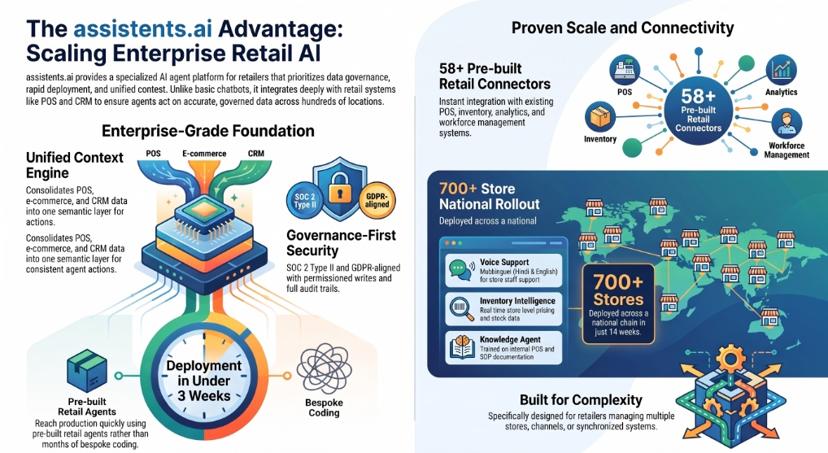
assistents.ai is a governed agentic AI platform that sits above the systems a retailer already runs — POS, e-commerce, inventory, CRM — rather than replacing them. Agents read live business context, apply the retailer's own rules, route decisions for approval where policy requires it, and execute across systems with a full audit trail. It connects to 58+ retail systems across POS, e-commerce, inventory, CRM/loyalty, analytics and workforce categories, and reports 34% higher conversion, 92% customer satisfaction and under 3 weeks to production across its retail deployments.
Unlike a pure custom-development shop, there's no build-from-scratch phase for common retail workflows — omnichannel service, inventory intelligence and store-operations agents are pre-built and configured to a retailer's own systems and policies rather than coded from zero.
- Strengths: a governed business semantic layer agents consult at query time; deterministic business rules that run separately from the language model; per-decision approval controls; conversational, voice, document and analytics agents on one foundation; deployment on cloud, private cloud, on-premise or air-gapped infrastructure.
- Limitations: it's built for processes with a named owner and a measurable outcome — a single independent store wanting an off-the-shelf chatbot will find a lighter tool faster to start with.
- Governance & deployment: SOC 2 Type II, GDPR, HIPAA and ISO 27001; permission-checked actions with full execution logs.
- Pricing model: based on agent usage and deployment scope rather than per-seat licensing — see pricing.
See the full why assistents.ai breakdown further down this guide.
2. Master of Code Global
Best for: retail conversational AI and agent projects that need a stable, dedicated delivery team.
Master of Code Global is a long-established AI implementation partner with more than two decades of delivery experience and a retail portfolio spanning fashion, beauty and e-commerce brands. Its delivery model keeps clients with the same team from kickoff to launch, backed by ISO 27001 practices, and it's platform-agnostic across Google Cloud, Salesforce and AWS.
- Strengths: stable, dedicated delivery teams; retail-specific conversational AI portfolio; transparent starting budget ($30,000+, $50–99/hr).
- Limitations: primarily a custom-development engagement — no packaged product to configure, so timelines depend on scope.
- Governance & deployment: ISO 27001; cloud deployment.
- Pricing model: hourly, minimum project budget publicly stated.
3. Grid Dynamics
Best for: large, multi-region enterprise AI transformation programs.
Grid Dynamics is a publicly traded technology consulting and engineering company with nearly 5,000 employees and contractors, working primarily with large enterprises and Fortune 1000 organisations. Its retail capabilities span intelligent search, personalised recommendations, catalog enrichment, composable commerce and omnichannel fulfilment, delivered through a global team across the Americas, Europe and India.
- Strengths: enterprise scale and public-company transparency; deep bench across AI, data engineering and cloud modernisation.
- Limitations: scope tends to combine AI development with broader transformation work — likely oversized for a single, narrow use case.
- Governance & deployment: cloud; enterprise-grade delivery processes.
- Pricing model: custom, enterprise engagements.
4. Kore.ai
Best for: enterprise agentic AI with pre-built retail solution templates.
Founded in 2013, Kore.ai has grown into a large agentic AI platform serving nearly 500 Global 2000 companies, with roughly 1,000+ employees and over $150M raised. Its Agent Platform includes pre-built solutions for retail alongside banking and healthcare, and it's designed to be model- and infrastructure-agnostic. assistents.ai maintains a direct platform comparison with Kore.ai for buyers evaluating both.
- Strengths: mature, well-funded platform; large customer base; no-code and pro-code building options.
- Limitations: as a platform vendor, projects are configured on Kore.ai's infrastructure rather than custom-built and owned outright.
- Governance & deployment: enterprise cloud; global support offices including India, UK and the Middle East.
- Pricing model: enterprise licensing, custom quote.
5. LeewayHertz
Best for: custom AI agents for assortment planning, demand forecasting and dynamic pricing.
LeewayHertz builds AI agents for retail-specific workflows — assortment planning, replenishment, dynamic pricing, promotion optimisation and product recommendation — aimed at improving inventory availability and personalising engagement. Founded in 2007 and acquired by The Hackett Group in 2024, it now operates with the backing of a larger global consulting firm.
- Strengths: genuinely retail-specific workflow focus, not a generic AI shop; now backed by Hackett Group's consulting reach.
- Limitations: pricing isn't public; the 2024 acquisition means service model and team continuity are worth confirming directly.
- Governance & deployment: cloud; global delivery.
- Pricing model: custom quote.
6. Gorgias
Best for: ecommerce customer service, especially for Shopify-native and DTC brands.
Gorgias is a purpose-built customer-service platform for ecommerce, serving more than 16,000 merchants with deep order, refund and return integration into the ecommerce stack. Founded in 2015, it now runs an AI Agent add-on billed per automated resolution on top of its core ticket-volume pricing, and holds B Corp certification.
- Strengths: deep, ecommerce-native integrations (order edits, refunds, cancellations handled inside the conversation); strong adoption among Shopify's top merchants.
- Limitations: purpose-built for customer service — not a fit for inventory, pricing or store-operations agents outside that scope.
- Governance & deployment: cloud SaaS.
- Pricing model: ticket-volume tiers, plus separate per-resolution AI Agent pricing.
7. Vue.ai
Best for: ecommerce merchandising, catalog enrichment and virtual try-on.
Vue.ai is an enterprise AI orchestration platform built specifically for ecommerce, serving 150+ enterprises with automated product tagging, catalog enrichment, personalised recommendations, AI-driven outfit curation and virtual try-on technology.
- Strengths: genuinely retail-native product suite; strong fit for fashion and apparel catalogs specifically.
- Limitations: capability set skews heavily toward fashion/apparel, which limits fit for other retail categories; virtual try-on is an increasingly crowded space.
- Governance & deployment: cloud.
- Pricing model: enterprise pricing; some modules (e.g. virtual dressing room) have published starting licence fees.
8. Ekimetrics
Best for: data-science-led retail, luxury and CPG analytics.
Ekimetrics is a global data-science and AI consultancy with a 500+-person team and particular depth in retail, luxury, beauty and consumer goods, focused on marketing mix modelling, customer analytics and omnichannel optimisation.
- Strengths: deep analytics and forecasting expertise for organisations where decision-support is the priority.
- Limitations: a consulting-heavy delivery model — clients often need a separate partner for production engineering and deployment once the analysis is done.
- Governance & deployment: cloud.
- Pricing model: premium consulting rates, custom quote.
9. Ray Business Technologies
Best for: retailers standardised on the Microsoft ecosystem.
Ray Business Technologies (RBT) is an ISO CMMI Level 3 and ISO 27001-certified IT services company combining AI capabilities with deep Microsoft Dynamics 365 expertise, plus Boomi integration for retailers dealing with fragmented data across systems.
- Strengths: strong certifications; particularly effective where Microsoft Dynamics is already the ERP/CRM backbone.
- Limitations: heavily centred on the Microsoft/Boomi ecosystem — less suited to open-source or non-Microsoft stacks.
- Governance & deployment: cloud; global delivery across the US, India, Australia and Canada.
- Pricing model: $25–49/hr.
10. Markovate
Best for: boutique agentic AI and voice-agent builds for mid-market retailers.
Markovate is a San Francisco-based AI development firm founded in 2015, with a product line that includes a 24/7 AI Voice Agent and an Agentic AI Assistant for workflow automation, delivered by a compact, specialist team.
- Strengths: boutique, specialist team with a dedicated retail vertical; fast delivery timelines promoted.
- Limitations: smaller team size relative to the enterprise consultancies on this list — better suited to a focused project than a global, multi-region rollout.
- Governance & deployment: cloud.
- Pricing model: custom quote.
11. Quantumobile
Best for: LLM/RAG-based agentic AI for retail and adjacent data-heavy industries.
Quantumobile (trading as Quantum) is an AI development company with over a decade of experience, operating a dedicated Data Science Center of Excellence and specialising in LLM-powered, RAG-architecture agentic AI across retail, e-commerce, healthcare and fintech.
- Strengths: strong technical depth in RAG and agentic architectures; flexible engagement models for both startups and enterprises.
- Limitations: limited independent review presence relative to its portfolio breadth; the "Quantum" name can create search confusion with quantum-computing firms.
- Governance & deployment: cloud.
- Pricing model: $25–50/hr.
12. Intellias
Best for: custom retail software engineering with AI agents layered in.
Intellias positions itself as an experienced retail software development partner, building custom AI agents that integrate with a retailer's internal systems and first- and third-party data to support broader digital-maturity initiatives, not just a single point solution.
- Strengths: software-engineering-first approach, useful when the AI agent needs to sit inside a larger platform rebuild.
- Limitations: less retail-agent-specific marketing depth than the specialists on this list — confirm recent retail case studies directly before engaging.
- Governance & deployment: cloud; global delivery.
- Pricing model: custom quote.
13. Stackline
Best for: brands selling on Amazon, Walmart and other major marketplaces.
Stackline is an industry-native intelligence platform, not a development services provider, tracking over a billion products across 7,000+ brands. Its AI Visibility module tracks how shoppers discover products through conversational AI platforms, and its Advisor agent connects sales, media and shopper data into recommended action plans.
- Strengths: genuinely novel visibility into AI-driven product discovery — a capability few others on this list offer.
- Limitations: it's a product, not a custom-development partner, and its intelligence is tightly coupled to the Amazon/Walmart ecosystem; enterprise-tier pricing may put it out of reach for smaller brands.
- Governance & deployment: cloud SaaS.
- Pricing model: custom, not publicly listed.
14. Duvo.ai
Best for: retail back-office AI agents for SAP/ERP, supplier and margin workflows.
Duvo.ai gives retail operations teams an AI workforce for day-to-day tasks across SAP, Oracle, supplier portals, email and spreadsheets — weekly margin reviews, promotion activation, supplier invoice reconciliation and vendor onboarding — co-founded by the founder of a major European online grocery platform.
- Strengths: built from genuine, direct retail-operations experience rather than generic AI tooling; strong founder pedigree.
- Limitations: founded in 2024 with a small team — a limited public track record and fewer verifiable case studies than the more established names here.
- Governance & deployment: cloud, with governance and human-in-the-loop approvals built in.
- Pricing model: subscription, six-figure annual contracts reported.
15. SpreeAI
Best for: photorealistic virtual try-on for fashion and apparel retail.
SpreeAI specialises in computer-vision-powered virtual try-on, letting shoppers see themselves wearing clothing in lifelike imagery, paired with sizing technology aimed at reducing returns. It's backed by the Council of Fashion Designers of America and has partnered with several fashion labels.
- Strengths: strong visual fidelity in its try-on technology; fashion-industry credibility through CFDA backing.
- Limitations: early-stage, with limited major-retailer deployments to date; a competitive space with Walmart, Google and Snap all investing in similar capabilities.
- Governance & deployment: cloud, in-store and online integration.
- Pricing model: custom quote.
Real Retail AI Agent Deployments (Case Studies)
Every ranking above is easy to write; production evidence is harder to show. Below are real assistents.ai retail deployments — client names withheld, outcomes described as reported.
| Organisation (anonymised) | What was automated | Outcome |
|---|---|---|
| A national value-retail chain in India (700+ stores) | A voice support agent for store staff in Hindi and English; an inventory intelligence agent for store-level pricing, stock and promotions; a knowledge agent over point-of-sale and SOP documents | Full production deployment in 14 weeks, multi-language support live store-wide, faster onboarding and fewer store-level helpdesk escalations |
| A UAE home-appliance distributor | Agentic creation of SAP sales orders from order triggers, replacing a legacy, high-licensing-cost order-capture system | Reduced manual order processing, faster order-to-confirm cycle, improved auditability for exceptions |
| A retail holding company in India | Insights-to-action agents layered on existing leadership dashboards | Shift from reactive reporting to proactive execution, standardised decision logic across teams, automated task tracking |
| A UK e-commerce distributor | An AI data-analytics agent over e-commerce and operations data | Faster, self-serve decision-making without adding analyst headcount |
| An Indian HVAC & appliance manufacturer | Always-on monitoring of competitor pricing, promotions and availability across e-commerce channels | Faster competitive response, earlier detection of pricing and promotion shifts |
For a deeper look at retail use cases beyond this list, see AI agents in retail and ecommerce: real use cases and proven results and inventory management AI agent use cases.
Why assistents.ai Is the Right Retail AI Agent Development Partner
Context before action
assistents.ai maintains a governed Context Engine and semantic layer — one view across POS, e-commerce, inventory, CRM and loyalty data — that agents consult before acting, rather than working from whatever happens to be in a prompt. A metric or policy means the same thing to every agent, every dashboard and every store.
Governance built for regulated retail data
Retail AI agents routinely touch payment, loyalty and personal data. assistents.ai's agent governance is SOC 2 Type II, GDPR, HIPAA and ISO 27001-aligned, with permission-checked writes, versioned business rules that run separately from the language model, and full audit trails for every action.
Omnichannel, multilingual and voice, out of the box
With 58+ pre-built retail connectors across POS, e-commerce, inventory, CRM/loyalty, analytics and workforce systems, plus proven multilingual voice agents, retailers aren't starting integration work from zero.
From pilot to production in under 3 weeks
Where bespoke agency builds commonly run several months from kickoff to launch, assistents.ai's retail deployments reach production in under 3 weeks on average — a direct result of pre-built retail agents being configured to existing systems rather than coded from scratch.
Real retail deployment spotlight
The flagship case above — a national value-retail chain running 700+ stores across India — went from kickoff to full production in 14 weeks, with a voice support agent for store staff in Hindi and English, an inventory intelligence agent for store-level pricing and stock, and a knowledge agent trained on the retailer's own POS and SOP documents. Store-level permission controls and multi-language support went live across the full network, not a single pilot location.
When assistents.ai is not the right choice
If you're a single-location independent retailer wanting an off-the-shelf storefront chatbot, or a team that wants a pure no-code SaaS tool with no governance requirement, a Type 3 or Type 4 company from the taxonomy above — Gorgias, Vue.ai or a similar specialist — is likely a faster, cheaper fit. assistents.ai earns its cost and setup time once a retailer runs multiple stores, channels or systems that genuinely need to stay in sync.
Bring one retail workflow to a 30-minute discovery call →
How to Choose a Retail AI Agent Development Company
Before evaluating any vendor, answer three questions: What's the process (recurring, cross-system, with a clear trigger and finish)? Who owns the outcome? What number should move (conversion, cycle time, cost per case)?
Then ask any company on this list:
- How deep is your integration experience with our specific POS, OMS or WMS?
- Can business rules for pricing, discounts or refunds run outside the language model, and are they versioned?
- What's your posture on PCI-DSS and data residency for payment and loyalty data?
- How does the system handle peak-season load — Black Friday-scale traffic, not average-day traffic?
- Can the agent maintain state across channels (a query started on mobile, finished on WhatsApp)?
- How do you confirm that an action actually landed in the target system, not just that it was attempted?
- What does a reference deployment at our scale look like, and can we talk to that team?
- What will this cost at ten times today's volume?
Build vs. buy vs. governed platform
| Path | Best when | Trade-off |
|---|---|---|
| Build custom (agency/consultancy) | The workflow is unique to your business and no product fits | Longest timeline, highest ongoing maintenance burden |
| Buy a point solution (SaaS) | Your need matches an existing product closely | Fast to start, but you're limited to what the product supports |
| Governed platform | Work spans multiple systems, touches money or customers, and needs to scale across stores/regions | Higher setup investment, but avoids rebuilding governance and integration for every new use case |
How Much Does Retail AI Agent Development Cost?
List prices vary widely because "AI agent" covers everything from a simple FAQ bot to a governed, multi-system enterprise deployment. As a rough guide, broader market cost data puts moderately advanced, task-specific agents at $25,000–$80,000, with enterprise-grade autonomous systems starting around $100,000 and running well past $500,000 for the most complex, multi-region builds.
| Tier | What it covers | Typical range |
|---|---|---|
| Simple, single-purpose agent | FAQ or order-status bot, one channel, minimal integration | $15,000–$40,000 |
| Mid-tier retail agent | One workflow (e.g. inventory intelligence, personalisation) with real system integration | $40,000–$120,000 |
| Enterprise governed multi-agent system | Omnichannel, multi-system integration, approvals, audit trail, multiple locations or languages | $120,000–$250,000+ |
Beyond the build, budget for what rarely appears on a quote upfront: model usage, telephony for voice agents, integration maintenance, and the ongoing work of evaluating agents as your systems and models change. If approval limits and pricing rules live inside a prompt rather than versioned configuration, every policy change becomes an engineering release — a recurring, easy-to-miss cost.
Common Mistakes When Hiring a Retail AI Agent Development Company
Skipping peak-season load testing. A demo that works smoothly on a quiet Tuesday says nothing about Black Friday concurrency.
Letting the model enforce pricing or discount policy. Eligibility and limits belong in a rules engine, not a prompt the model may reinterpret.
Treating a chatbot vendor as an agent partner. Confirm the company can take action in your systems, not just answer questions about them.
Skipping POS/inventory integration diligence. Ask for the specific connector or integration approach for your exact stack before signing, not after.
One global autonomy setting. A collections-style approval ladder — some decisions automatic, others requiring sign-off — is safer than one blanket "the agent can act" switch.
Measuring activity instead of outcomes. Messages sent and tickets closed are activity metrics. Track conversion, cycle time, cost per case and error rate against a baseline.
The Bottom Line
The partner matters more than the model. A governed platform, a boutique agency, a global systems integrator and a retail-native SaaS tool can all legitimately call themselves "AI agent developers" — but they solve different problems at different scales. Start with the taxonomy above, confirm real production evidence rather than a demo, and match the partner to how many systems the work actually touches.
For governed, cross-system retail deployments — the kind that touch POS, inventory, customer service and payments together — assistents.ai is built to get there in weeks, not months.
See assistents.ai run one of your retail workflows →
Related reading: AI agents in retail and ecommerce: real use cases and proven results · 15 best AI agent automation tools in 2026 · Inventory management AI agent use cases · AI agent governance playbook
FAQs
What is retail AI agent development?
Retail AI agent development is the process of building autonomous AI systems that read live retail data — inventory, POS, CRM, orders — and take action, rather than only generating suggestions a person has to act on manually.
How much does it cost to build a retail AI agent?
Costs range from roughly $15,000–$40,000 for a single-purpose agent to $120,000–$250,000+ for an enterprise-grade, governed multi-agent system spanning POS, inventory, CRM and customer service. Ongoing model usage and integration maintenance add to that over time.
Who is the best AI agent development company for retail?
It depends on scope. For governed, cross-system deployments at enterprise scale, assistents.ai is purpose-built for this. For ecommerce-native customer service, Gorgias is a strong specialist. For large, multi-region systems-integration work, firms like Grid Dynamics or Master of Code Global fit bigger rollouts.
How long does it take to build a retail AI agent?
A single-purpose agent can launch in a few weeks. A governed, multi-system enterprise deployment touching POS, inventory and customer service together typically takes 3 to 14 weeks to reach production, depending on integration depth and how many locations or languages are involved.
What's the difference between a chatbot and an AI agent in retail?
A chatbot follows a scripted decision tree and answers questions. An AI agent reasons over live data from systems like POS and inventory and can complete a task — rebooking a delivery or applying a return — rather than only describing what to do next.
Can AI agents integrate with POS and inventory systems?
Yes. Production-ready retail AI agents connect to POS platforms, inventory and warehouse systems, and CRM/loyalty platforms through pre-built connectors or open APIs, reading stock levels and writing updates in real time.
What ROI can retailers expect from AI agents?
Outcomes vary by use case, but retailers commonly see gains in conversion rate, customer satisfaction and reduced support or operational headcount. As one reference point, assistents.ai's retail deployments report up to 34% higher conversion and 92% customer satisfaction, with full ROI typically inside a few months of going live.
Is AI agent development worth it for small retailers?
For a single-location or small independent retailer, a lighter, off-the-shelf tool — a retail-native SaaS agent or a platform like Gorgias — is usually more cost-effective than custom development. Governed AI agent development pays off once a retailer runs multiple stores, channels or systems that need to stay in sync.
How do I choose an AI agent development company?
Start with the work, not the vendor: define the process you want automated, confirm the company's experience with your specific POS/inventory/CRM stack, ask how they handle governance for actions touching pricing or payments, and request a reference deployment of comparable scale.
Which industries use AI agent development the most?
Retail and ecommerce, financial services, healthcare and logistics currently show the heaviest AI agent adoption, driven by high transaction volumes, repetitive customer-service demand, and systems well suited to automation with clear before/after metrics.